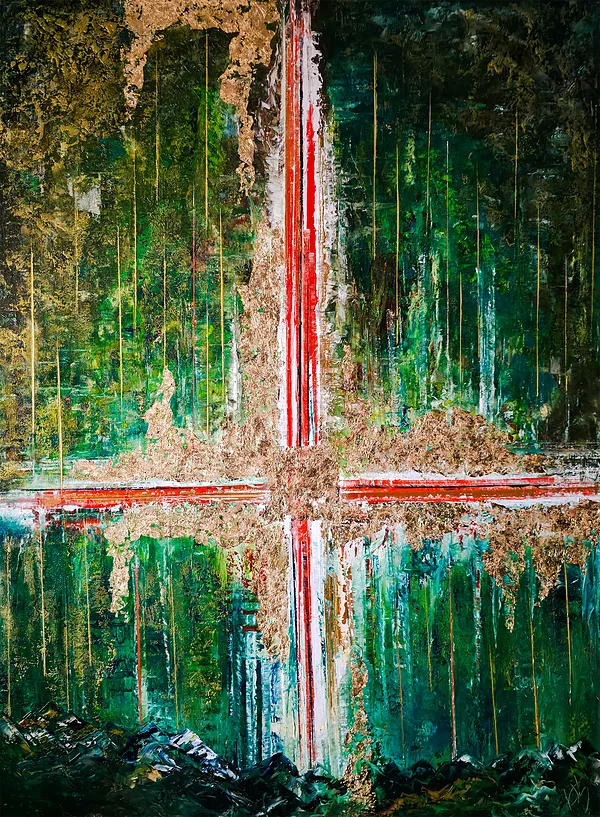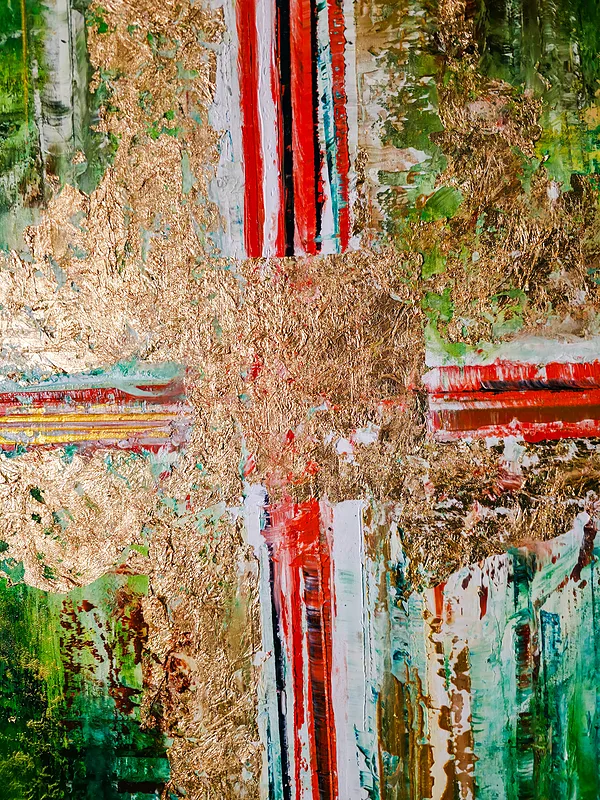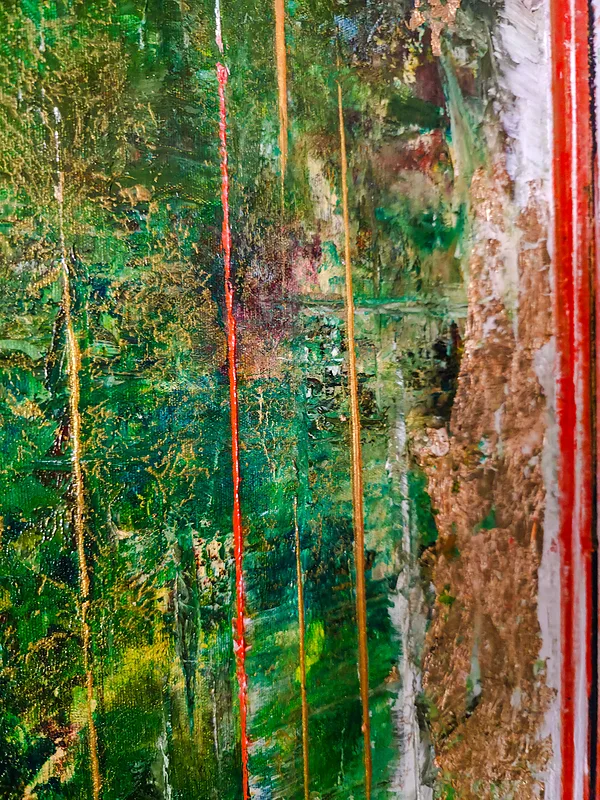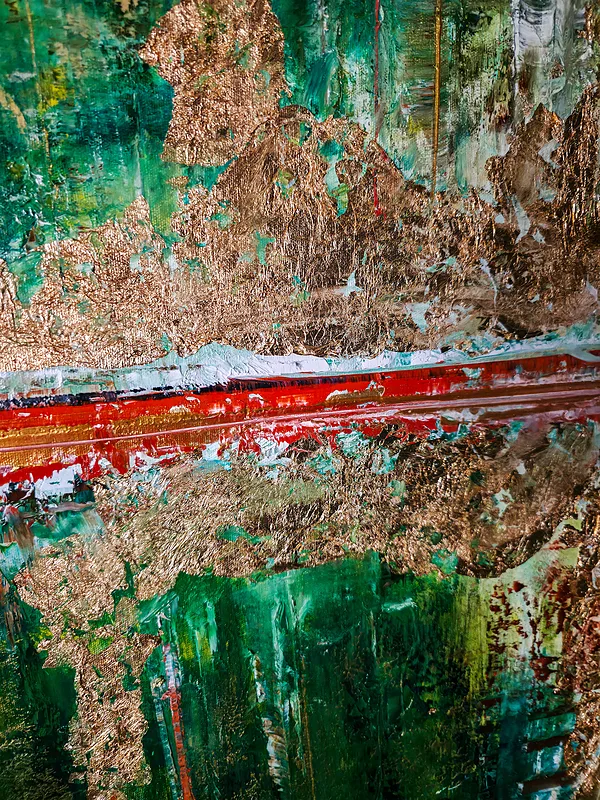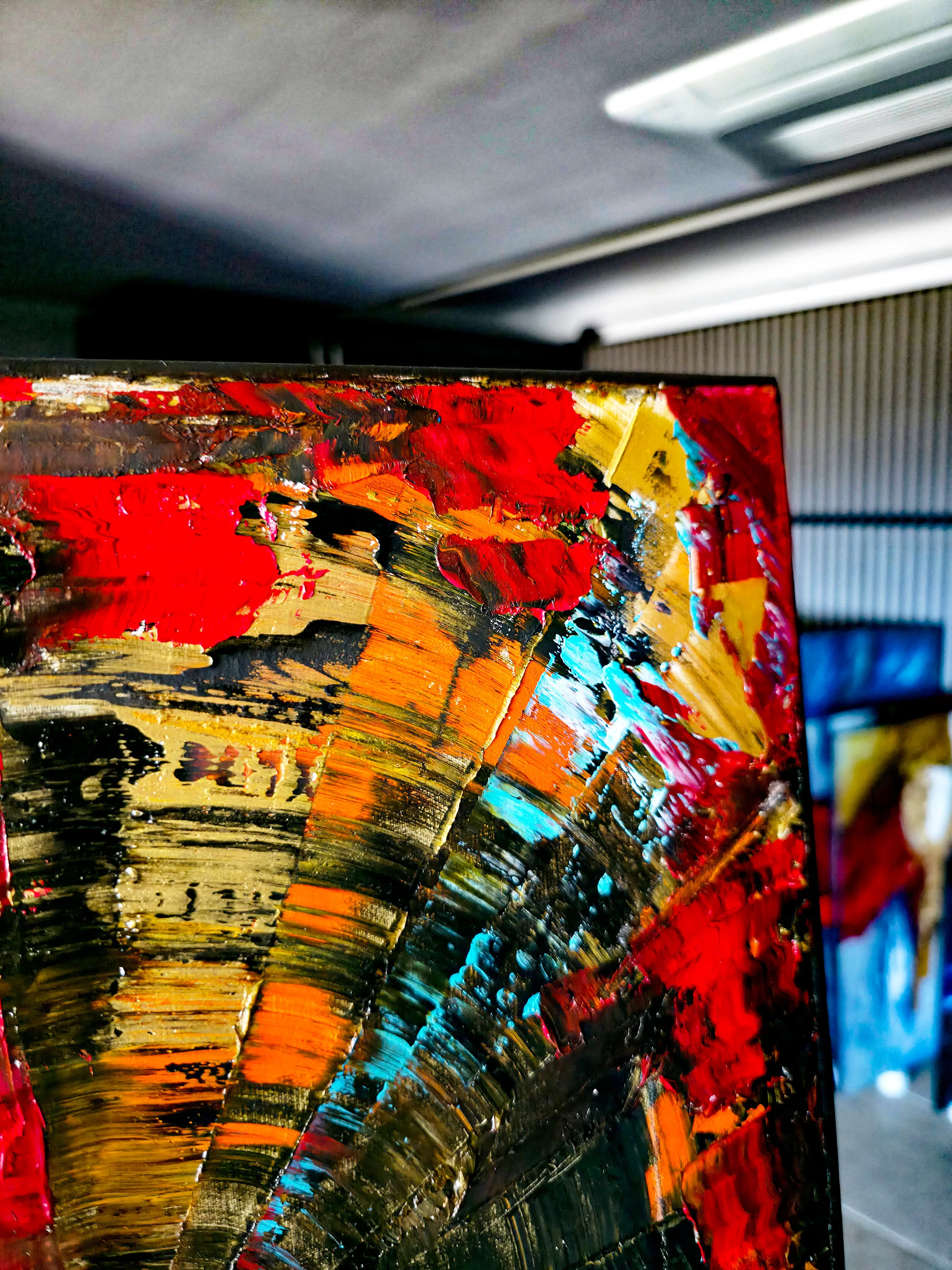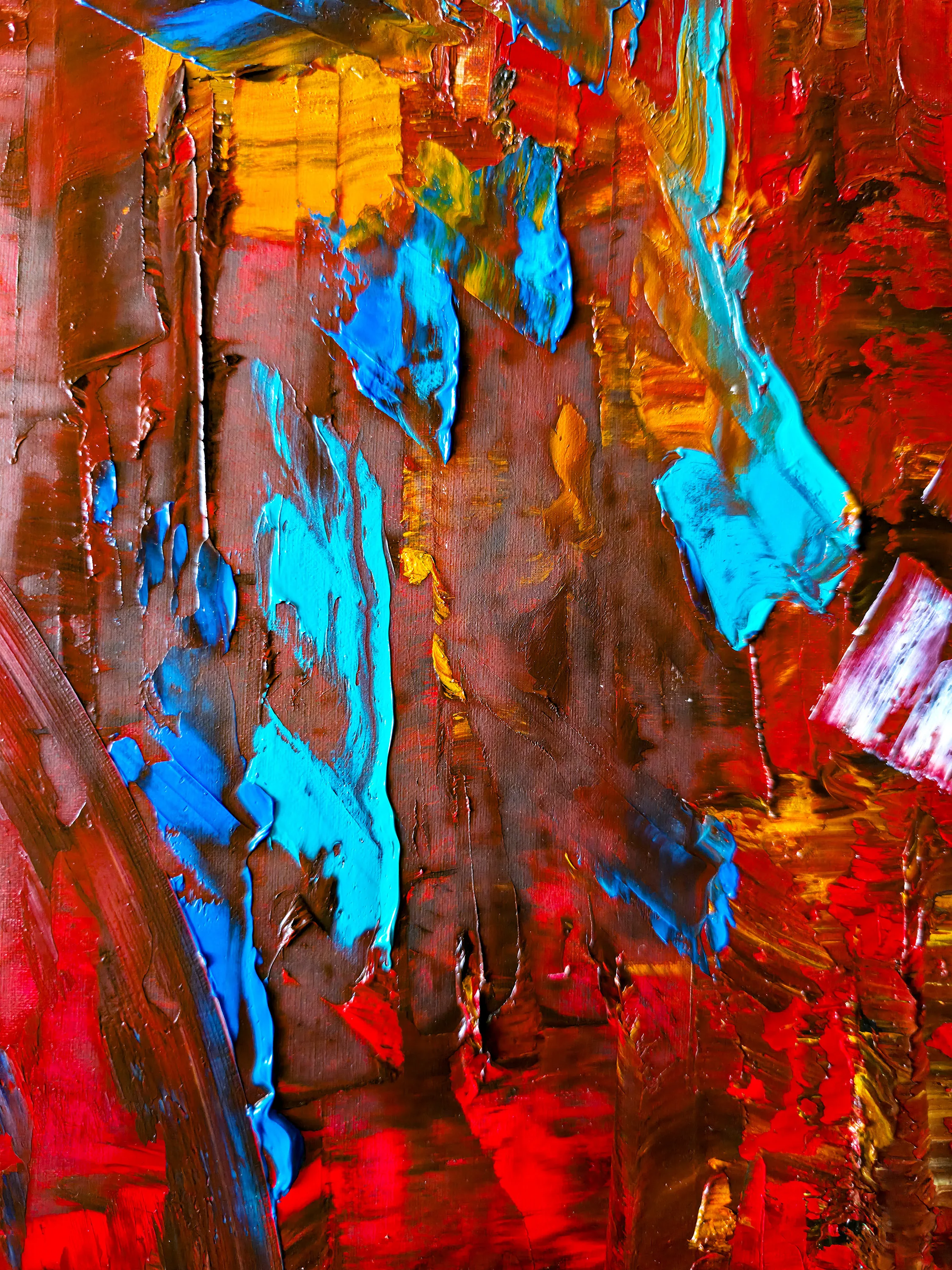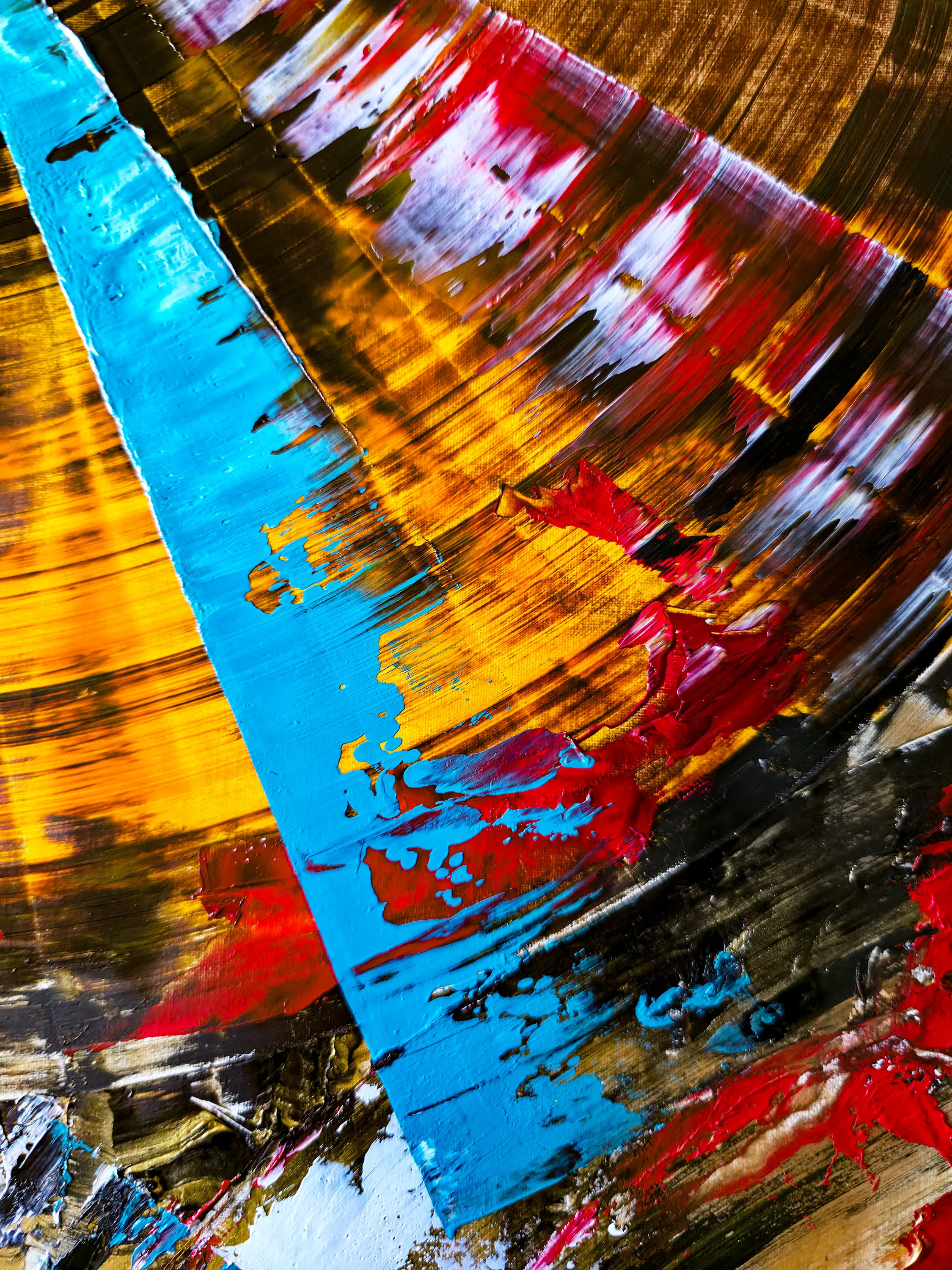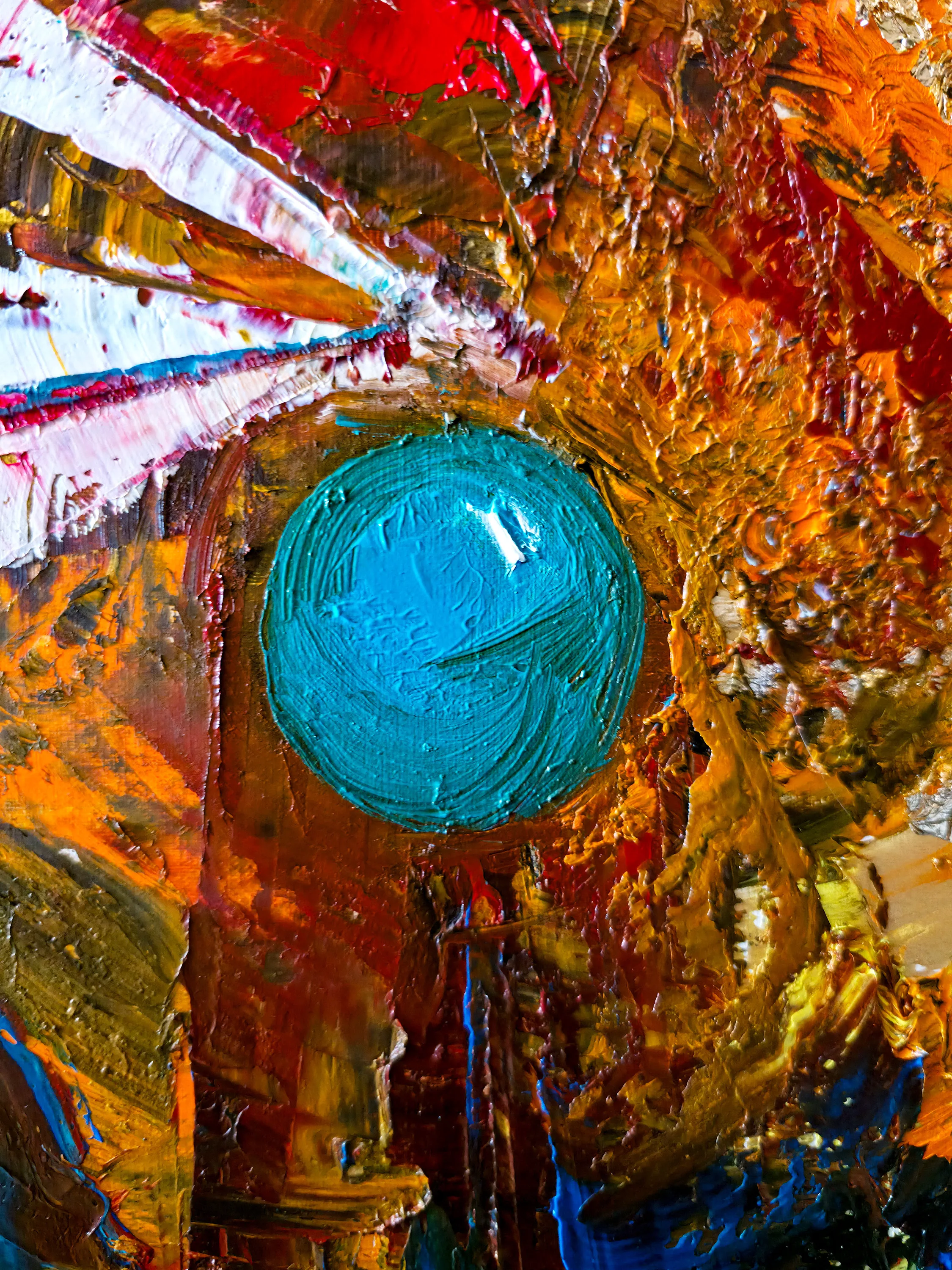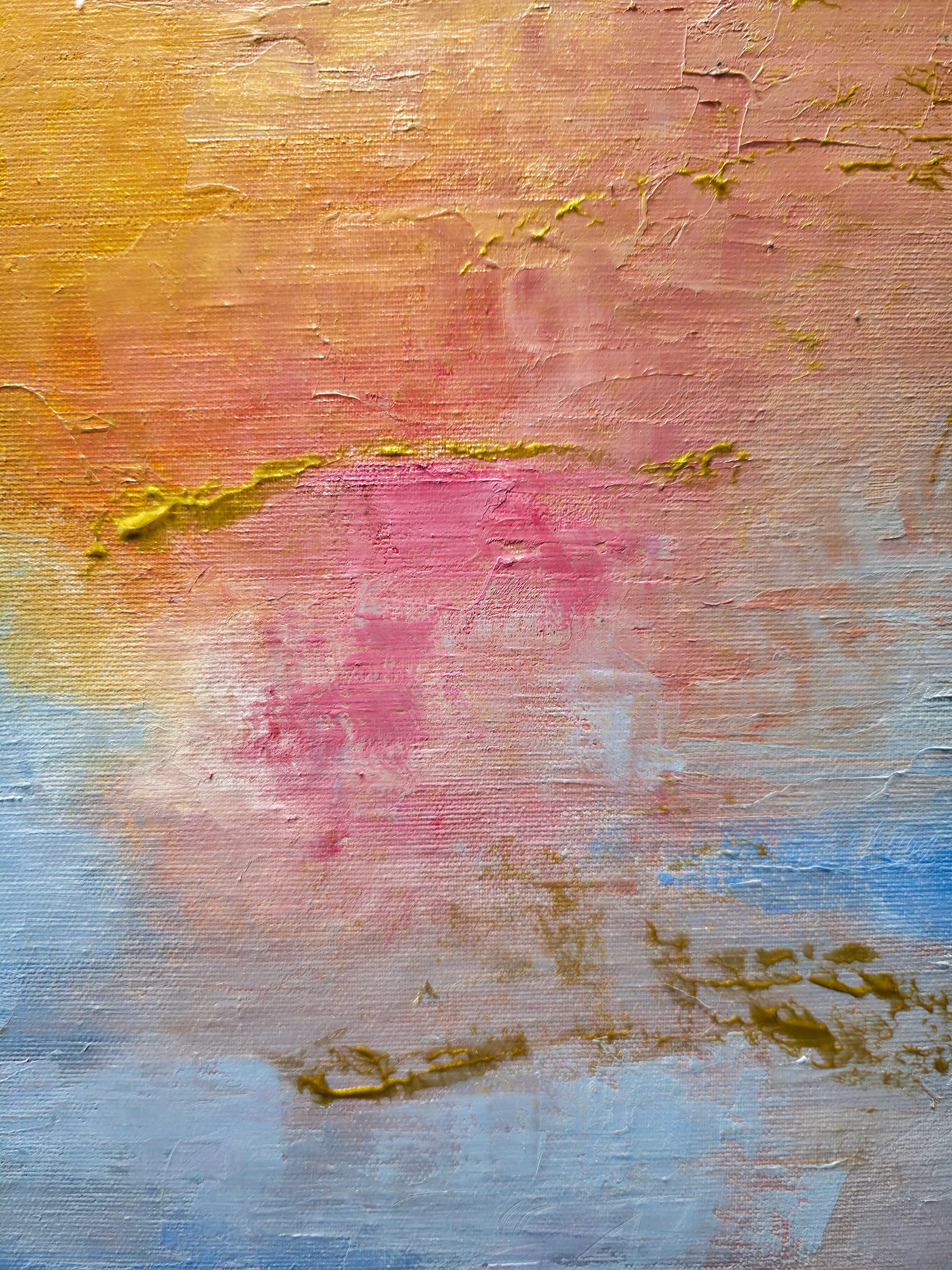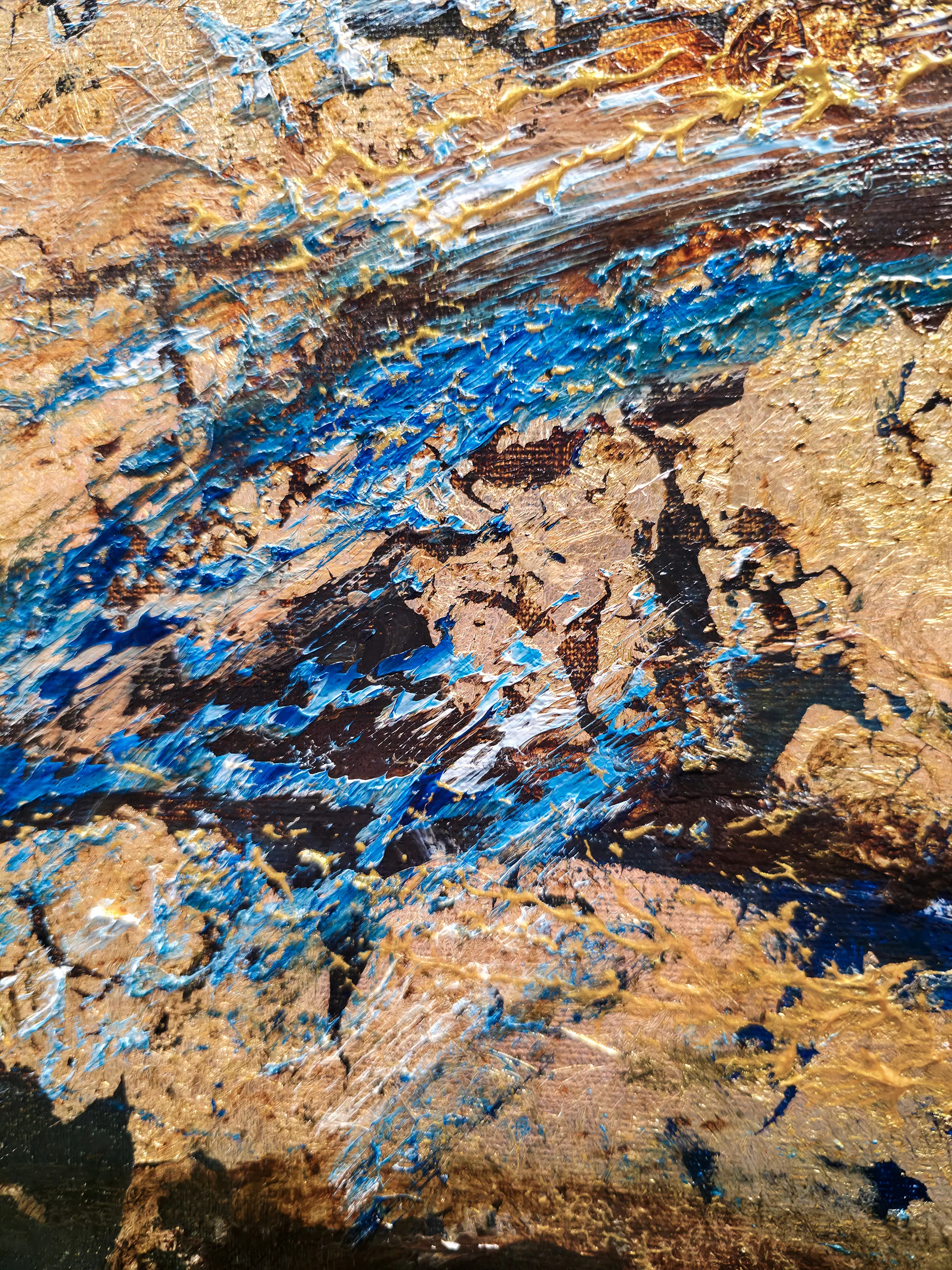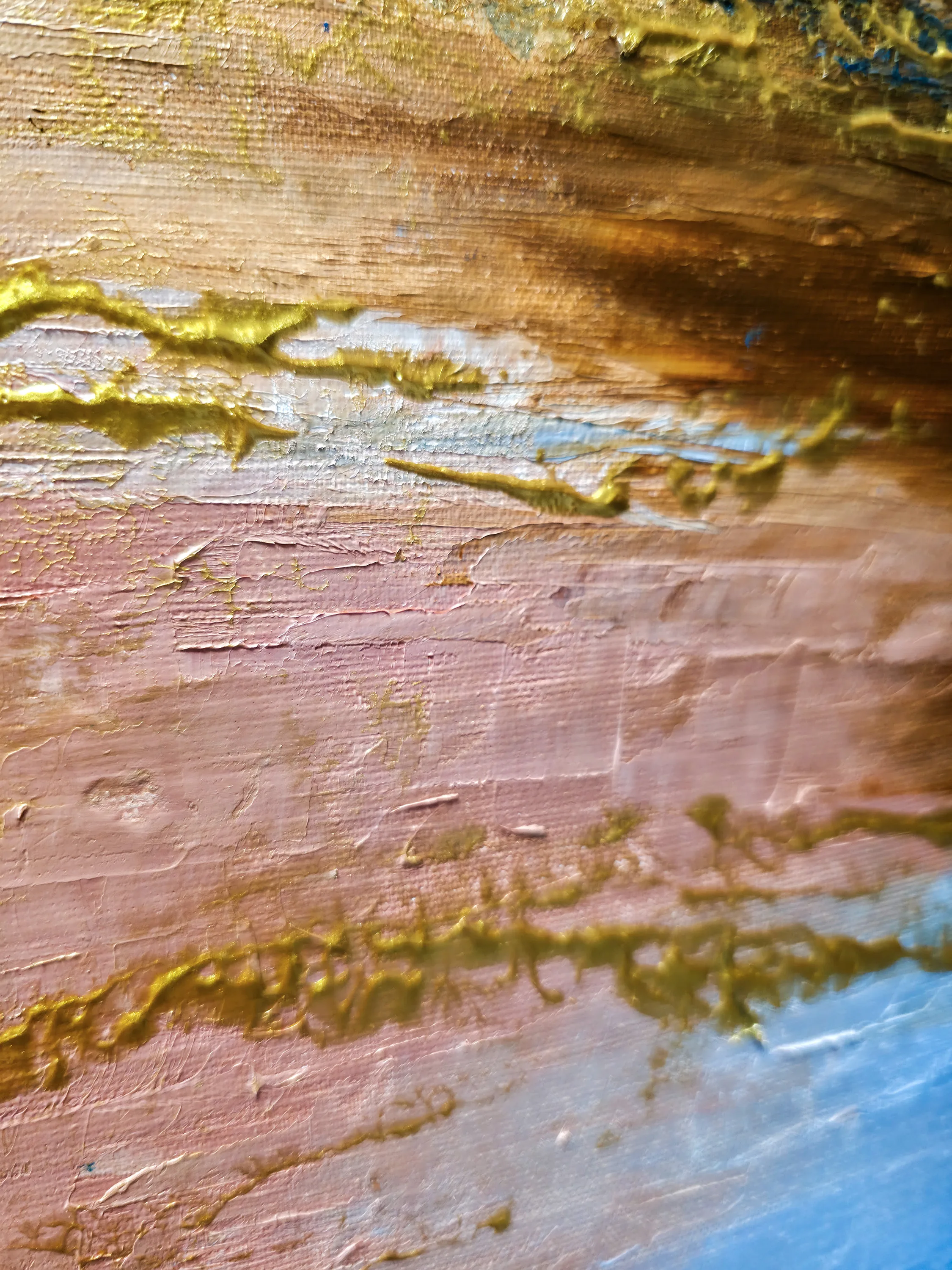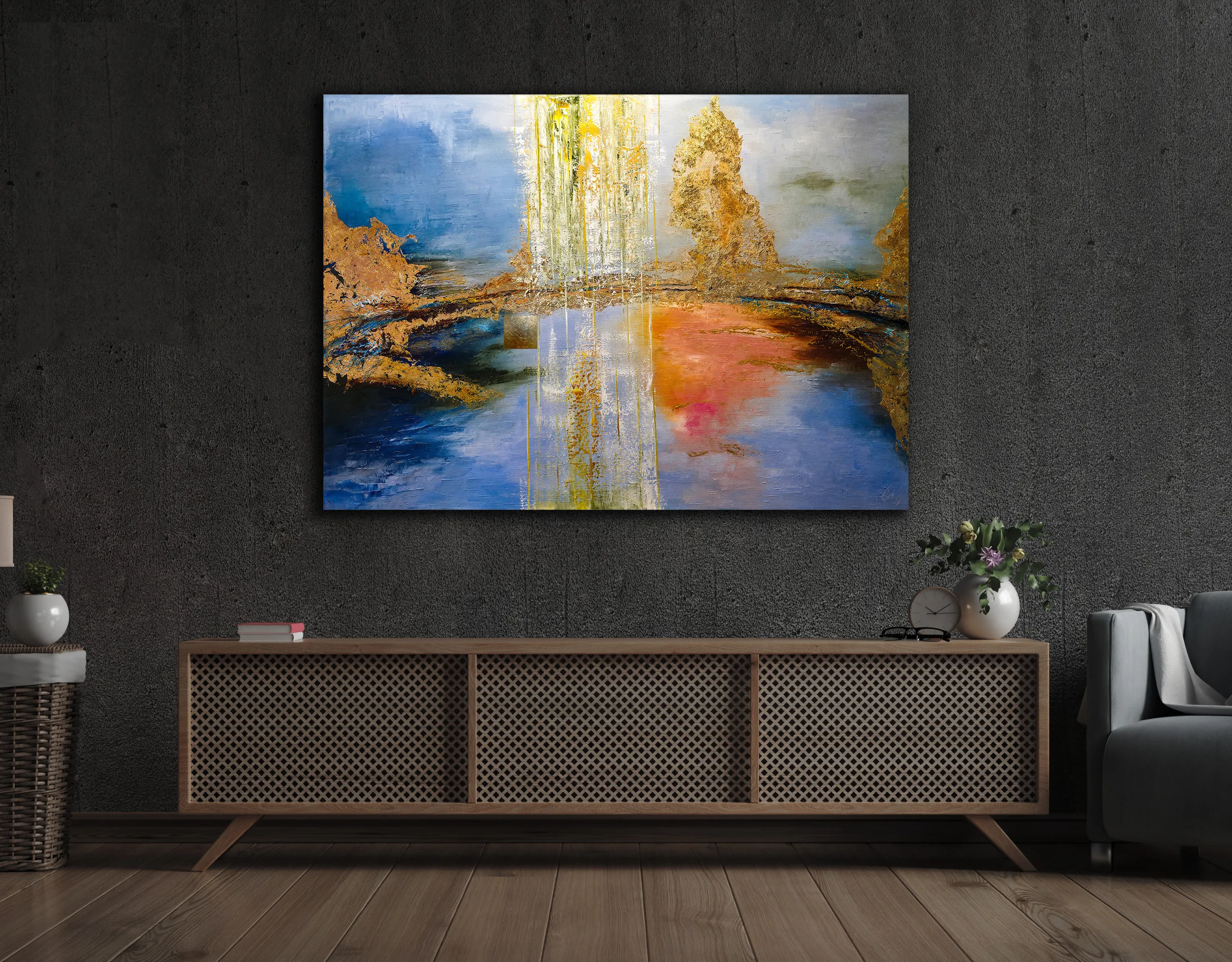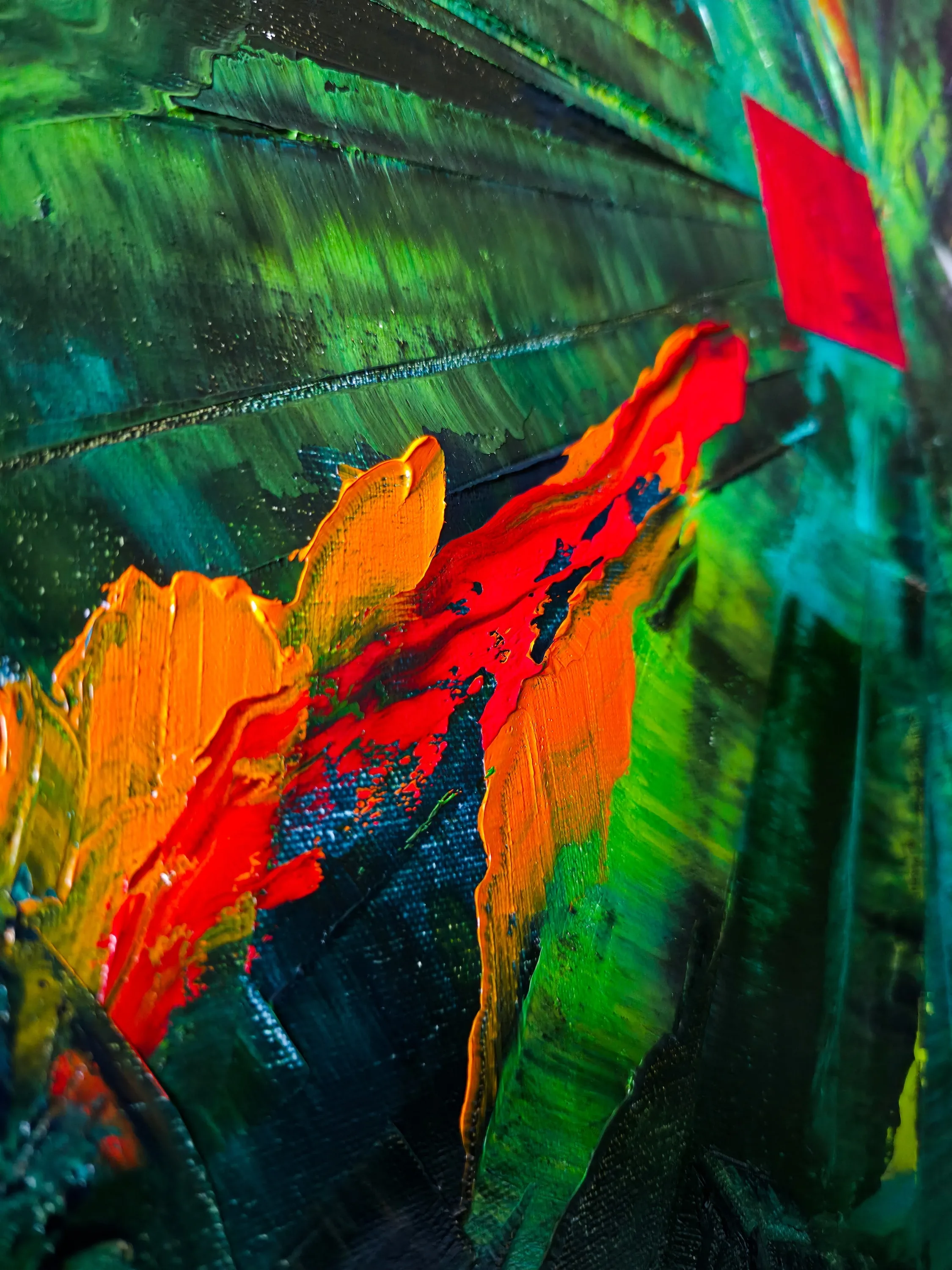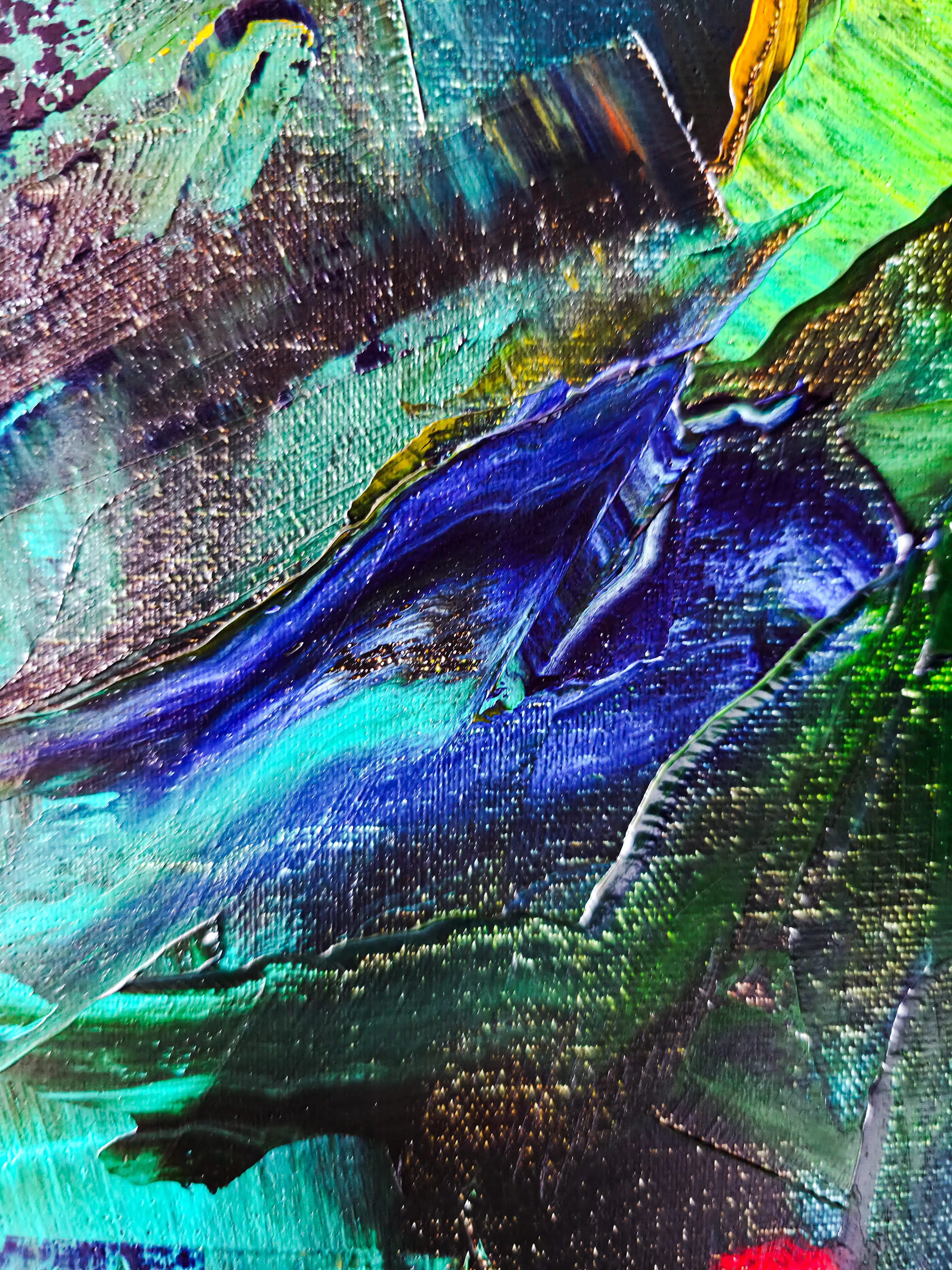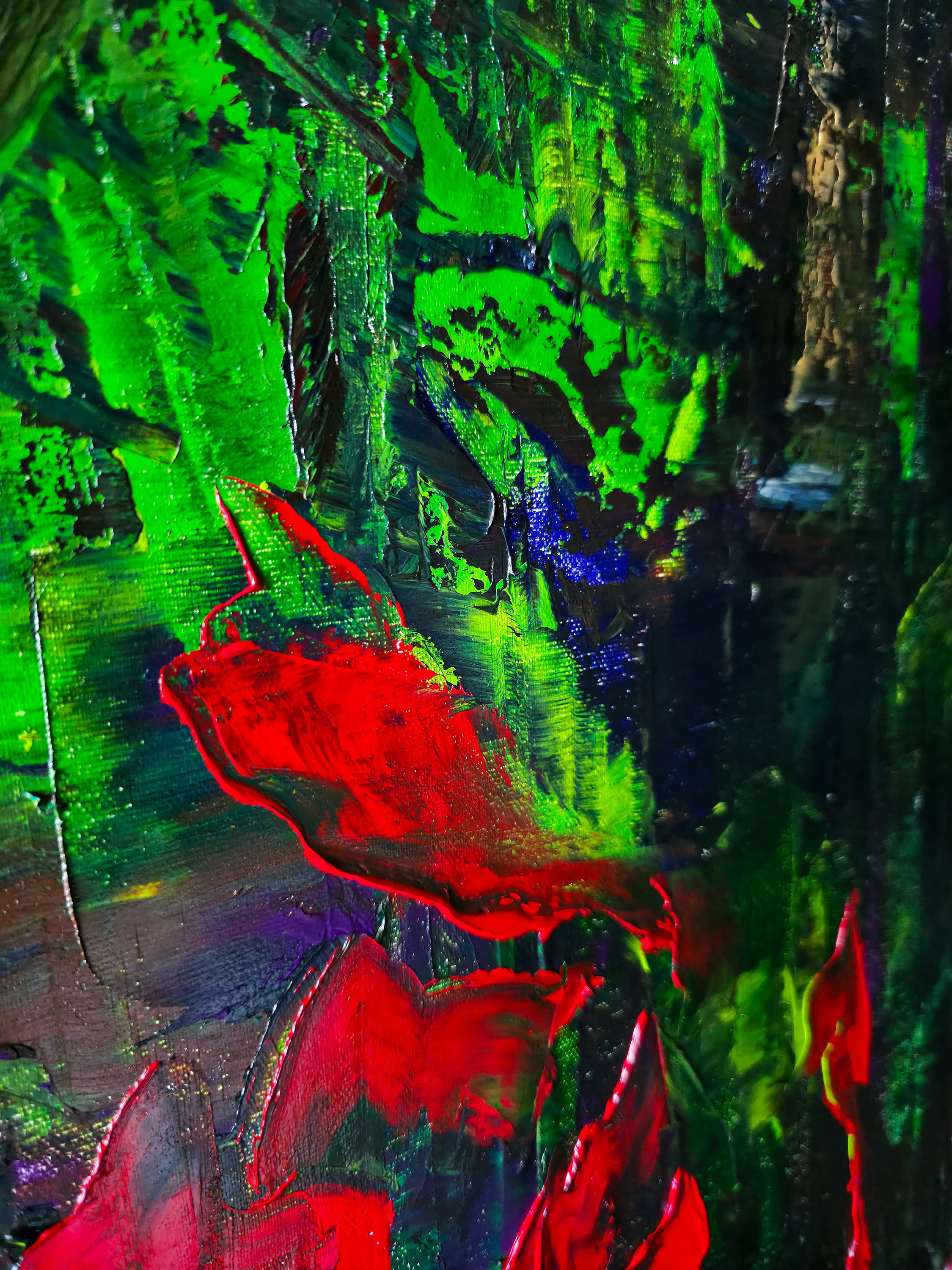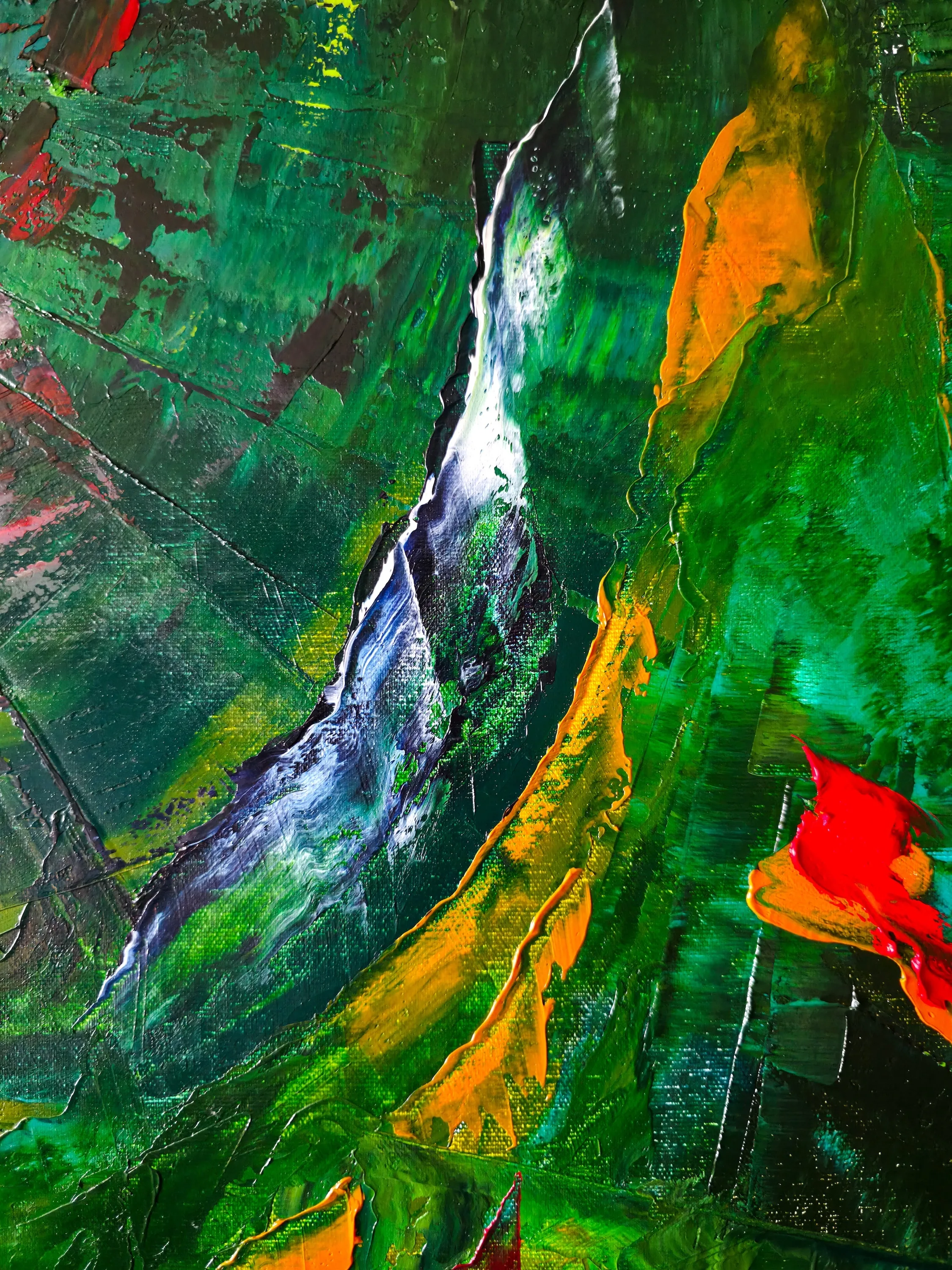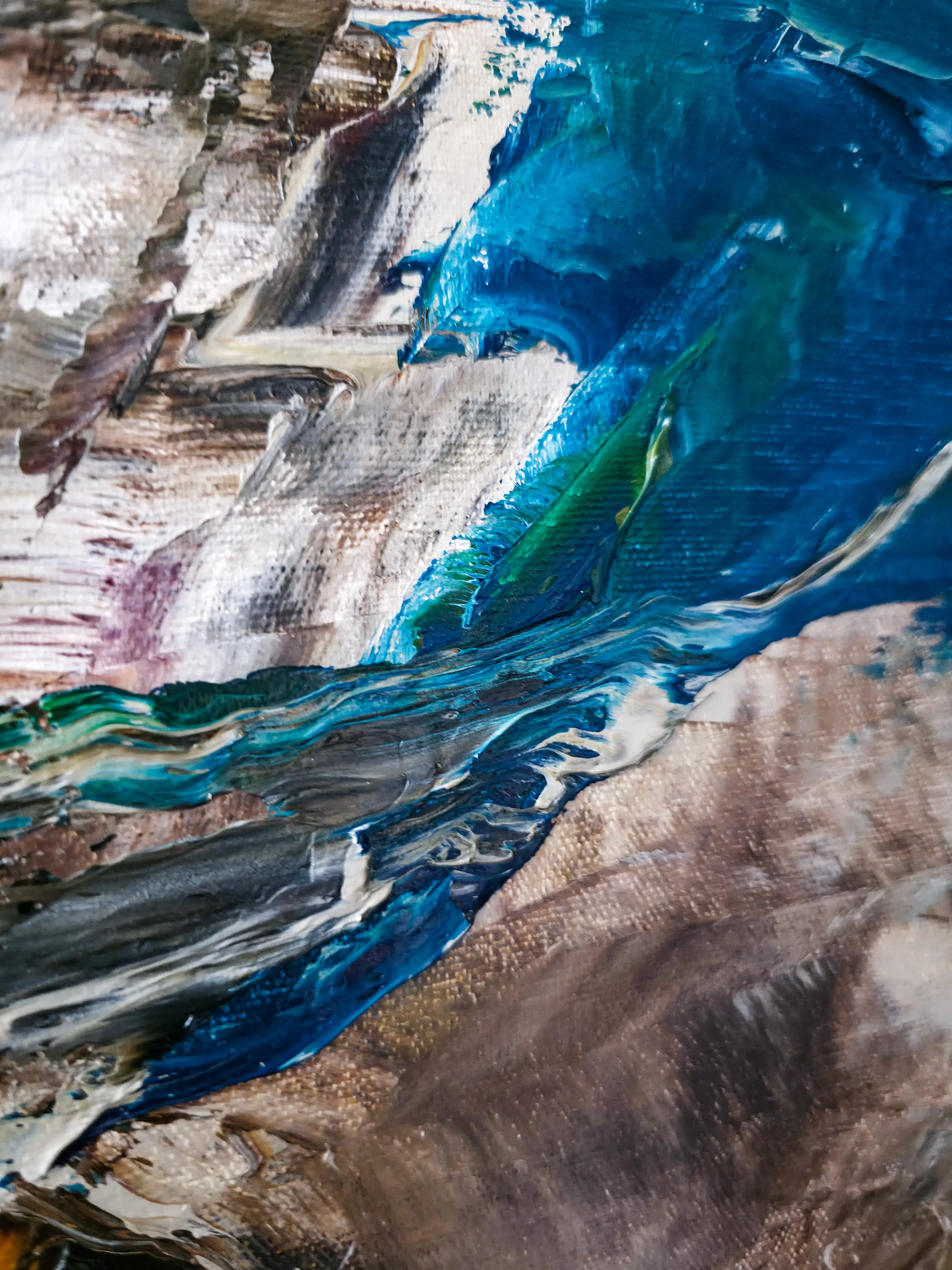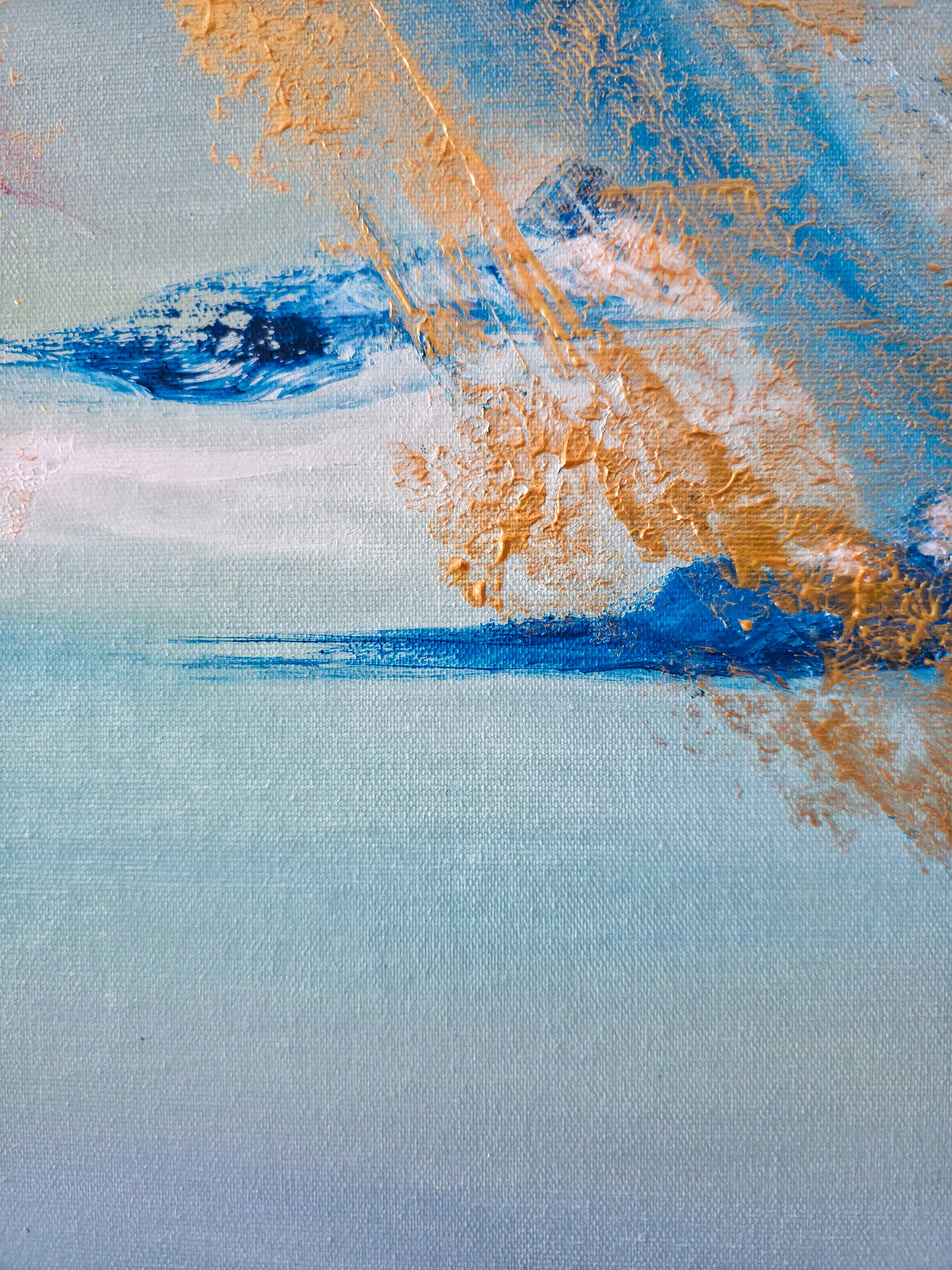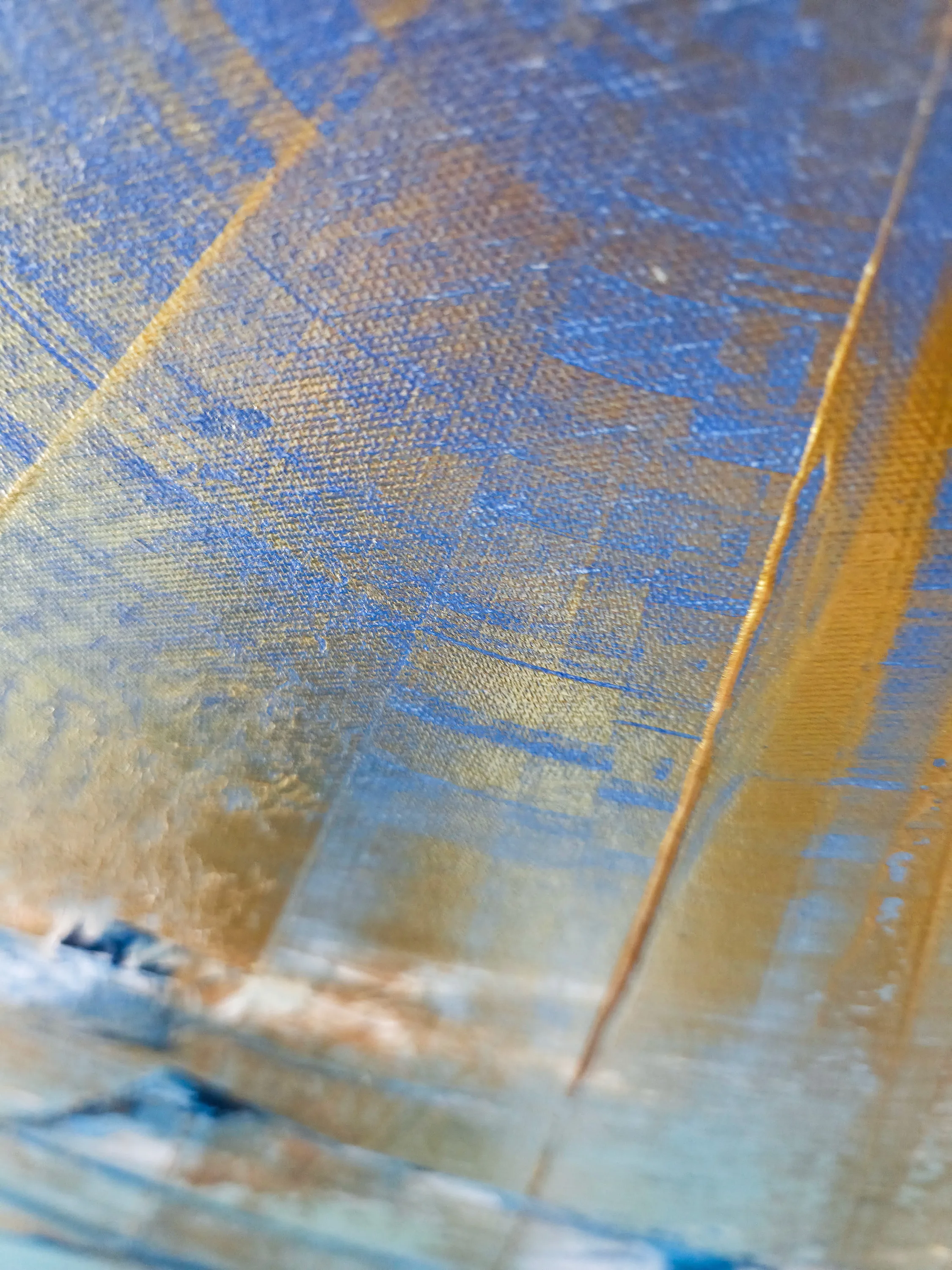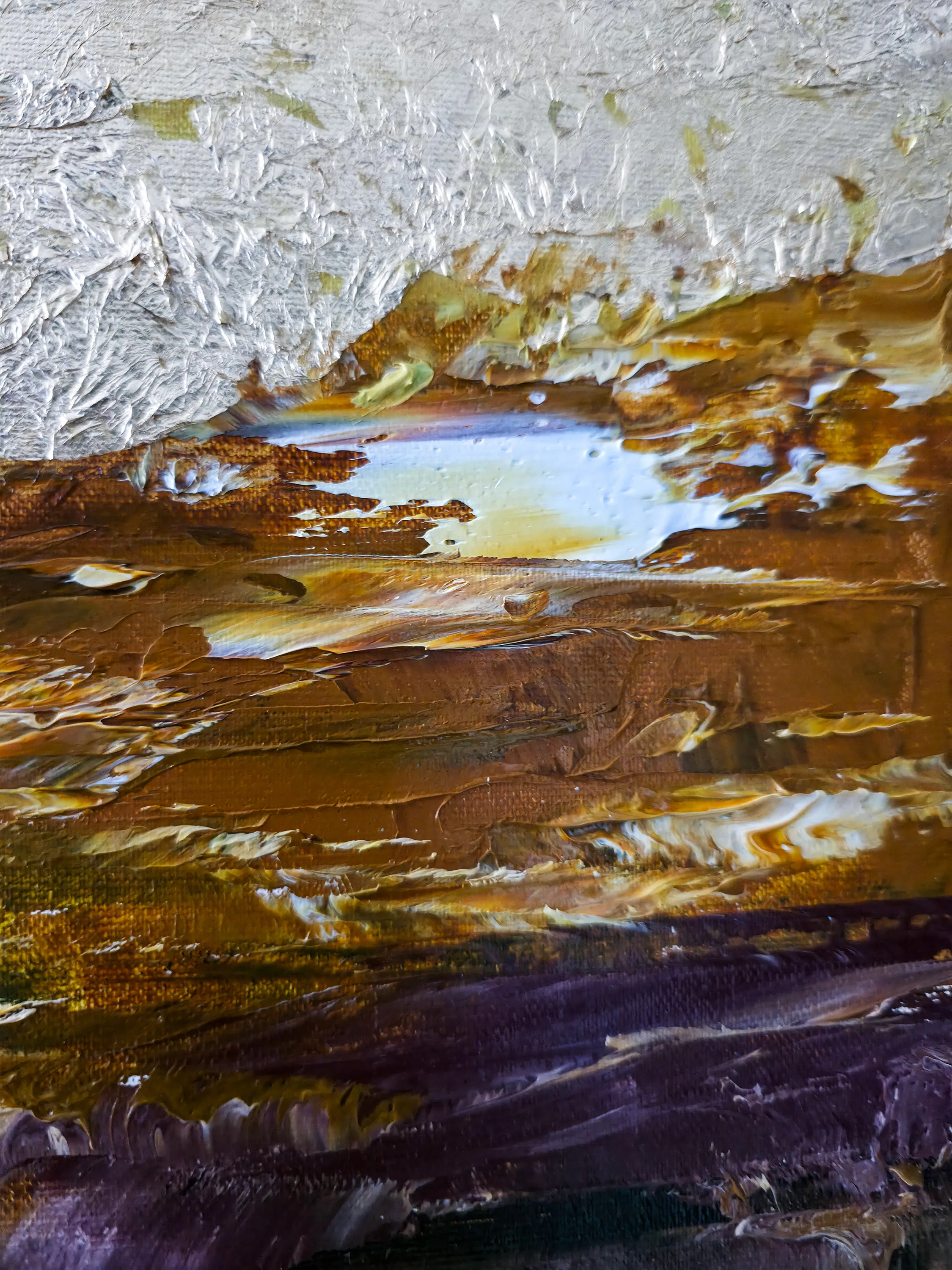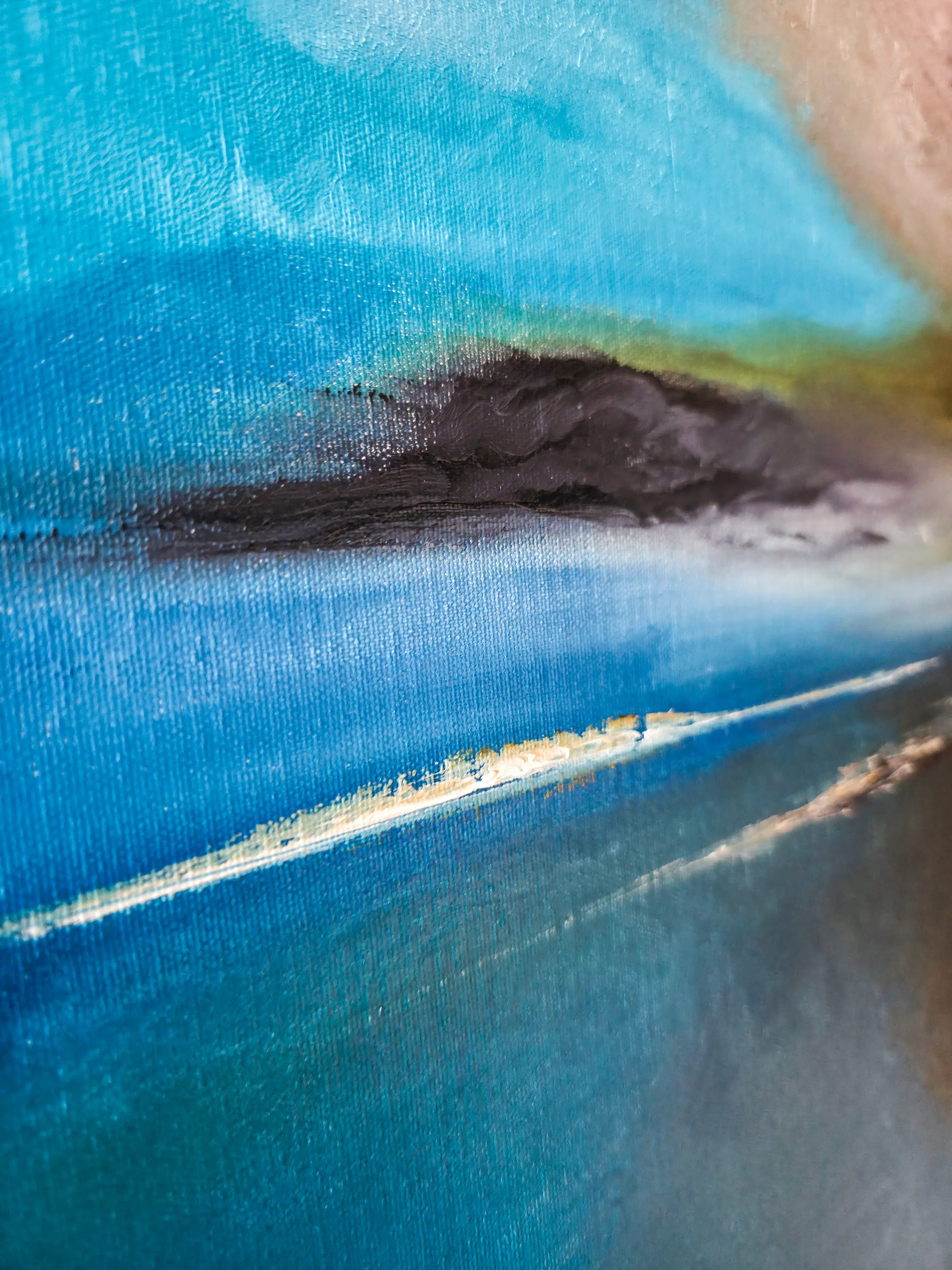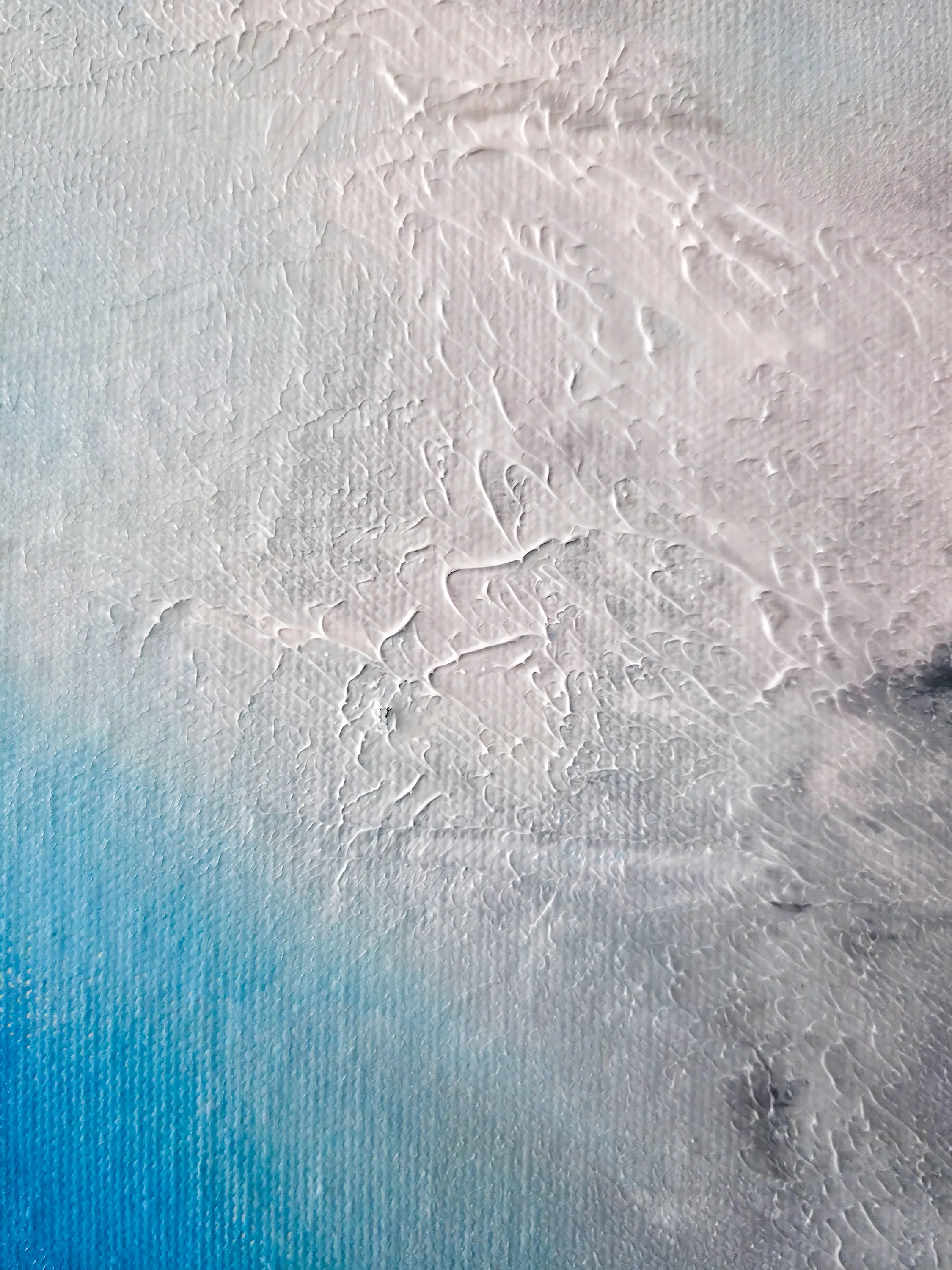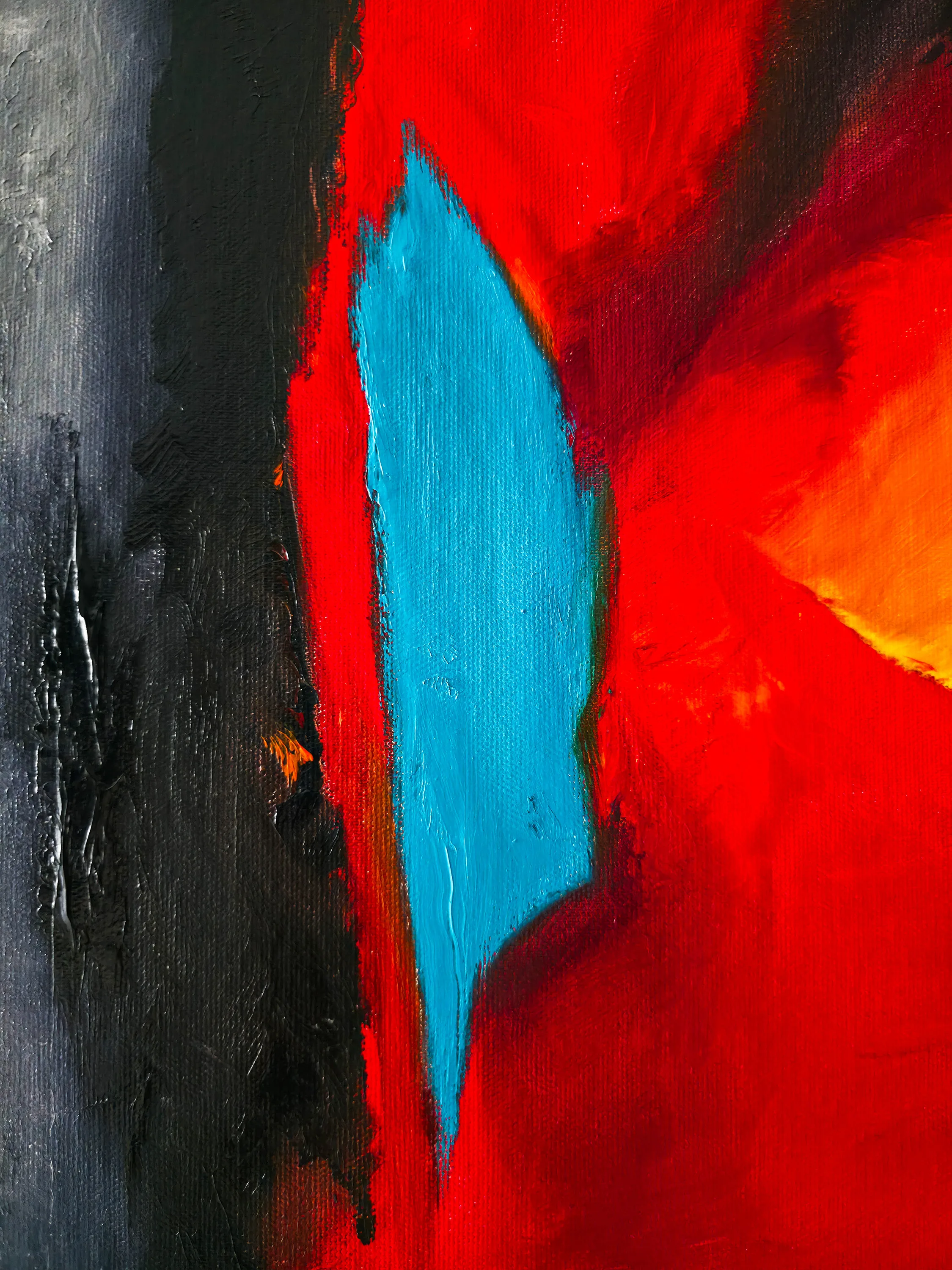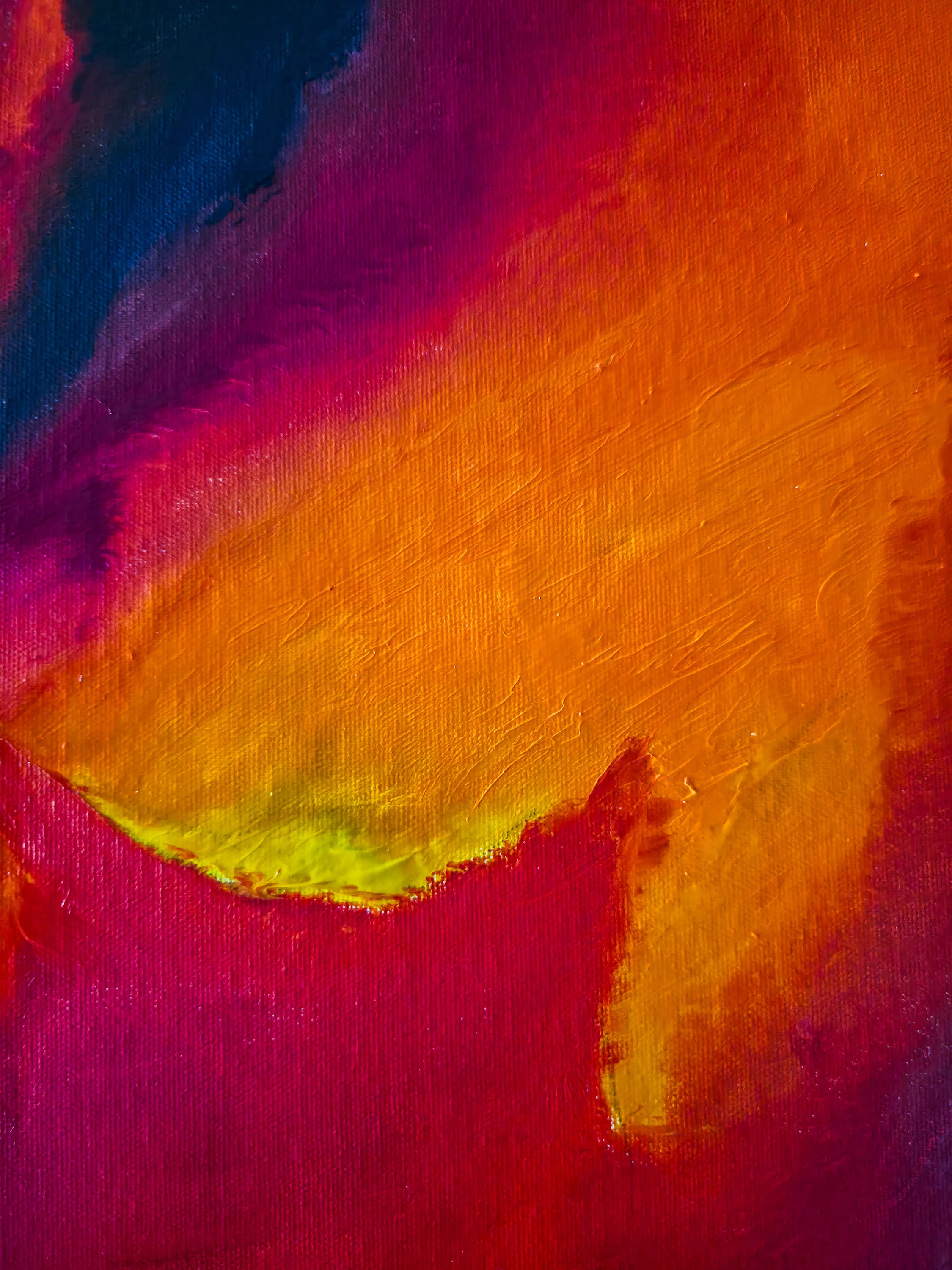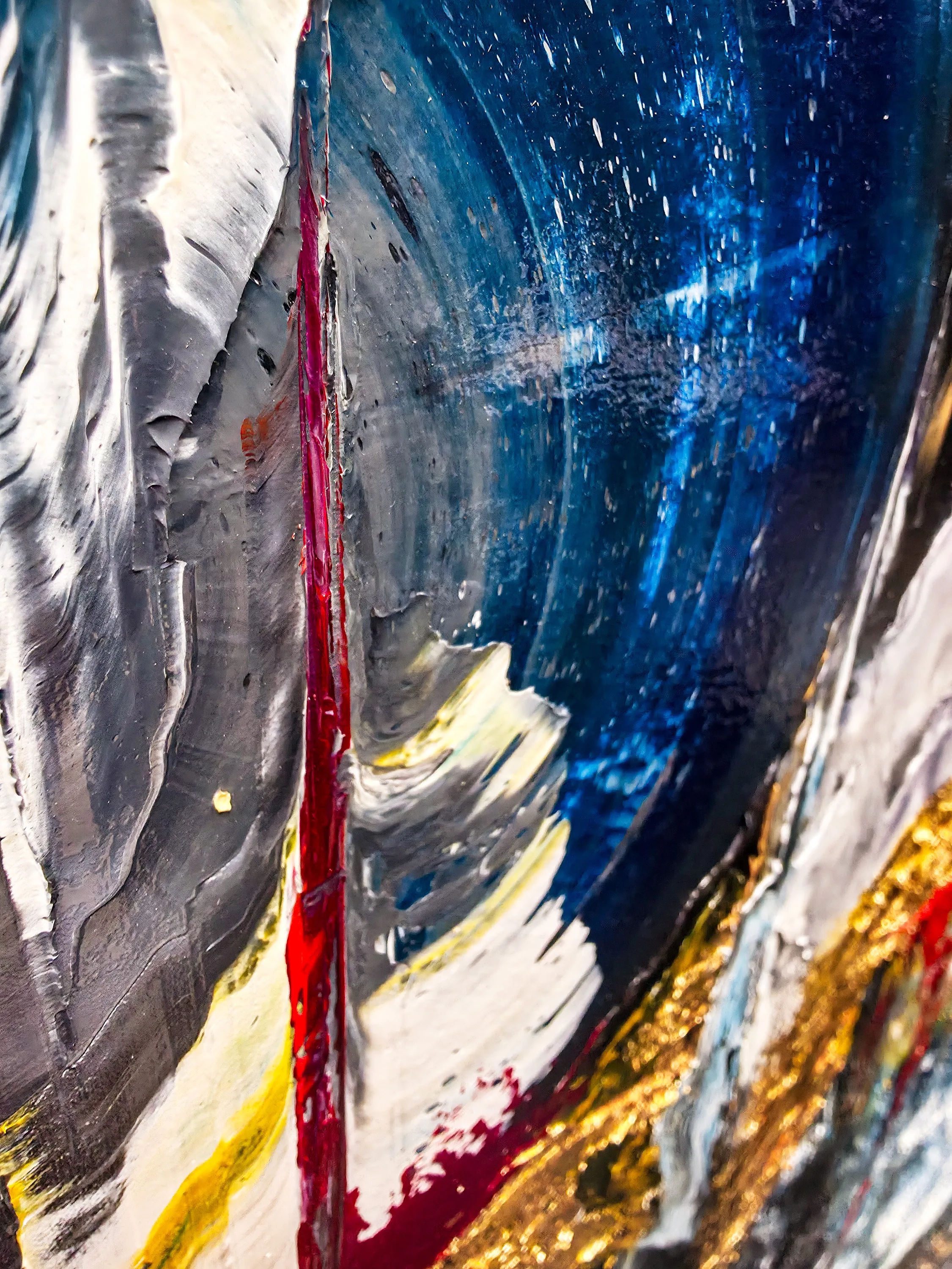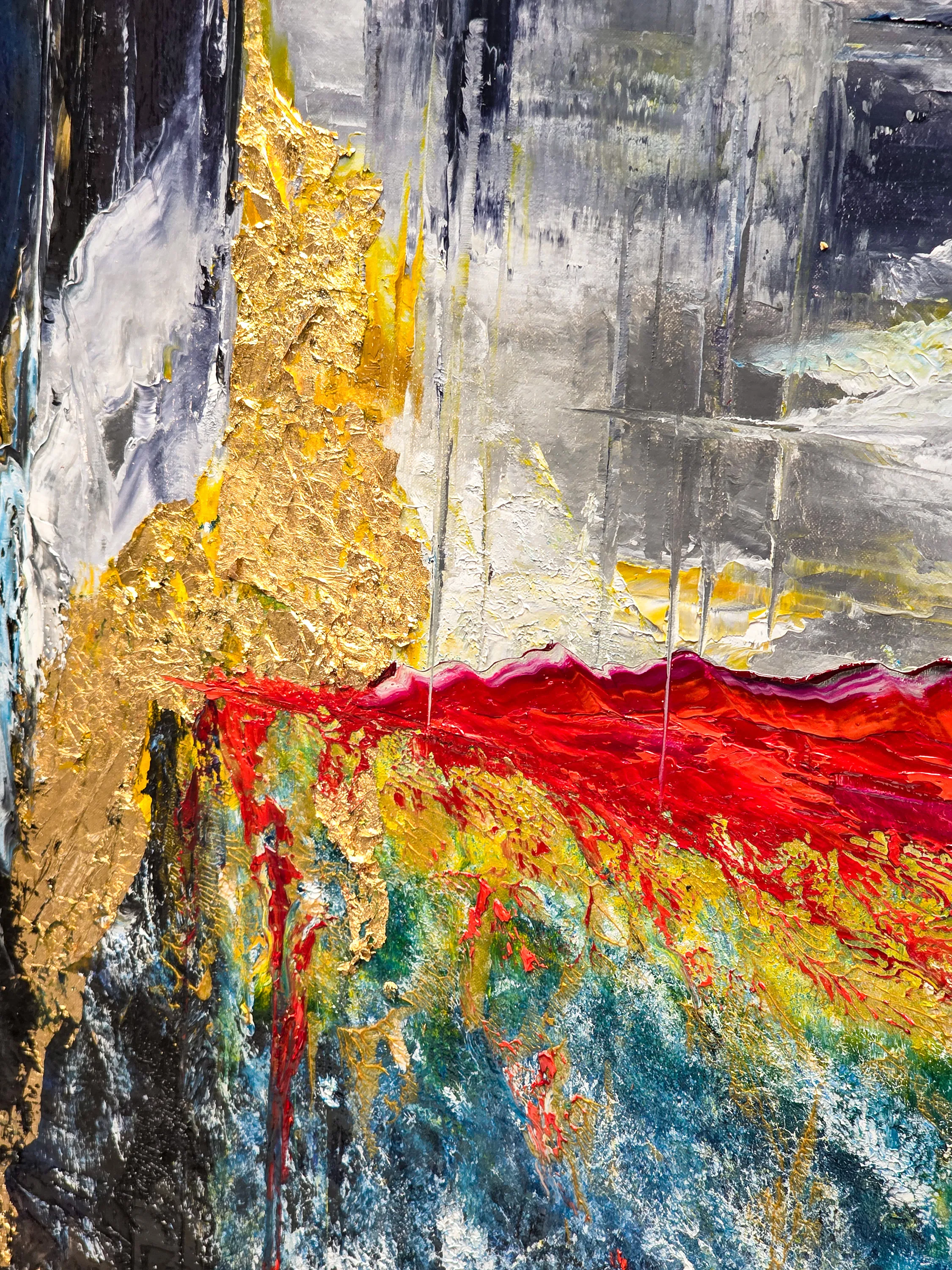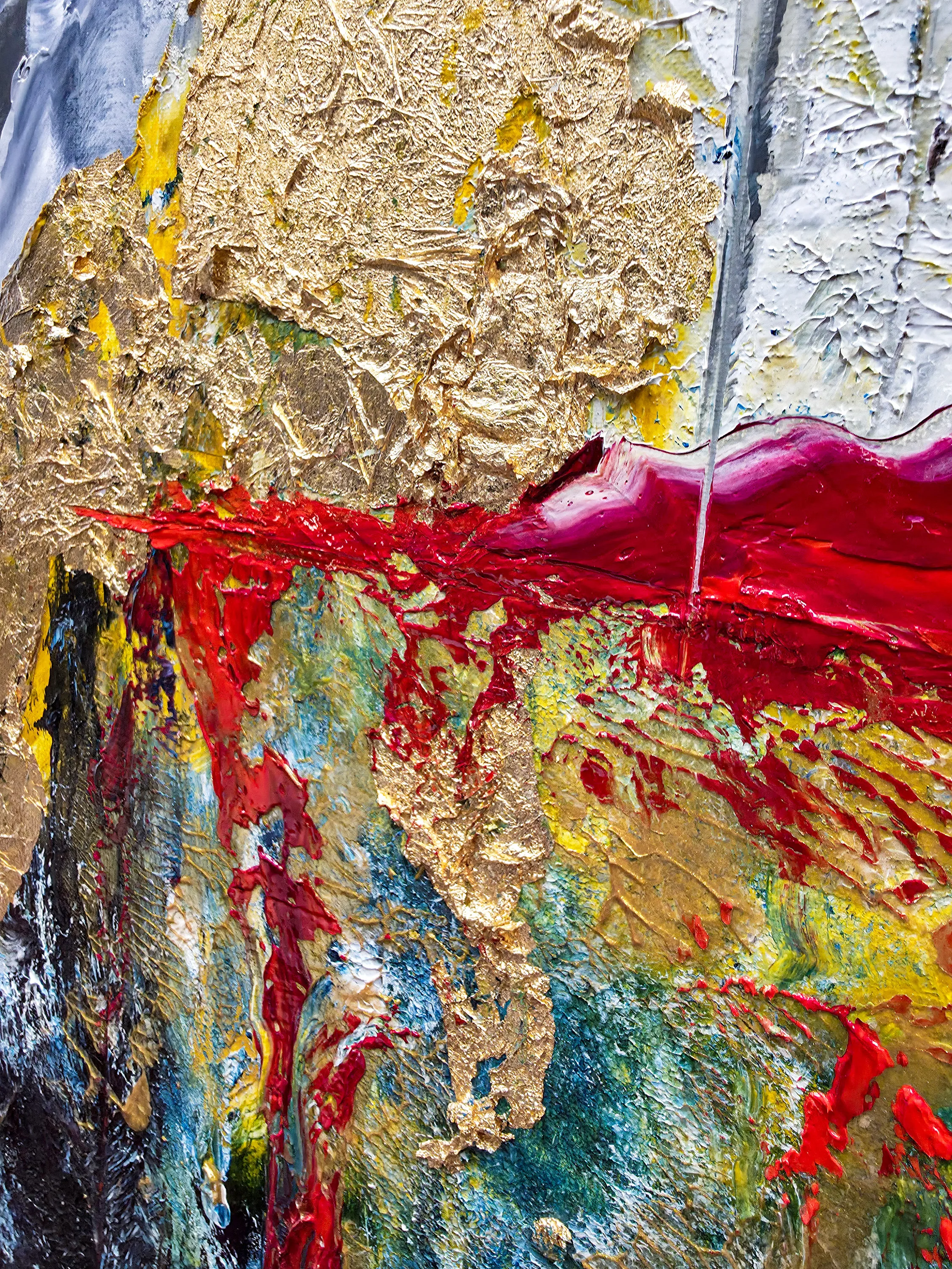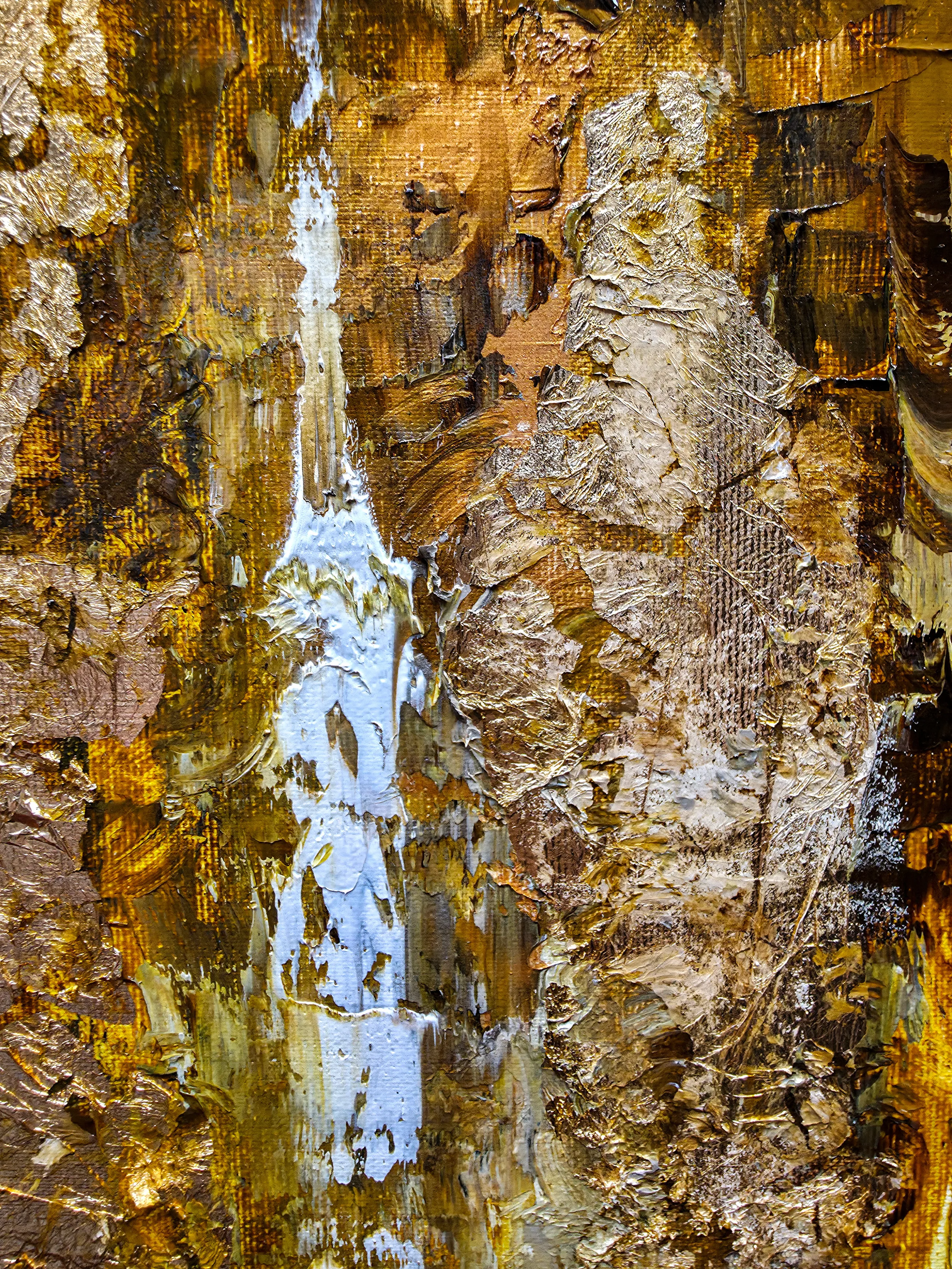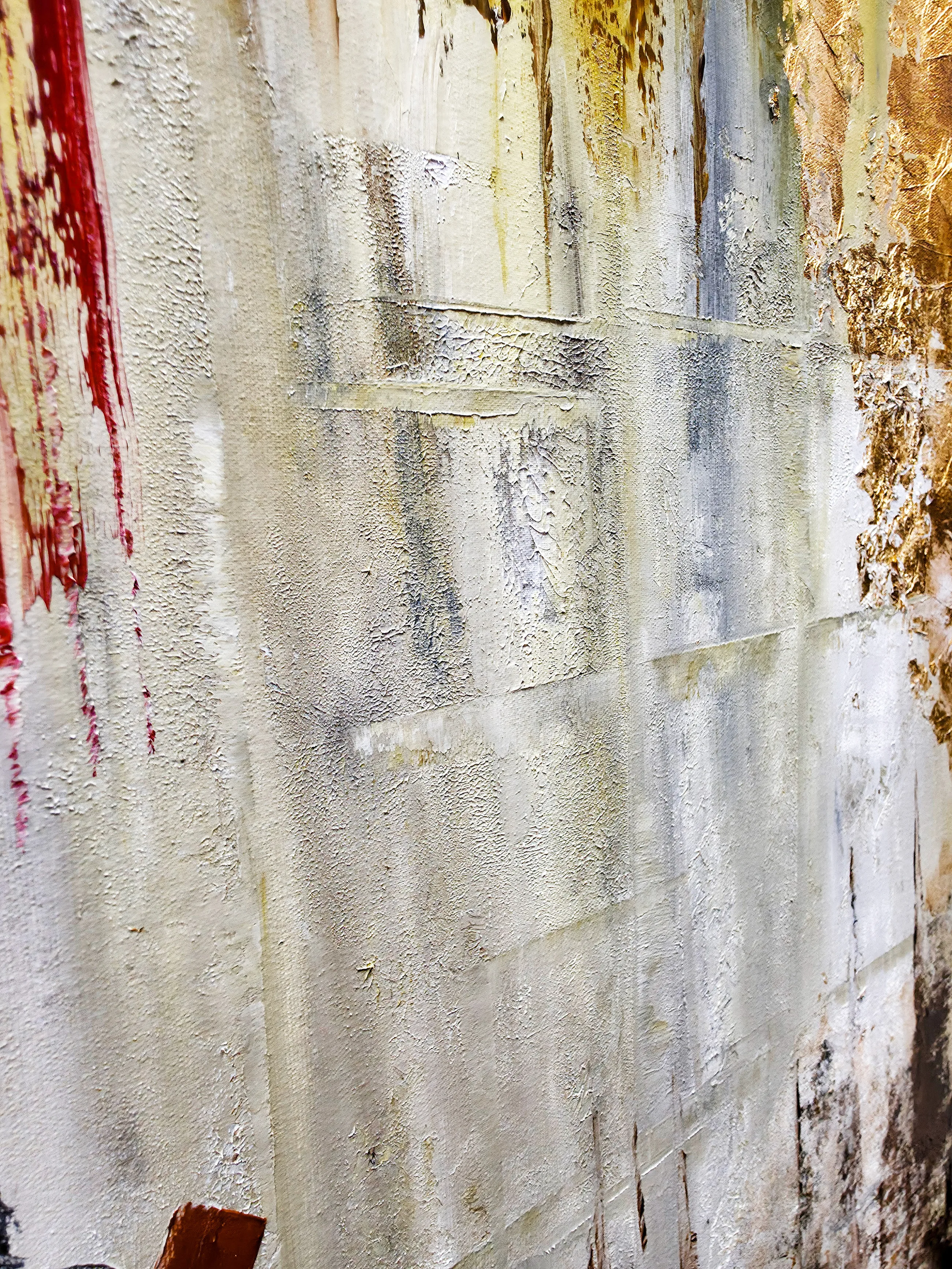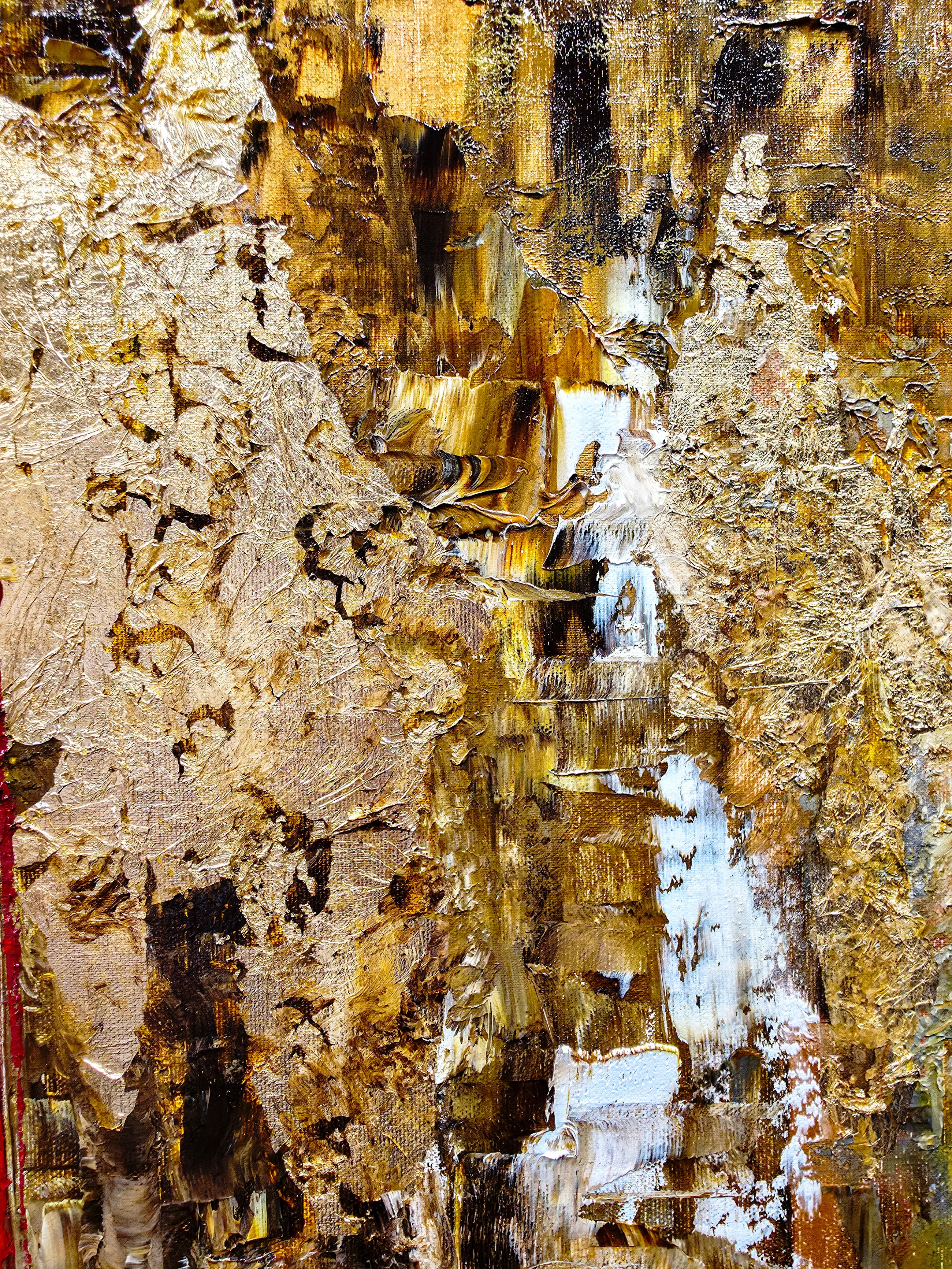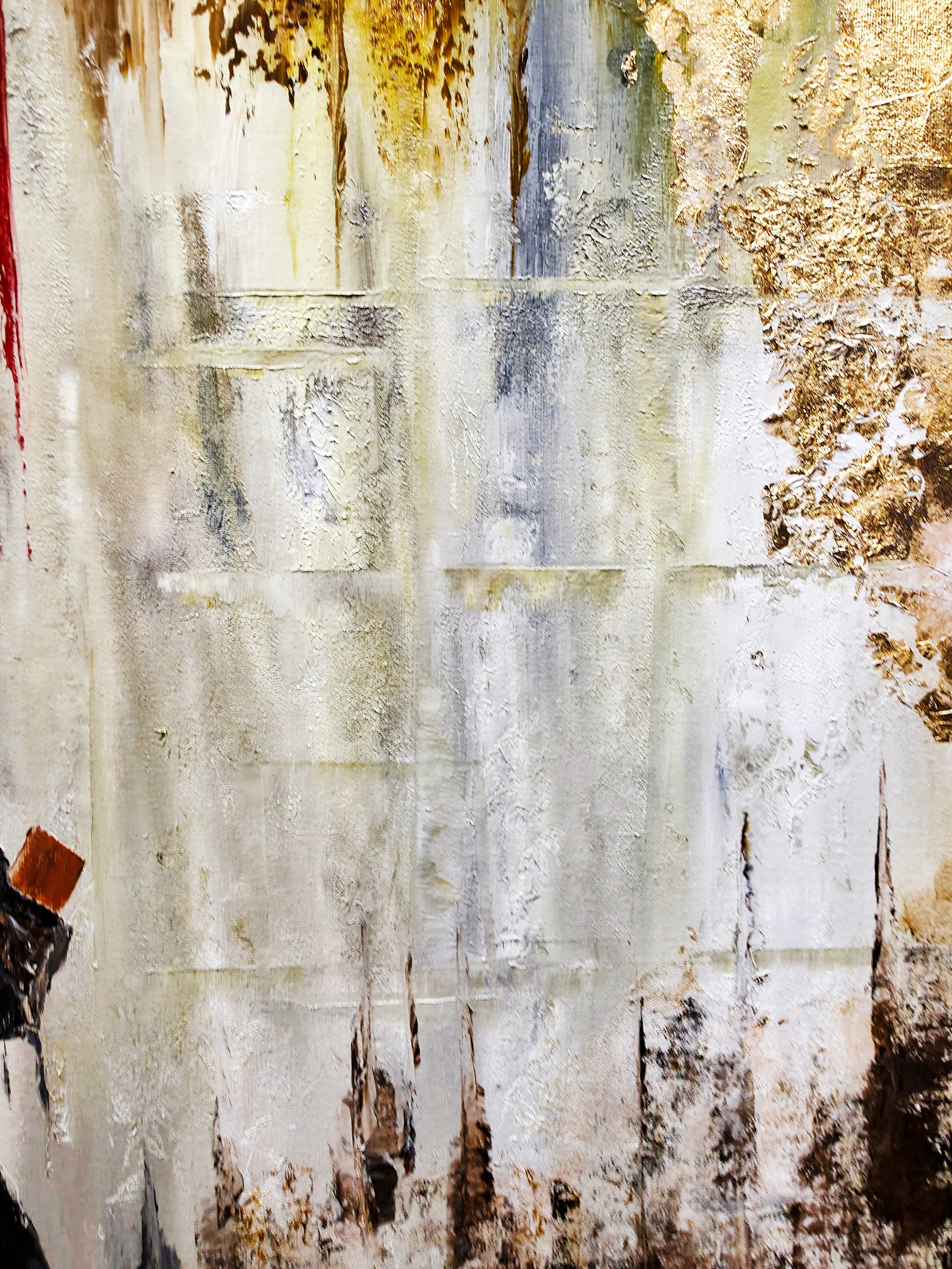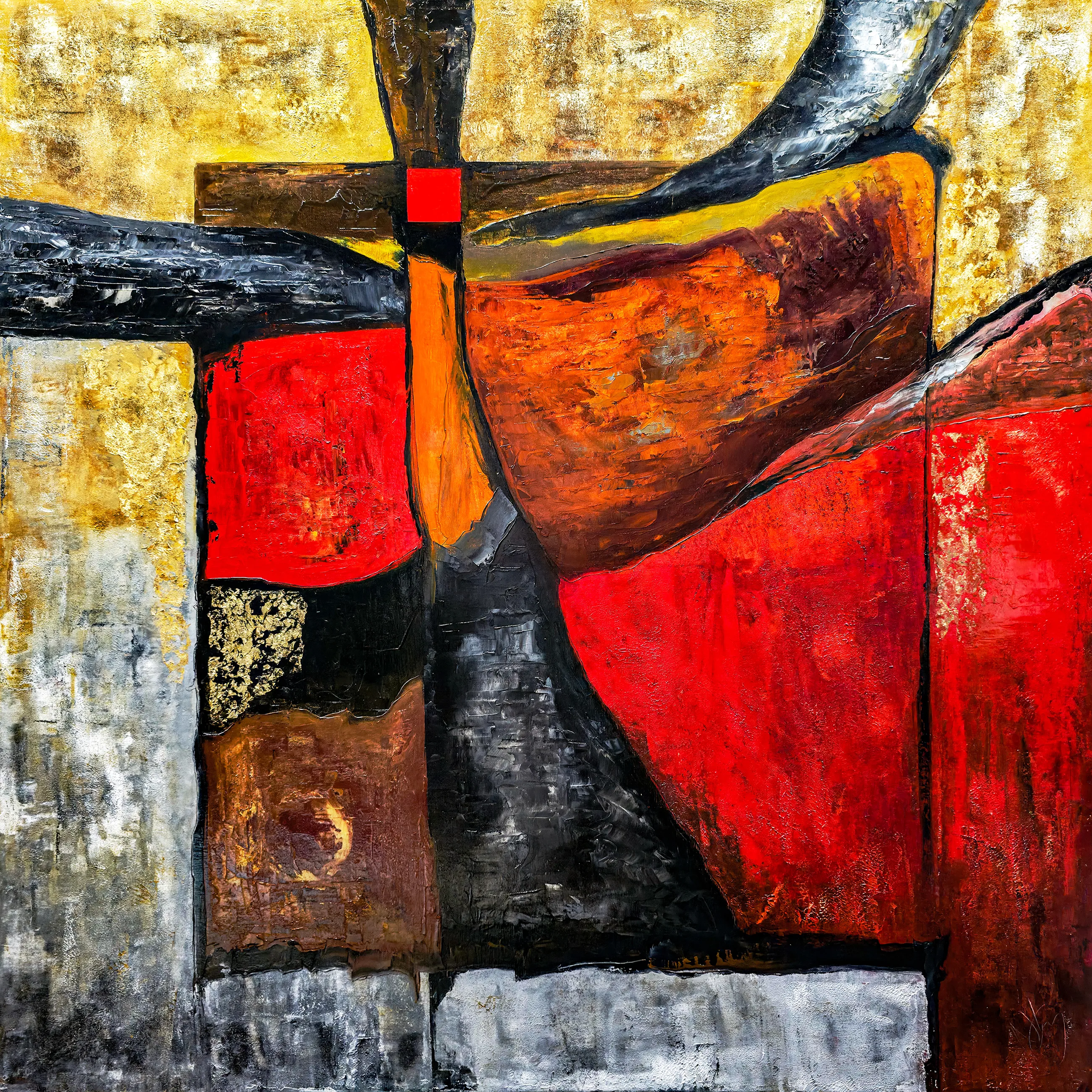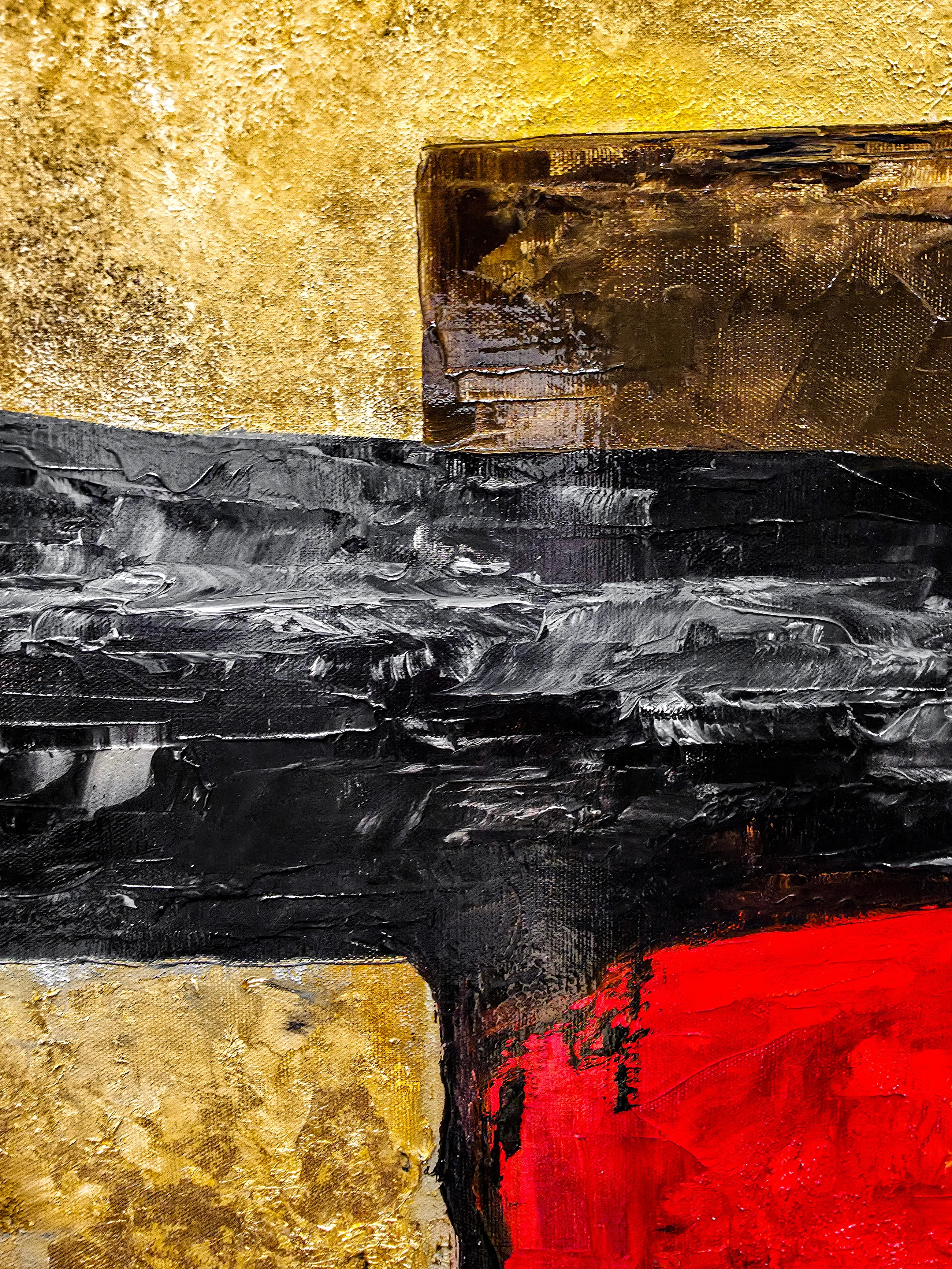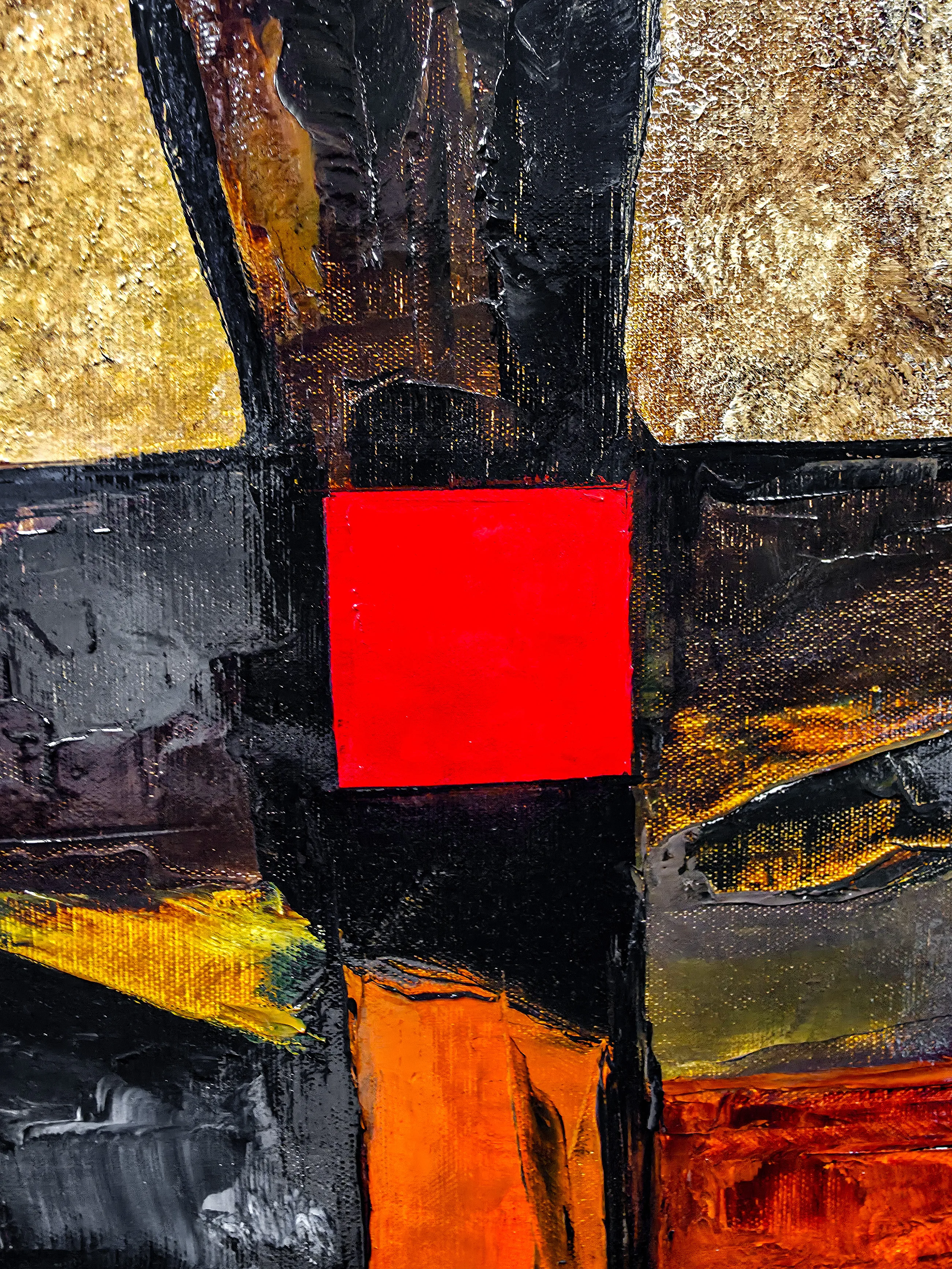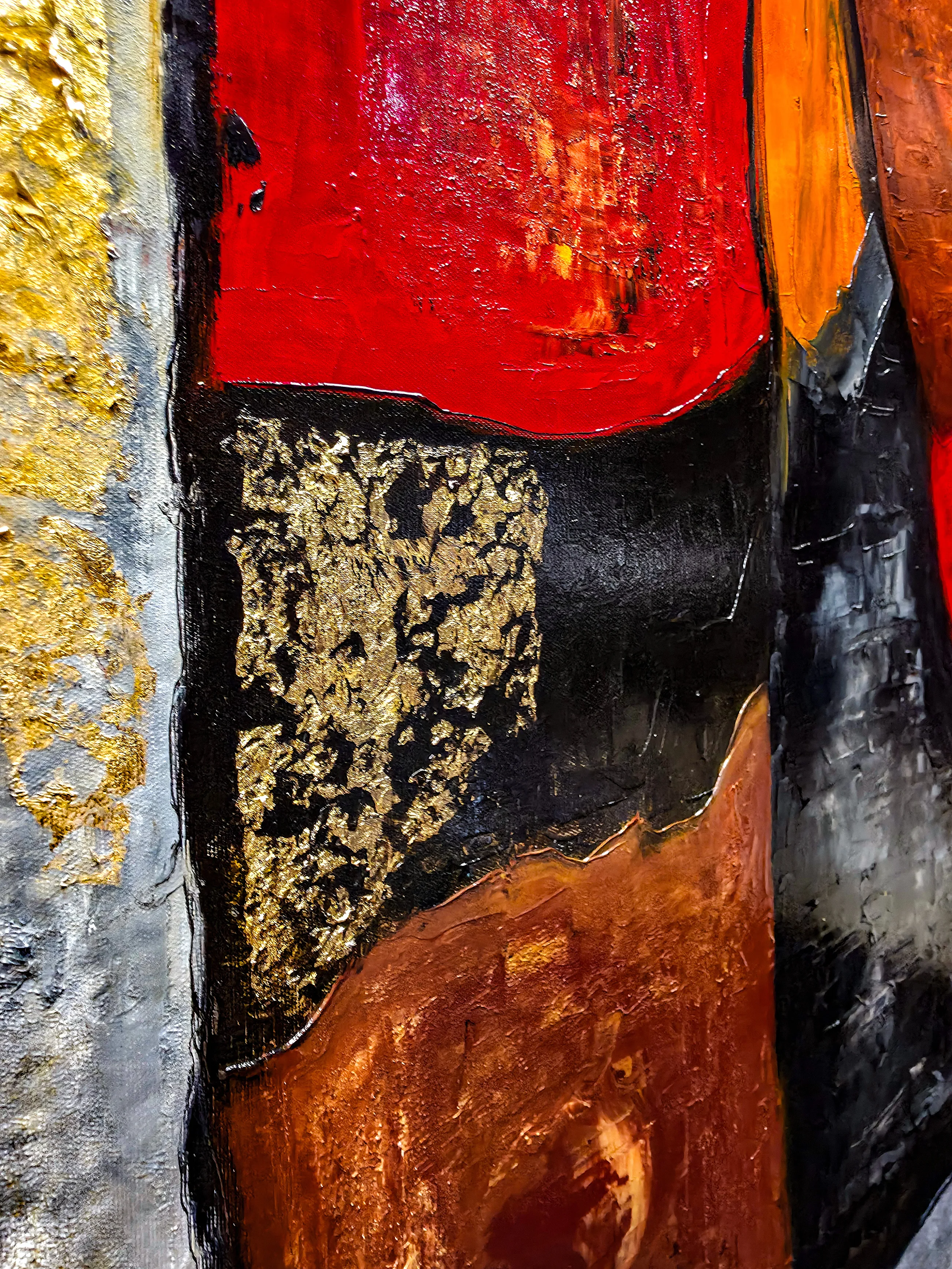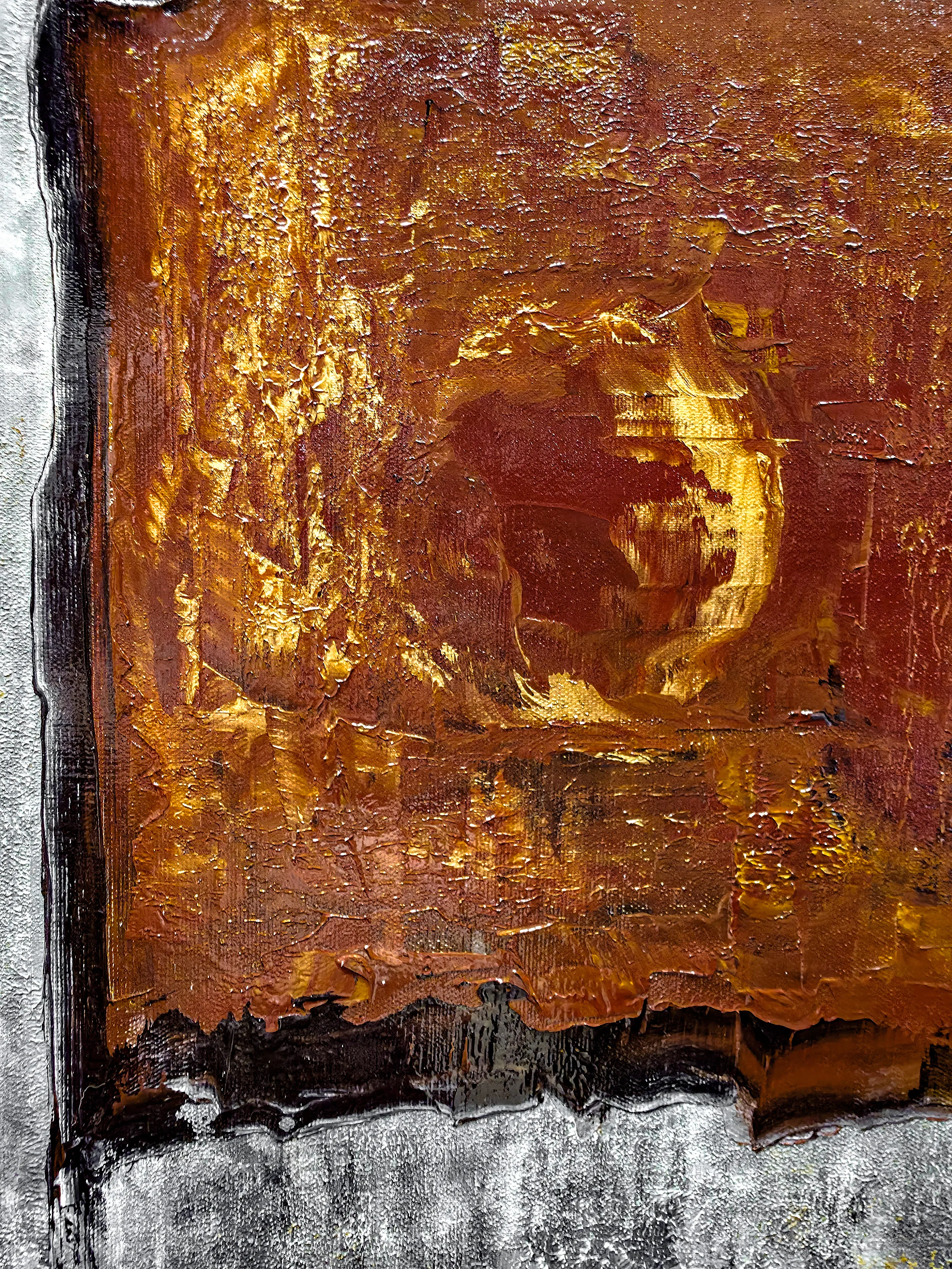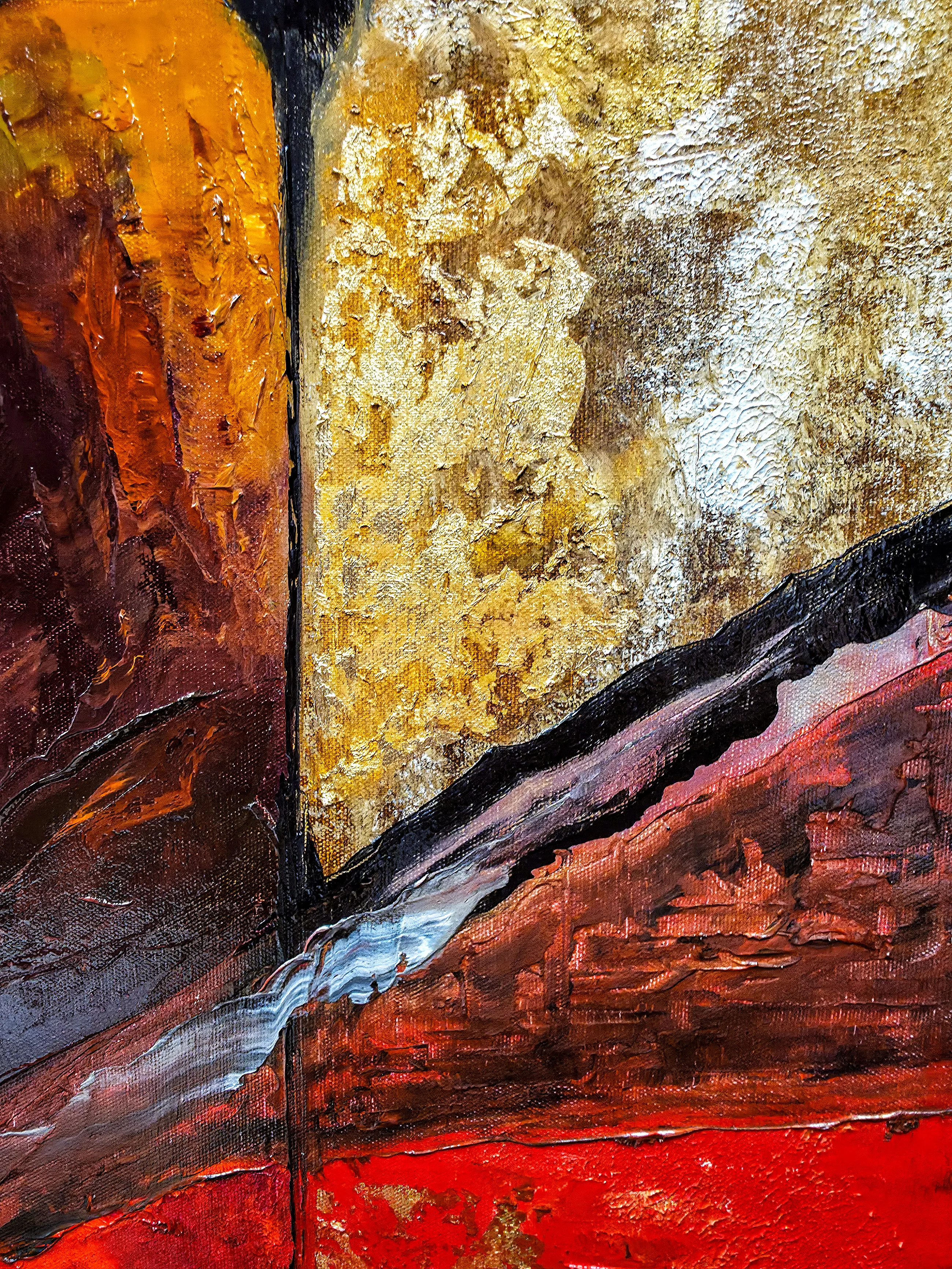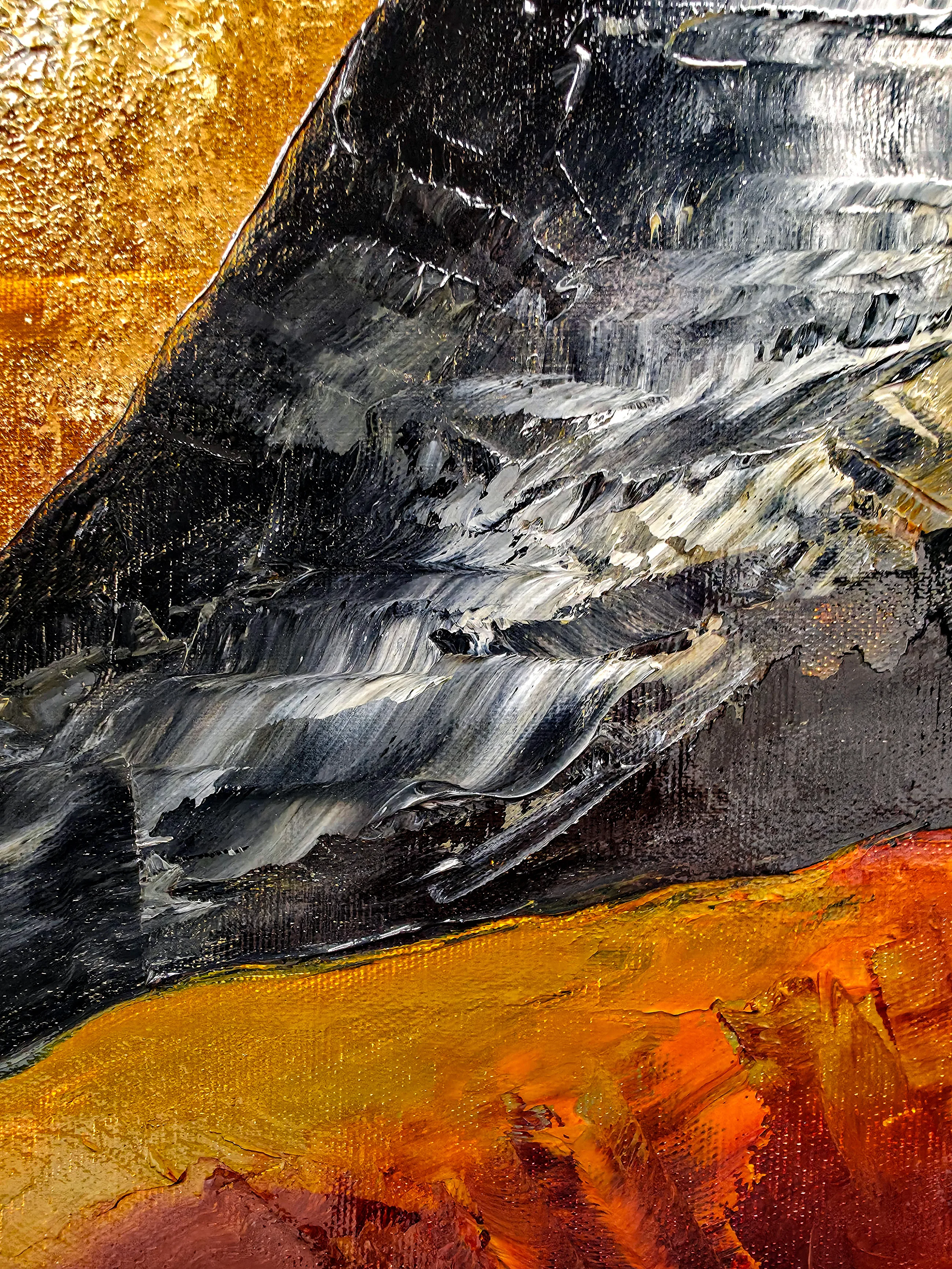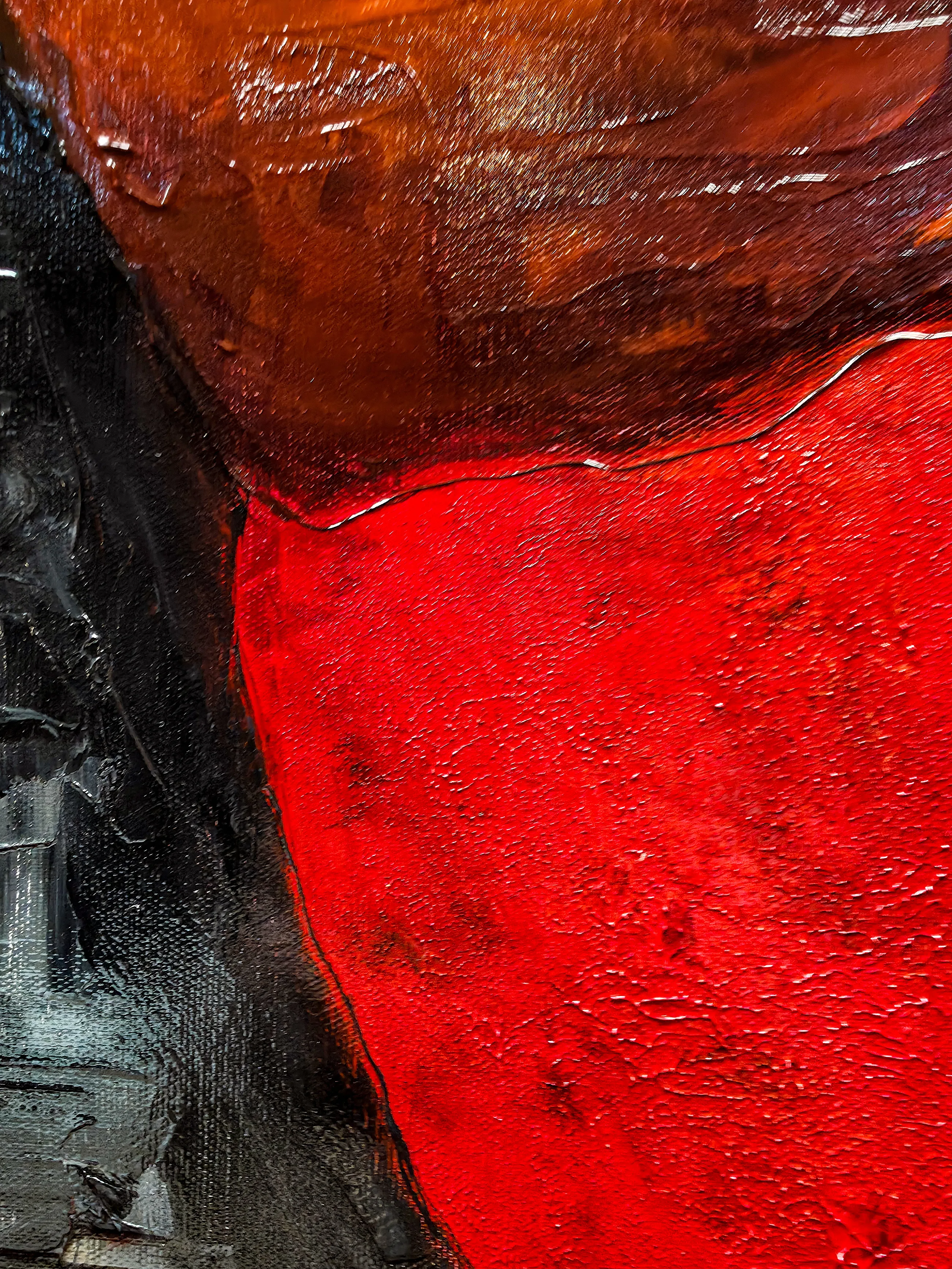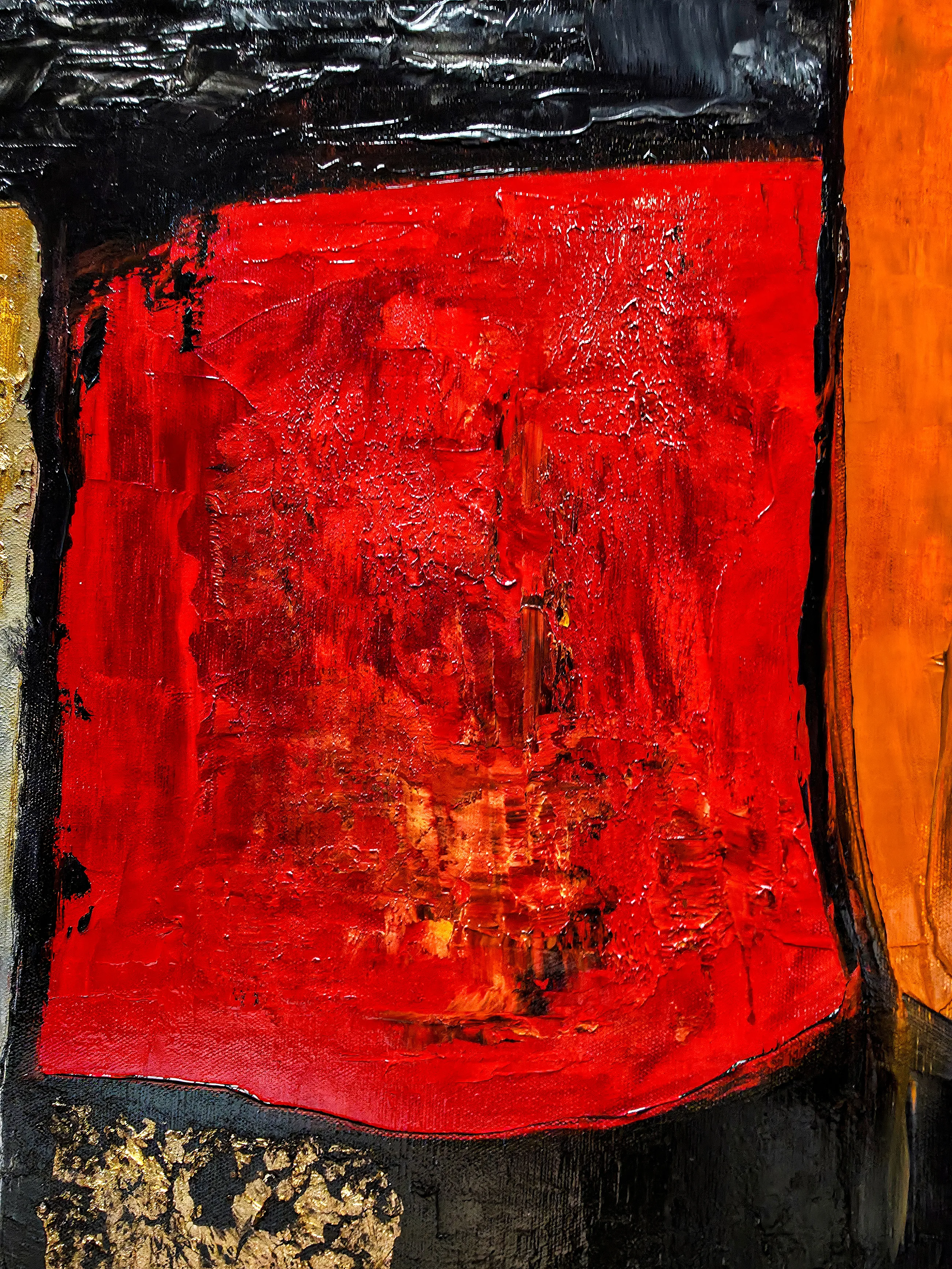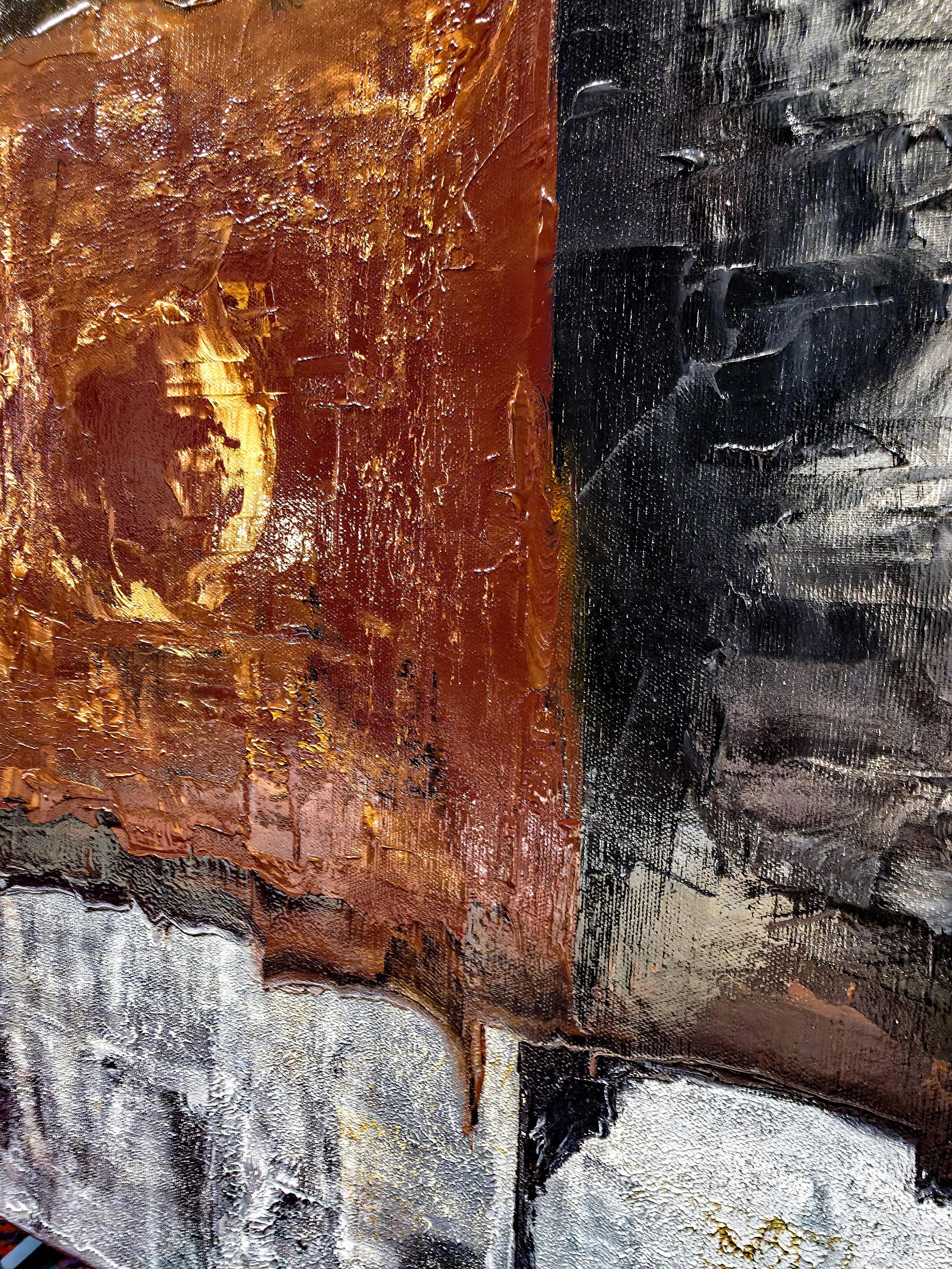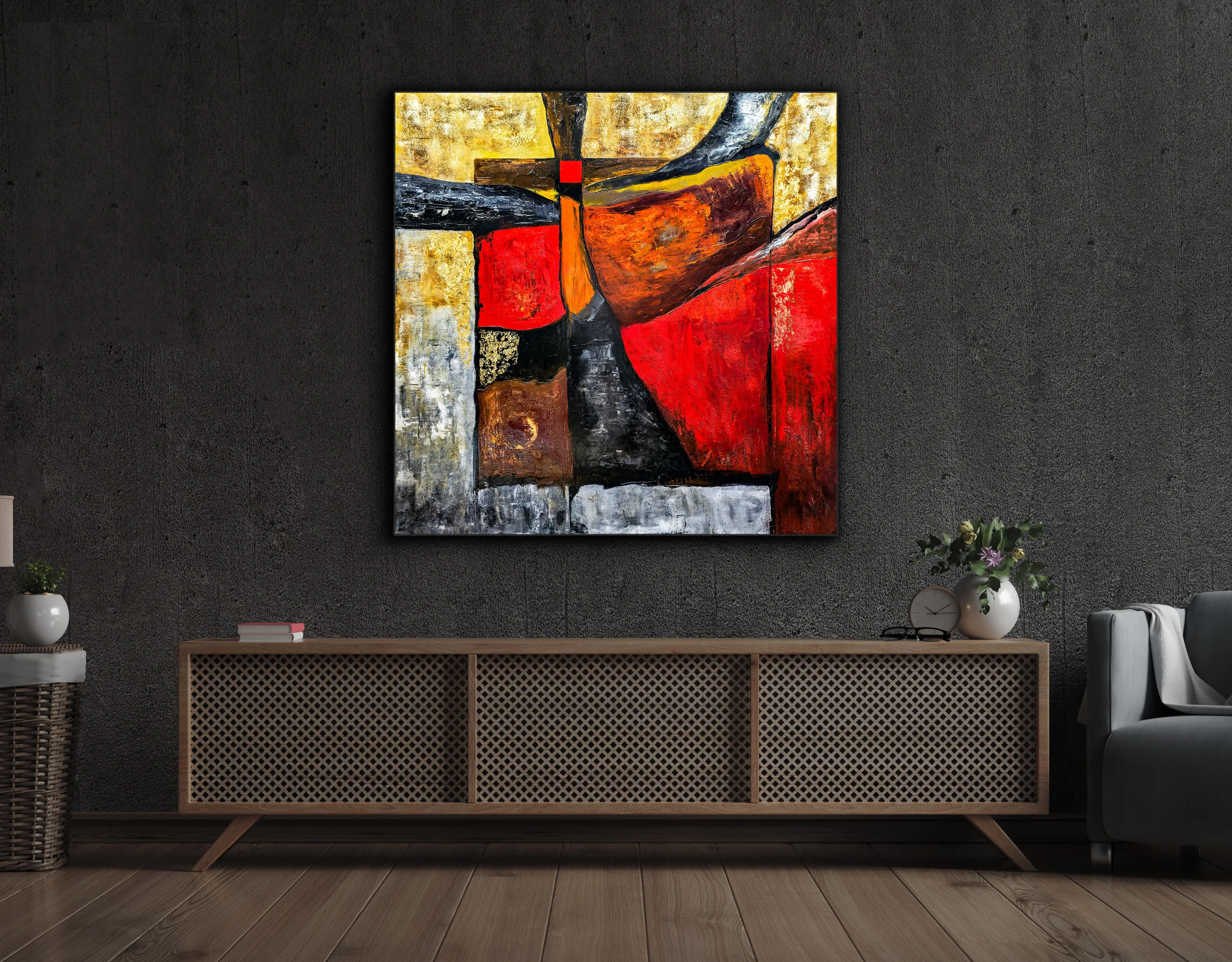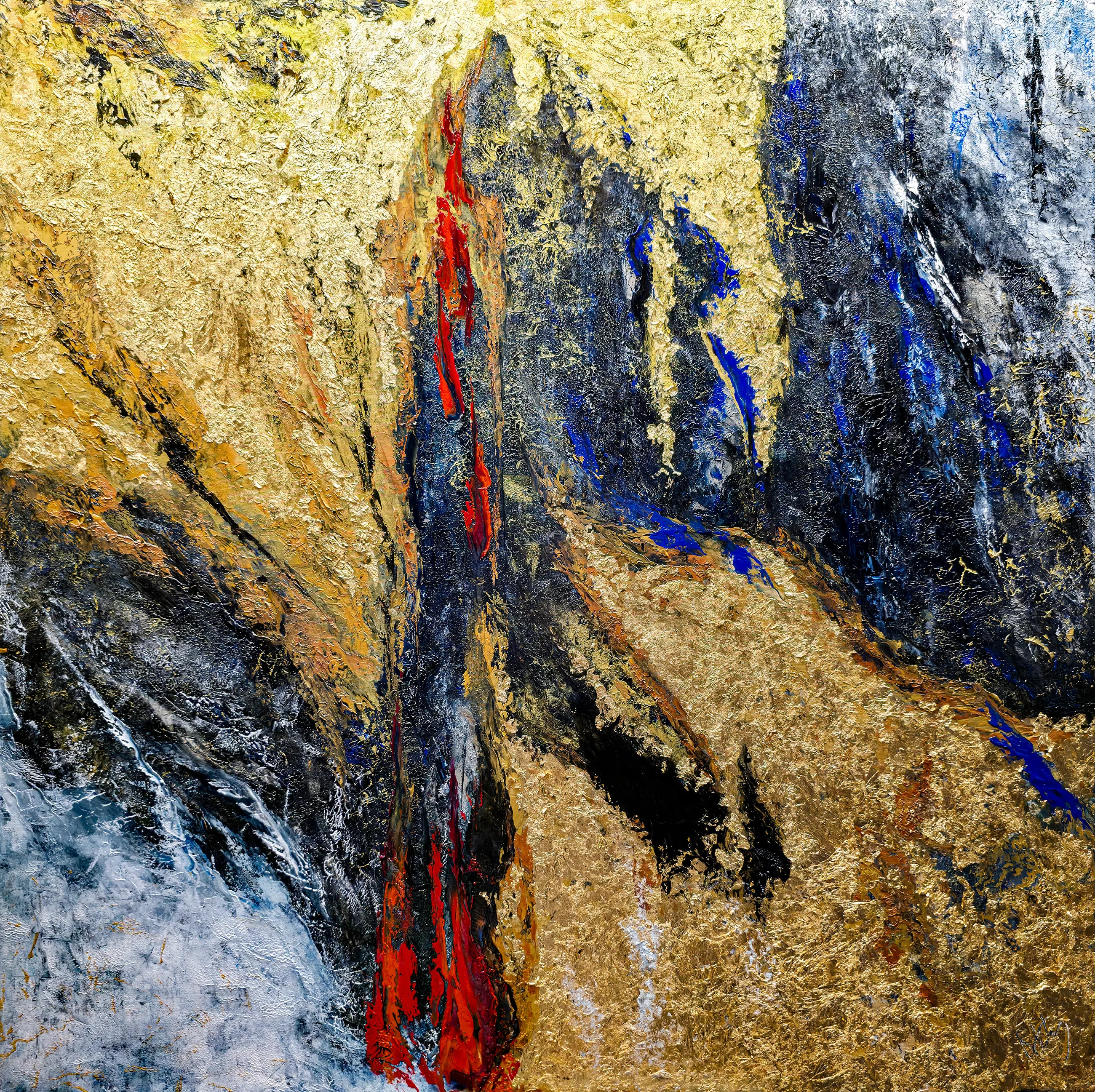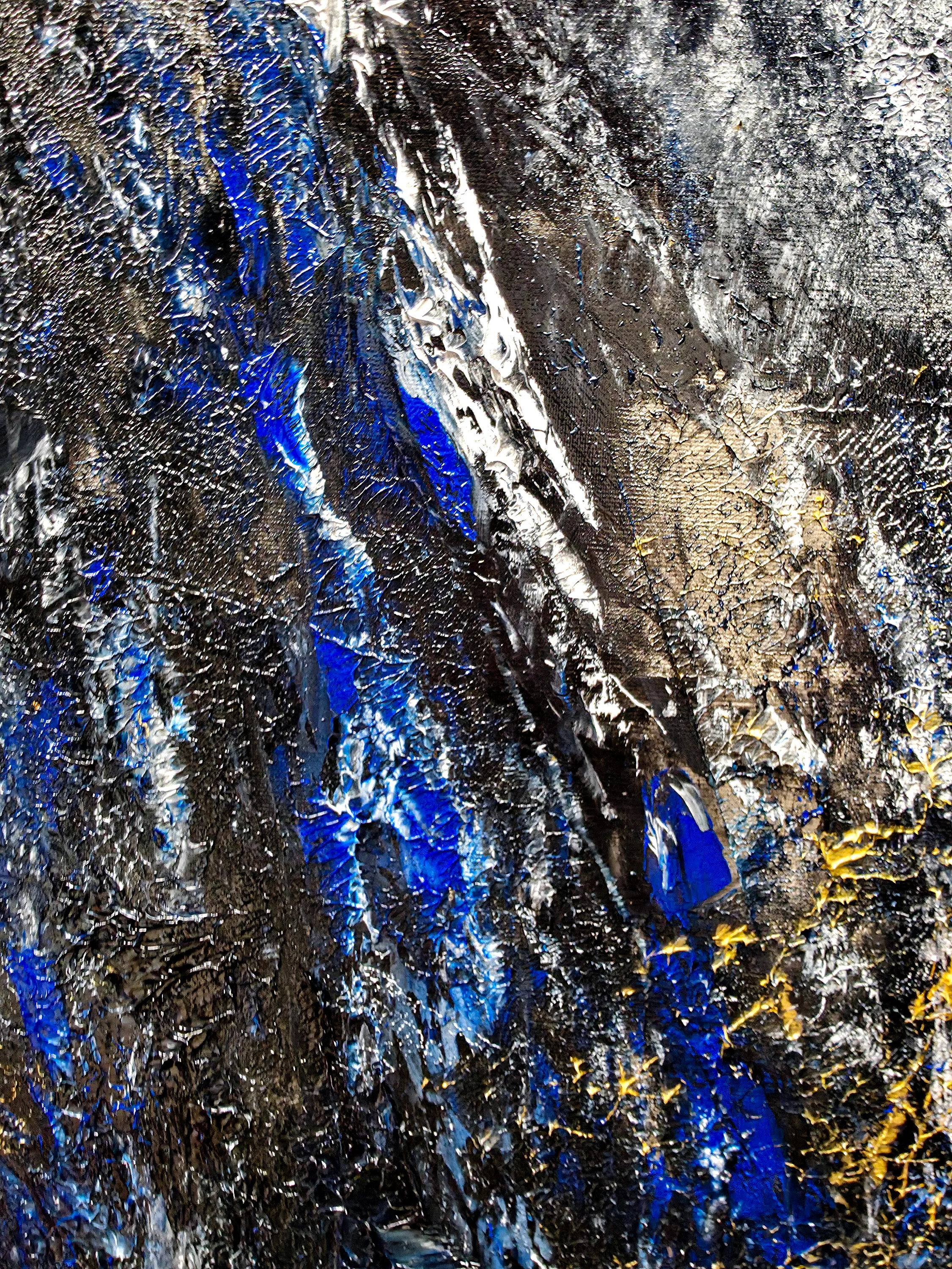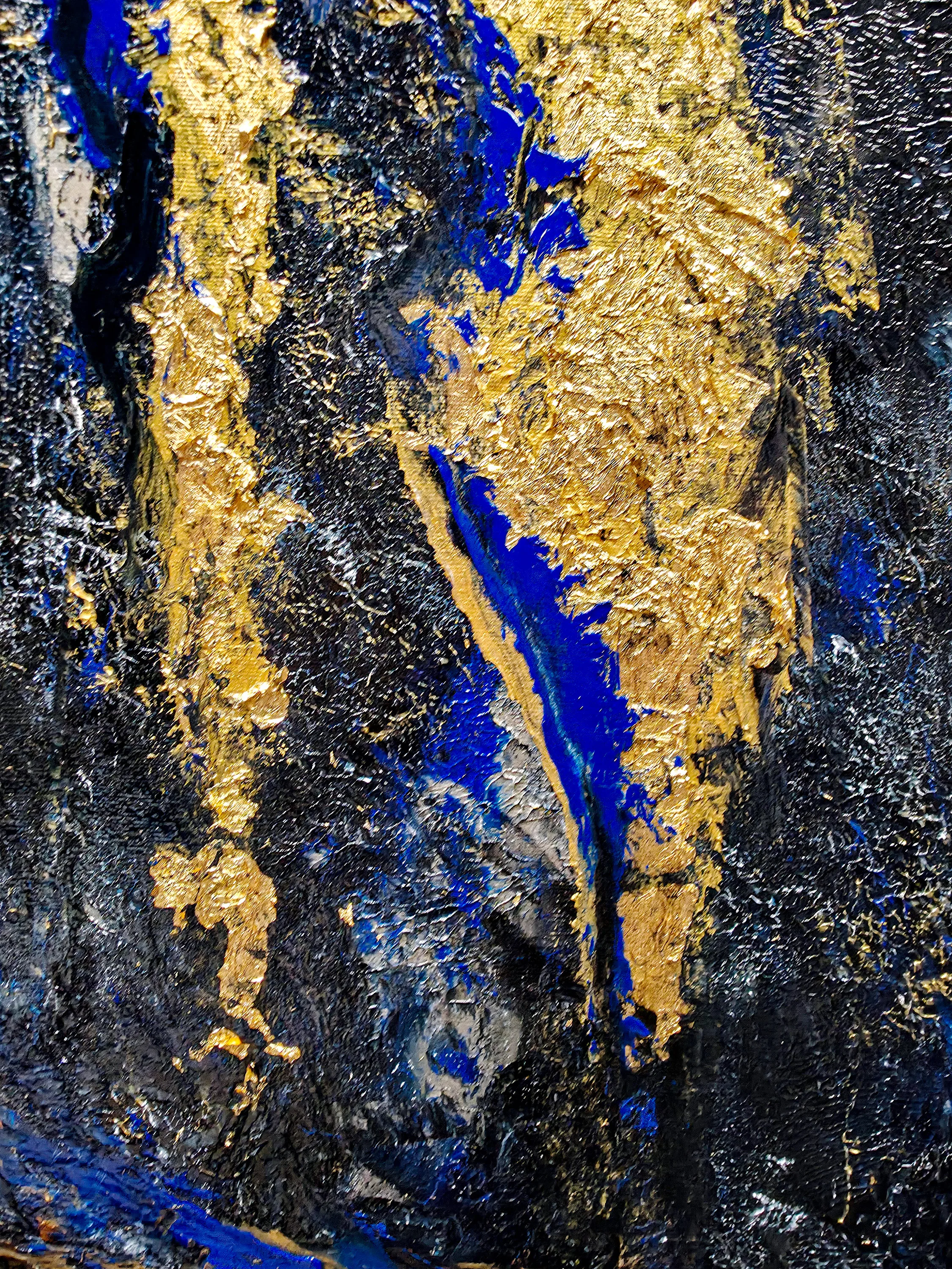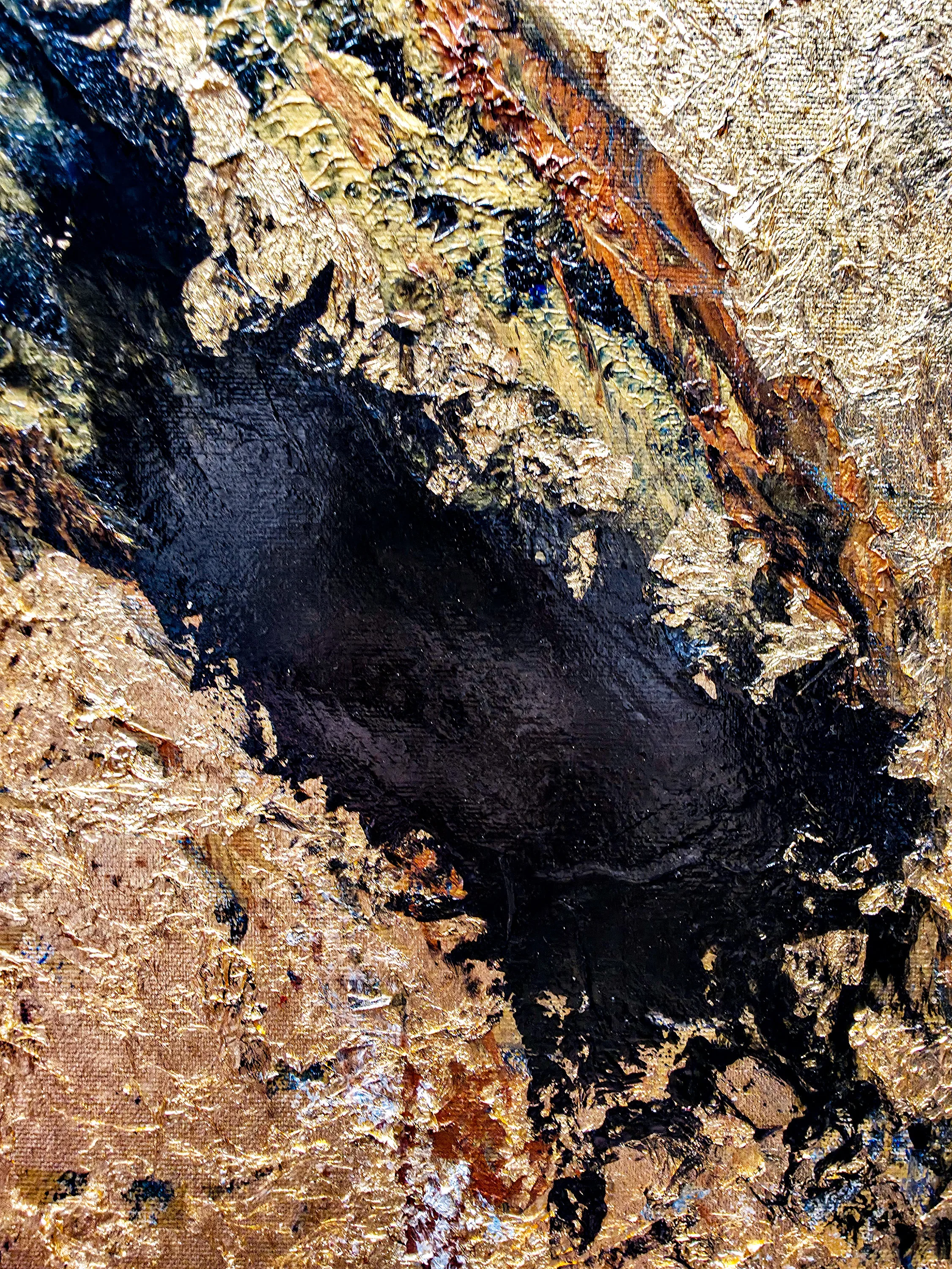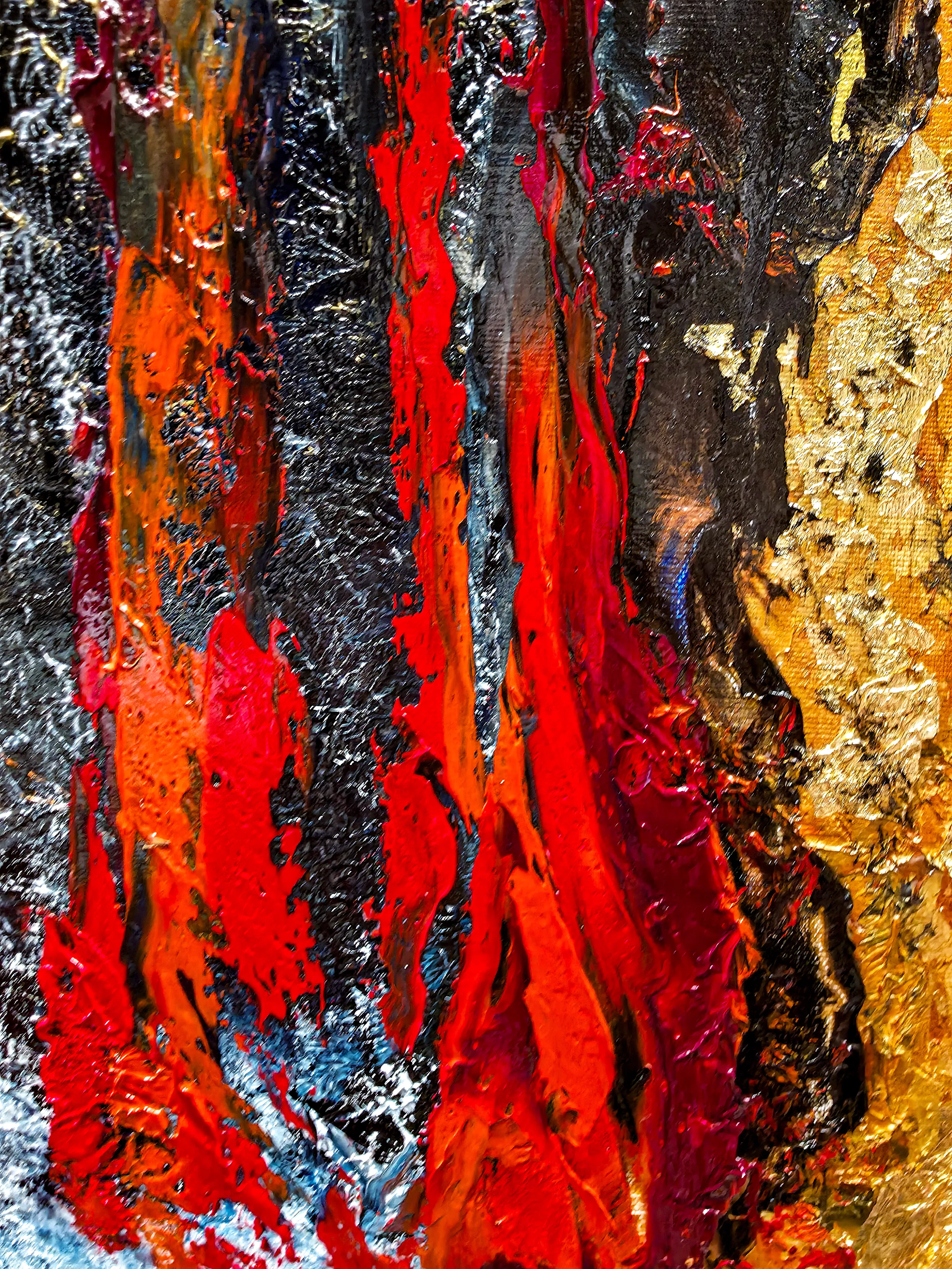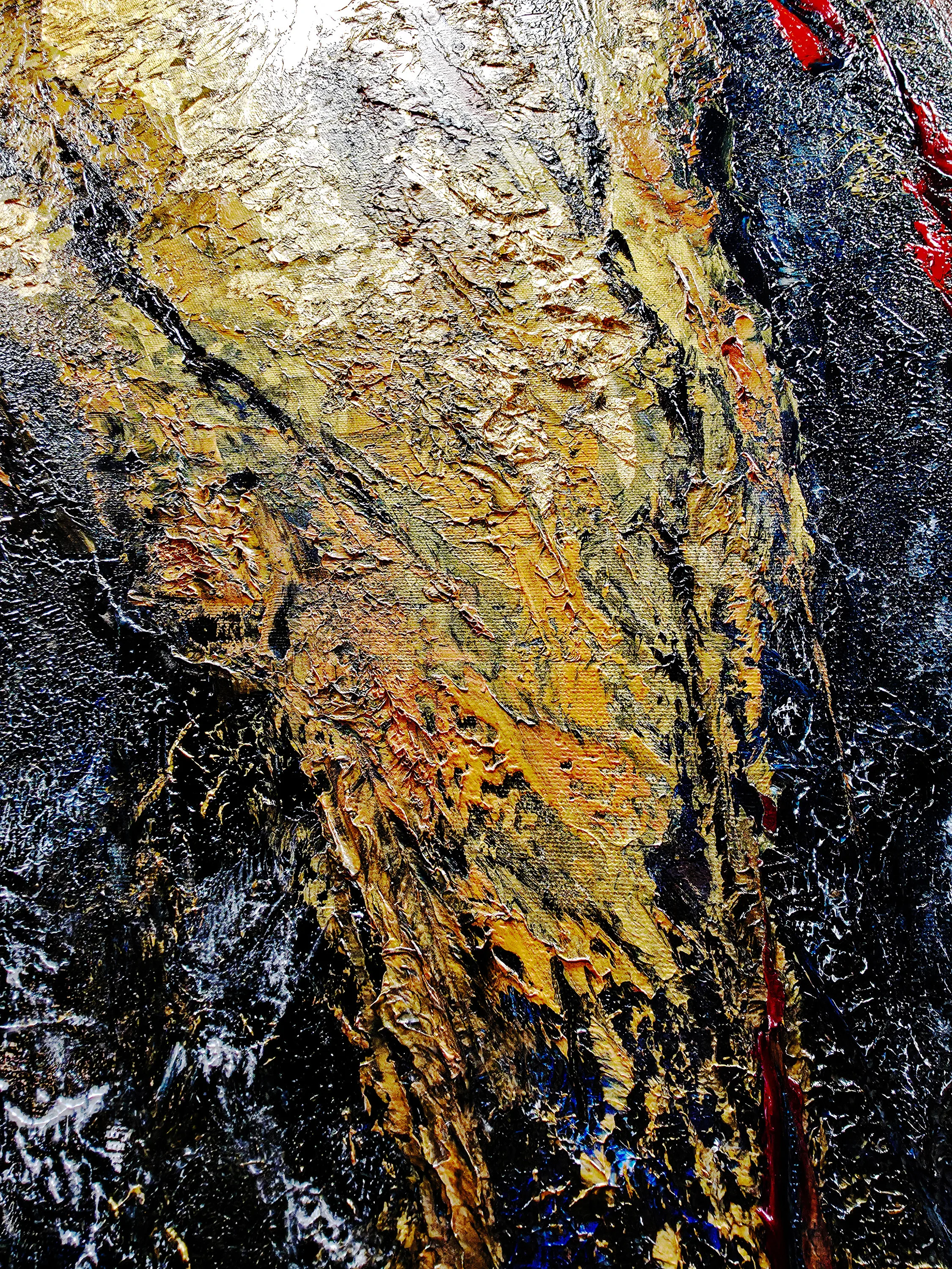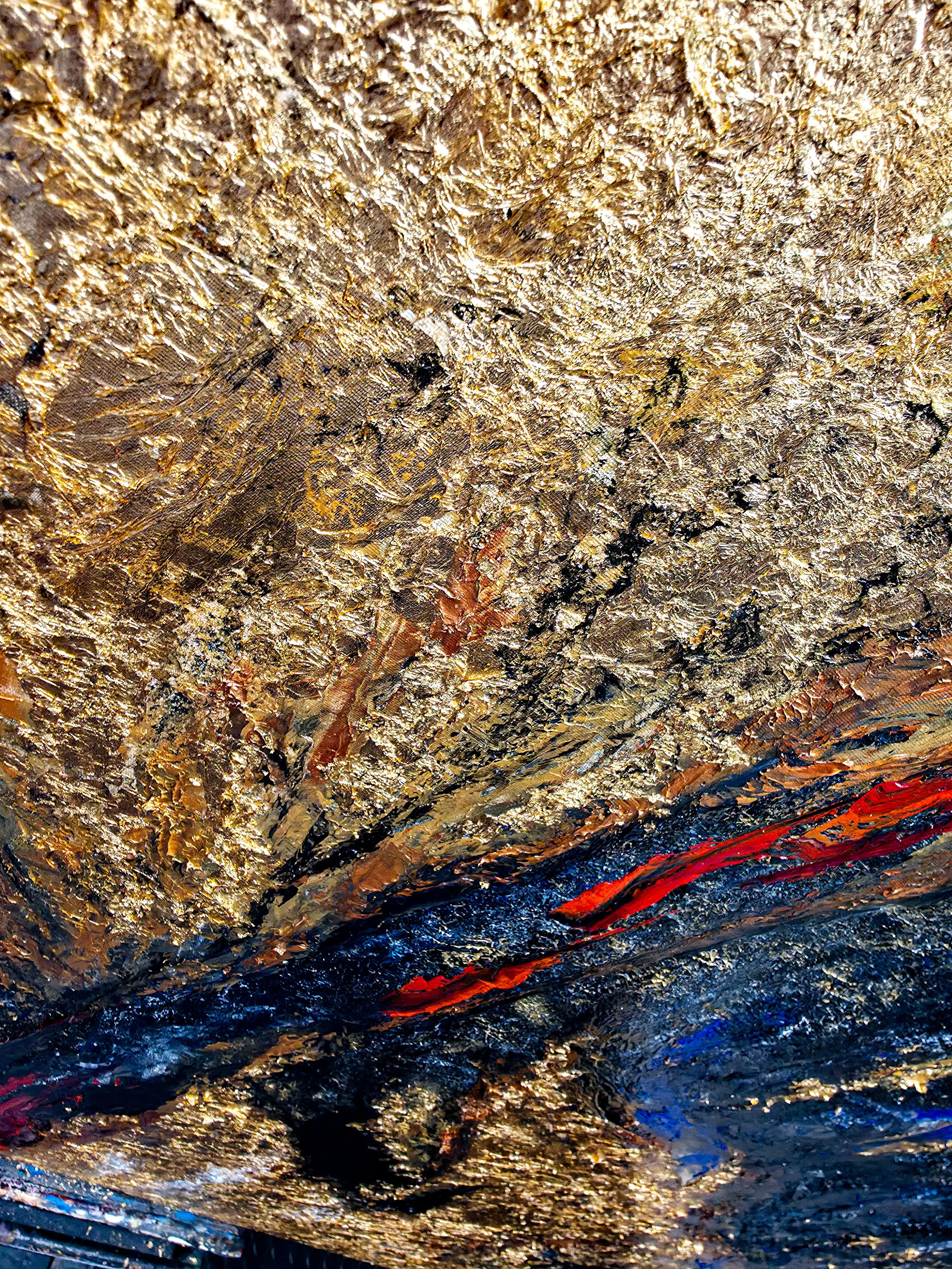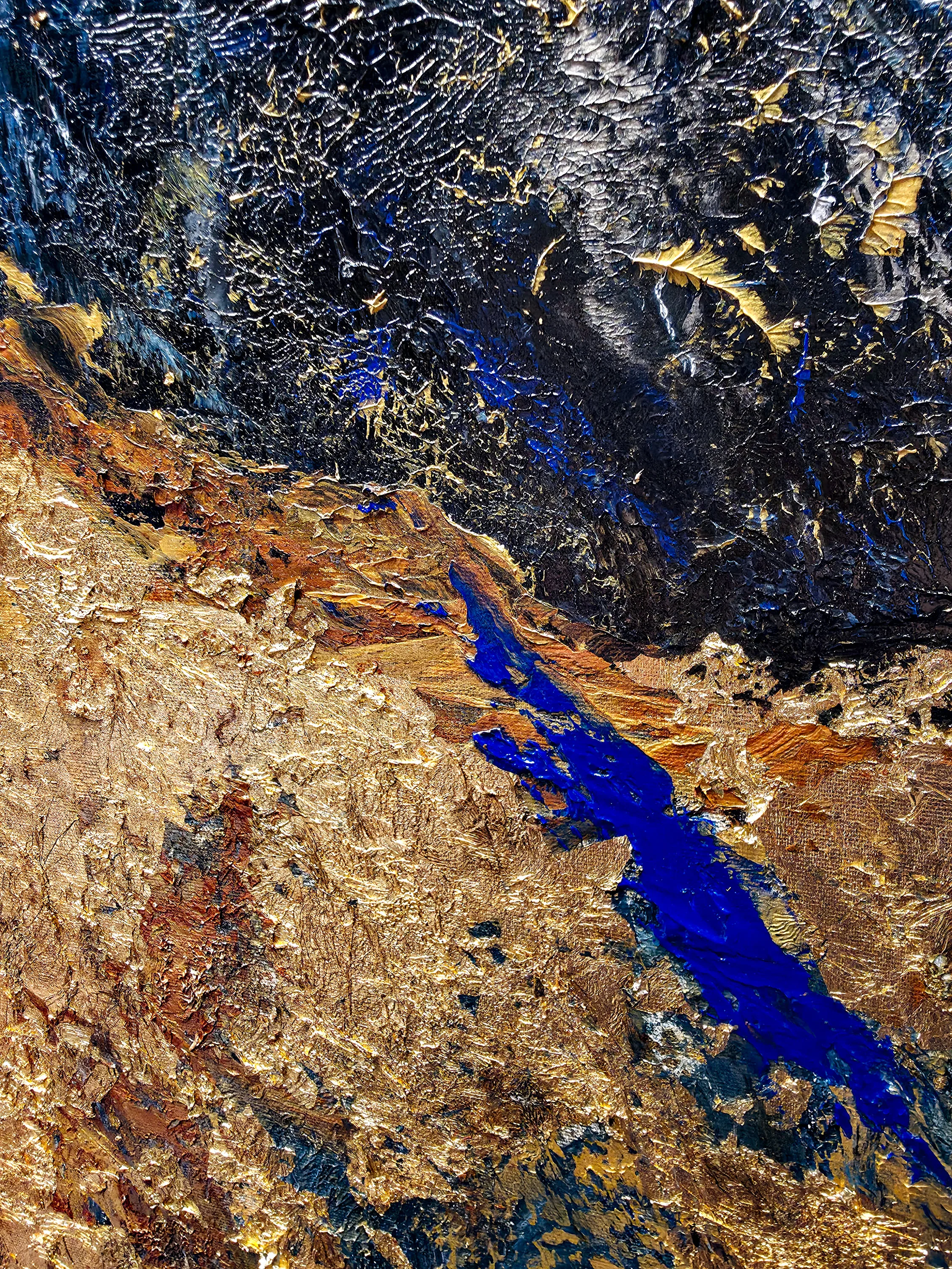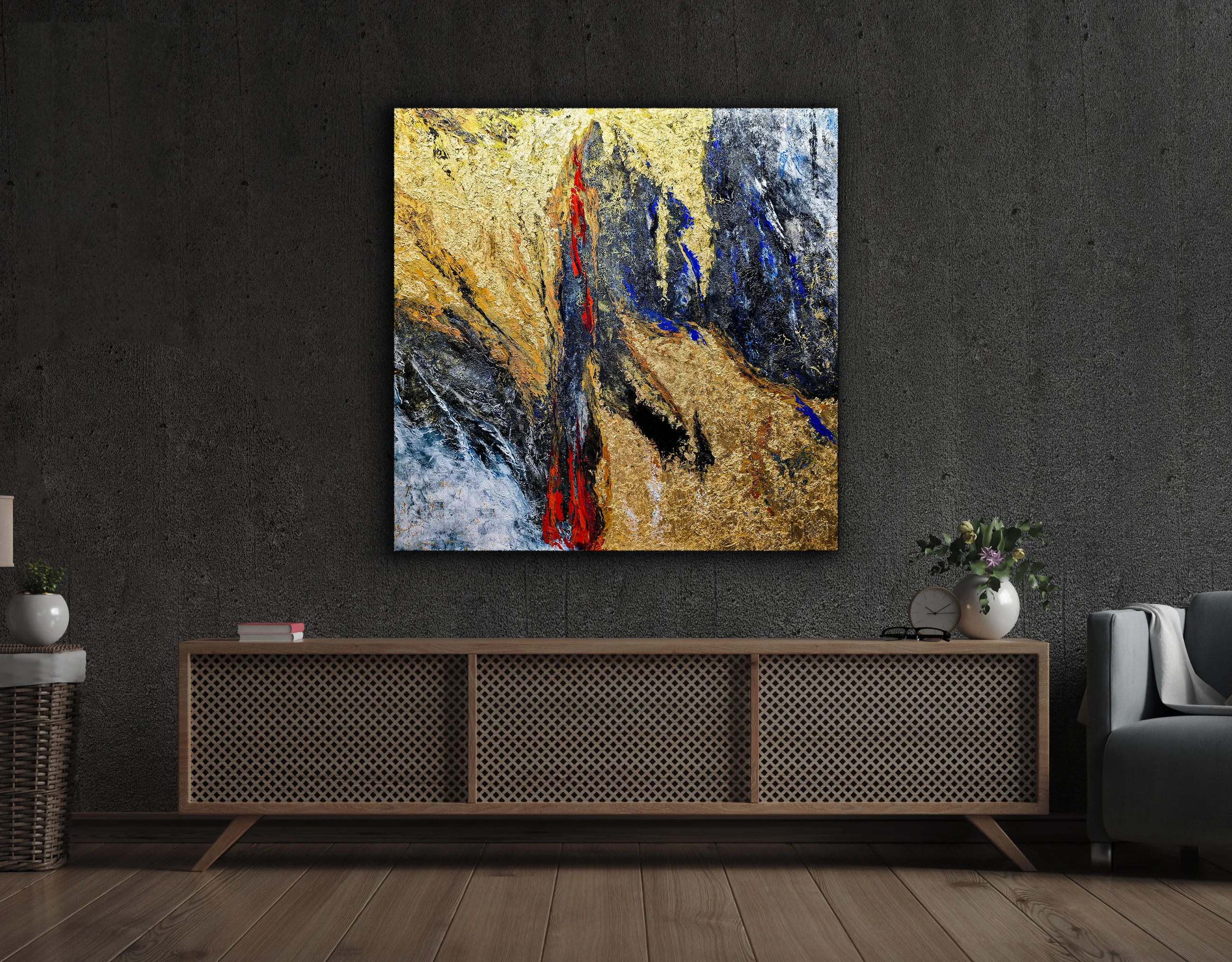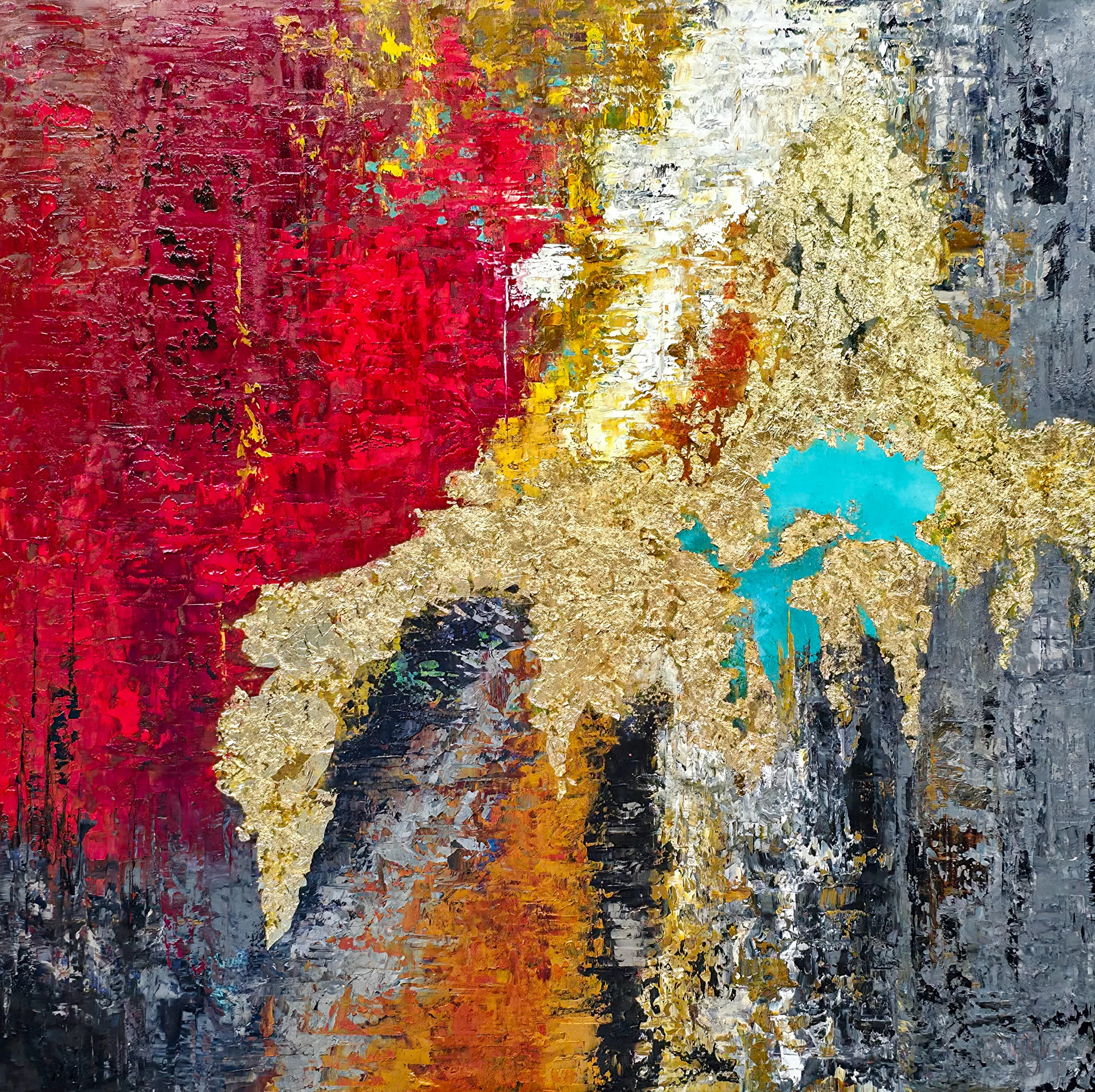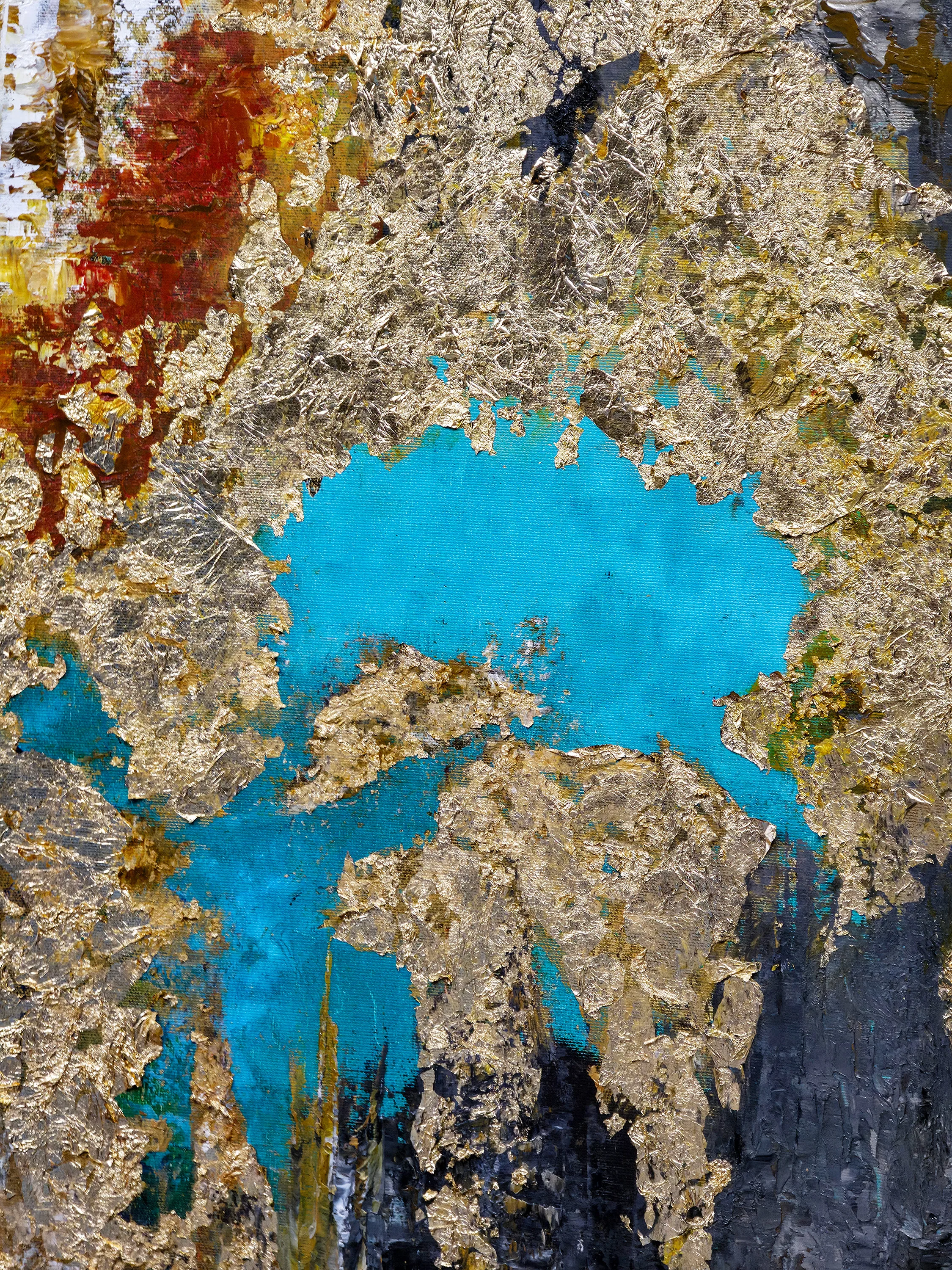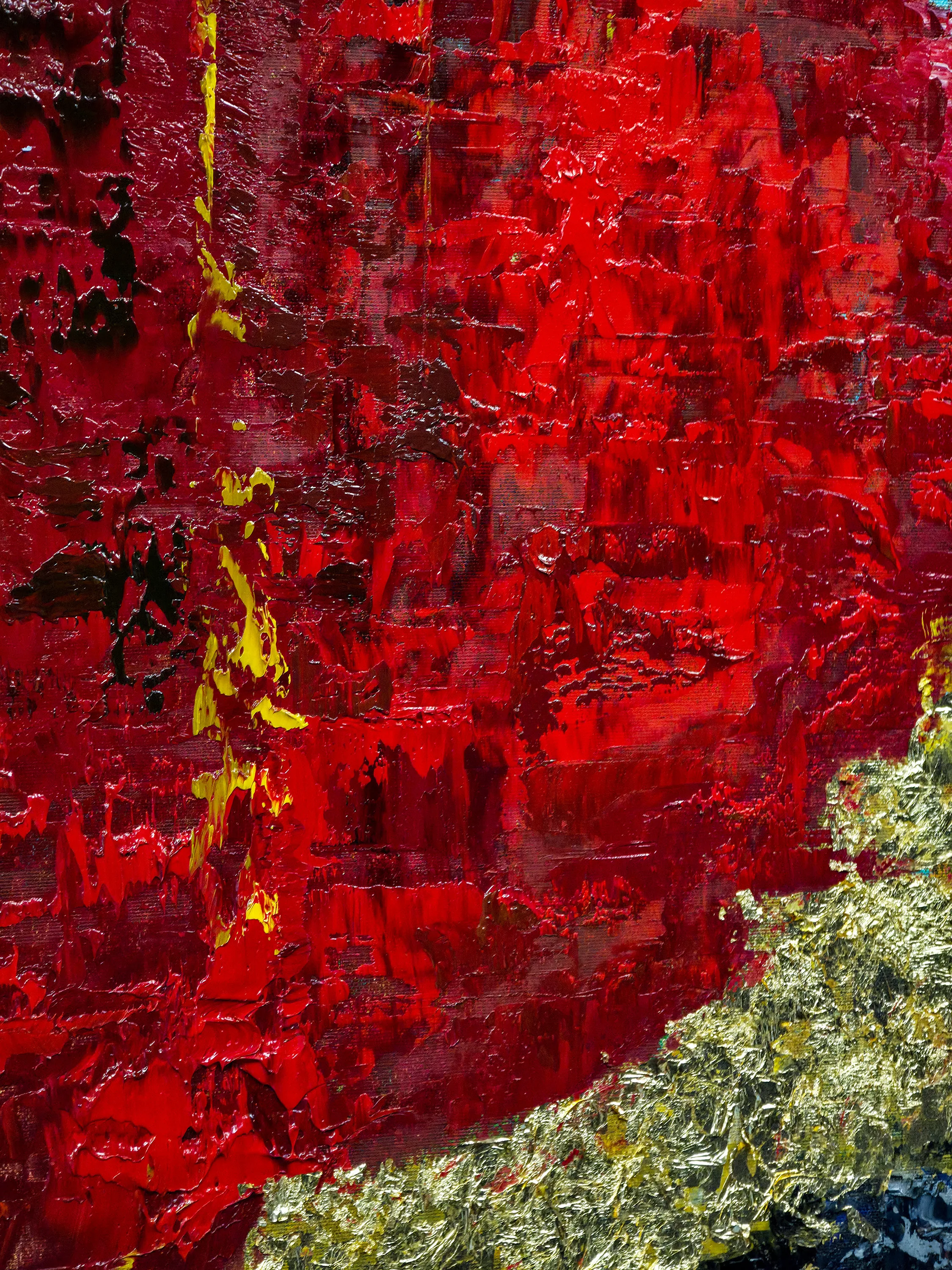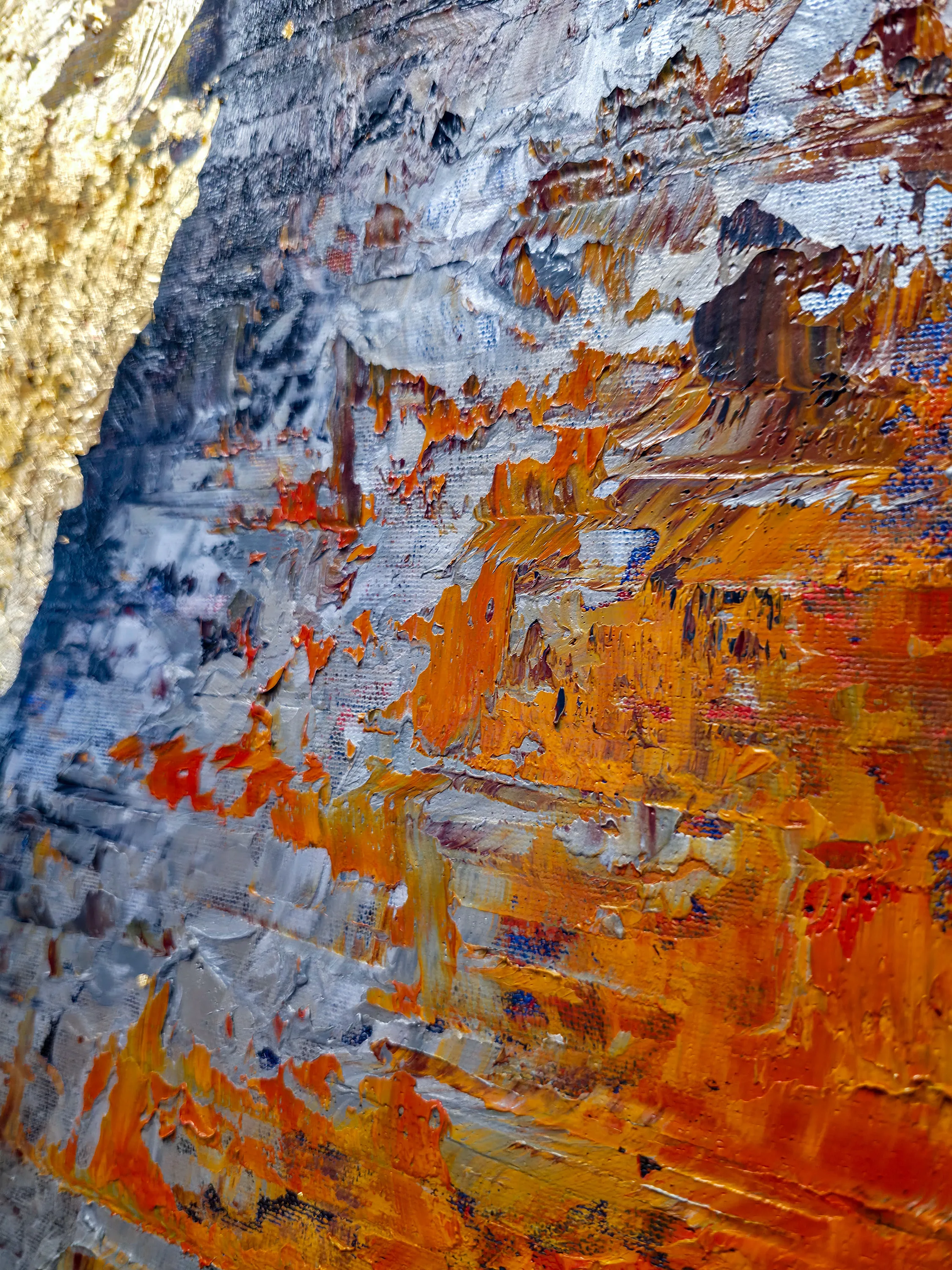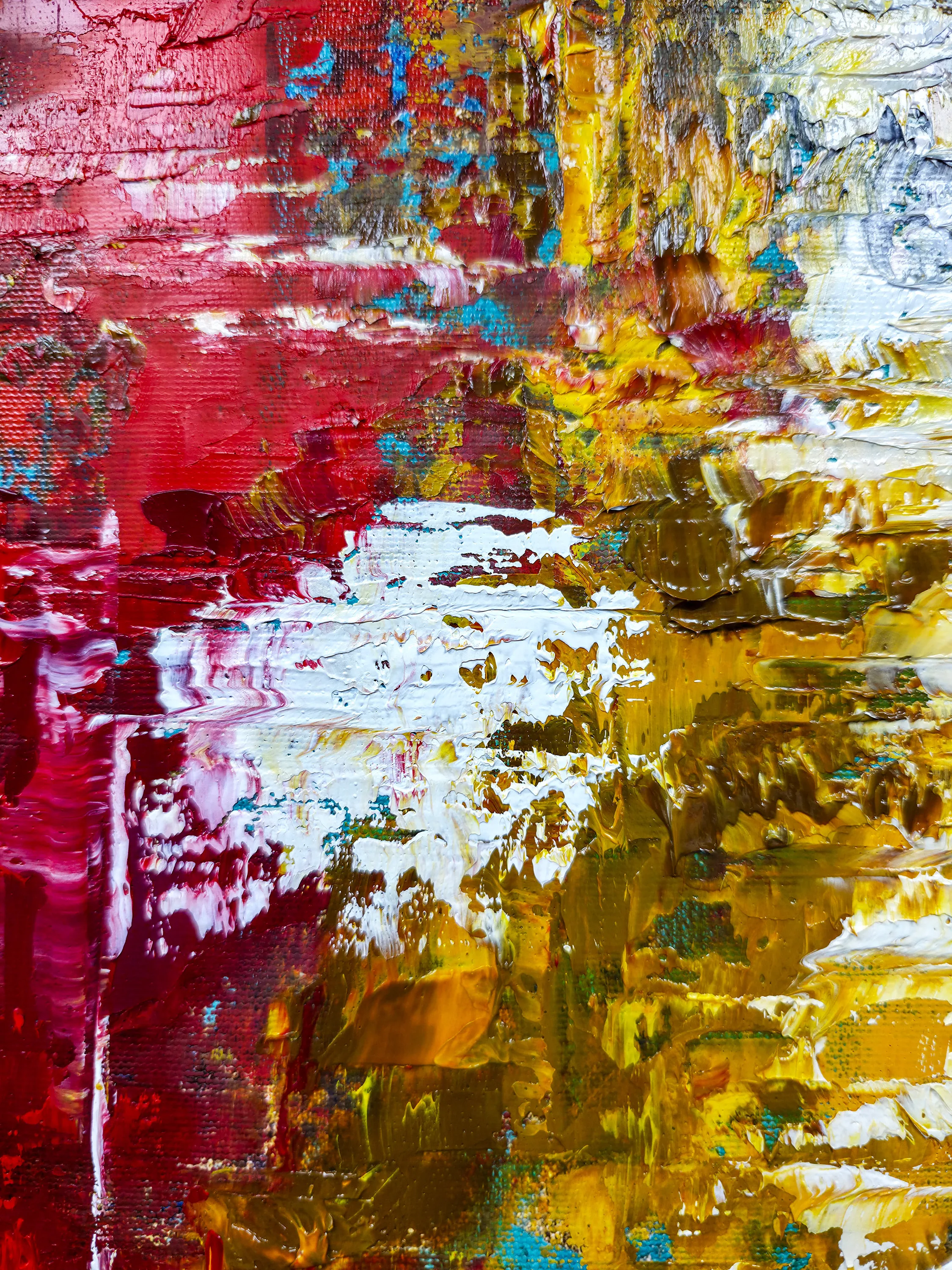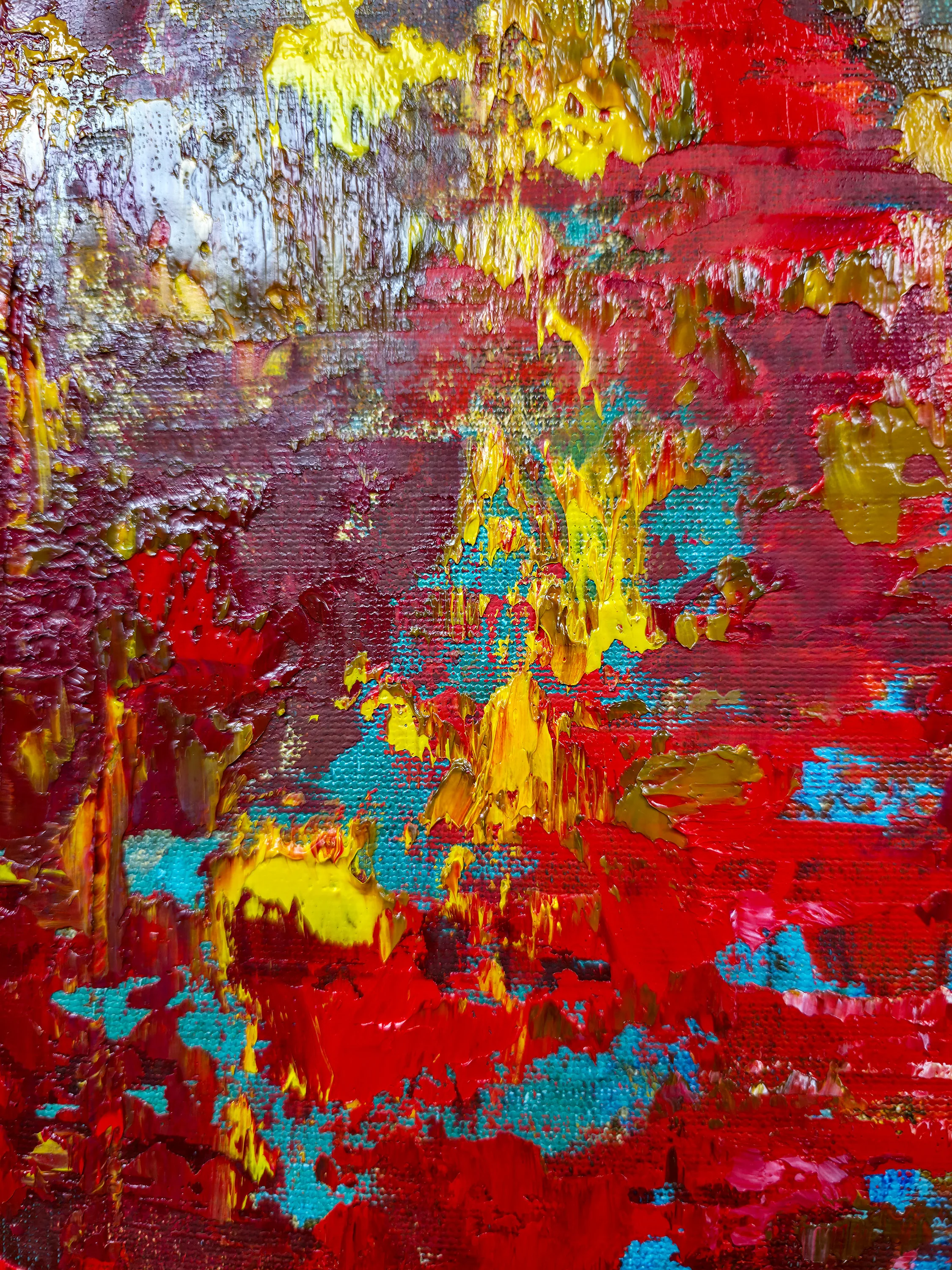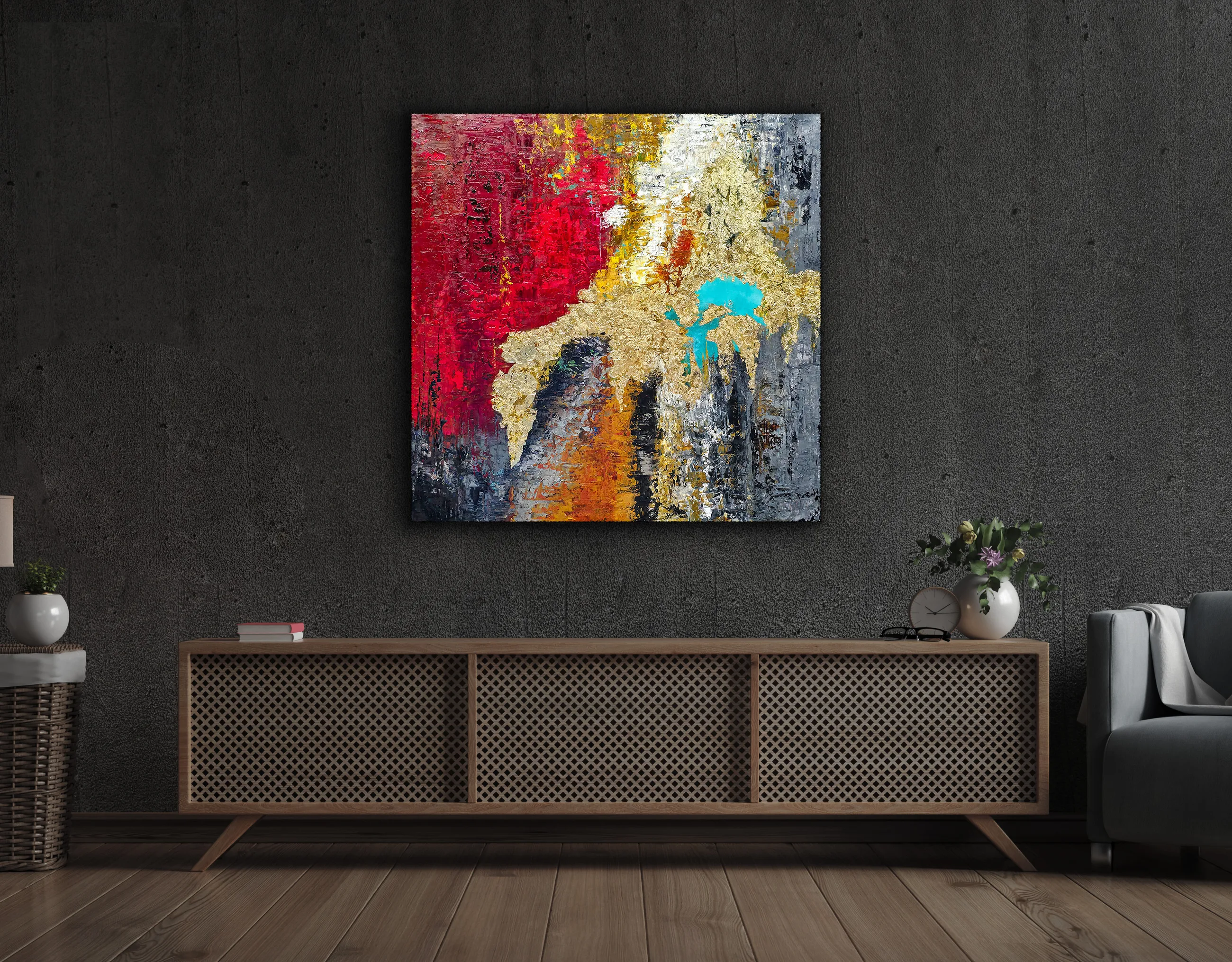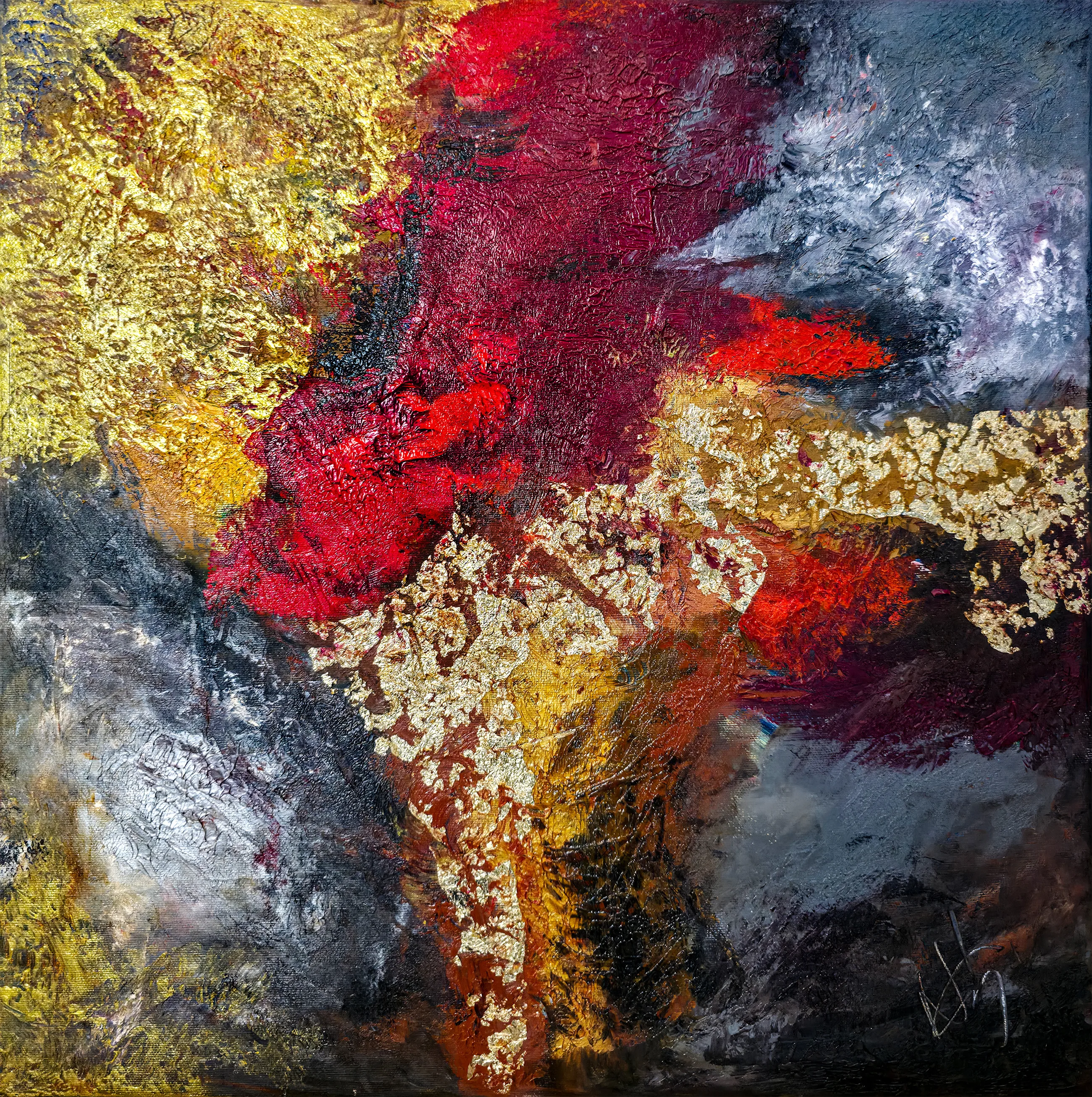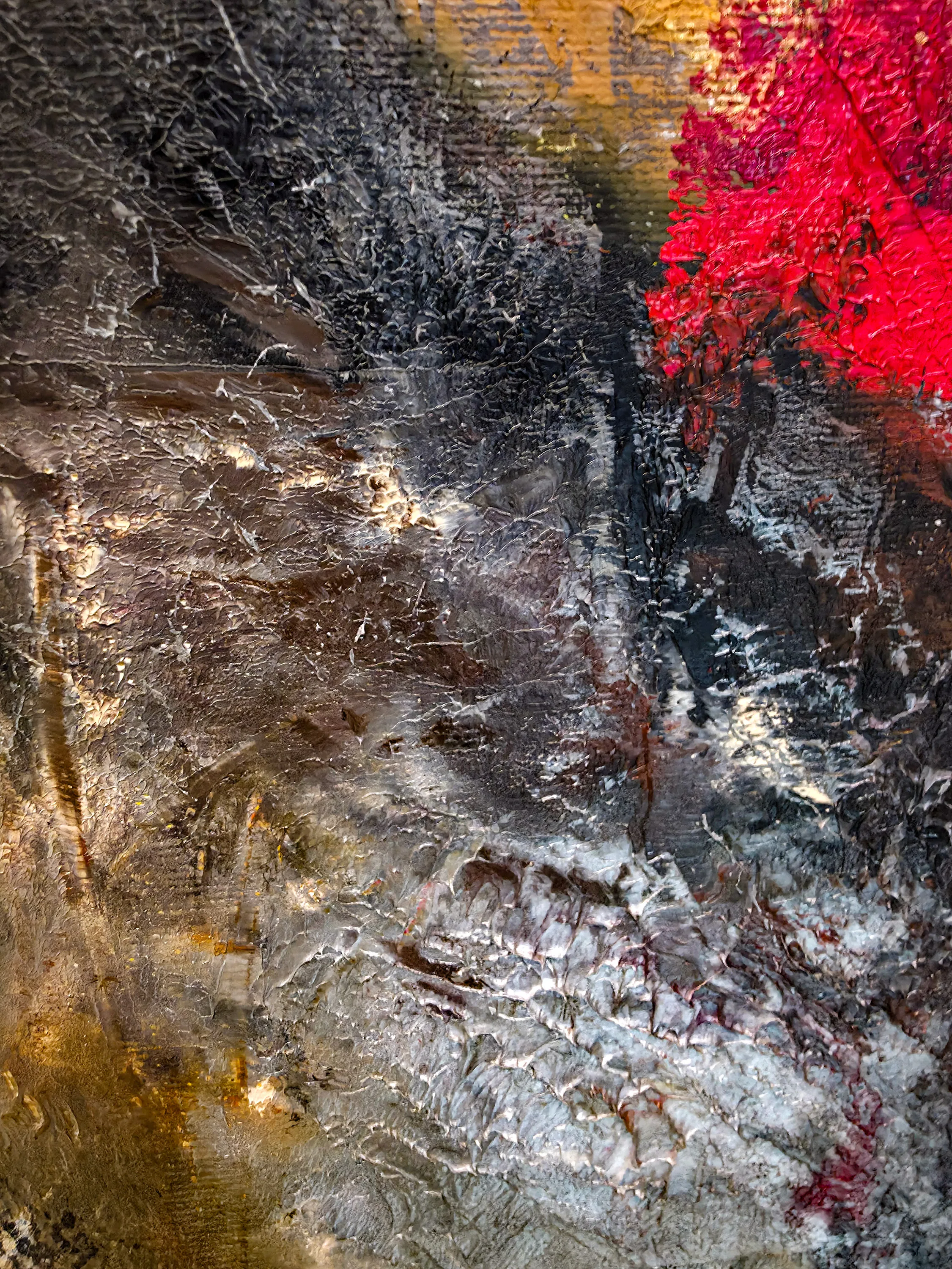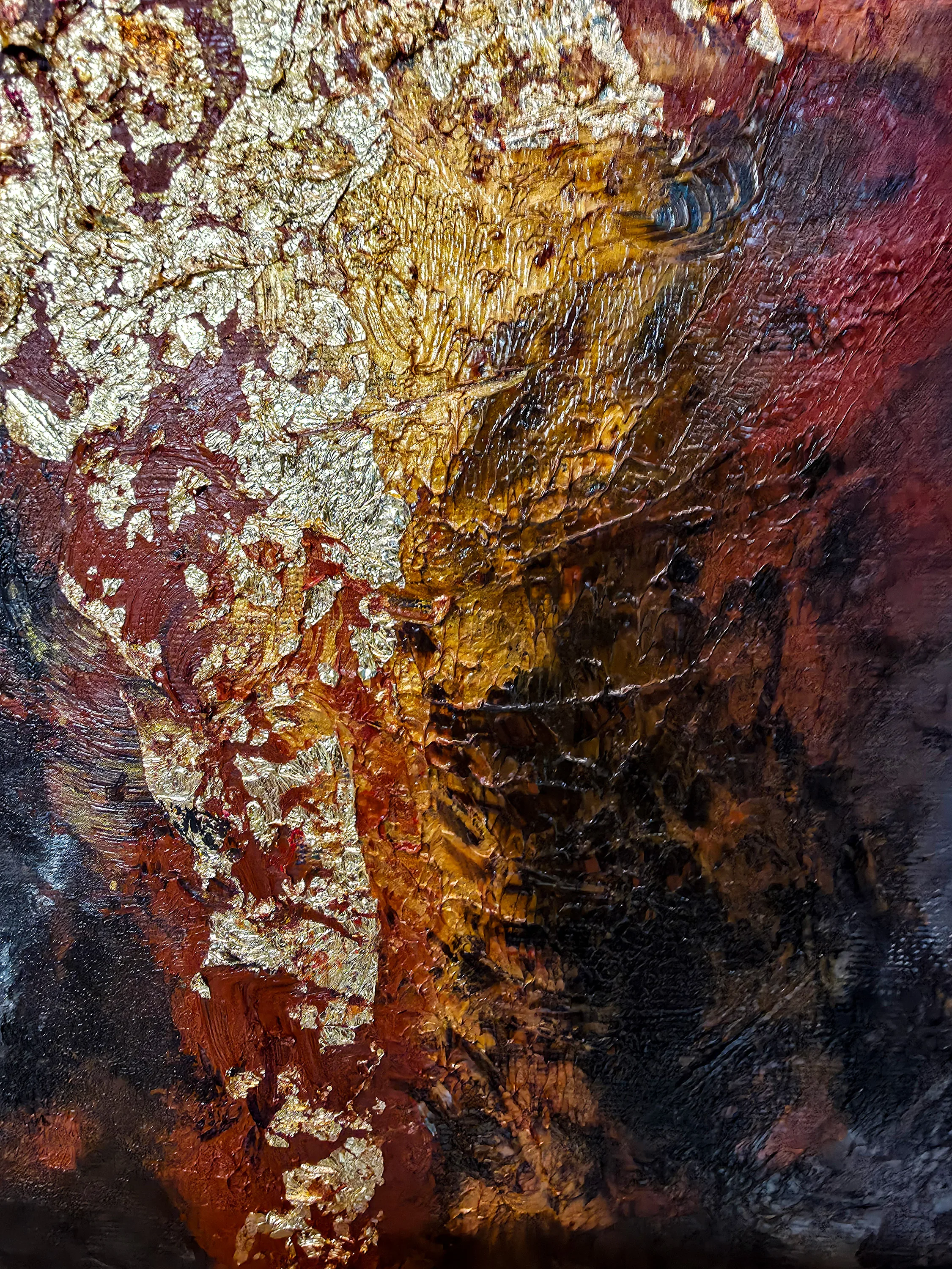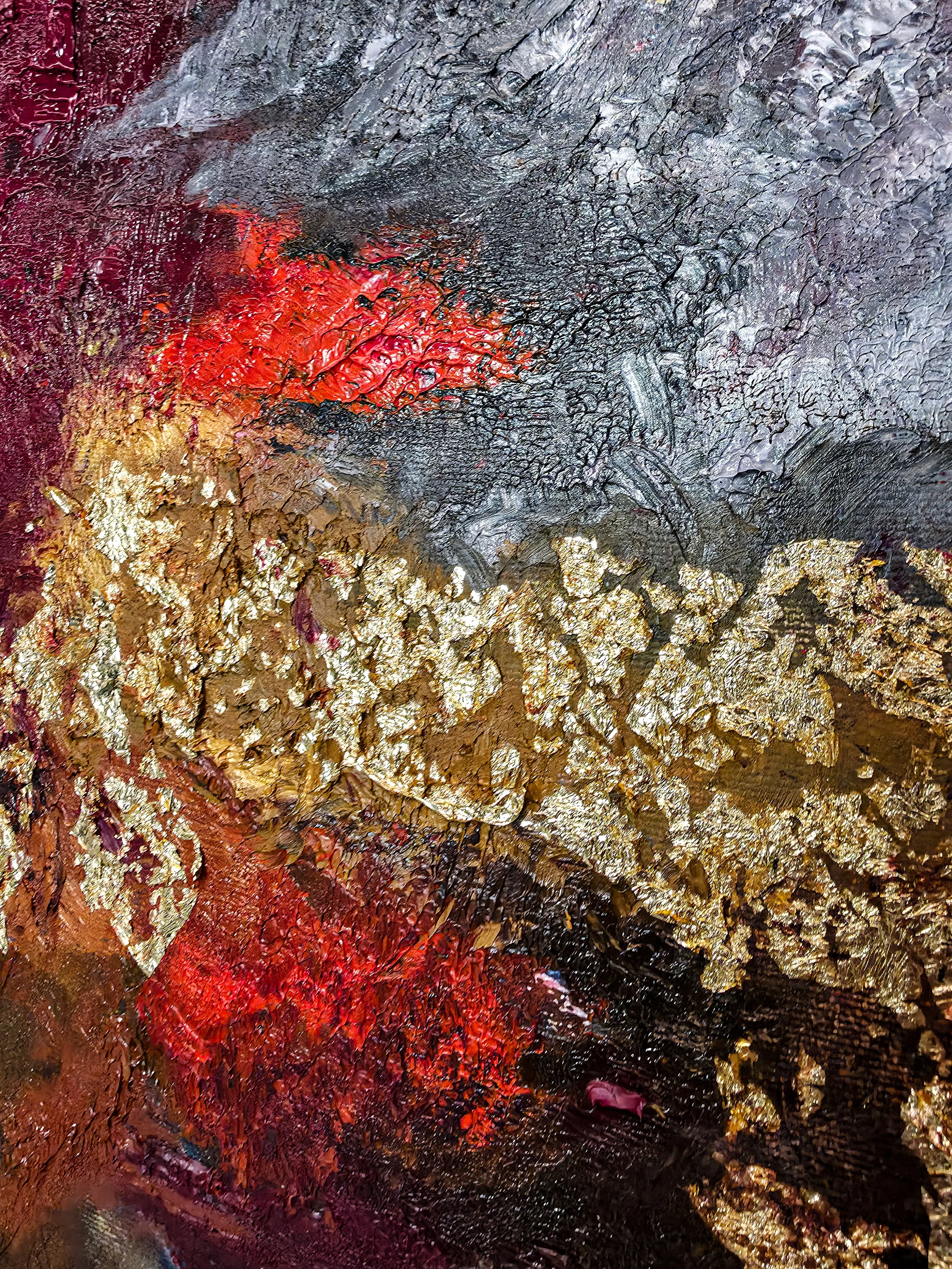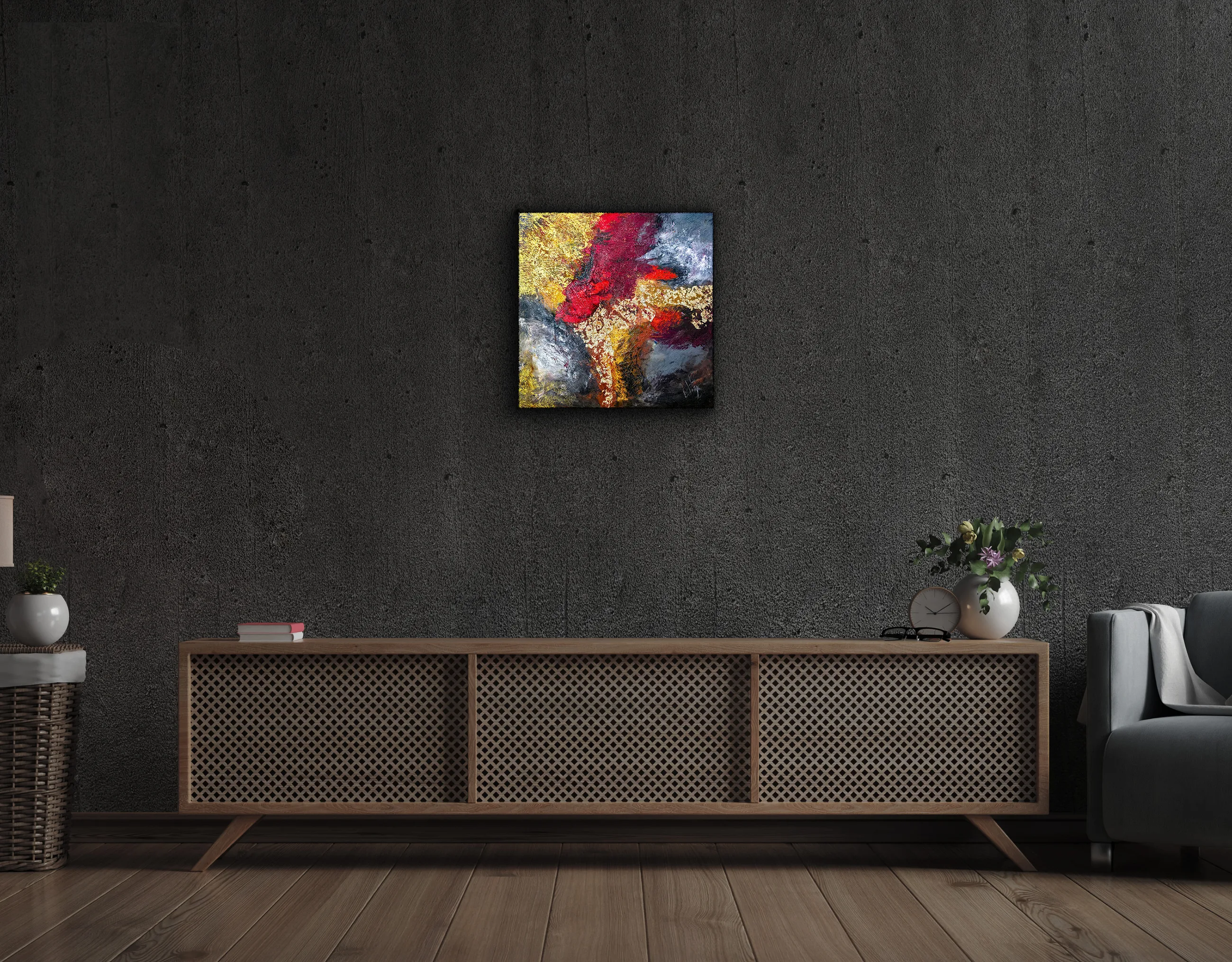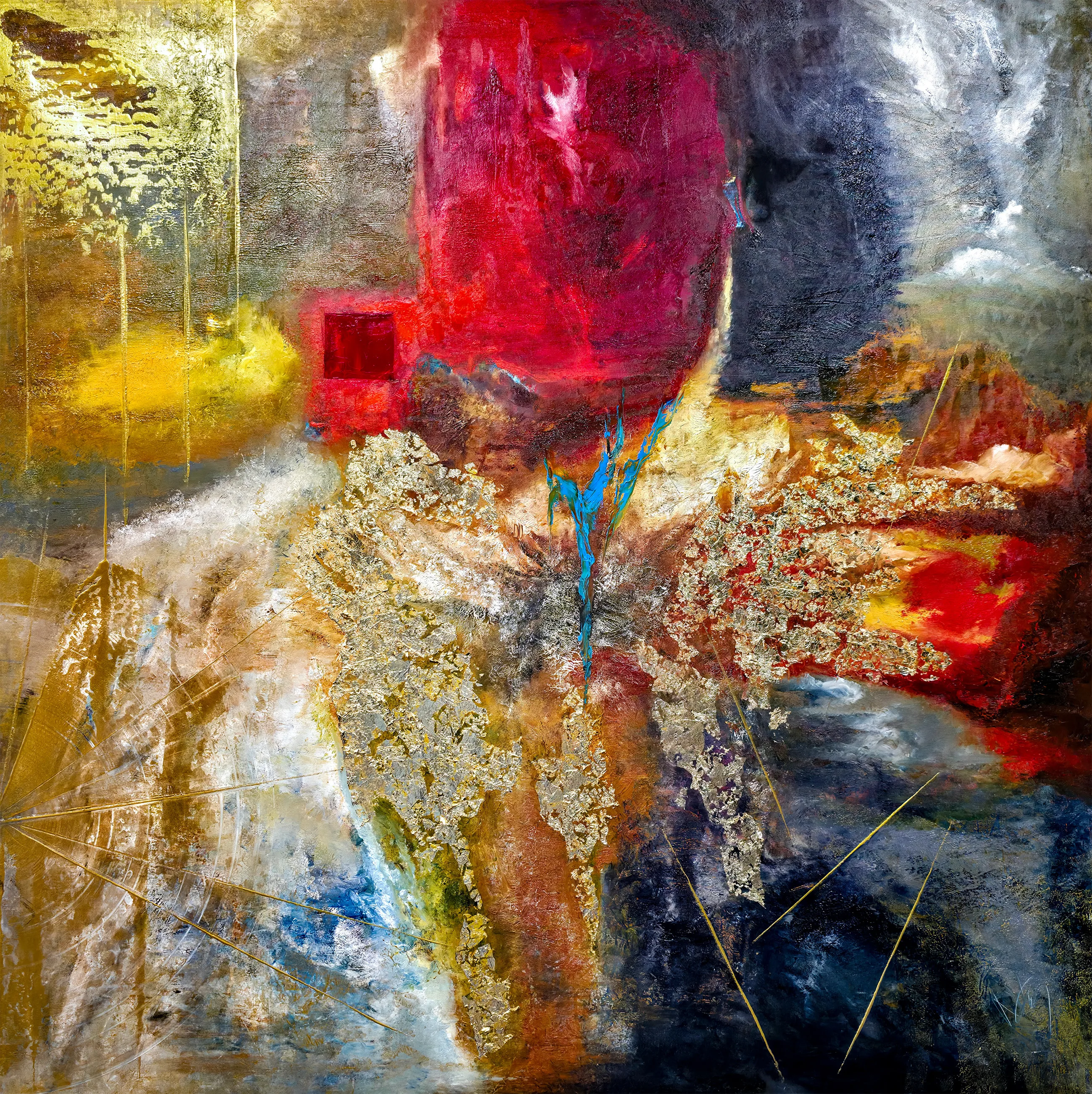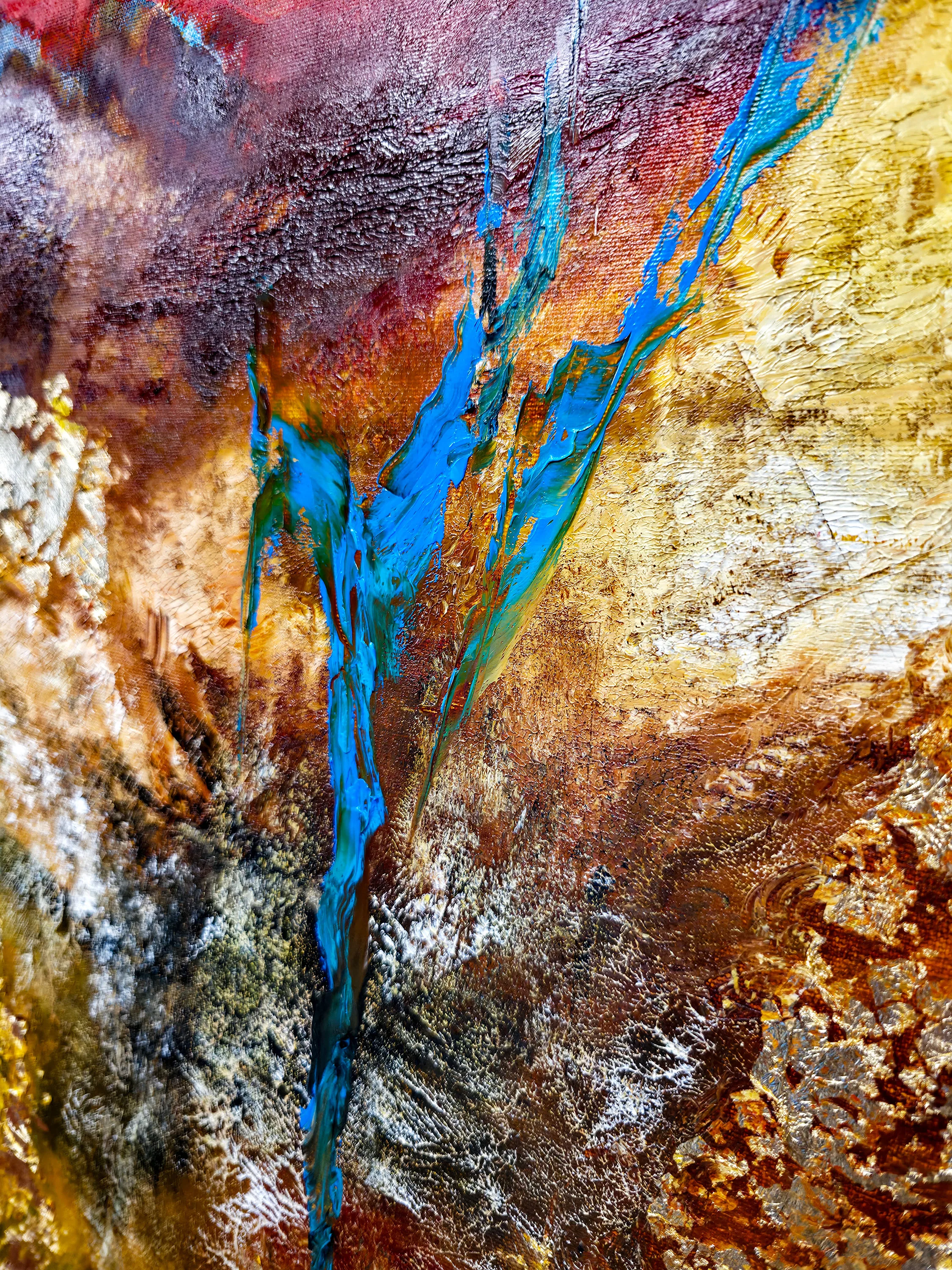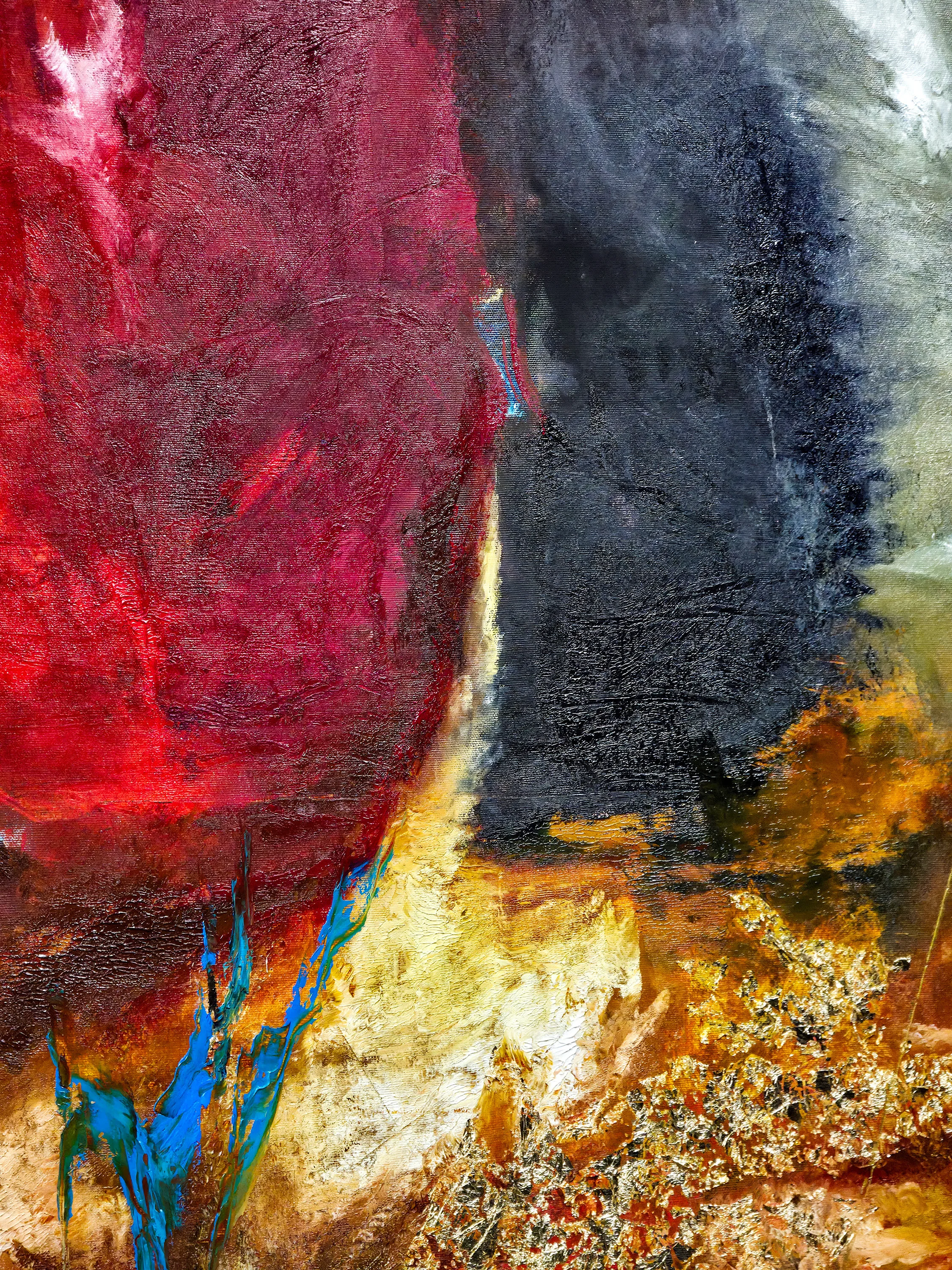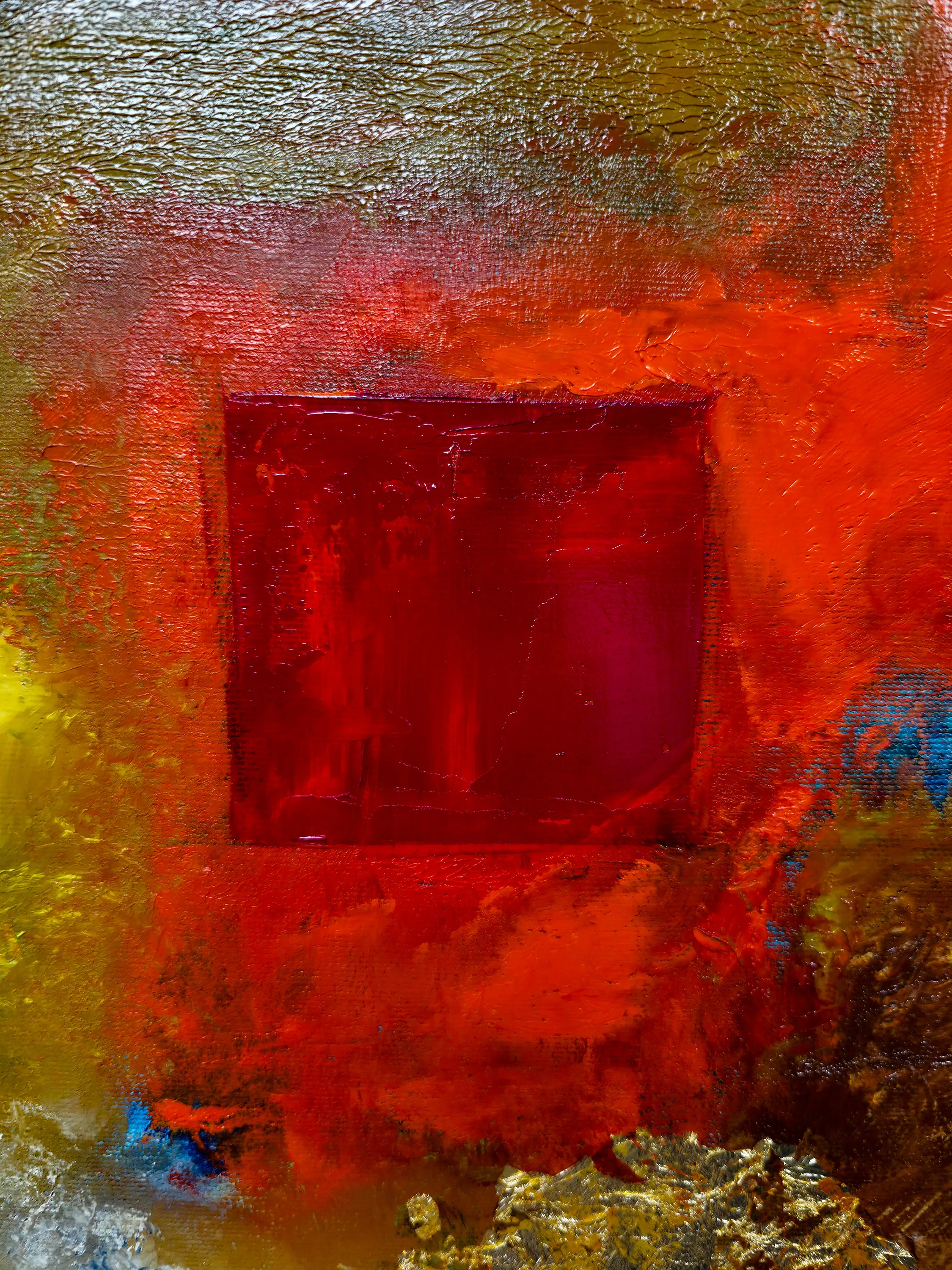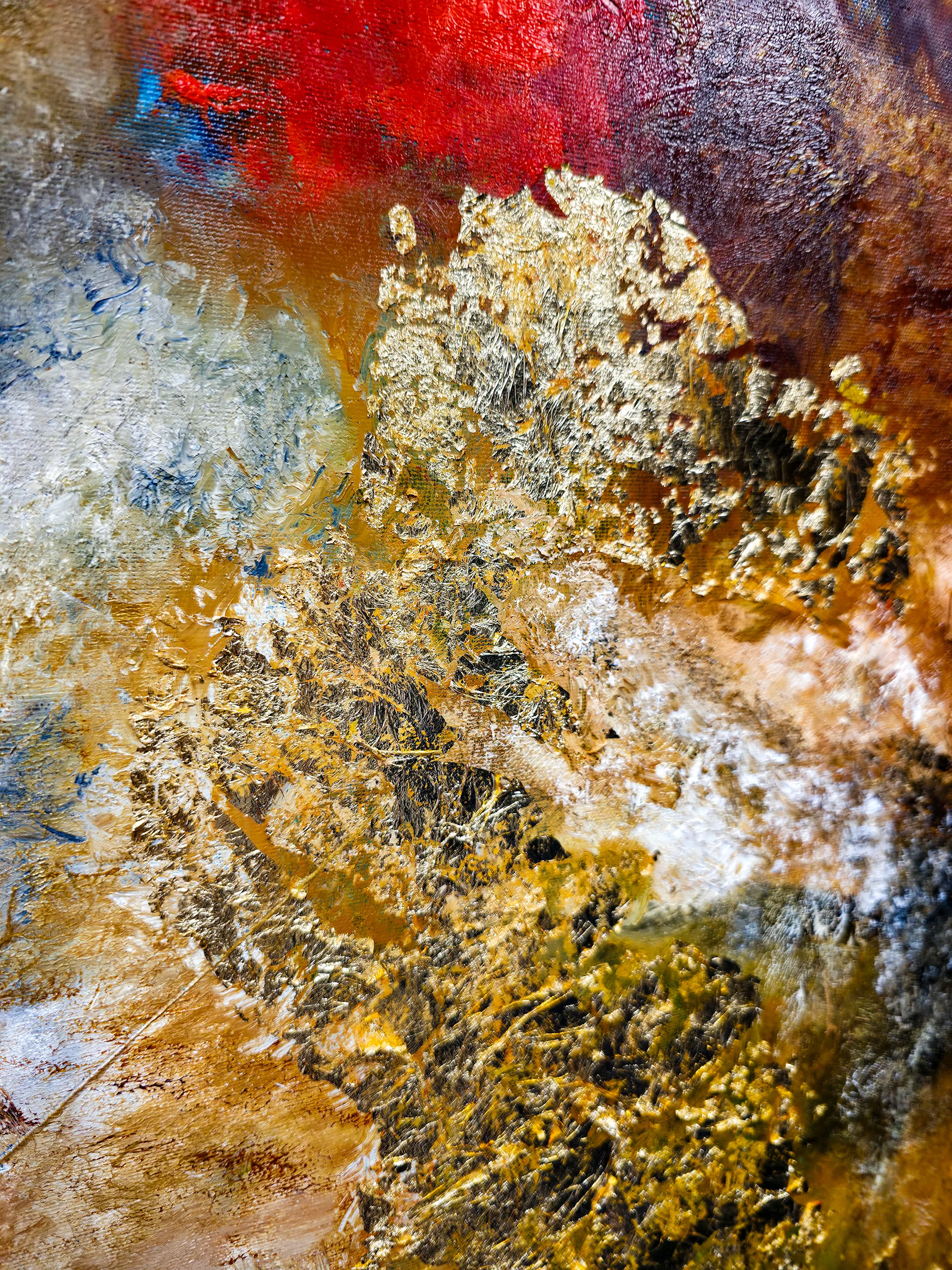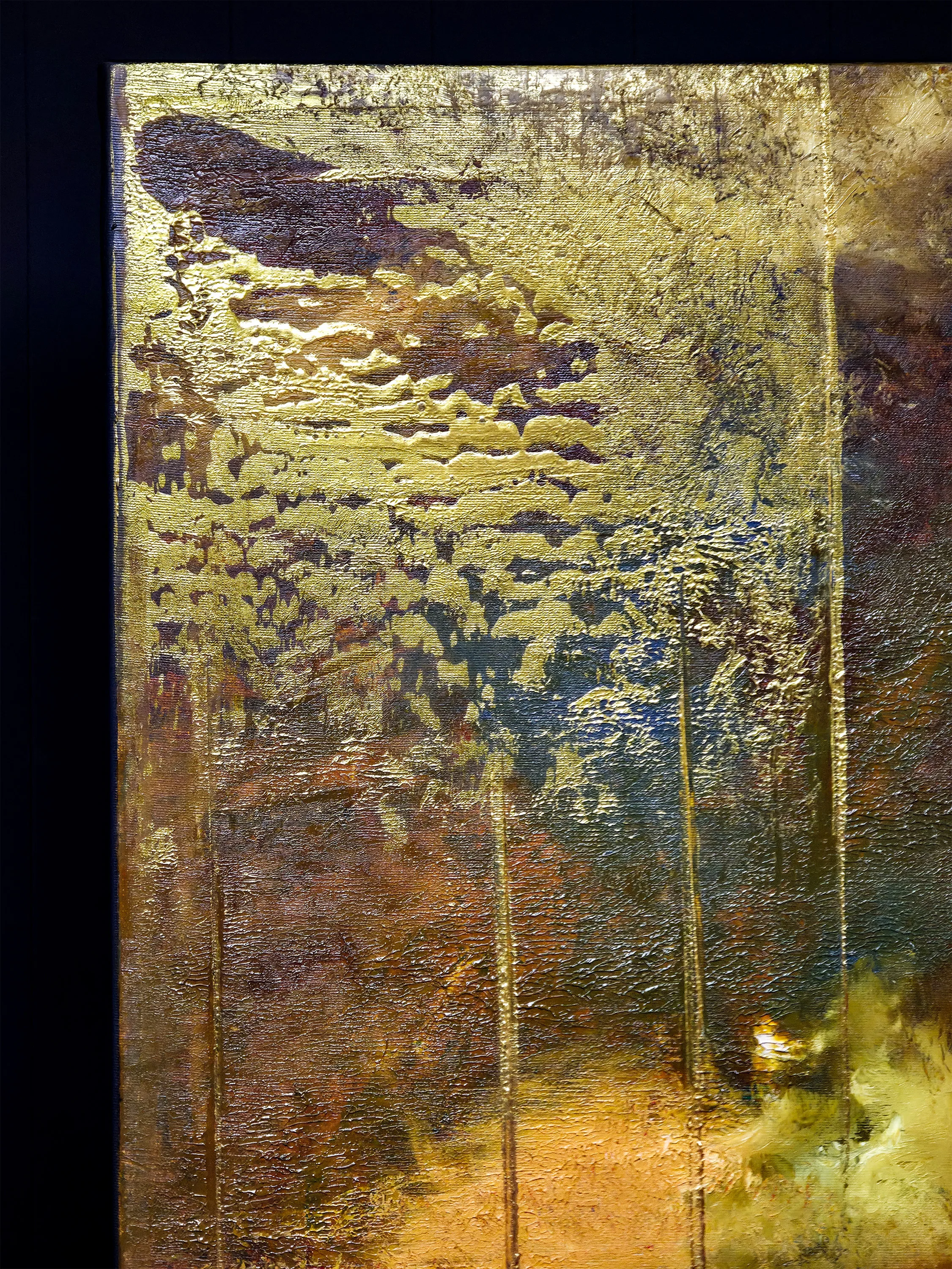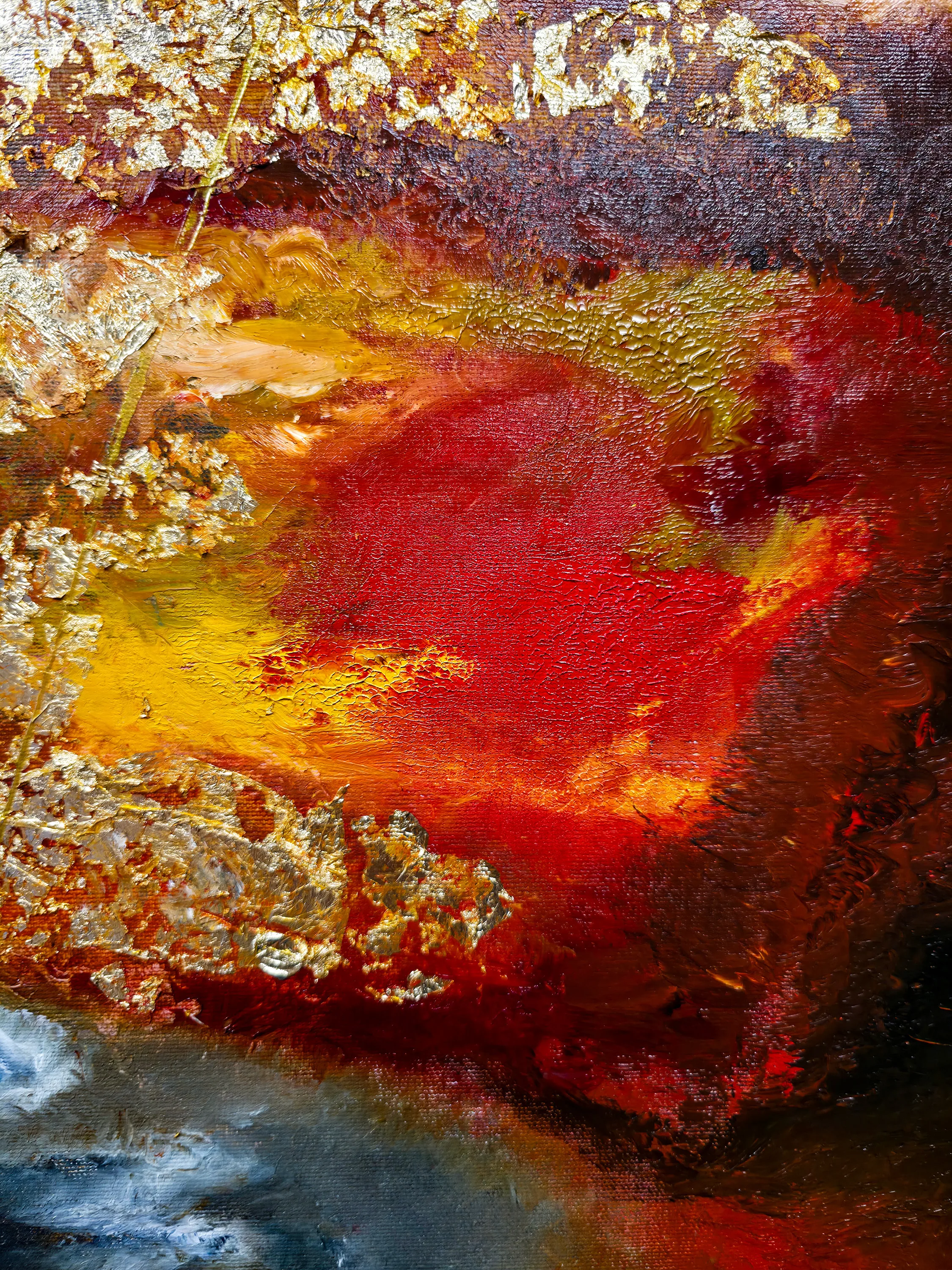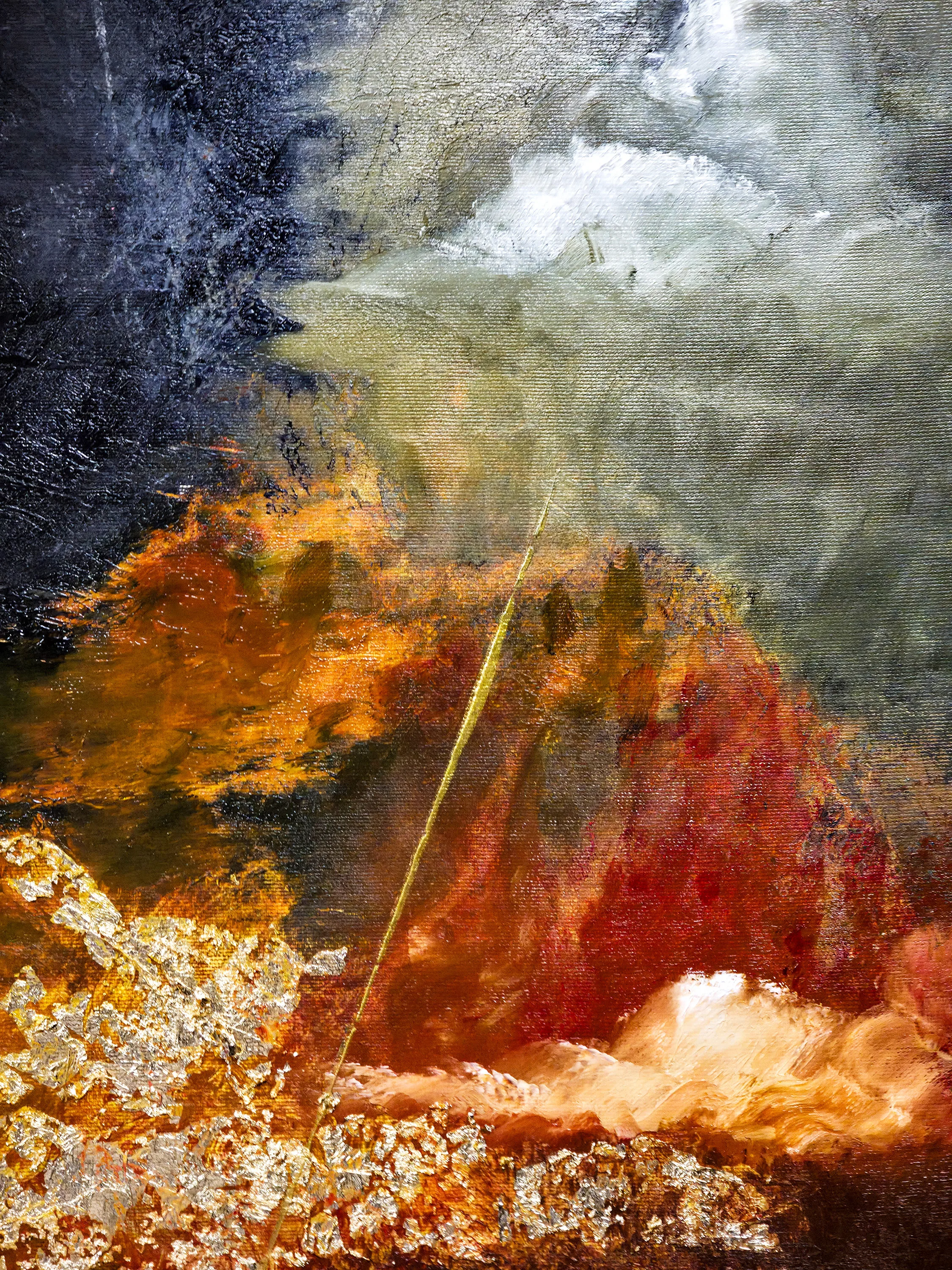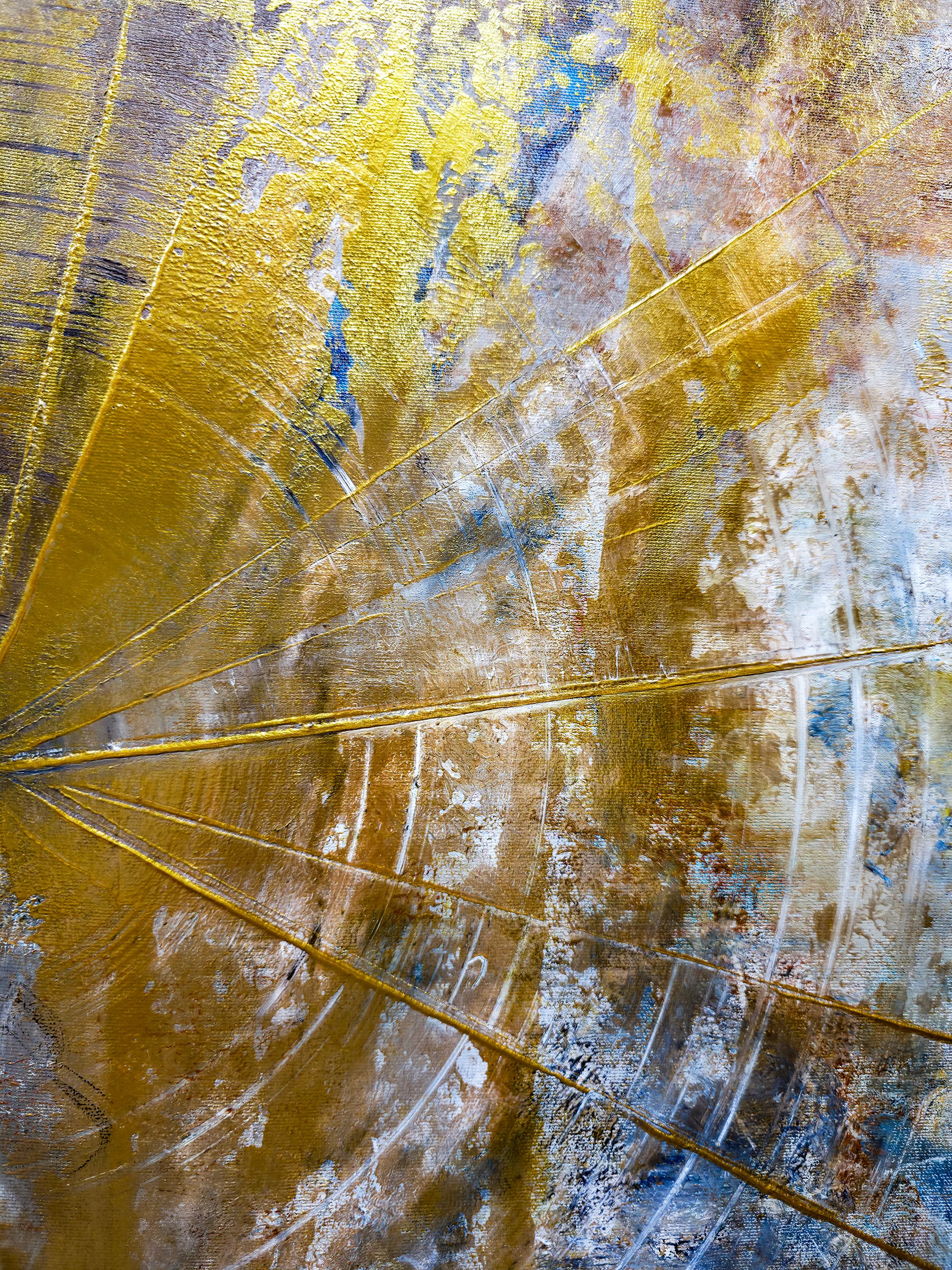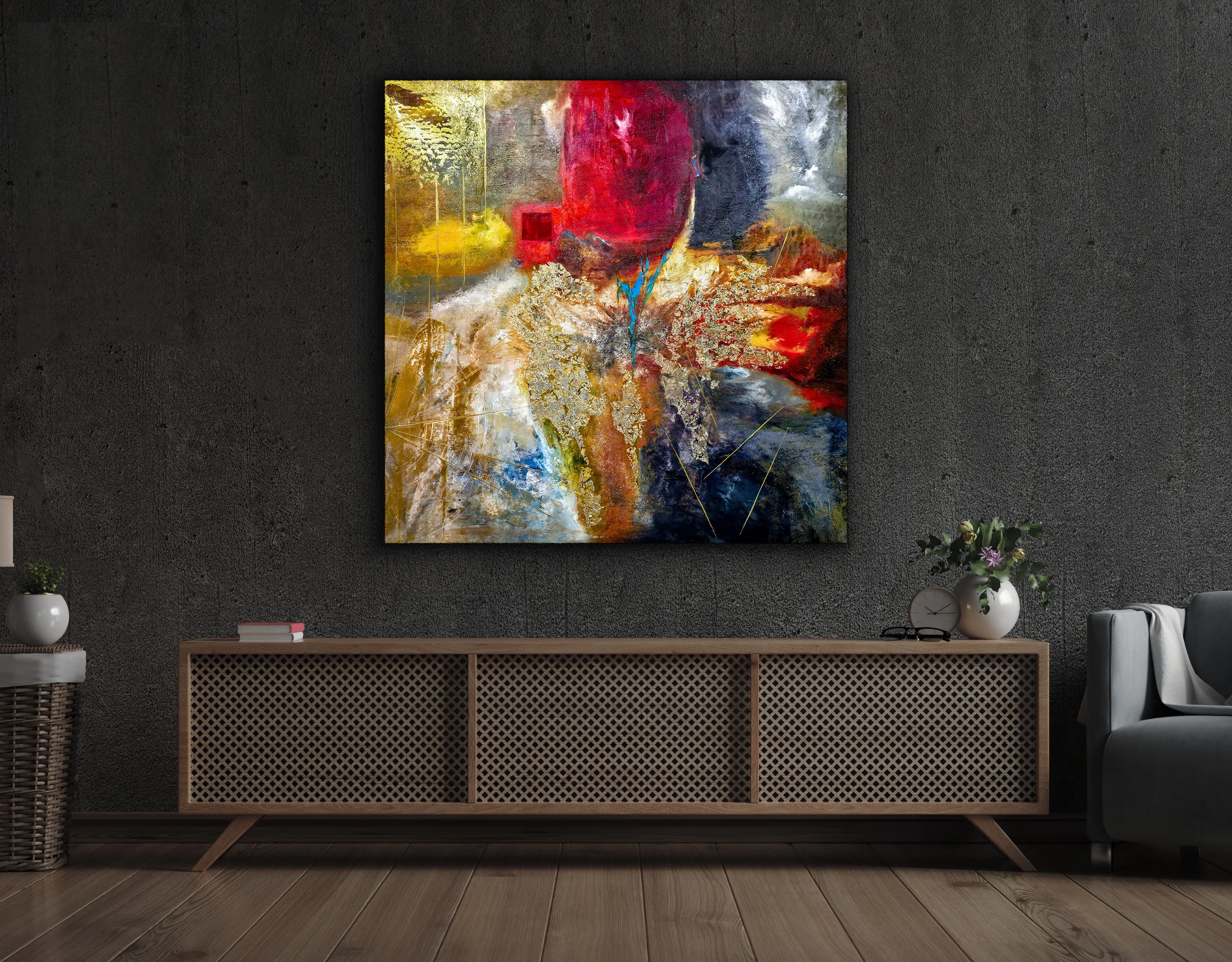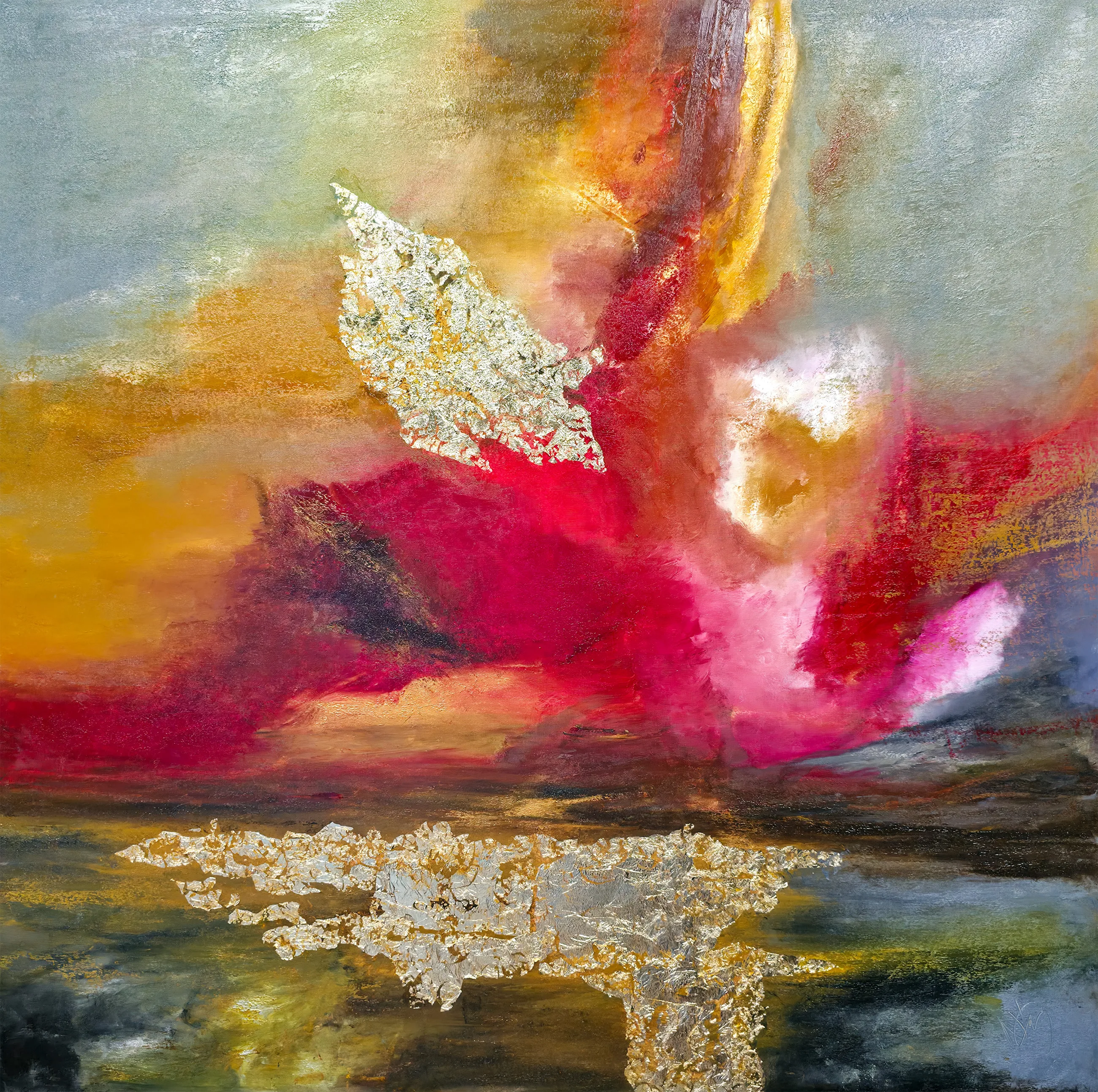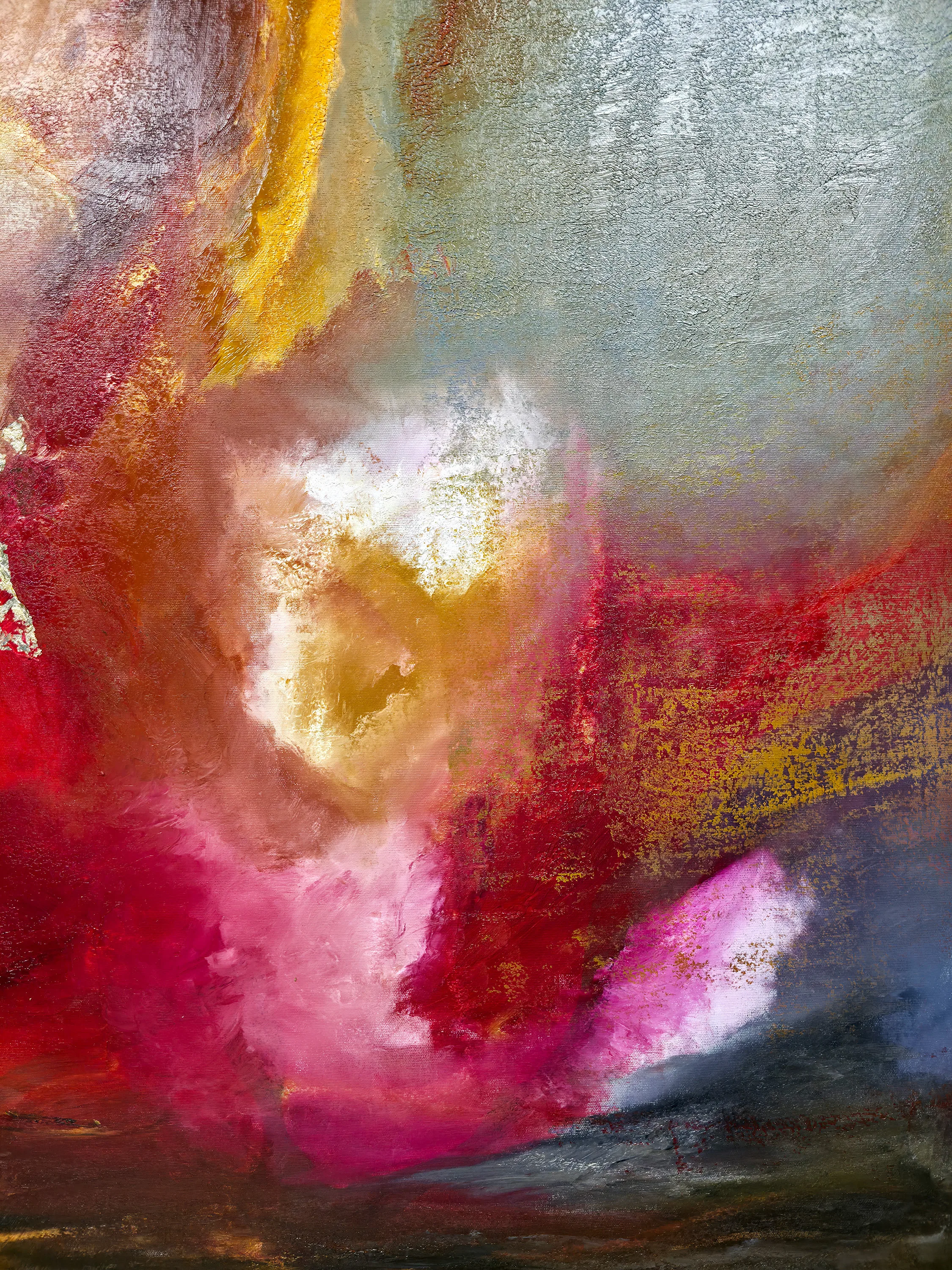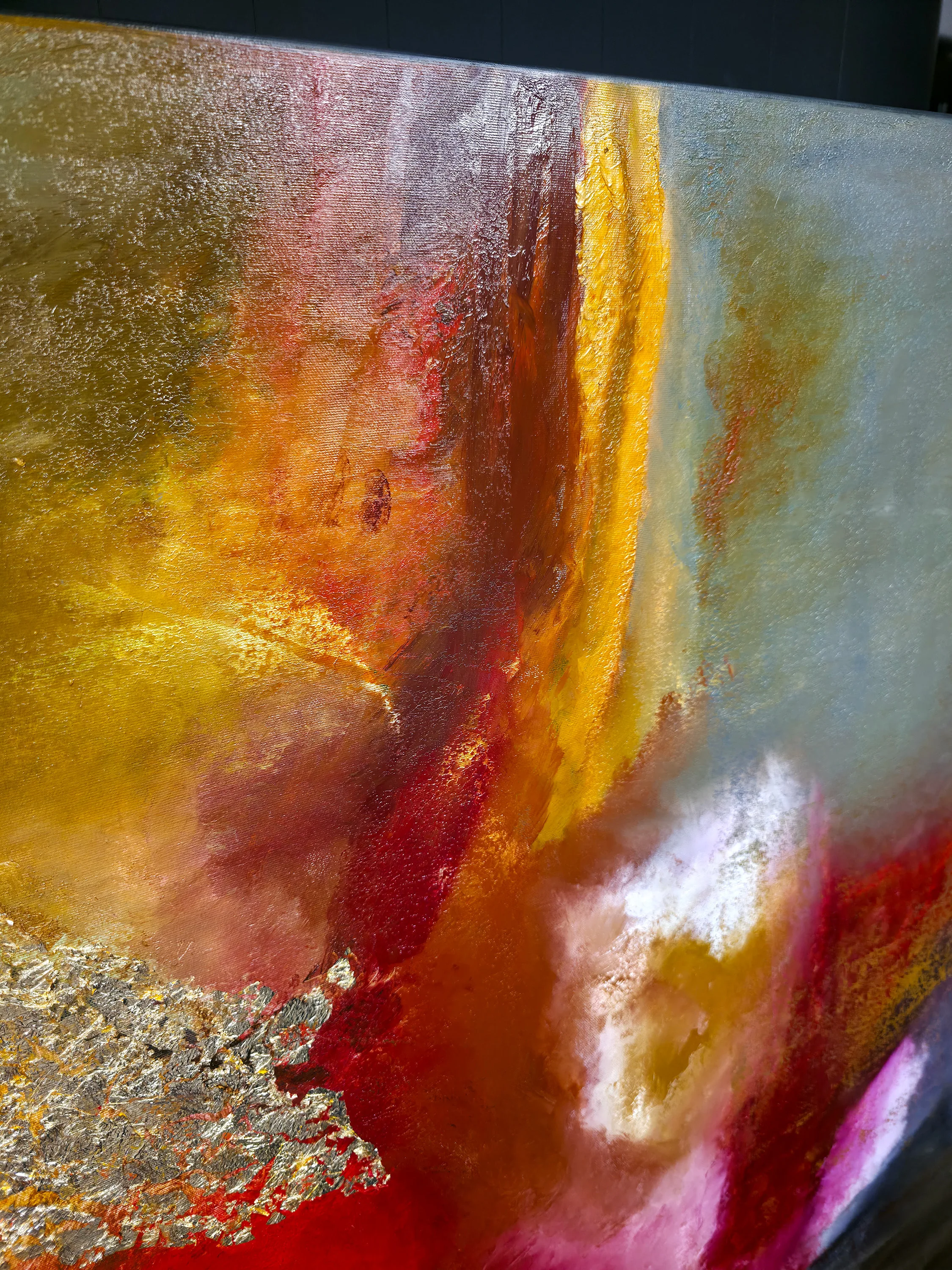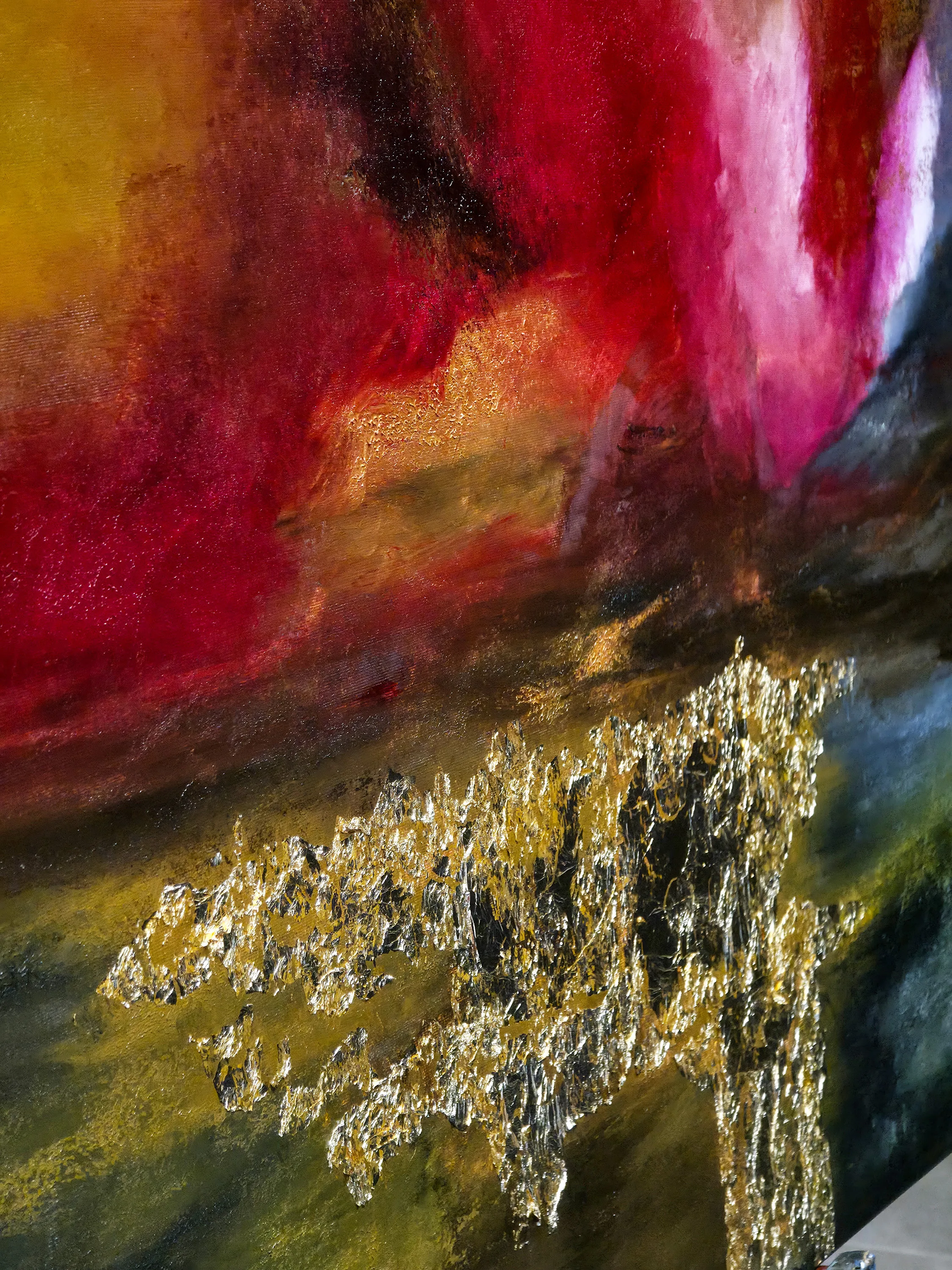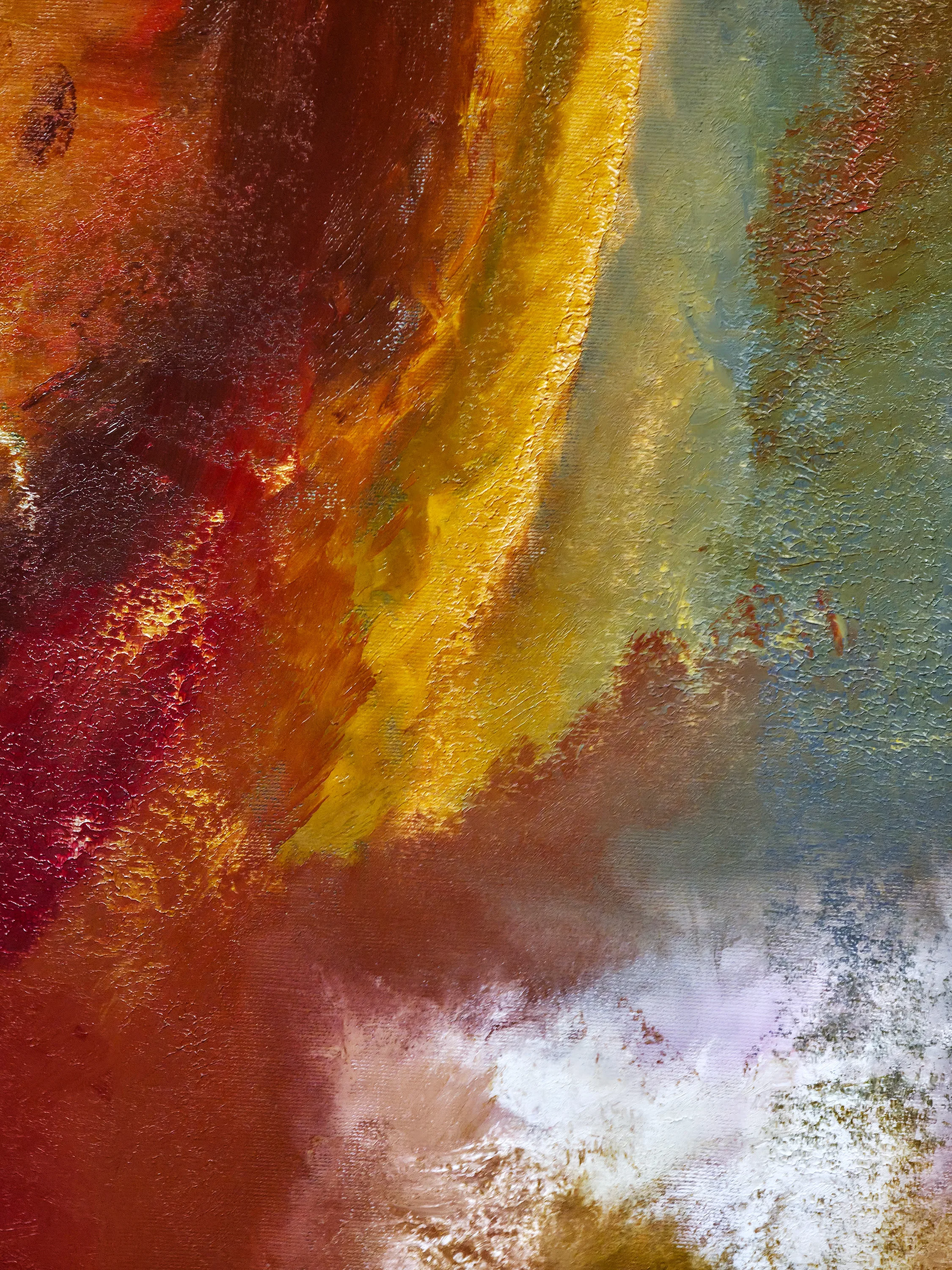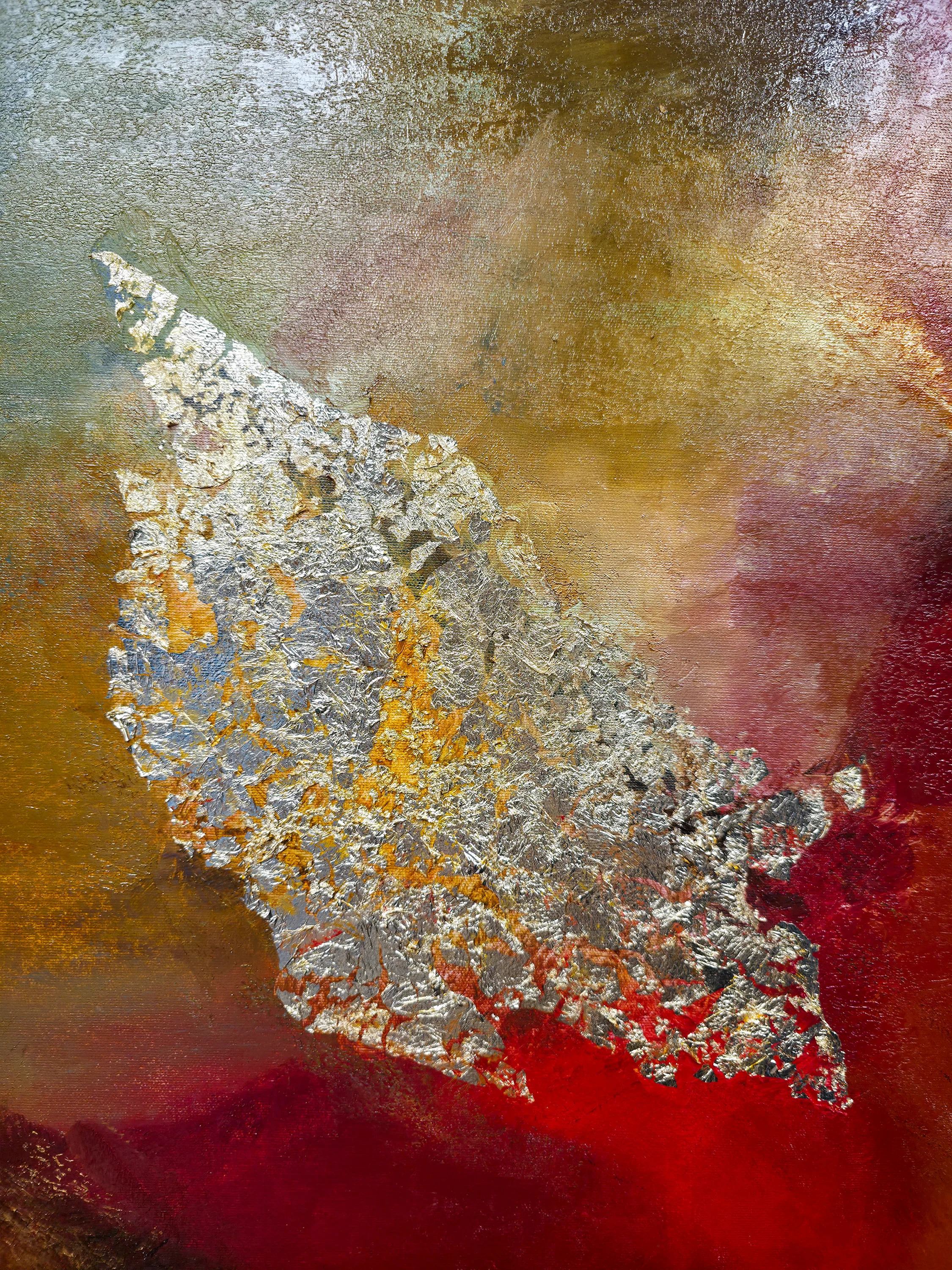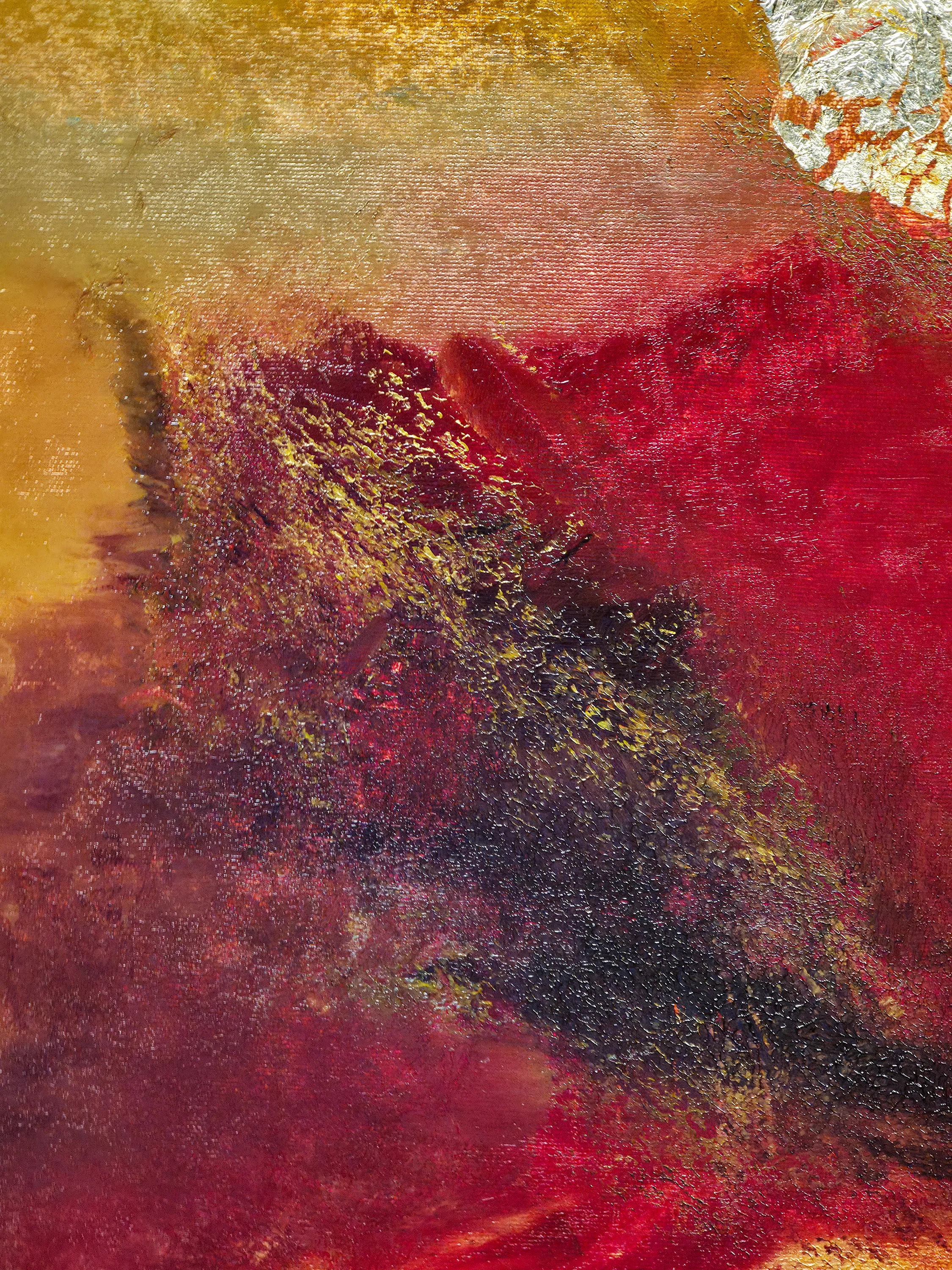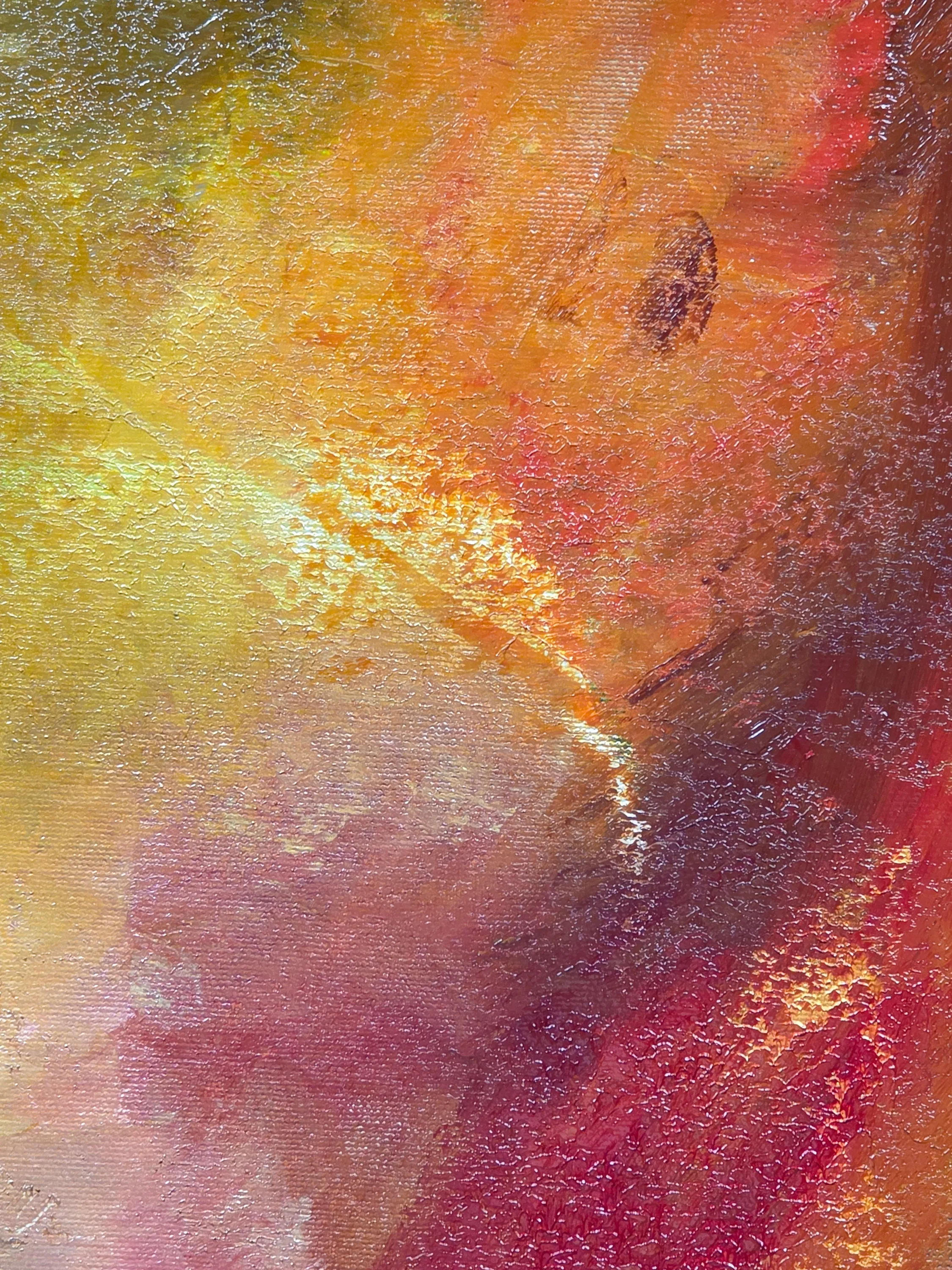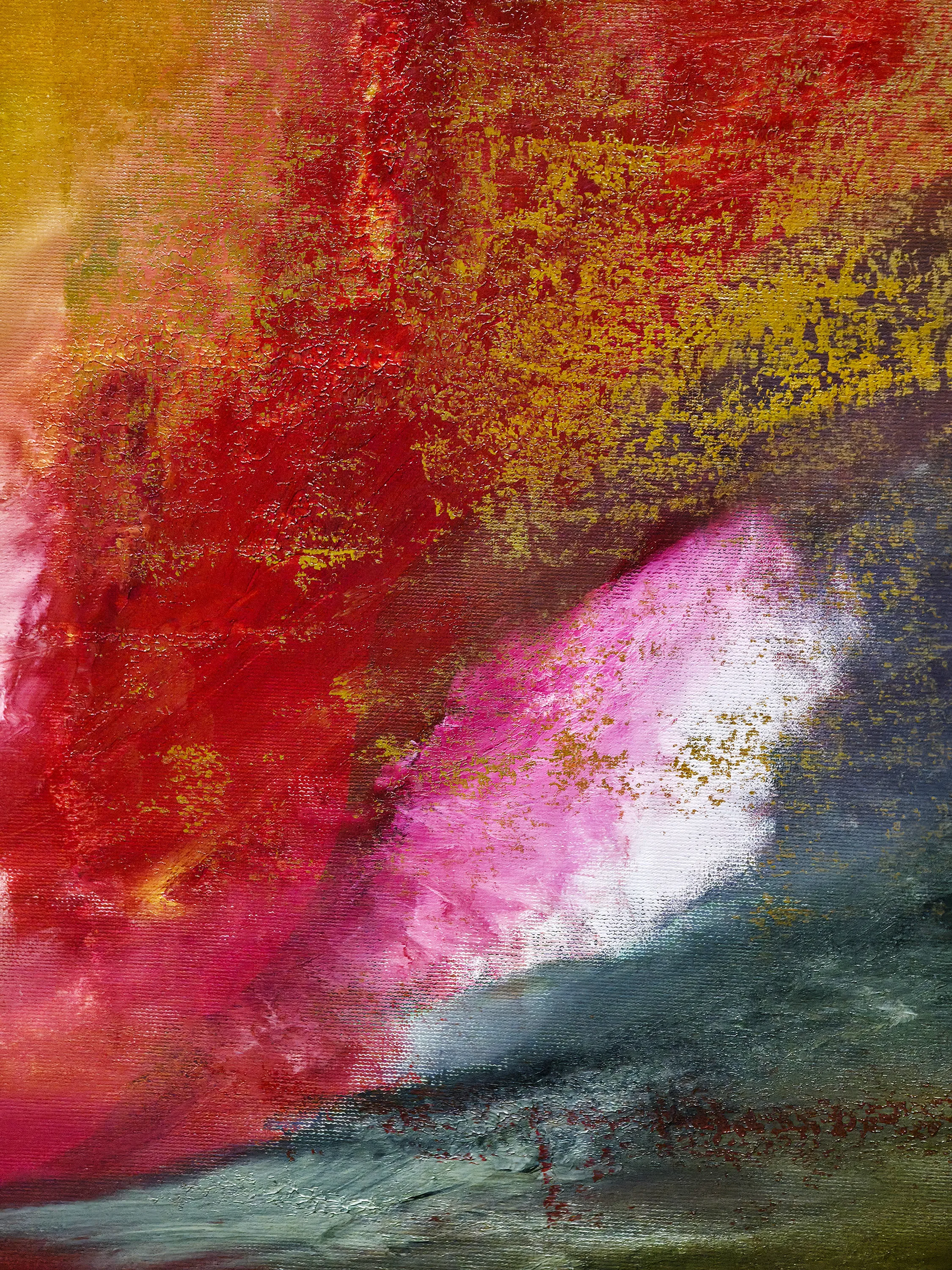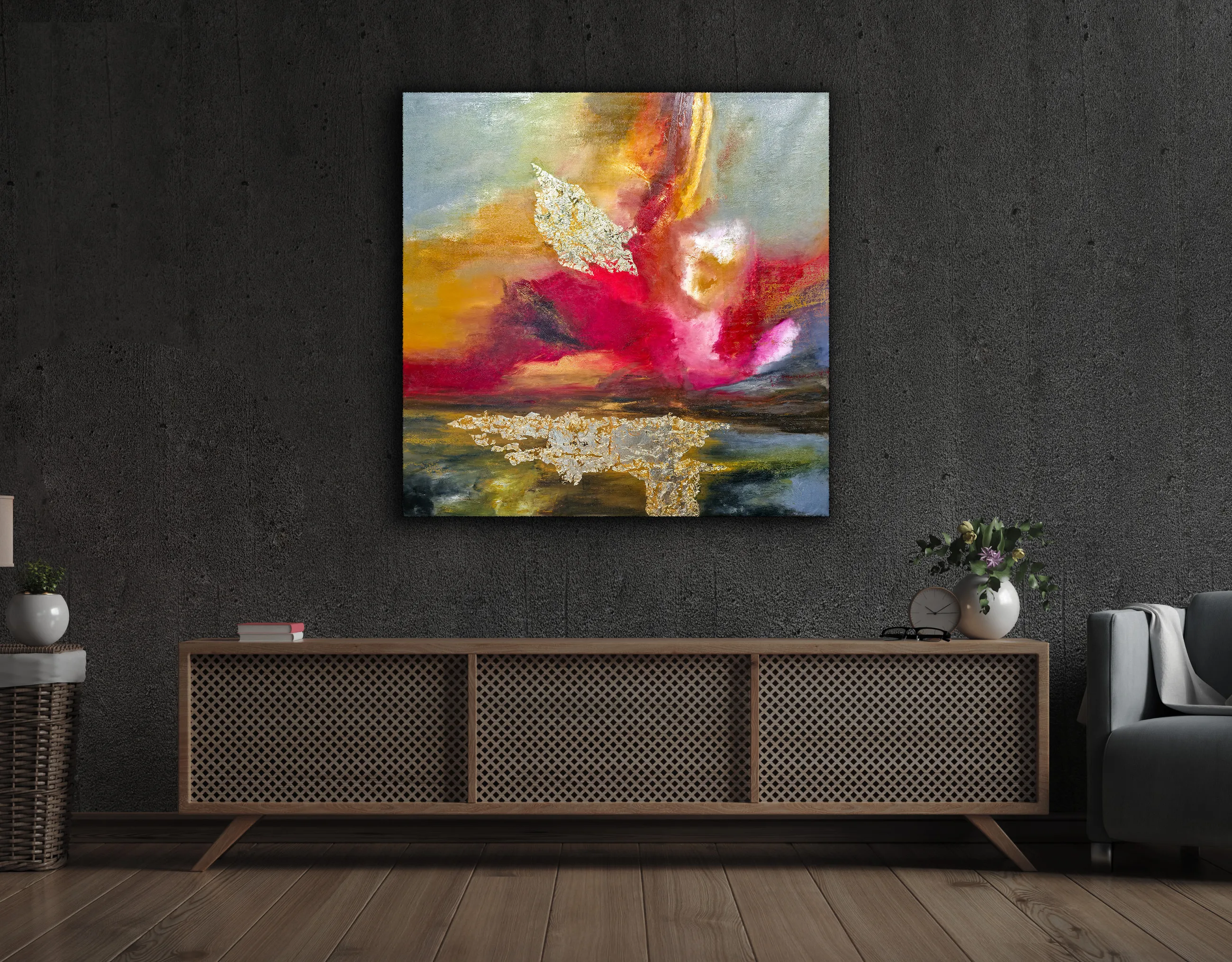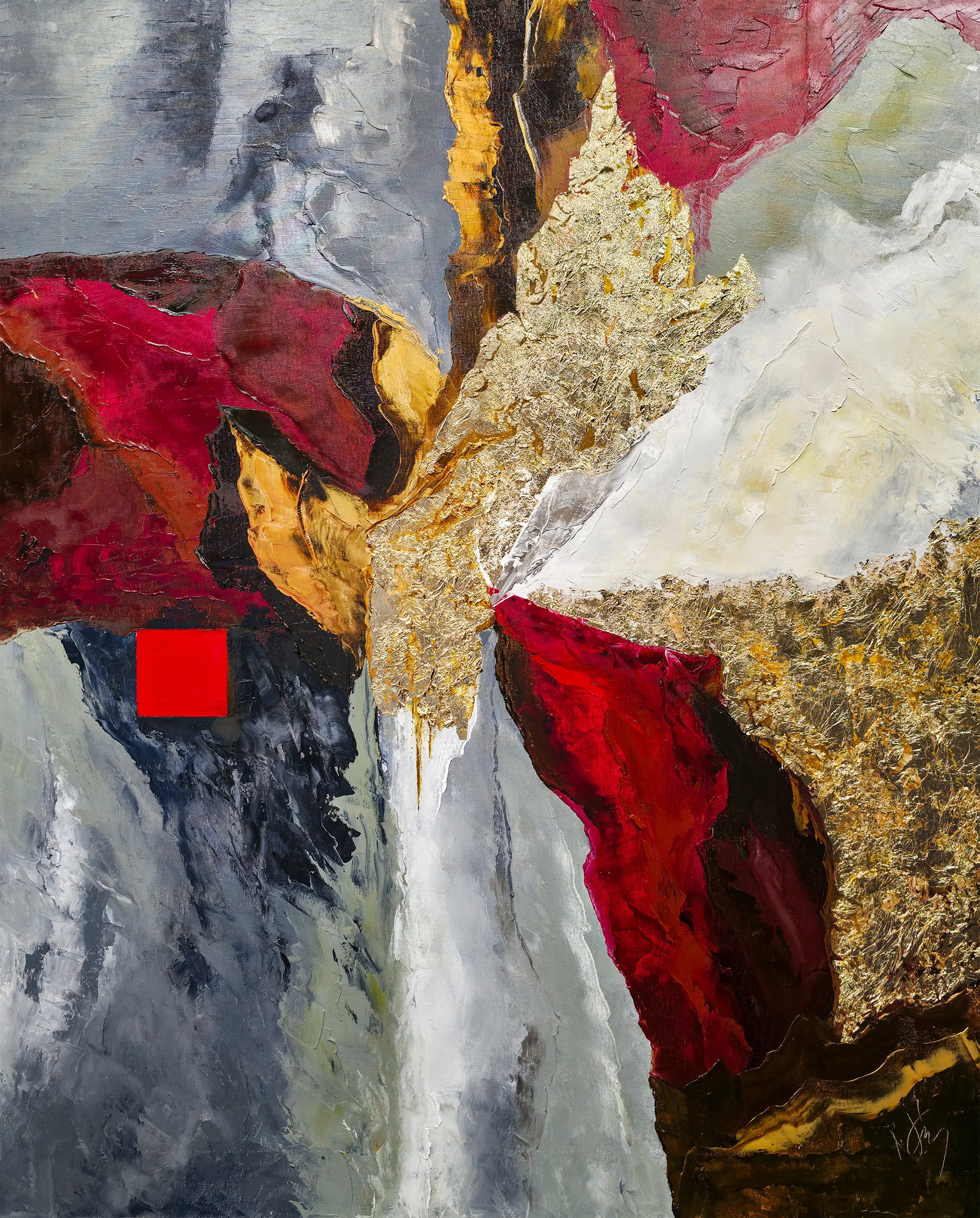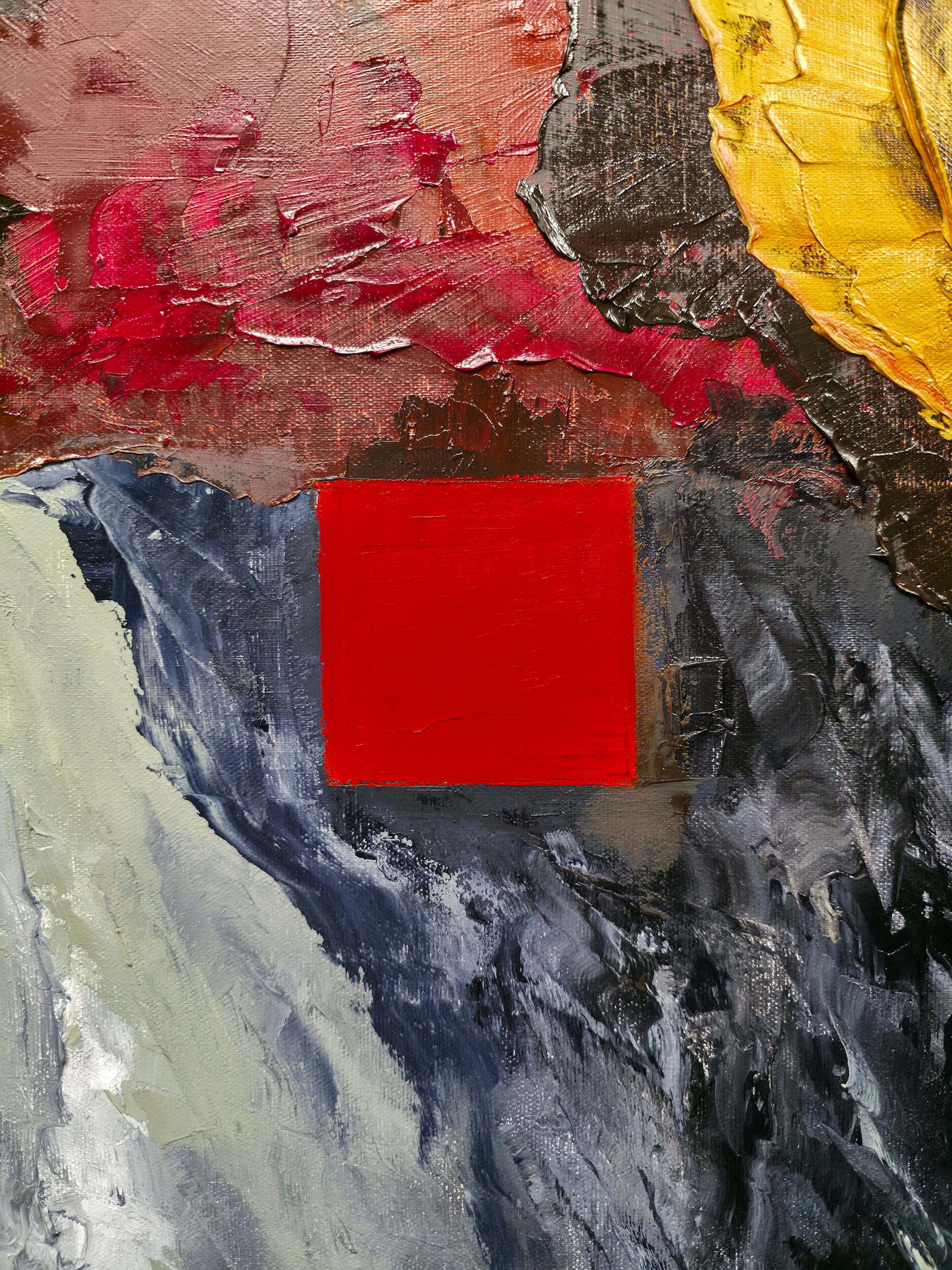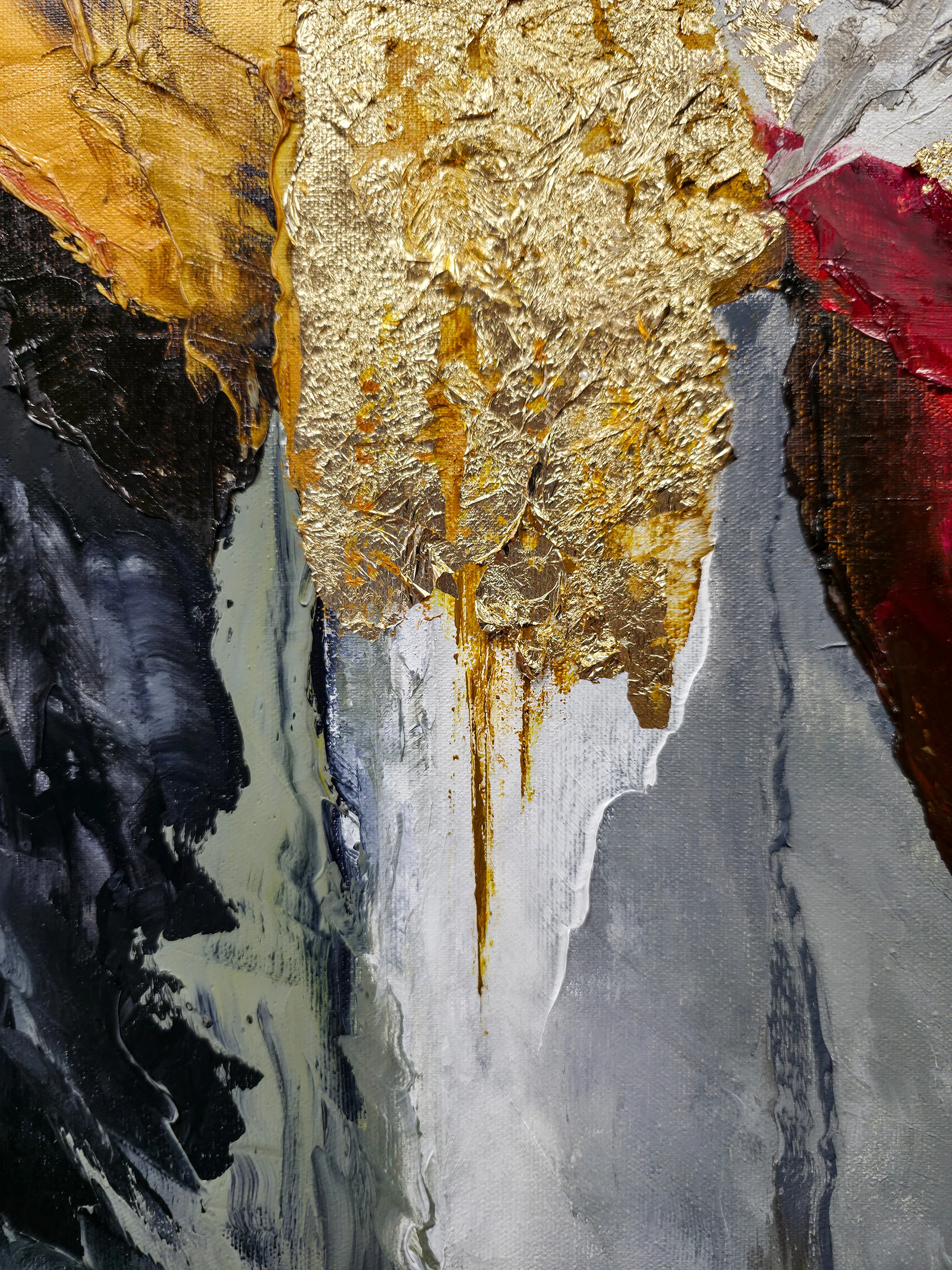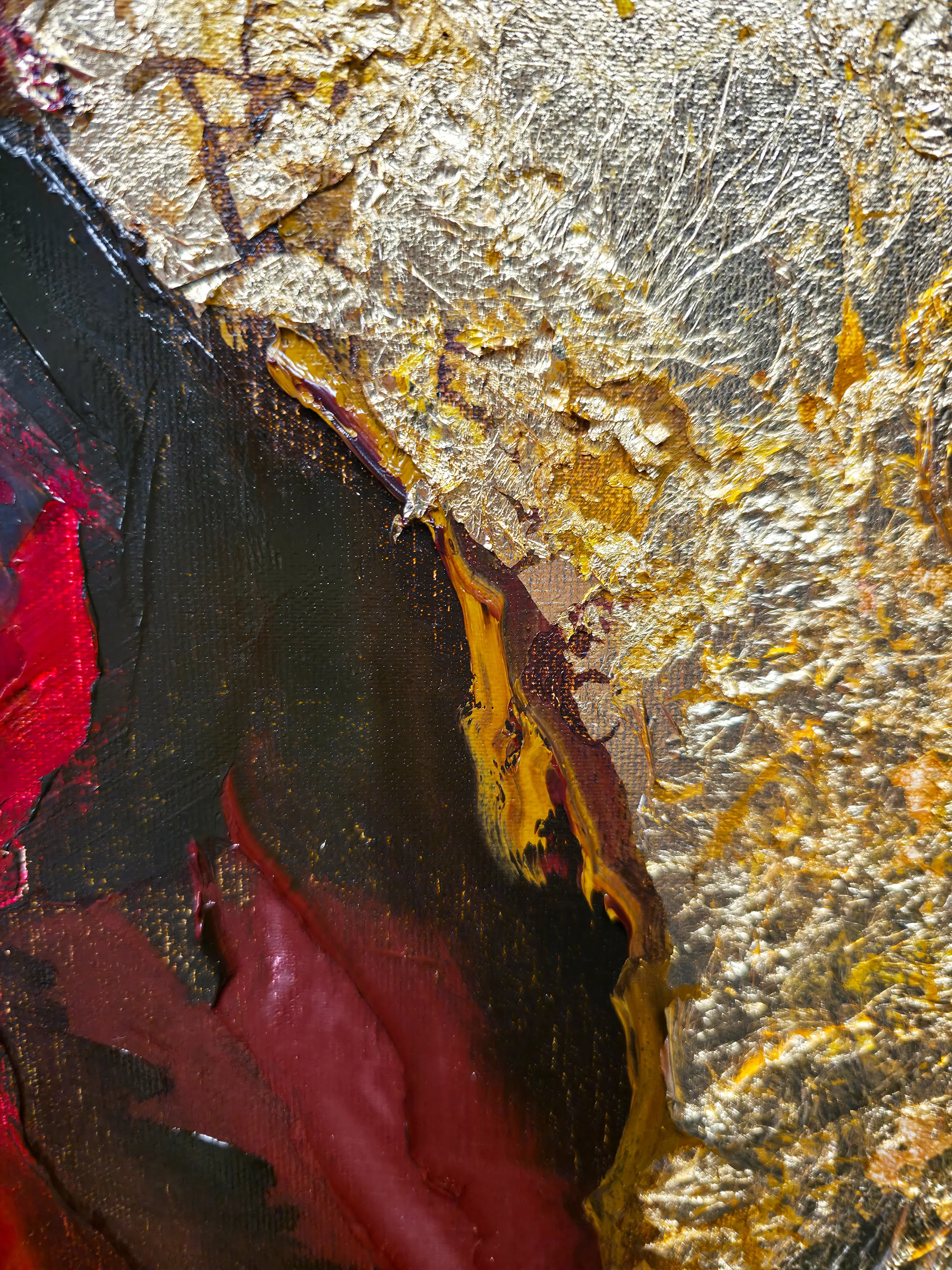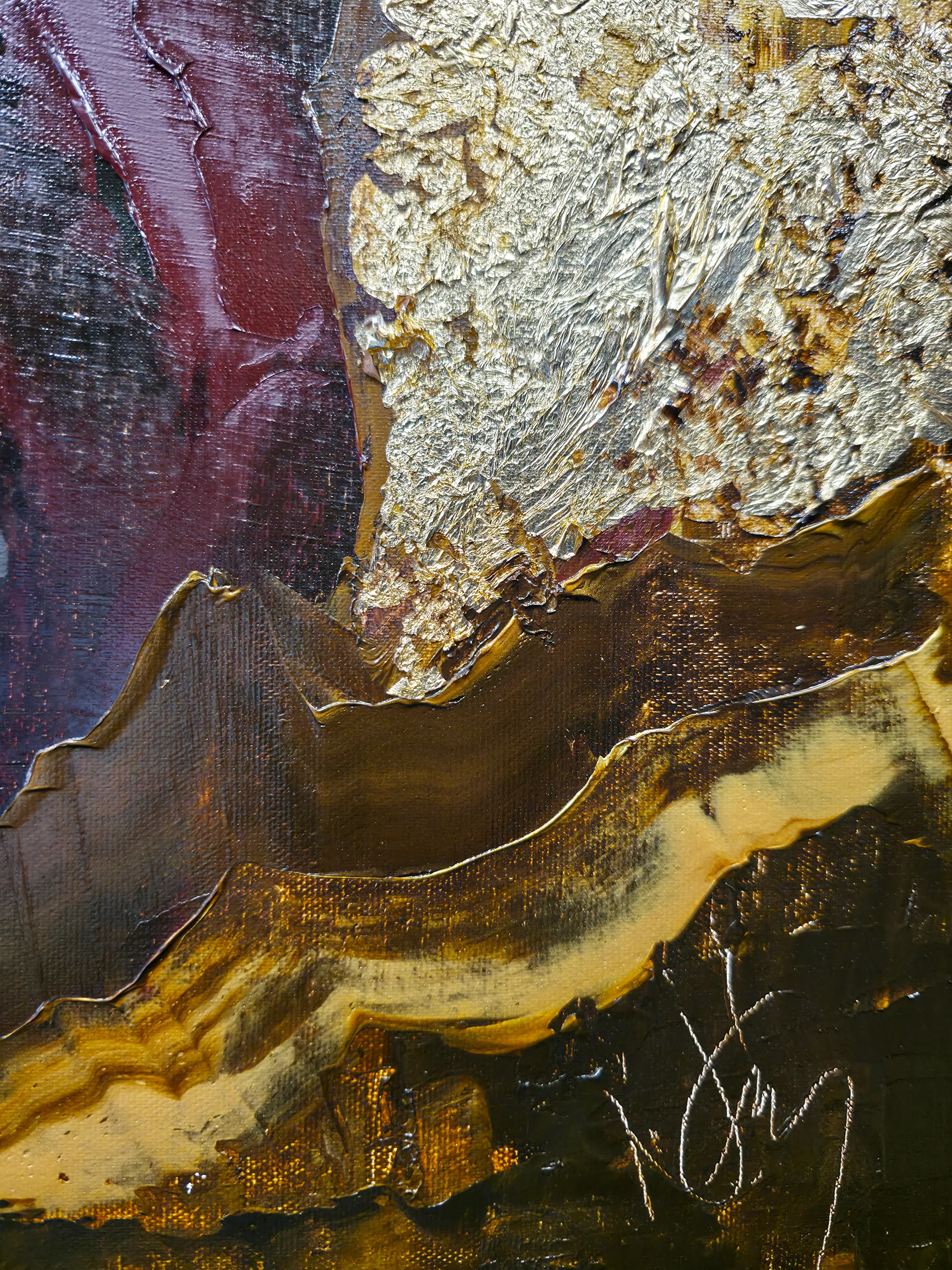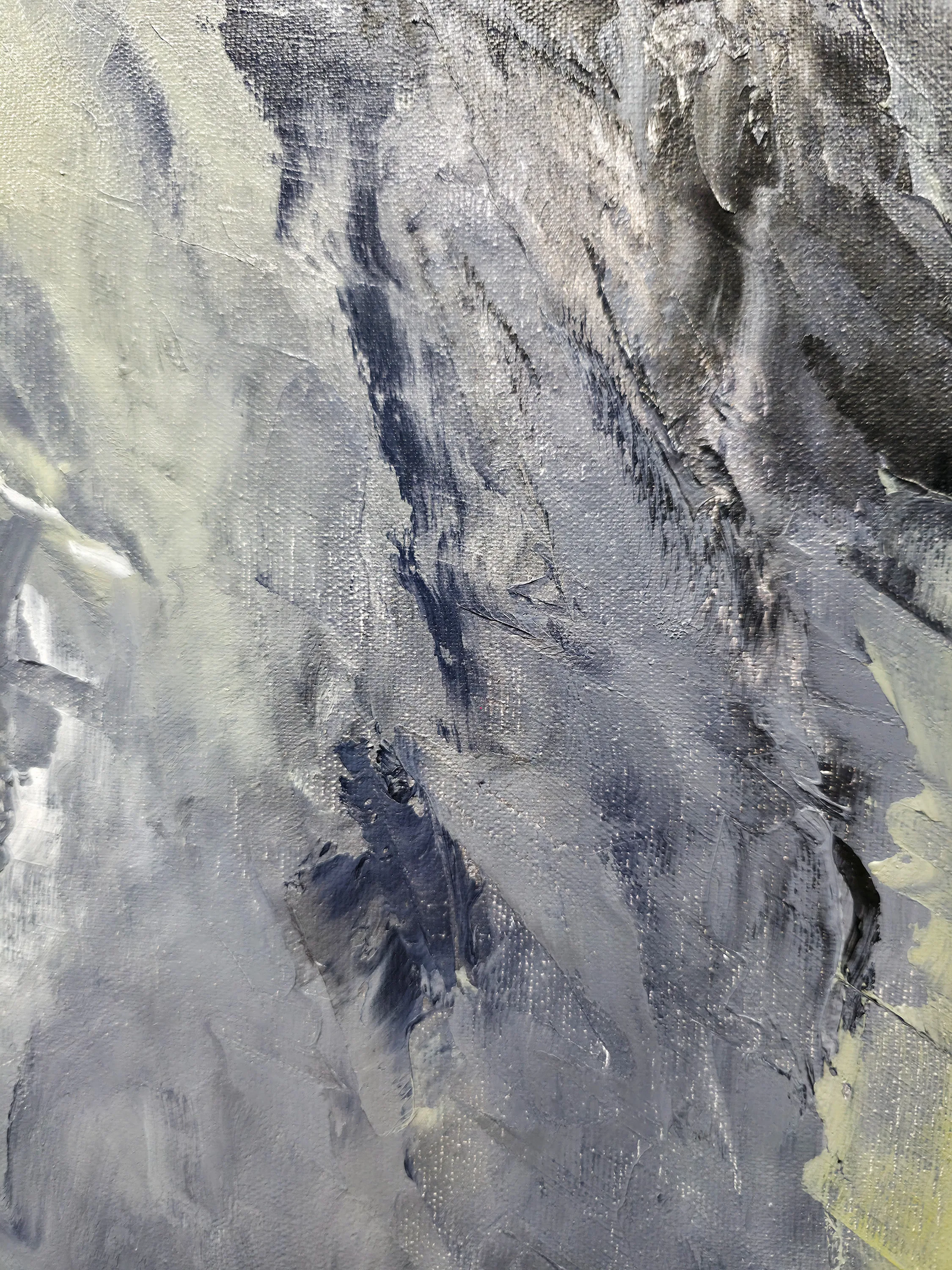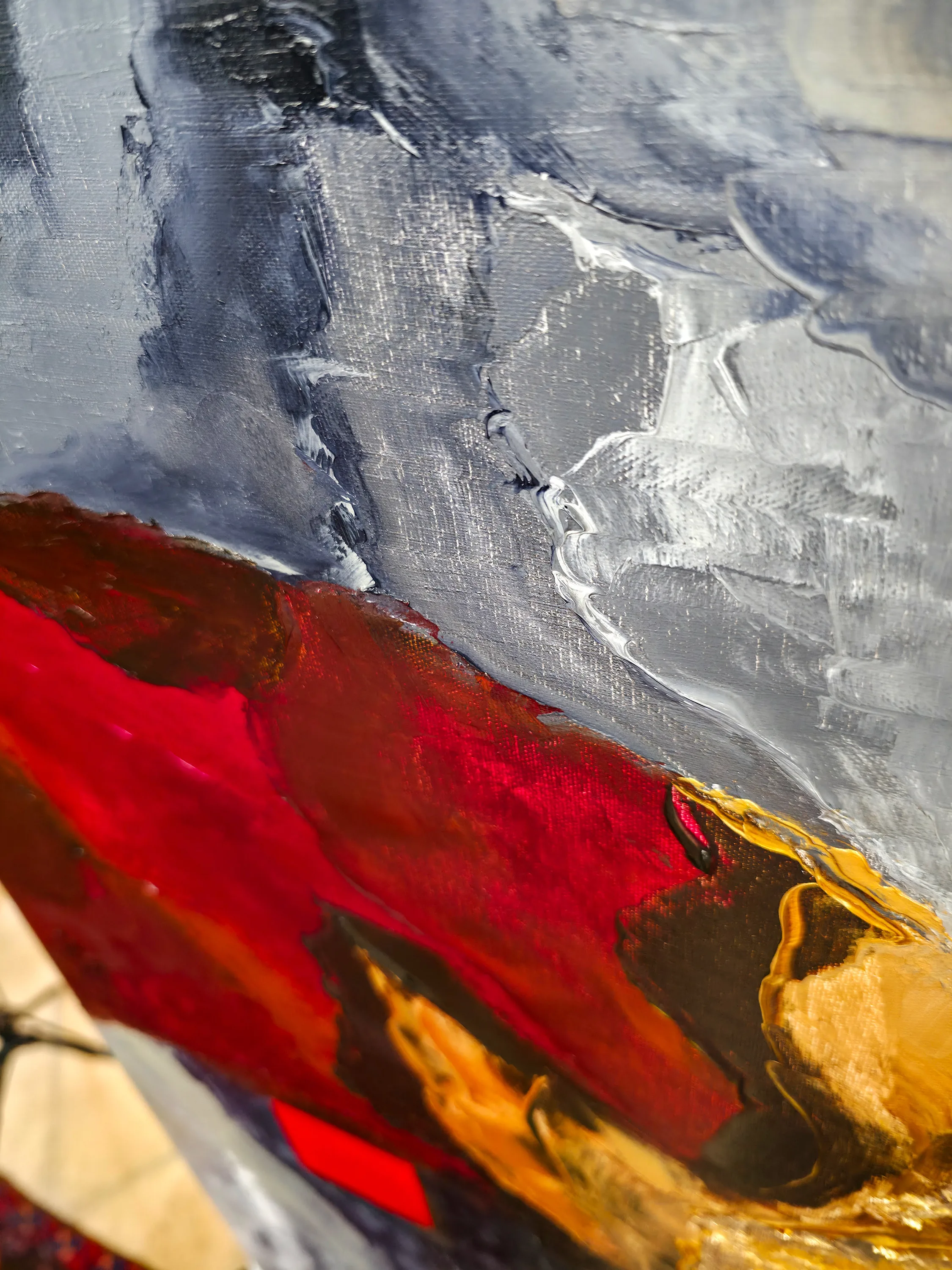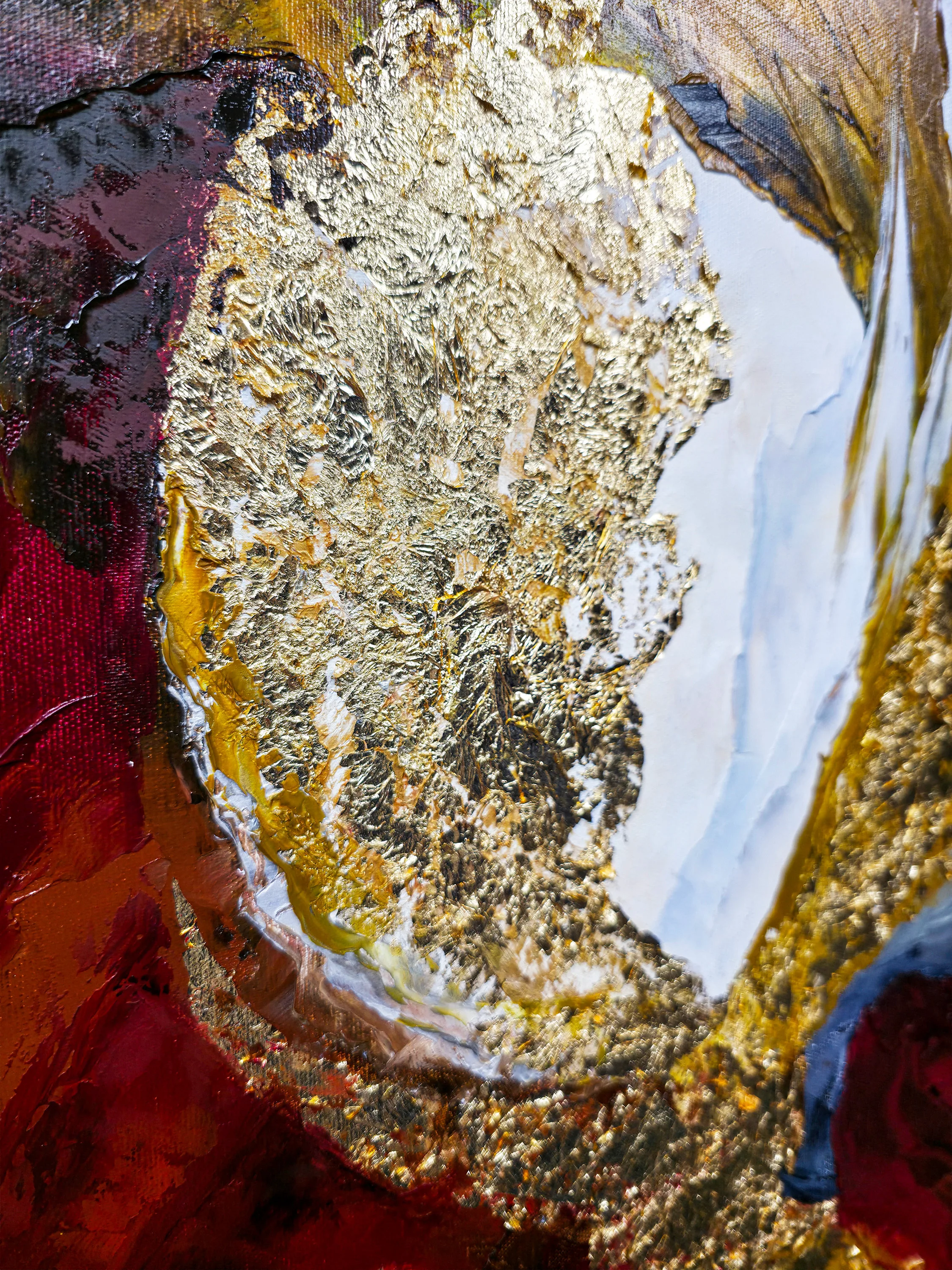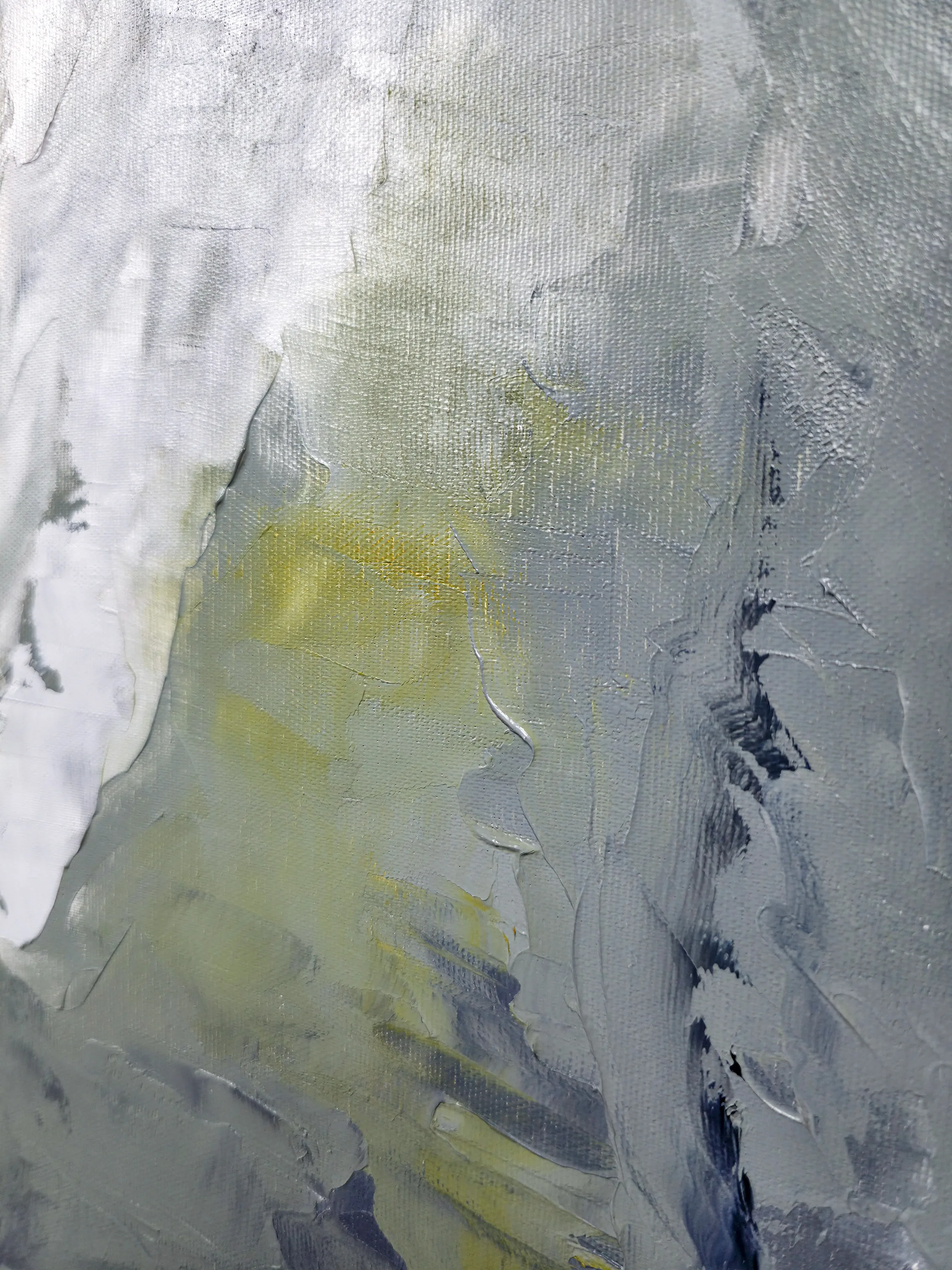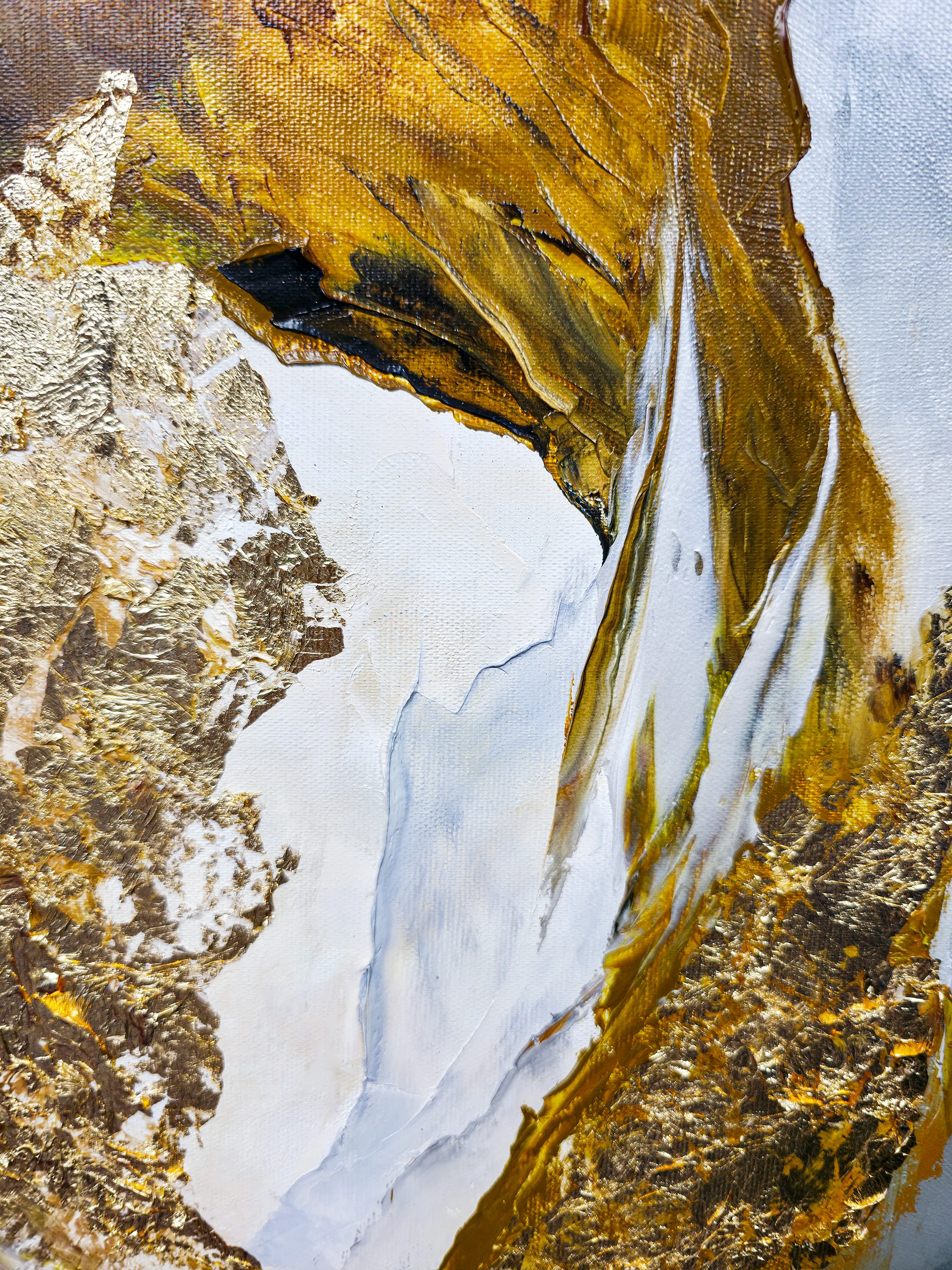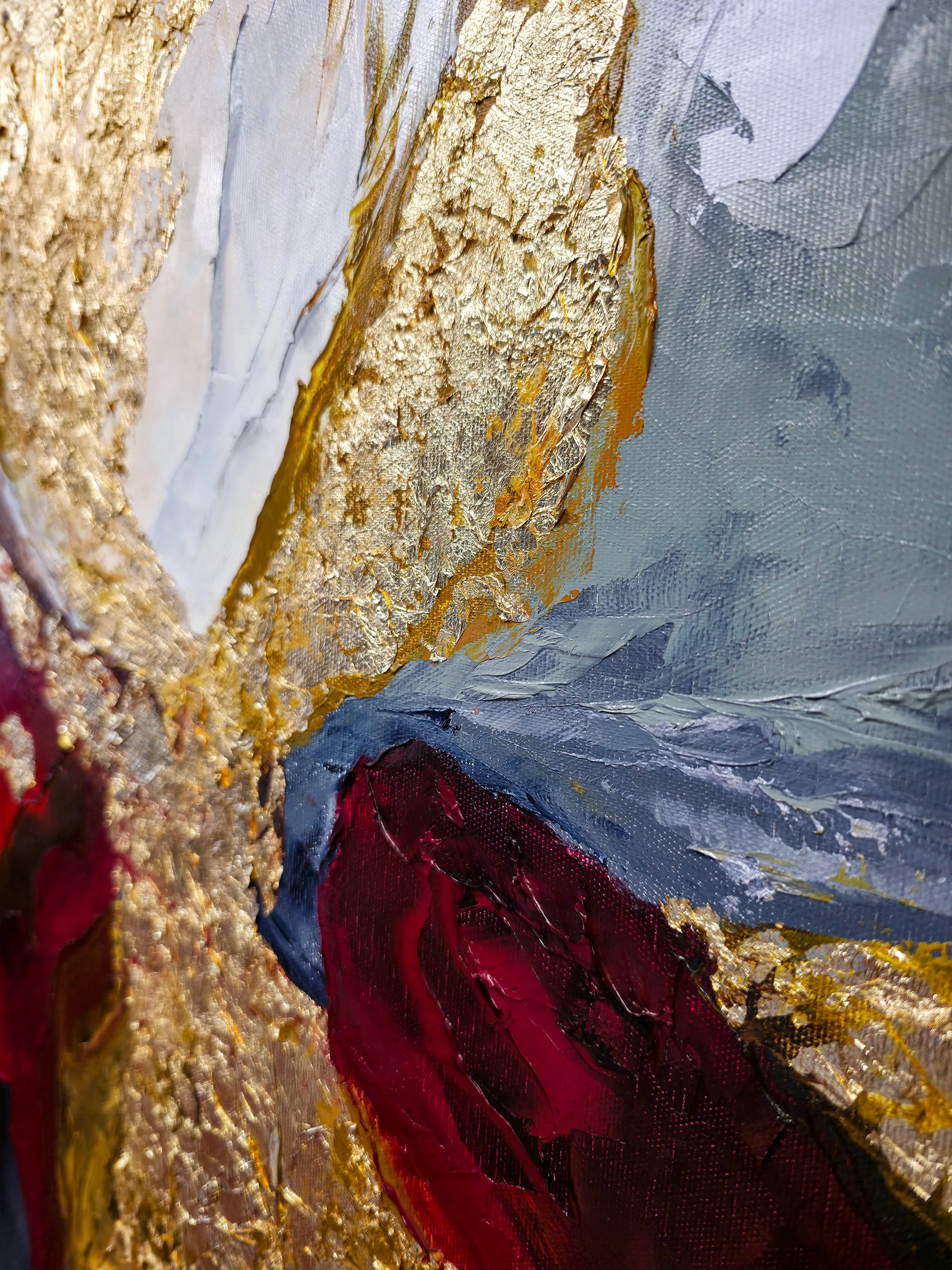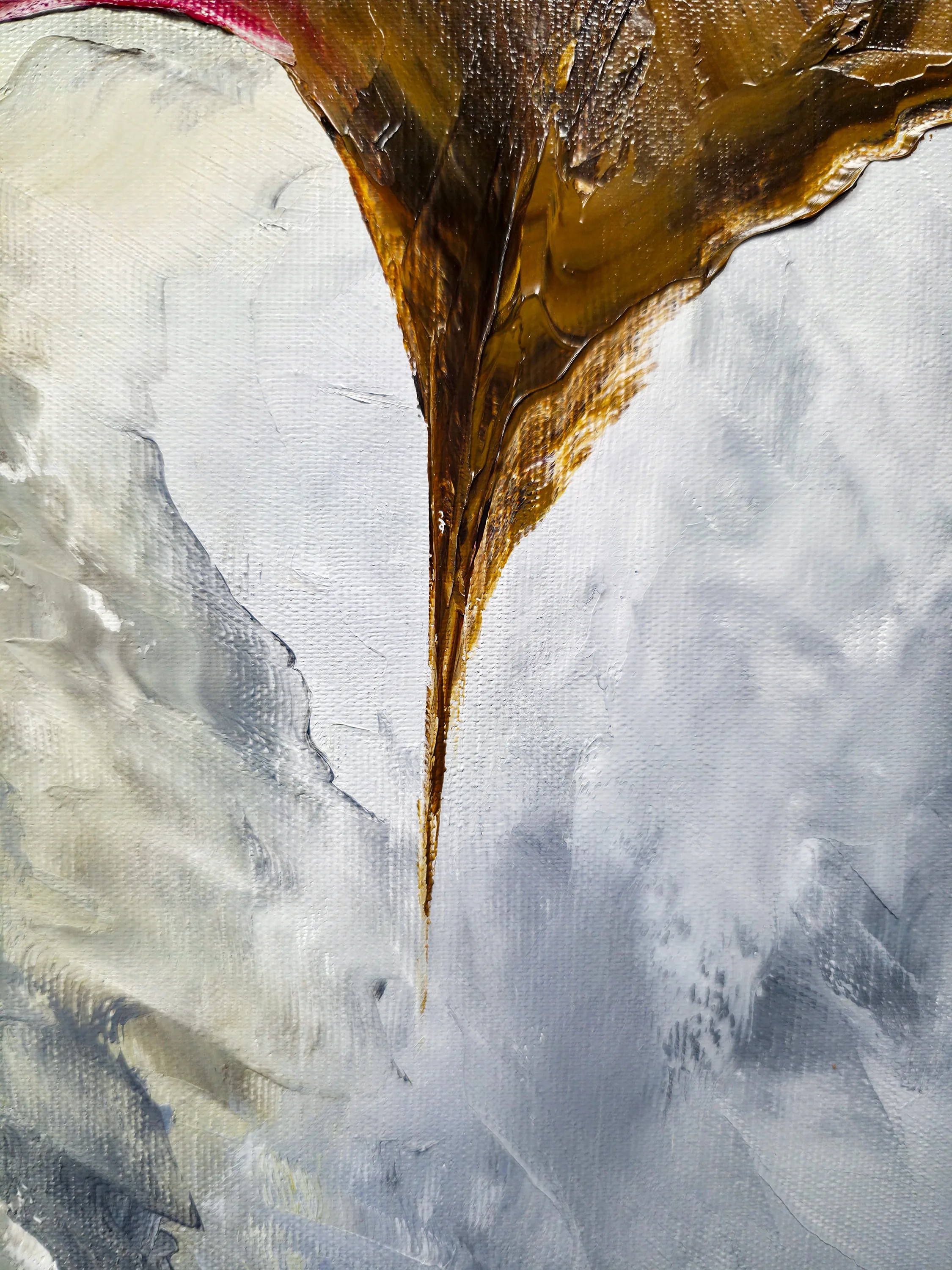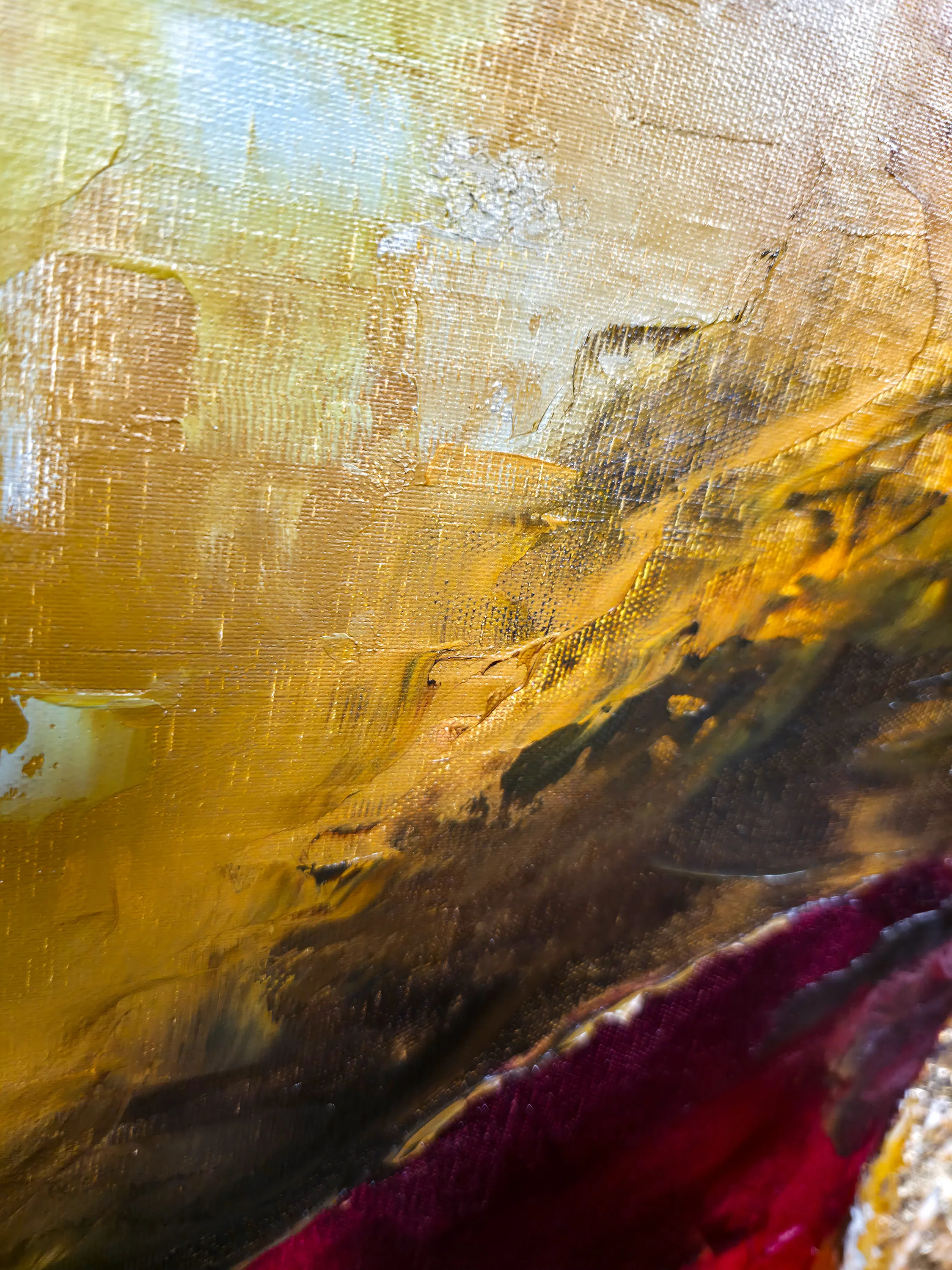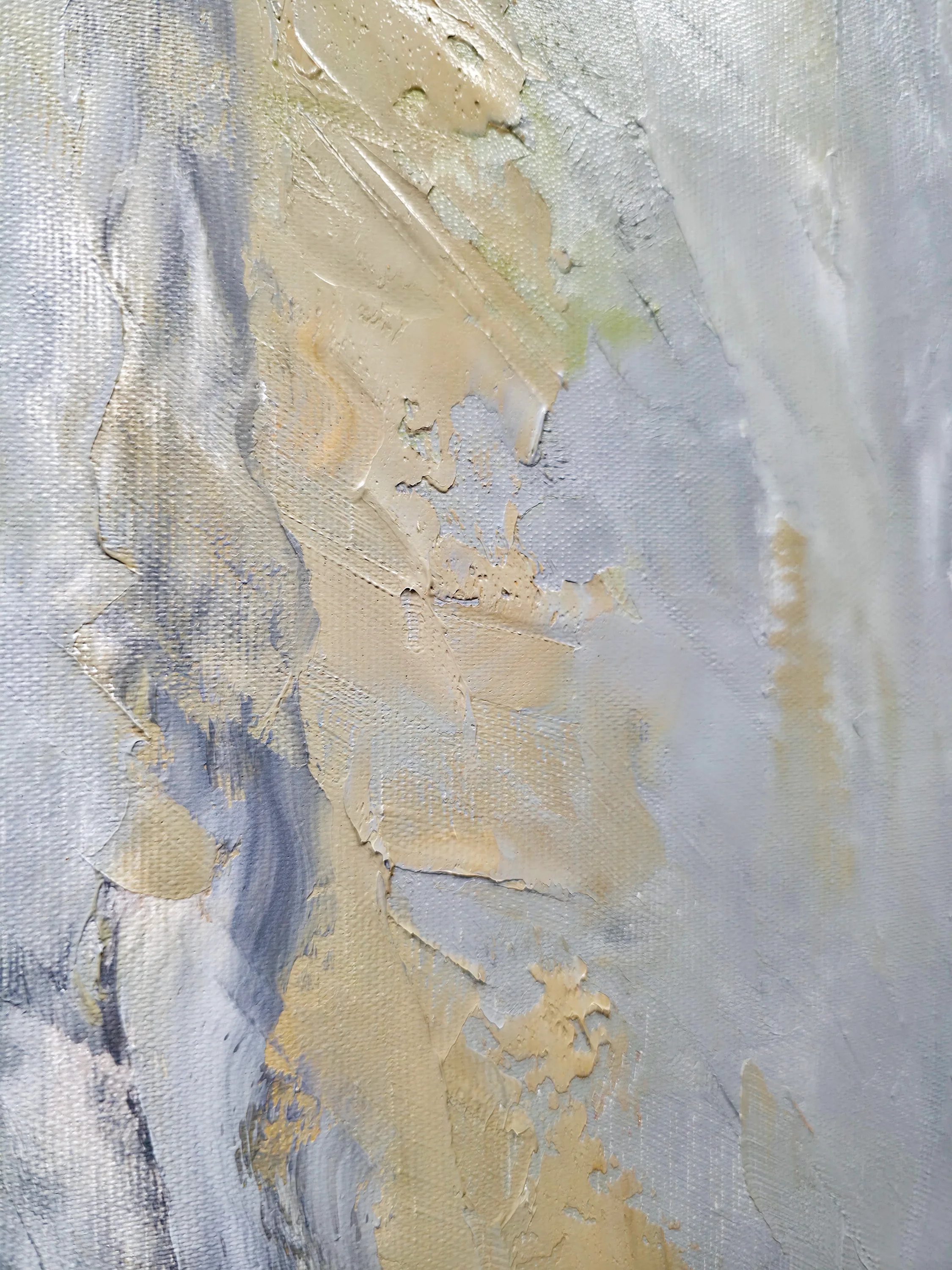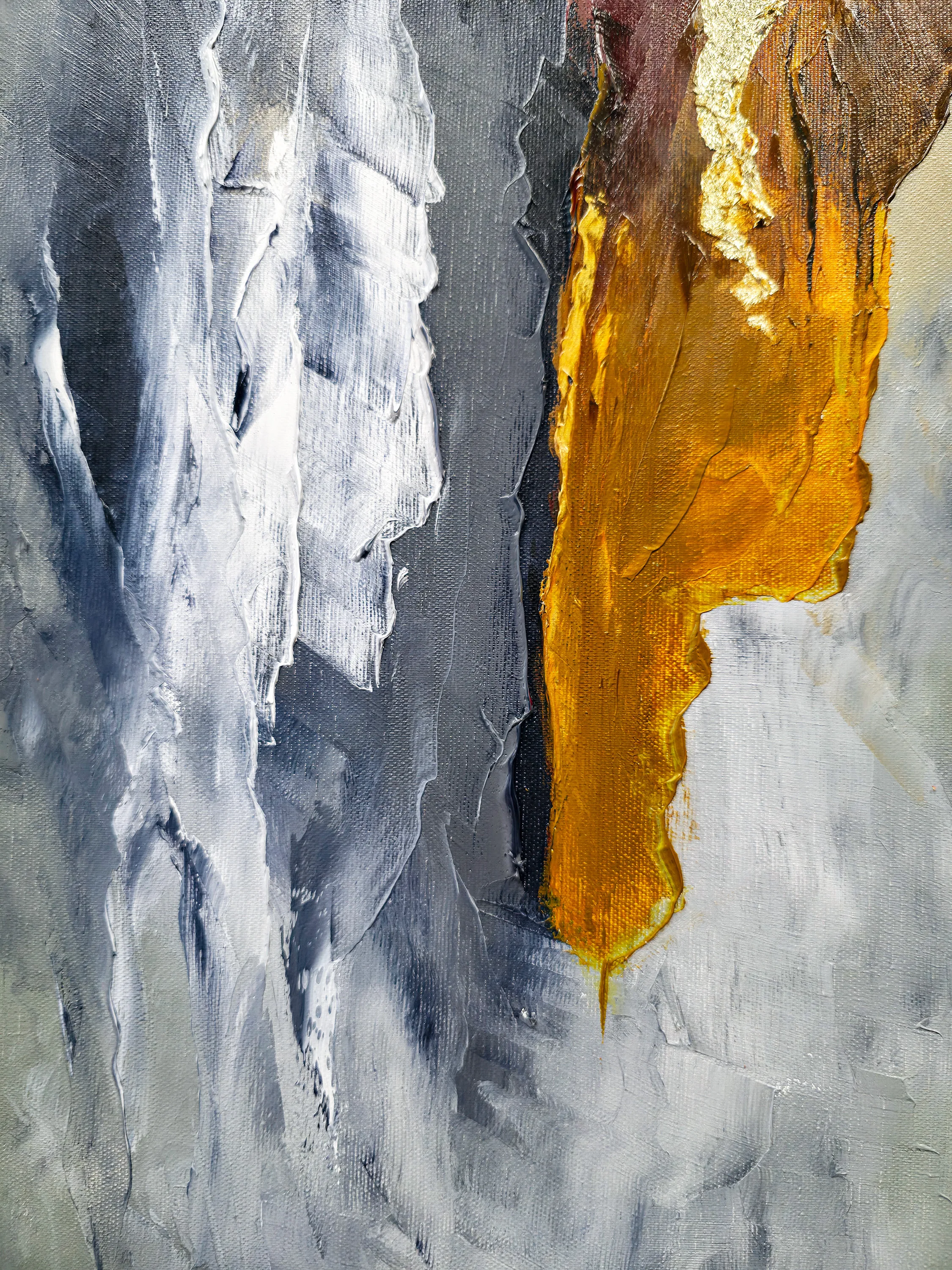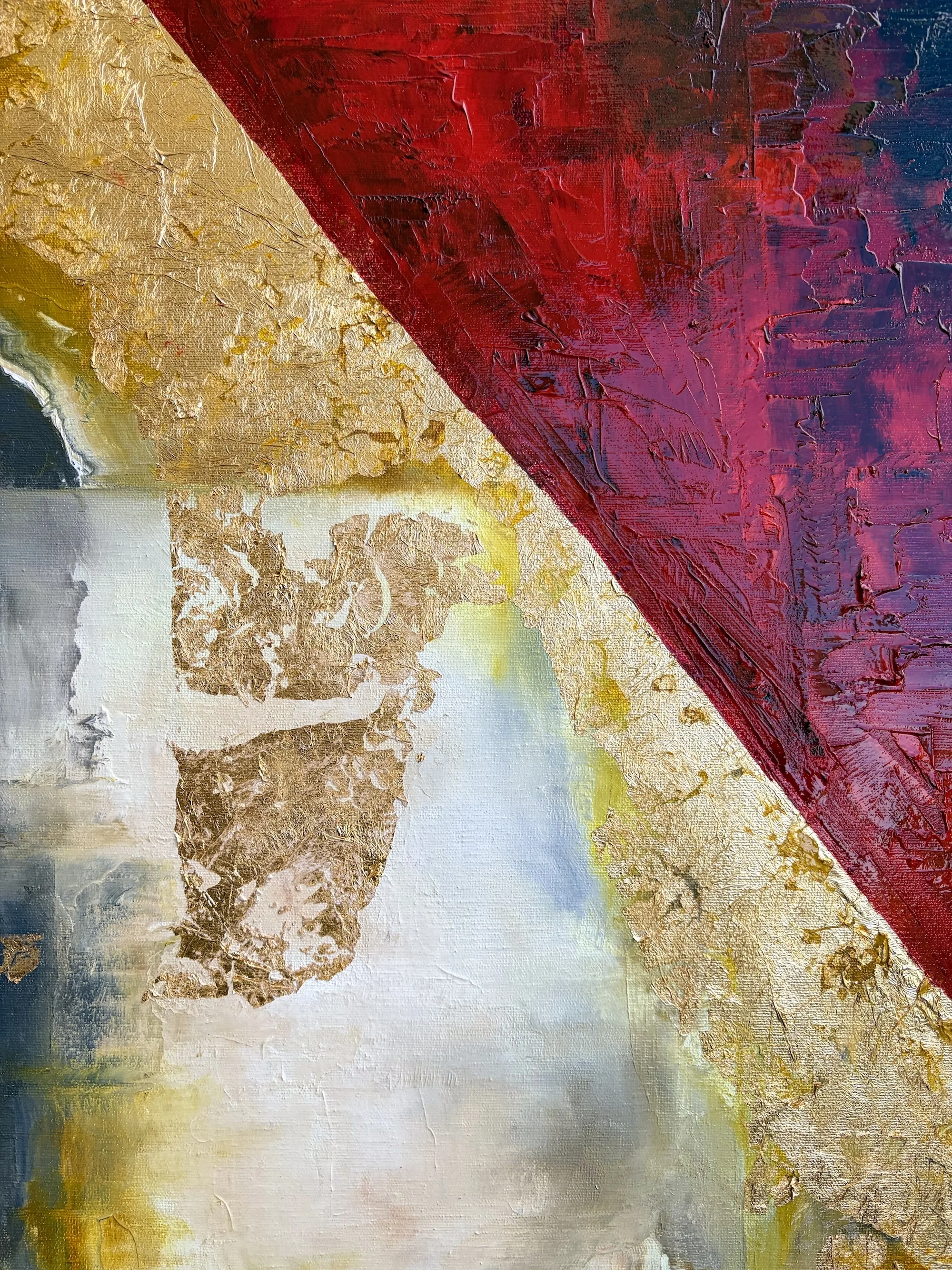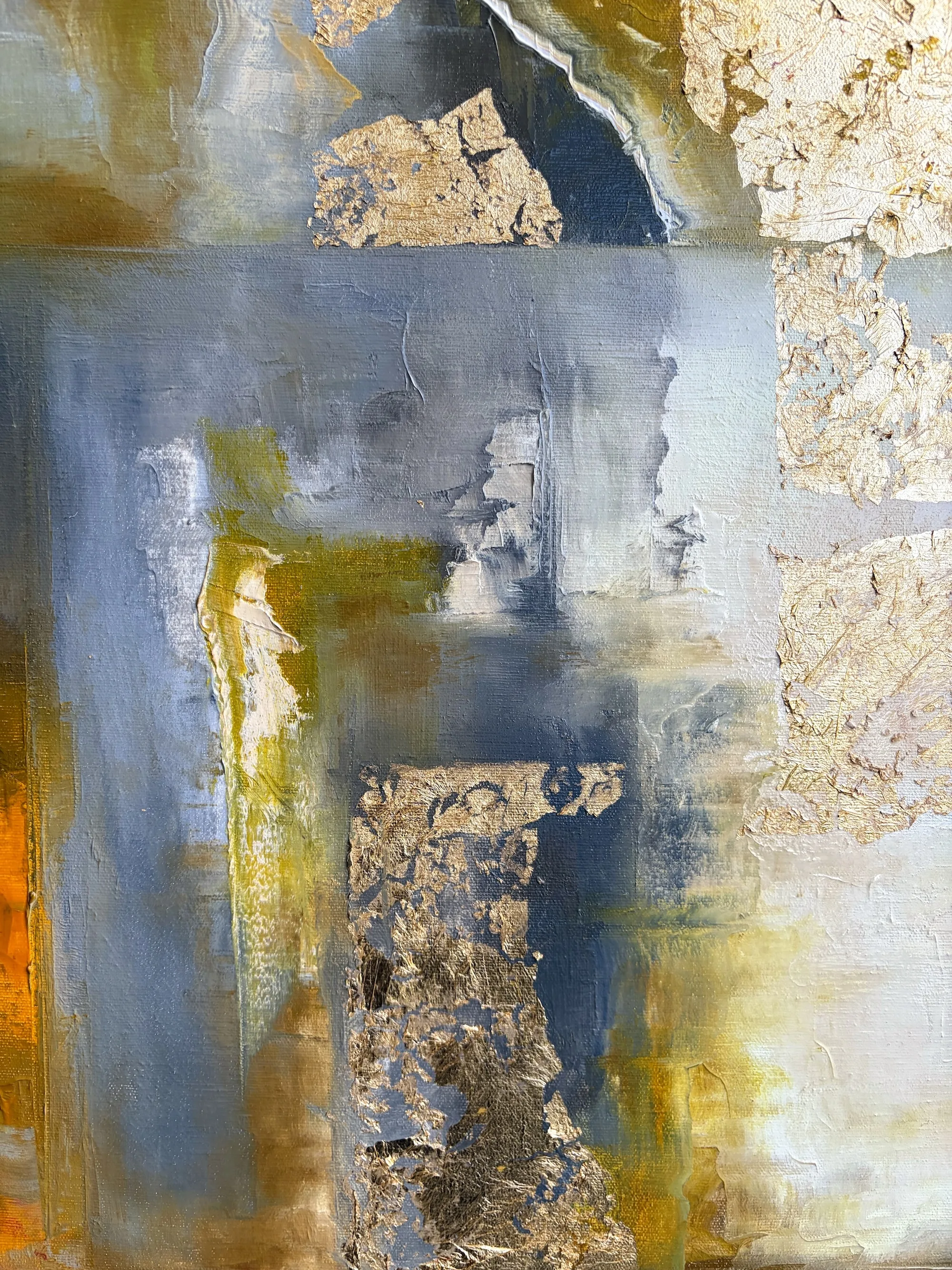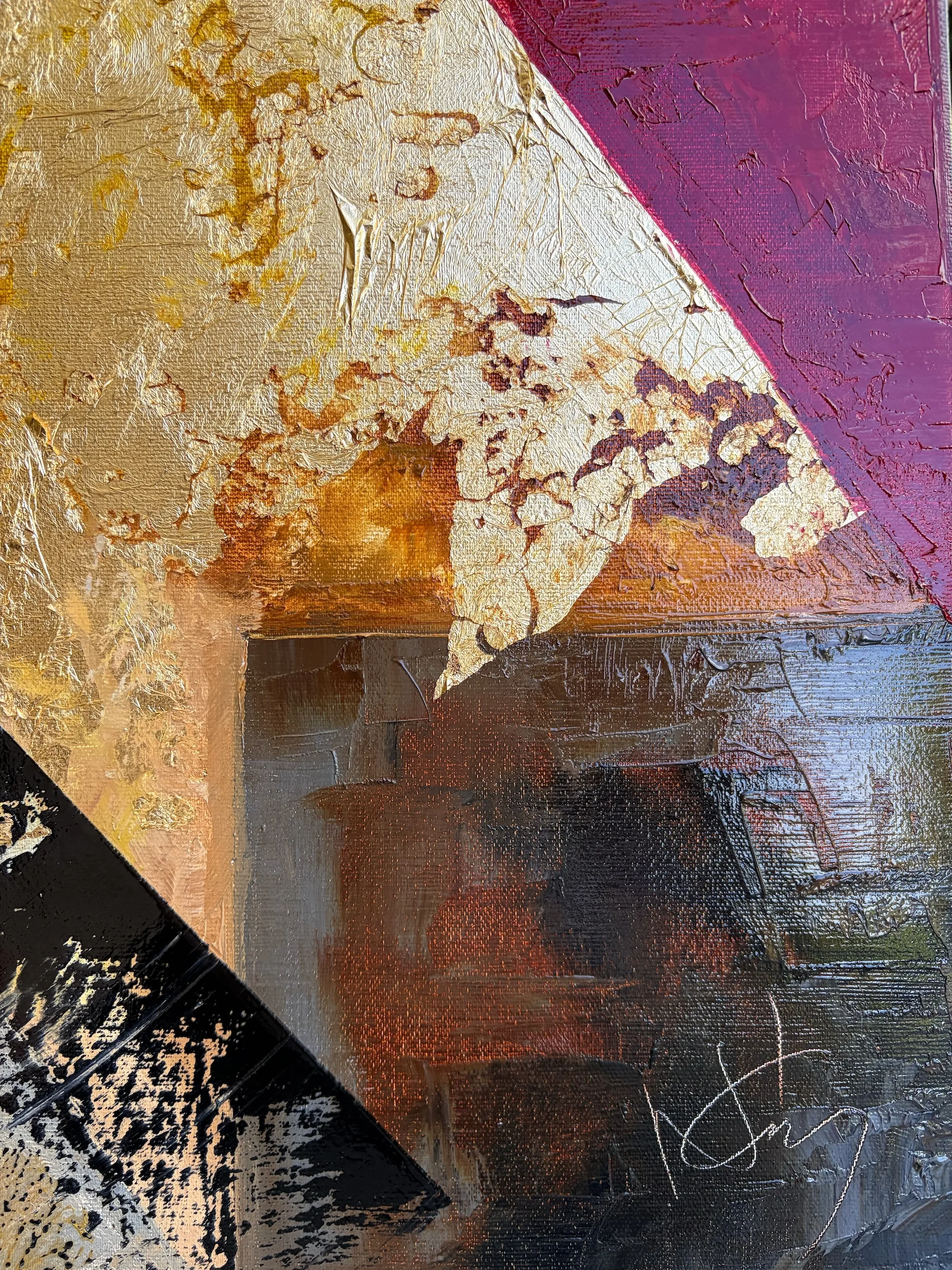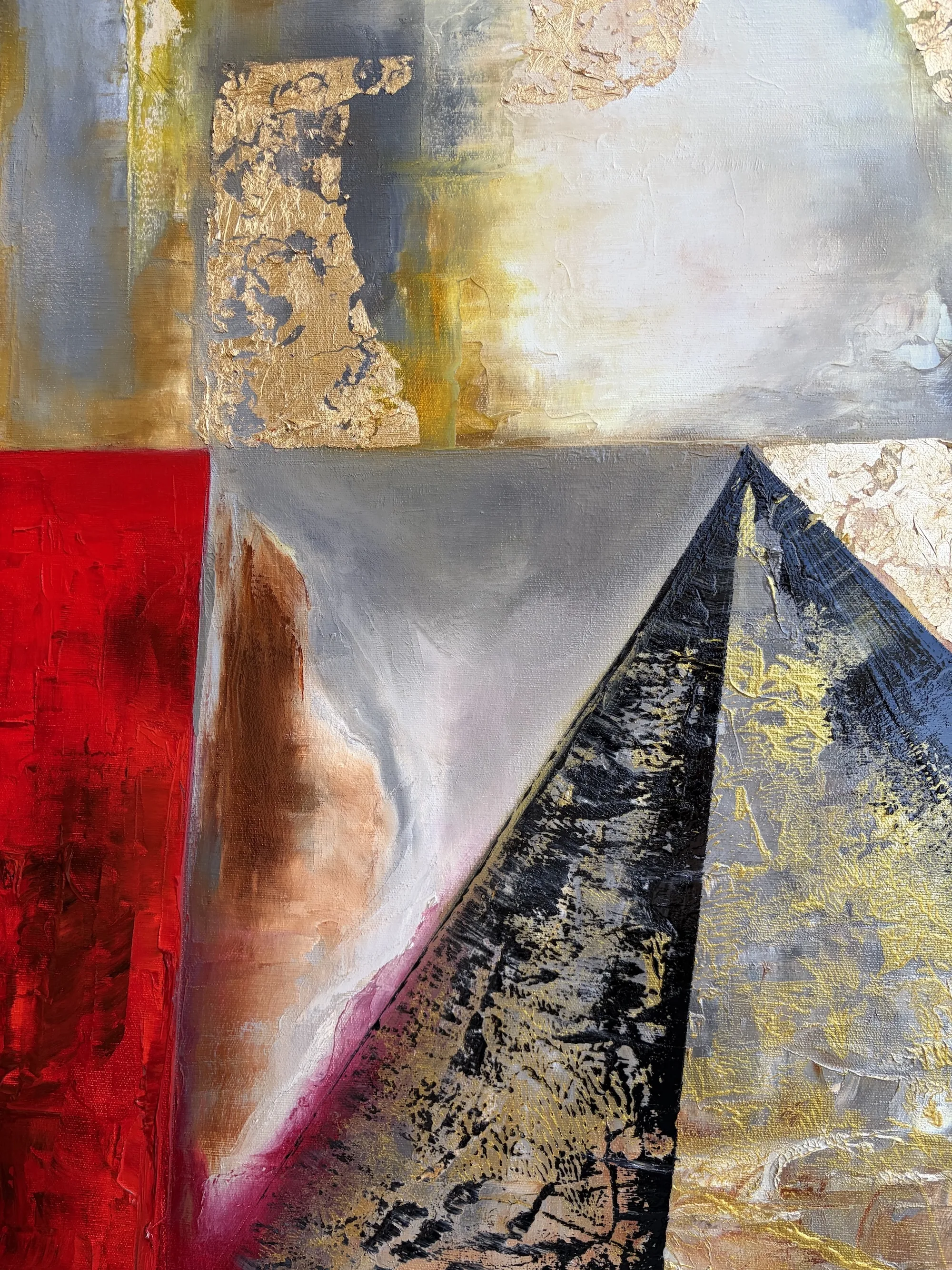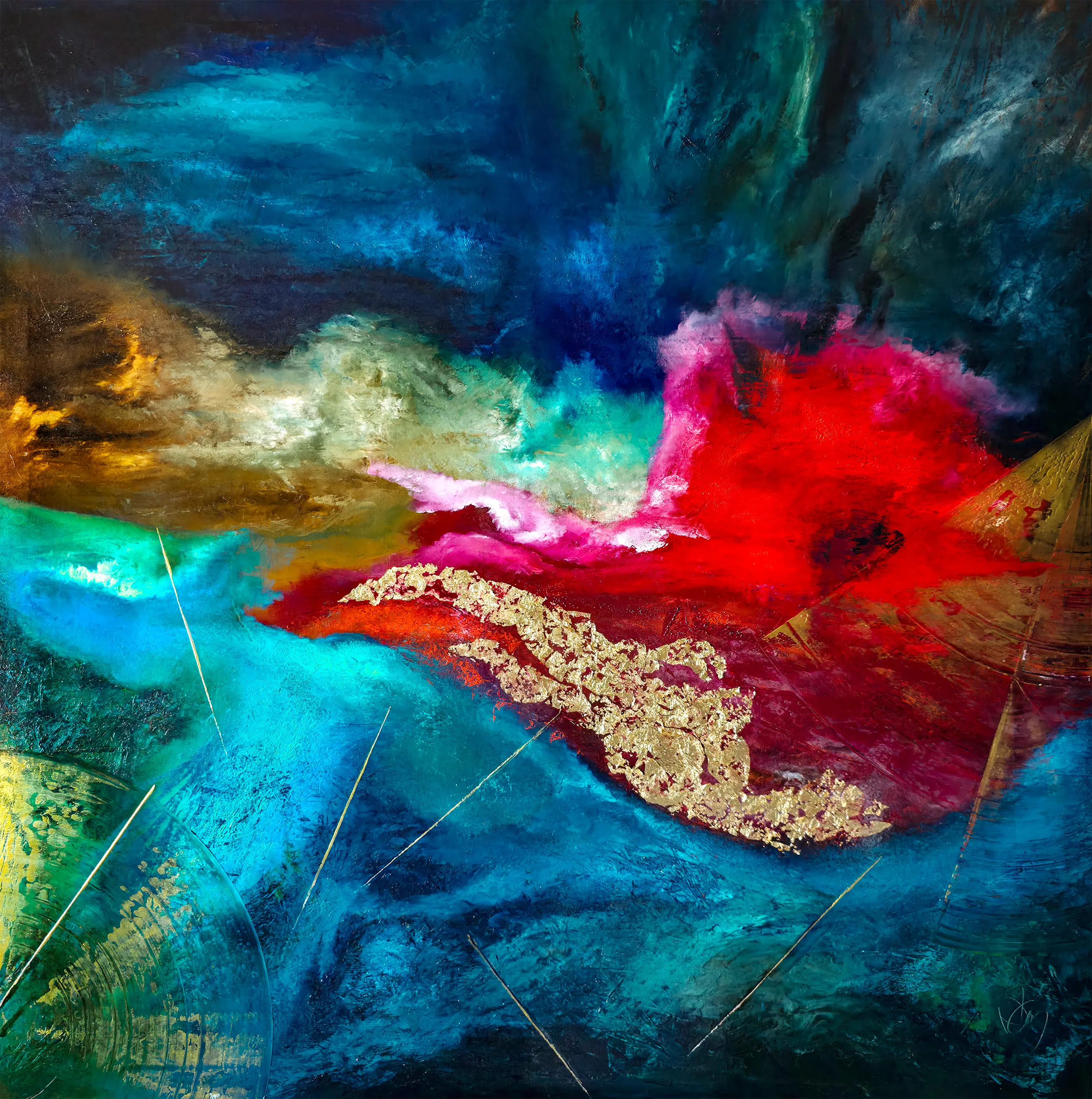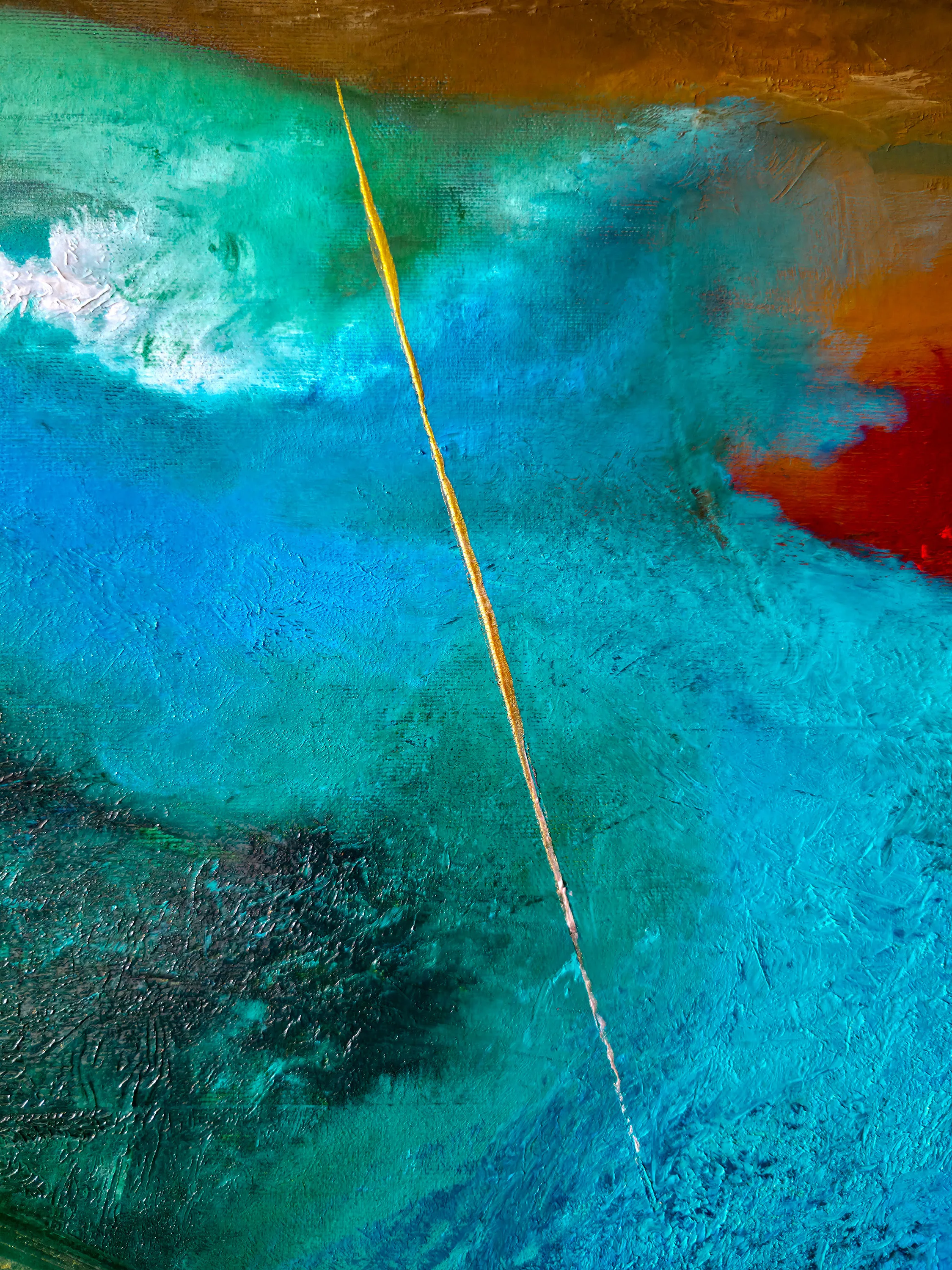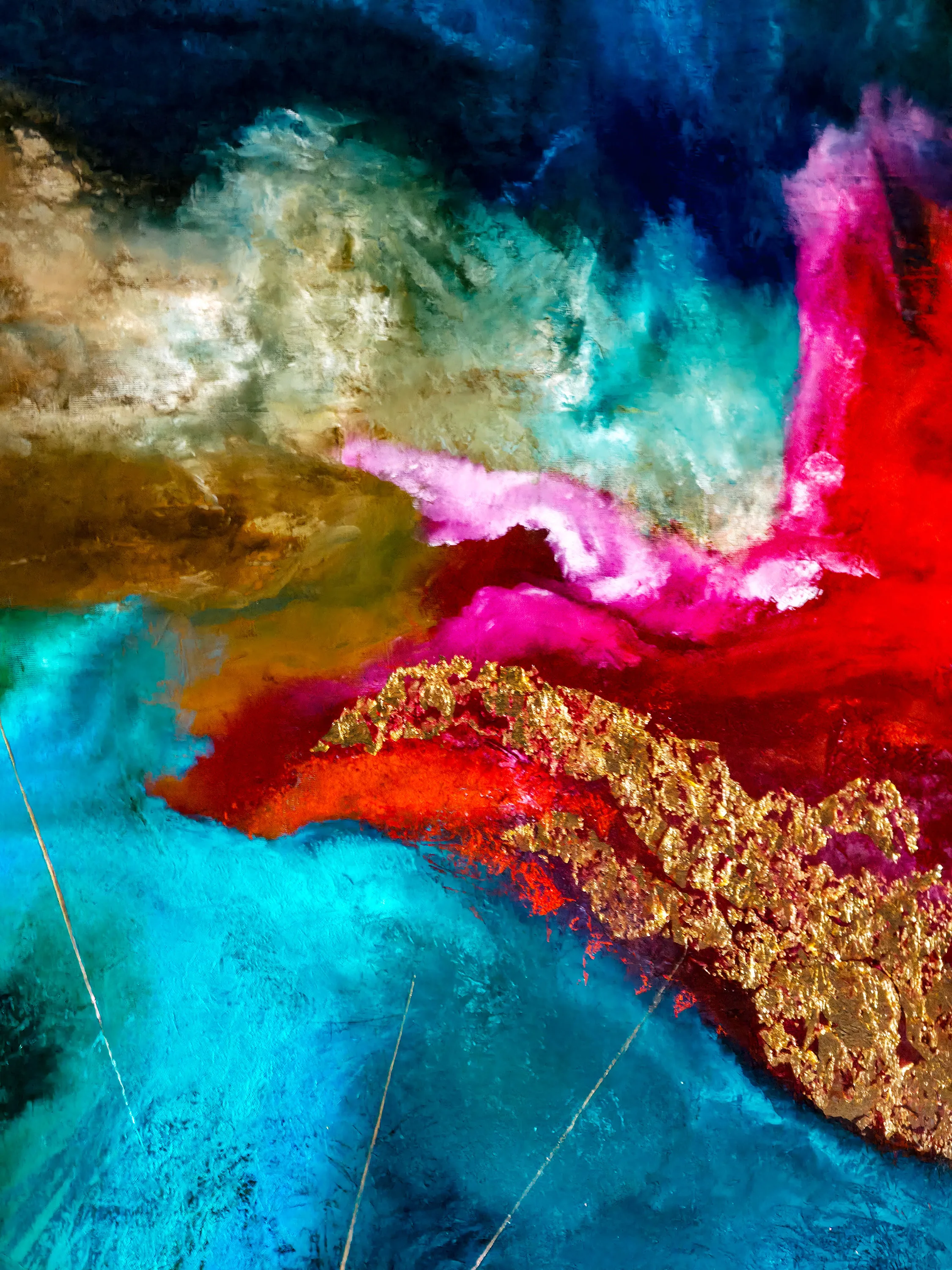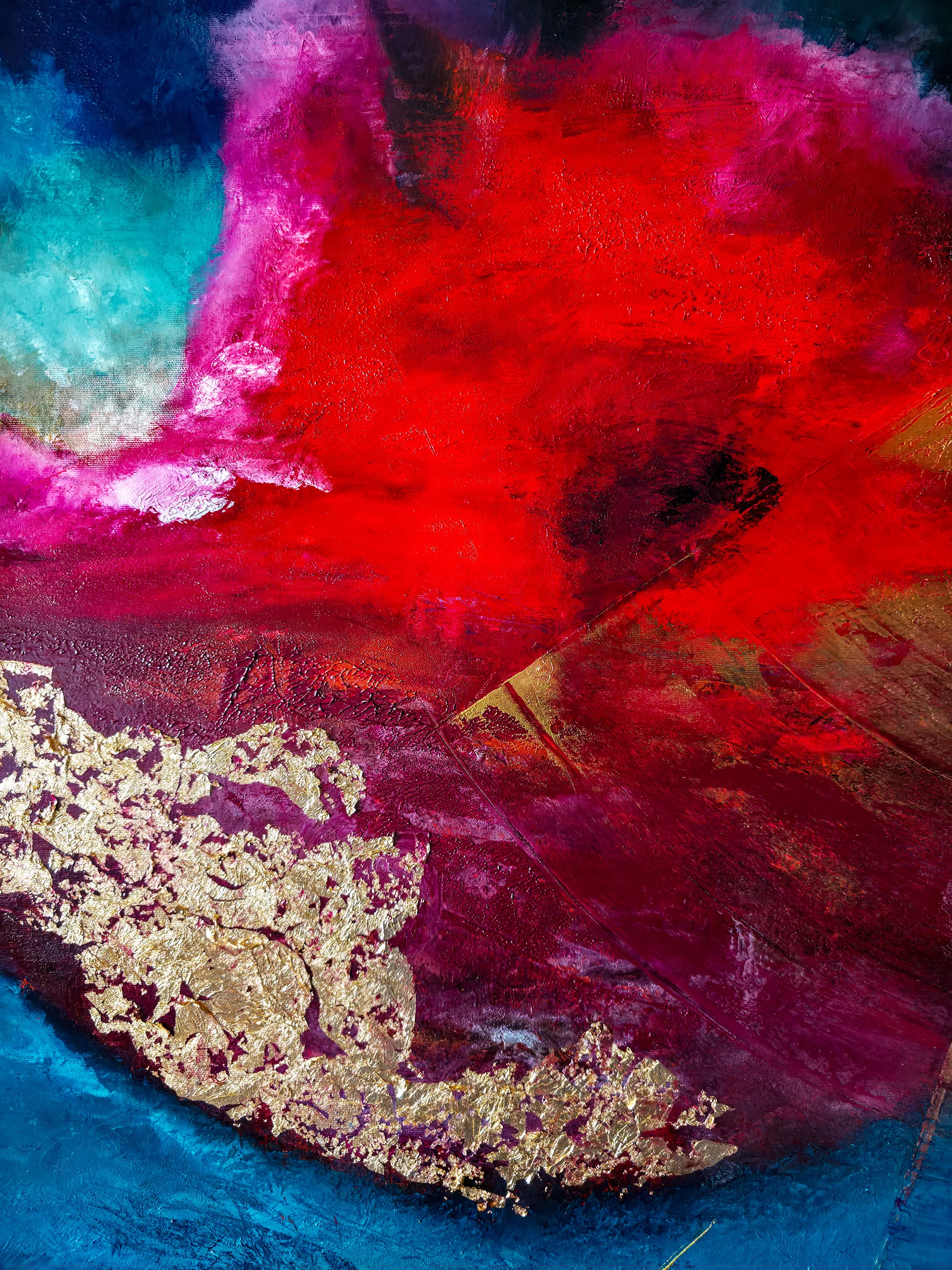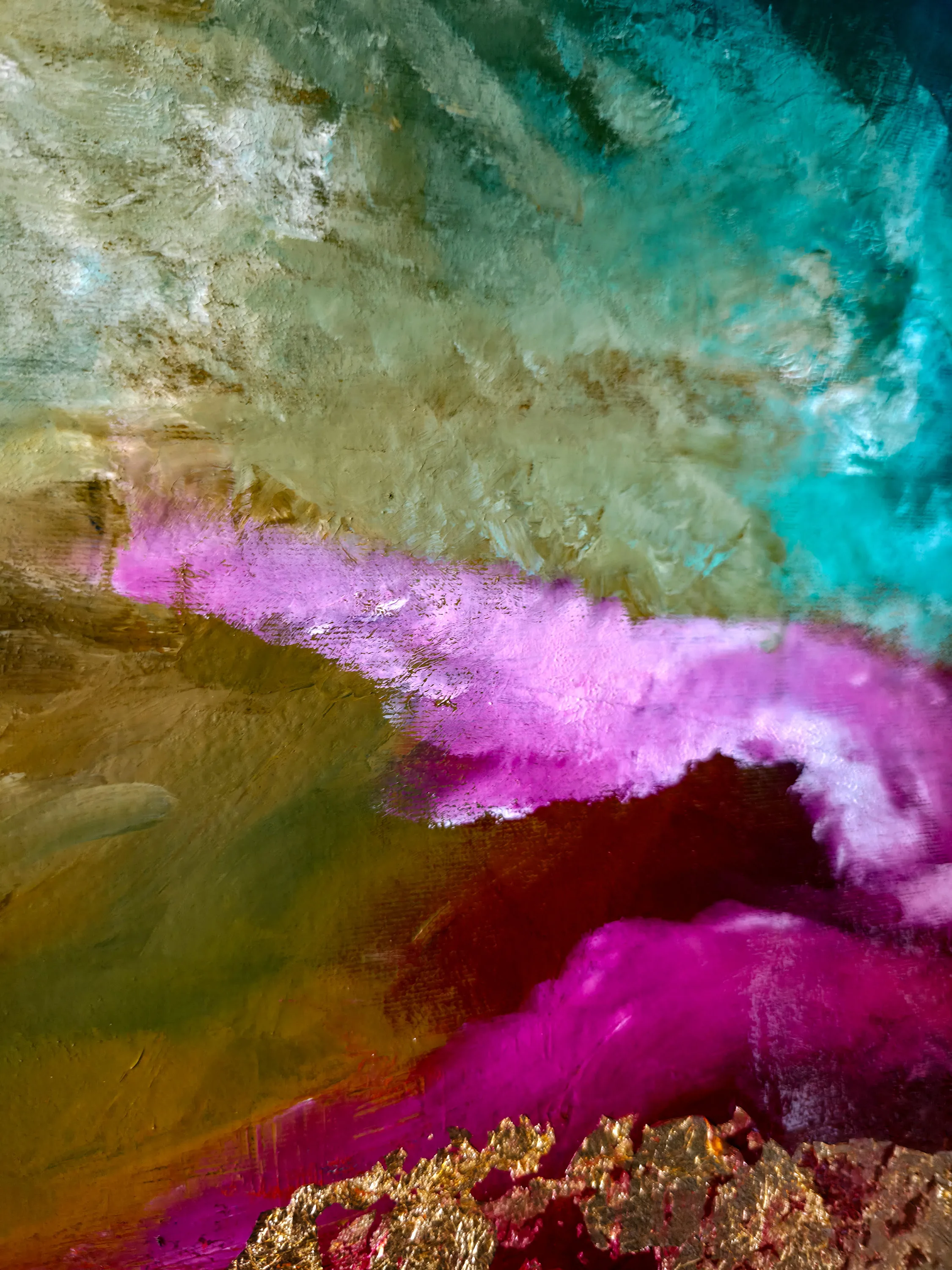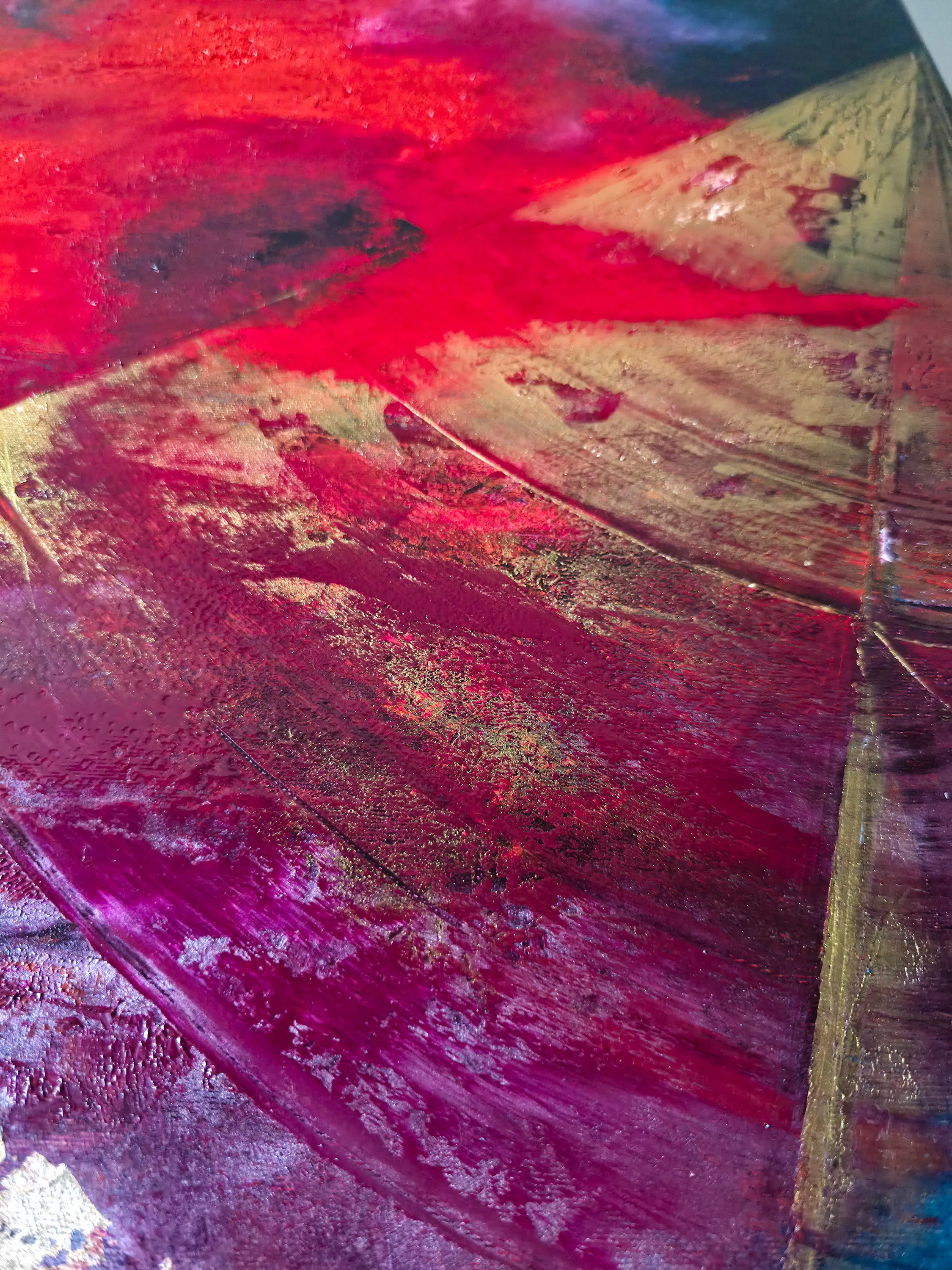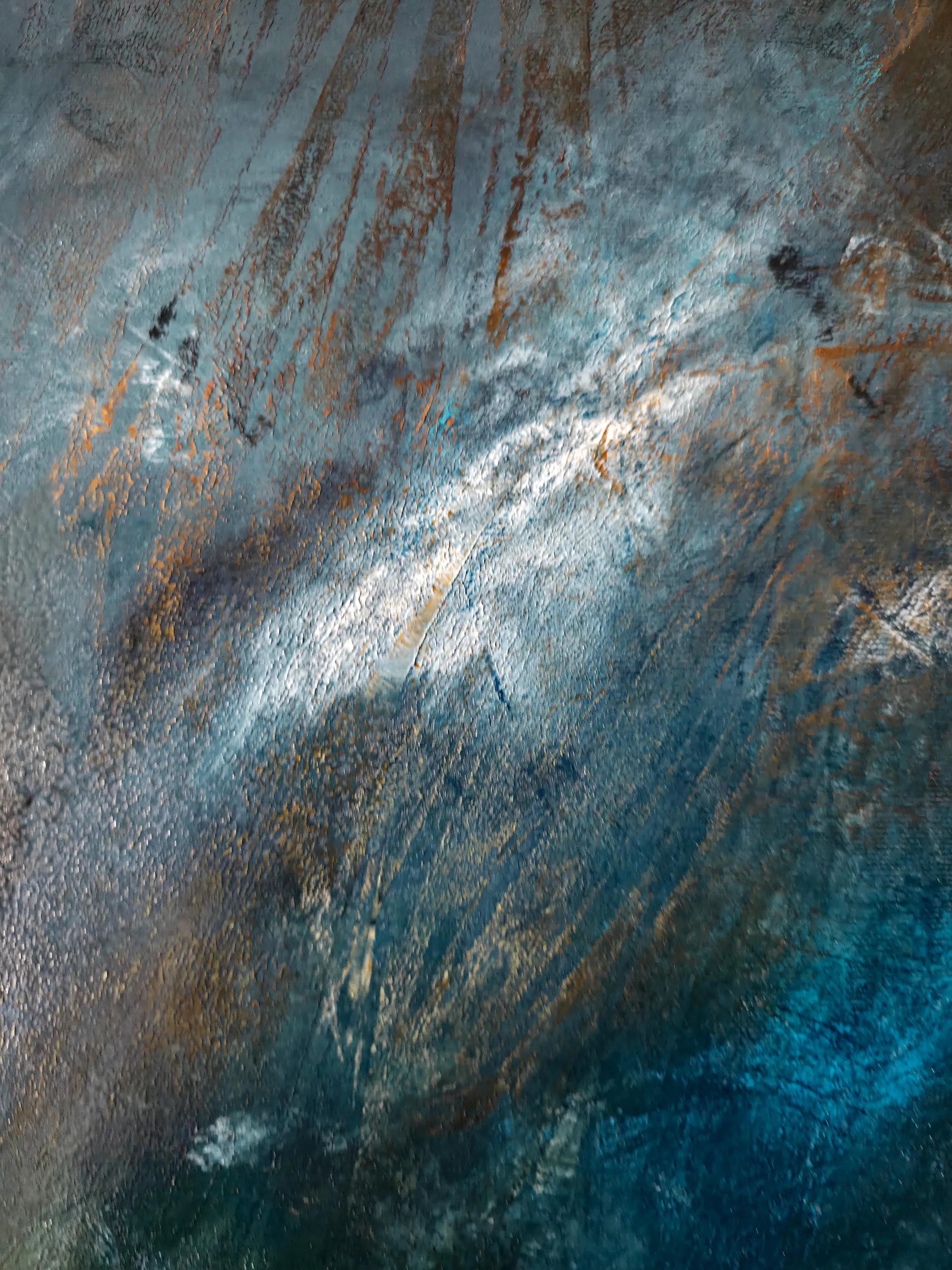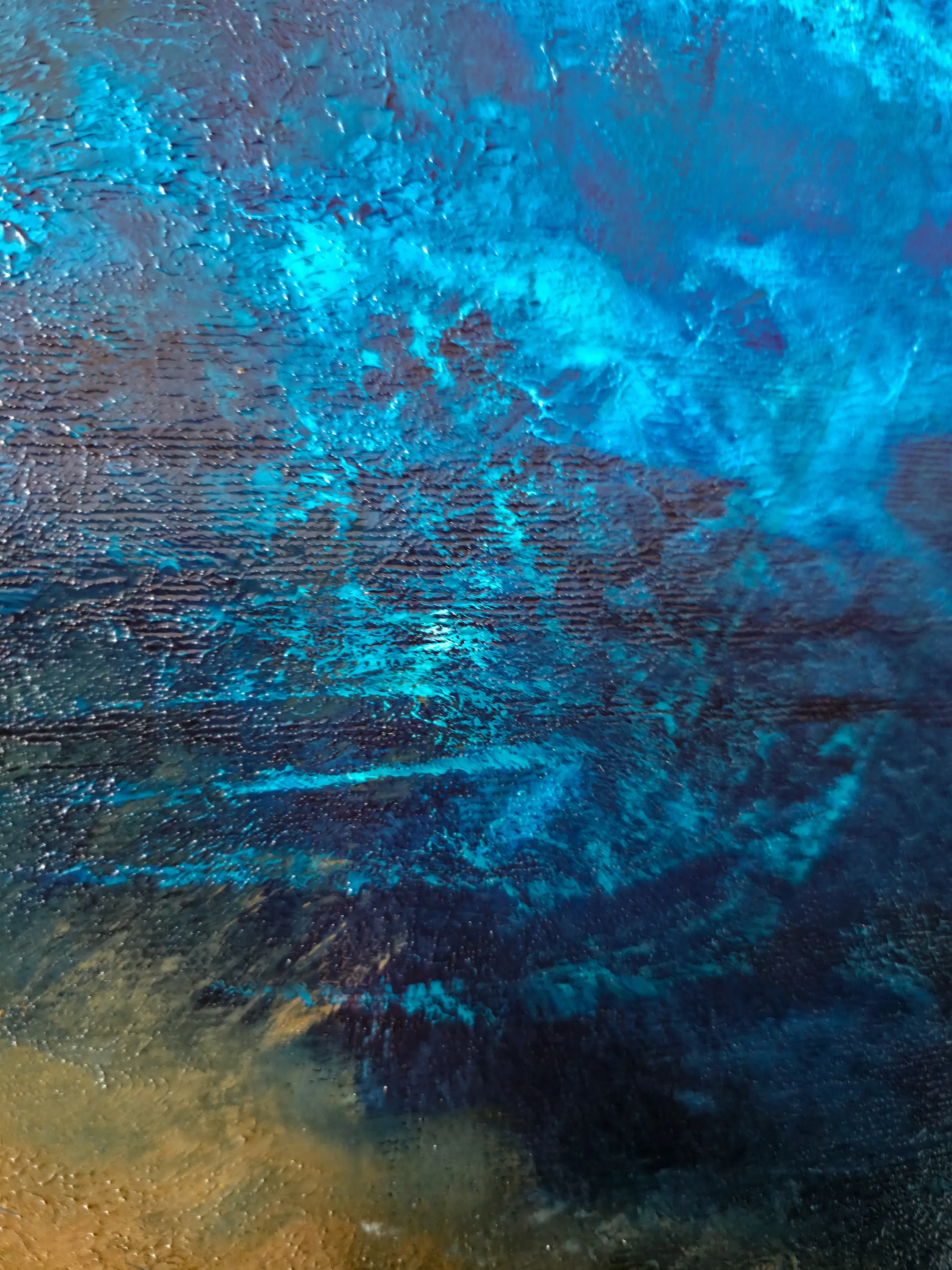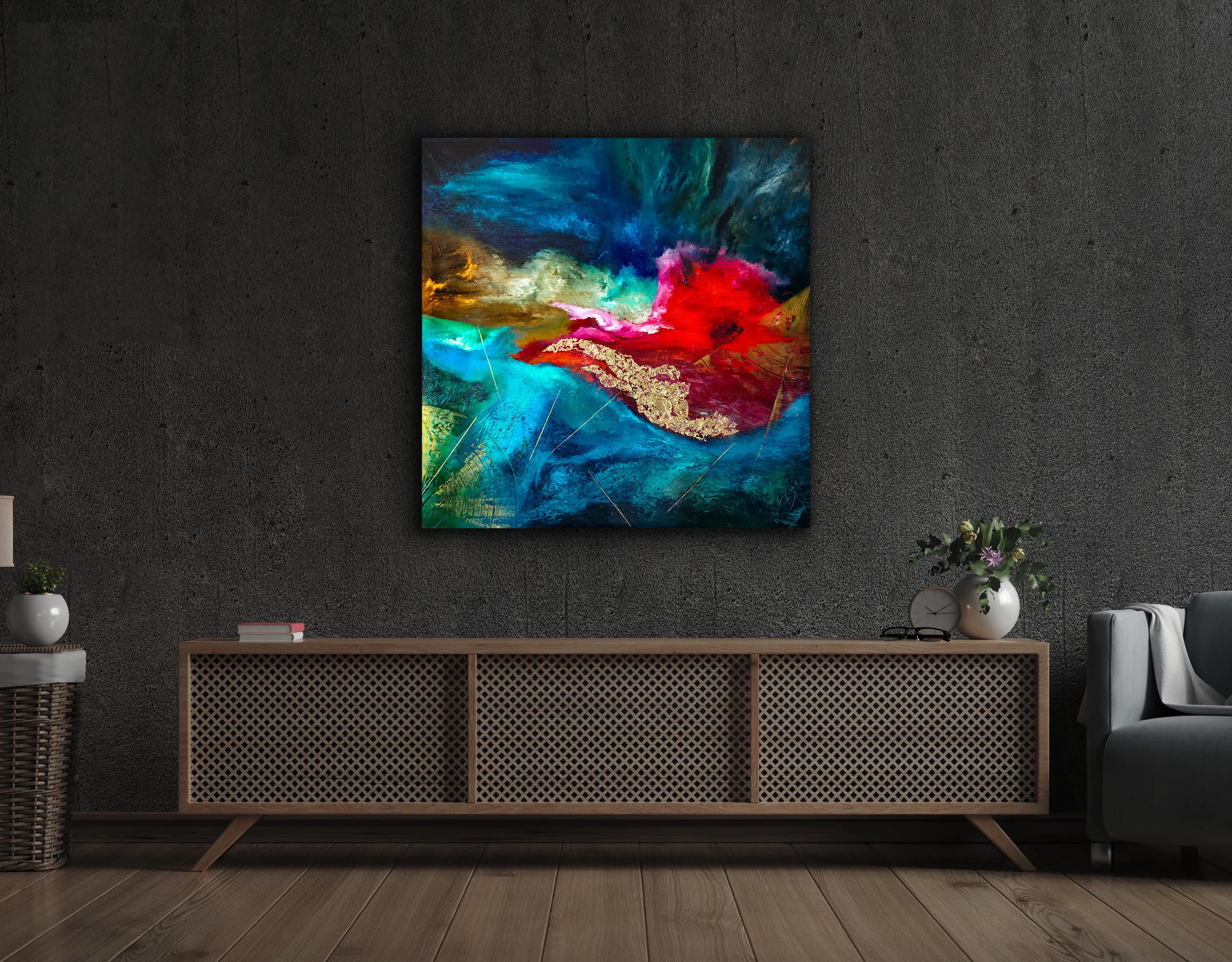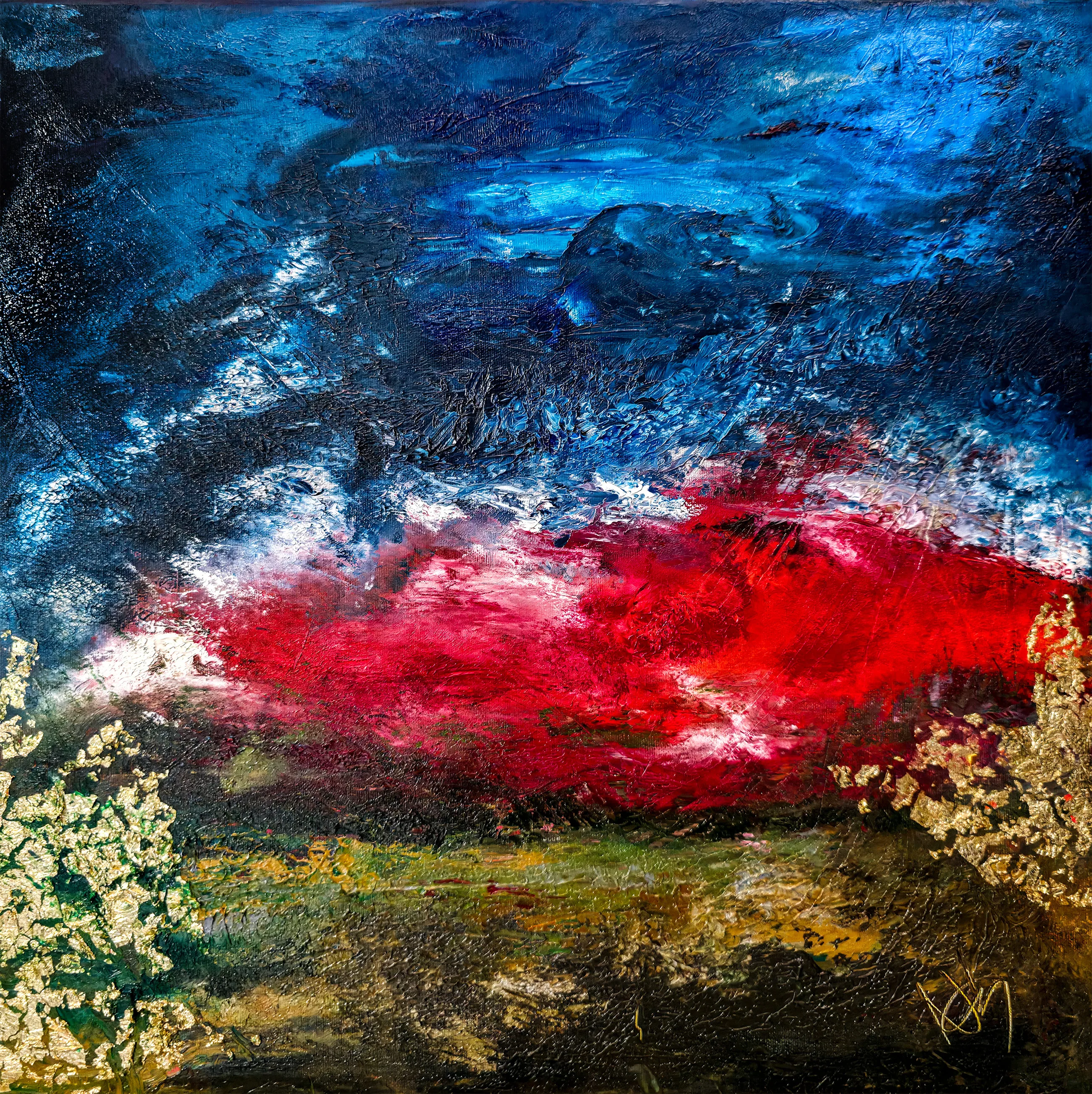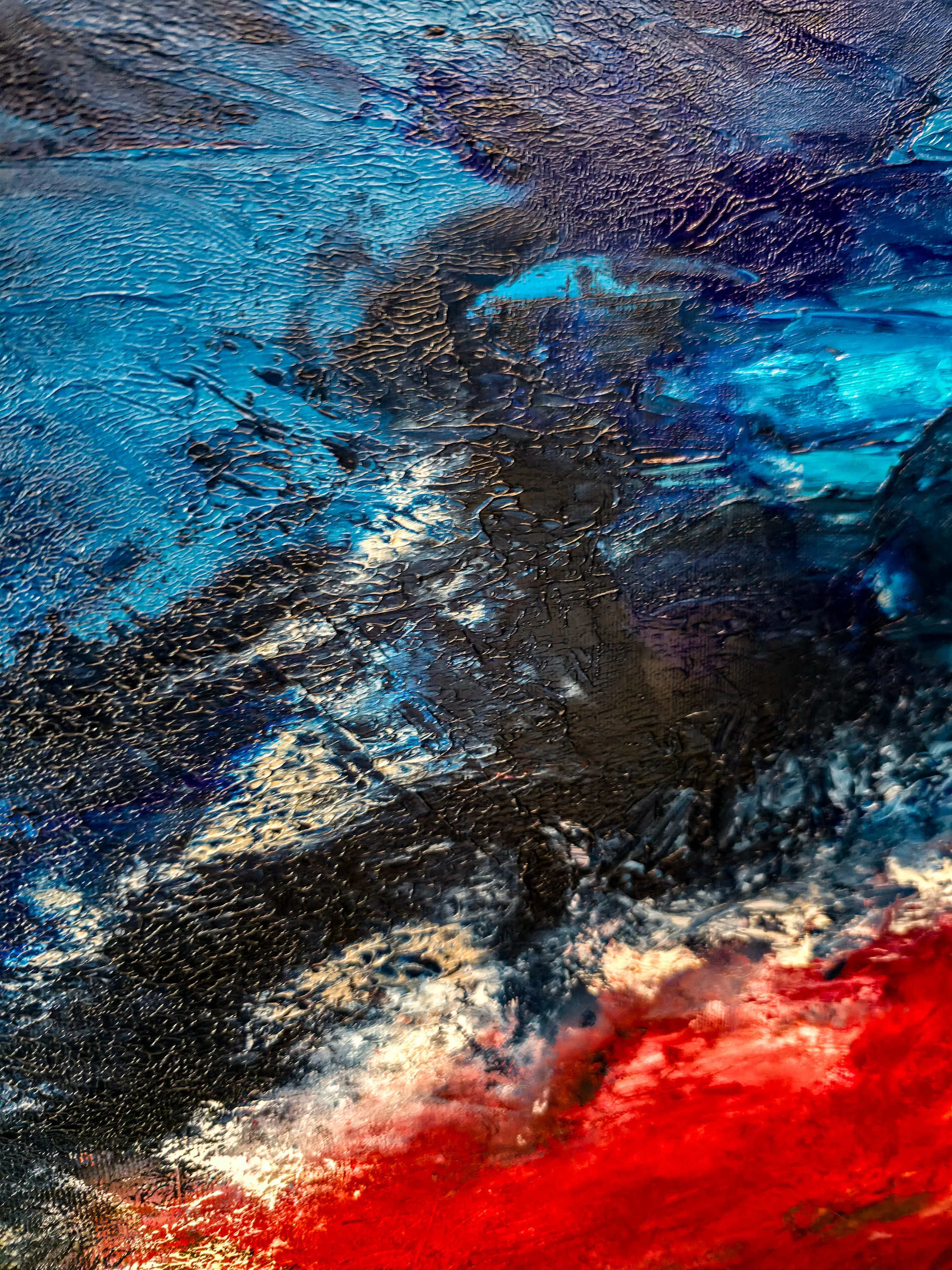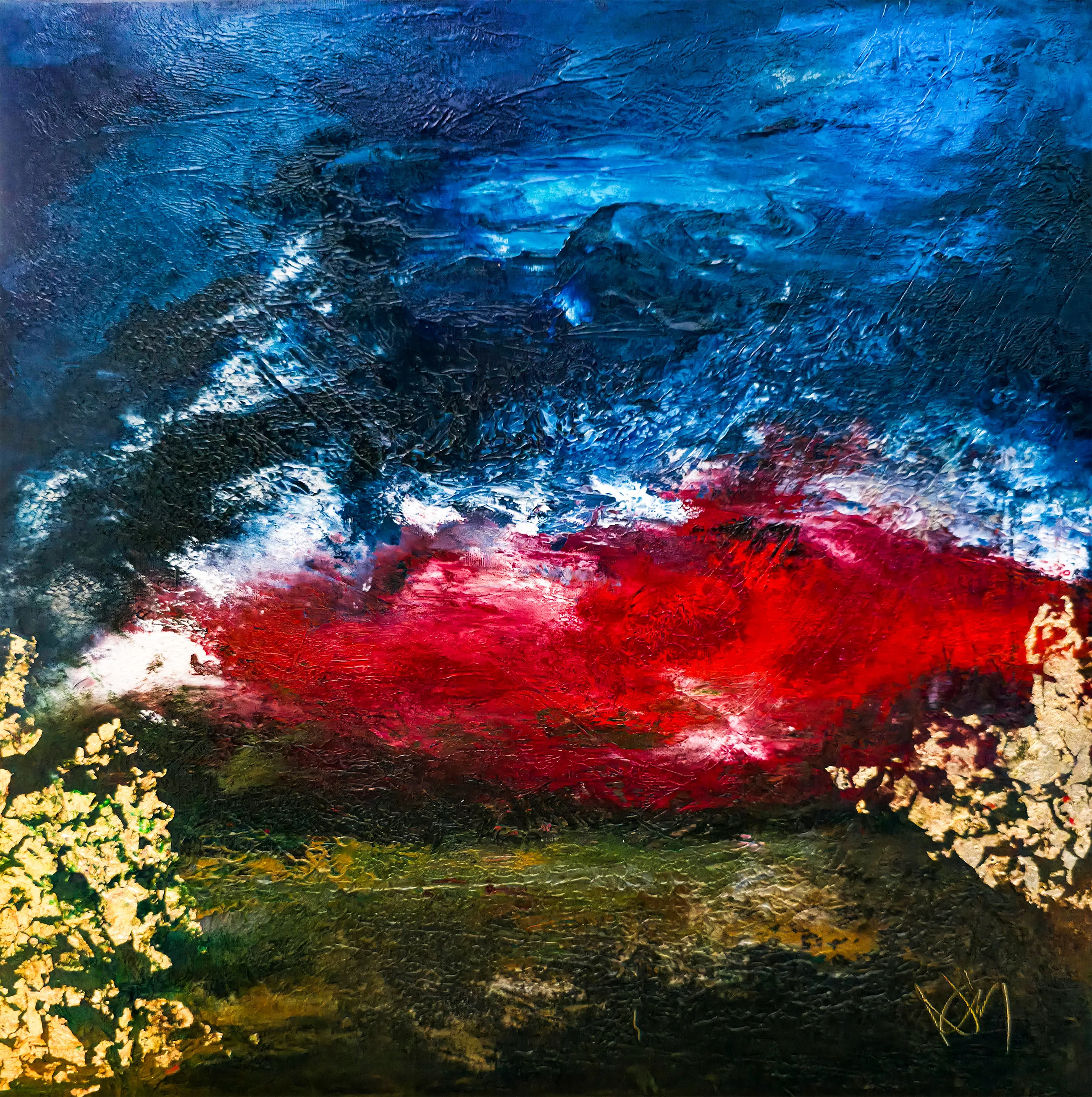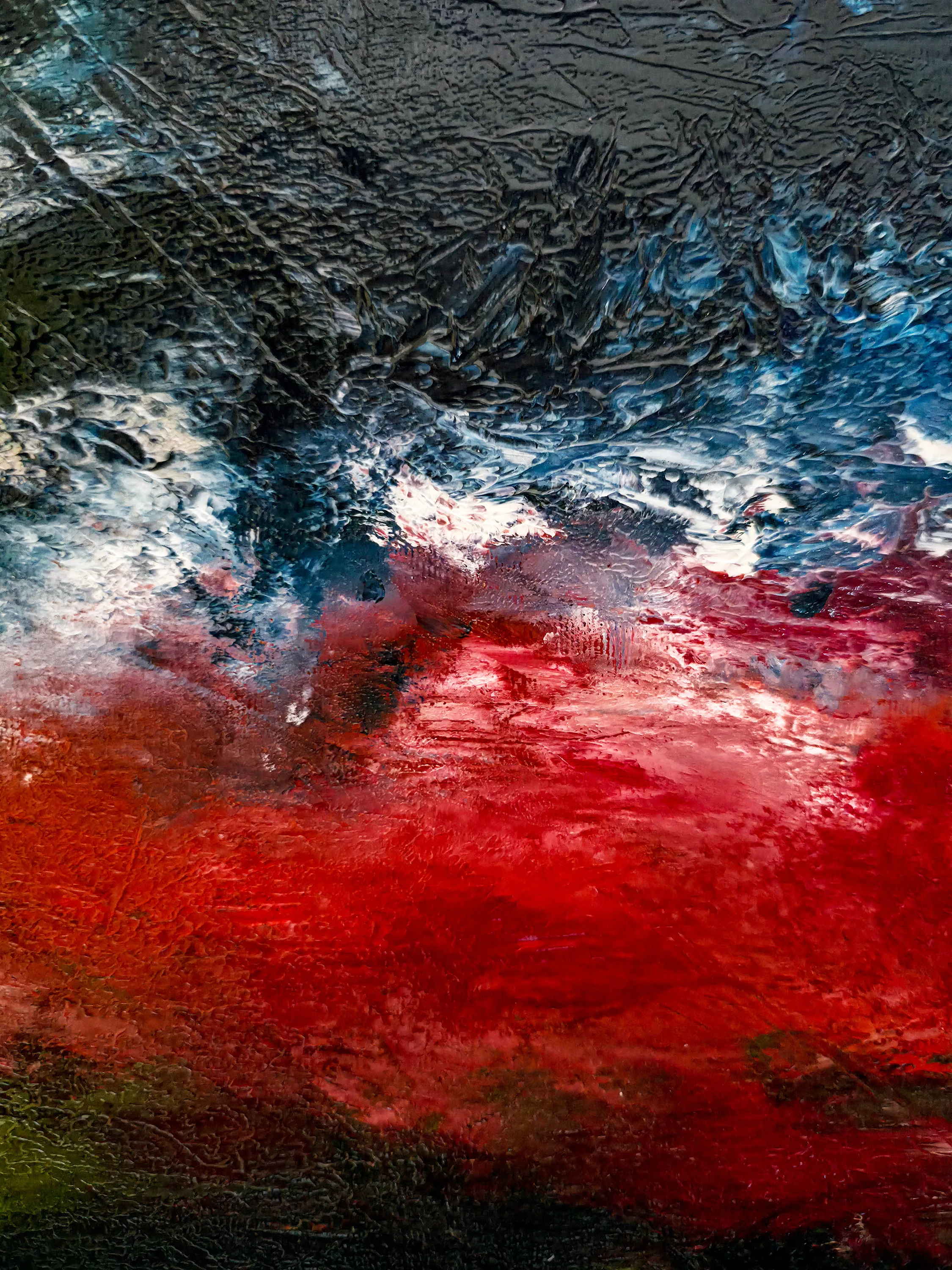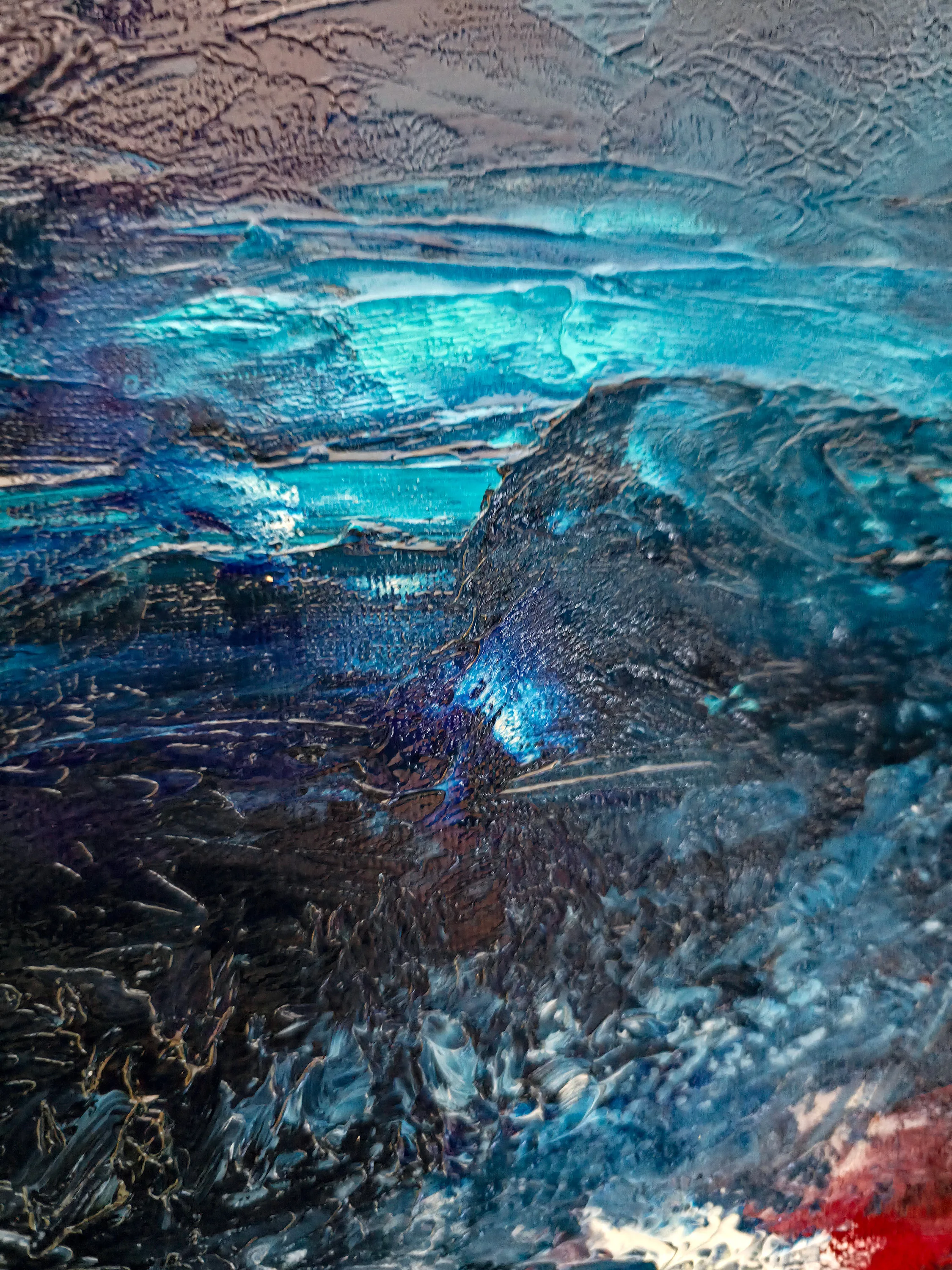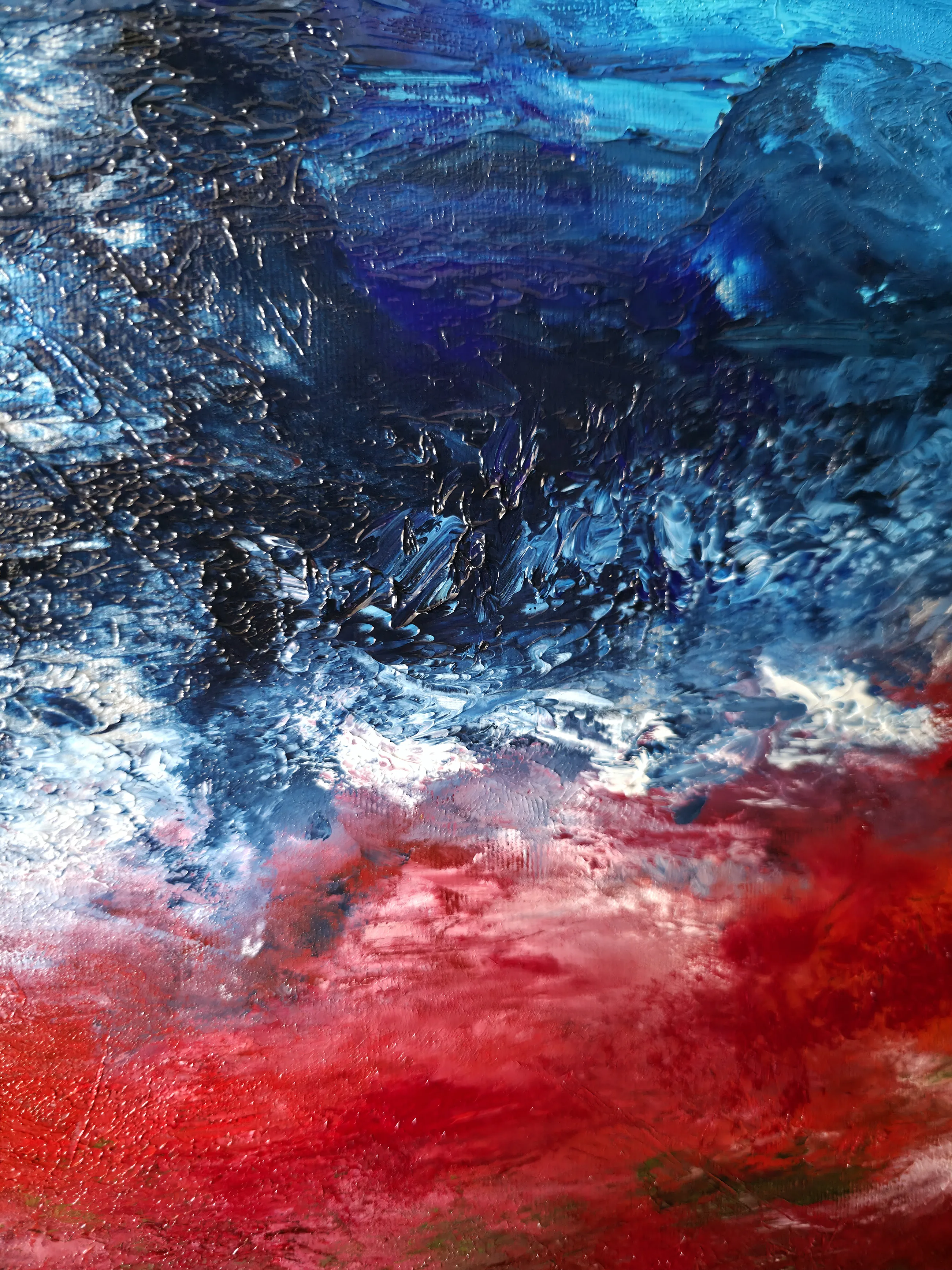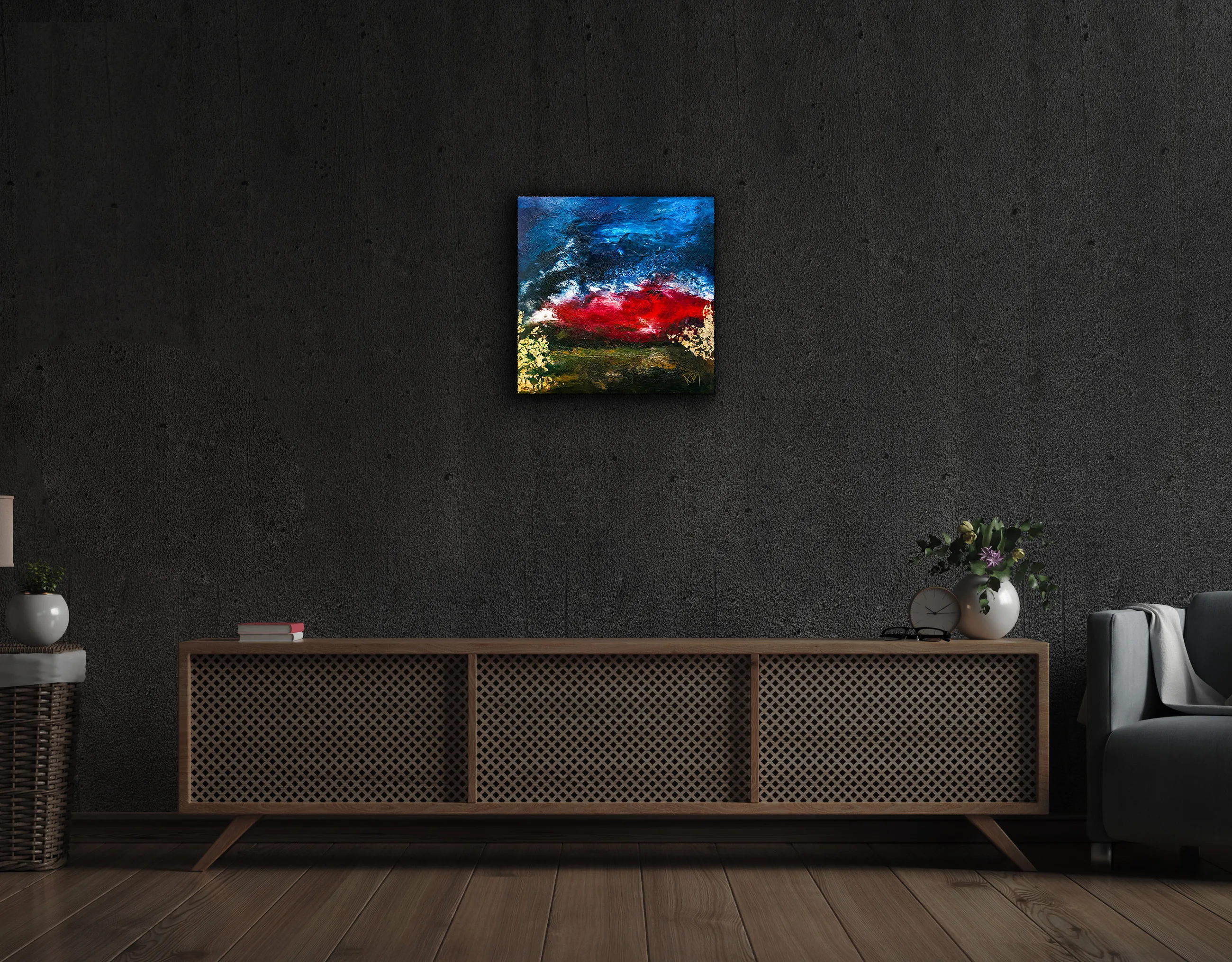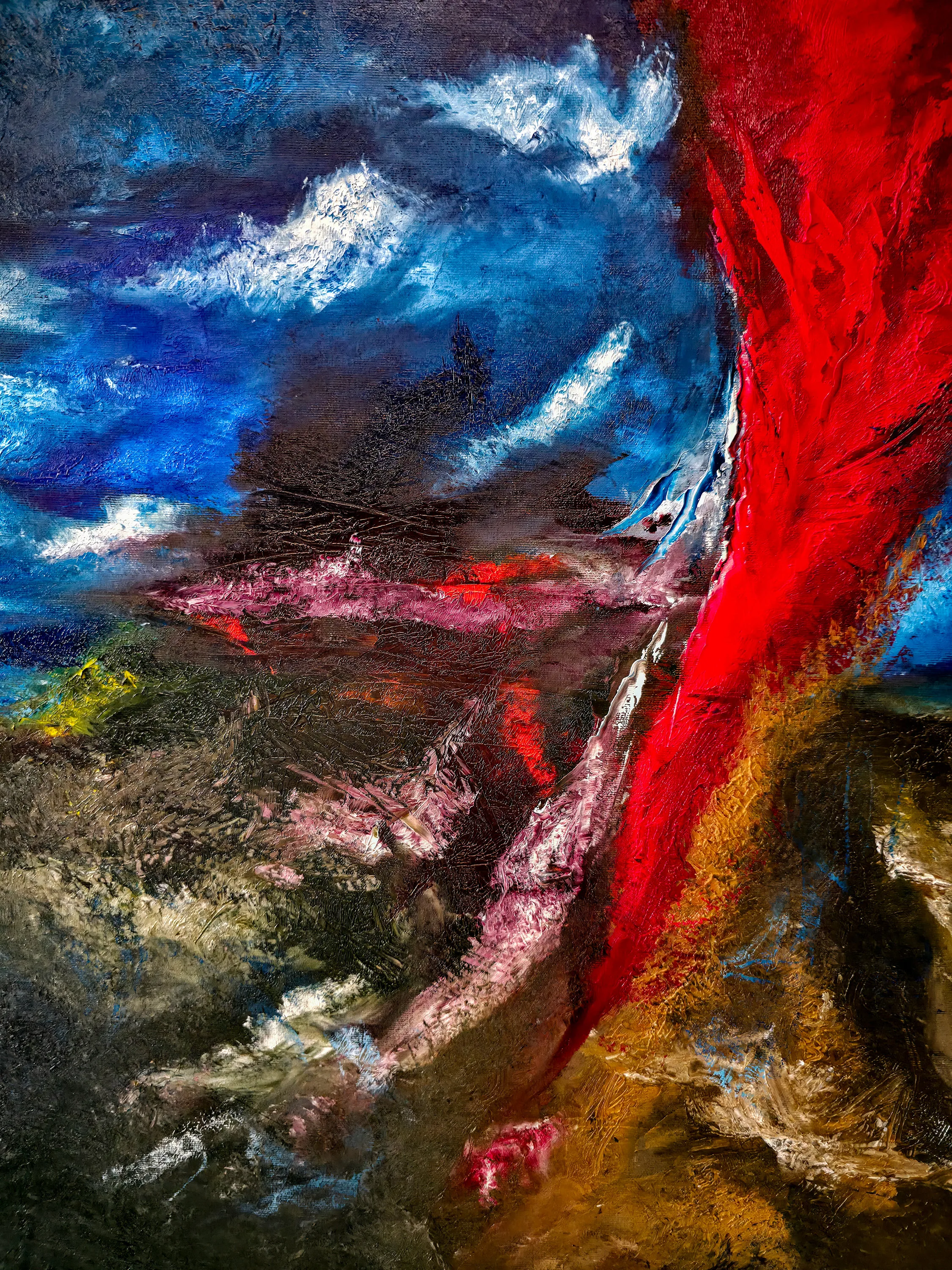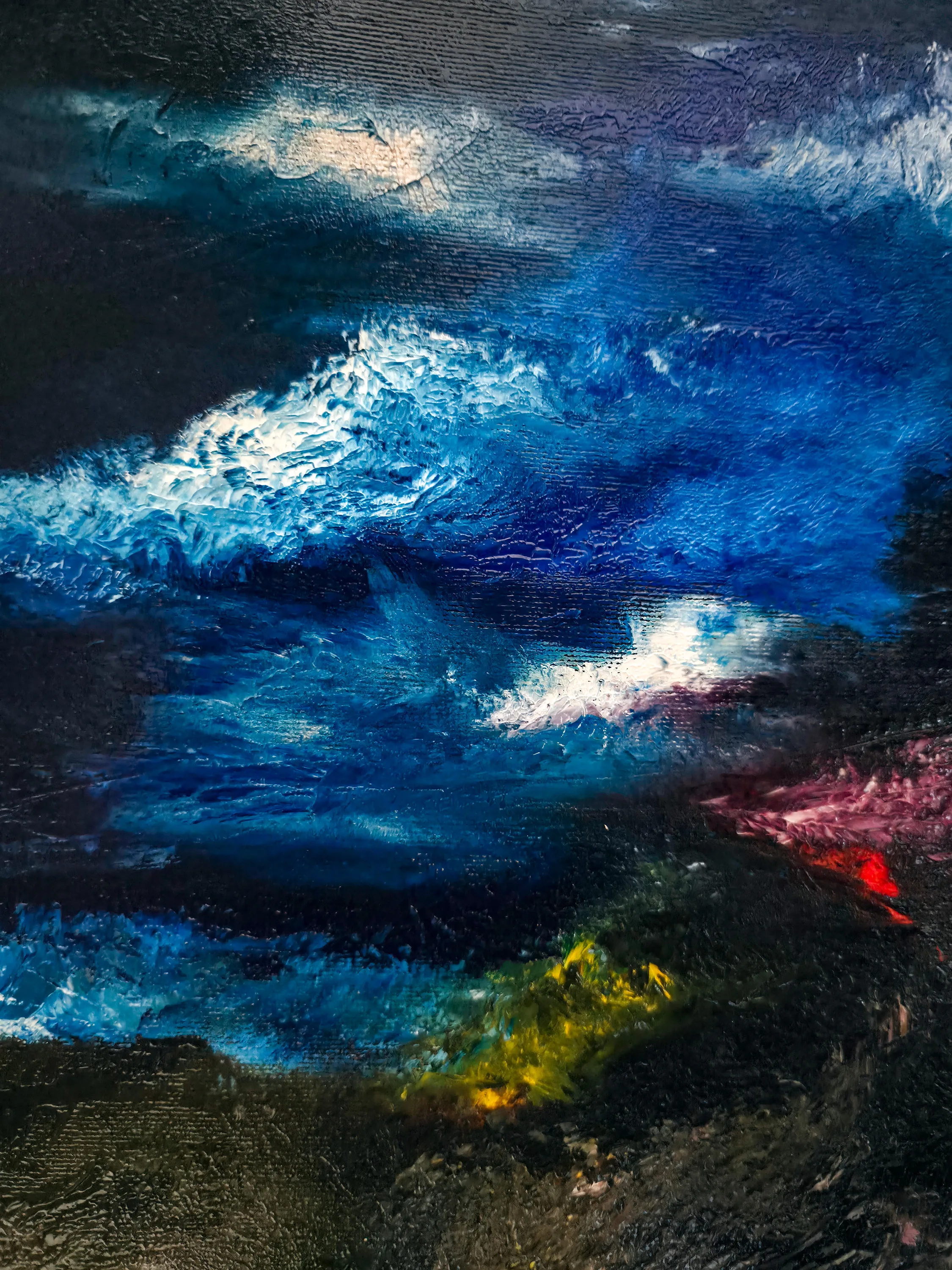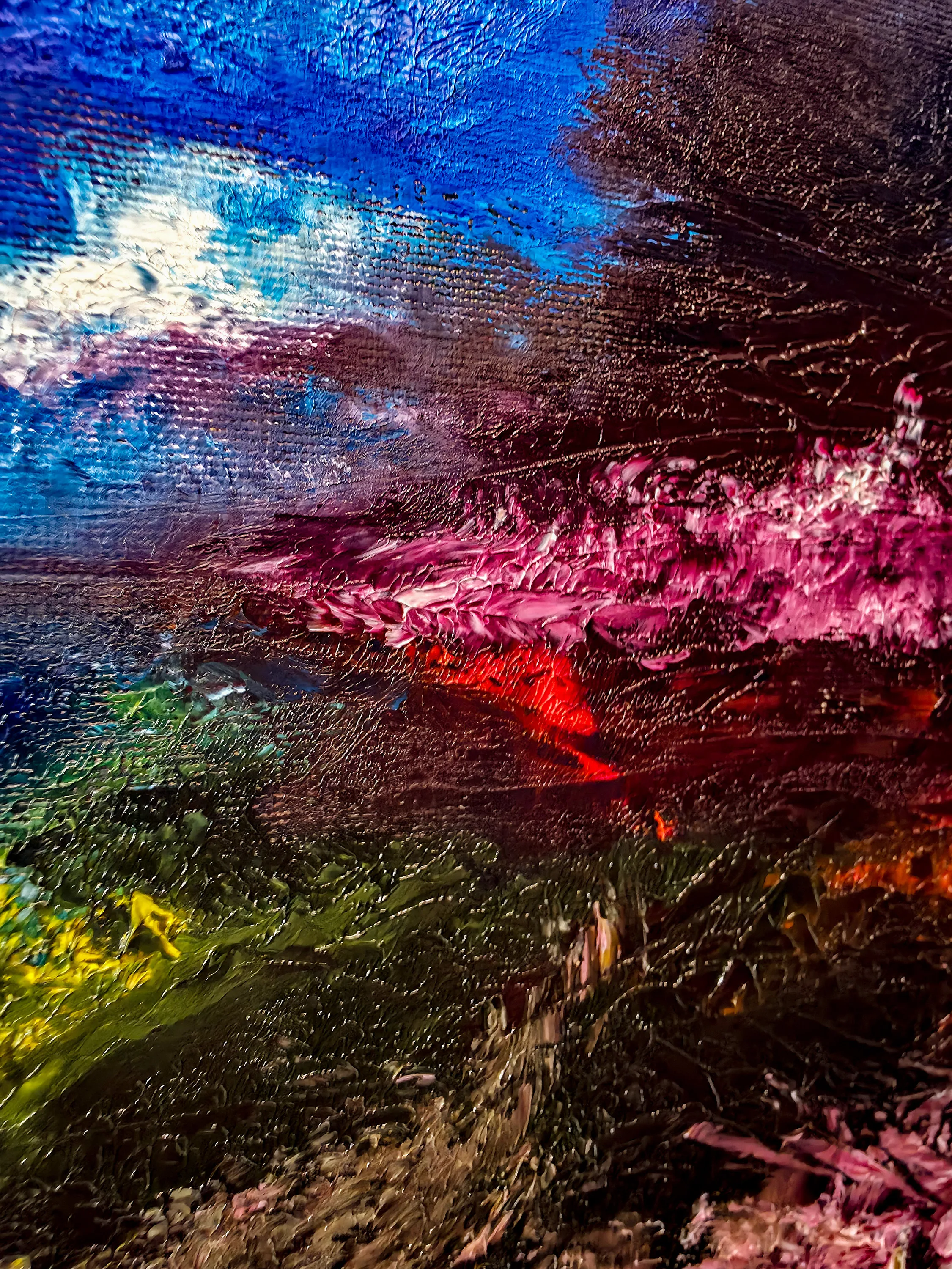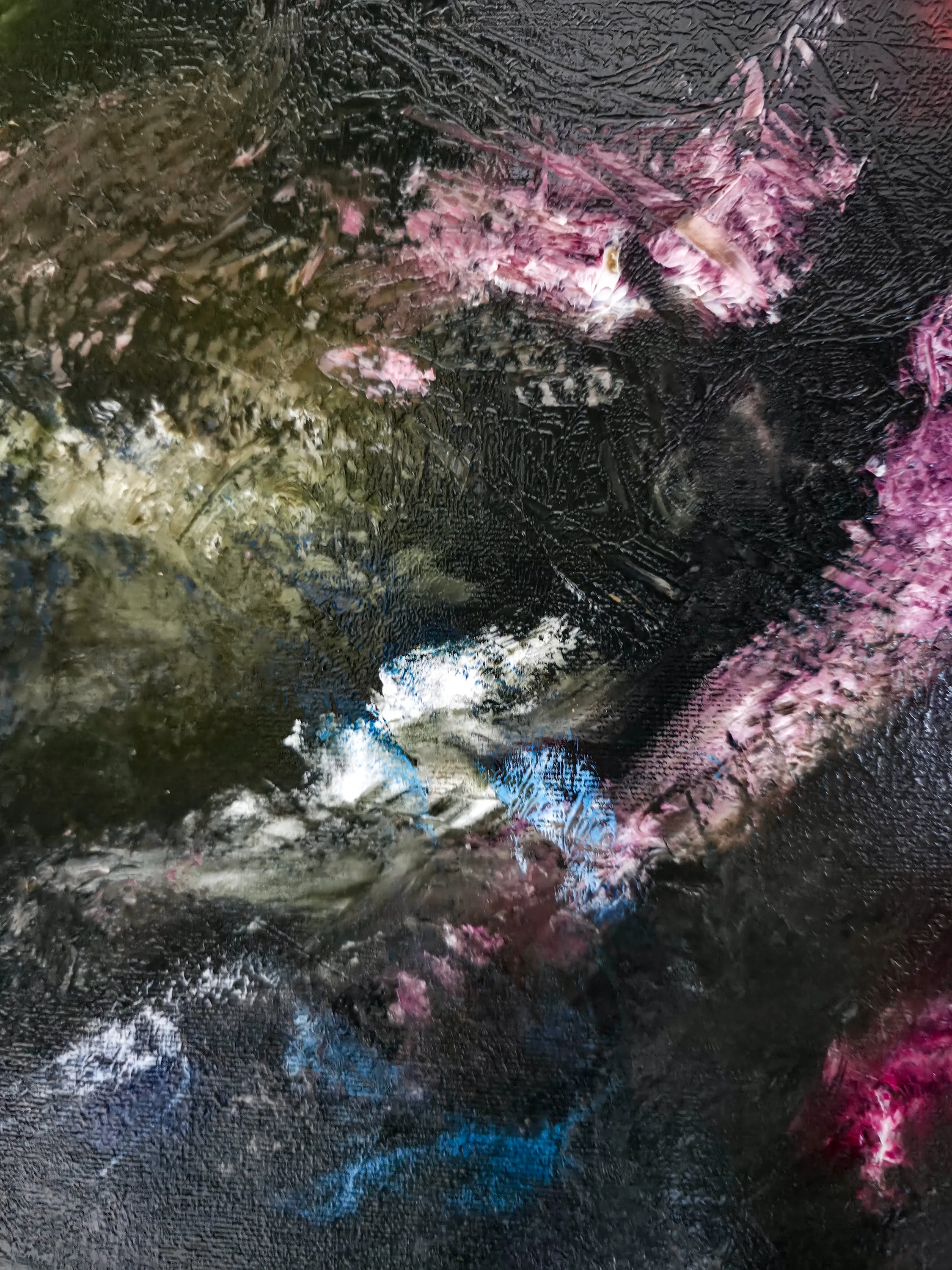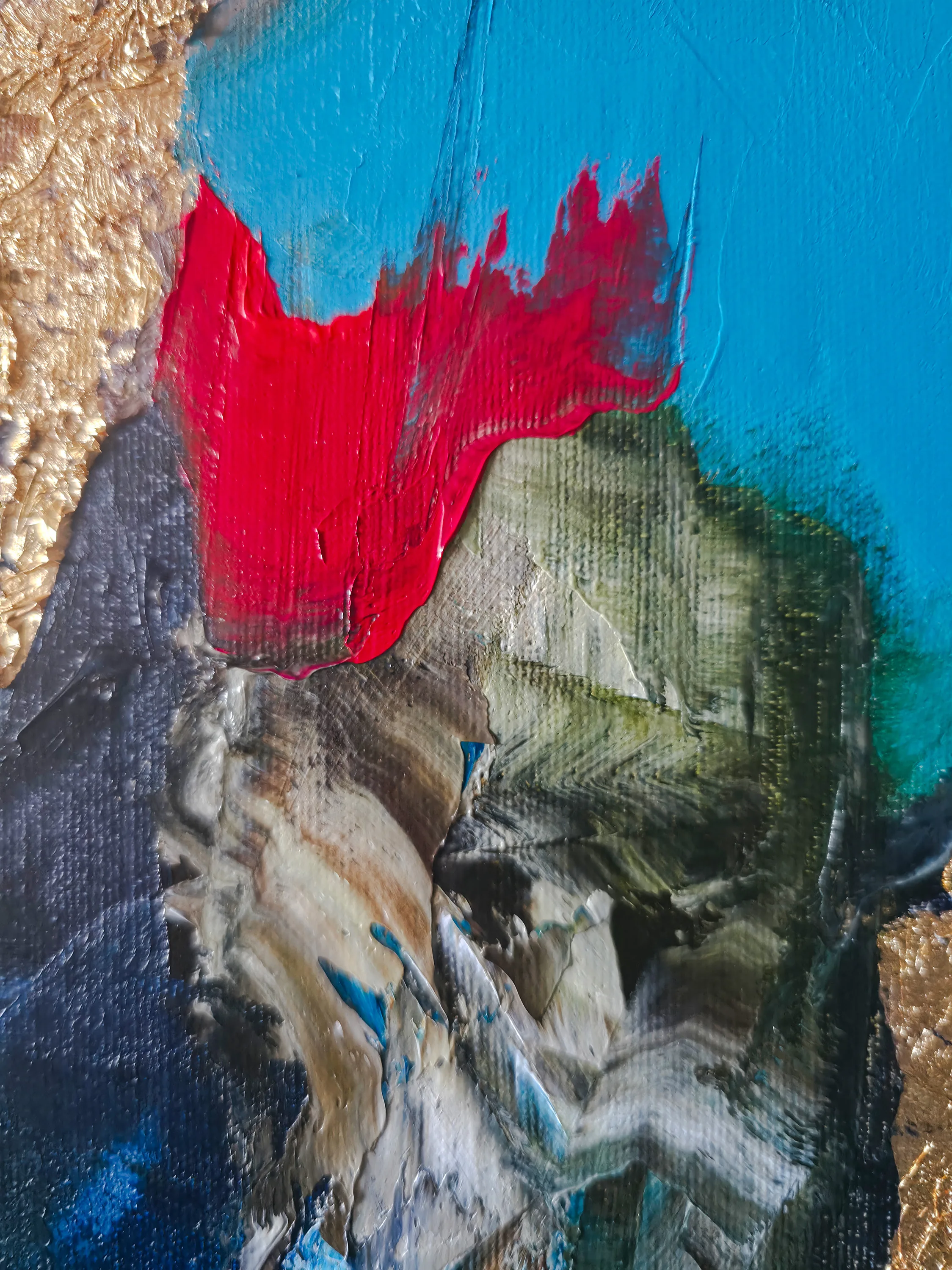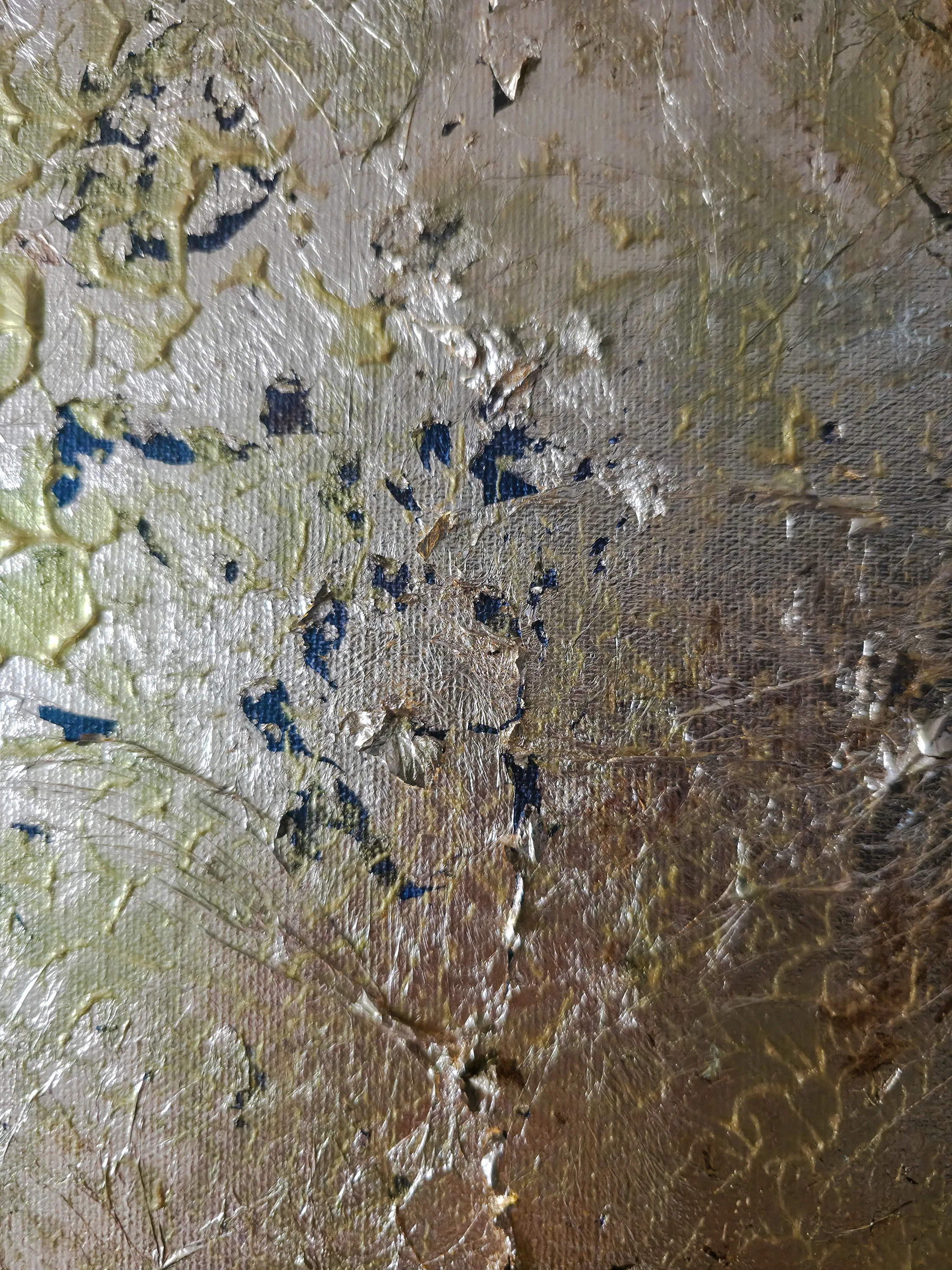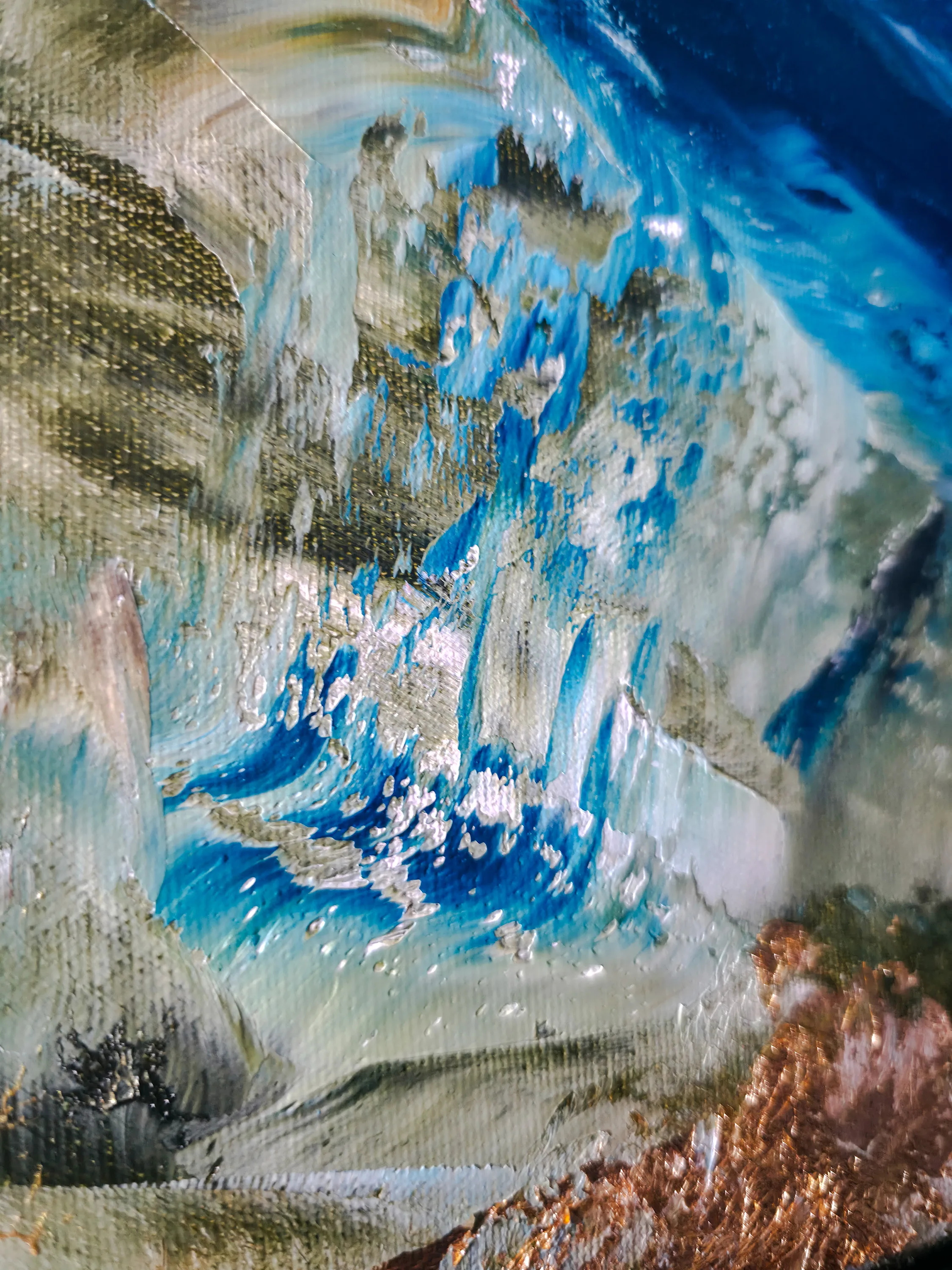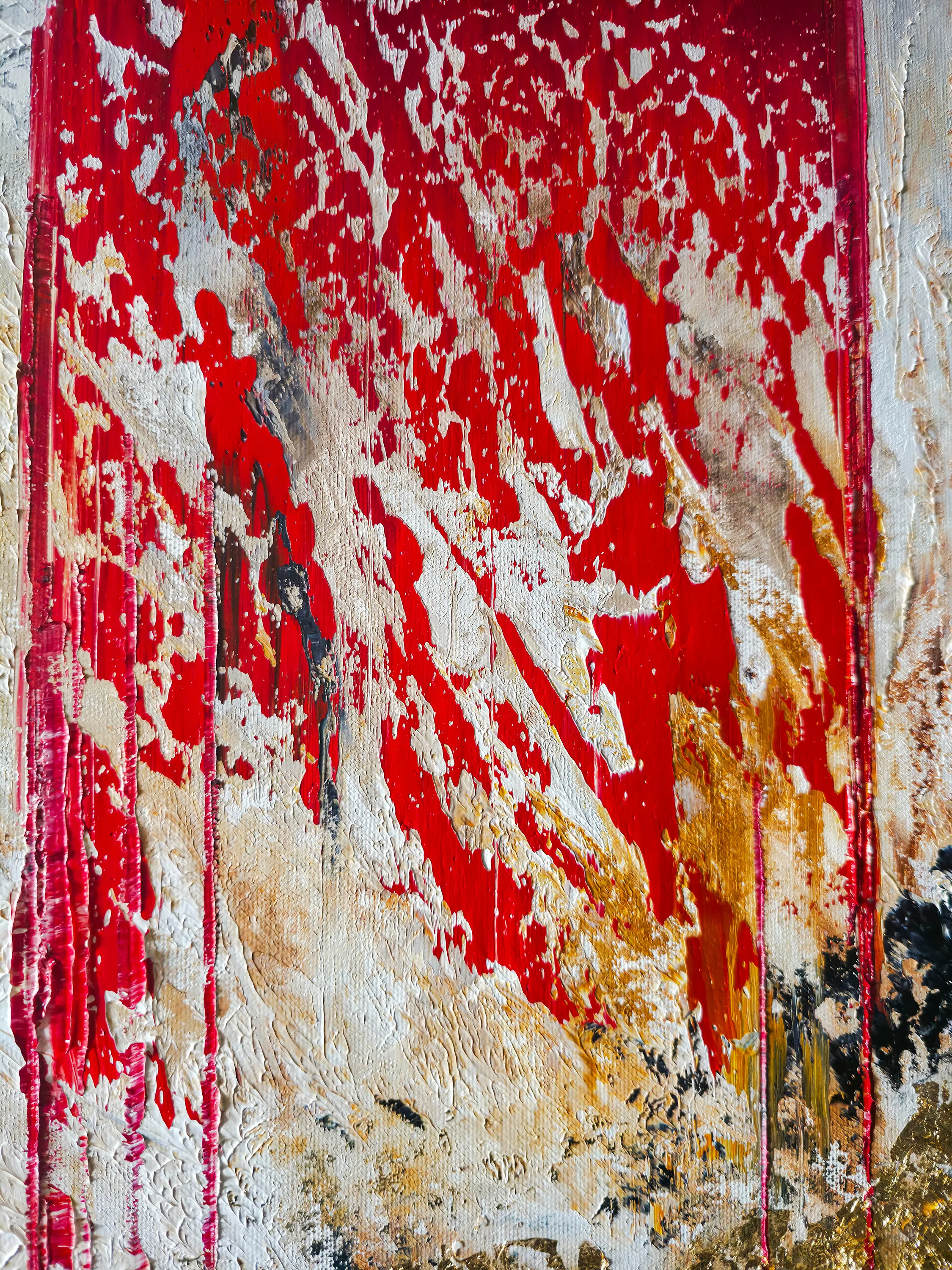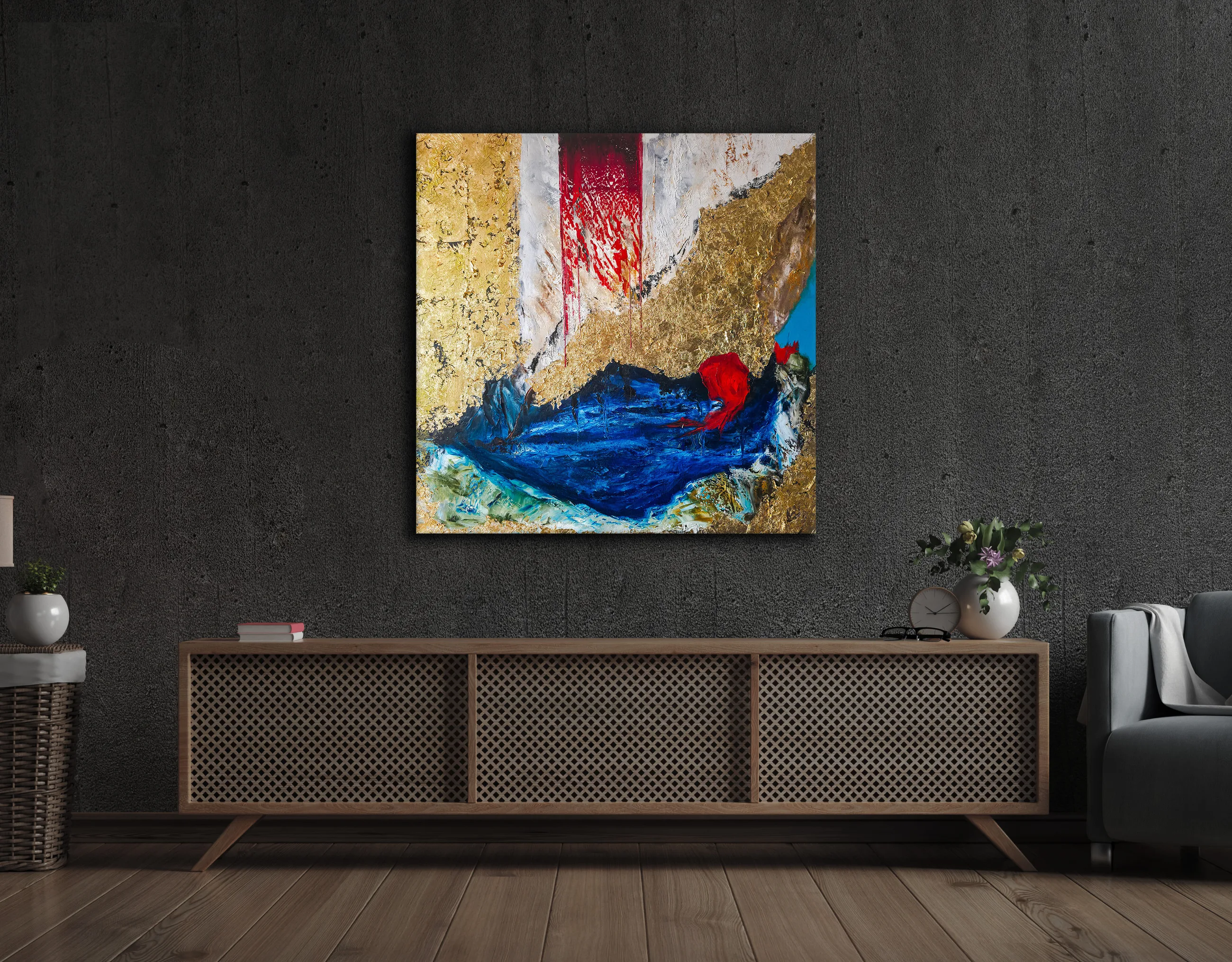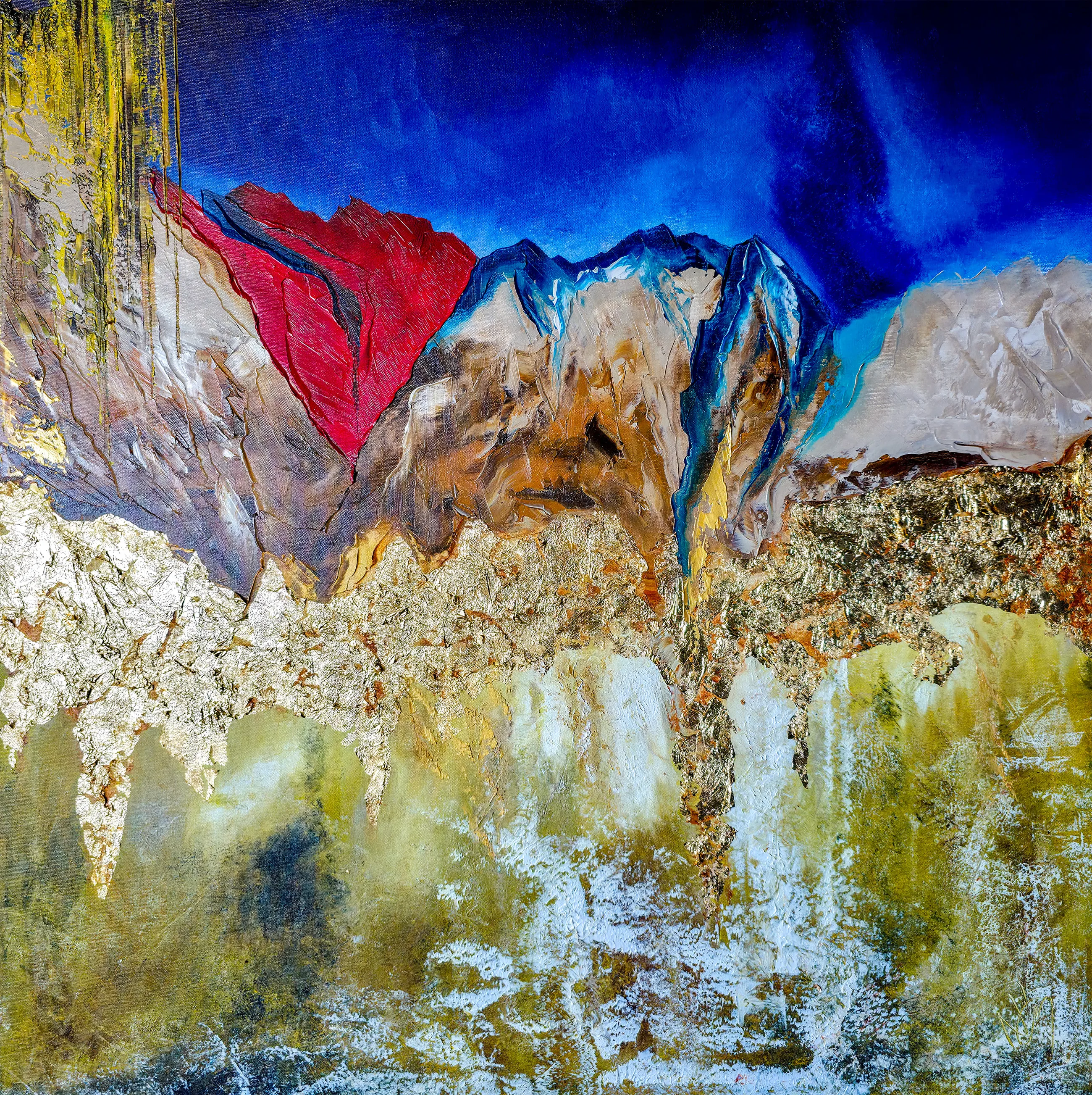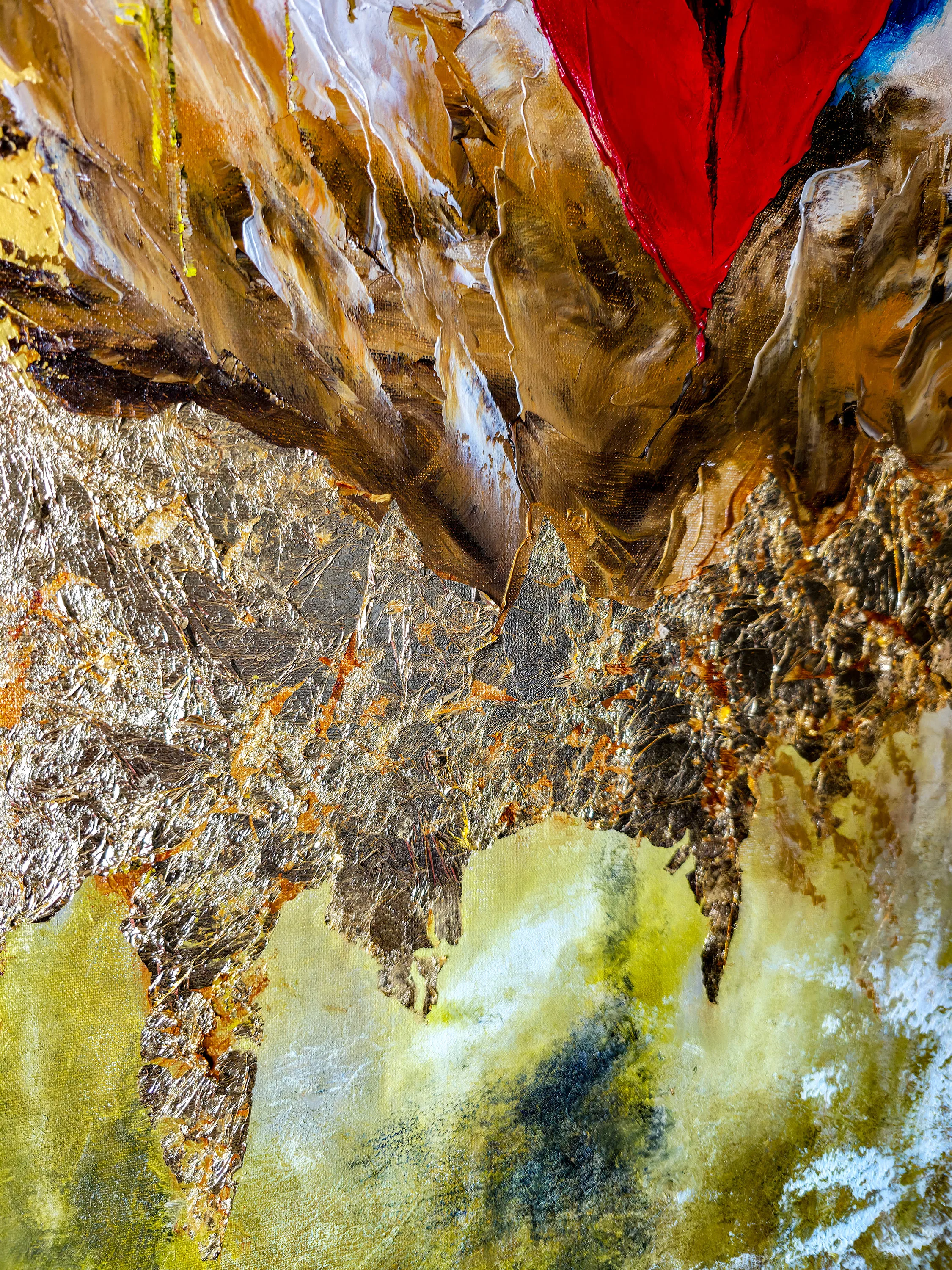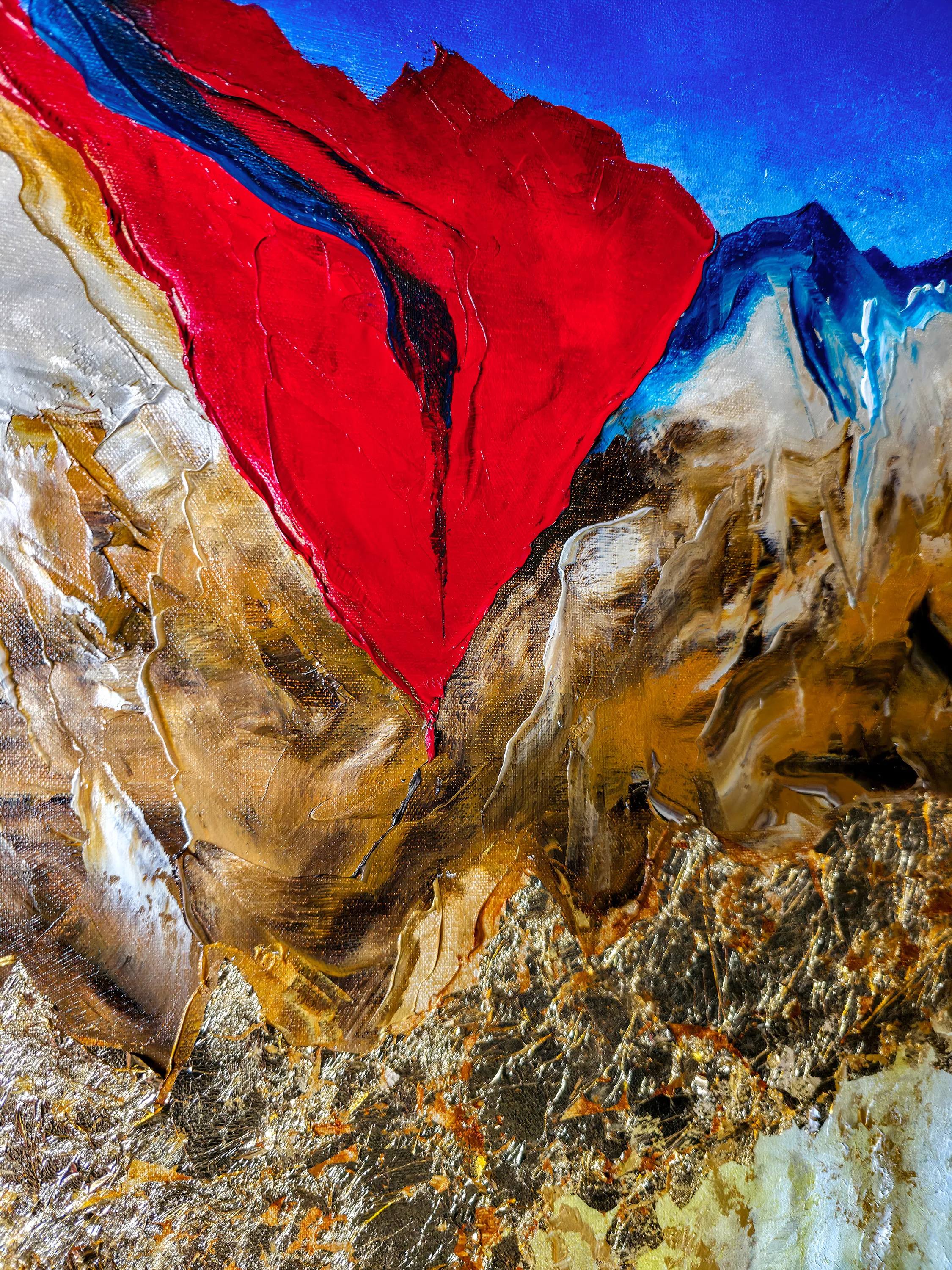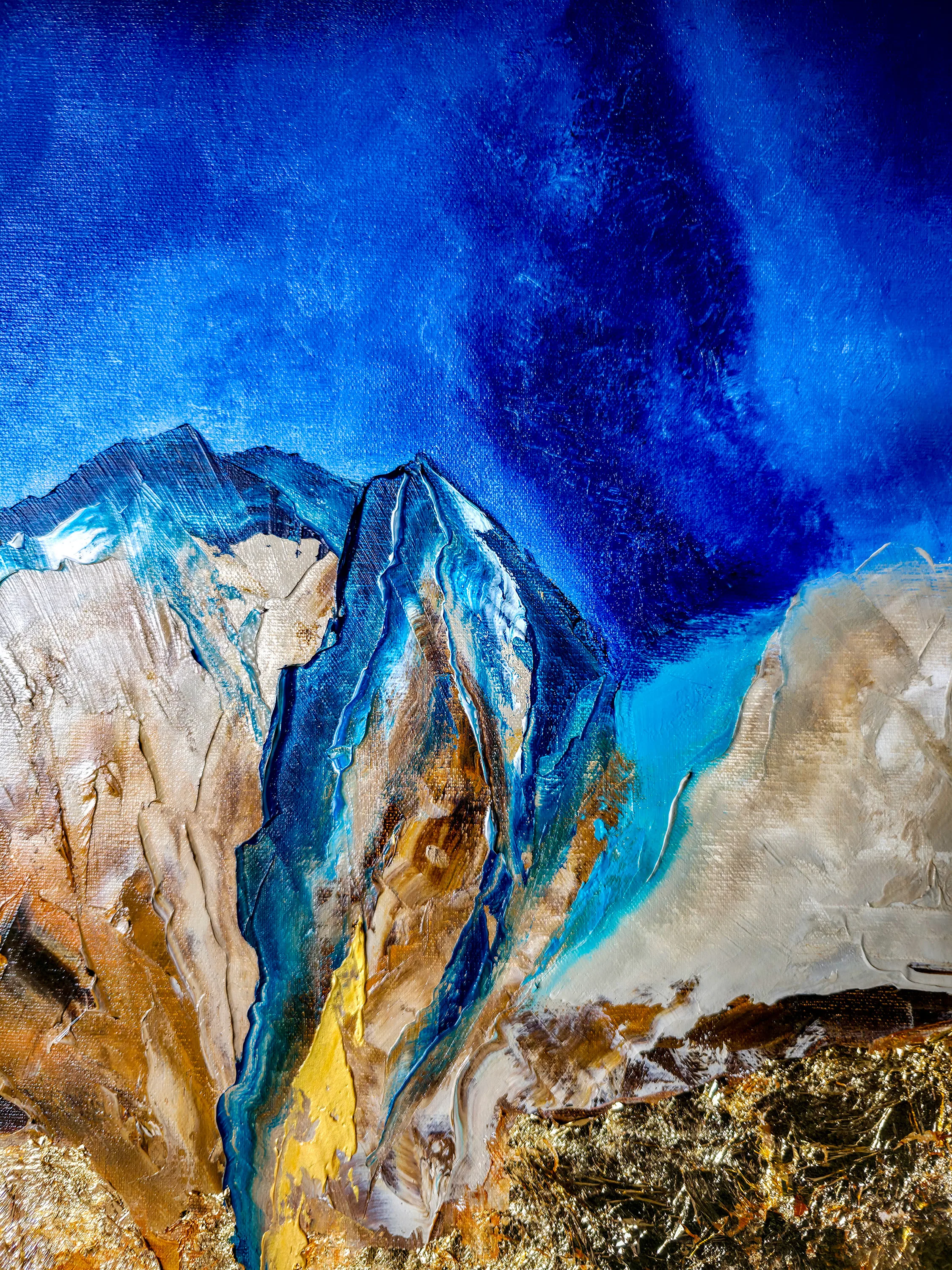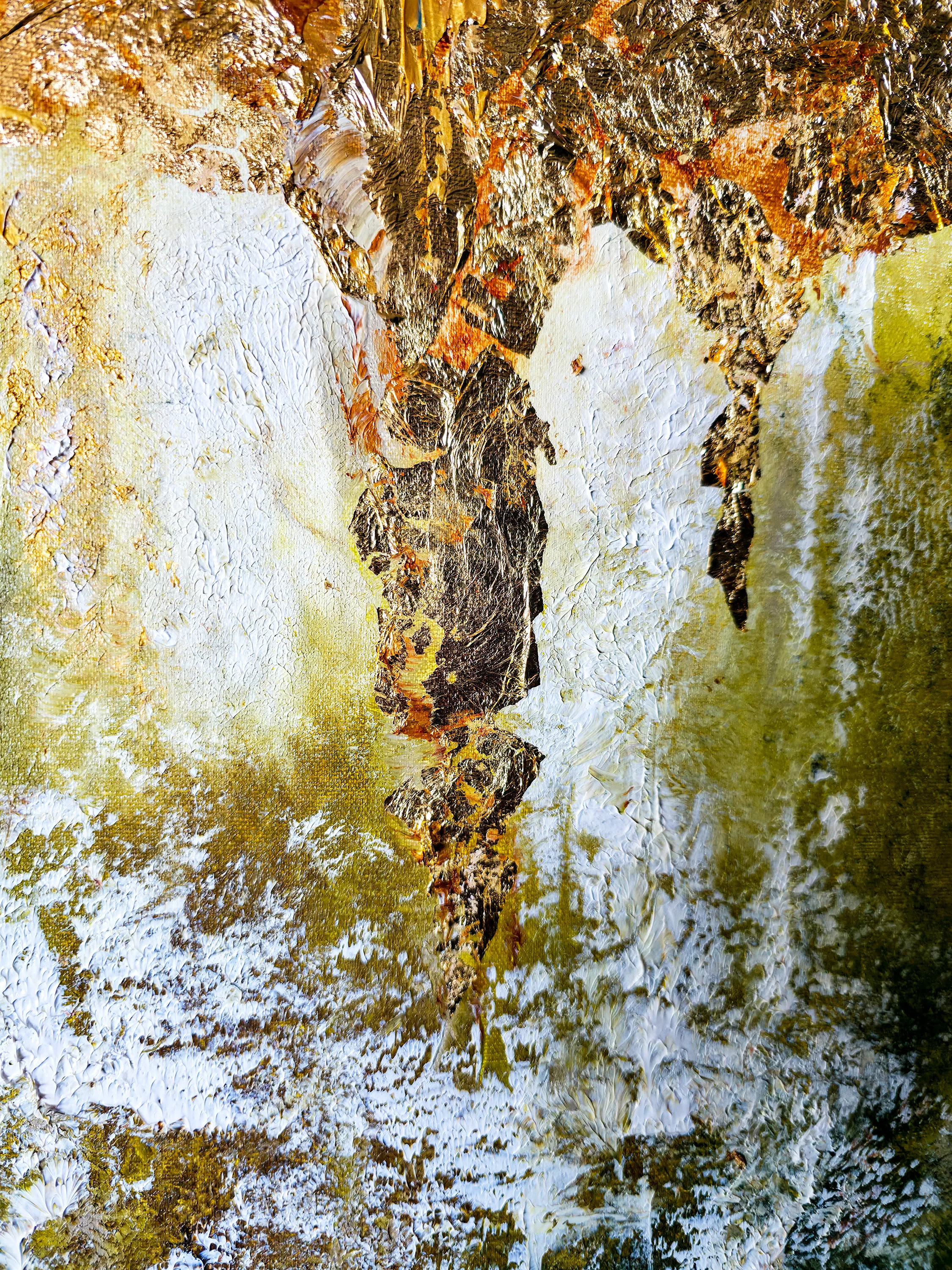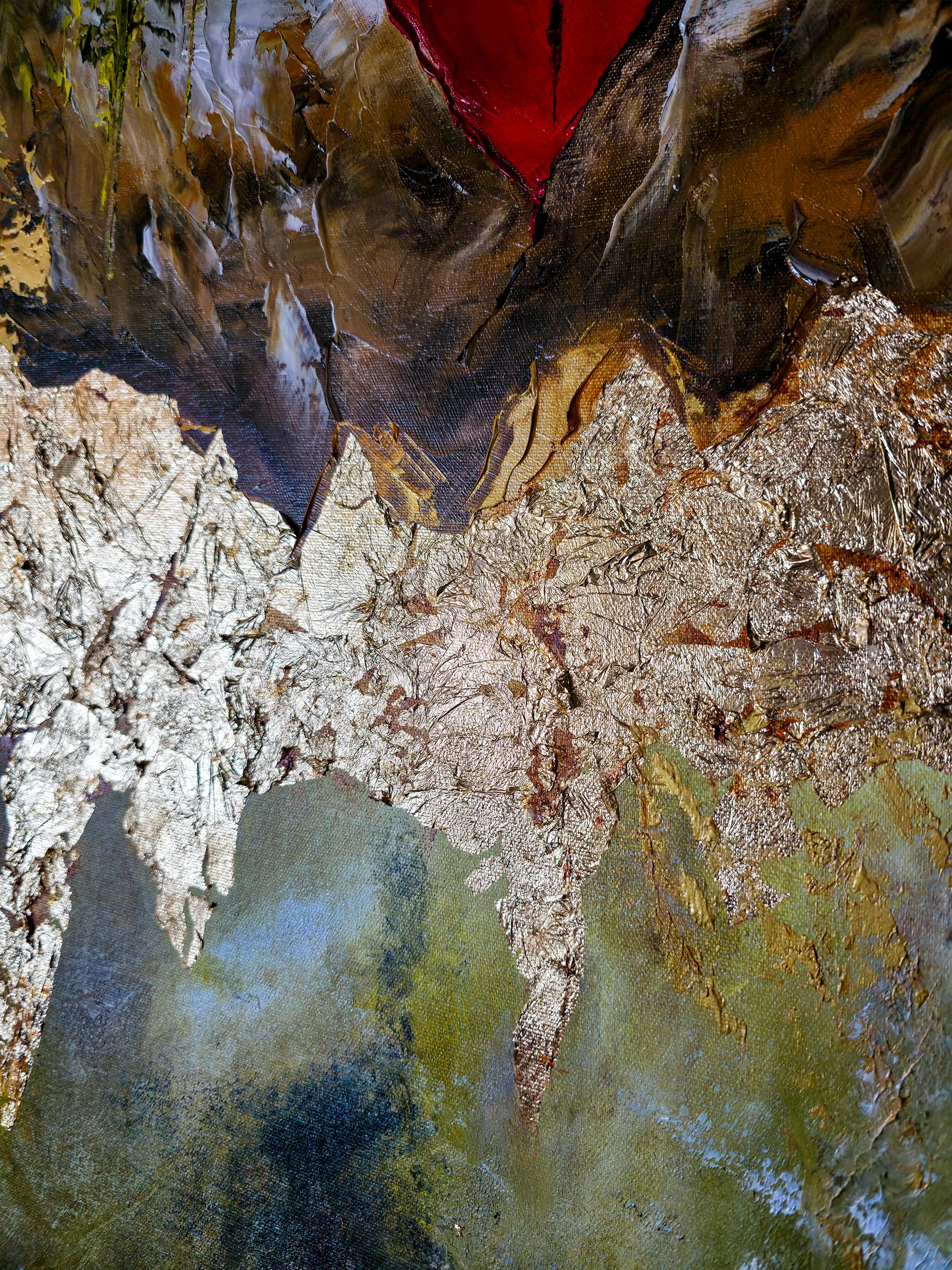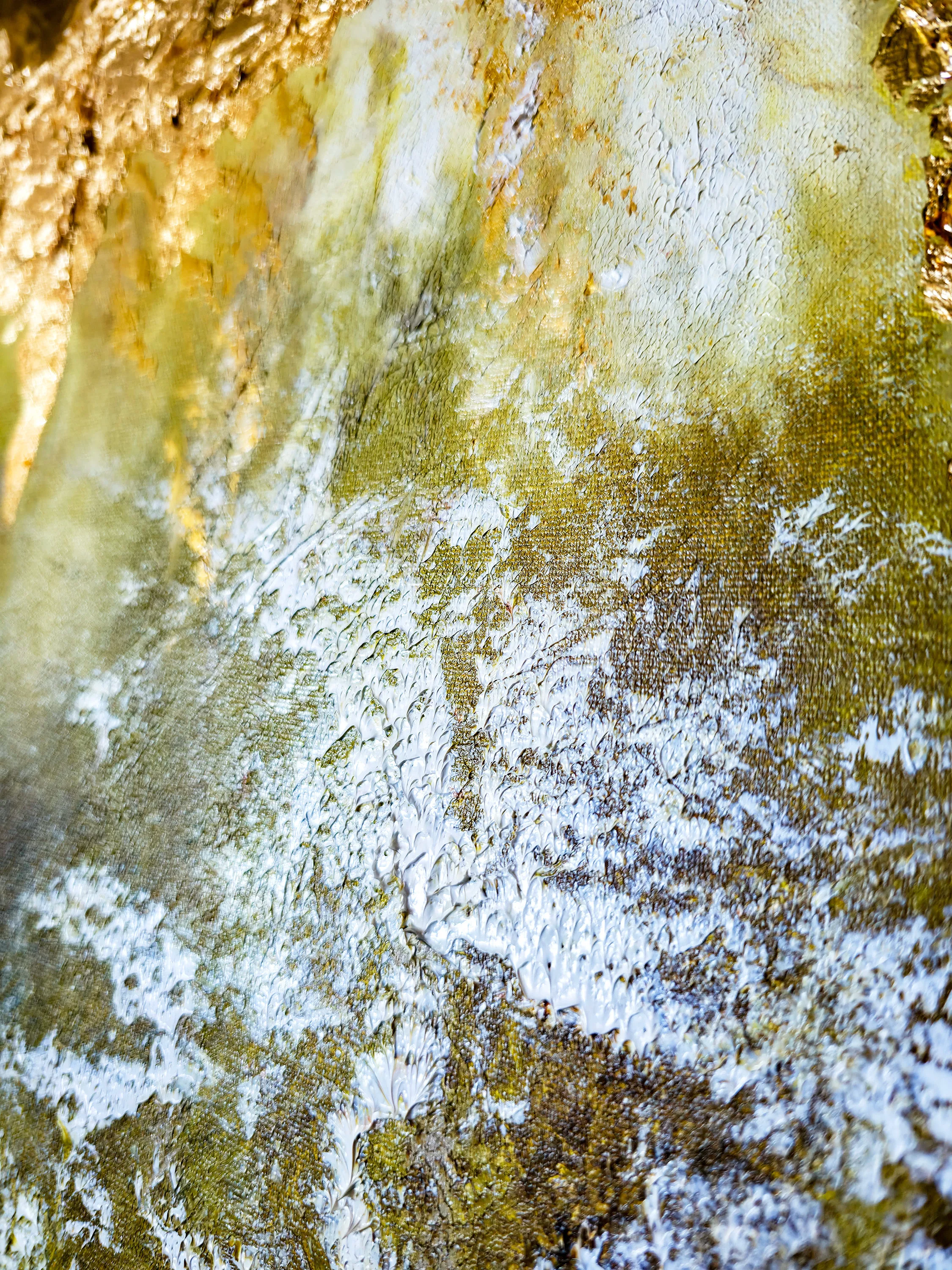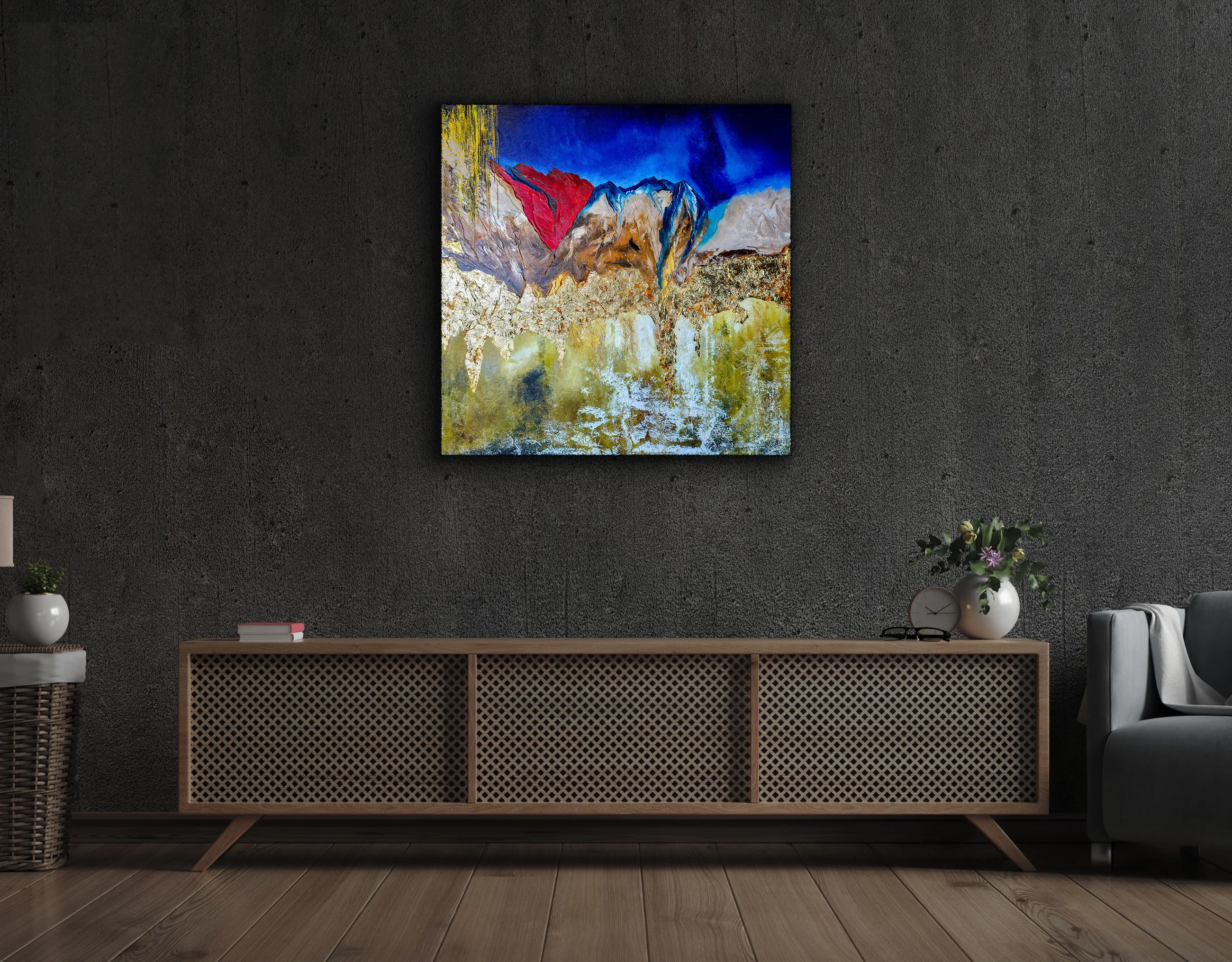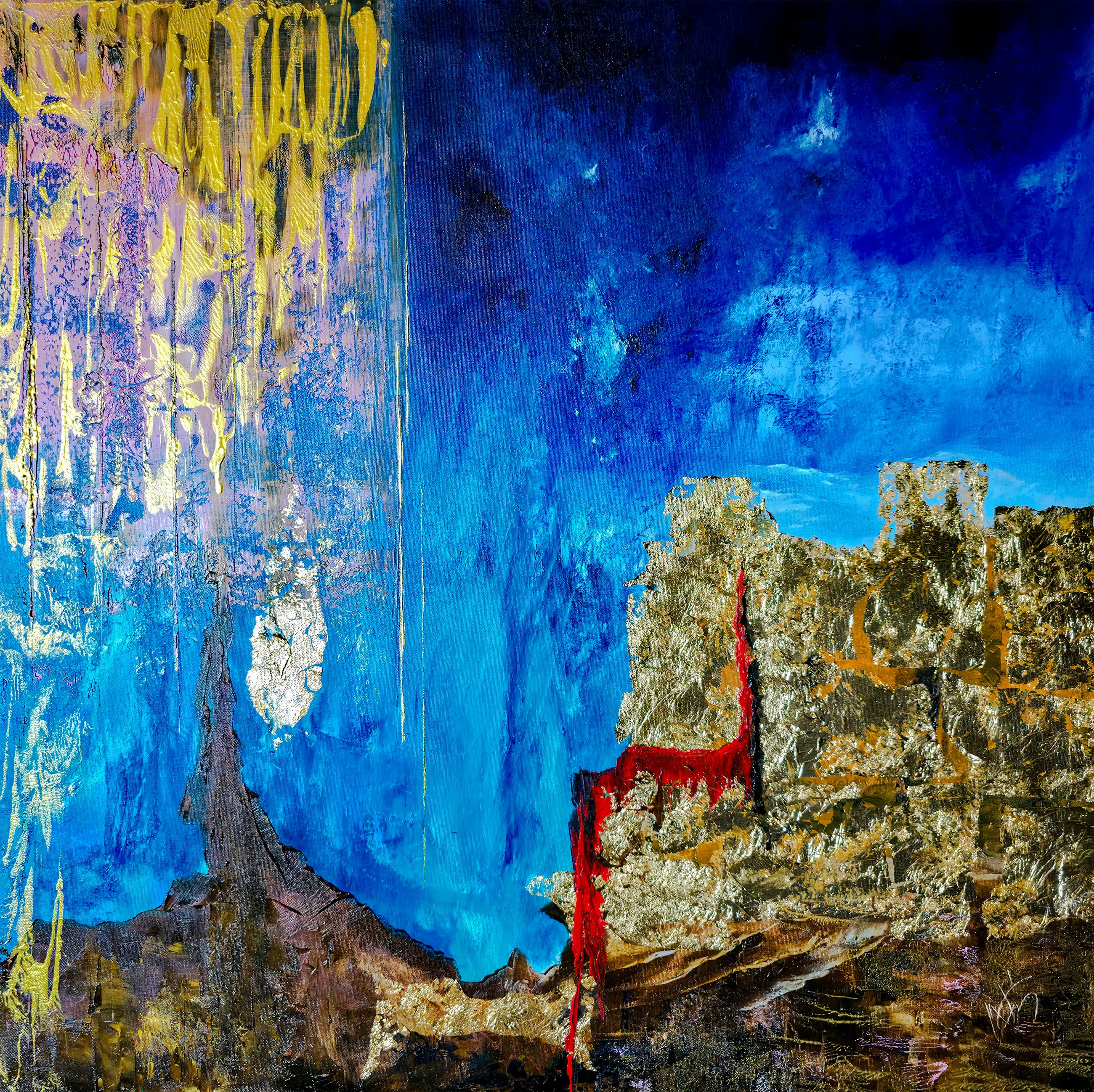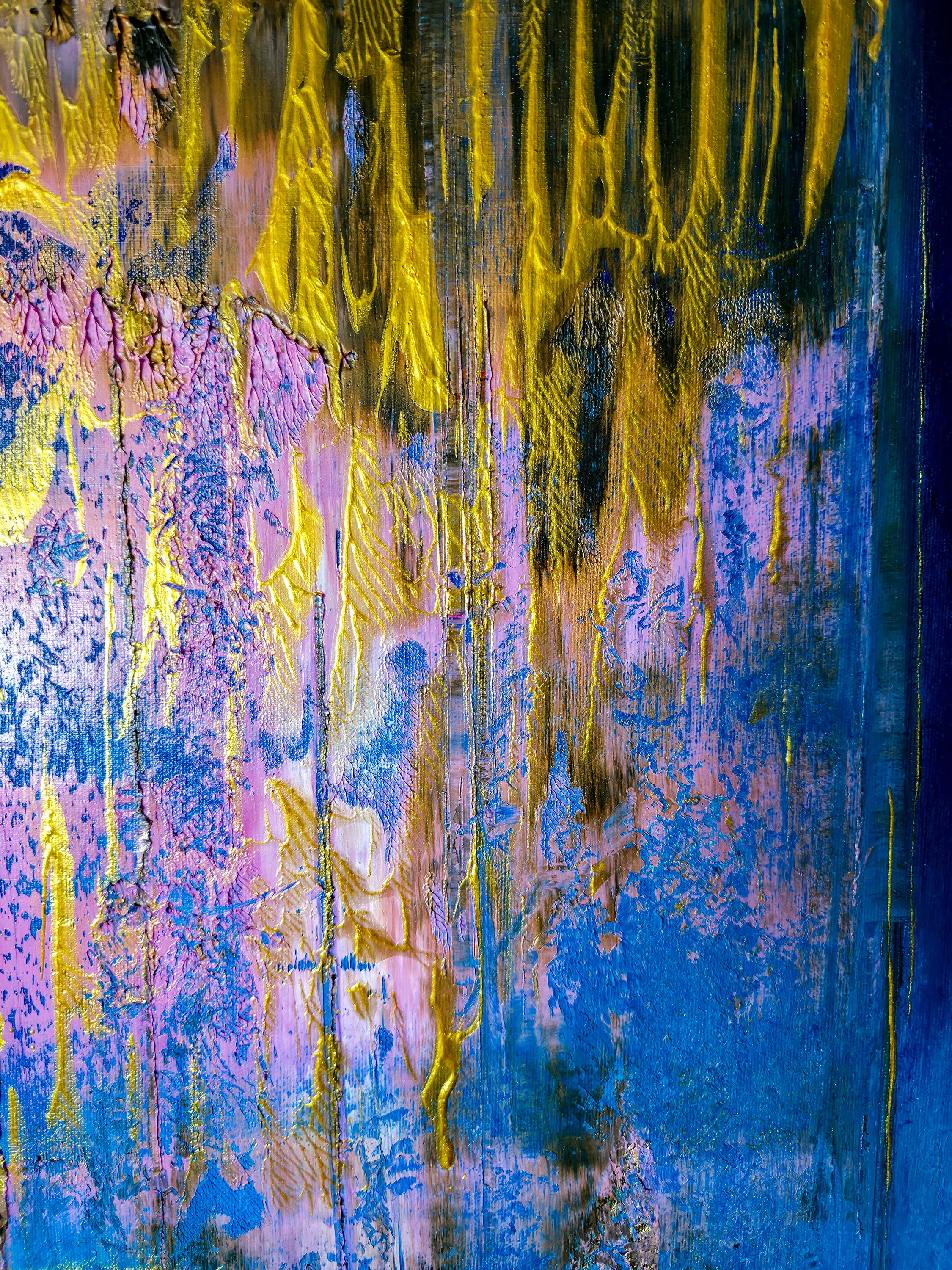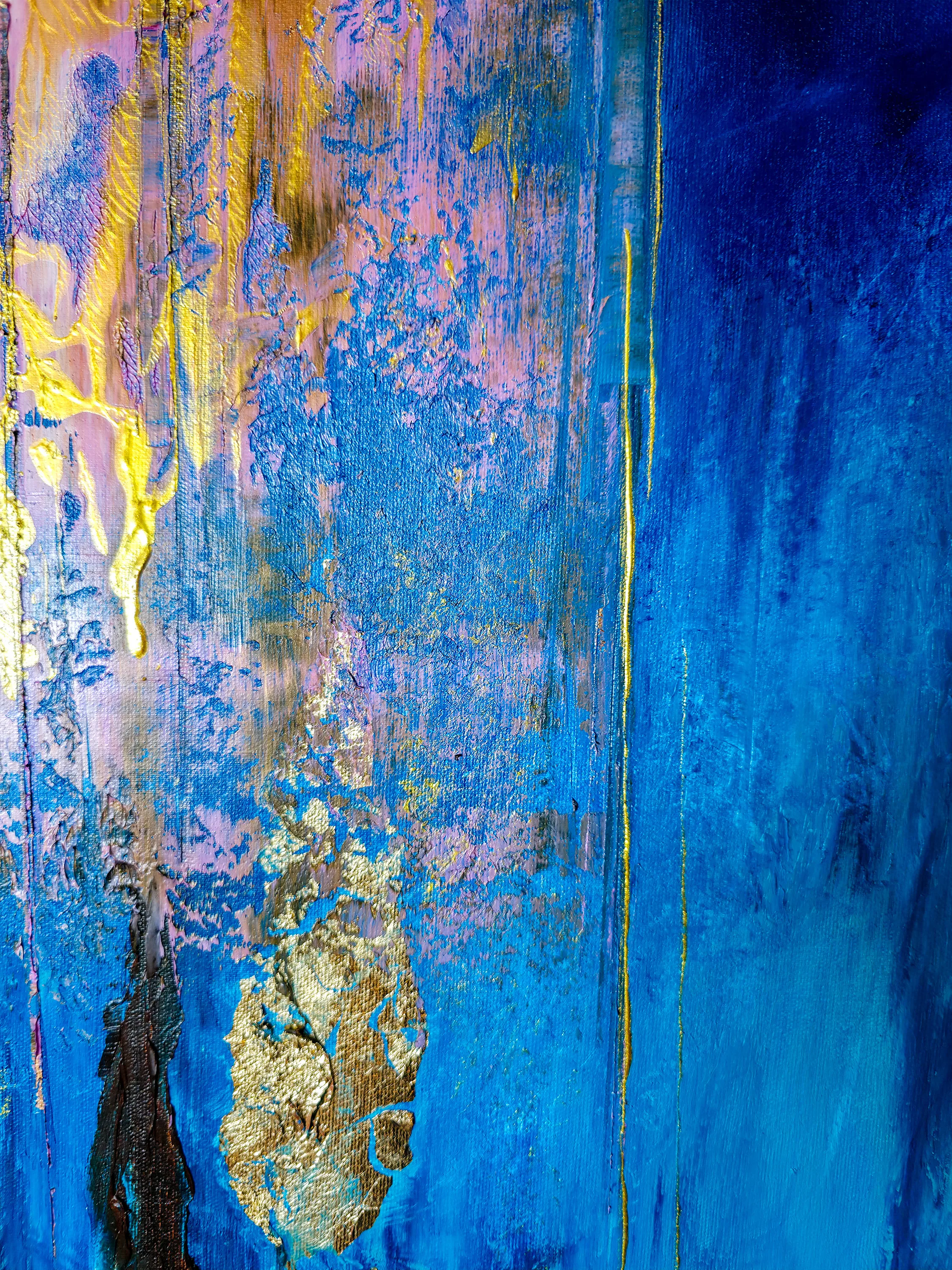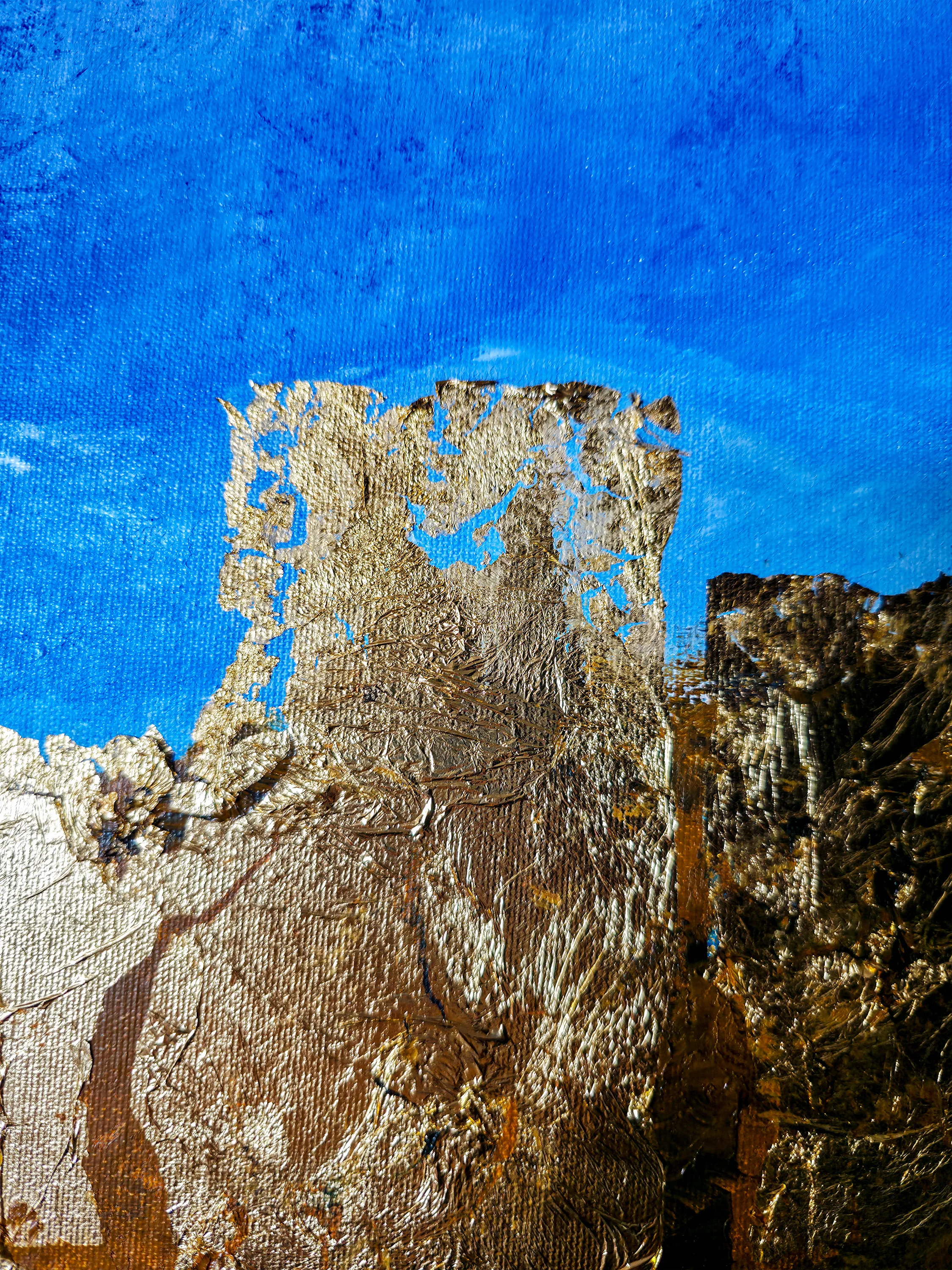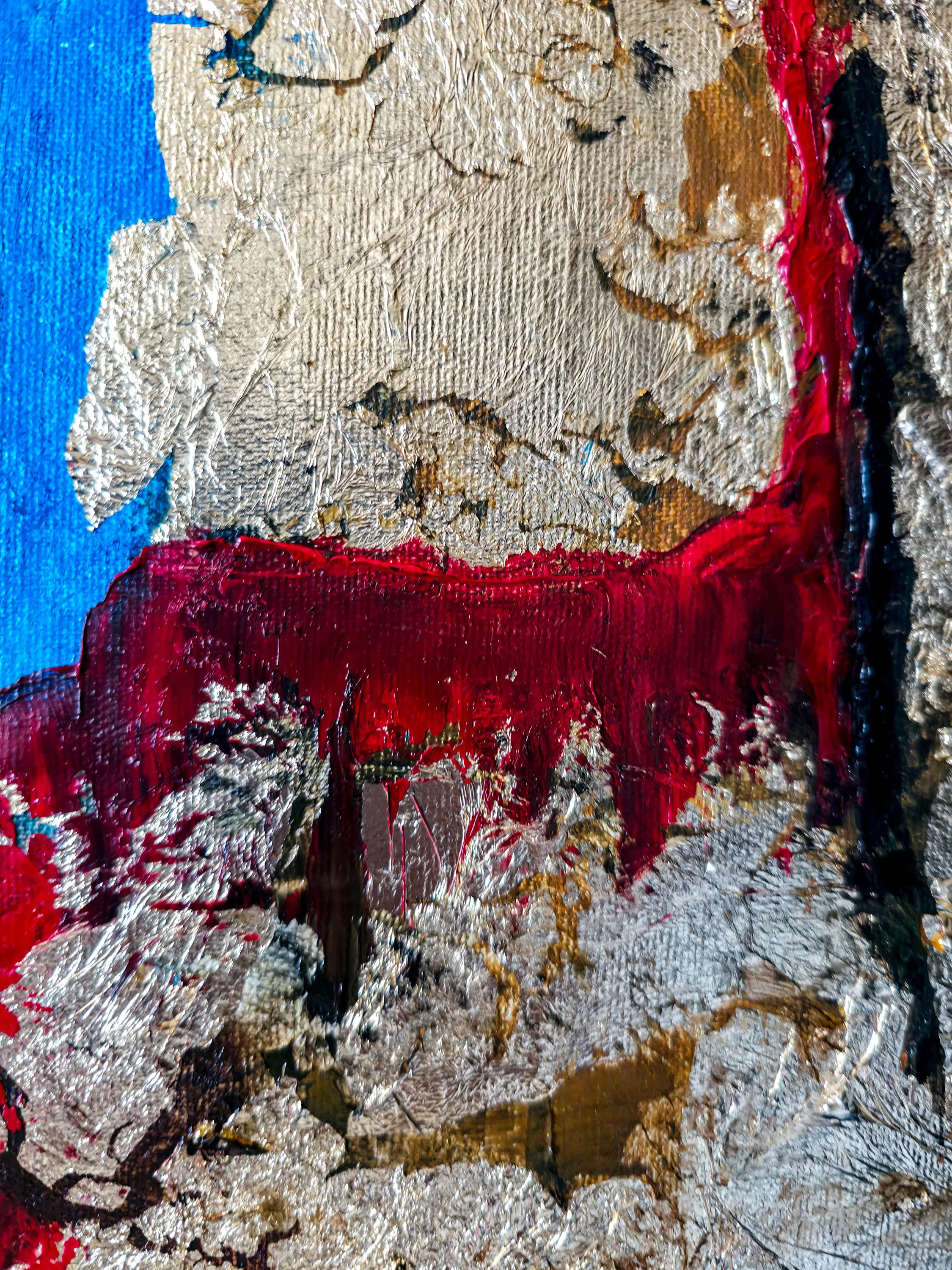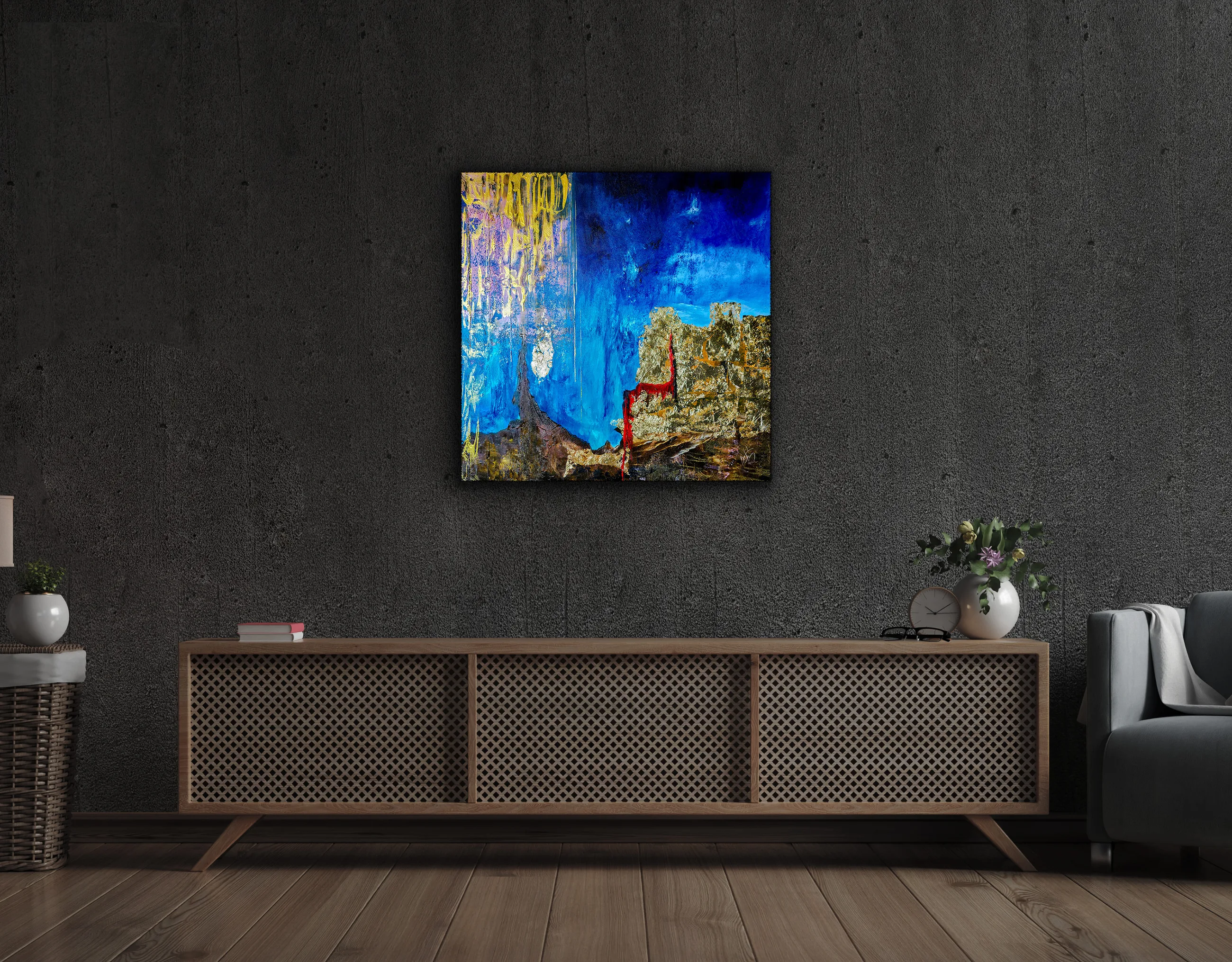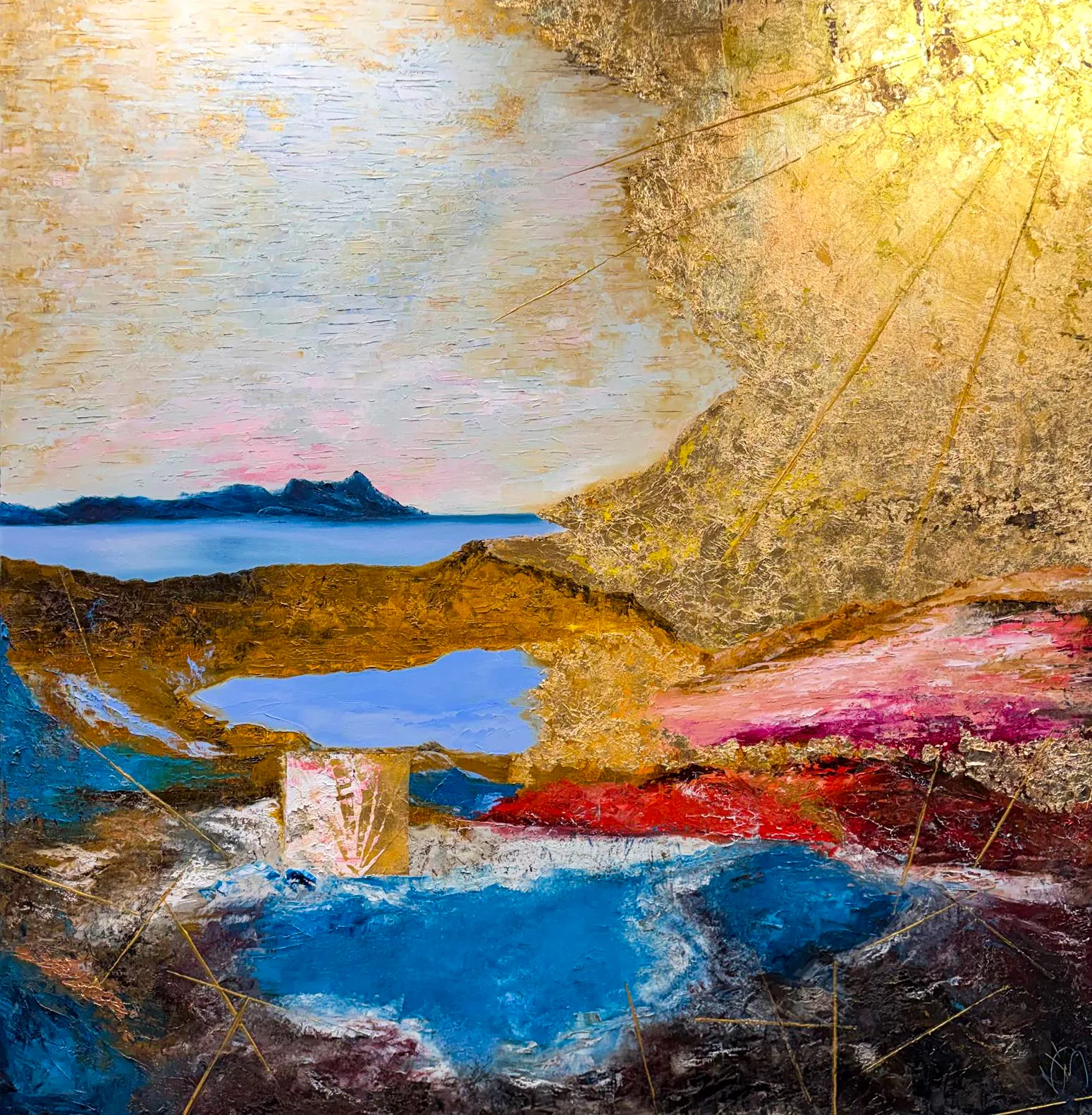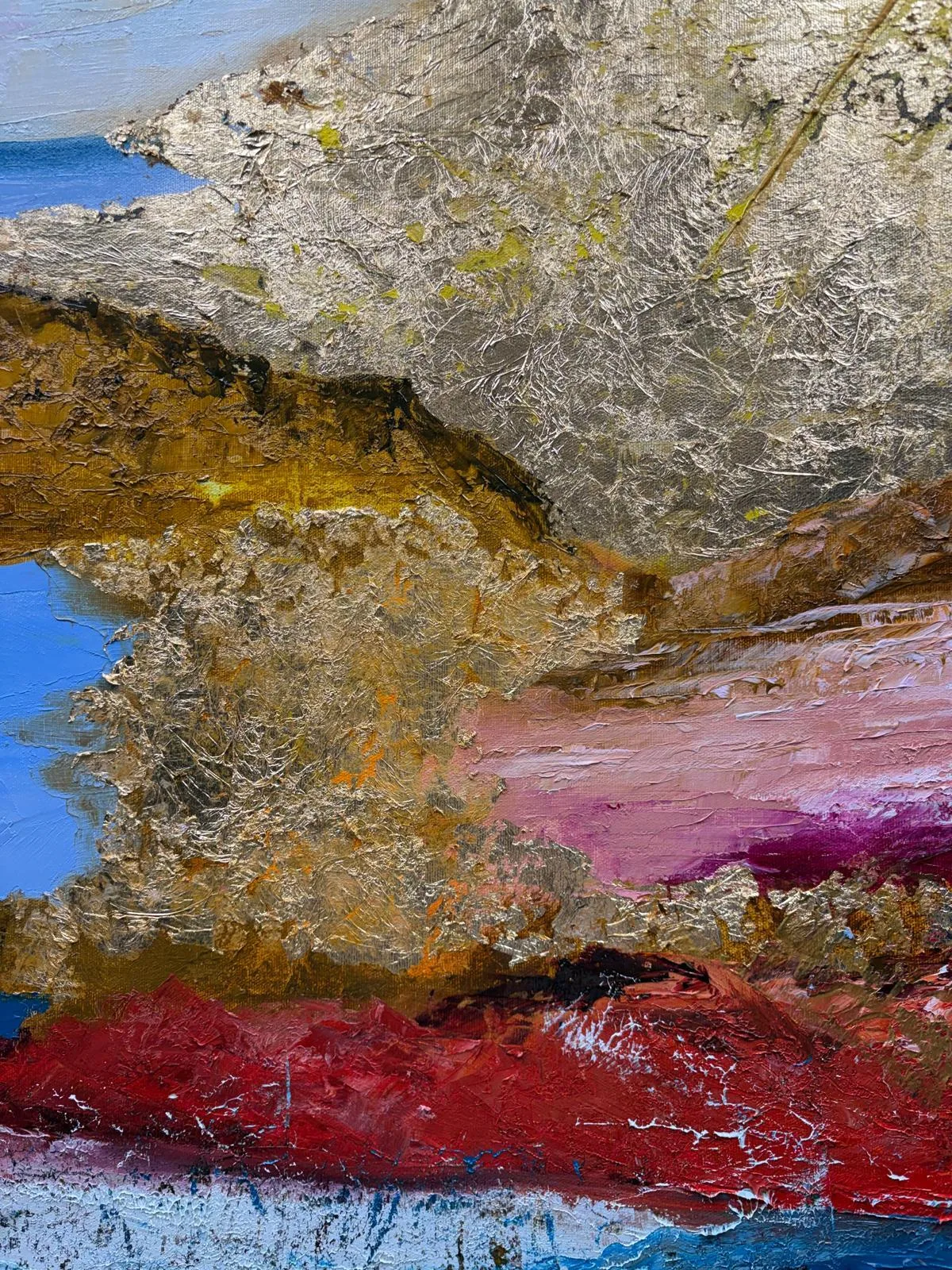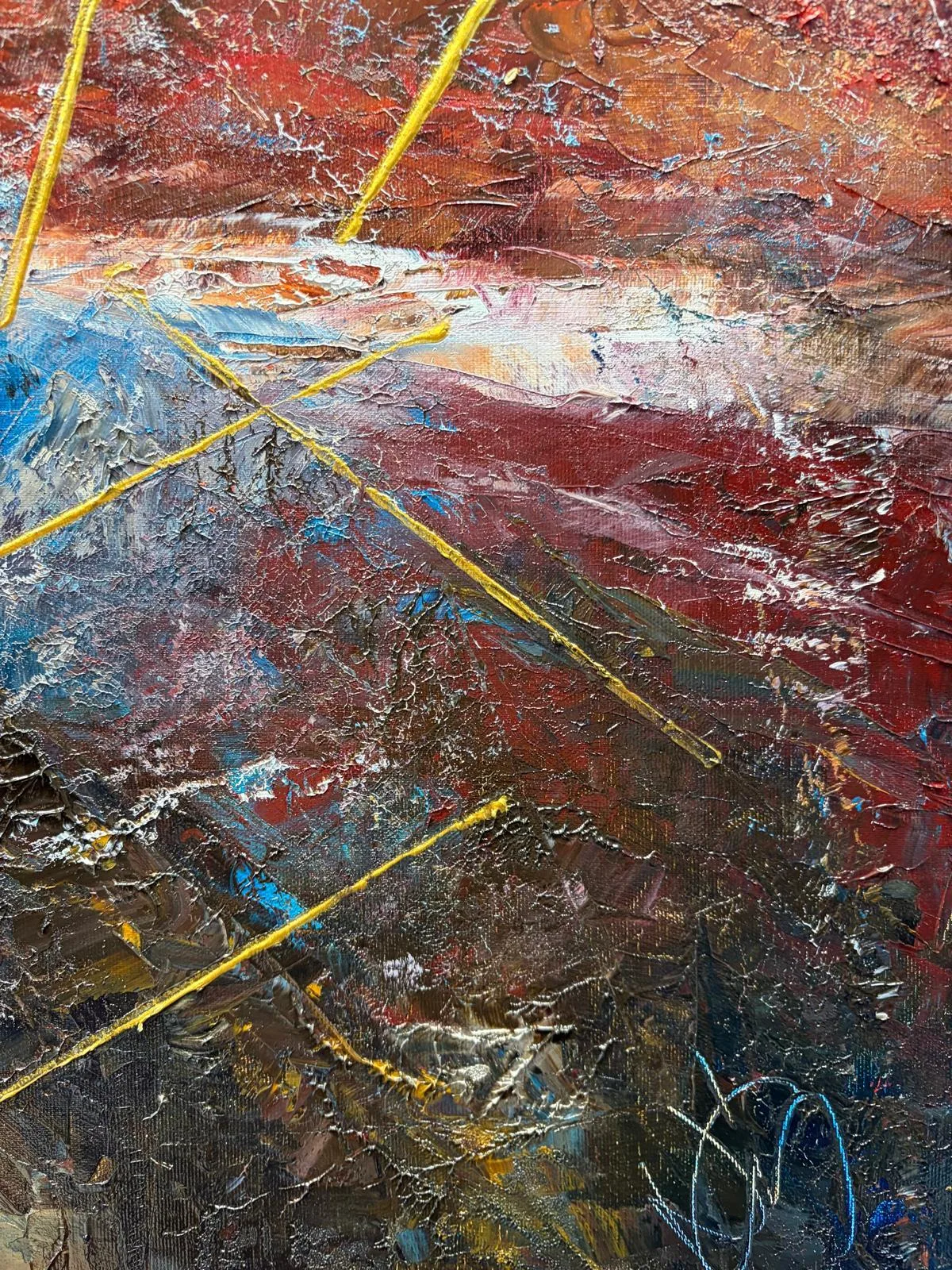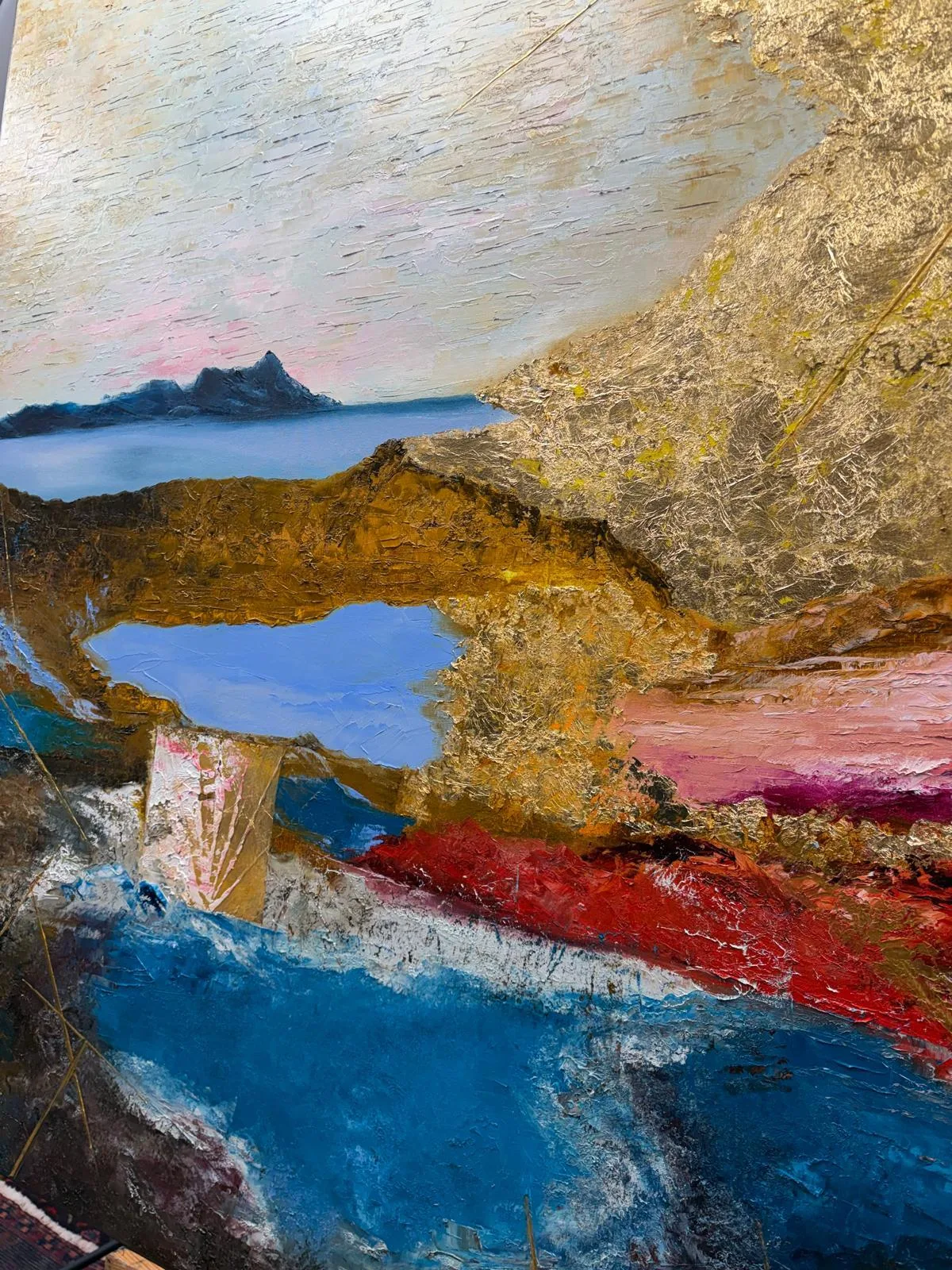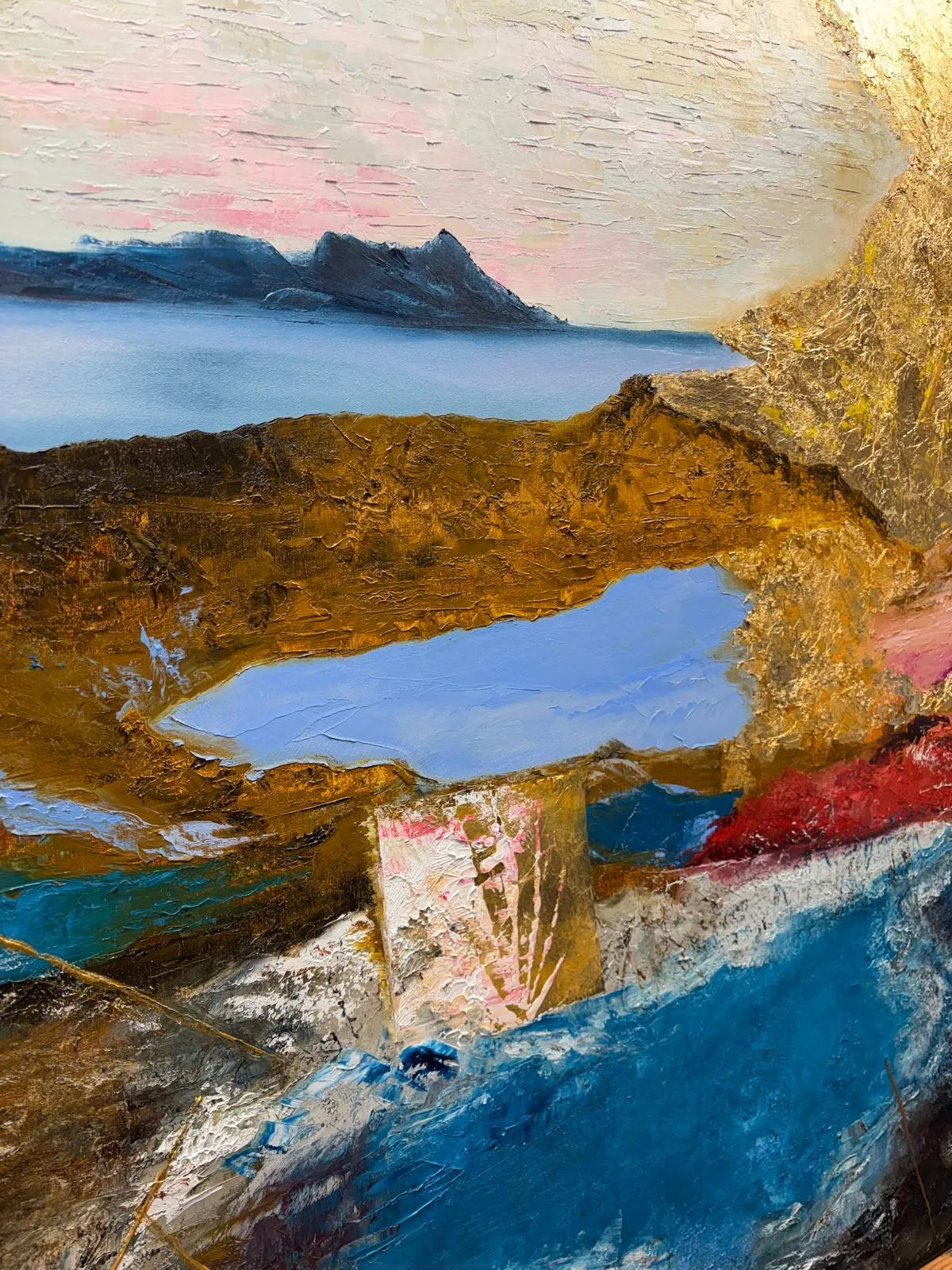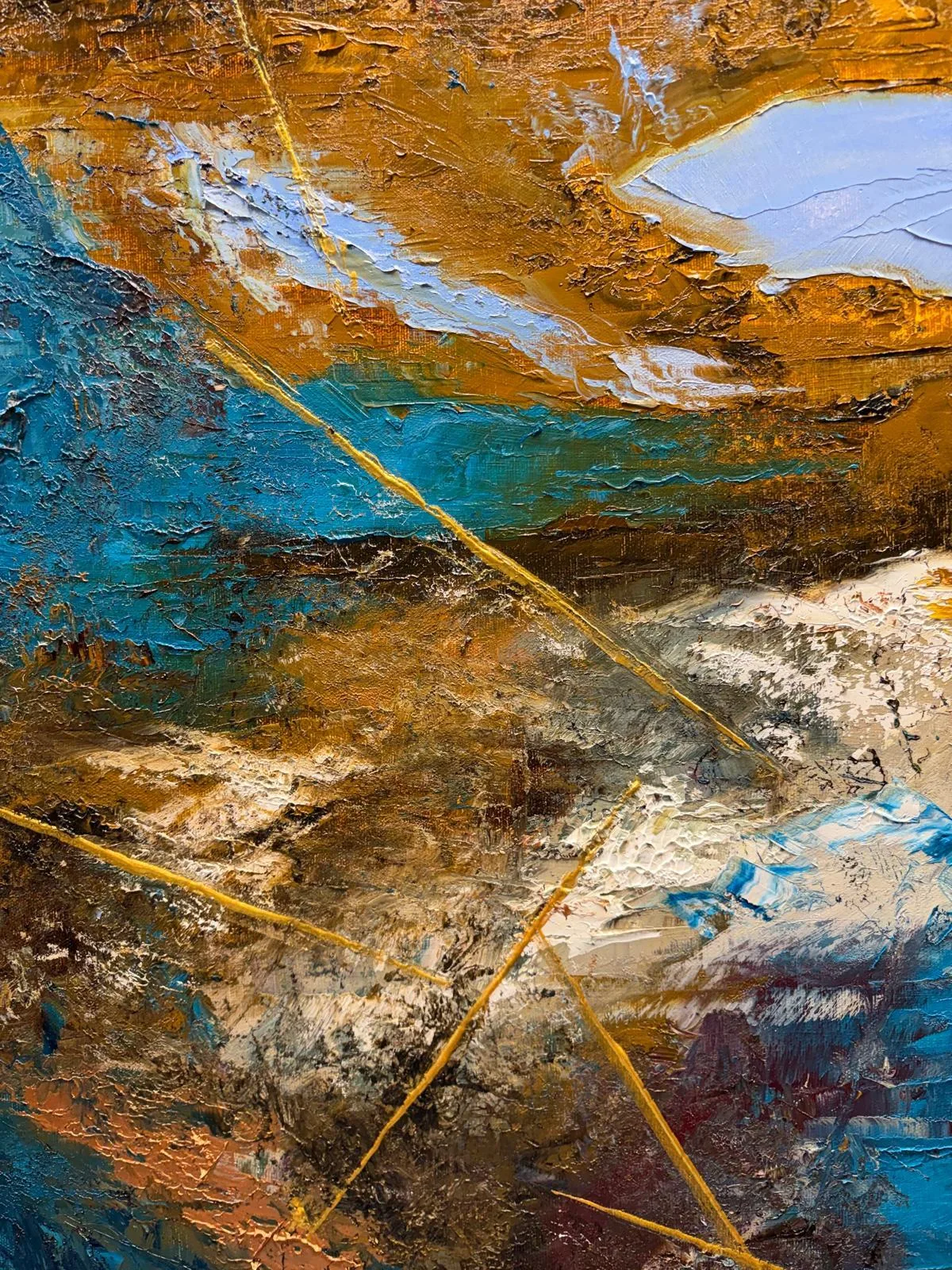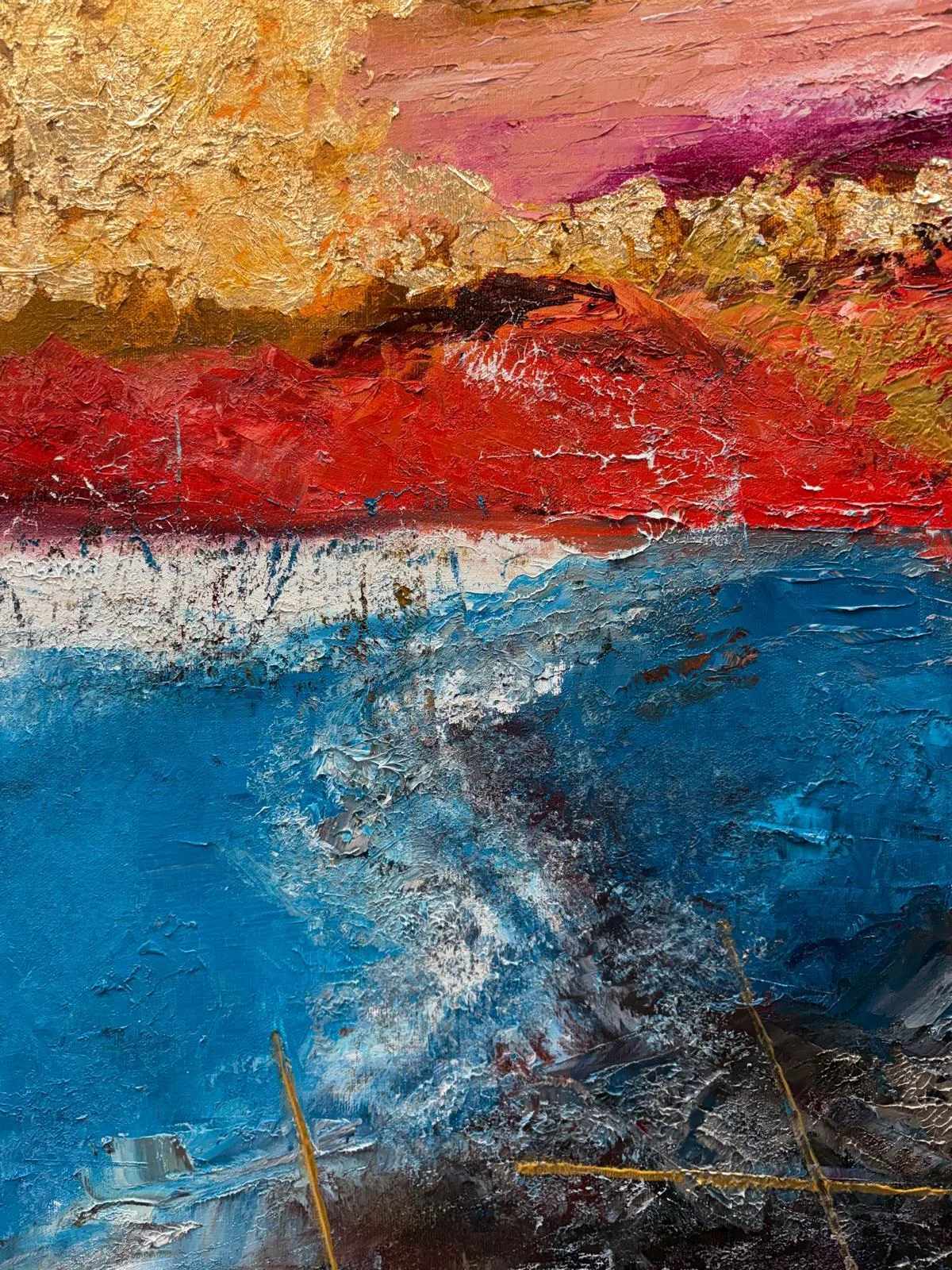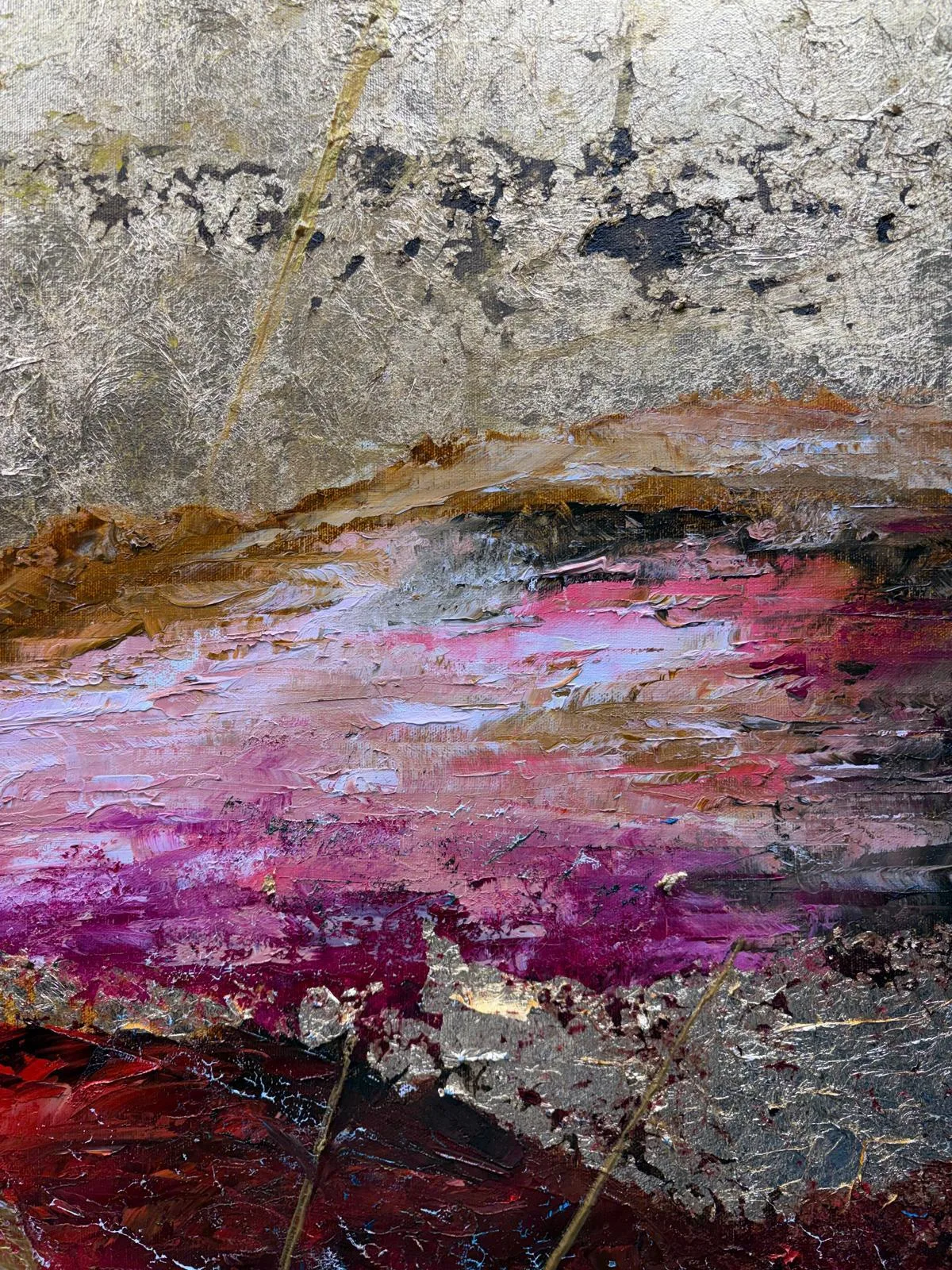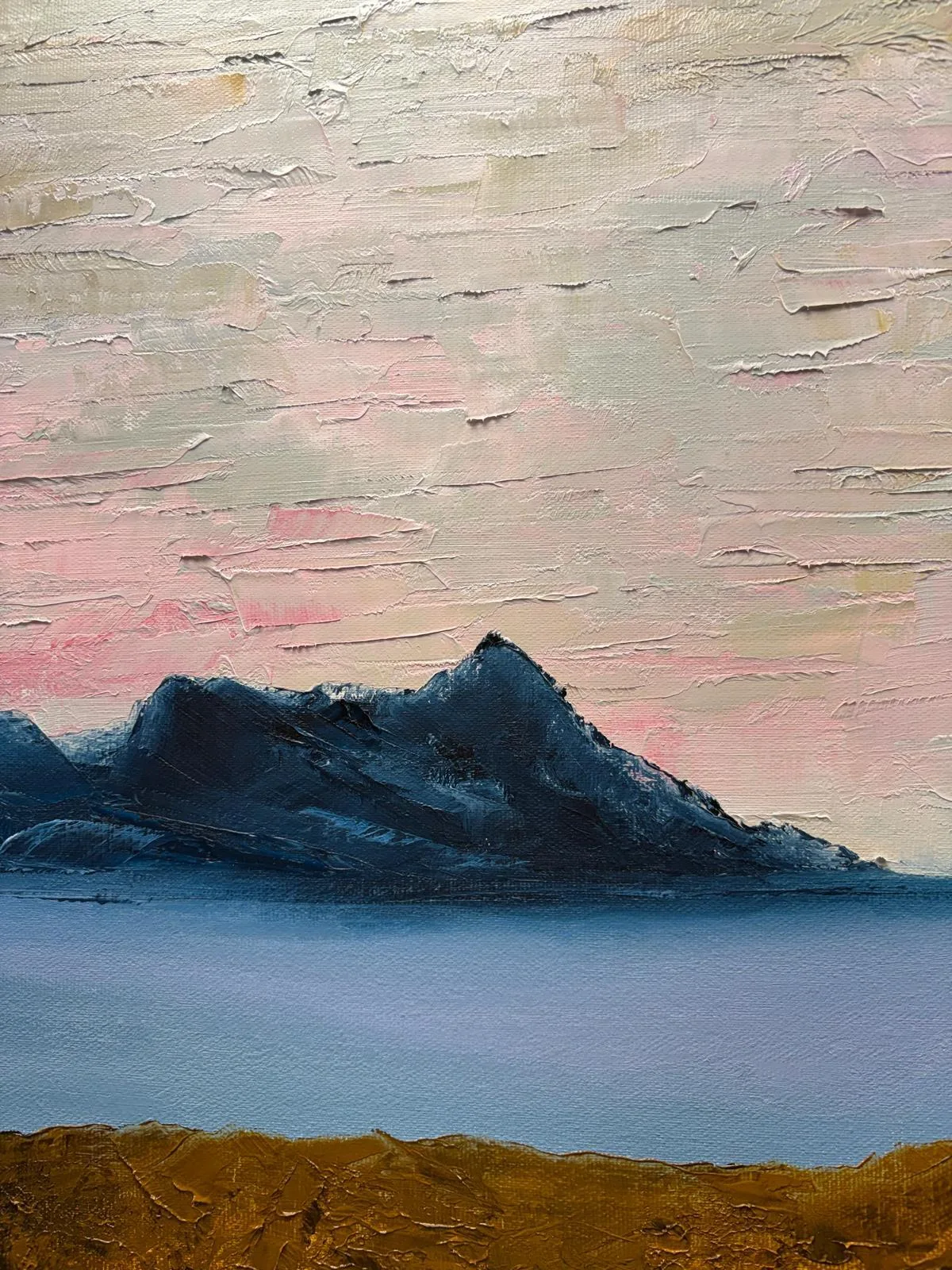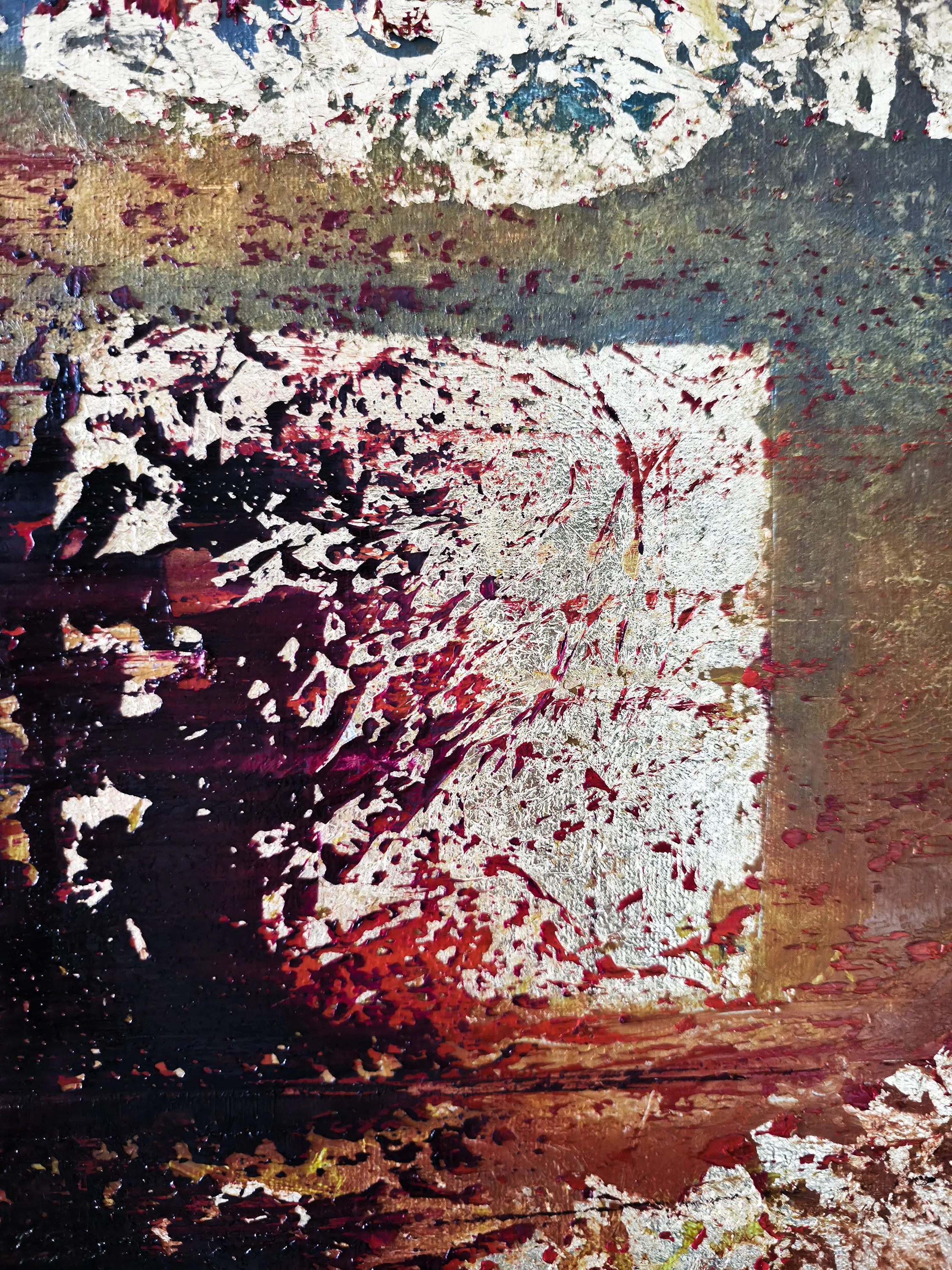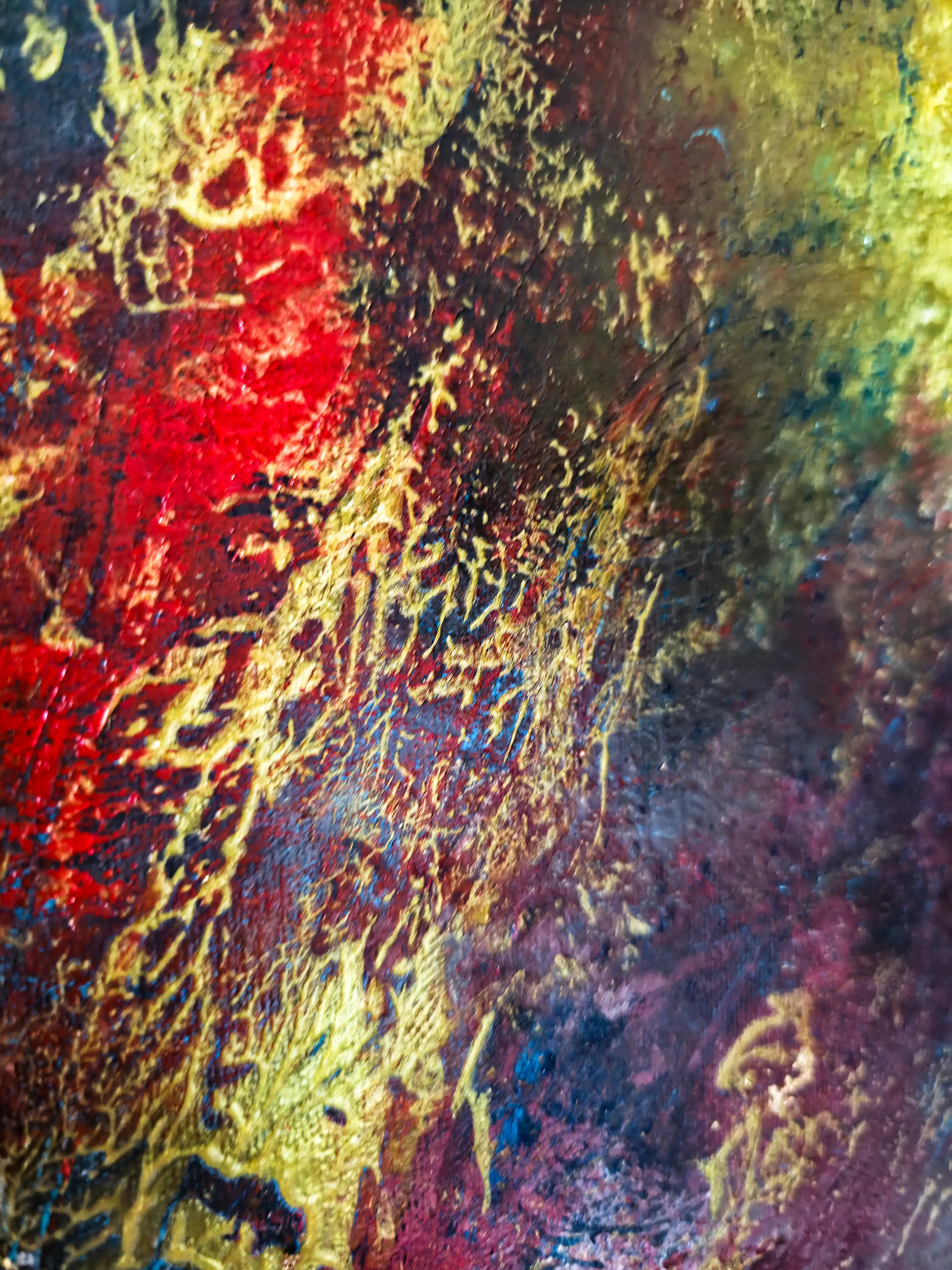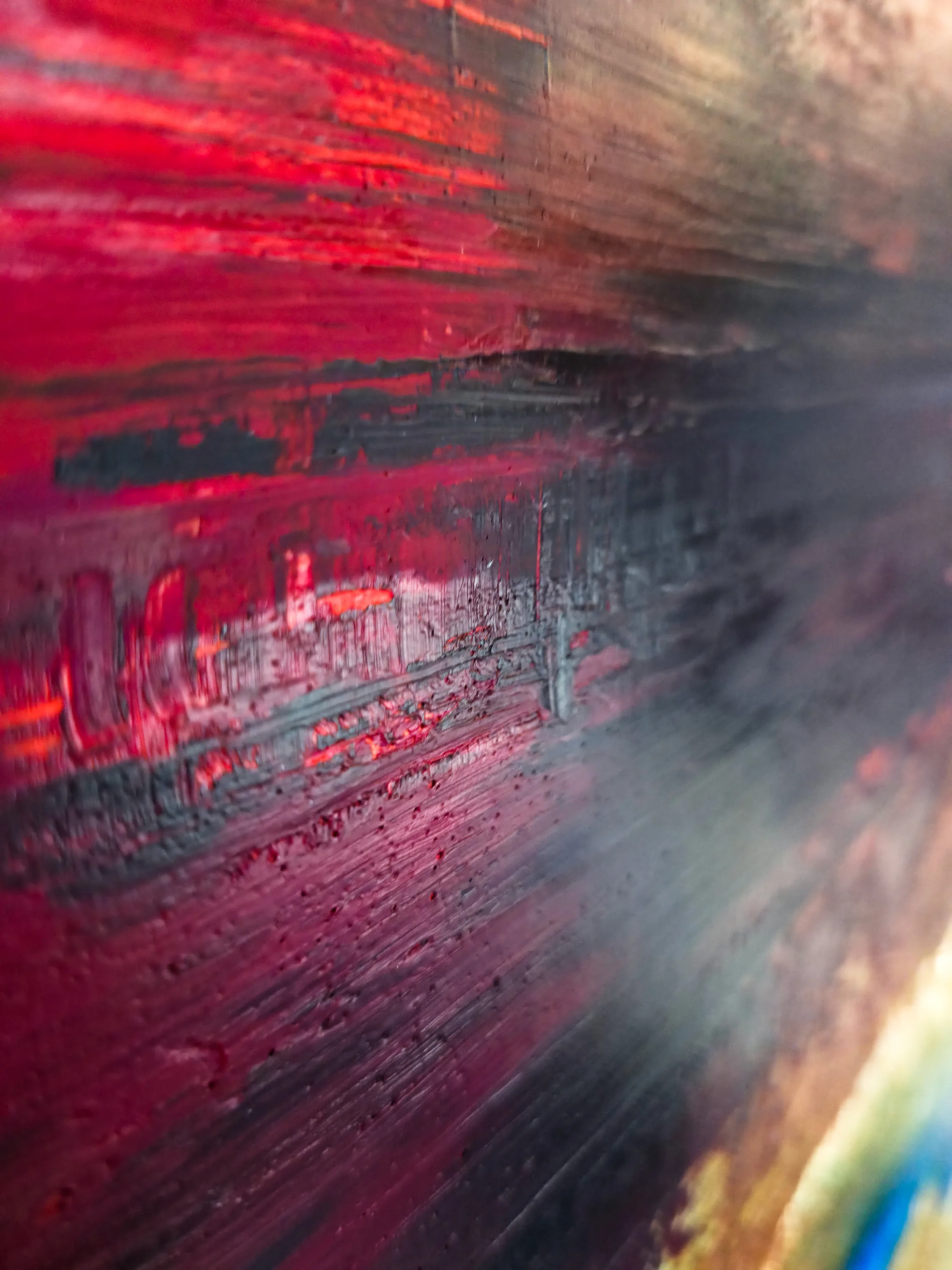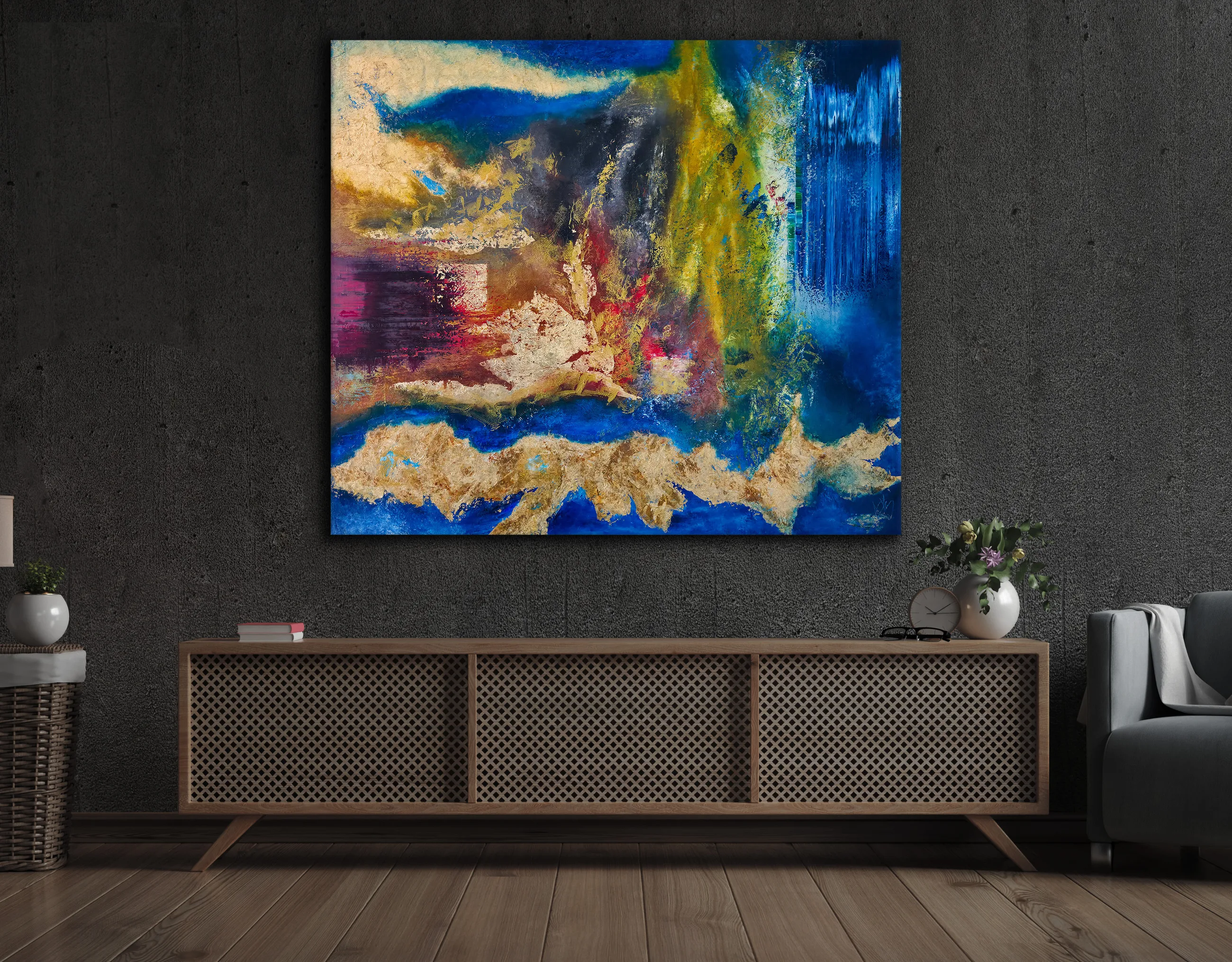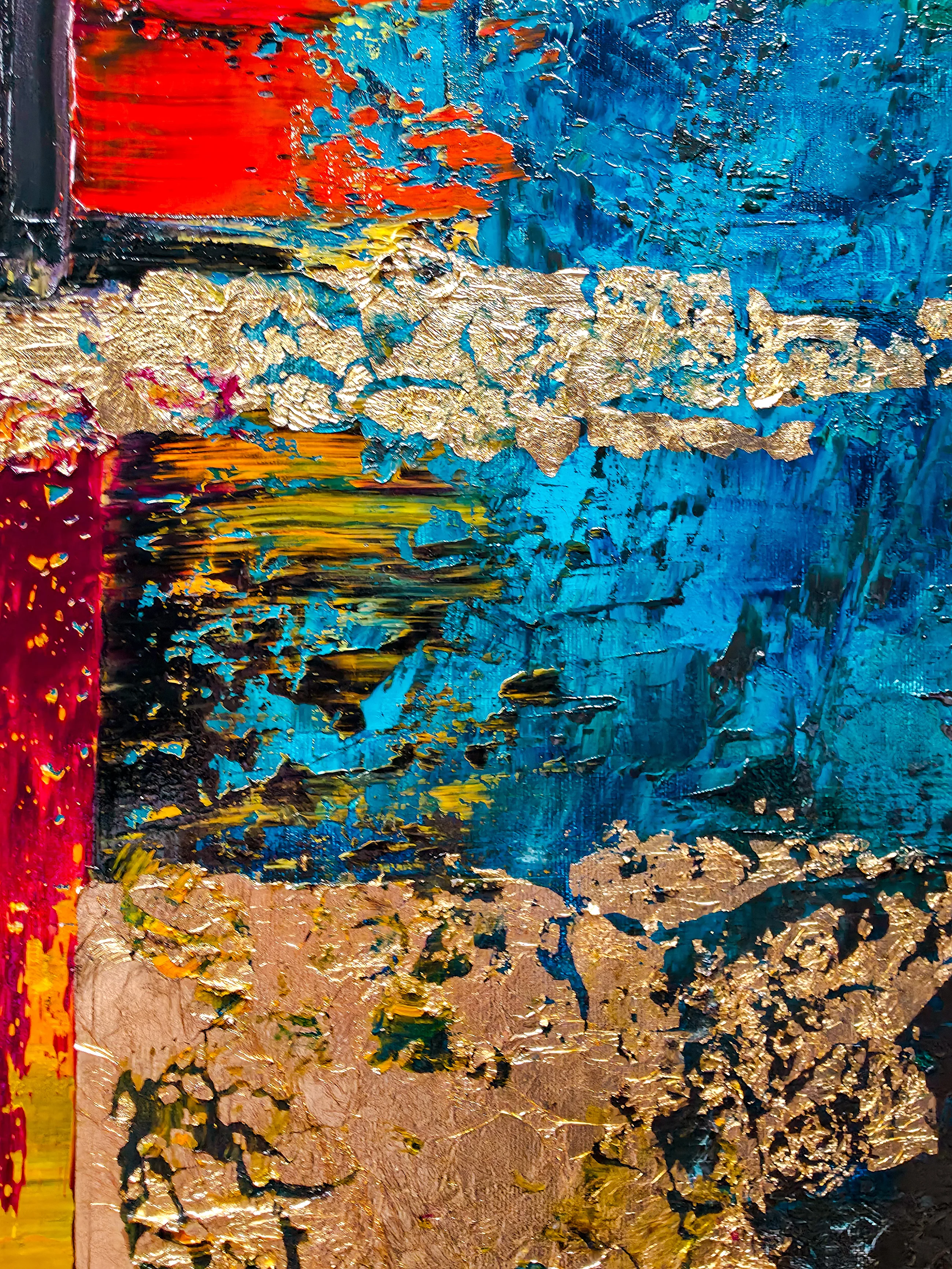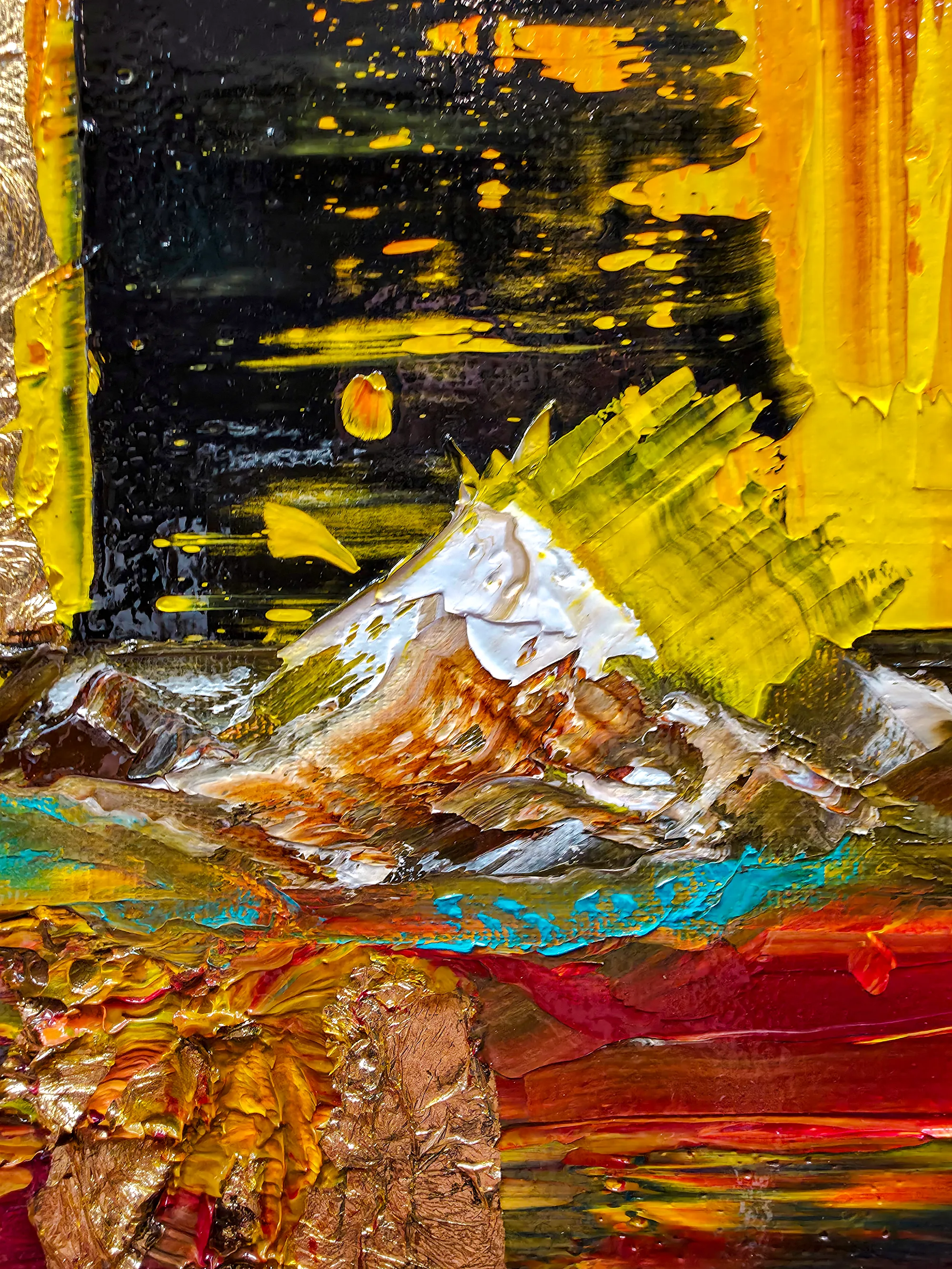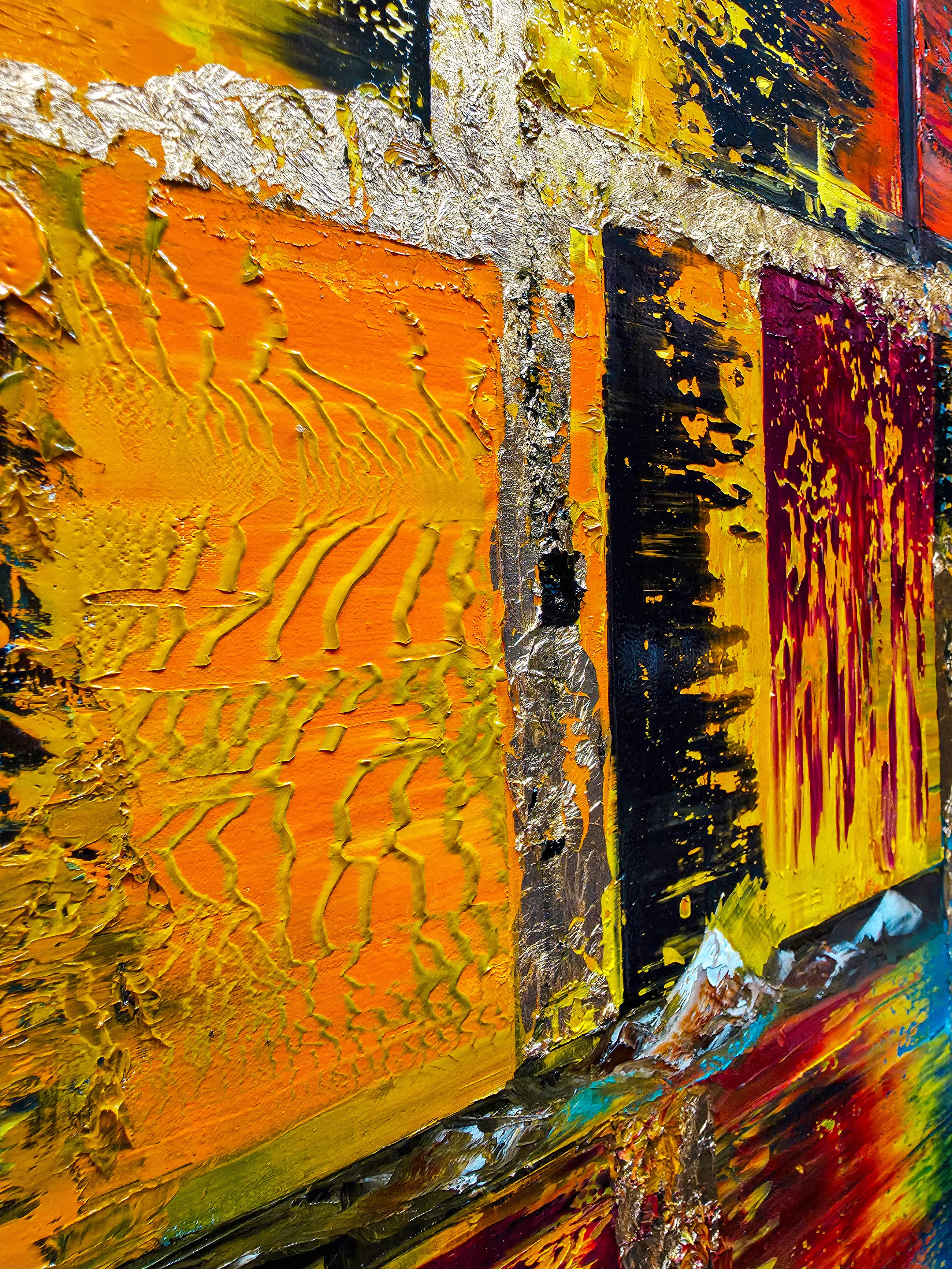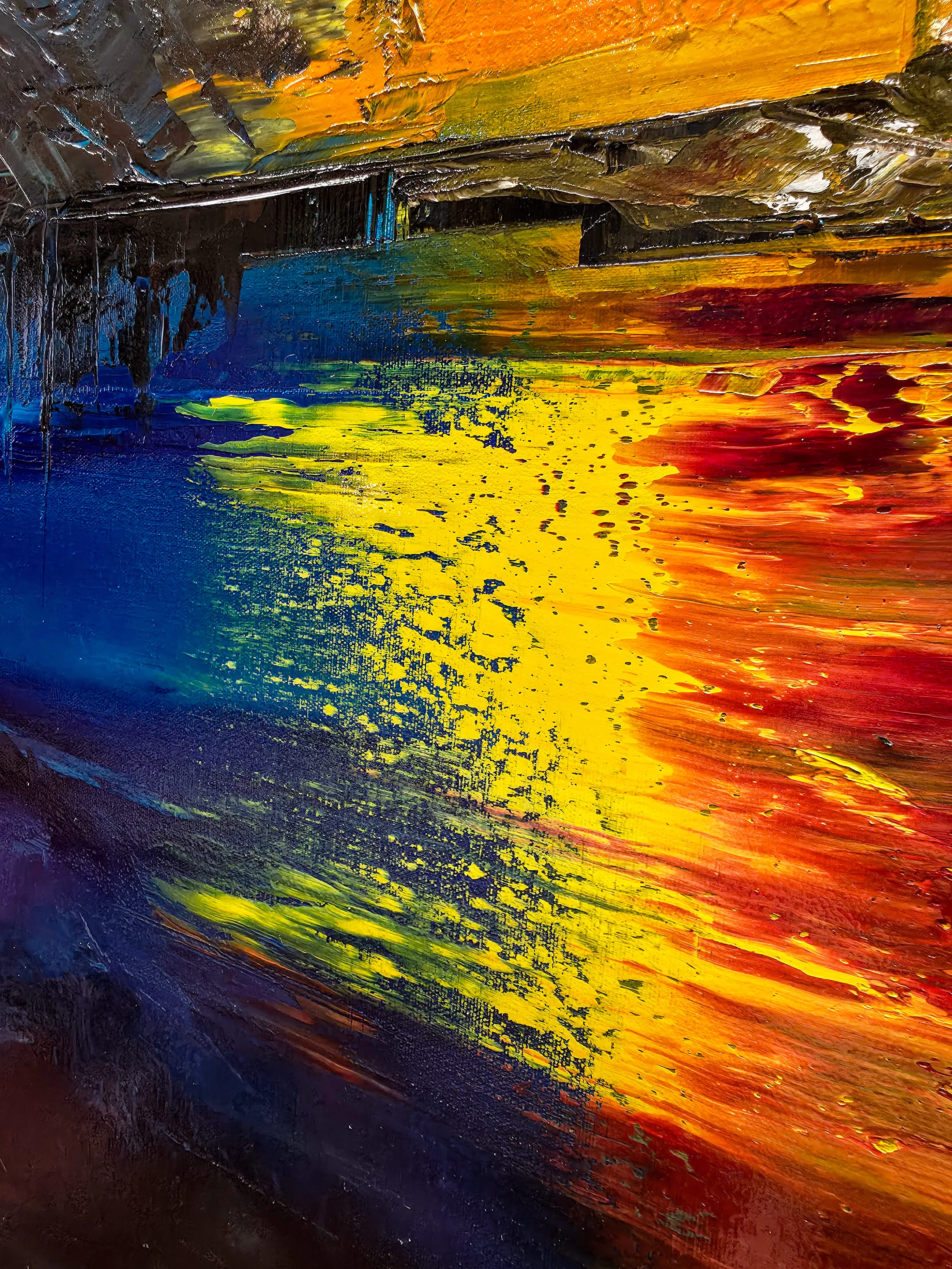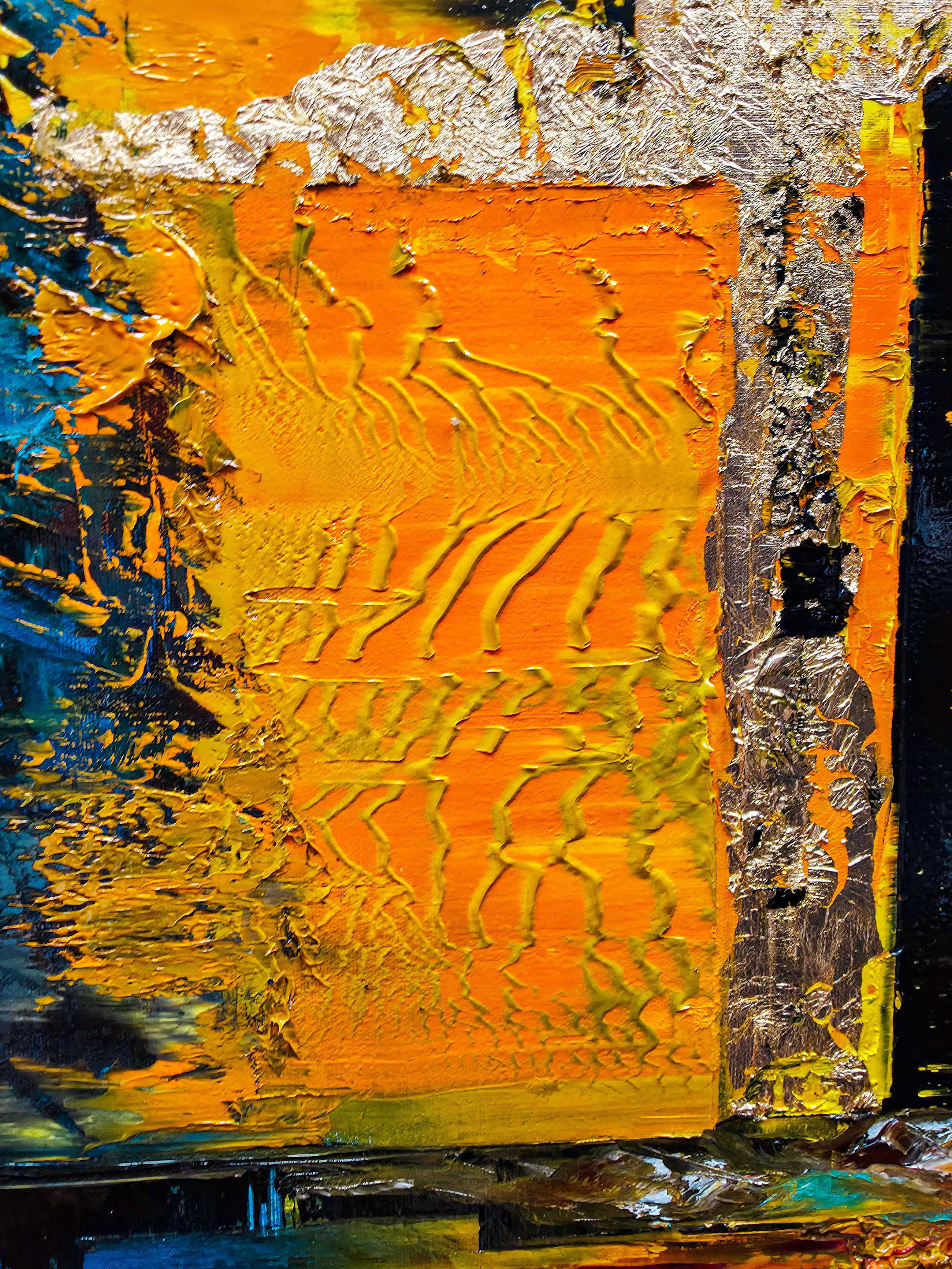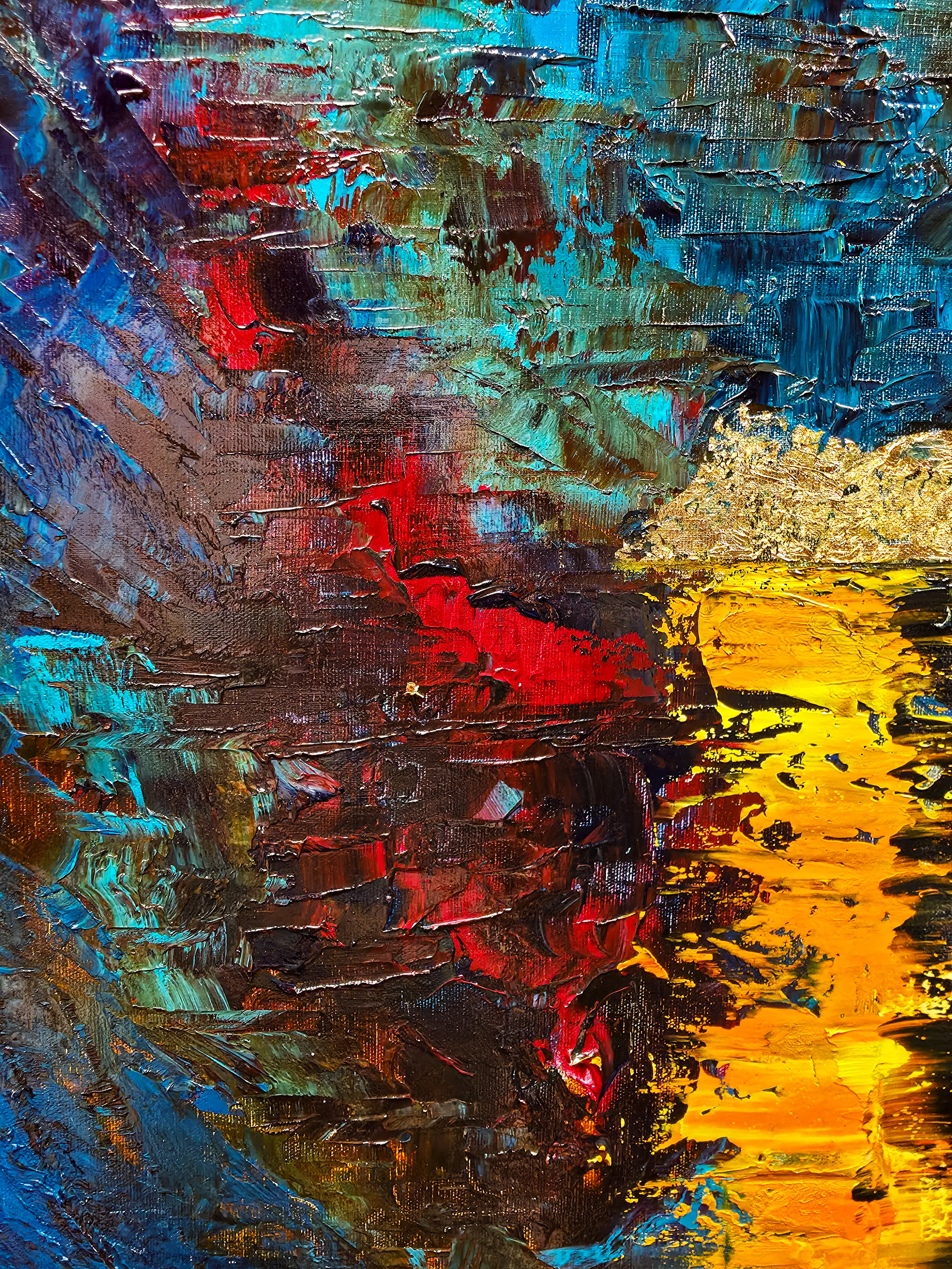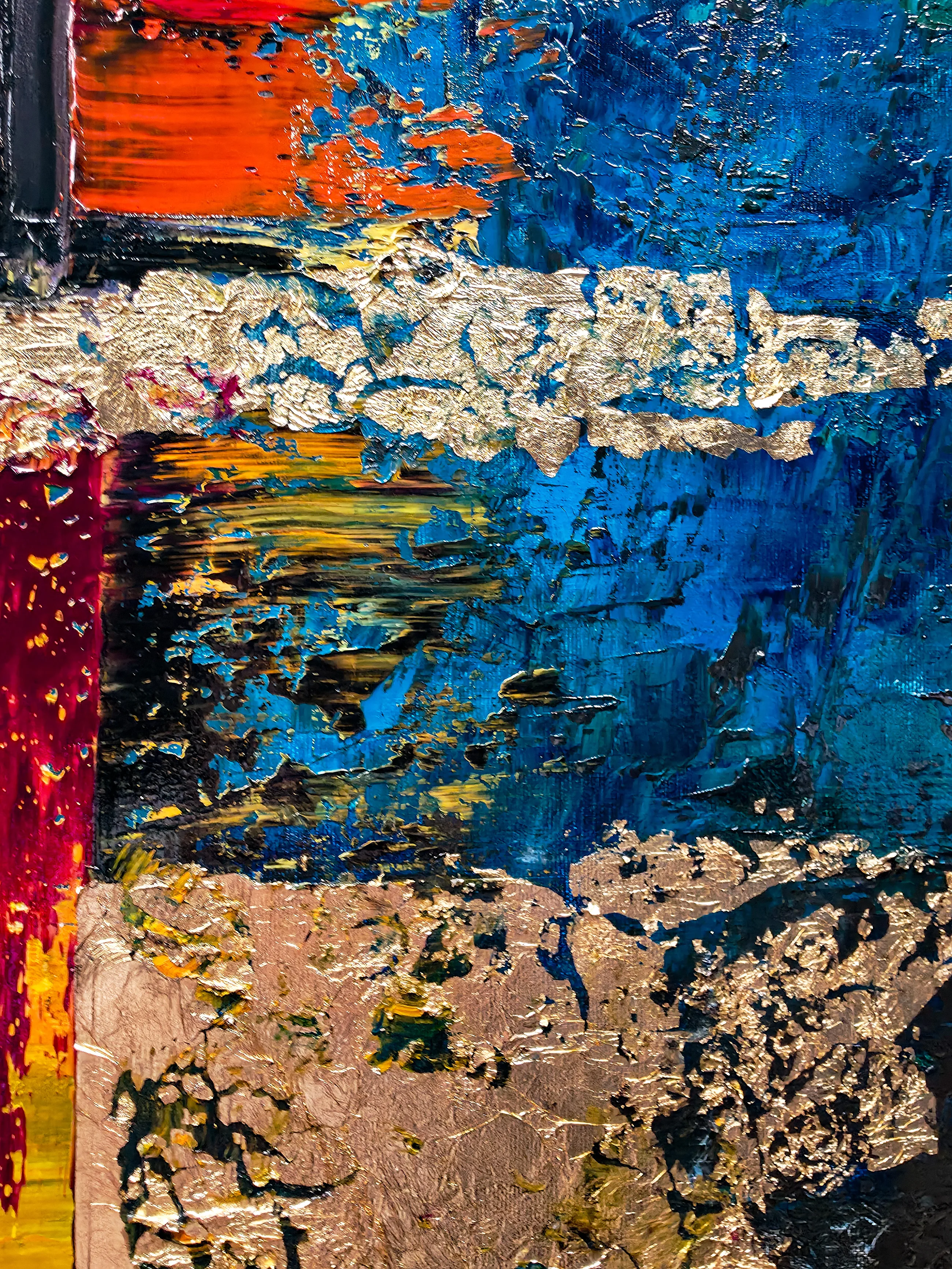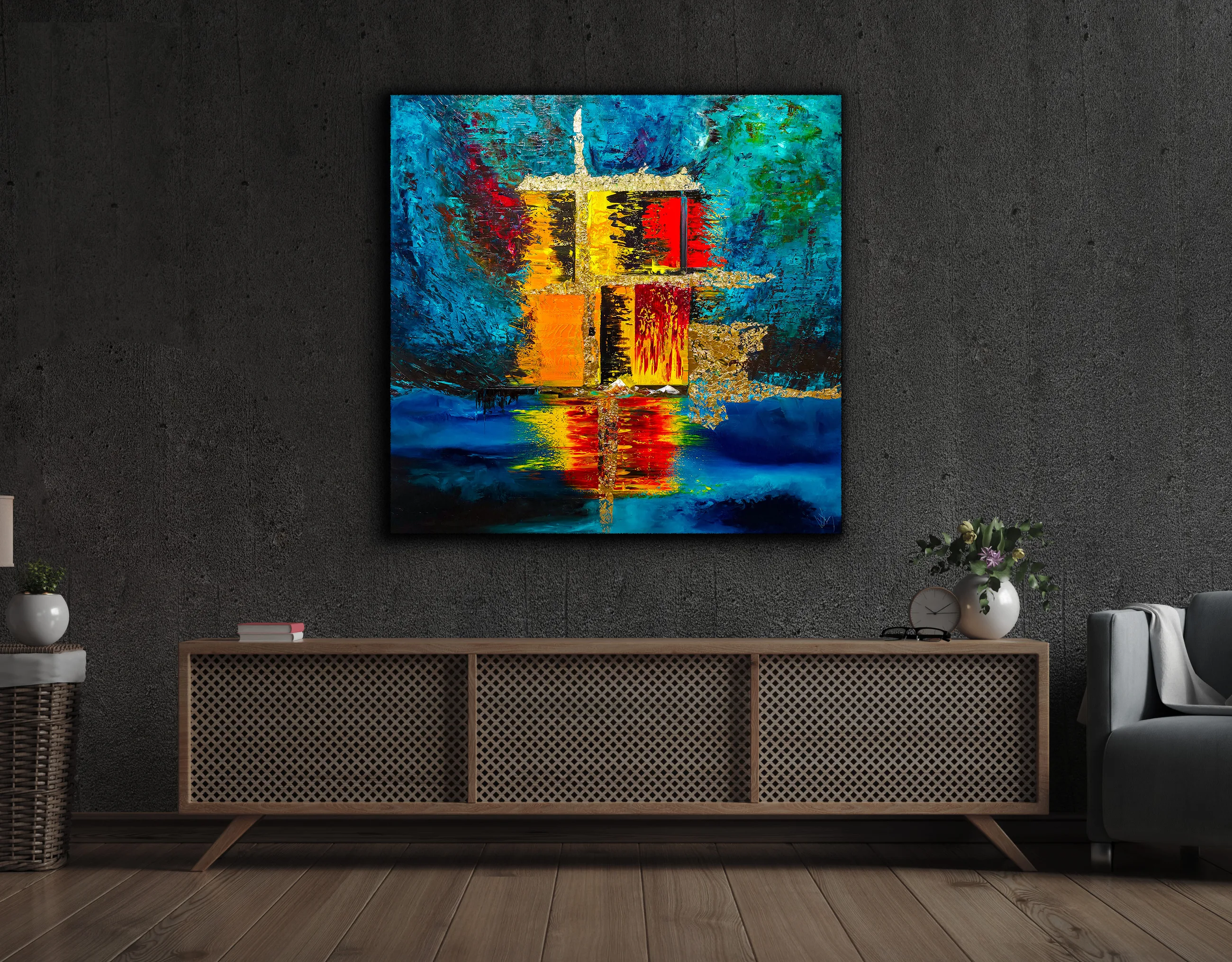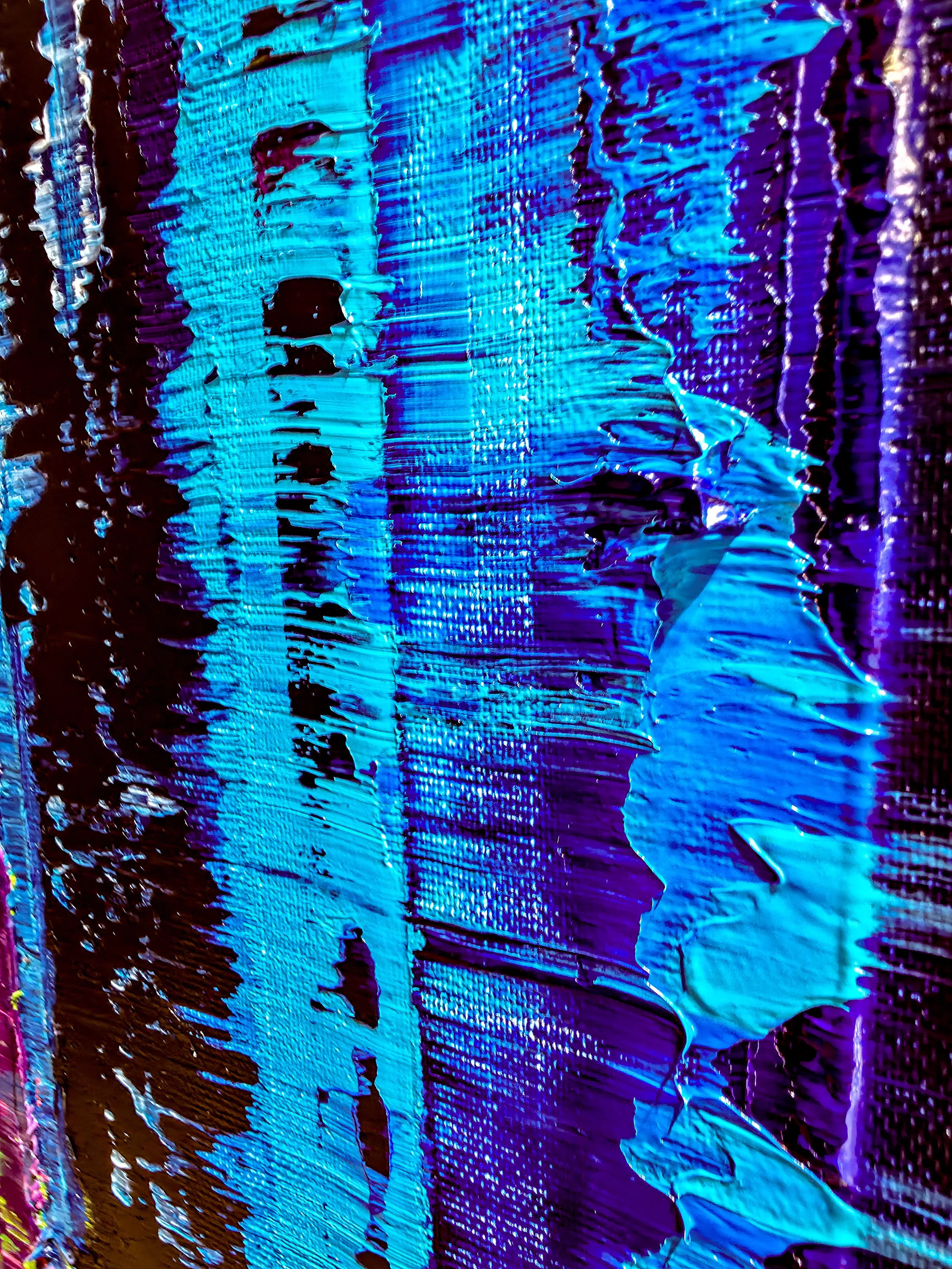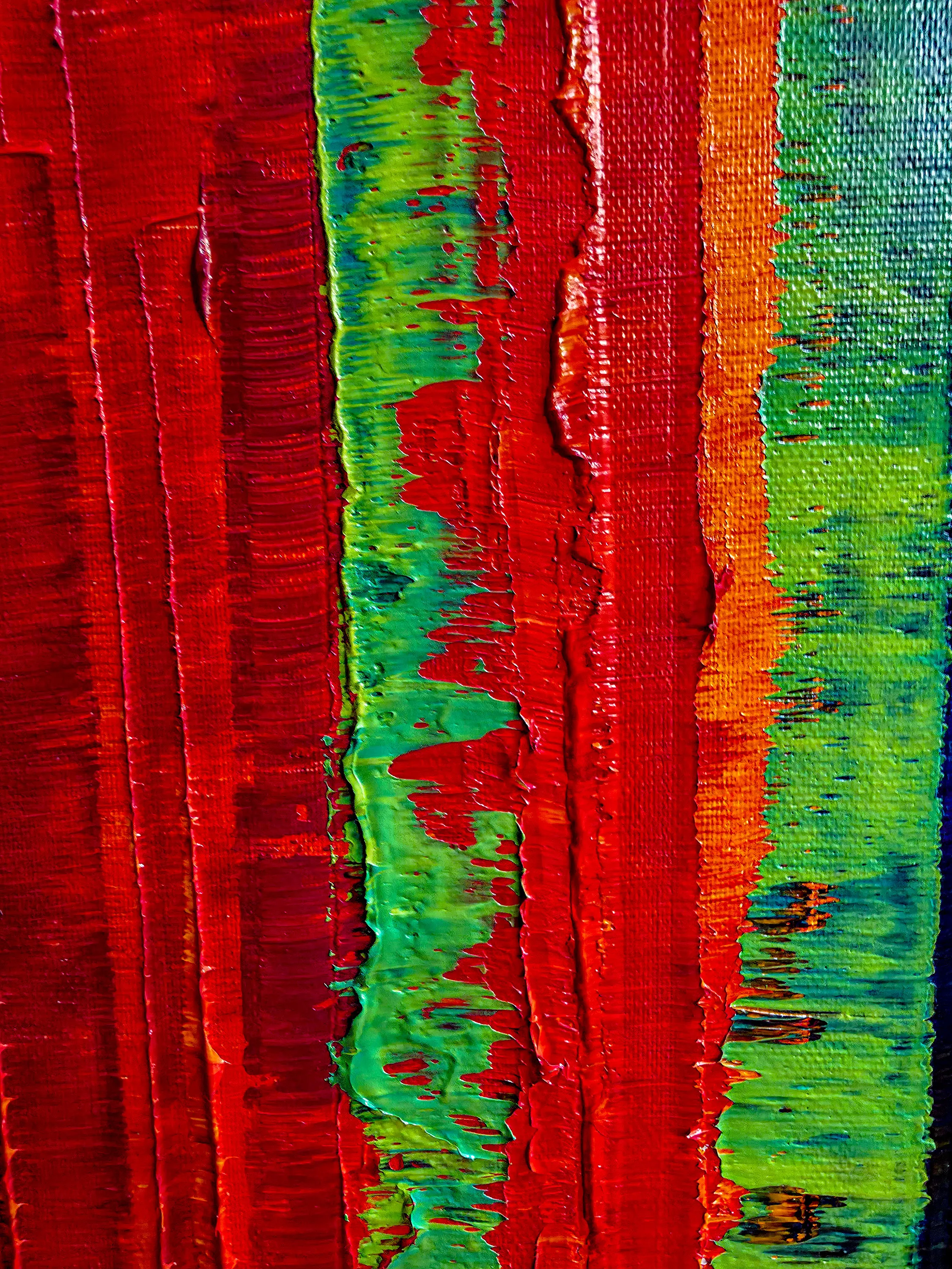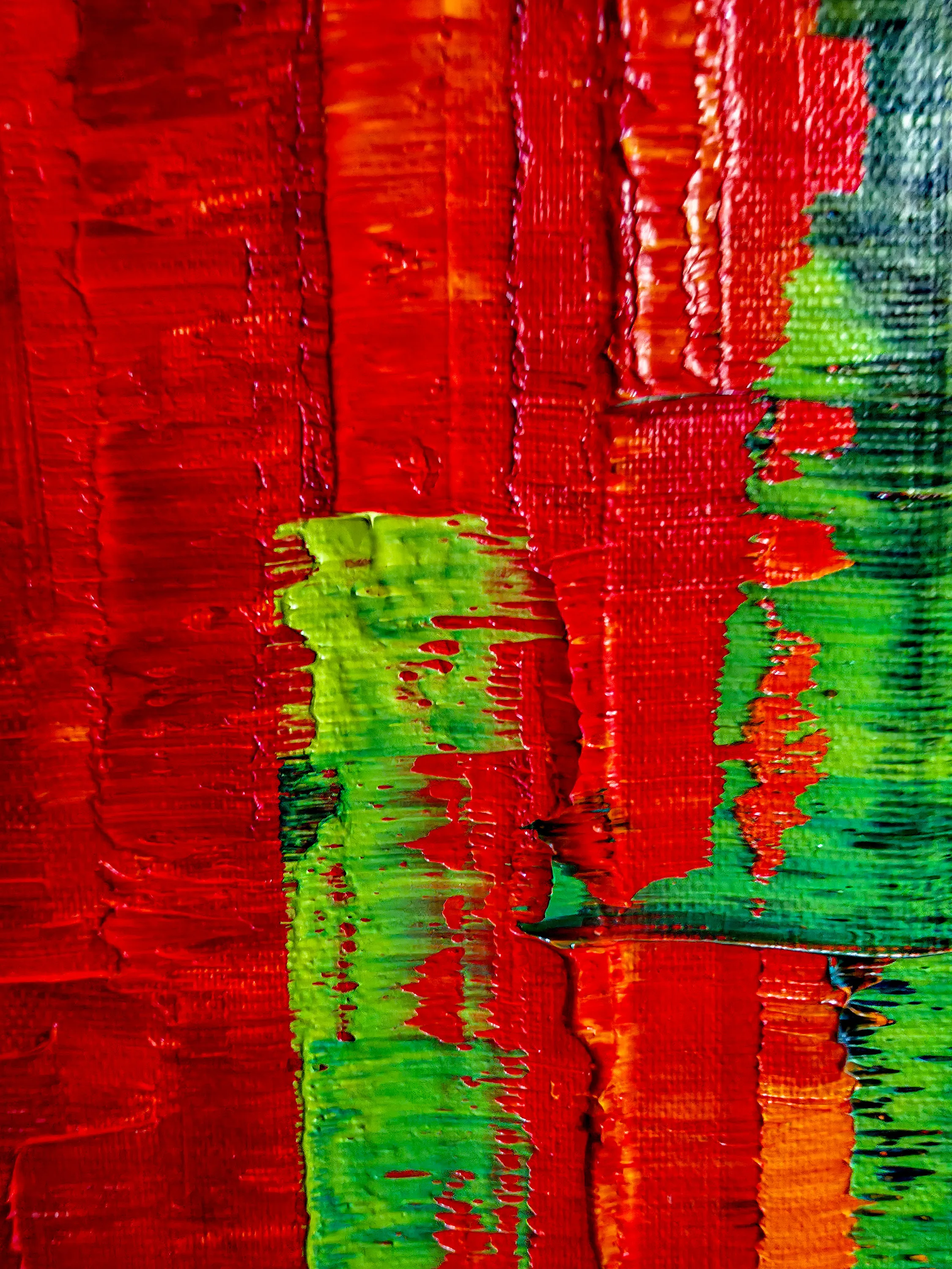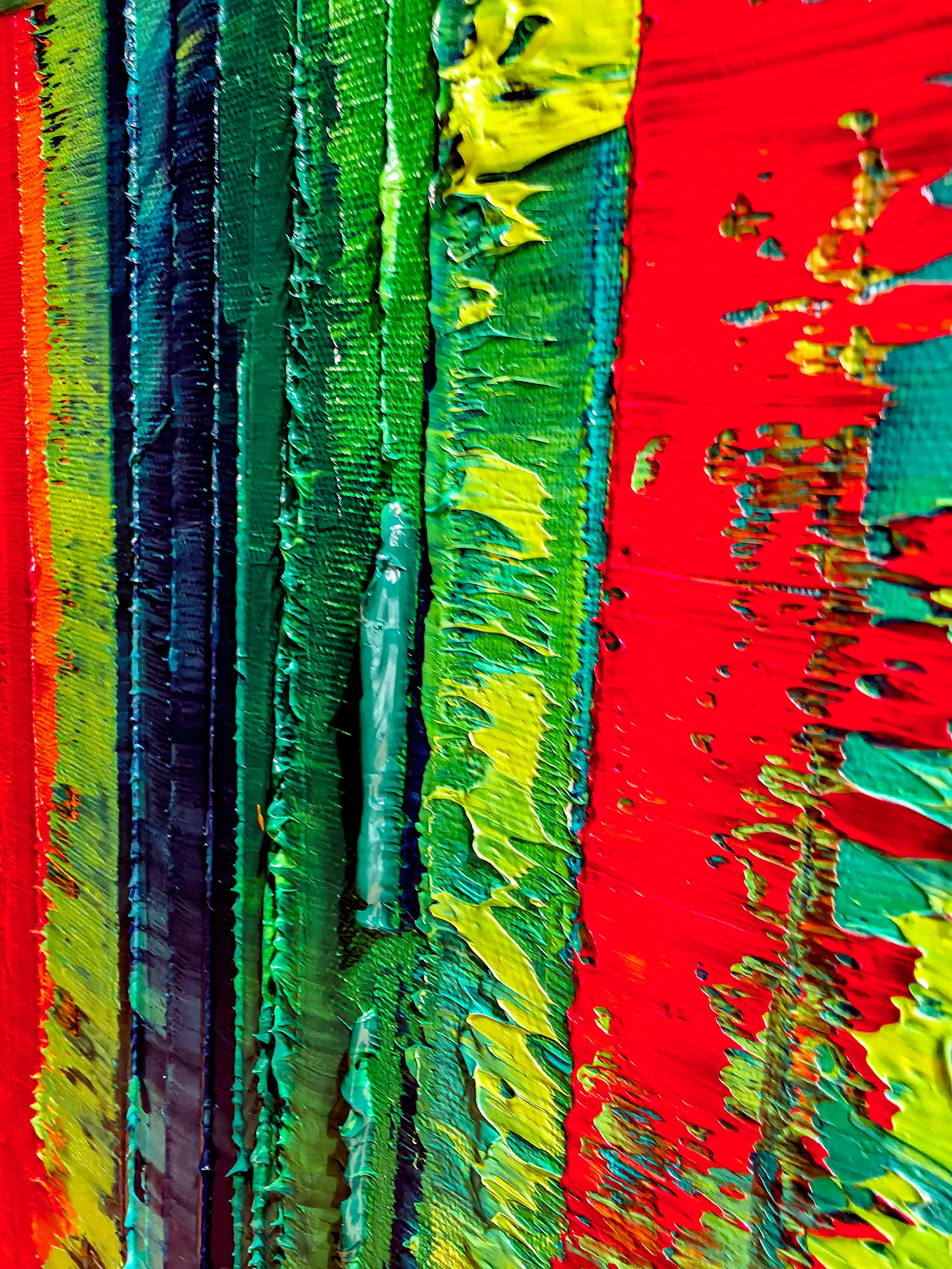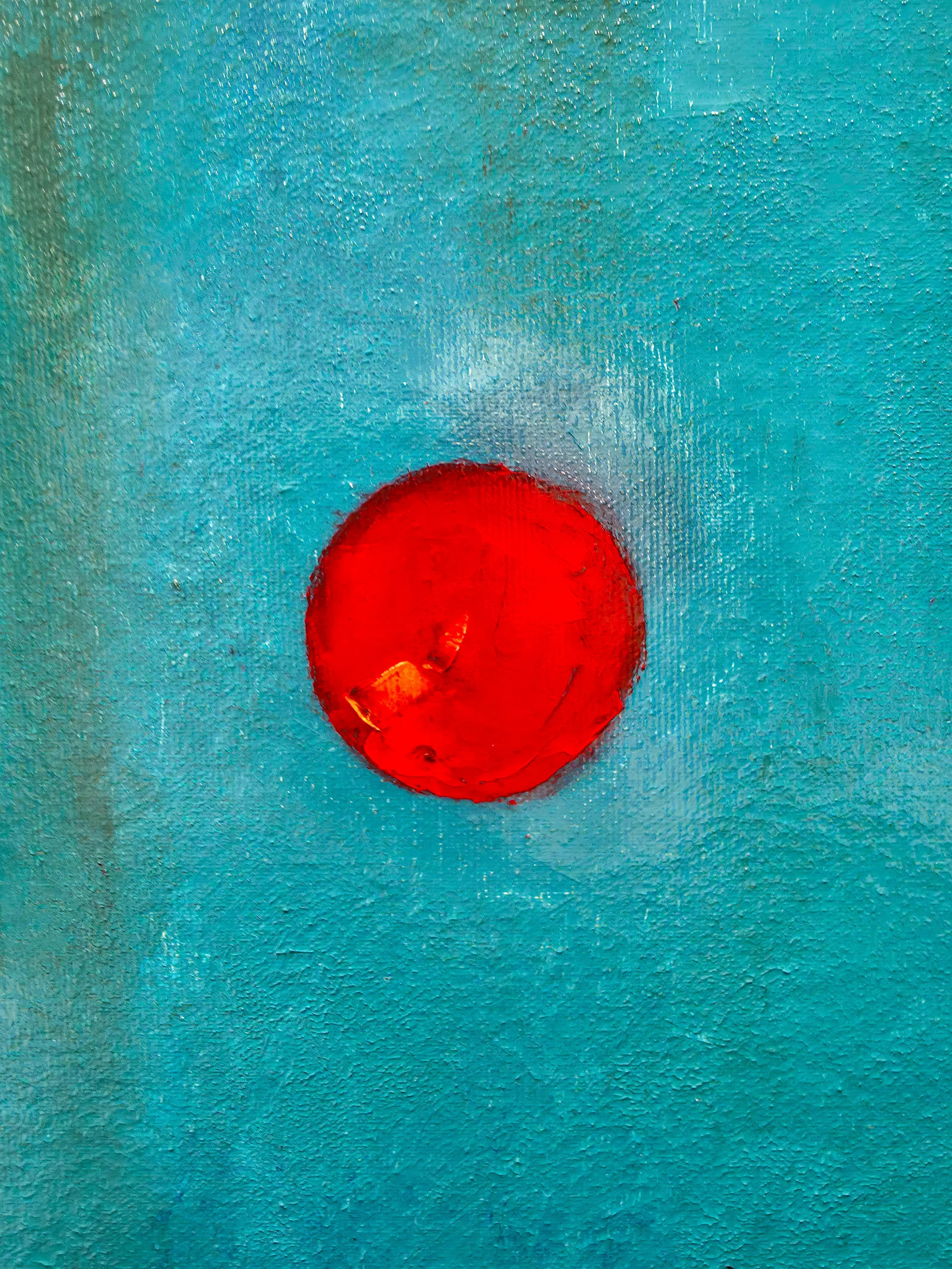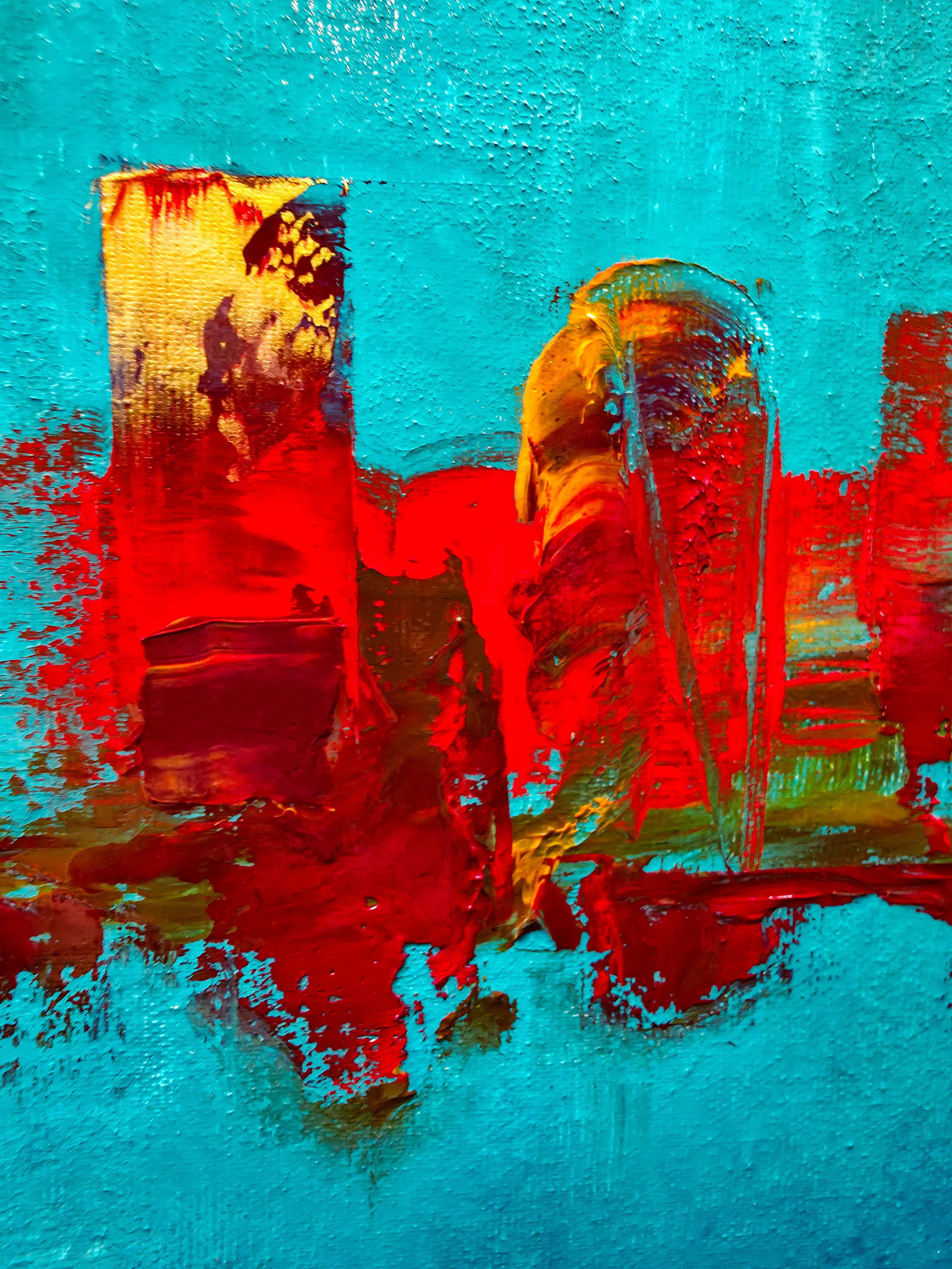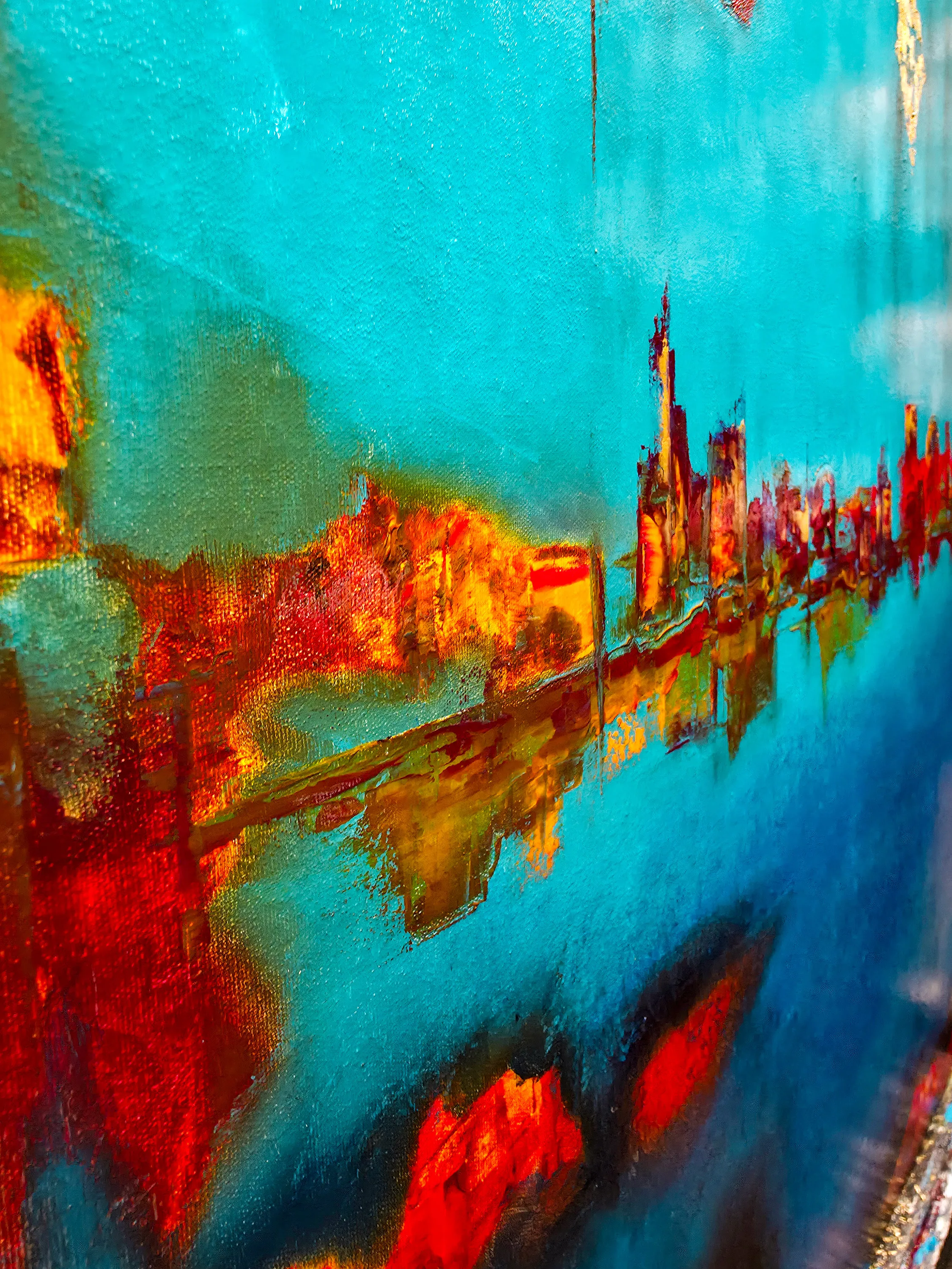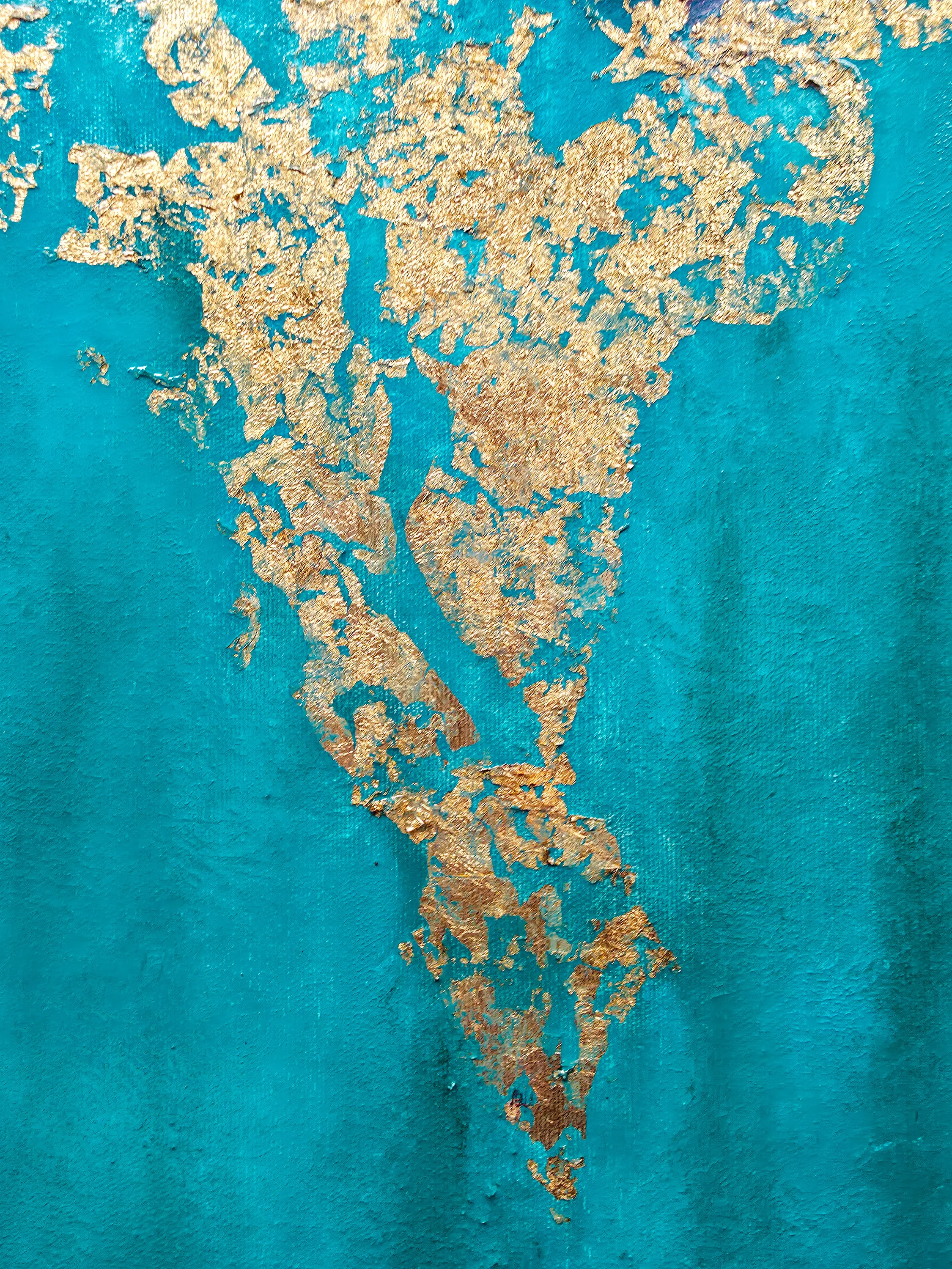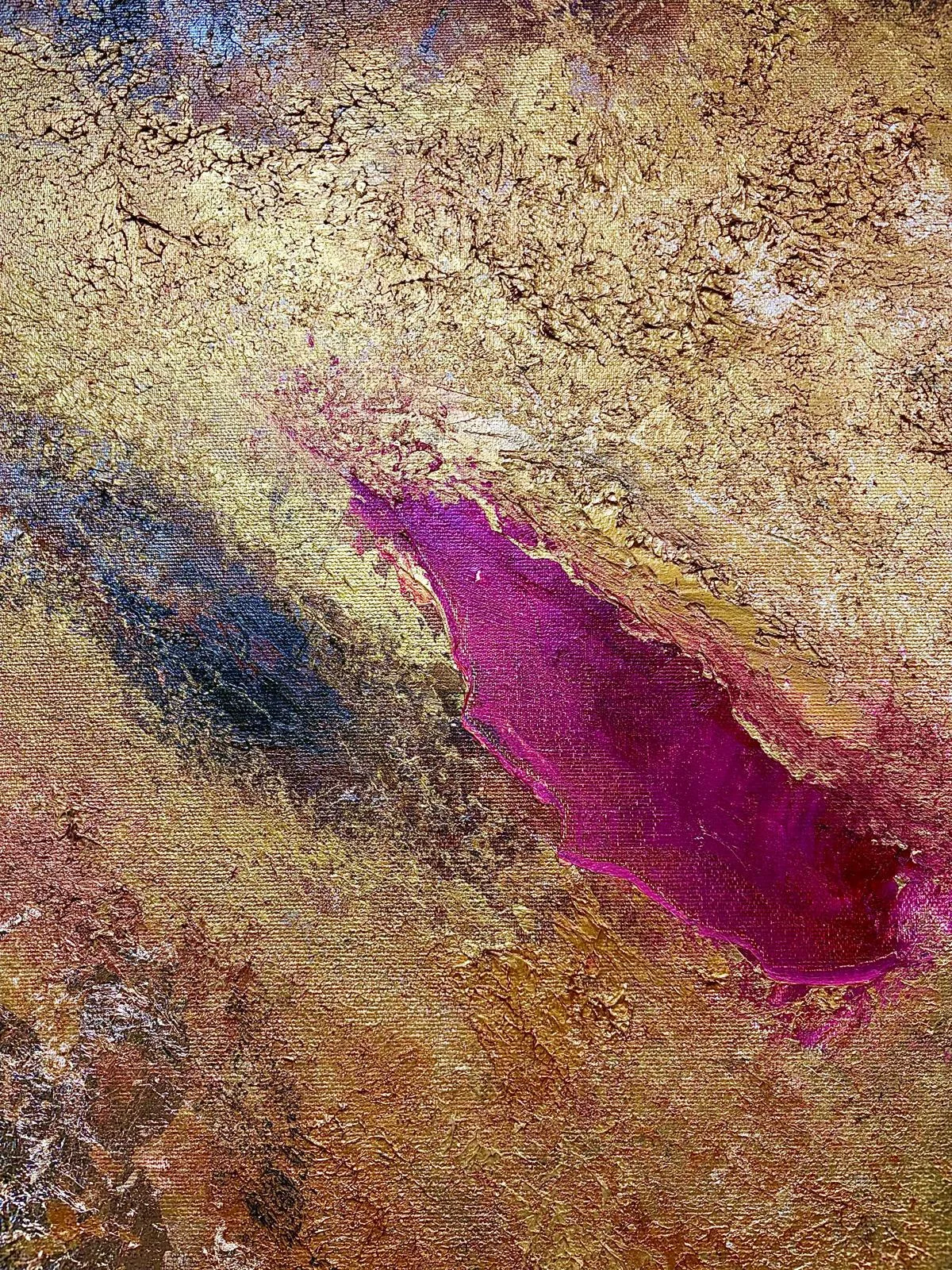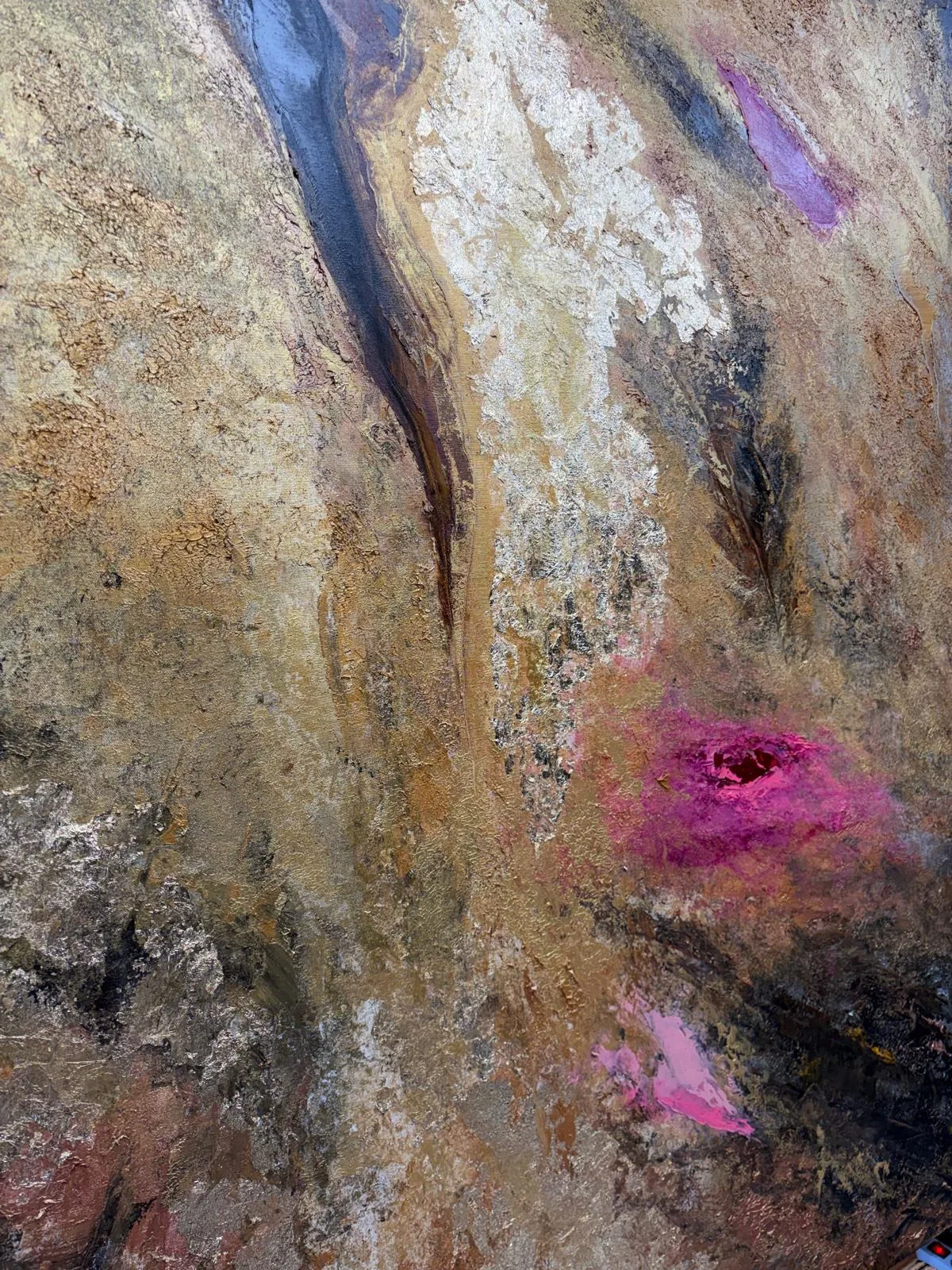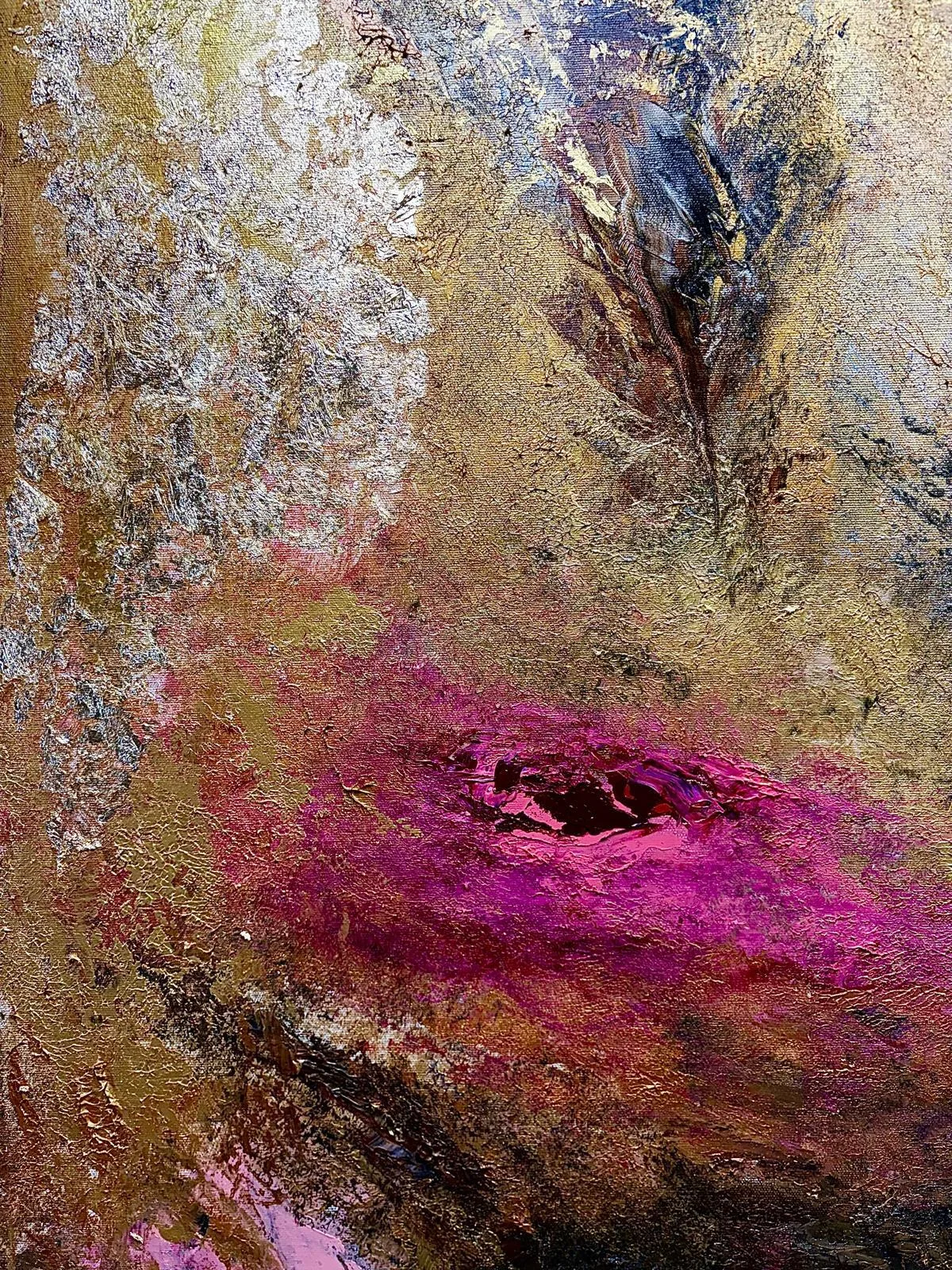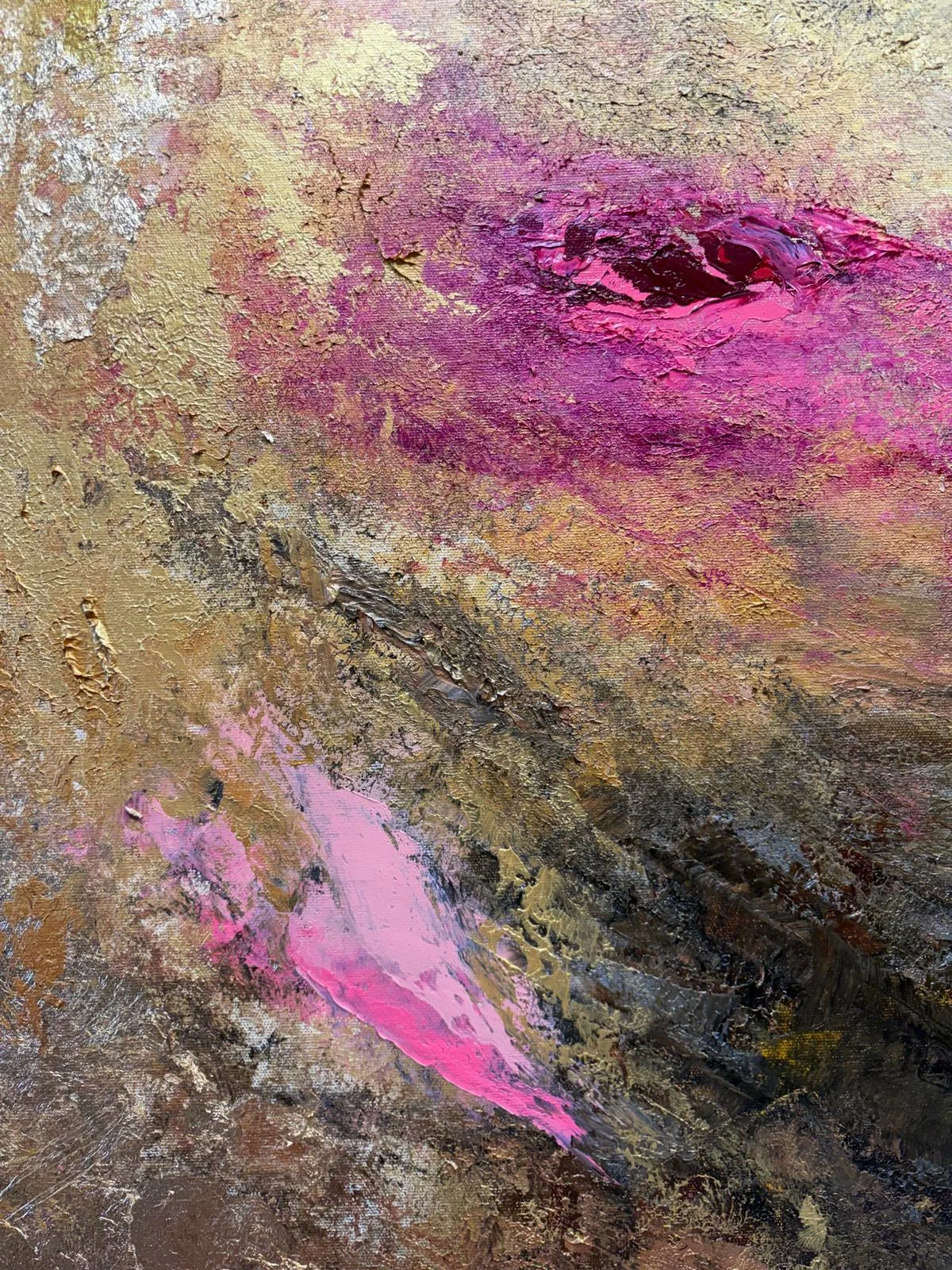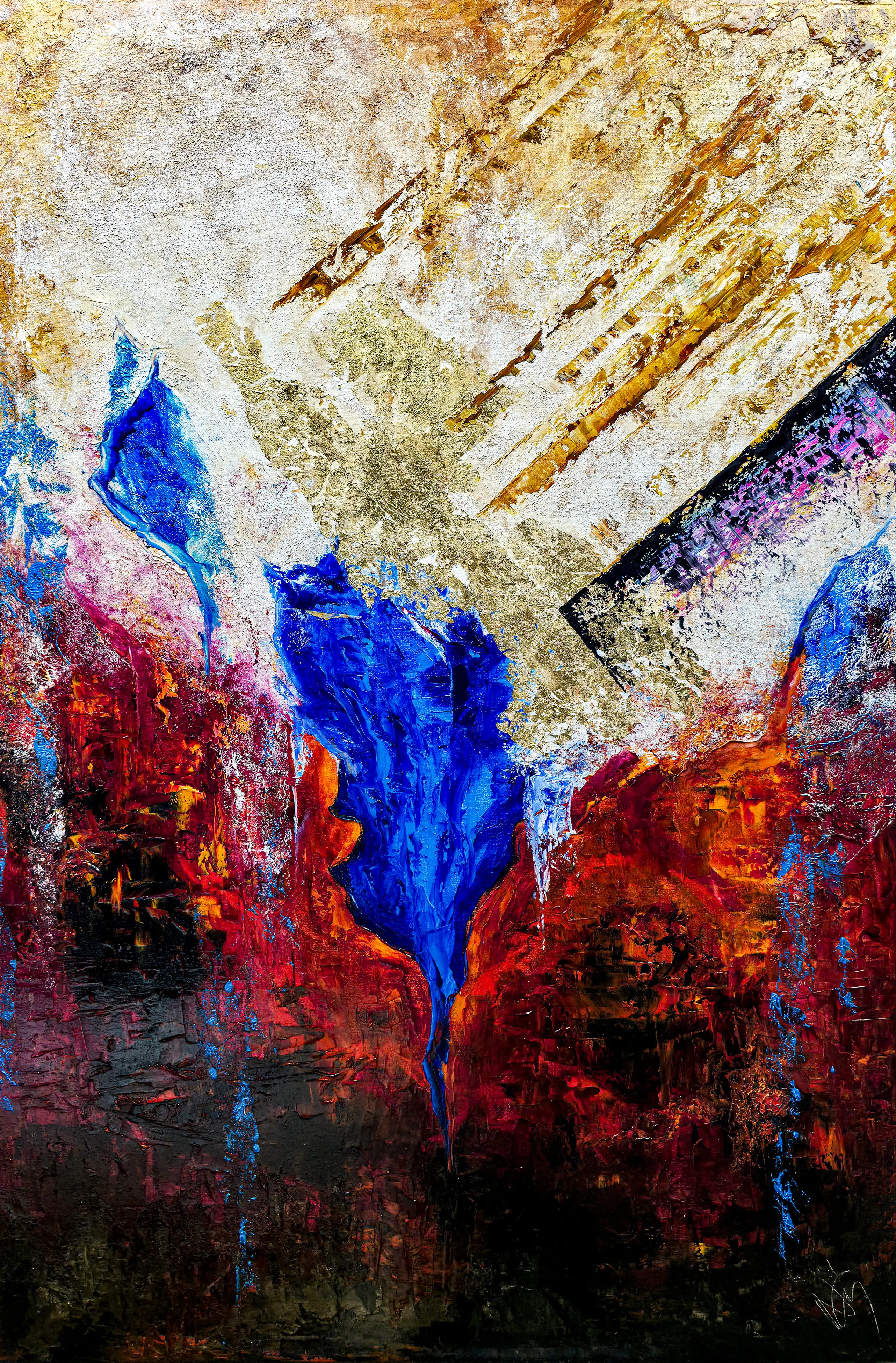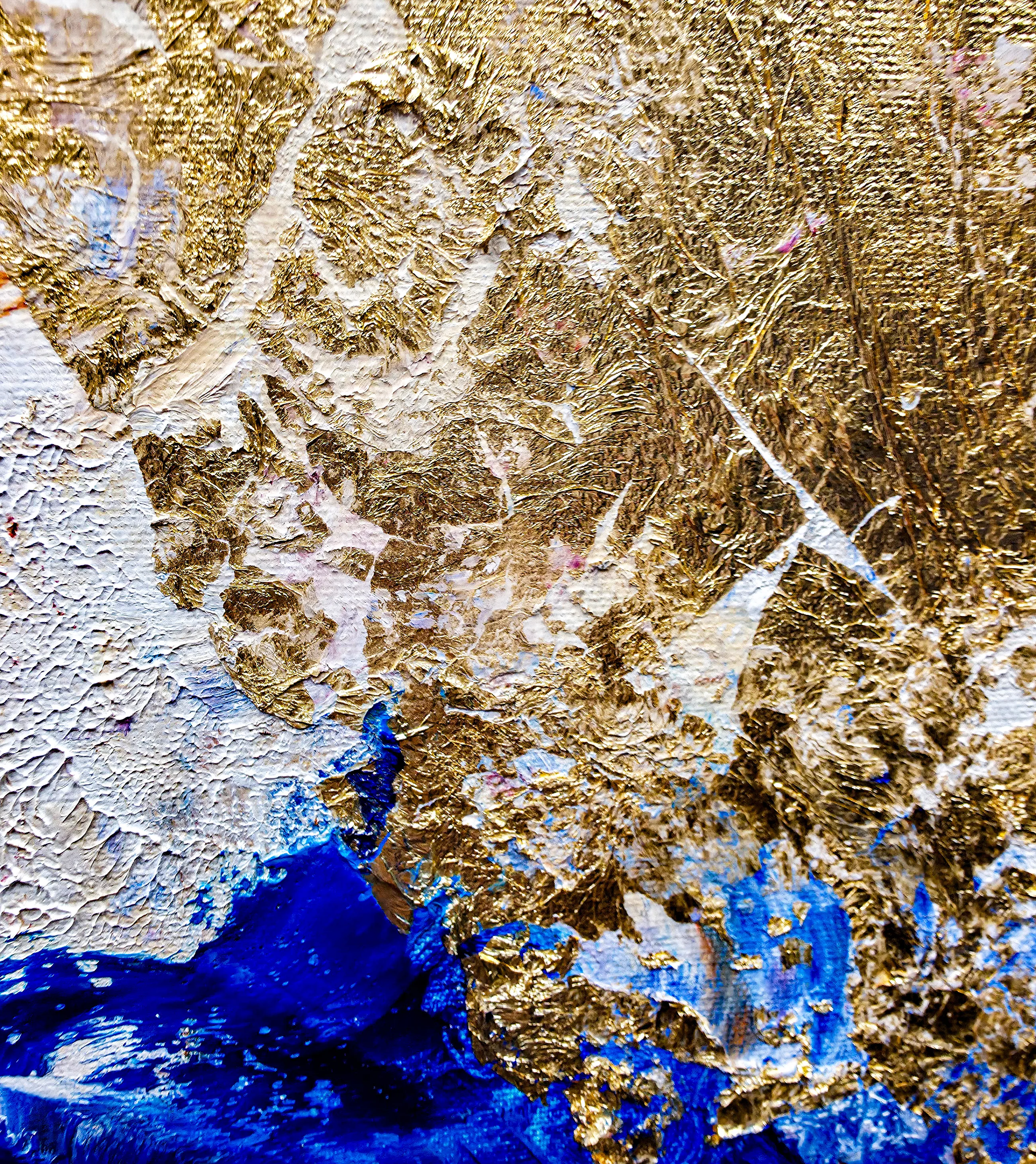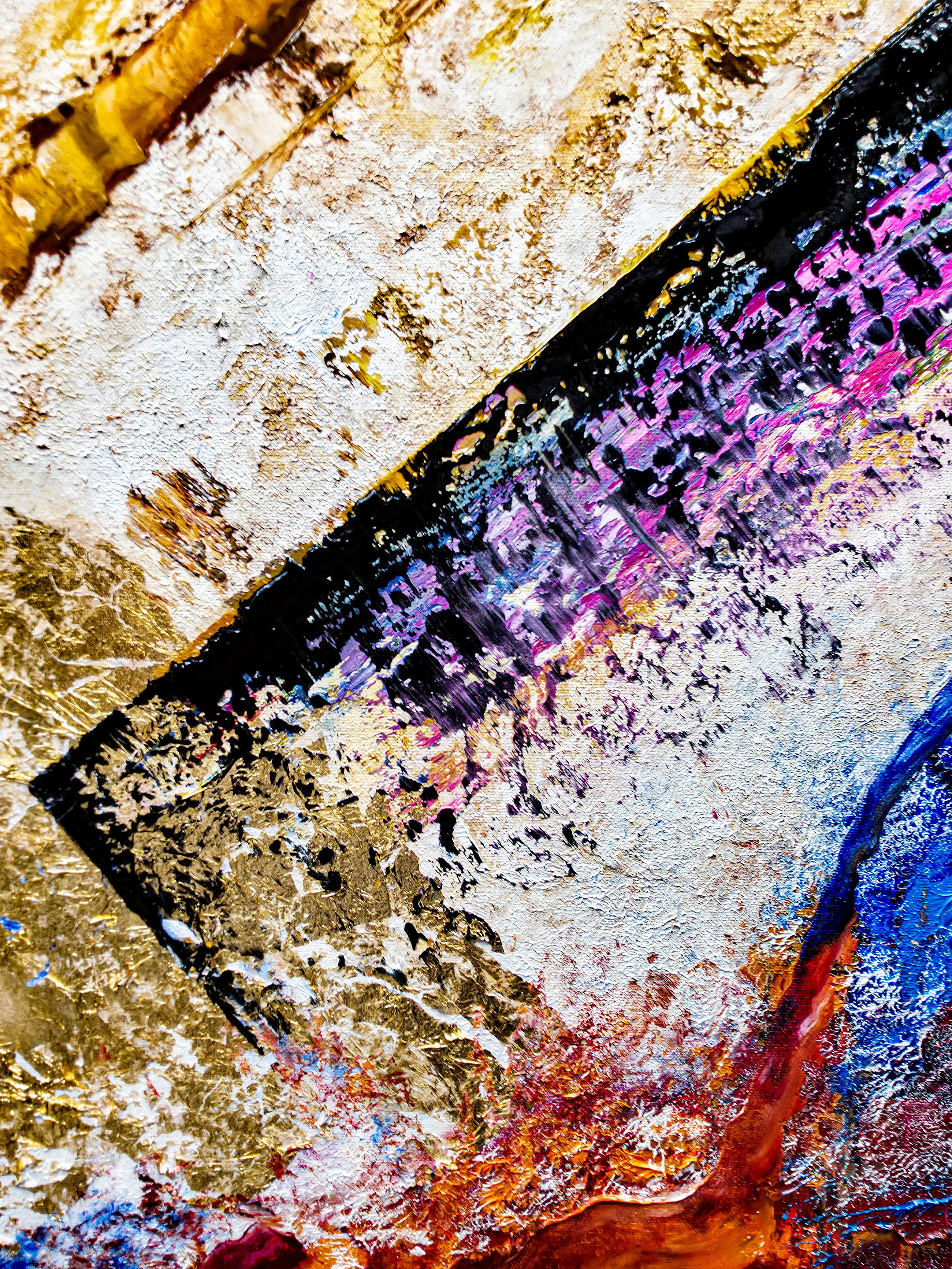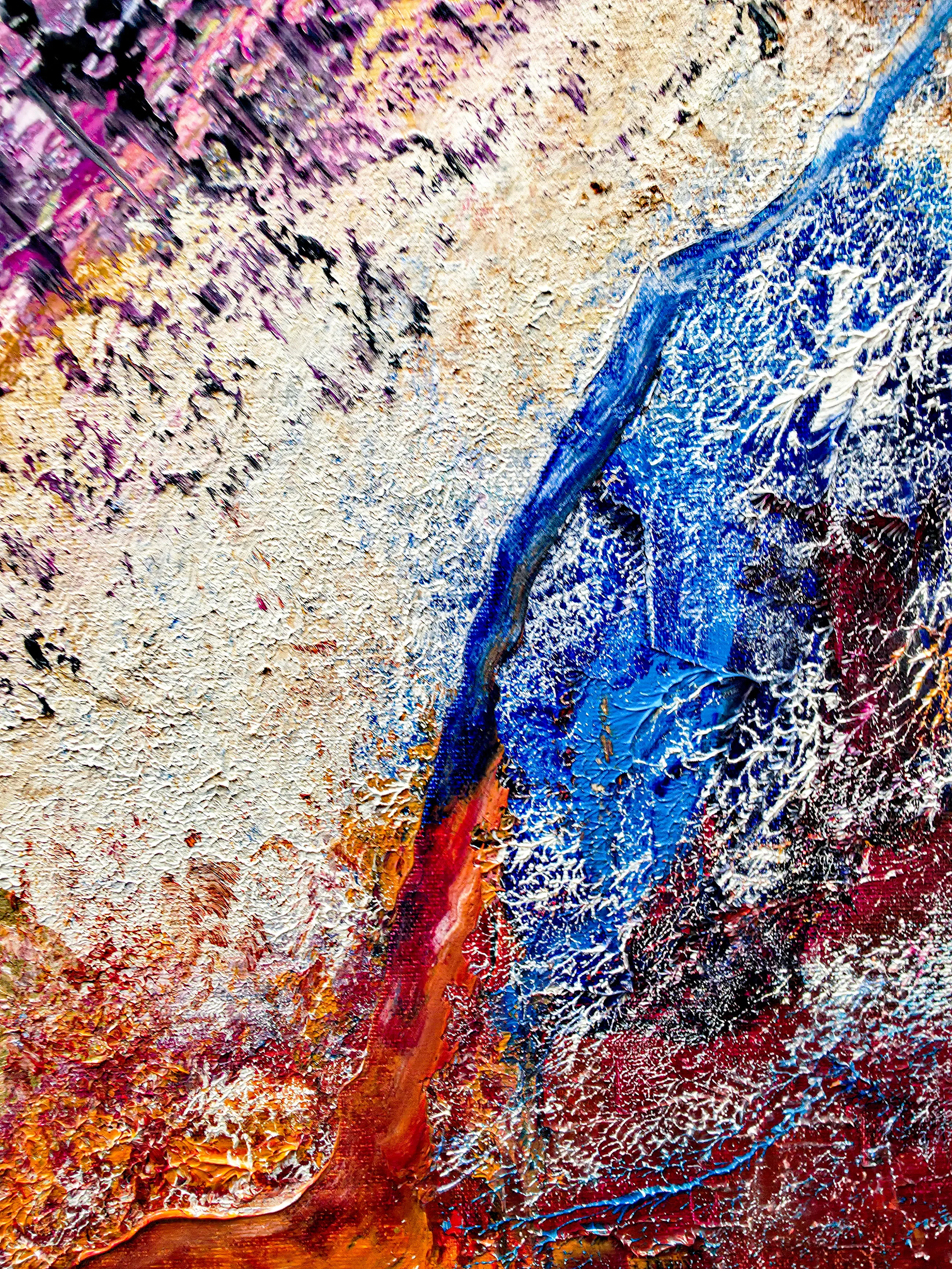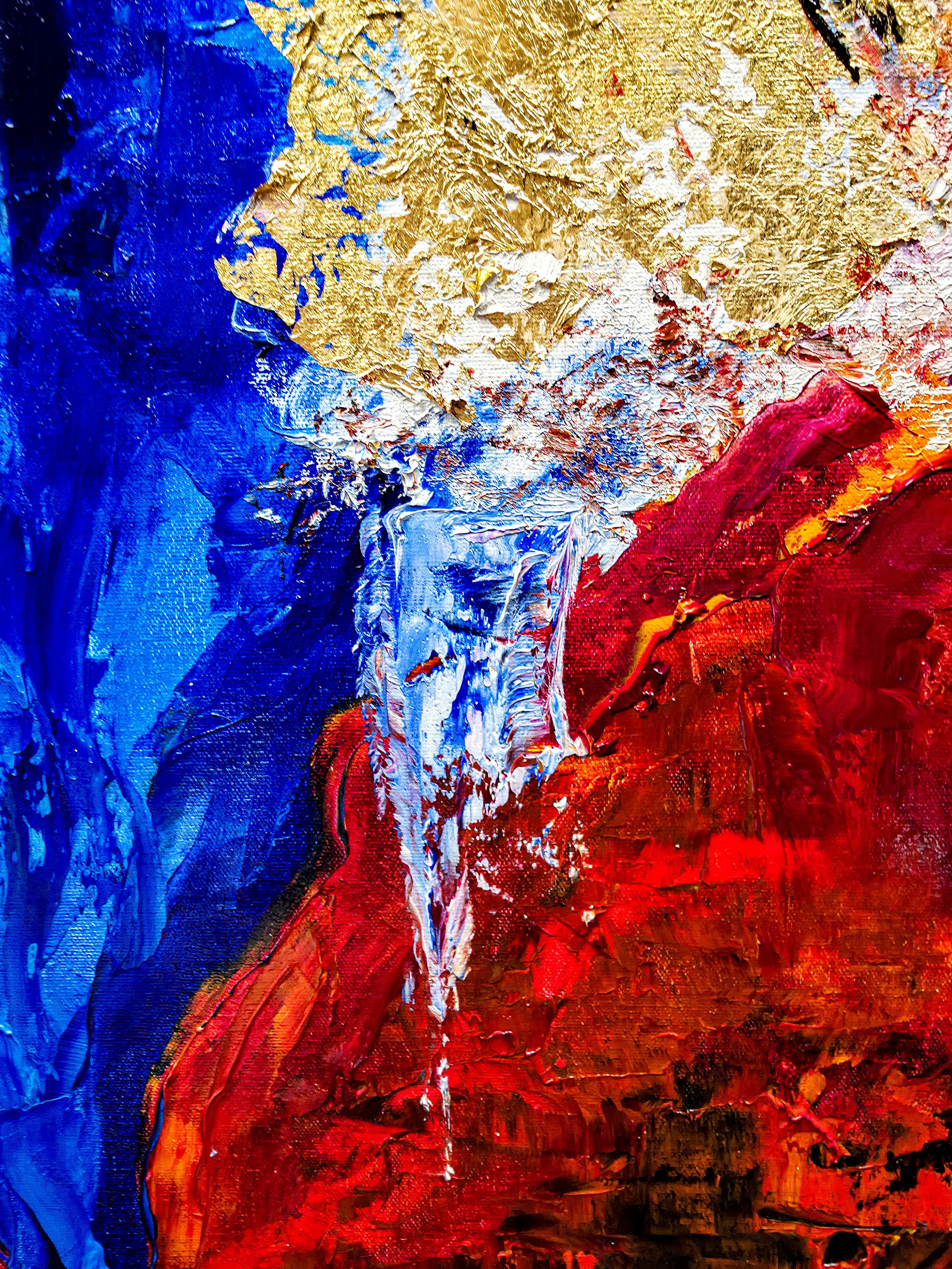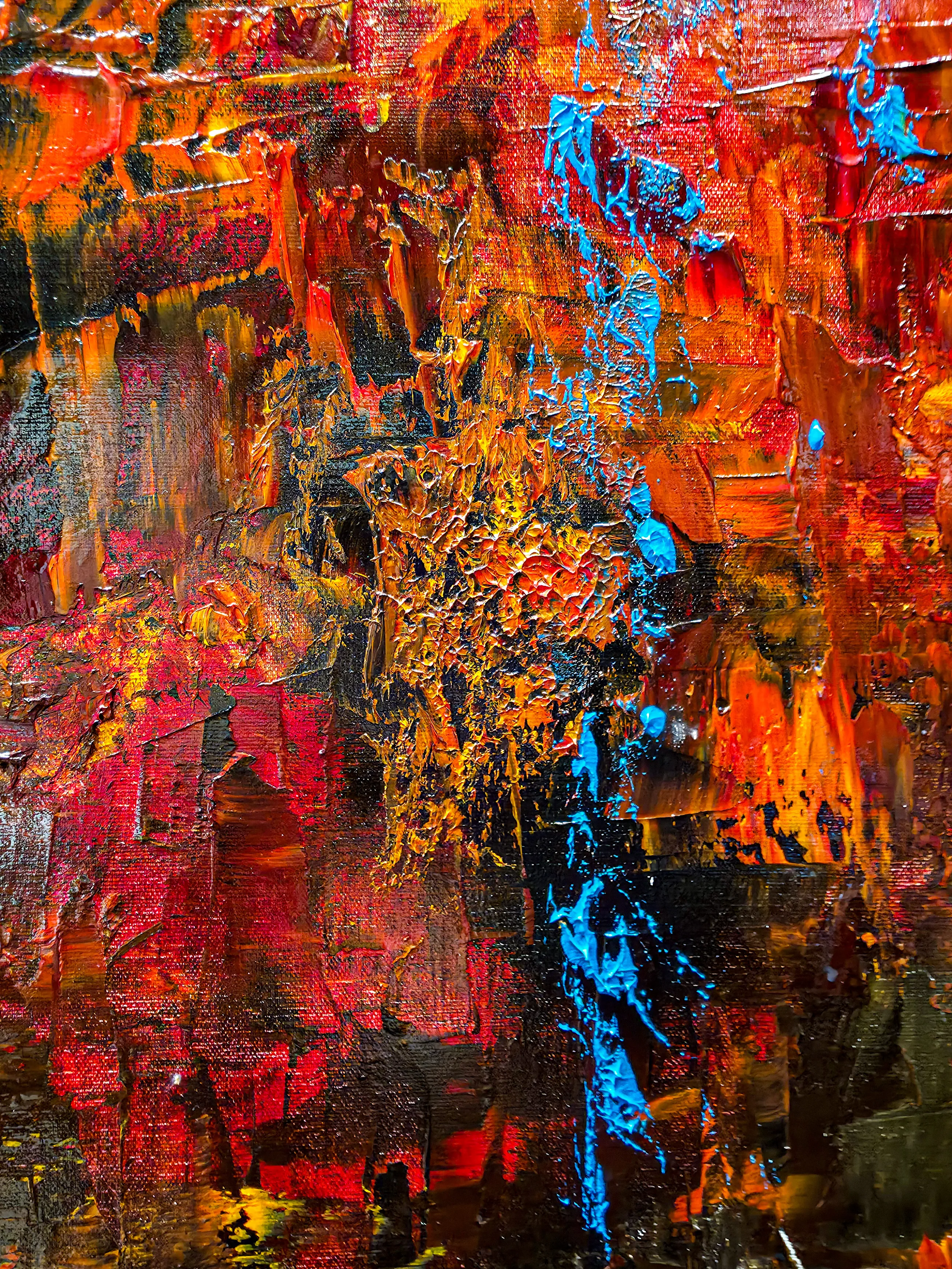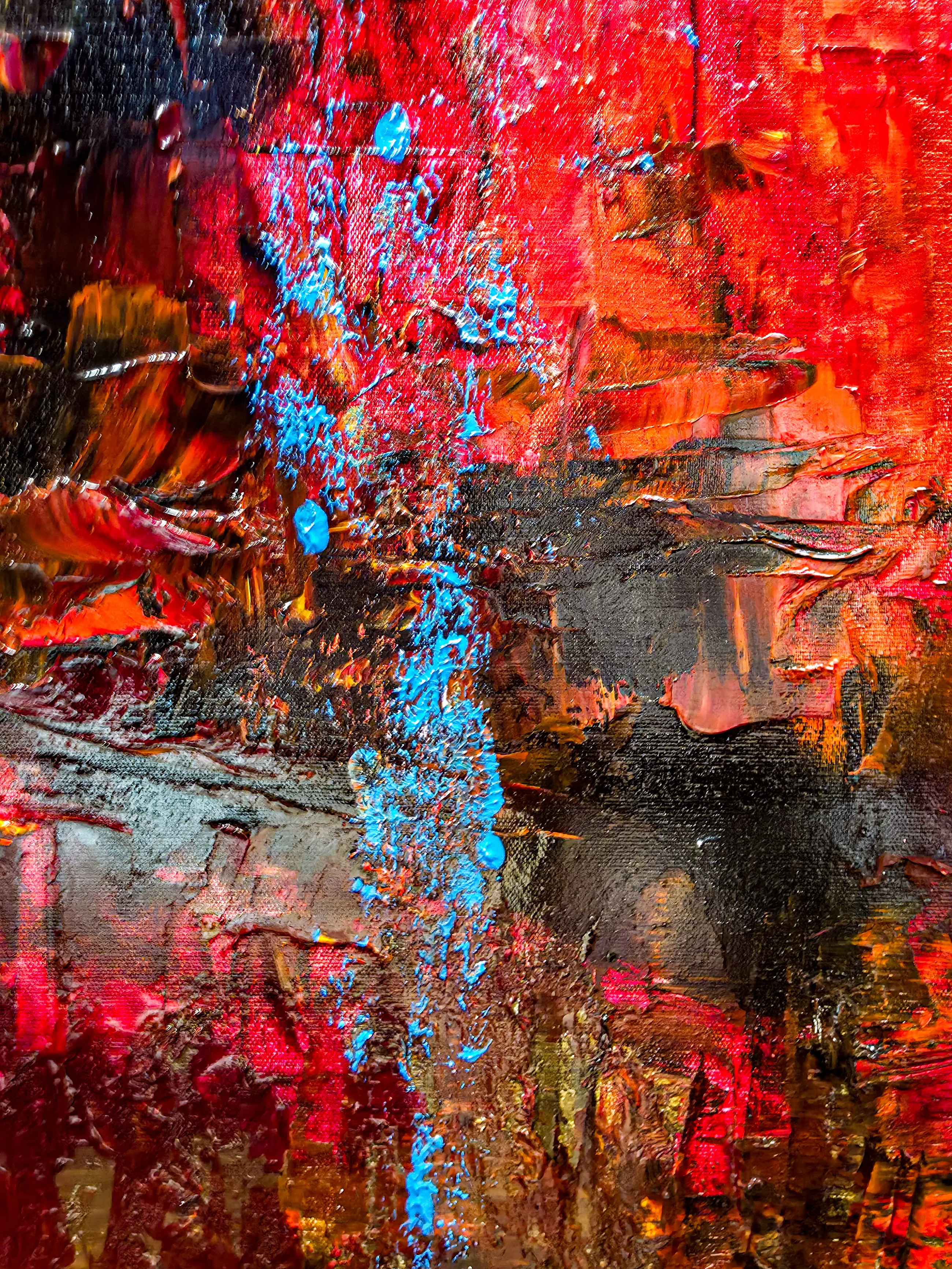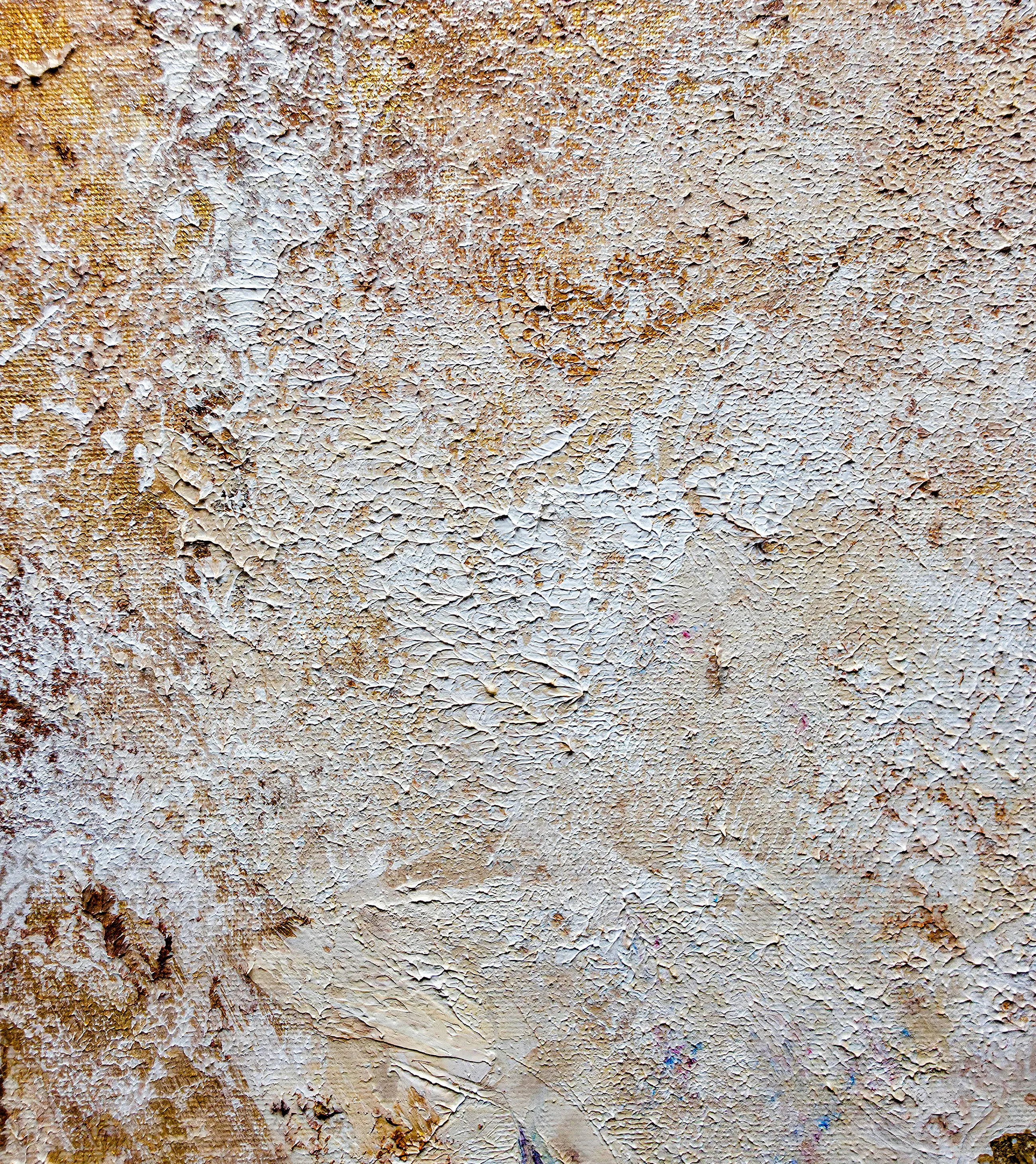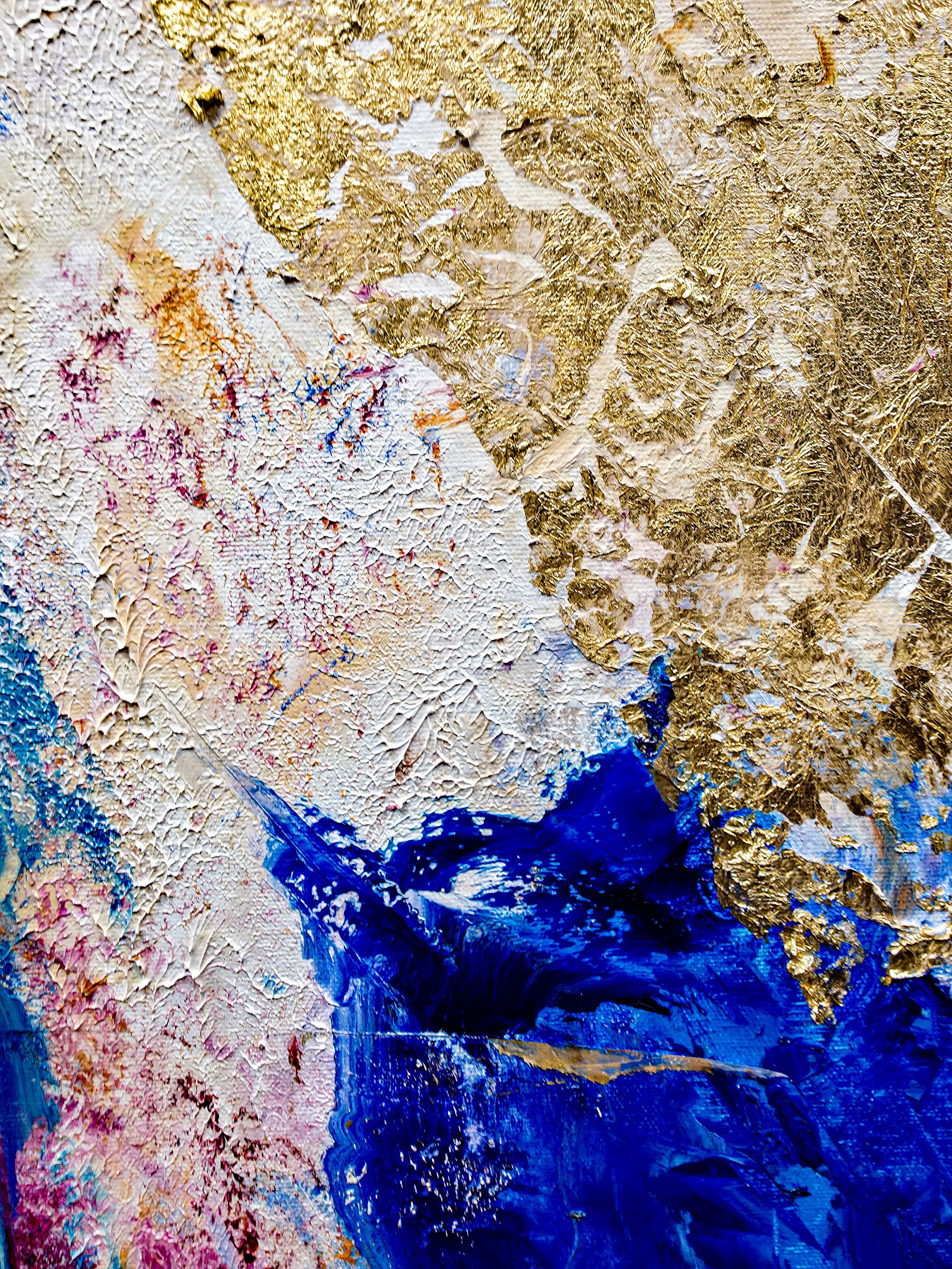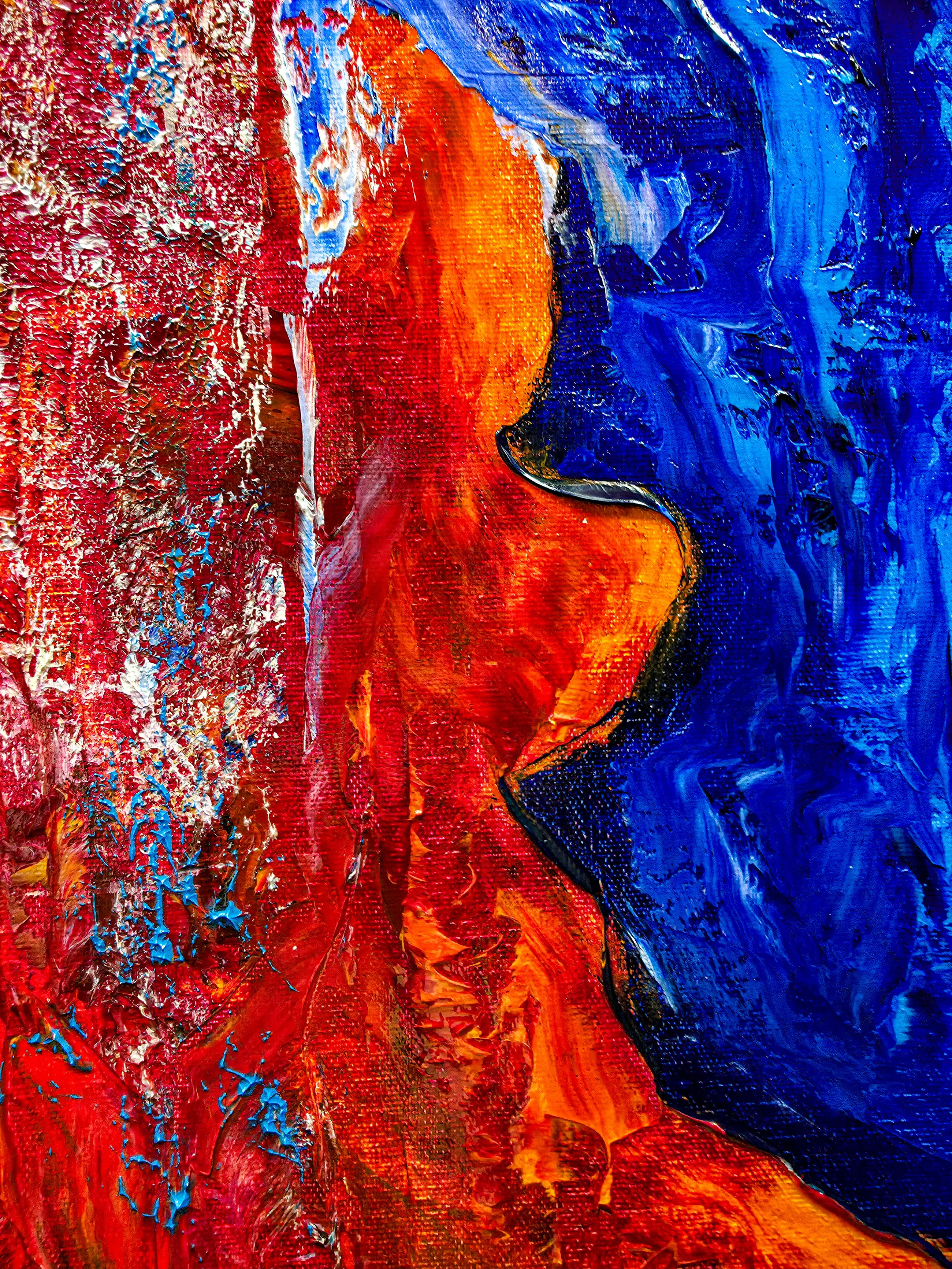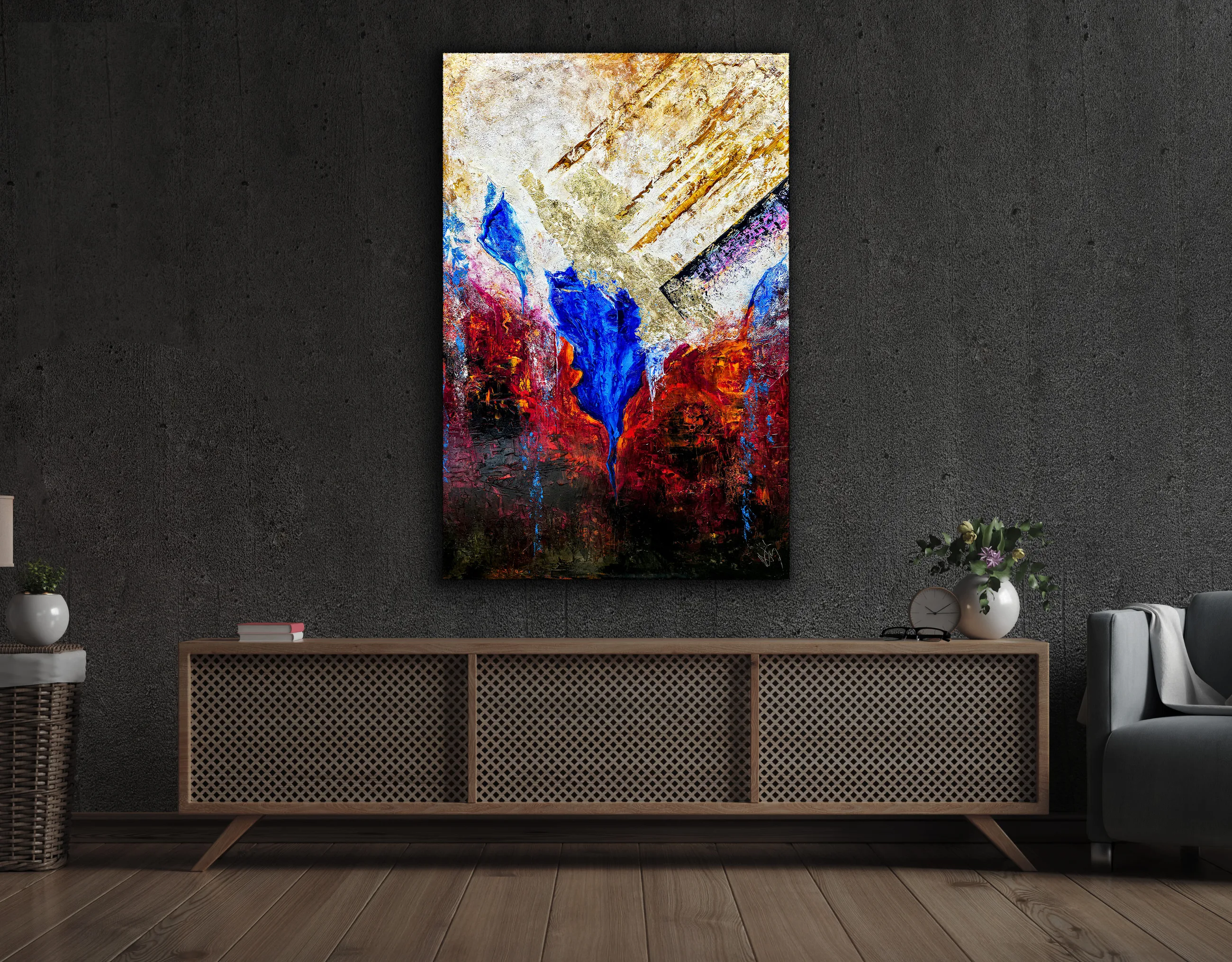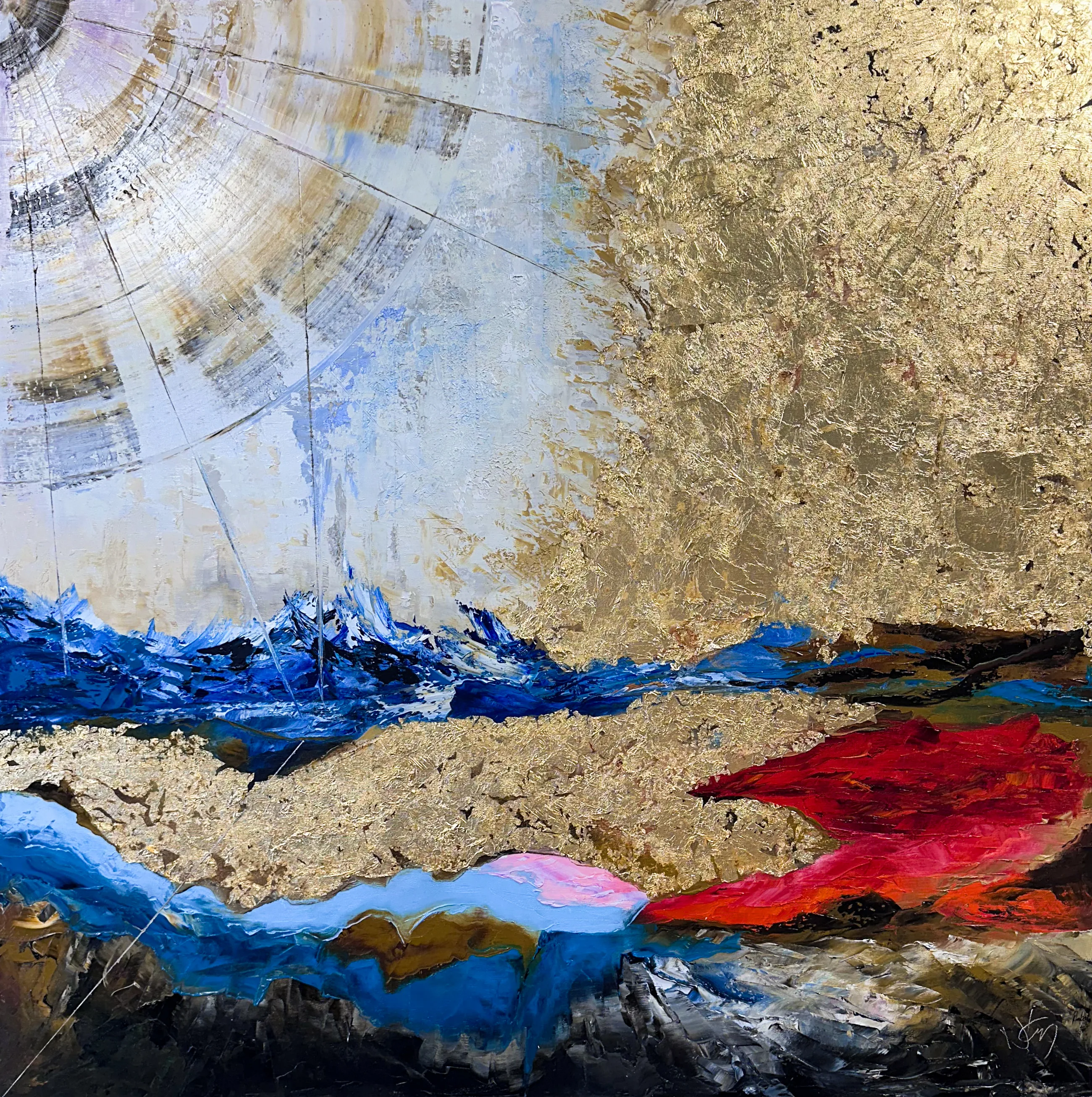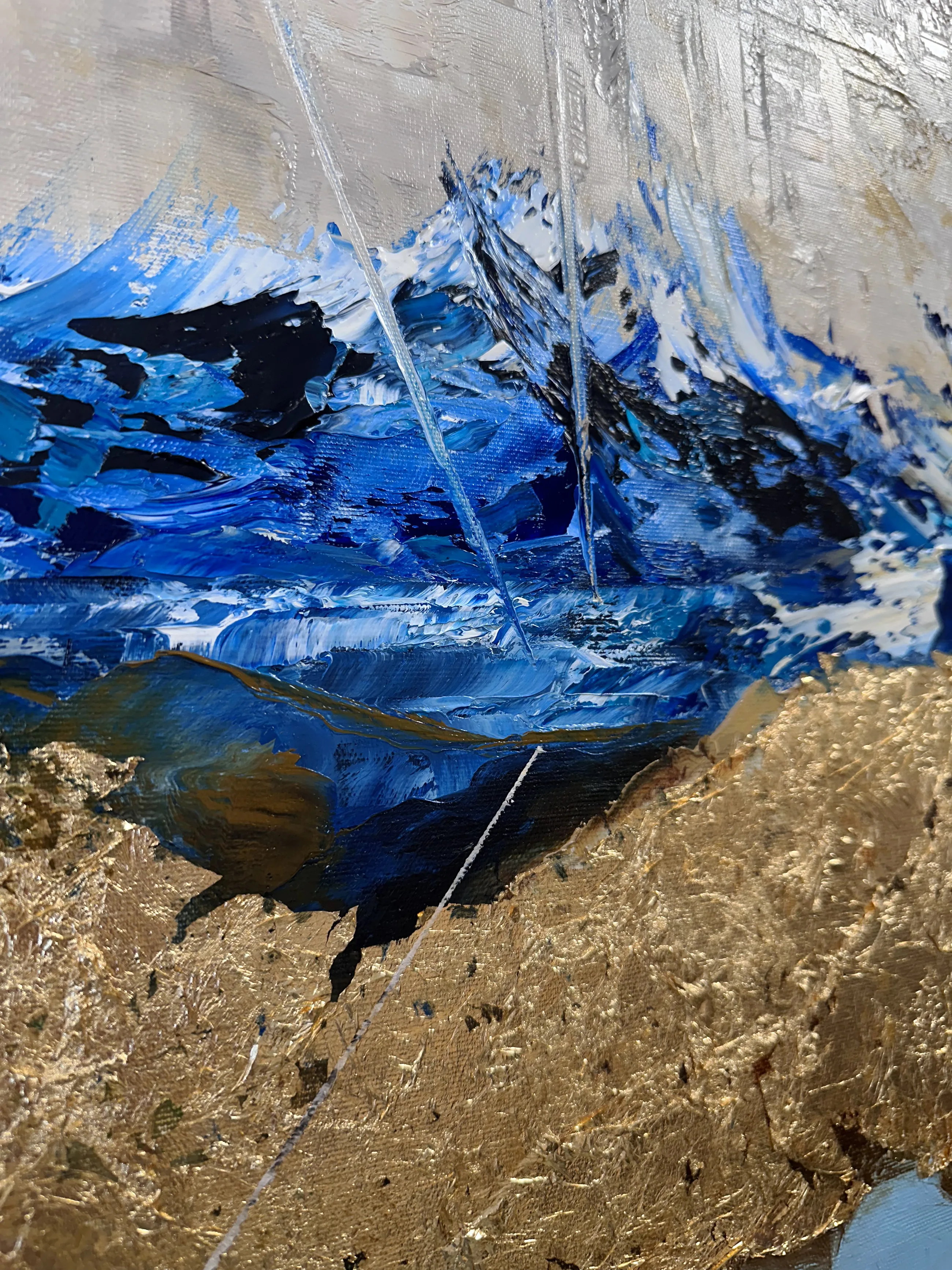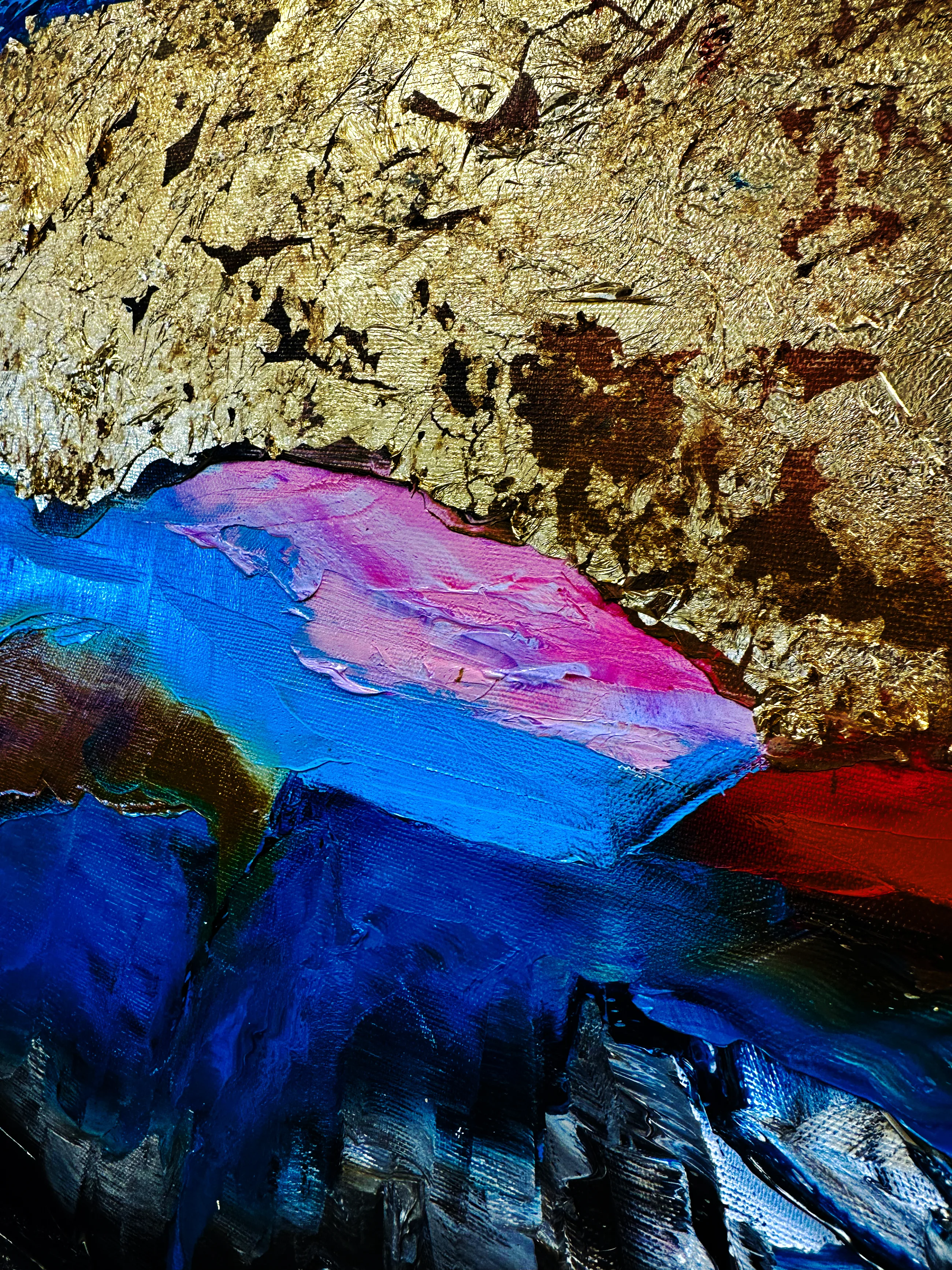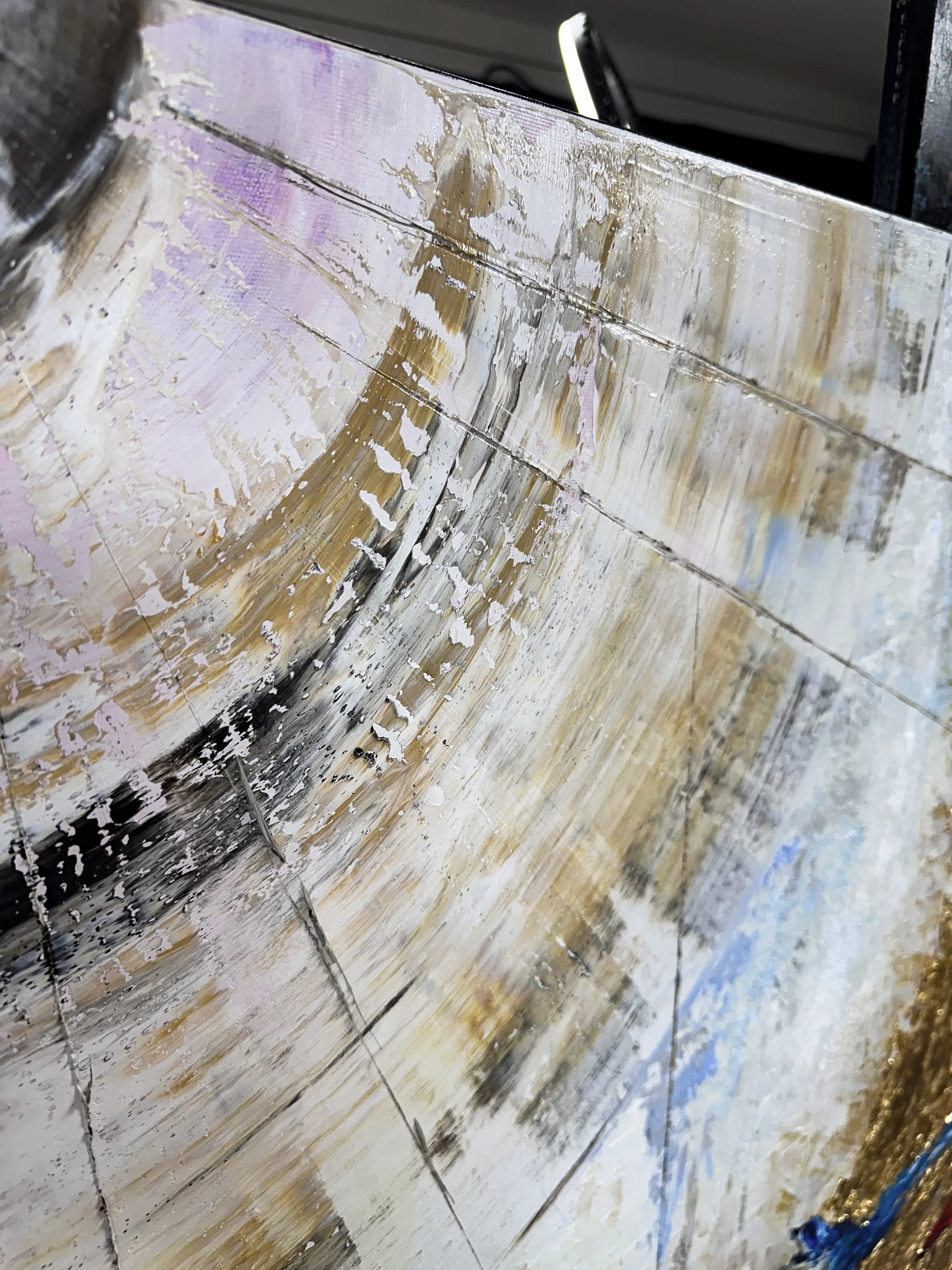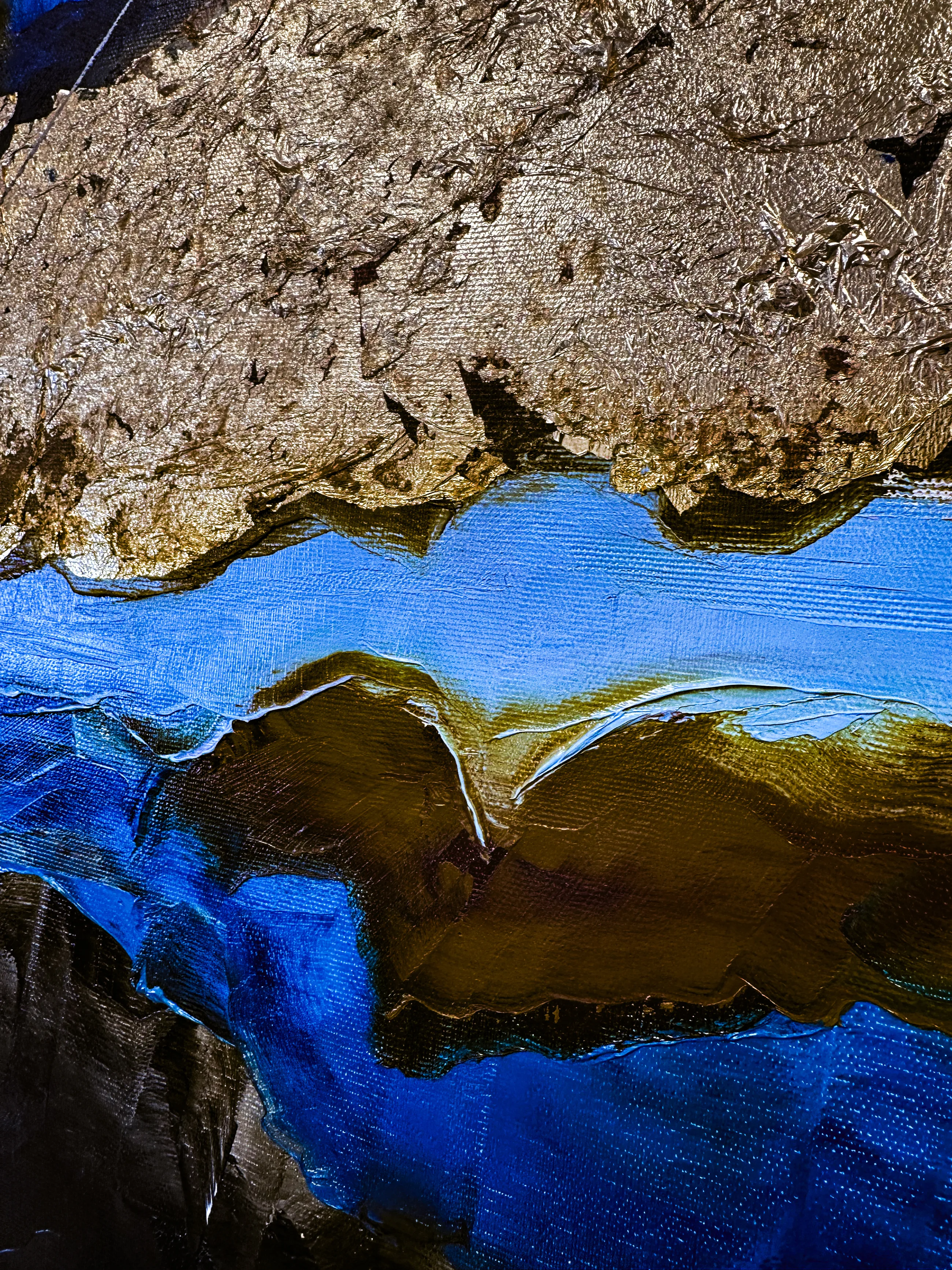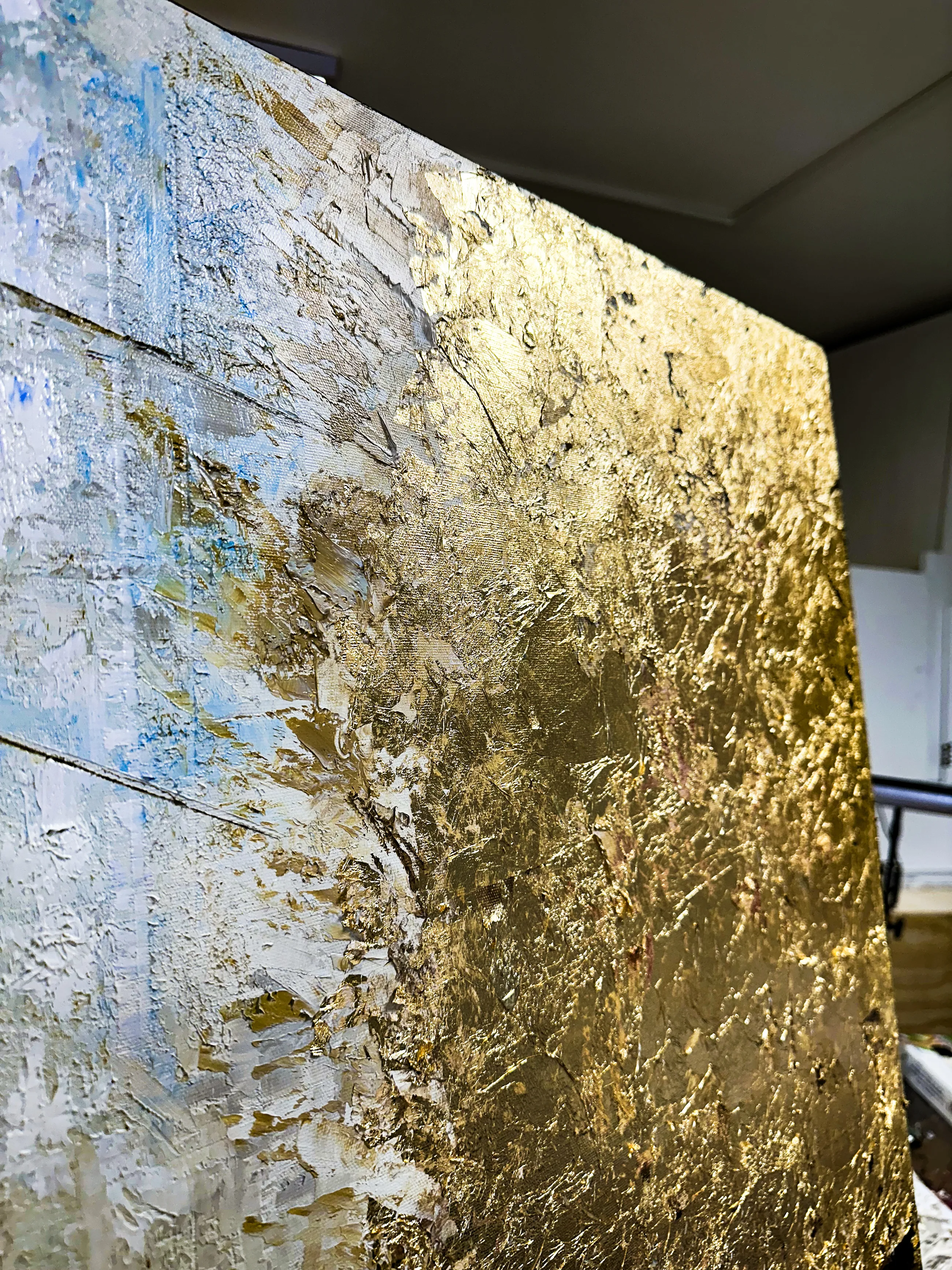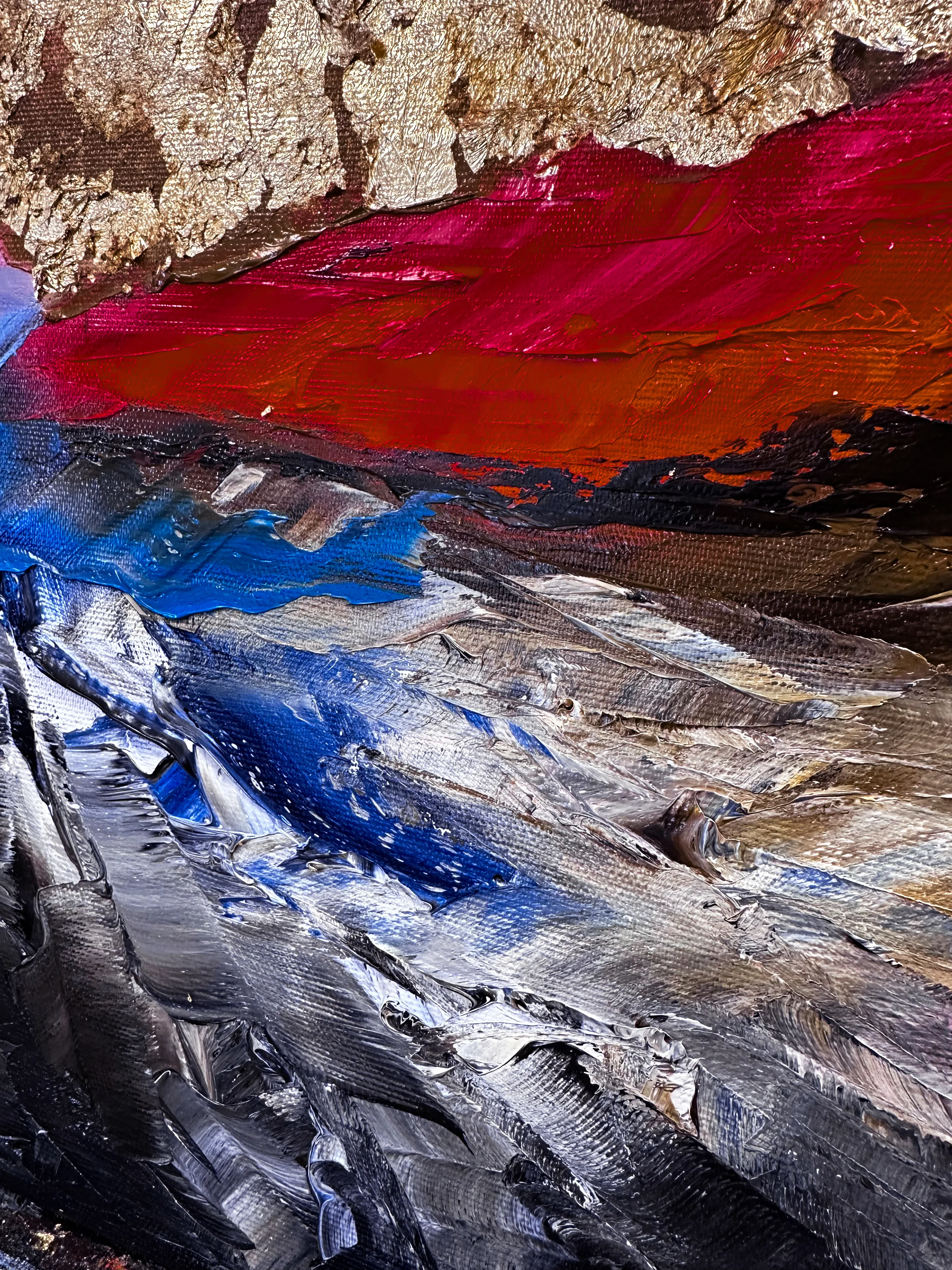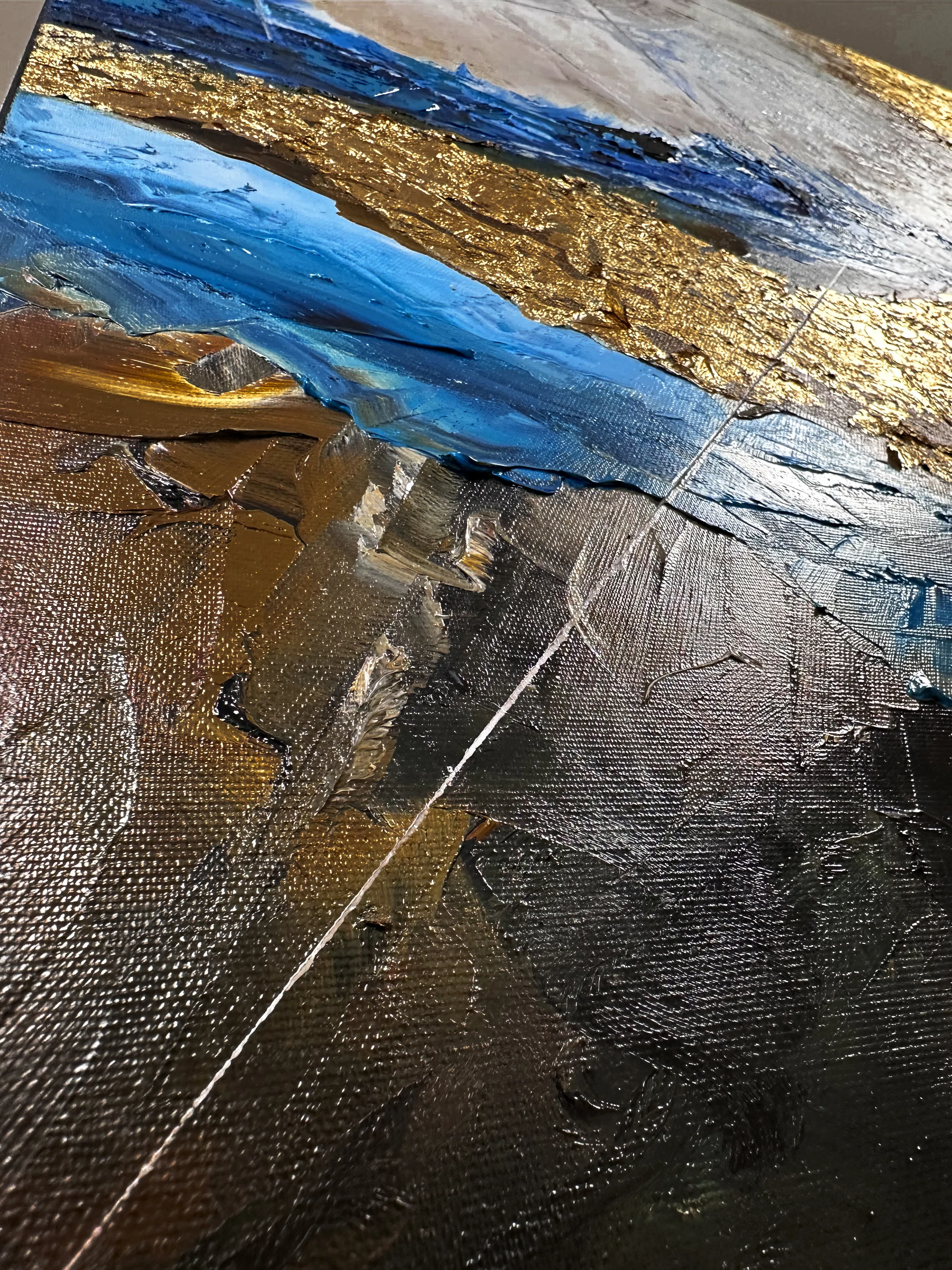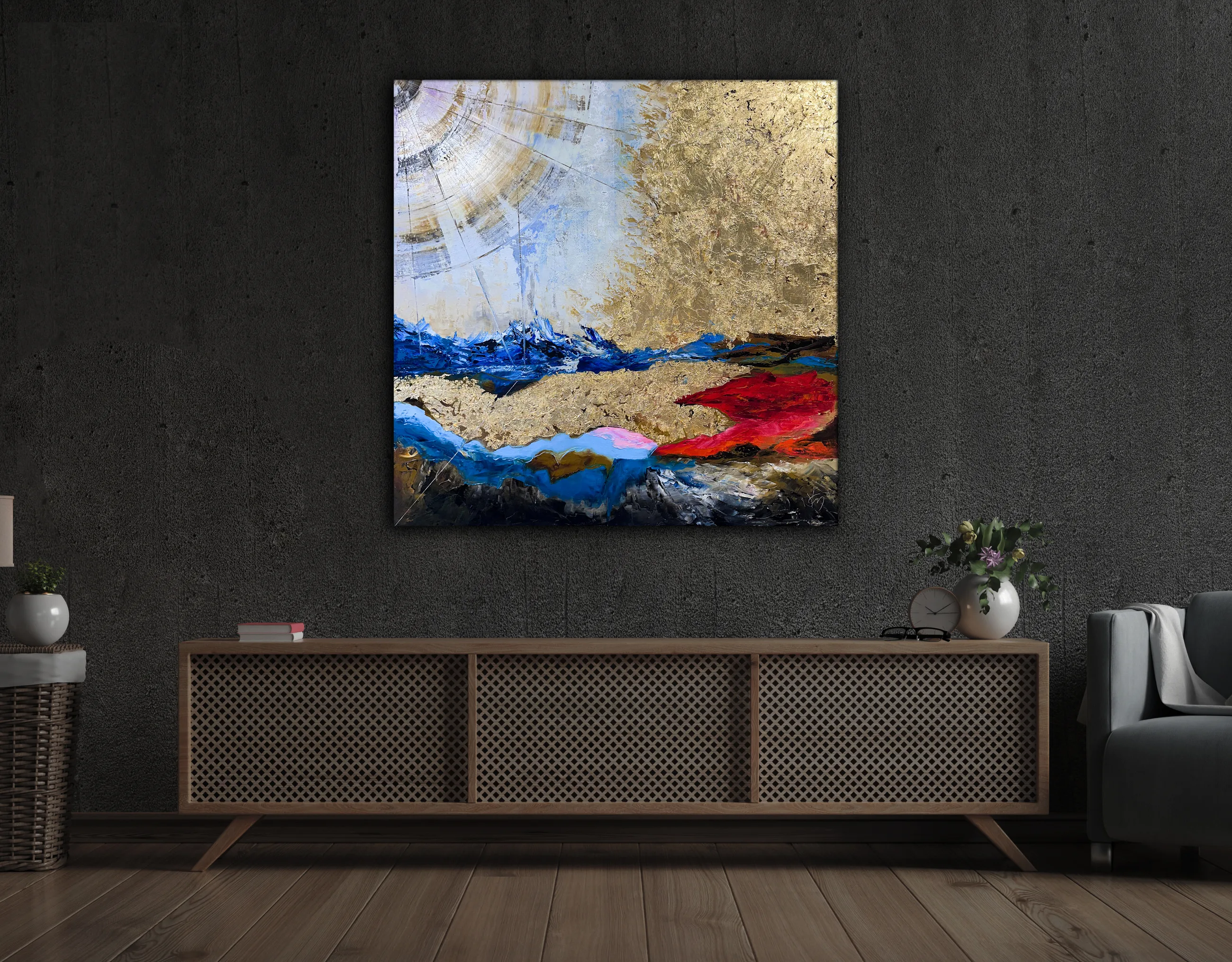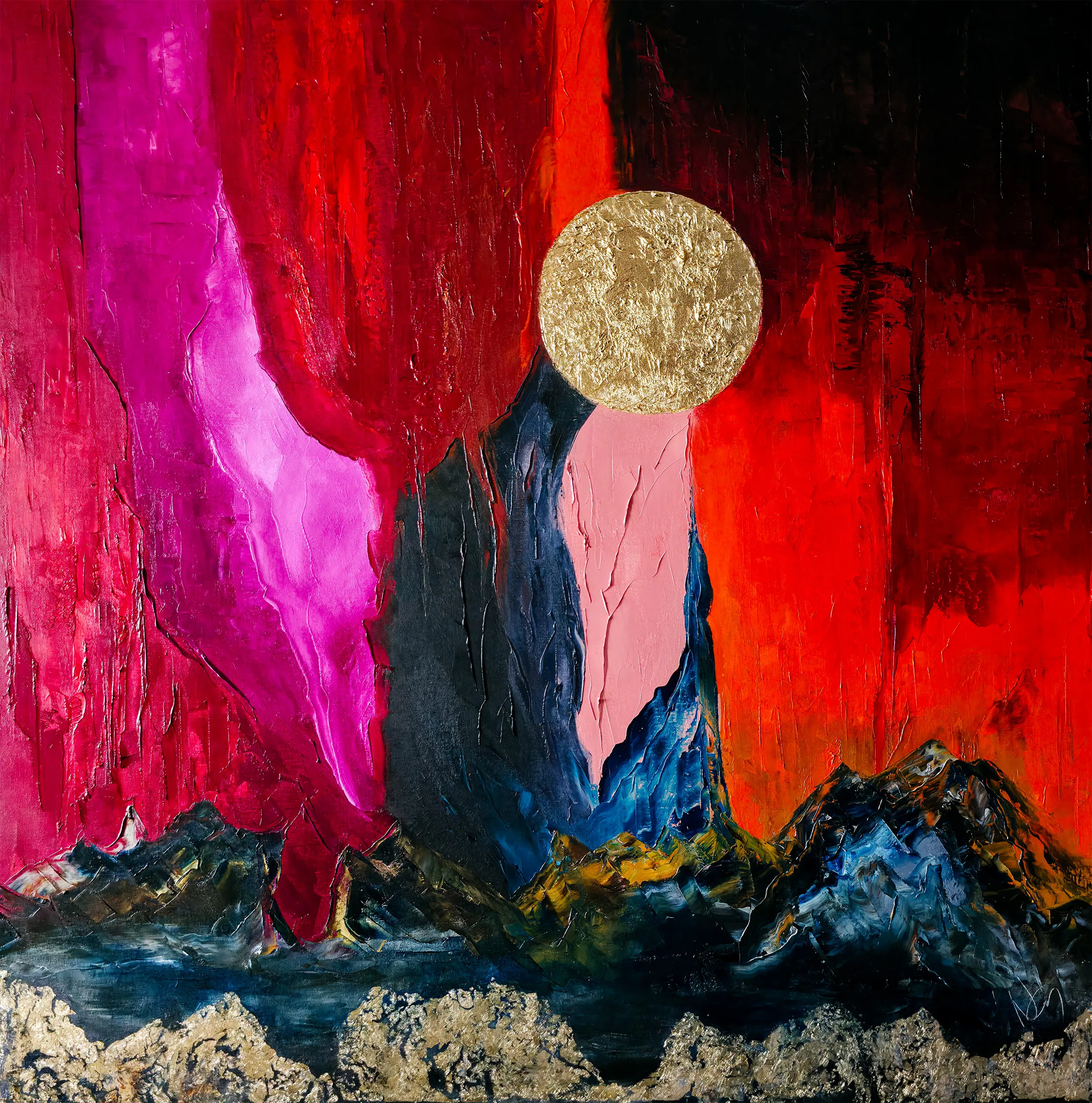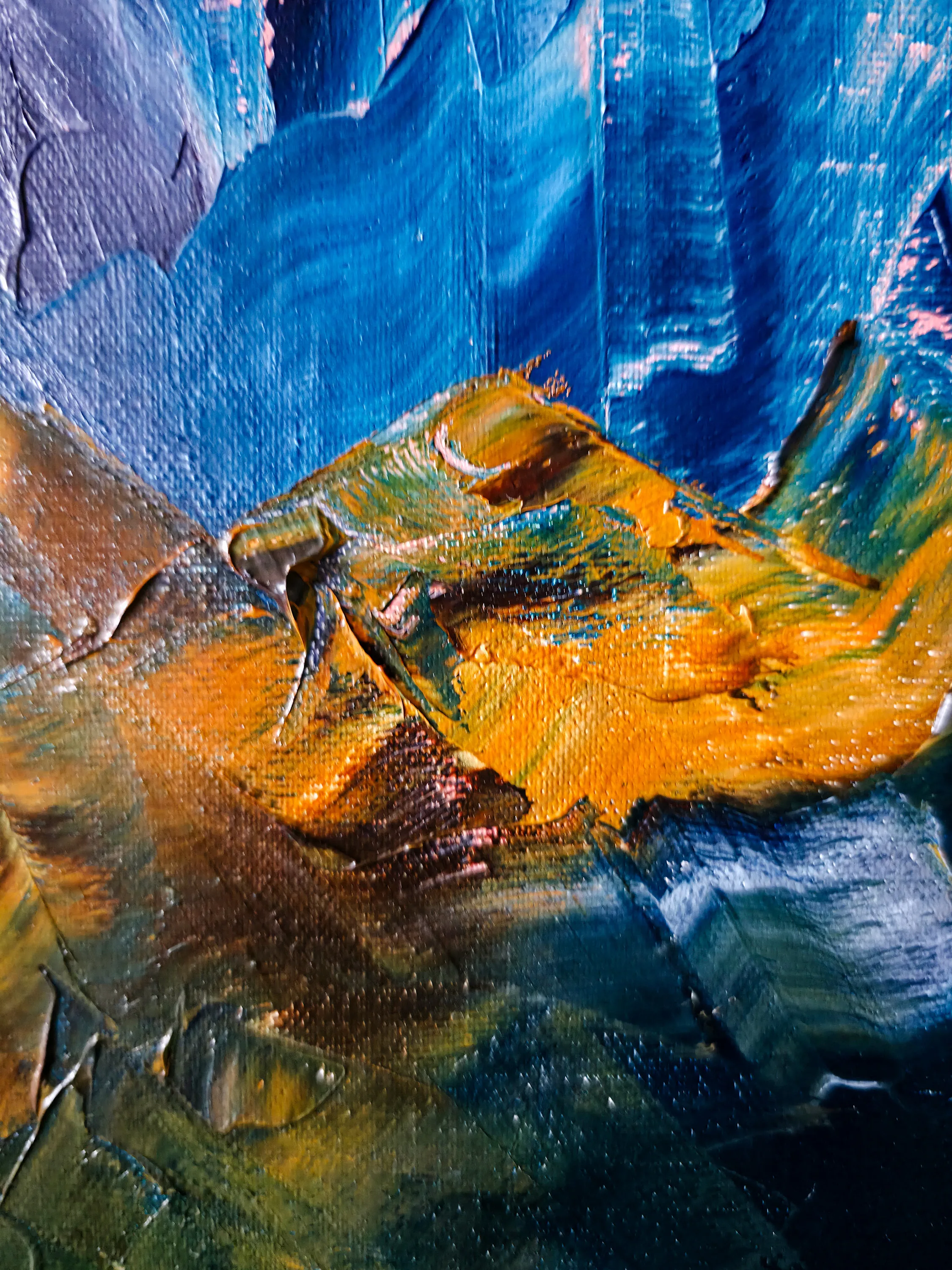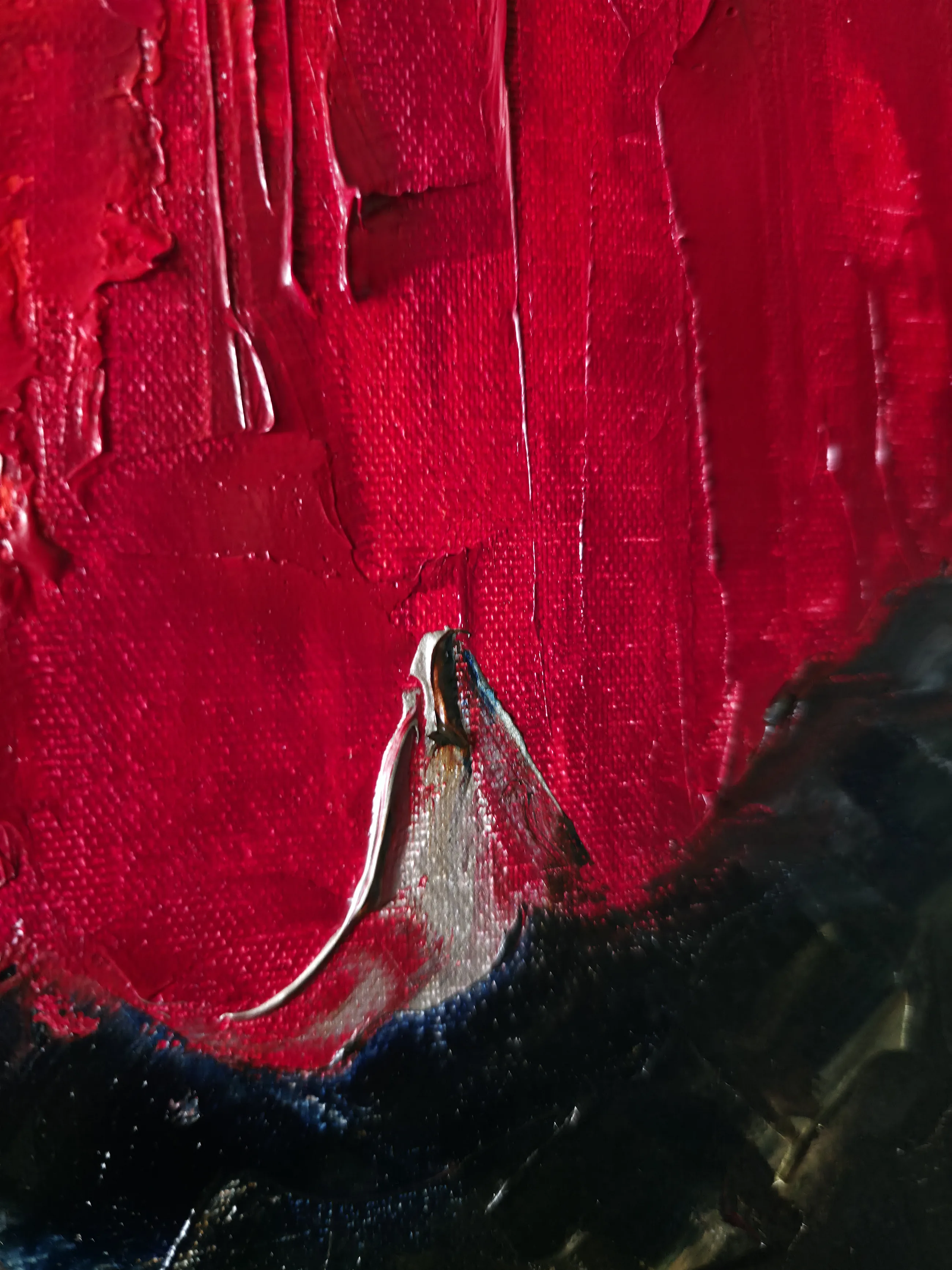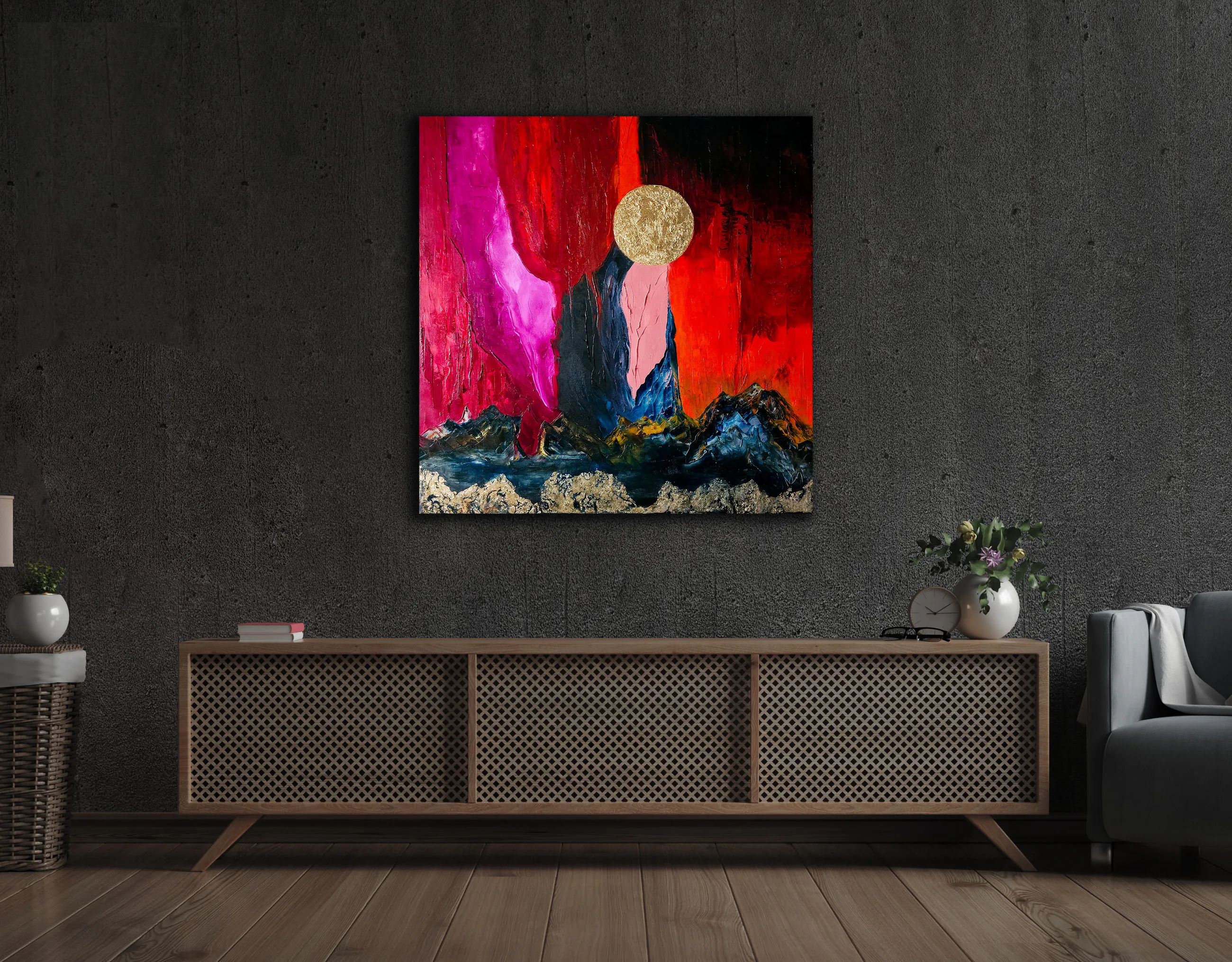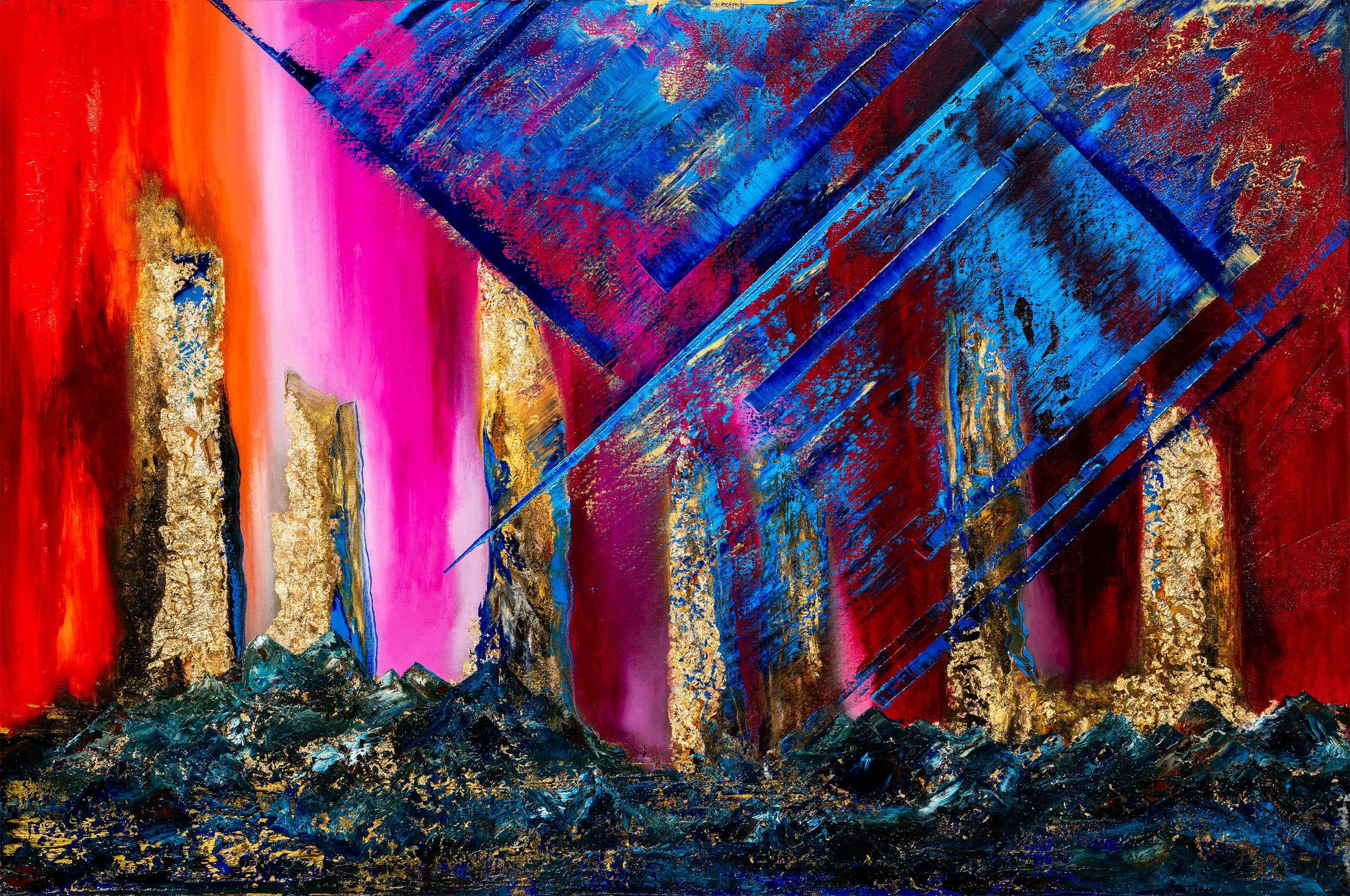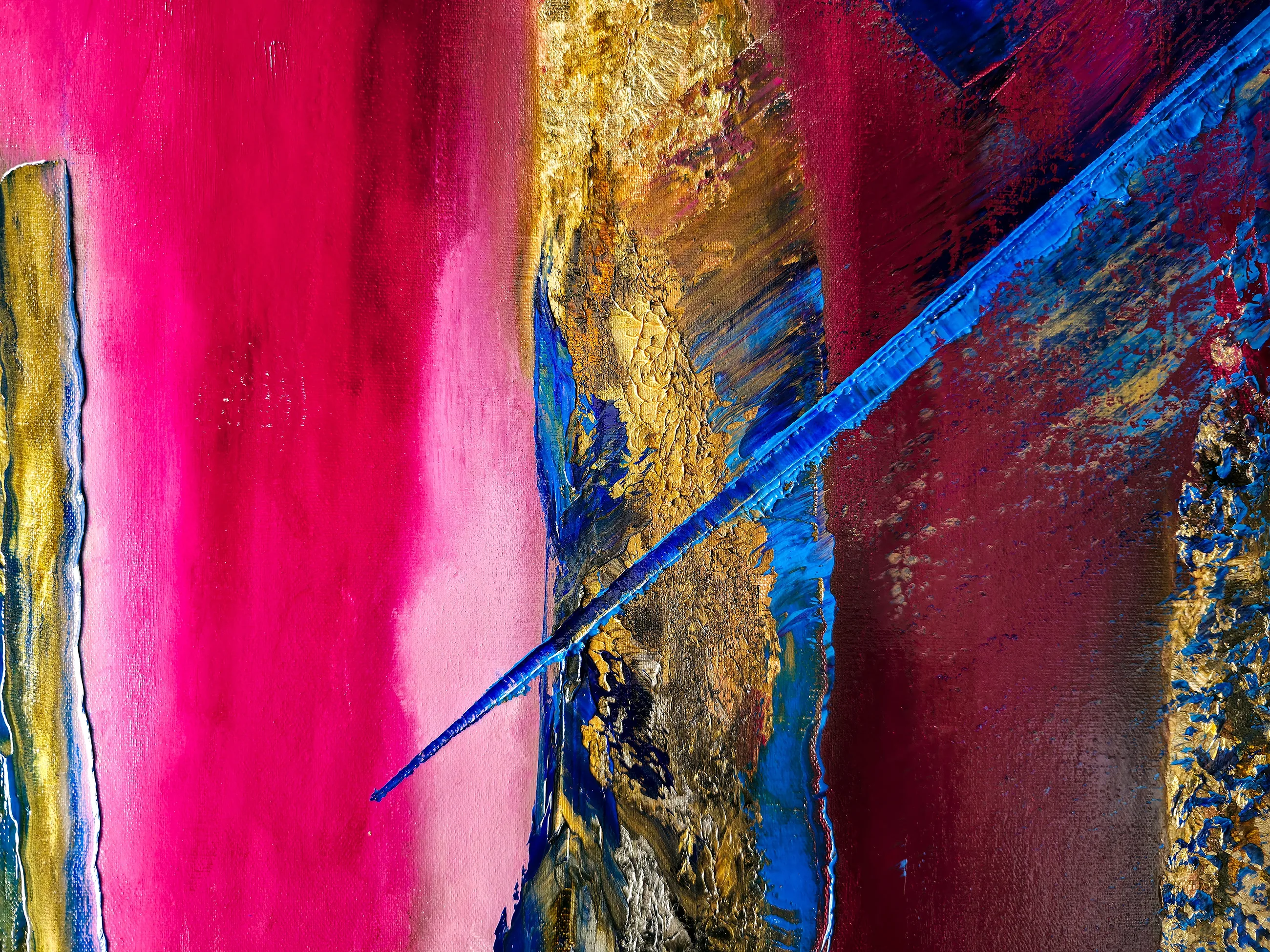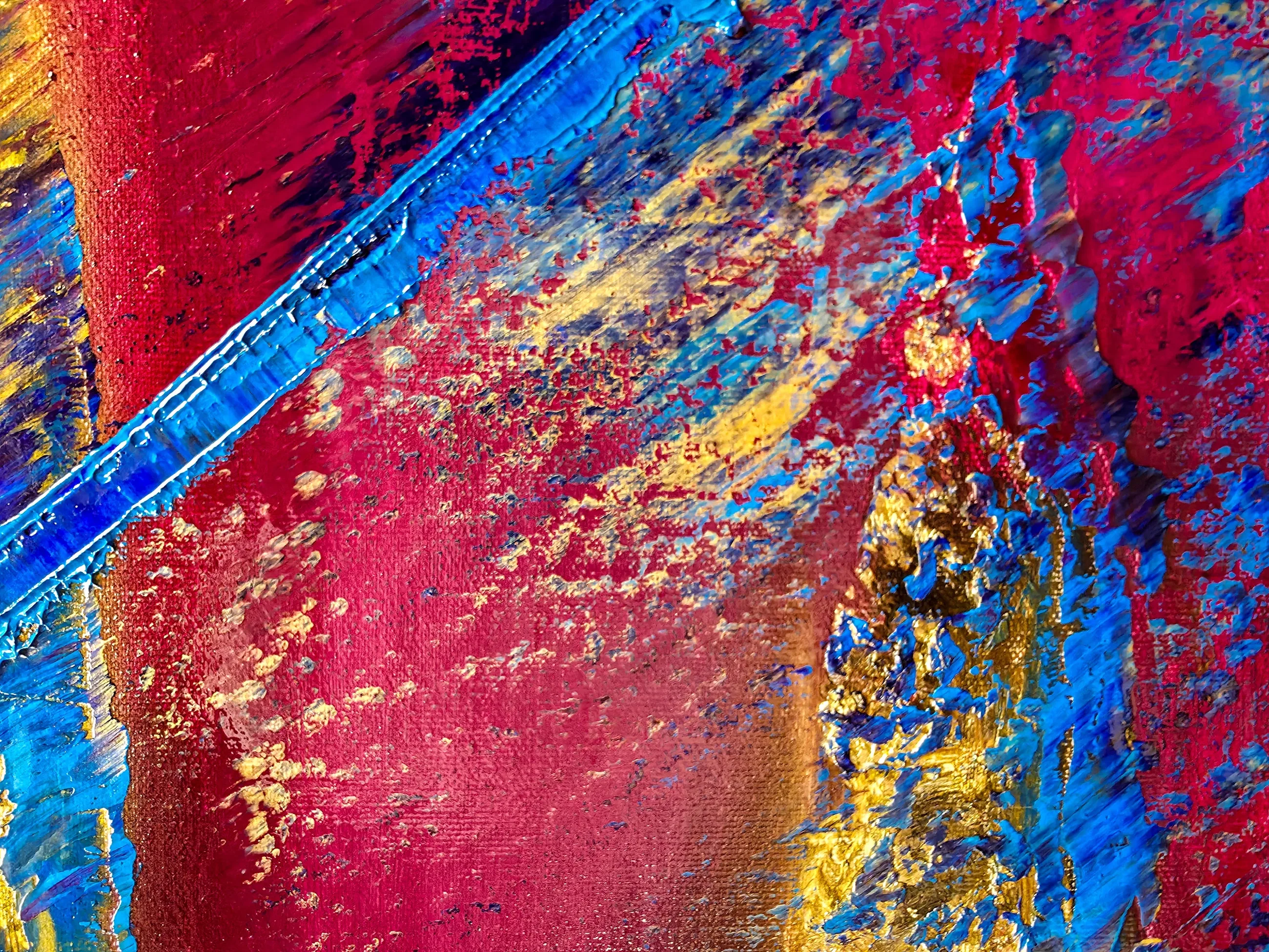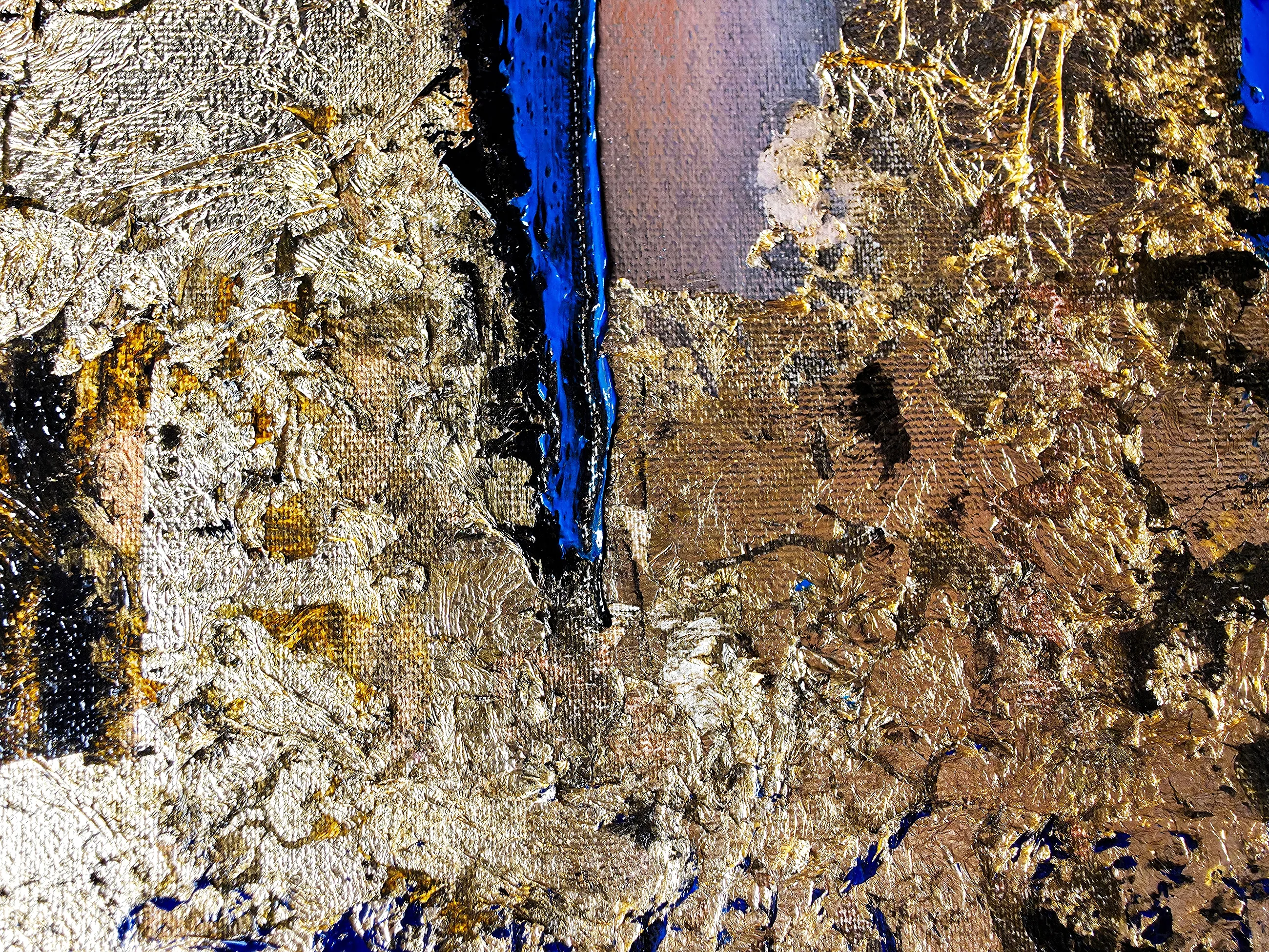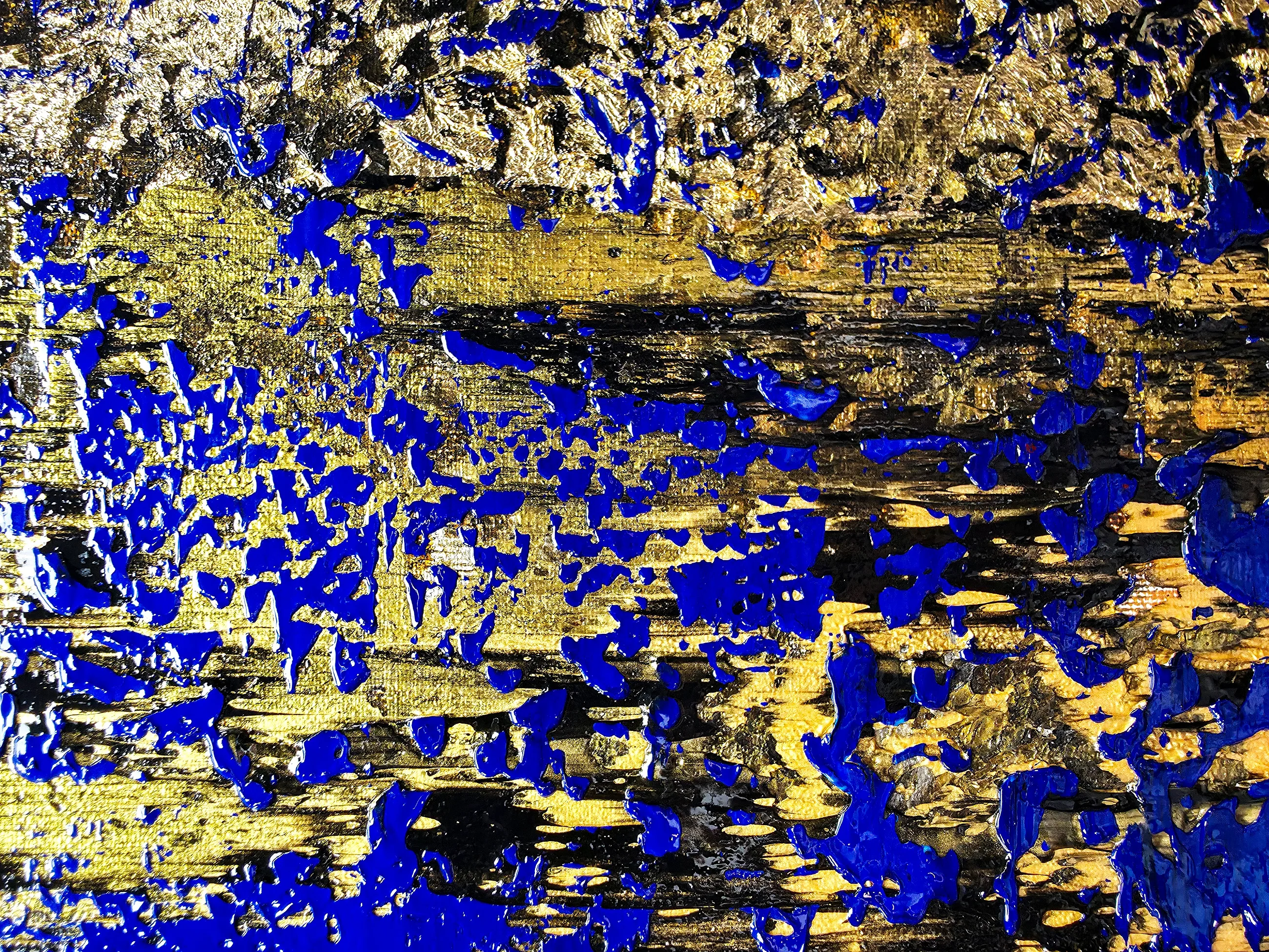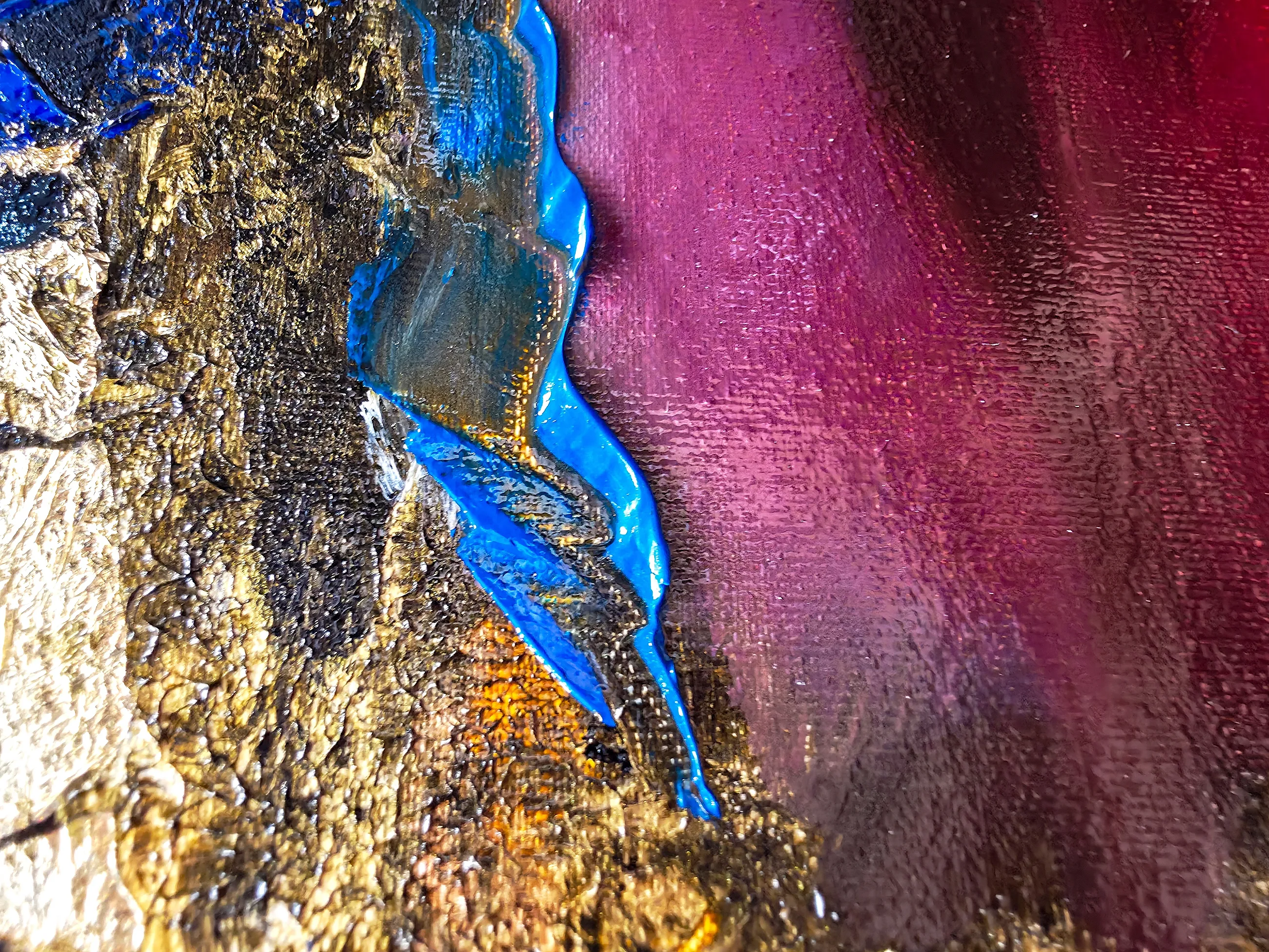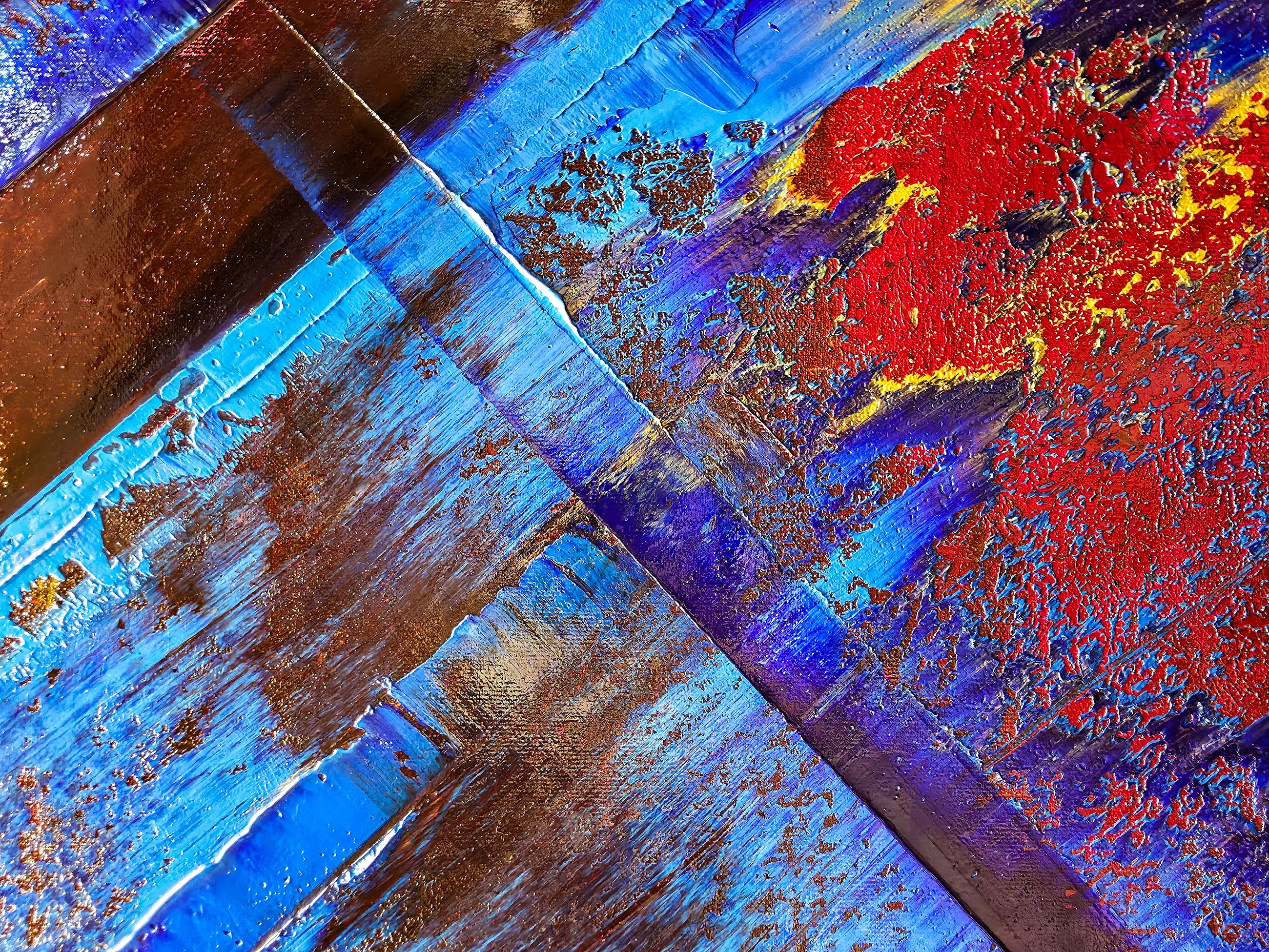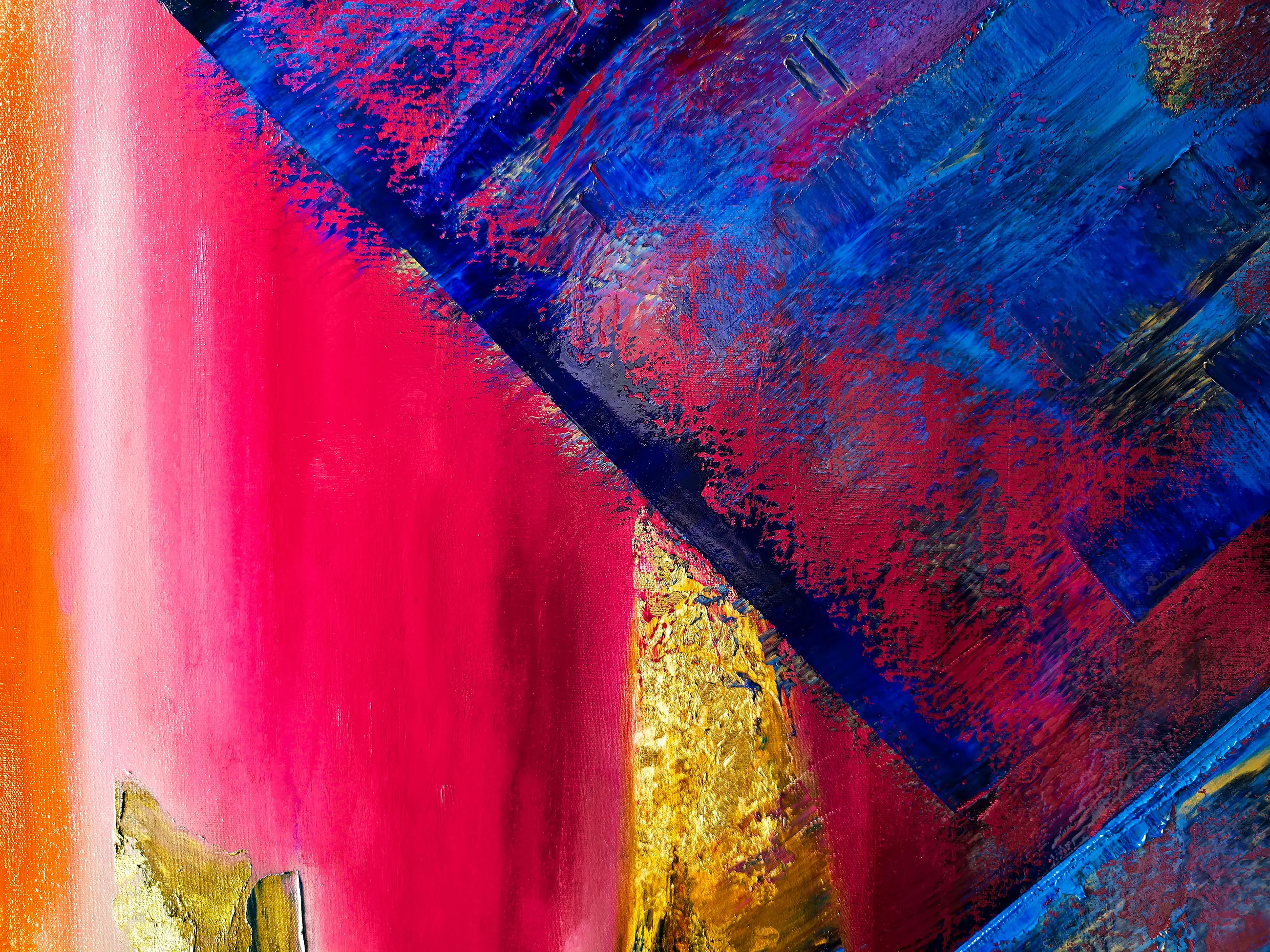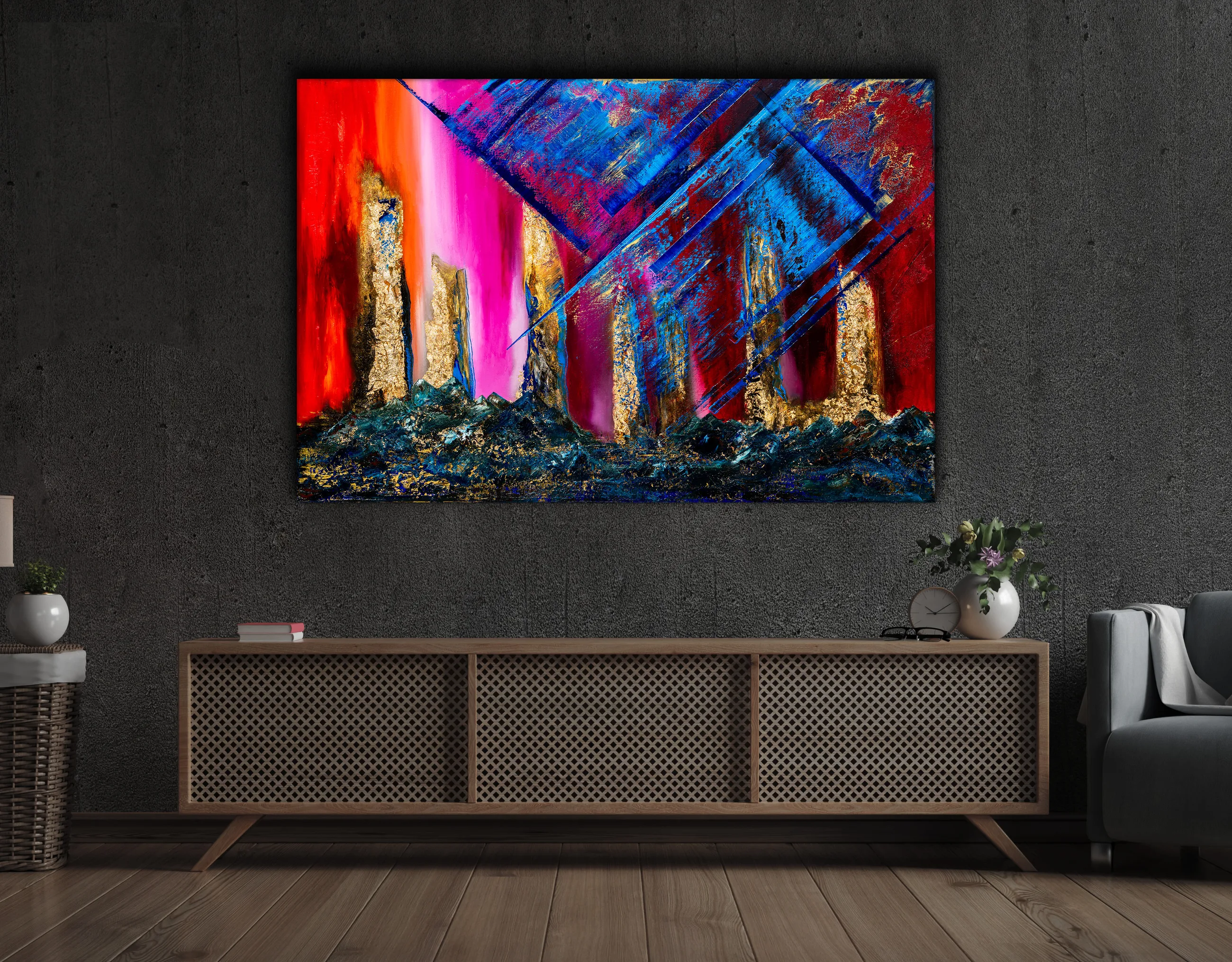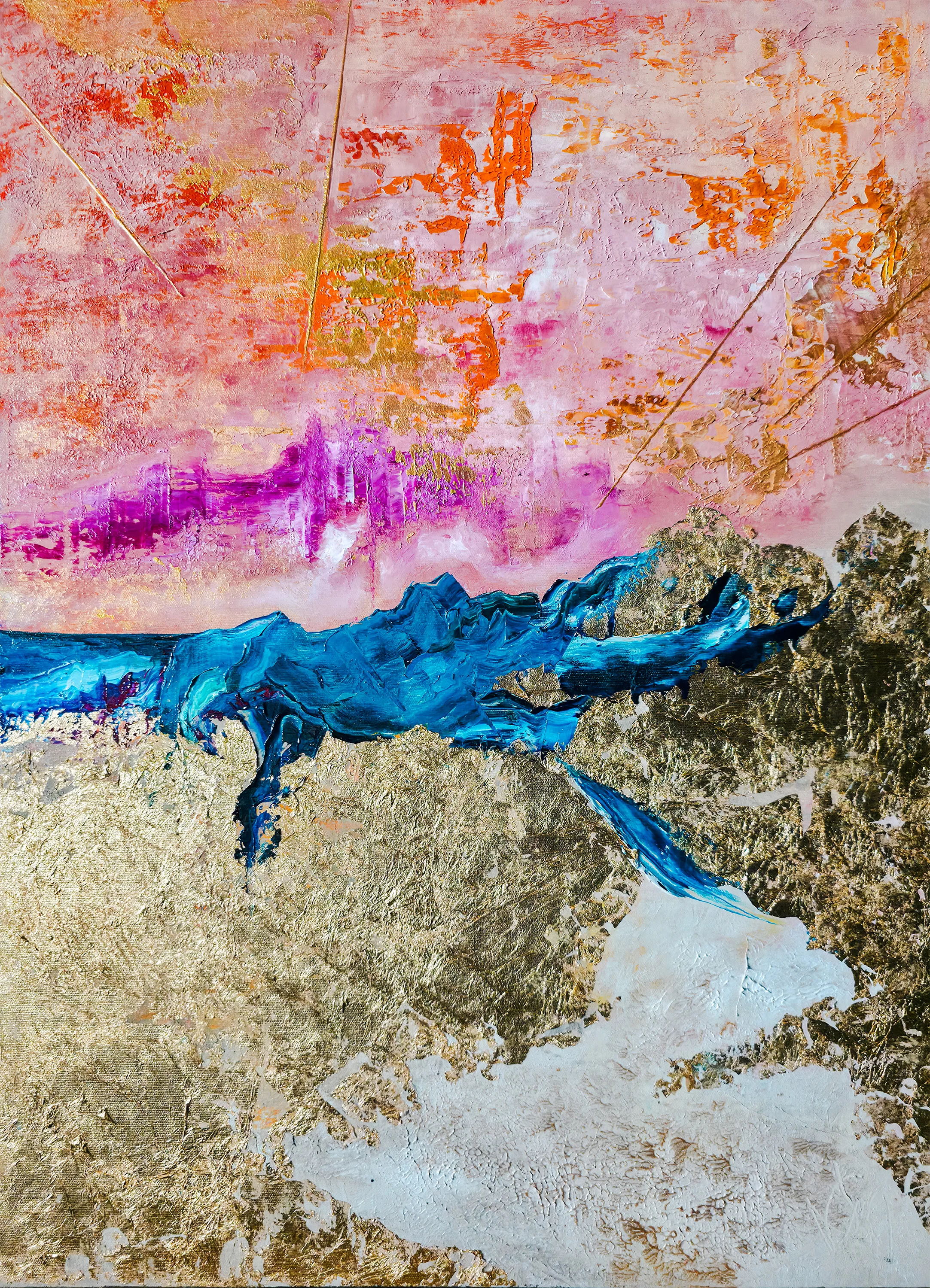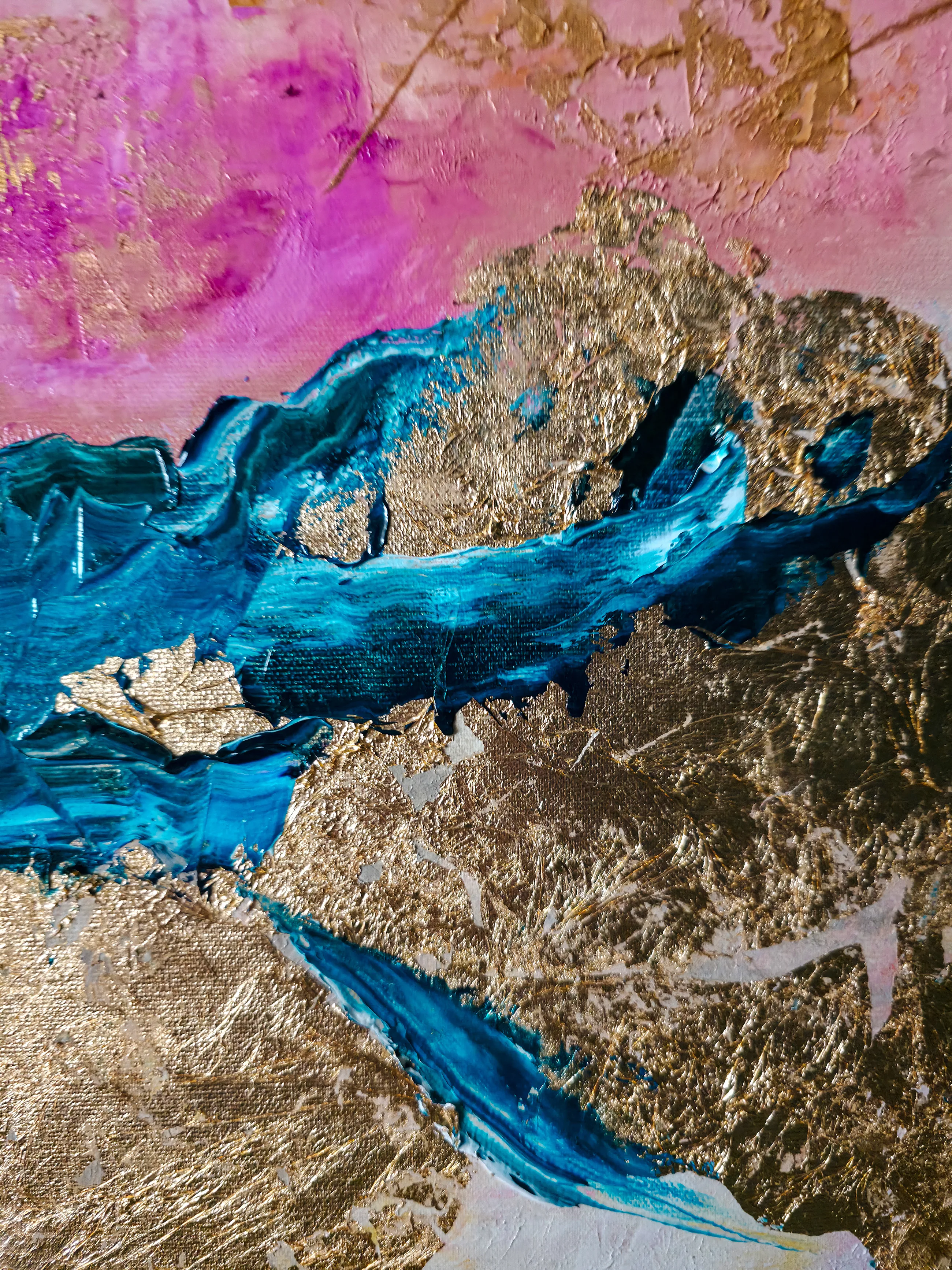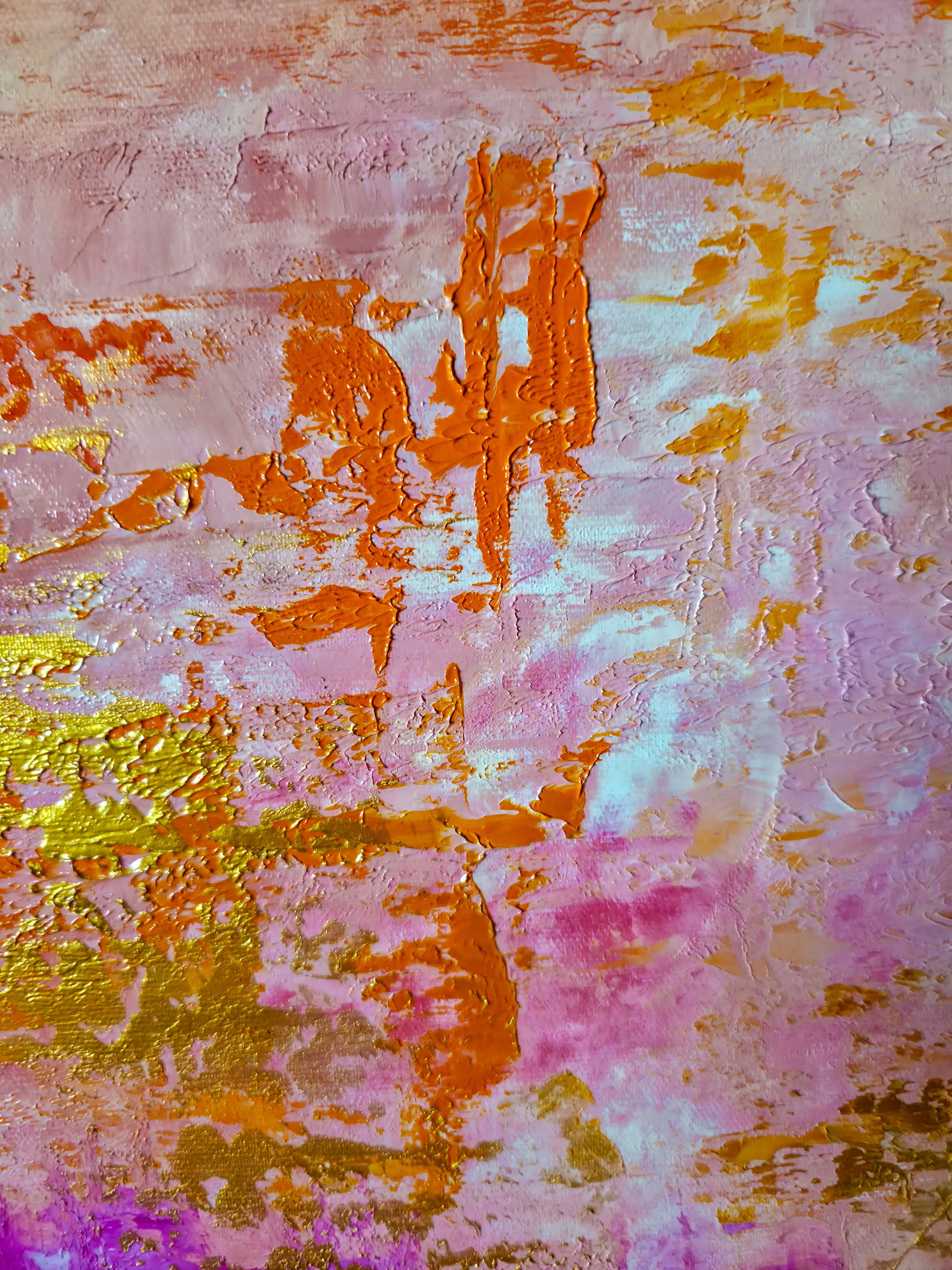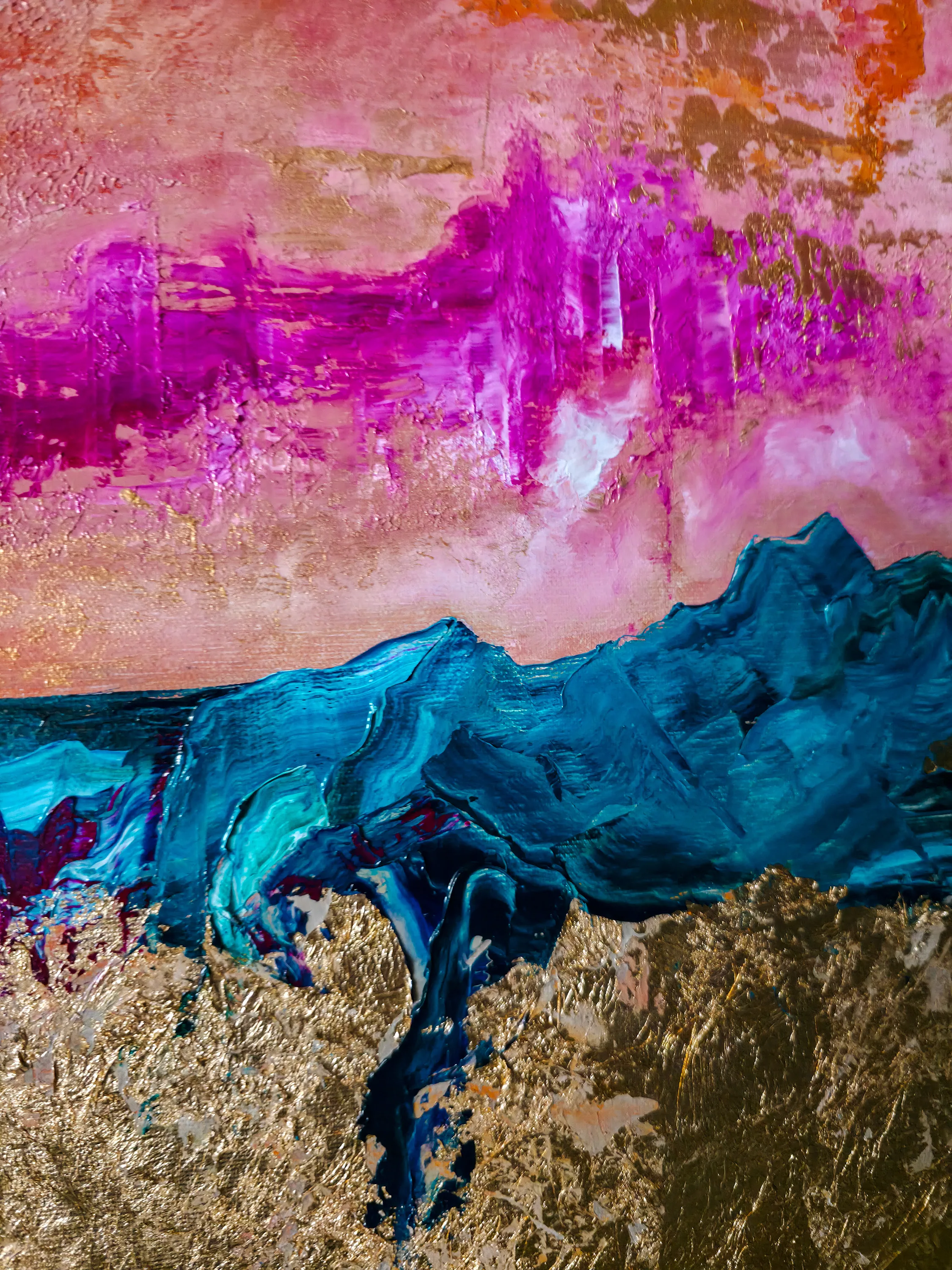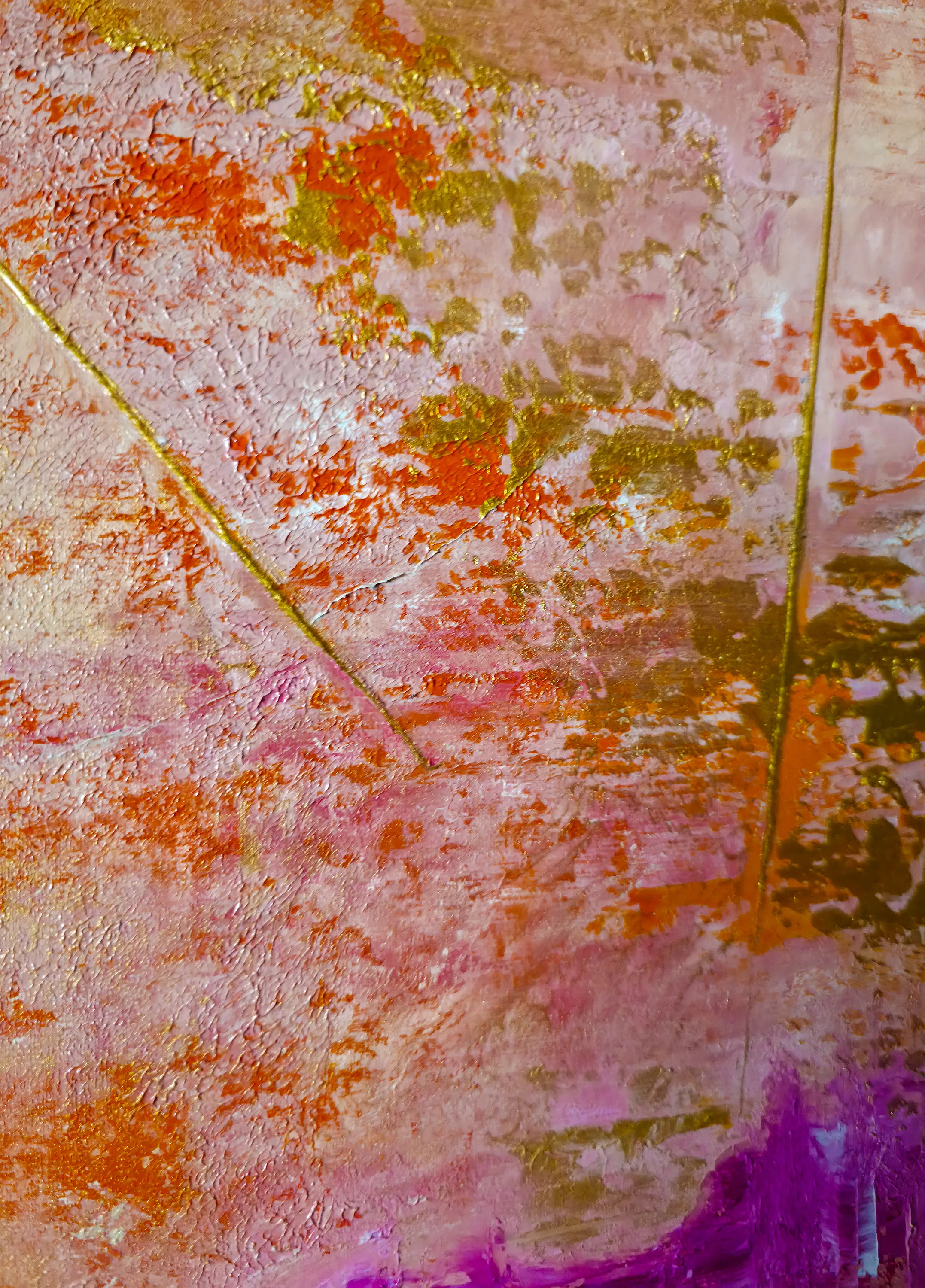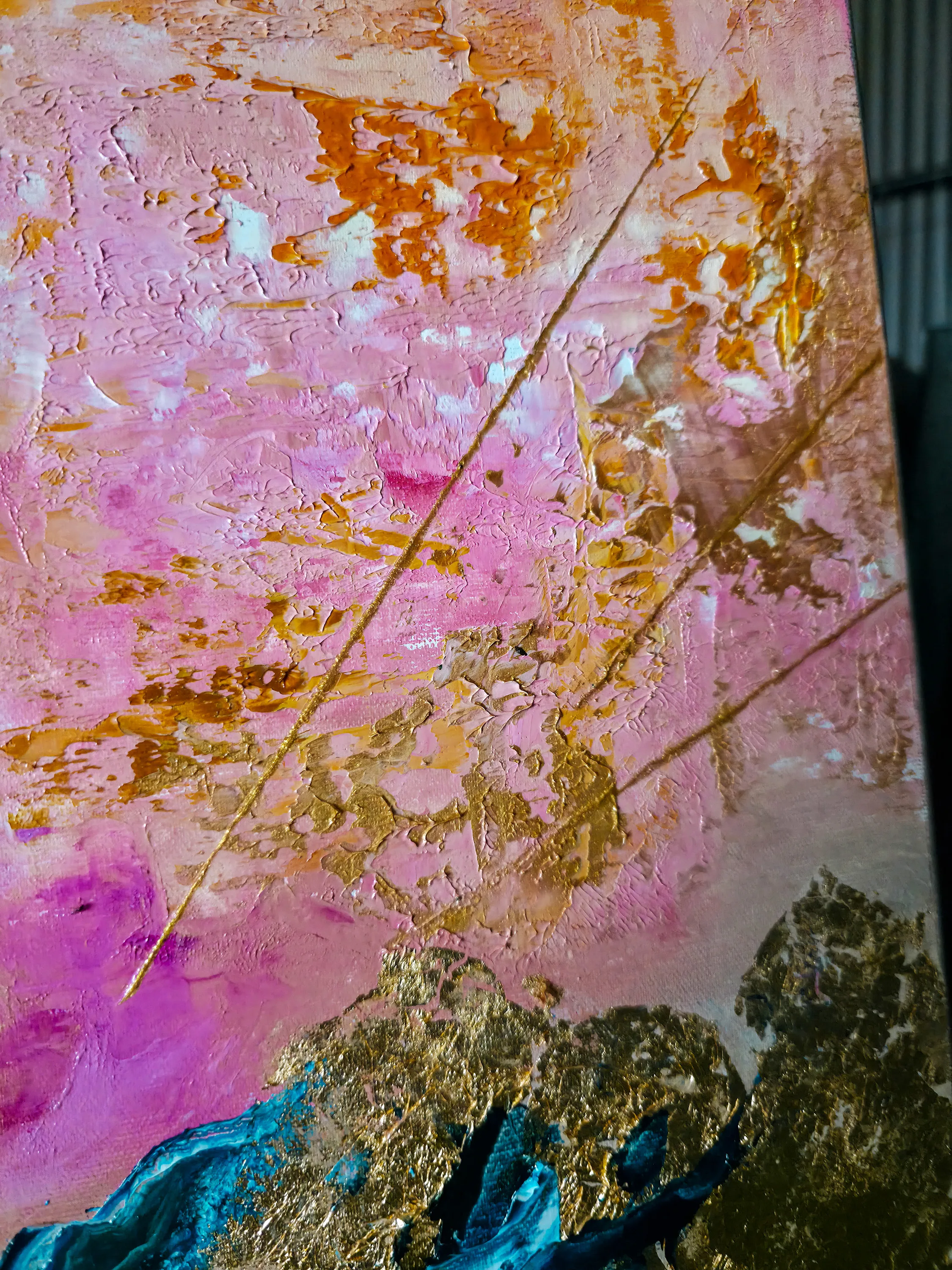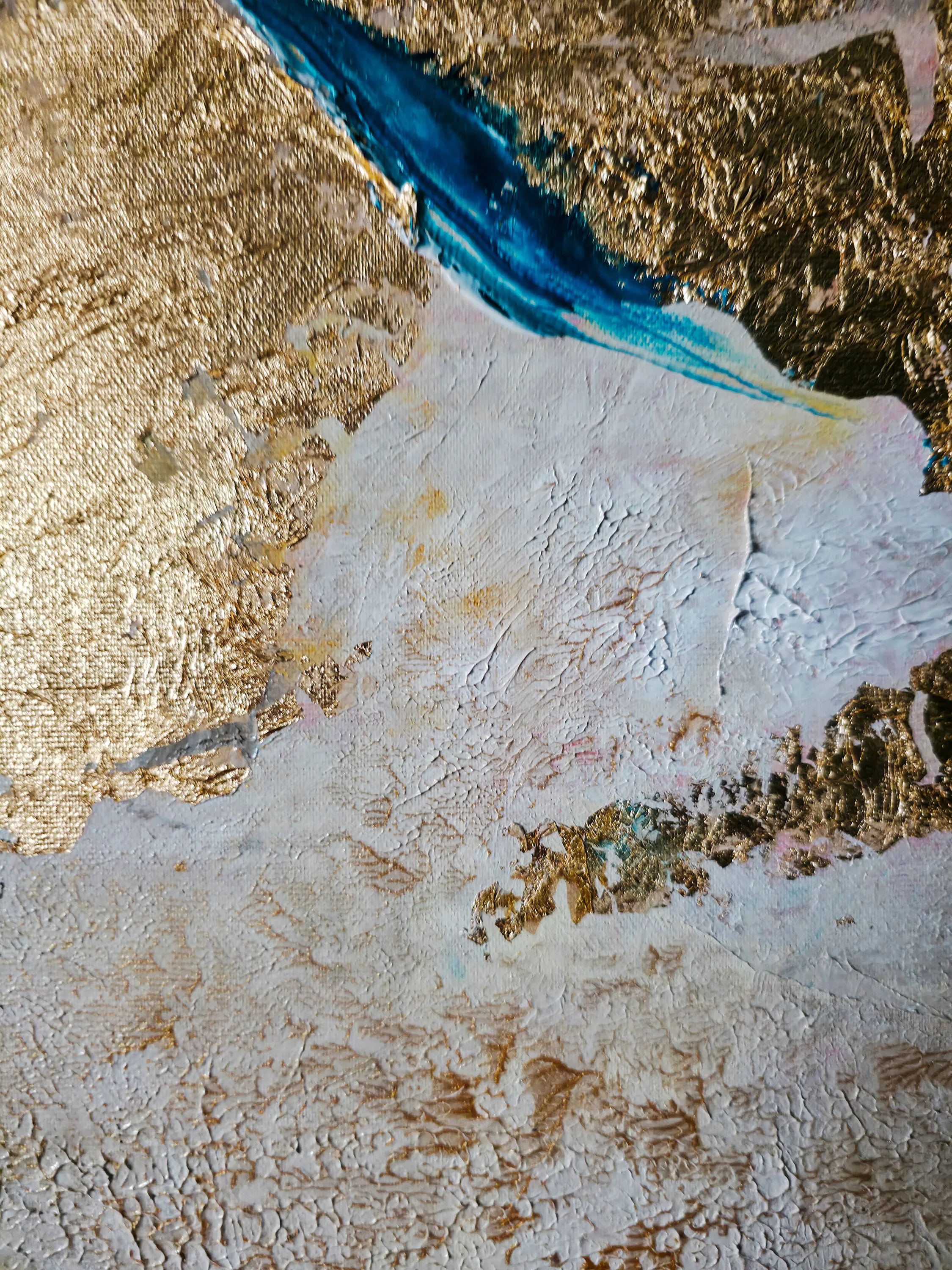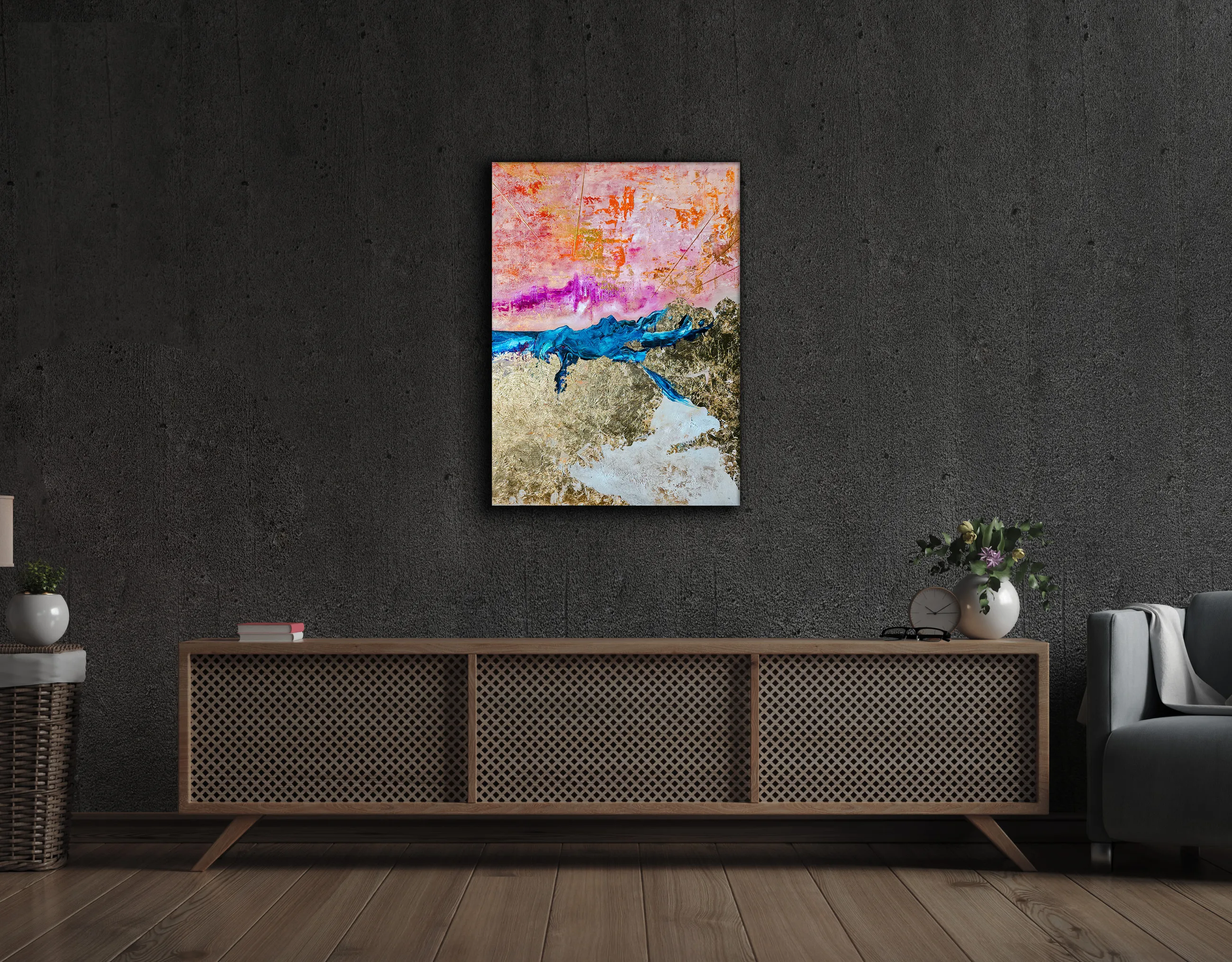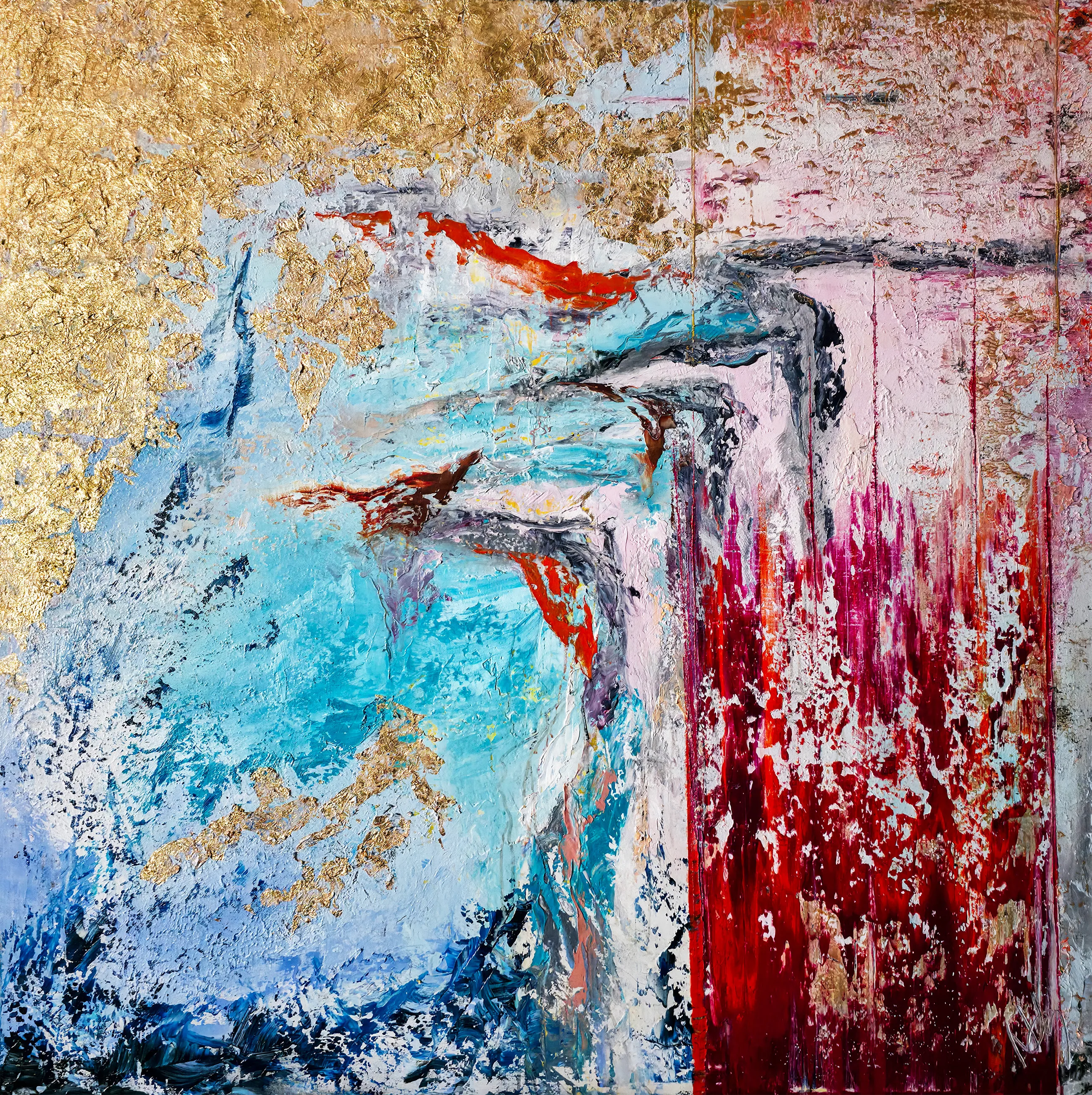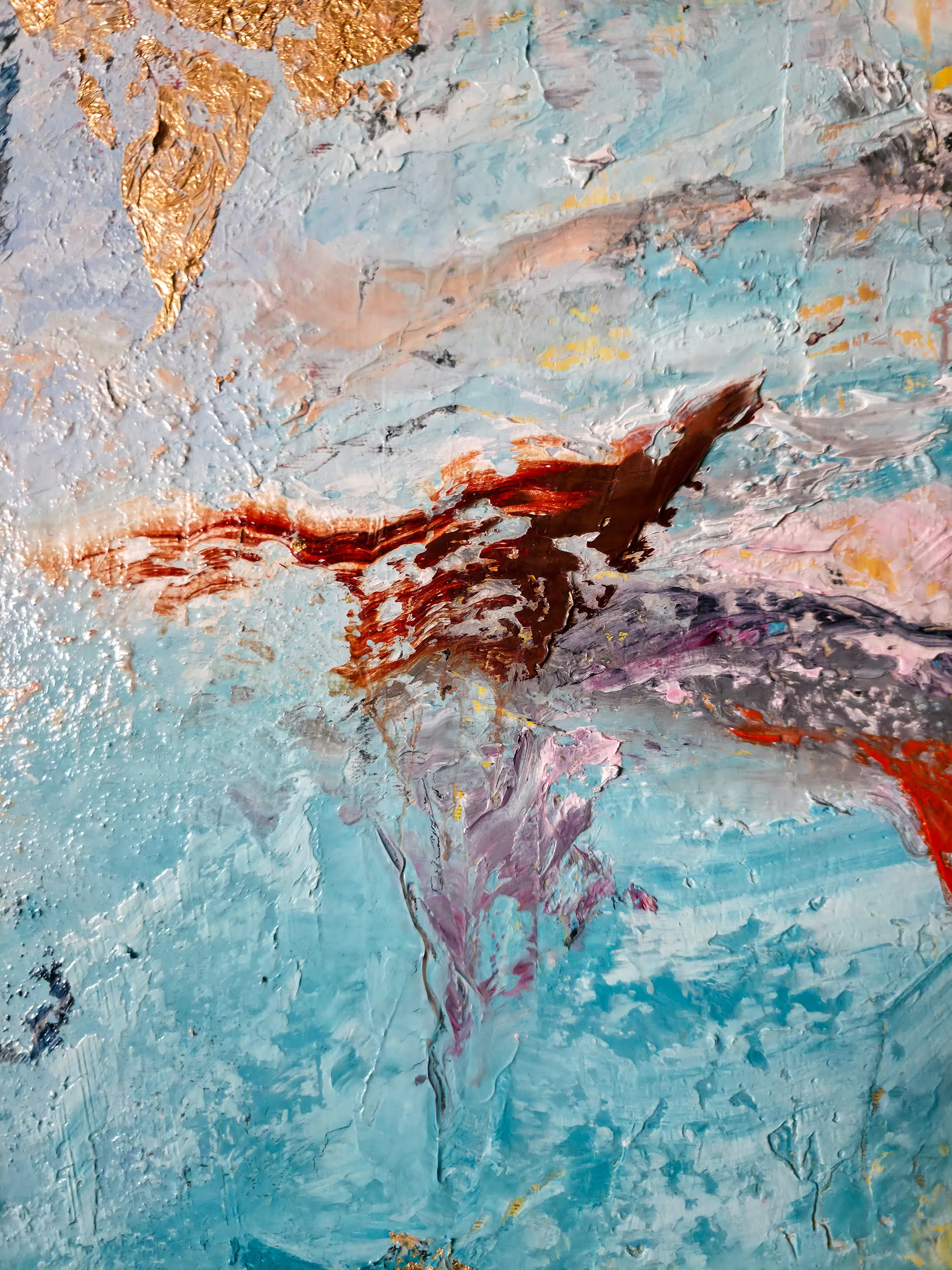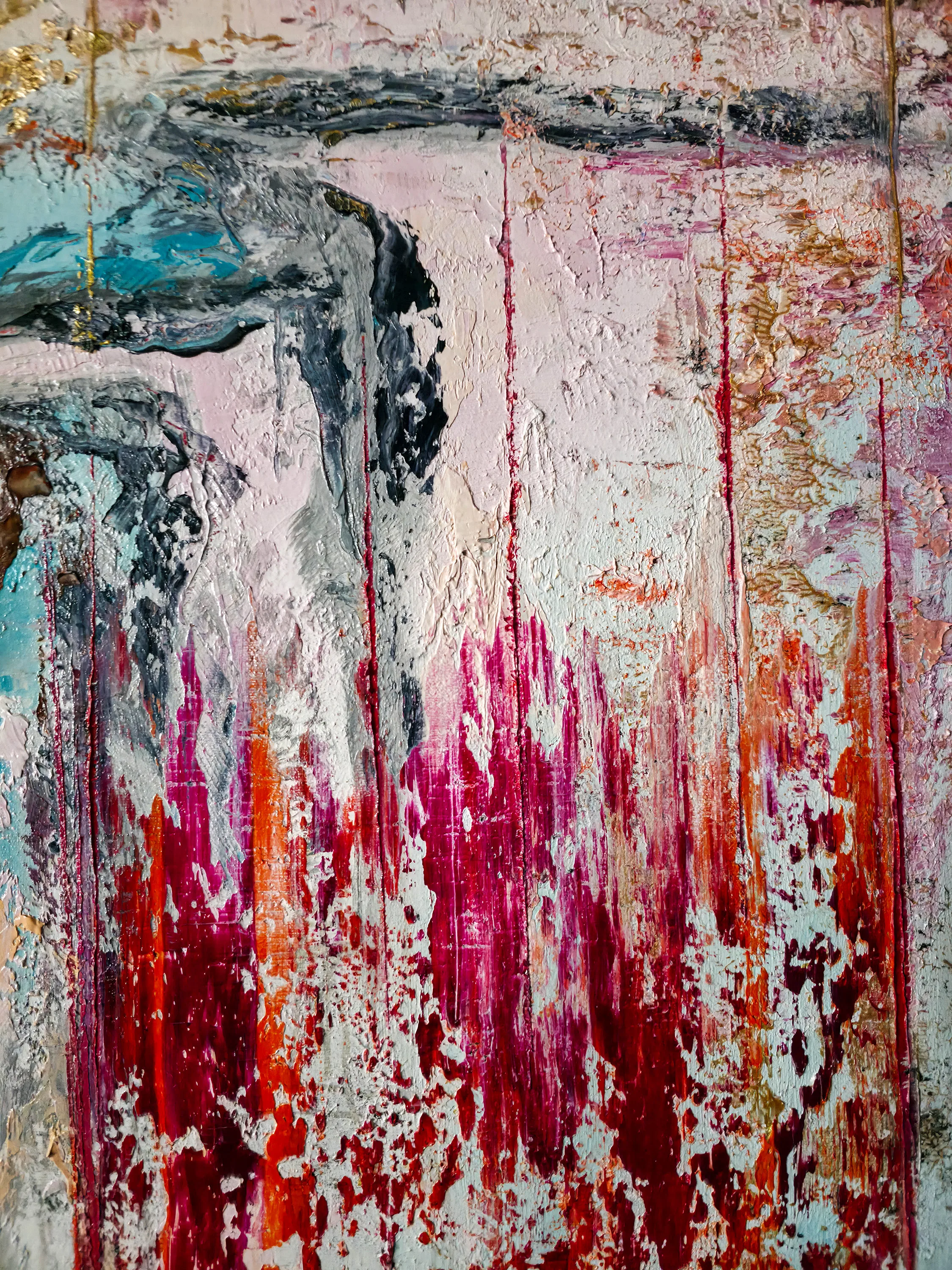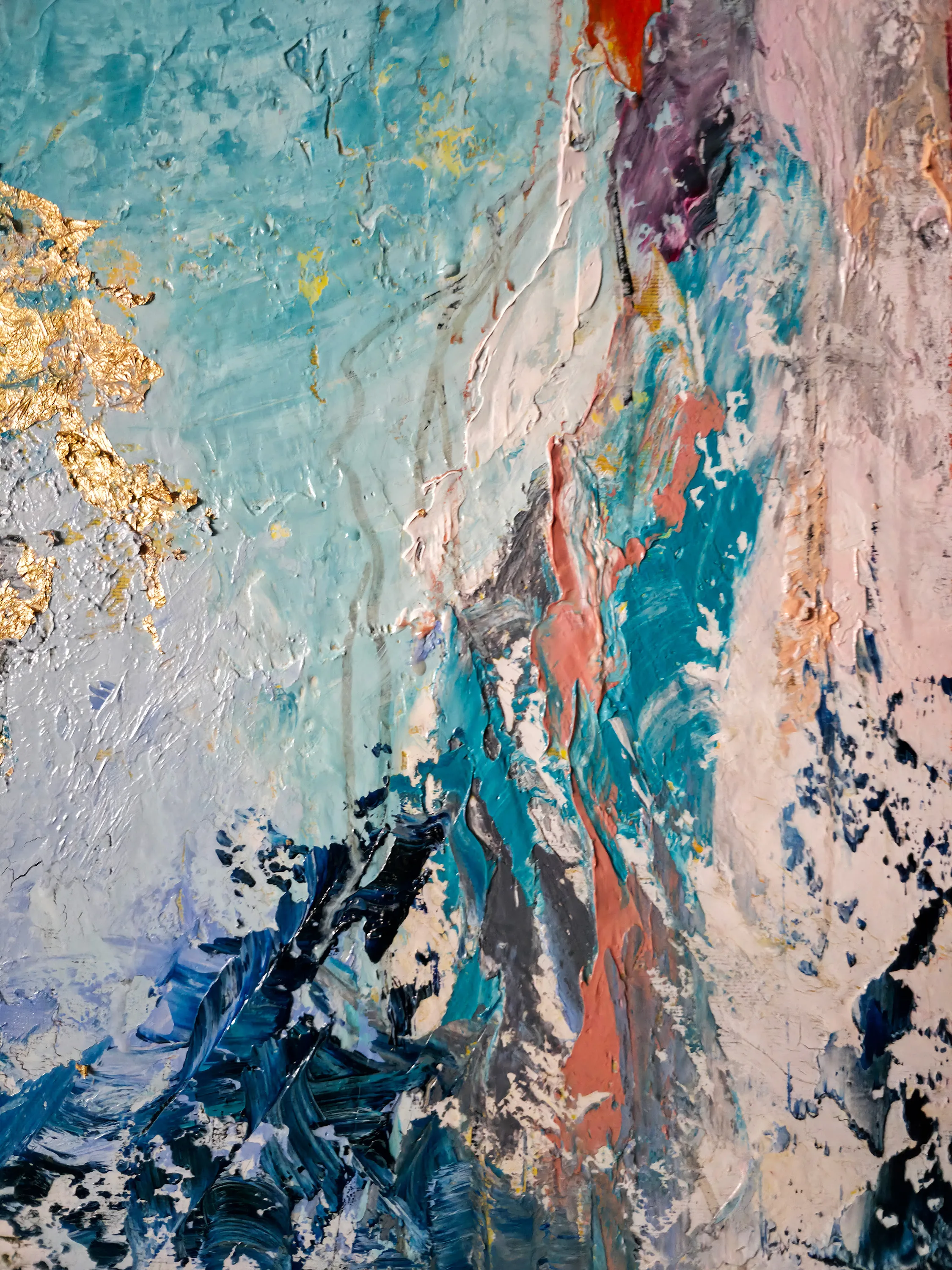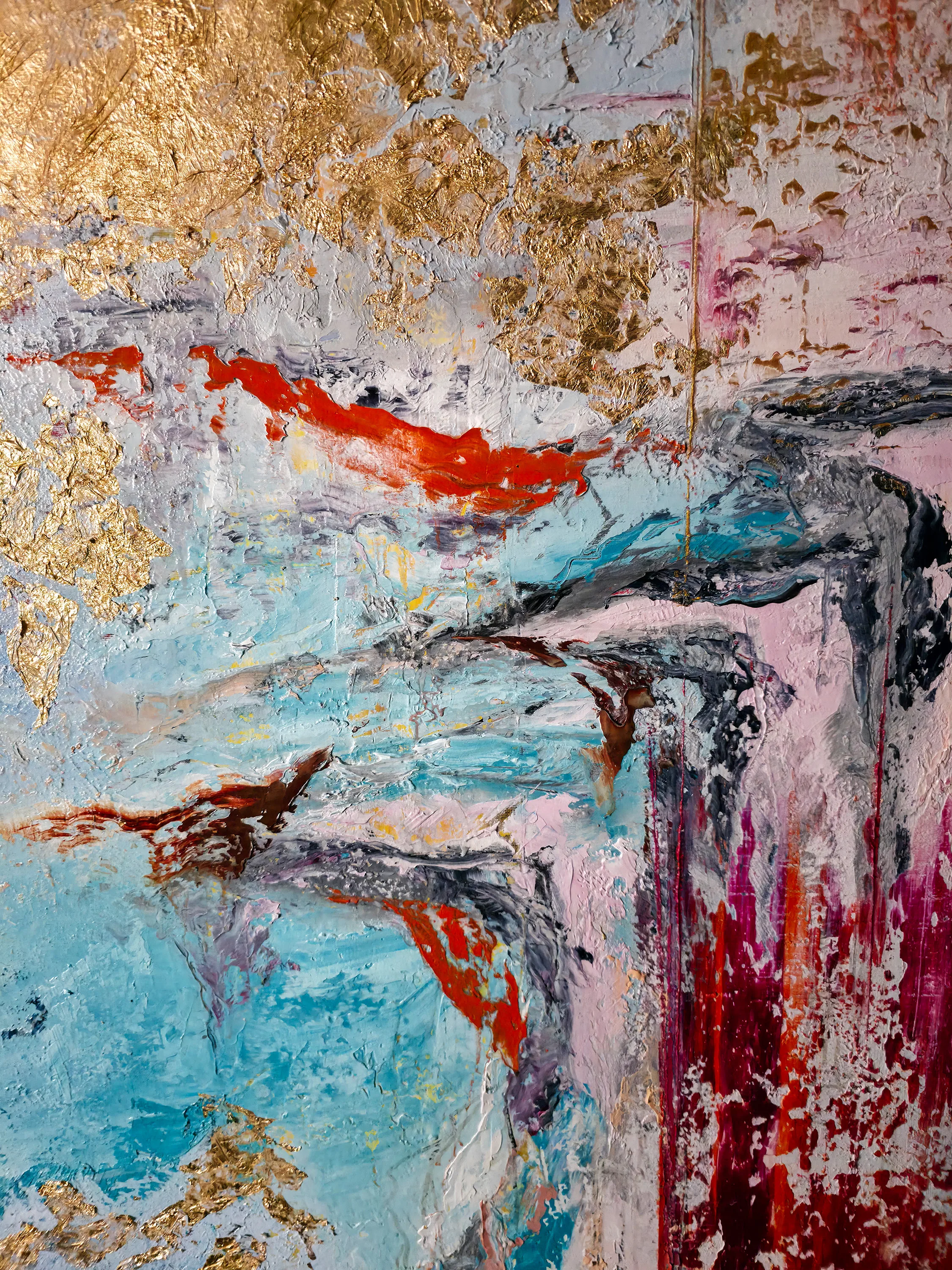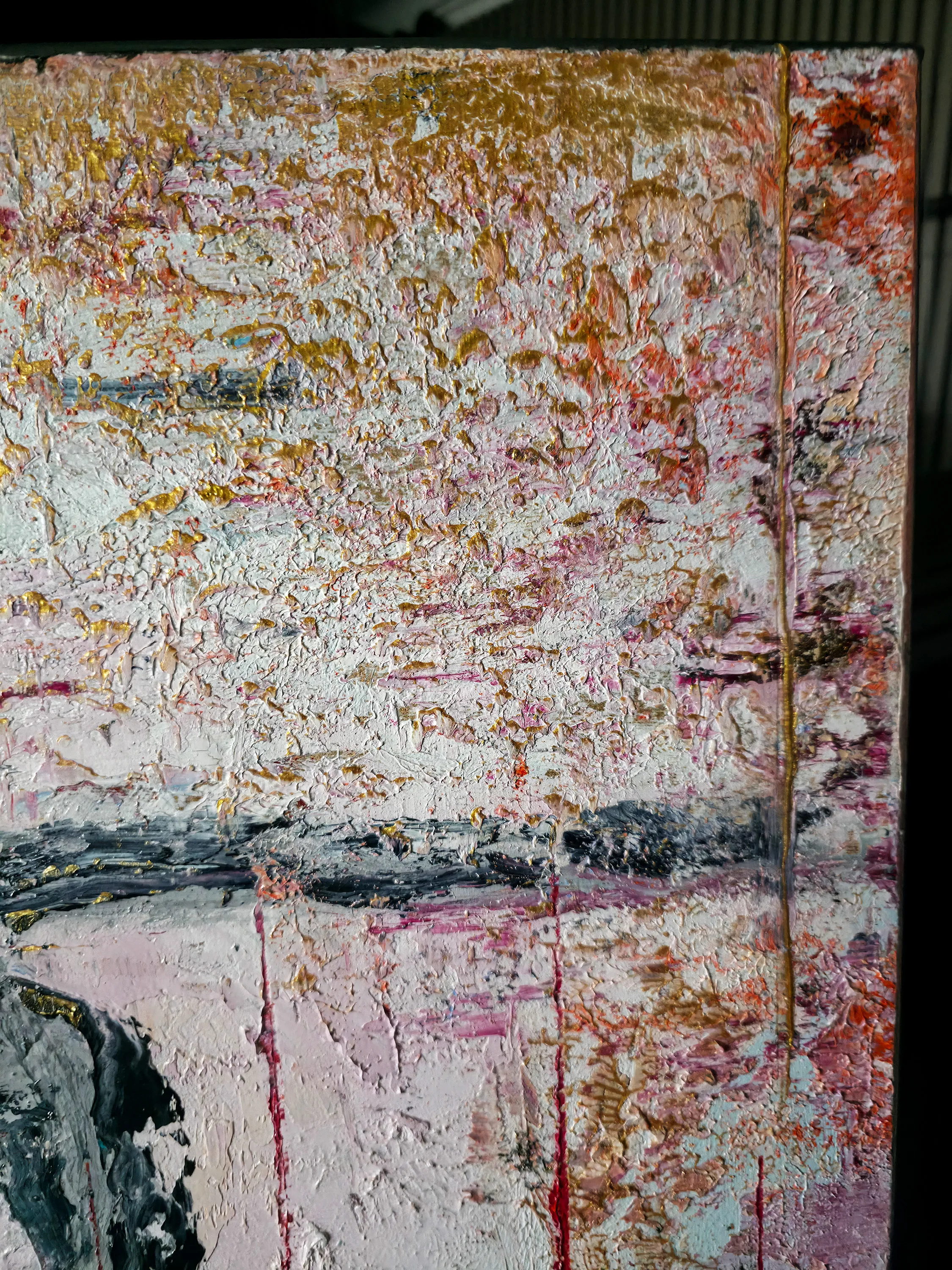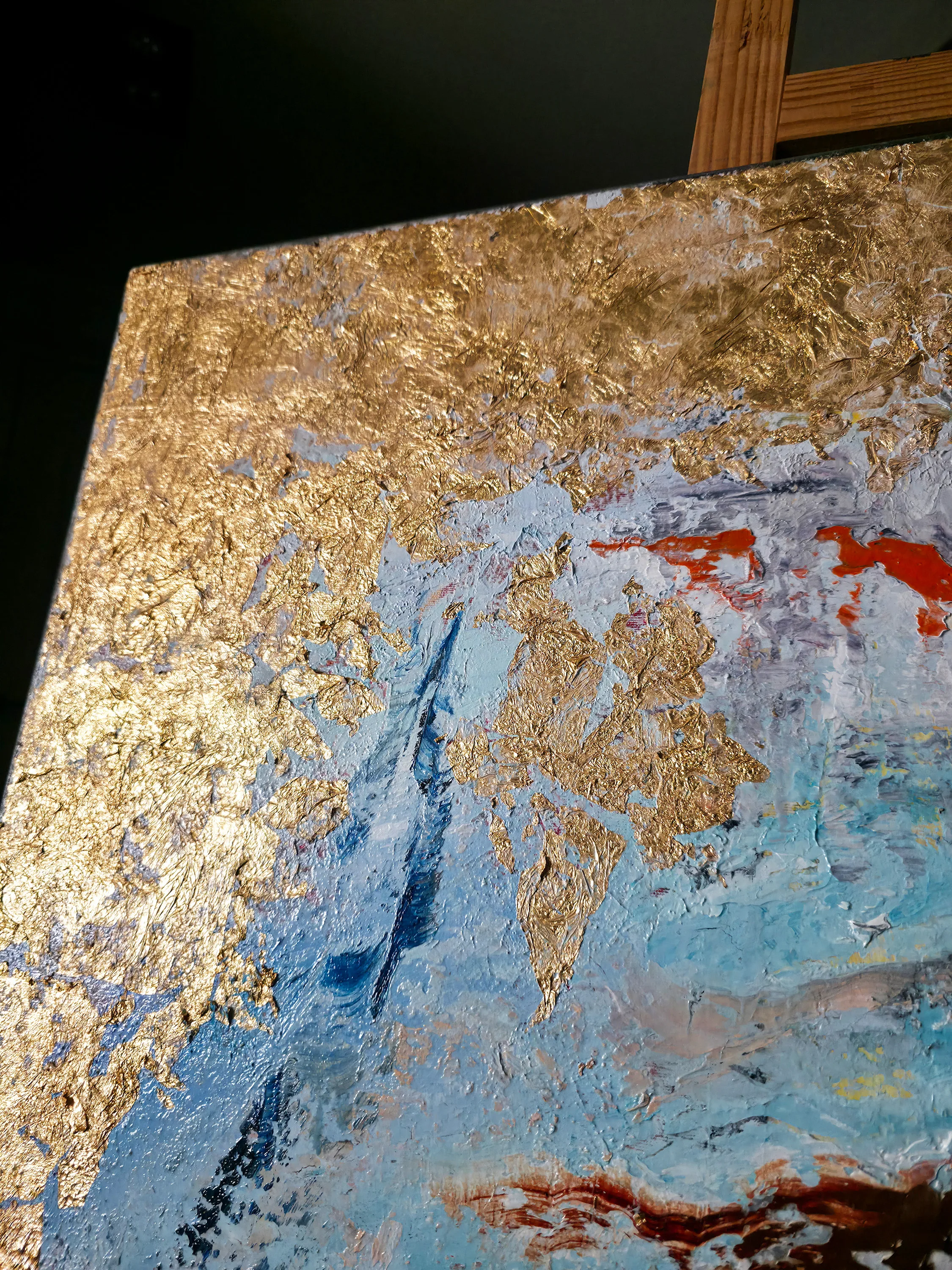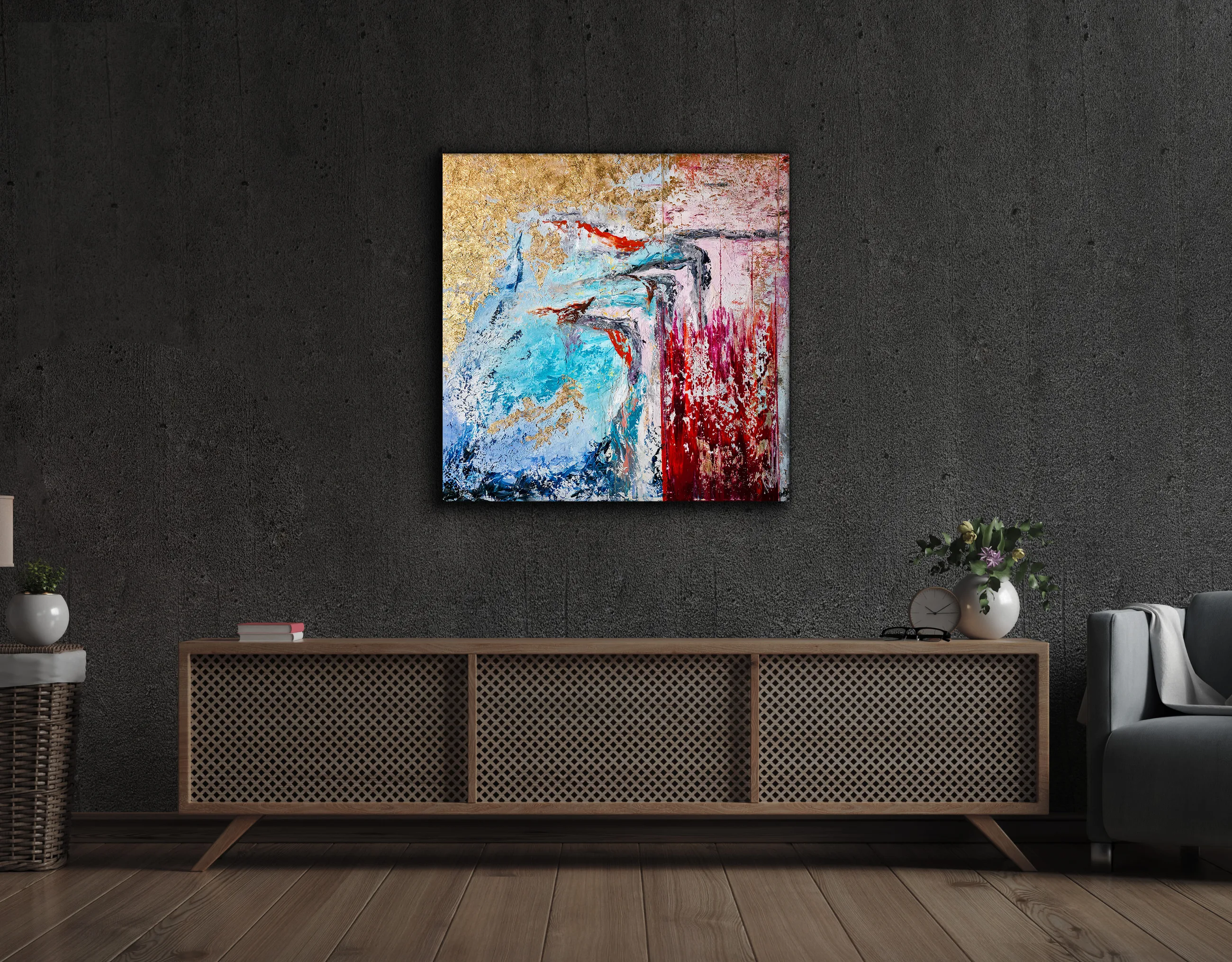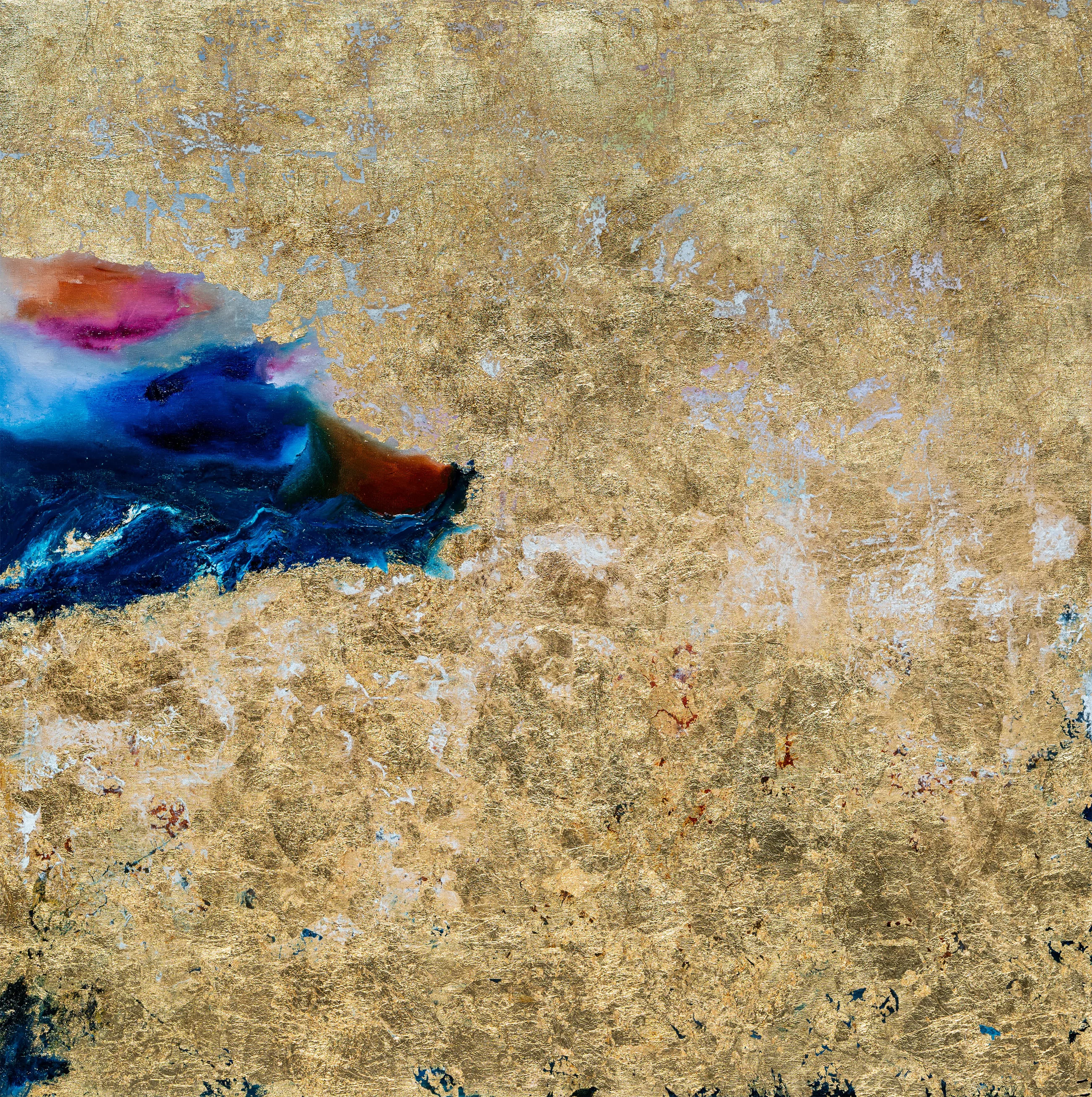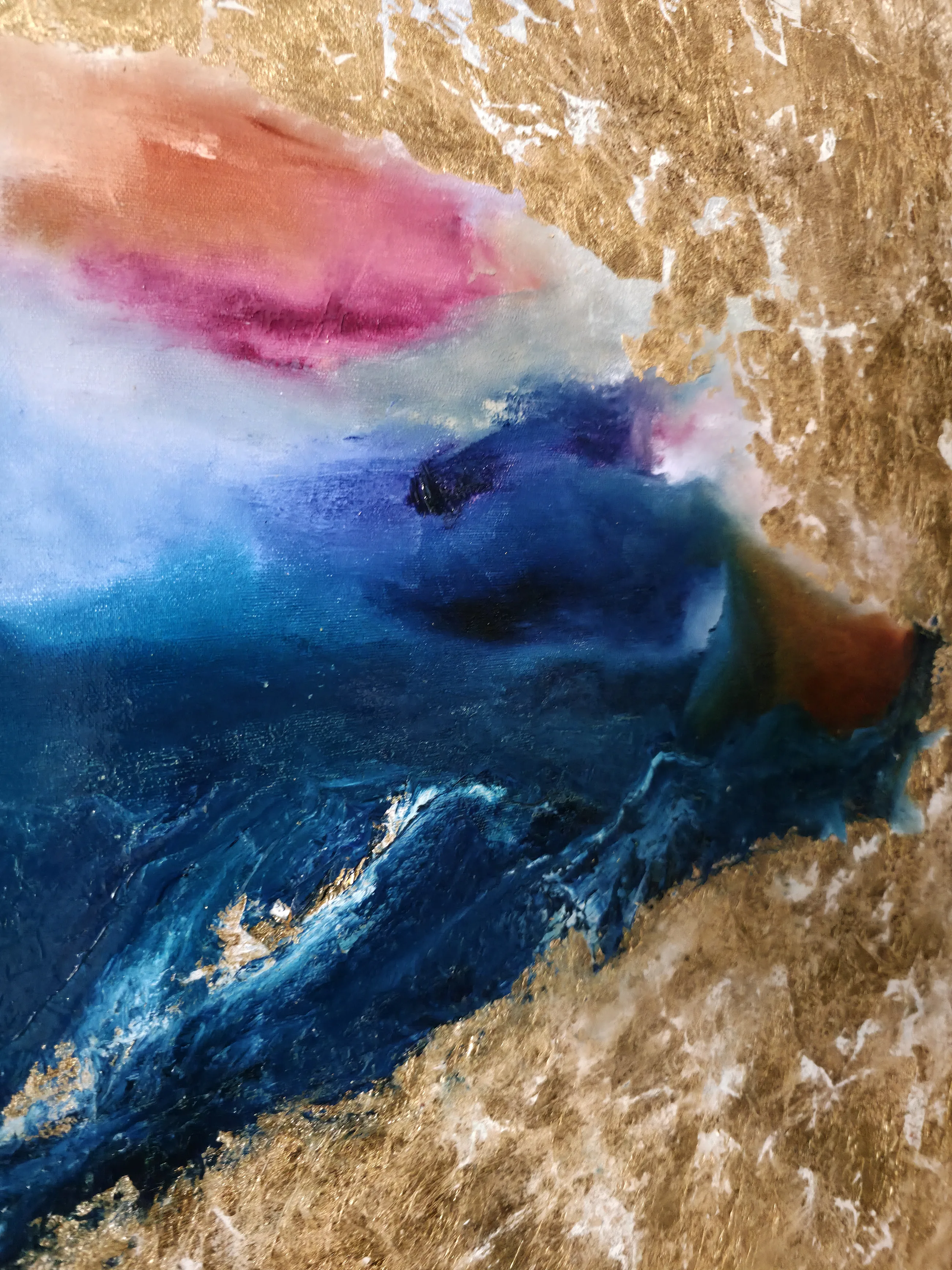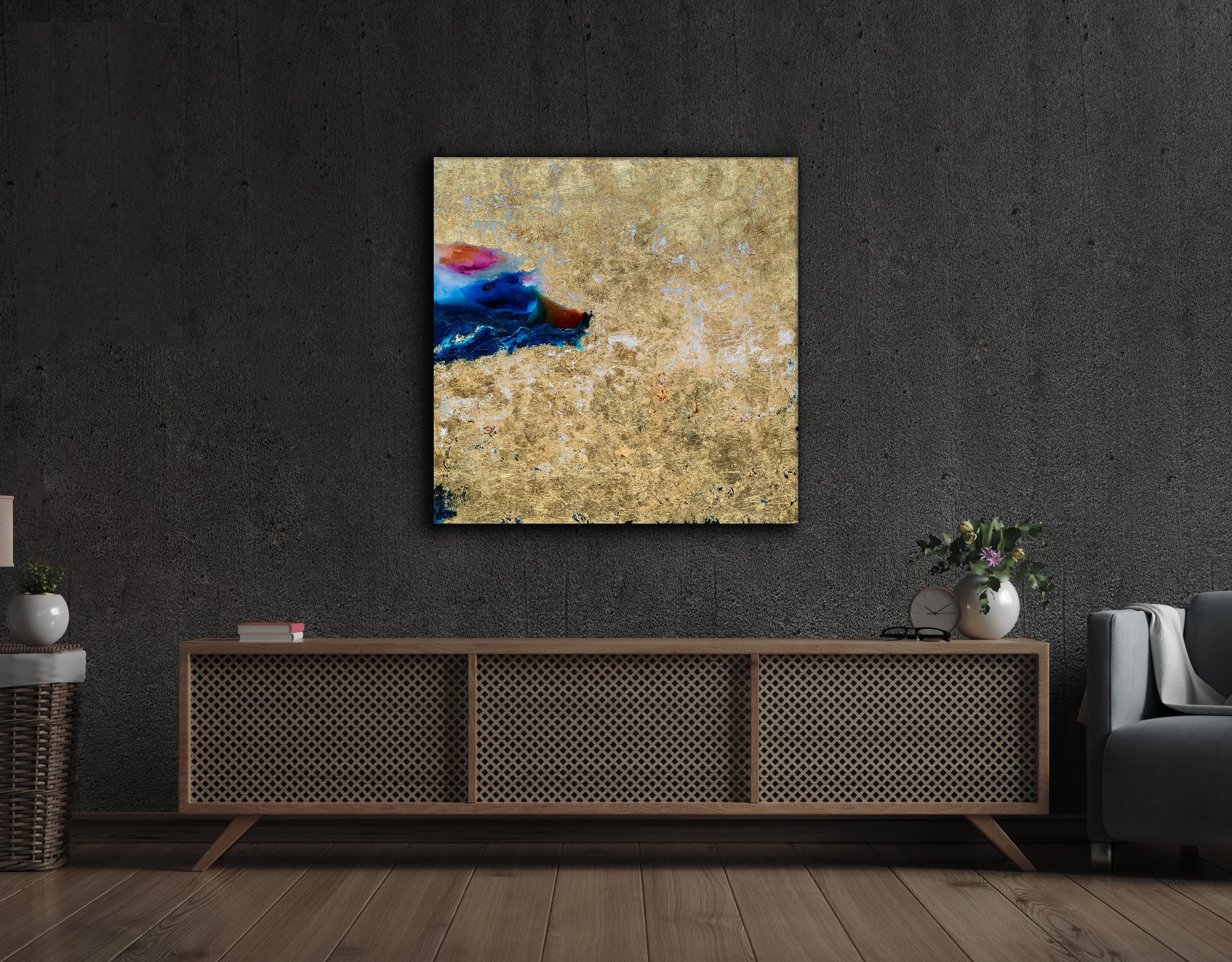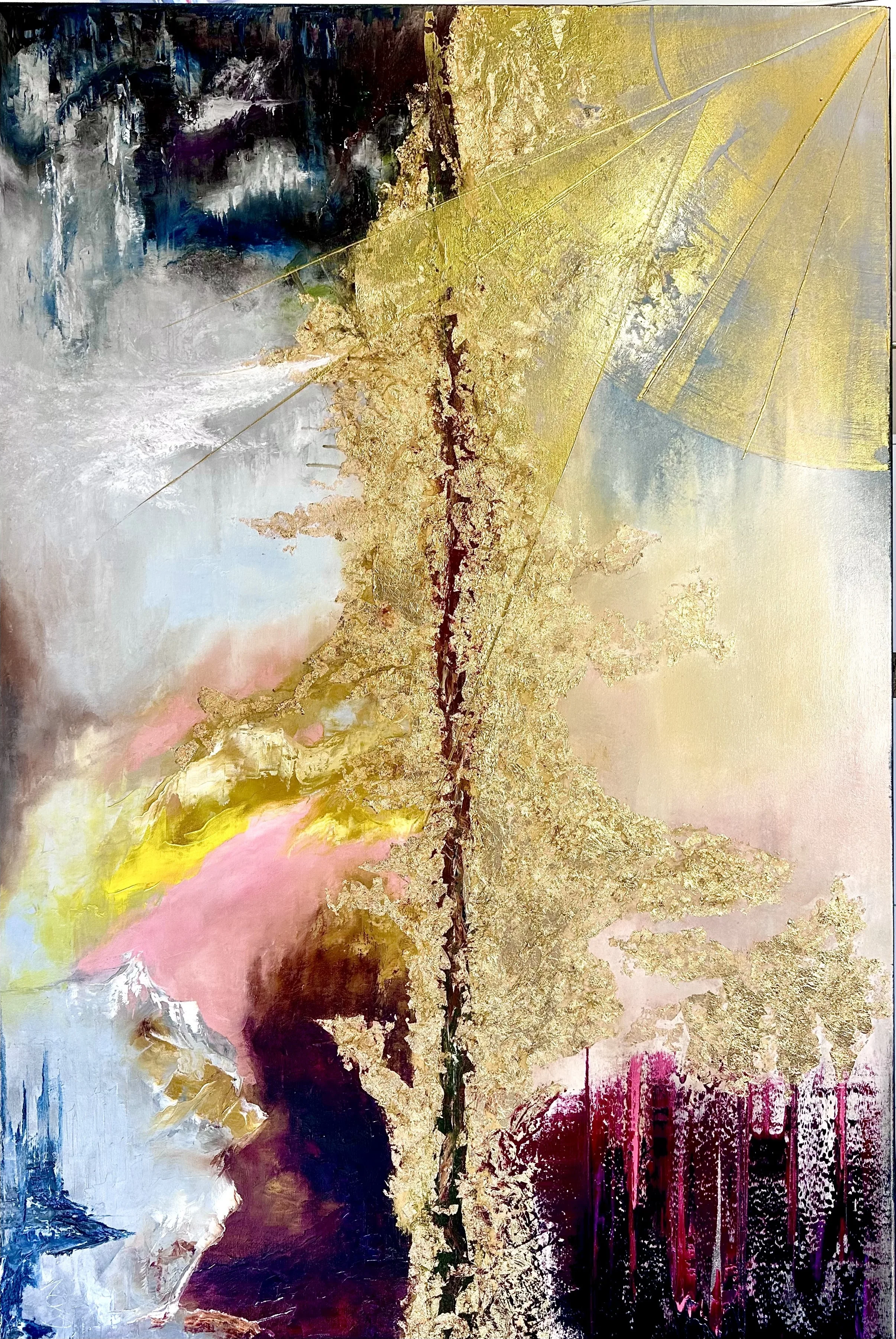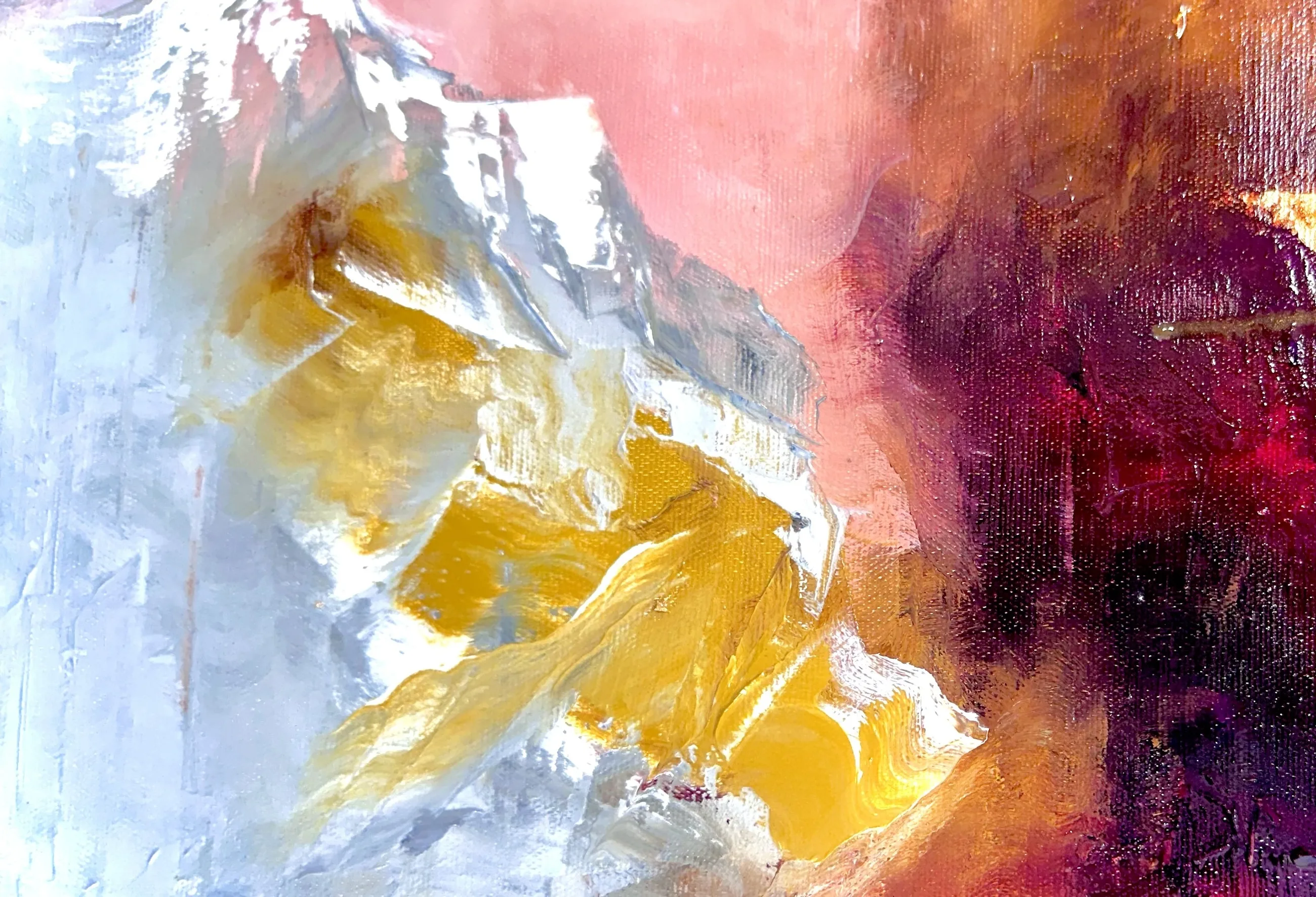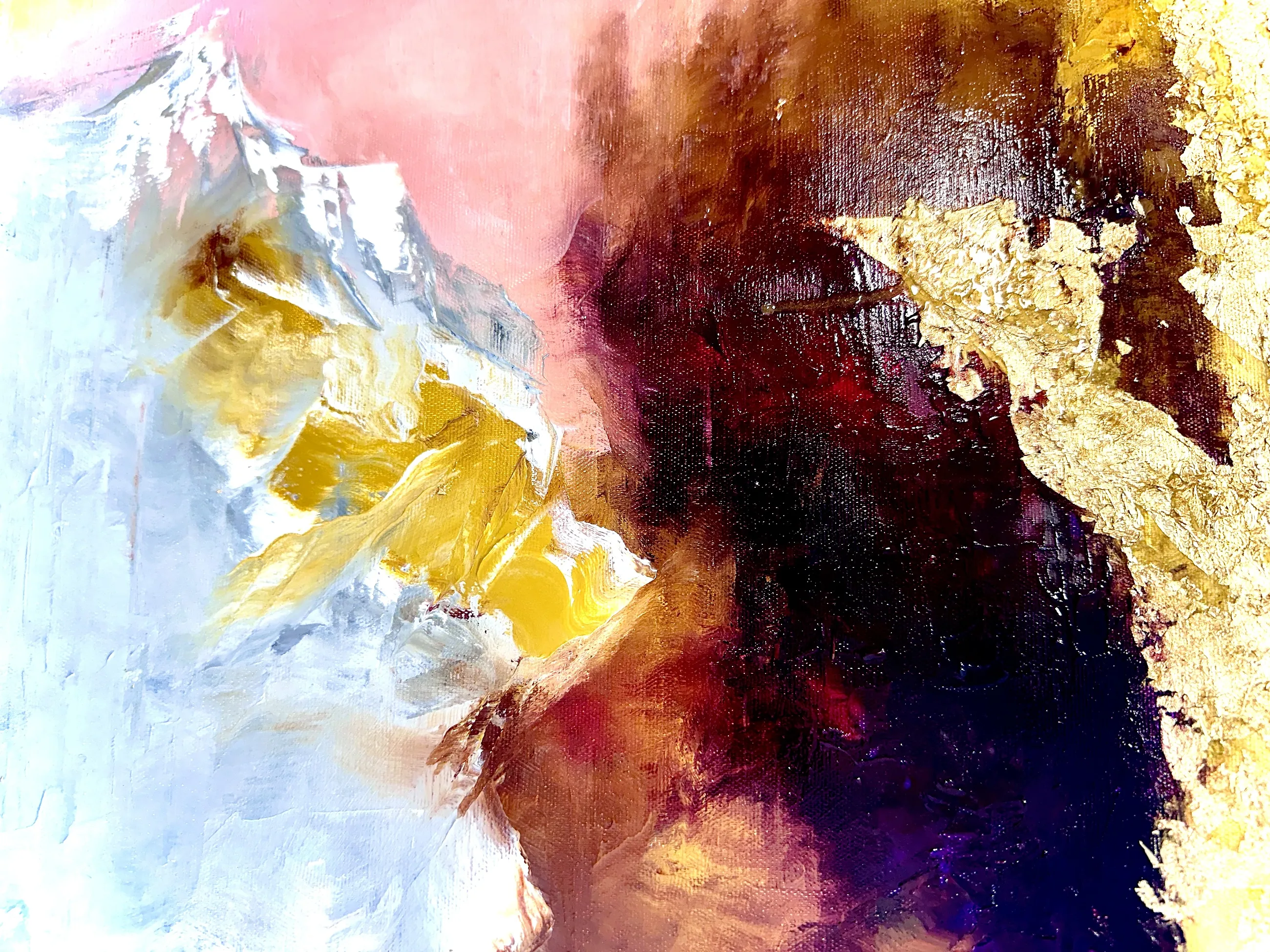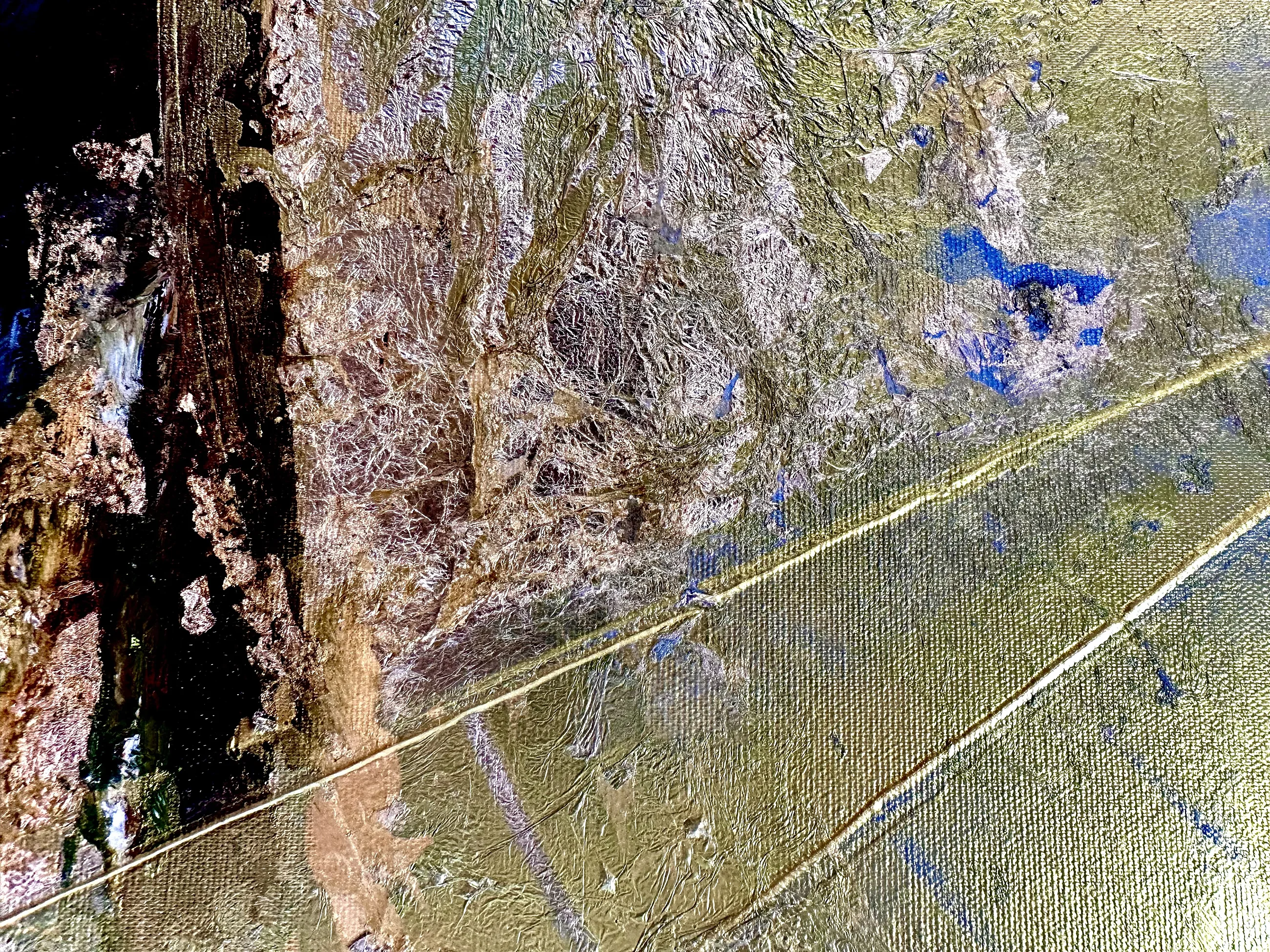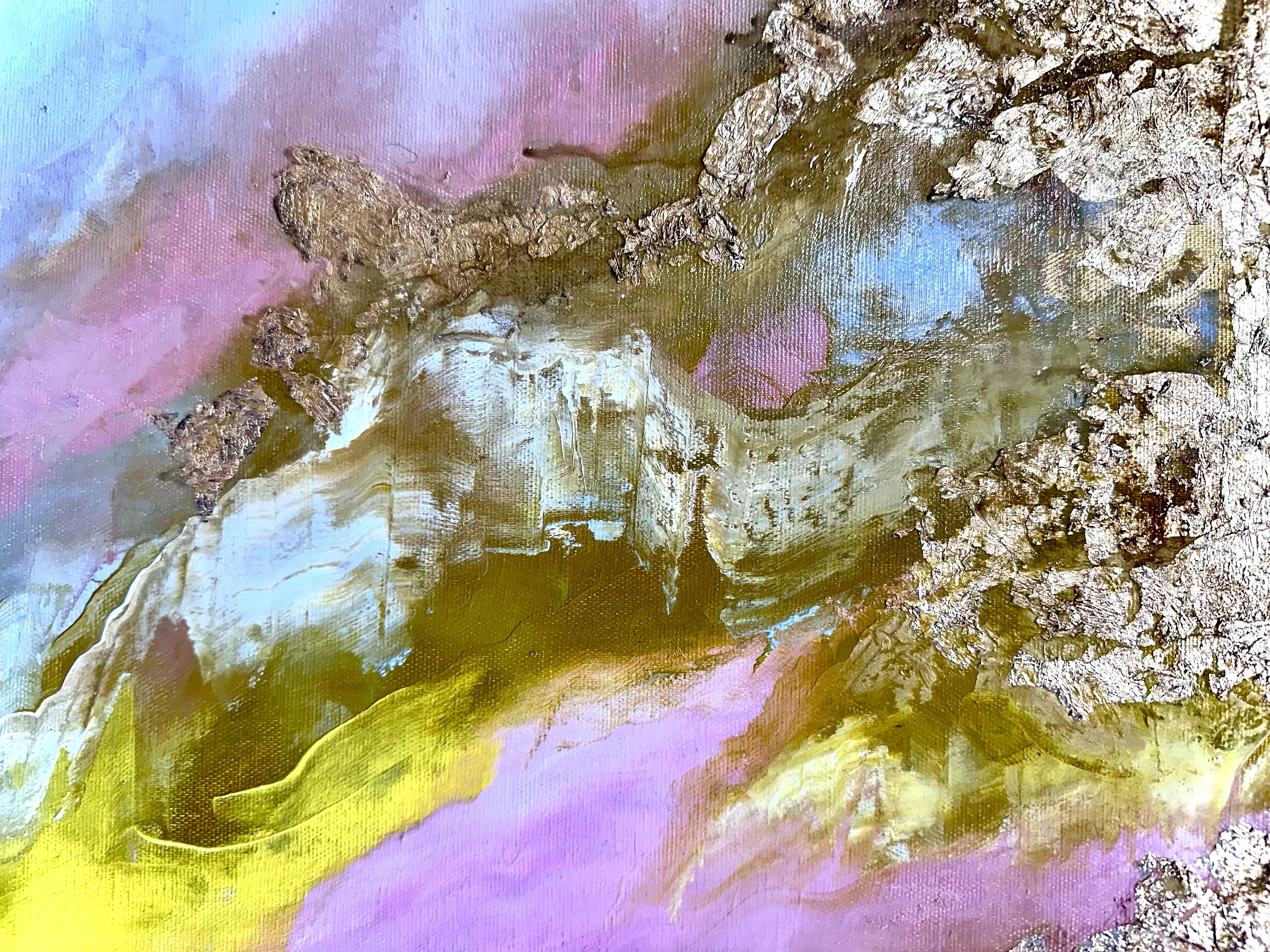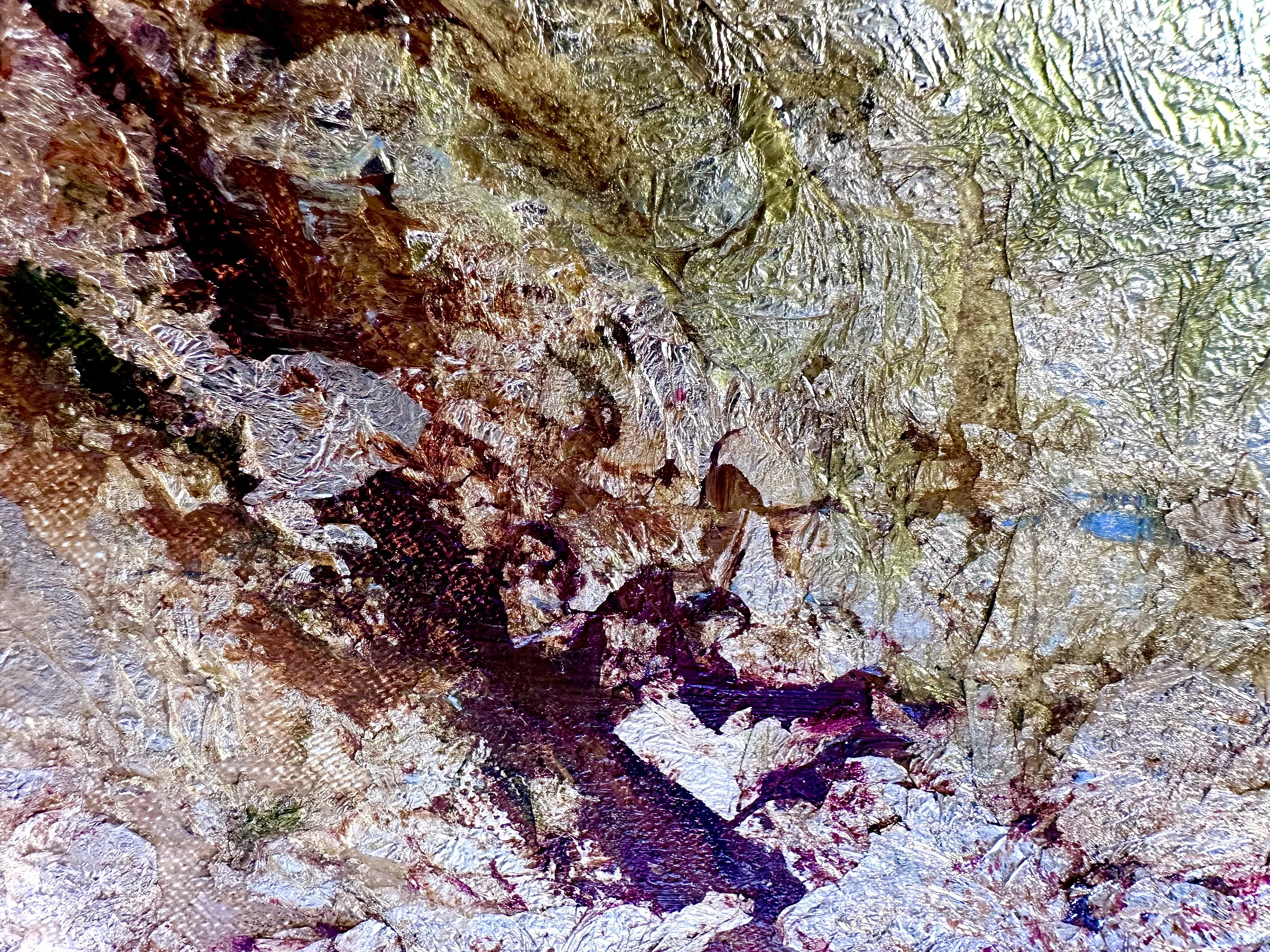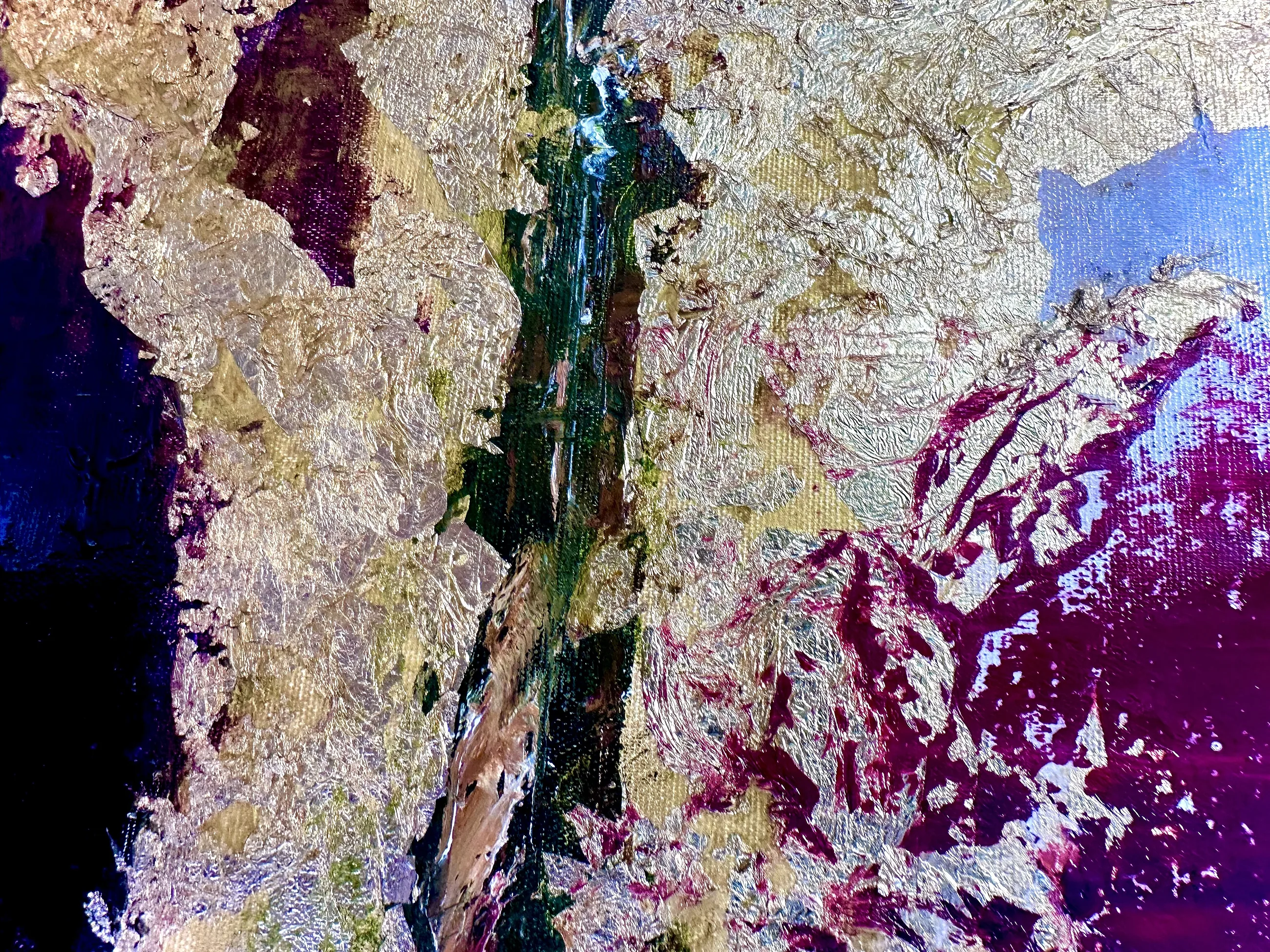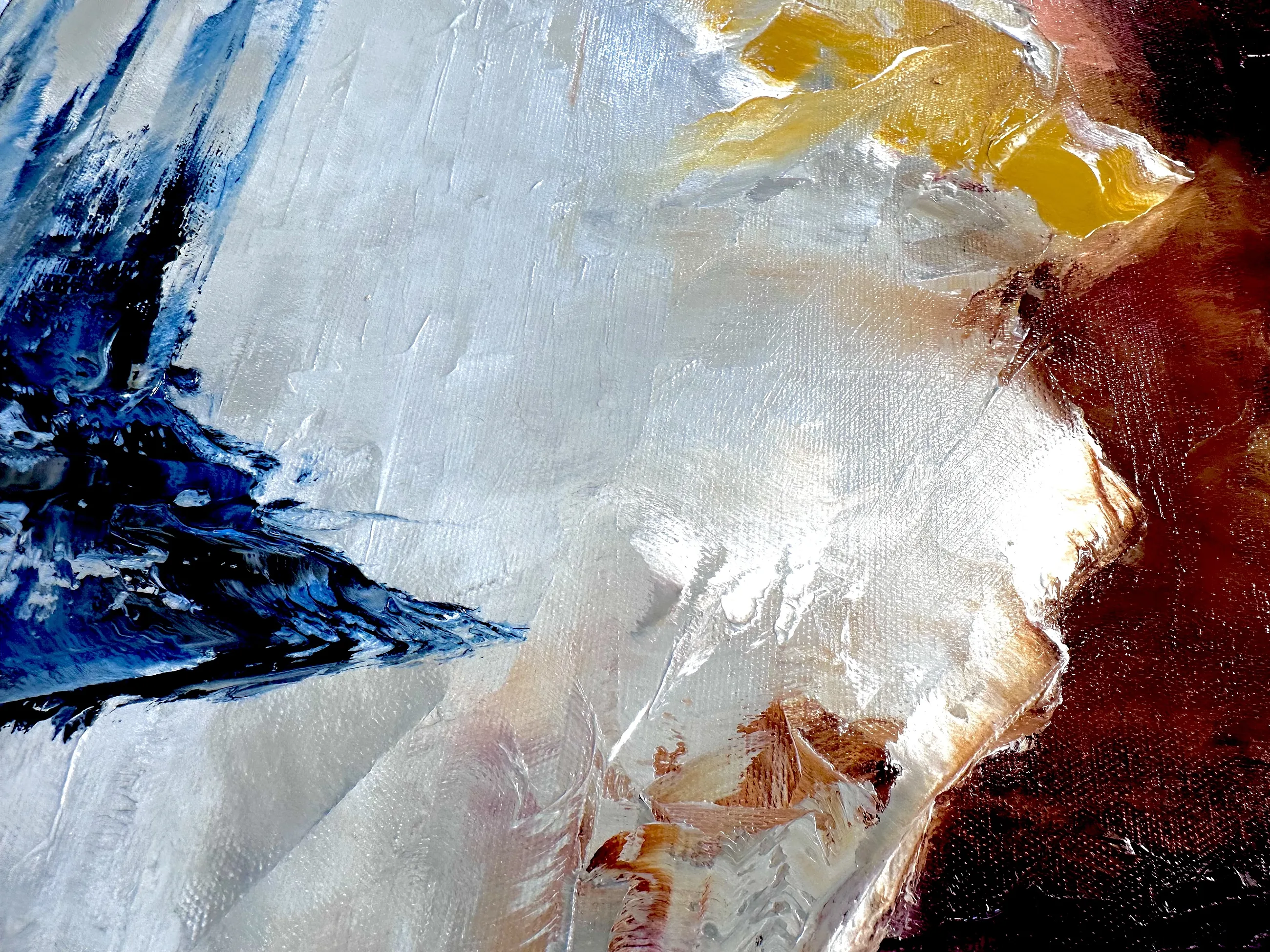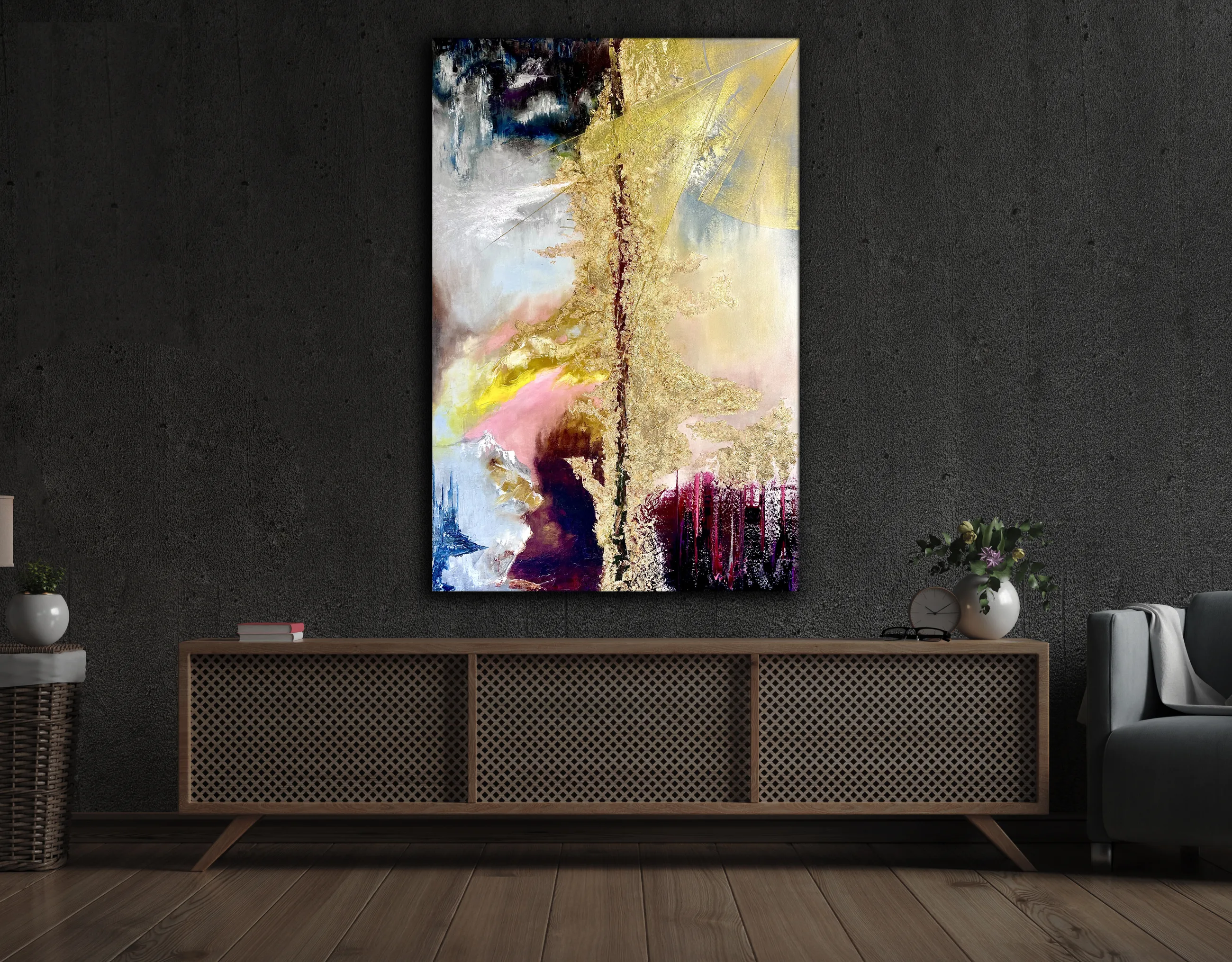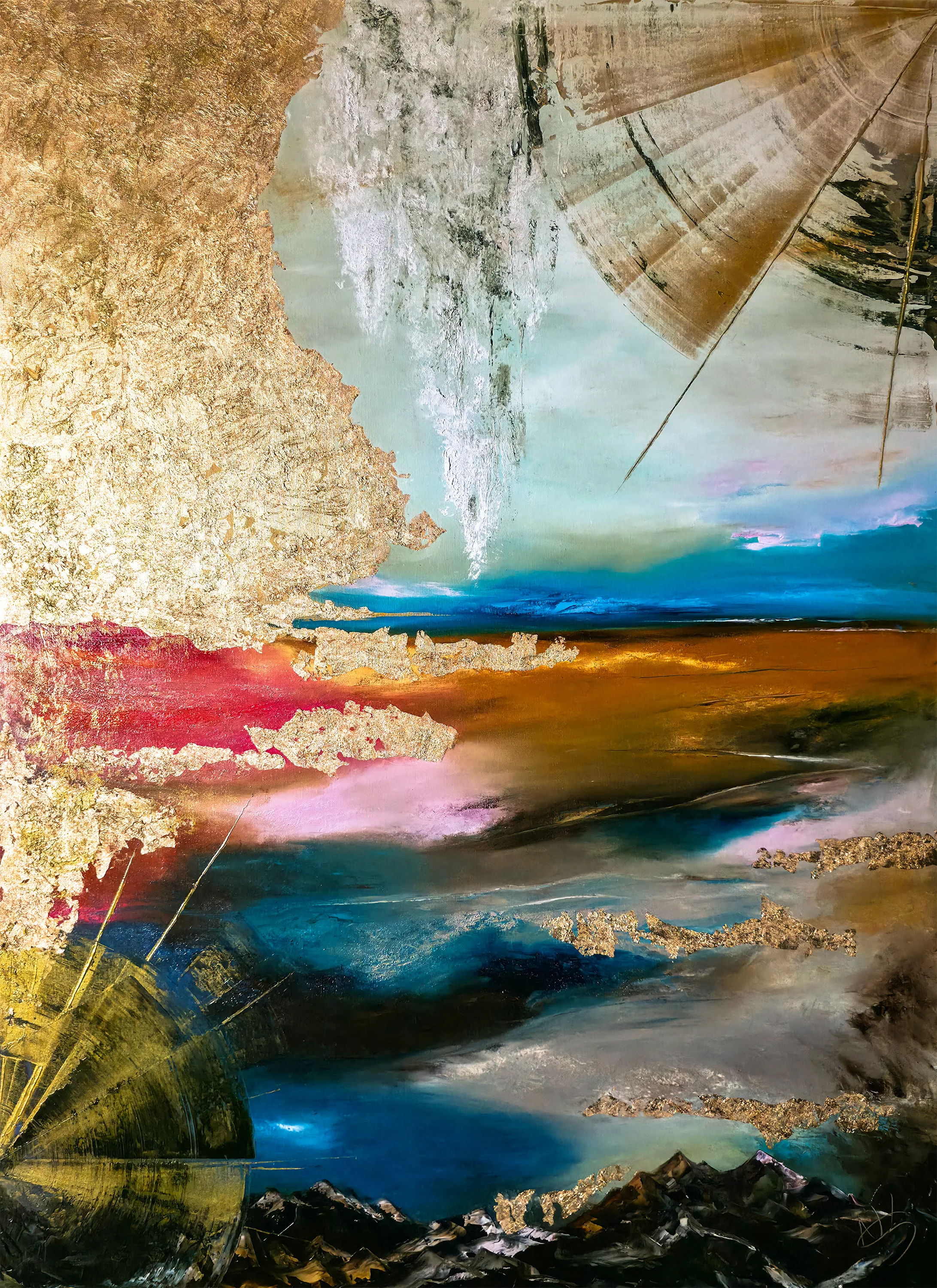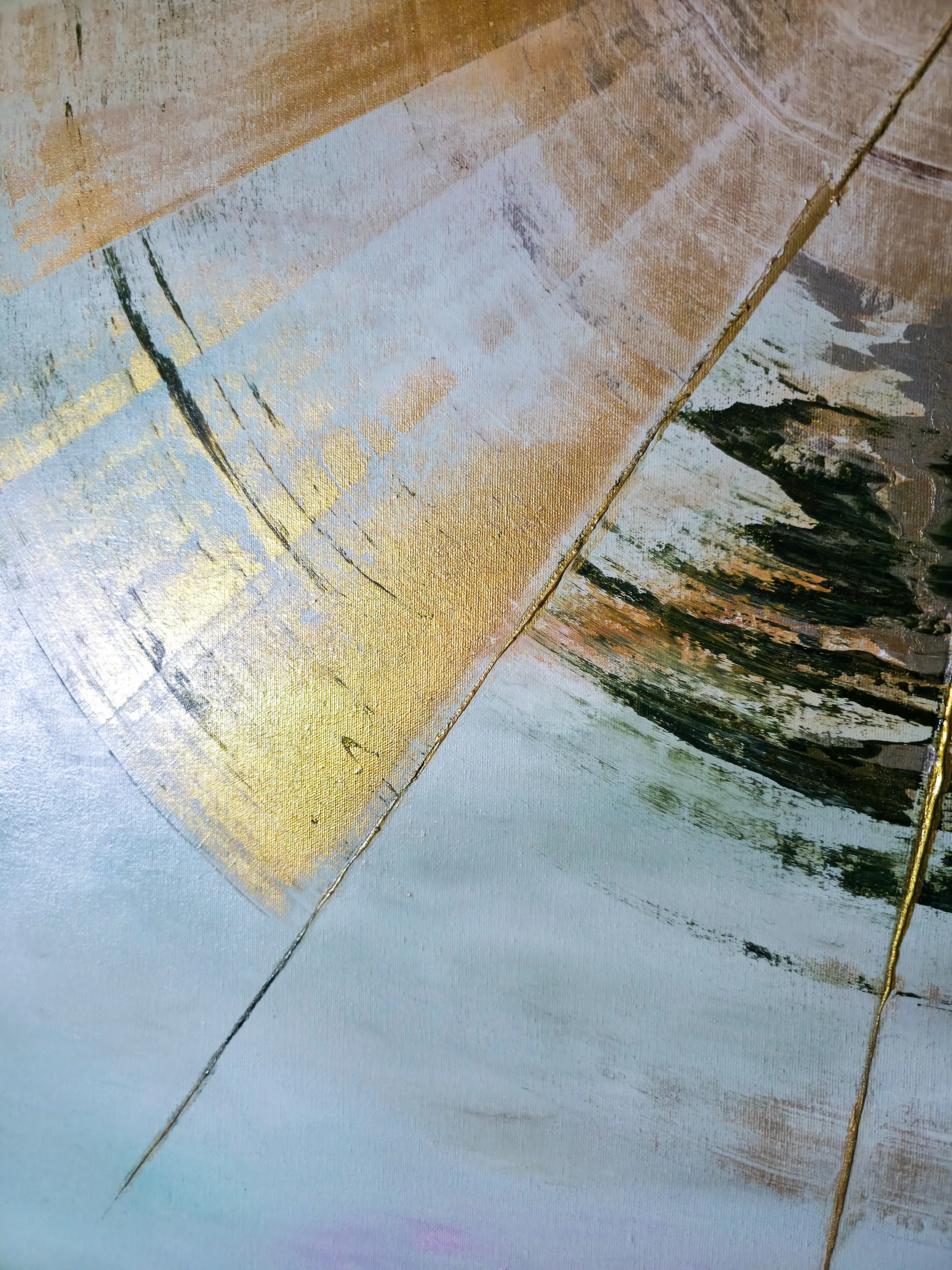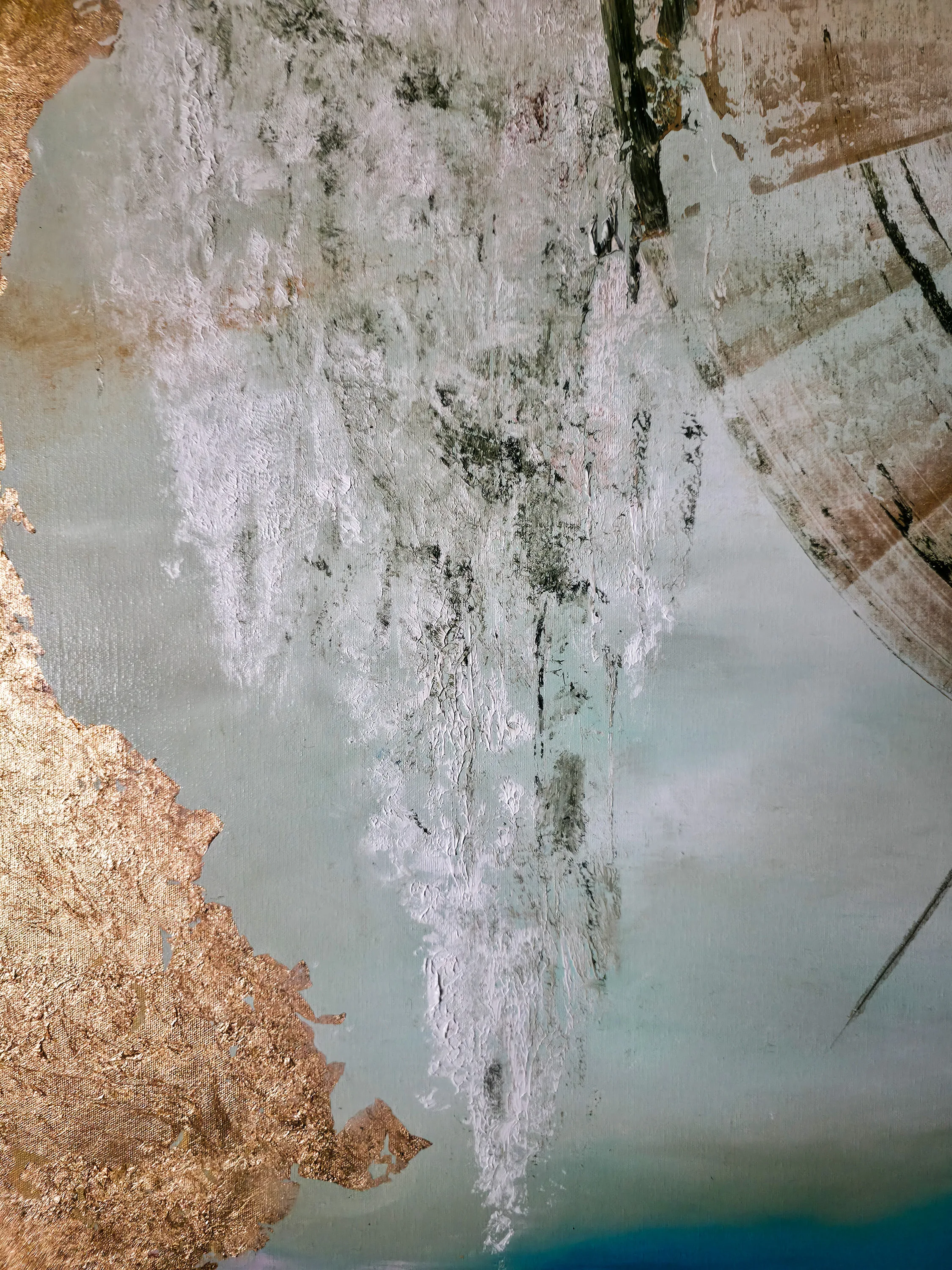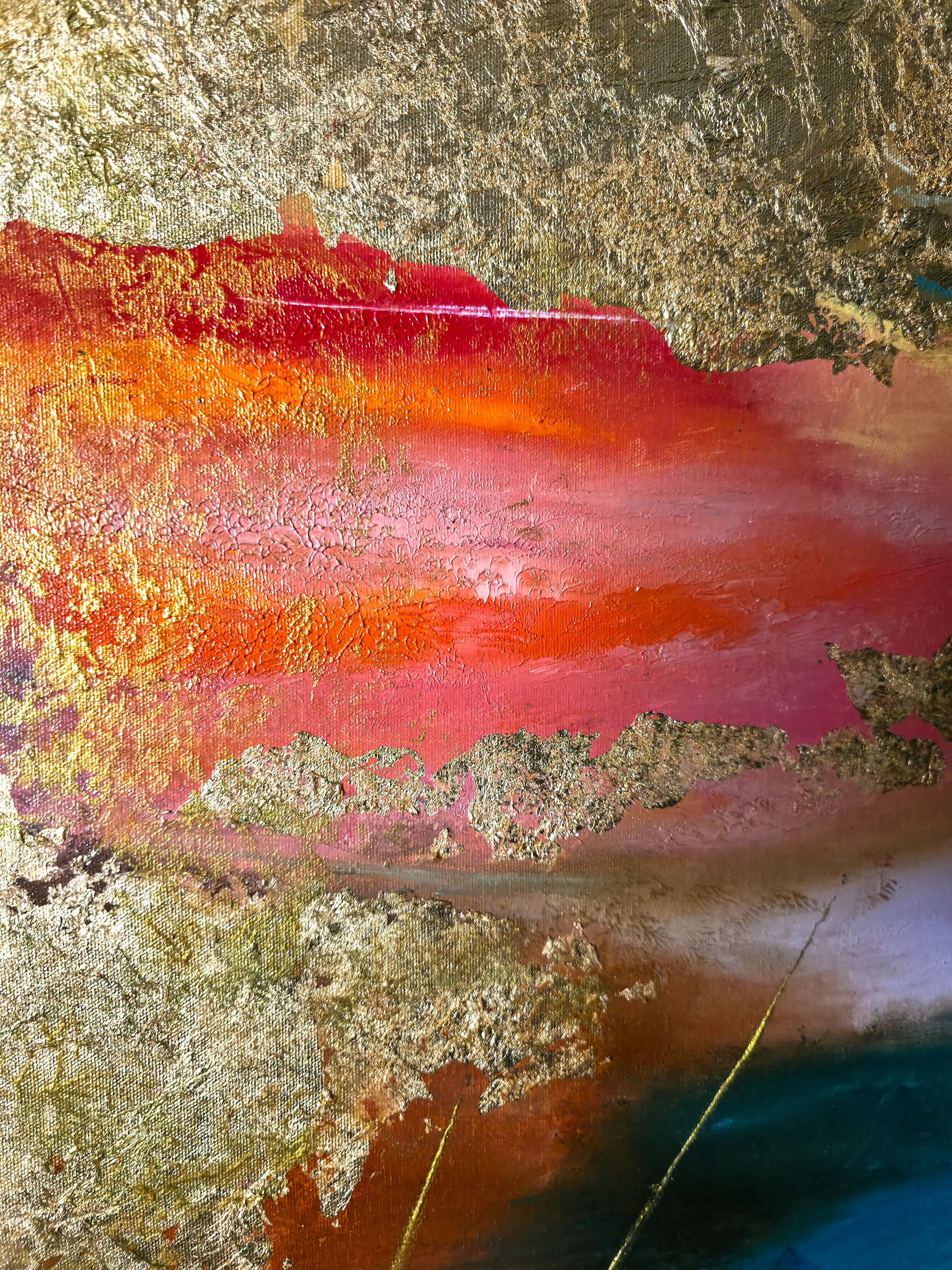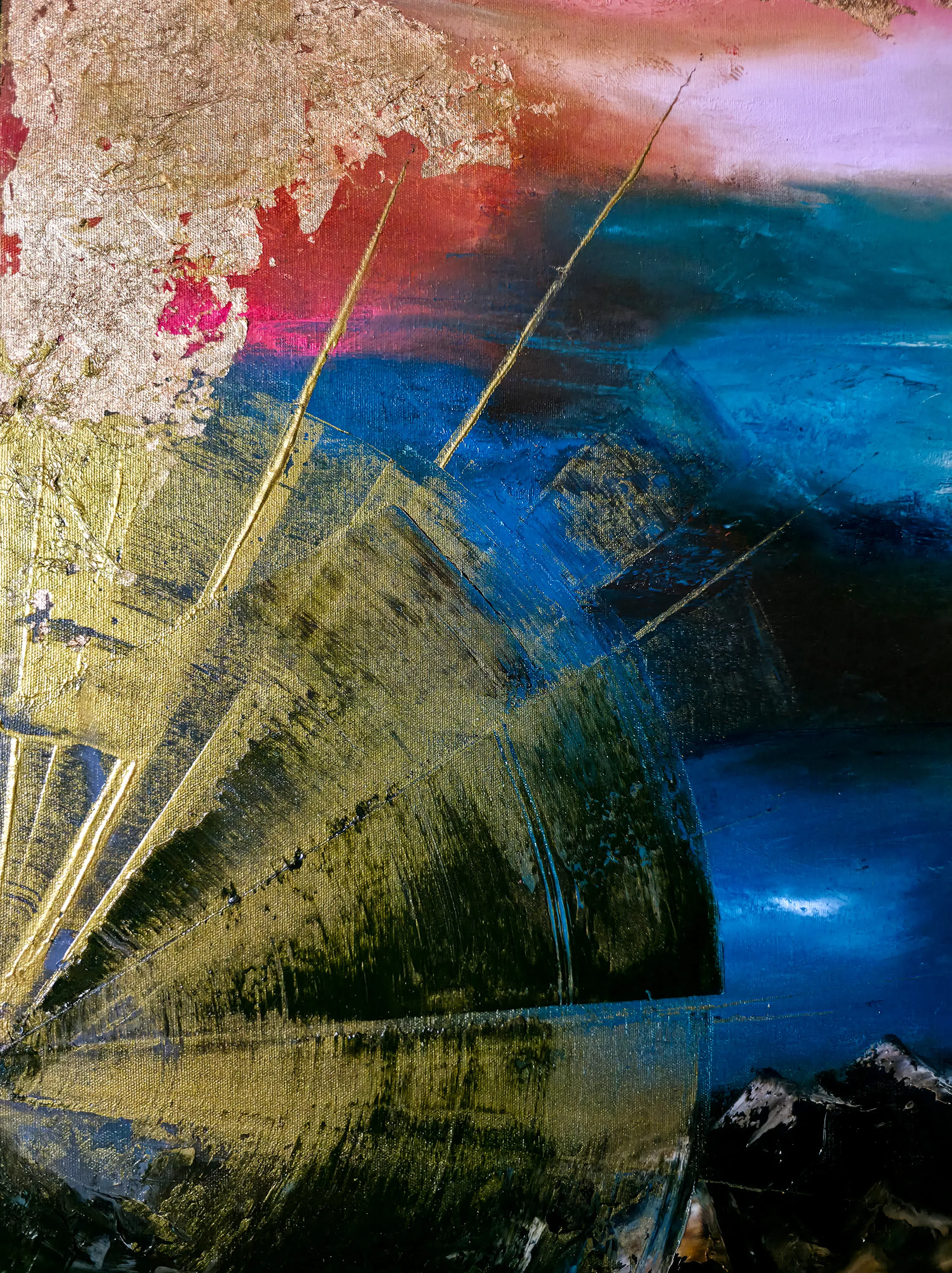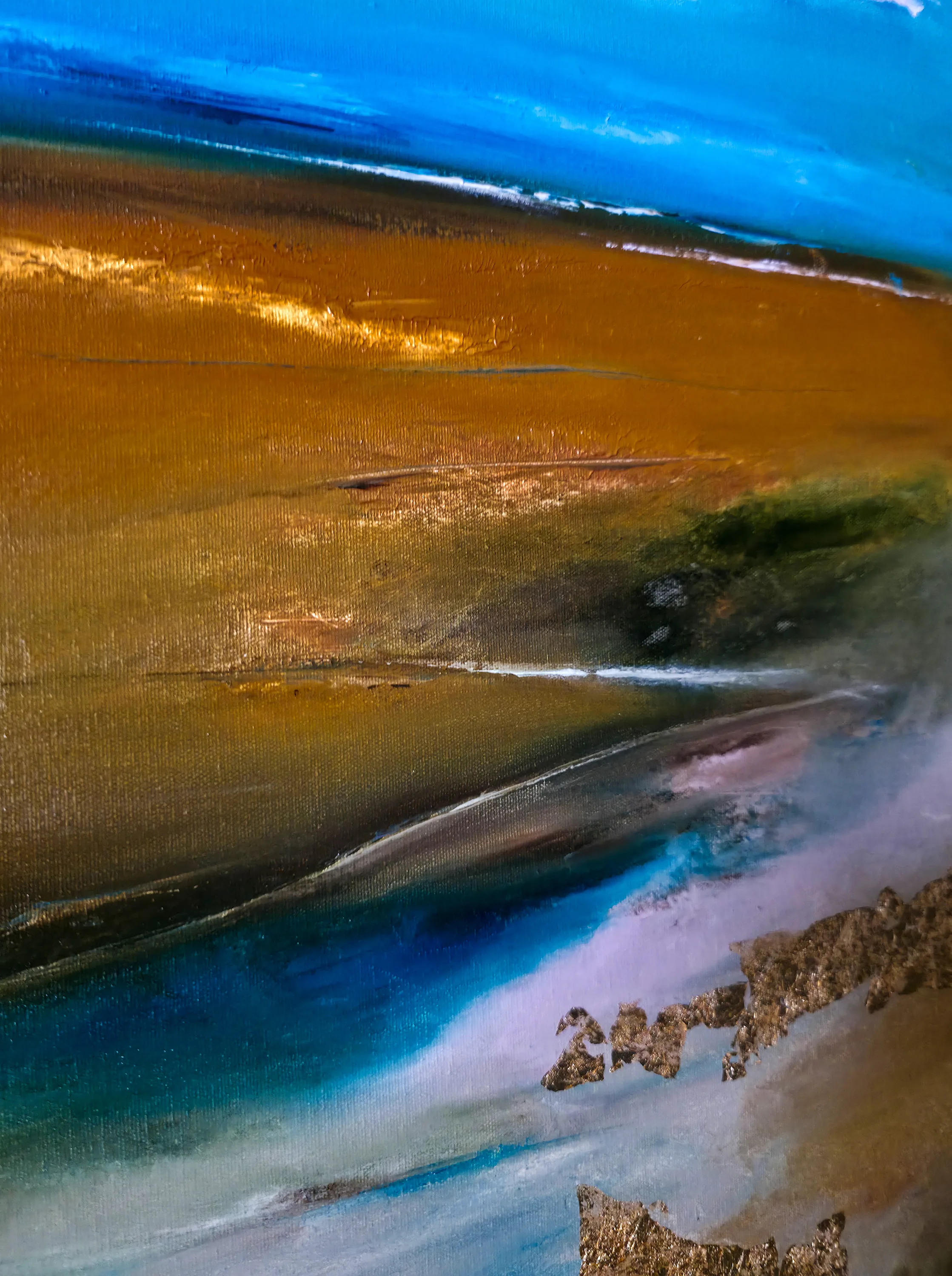
OLD TESTAMENT III.
In Search of the Secrets of Eternity
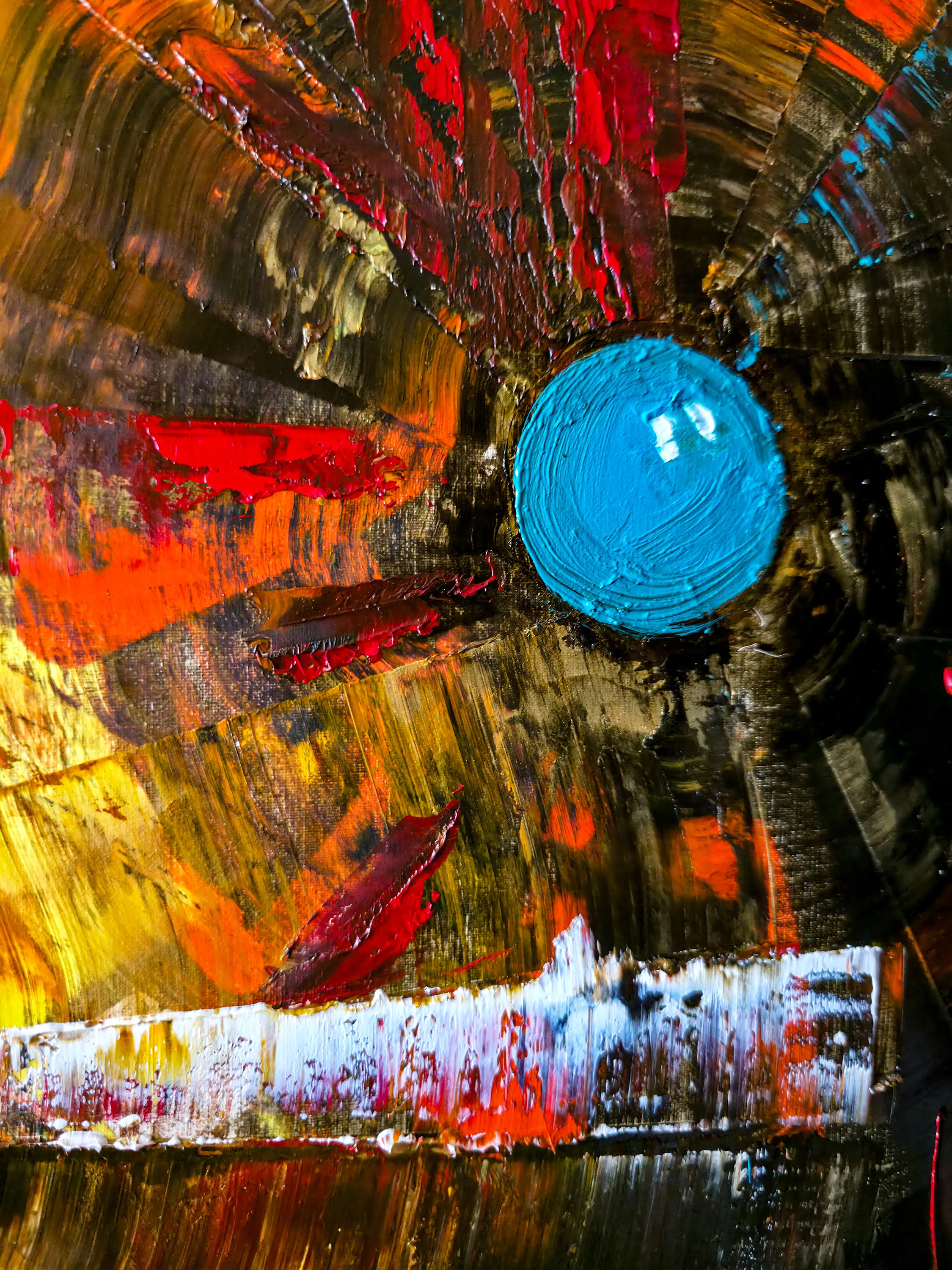
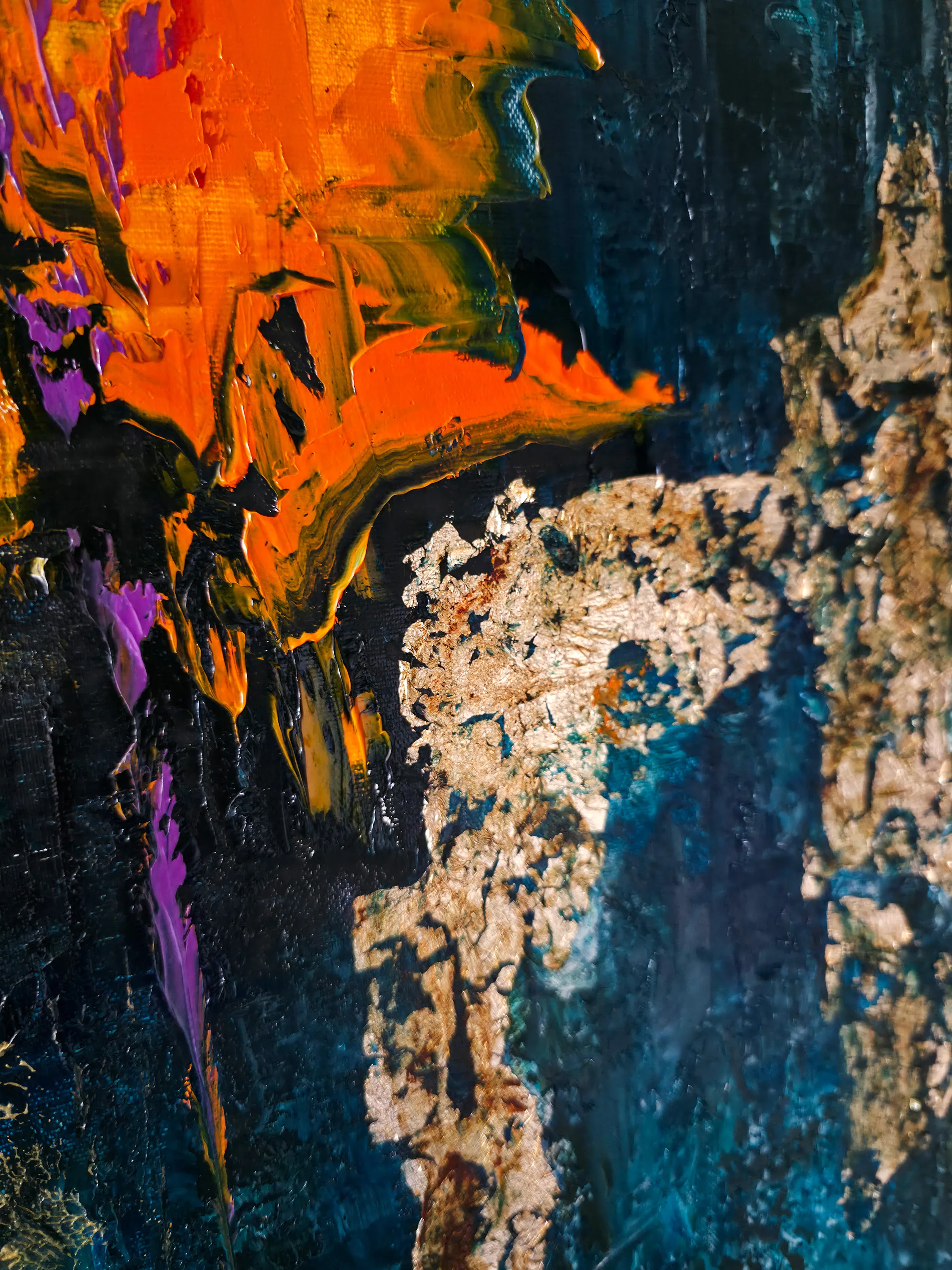
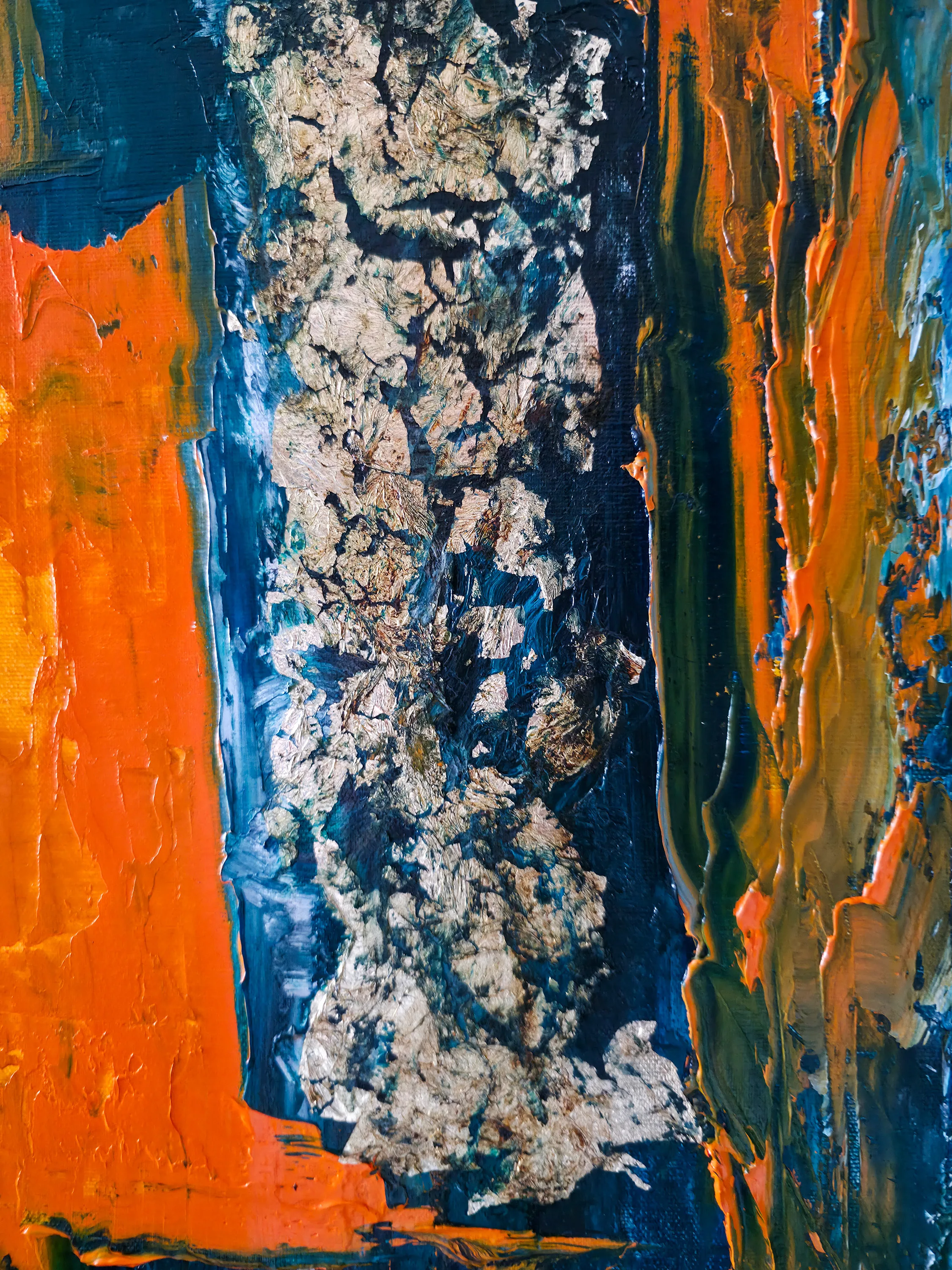
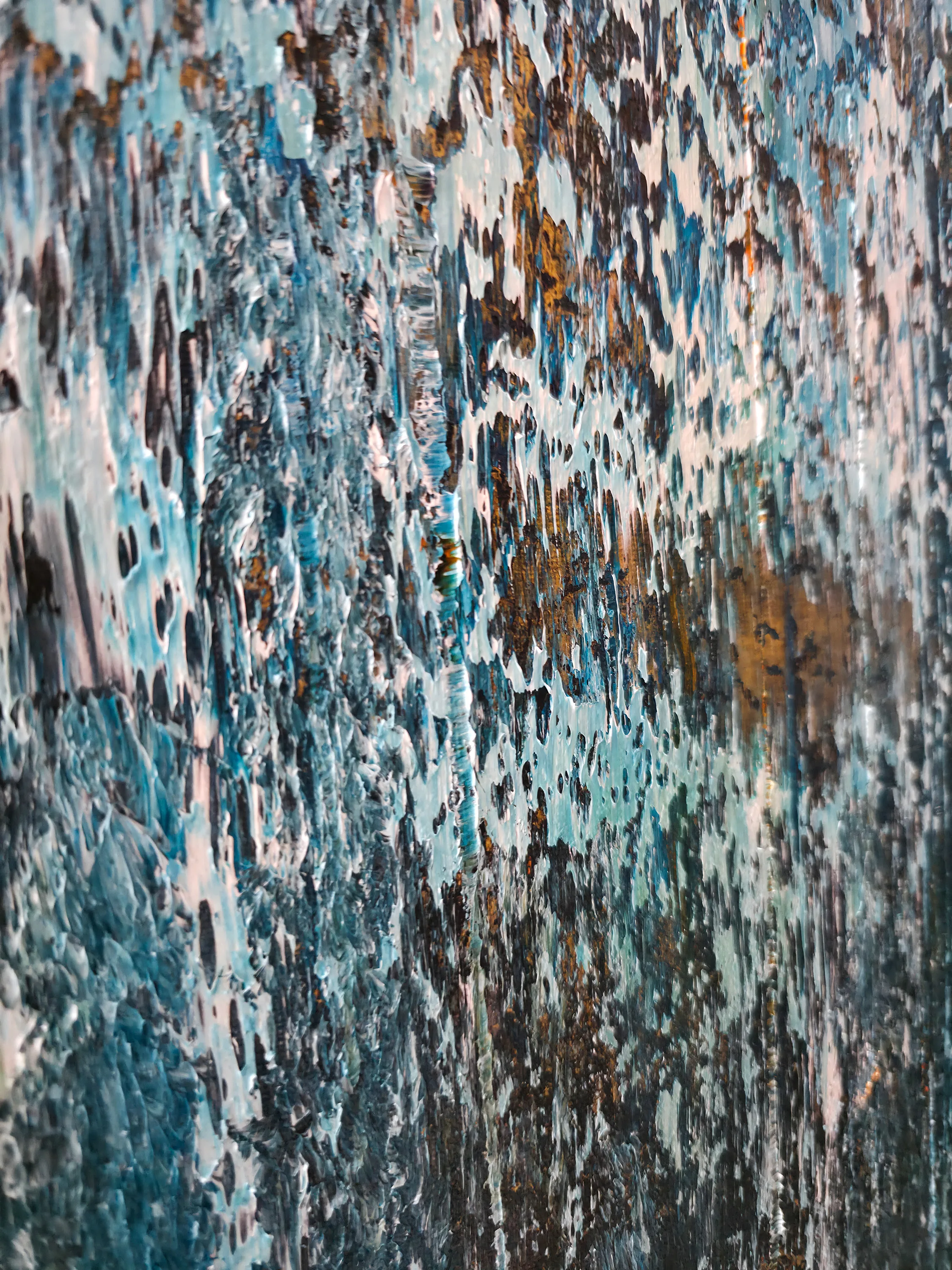
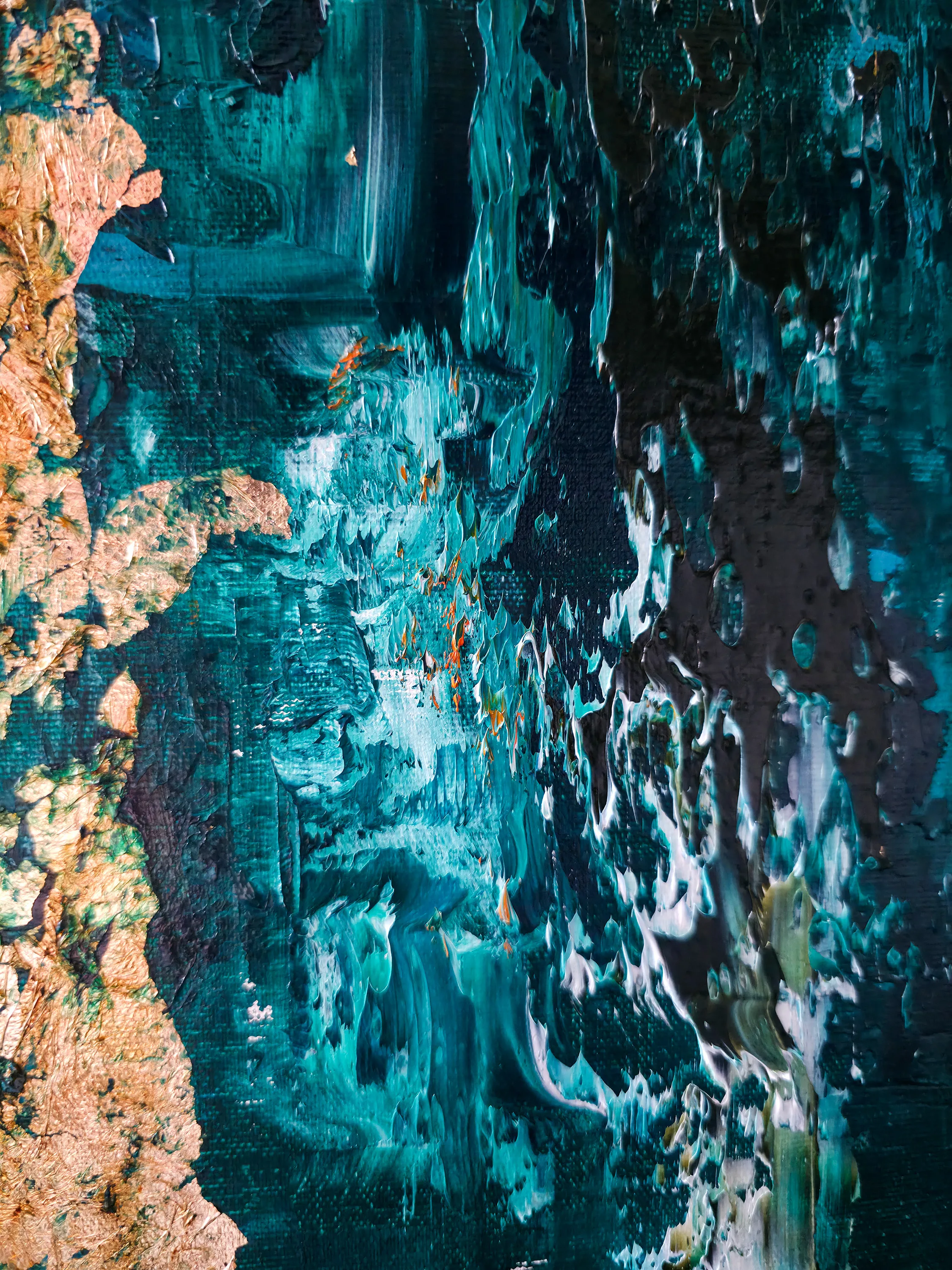
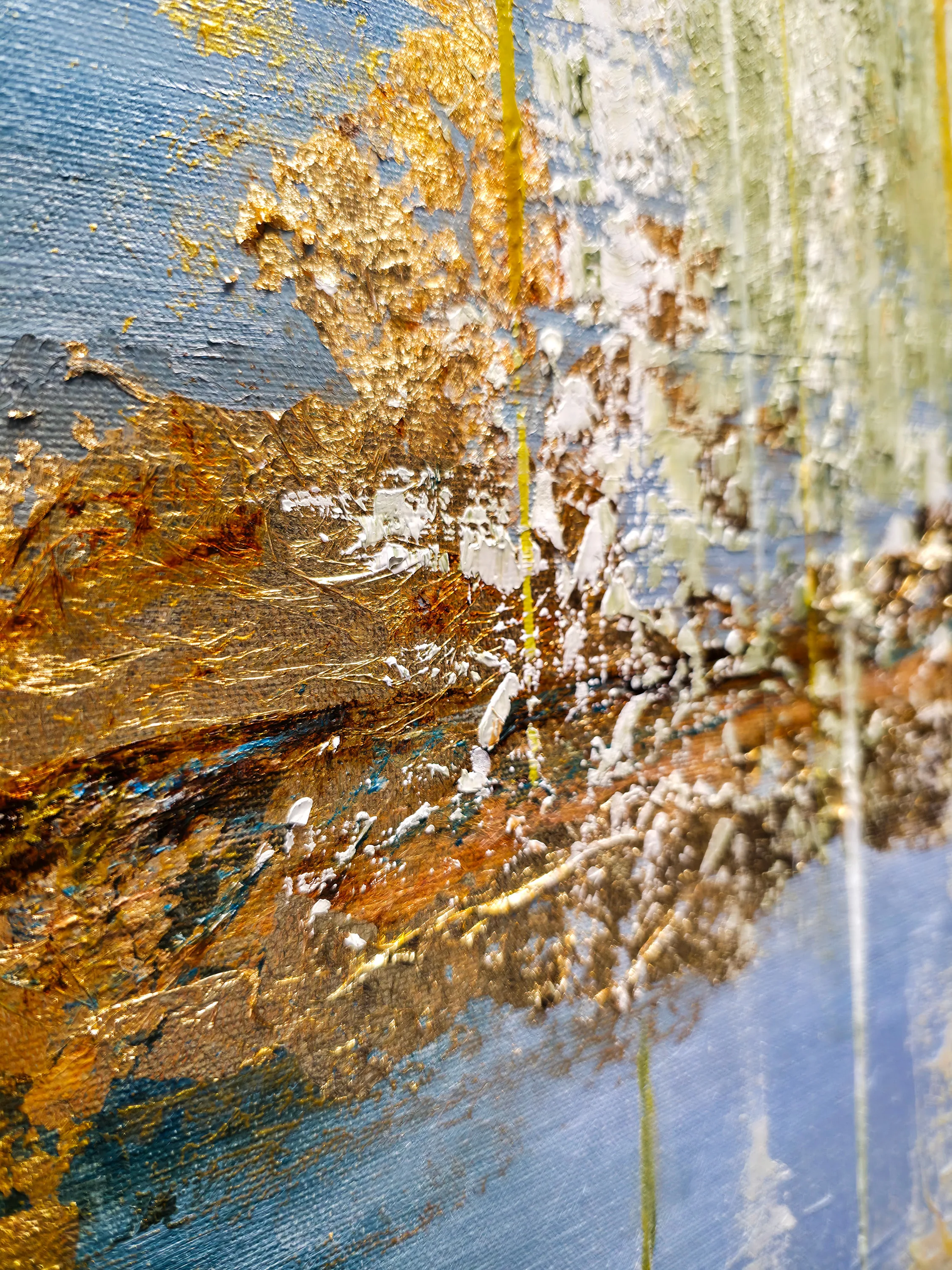
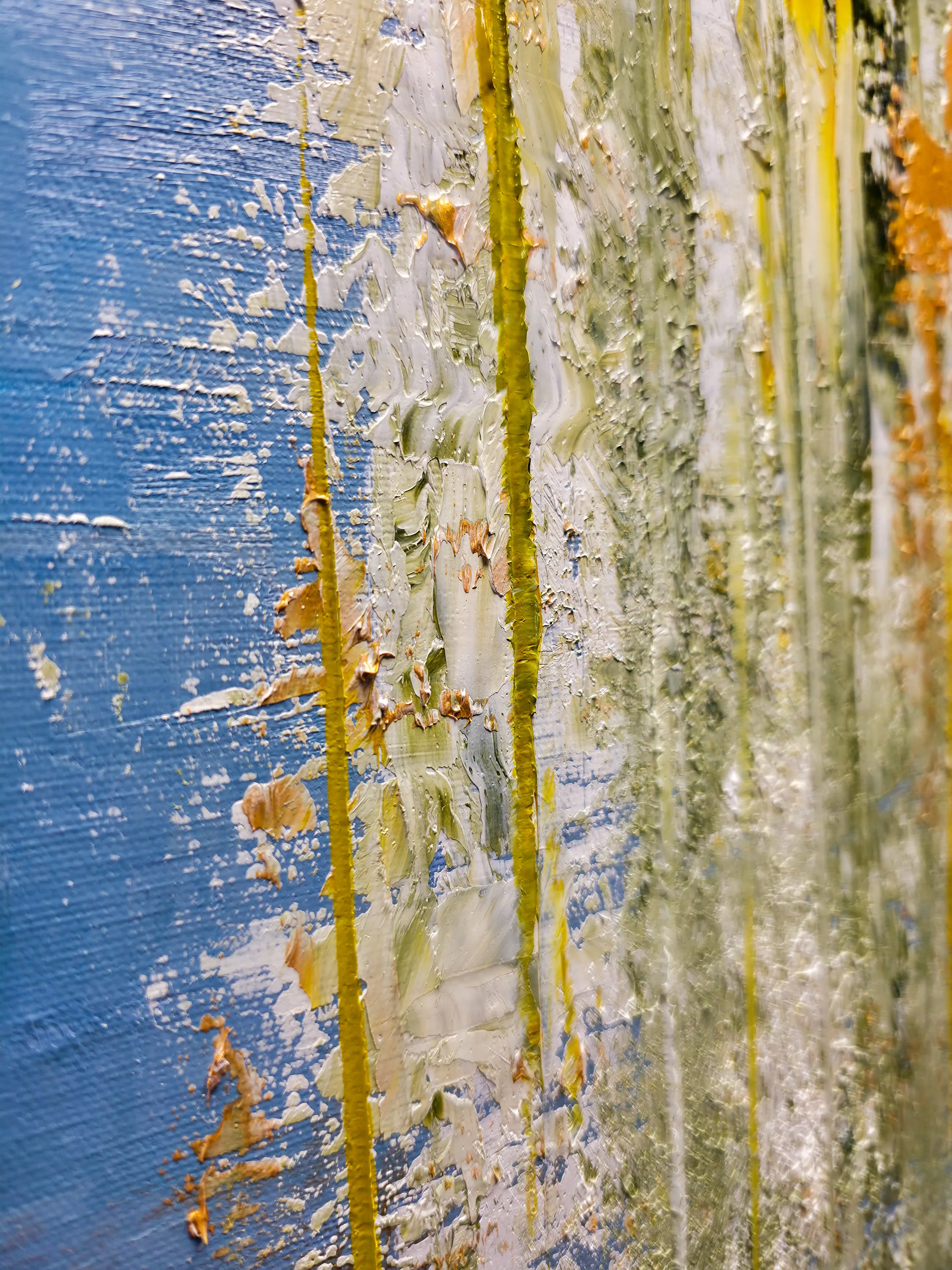
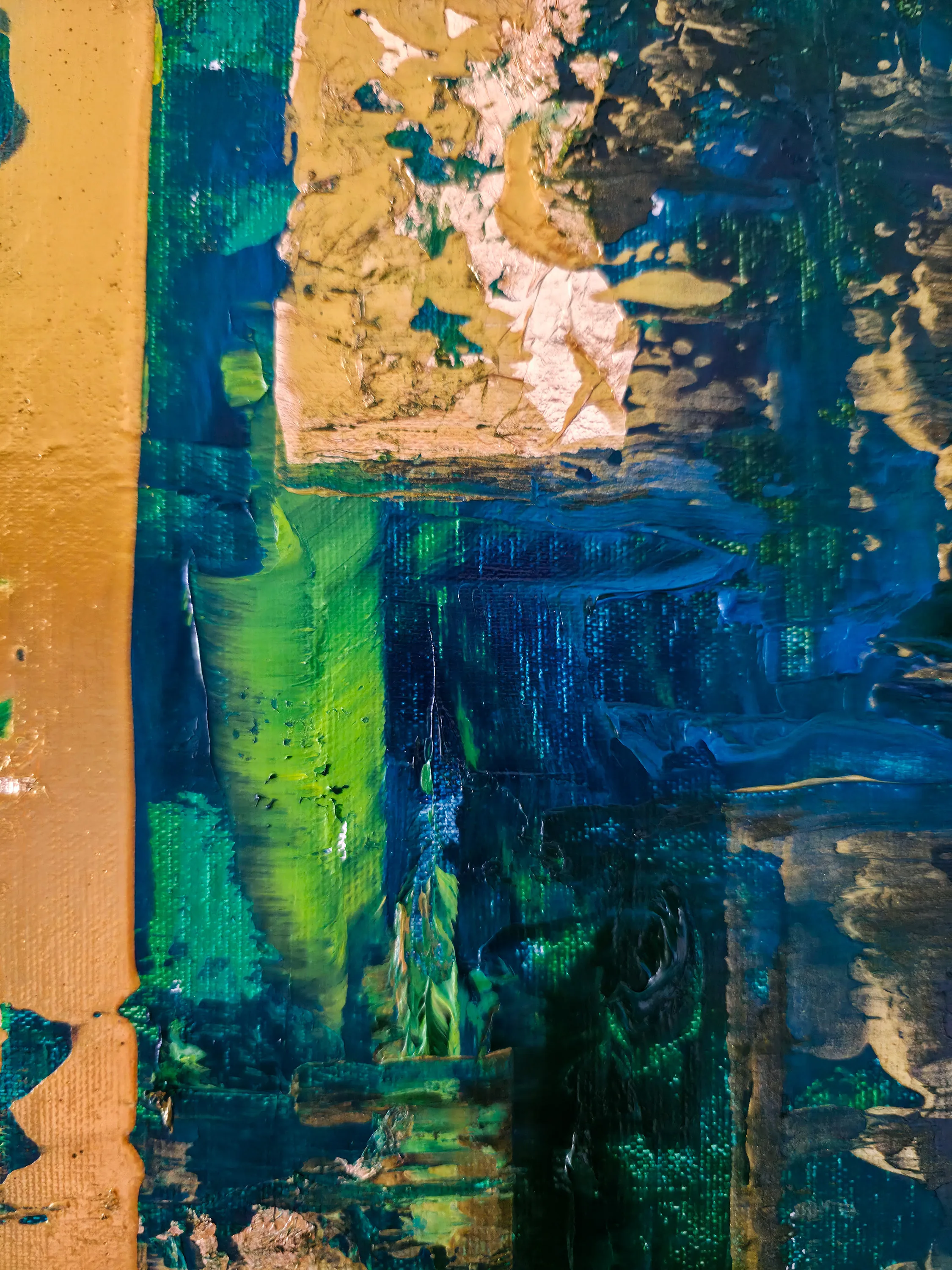
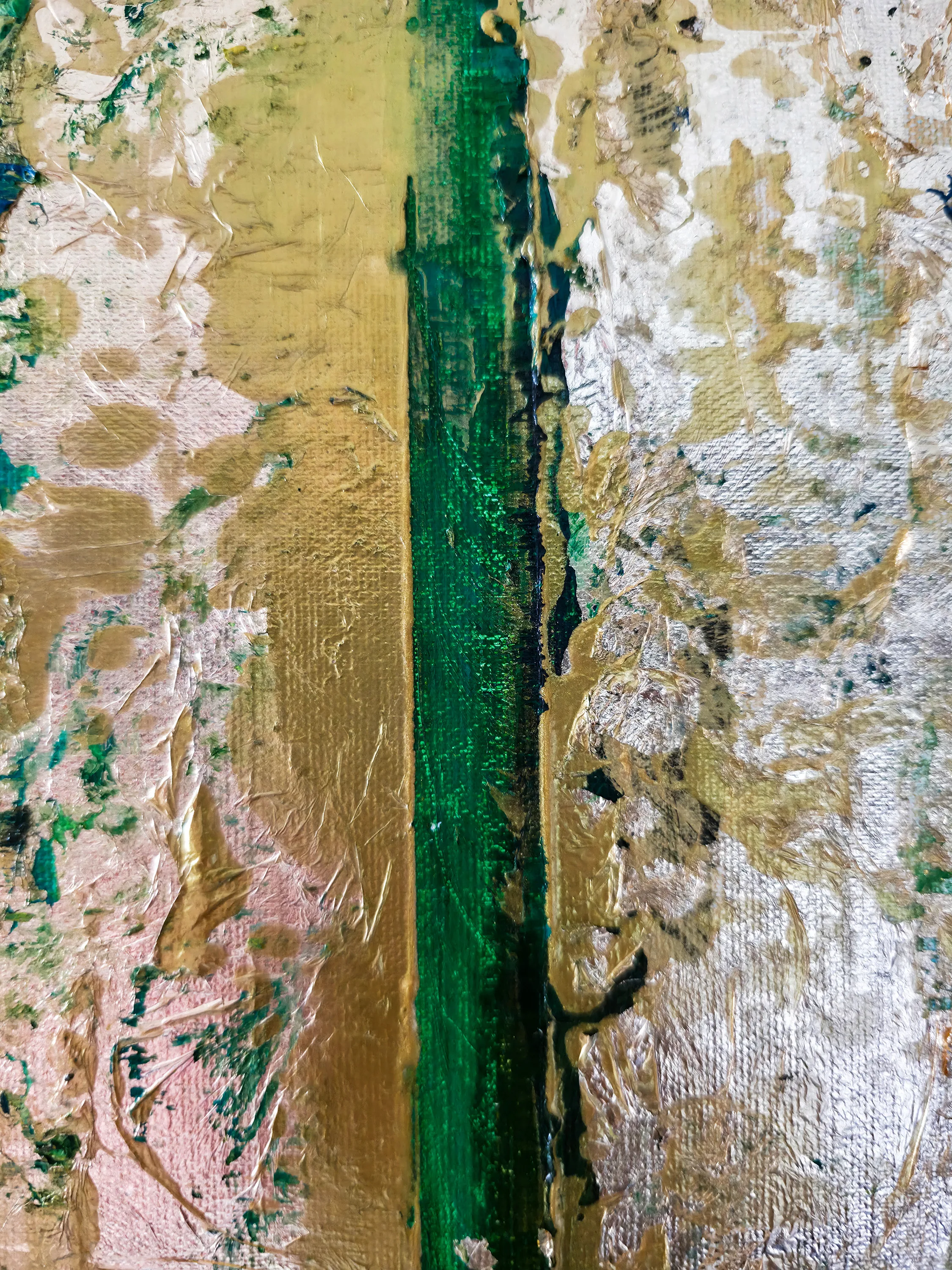
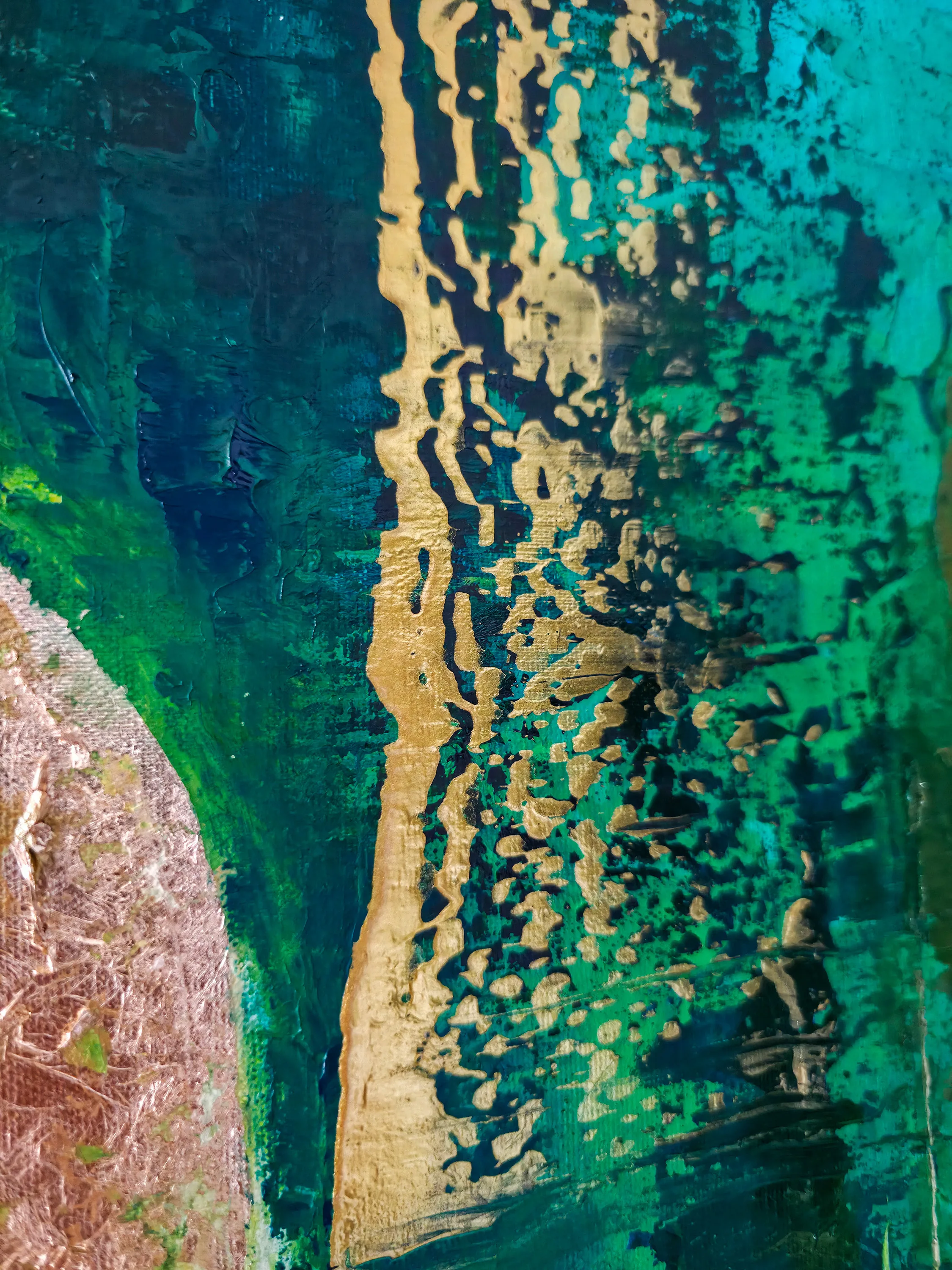
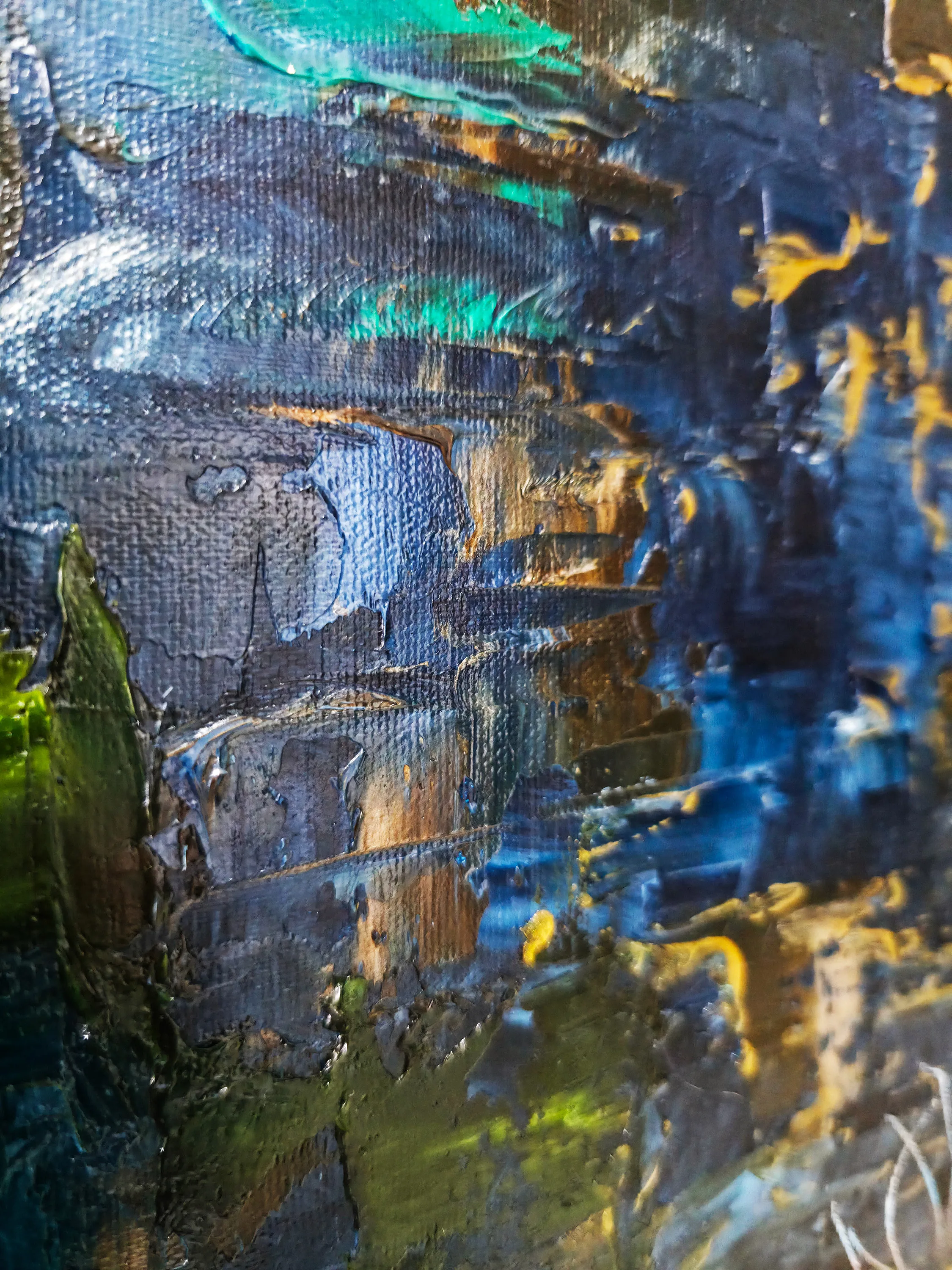
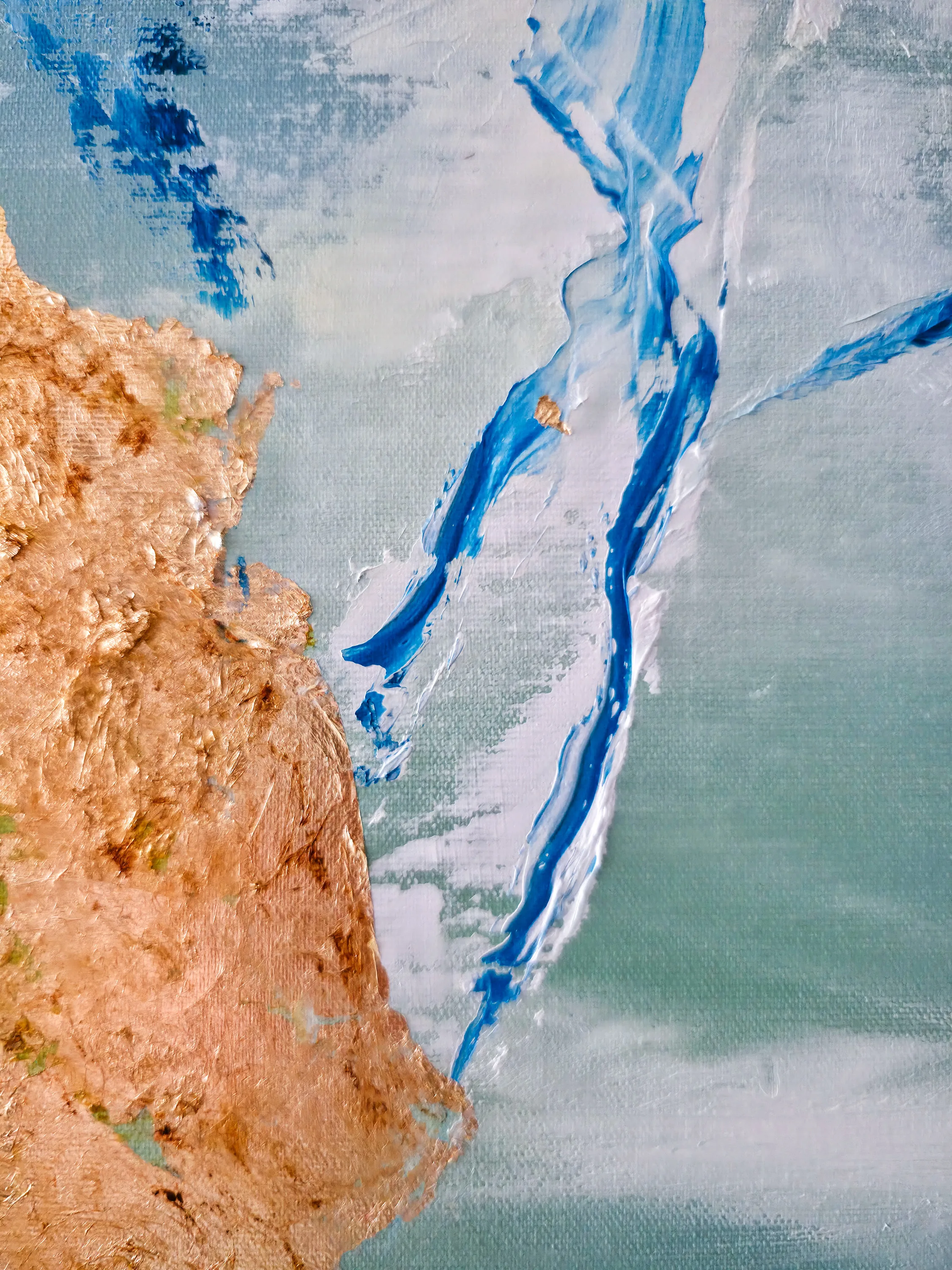
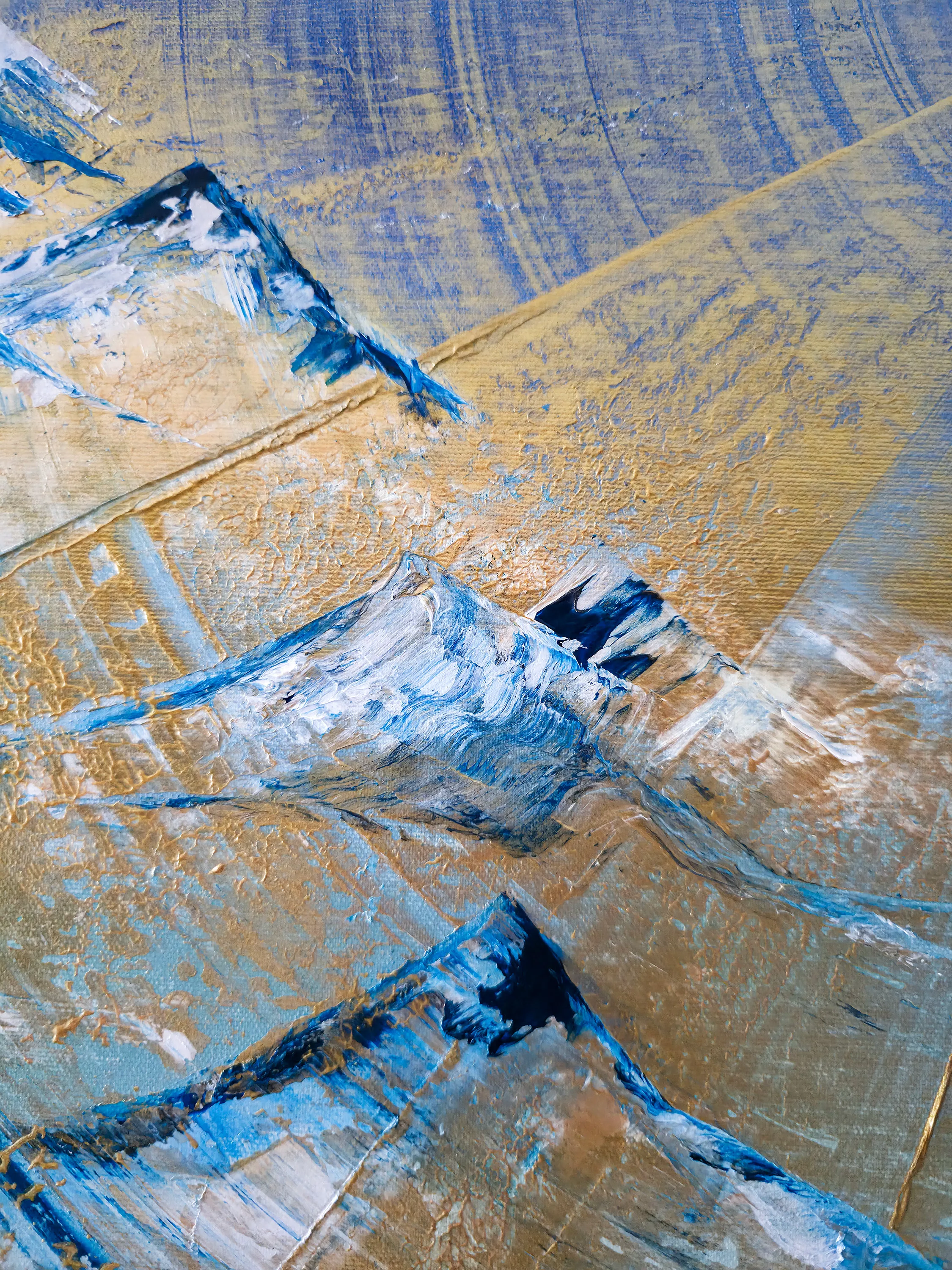
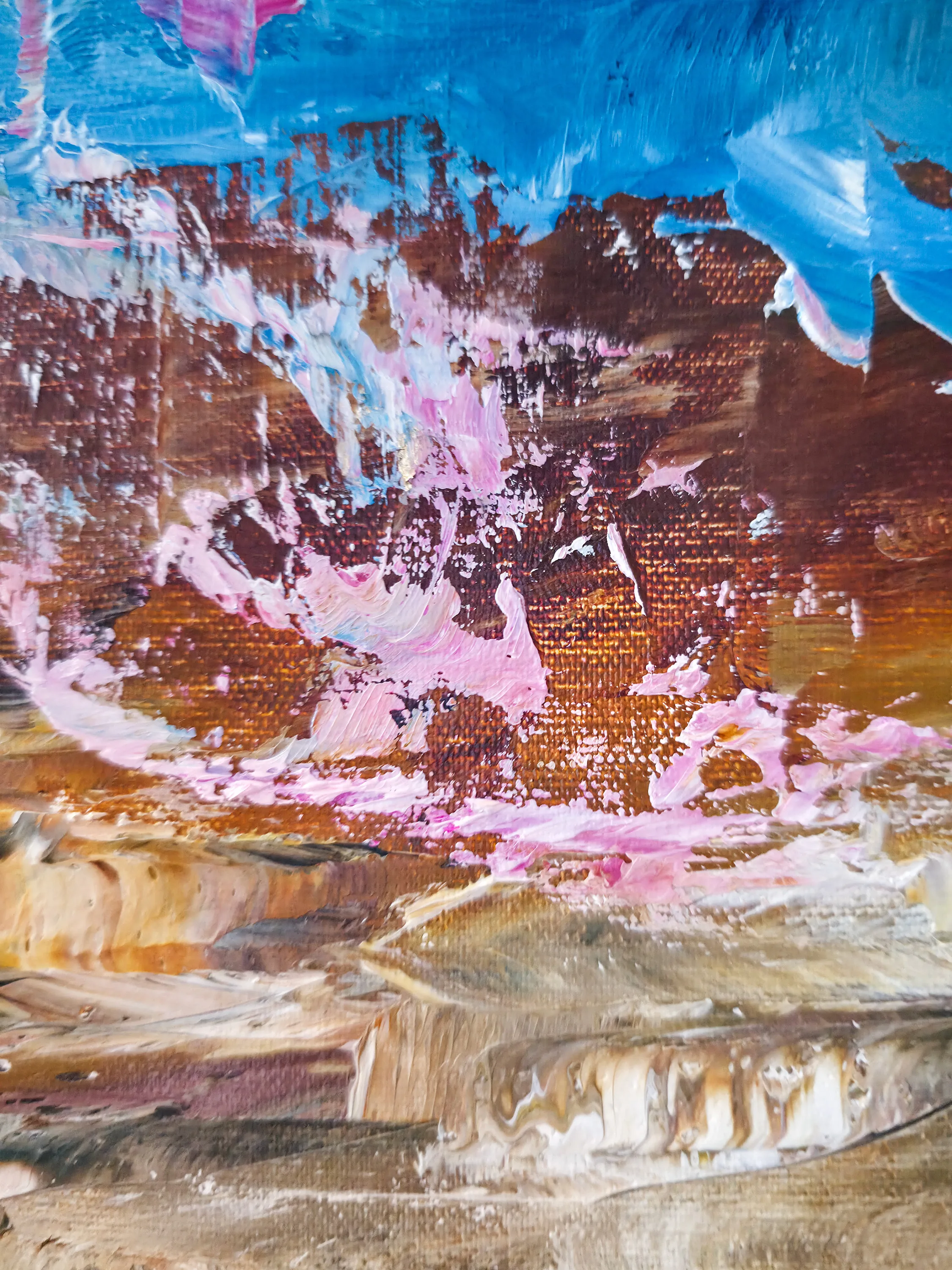
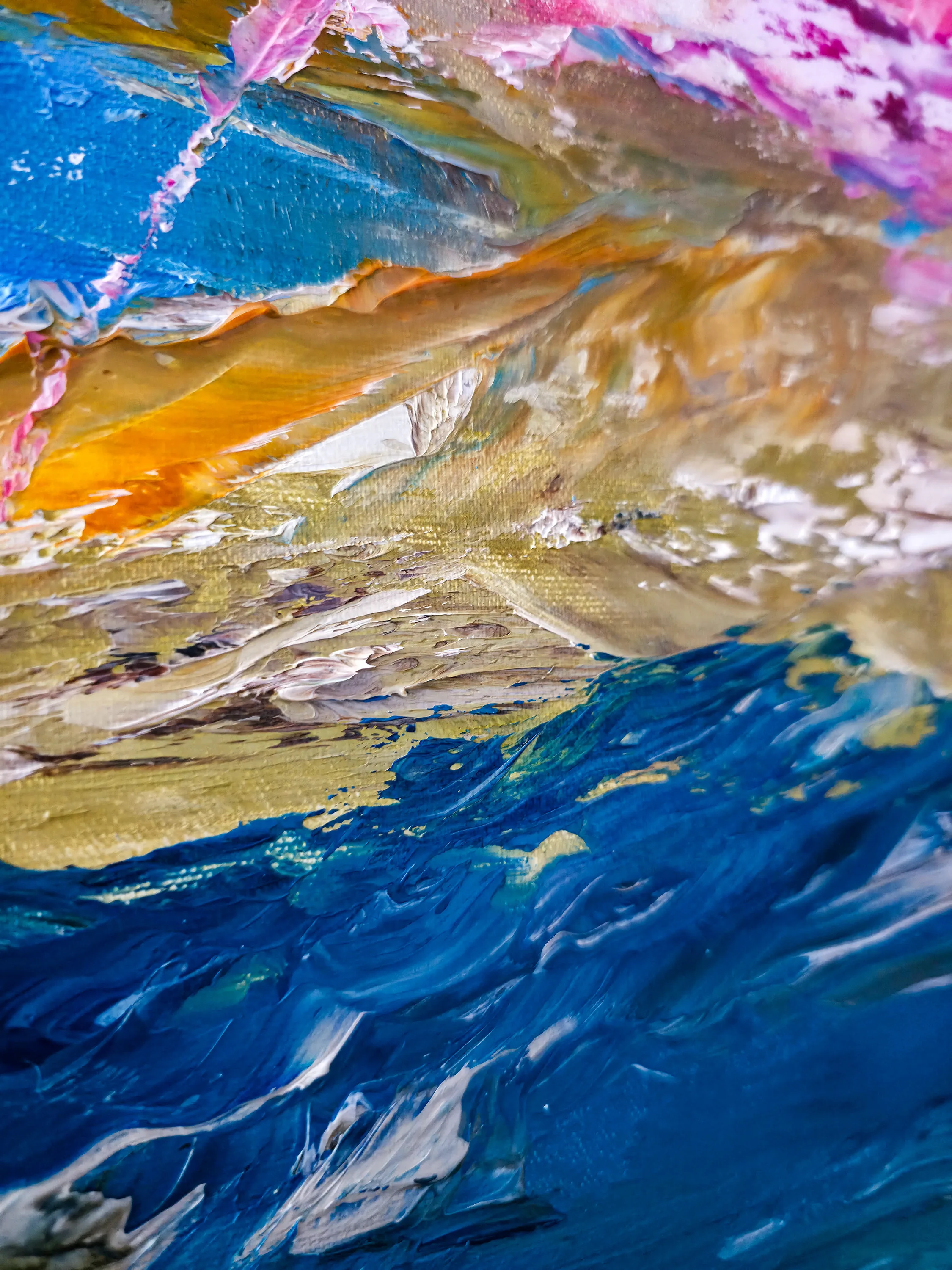
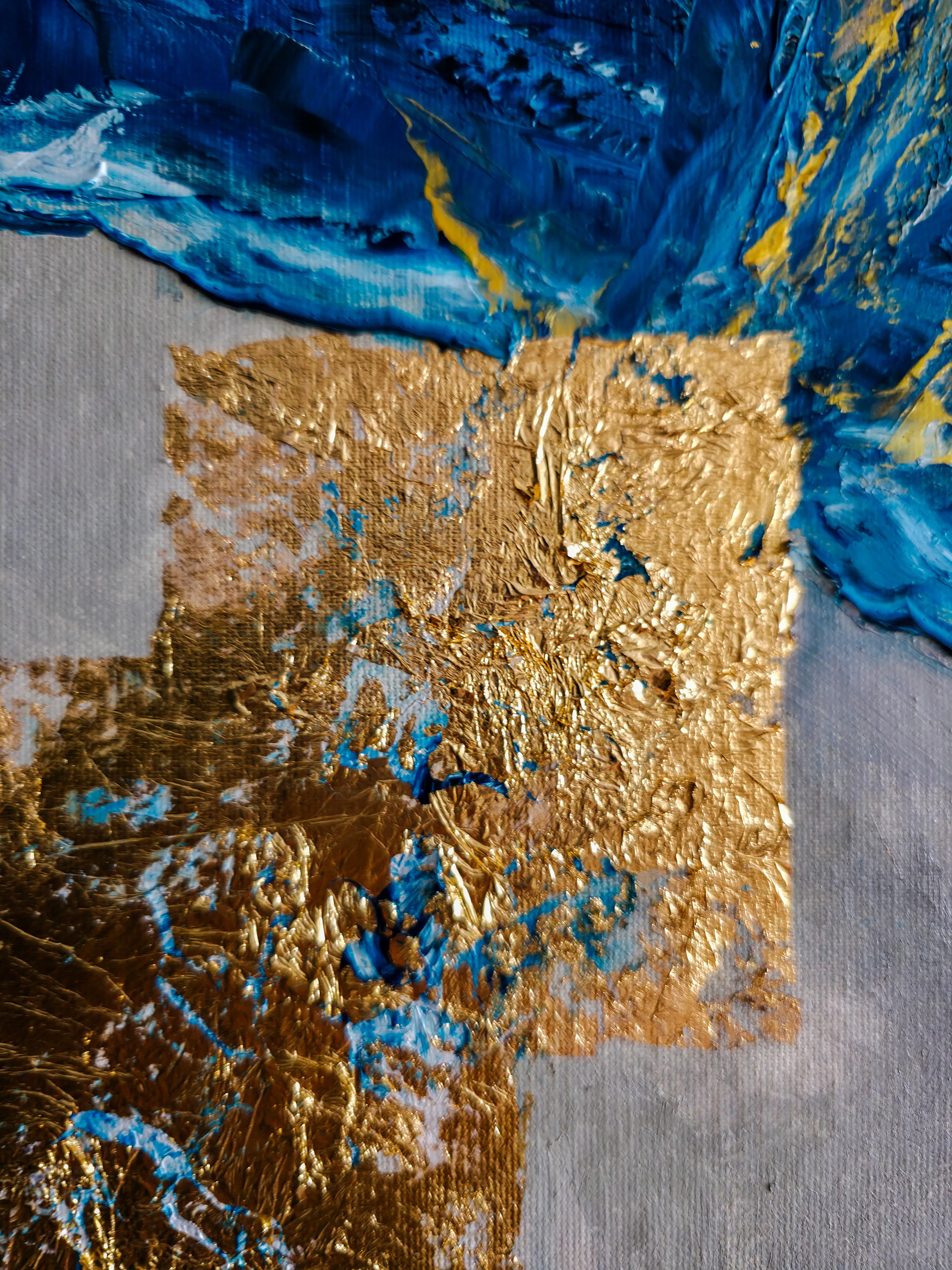
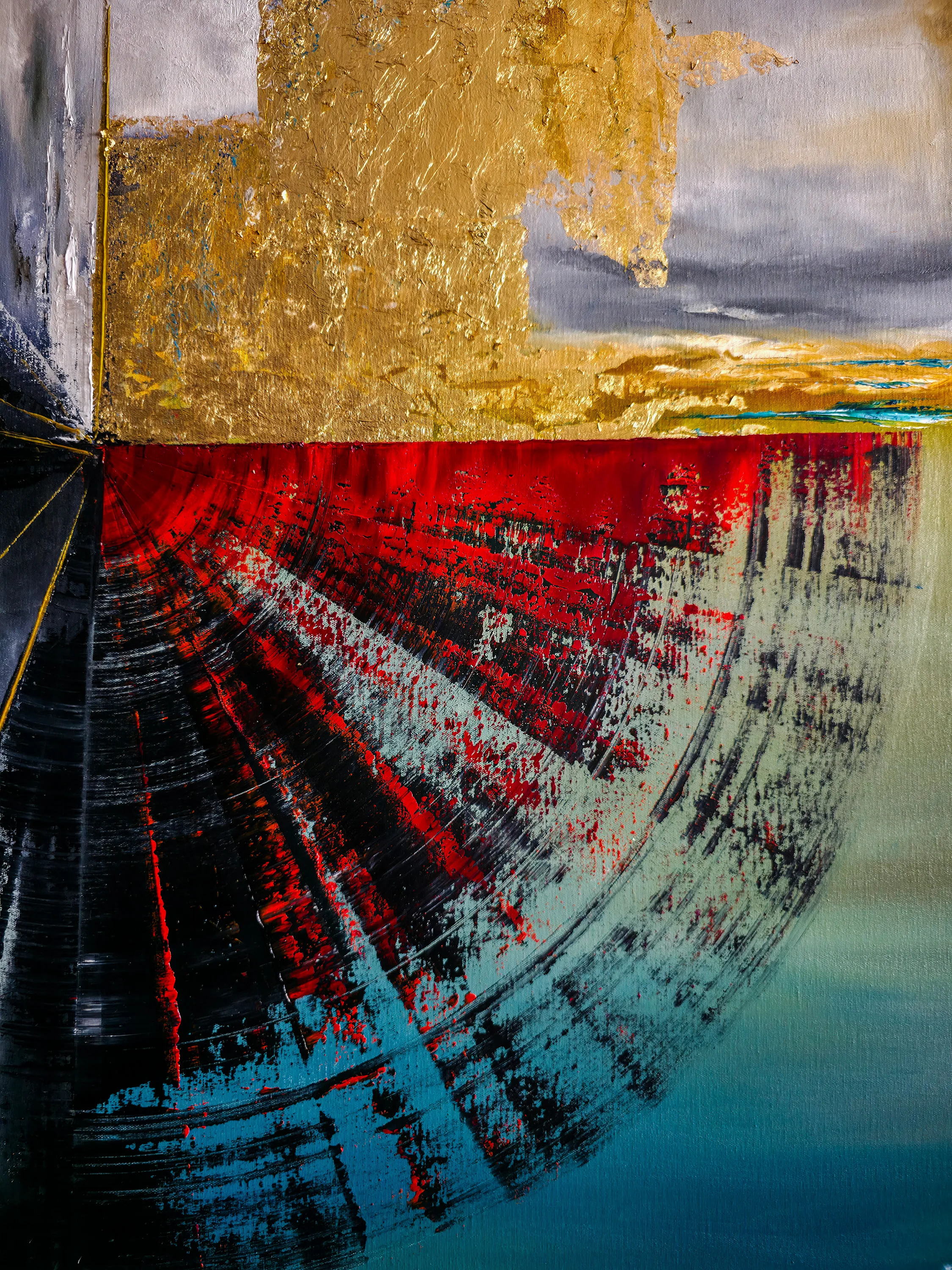
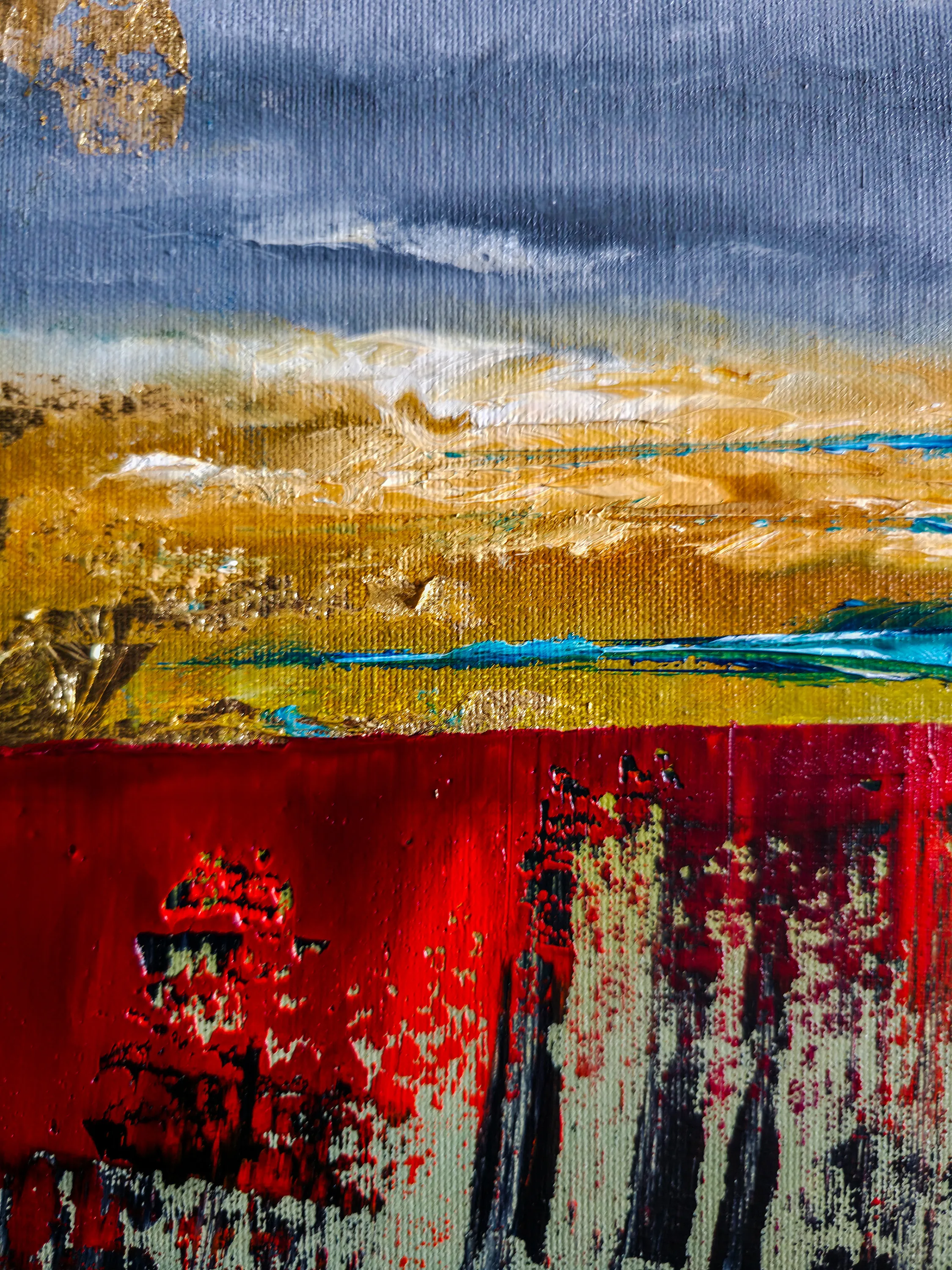
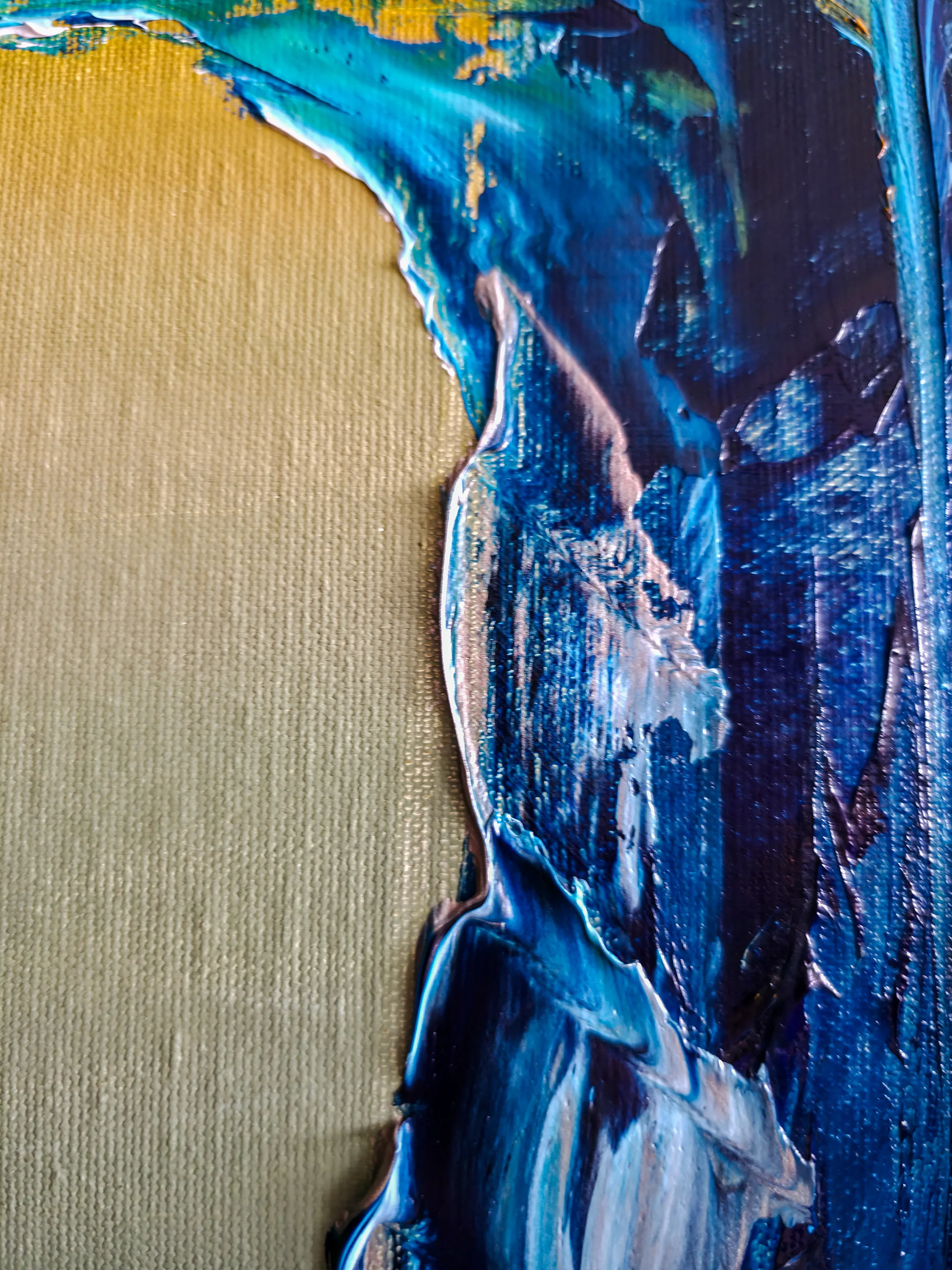
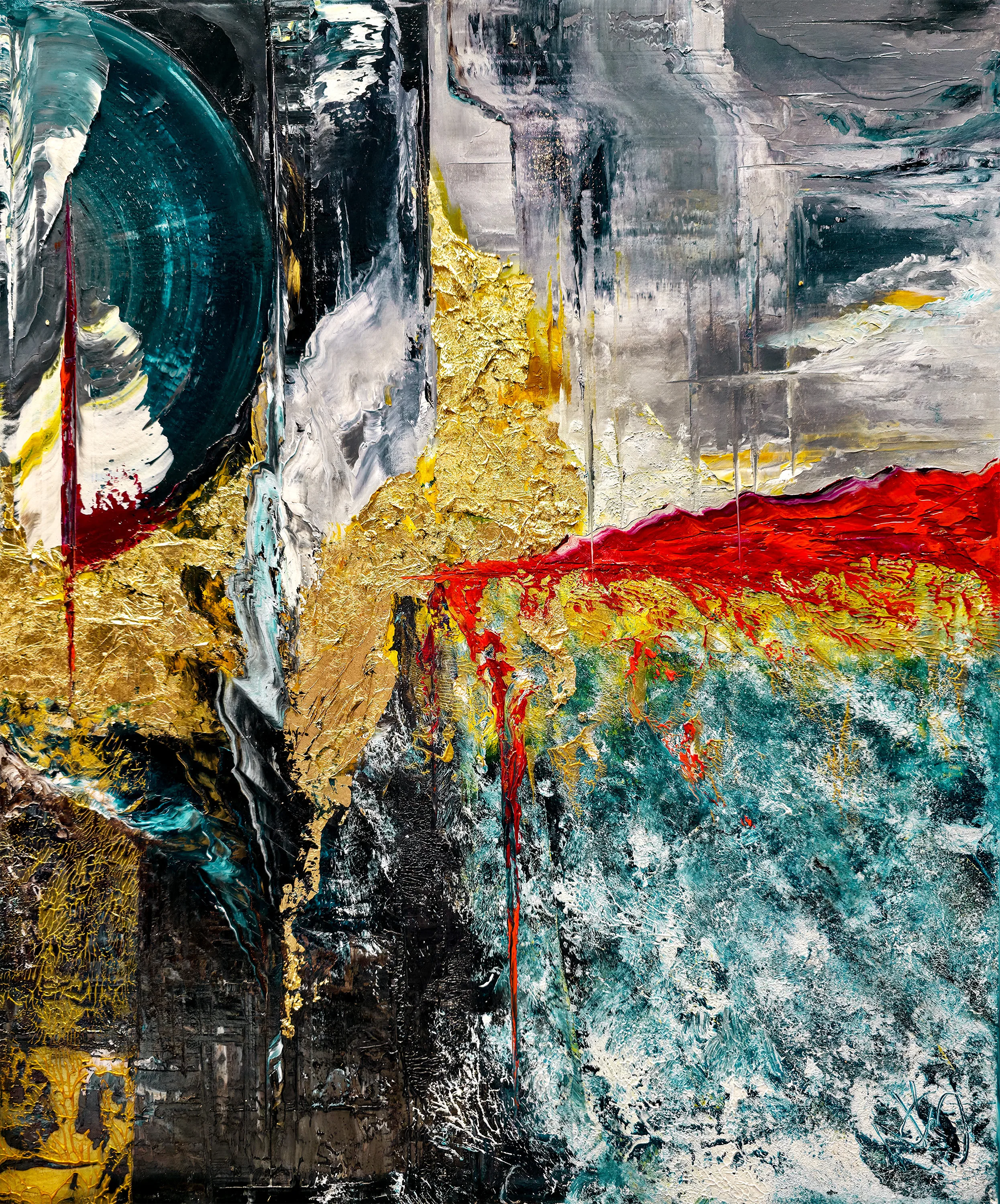
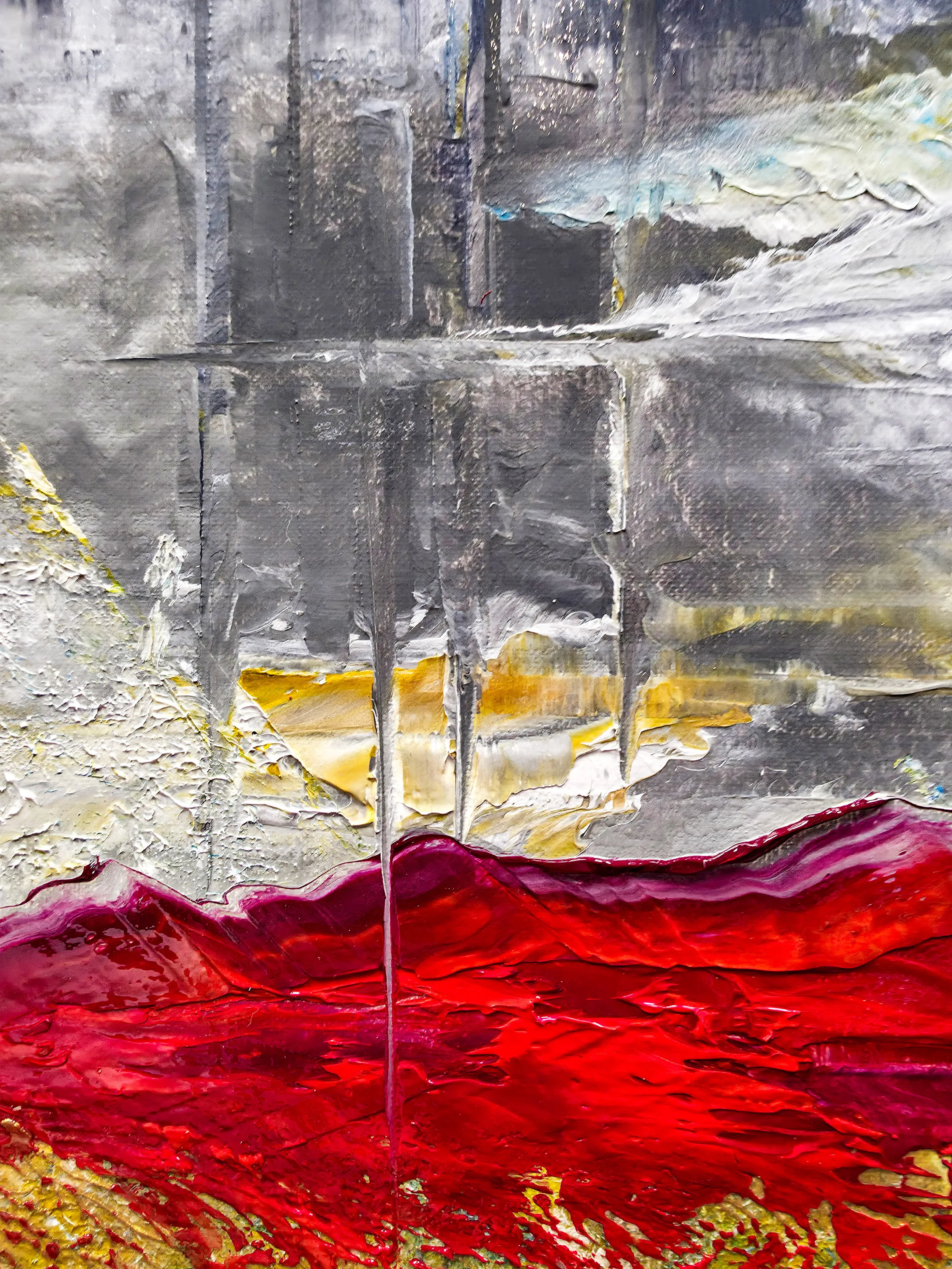
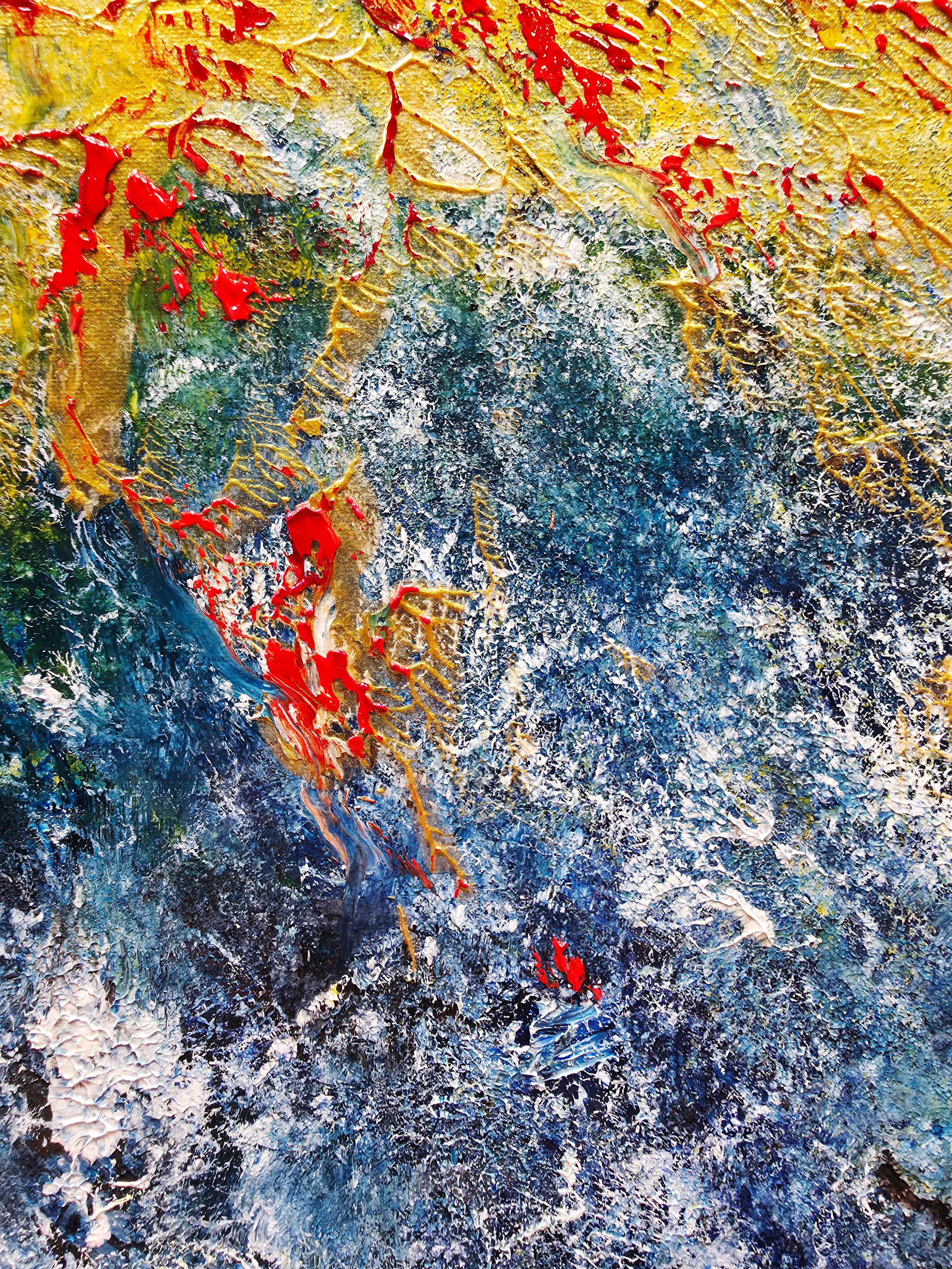
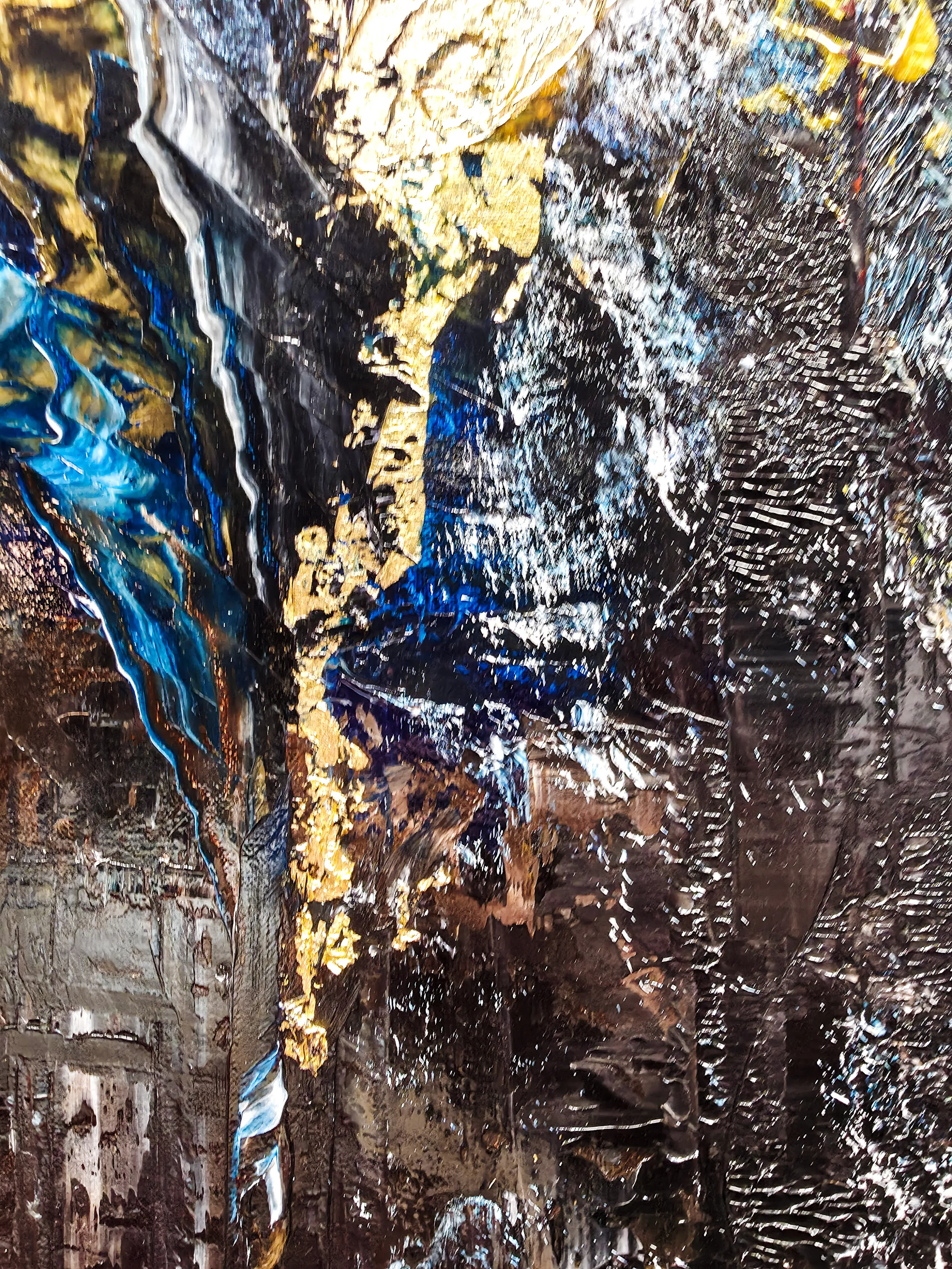
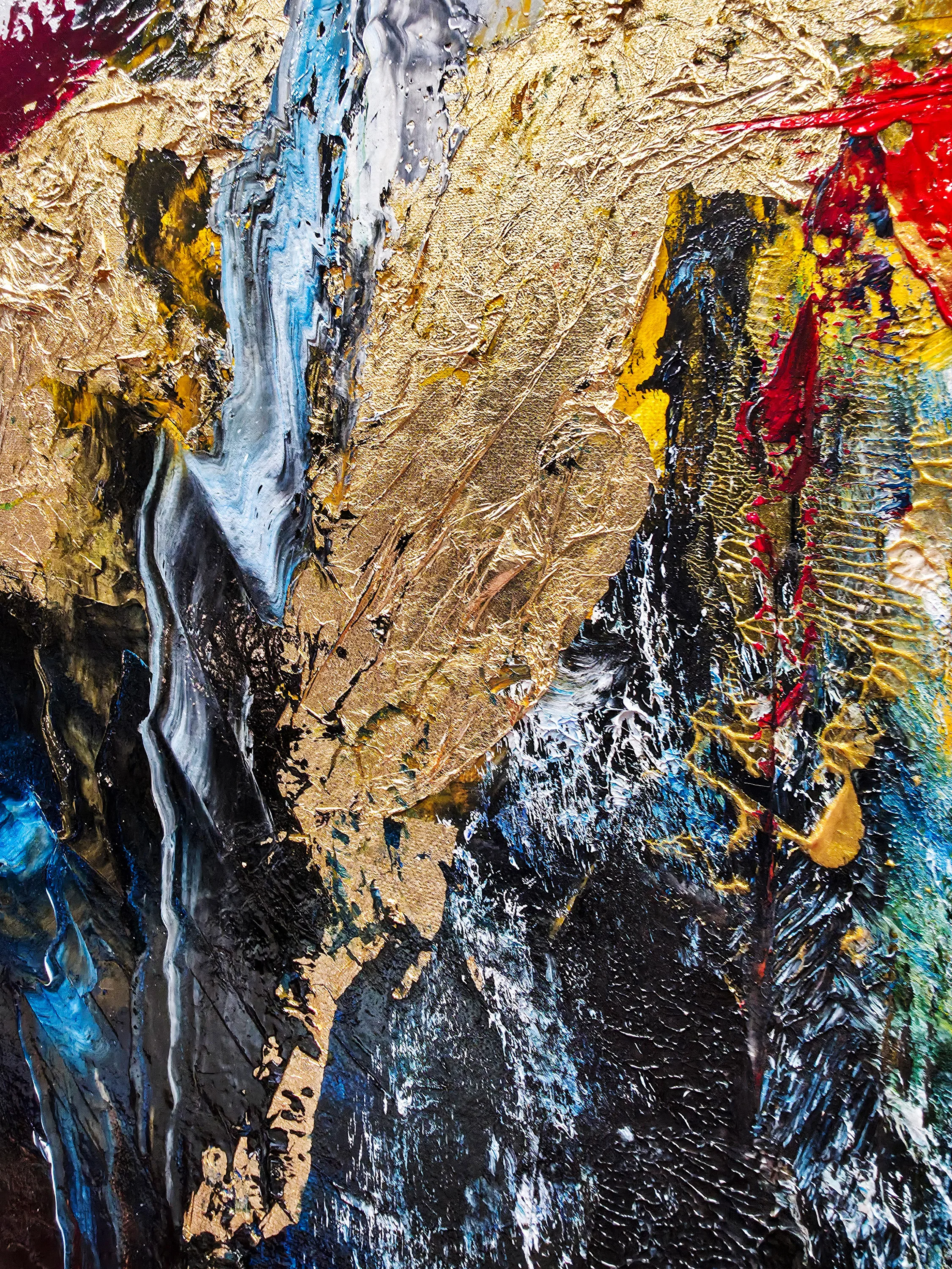
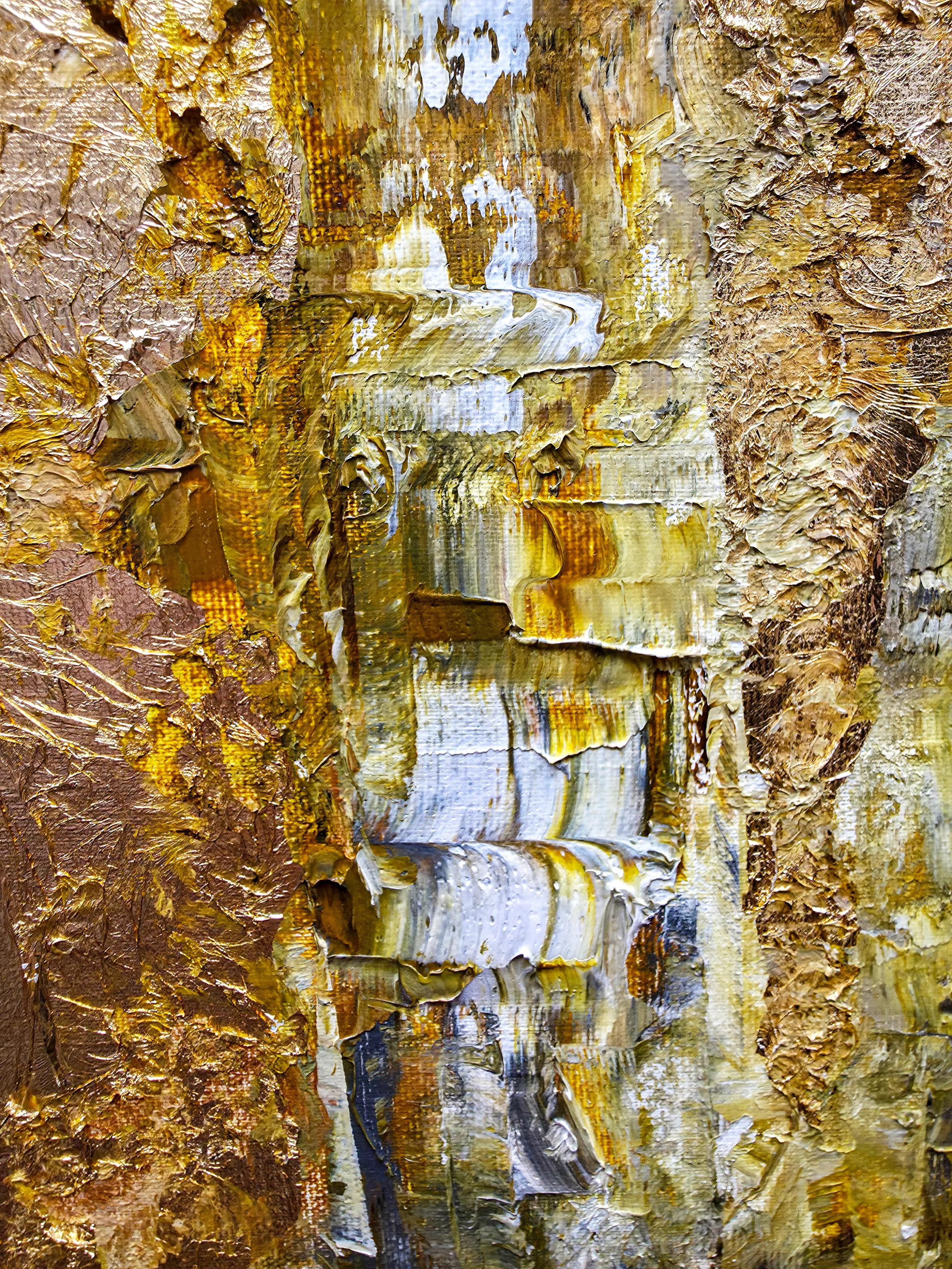
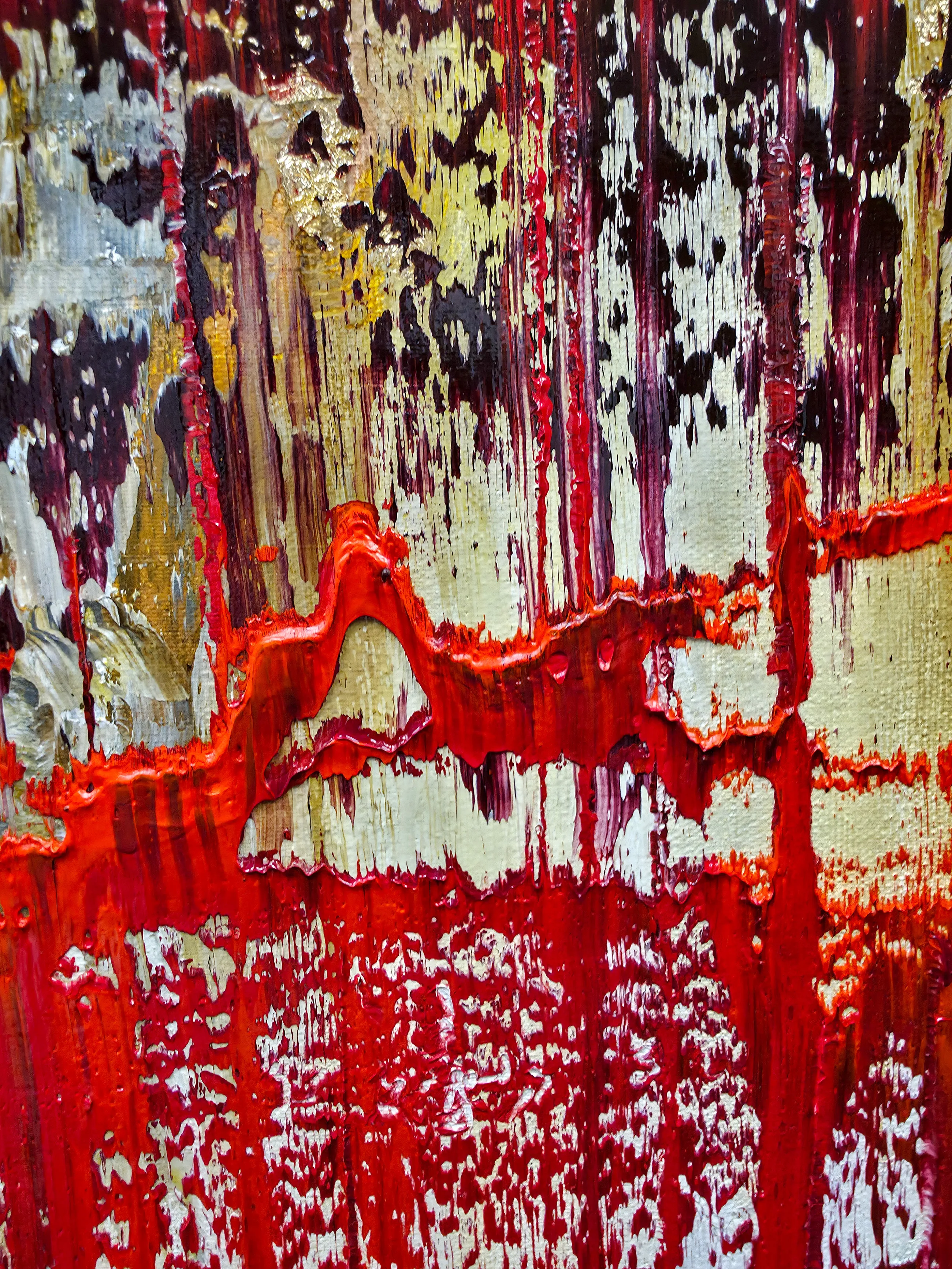
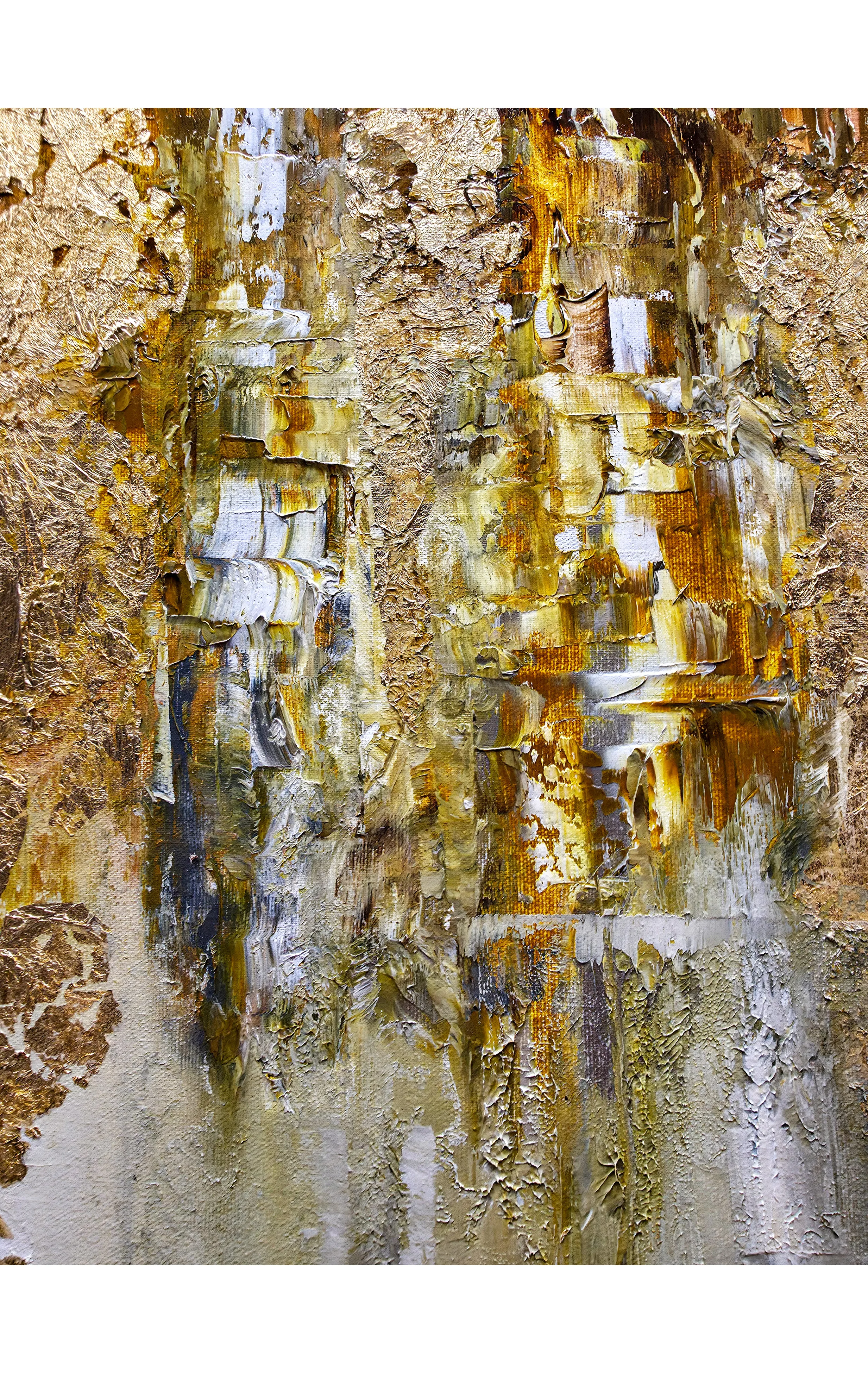
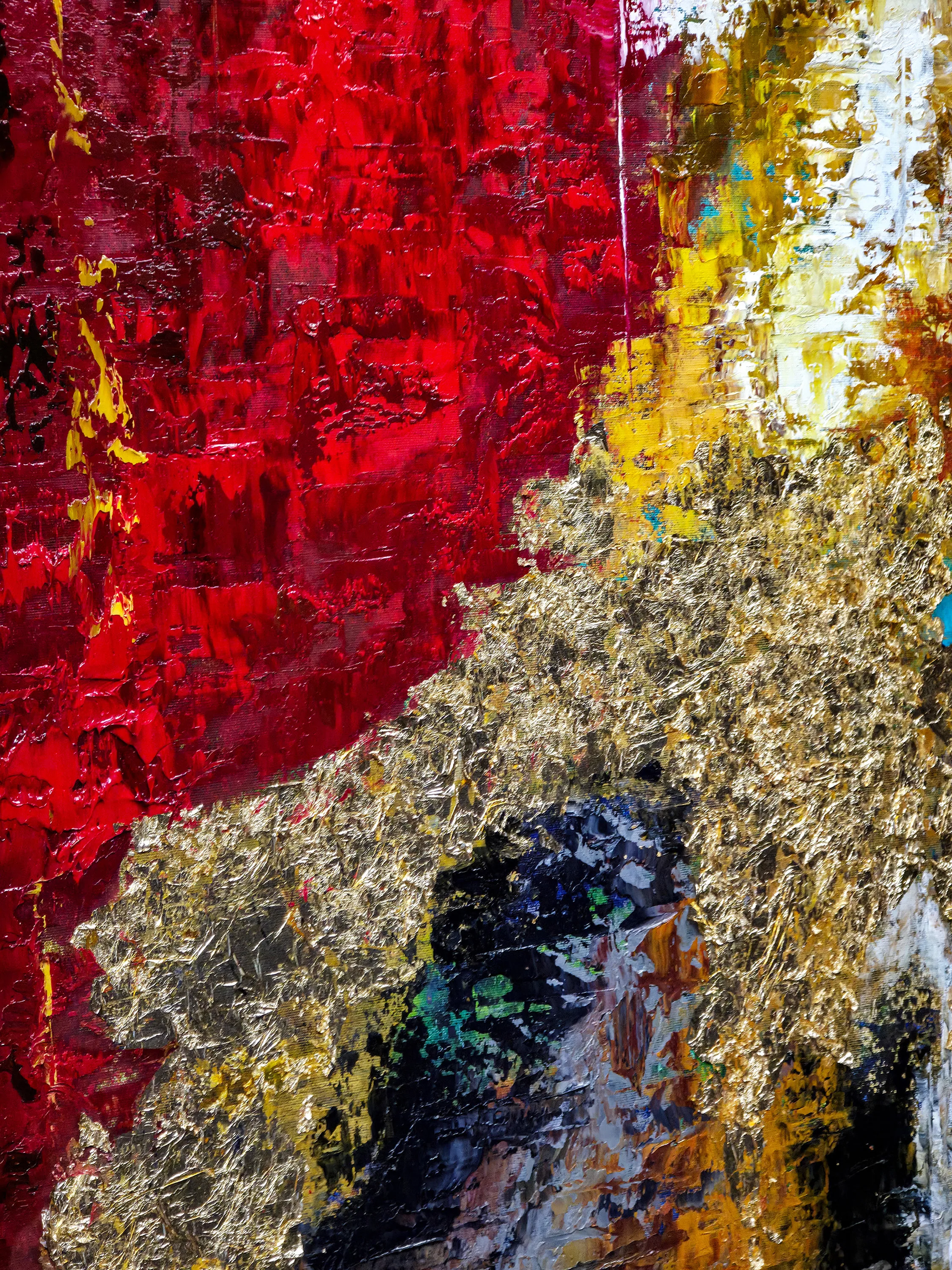
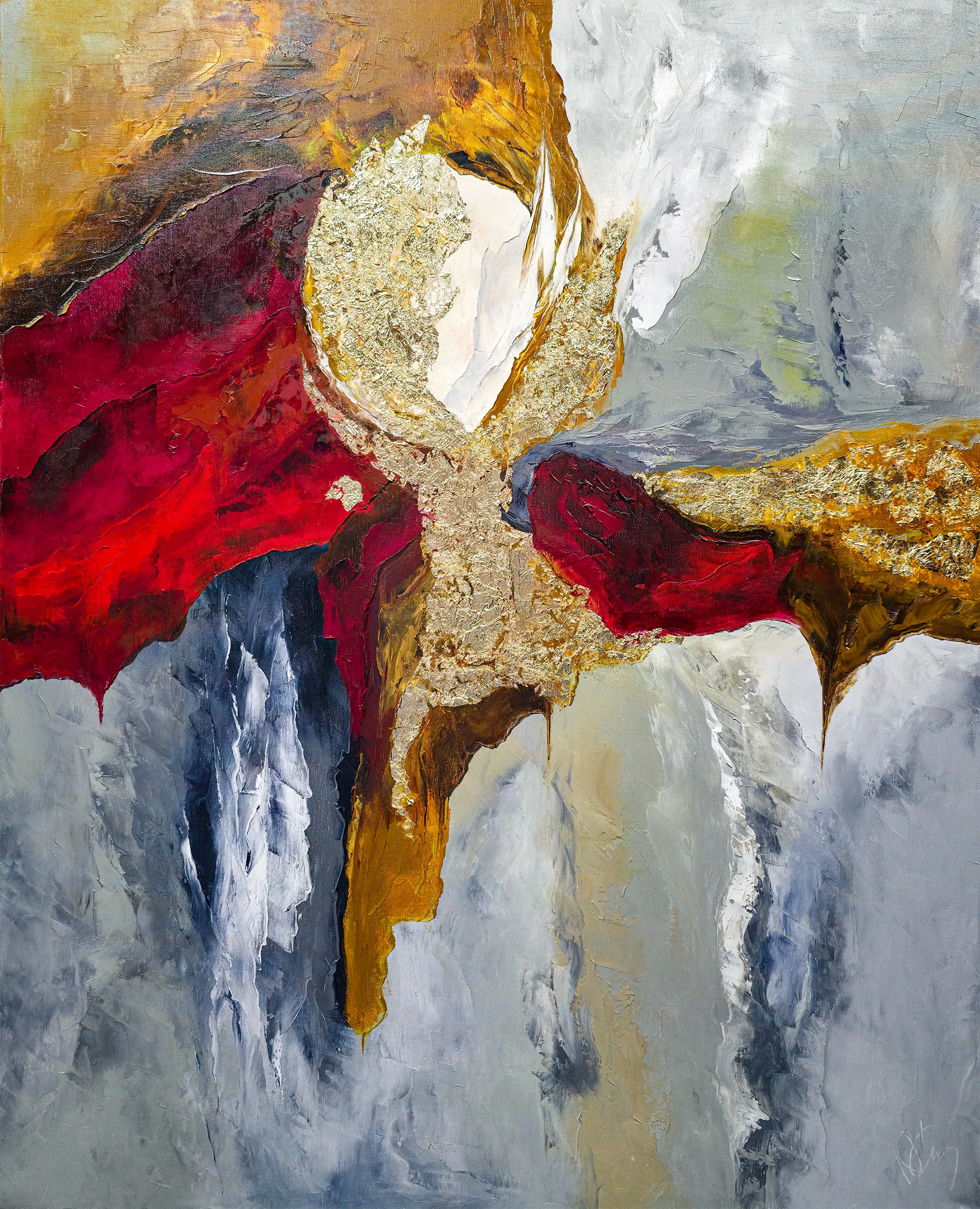
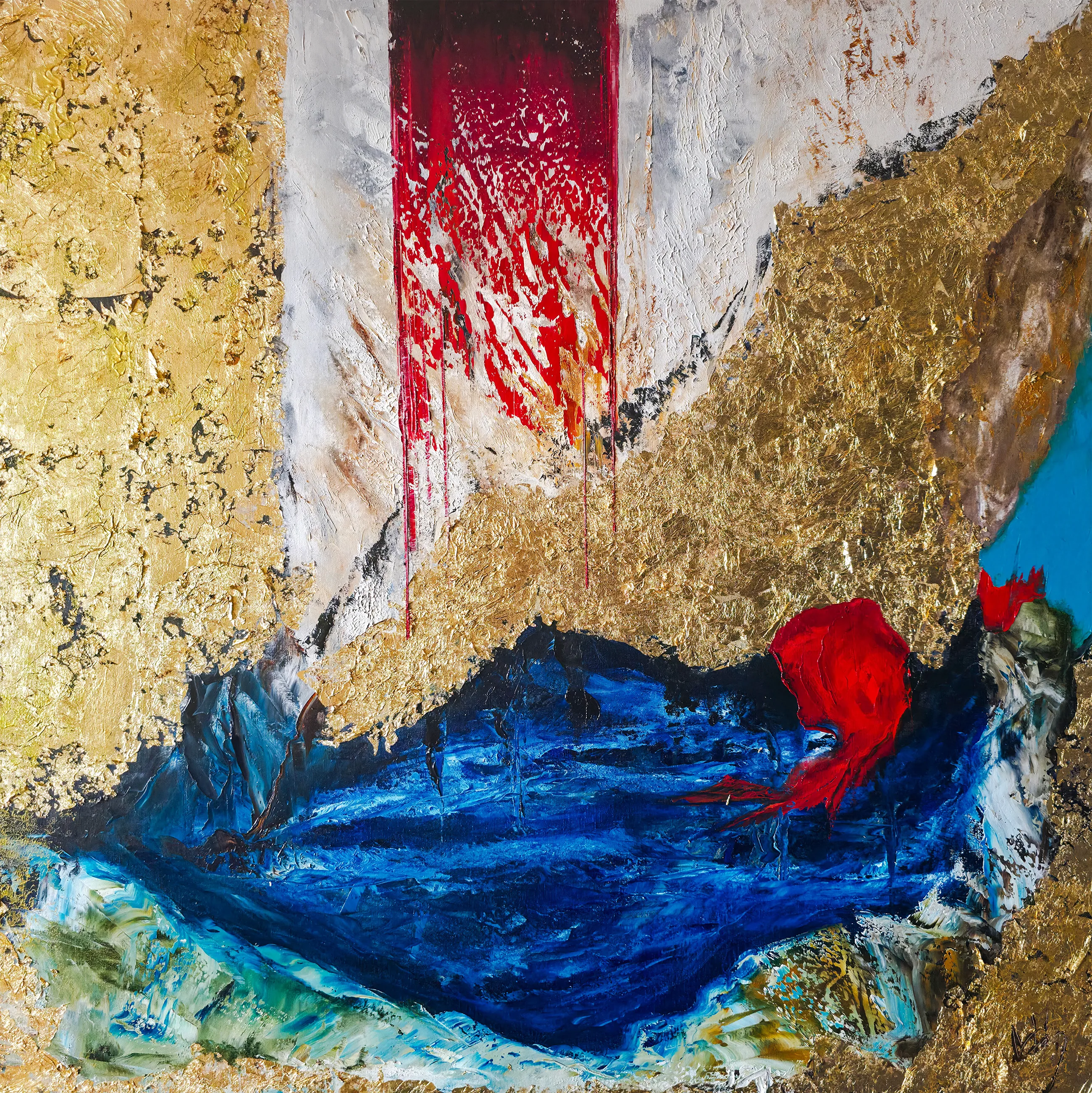
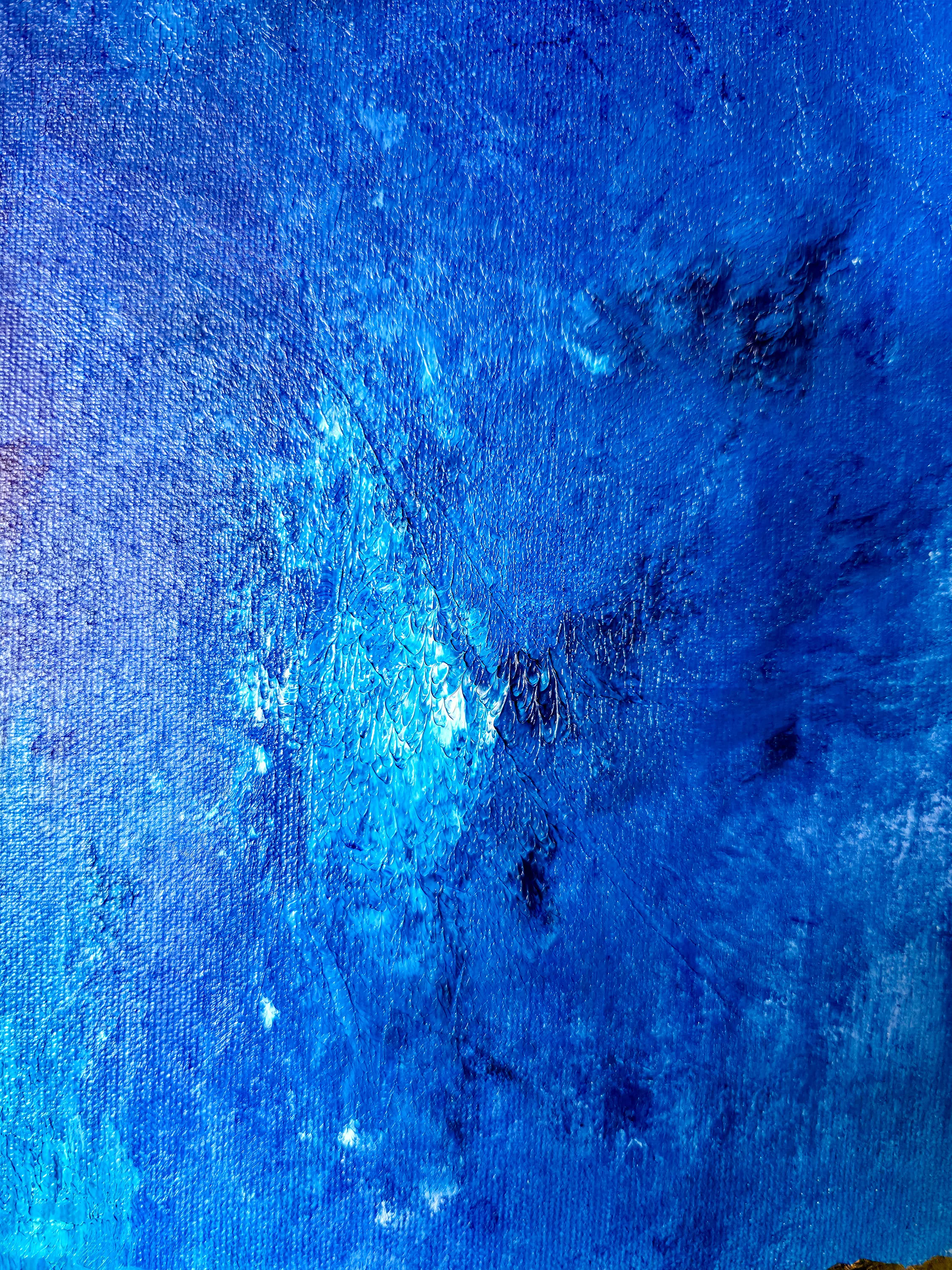
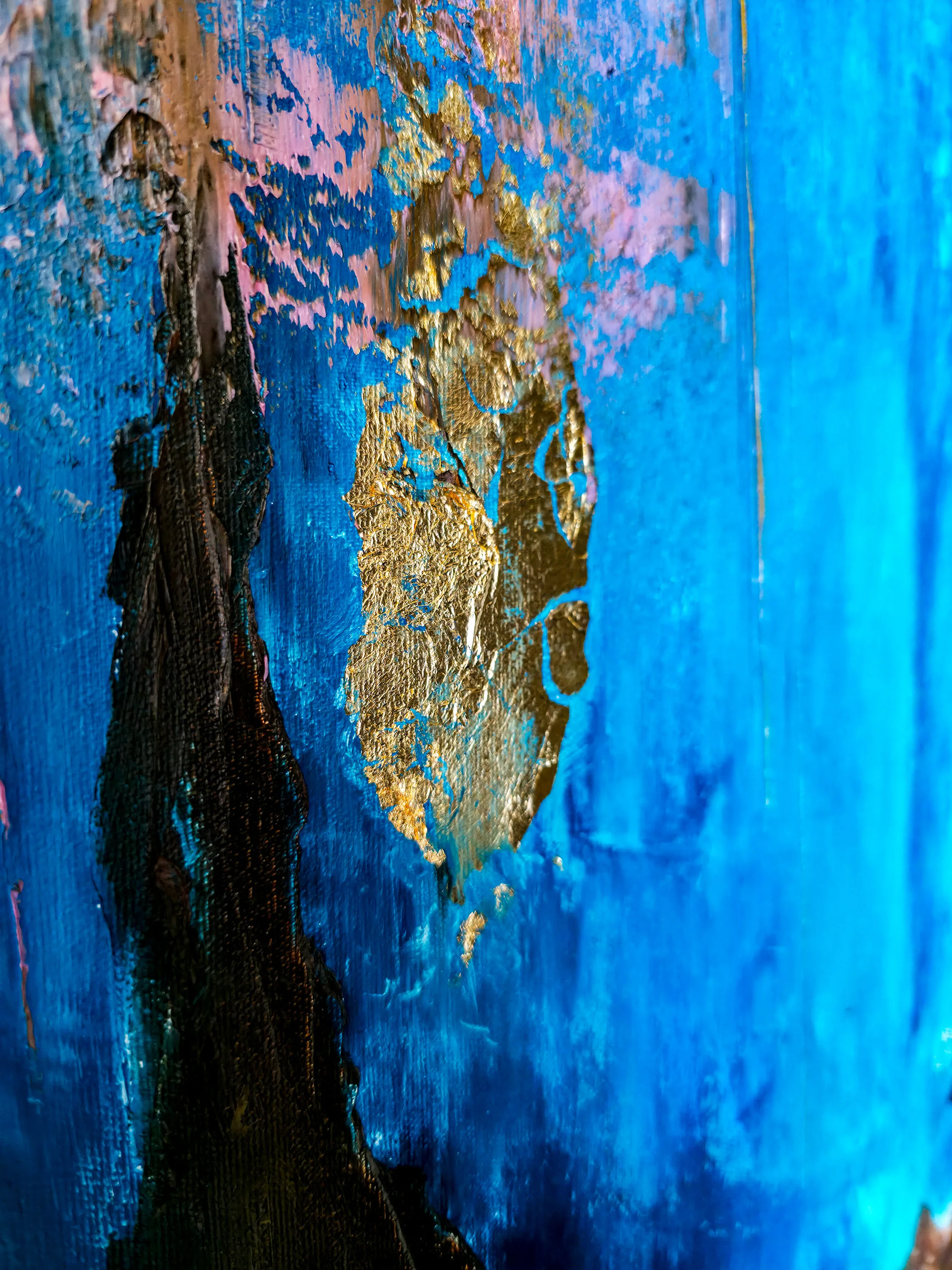
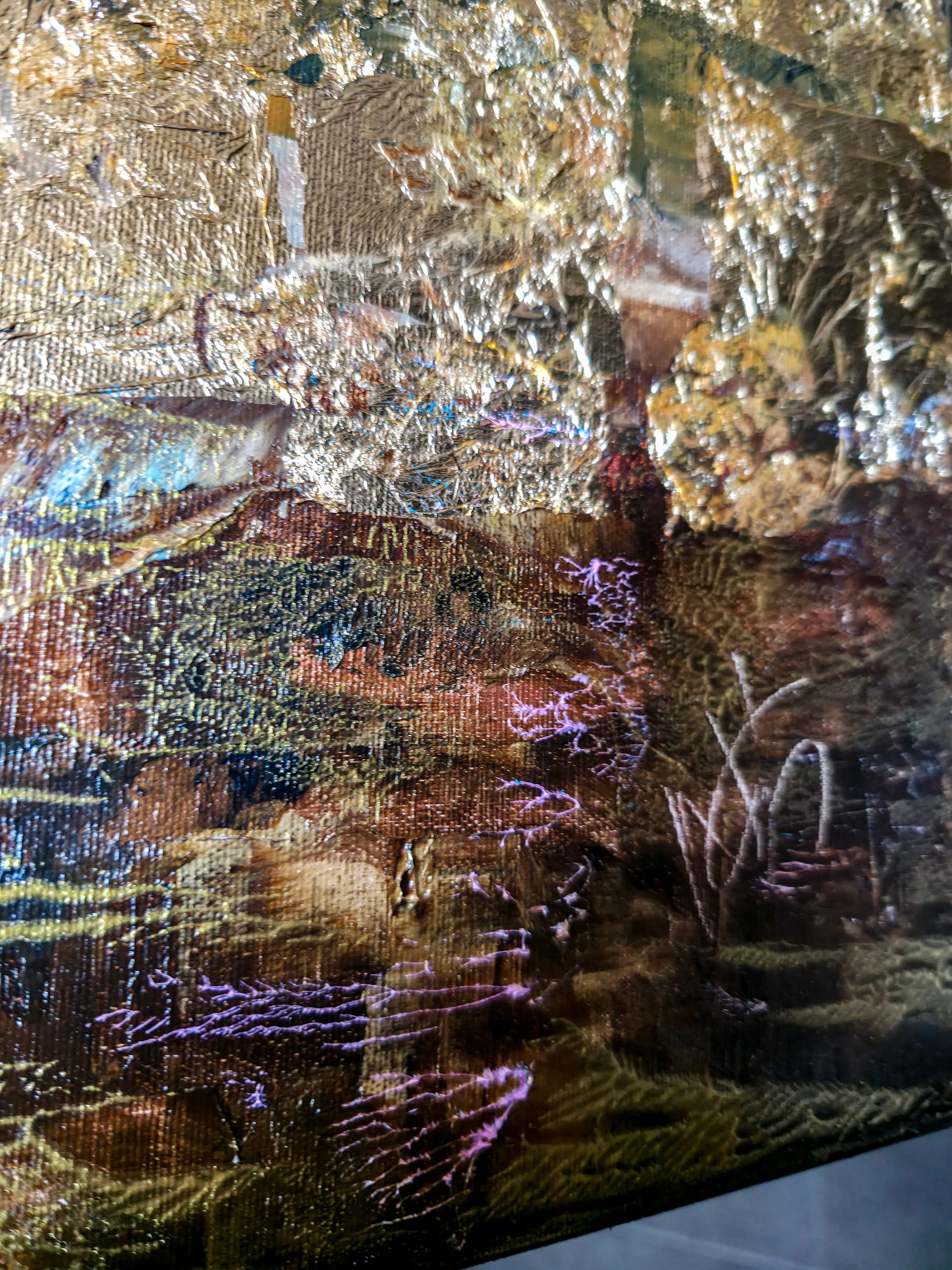
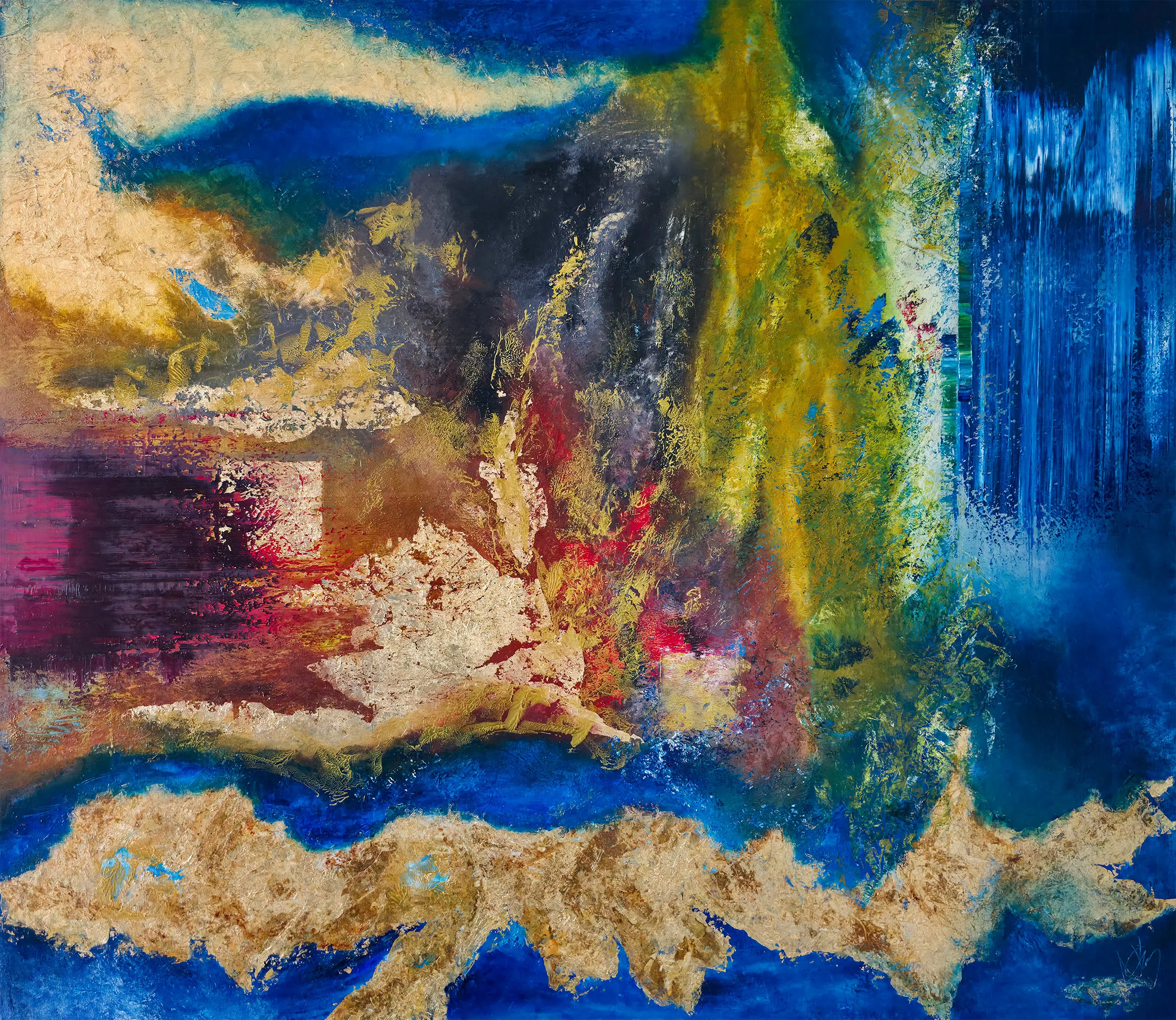
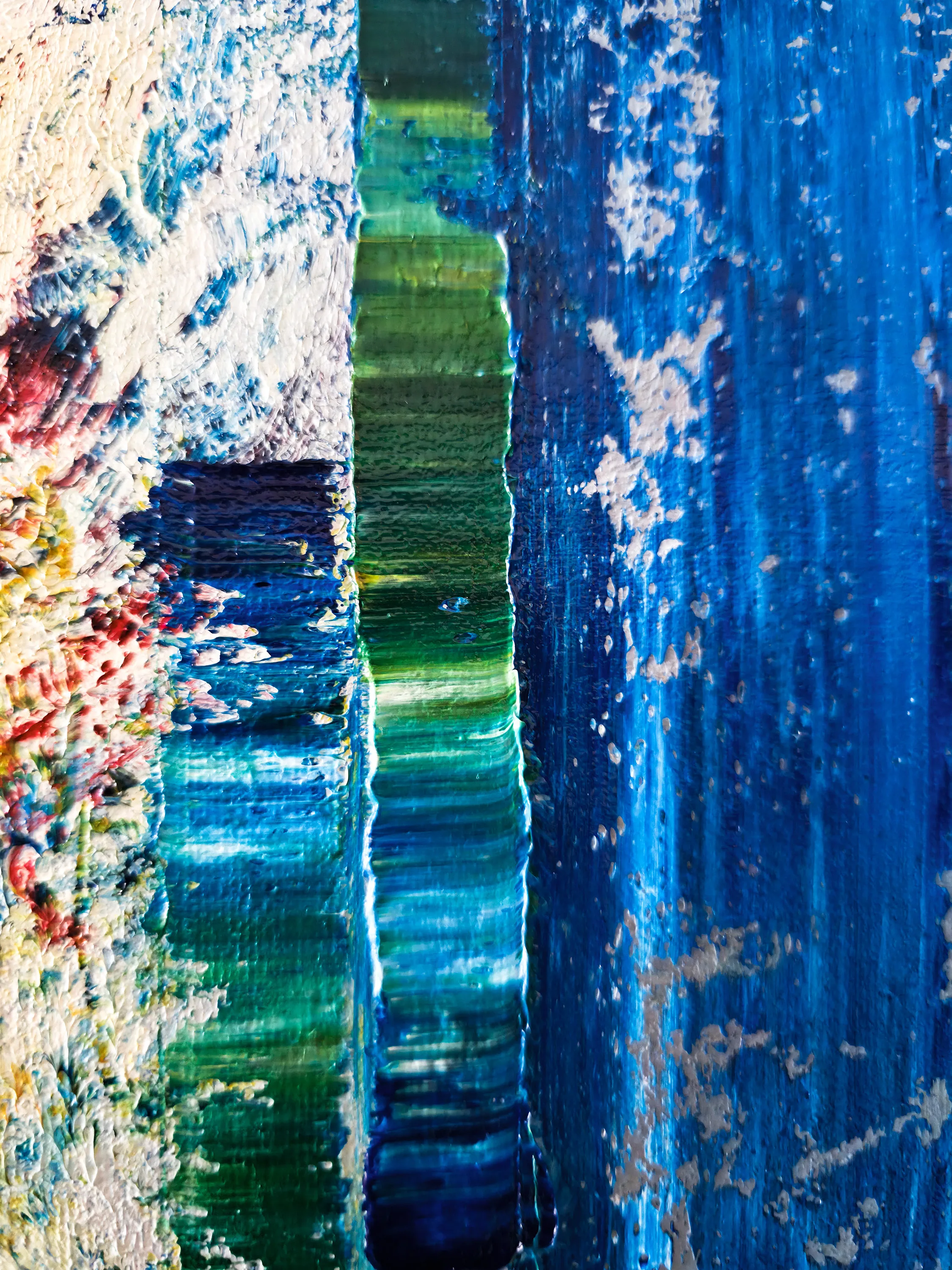
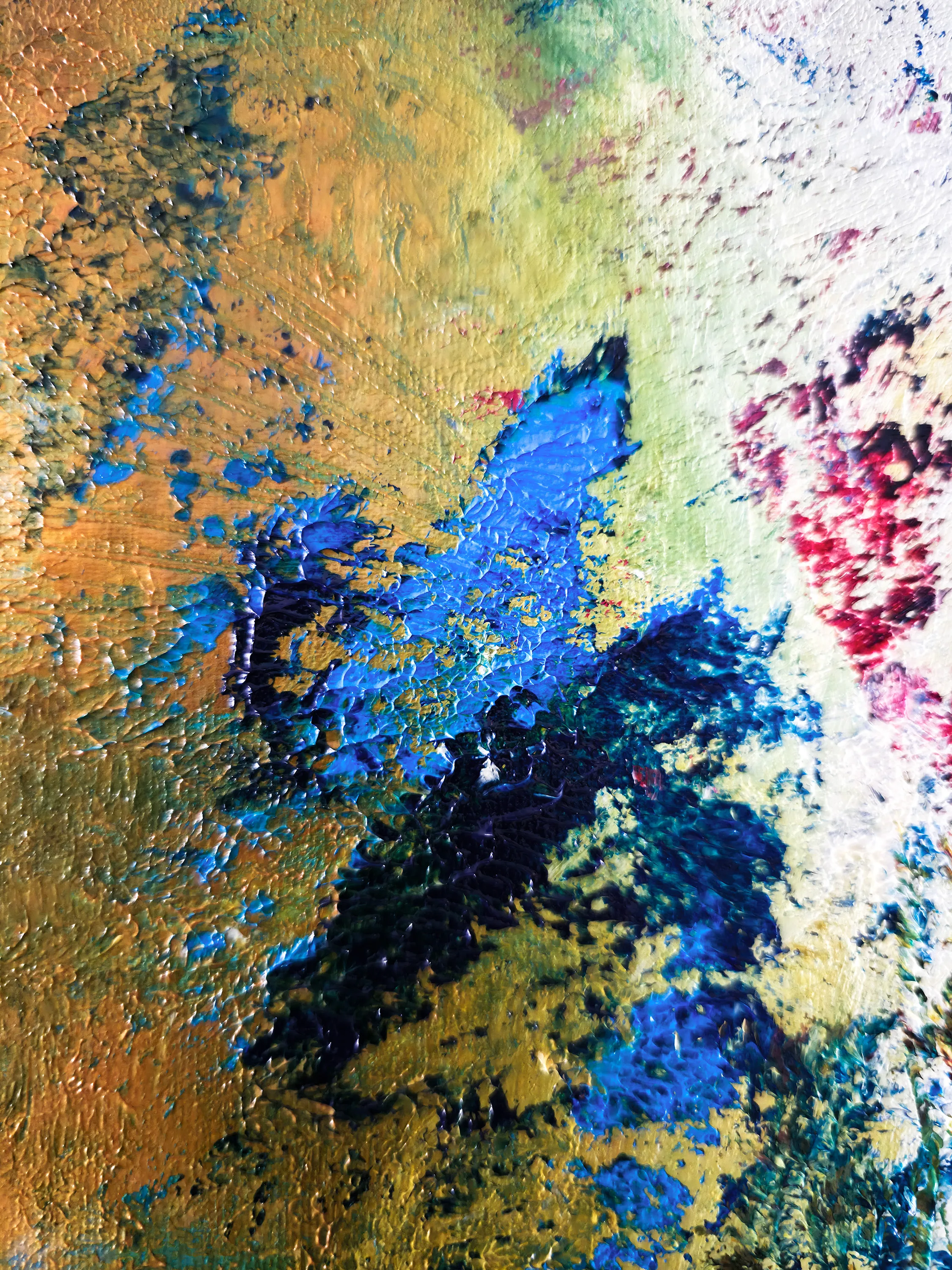
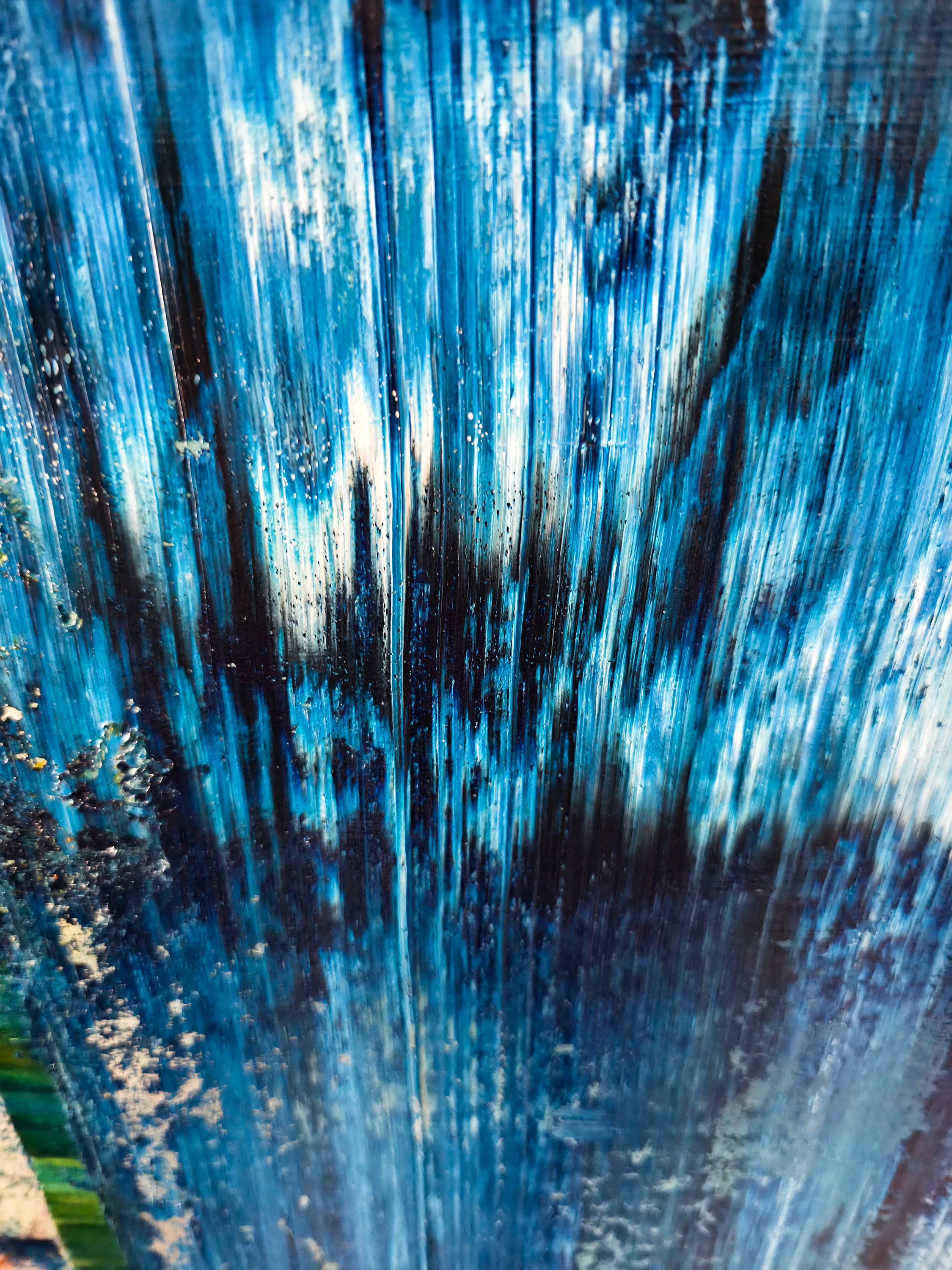
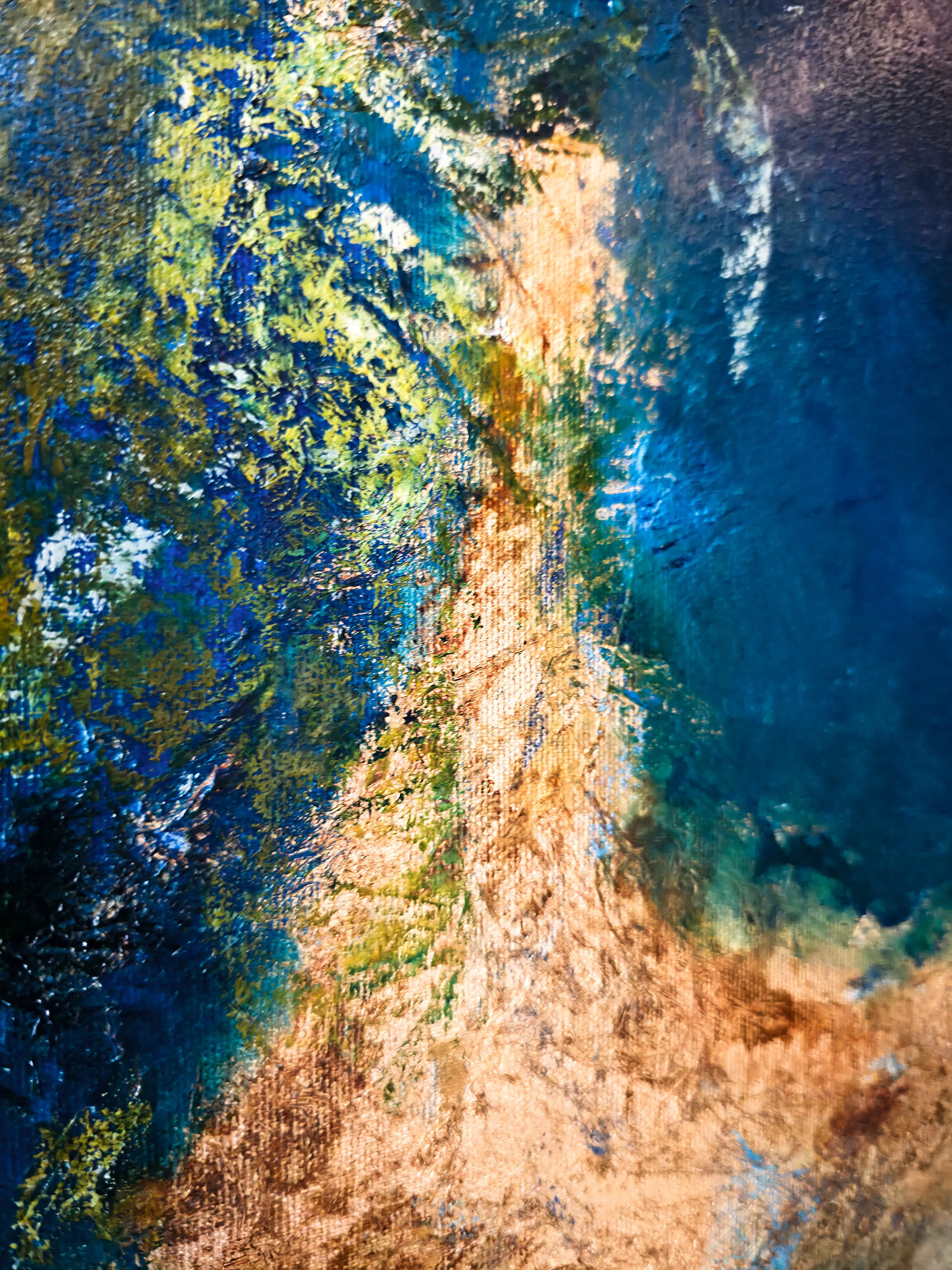
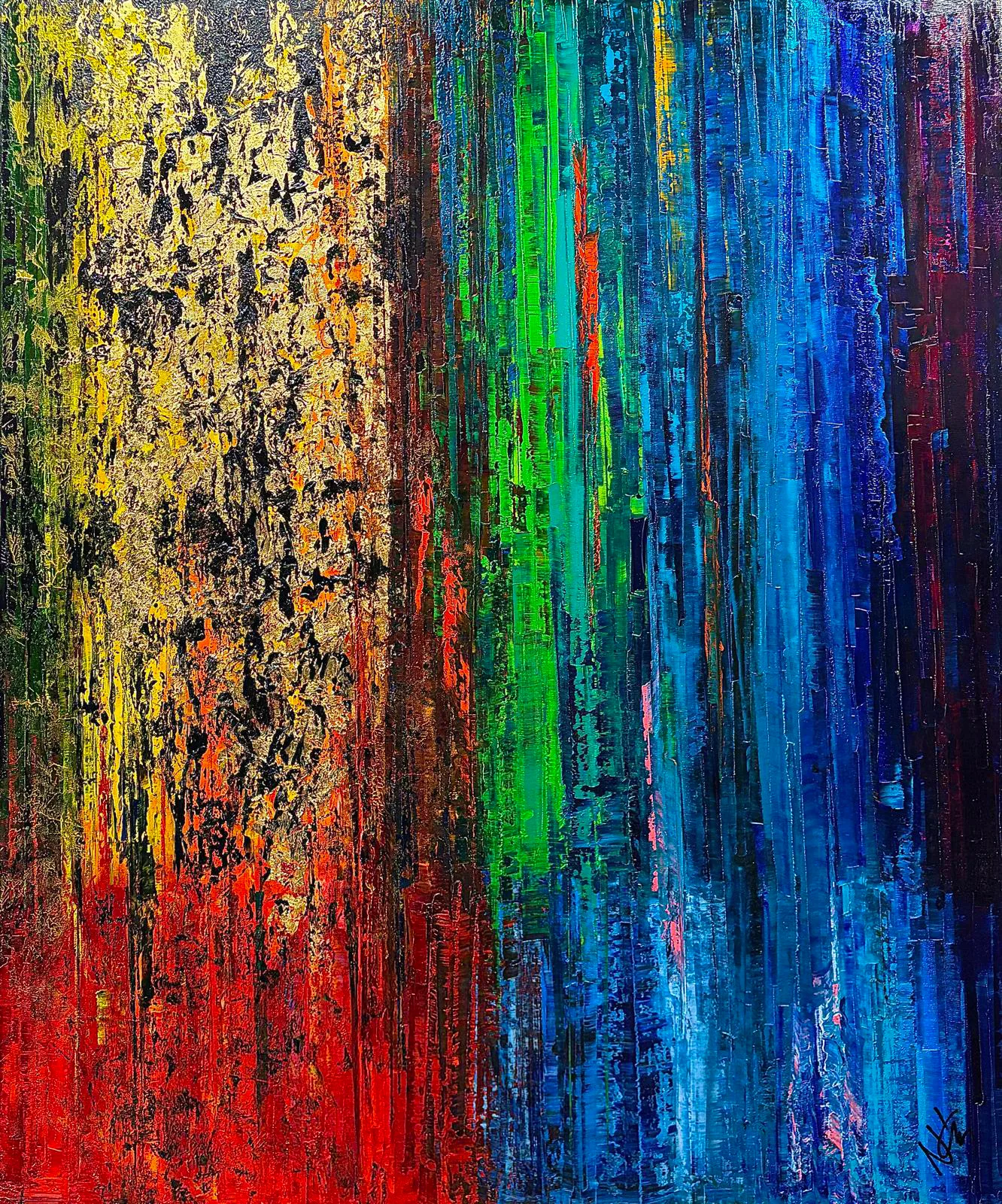
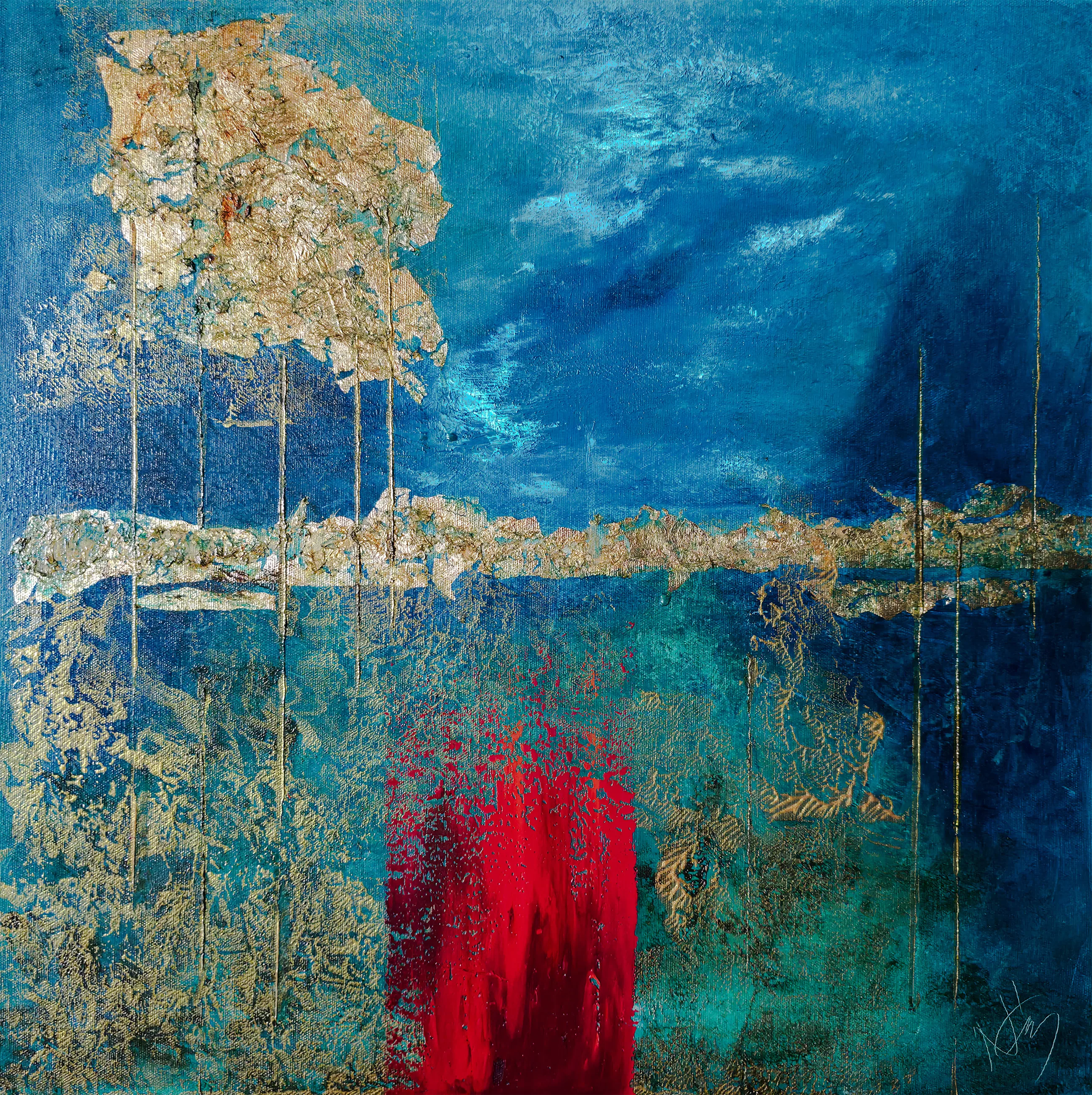
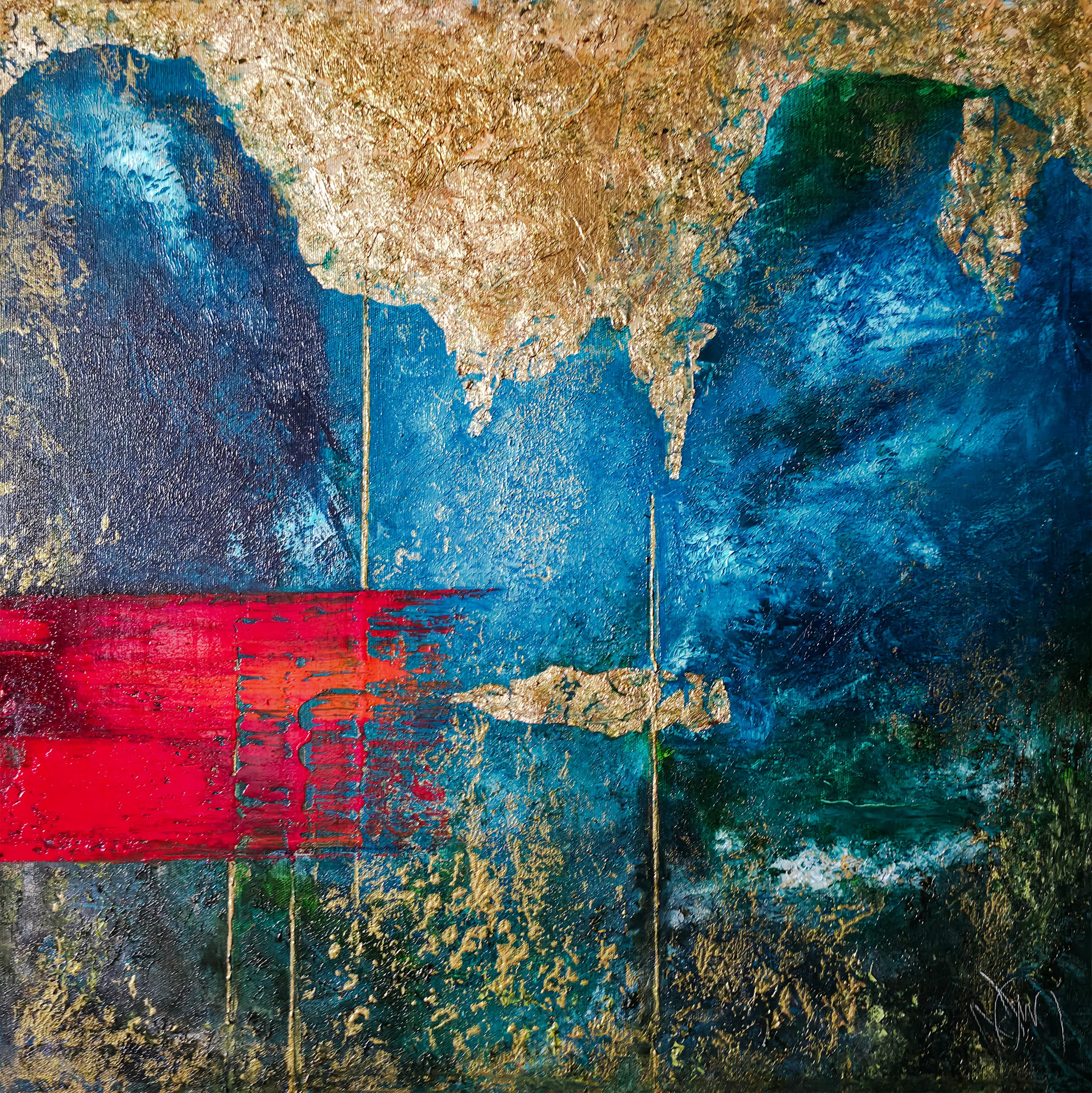
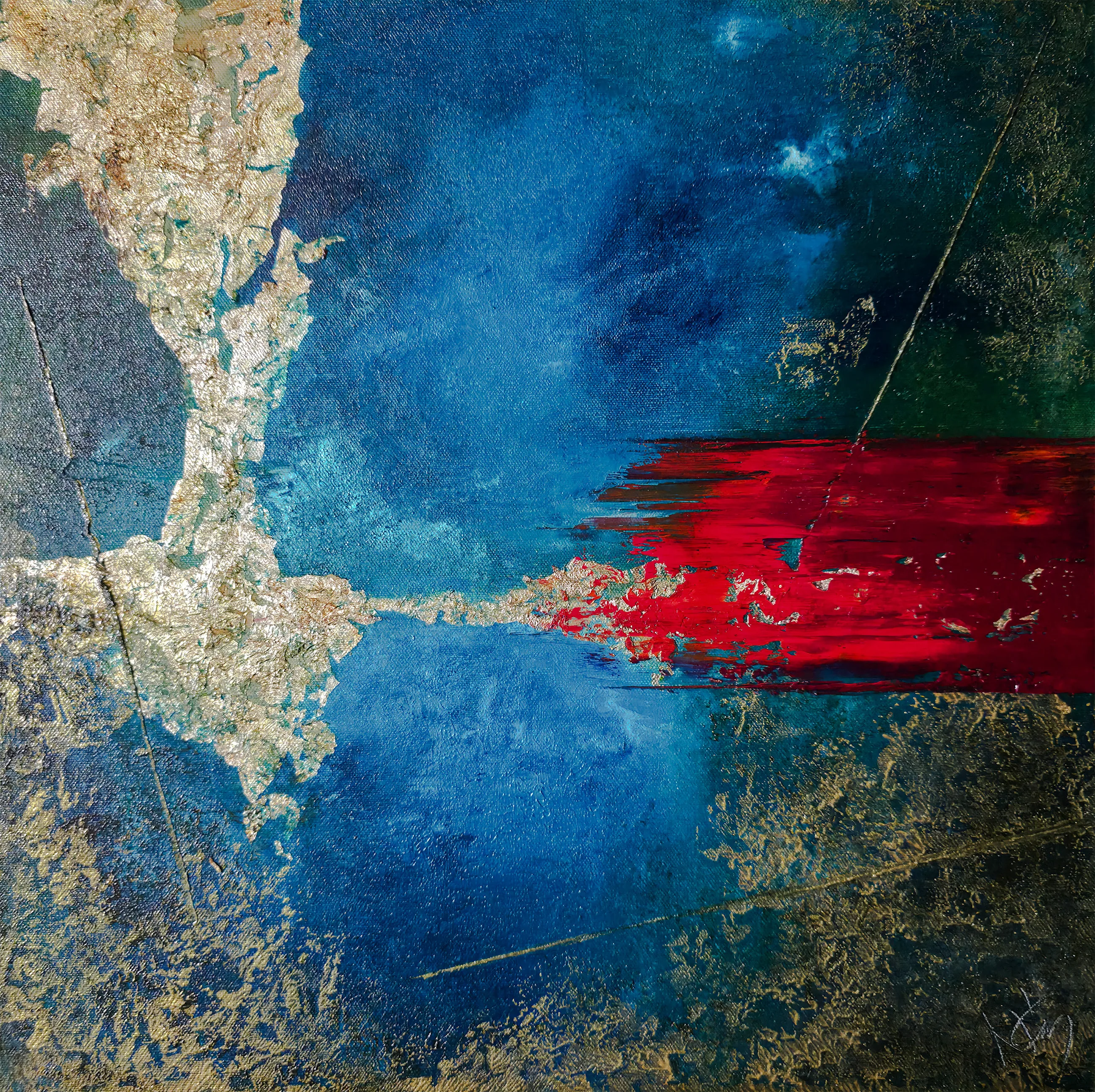
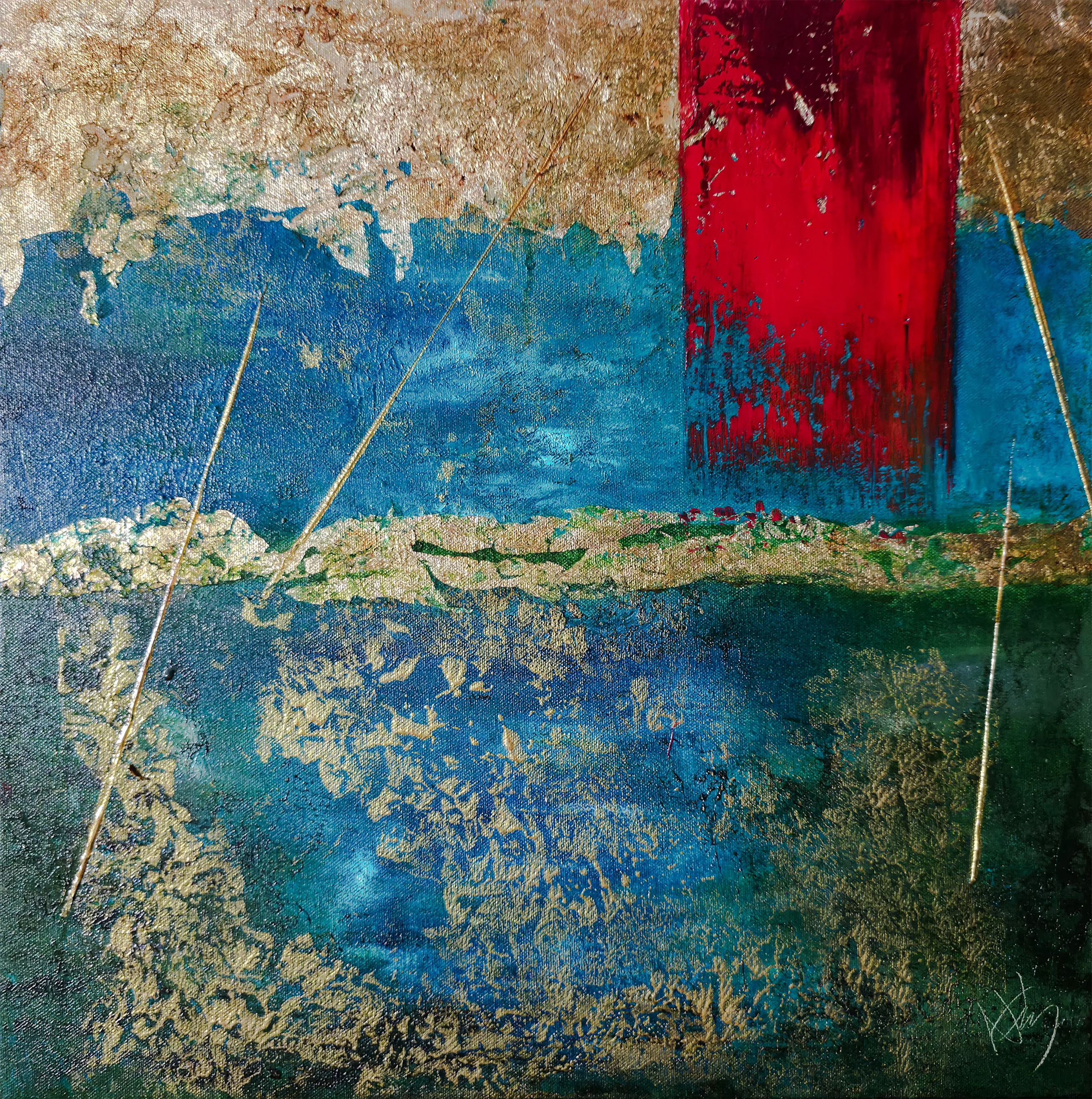
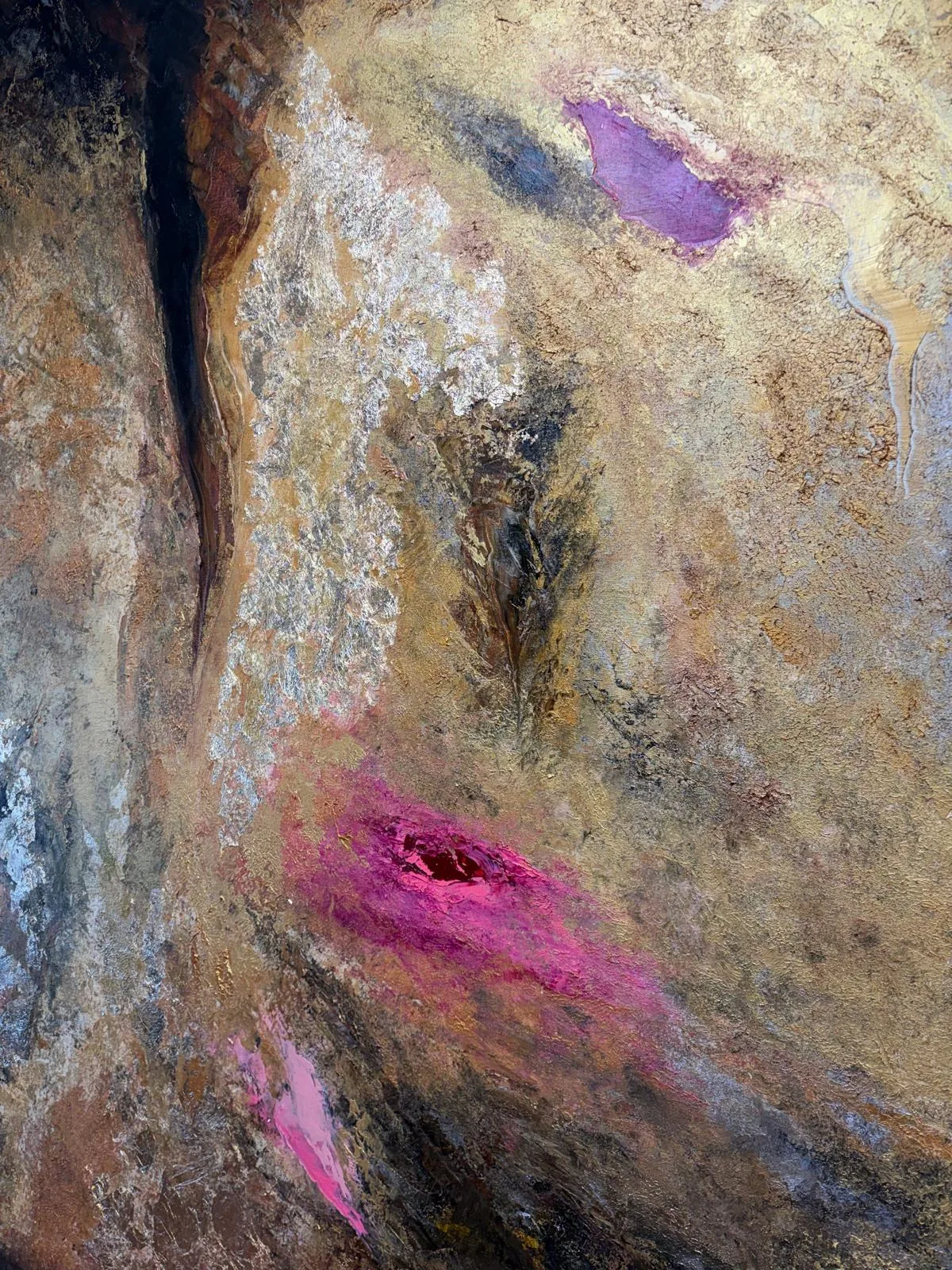
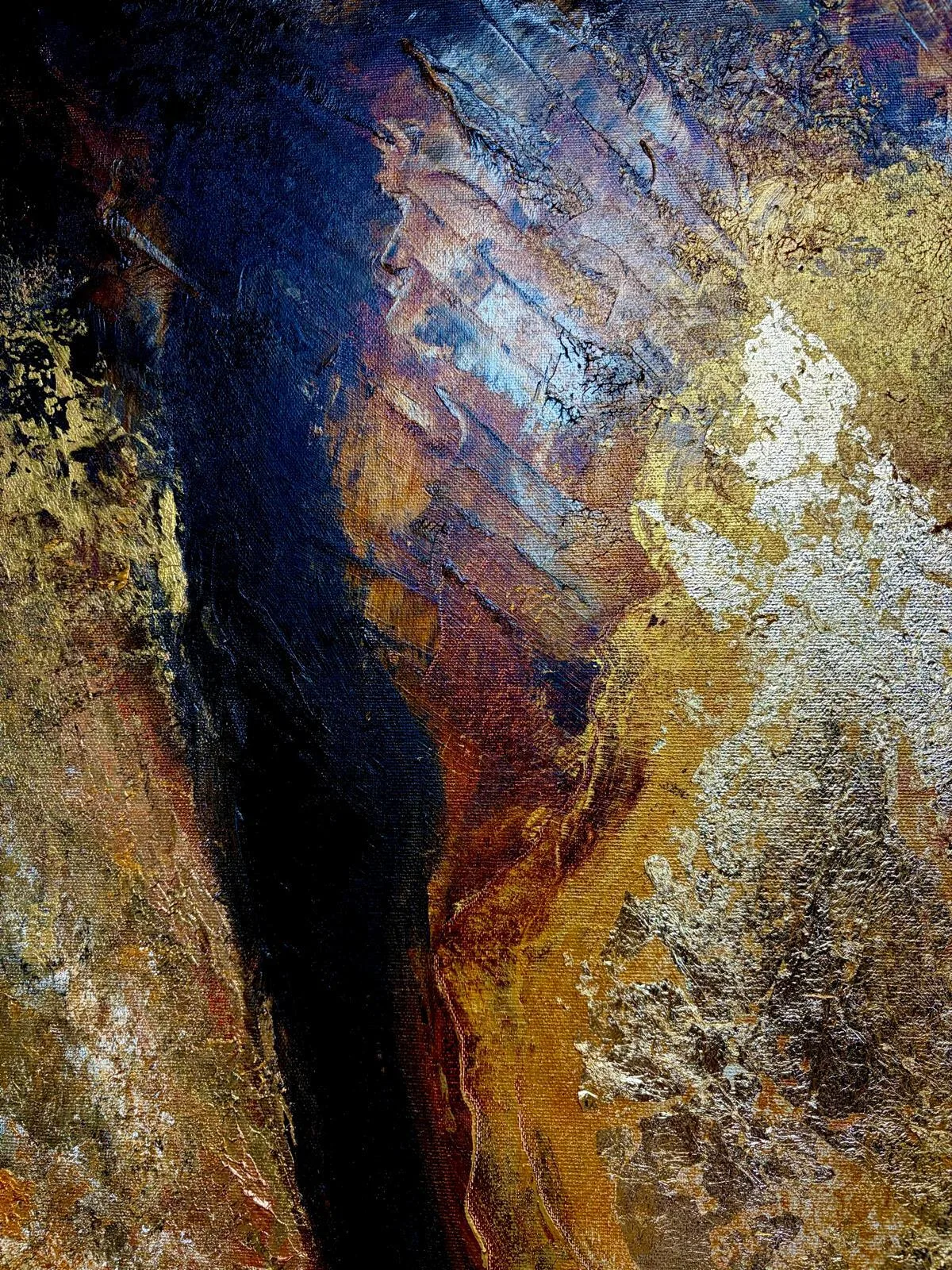
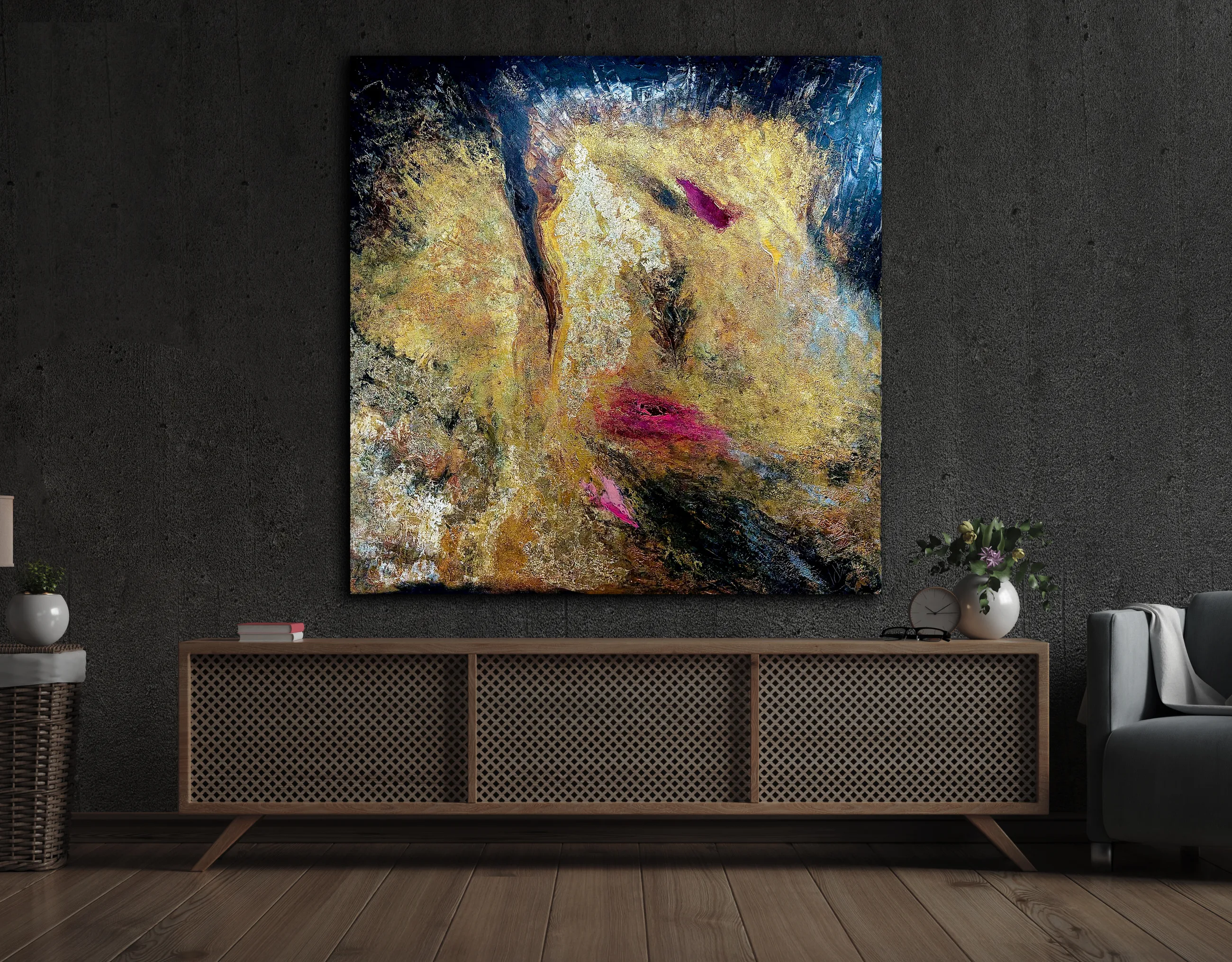
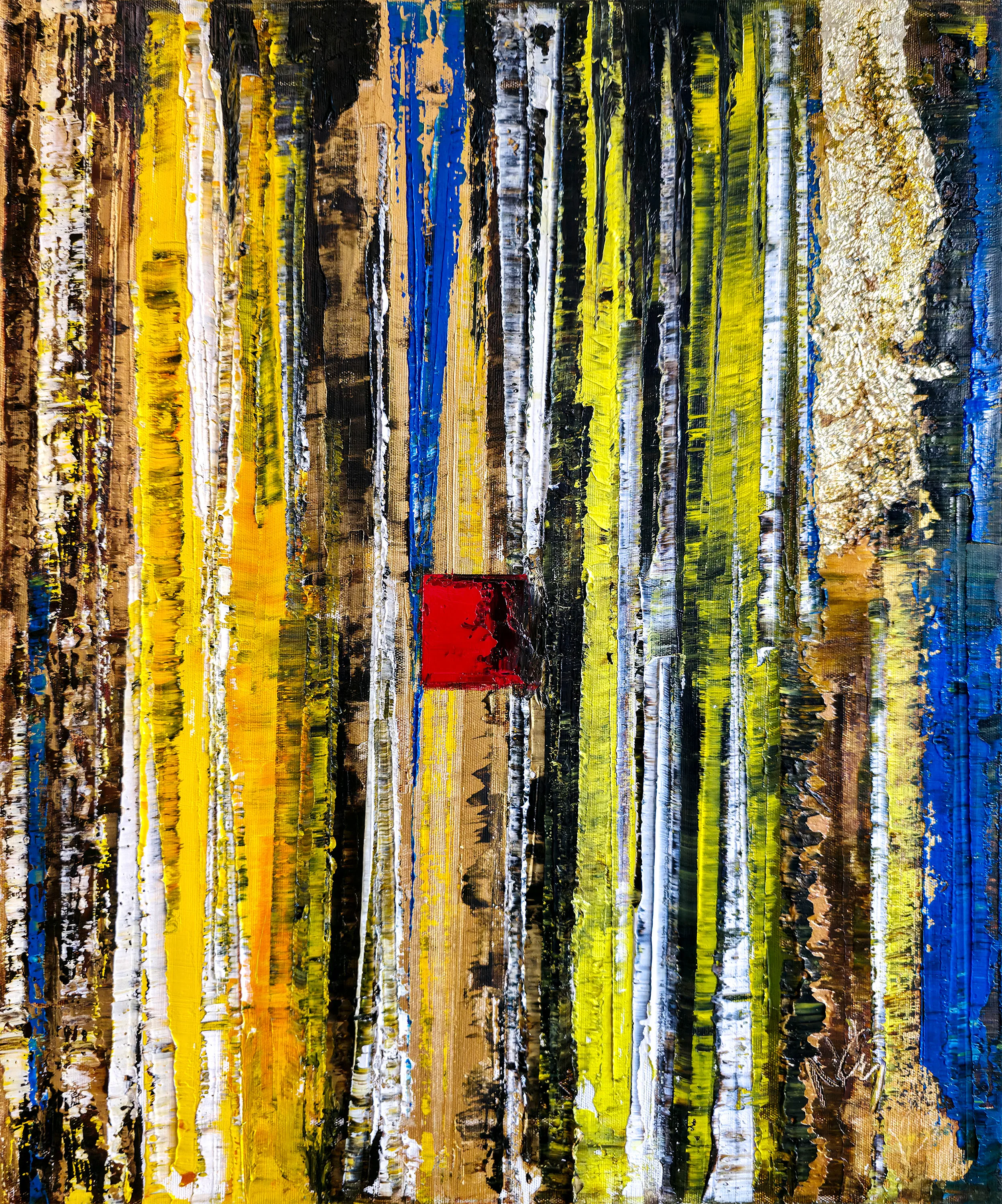
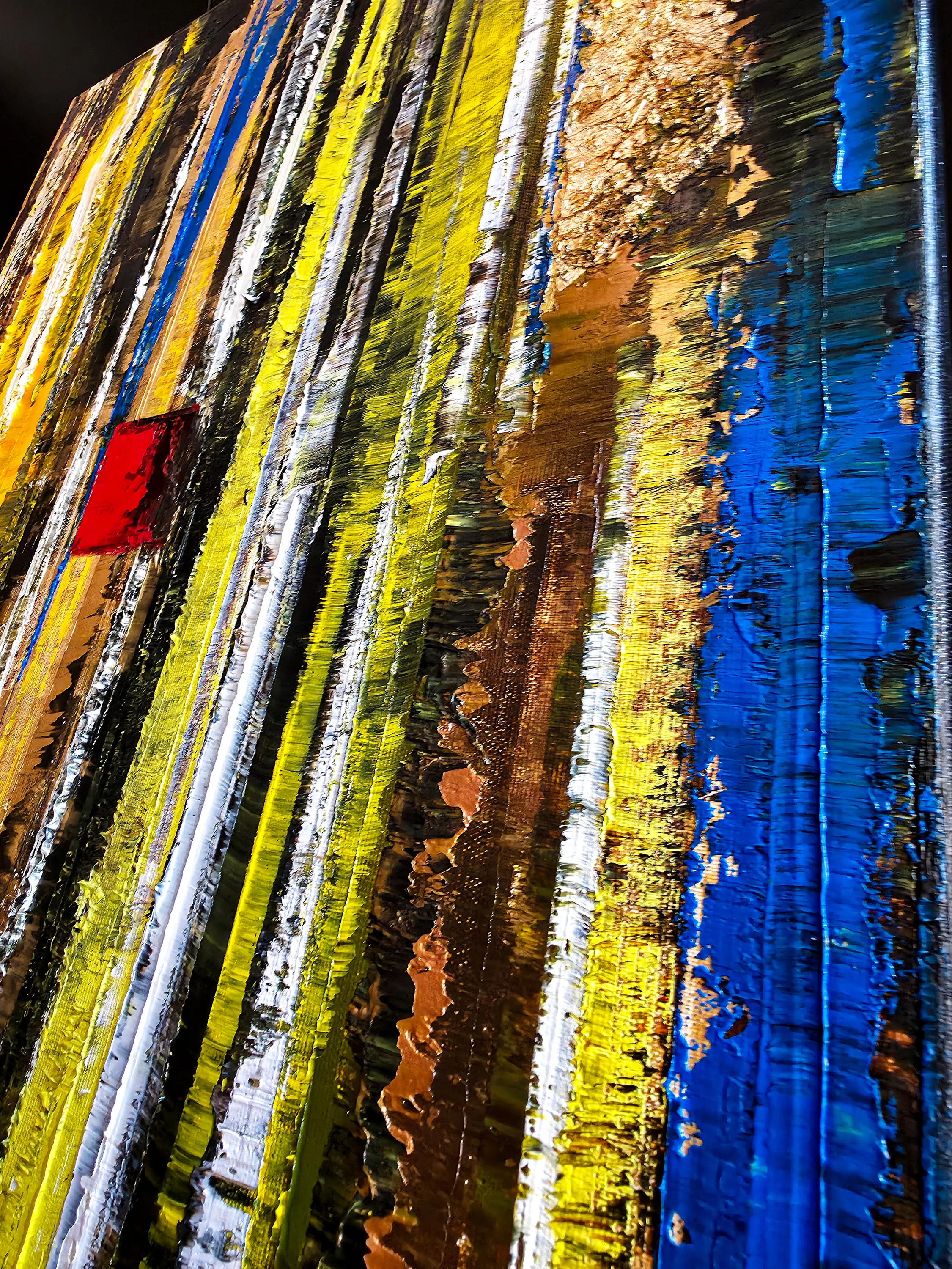
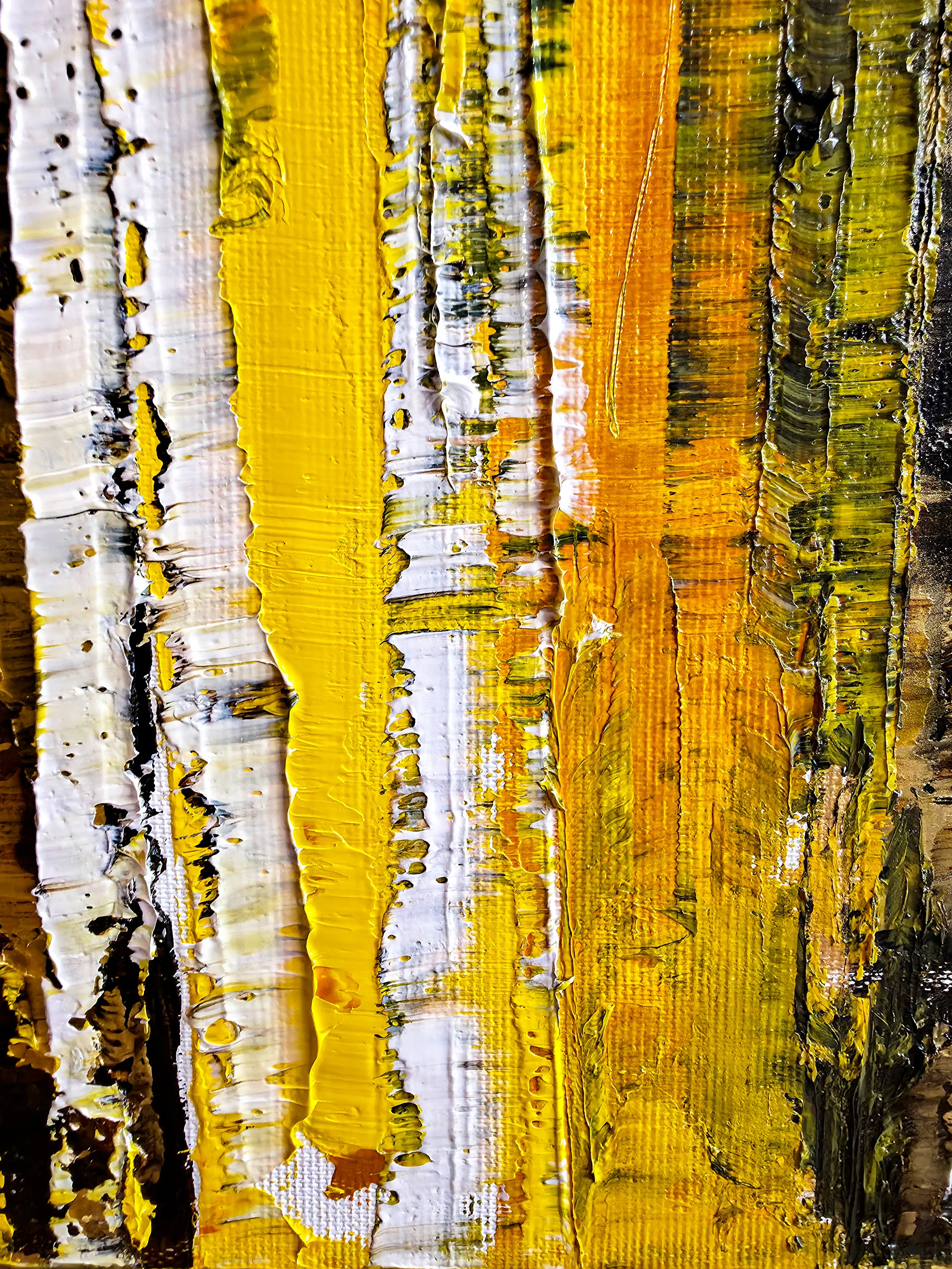
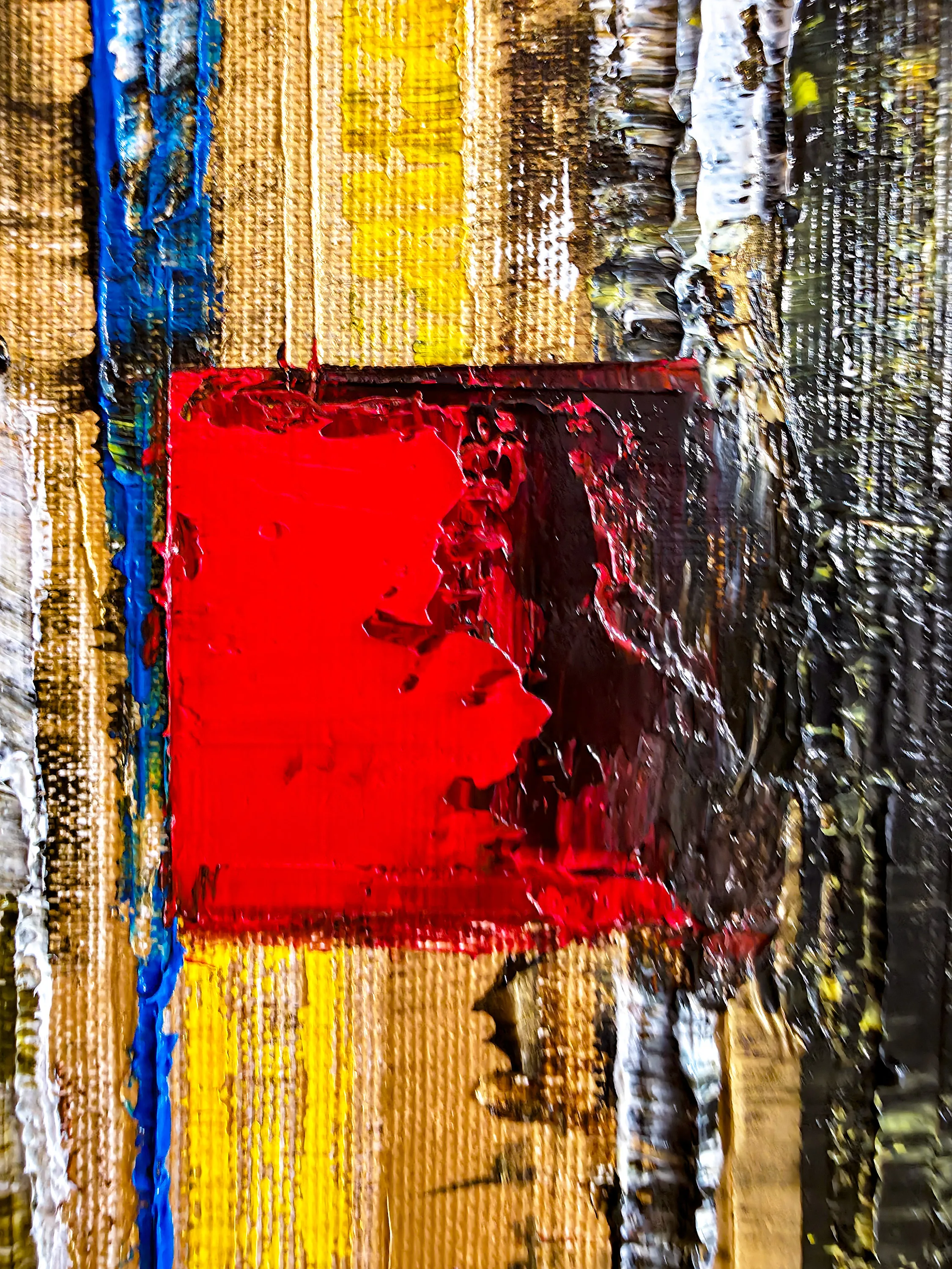
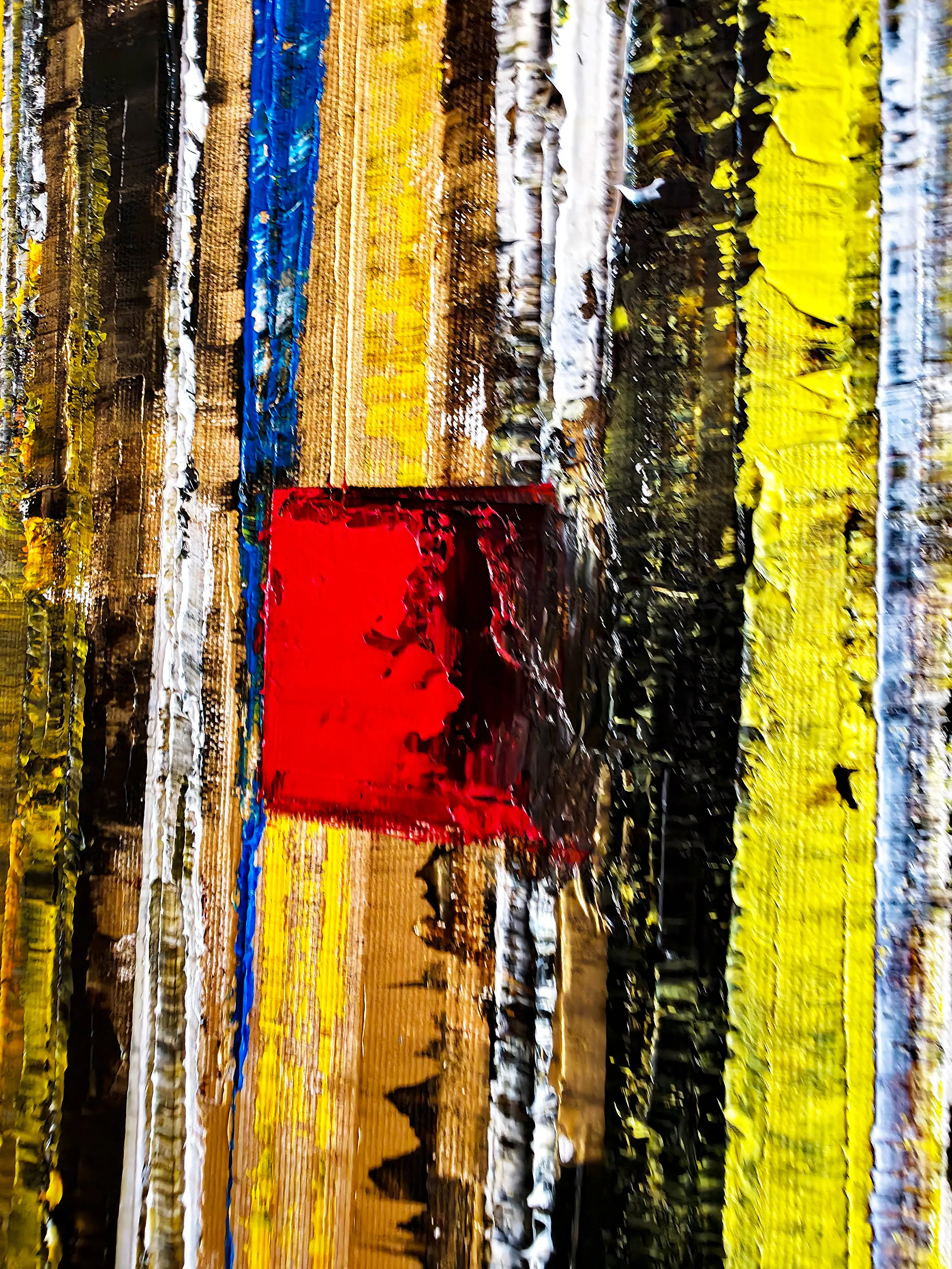
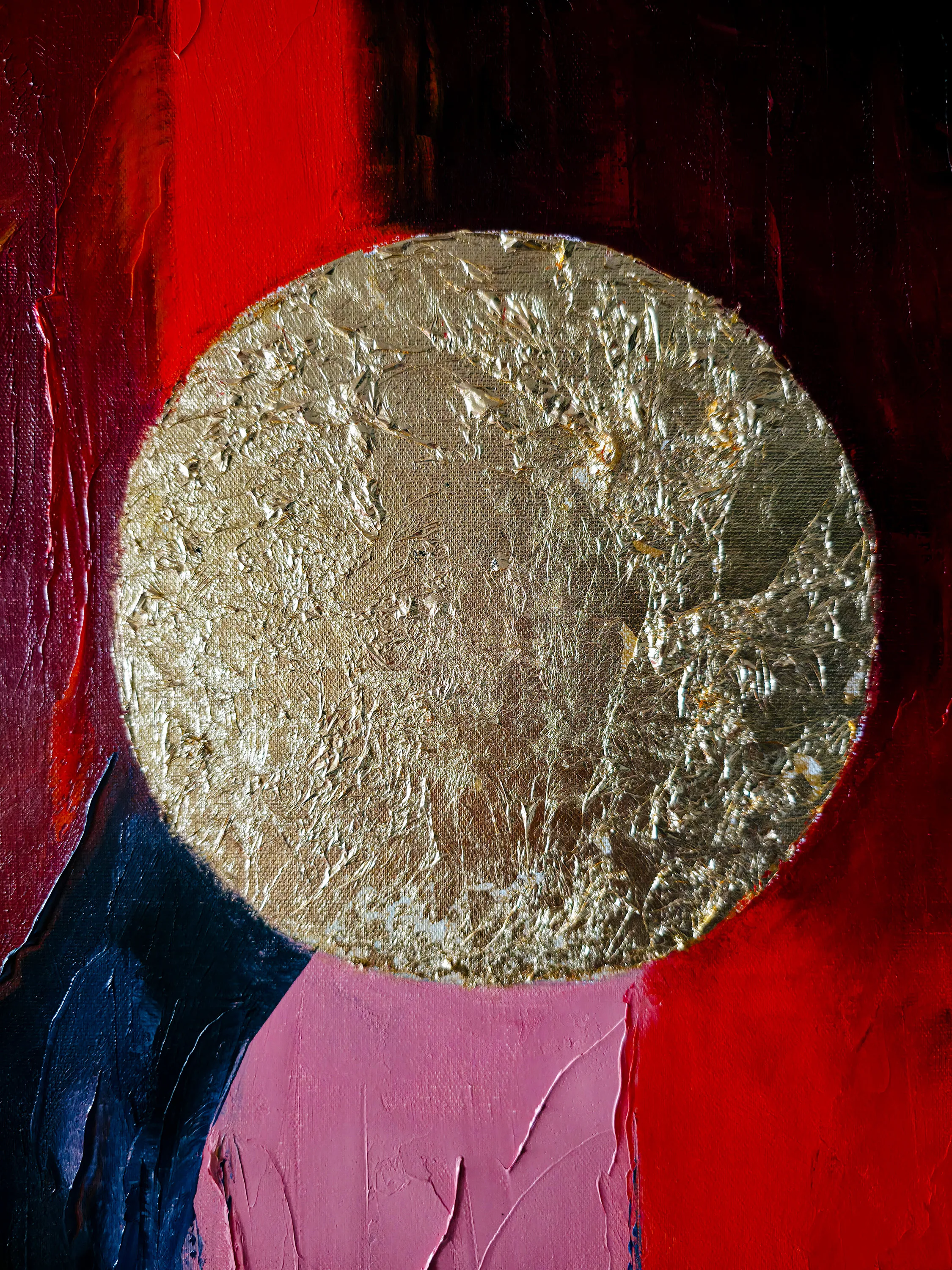
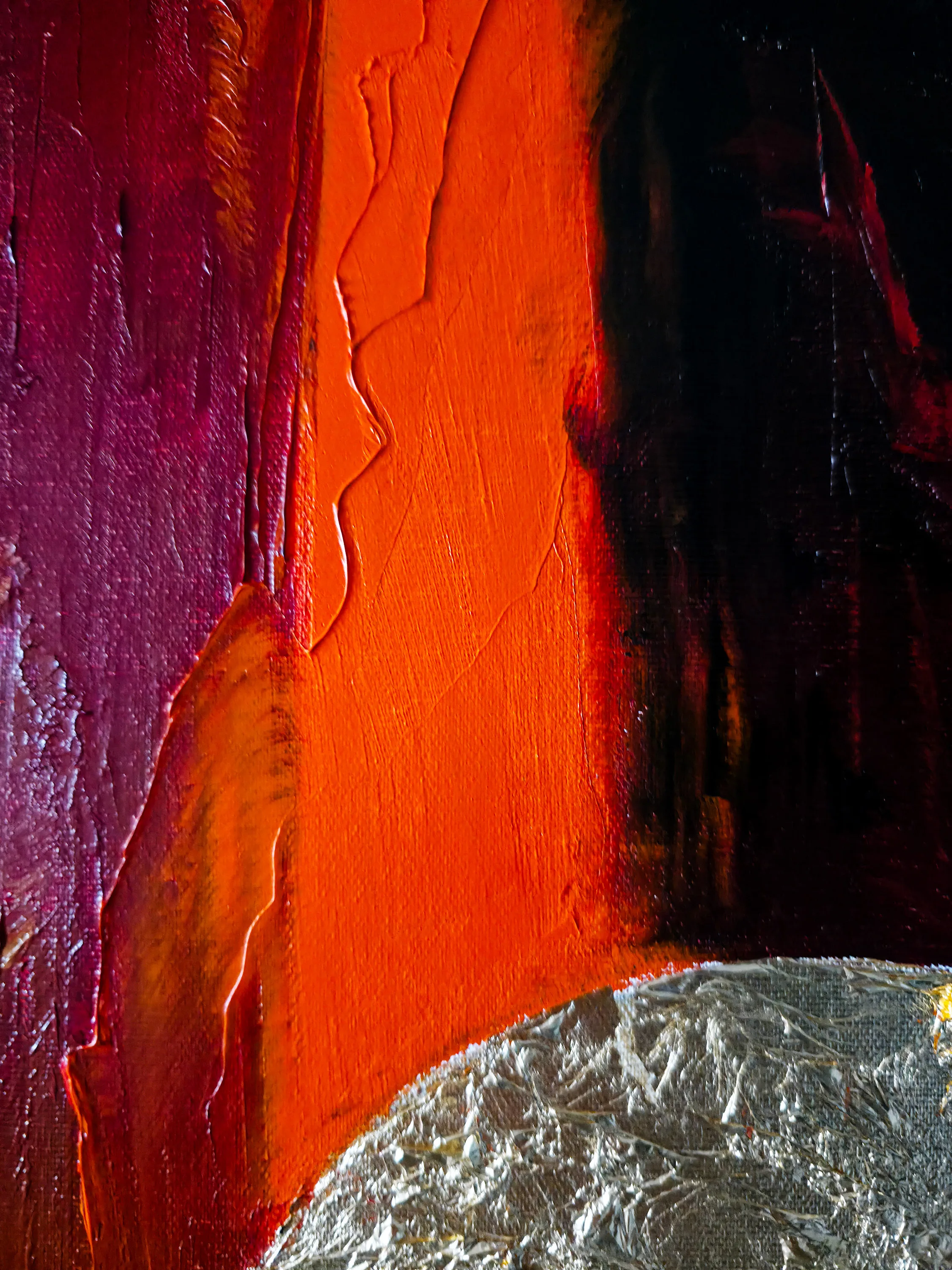
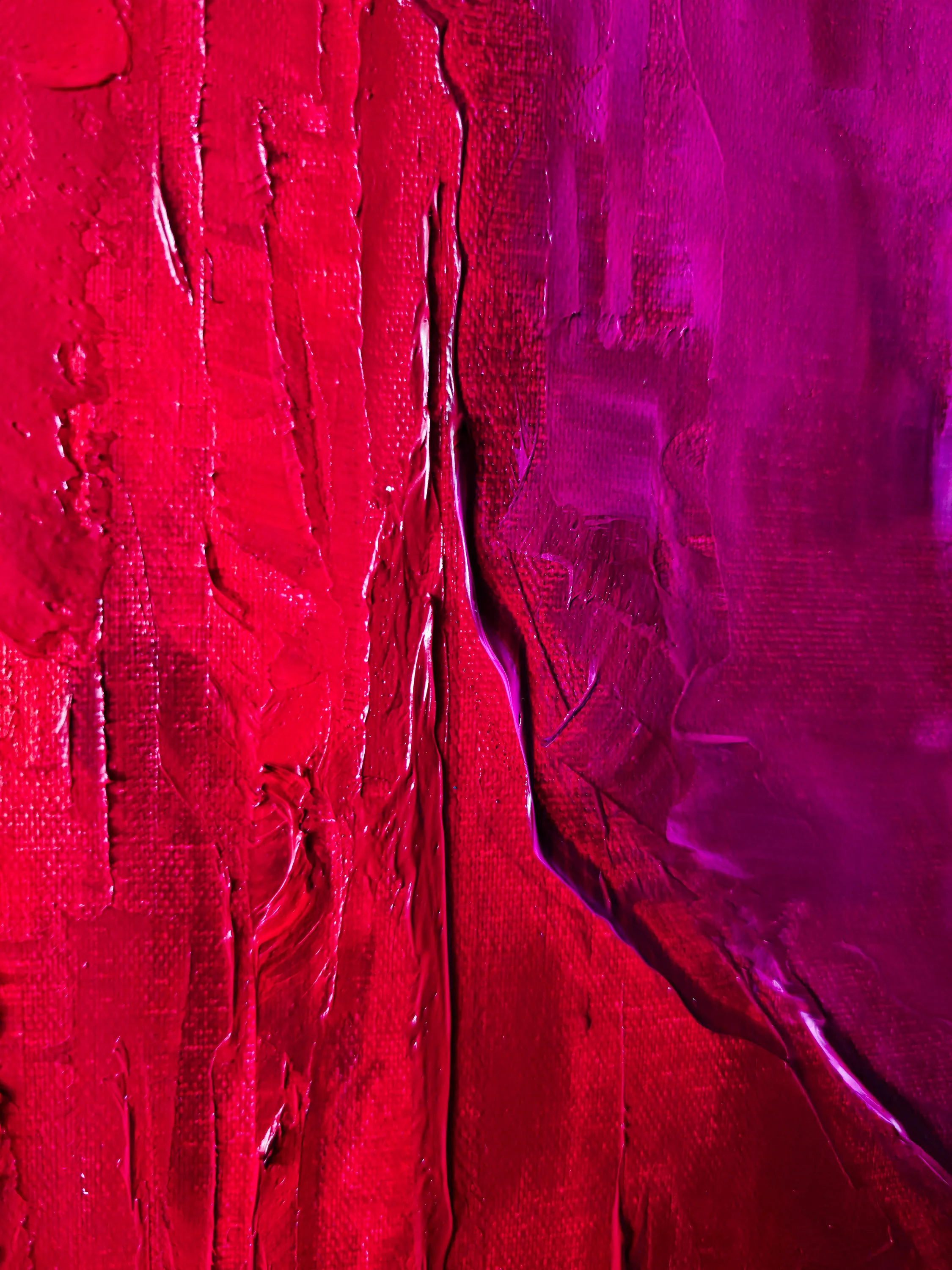
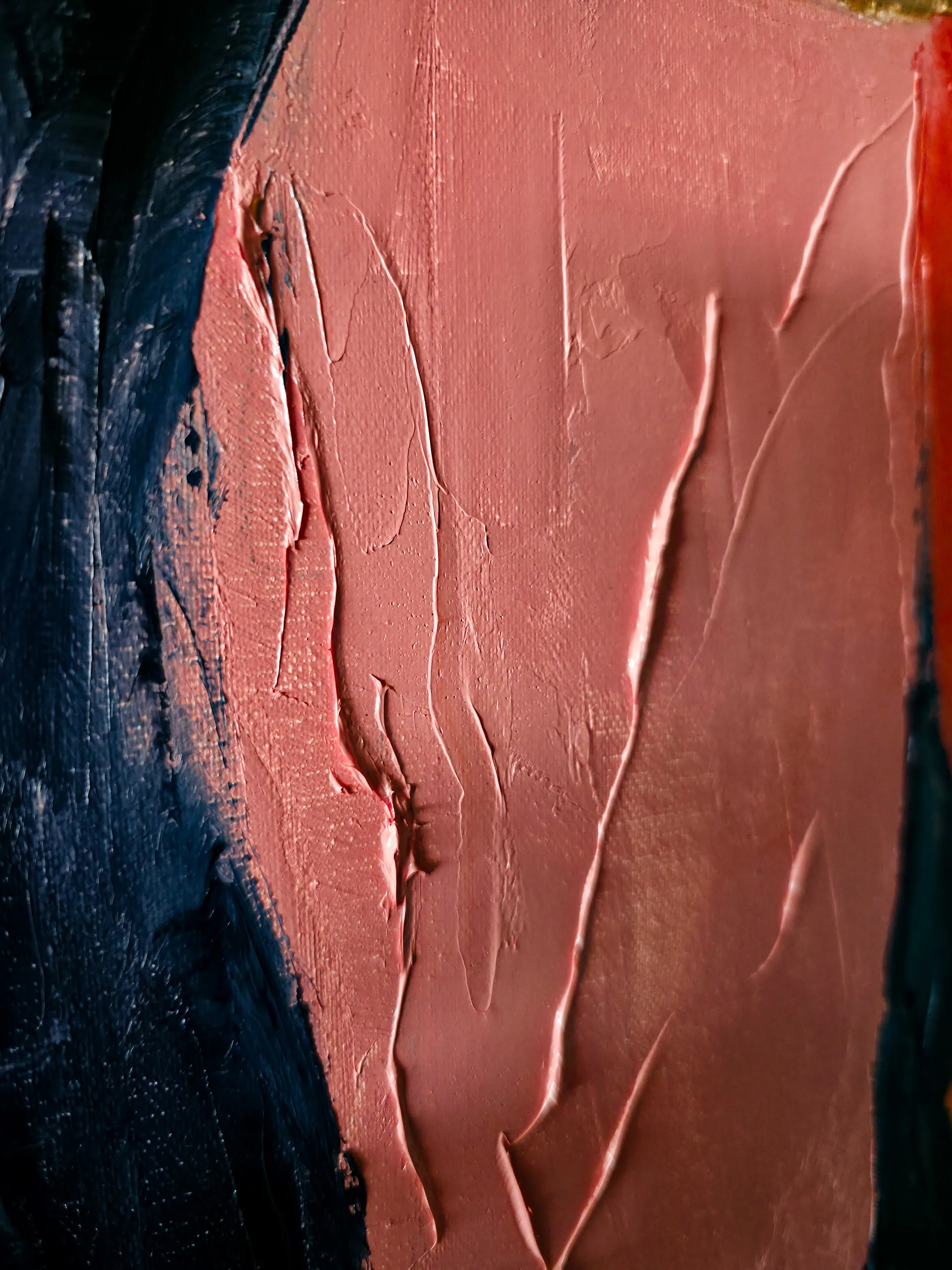
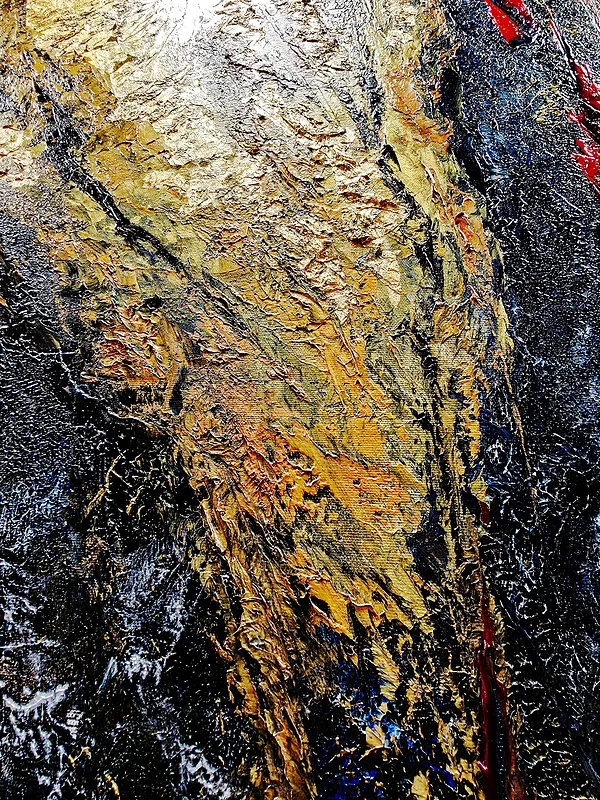
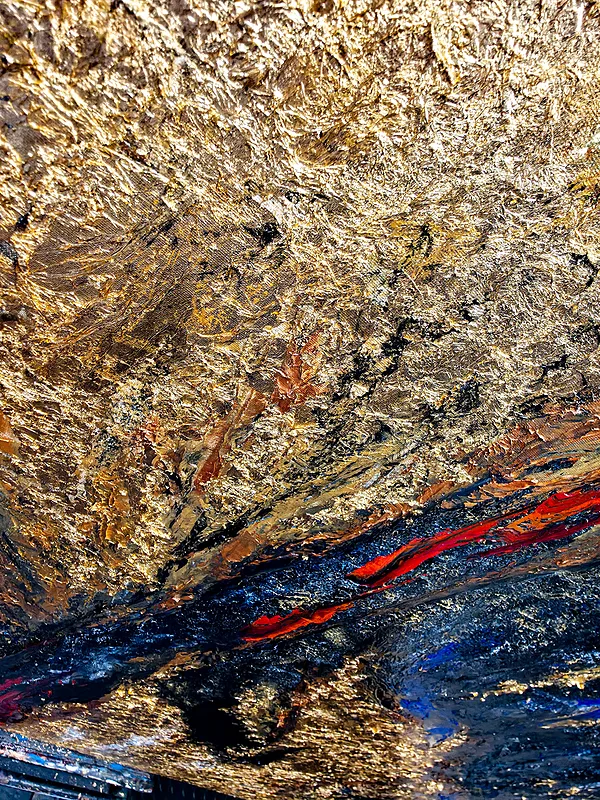
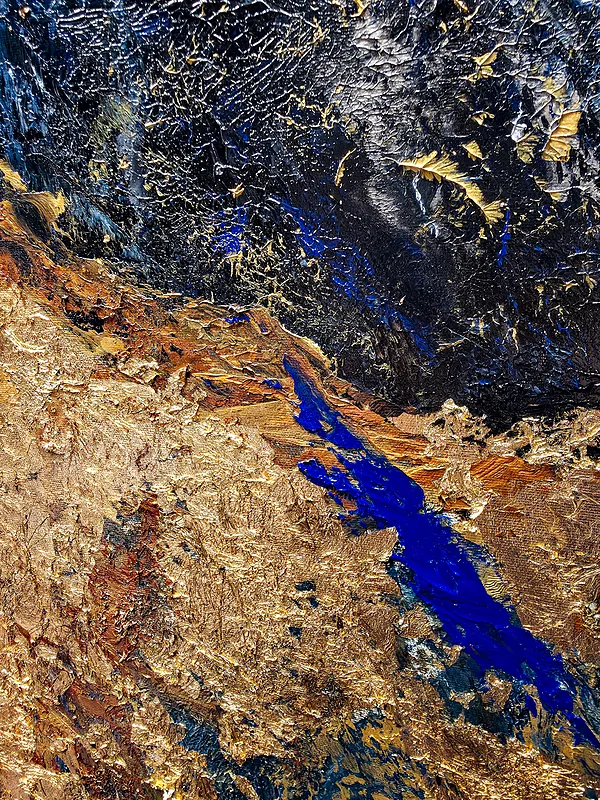
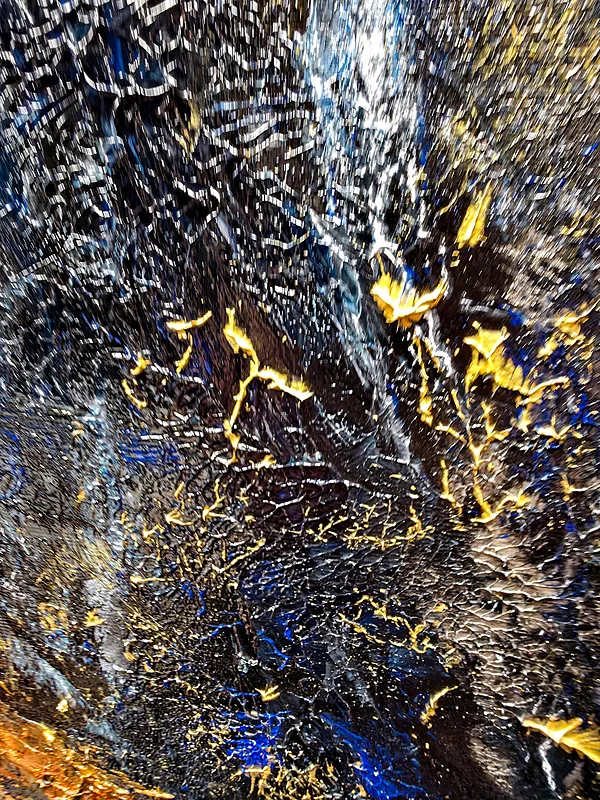
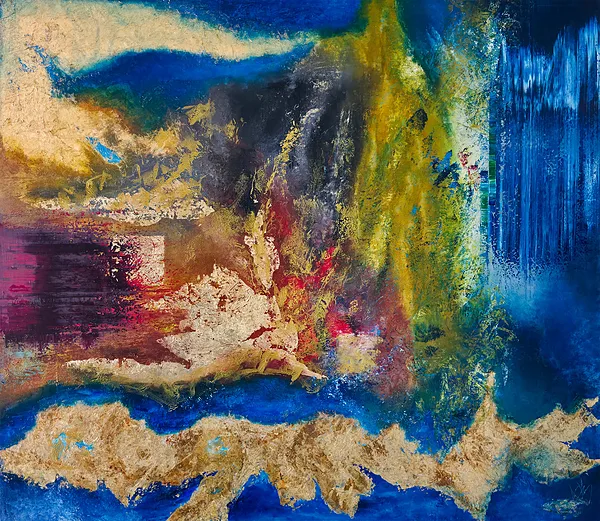
Following several decades devoted to great historical and mythological cycles, Náray once again leads the viewer into the world of the Old Testament, now through the eyes of a more mature painter, shaped by another era and another human experience.
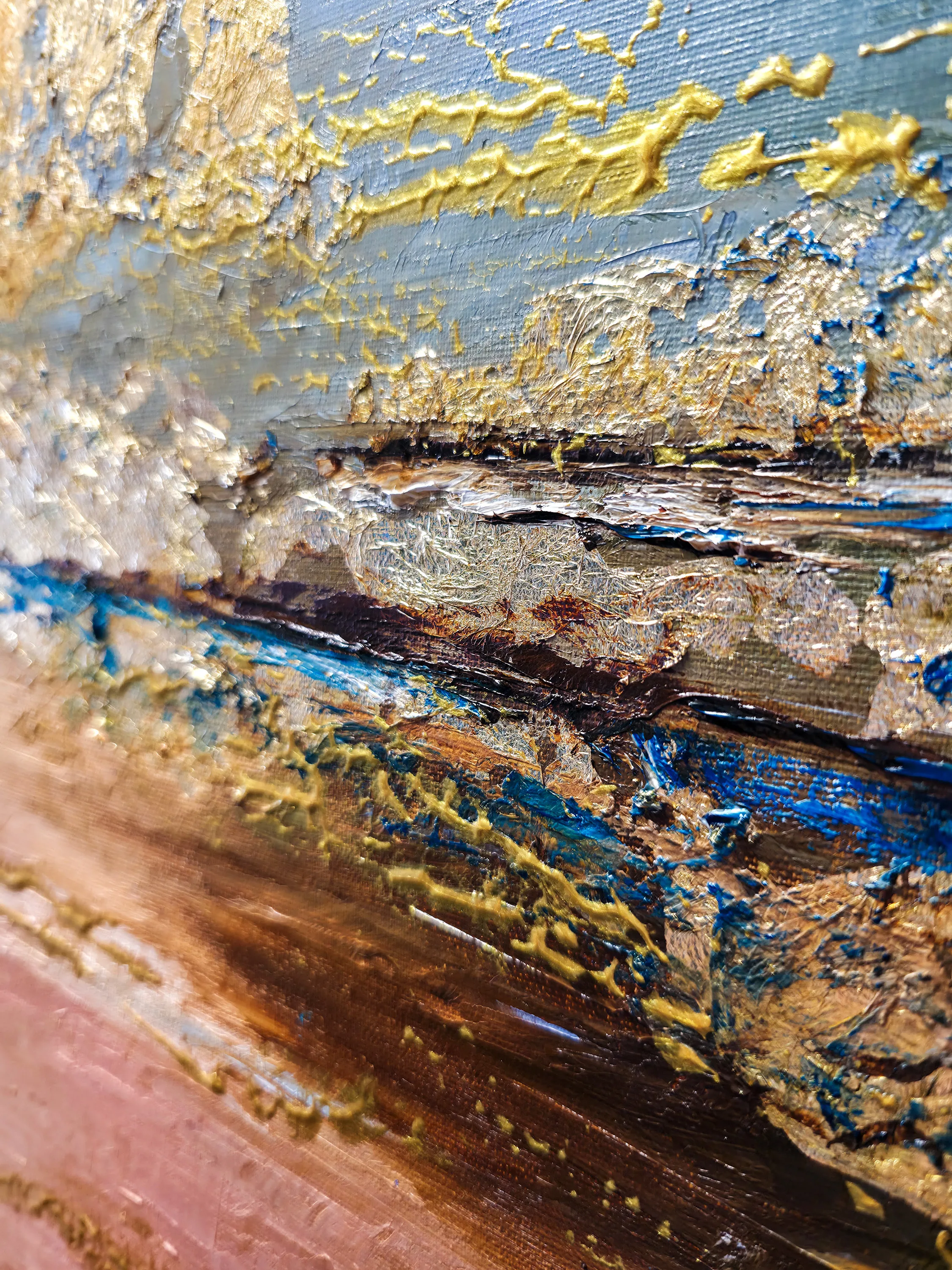
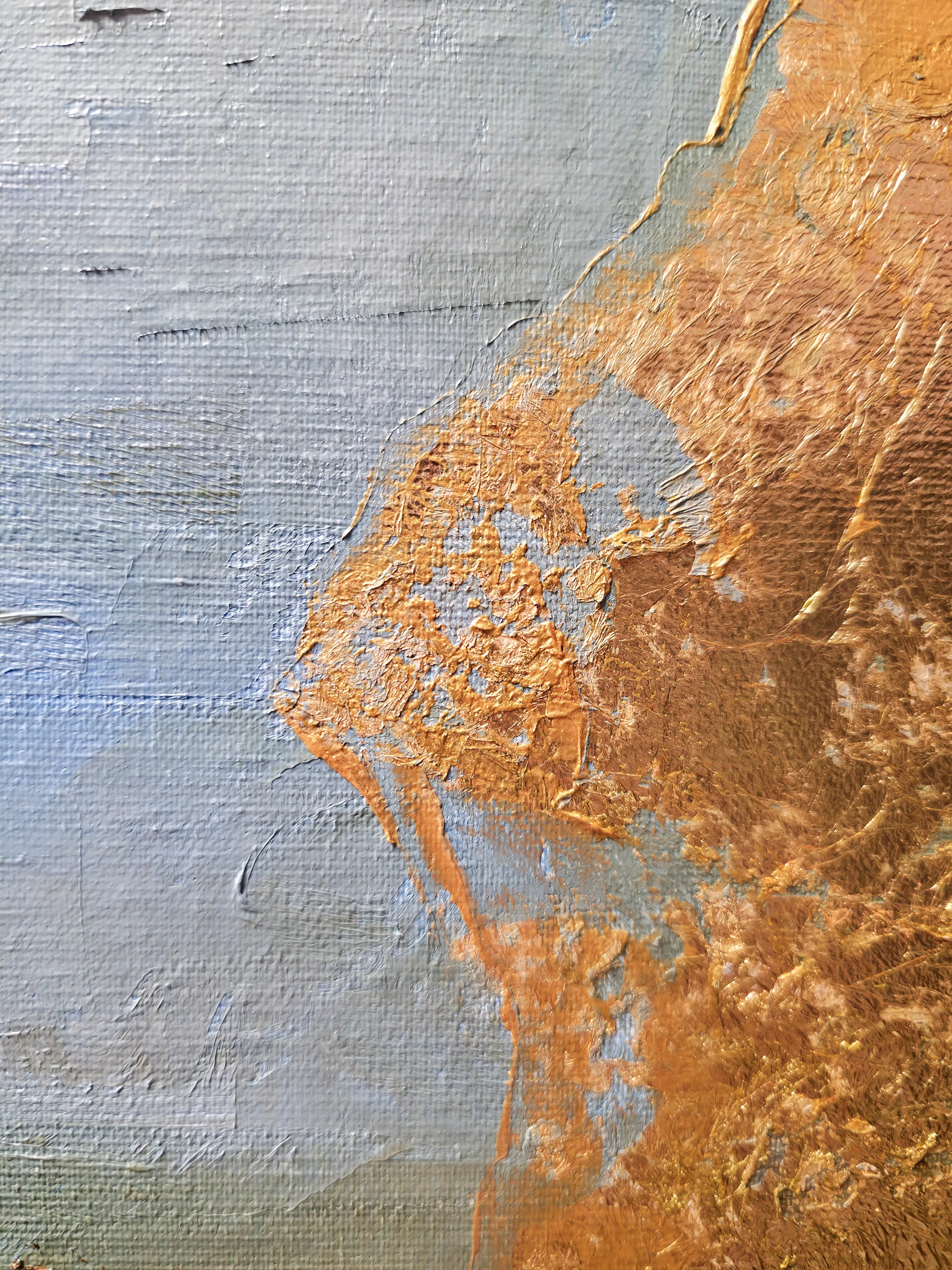
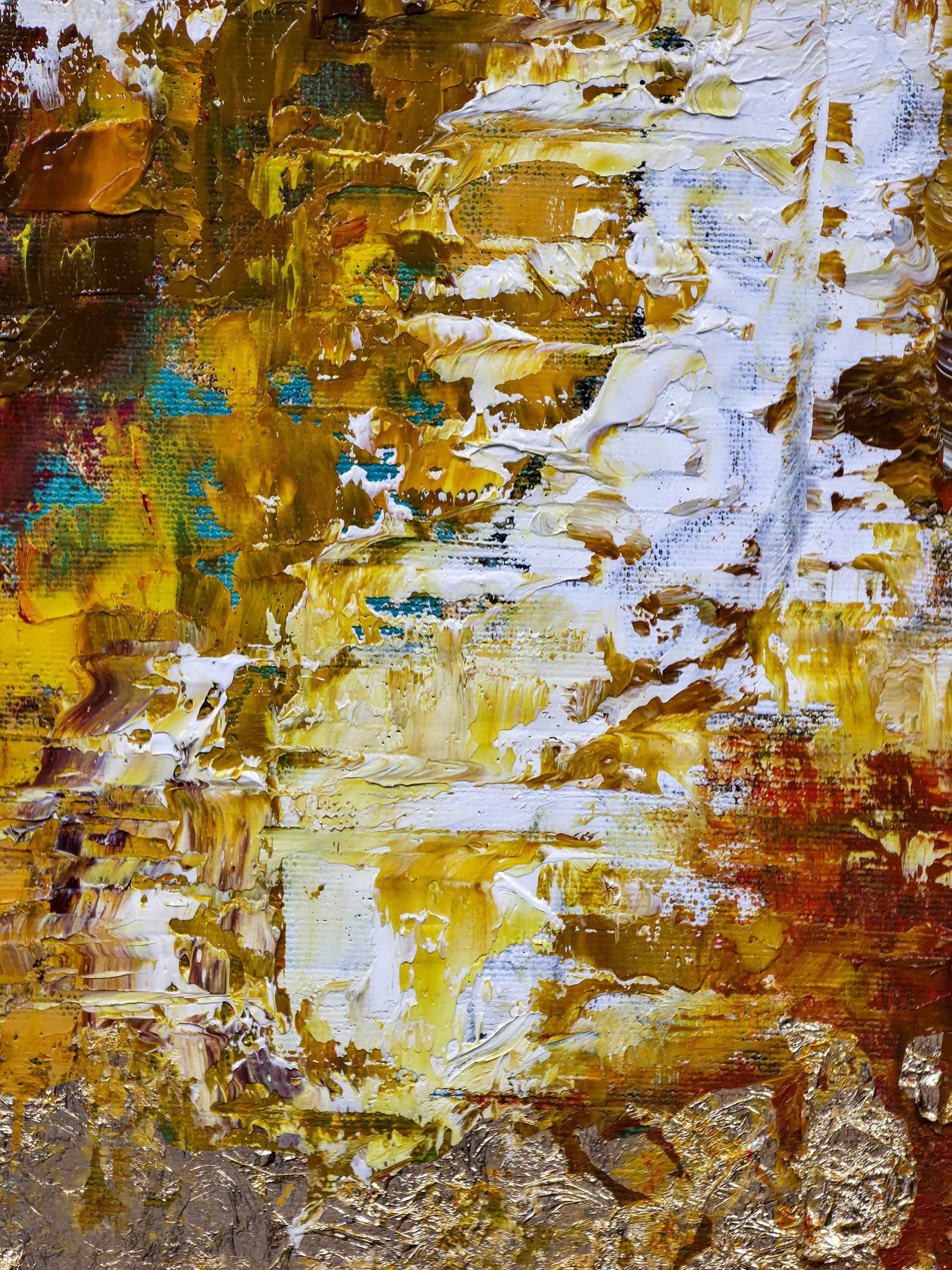
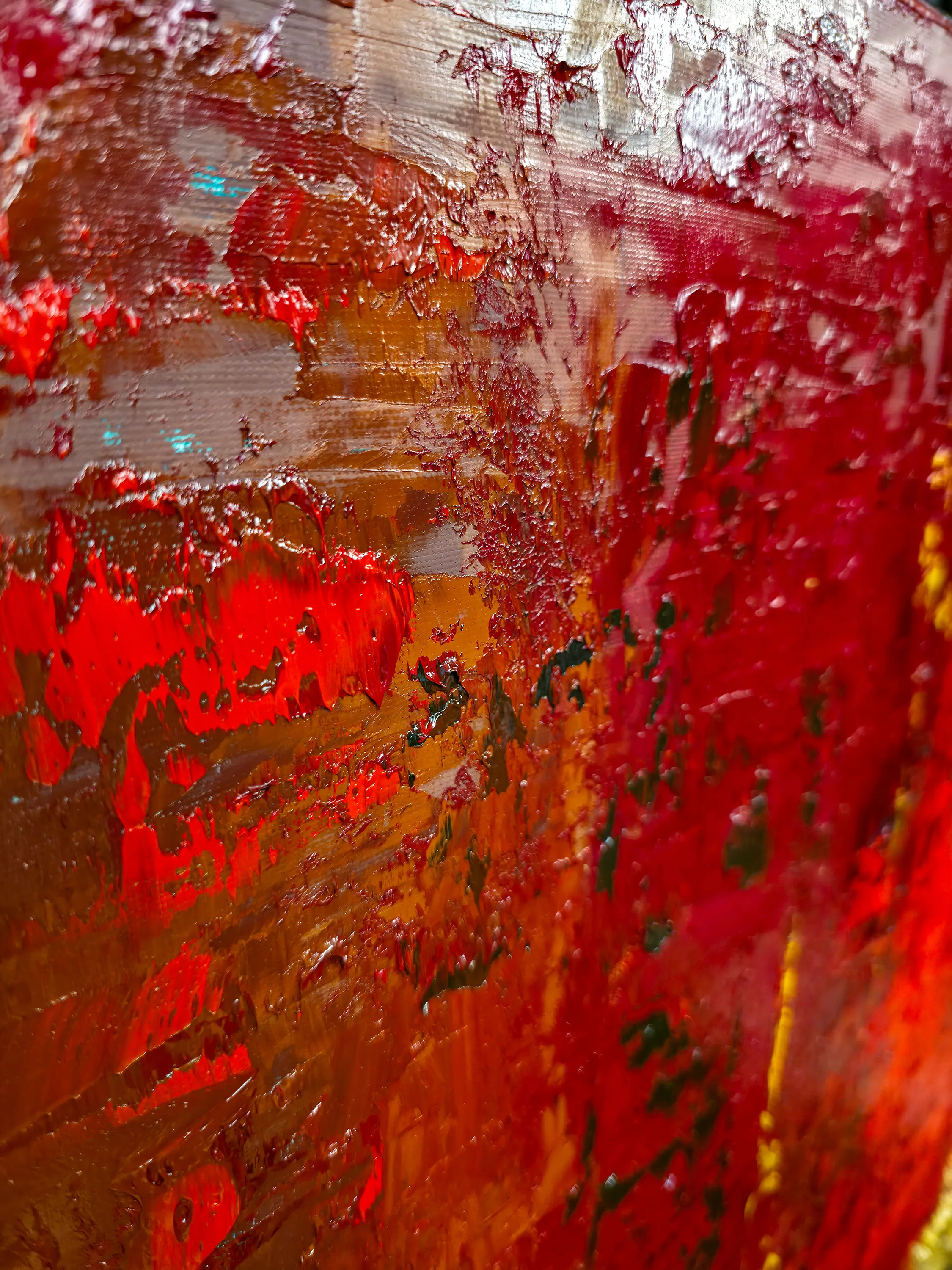
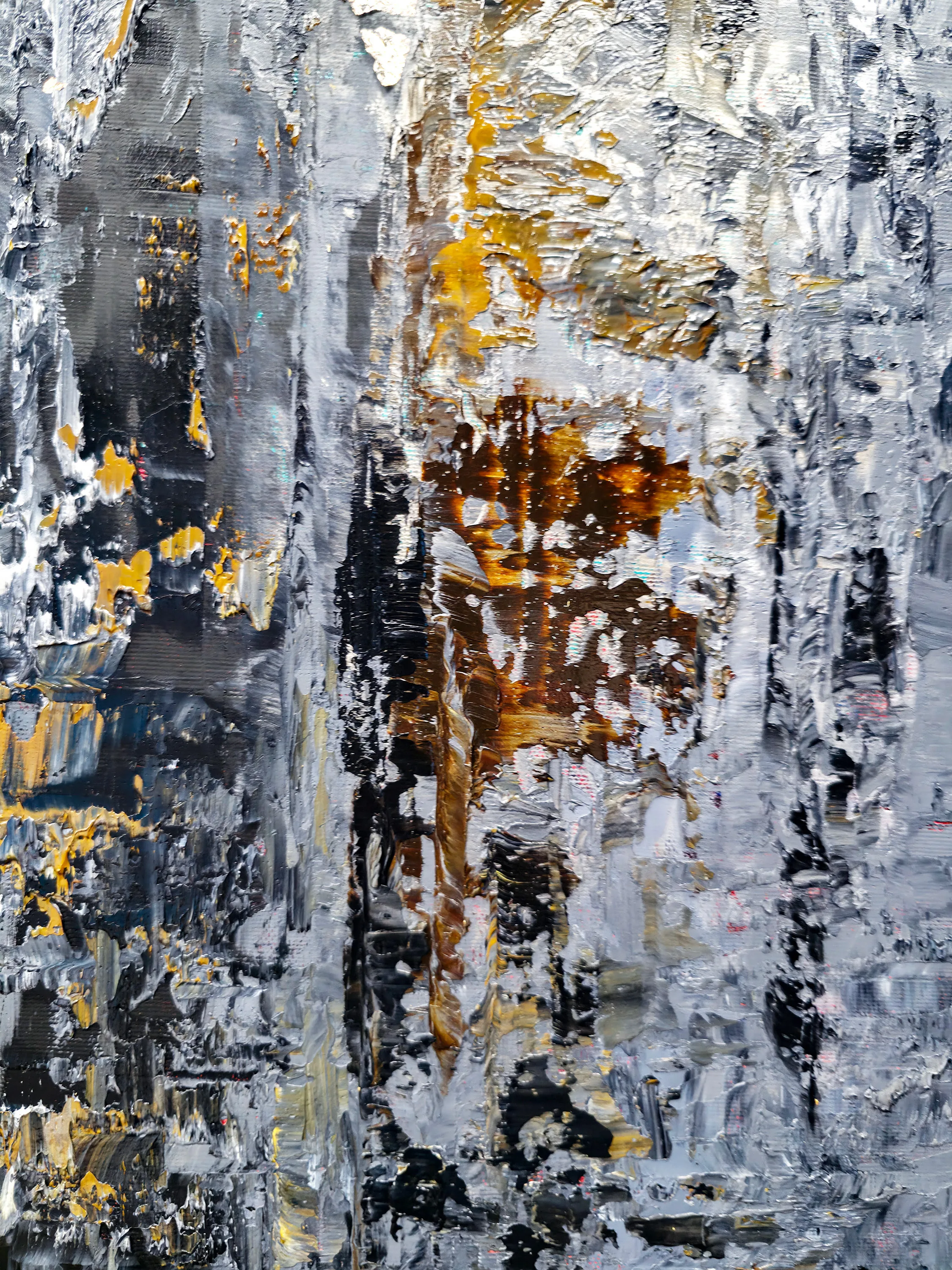
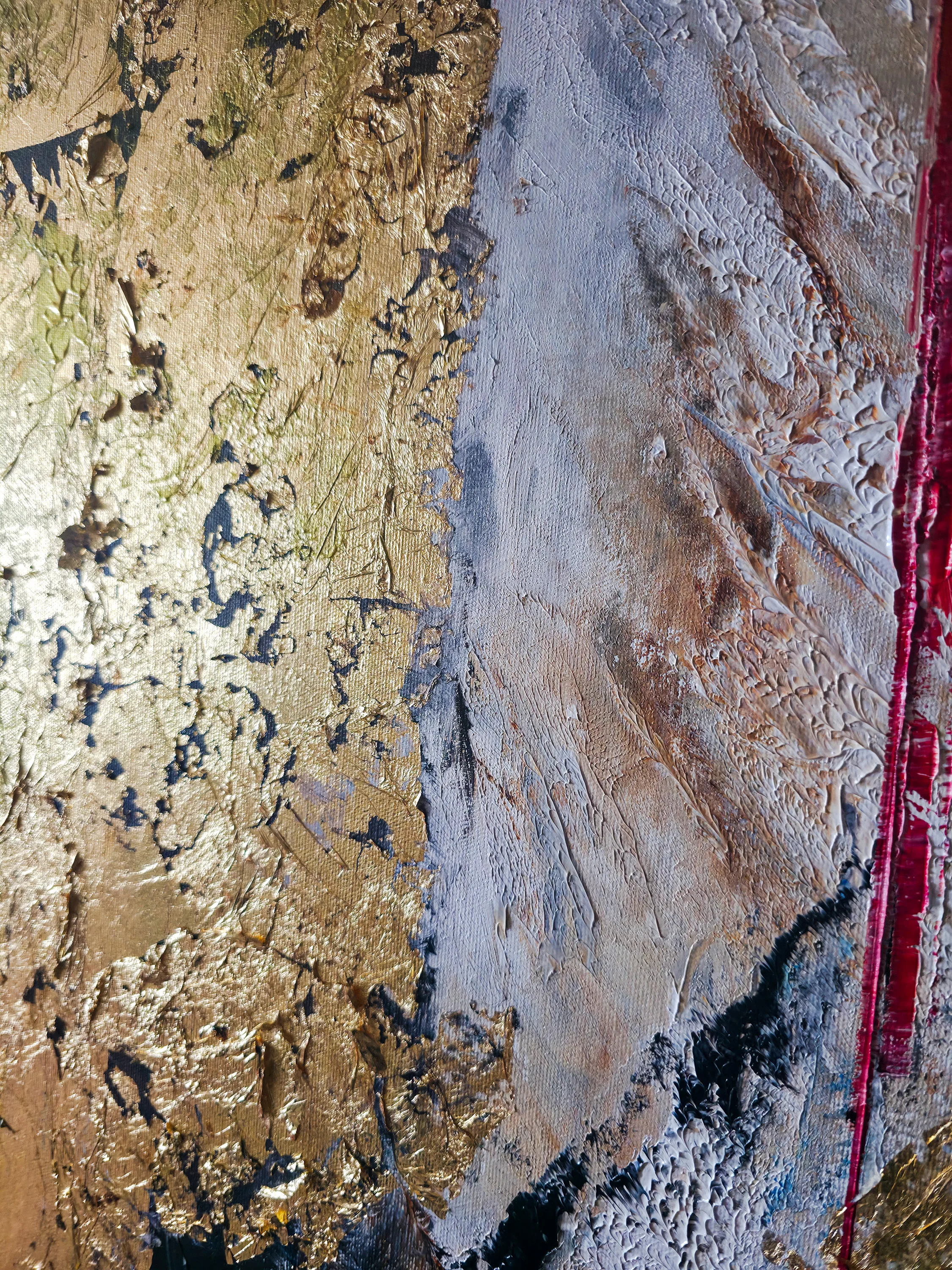
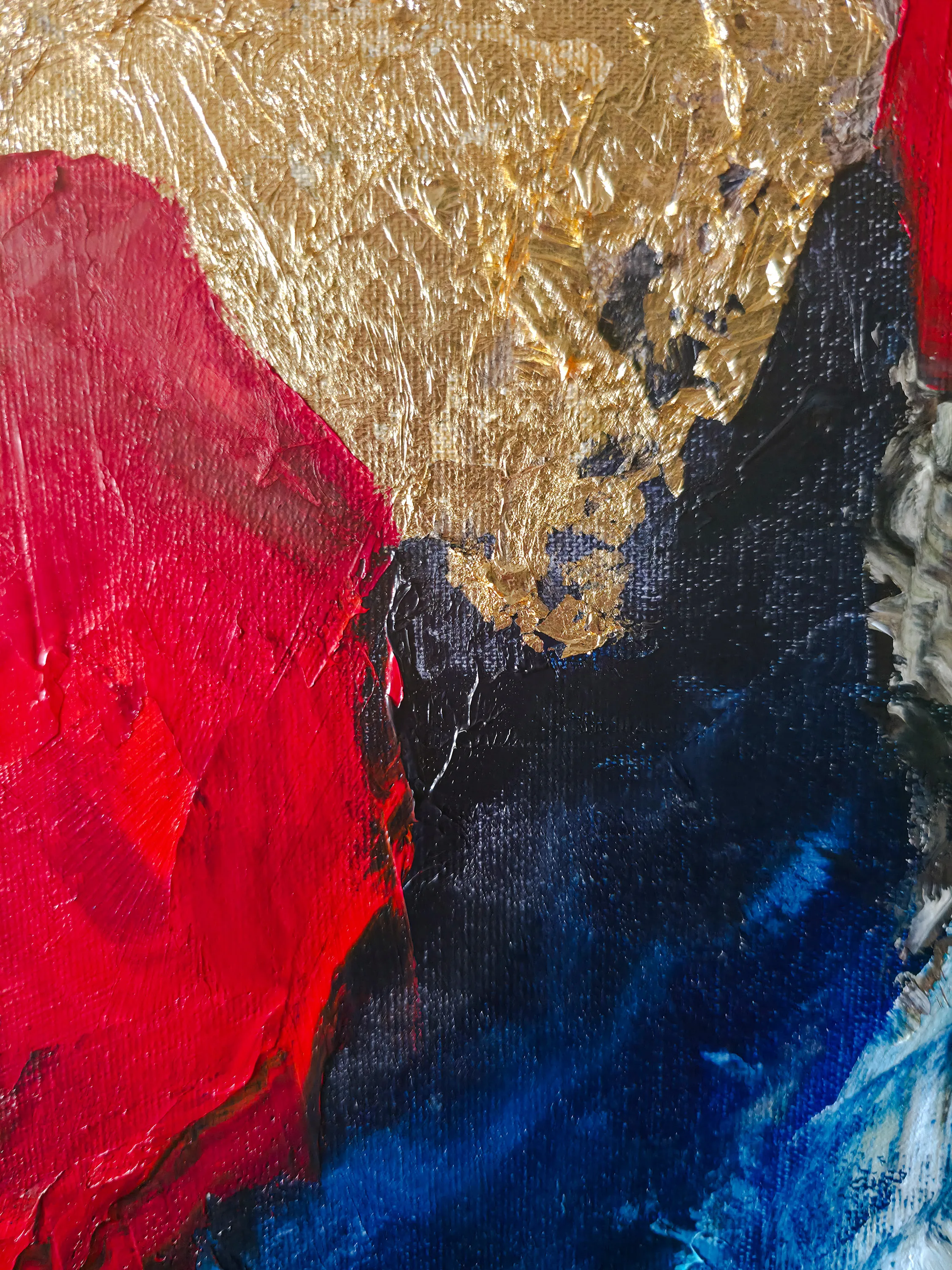
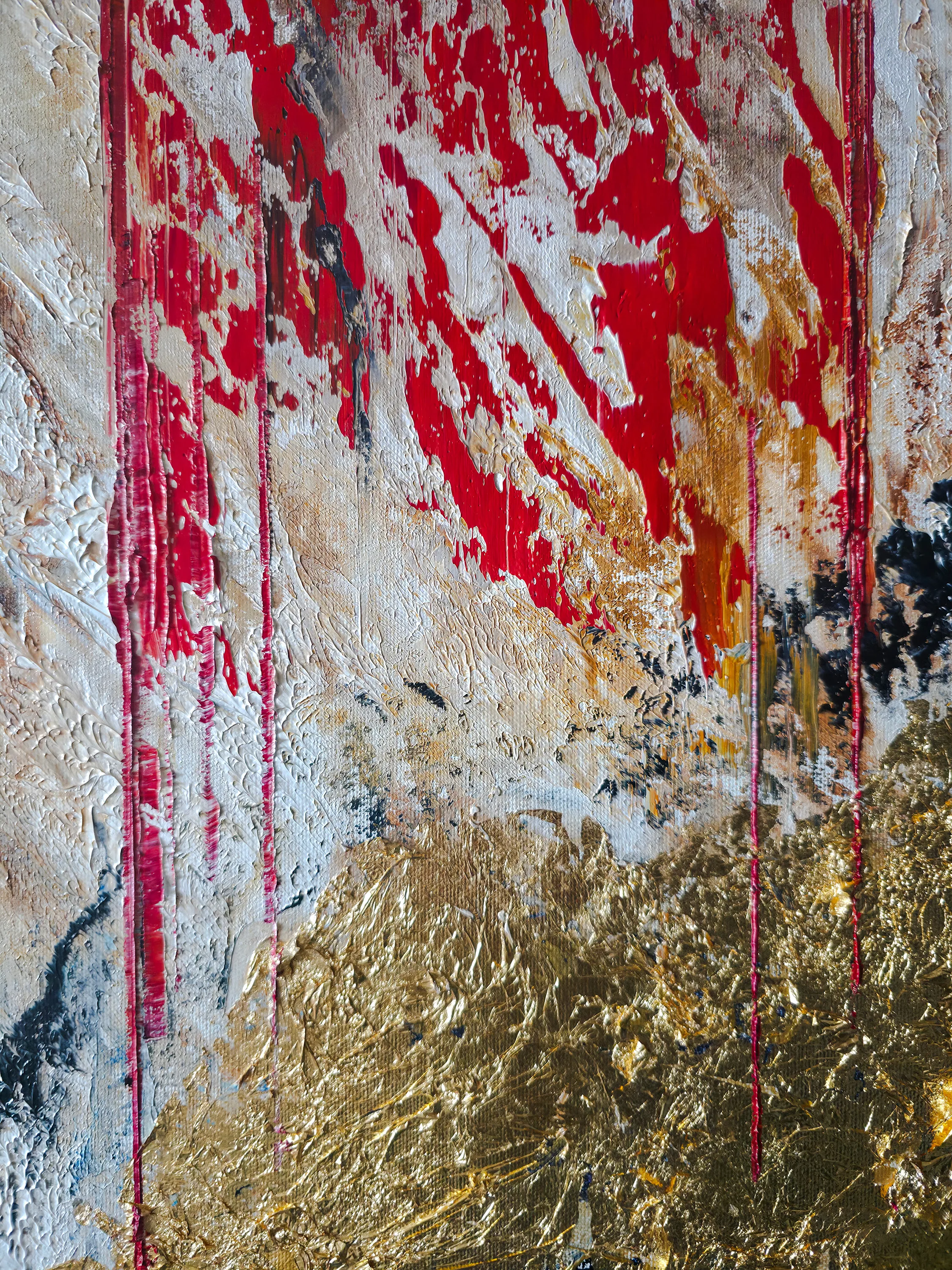
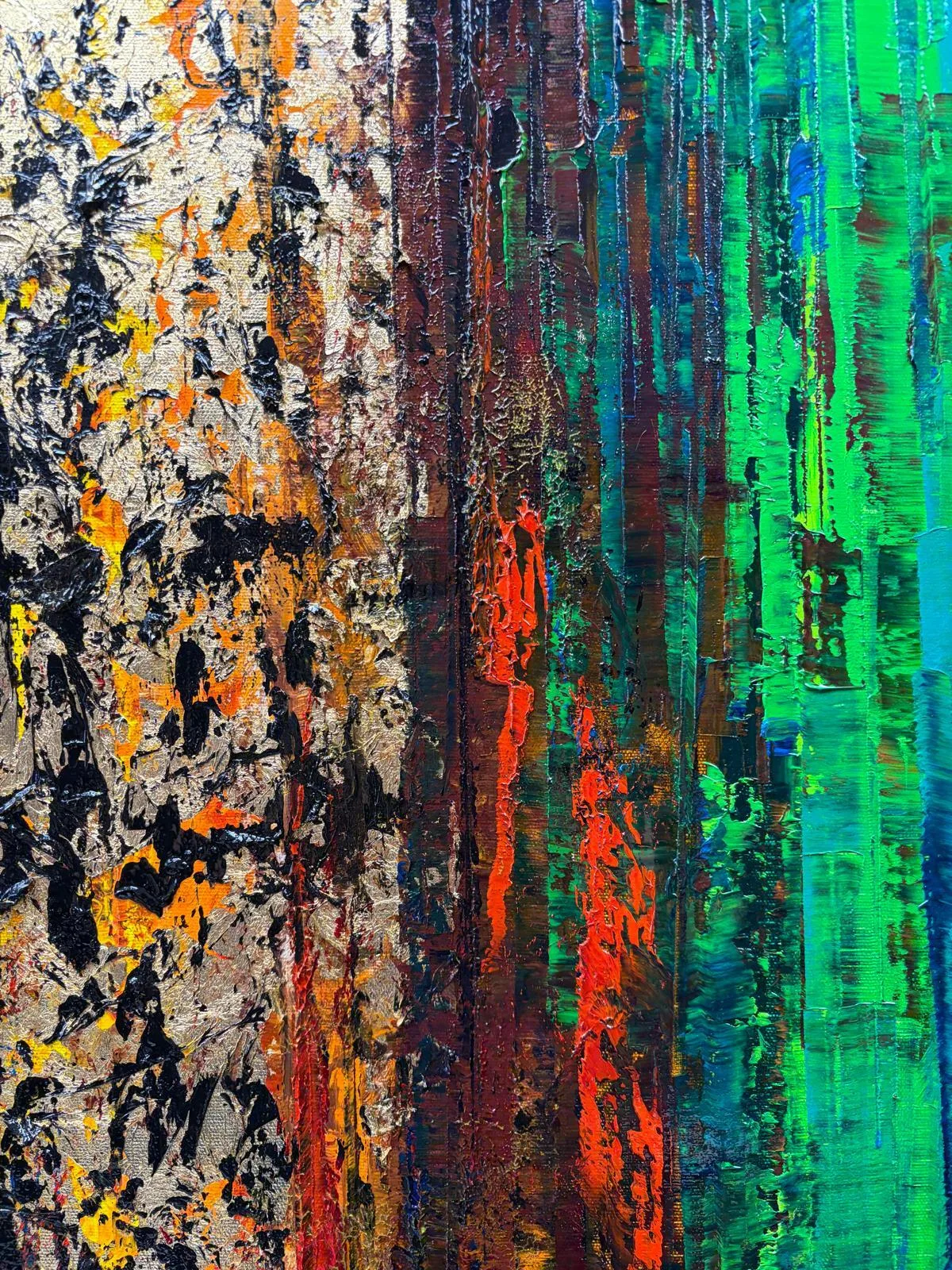
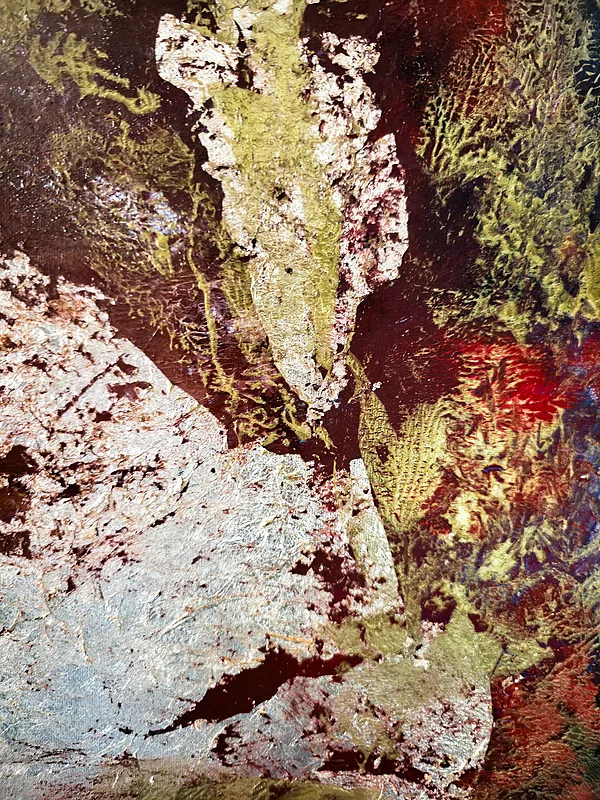
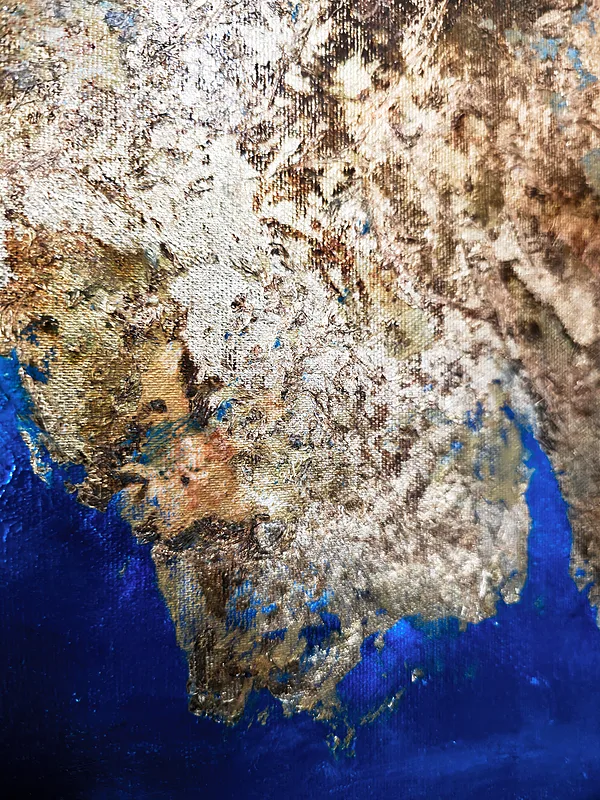
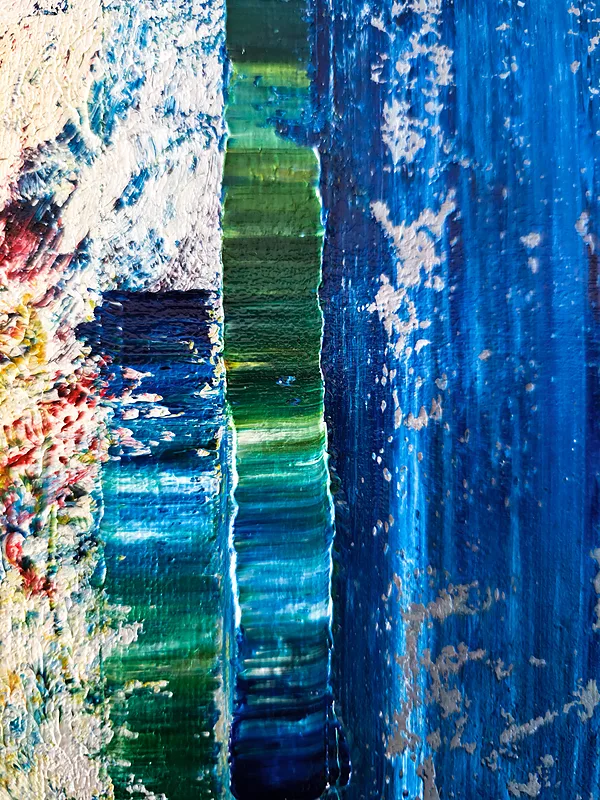
The artist’s painting simultaneously embodies the mastery of classical craft, the elemental power of color, and the freedom of the symbols that have become the hallmark of his abstraction, while the recurring presence of gold evokes a realm beyond transience.
Old Testament III constitutes a synthesis of the artist’s ongoing ontological and metaphysical investigations. The cycle is organically connected to an abstract reinterpretation of theological iconography.
Genesis as a pictorial act: The works in the series capture the cosmic and spiritual moment of Creation. Within the compositions, the dichotomy of chaos and order, darkness and light, is held in tension. Explosive textures and structured fields of color appearing across the picture surface model Creation itself as a pictorial act.
Gold as a metaphysical code: In Náray’s art, gold functions as a sacred signifier. Evoking the traditions of Byzantine icon painting and medieval art, gold symbolises the ineffable divine Light and the immanent presence of transcendence through the visual language of modernity.
Iconography without narrative: Náray’s achievement in his Old Testament cycles lies in his ability to convey the moral and dramatic weight of the biblical texts without becoming illustrative. The paintings do not tell stories; rather, they communicate affective and intellectual states - faith, promise, prophecy and destiny - to the viewer as pure visual energies. These energies permeate the viewer standing before the works.
With Old Testament III, Náray Tamás has definitively positioned himself at the forefront of contemporary sacred abstraction. His work demonstrates that non-figurative painting, even in the twenty-first century, remains capable of articulating the deepest metaphysical questions with validity and monumental force.
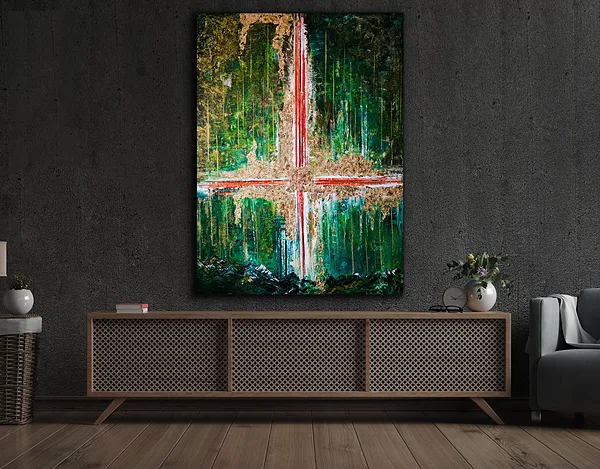
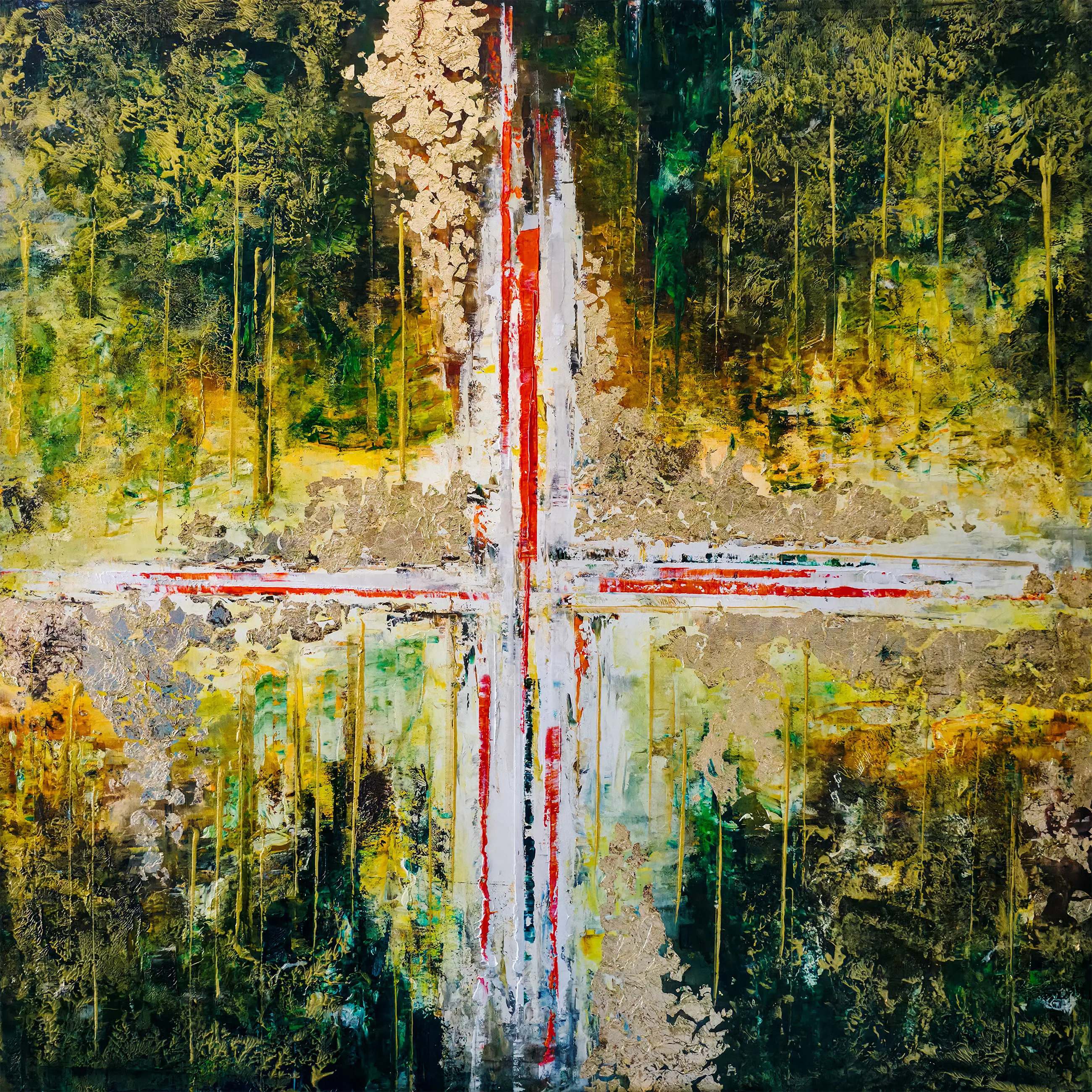
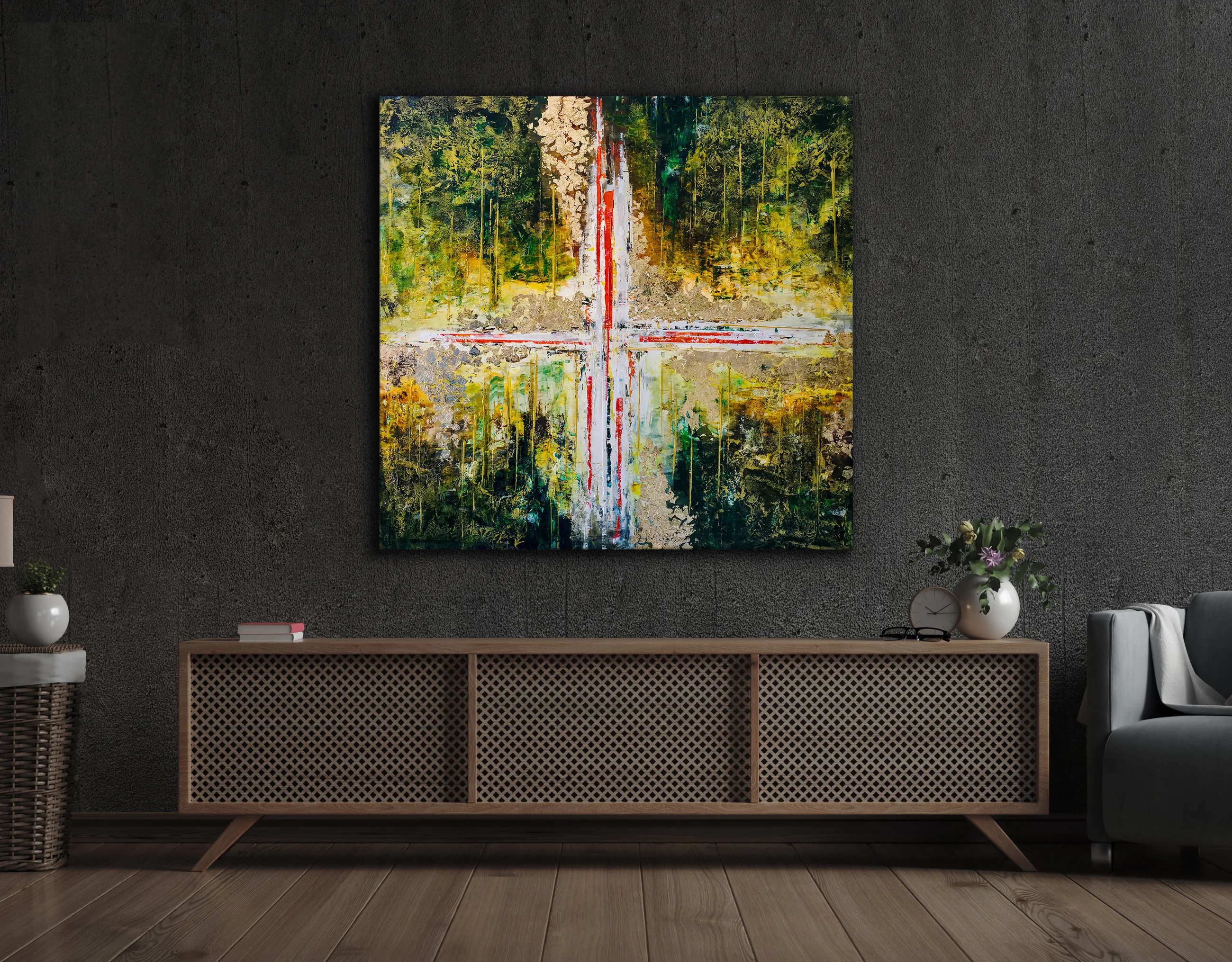
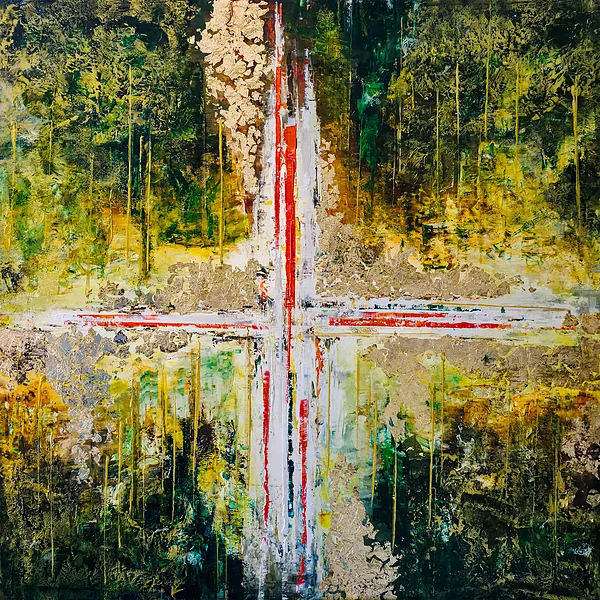
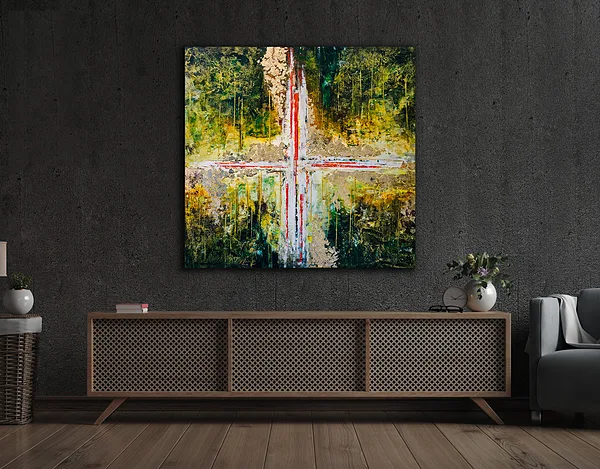
MM The Beginning of Time
- 120 x 120 cm
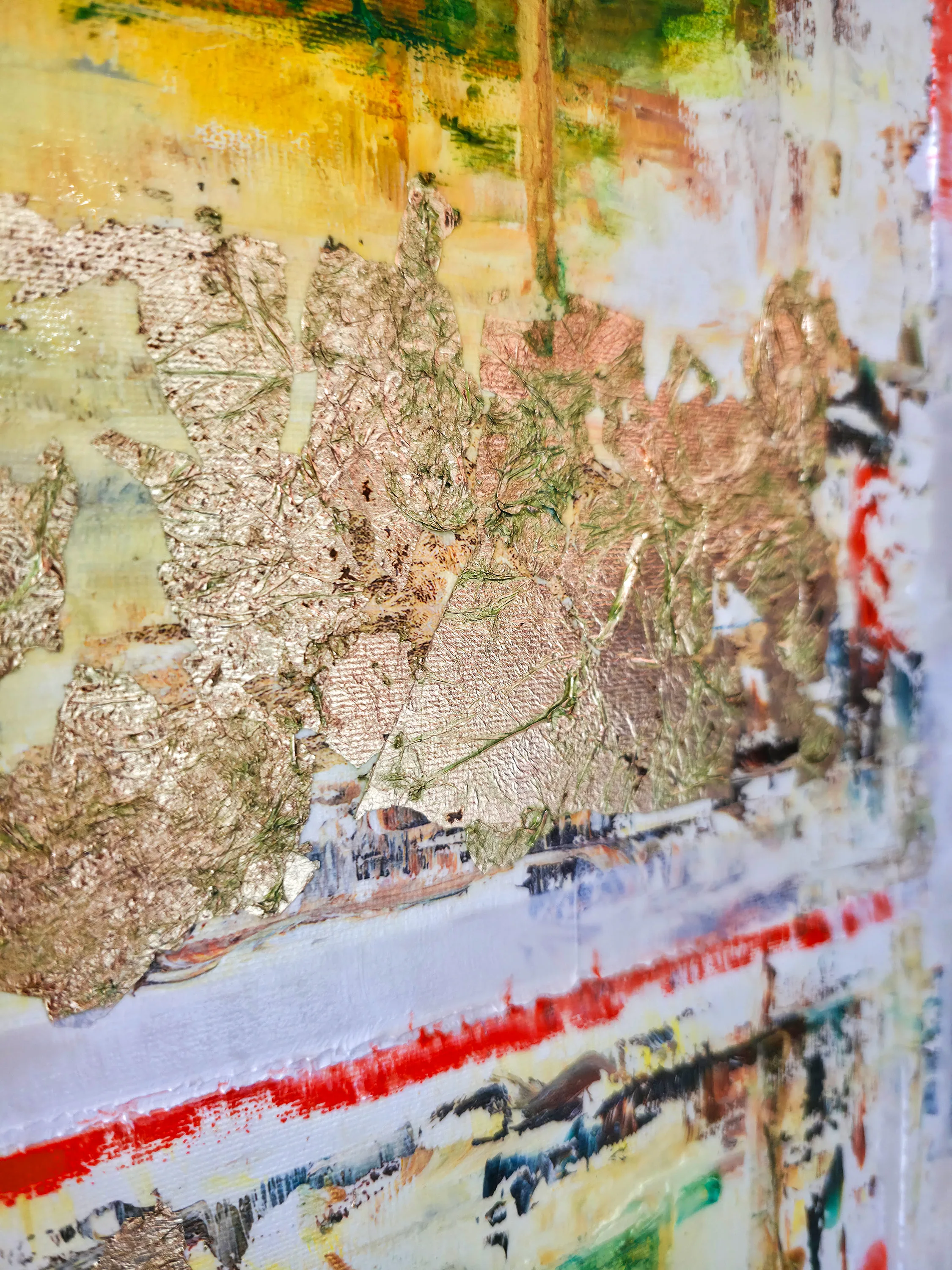
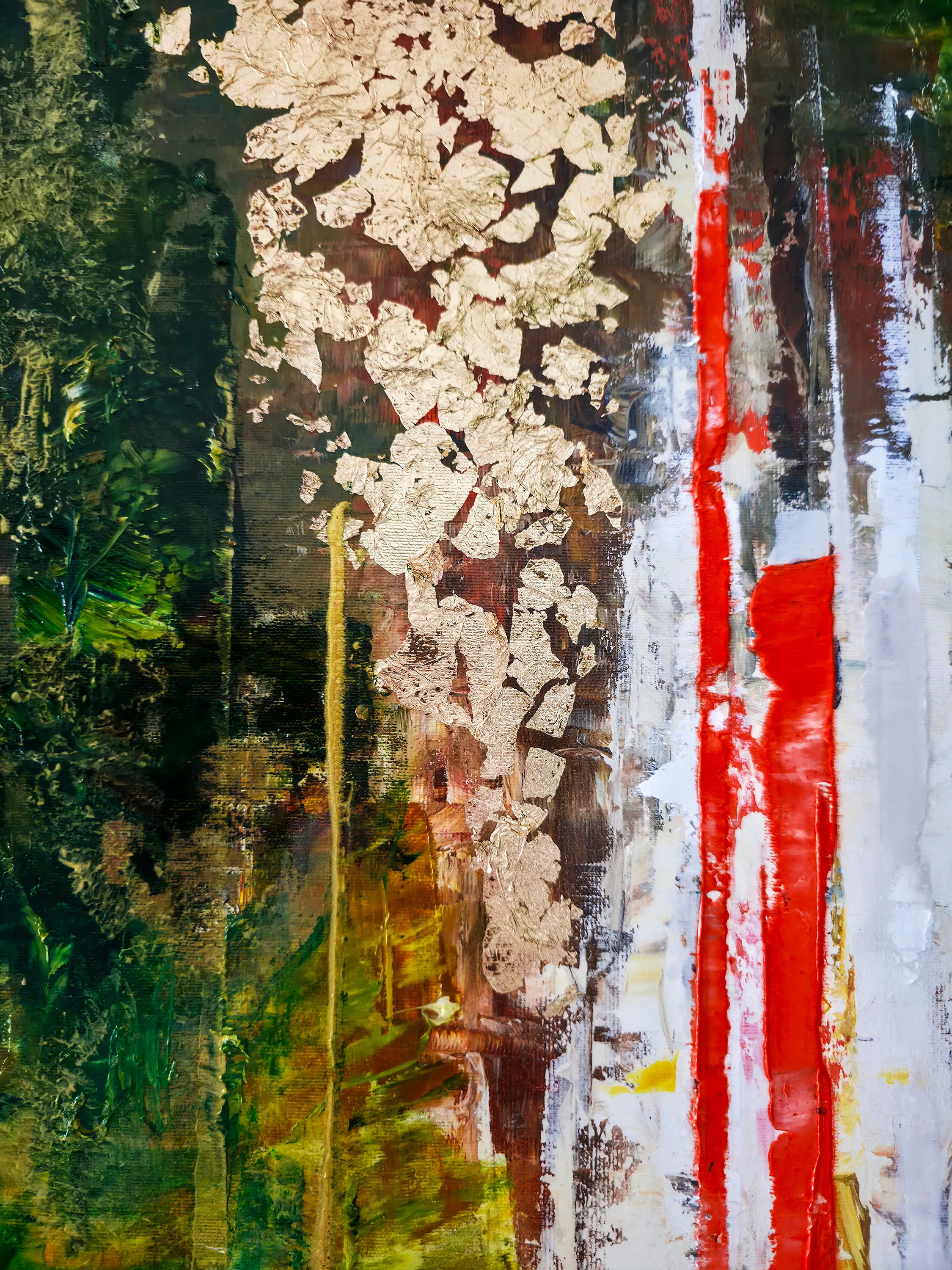
- Oil and gold on pre-printed canvas (mixed media)
- Created: Sitges, 2026
- The artwork is part of the 'Old Testament III - In Search of the Secrets of Eternity' cycle
- SOLD
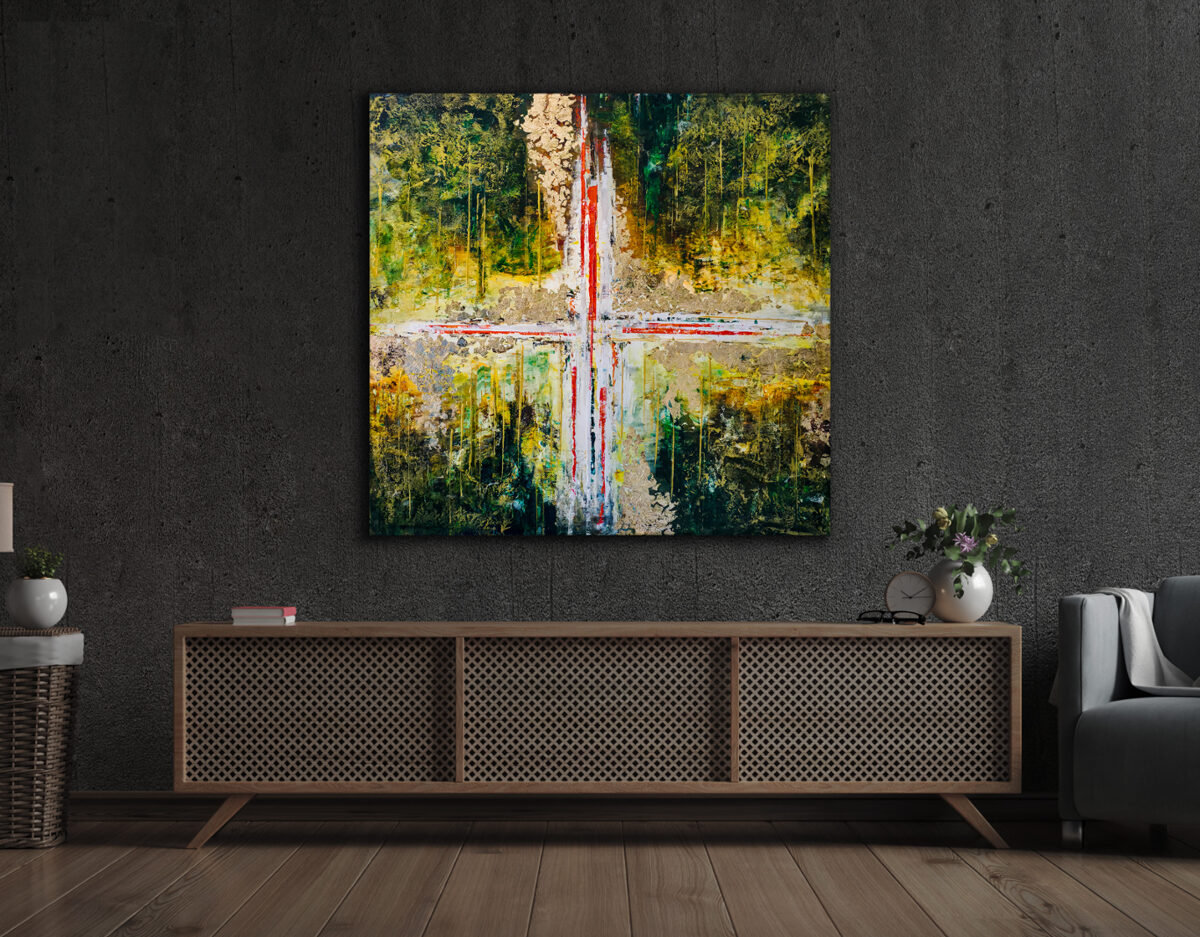
When Scripture declares "In the beginning," it does not define time. Within this infinite state, incomprehensible by human measure, a single entity existed: God. According to the biblical account of creation, the world is not of divine nature, but comes into being solely by the will of the one, personal God.
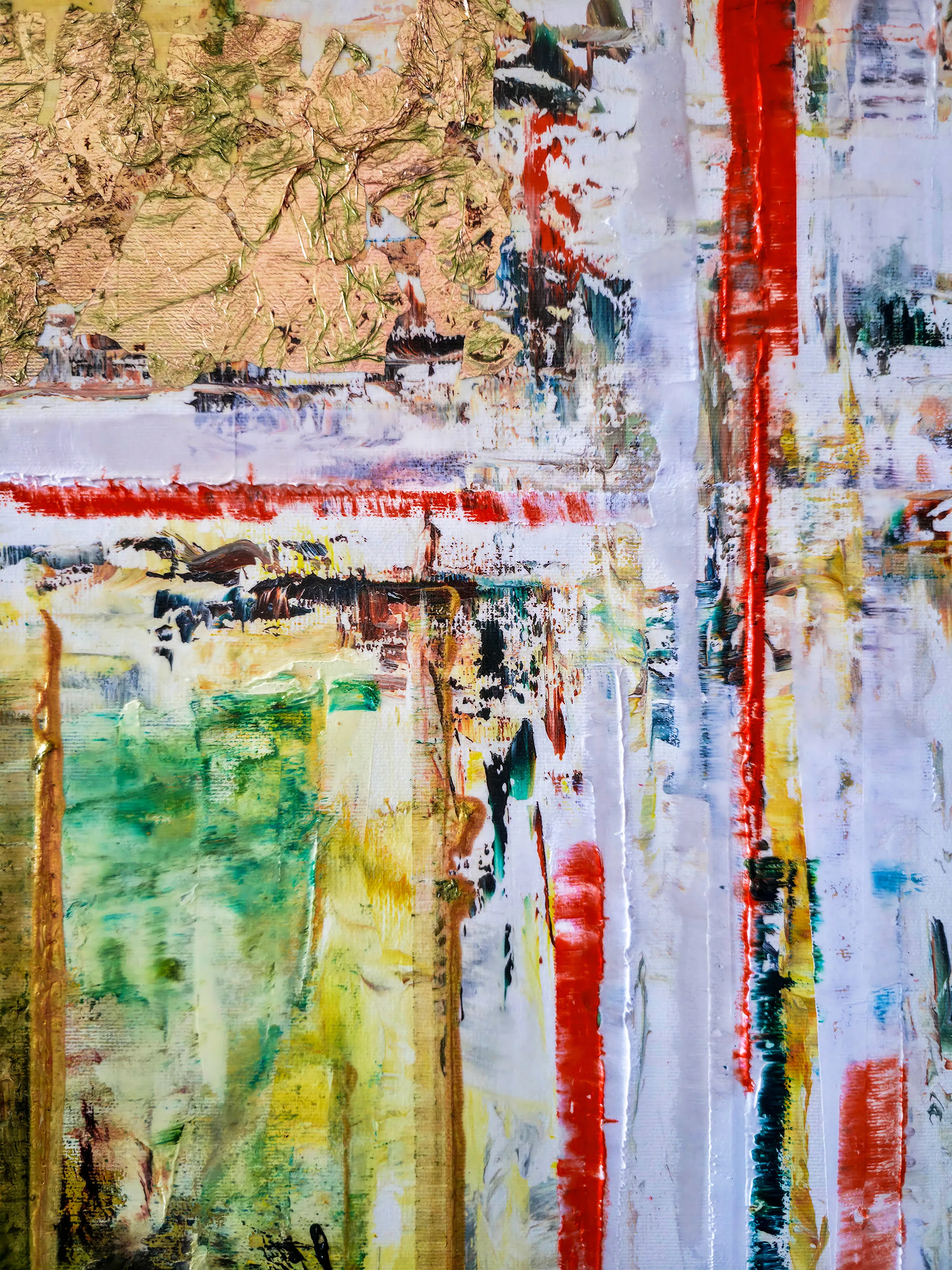
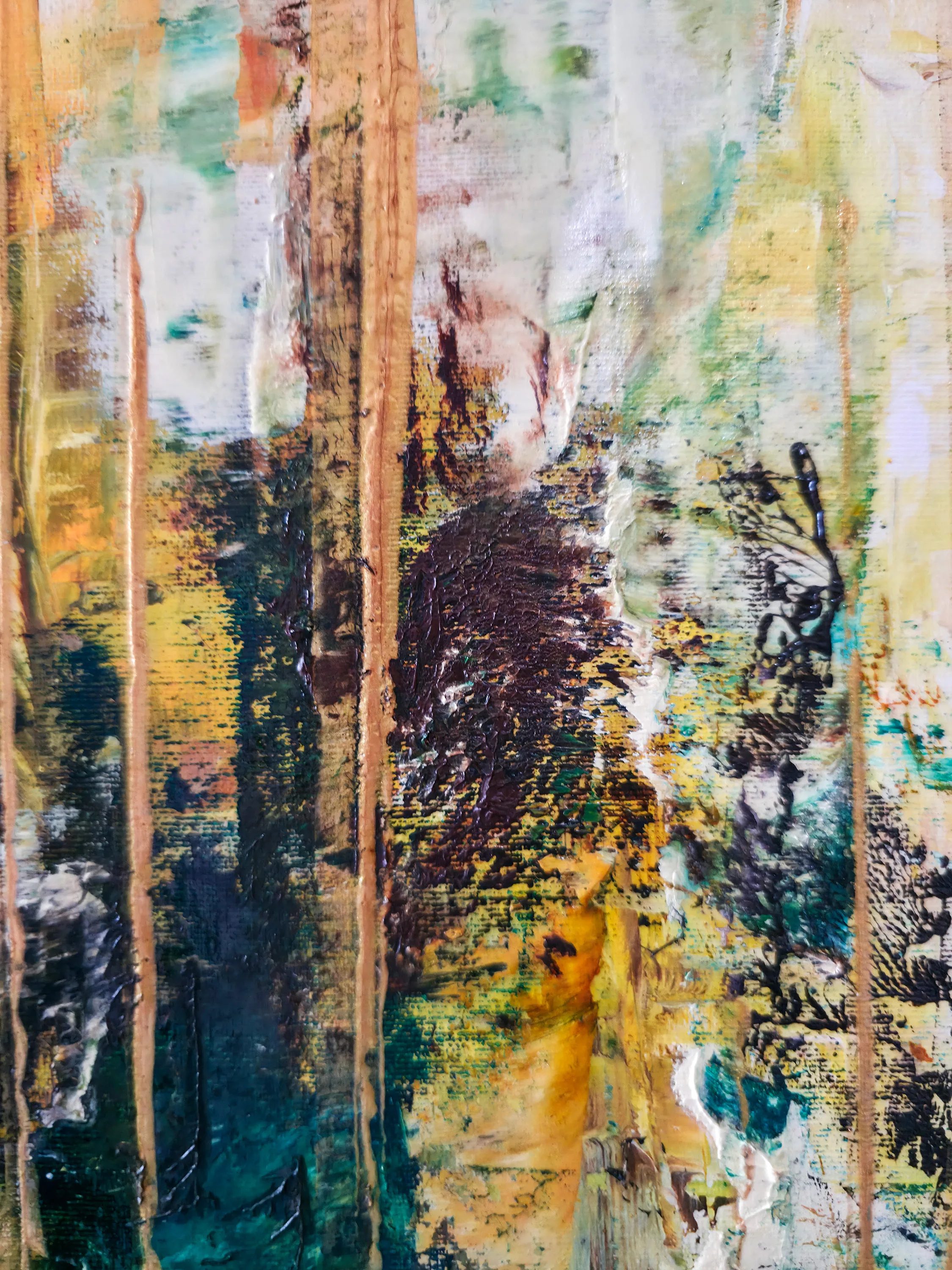
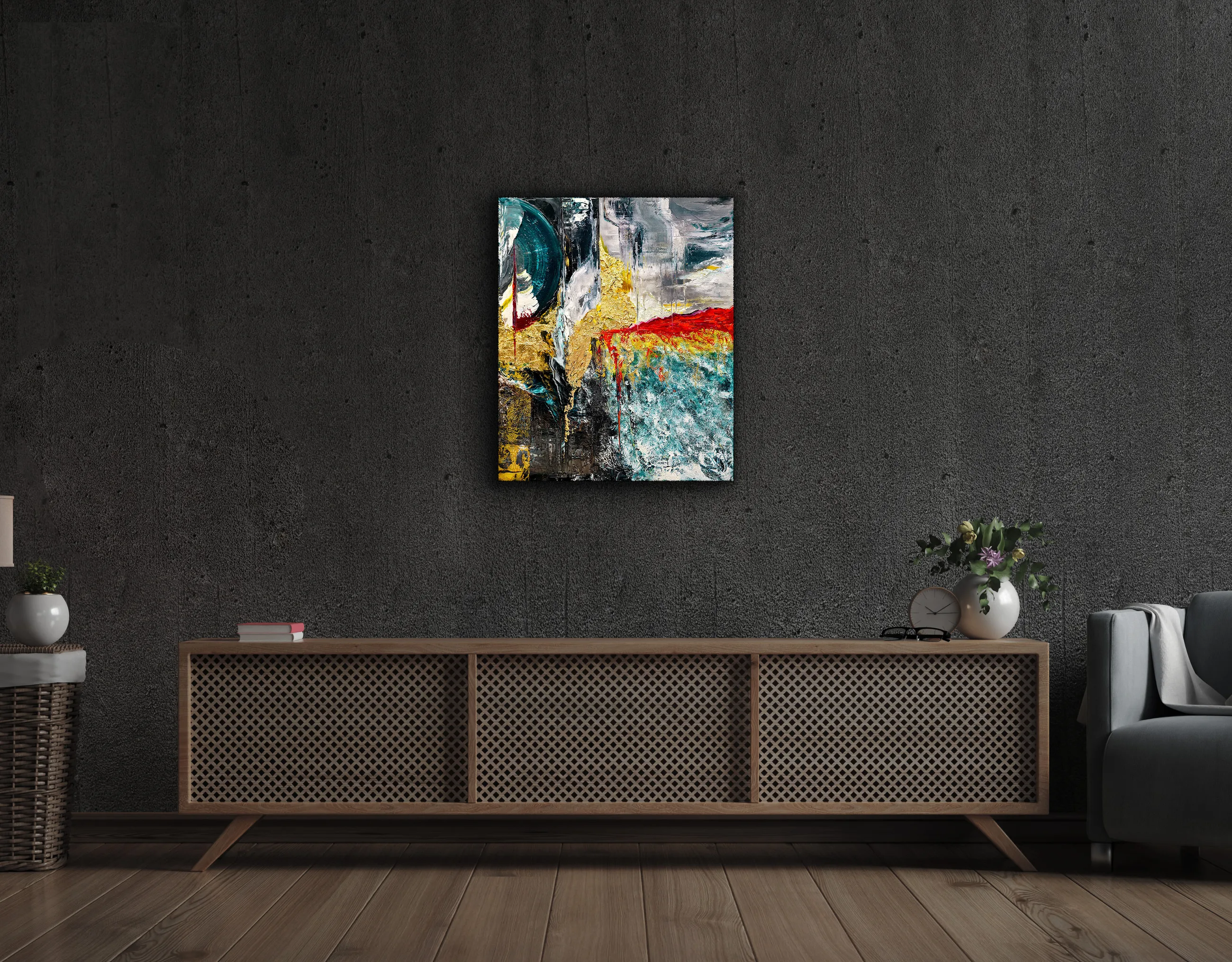
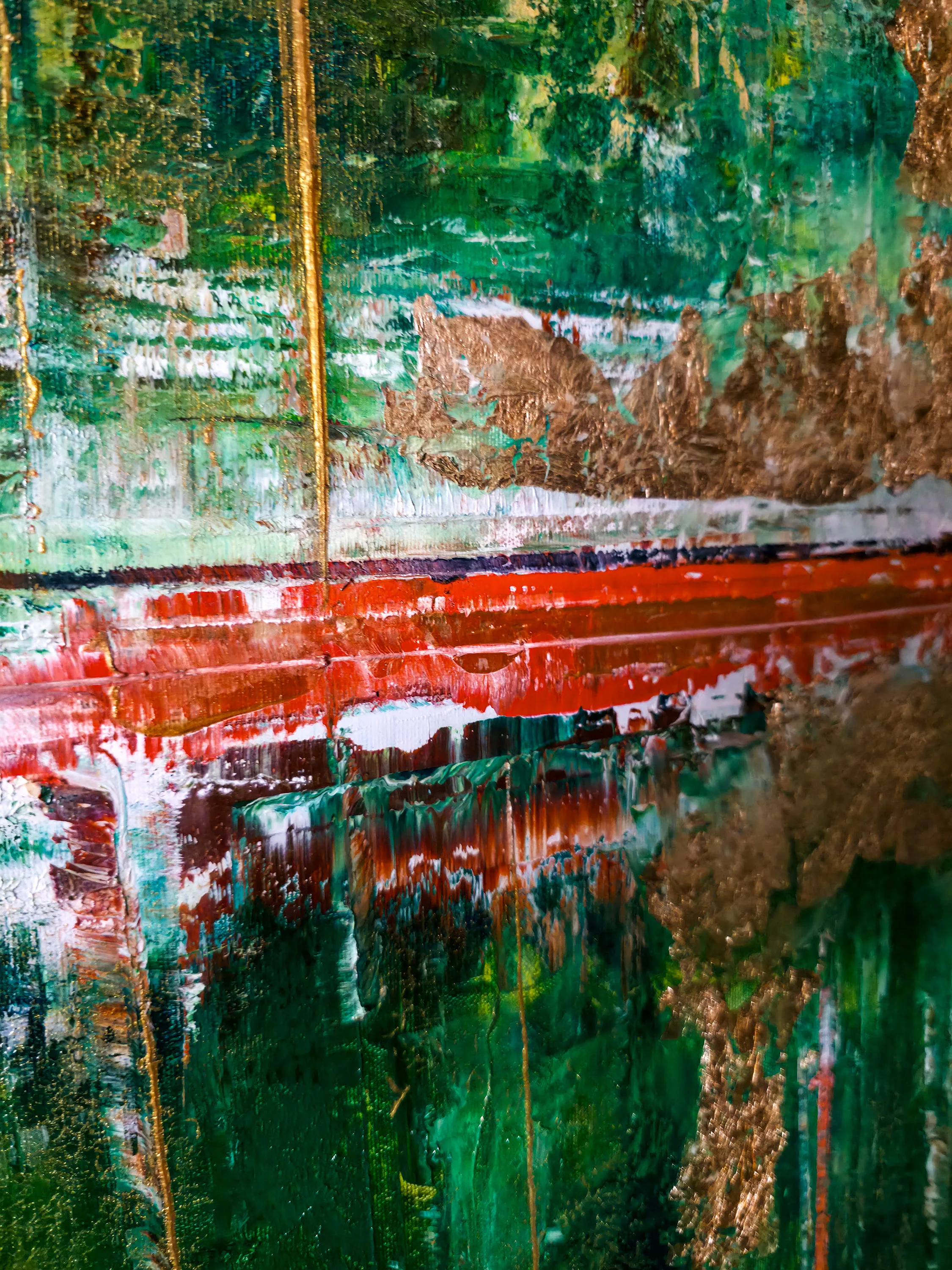
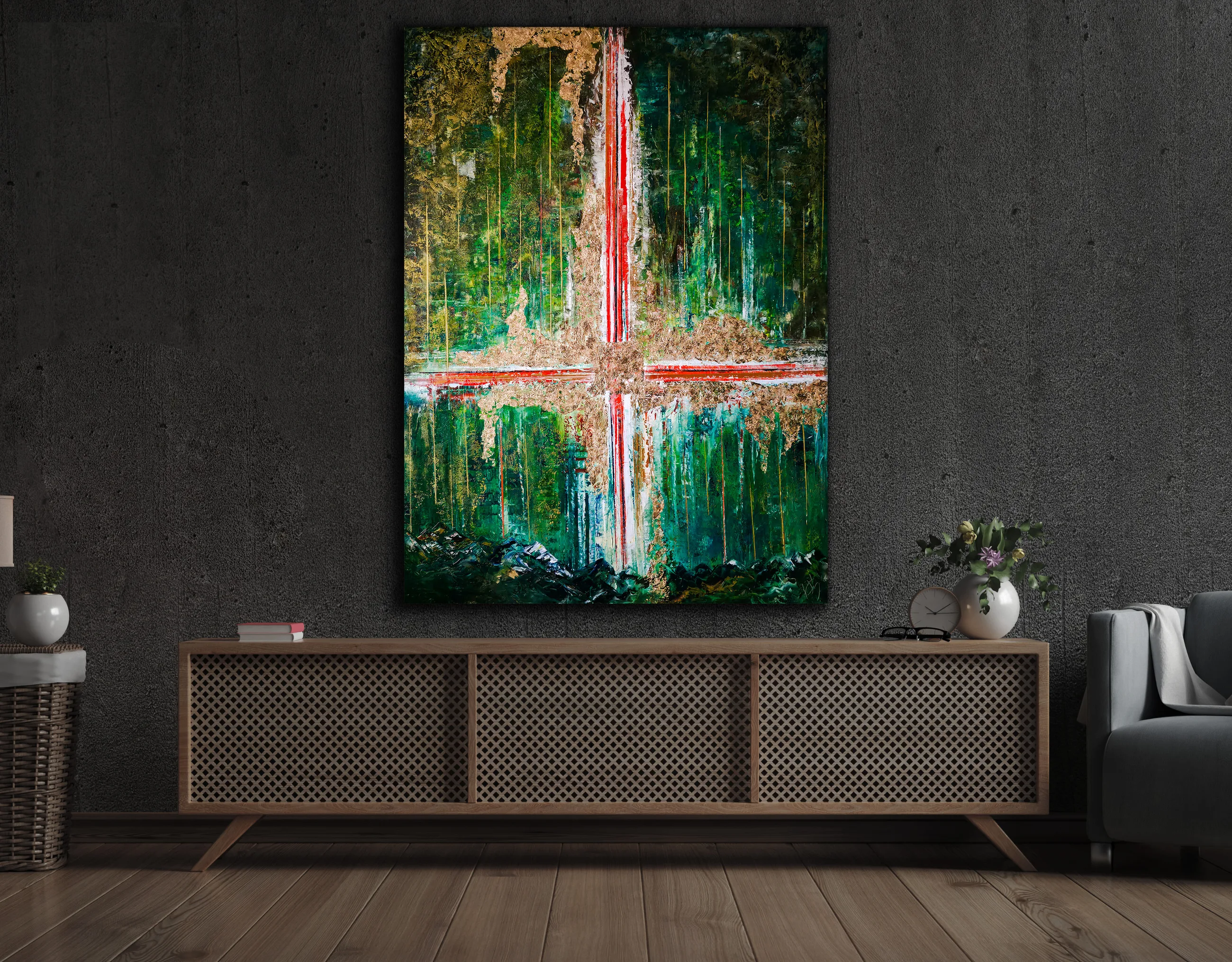
The composition evokes the timeless infinity preceding creation while simultaneously hinting at the scientific hypothesis of the Big Bang. Deep greens, blues, and browns ignite in a golden glow, shifting into blinding white at the center of the canvas. Swirling golden bands evoke the image of a forming universe, while the intersection of the red and white vertical and horizontal axes condenses the elemental tension of the moment of inception. The contrast between light and darkness reveals the potential formation of cosmic order.
The central arrangement organizes the pictorial field into unity with a resolute structural force. The vertical axis evokes the concepts of ABOVE and BELOW, of the transcendent and the material world, whereas the horizontal direction expands the composition and opens the process of creation toward infinite space.
The artwork holds the viewer on the borderline between the biblical narrative of creation and scientific explanation. Are we witnessing a created world, or is the Big Bang itself the moment of creation? The painting does not resolve this ambiguity; rather, it deepens the mystery of the beginning. In the convergence of these two approaches, the ultimate answer is left to the personal conviction of the beholder.
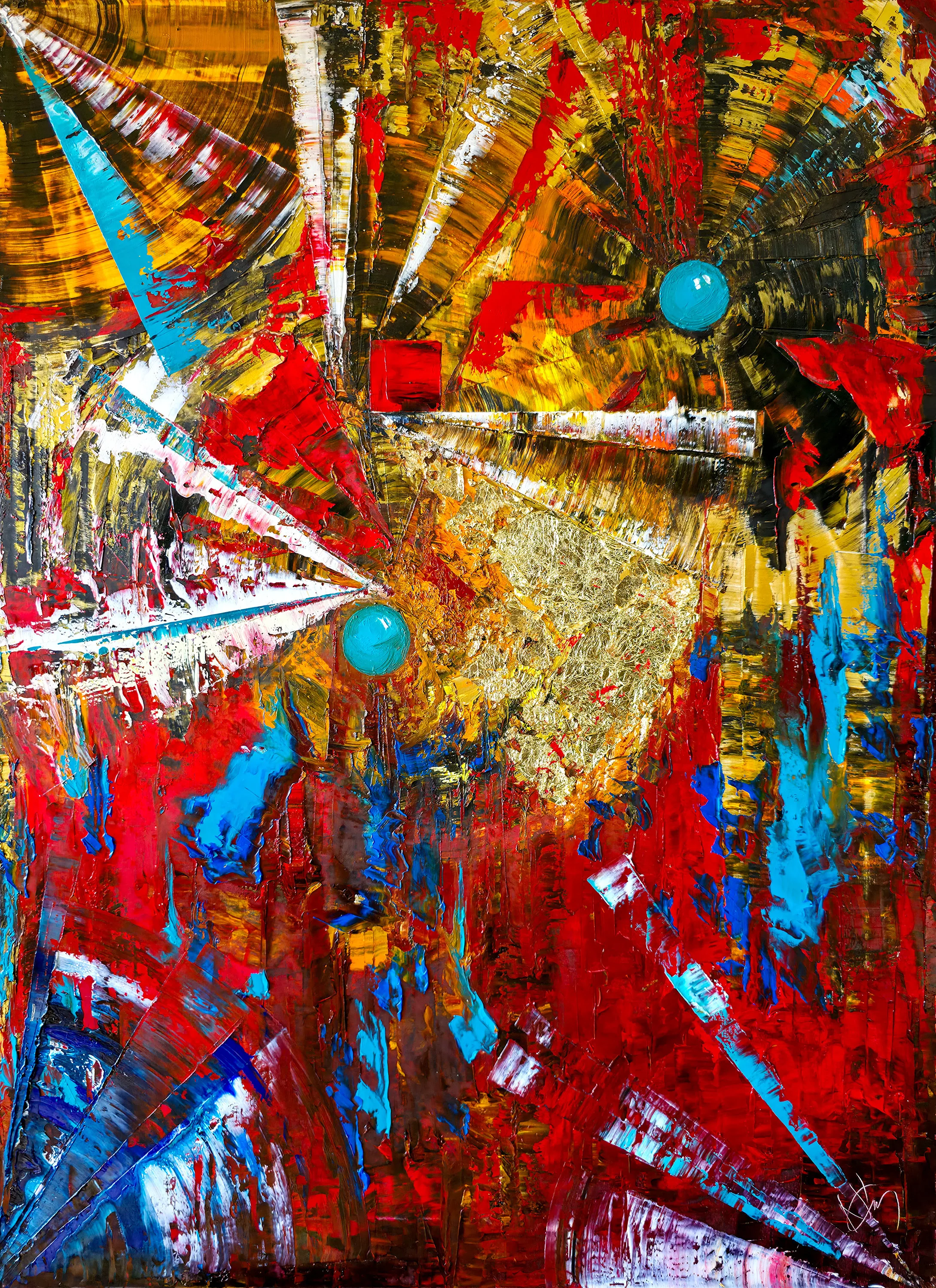
Before the "EVERYTHING"
- 100 x 73 cm
- Oil and gold on canvas
- Created: Sitges, 2026
- The work is part of the 'Old Testament III - In Search of the Secrets of Eternity' cycle
- SOLD
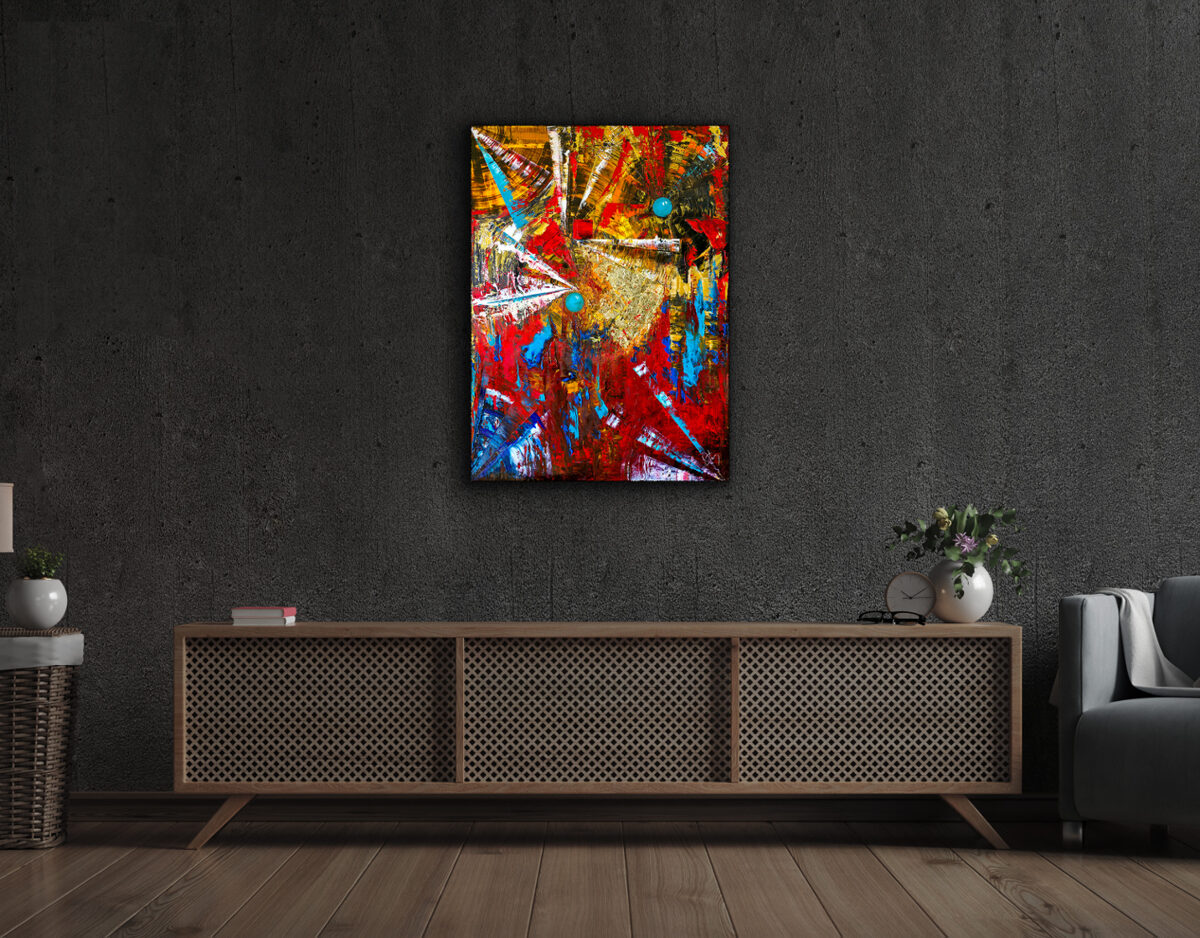
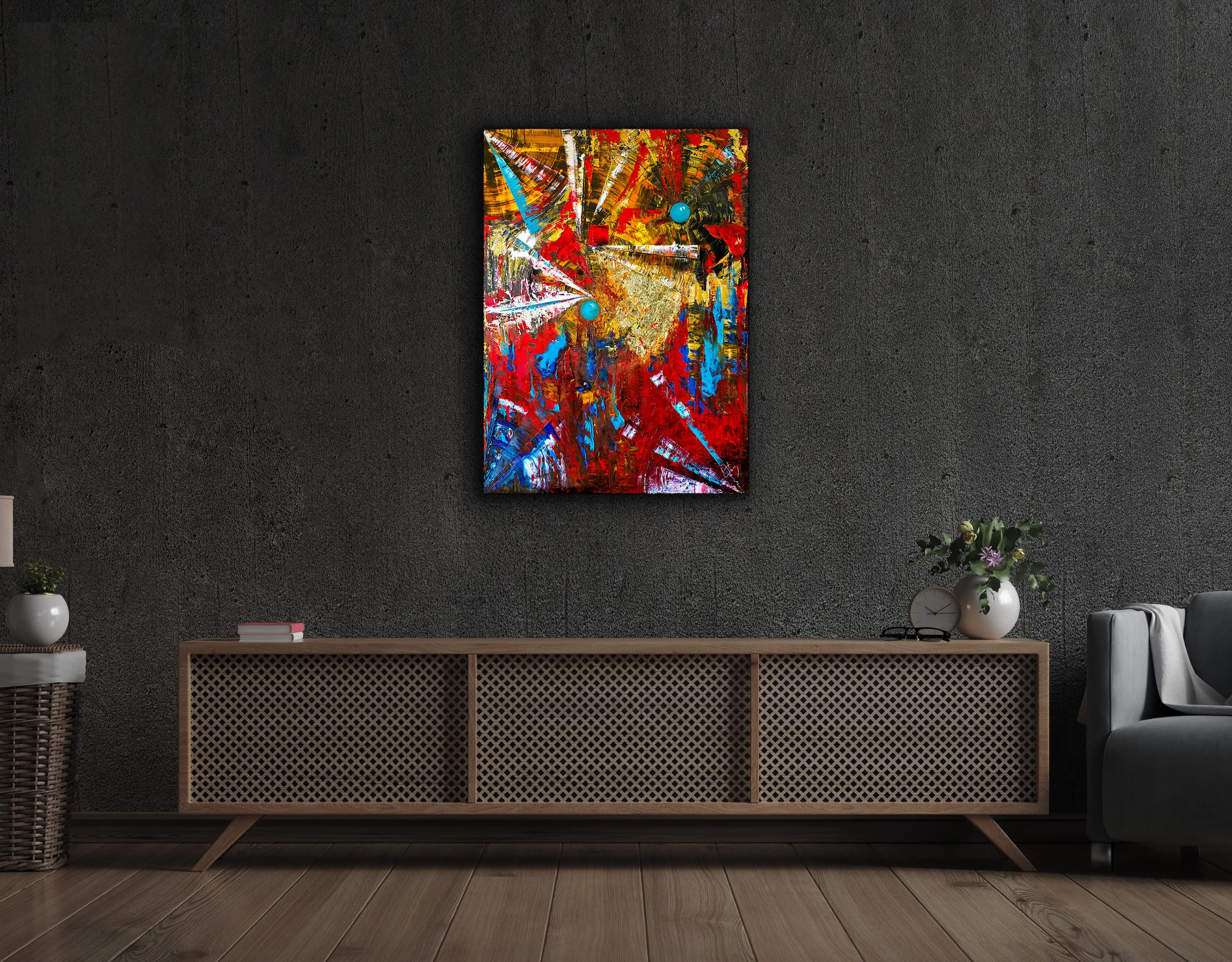
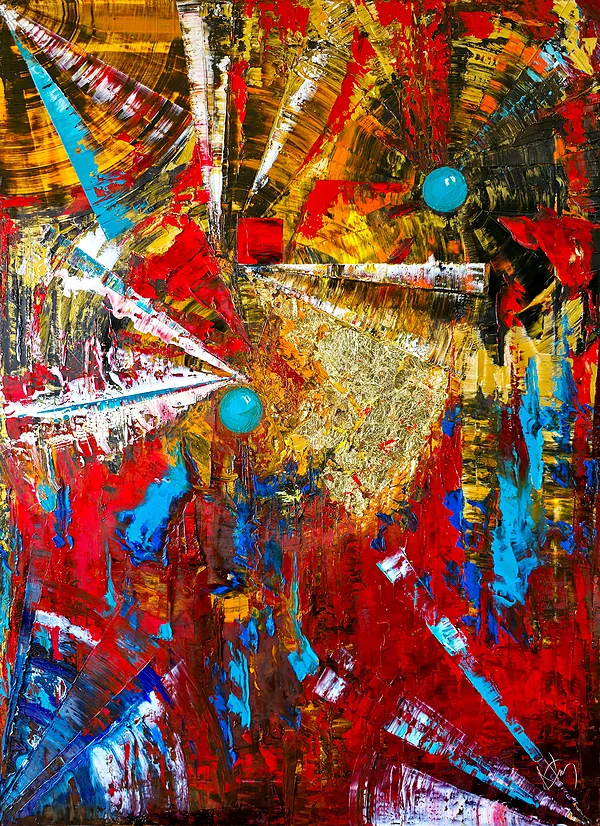
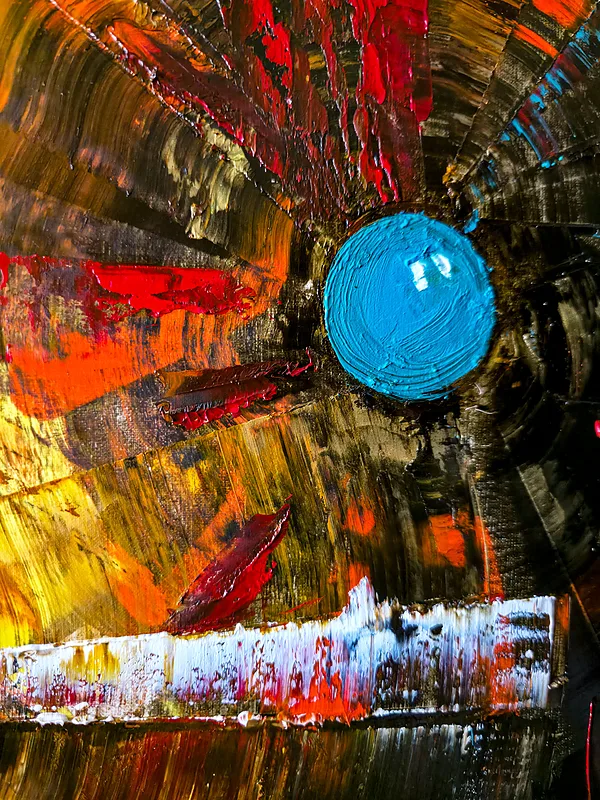
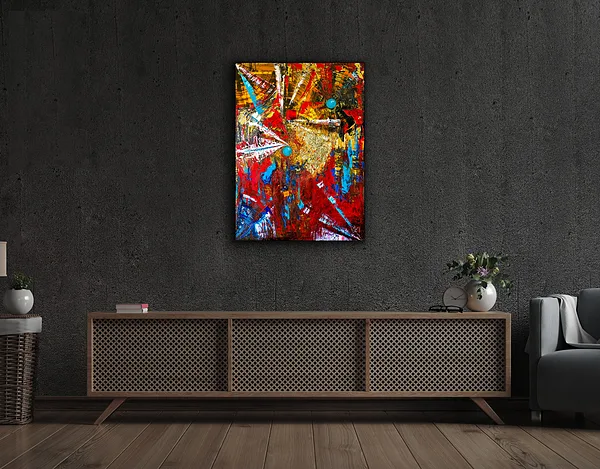
The painting leads us before the biblical account of creation, into a primal chaos preceding the birth of the created world - a state almost incomprehensible to the human mind. We find ourselves in the moment before the establishment of time's commanded order.
Within the painter’s system of symbols, radial shapes represent the cycle of existence, yet here they swirl in scattered fragments: although time already exists, it has not yet organized into a measurable process.
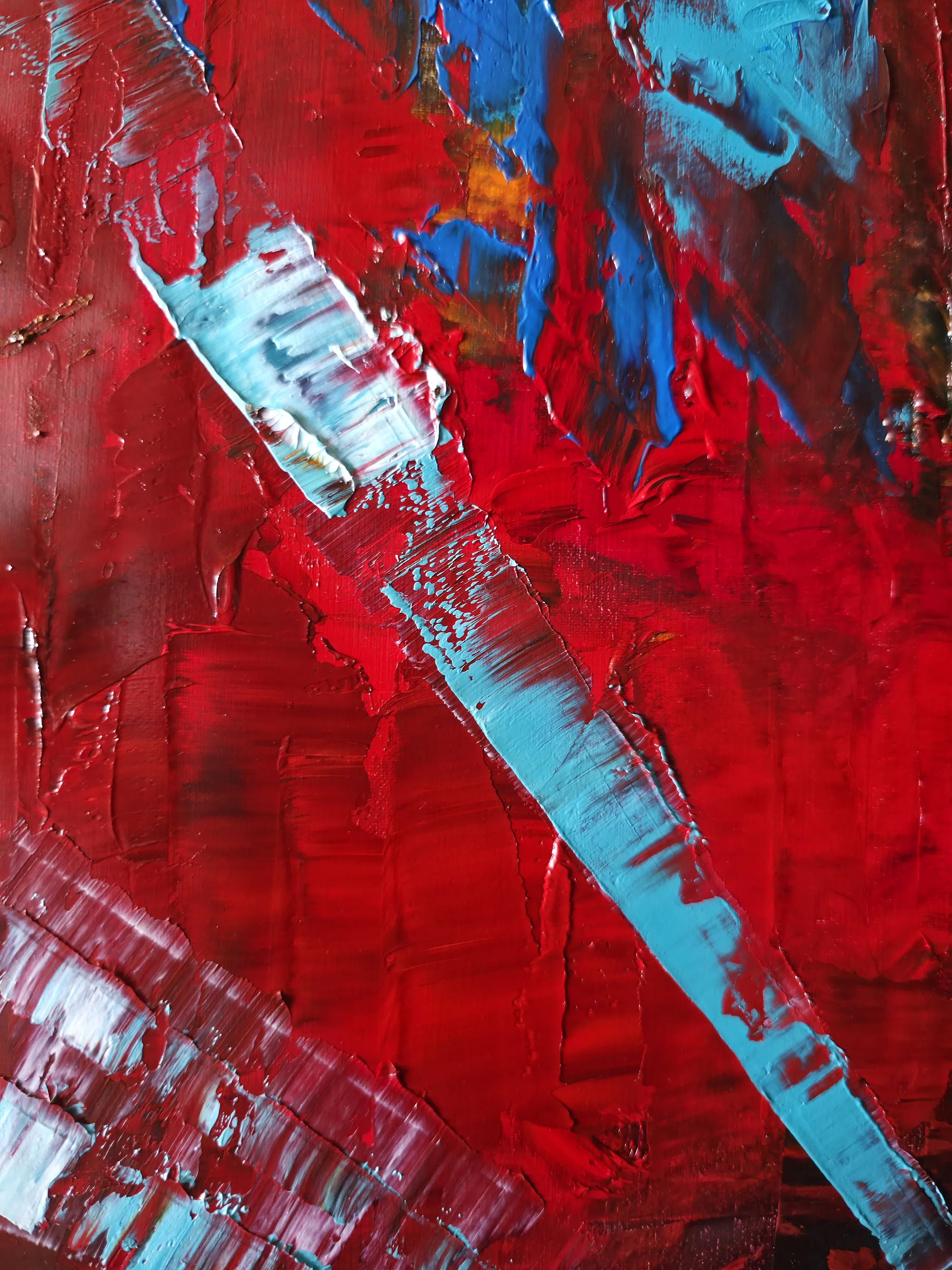
The blazing red fields carry the accumulating energy of a world awaiting birth, while at the center, a crusty, metallically glowing golden surface evokes the image of a forming cosmic seed.
The words of the Book of Genesis already foreshadow the impending turning point:
"And God said, Let there be light: and there was light" (Genesis 1:3).
A singular tranquility is represented by the two turquoise circles - recurring symbols of the Garden of Eden - which evoke the memory of the primeval waters and the yet-unfolding potential of life. They form a formal and semantic contrast with the red square, the solid, indivisible sign of the One, the bearer of the invisible guiding principle of the future created order. The continuity of the circles and the resolute geometry of the square already flash the prospect of emerging order within the primal chaos.
As a vision of the moment before the "Everything," the artwork captures that inexpressible threshold where organized time unfolds from possibilities still locked in unity, the creative Word is spoken, and light breaks forth from the darkness.
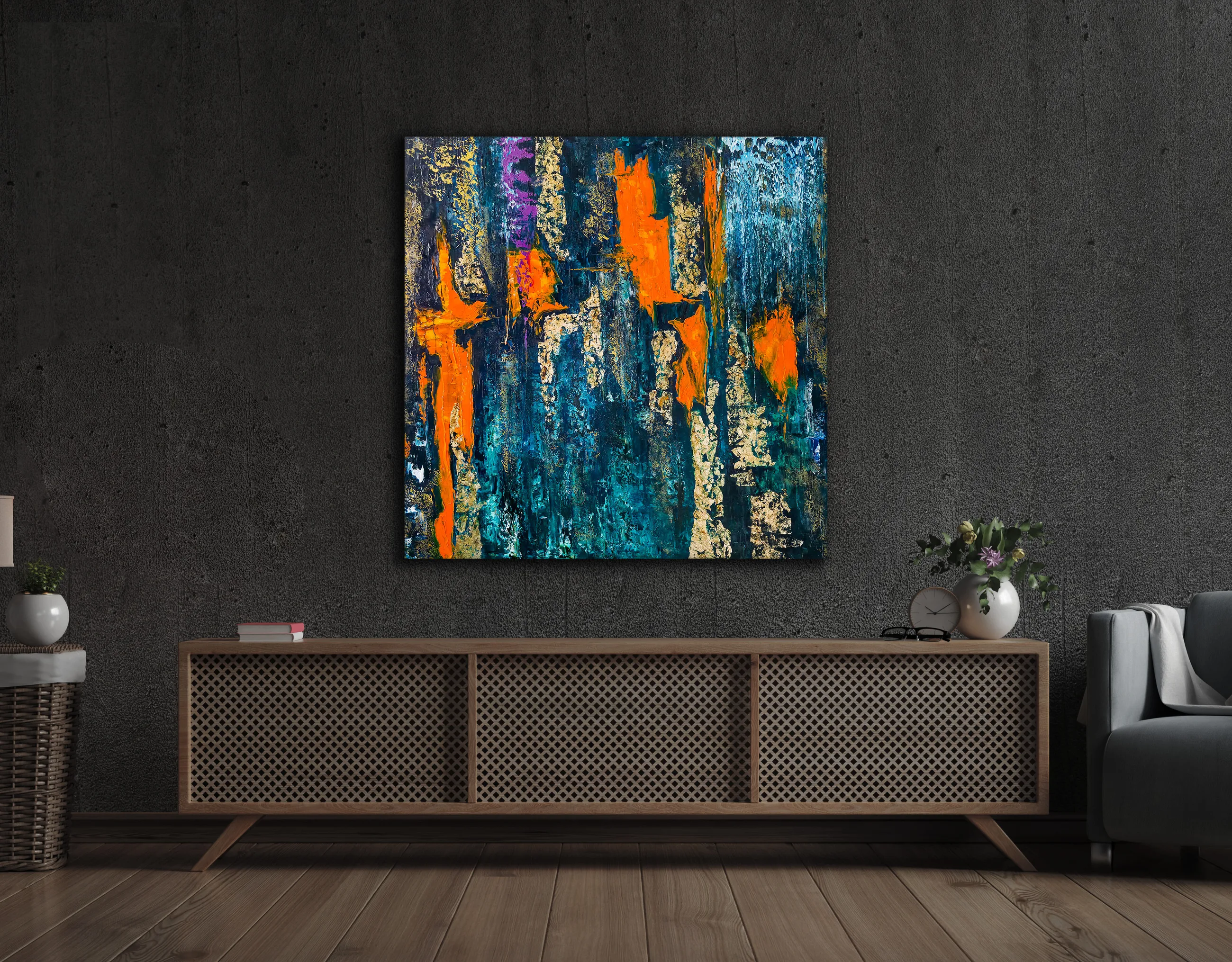
Before the Spirit of God Moved Upon the Waters
- 120 x 120 cm
- Oil and gold on canvas
- Created: Sitges, 2026
- The artwork is part of the 'Old Testament III - In Search of the Secrets of Eternity' cycle
- RESERVED
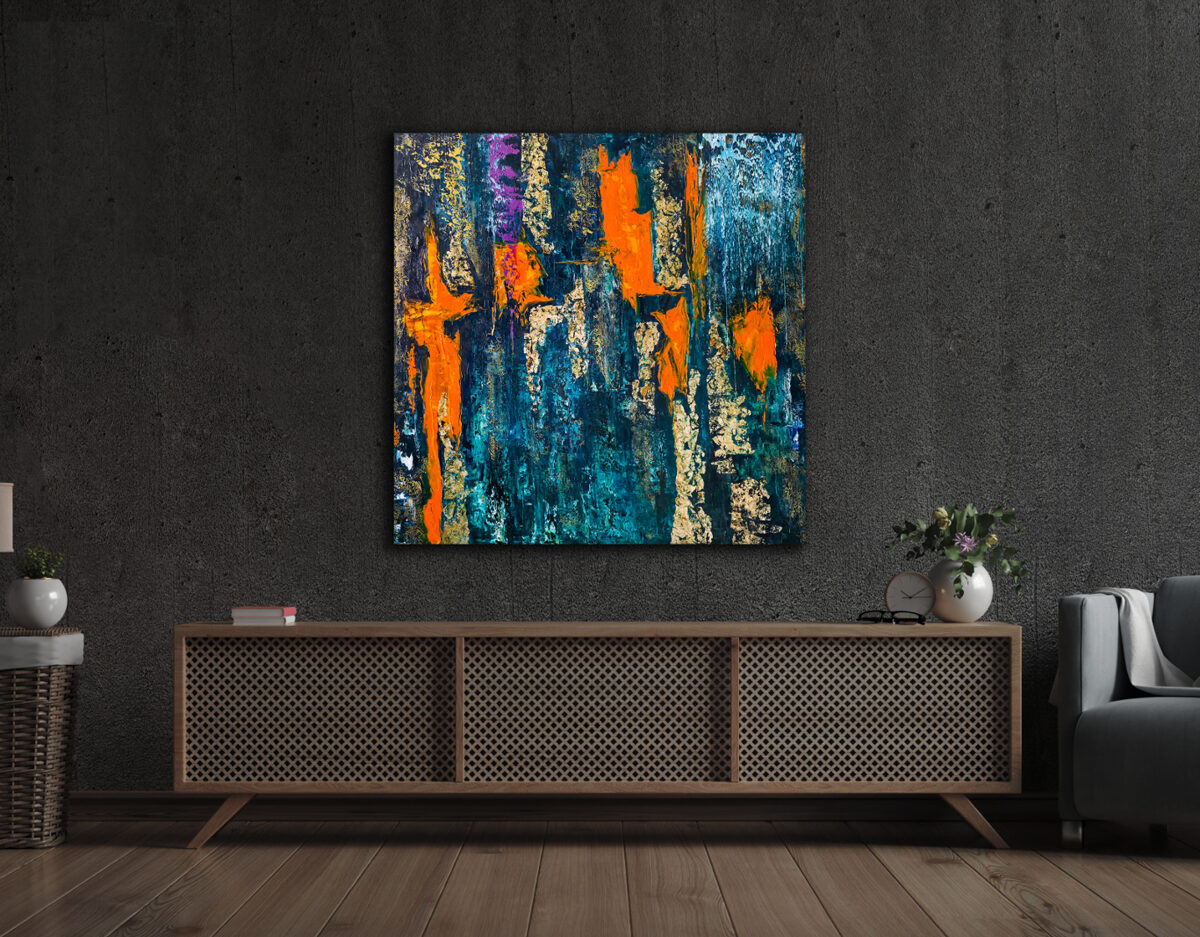
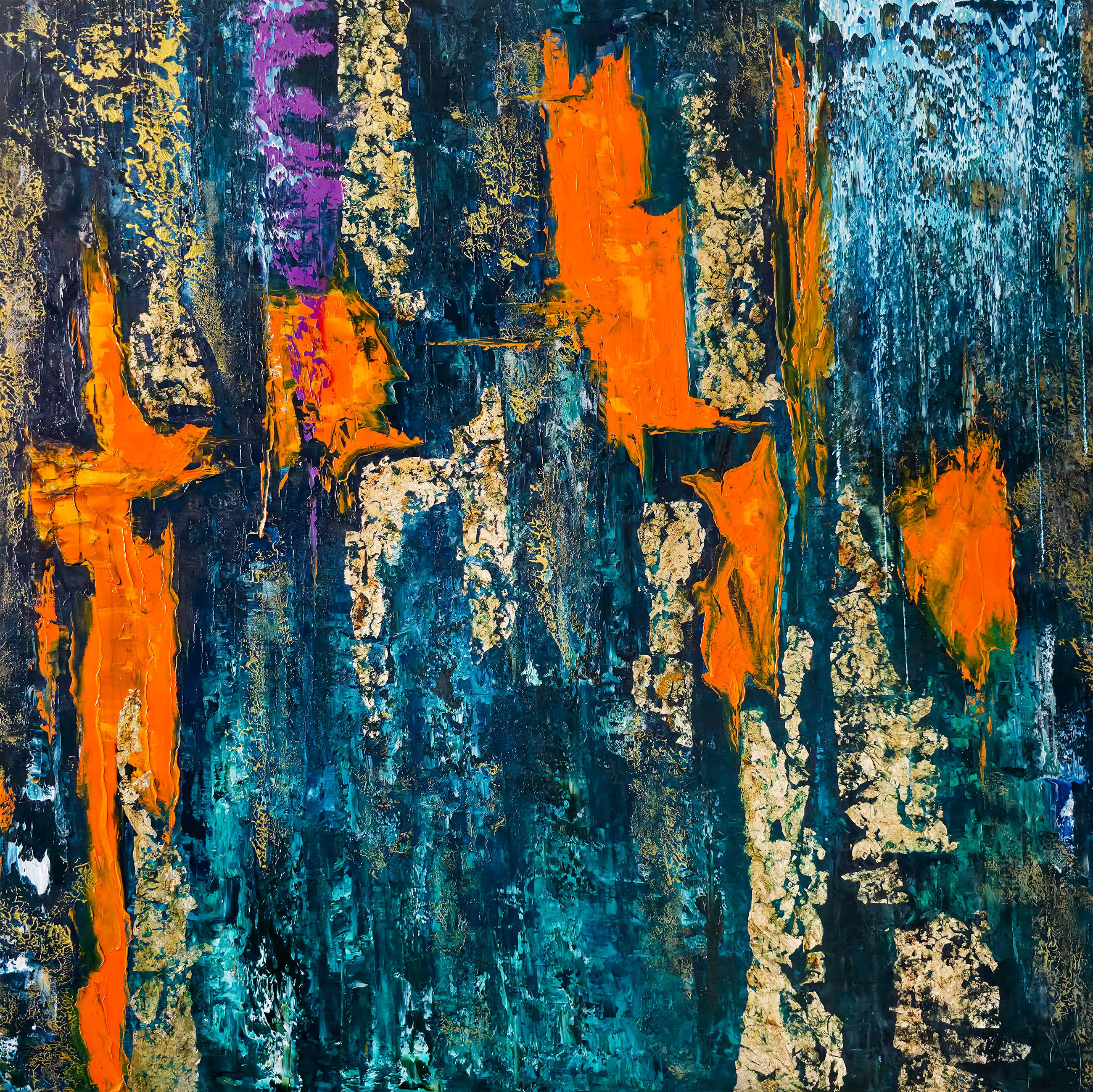
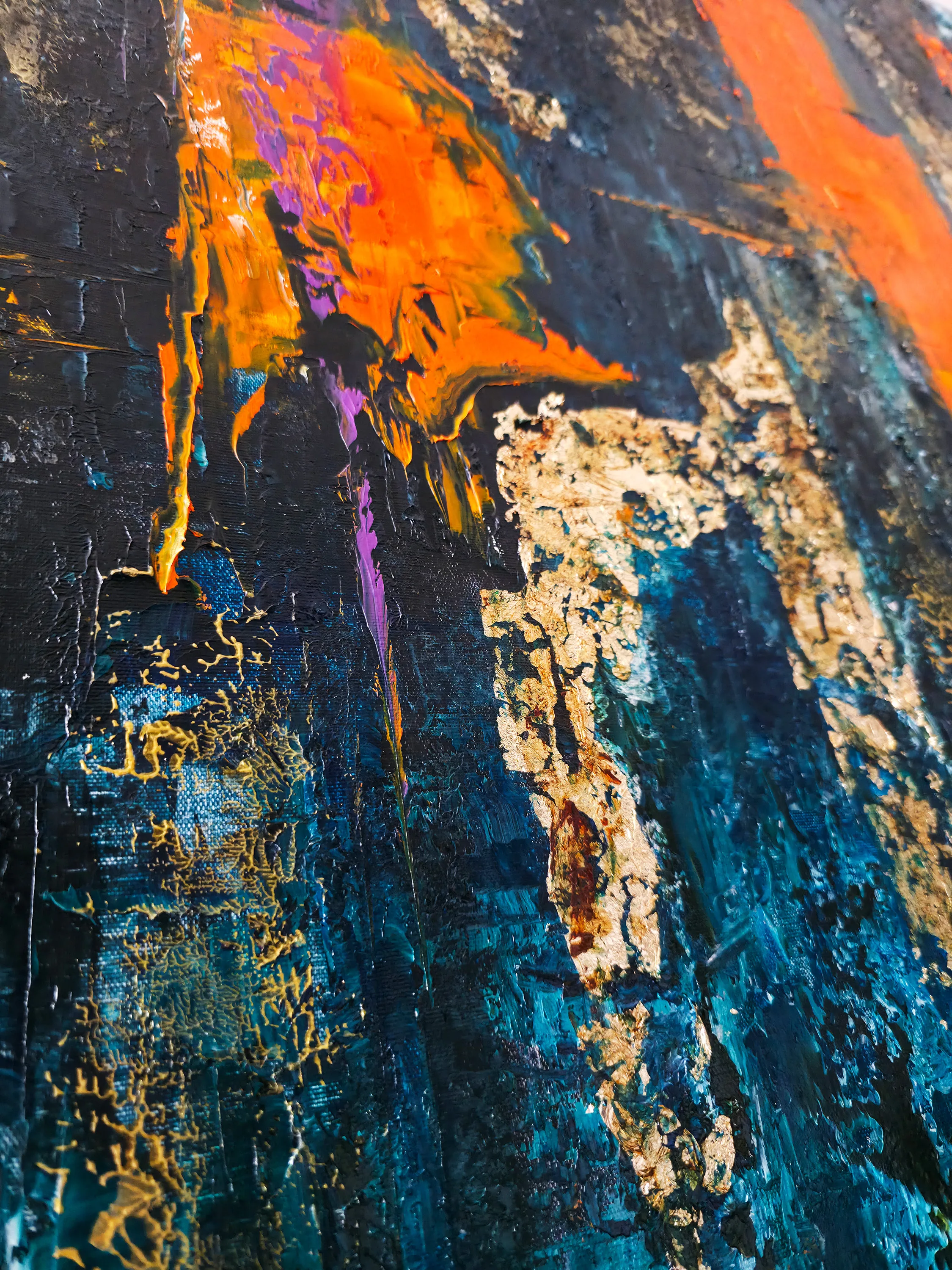
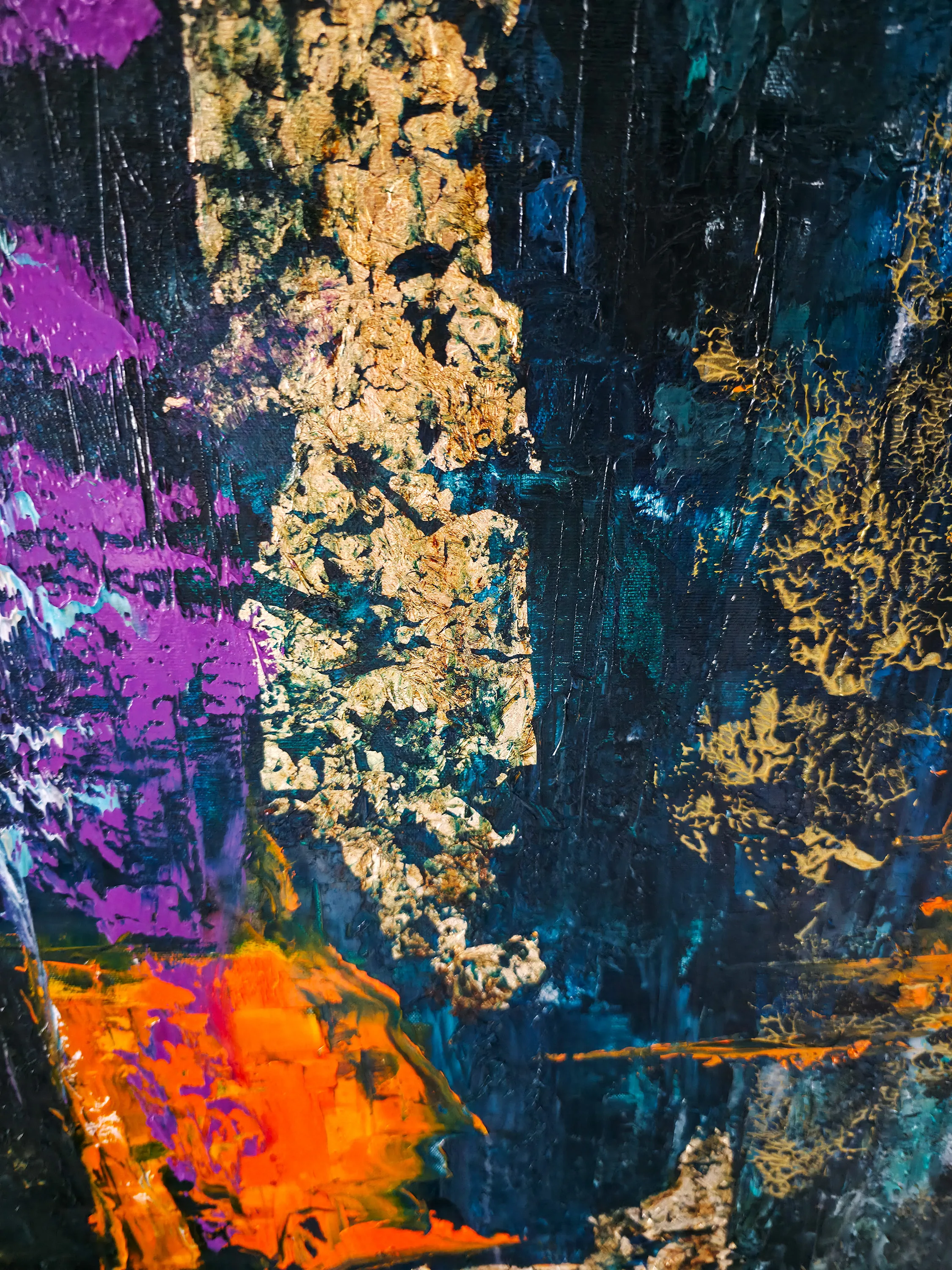
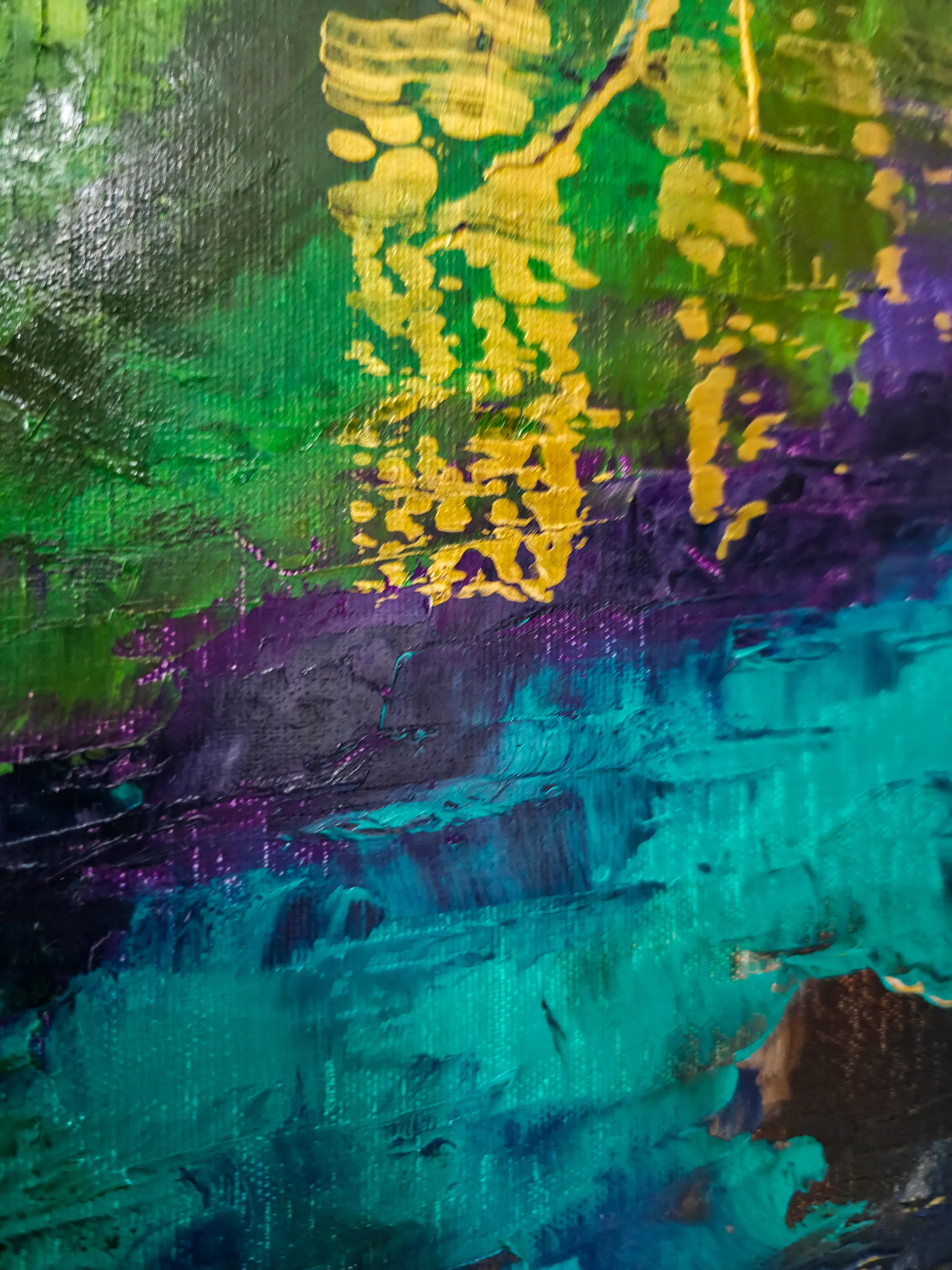
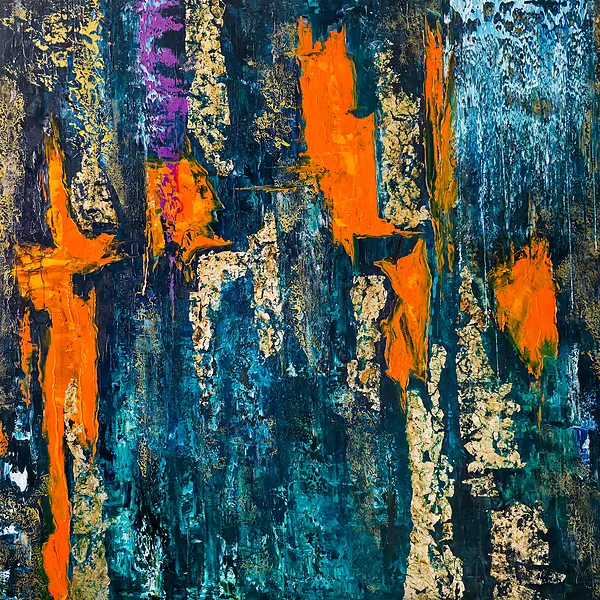
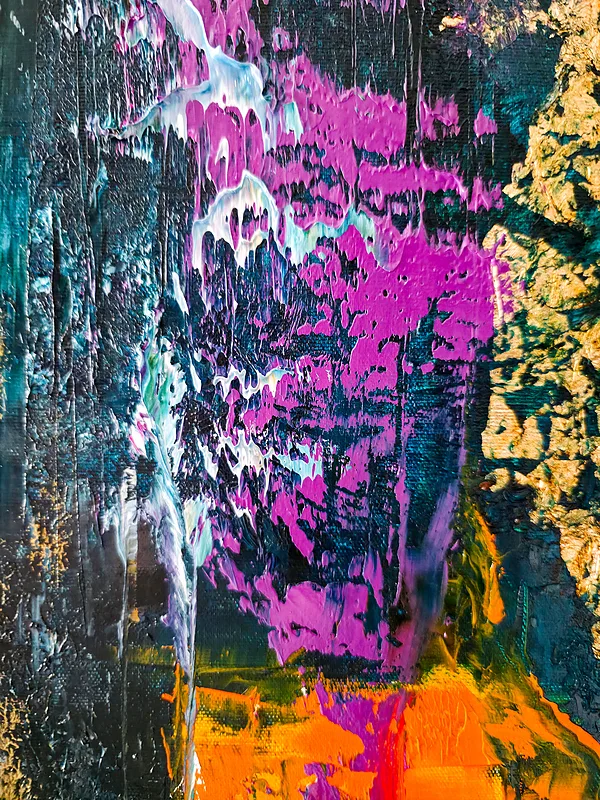
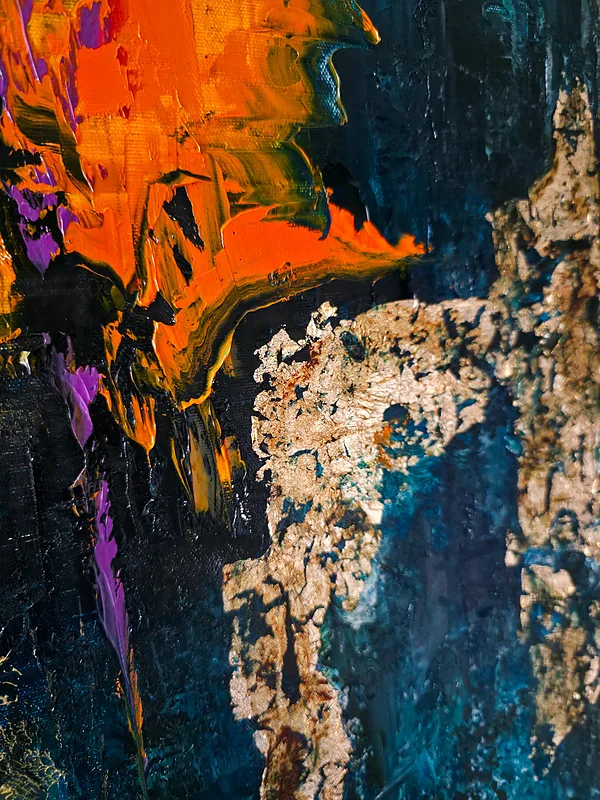
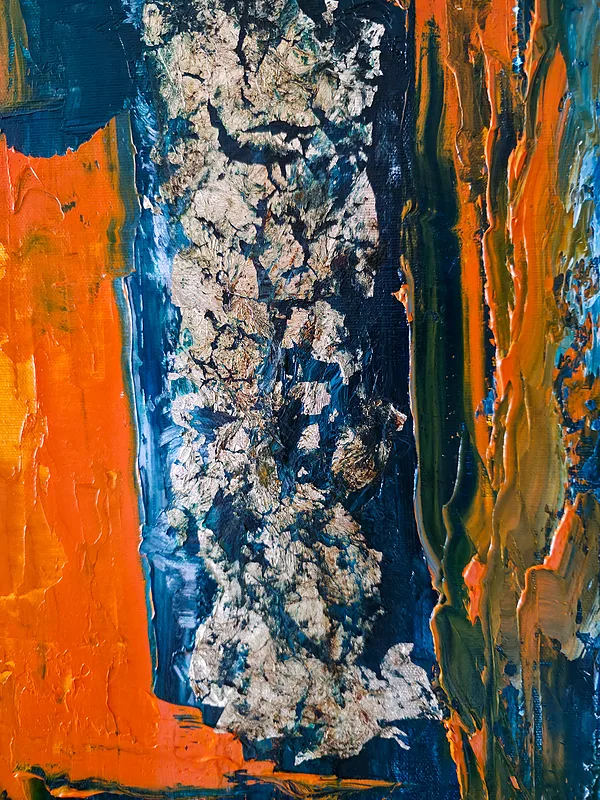
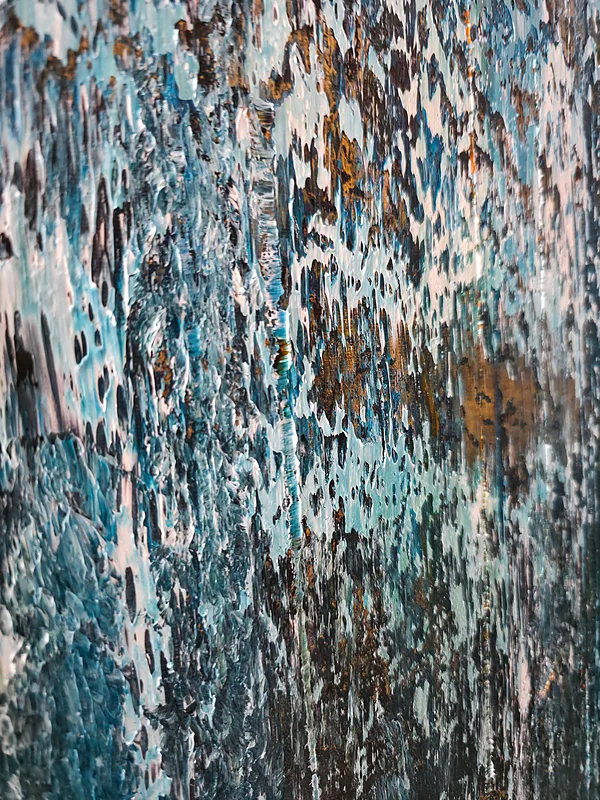
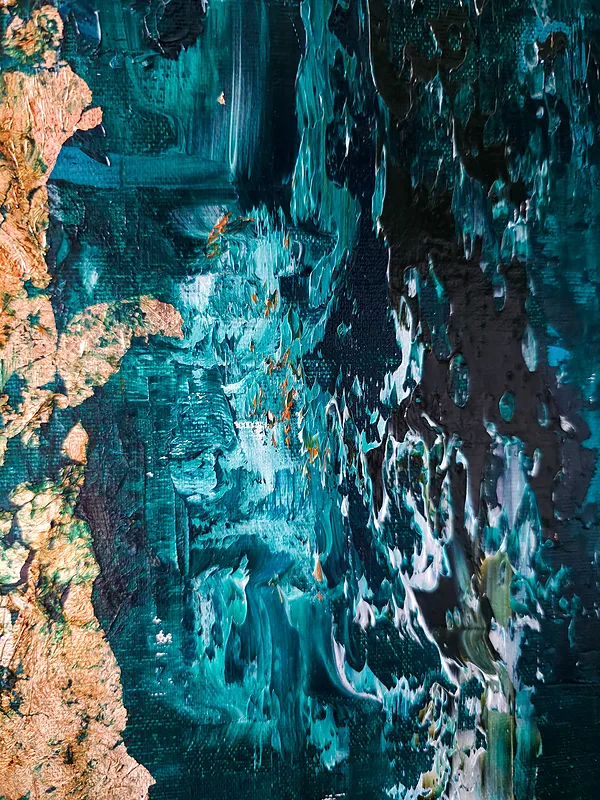
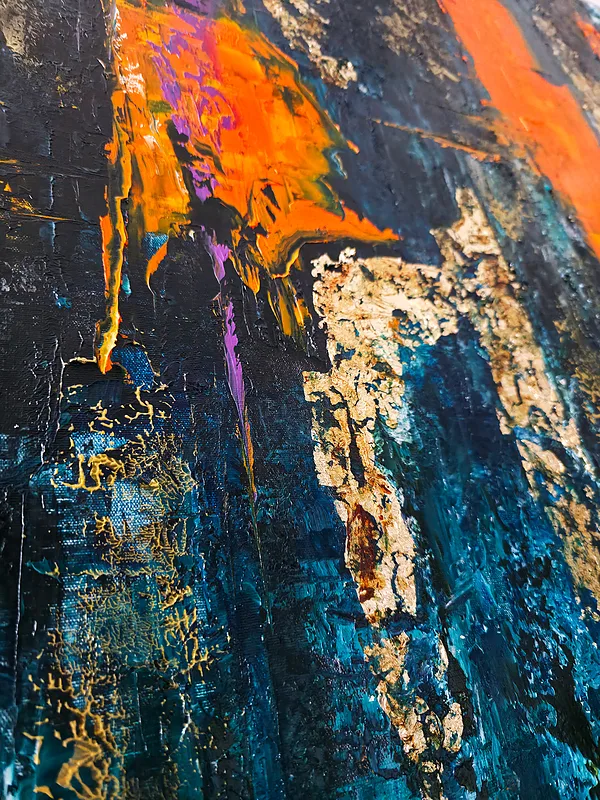
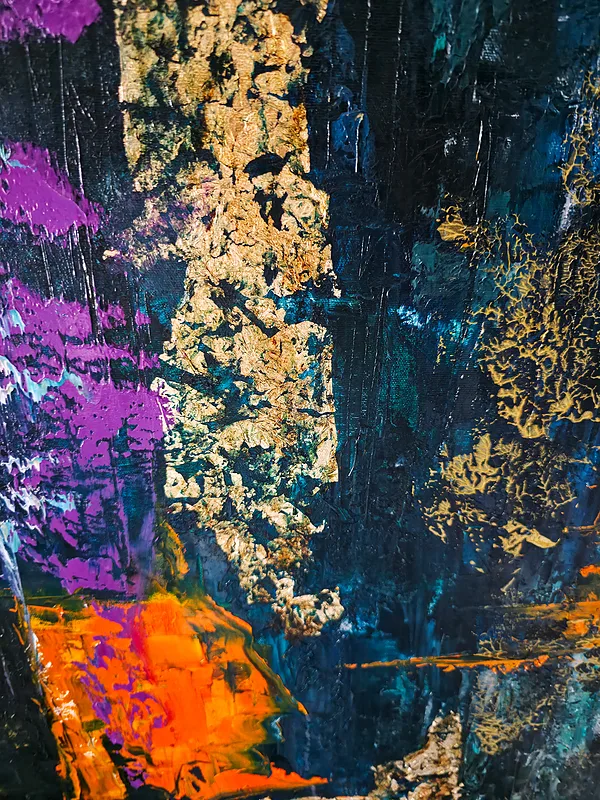
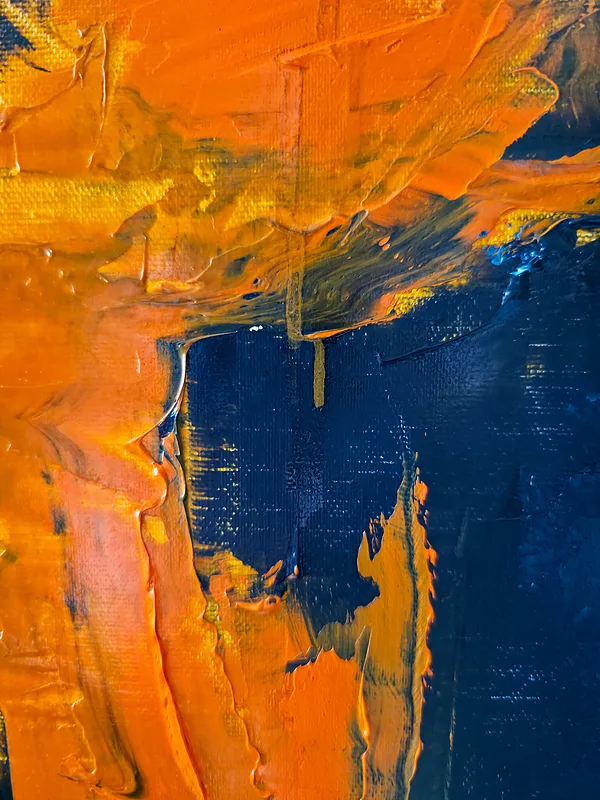
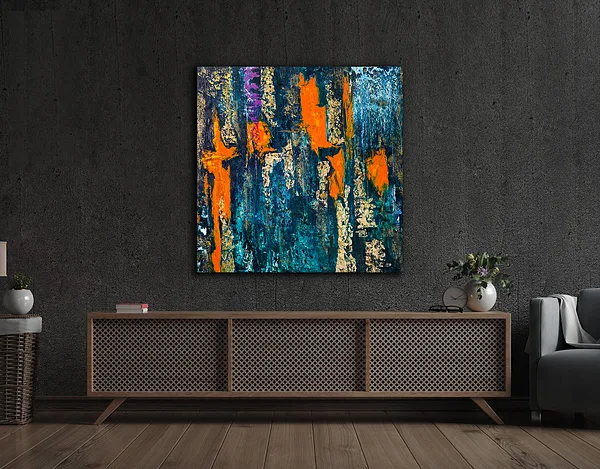
A vision unfolds of the timeless eternity preceding the biblical dawn of Creation, where heaven and earth still slumber within the divine will, and light and darkness coexist as one within the primordial abyss. The work evokes the state before Creation, when time has yet to be divided into days and nights, yet forms have already begun to take shape.
“And the earth was without form, and void; and darkness was upon the face of the deep. And the Spirit of God moved upon the face of the waters.” (Genesis 1:2)
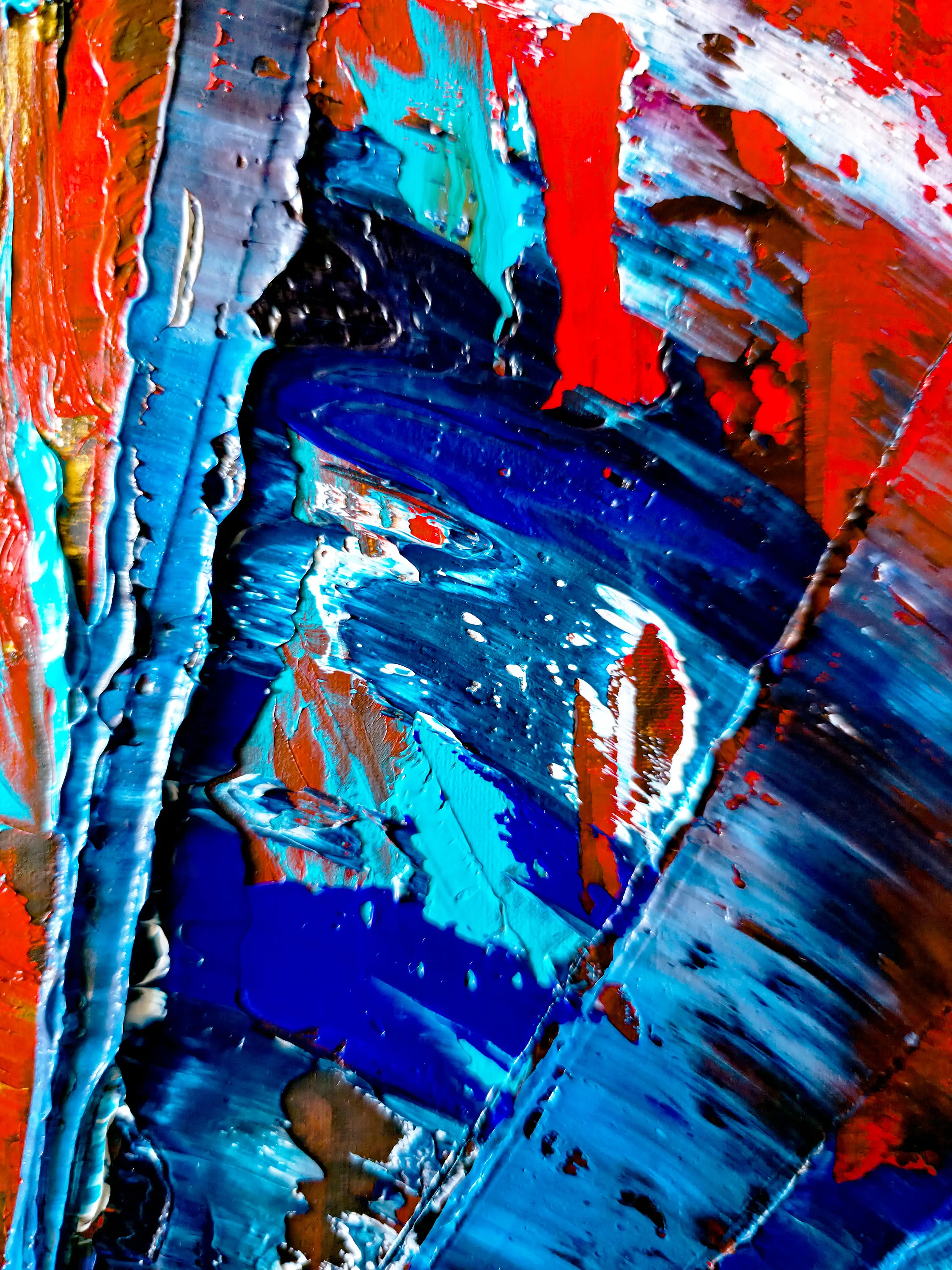
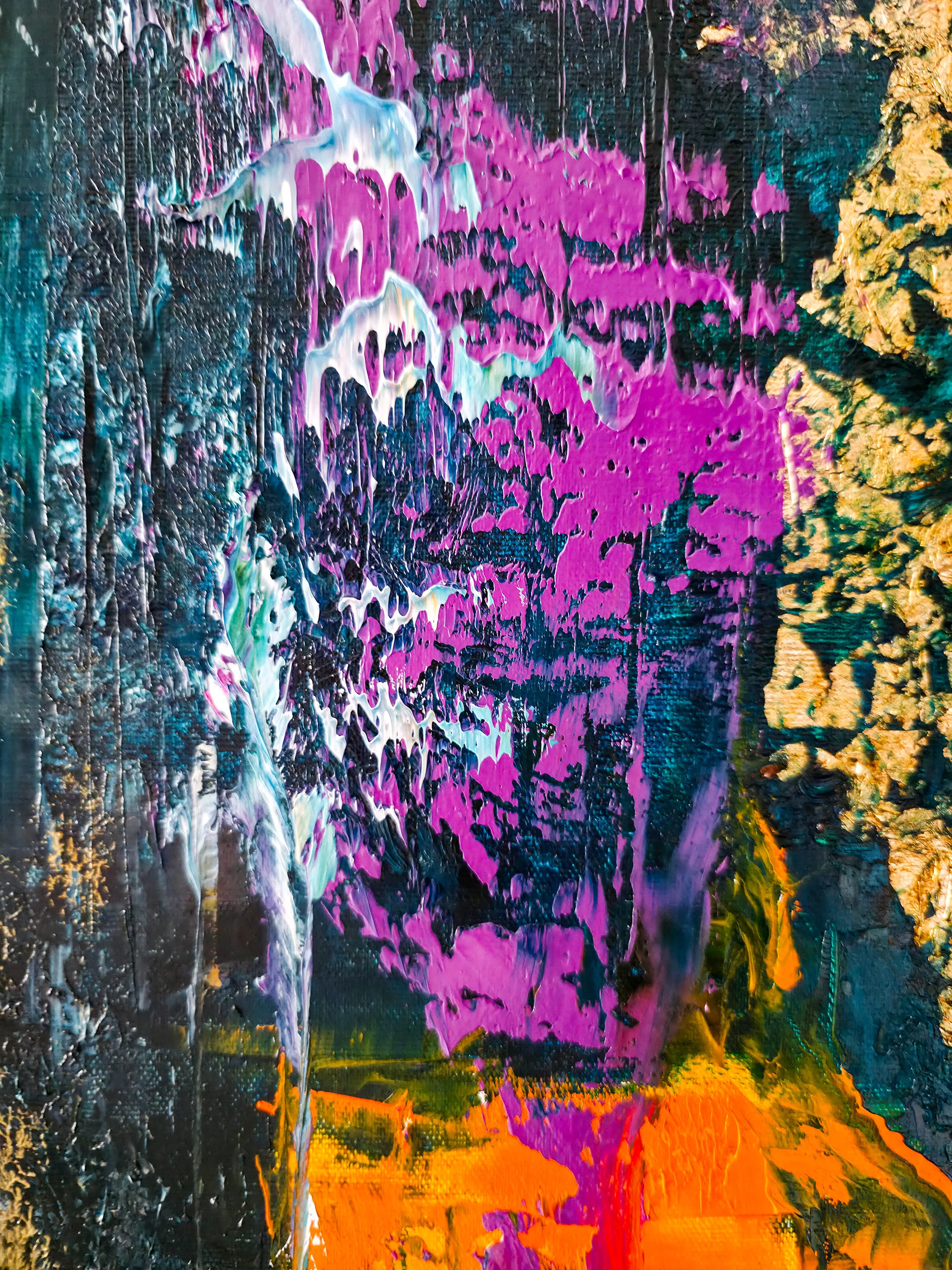
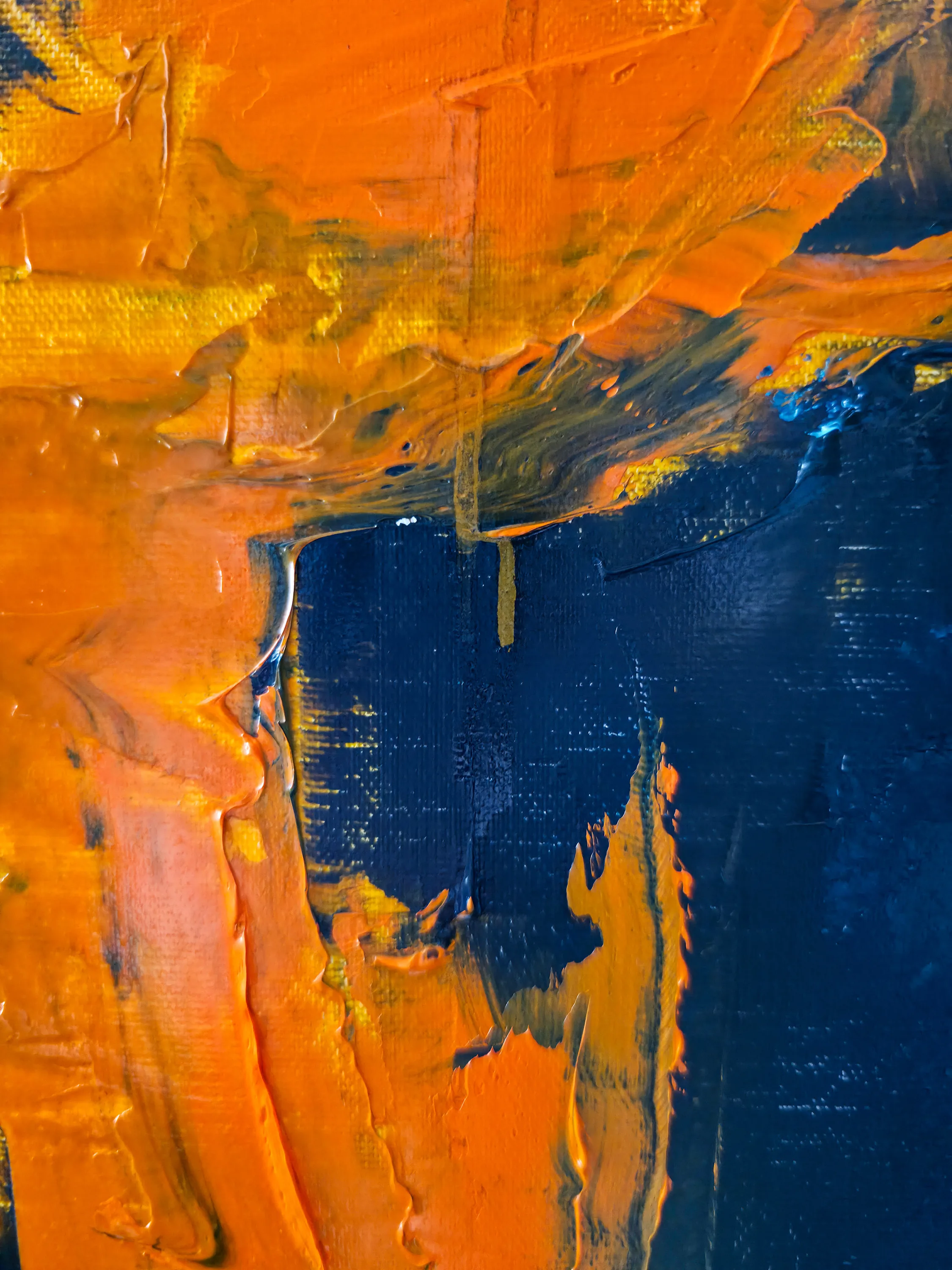
Layers of deep blue, petrol blue, and near-black create an abyss of boundless depth. Vertical brushstrokes and translucent turquoise glimmers evoke the still yet vibrant realm of the primordial waters. Flaming orange forms emerging from the deep blue fields suggest the awakening of primordial matter, the first flare of the creative force. Layers of purple and violet convey the mystery of divine thought, while irregular, fragmented gold surfaces signal the emergence of order and the presence of the divine will. The silvery and ice-blue layers in the upper right corner foreshadow the first glimmer of light.
The painting holds the viewer's gaze at the threshold of Creation, at that sacred instant when the infinite abyss still awaits the divine command that will mark the beginning of existence:
“Let there be light!”
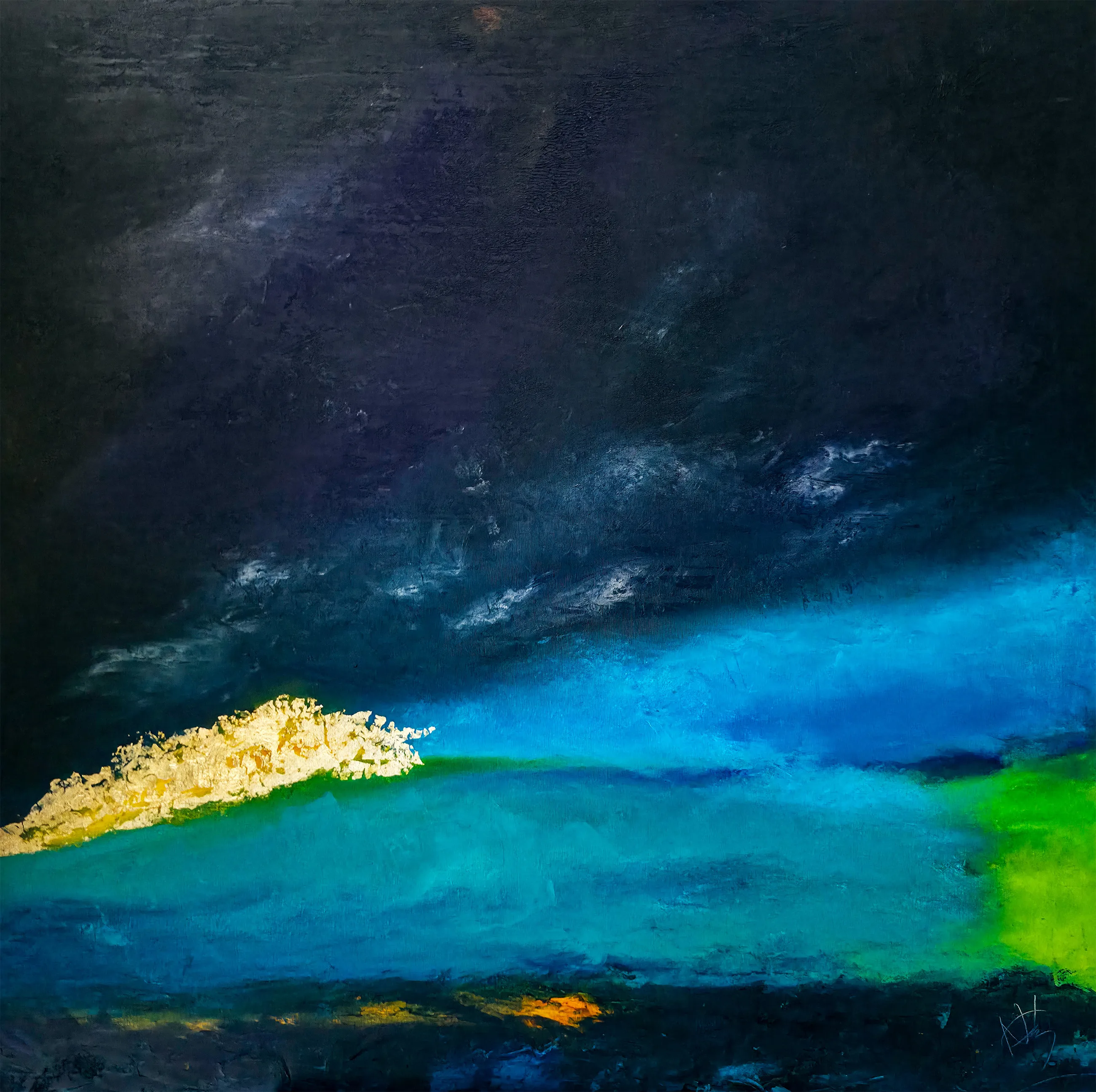
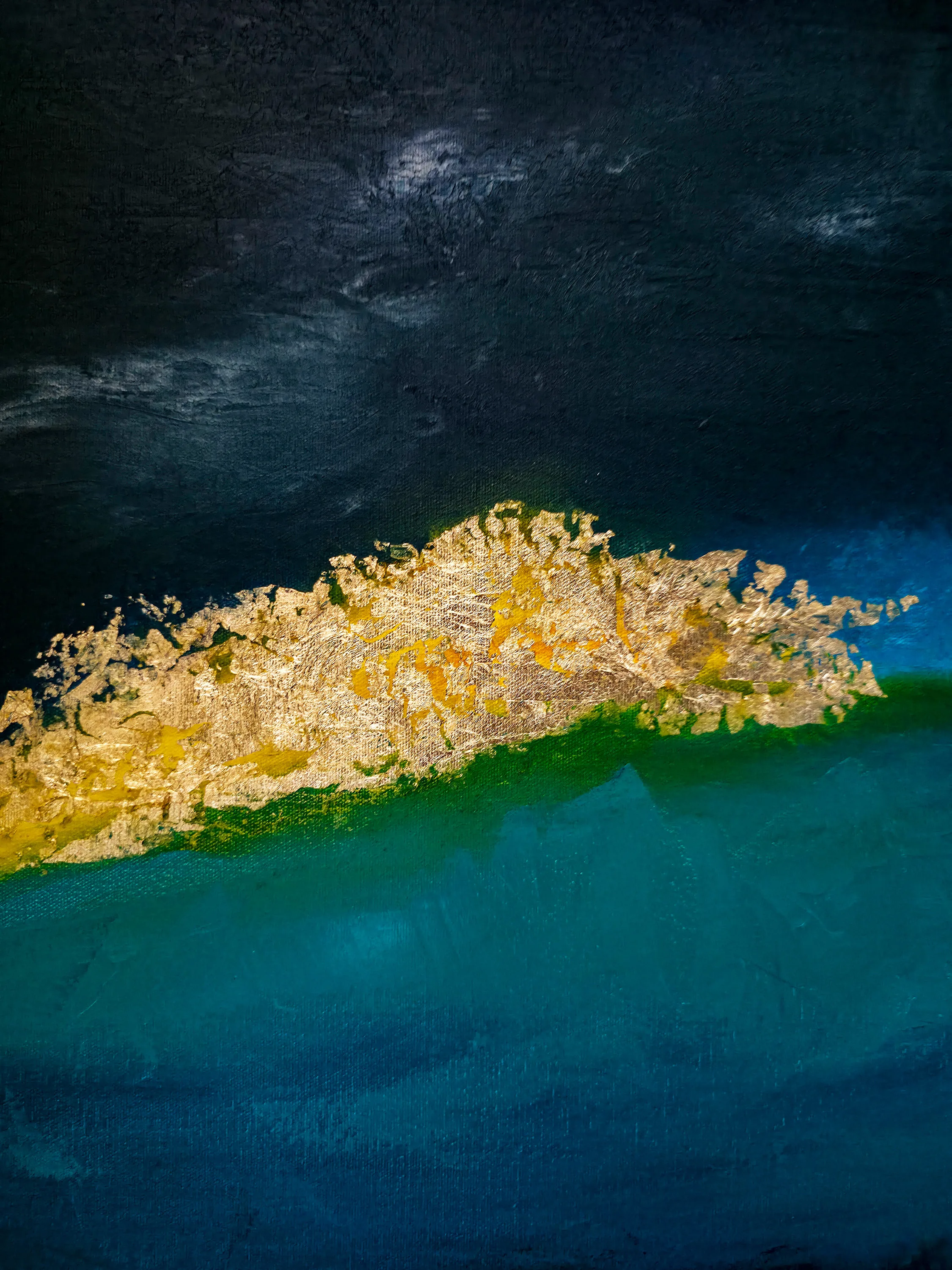
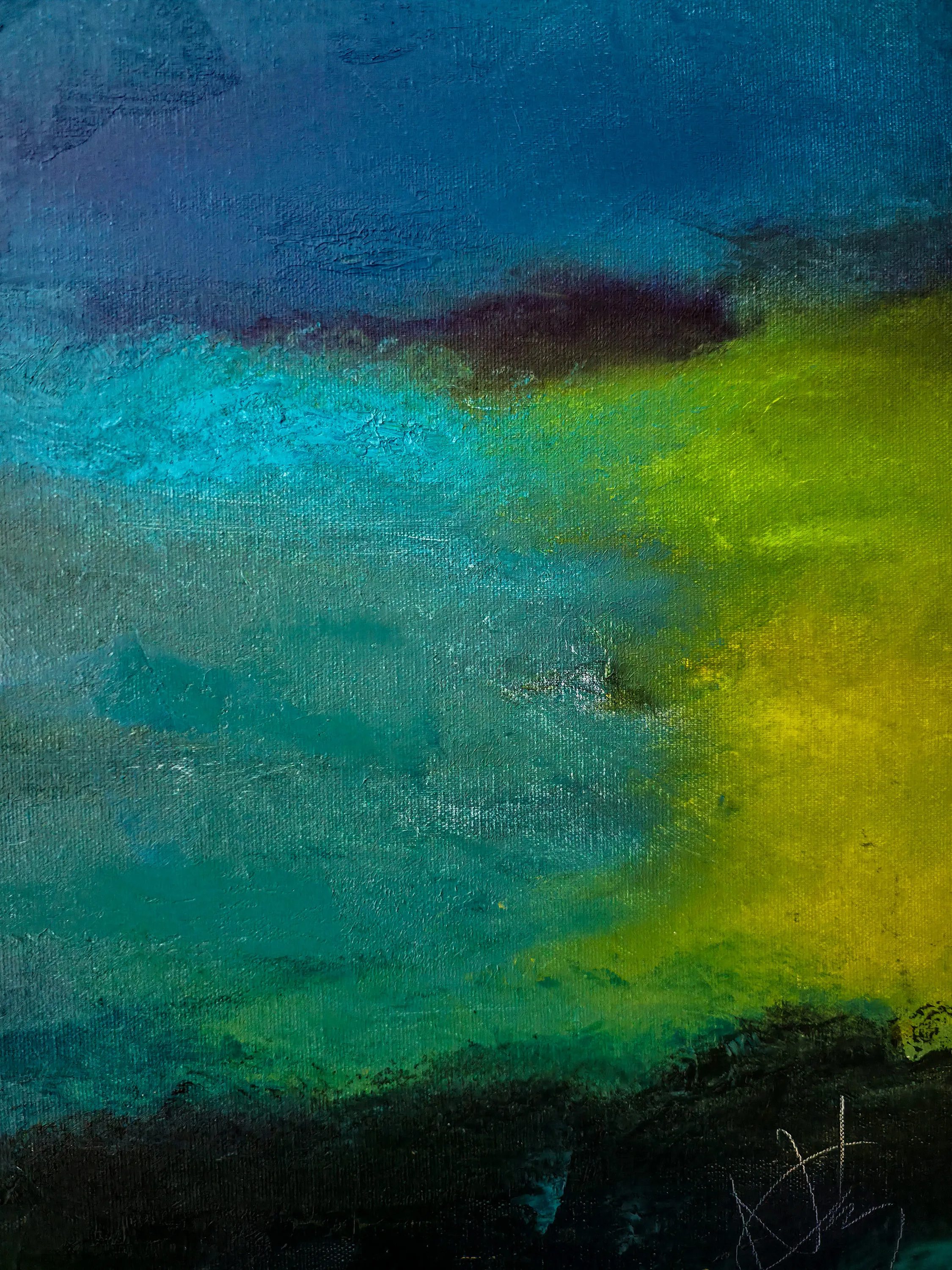
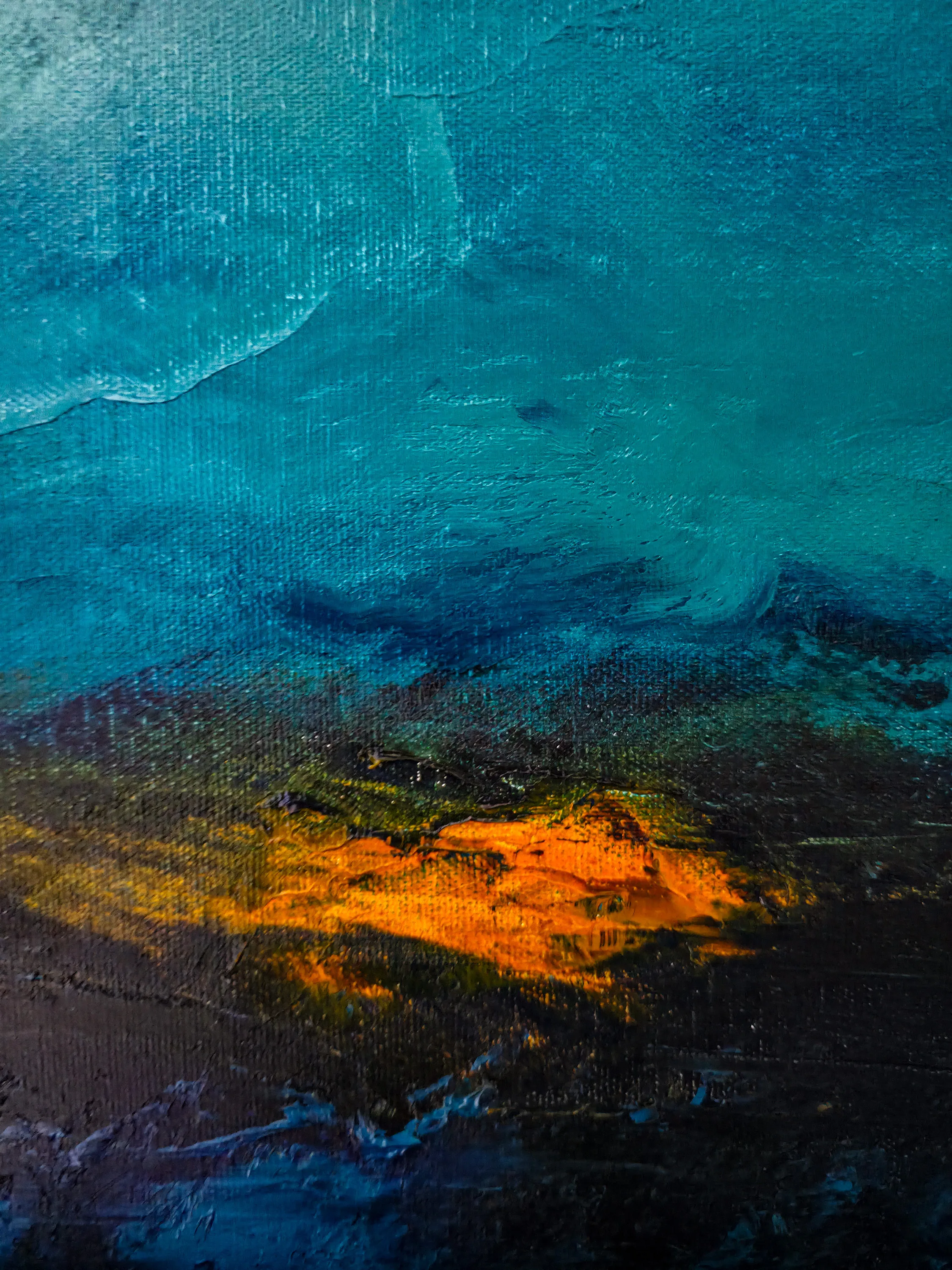
The First Day
- 100 x 100 cm
- Oil and gold on canvas
- Created: Sitges, 2026
- The artwork is part of the 'Old Testament III - In Search of the Secrets of Eternity' cycle
- SOLD
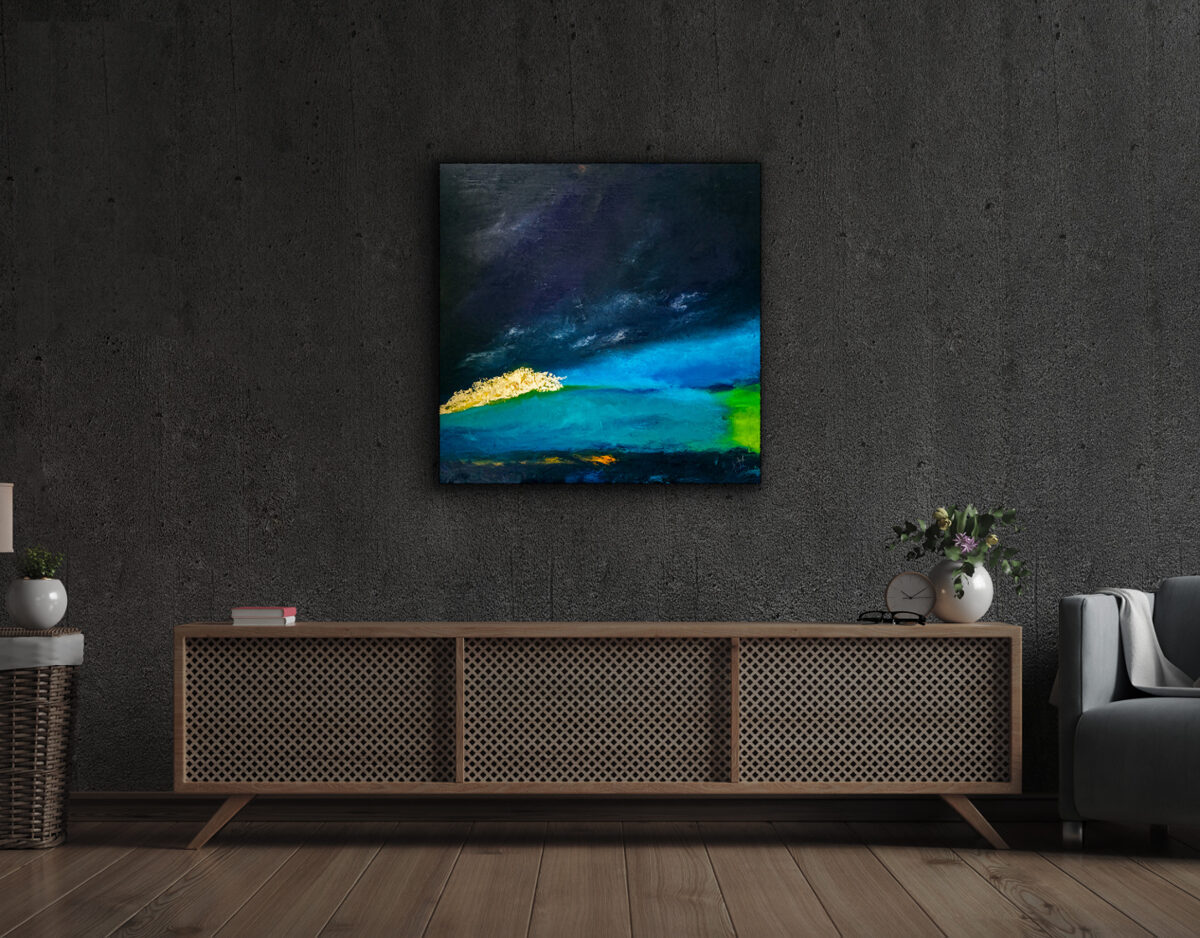
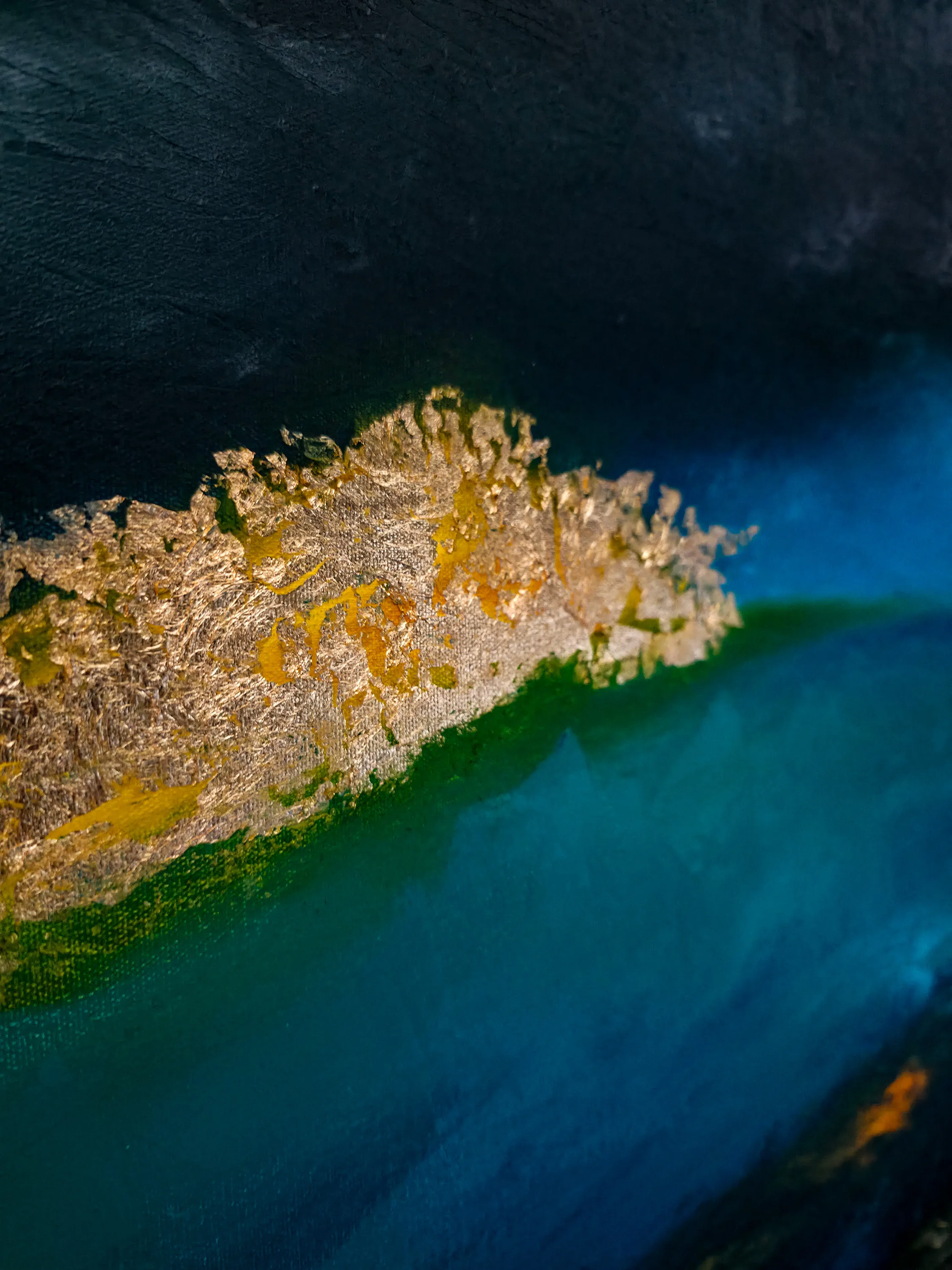
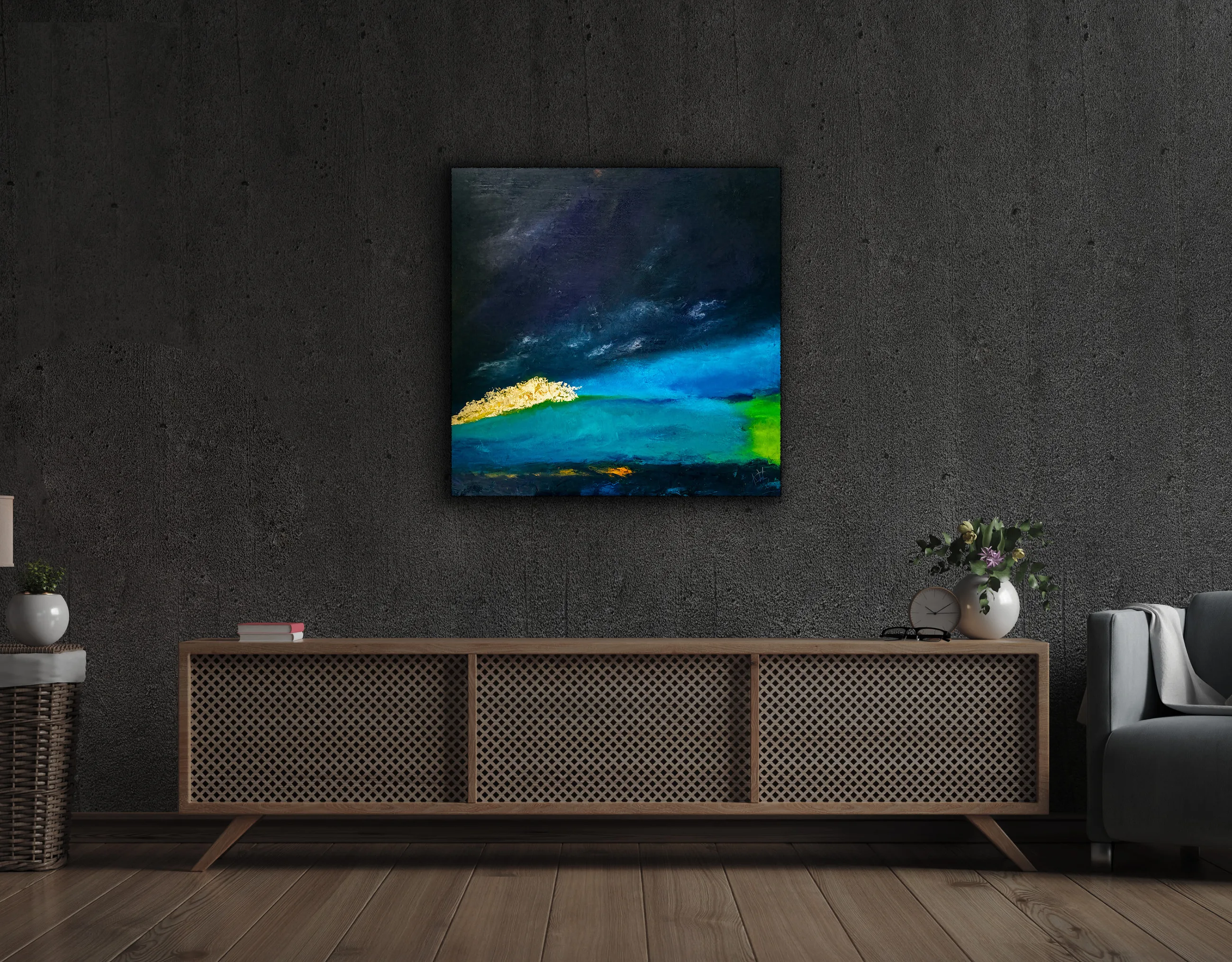
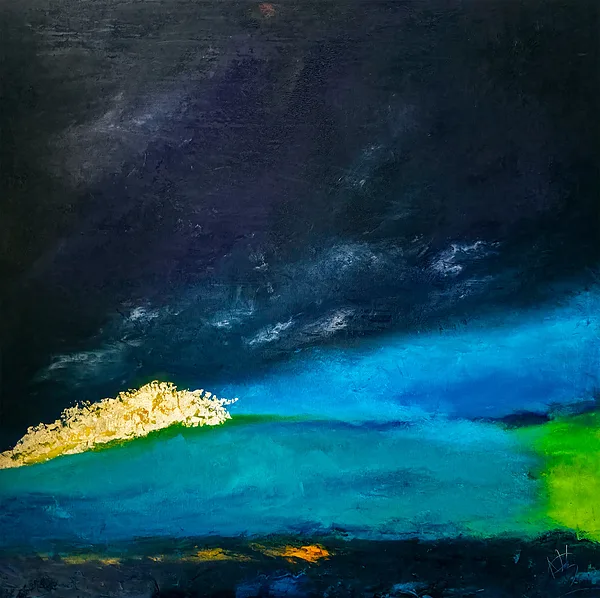
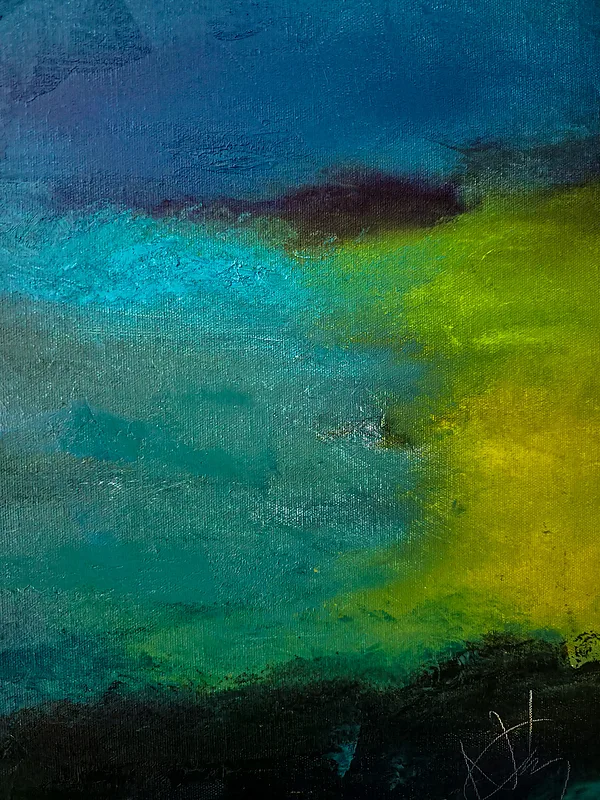
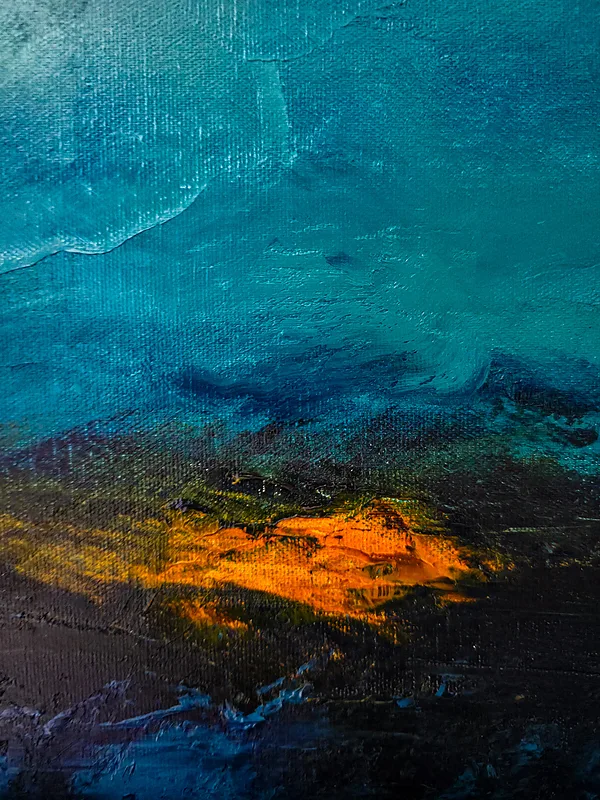
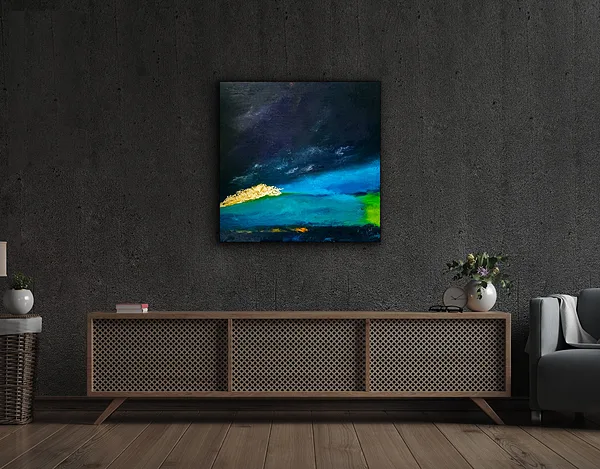
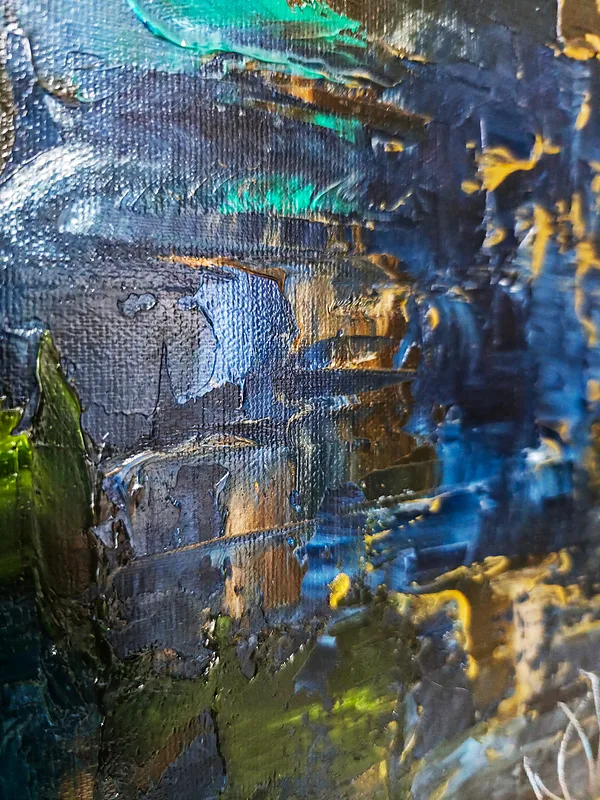
The world of this painting, clothed in midnight indigo, deep cobalt blue, and the luminous turquoise of the primordial waters, reveals the very first moment of Creation, beyond the reach of human understanding. Here, the many hues of darkness envelop the waters slumbering beneath them like a cosmic womb, while the Universe rests in the mysterious silence of formlessness, and the first faint glimmer of the light that will emerge at the Eternal One’s command begins to shimmer at the threshold of darkness.
The opening sentence of the Book of Genesis draws heaven and earth forth from the depths of eternity:
“In the beginning God created the heaven and the earth” (Genesis 1:1), and then Scripture offers a glimpse into the mysterious depths of the primordial state of the created world: “And the earth was without form, and void; and darkness was upon the face of the deep. And the Spirit of God moved upon the face of the waters” (Genesis 1:2).
The painting transforms the unfathomable beginning into a monumental silence of colour: the darkness of the upper portion of the canvas envelops the entire Universe, while an extraordinary, phosphorescent emerald radiance unfolds within the turquoise depths below, making the impending transformation perceptible.
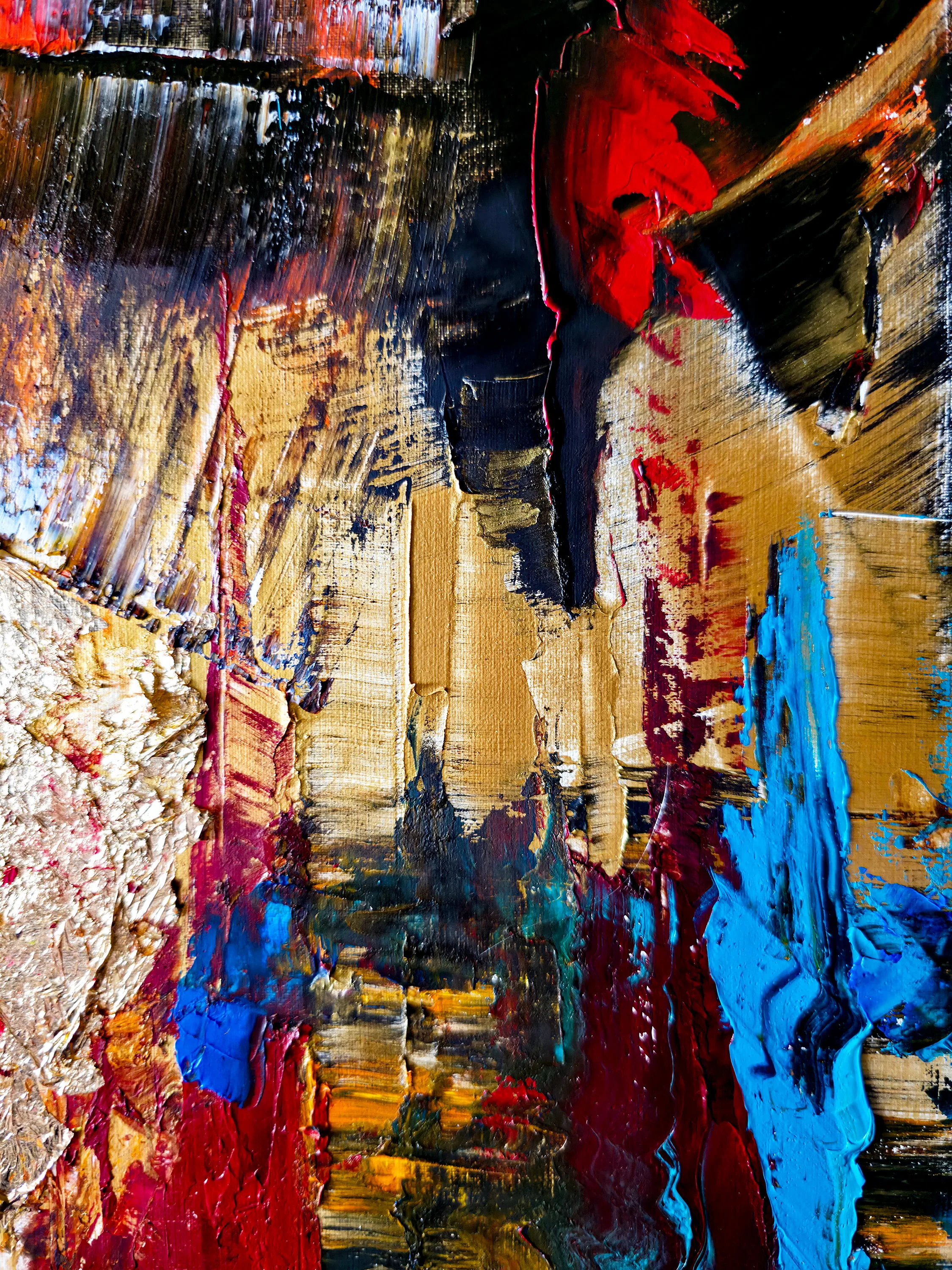
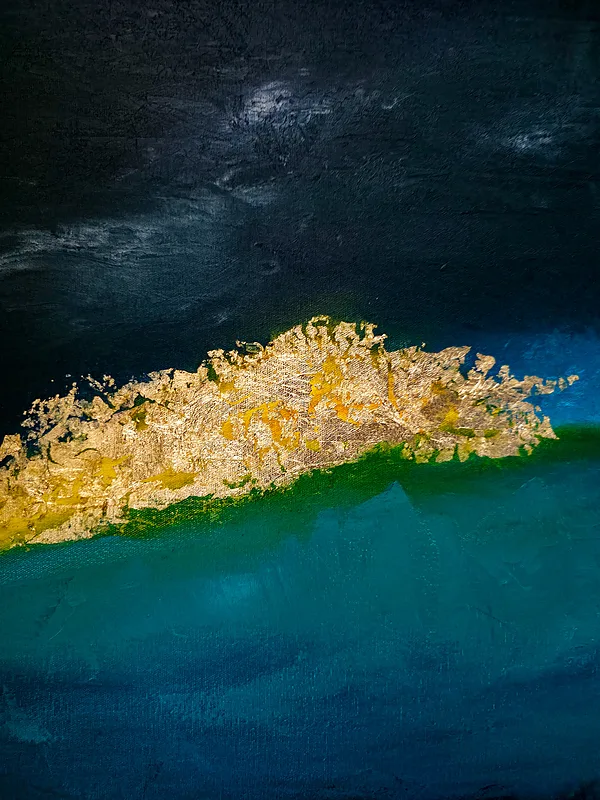
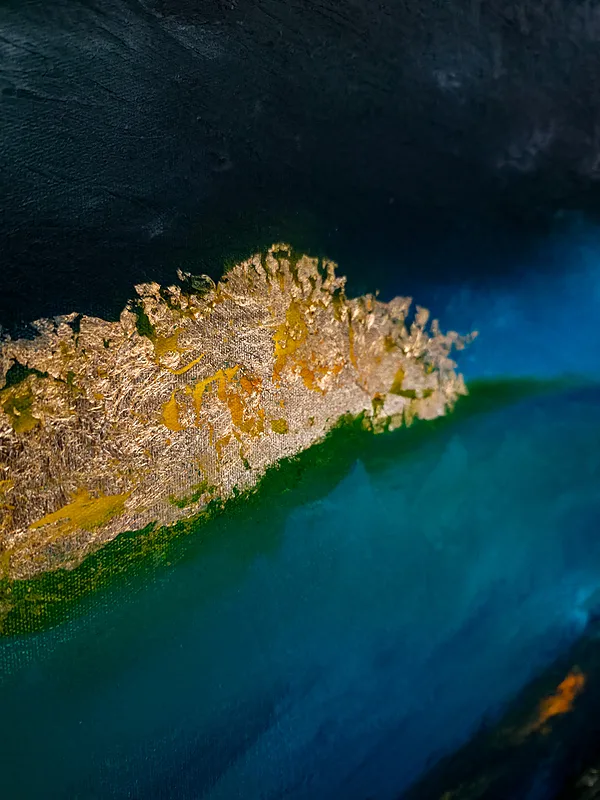
Emerging with particular force from this monumental silence of colour is the golden relief in the lower-left region of the painting. Its surface is rough and rock-like, and along its edge the words of Genesis already shine forth:
“And God said, Let there be light: and there was light” (Genesis 1:3).
“And the evening and the morning were the first day” (Genesis 1:5).
And as our gaze makes its final passage across the midnight vault of the canvas, the boundless turquoise of the primordial waters, and the golden crown radiant at the edge of the abyss, the first day of Creation unfolds before us as the eternal mystery of the birth of the Universe.
The Second Day
- 110 x 140 cm
- Oil and gold on canvas
- Created: Sitges, 2026
- The artwork is part of the 'Old Testament III - In Search of the Secrets of Eternity' cycle
- AVAILABLE FOR PURCHASE
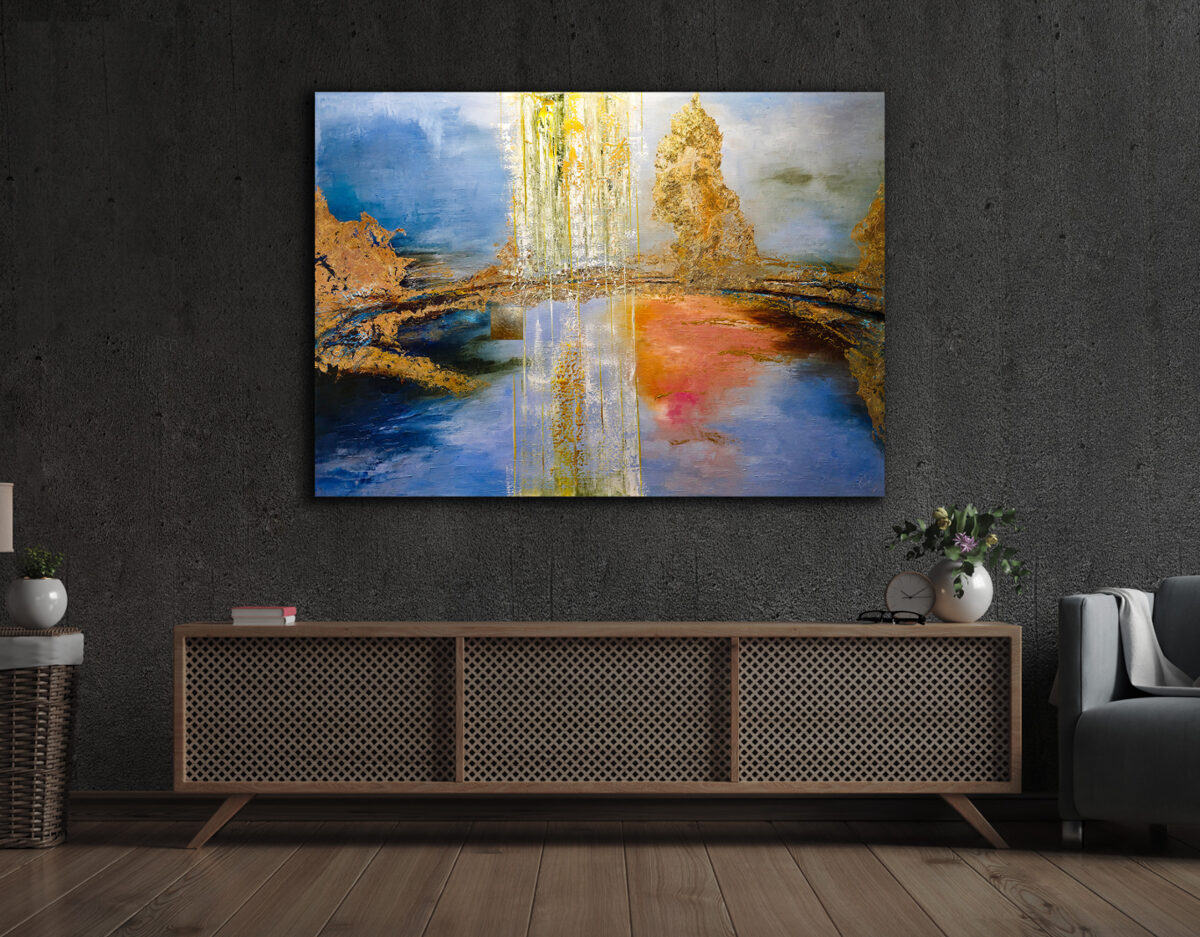
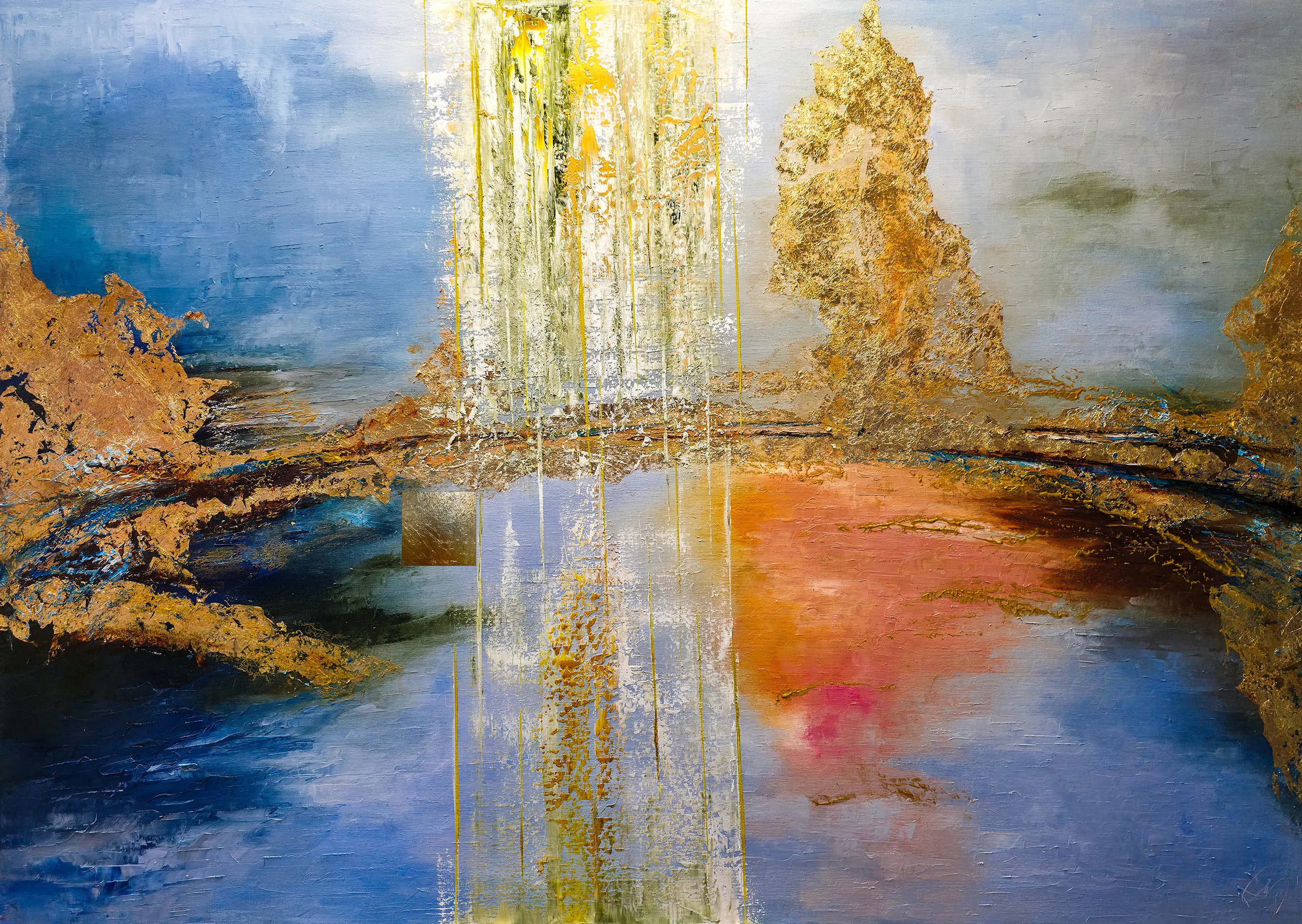
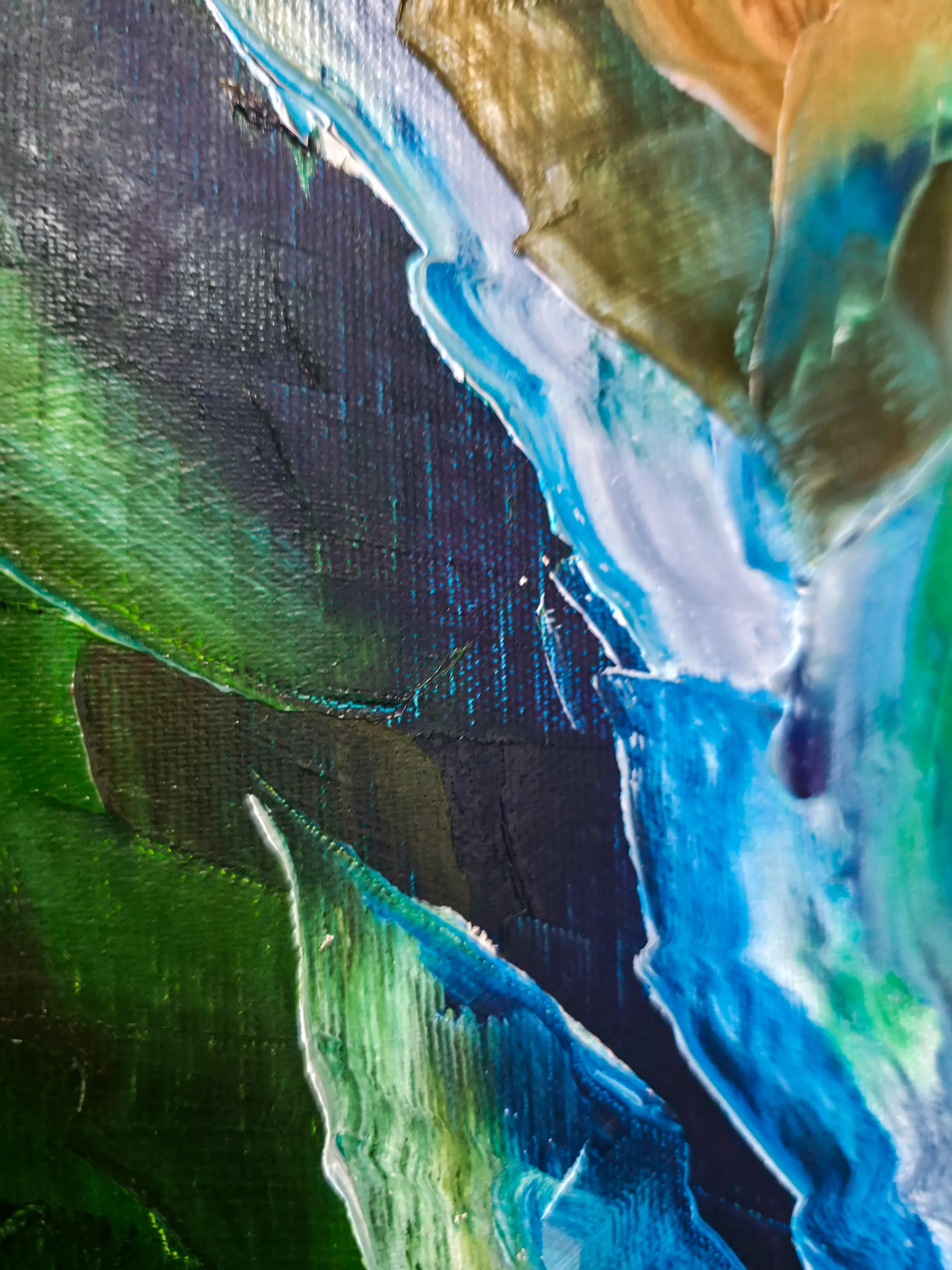
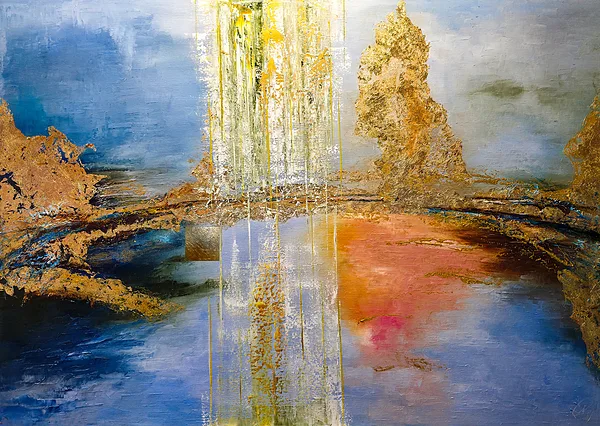
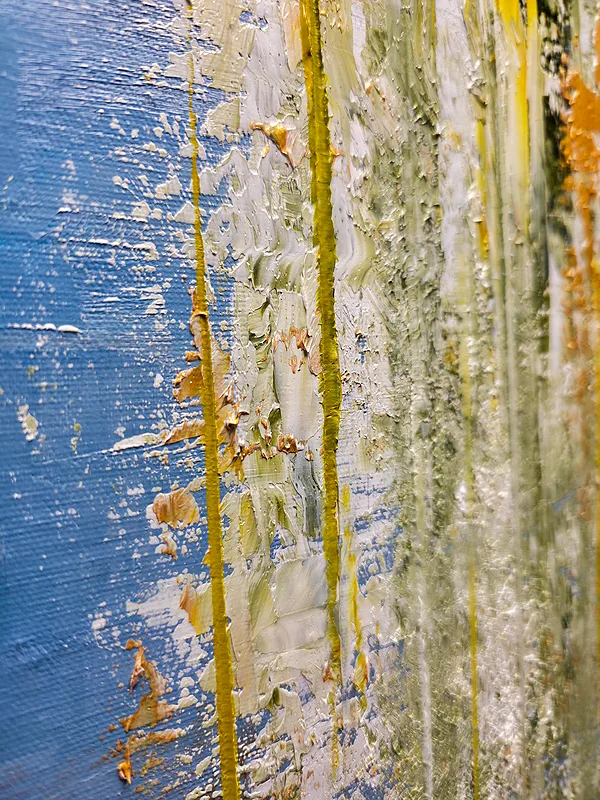
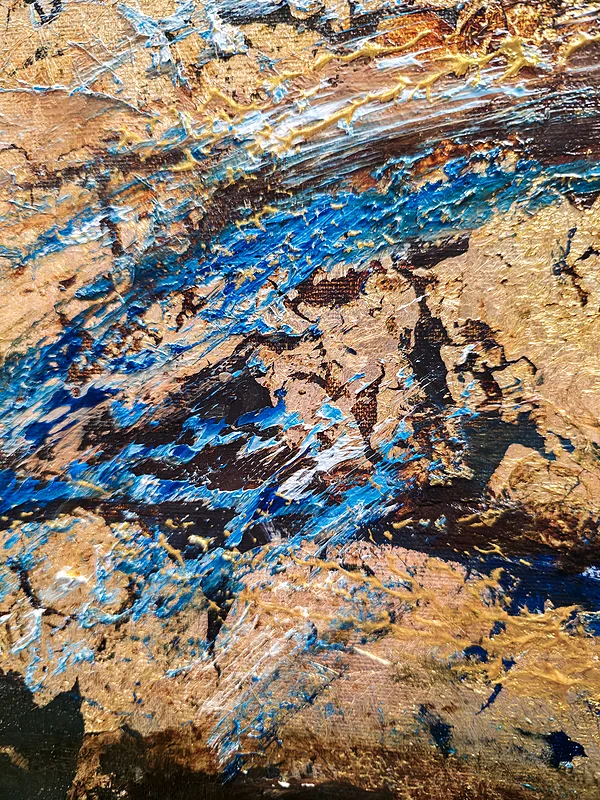
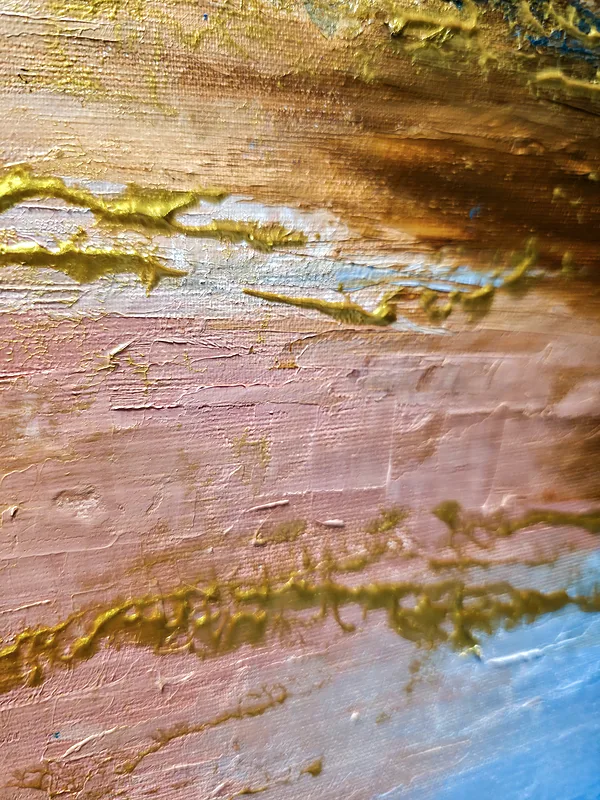
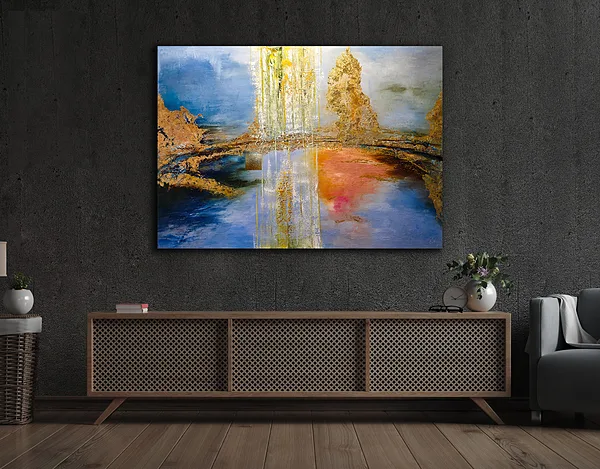
On the second day of Creation, God separates the waters and creates the firmament. Within the formless primordial world, space, distance, and boundaries come into being, making possible the unfolding of the visible world.
“And God said, Let there be a firmament in the midst of the waters, and let it divide the waters from the waters.” (Genesis 1:6)
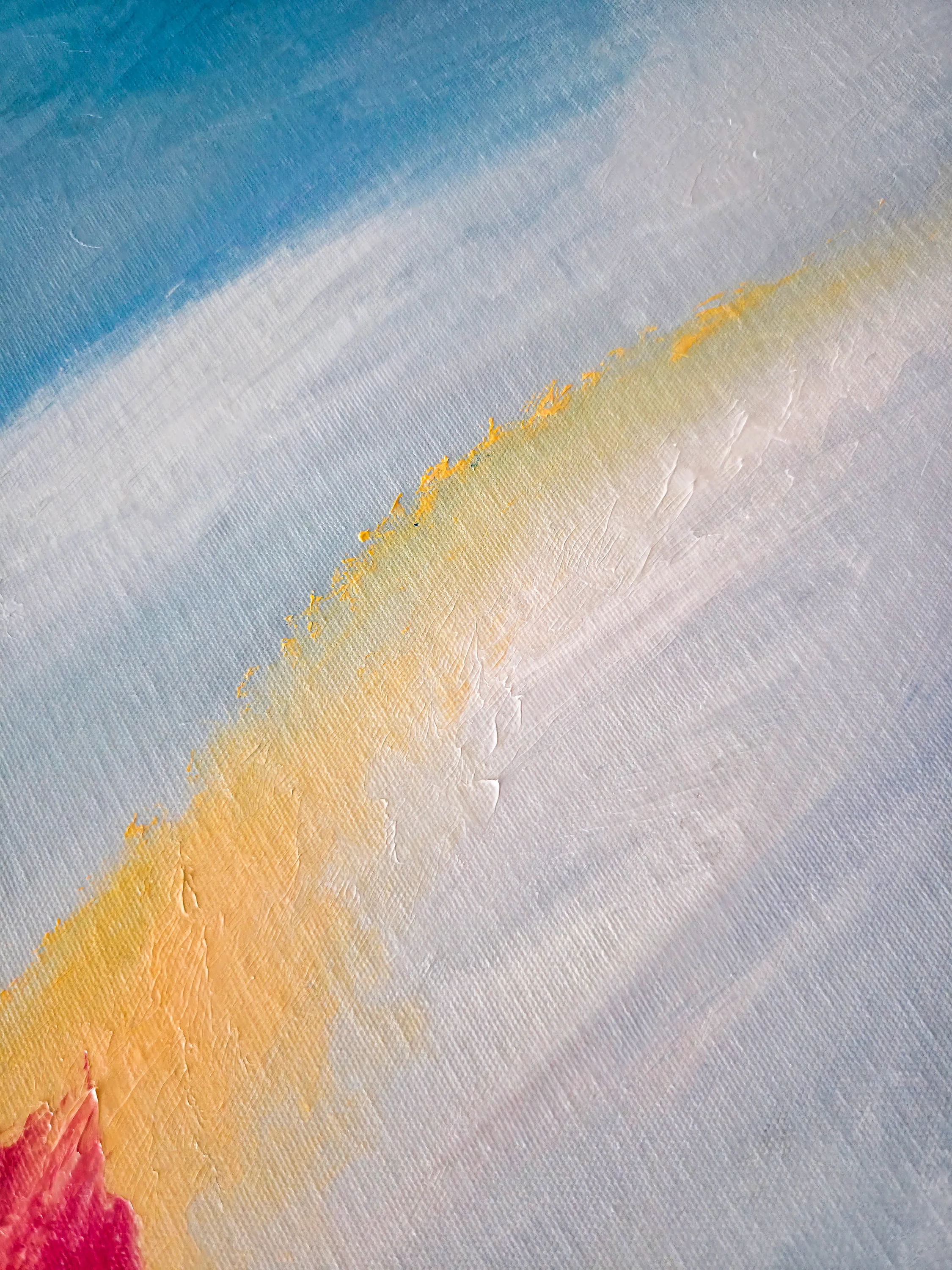
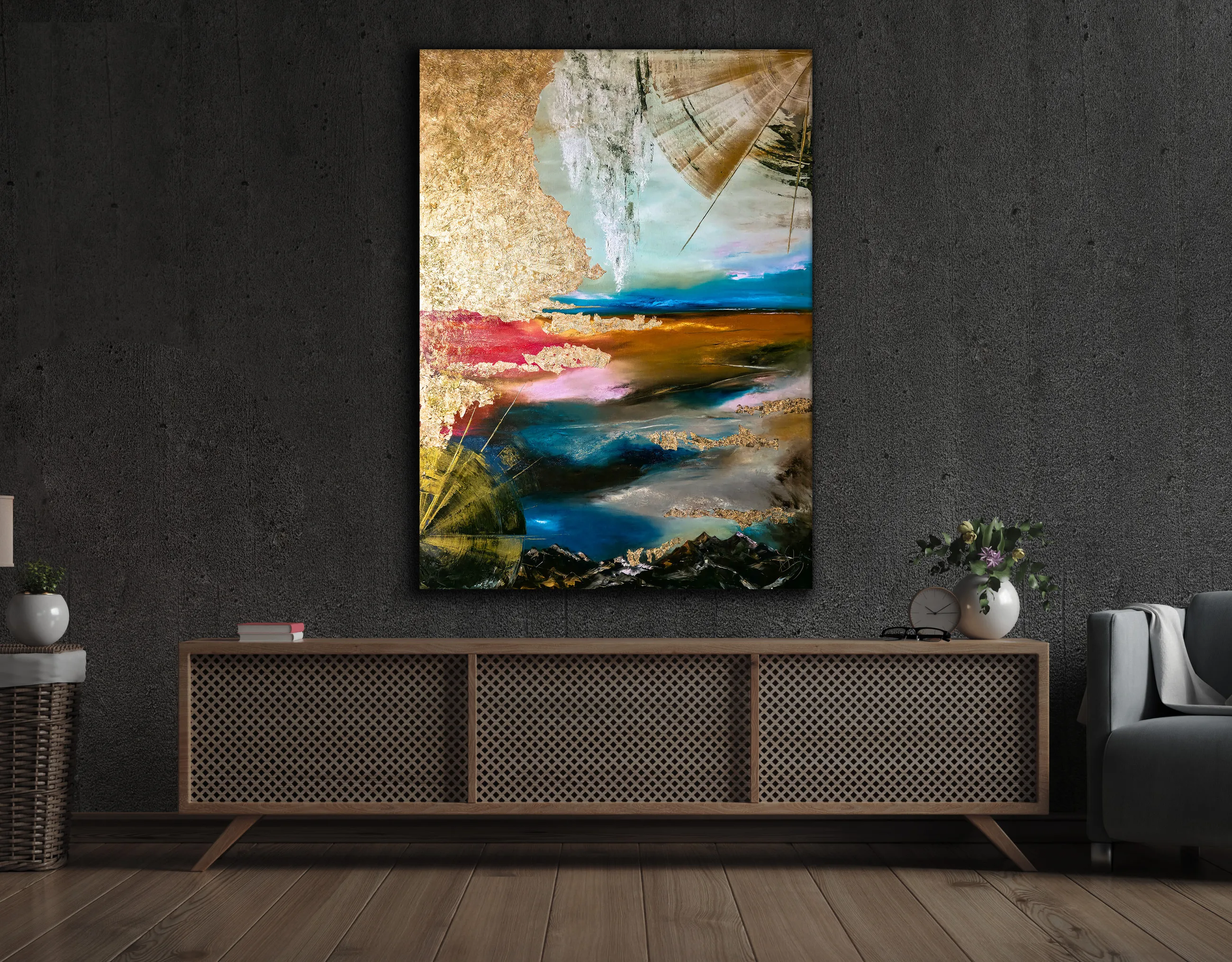
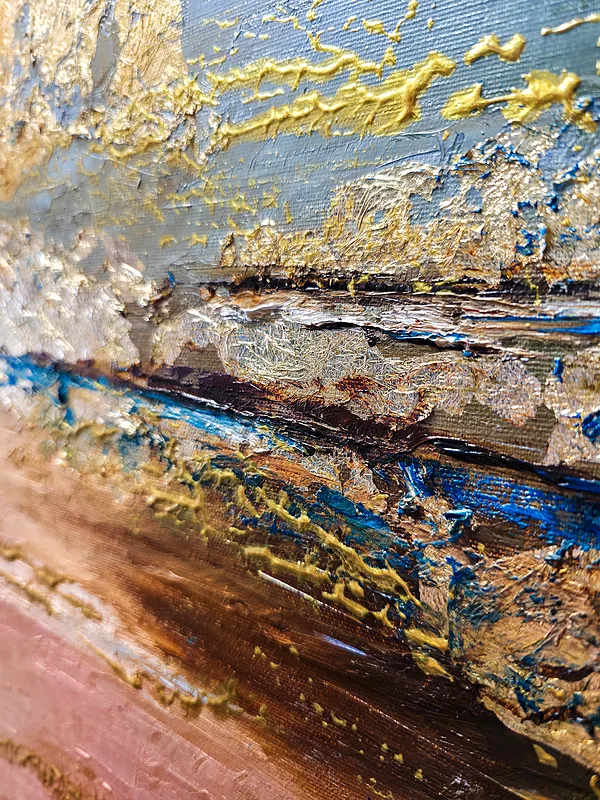
The painting’s monumental composition opens up cosmic vistas. Within the boundless expanse of blue, the curve of the Earth emerges, seeming to extend beyond the horizon.
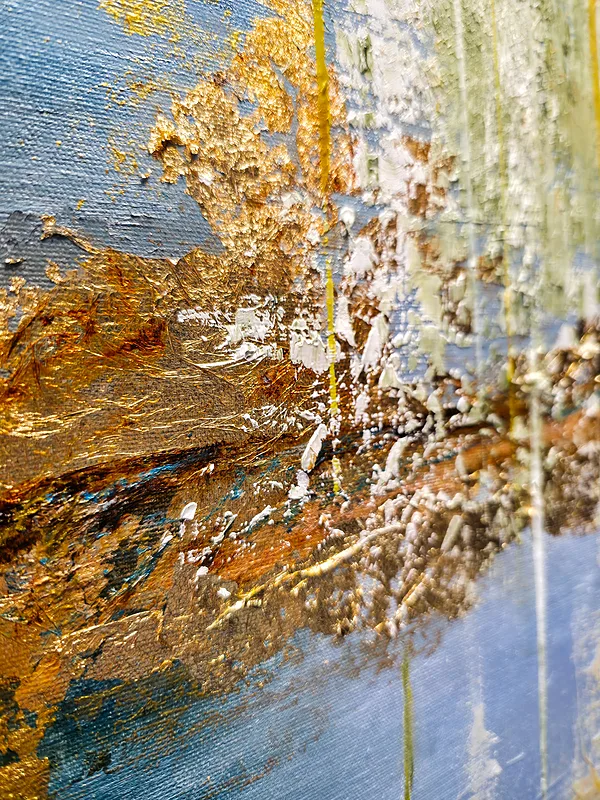
Along the painting’s vertical axis, a radiant mass of gold channels the creative force into the visible world. Streaks of white paint in varying shades flow downward from above, following the direction of the divine will.
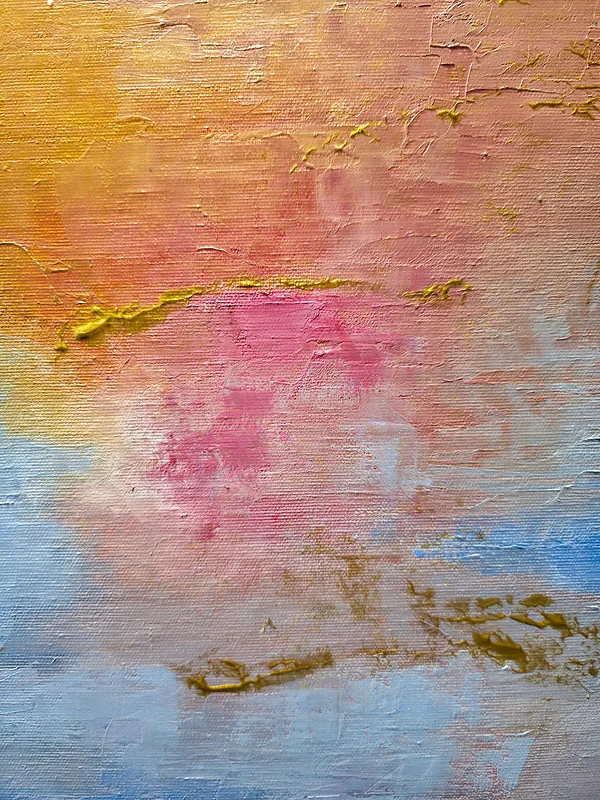
Rose, orange, and reddish tones infuse the cool blues with the vibrant energy of Creation. Light does not remain in the heavens; it permeates space and shapes the world as it unfolds.
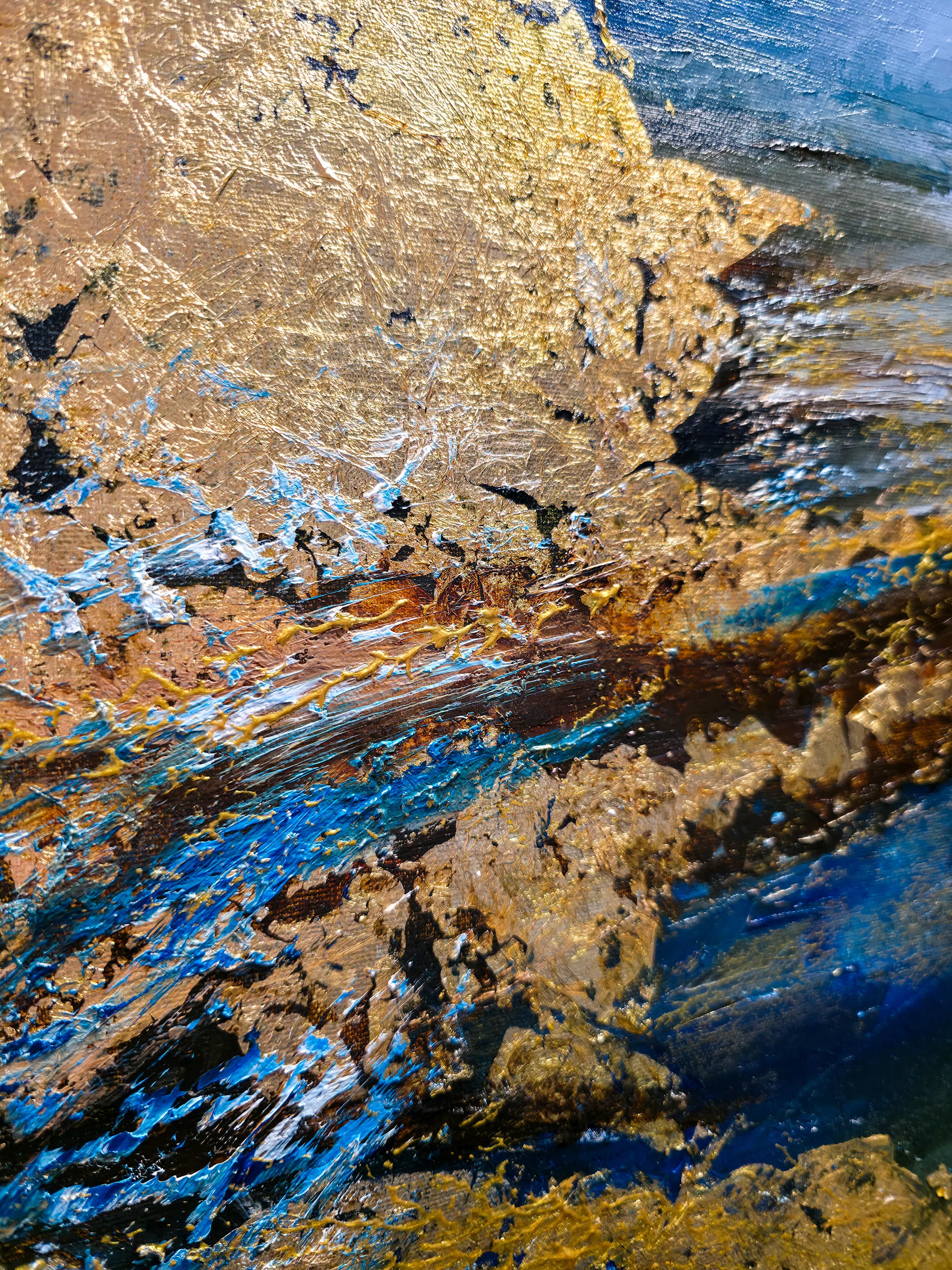
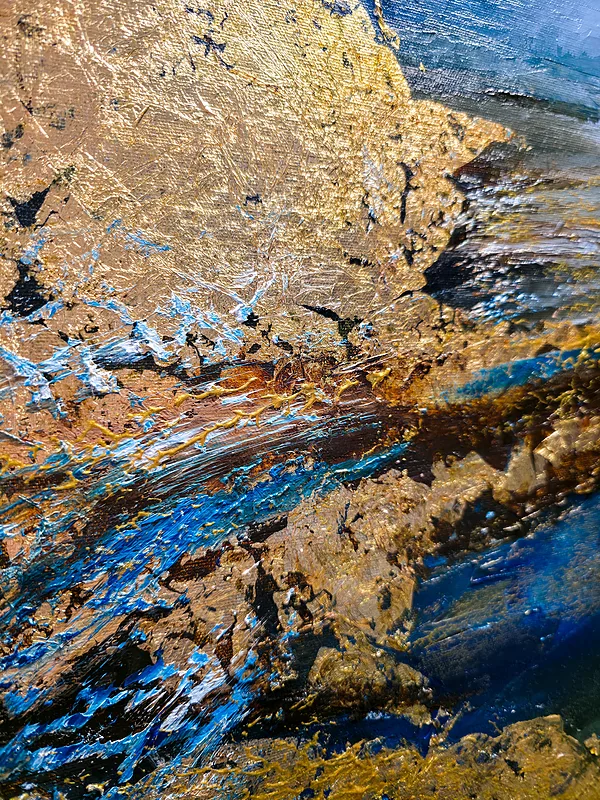
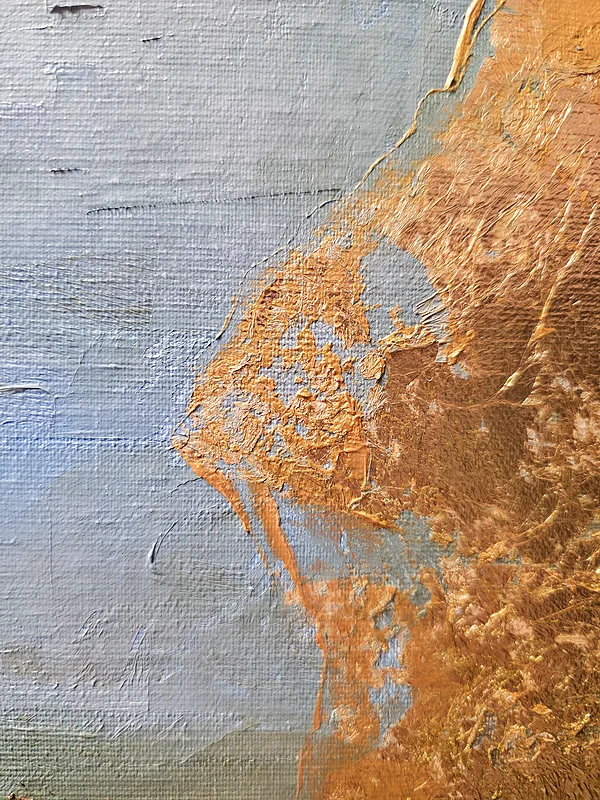
Dark and golden bands of land crossing the horizon emphasise the boundary between the waters and the dry land. The fragmented rock formations on the left and the towering golden-brown formation on the right evoke the emerging contours of the Earth.
In the lower part of the composition, a golden altar symbolises the meeting of the heavenly and earthly realms. The divine will seems to bring the altar down into the realm of Creation, so that the sacred presence no longer remains in distant heights but finds its place within the world coming into being.
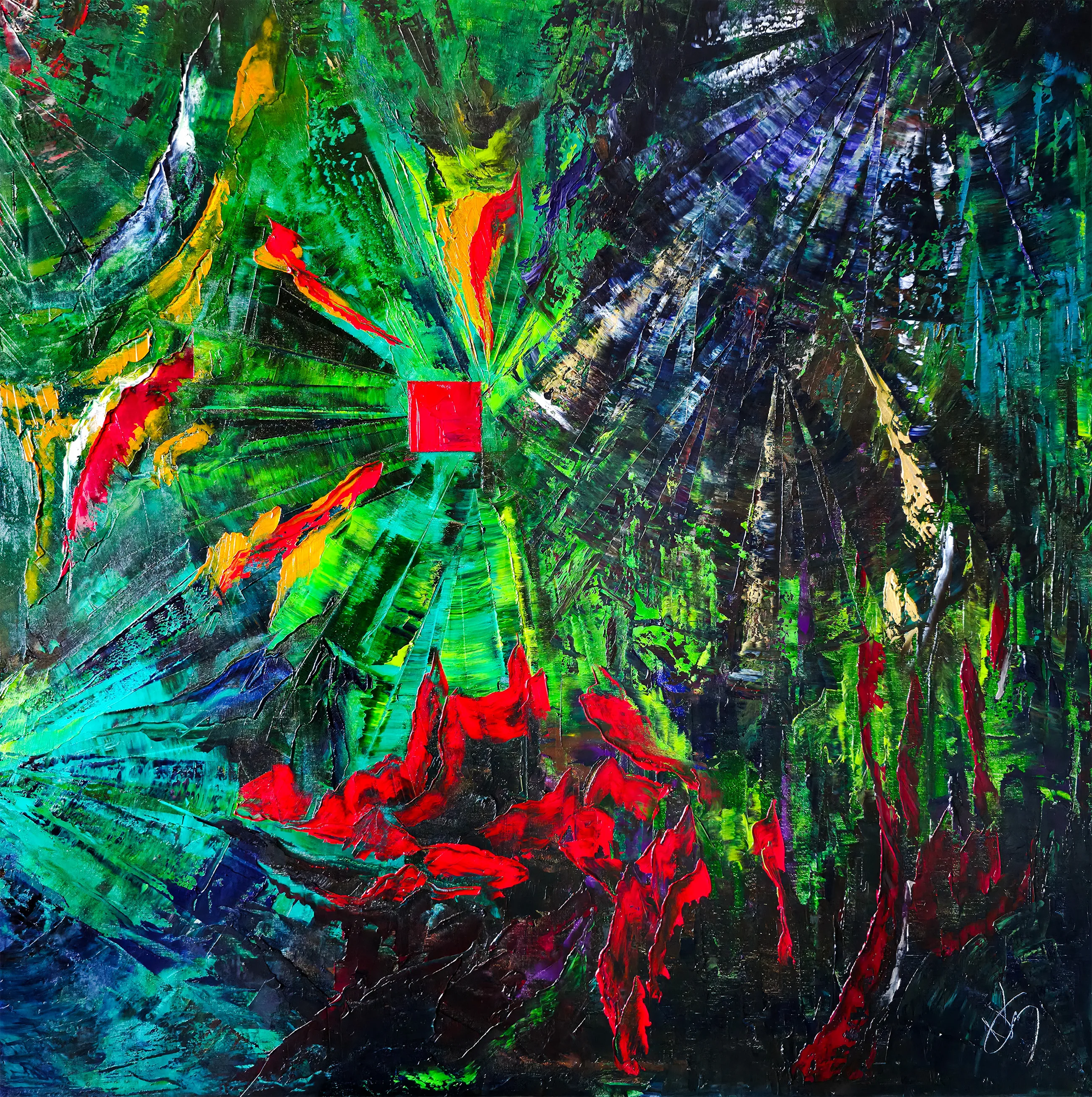
The Third Day
- 100 x 100 cm
- Oil and gold on canvas
- Created: Sitges, 2026
- The artwork is part of the 'Old Testament III - In Search of the Secrets of Eternity' cycle
- SOLD
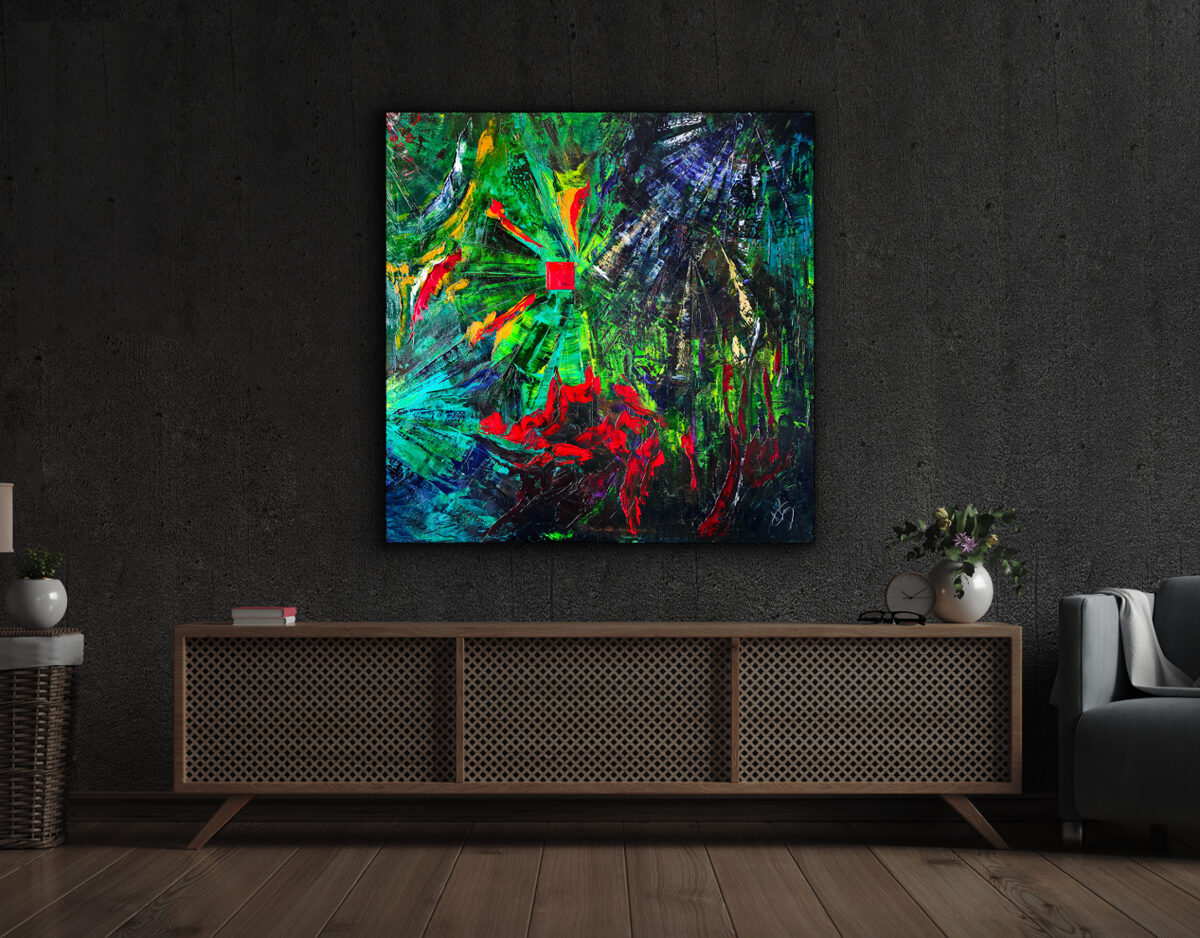
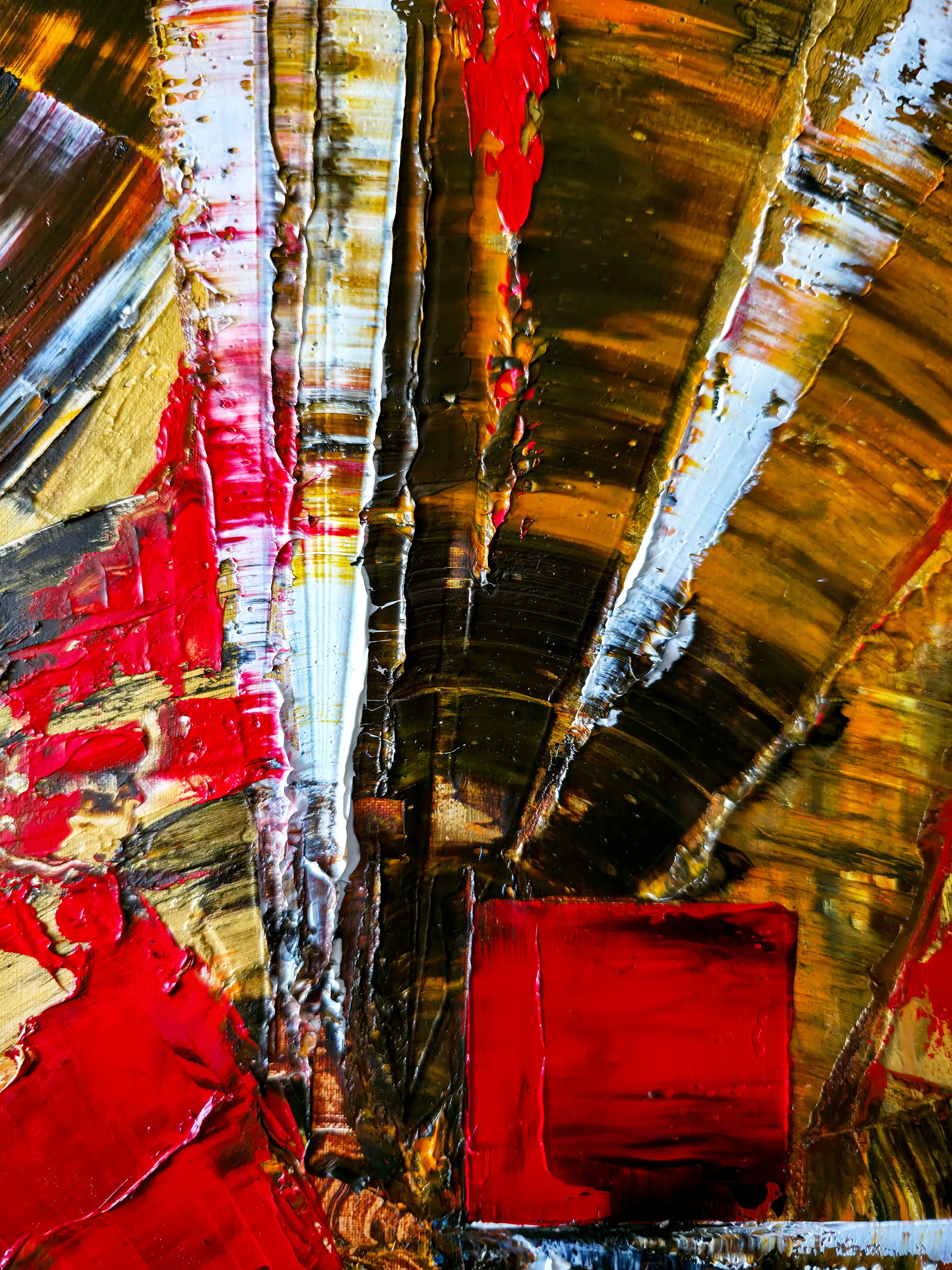
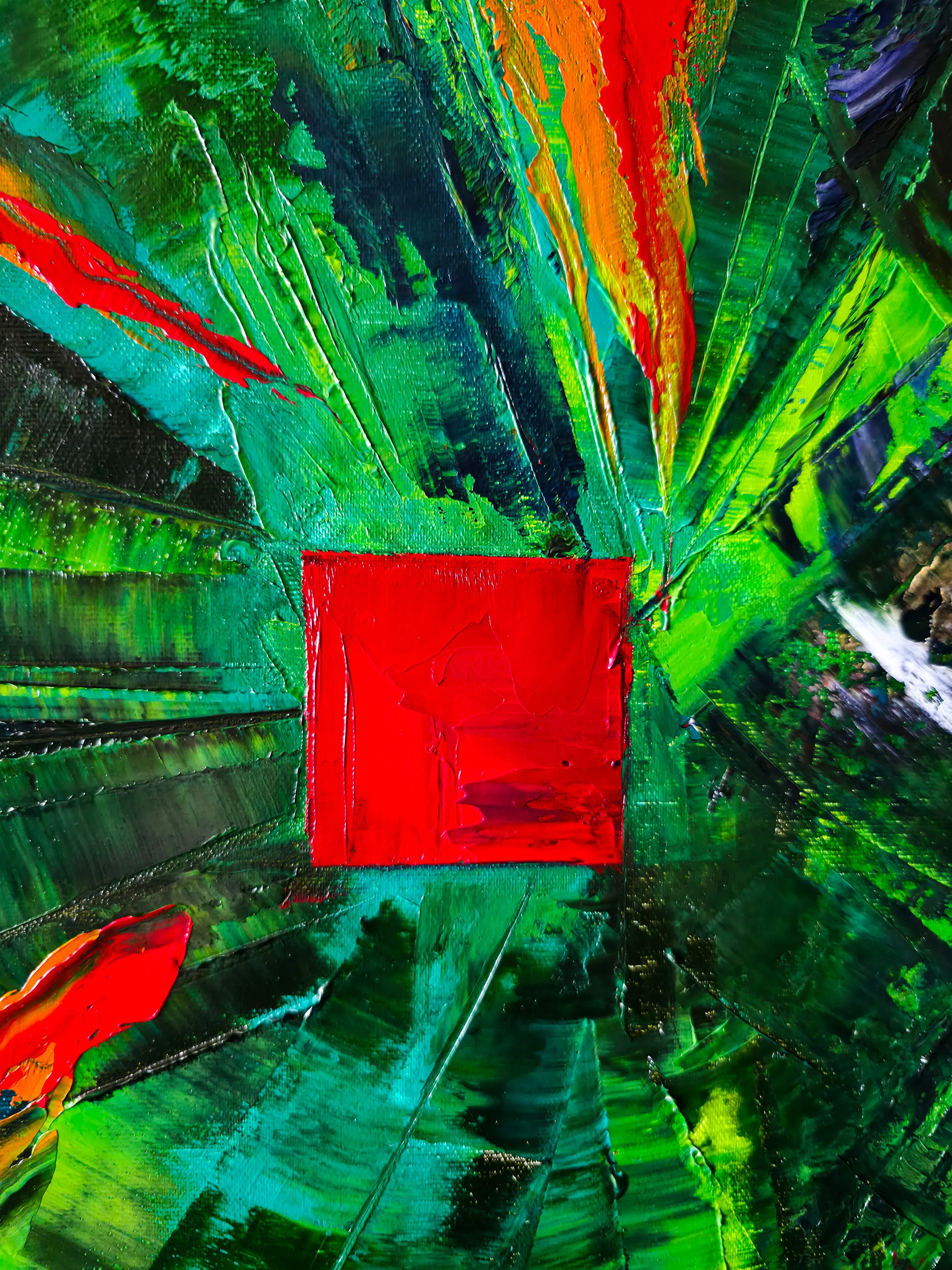
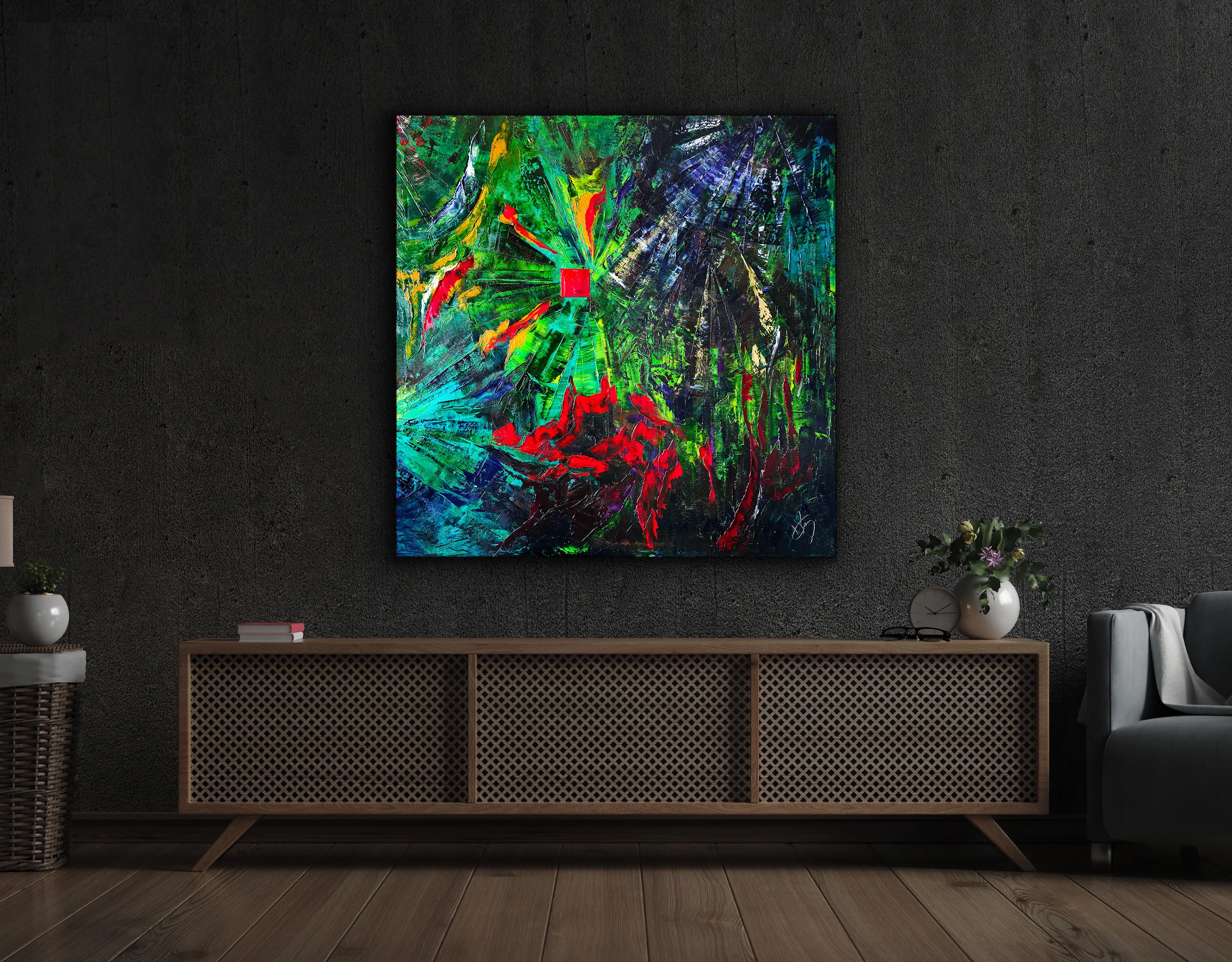
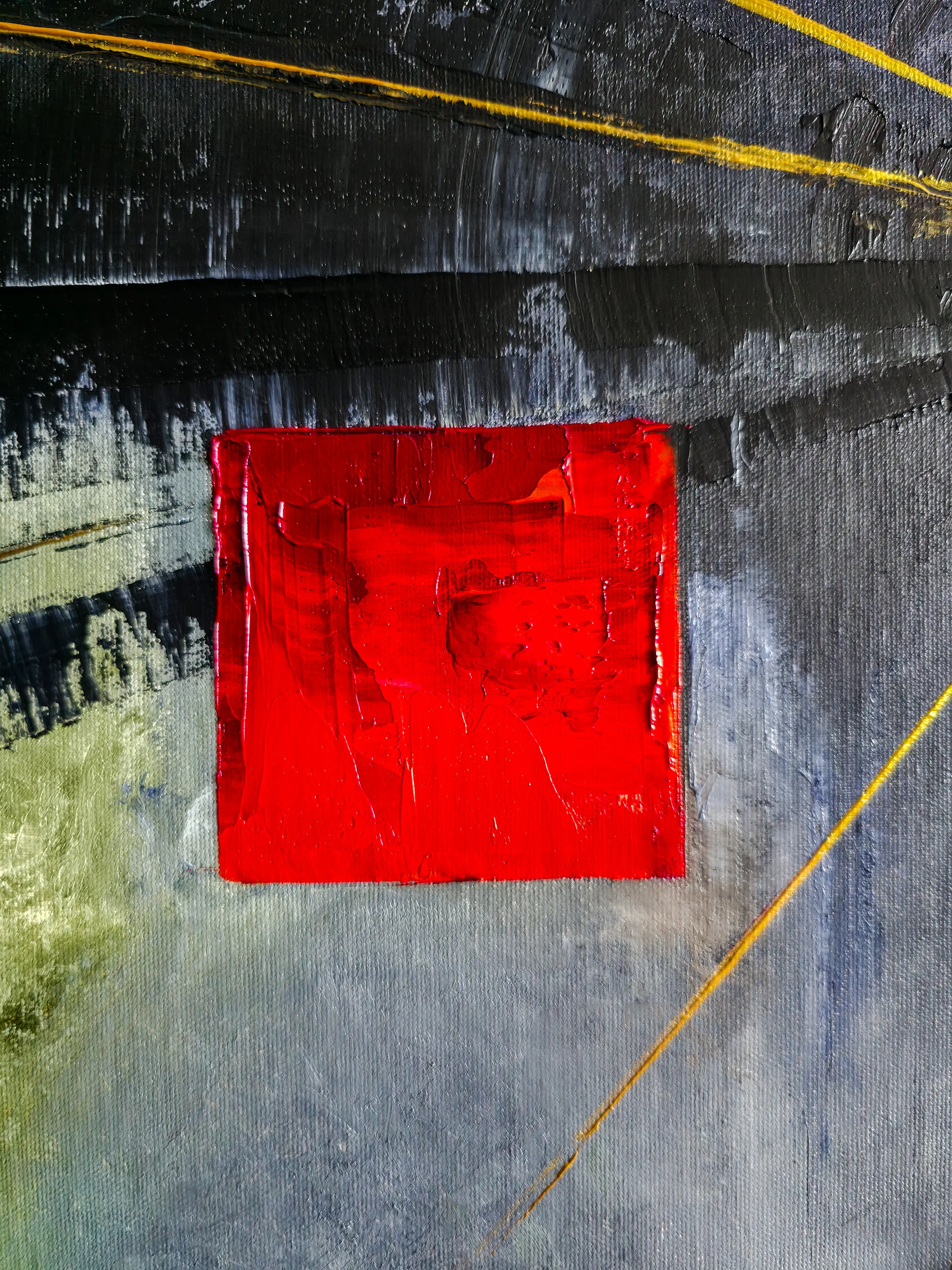
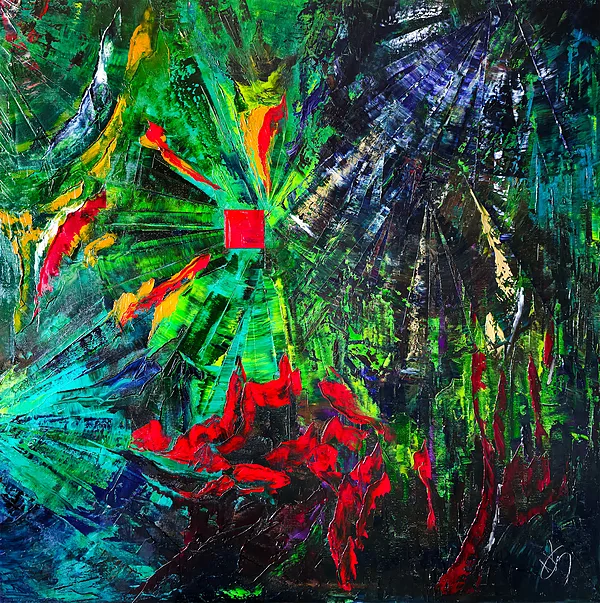
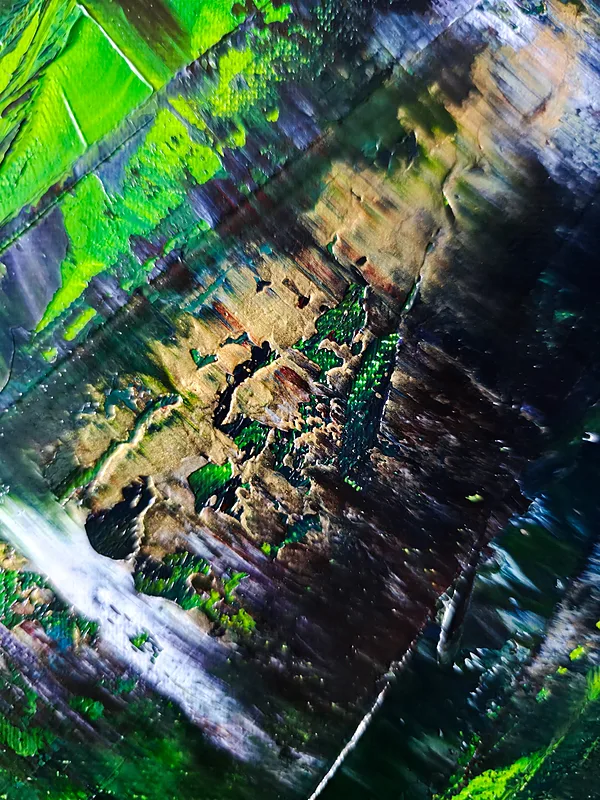
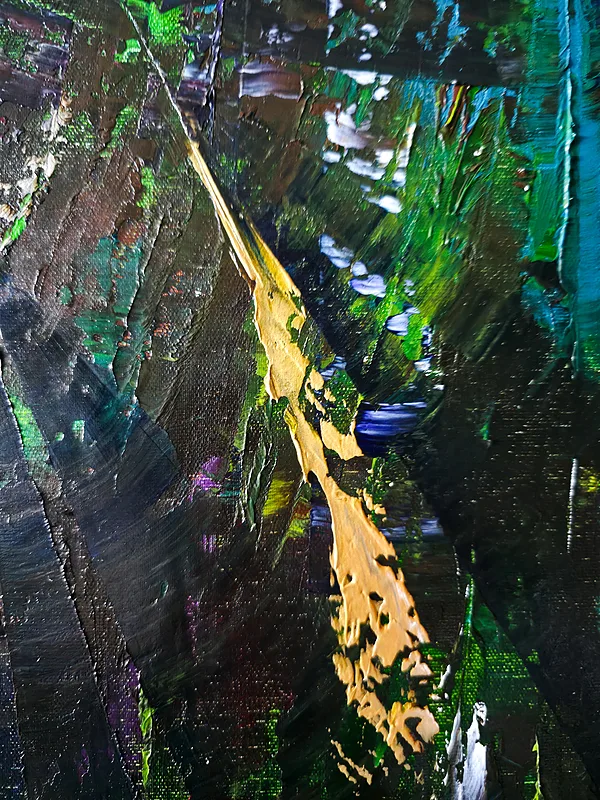
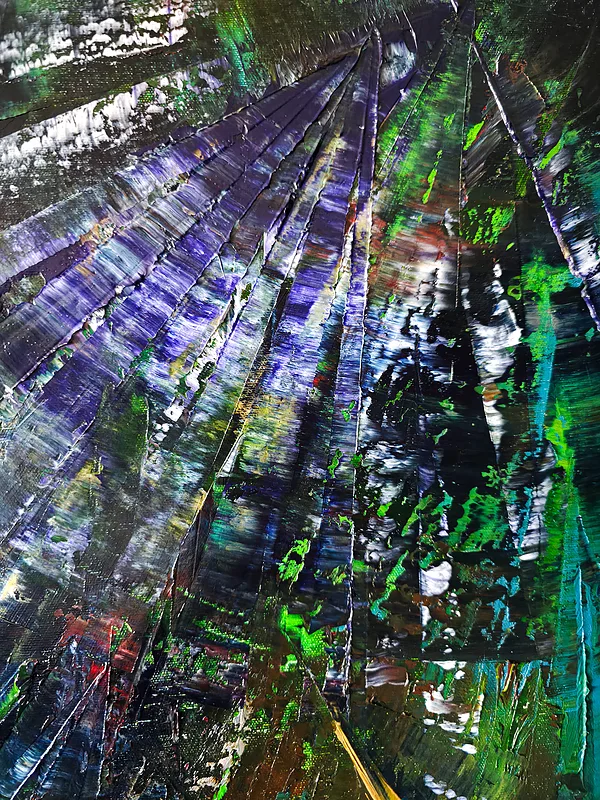
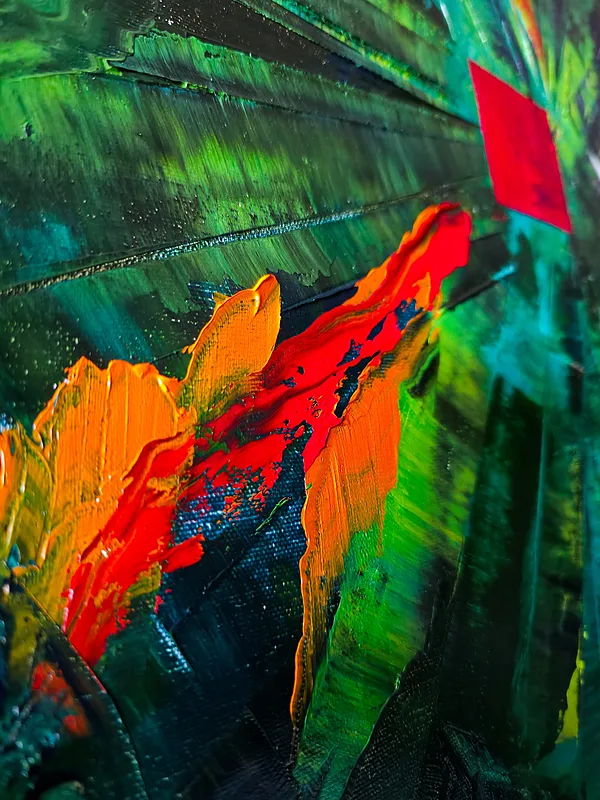
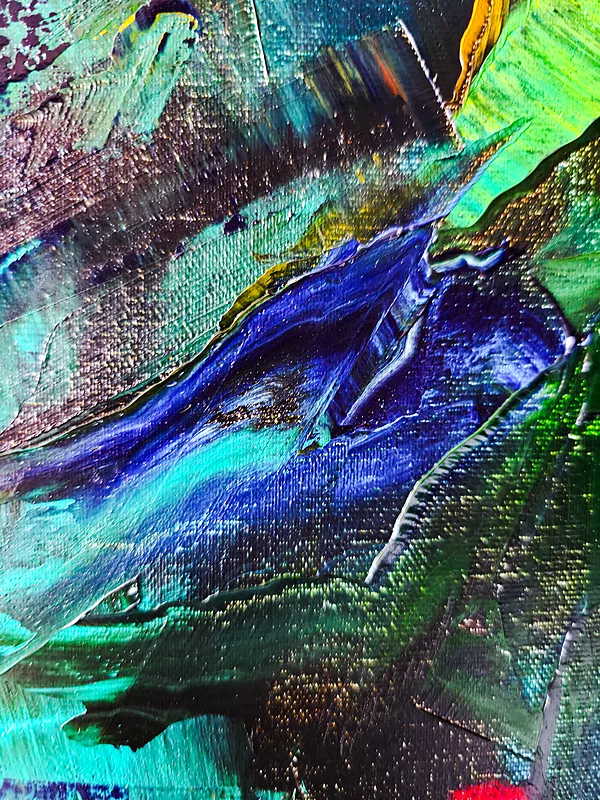
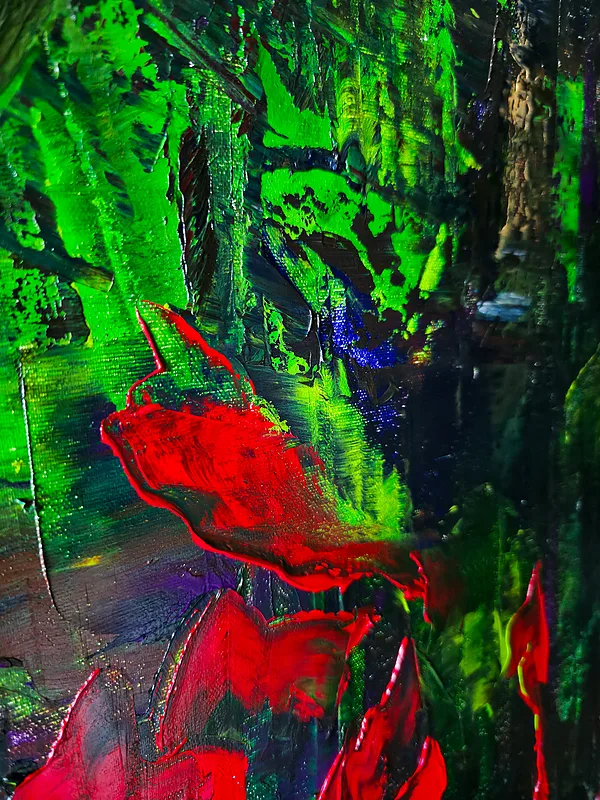
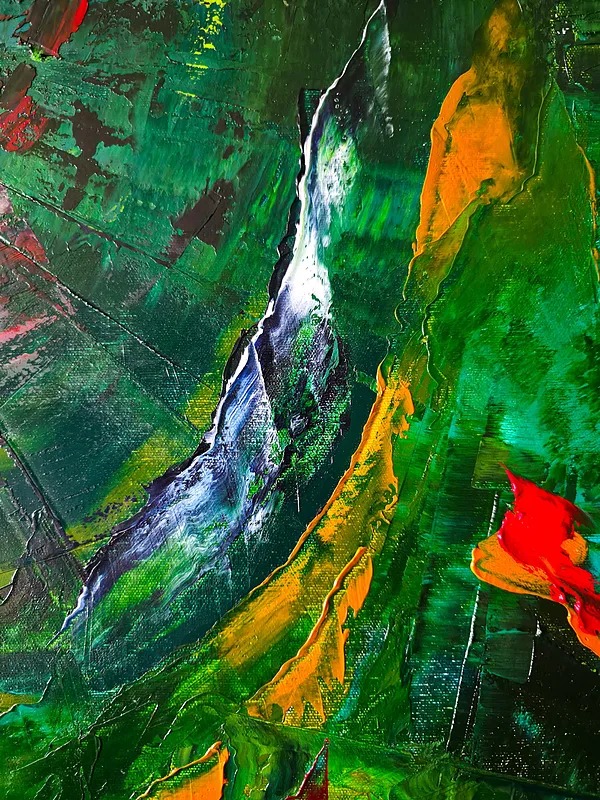
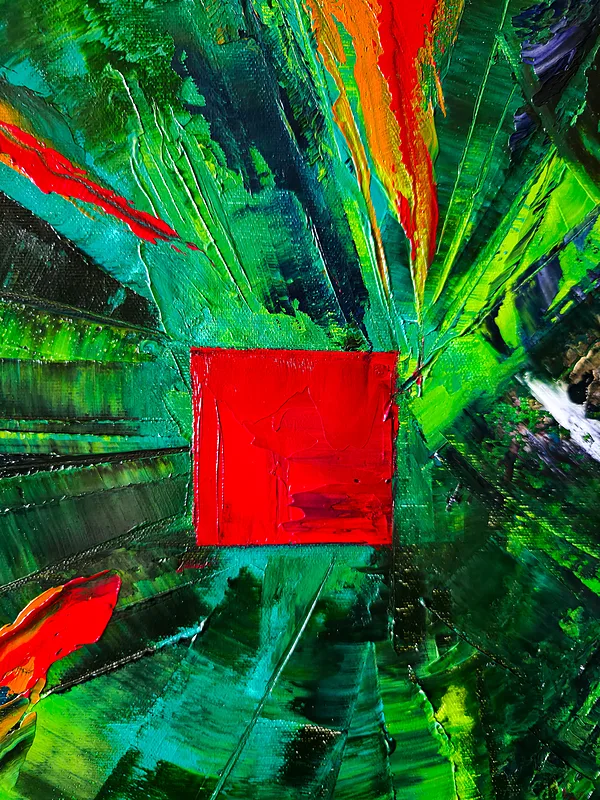
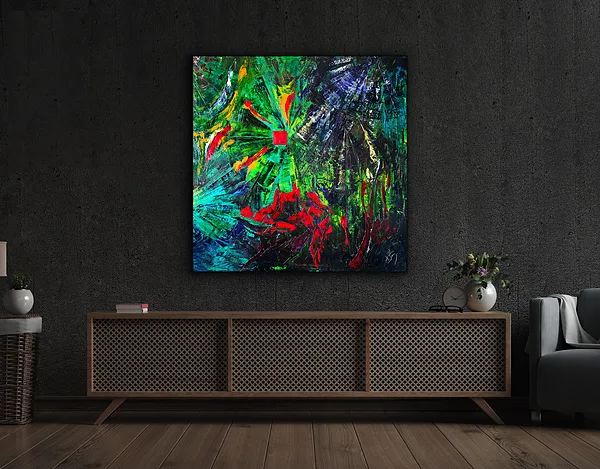
The Third Day elevates into a monumental vision the moment in Creation when the formless primordial world takes shape as land, sea, and burgeoning life. From the depths of the canvas, vast arcs and radially expanding forms unfold: time itself comes into being. From fields of emerald, malachite, and turquoise emerge deep-blue channels of water, shadowy depths verging on black, bands of golden earth, and scarlet, flame-like forms. Near the centre of the composition, a radiant red square emerges in pristine geometric order.
The third day of Genesis unfolds through two successive divine commands. First, God gathers the waters beneath the heavens so that dry land may appear. Then, addressing the newly emerged earth, He issues a further command:
“Let the earth bring forth grass, the herb yielding seed, and the fruit tree yielding fruit after his kind, whose seed is in itself, upon the earth.” (Genesis 1:11)
In the biblical narrative, this day marks the first great separation and the first emergence of life: water and land each assume their rightful place, and the dry land becomes the stage upon which life unfolds.
“And the evening and the morning were the third day.” (Genesis 1:13)
Amid this unrestrained organic outpouring, the red square emerges with particular force as the symbol of the altar. Its geometric purity stands in sharp contrast to the irregular forms of nature swirling around it. While the paradisiacal world branches out, grows, and multiplies, the red sign draws everything inward, concentrating its force. As the recurring symbol of the One throughout the cycle, it becomes the visual seal of the creative will, the sign of the singular origin from which the diversity unfolding around it springs.
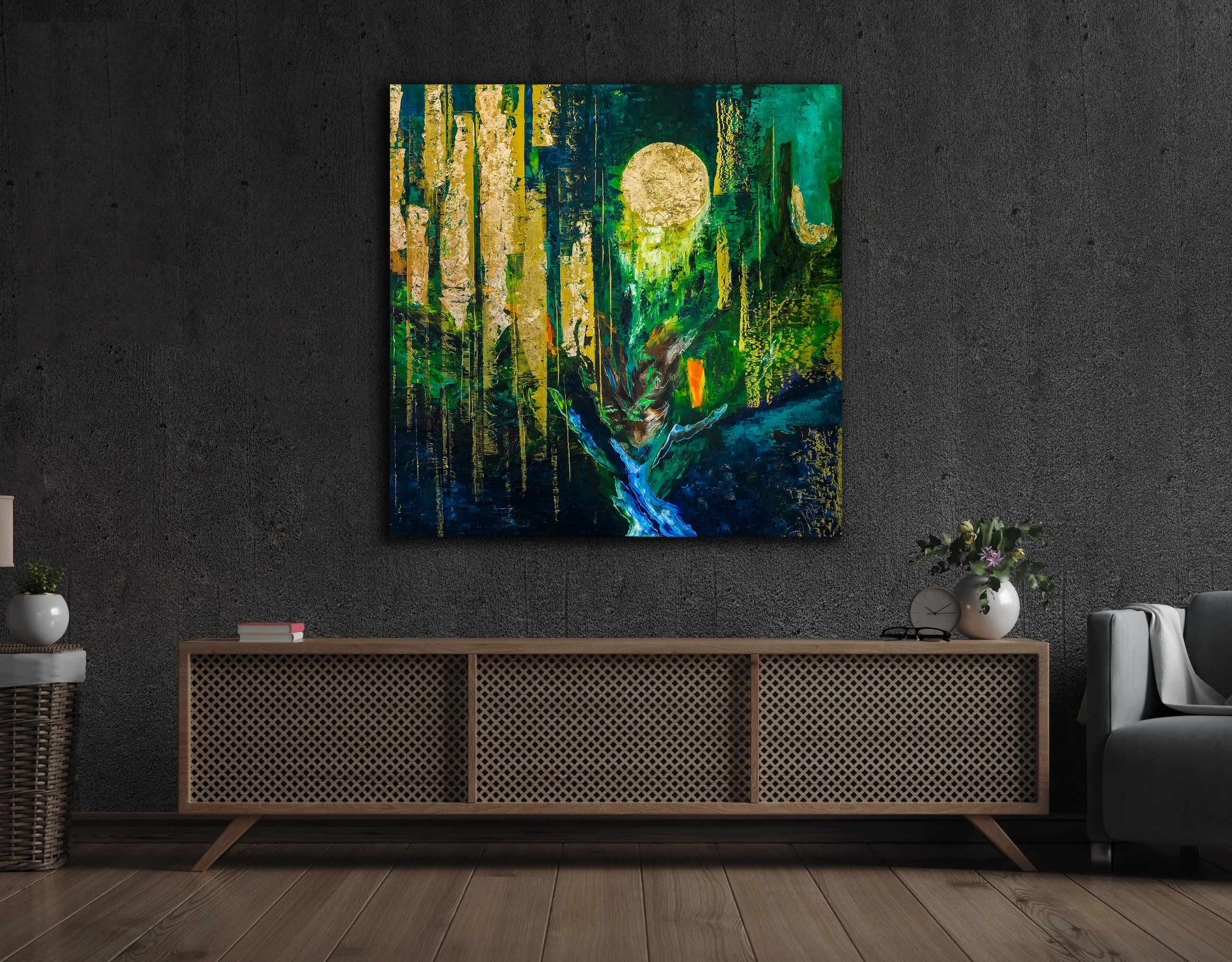
The Fourth Day
- 120 x 120 cm
- Oil and gold on canvas
- Created: Sitges, 2026
- The artwork is part of the 'Old Testament III - In Search of the Secrets of Eternity' cycle
- AVAILABLE FOR PURCHASE
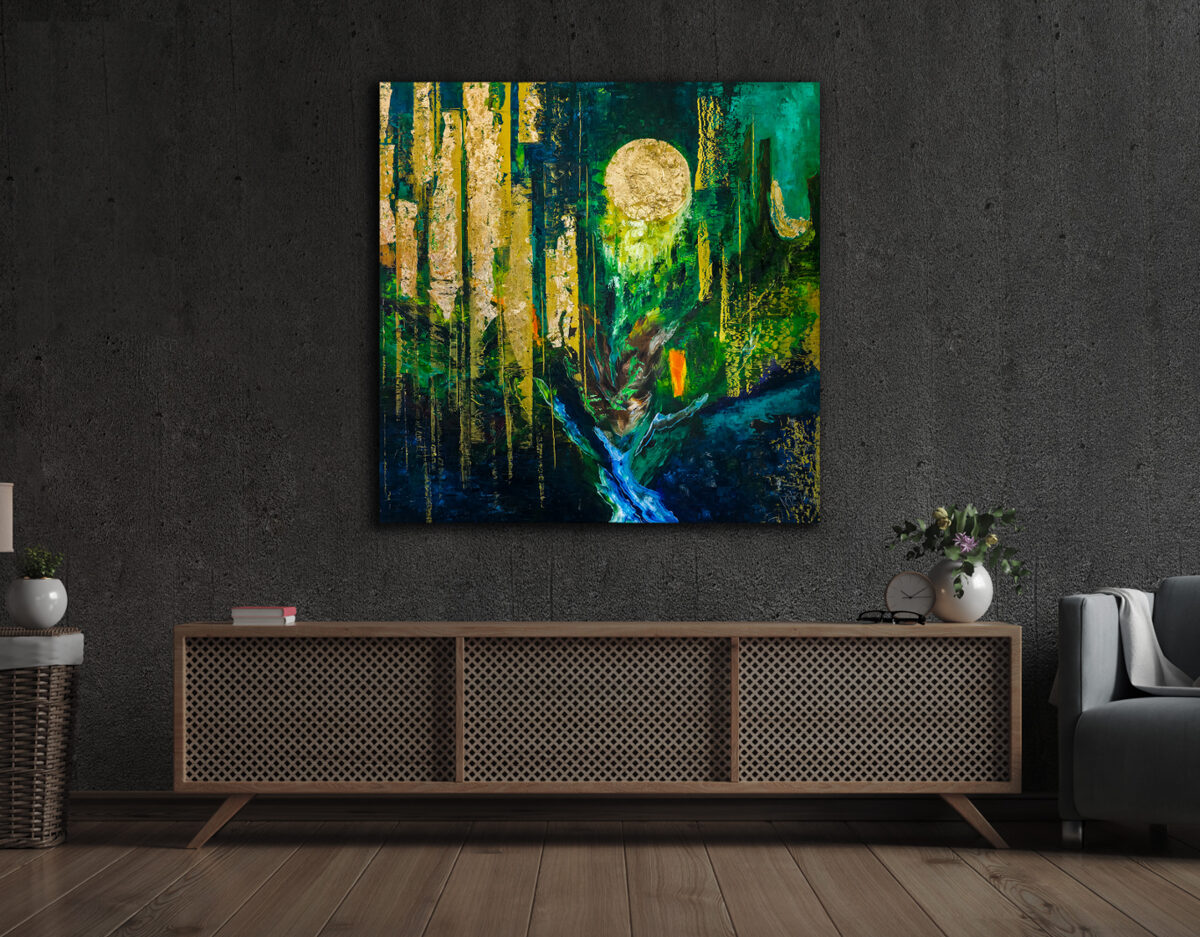
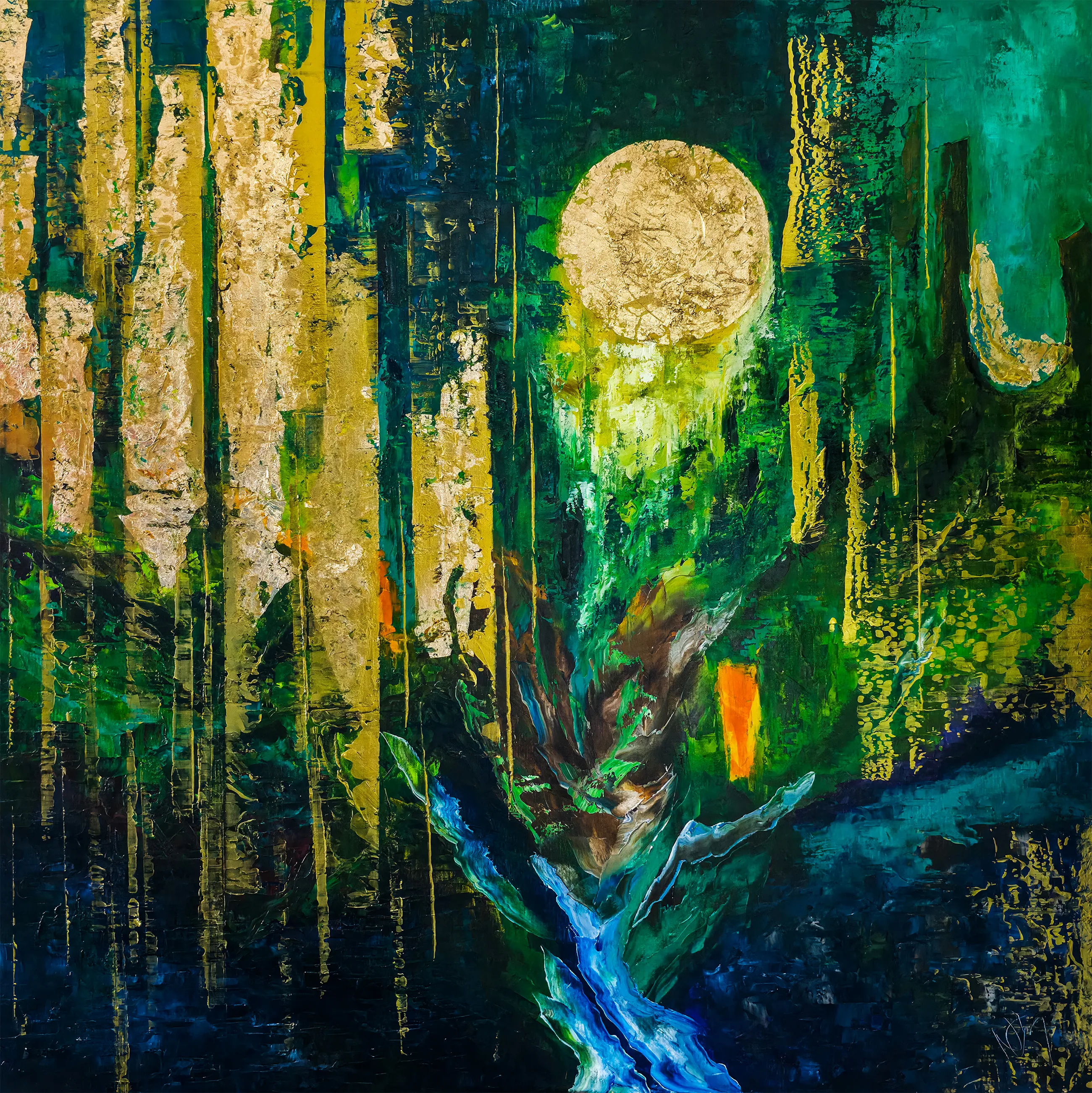
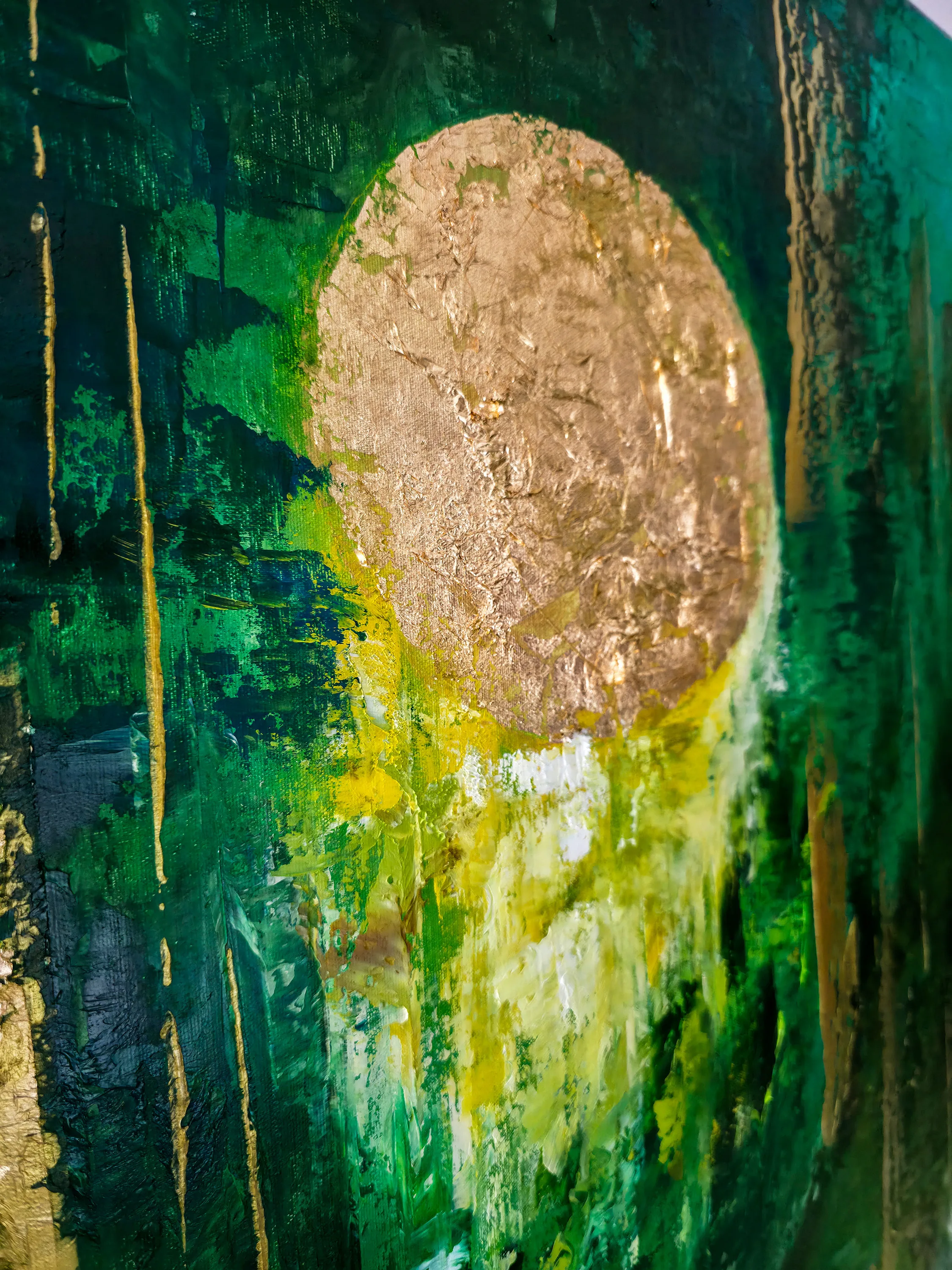
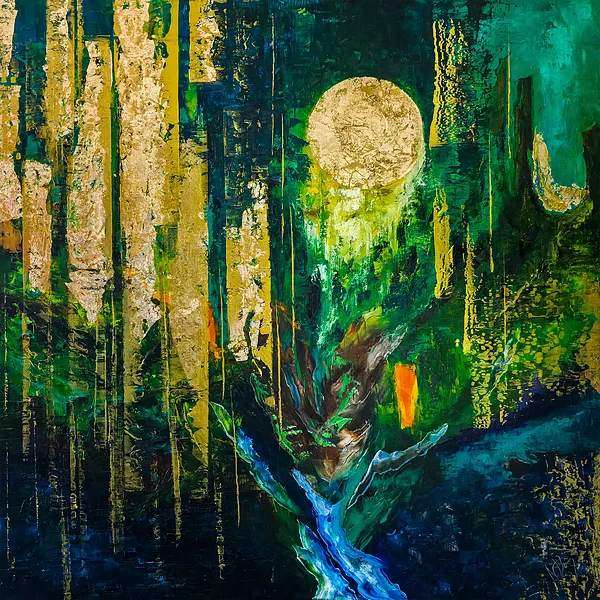
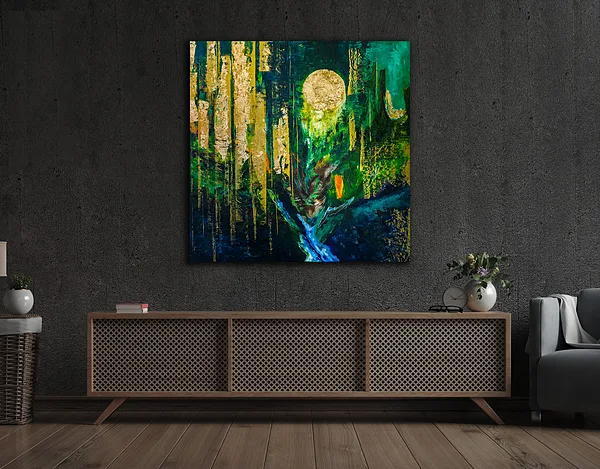
On the fourth day of Creation, God brings forth the Sun, the Moon, and the stars to illuminate the Earth, separate day from night, and establish the order of time.
“And God said, Let there be lights in the firmament of the heaven to divide the day from the night.” (Genesis 1:14)
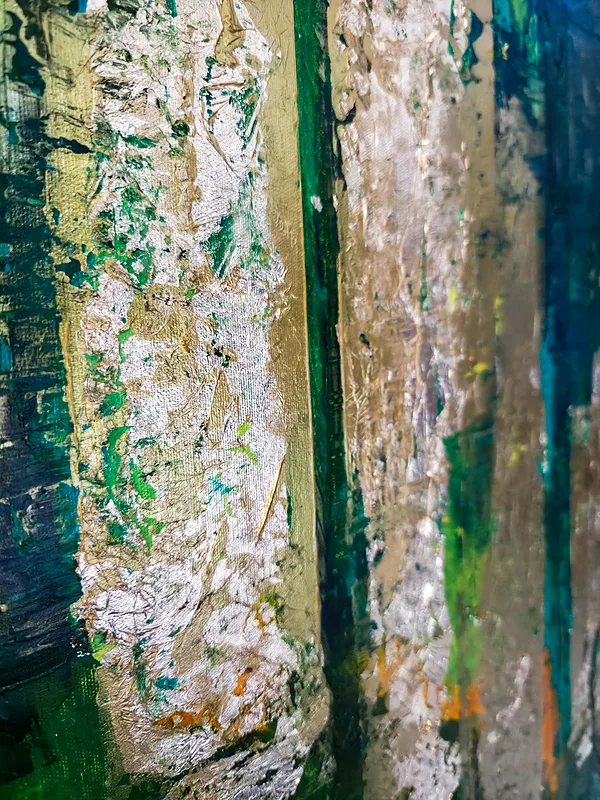
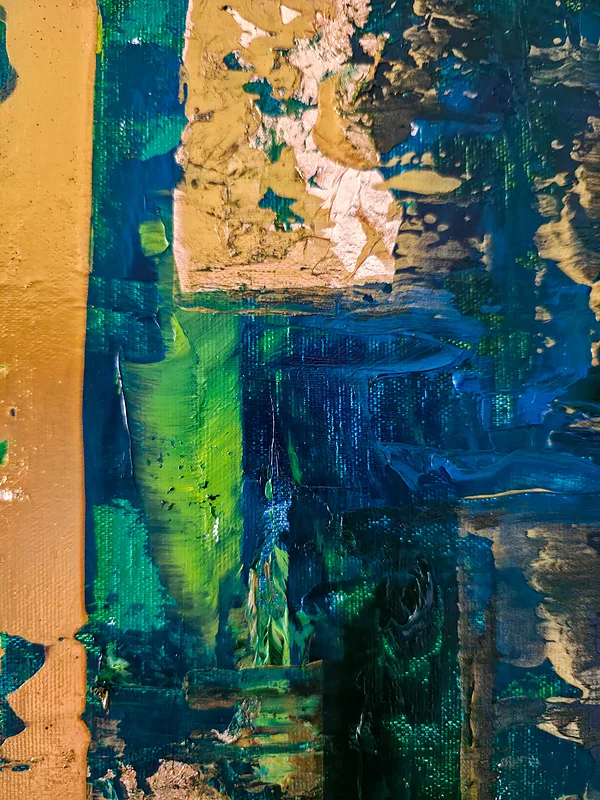
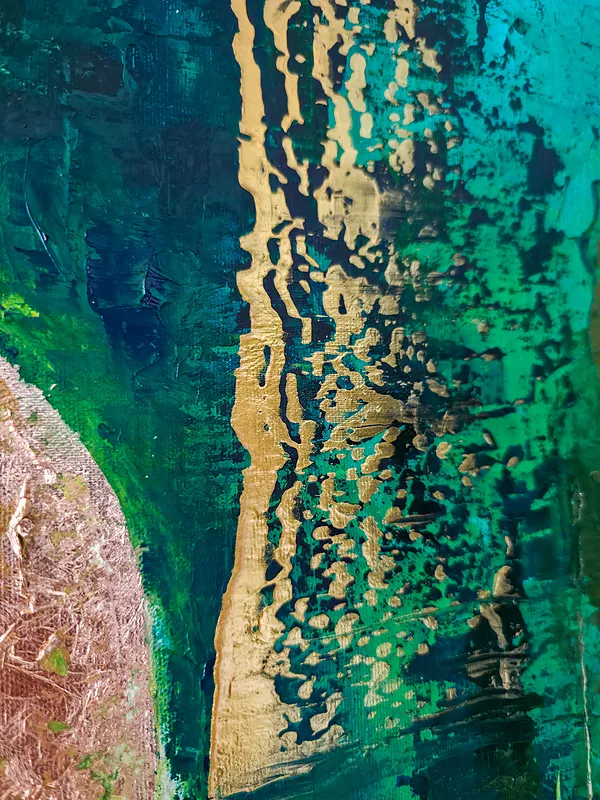
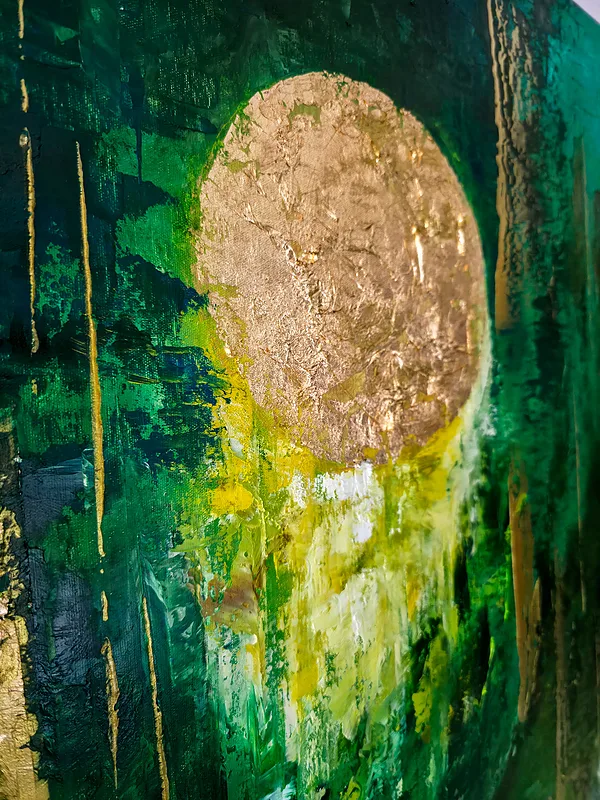
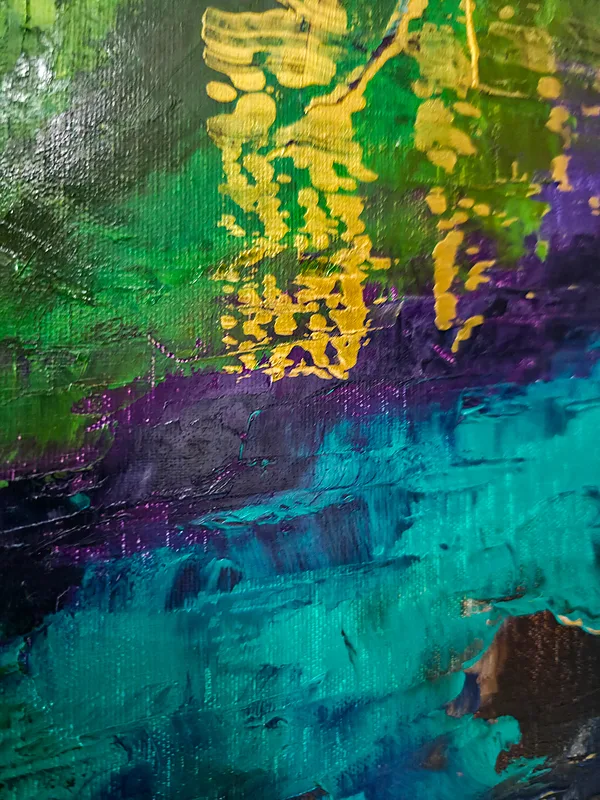
At the centre of the painting, a blazing golden celestial body rises into the heavens. Its emergence is accompanied by an imaginary channel opening from the depths of the composition, its spreading forms embracing the path of light like outstretched arms. The motif evokes the image of a womb: a new form of existence emerges from the depths of Creation. The Moon, appearing in the Sun’s shadow, becomes the second celestial body in this process of birth, forming part of the complementary order of light and darkness.
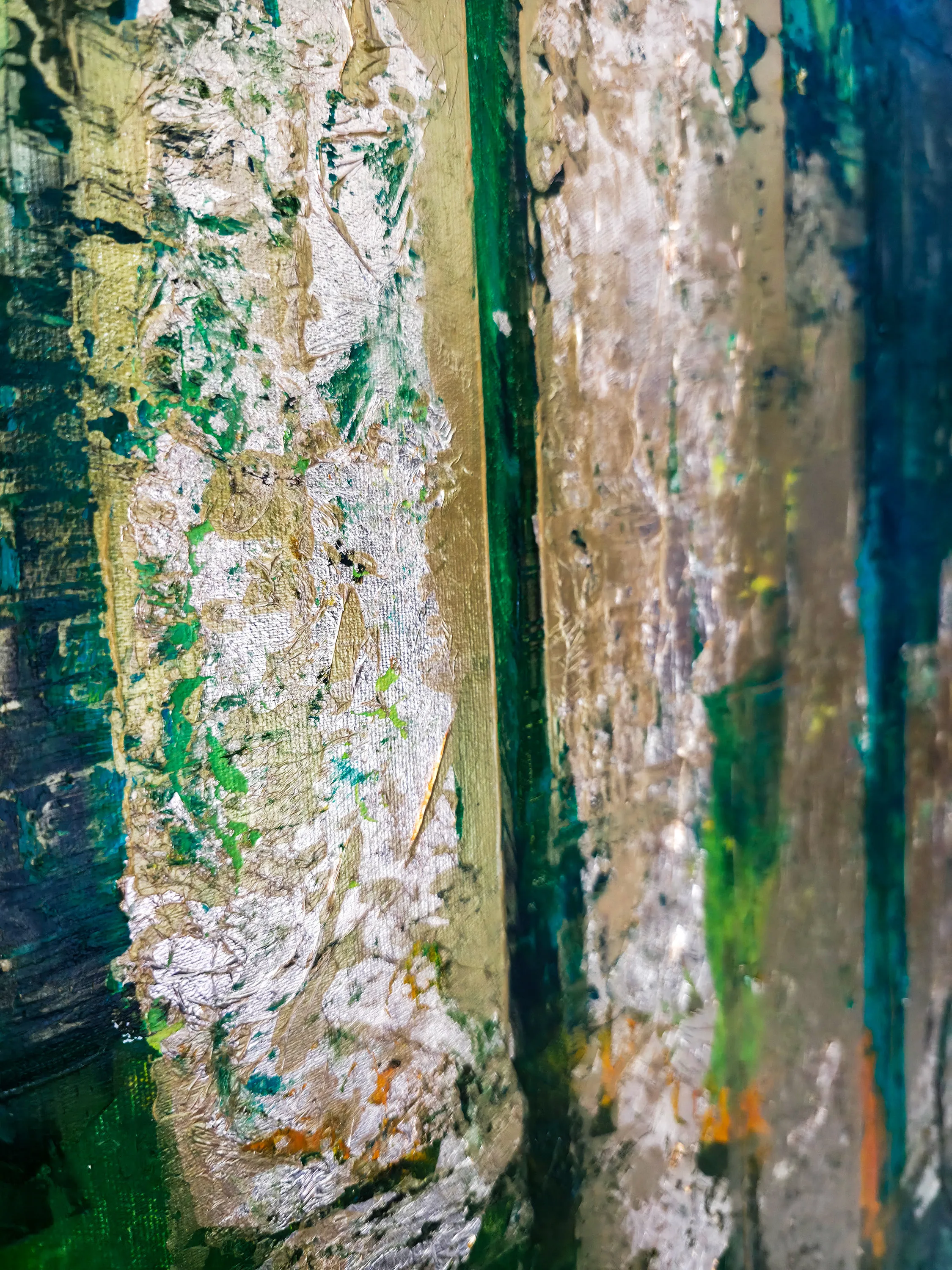
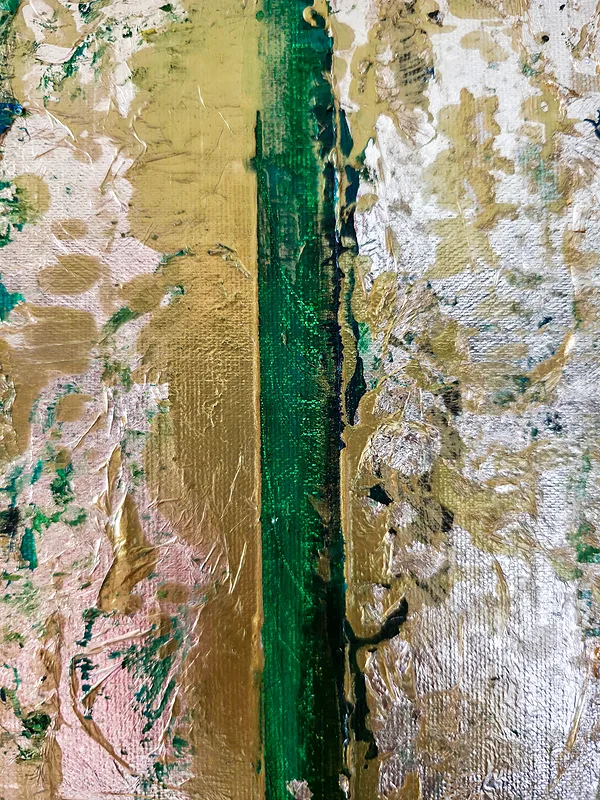
The golden fields on the left represent the immutable divine will. Their strict vertical divisions embody the force of law and order. Gradually, the golden surfaces recede from the emerald-green field of the painting: the creative will has fulfilled its work and now gives way to the world it has brought into being.
An orange form on the right side of the painting unexpectedly interrupts the flow of greens and blues. Yet its assertive presence establishes a sense of stability amid perpetual change.
The Fourth Day is a dramatic vision of cosmic birth. The radiant Sun, the Moon emerging from its shadow, the swirling greens, and the receding golden fields condense the successive moments of Creation into a single pictorial event.
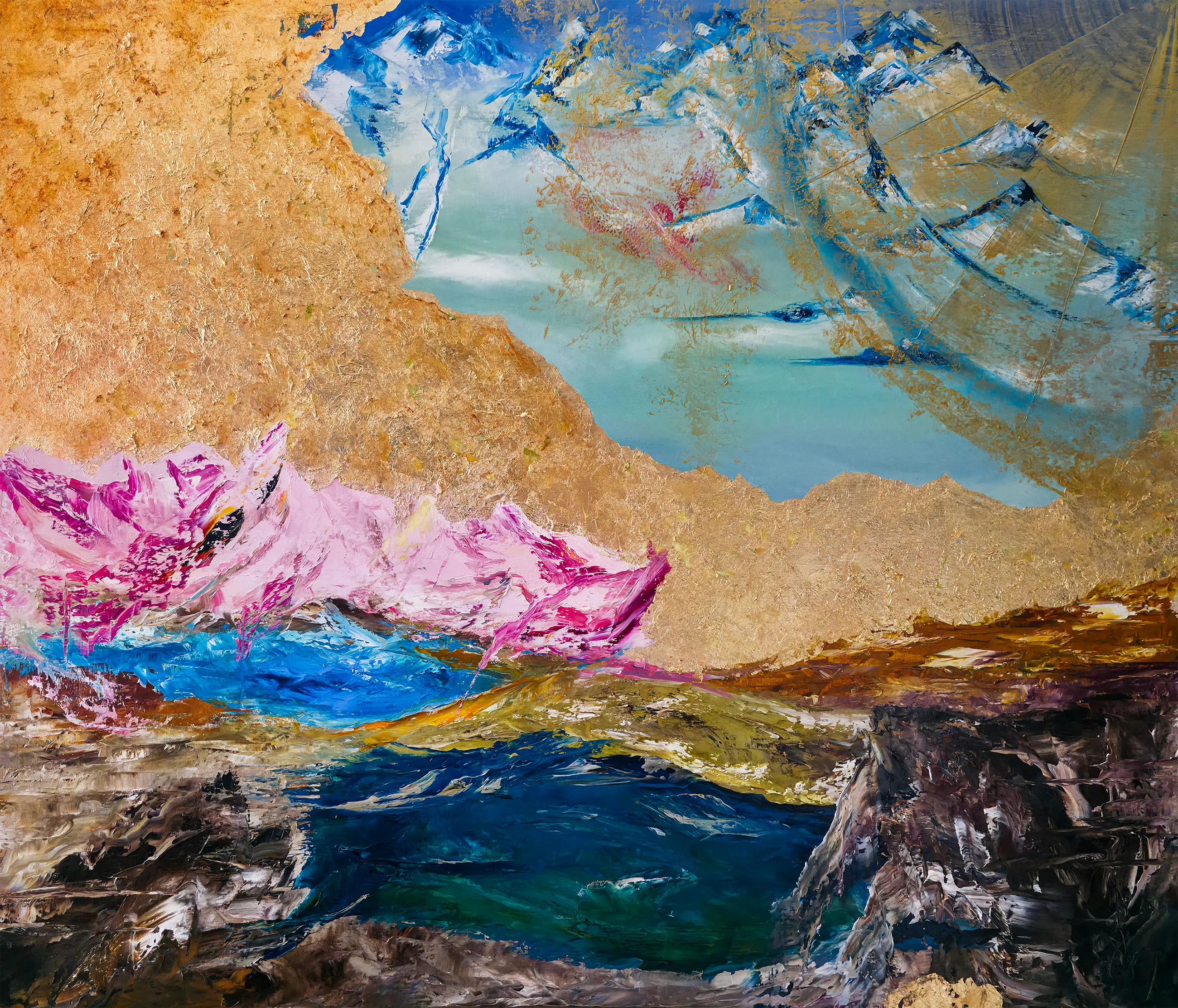
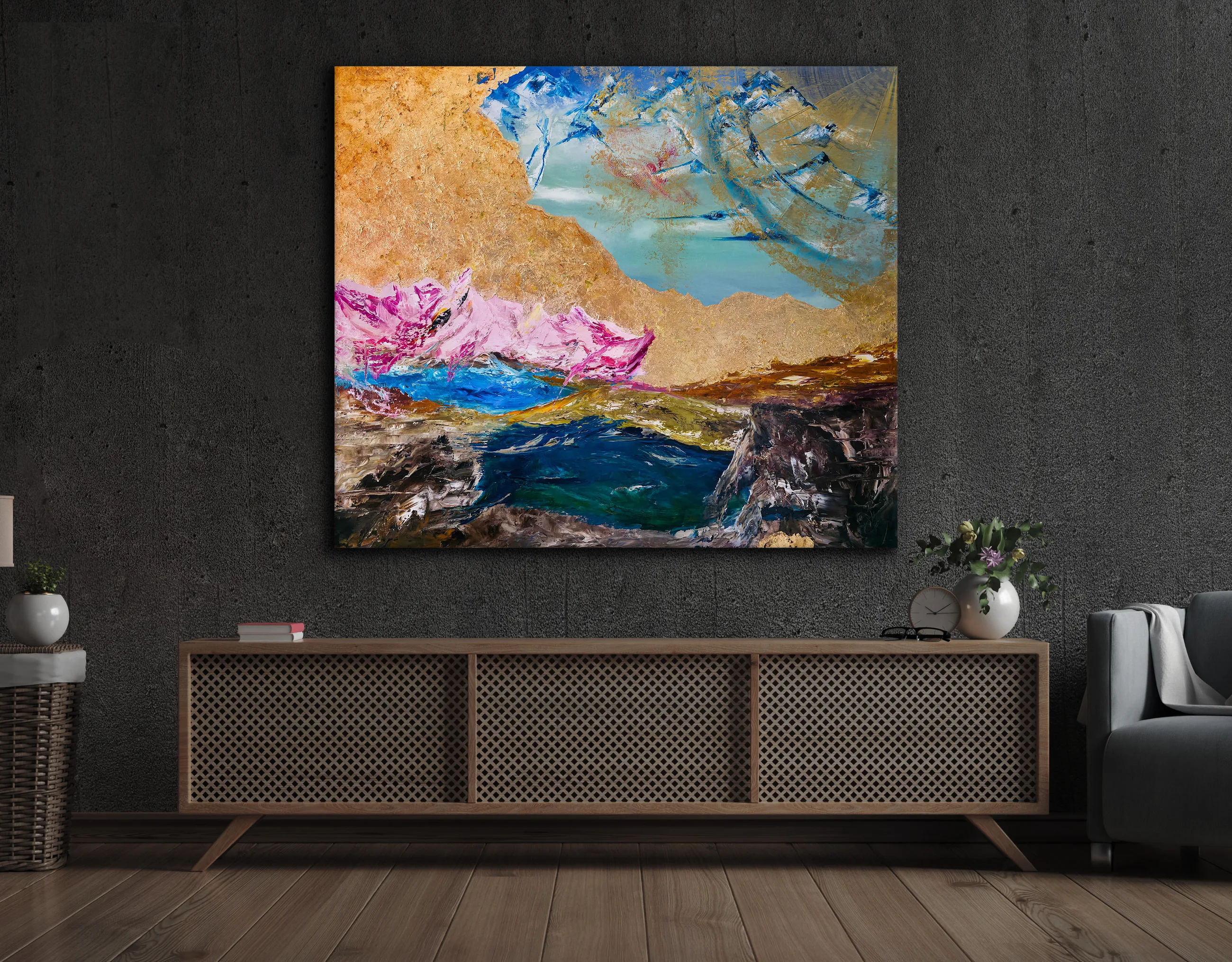
The Fifth Day
- 120 x 140 cm
- Oil and gold on canvas
- Created: Sitges, 2026
- The artwork is part of the 'Old Testament III - In Search of the Secrets of Eternity' cycle
- SOLD
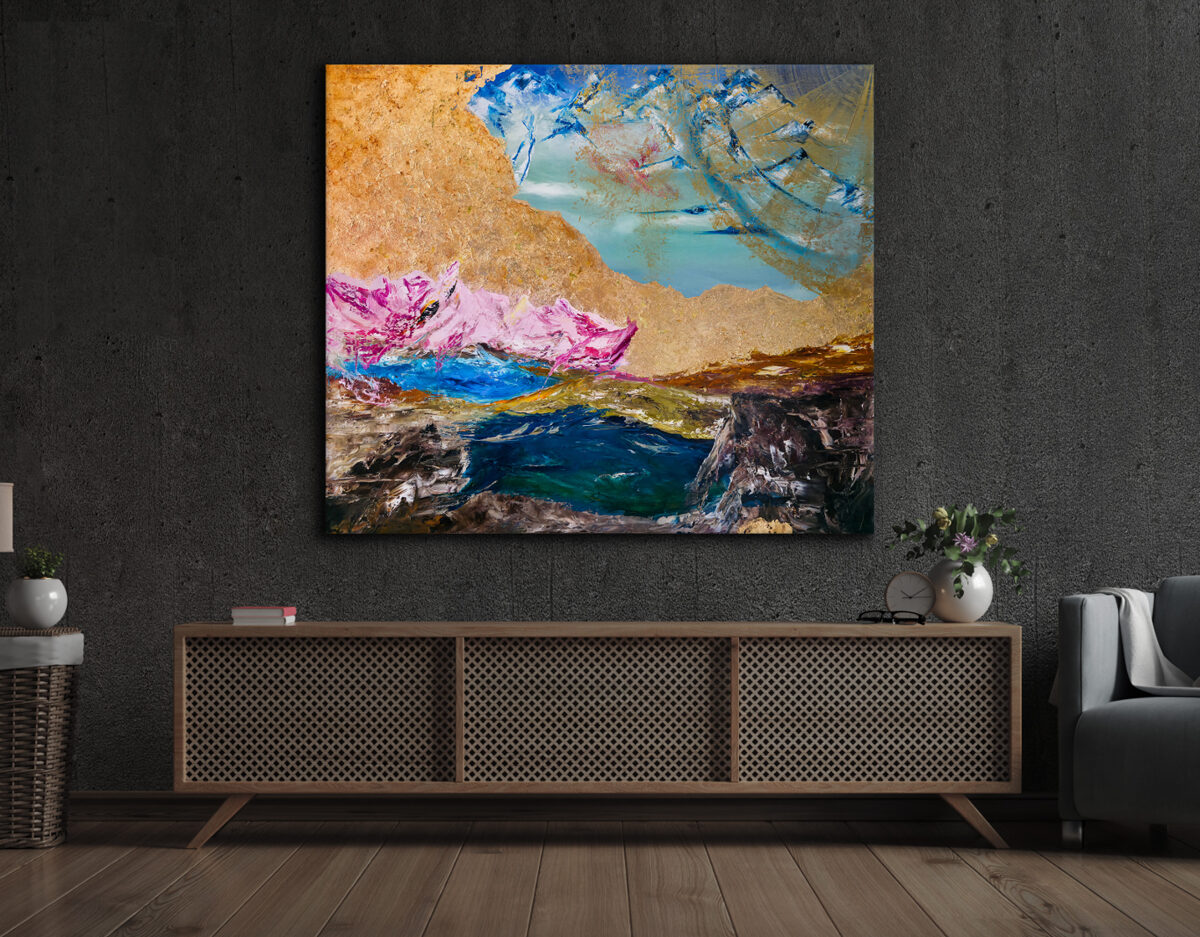
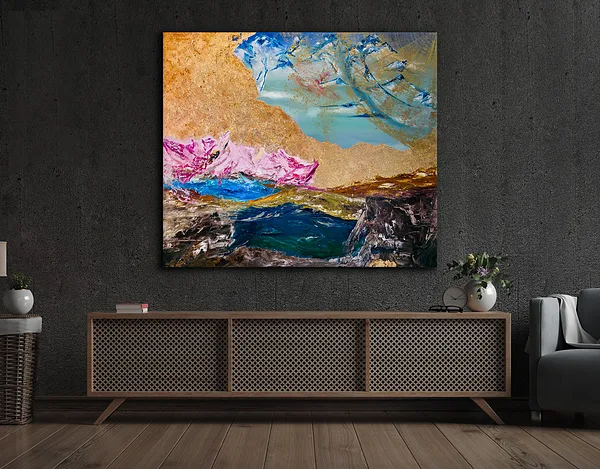
“And God said, Let the waters bring forth abundantly the moving creature that hath life, and let birds fly above the earth across the expanse of heaven.” (Genesis 1:20)
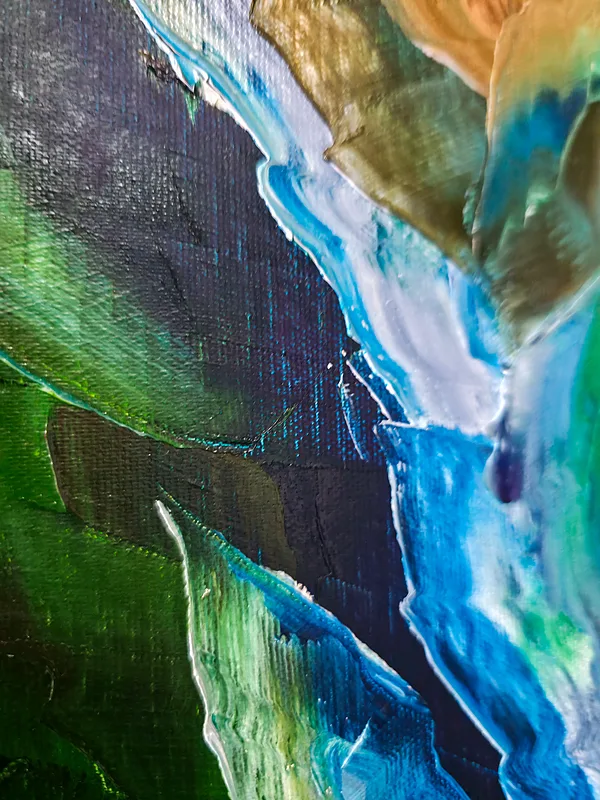
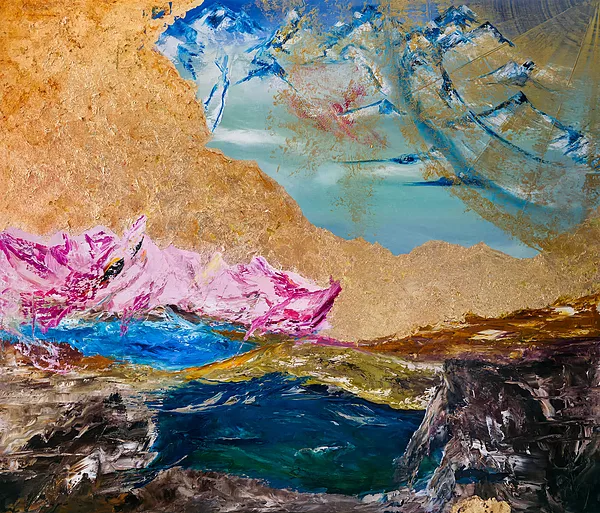
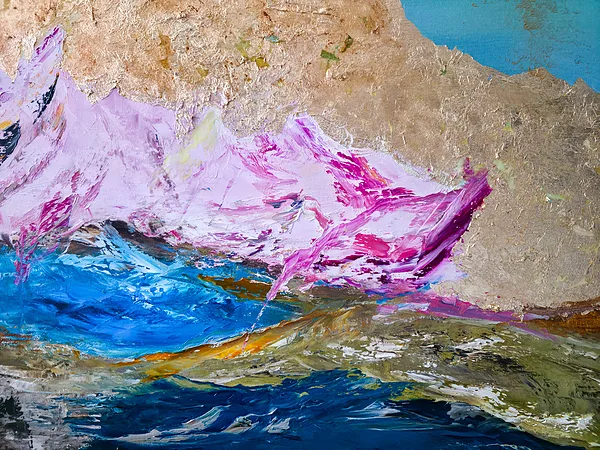
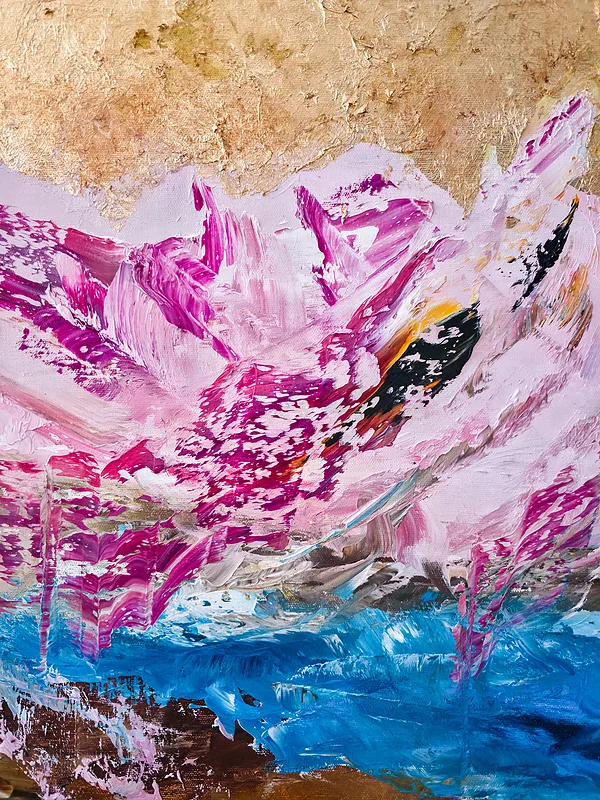
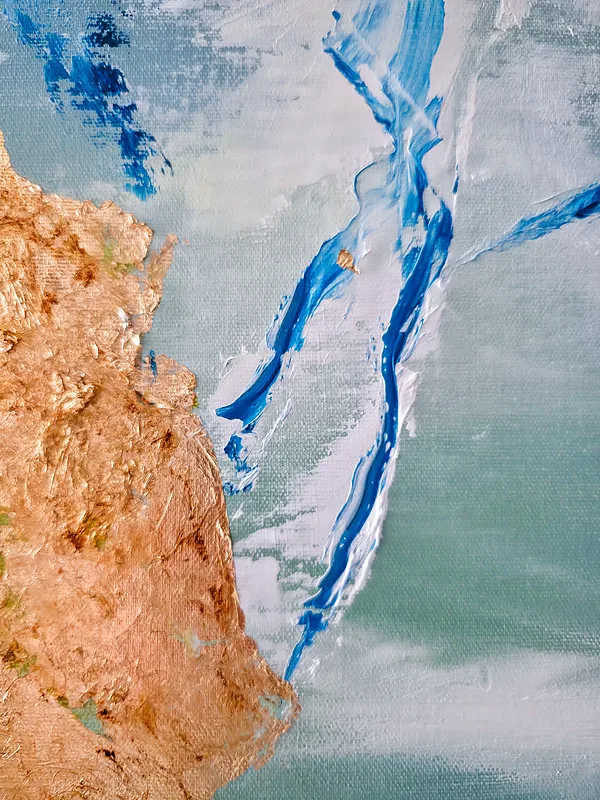
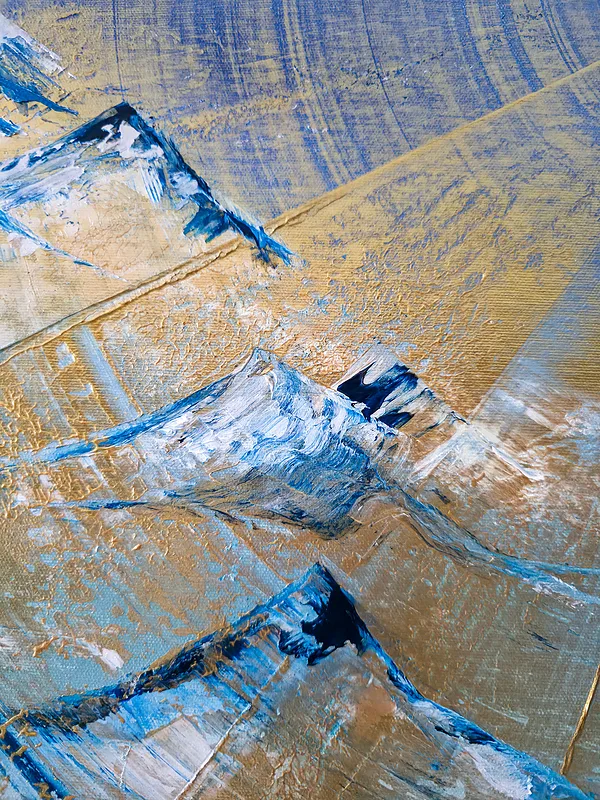
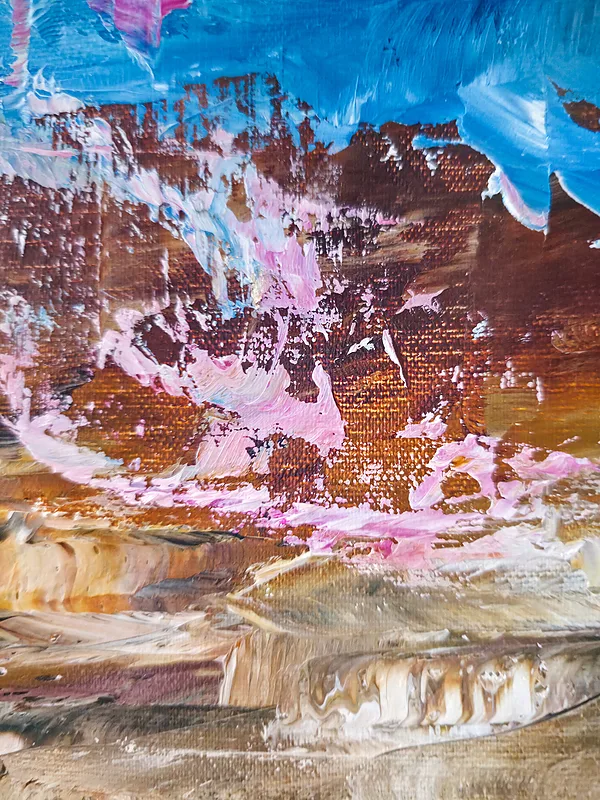
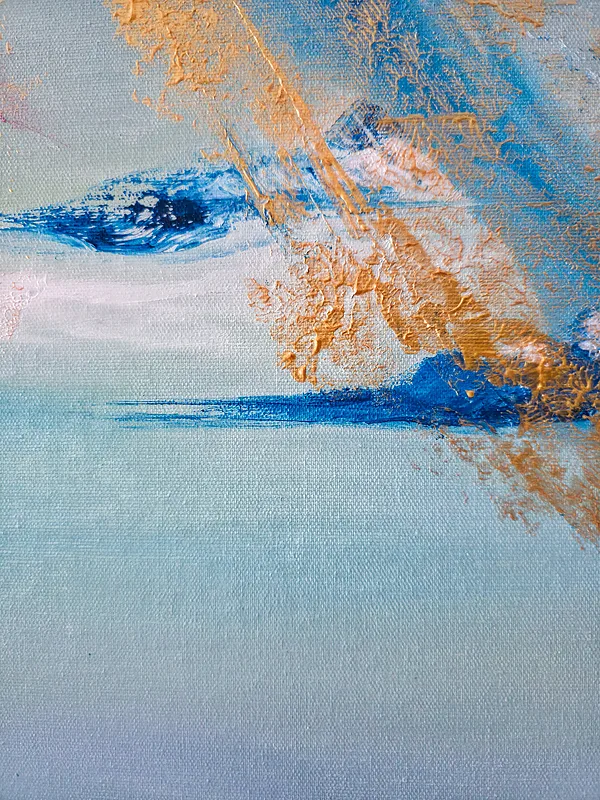
In the upper region of the painting, blue birds emerge from the cool mountain peaks and enter an airy, pastel-green expanse, answering the call of the divine will.
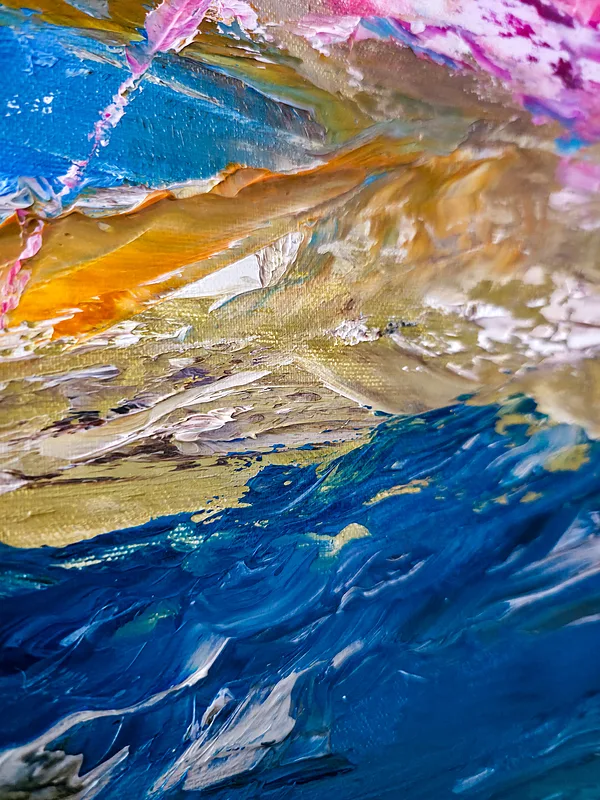
The golden surface drapes itself over the composition like a protective celestial mantle. It symbolises both the divine creative will and the presence that safeguards the world. Its radiance is not static but a pulsating, living force. The golden semicircle also evokes the passage of time, suggesting that everything in Creation has its appointed moment.
Scattered flecks of paint across the canvas enhance the sense of spatial depth and three-dimensionality.
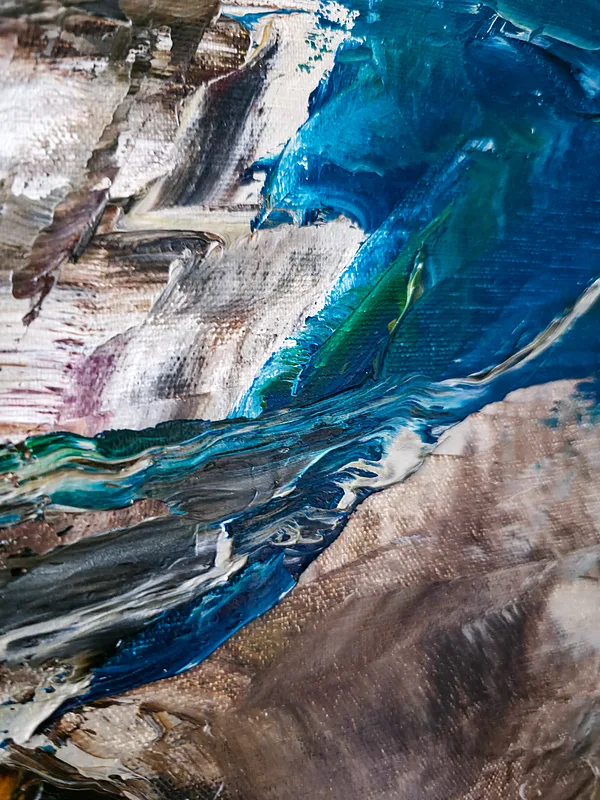
In the middle and lower regions of the painting, the waters reveal their many different faces. Alongside the intense blues of the deep, dark, rumbling ocean, luminous, translucent lagoons emerge.
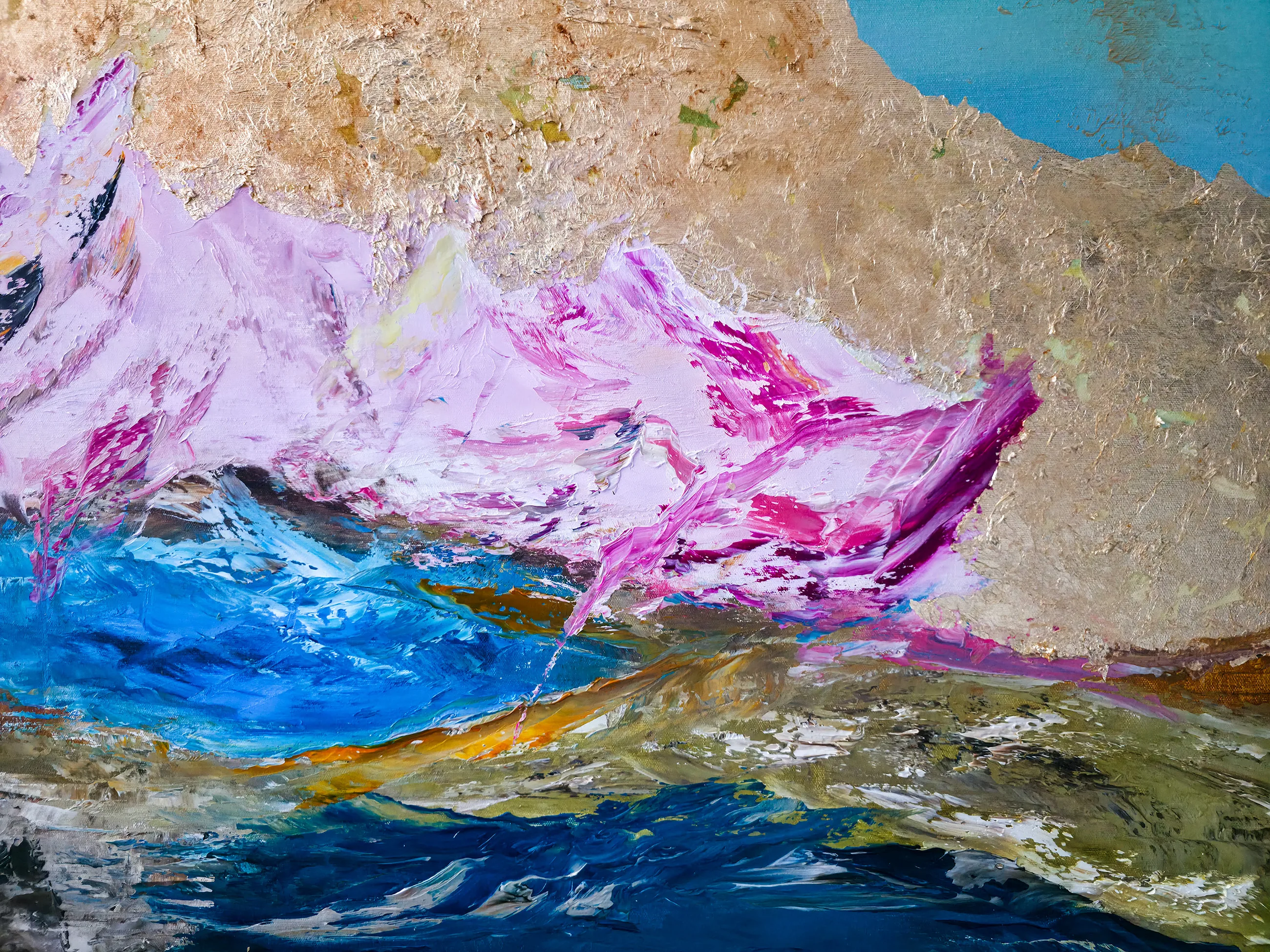
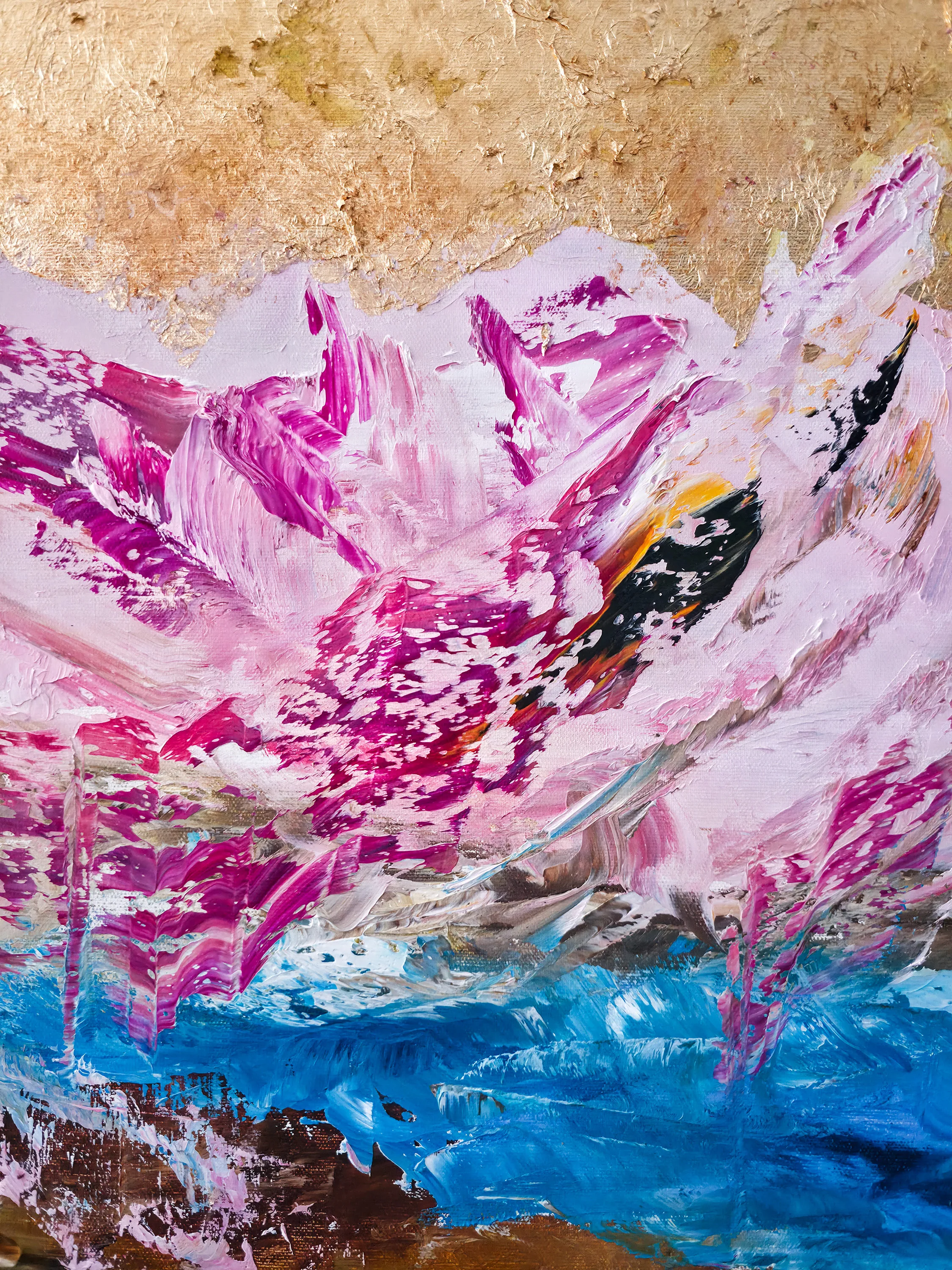
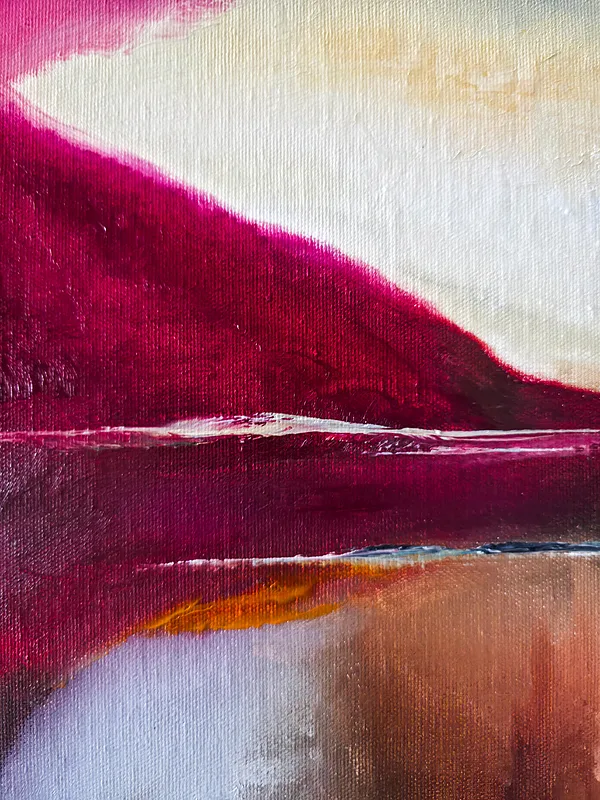
The once-desolate land, parched in russet brown, now teems with life. Streaks of pink and gold emphasise the beauty and fertility of the newly created world. The pink mountain forms and shorelines, together with the colours unfolding above them and along the boundary between water and sky, evoke the joy of burgeoning life and the richness of Creation. Earth, water, and air together become a home for life, where movement, light, and colour meet in harmony.
The Fifth Day celebrates the fulfilment of Creation.
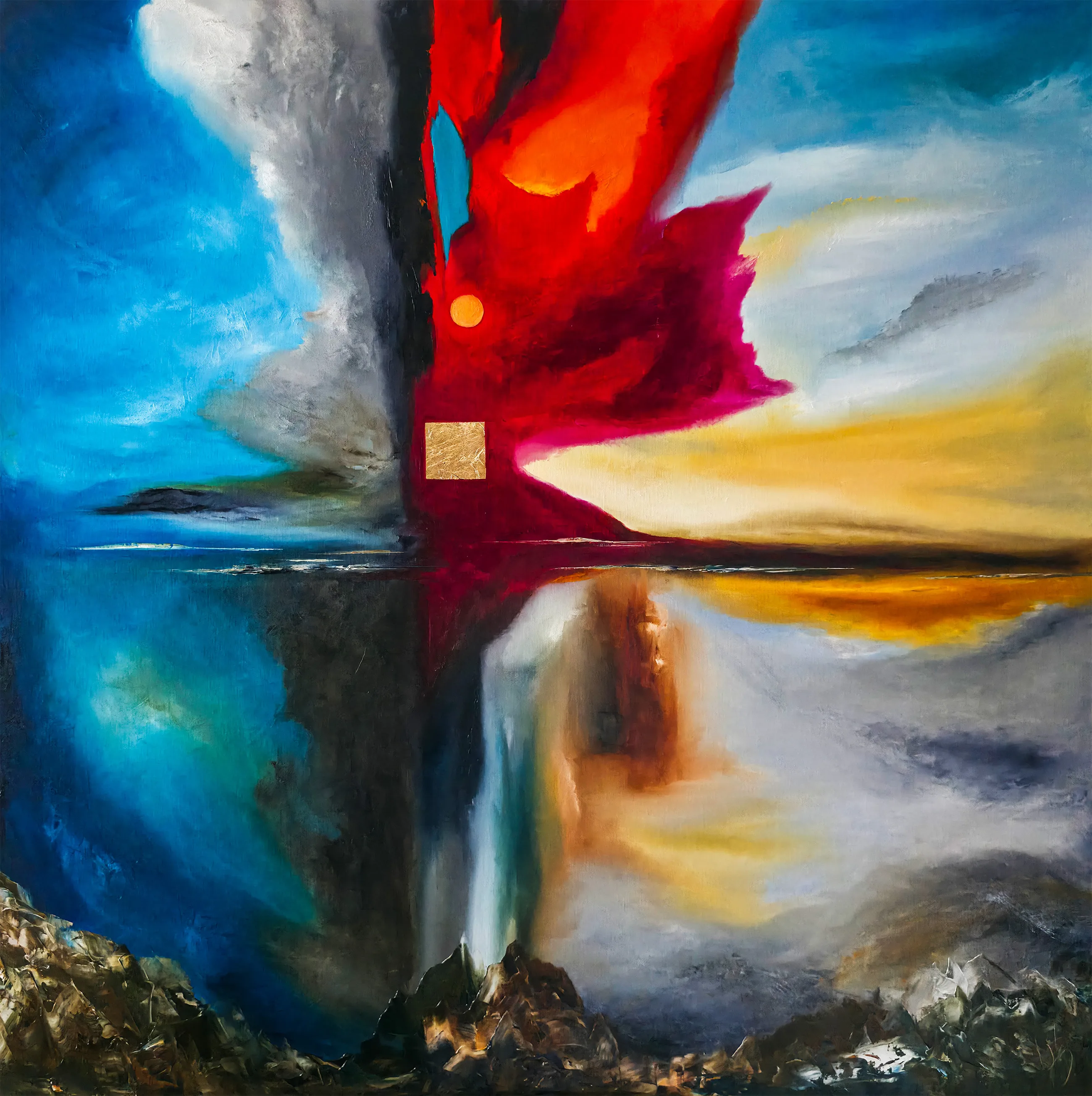
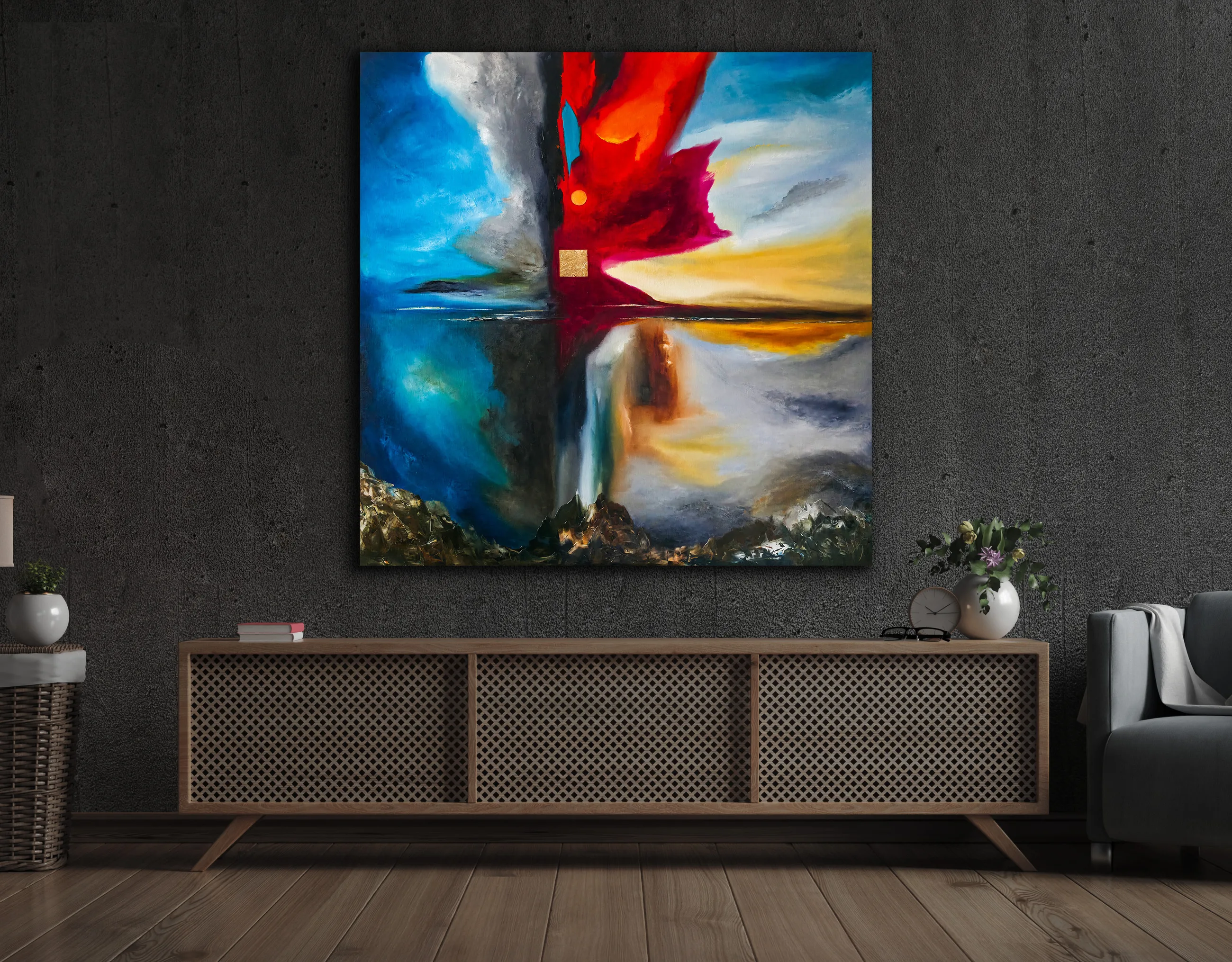
The Sixth Day
- 140 x 140 cm
- Oil and gold on canvas
- Created: Sitges, 2026
- The artwork is part of the 'Old Testament III - In Search of the Secrets of Eternity' cycle
- AVAILABLE FOR PURCHASE
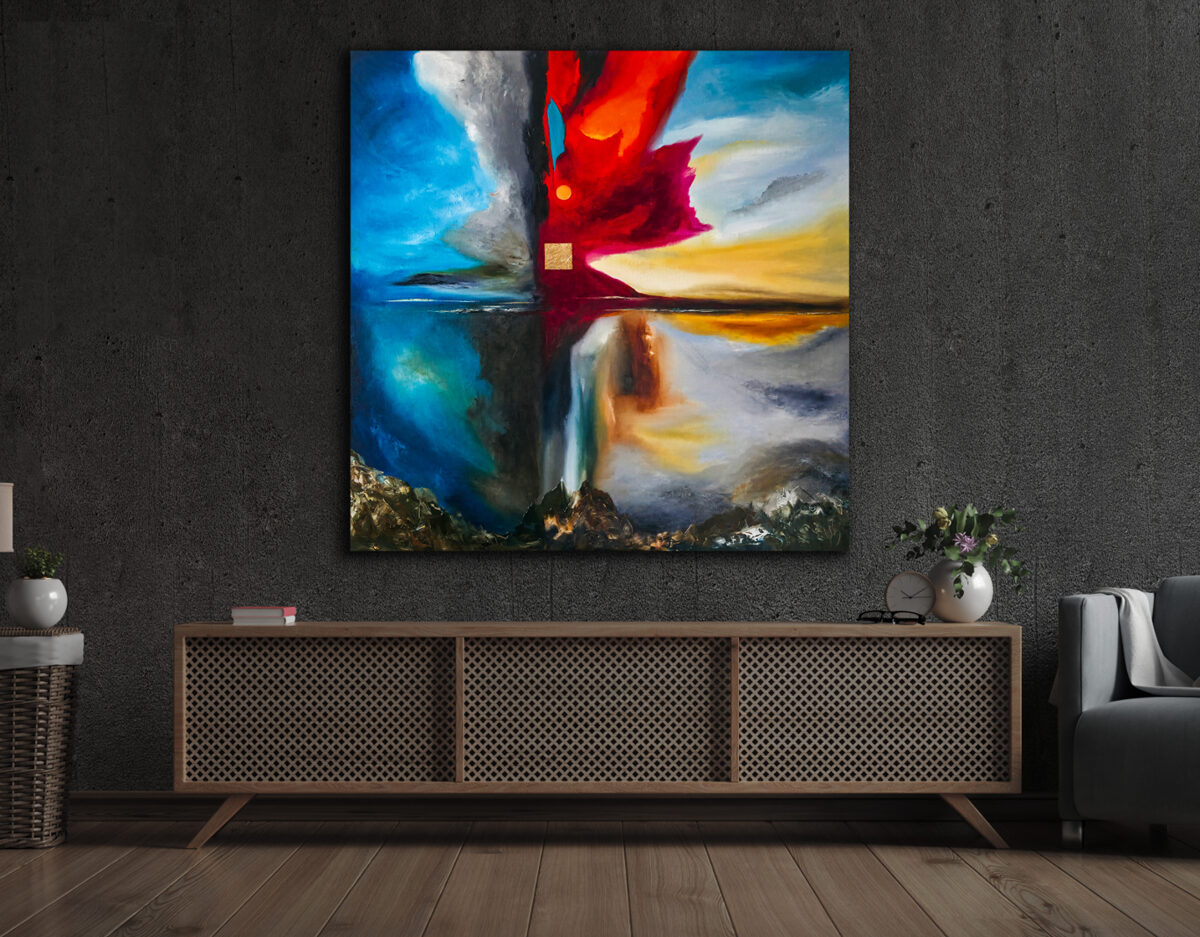
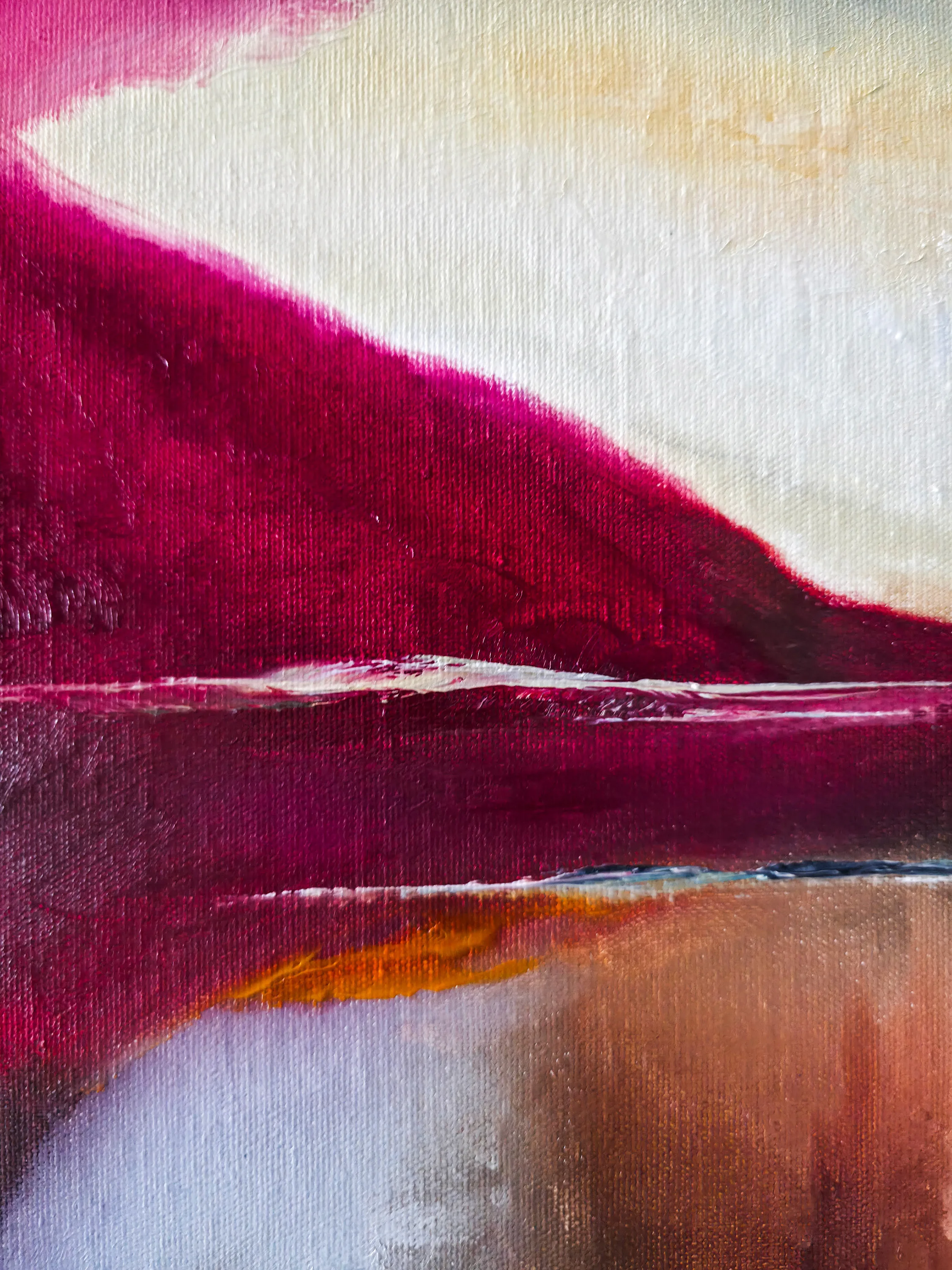
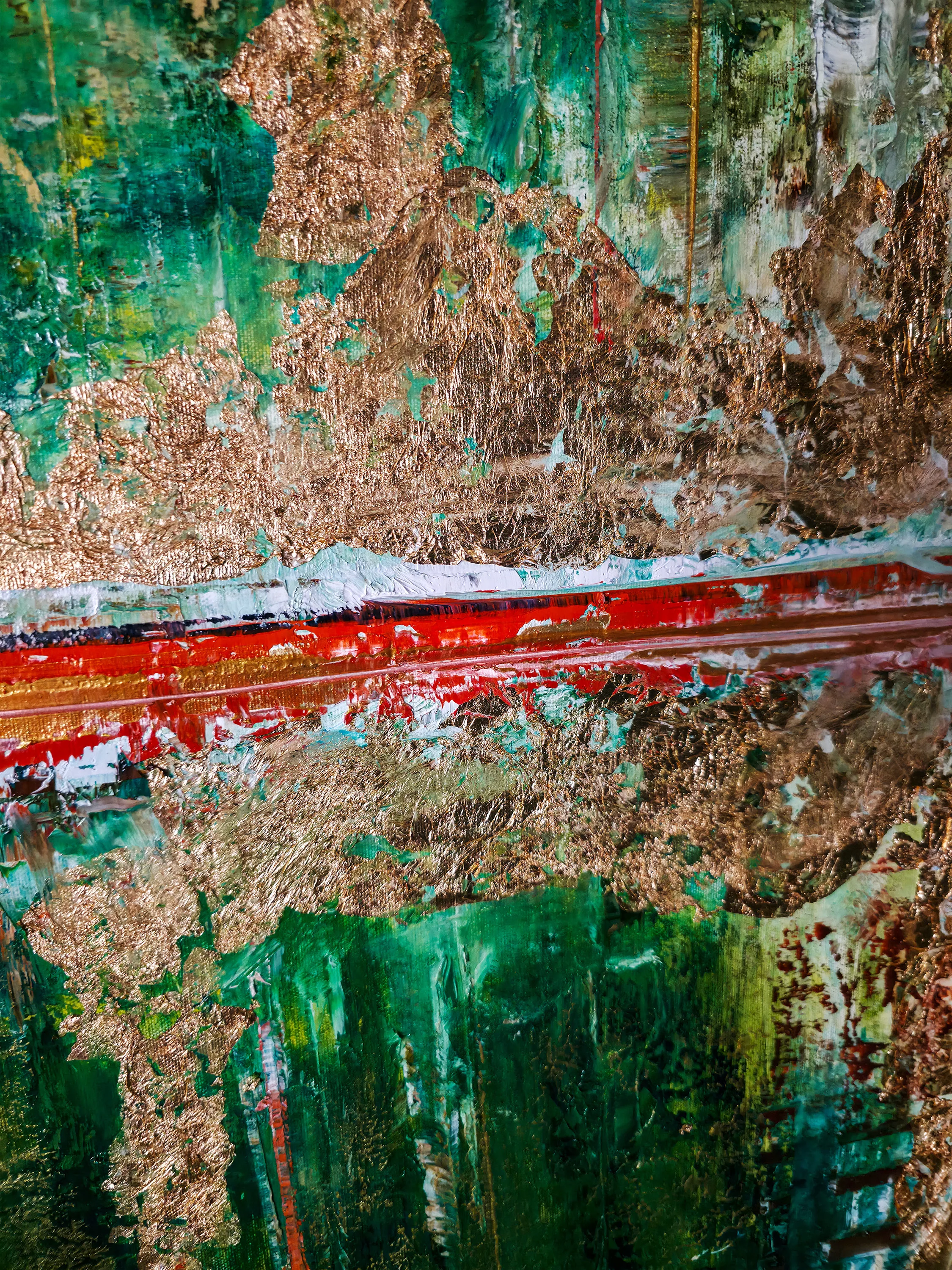
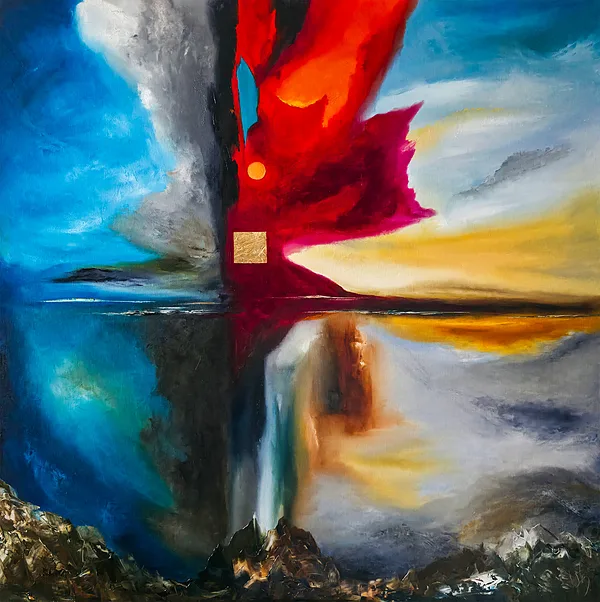
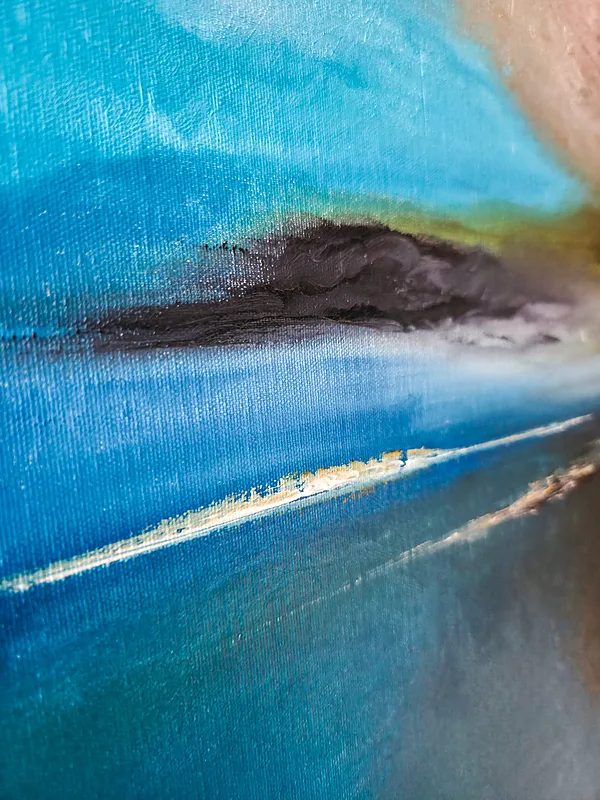
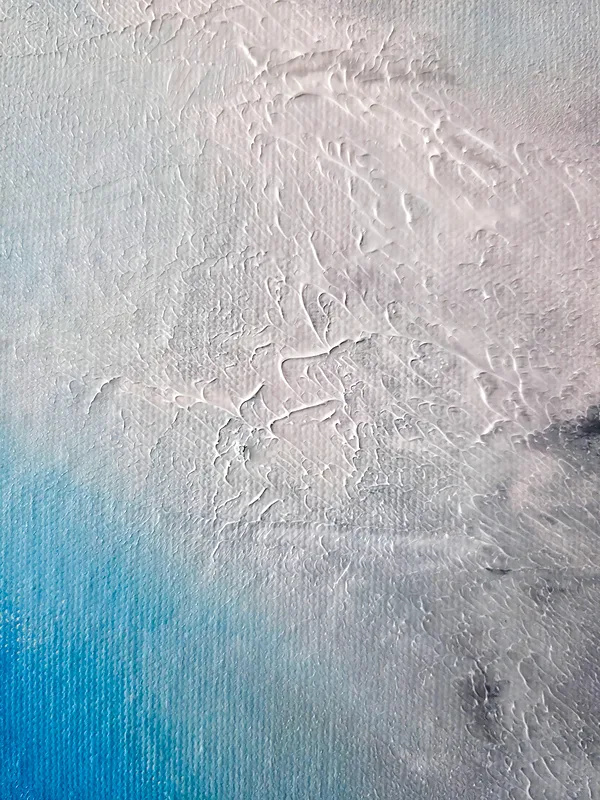
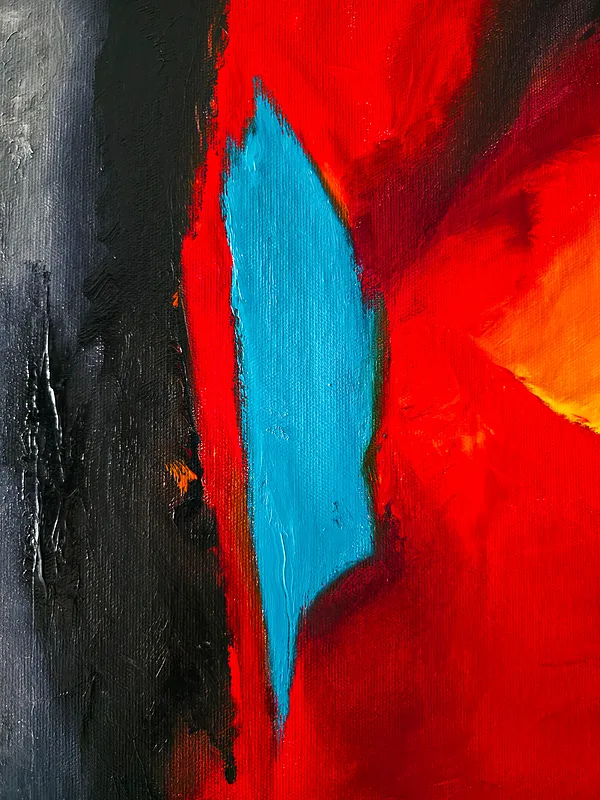
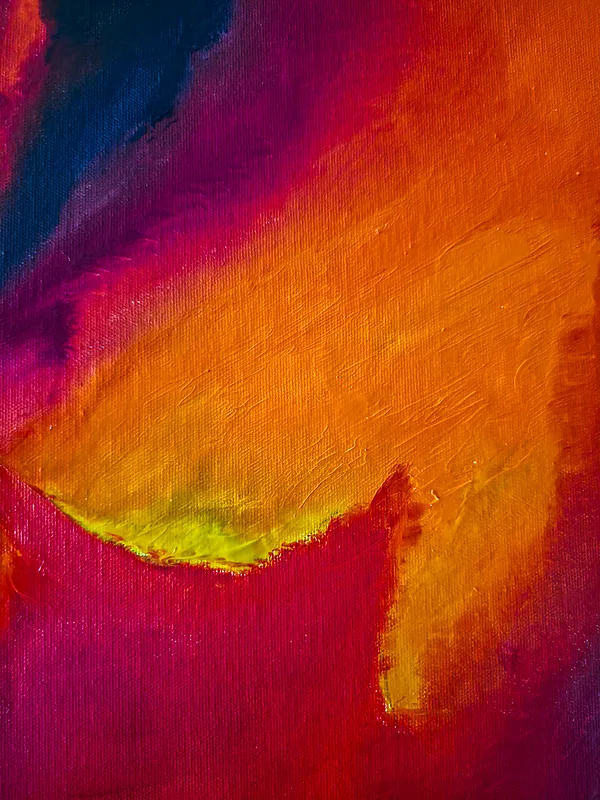
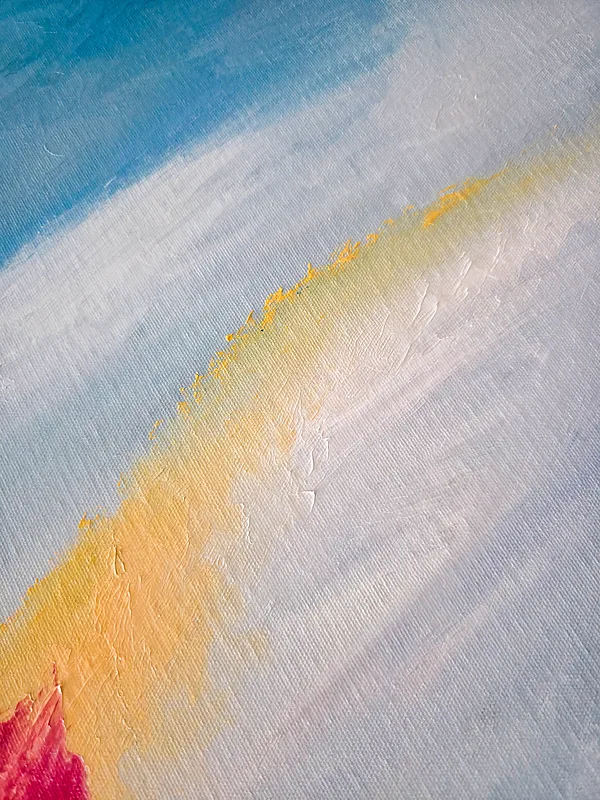
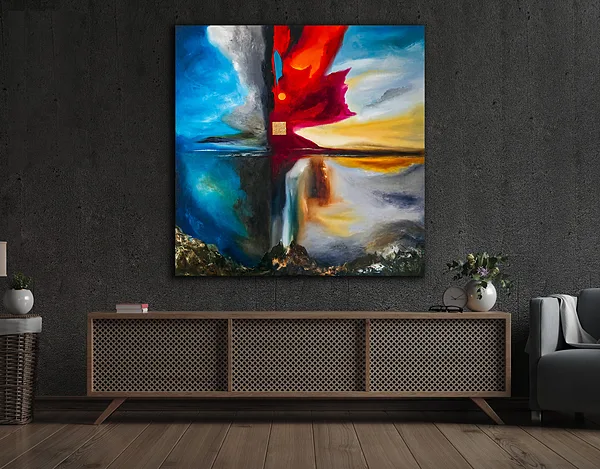
The composition is divided by a distinct horizontal axis, a delicate, light-filled boundary between heaven and earth. The visible world and its reflection engage in a dialogue. The forms of the upper realm take on new shapes in the lower part of the painting: the crimson force descends as a darker reflection among deep blues, turquoise, and silvery glimmers. The cooler tones on the left and the warm golden radiance on the right retain their distinct character in the reflection, while merging into a harmonious whole.
Forms that deliberately depart from symmetry create a dynamic balance. The scarlet, crimson, and orange hues flaring on the right side of the painting embody the fire, strength, and creative impetus of feminine energy. Opposing them, the azure, ultramarine, and silver-grey tones on the left evoke stability, security, and protective strength - the masculine energies. Despite the vertical division, these two distinct colour palettes do not oppose one another but blend and flow together.
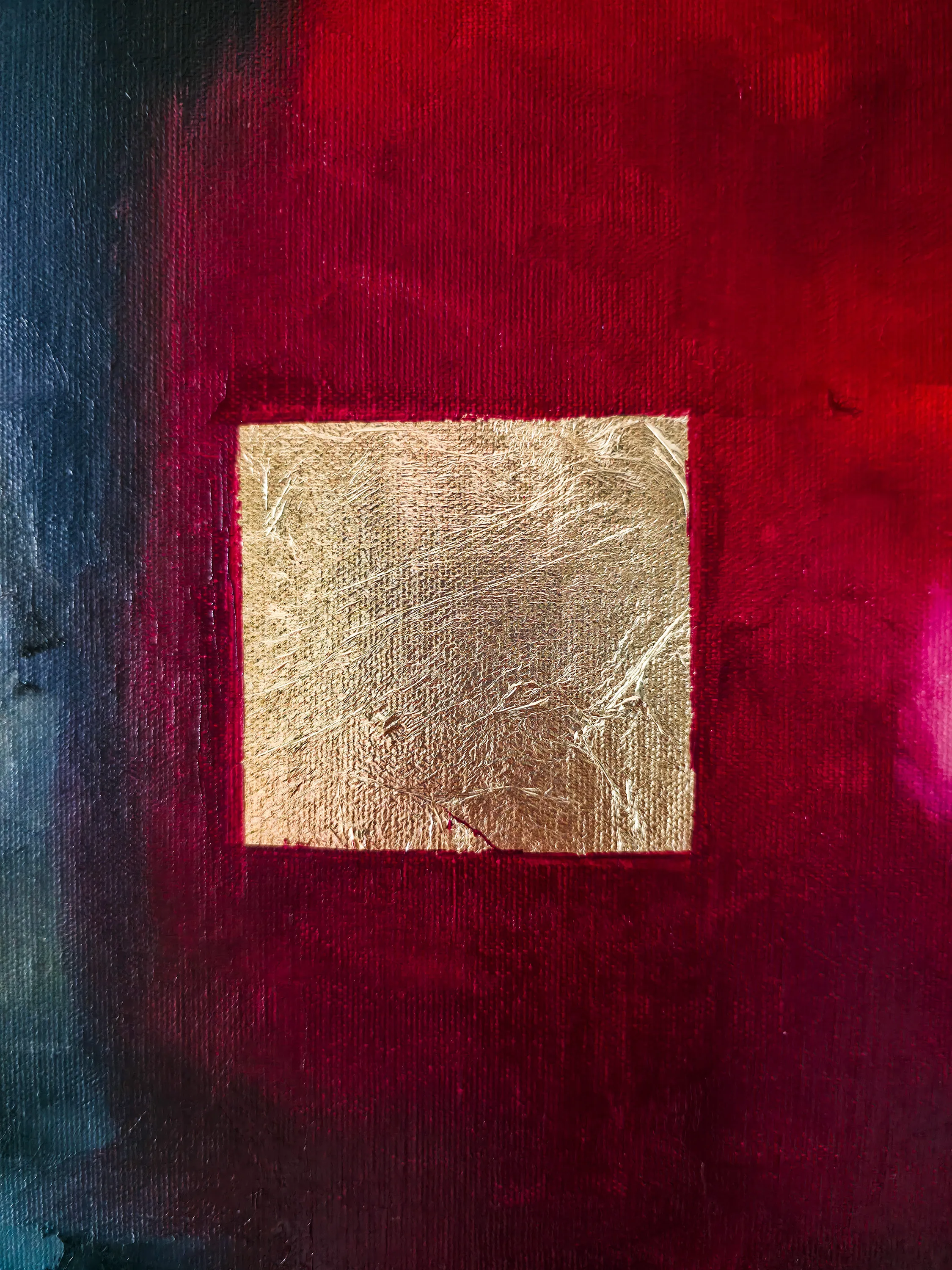
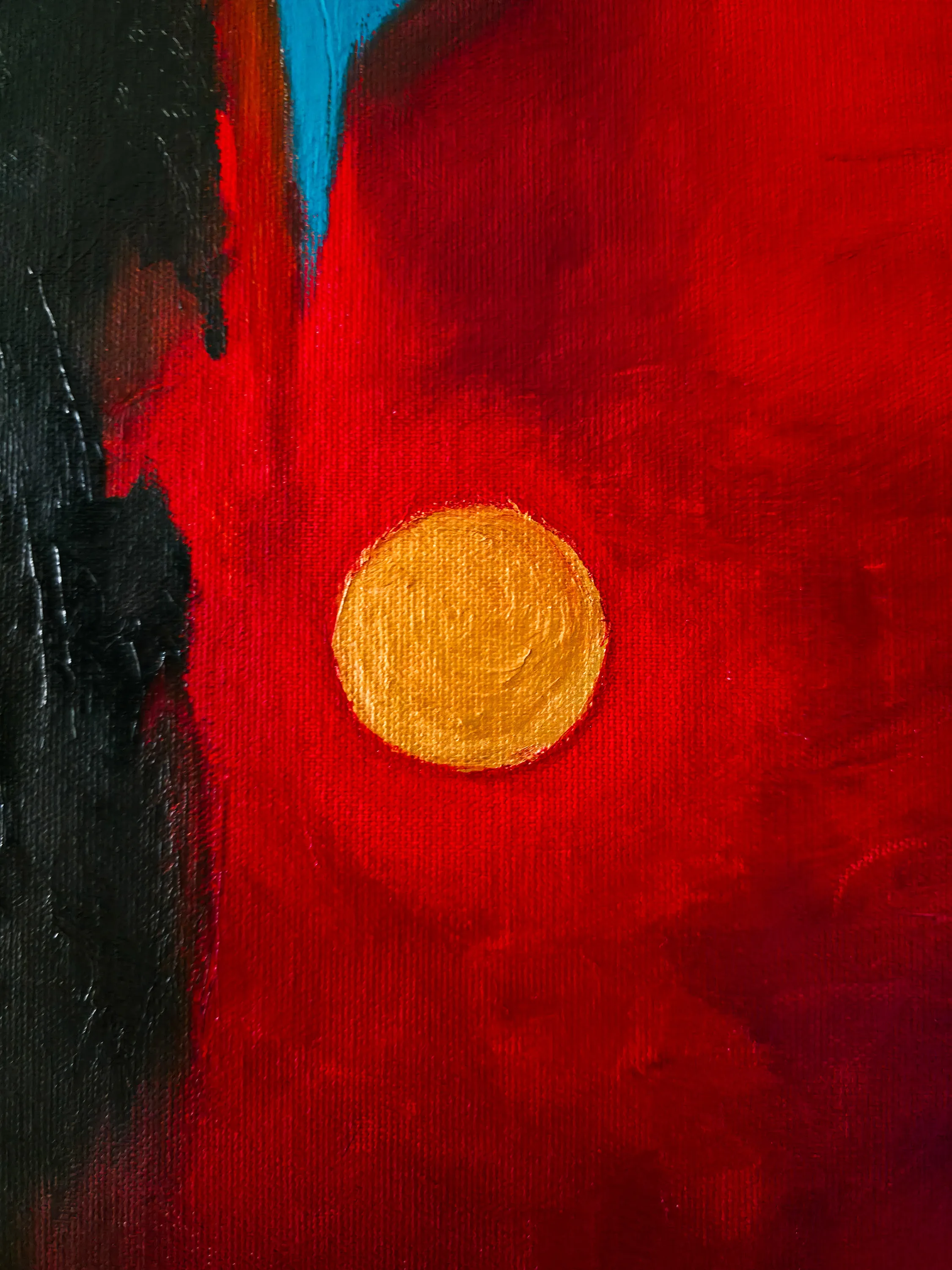
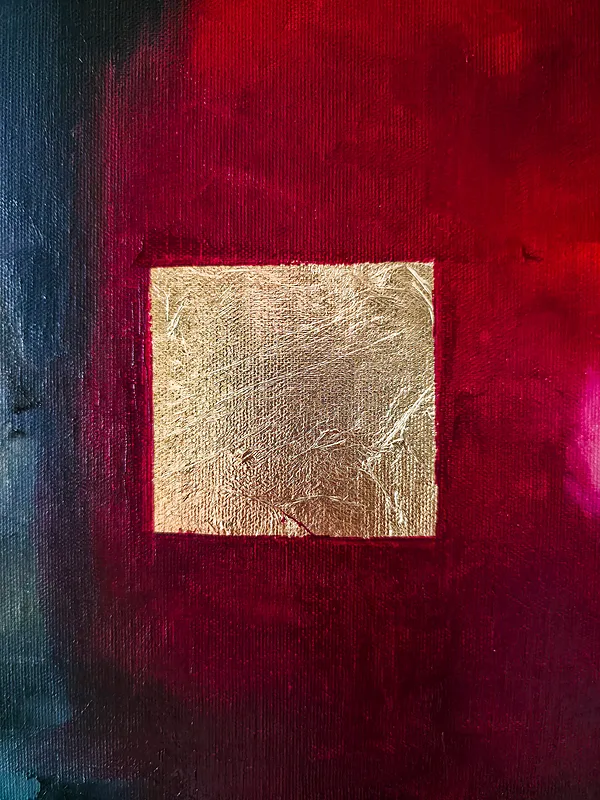
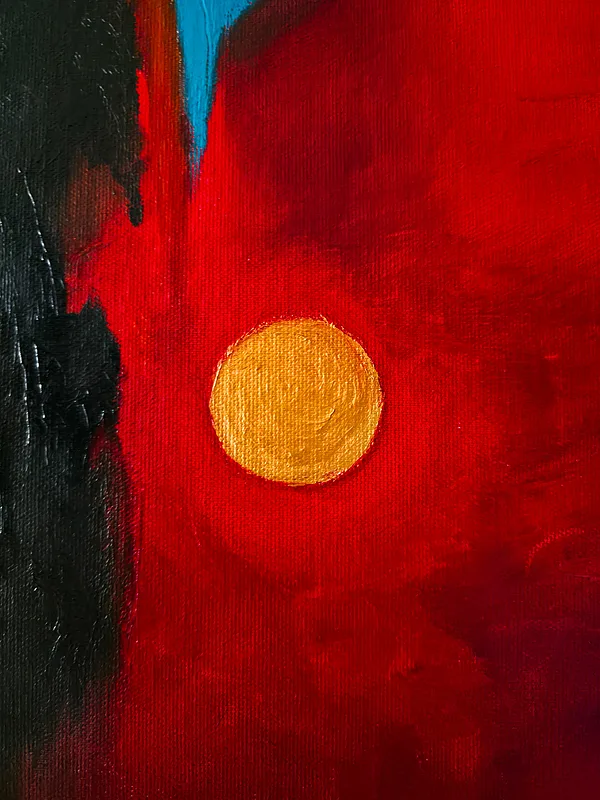
The turquoise detail within the red form, reminiscent of a quill, symbolises the Garden of Eden. Beneath it, the golden circle represents wholeness and the feminine principle, while the golden square positioned slightly lower appears as the heavenly counterpart of the earthly altar, embodying the masculine principle associated with angular forms.
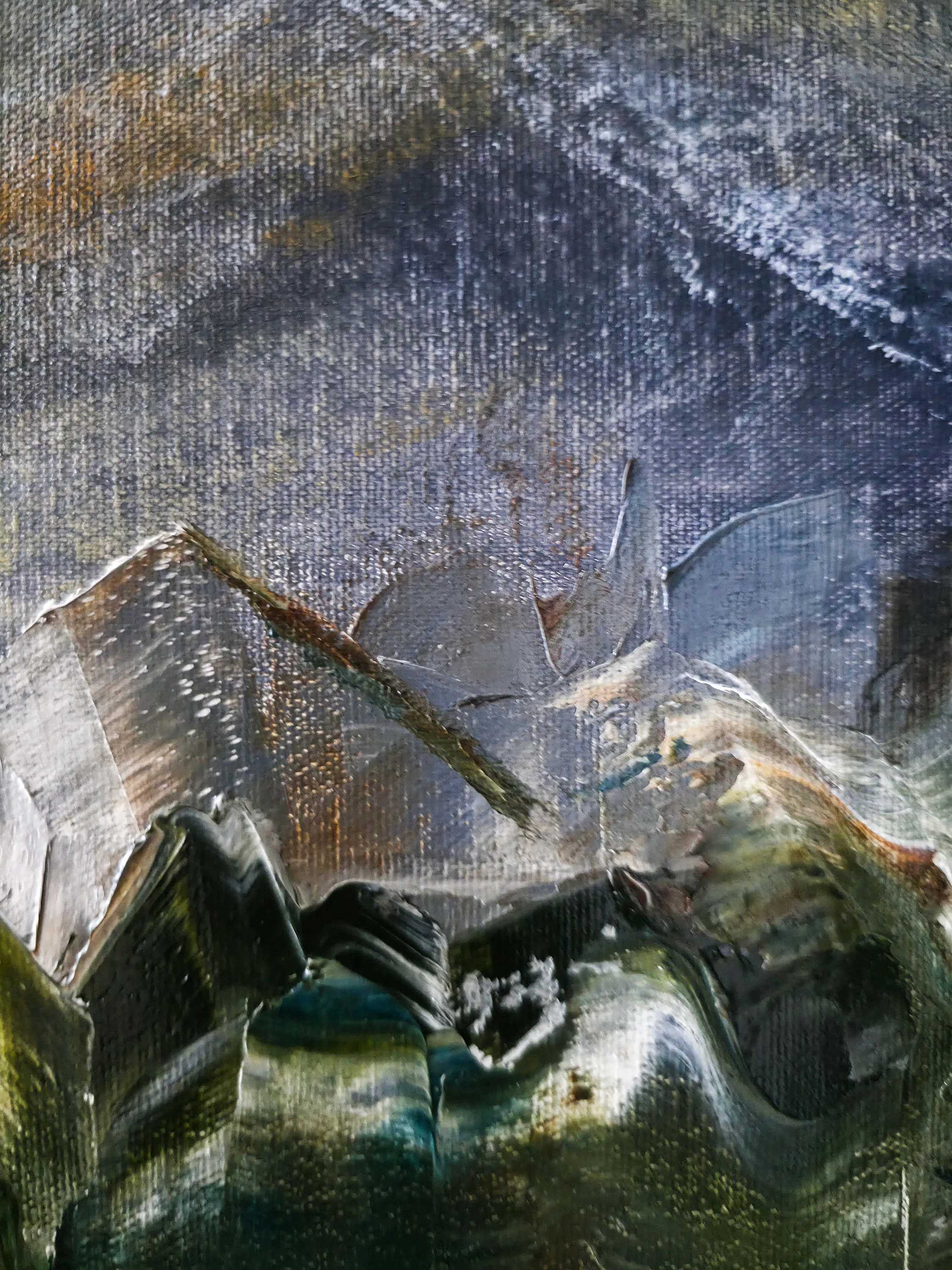
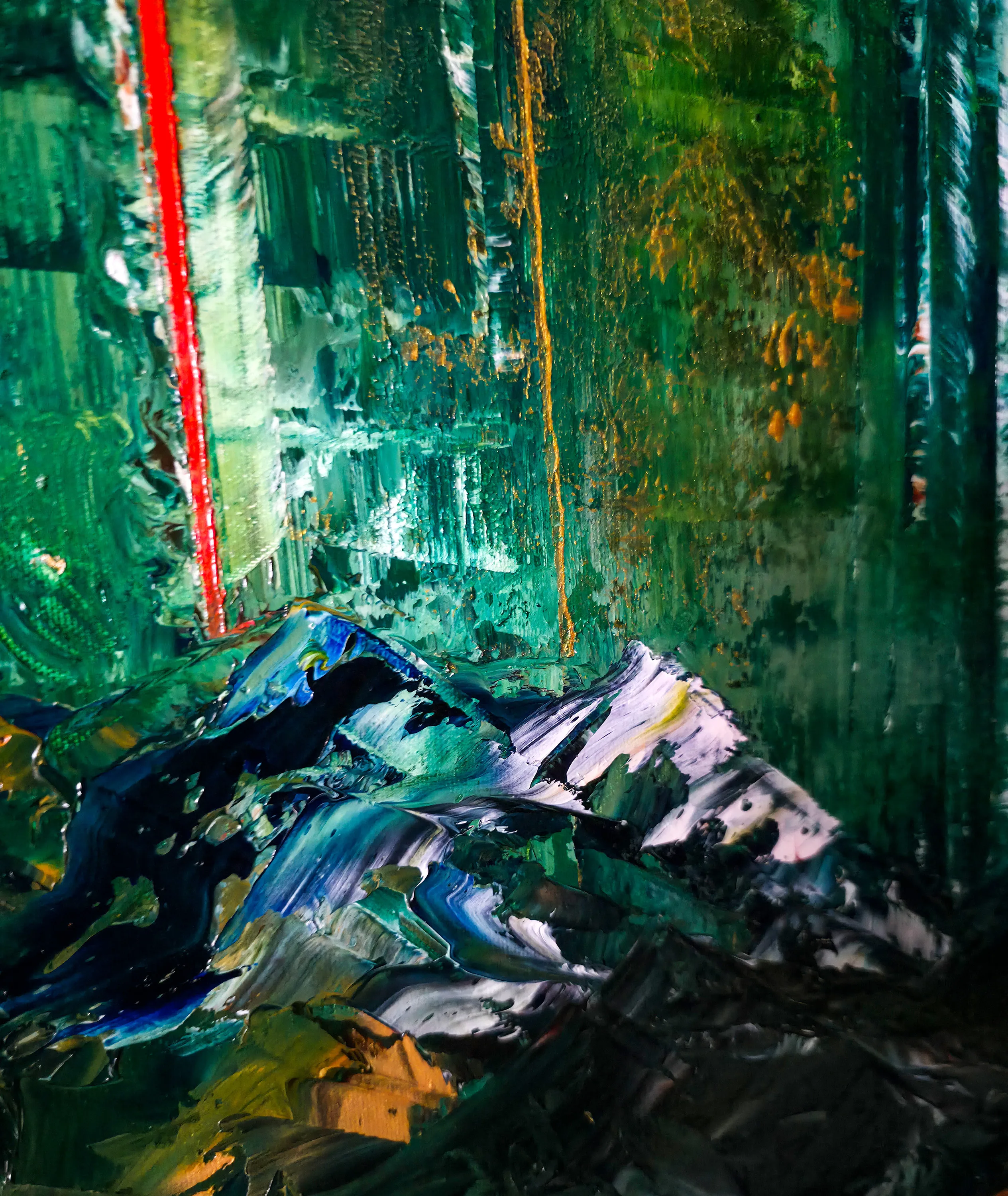
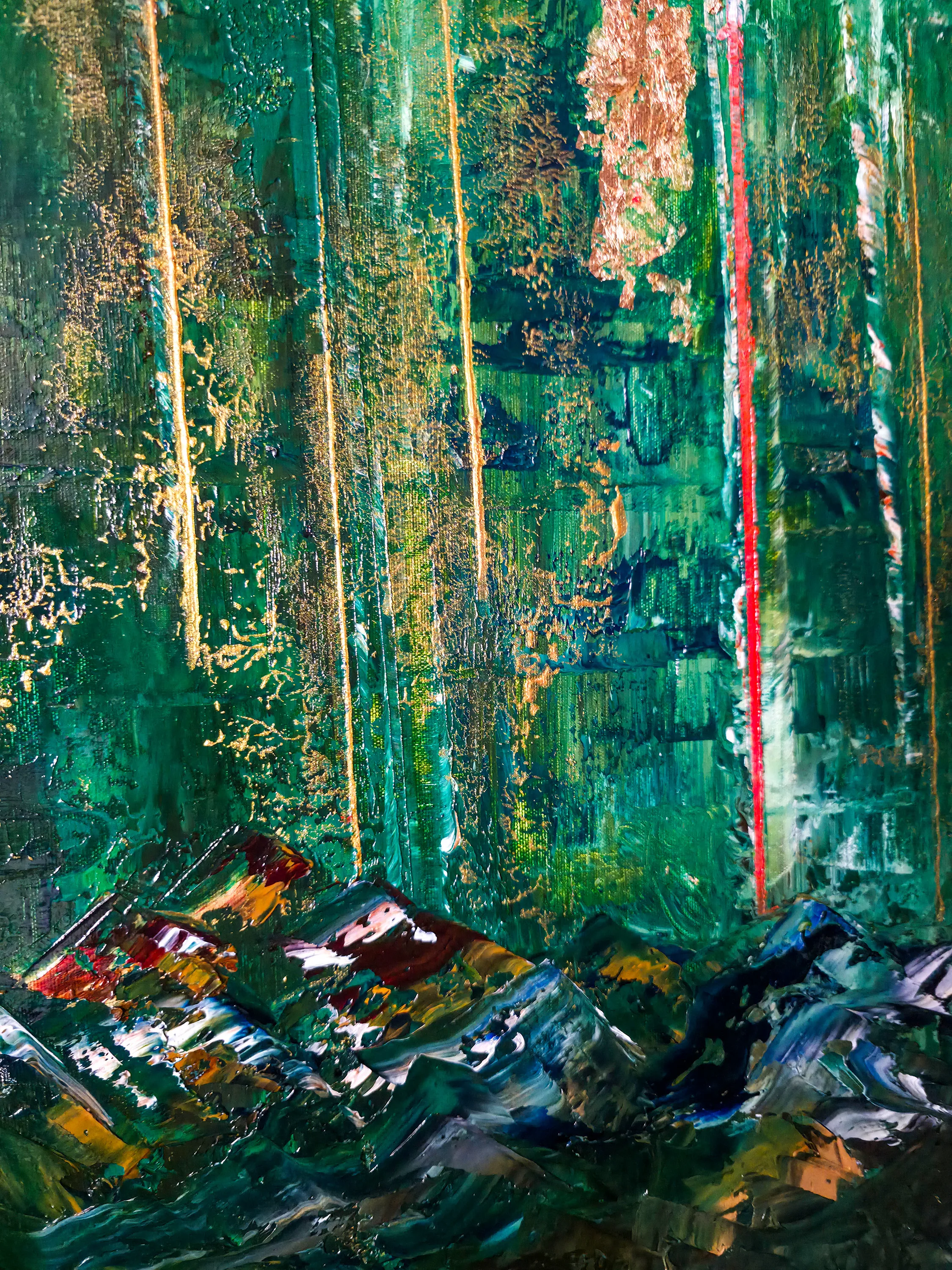
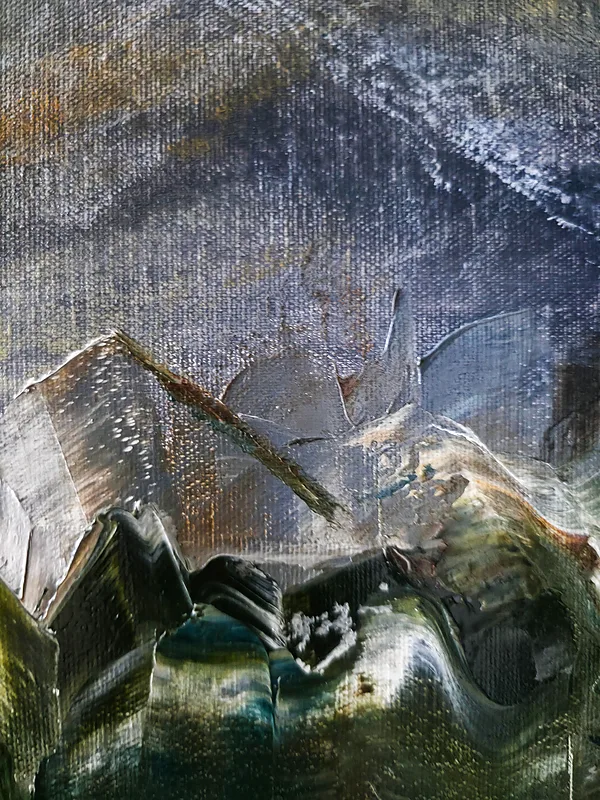
Along the lower edge of the canvas rise the rocky ridges of the Holy Mountains. At the centre of the composition, the highest peak splits in two, receiving the breath of God, the creative force. The mountains’ ancient forms, interwoven with dark bronze gold, slate grey, and black, evoke the primordial body of the Earth, which, touched by heavenly power, becomes the cradle of life.
“So God created man in his own image, in the image of God created he him; male and female created he them.” (Genesis 1:27)
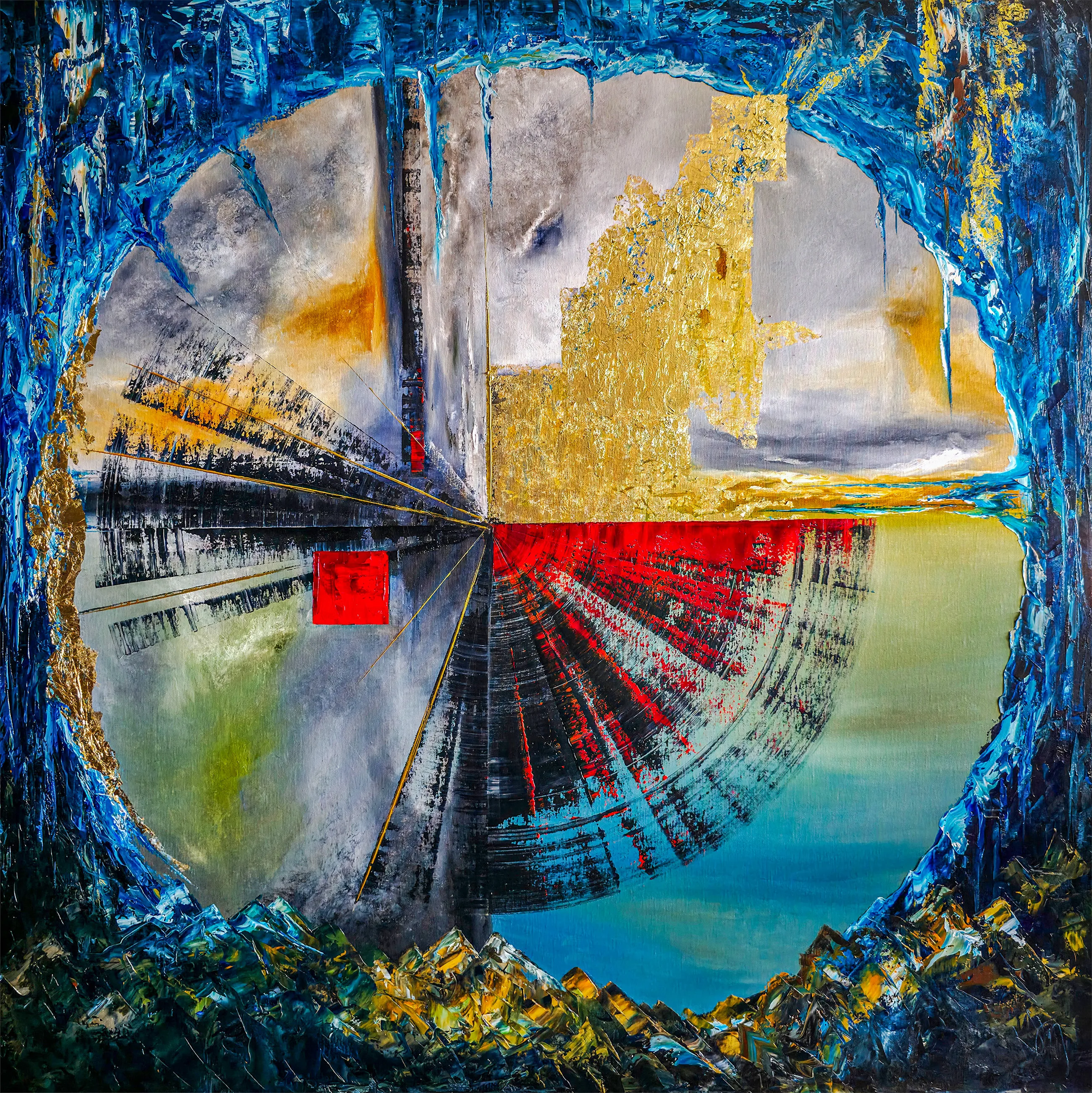
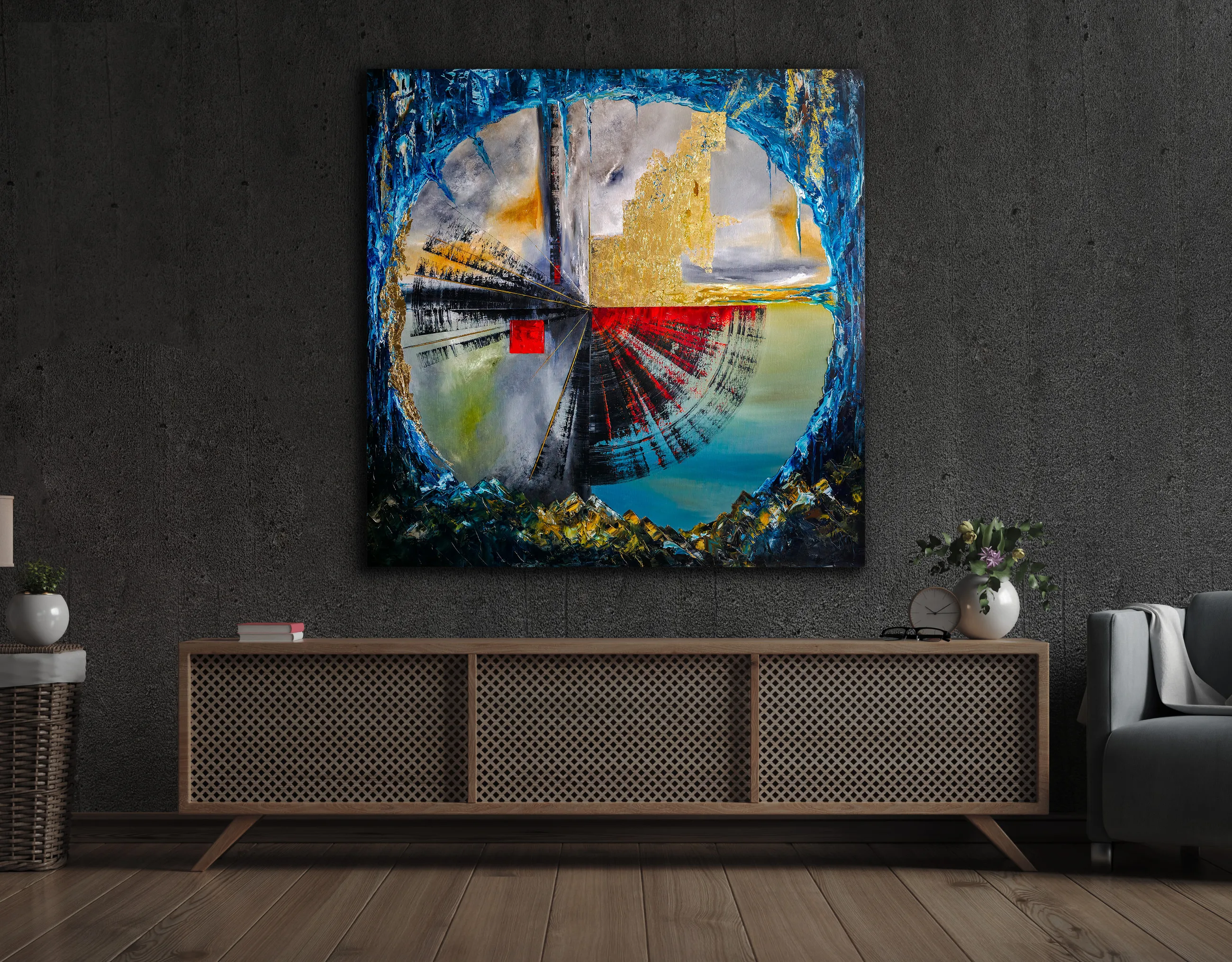
The Seventh Day
- 140 x 140 cm
- Oil and gold on canvas
- Created: Sitges, 2026
- The artwork is part of the 'Old Testament III - In Search of the Secrets of Eternity' cycle
- AVAILABLE FOR PURCHASE
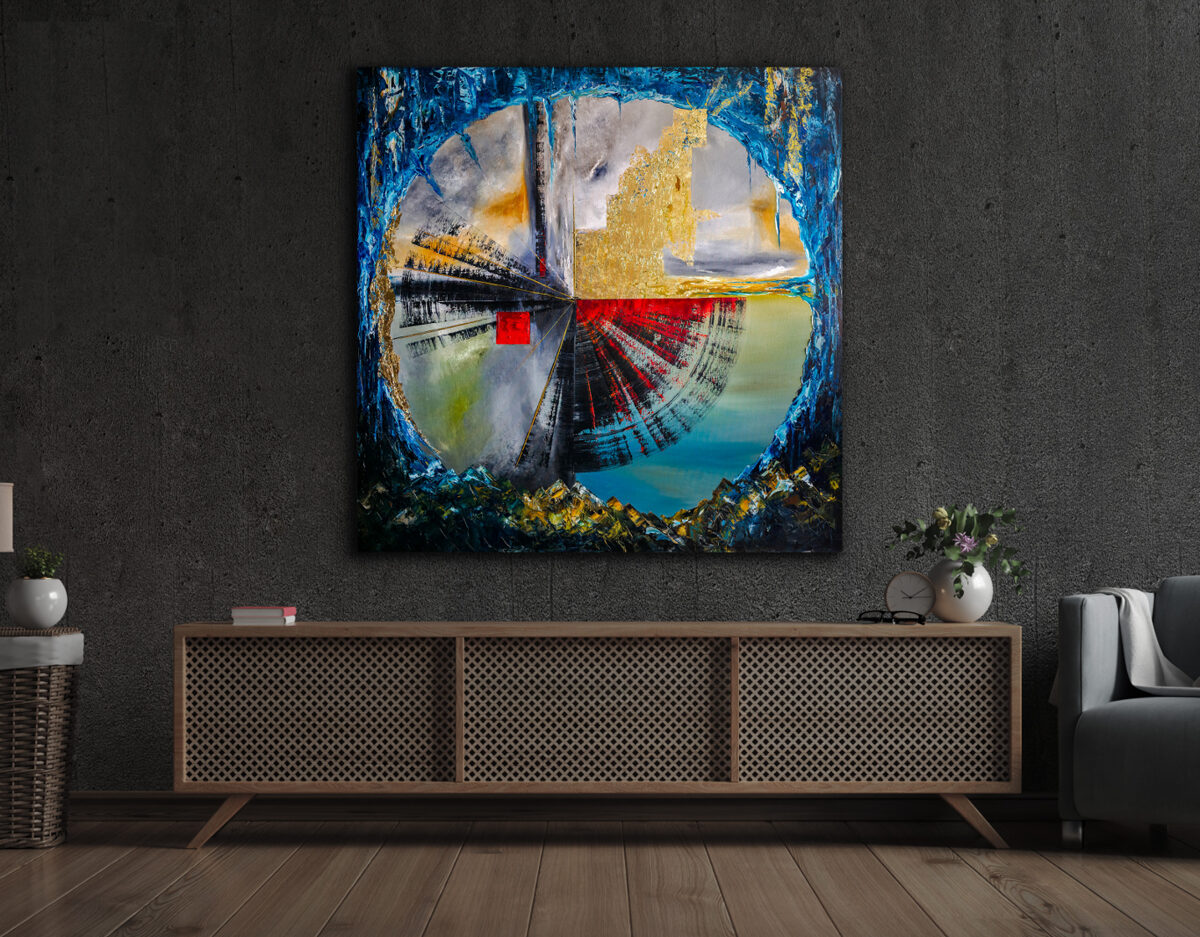
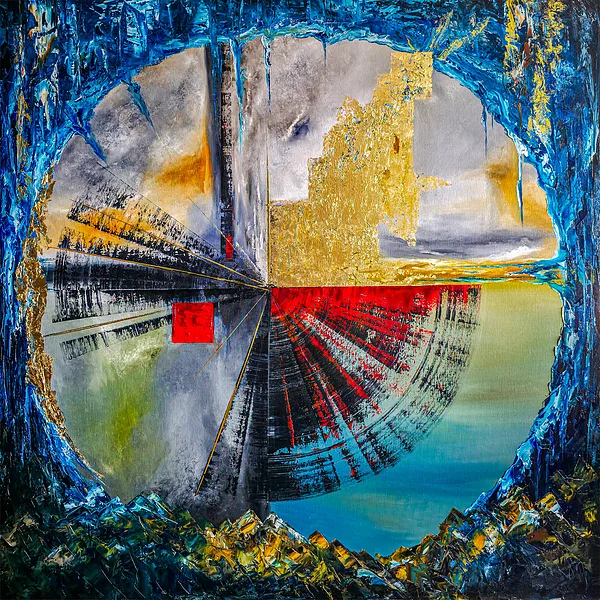
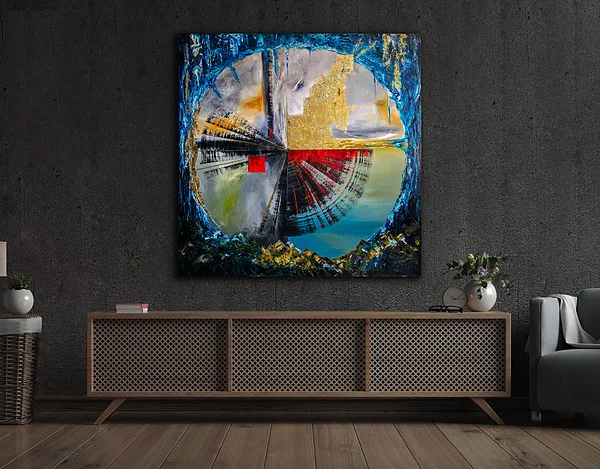
The Seventh Day marks the birth of sacred time. When the heavens and the earth and all their hosts had been completed, God rested from His creative work and bestowed a special dignity upon the seventh day. In the biblical sense, rest is the joy of fulfilment, a celebration of divine contentment in the beauty of Creation.
“And God blessed the seventh day, and sanctified it: because that in it he had rested from all his work which God created and made.” (Genesis 2:3)
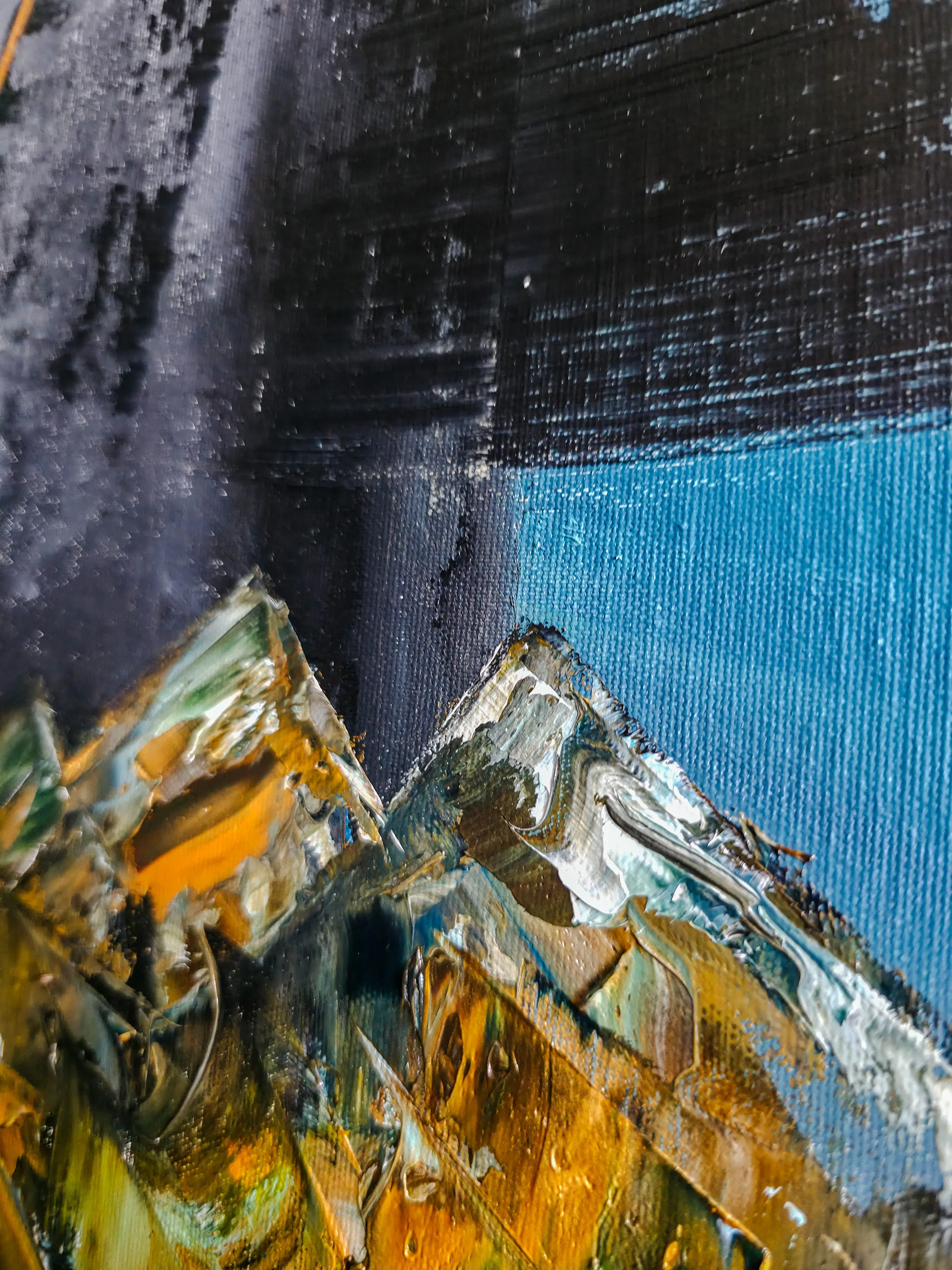
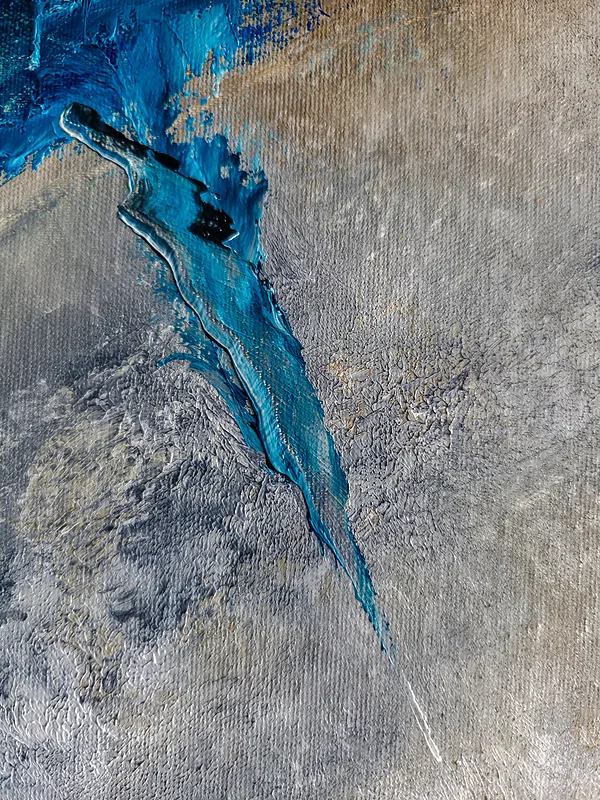
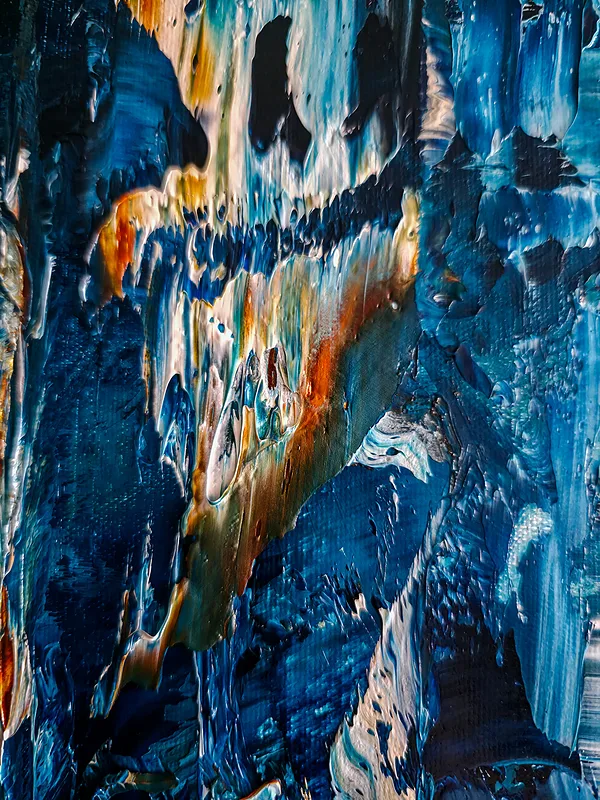
The entire canvas is framed by a monumental, vaulted arc composed of sapphire blue and ultramarine, its form reminiscent of the rocky arch of a cathedral. Turquoise-tinted streaks of paint descend from above, hanging like stalactites over the luminous inner space. The arc symbolises wholeness, while also defining the boundaries of earthly life.
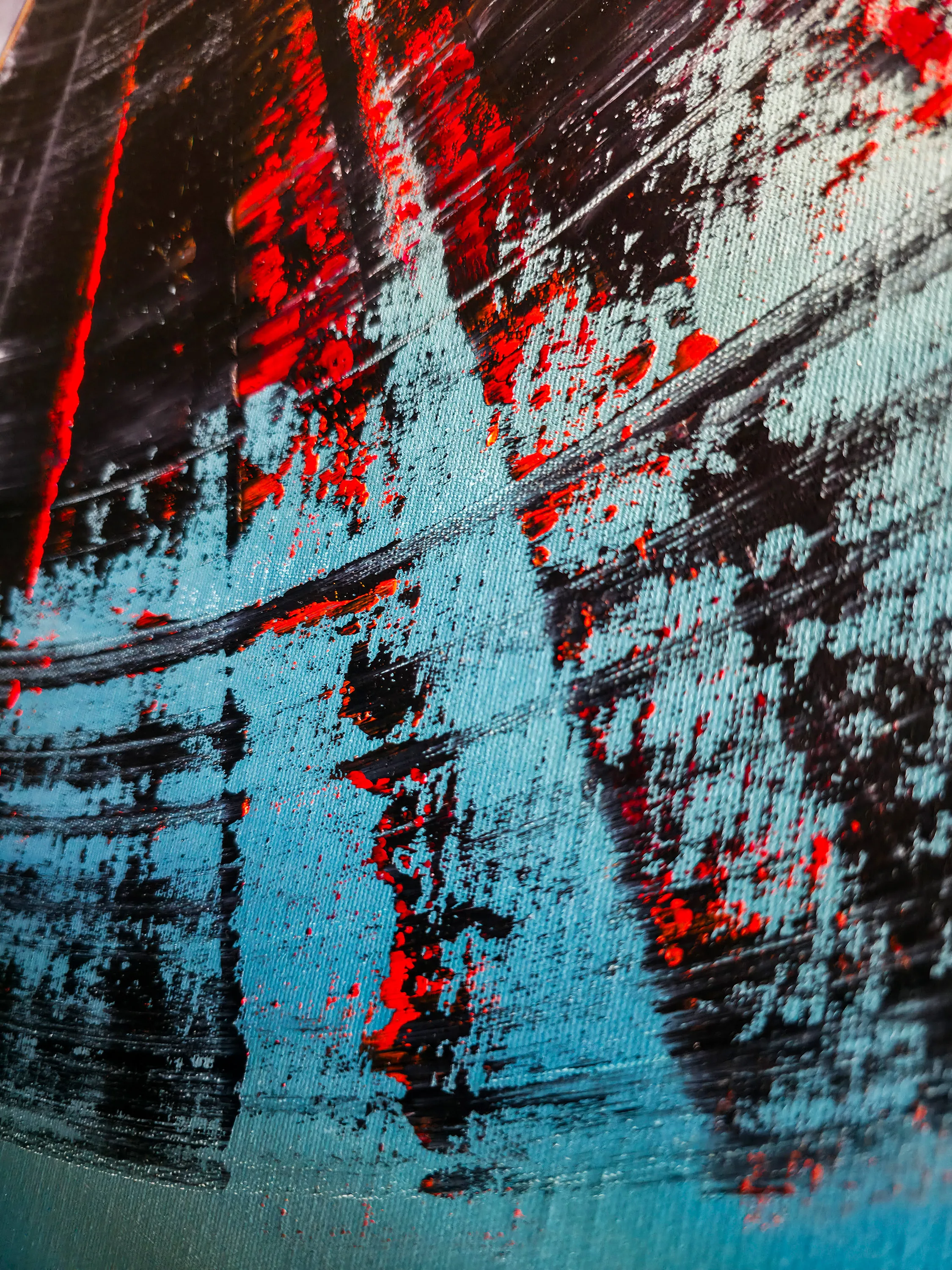
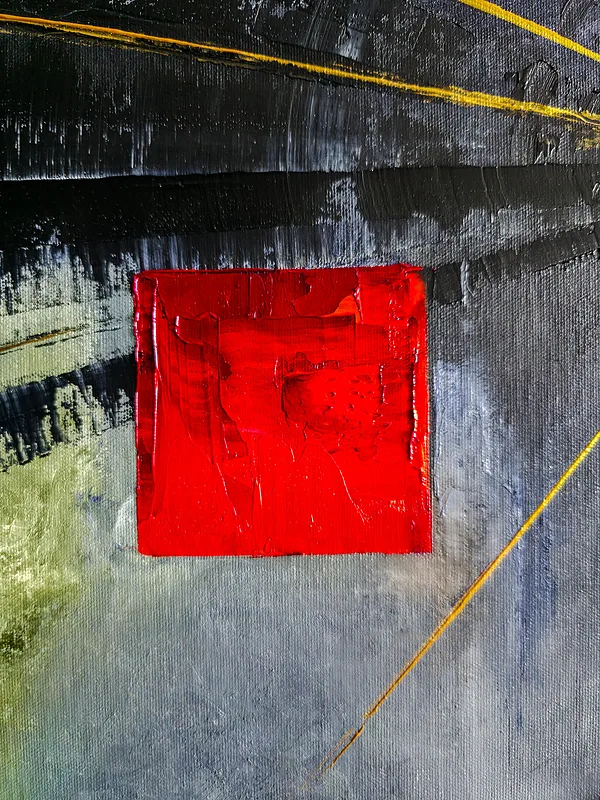
On either side, bands of black and blood-red paint fan out in radiant patterns, their projecting forms edged with delicate golden lines and converging at a single point. Following the six days of Creation, the seventh day signifies not merely the completion of the work, but the emergence of a new dimension of time. For humankind, time opens up as a realm of beginnings and fulfilment, of change and rest. The common axis of the radiating beams connects the rhythm of passing time with the stillness of eternity.
“Before the mountains were brought forth, or ever thou hadst formed the earth and the world, even from everlasting to everlasting, thou art God.” (Psalm 90:2)
The Seventh Day marks the solemn arrival of Creation at rest. The wholeness of the circle, the ordered arrangement of the offset axes, and the forms of heaven and earth answering one another evoke the birth of time for humankind within the created world.
The Judgment
- 65 x 54 cm
- Oil and gold on canvas
- Created: Sitges, 2026
- The artwork is part of the 'Old Testament III - In Search of the Secrets of Eternity' cycle
- RESERVED
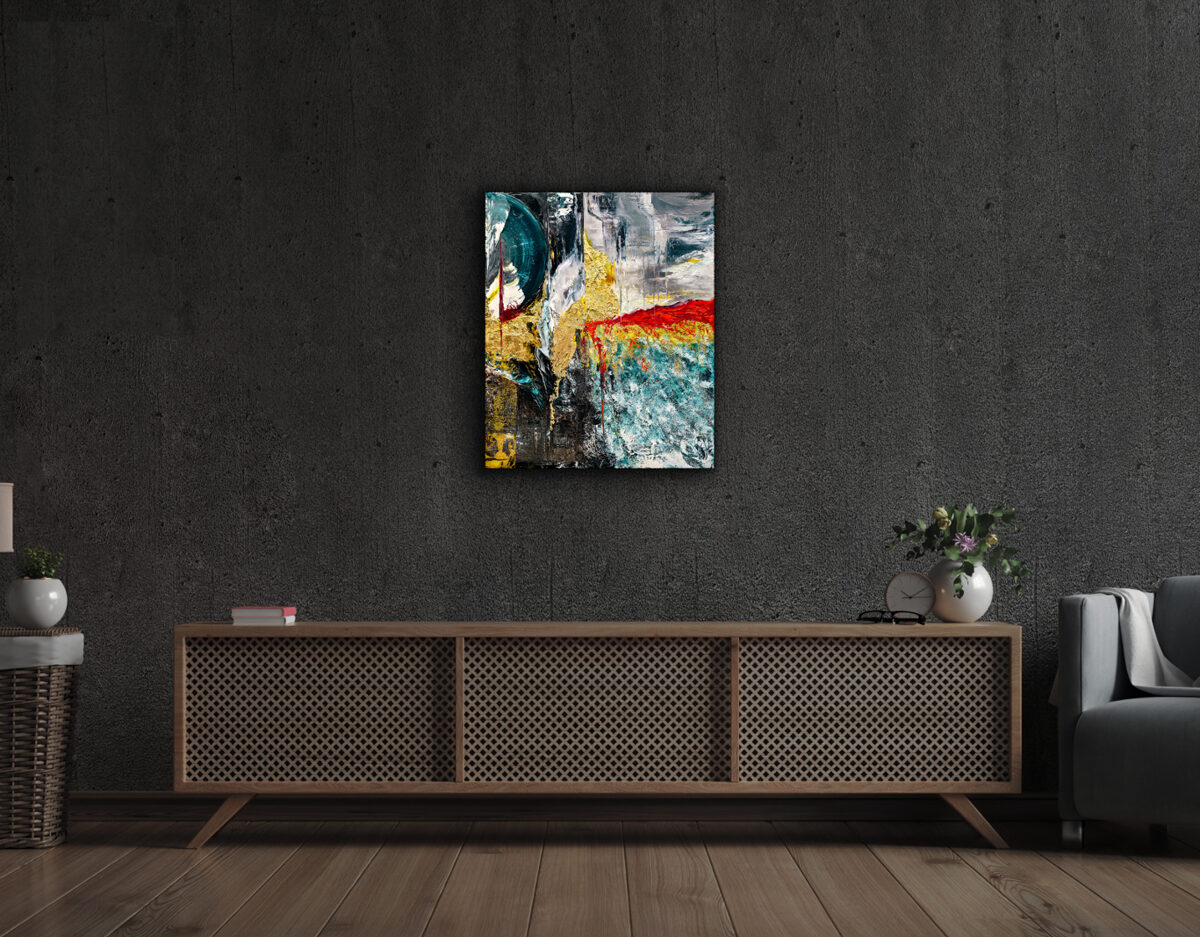
Built from turbulent vortices, torn layers of gold, ashen silver, and incandescent red, the painting offers a monumental pictorial interpretation of Daniel’s nocturnal vision. From the left, a vast arc of petrol blue and turquoise curves inward towards the heart of the composition. Beneath it, dark, earth-like masses gather, while at the centre, a rough, bas-relief-like golden form rises towards the heavens. To the right, misty whites and metallic greys open up the space. A band of carmine red cuts across this turbulent world, marking the dramatic boundary of judgement.
The vision begins with the sea:
“I saw in my vision by night, and, behold, the four winds of the heaven strove upon the great sea.” (Daniel 7:2)
The upper, silvery-white region of the painting forms the luminous realm of judgement. Layers of pearlescent white, ashen grey, graphite, and metallic silver rise into a vast, marble-like architecture above the composition.
At the edge of this realm of light rises one of the painting’s most powerful forms: a mass of gold, thickly applied, crumpled, and fractured. Within it, several layers of meaning converge: the mountain leading to the throne, the pillar rising from fire, and the threshold of heaven. The gold embodies the radiance of eternal order.
The golden form carries a visual echo of the coming of the Son of Man. The red caesura cuts across the body of history, while the silvery heights draw the gaze towards them. The composition finds its fulfilment in the final promise of Daniel’s vision:
“...his dominion is an everlasting dominion, which shall not pass away, and his kingdom that which shall not be destroyed.” (Daniel 7:14)
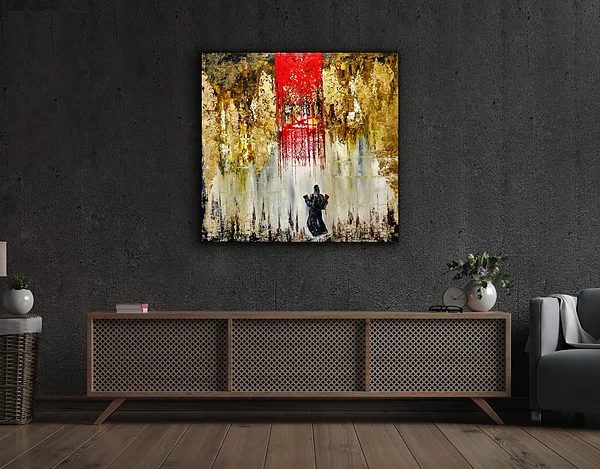
The Story of the First Betrayal
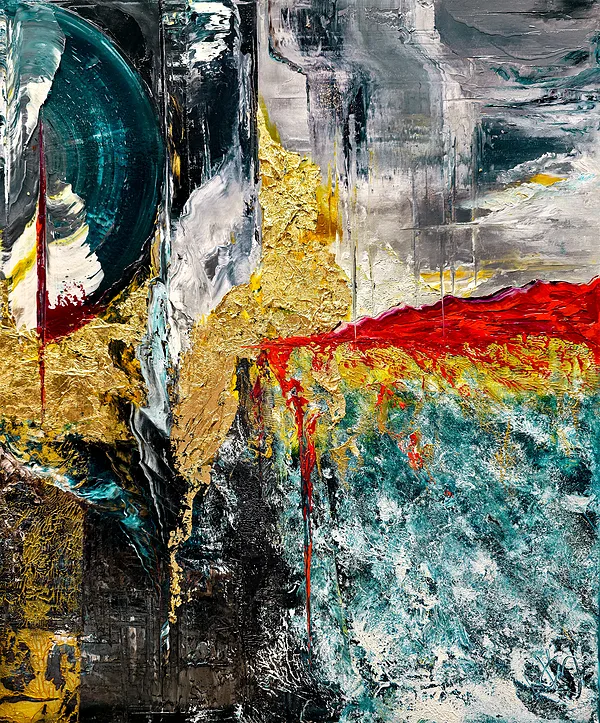
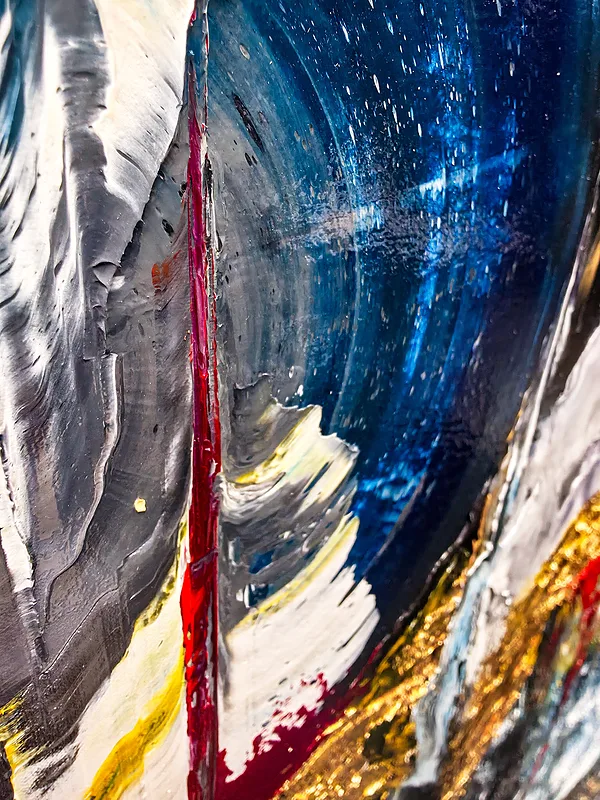
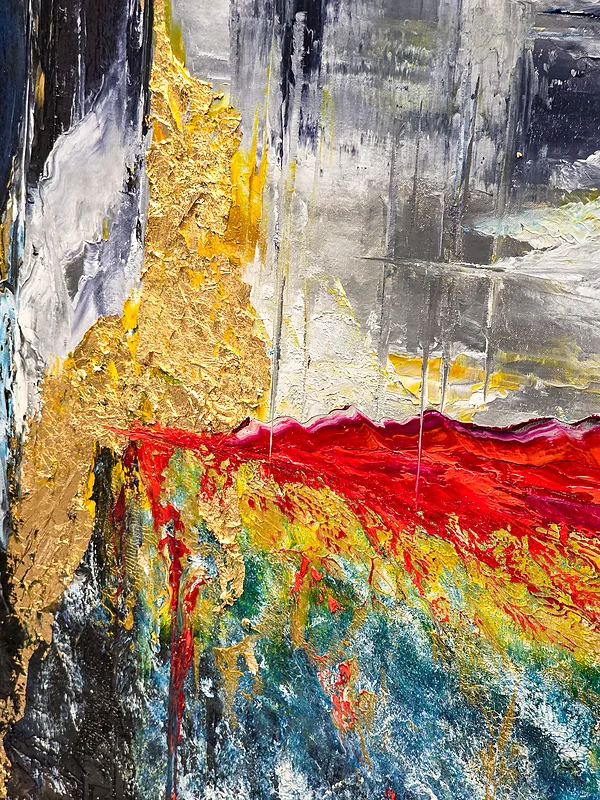
- 100 x 100 cm
- Oil and gold on canvas
- Created: Sitges, 2026
- The artwork is part of the 'Old Testament III. - In Search of the Secrets of Eternity' cycle
- AVAILABLE FOR PURCHASE
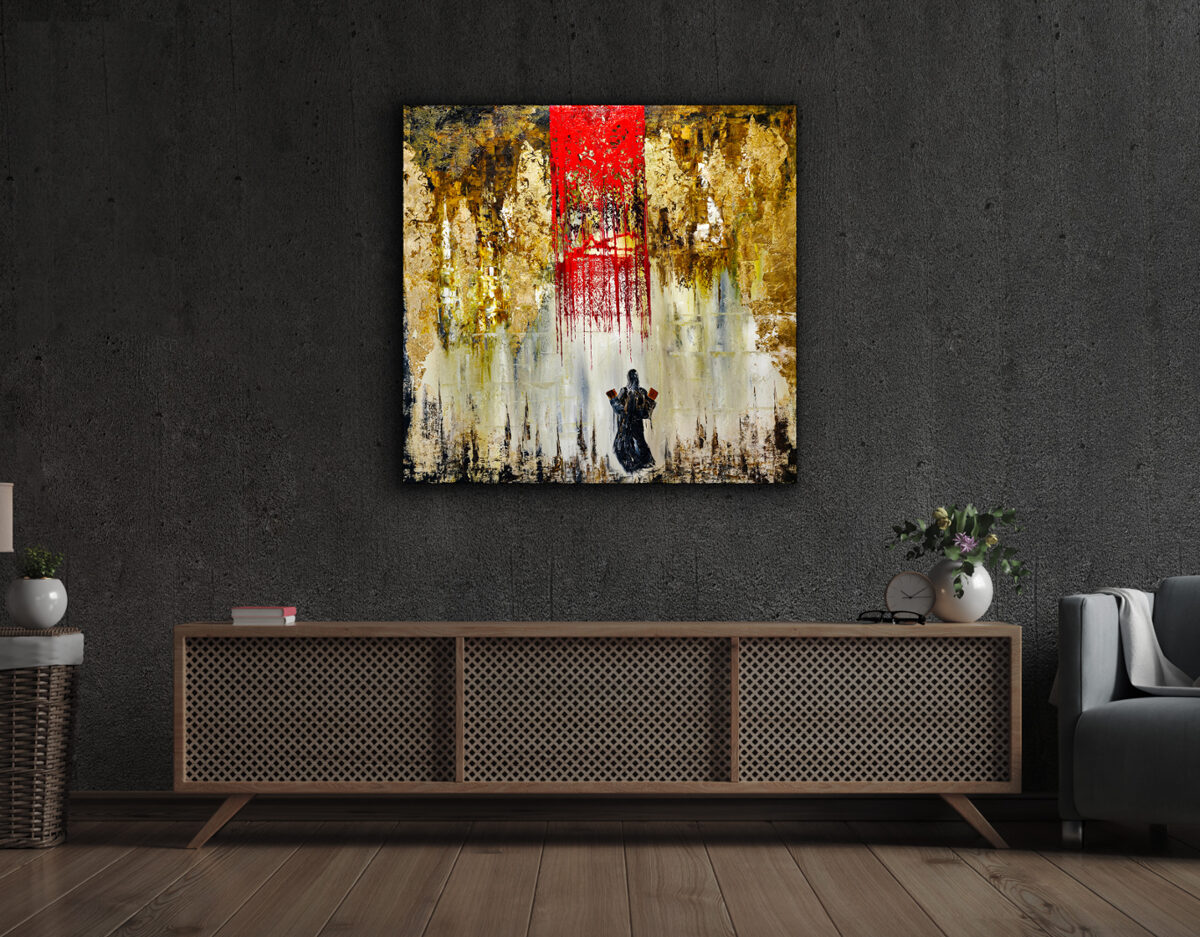
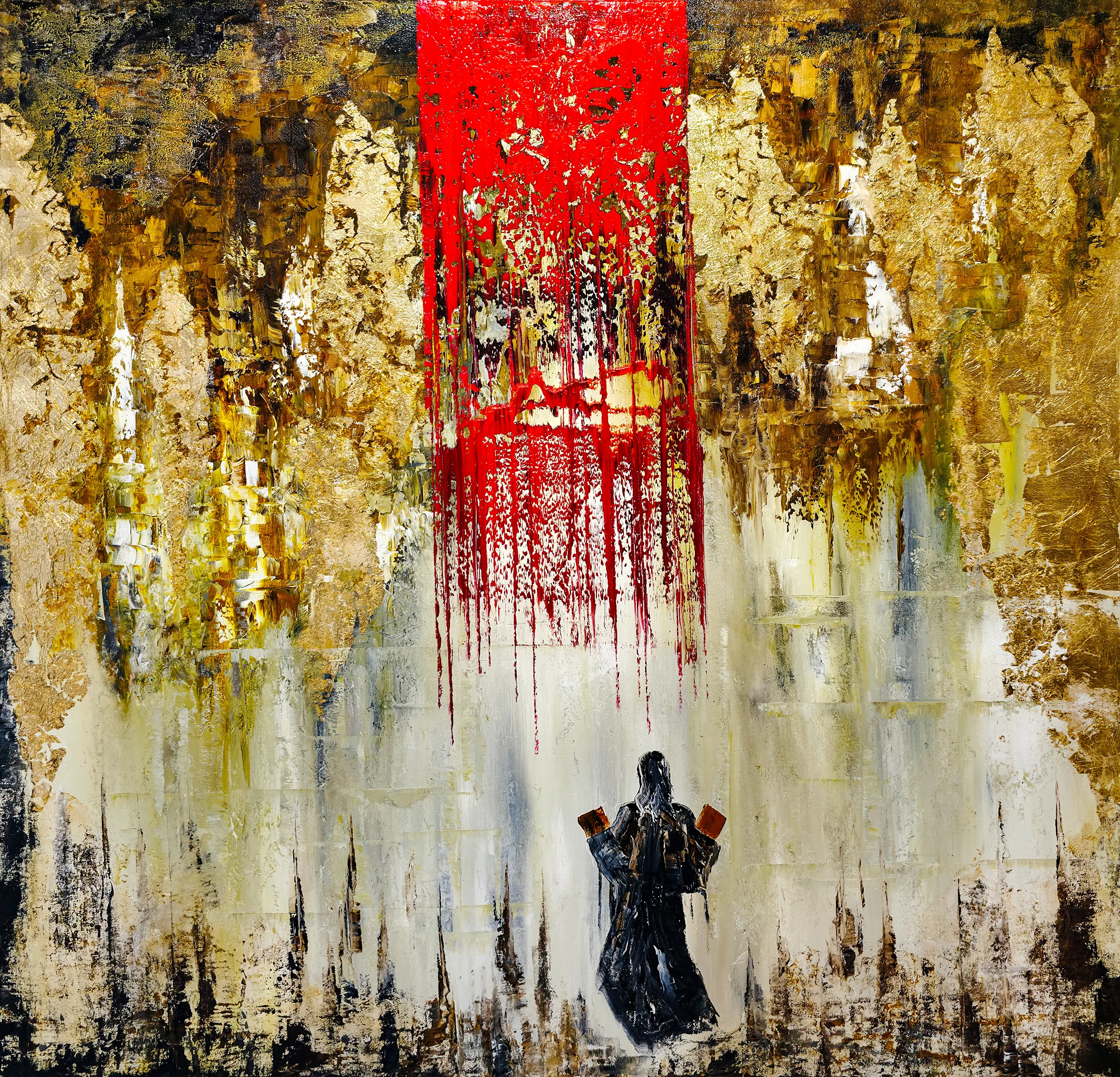
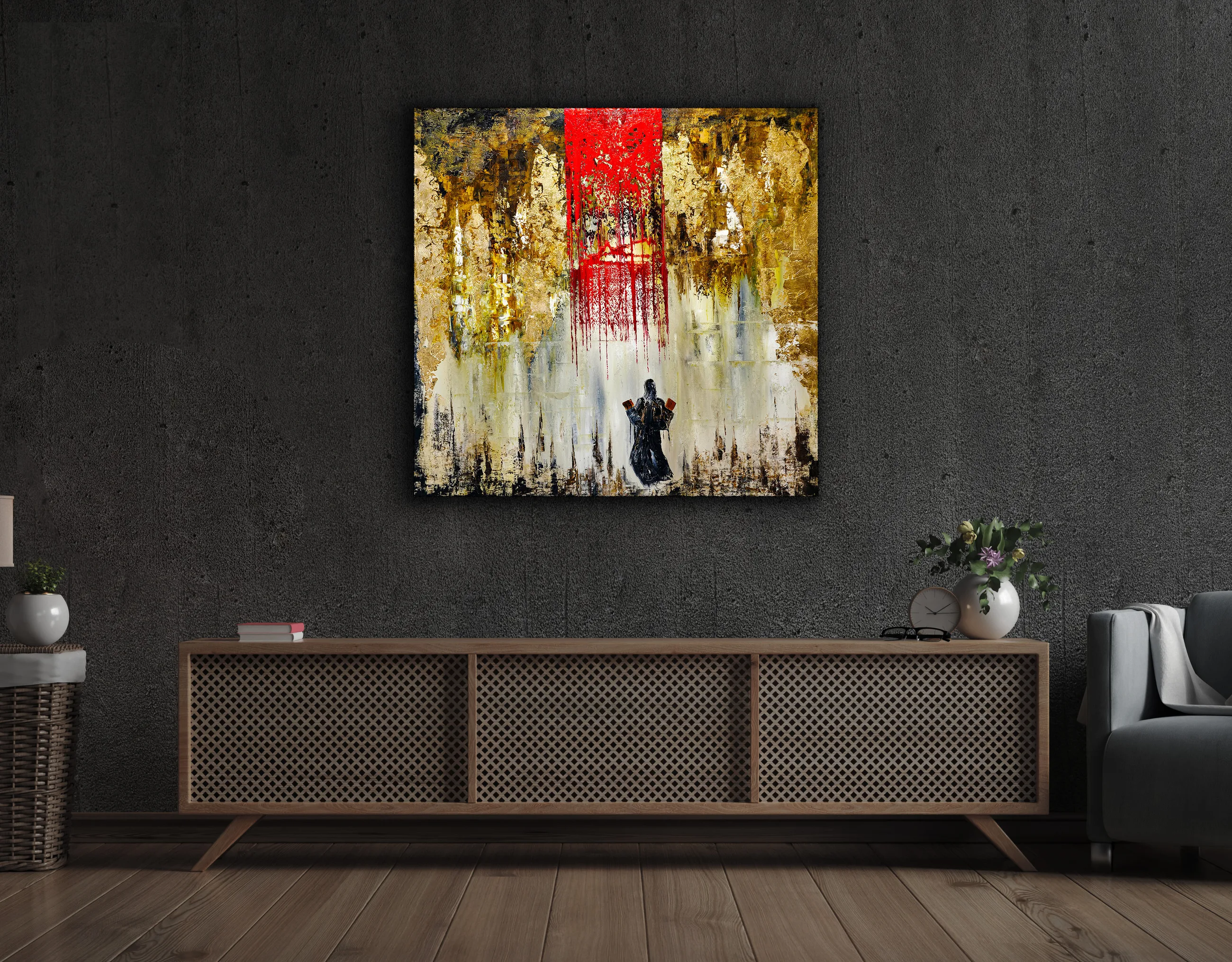
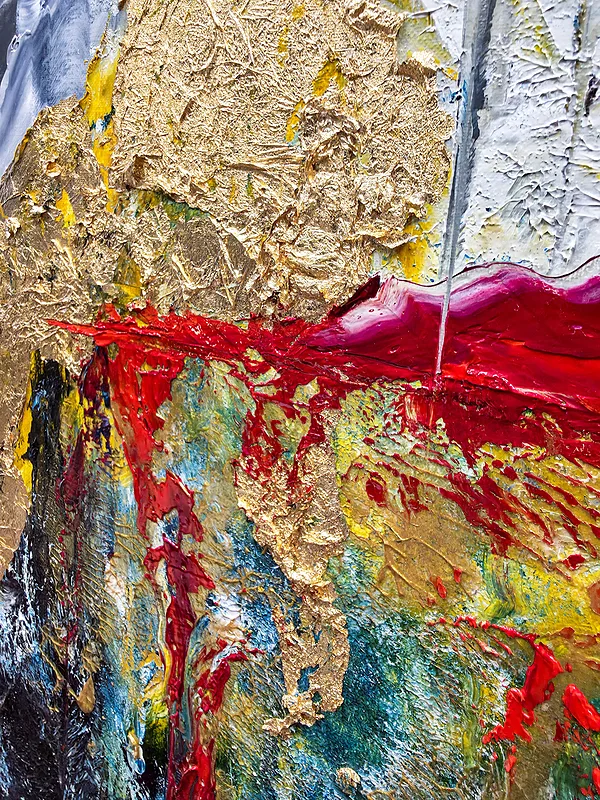
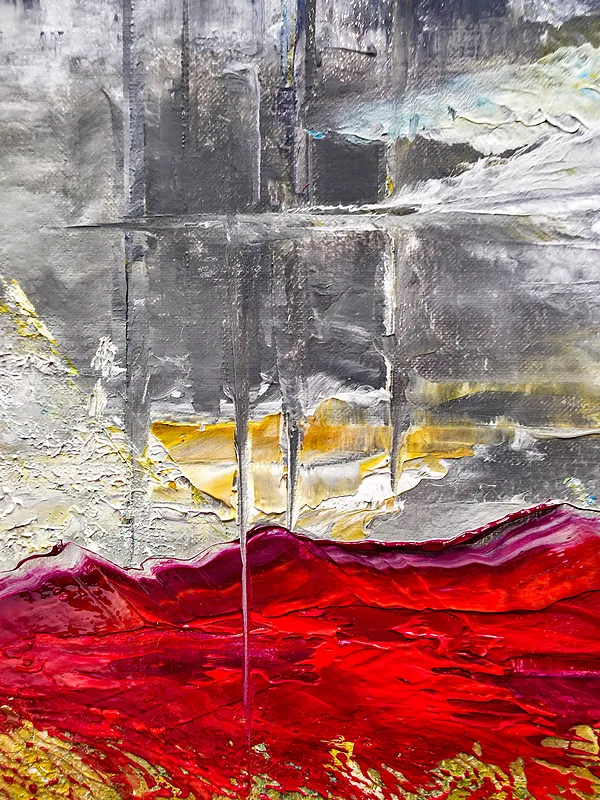
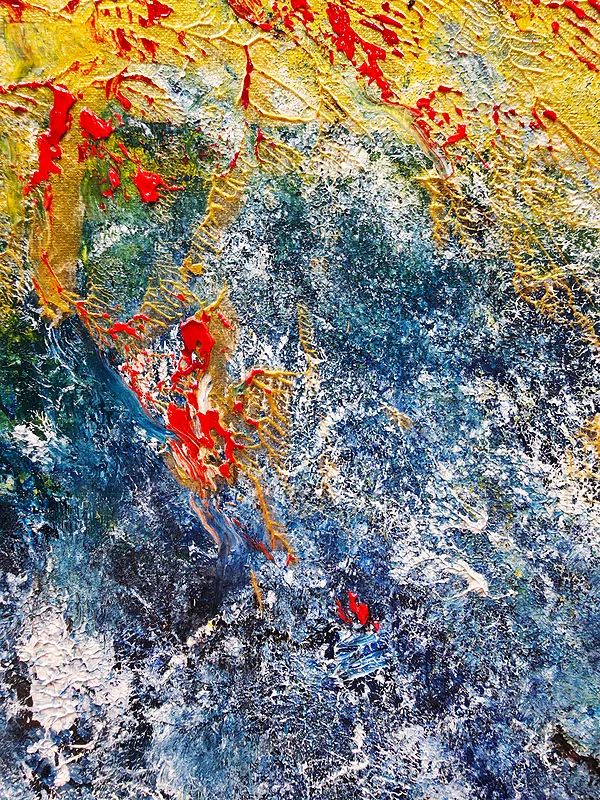
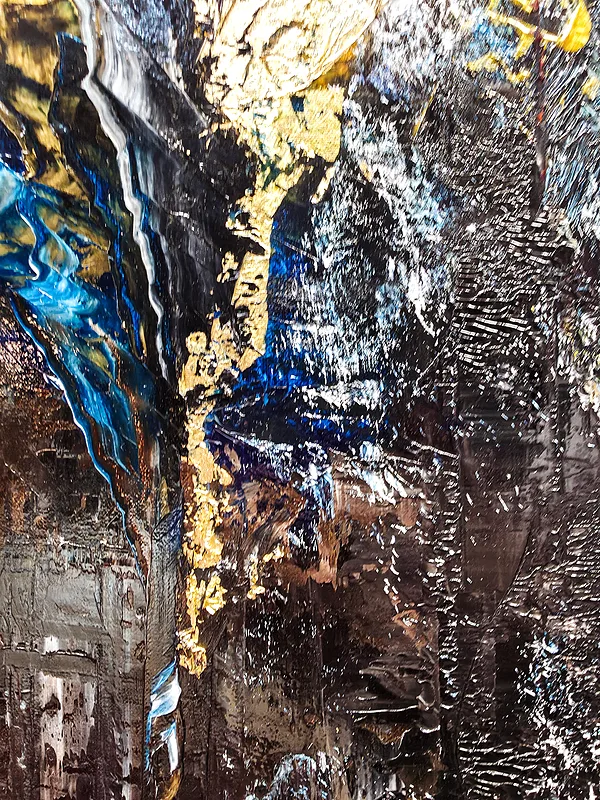
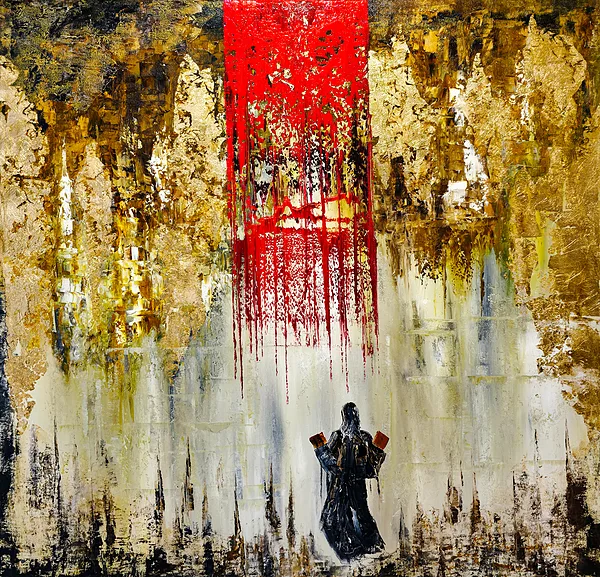
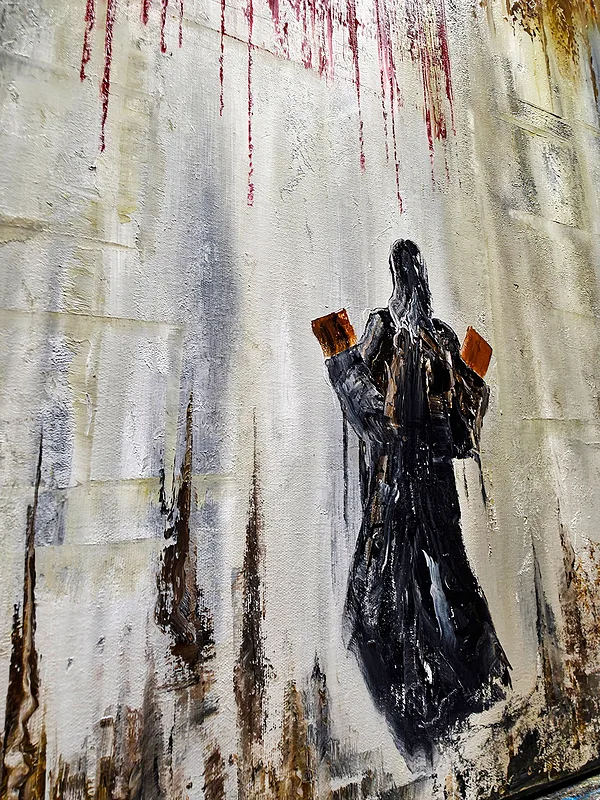
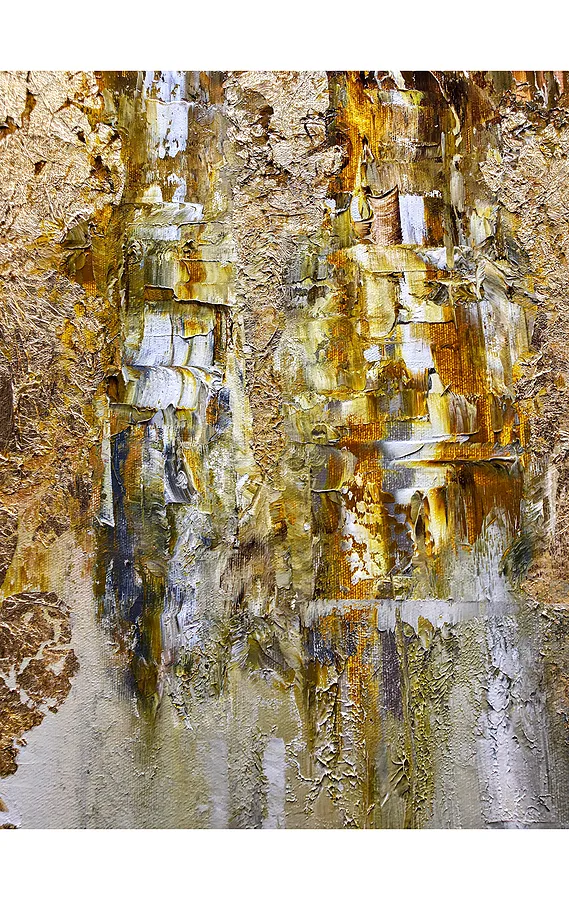
Immersed in a pictorial world pulsating with the life of sacred space, we witness one of the most dramatic events of the Old Testament: the shattering of the covenant between humankind and the Eternal One.
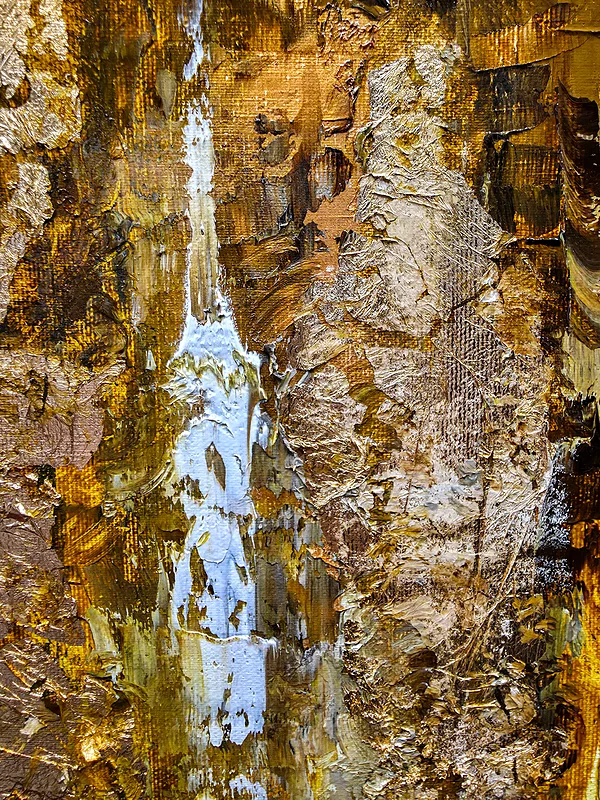
Moses has spent forty days upon Mount Sinai, where the word of the invisible God takes enduring form upon tablets of stone. Yet the impatience of the people waiting at the foot of the mountain turns to infidelity, and they demand that Aaron make them a god of their own. The gold of the canvas preserves the memory of heavenly light, yet, touched by earthly desire, it becomes the false radiance of an idol.
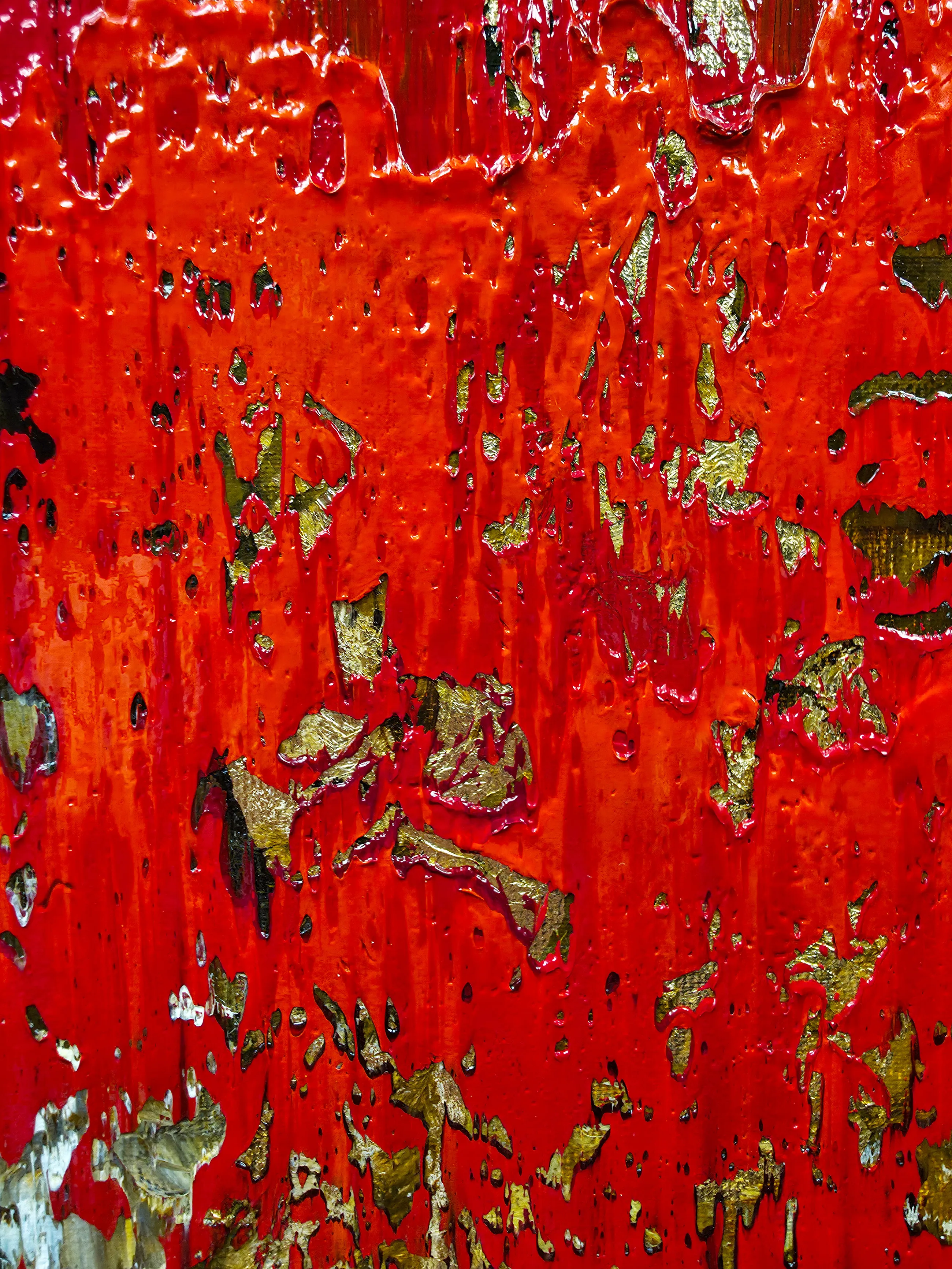
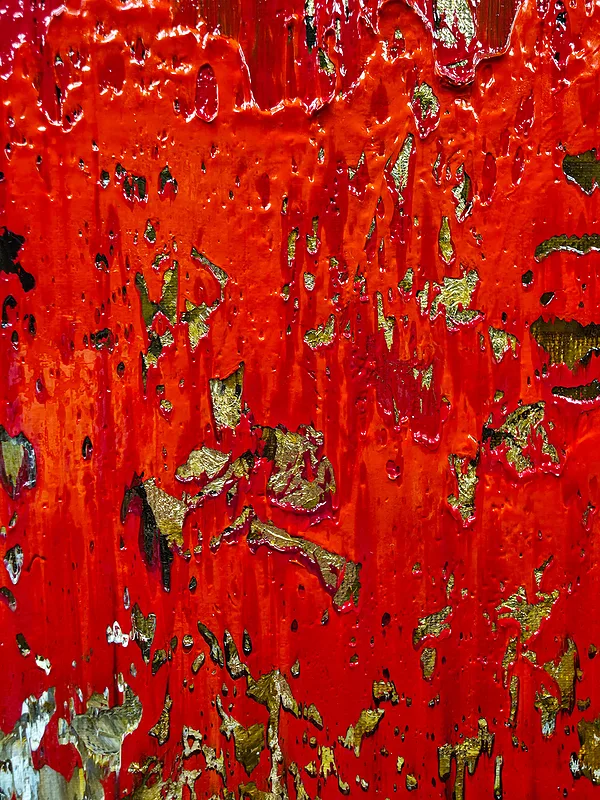
From this mineral world, the vast red field of the composition tears itself free. The recurring altar motif of the cycle is transformed here into a fragmented form that breaks apart and streams downwards.
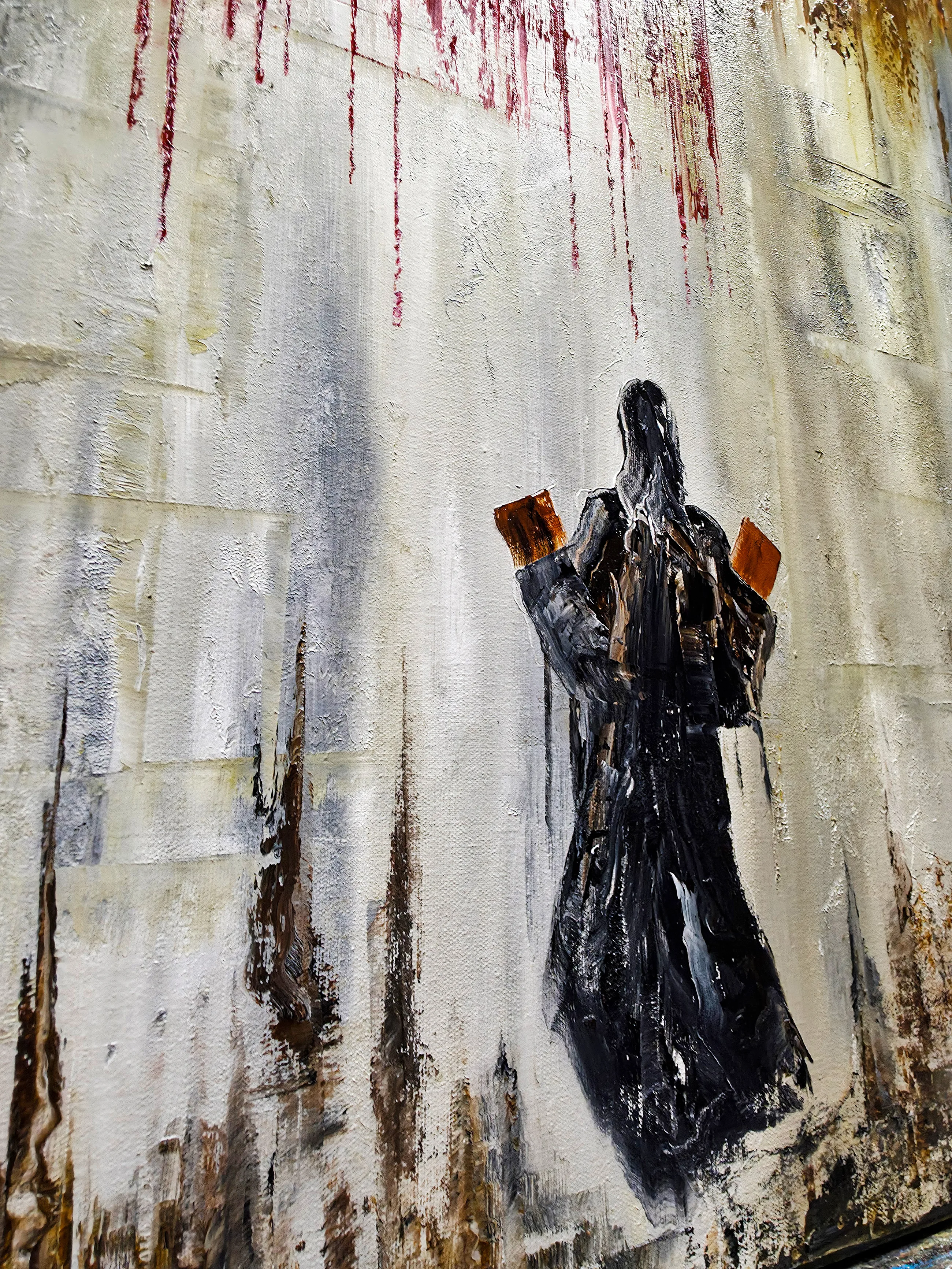
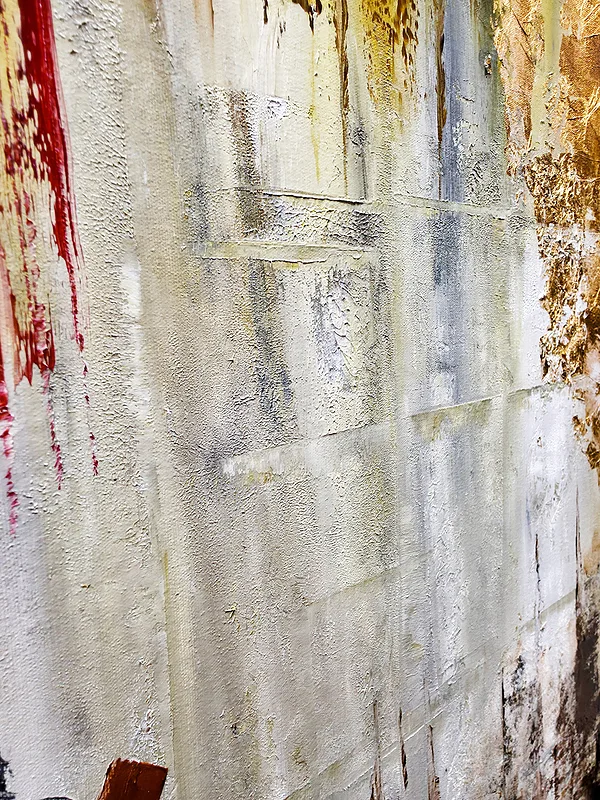
Beneath the red, a space of ivory, pearl grey, and chalk white opens up, evoking the majestic silence of Sinai and the purity of the Law. Emerging from this radiance in the lower part of the painting stands a dark figure with his back turned towards us: Moses.
In his hands, the two tablets of stone form a reddish-brown rectangle. Above him, the red of the broken covenant pours down, while all around him stretches an immense, soundless whiteness. One solitary human figure bears the weight of the encounter between two worlds.
In his anger, Moses shatters the tablets, yet later returns to the Eternal One and pleads for his sinful people. His raised arms thus embody the weight of the Law, the anguish of wrath, and the gesture of intercession. At the heart of the story lies the possibility of renewal, along with the promise of grace: what hangs above humankind here as a shattered altar may, in later paintings of the cycle, once again take shape as a solid, assured red square - the sustaining altar of the divine presence.
The Canon
- 120 x 120 cm
- Oil and gold on canvas
- Created: Sitges, 2026
- The artwork is part of the 'Old Testament III - In Search of the Secrets of Eternity' cycle
- RESERVED
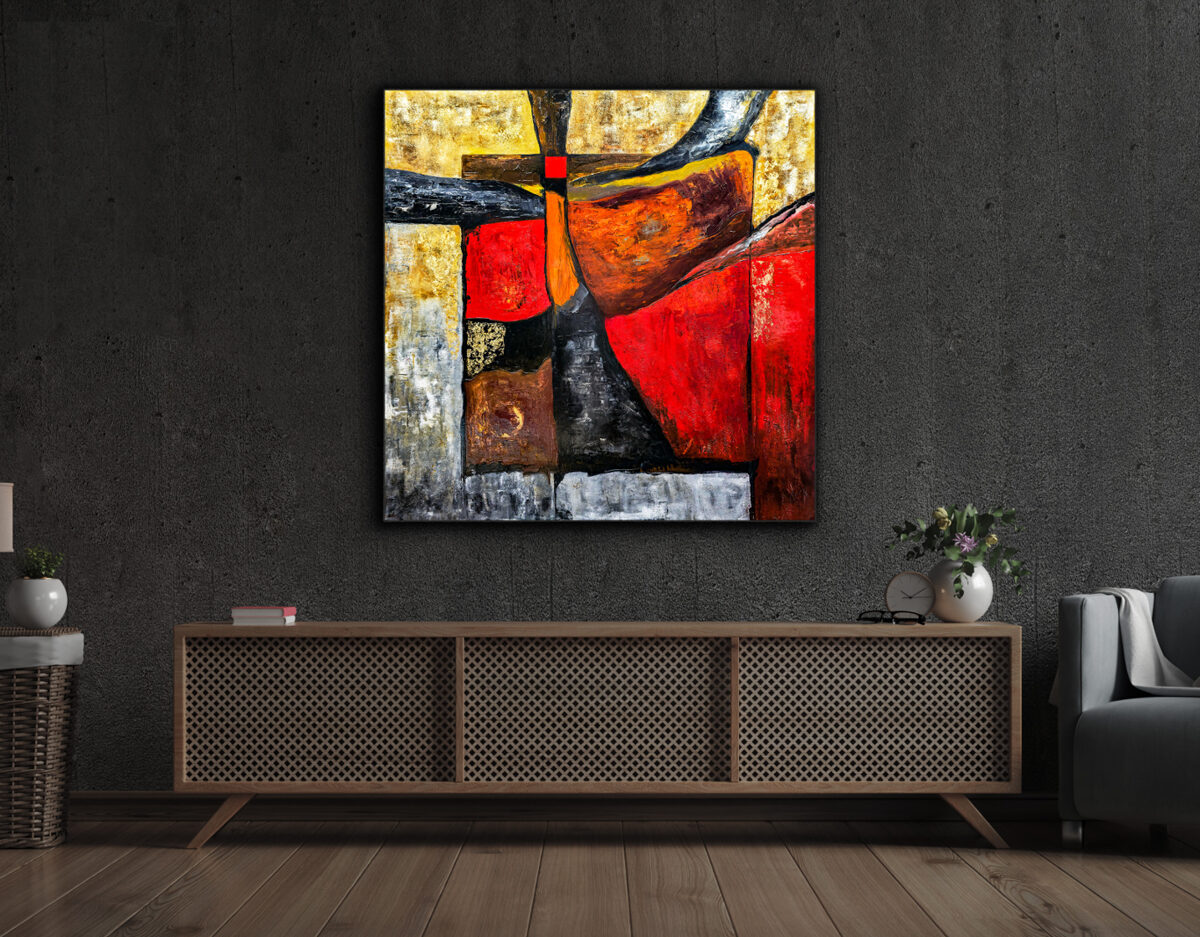
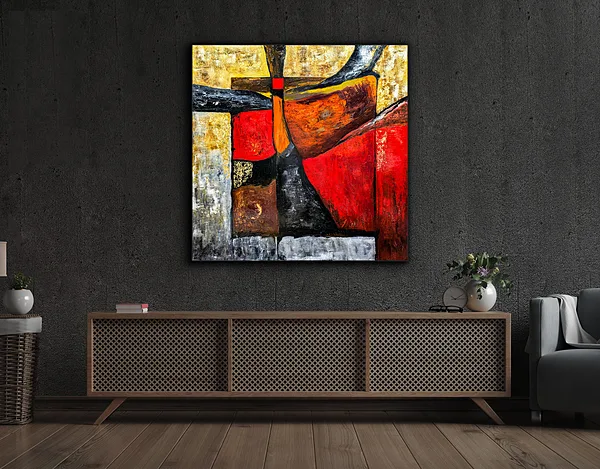
“Judgment also will I lay to the line, and righteousness to the plummet: and the hail shall sweep away the refuge of lies, and the waters shall overflow the hiding place.” (Isaiah 28:17)
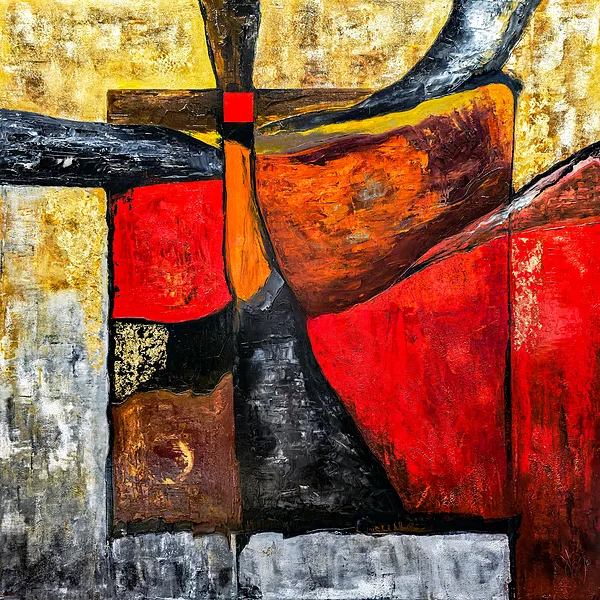
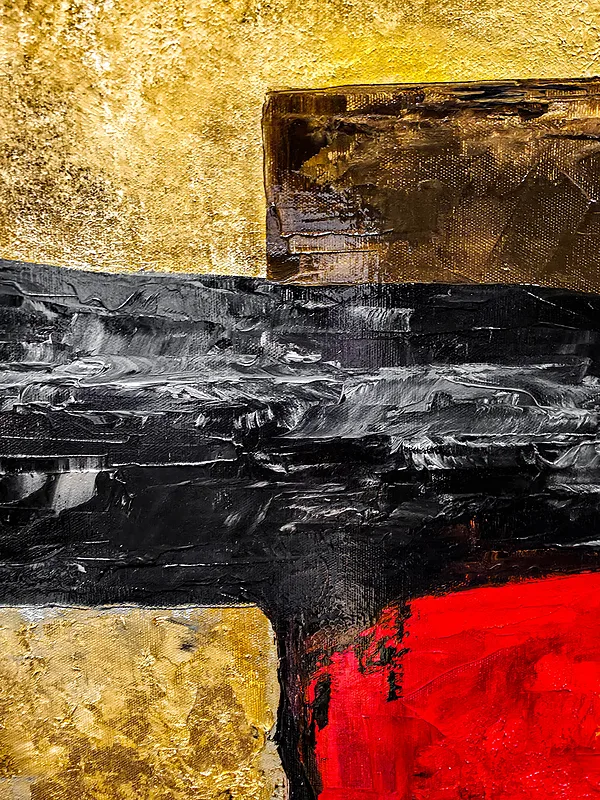
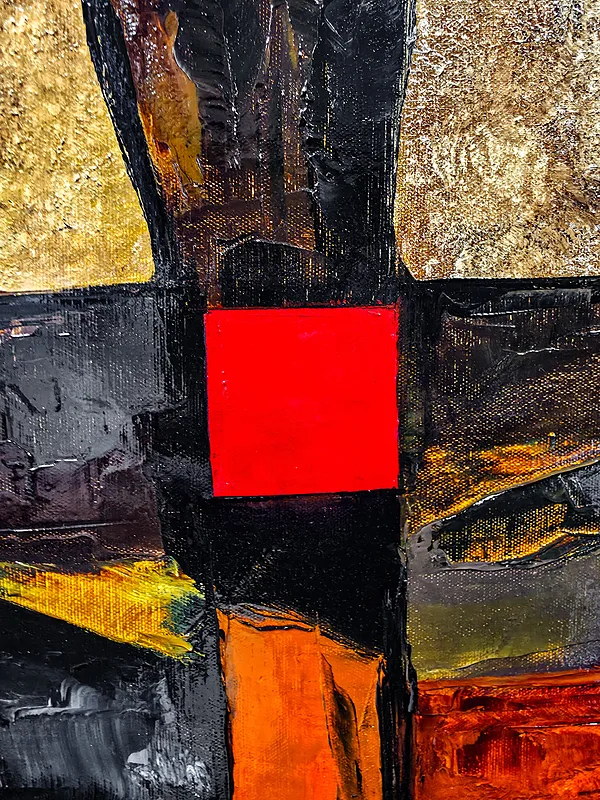
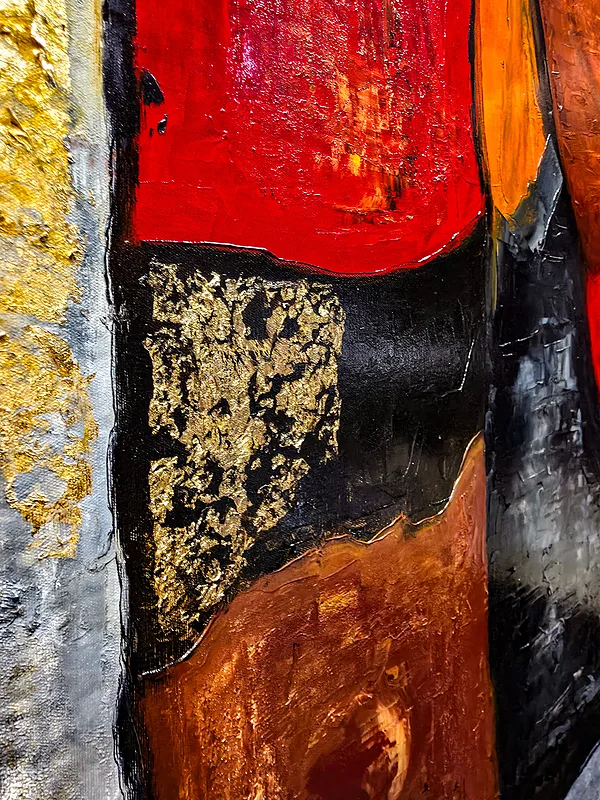
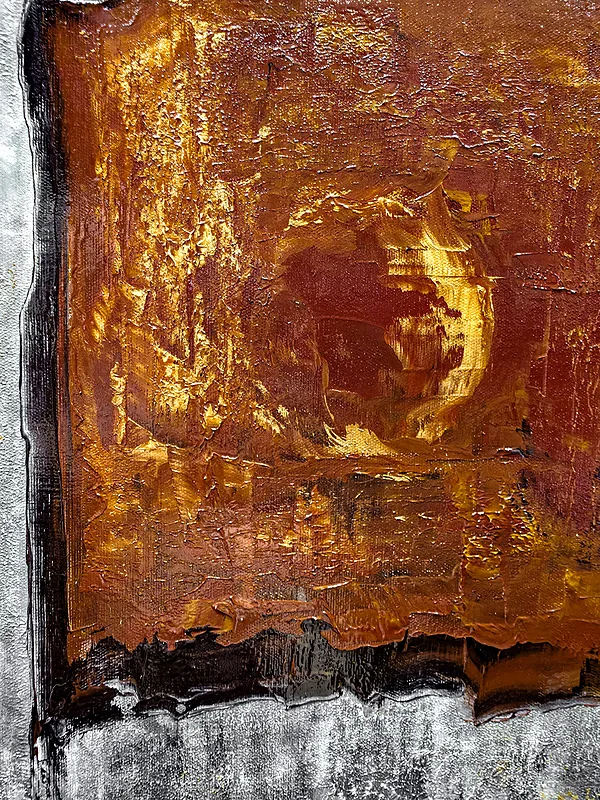
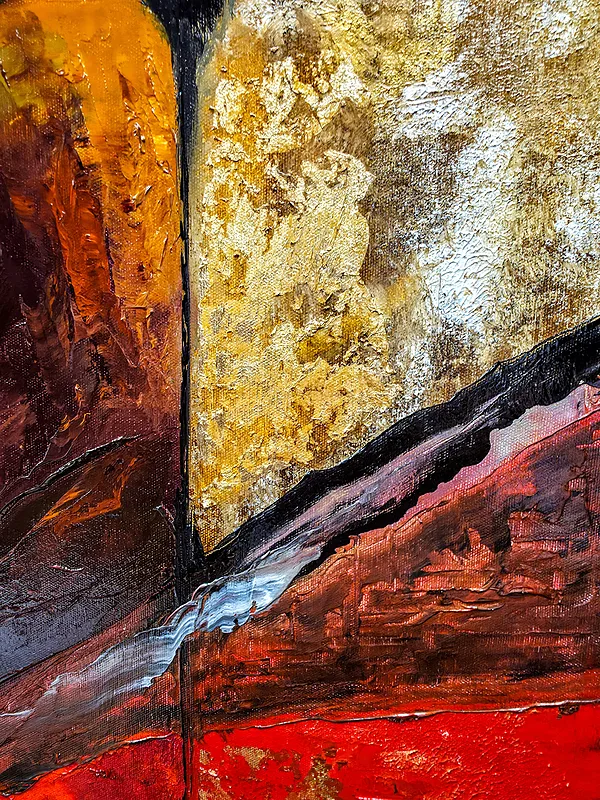
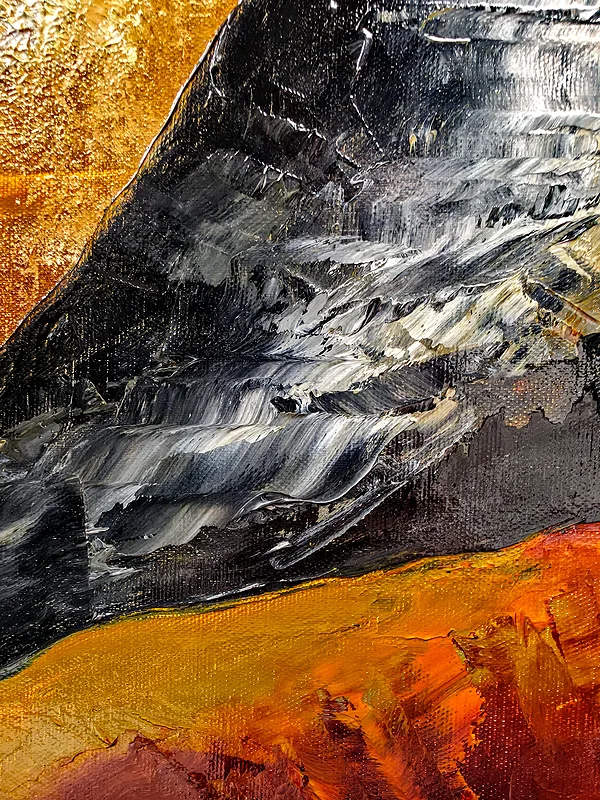
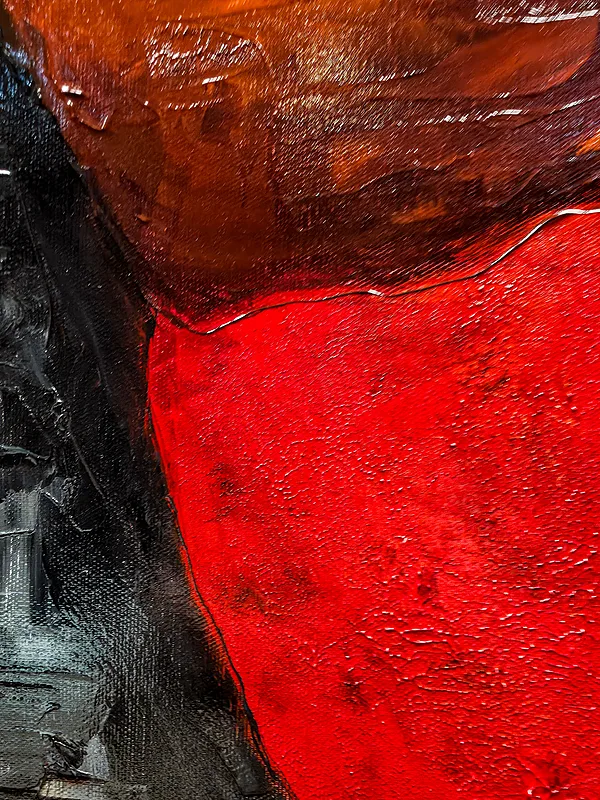
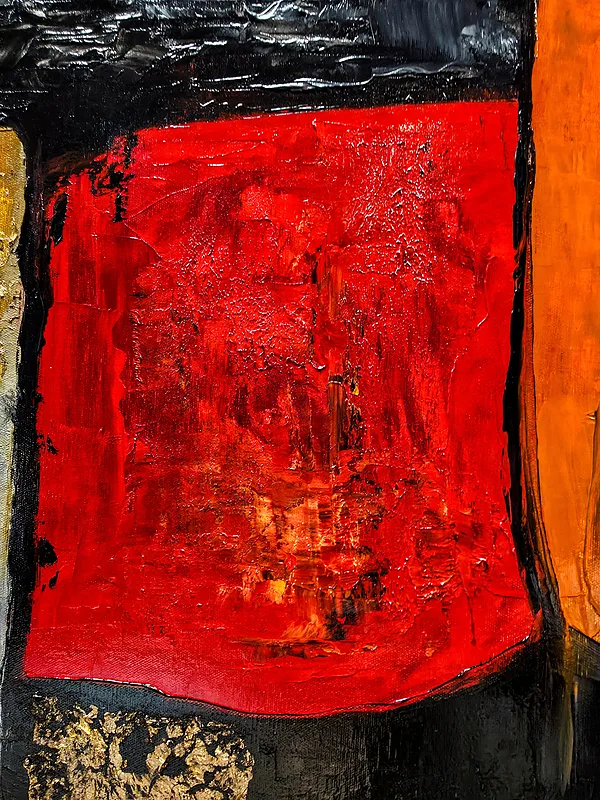
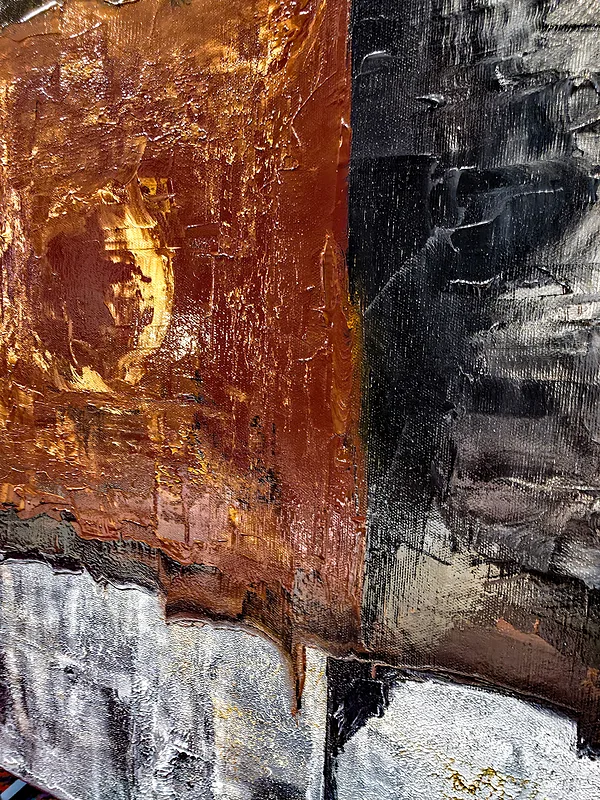
Standing before this abstraction, rich in distinctive motifs, we feel as though we are gazing upwards from the nave of a cathedral. The black axes rise like pillars, the radiant gold and silver background expands into a celestial vault, and the crimson fields take on the solemn grandeur of altars to human history. From the canvas as a whole, a single, timeless proclamation resounds: the word of the Eternal One is the eternal measure of humankind, and both truth and grace flow towards us from the same divine light.
At the heart of the composition, a monumental cross-like structure emerges, its intersecting axes and interlocking frames evoking both the steadfastness of divine order and the struggles of human history. At its centre shines the artist’s recurring symbol: the red square representing the earthly altar. It is the incandescent point of the One, the point of origin and return, towards which the divergent forms align and within which all diversity is gathered into unity.
Imprints emerging from the deeper layers of the composition preserve the memory of judgement and reckoning, recalling the words spoken to the king in the Book of Daniel: “Thou art weighed in the balances, and art found wanting.” (Daniel 5:27)
The denser, more angular core on the left side of the painting evokes the realm of judgement and self-knowledge, while the forms unfolding on the right open a path towards consolation and deliverance. The shapes flowing between these two worlds trace the arc of Isaiah’s prophecies, leading from judgement to hope, from human inadequacy to divine grace.
The Canon thus becomes a profound, contemplative meditation on the order of divine revelation. The divine measure is eternal and indivisible; the human measure takes shape through time, bearing the traces of choices, acts of faithfulness, straying, falls, and new beginnings.
The Purification of the Temple
- 120 x 120 cm
- Oil and gold on canvas
- Created: Sitges, 2026
- The artwork is part of the 'Old Testament III. - In Search of the Secrets of Eternity' cycle
- RESERVED
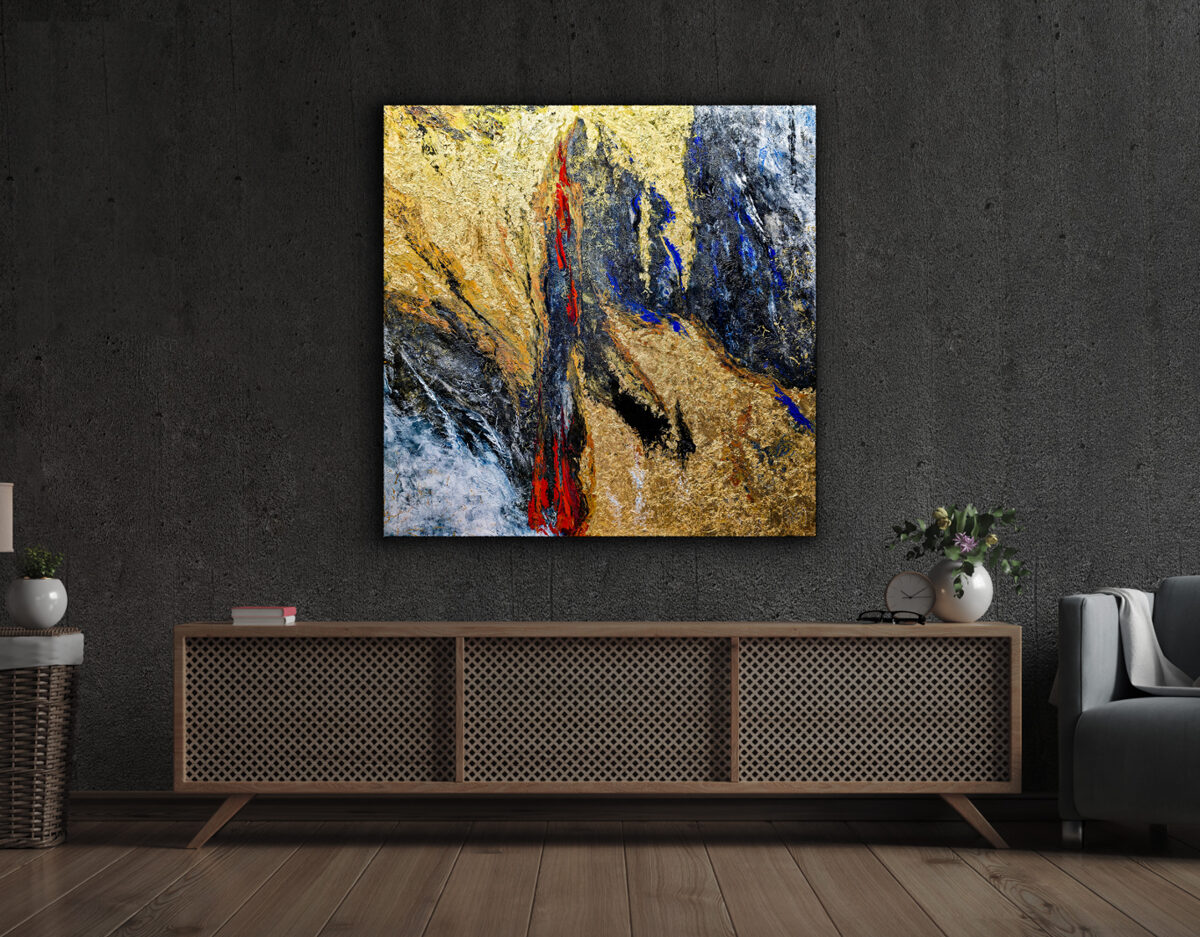
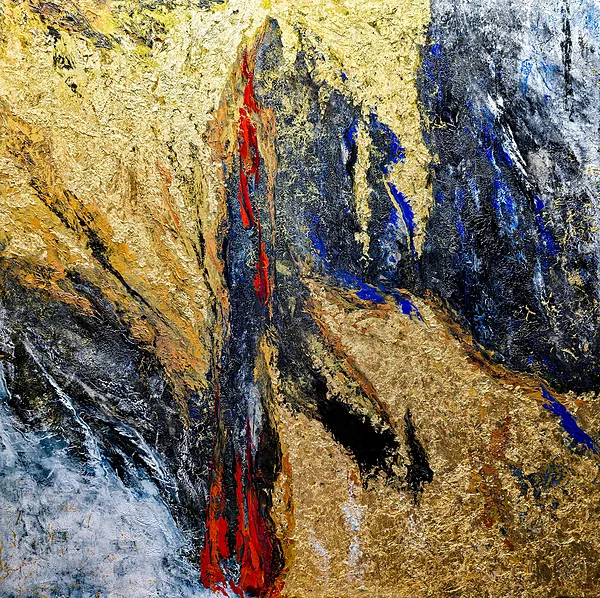
The solemn interplay of gold-clad surfaces, sooty midnight blacks, deep ultramarines, blood-red brushstrokes flaring like flames, and icy, luminous blue-whites unfolds before us like the sudden rekindling of a sanctuary that has lain silent for ages.
The painting evokes the gloria aeterna, the everlasting glory of Judas Maccabeus’s victory.
The cleansing of the Temple meant more than the restoration of its stones and sacred vessels; it also signified the renewal of a violated covenant. The canvas’s rough, heavily layered surface resembles, in places, the walls of a temple, elsewhere a rocky outcrop or a blackened altar stone.
From the depths of the composition, two monumental, incandescent forms emerge. Their indistinct contours evoke the heads of sacrificial animals facing one another. Between them, a deep vertical cleft takes on the form of an altar, from which a red flame rises like a burnt offering even as it streams downwards like blood shed in atonement.
The crimson paint courses through the composition like a deep, living vein, recalling an ember preserved beneath the ruins - one that neither the winds of time nor the shadow of idols could ever wholly extinguish.
The cool radiance of the blues evokes ritual purity, the cleansing power of water, and the protective presence of the heavens. As the depths of cobalt blue meet the solemn splendour of gold, it is as though heaven bends down towards the earth, reuniting faithfulness with earthly service.
“And the glory of the LORD filled the house of the LORD.” (1 Kings 8:11)
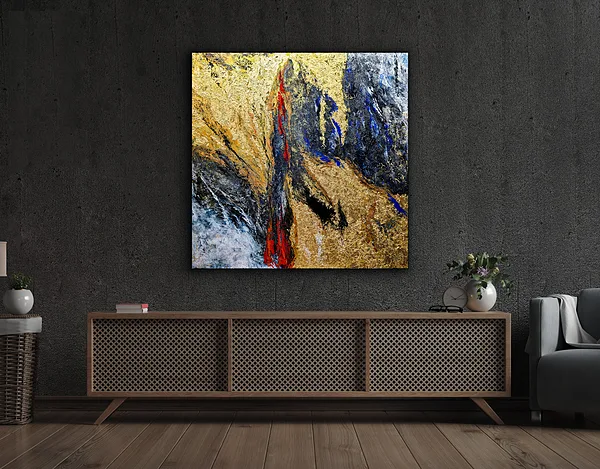
Eschatology
- 110 x 110 cm
- Oil and gold on canvas
- Created: Sitges, 2026
- The artwork is part of the 'Old Testament III - In Search of the Secrets of Eternity' cycle
- AVAILABLE FOR PURCHASE
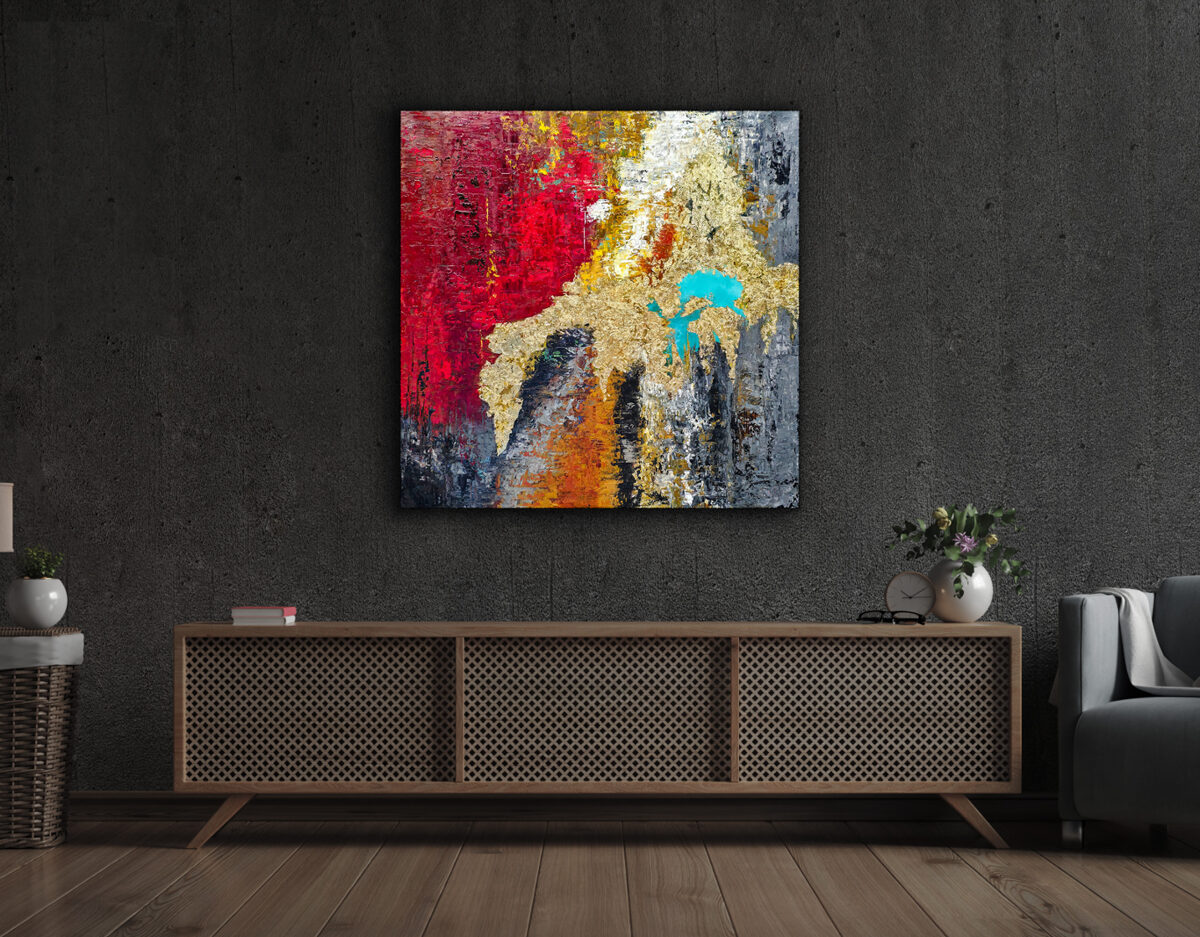
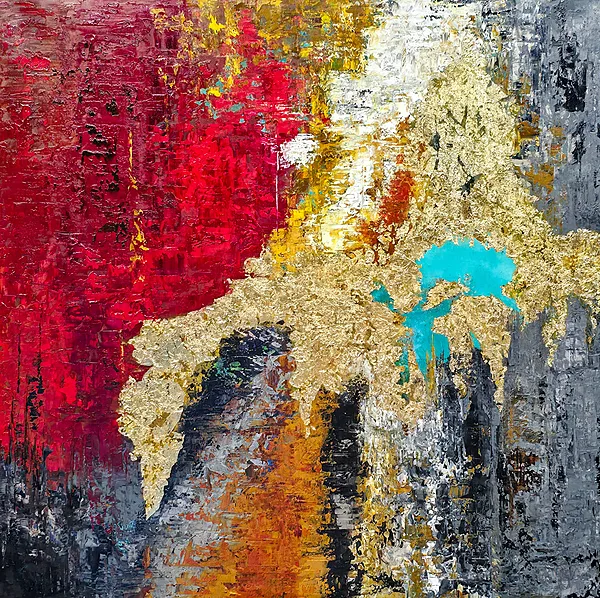
Eschatology leads us through the weight of mortality, the turmoil of history, and the drama of judgement and transformation towards the light of a restored Creation. Its biblical narrative arc is shaped by the visions of the prophet Daniel, in which earthly kingdoms rise and fall, while the promise of an everlasting kingdom shines above the course of history.
“But thou, O Daniel, shut up the words, and seal the book, even to the time of the end…” (Daniel 12:4)
The painting thus becomes a visionary unveiling of the sealed book, in which the ultimate destiny of history gradually emerges from the interplay of colours.
The crimson and carmine field dominating the left side rises into the composition like a wall heated by the fires of history. Blood, fire, royal splendour, prophetic fervour, and the memory of vanished ages converge within its deeply furrowed layers. Along the crimson edge, flashes of gold and ochre herald the dawn of a new age: the promise of an everlasting dominion, expressed in the Book of Daniel in these words:
“The God of heaven shall set up a kingdom, which shall never be destroyed … and it shall stand for ever.” (Daniel 2:44)
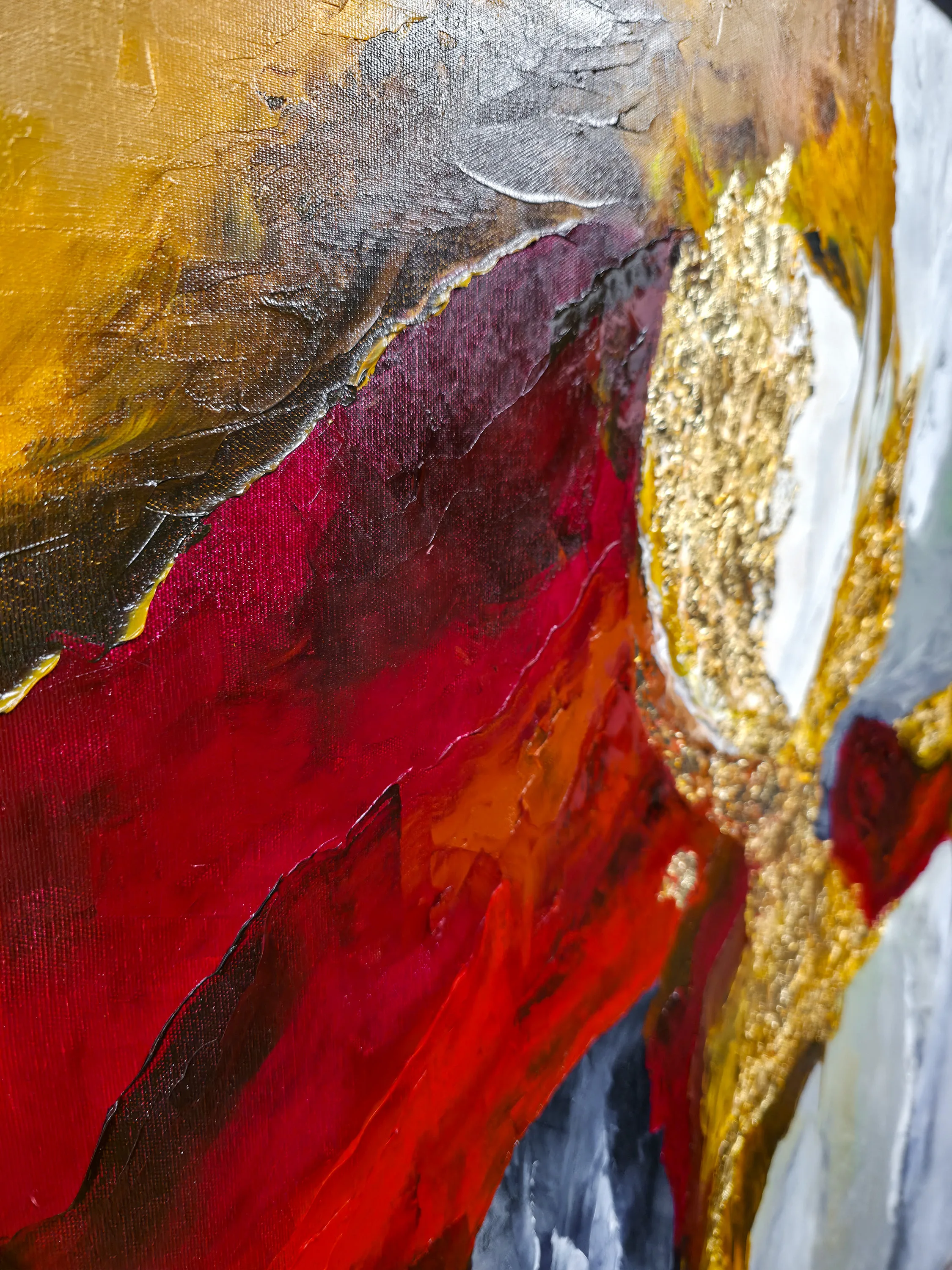
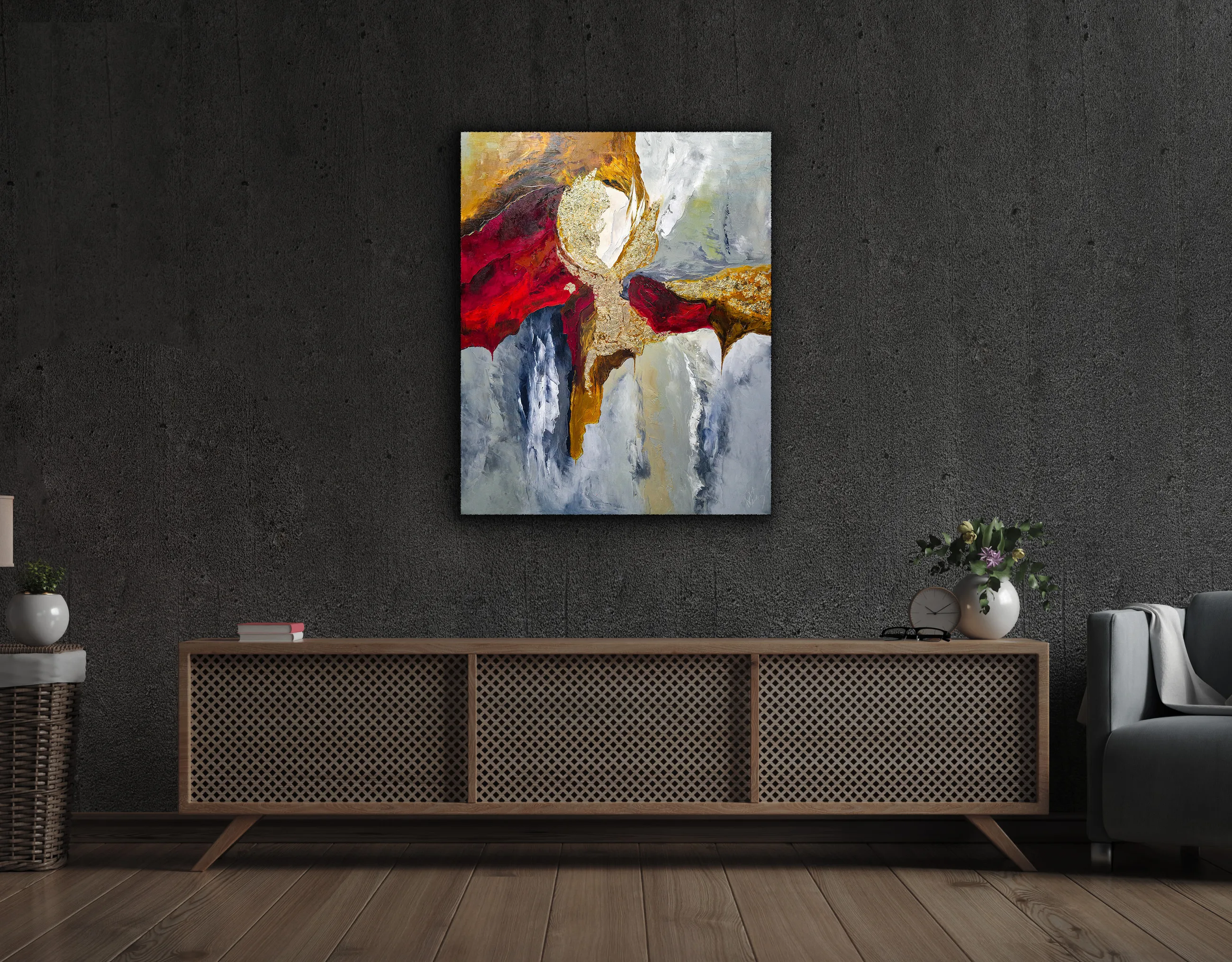
At the centre of the composition, a rough, mineral-like field of gold spreads outwards, evoking a crown, outstretched wings, foliage, and a strange celestial blossom. Beneath it, two dark forms rise from the lower reaches of the painting. Their layers of rust brown, ochre, and slate grey convey the weight of the earth, yet the forms surge towards the heights, as though the entire drama of human existence were concentrated in their upward movement.
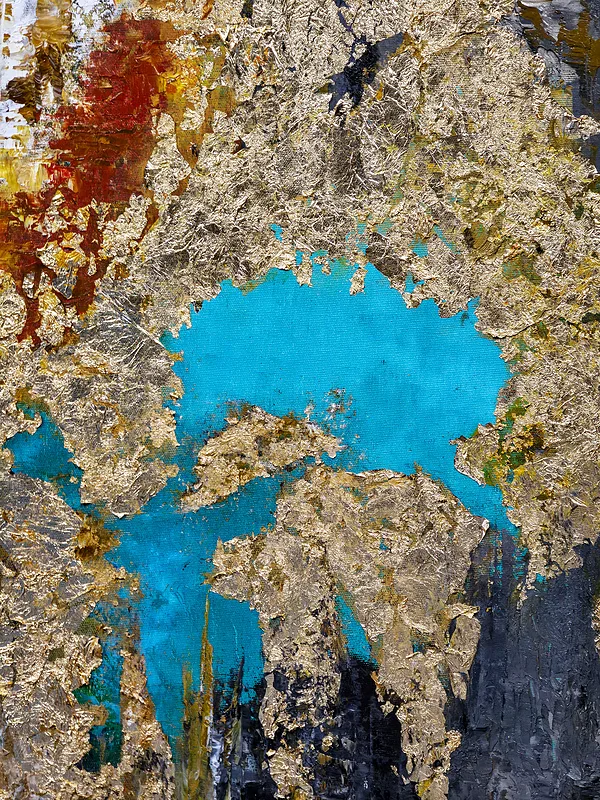
At the heart of this encounter shines one of the painting’s most enigmatic symbols: a pure turquoise form whose descending tendrils carry the sap of life into the dark strata of the earth. Turquoise evokes the memory of the Garden of Eden, the primordial harmony of Creation, and the promise of renewal.
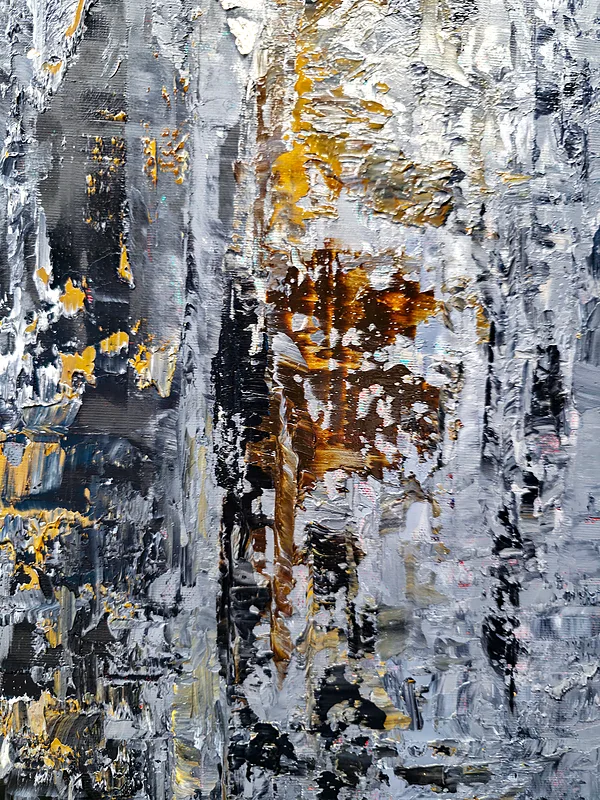
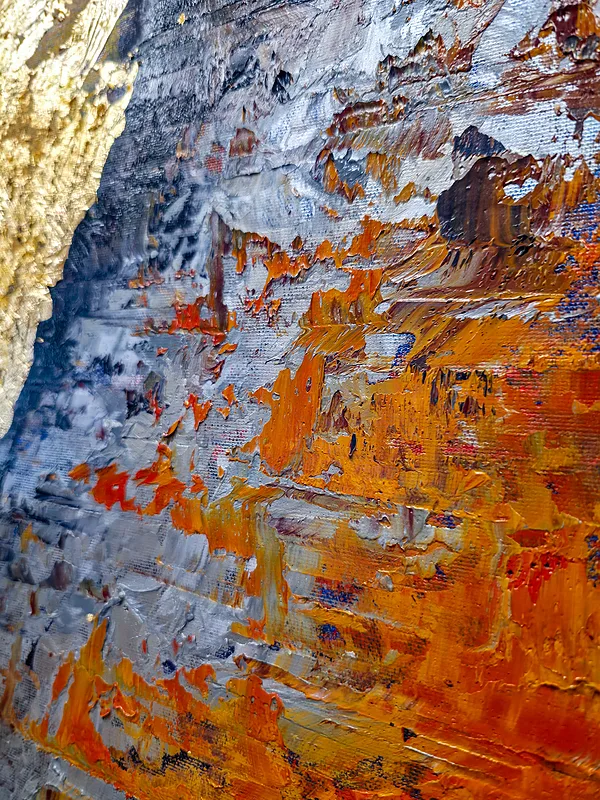
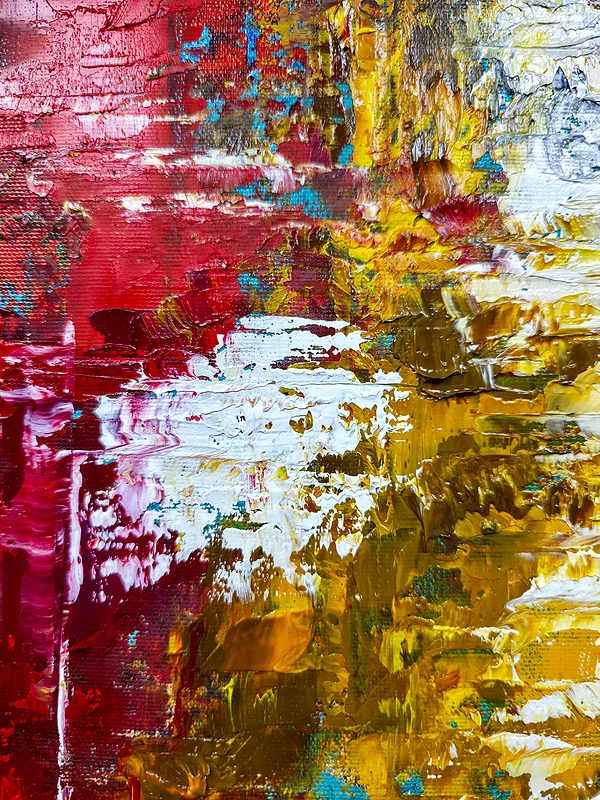
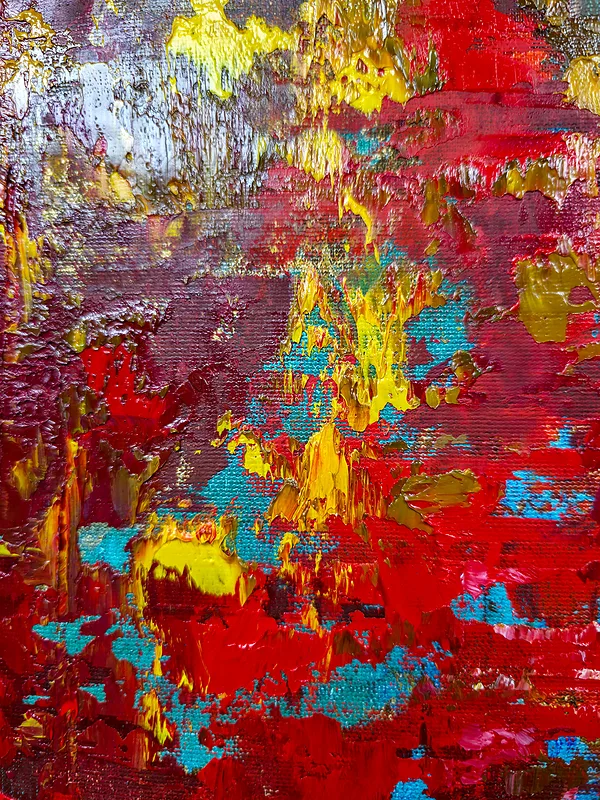
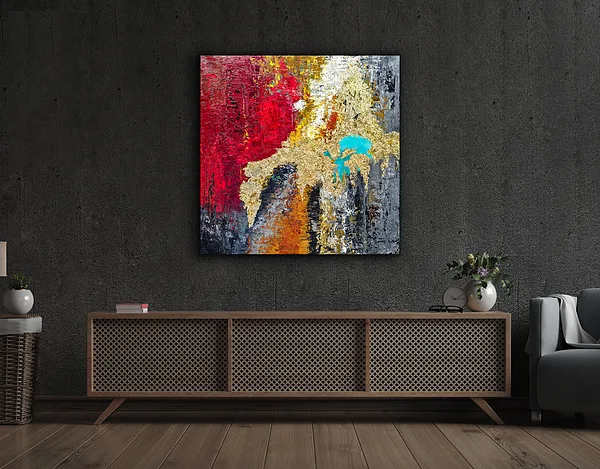
Proverbs (10:22) "The blessing of the Lord makes one rich, and He adds no sorrow with it"
- 45 x 45 cm
- Oil and gold on canvas
- Created: Sitges, 2026
- The artwork is part of the 'Old Testament III - In Search of the Secrets of Eternity' cycle
- SOLD
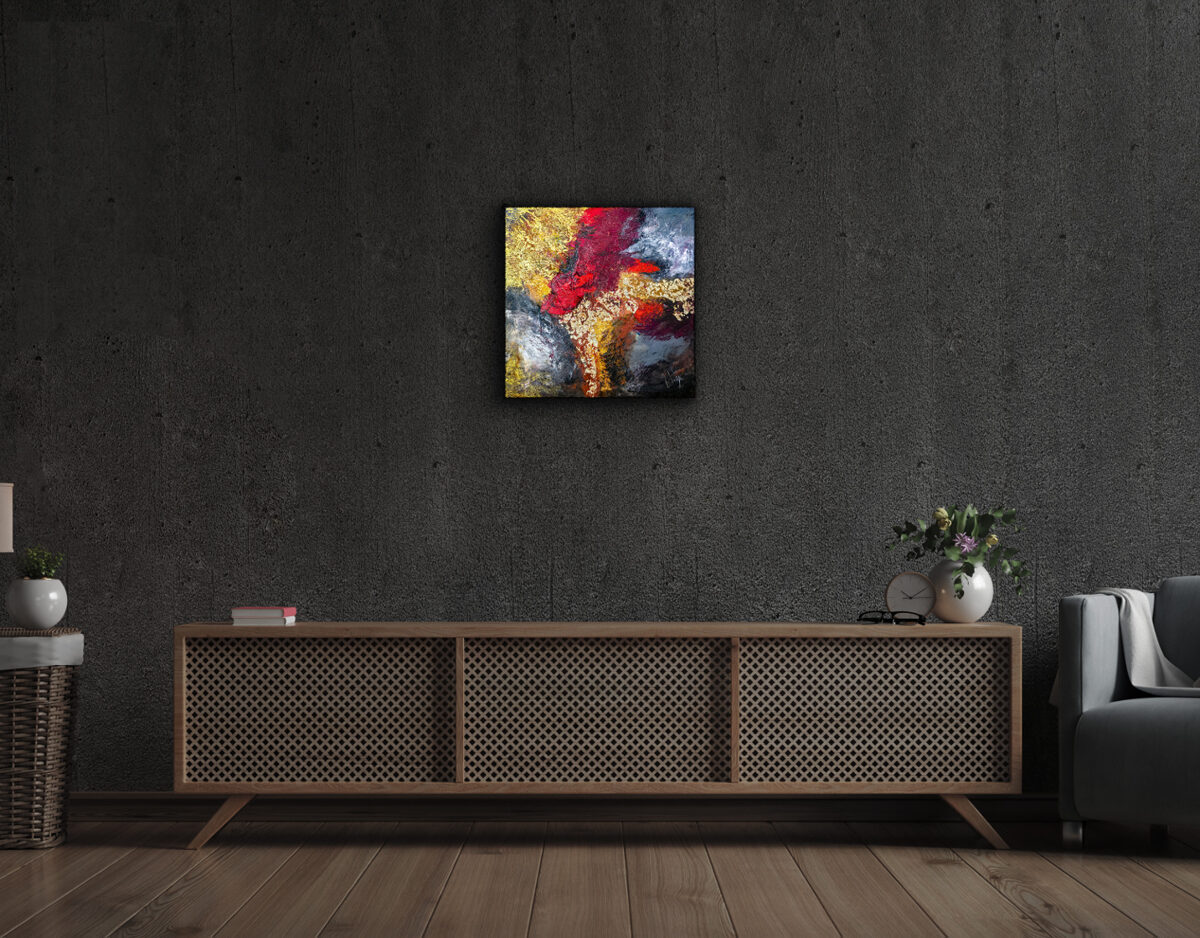
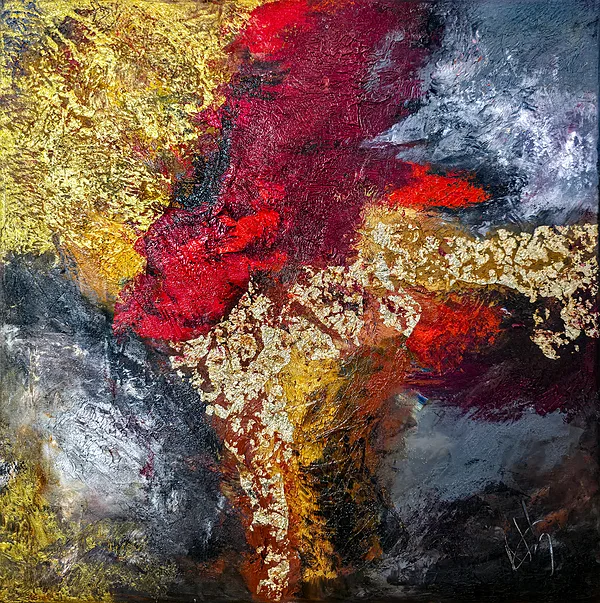
“The blessing of the LORD, it maketh rich, and he addeth no sorrow with it.” (Proverbs 10:22)
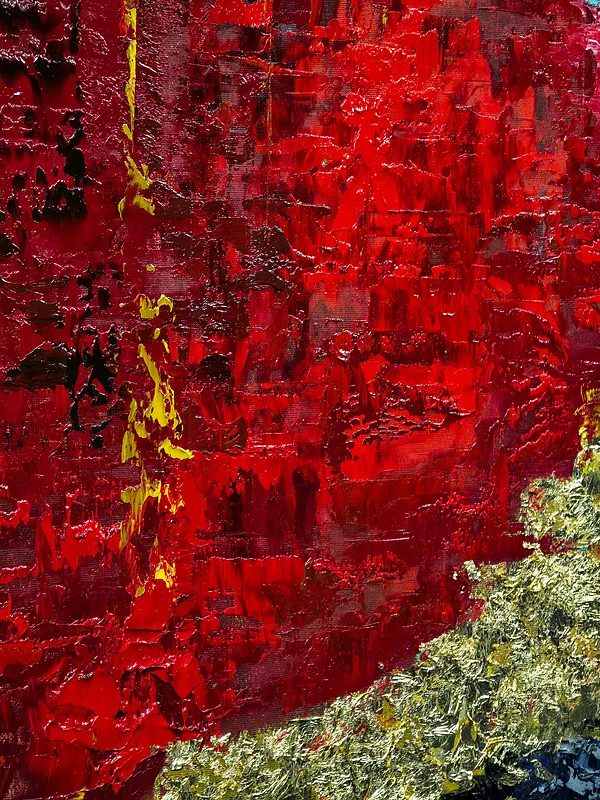
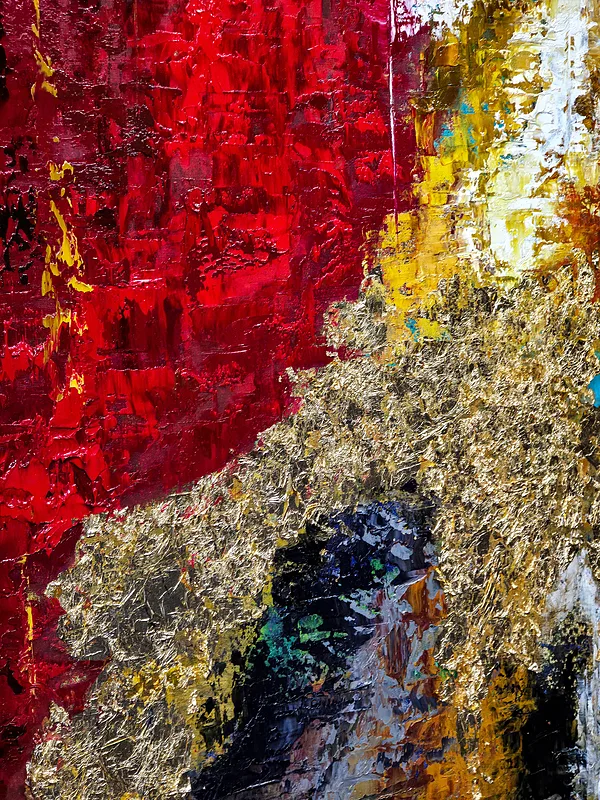
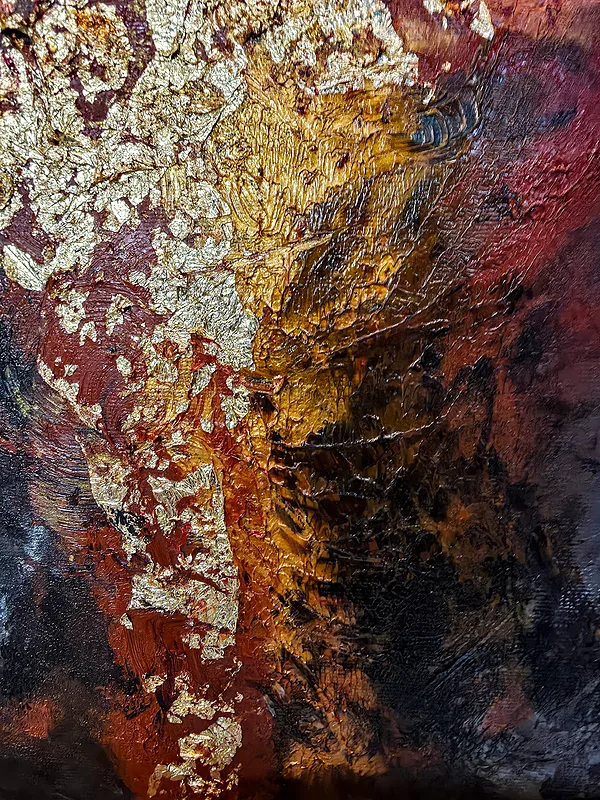
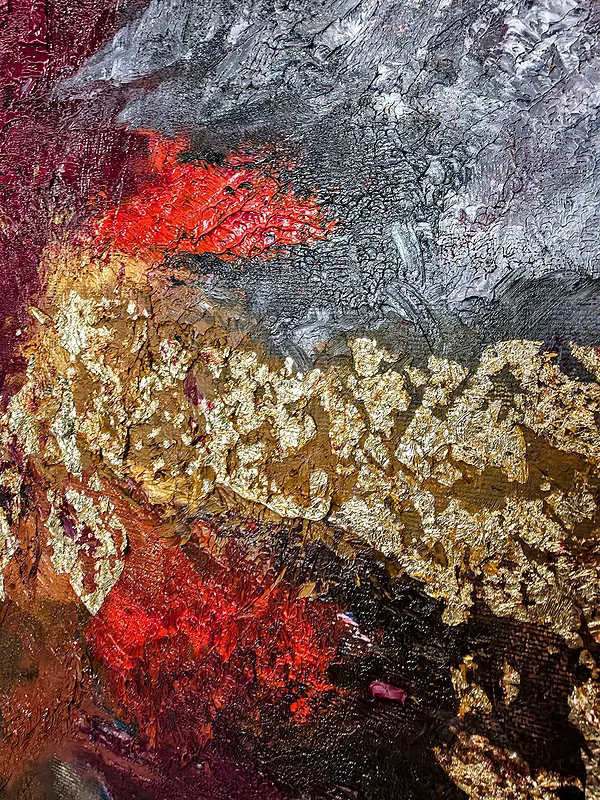
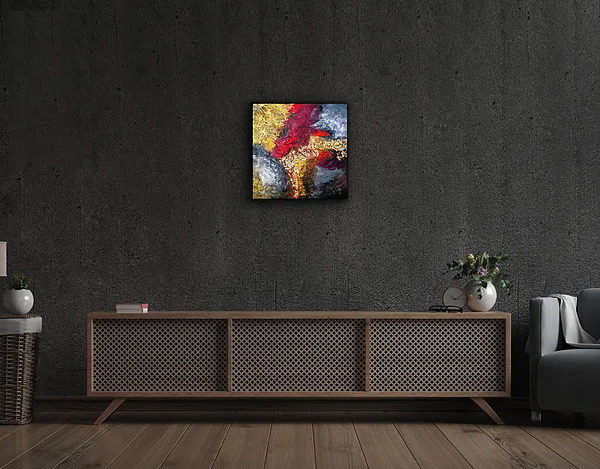
In The Proverb, Tamás Náray explores the conflict between divine blessing and the human ego through a dense, dramatic interplay of colour and form. At the centre of the composition, a scarlet-red motif unfolds, framed by two distinct golden surfaces and surrounded by layers of silvery white. The interplay of these colours establishes a moral order: the wealth that flows from divine grace transcends human pride and the desire for possession.
The radiance of gold does not celebrate the accumulation of earthly riches. Rather, it expresses the truth that the source of true wealth lies not in the human desire to possess, but in the blessing of the Lord.
The scarlet-red motif embodies the ego. Its intensity, expansive presence, and tension with the surrounding surfaces evoke the force of self-assertion.
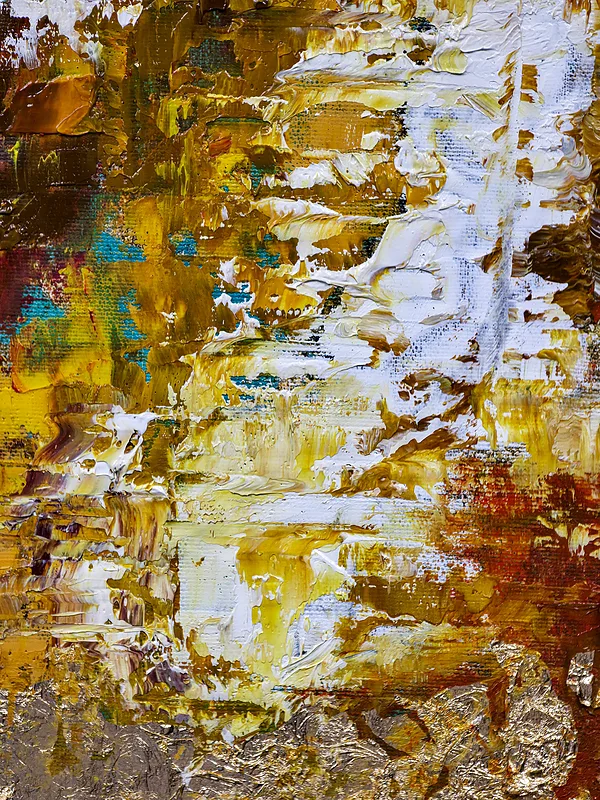
The silvery-white layers encircling the red open up a realm of purity and a renewed order of values. Their cooler tones counterbalance both the passion of the red and the brilliance of the gold.
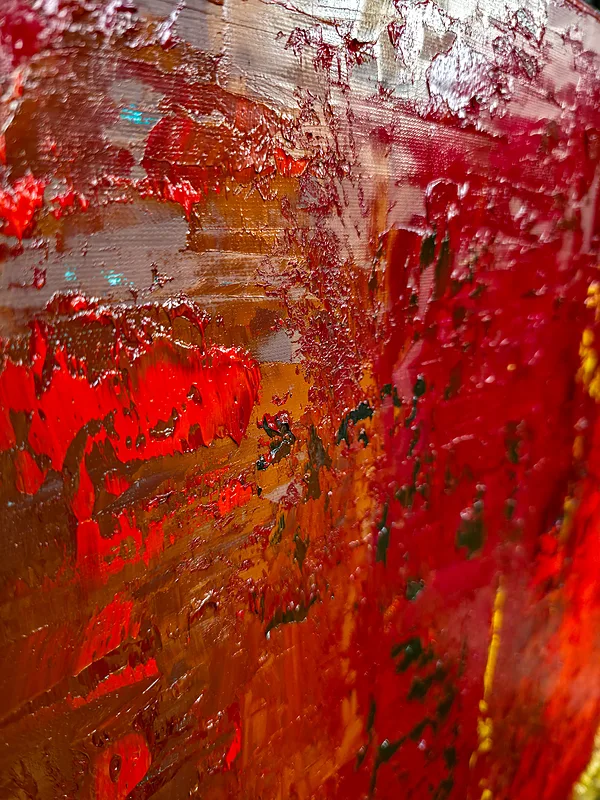
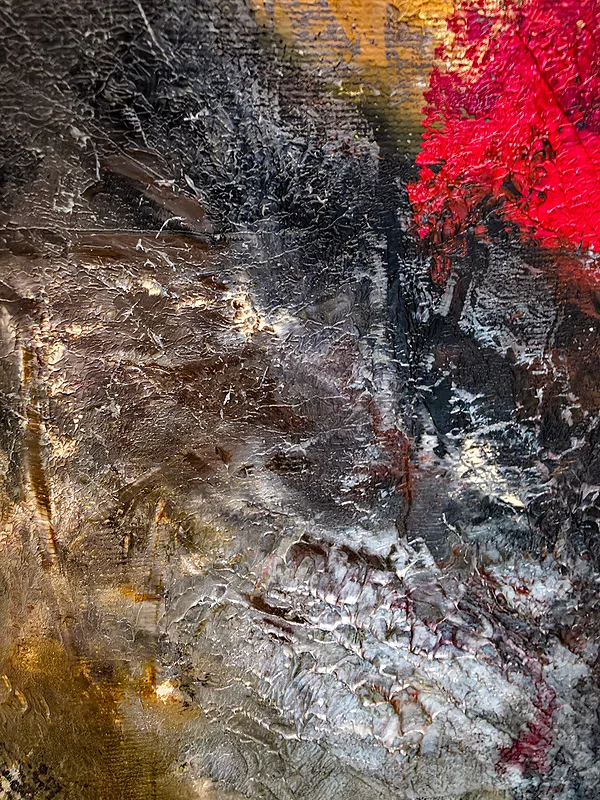
The painting’s tactile, layered surface and the forceful interplay of colours make the inner struggle almost tangible. Despite its modest dimensions, the composition possesses a monumental presence.
The Proverb reflects on the nature of true wealth. Divine blessing does not feed human greed; it transcends it. The painting’s ultimate message affirms the truth of the biblical proverb: true wealth flows from blessing and carries none of the sorrow that springs from the desire to possess.
The Command
- 120 x 120 cm
- Oil and gold on canvas
- Created: Sitges, 2026
- The artwork is part of the 'Old Testament III - In Search of the Secrets of Eternity' cycle
- SOLD
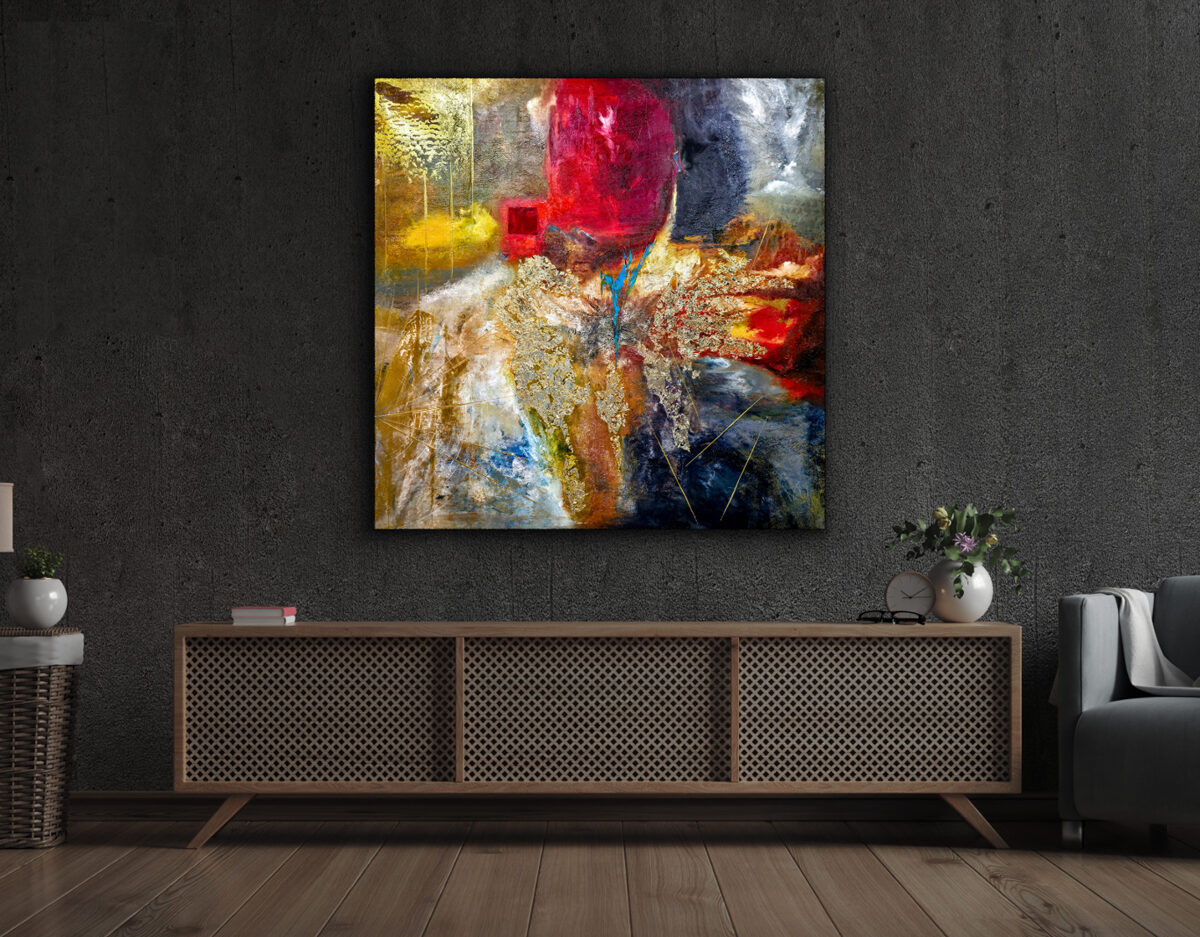
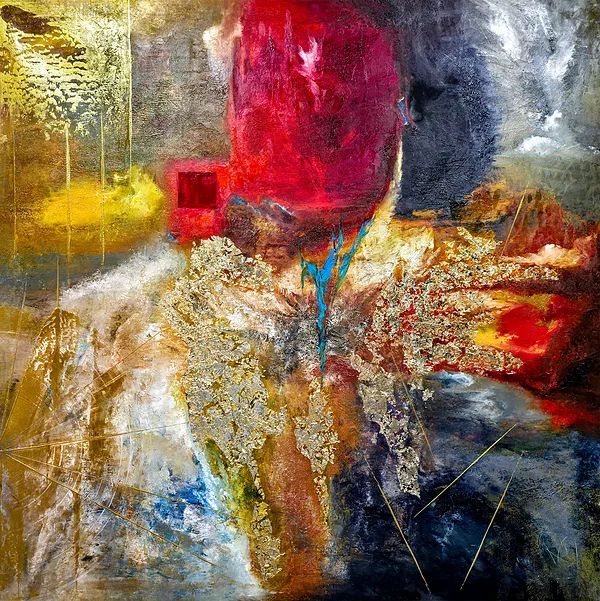
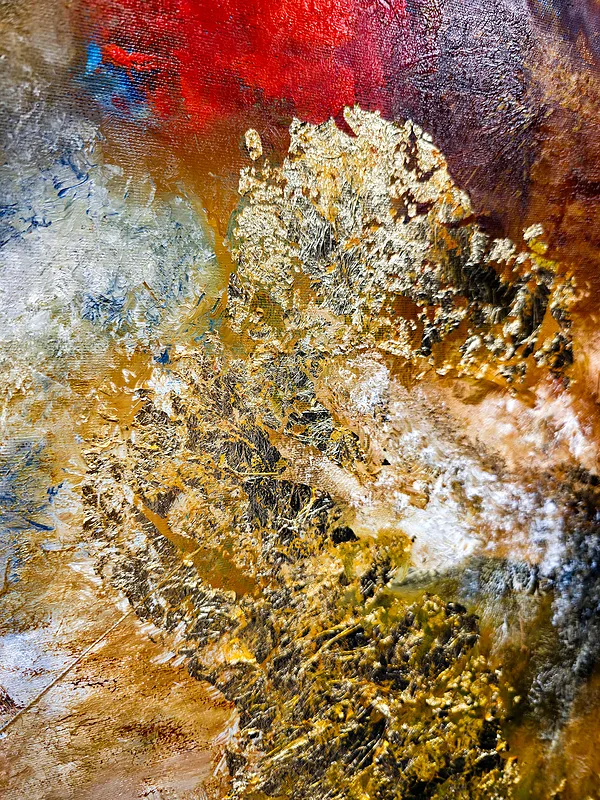
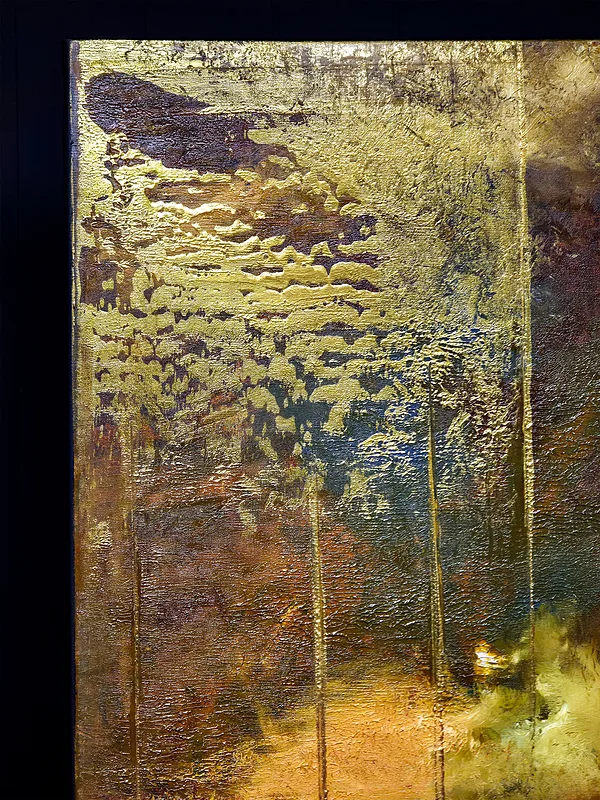
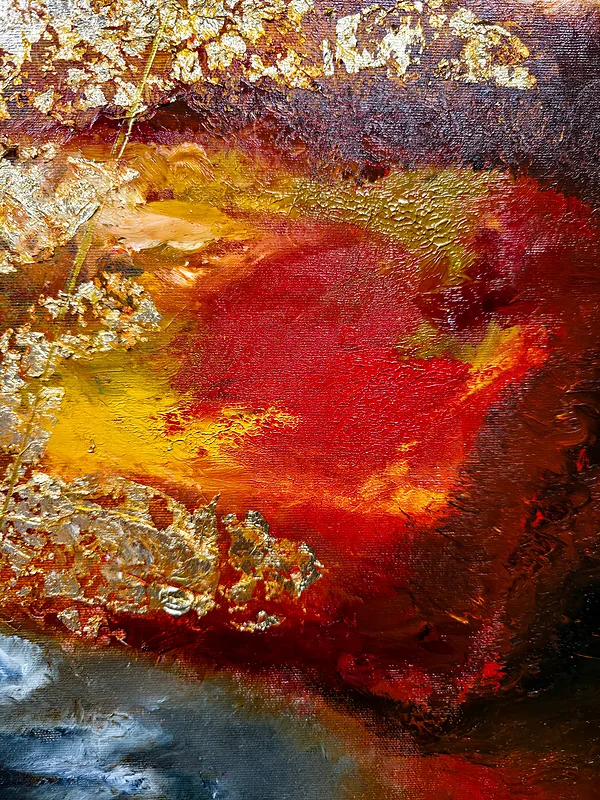
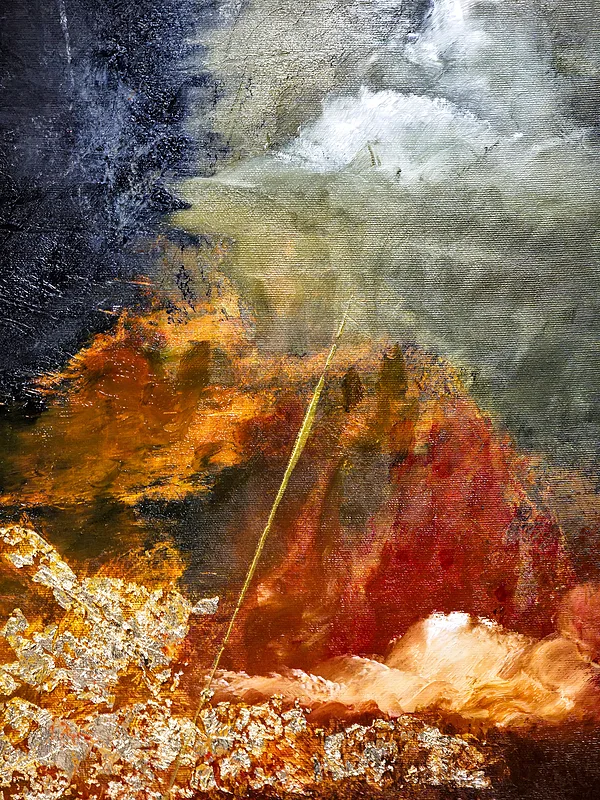
The painting unfolds like a solemn musical movement, its chords of gold, crimson, silver, deep blue, turquoise, and incandescent red resonating together and converging towards an invisible centre from which the words of Moses emerge.
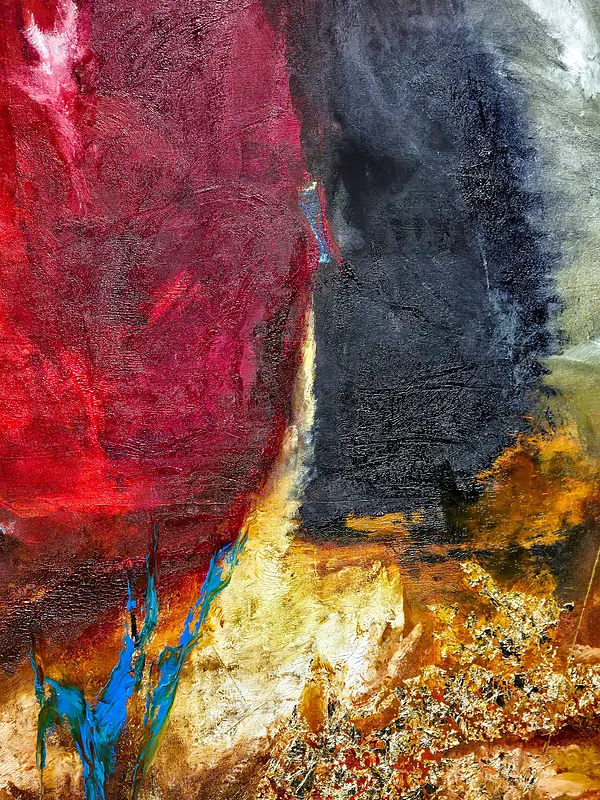
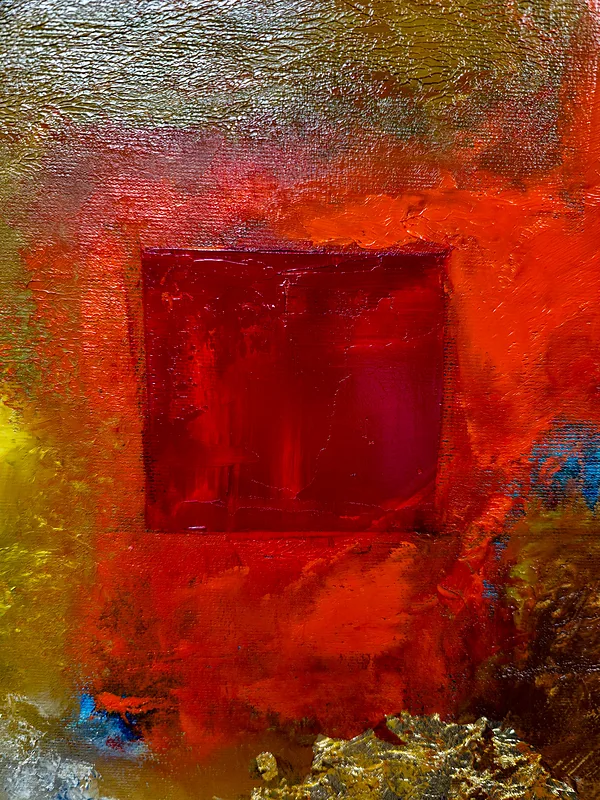
In the upper reaches of the composition, a blazing mass of crimson dominates the space, evoking at once the fire of Mount Sinai, the blood of the covenant, and the heart upon which the divine word is inscribed as an eternal law. Beside it, a small red square embodies the artist’s recurring symbol: the sign of the One, of indivisible origin, of the altar and the source.
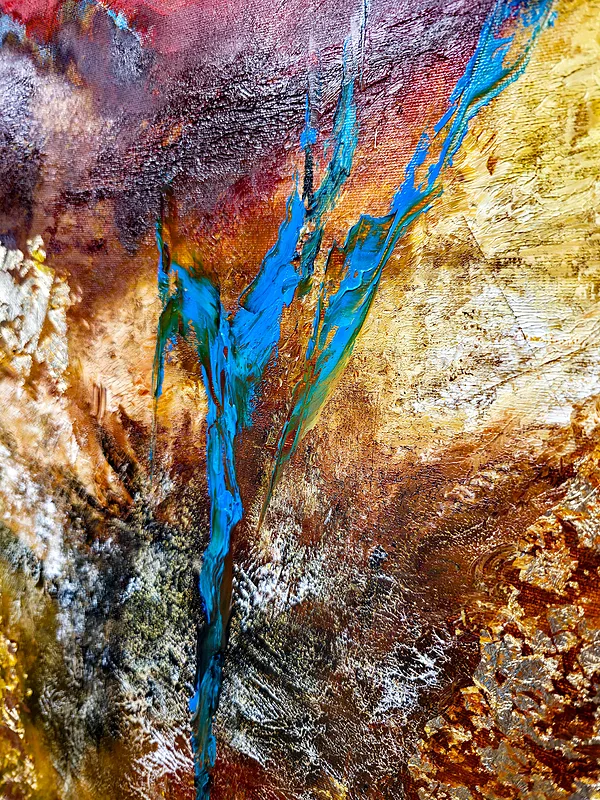
In the middle region, layers of gold, silver, rust, and earth tones render history itself almost tangible. The divine word enters the substance of human existence: dust, labour, wandering, and the lived experience of faithfulness and straying. Two vivid turquoise bands descend from the crimson centre like veins or flowing streams, carrying the force of the command into the earthly strata, symbolising life and its transmission from one generation to the next.
The lower half of the painting descends into increasingly profound tones. On the left, layers of white, ochre, and gold evoke the earthy world of the wilderness wanderings, while on the right, deep blue gives way to an almost black expanse, deepening into a dense night. Stretched across the darkness, golden lines trace the invisible geometry of order: the command continues to point the way even when the path ahead is shrouded in obscurity and the turmoil of history conceals the horizon.
As the gaze rises once more towards the crimson centre, the fragmented radiance of gold and silver settles into a solemn order of light, while the turquoise bands lead back to their source. The diversity of forms resolves into the unity of a single proclamation: the command lives in the fire, the cloud, the stone, the water, and the wandering, and every motif returns to the red seal of the One.
The Valley of Jehoshaphat
- 110 x 110 cm
- Oil and gold on canvas
- Created: Sitges, 2026
- The artwork is part of the 'Old Testament III - In Search of the Secrets of Eternity' cycle
- SOLD
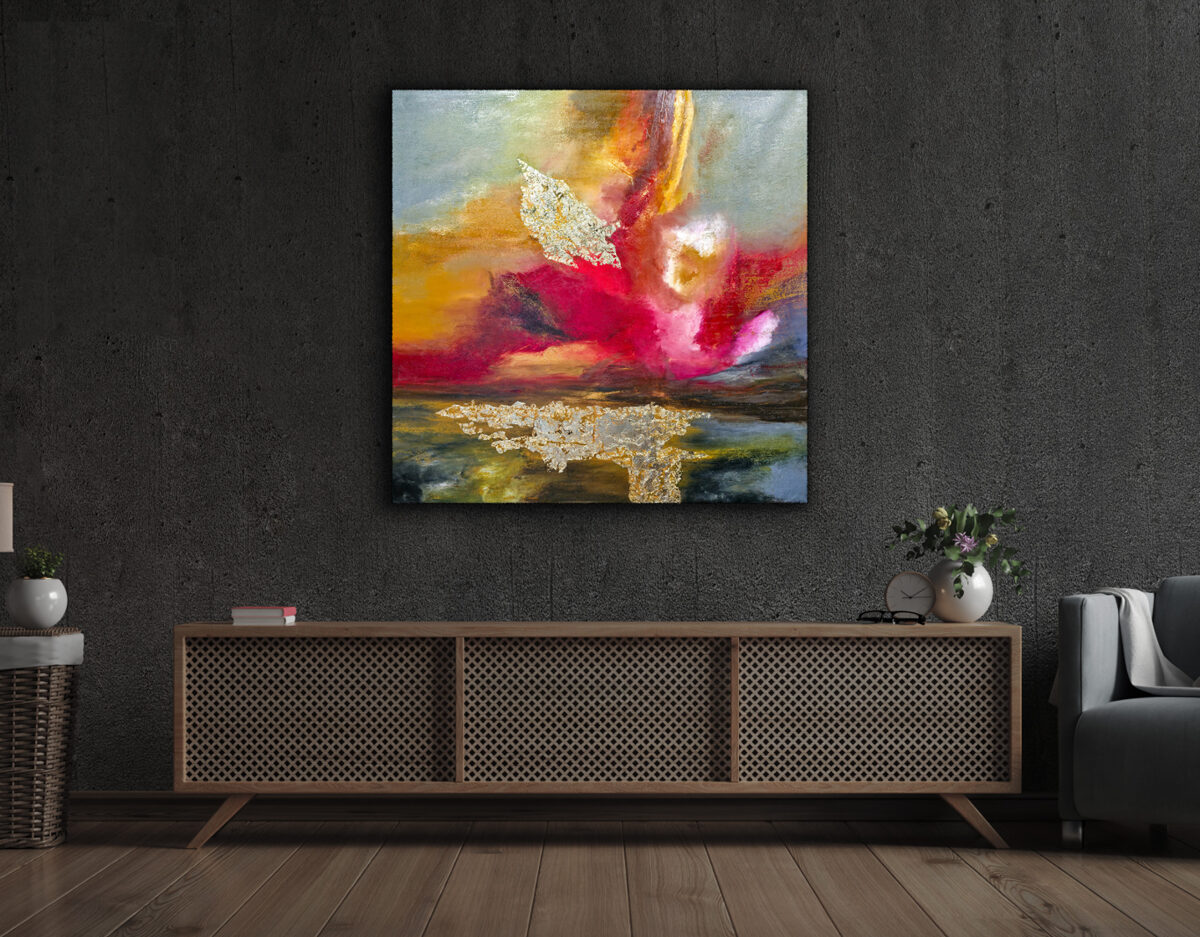
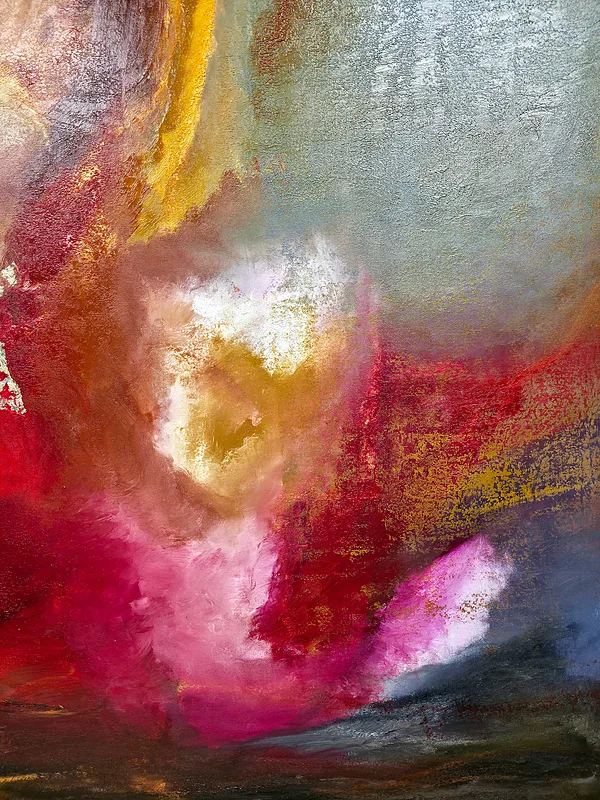
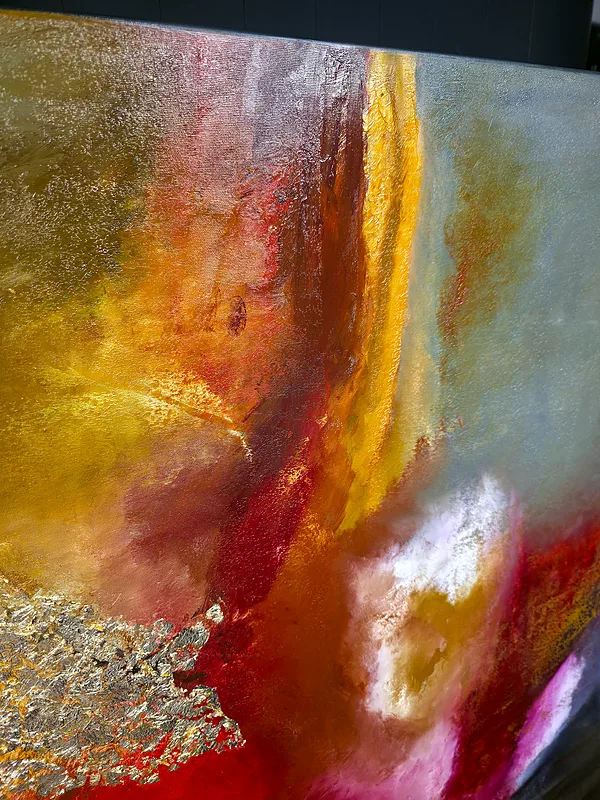
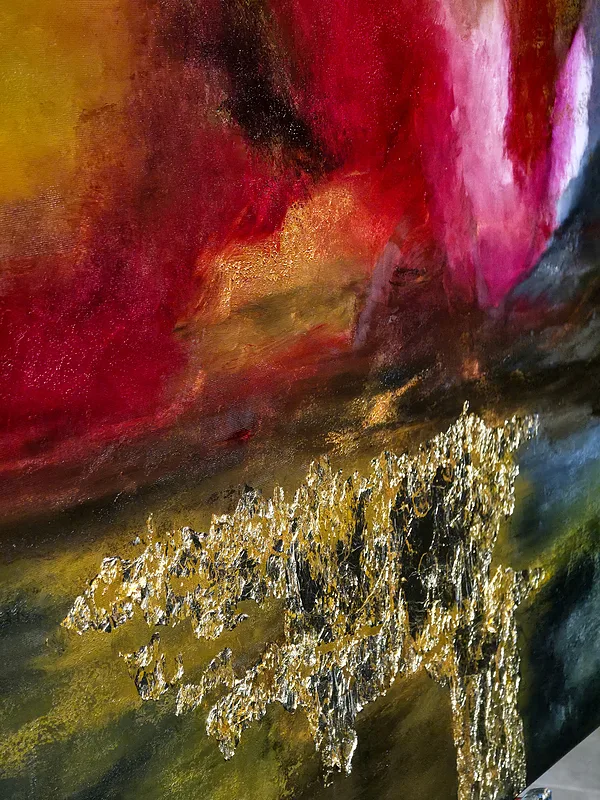
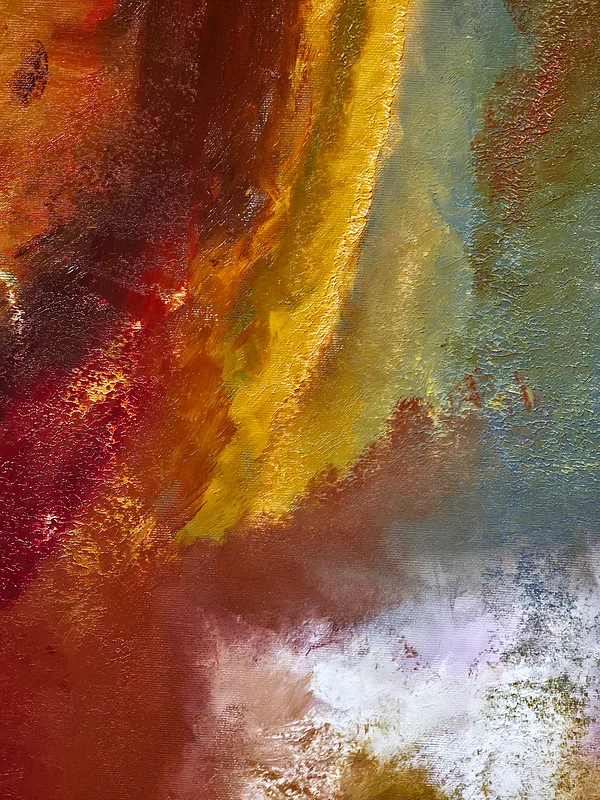
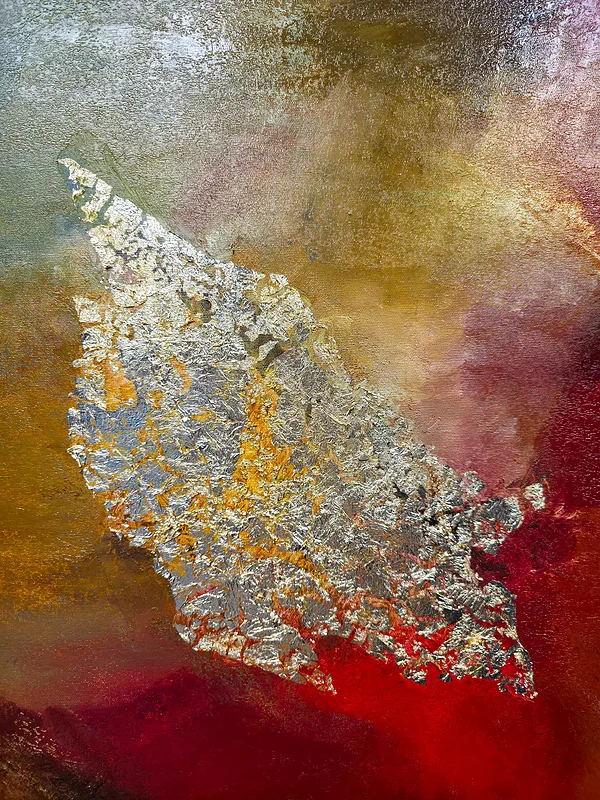
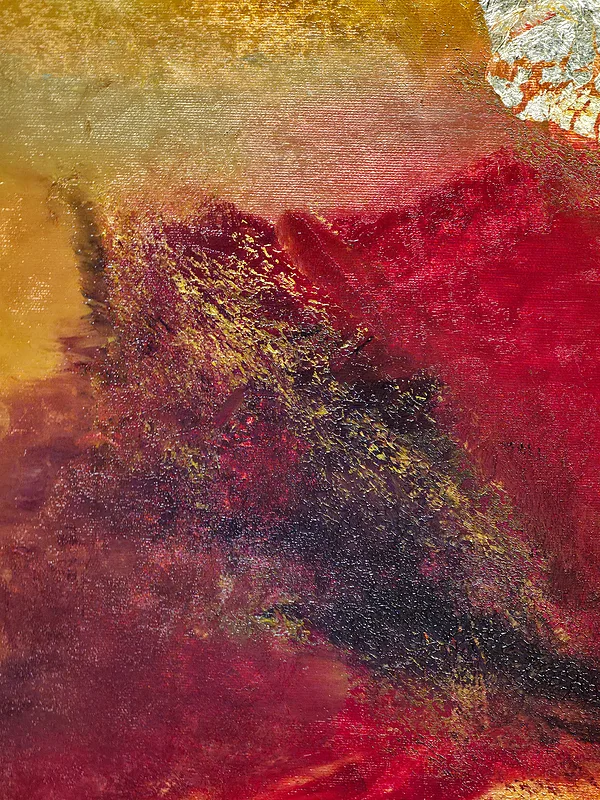
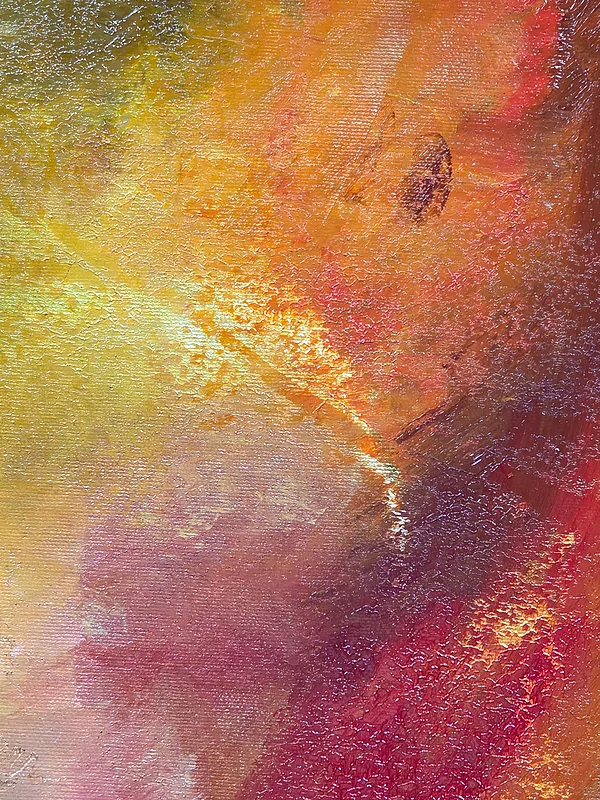
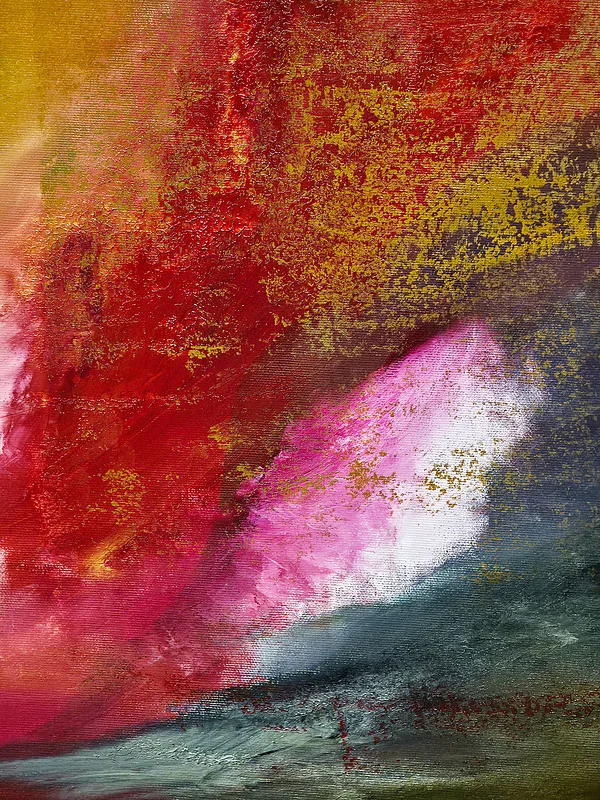
Crimson and carmine blaze at the centre of the composition, from which a stream of rose-coloured light surges heavenwards, while a golden radiance descends from above. Floating above the swirling currents of red, a relief-like wing in silver and gold evokes both the plumage of a celestial bird and the mysterious sign of a heavenly presence. Below, a form resembling the earth emerges from the darkness in gold and silver, illuminated by flashes of turquoise and olive green, bearing the promise of life and renewal.
The title evokes the vision in the prophecy of Joel, where the Valley of Jehoshaphat becomes the place of divine judgement and universal reckoning. The name Jehoshaphat means “the LORD judges”. The artist transforms this prophetic moment into a monumental vision through the passion of crimson, the majesty of gold, the celestial radiance of silver, and the profound tones of the earth. In the symbolism of the Old Testament, purple signifies royal dignity, power, and holiness, playing a prominent role in the sacred tabernacle and in the vestments of the priests. Here, it expresses not merely dramatic intensity, but also divine majesty and the weight of the prophetic word.
The meeting of light rising from the earth and golden radiance descending from above evokes the dramatic encounter between earthly history and divine will:
“The sun and the moon shall be darkened, and the stars shall withdraw their shining. The LORD also shall roar out of Zion, and utter his voice from Jerusalem; and the heavens and the earth shall shake.” (Joel 3:15–16, KJV)
In the artist’s symbolic language, the turquoise of the lower form represents the sap of life, the vital creative force of the Garden of Eden. Thus, the composition leads from the cosmic power of prophecy towards the hope of renewal: the Valley of Judgement becomes a vision of divine presence and life reborn.
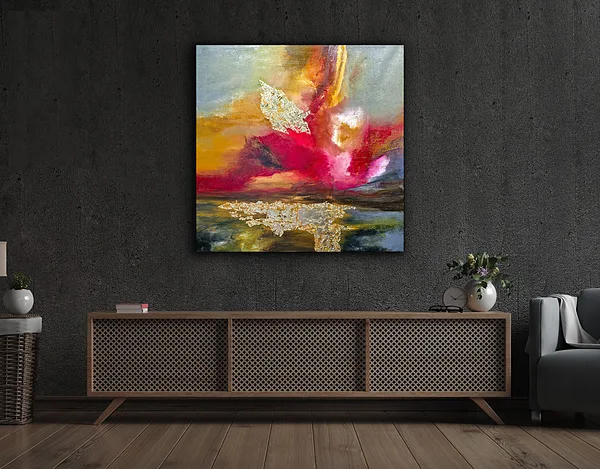
The Promise of Joel
- 100 x 81 cm
- Oil and gold on canvas
- Created: Sitges, 2026
- The artwork is part of the 'Old Testament III - In Search of the Secrets of Eternity' cycle
- SOLD
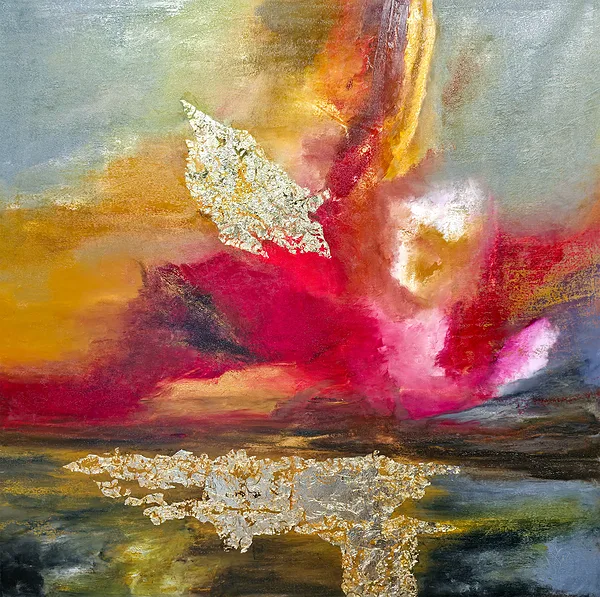
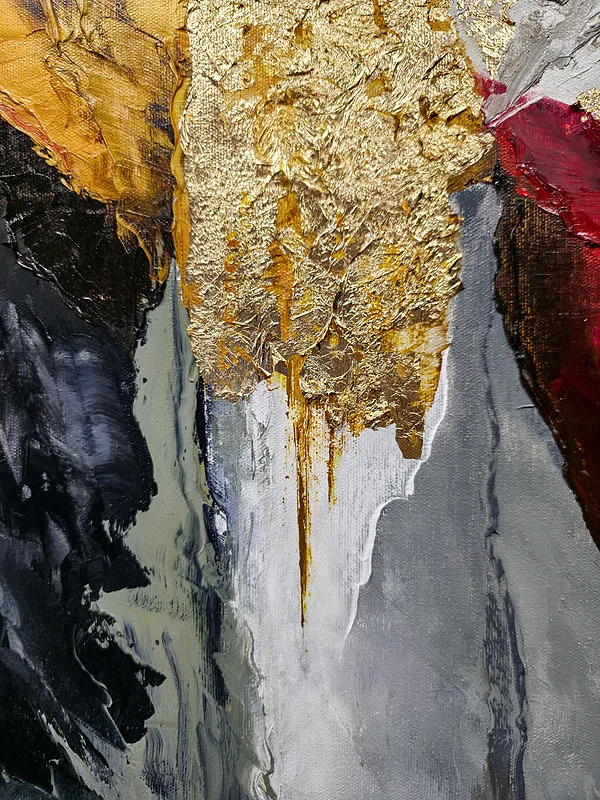
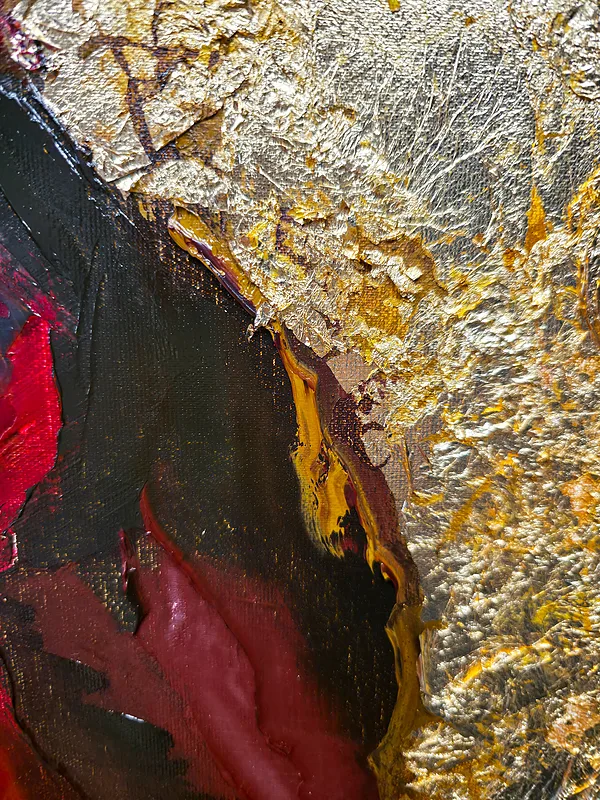
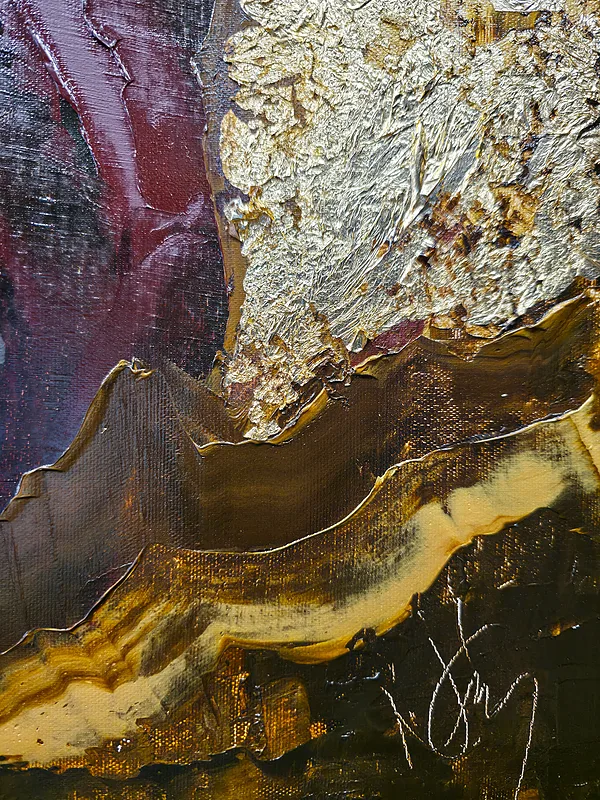
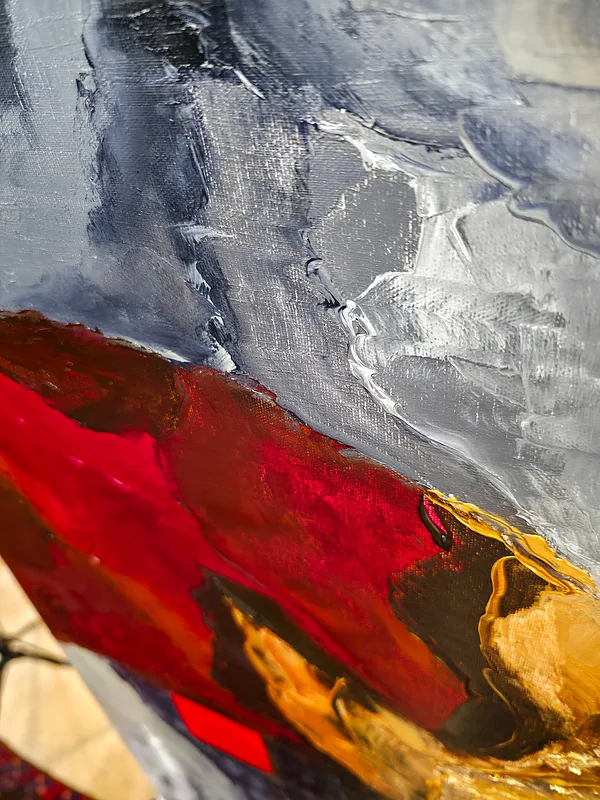
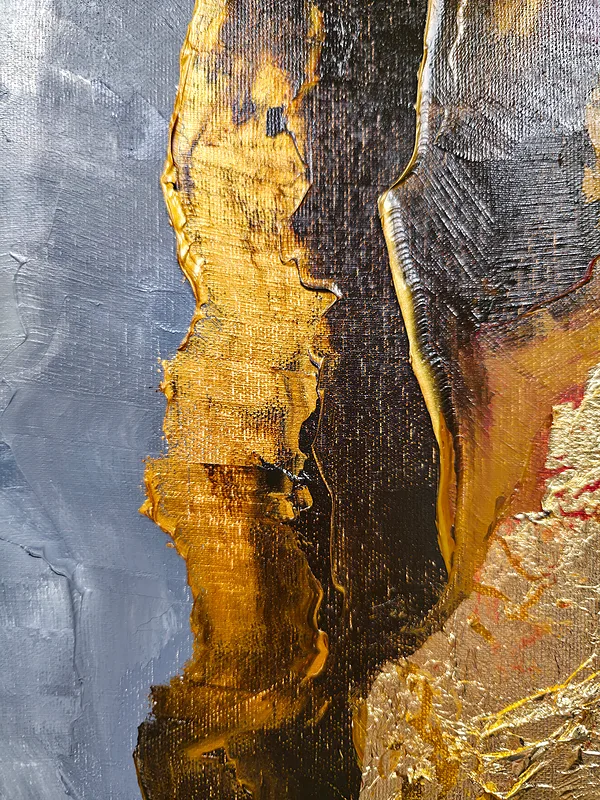
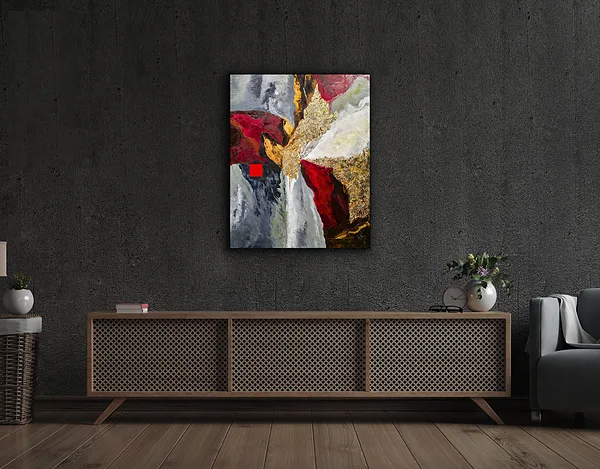
Amid the sweeping forms of red, crimson, and gold, a winged shape clothed in gold begins to emerge. The gold cascading from it and the broad, flowing expanses of white and silver evoke the outpouring of the heavenly Spirit and the power of divine presence reaching down to touch the earth. At the heart of Joel’s prophecy lies the promise:
“And it shall come to pass afterward, that I will pour out my spirit upon all flesh.” (Joel 2:28, KJV)
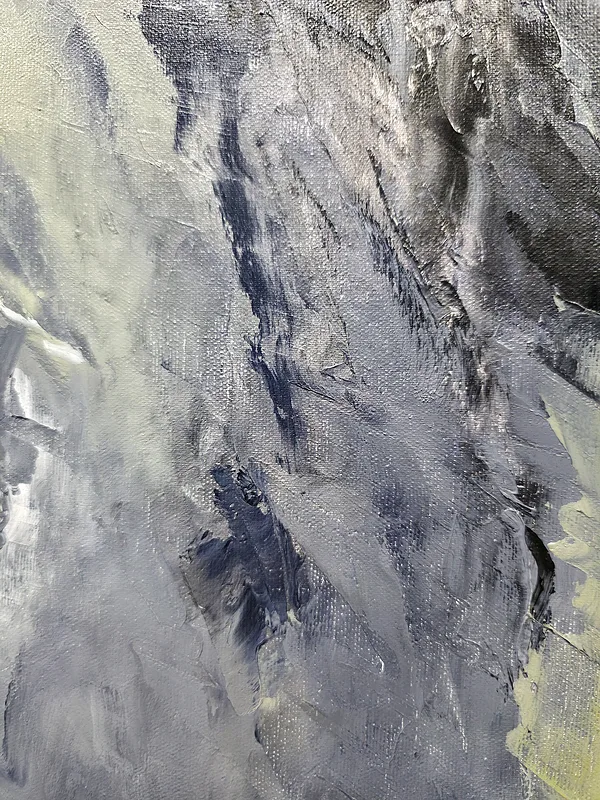
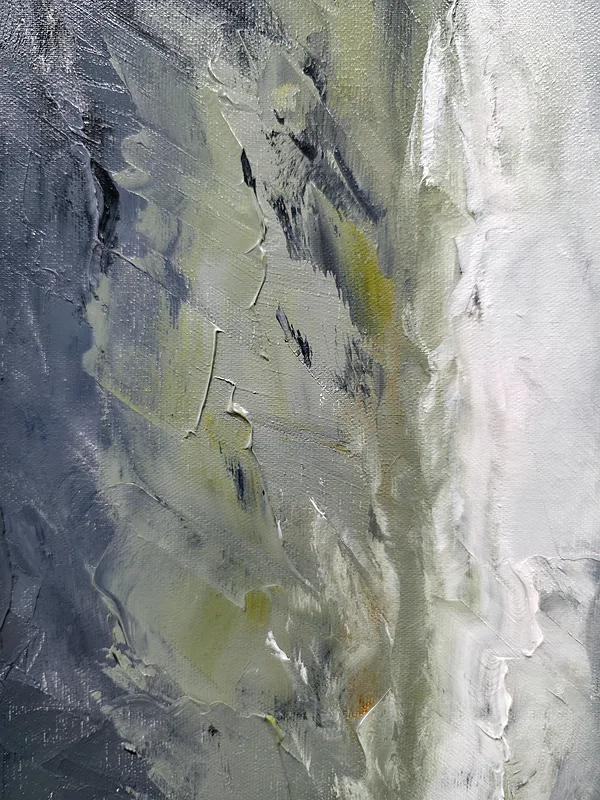
Crimson and carmine embody the forces of life, passion, and prophetic fire, while the relief-like gold becomes the material embodiment of heavenly radiance. Among the cool greys and ashen blues, a mask-like human profile emerges, evoking a wounded world frozen into stillness. The composition’s quietest yet most powerful sign is the red square, painted with geometric precision. Its disciplined geometry stands in sharp contrast to the organic movements of paint rippling around it. Within the artist’s recurring symbolic language, the square is the sign of the One. Its closed, pure form burns as an unchanging centre within the painting’s world of movement, its red imprint pressing the seal of the eternal Word upon human time.
Joel’s promise unfolds through the tension between stillness and outpouring, earthly woundedness and heavenly touch. The painting’s ultimate message is one of hope for renewal: even a world frozen in ice carries within itself the possibility of light and rebirth.
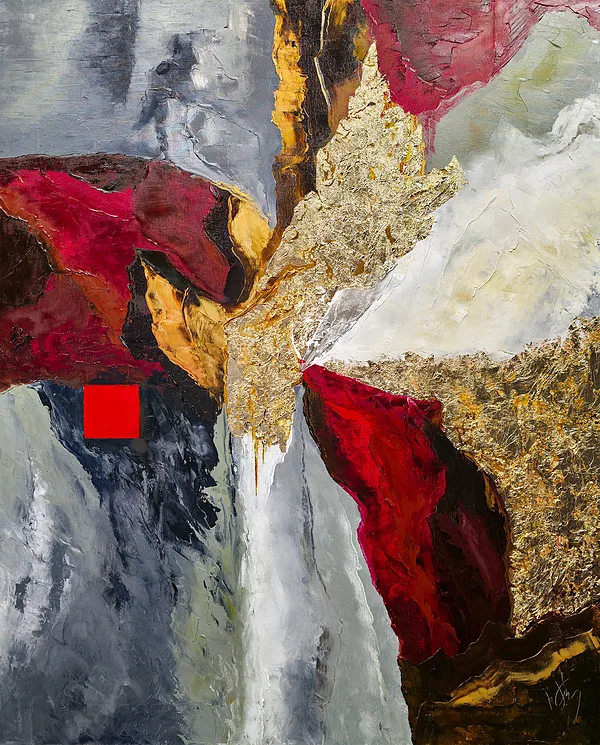
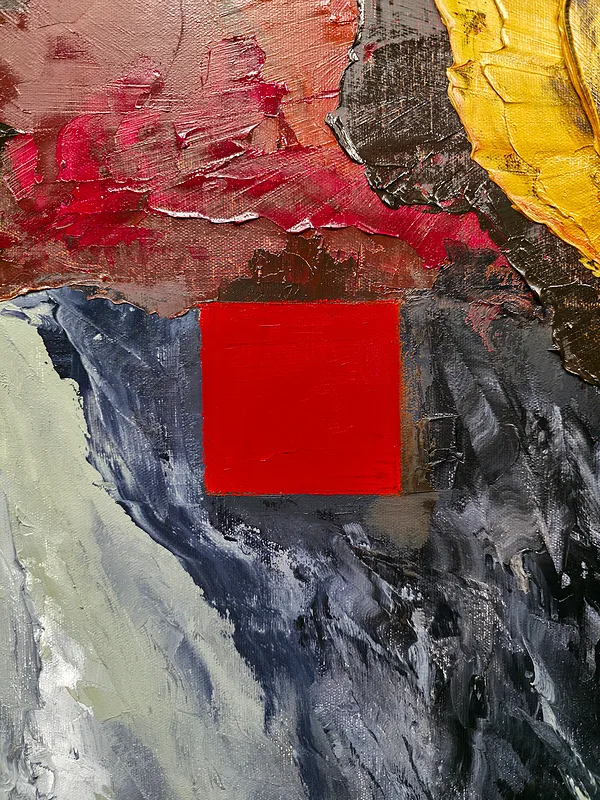
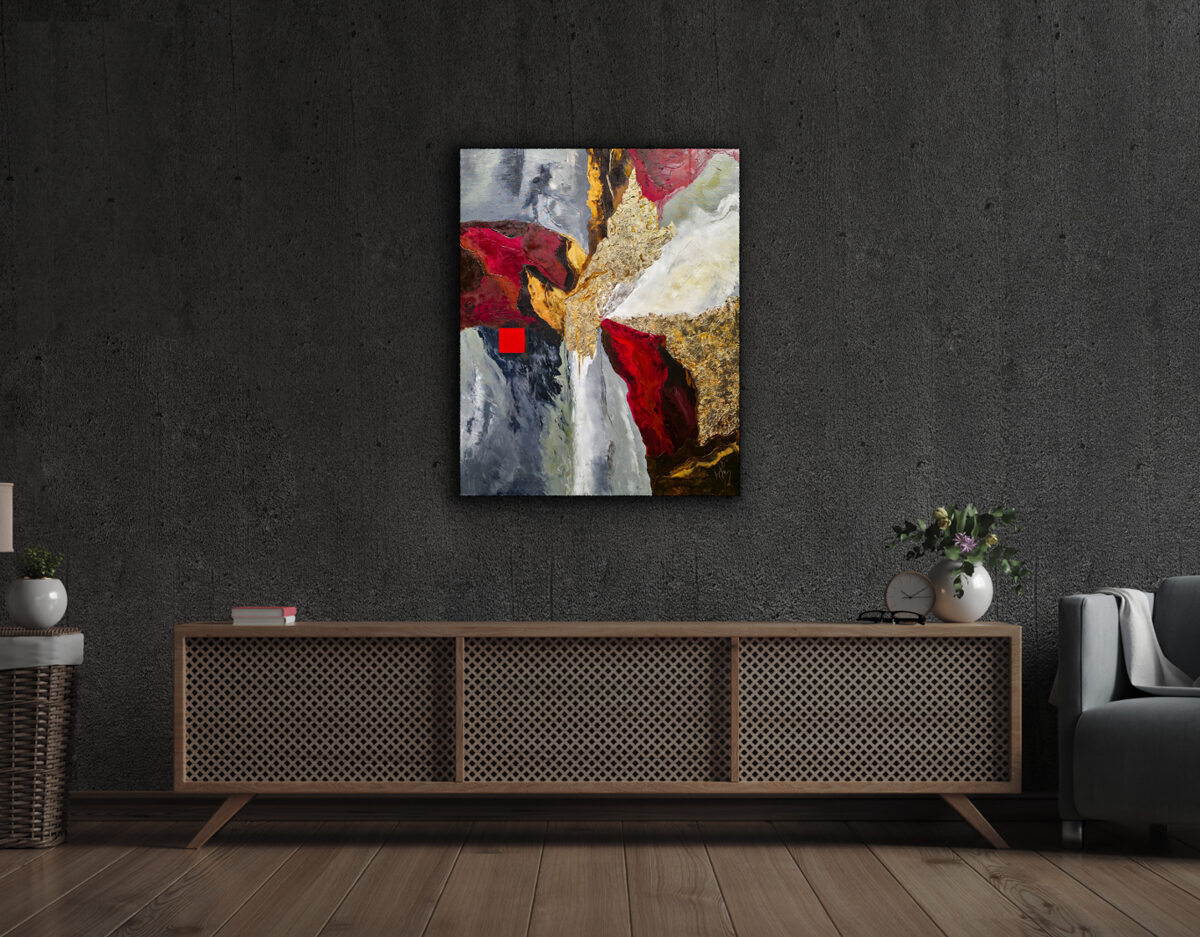
The Prophecy
- 100 x 81 cm
- Oil and gold on canvas
- Created: Sitges, 2026
- The artwork is part of the 'Old Testament III - In Search of the Secrets of Eternity' cycle
- AVAILABLE FOR PURCHASE
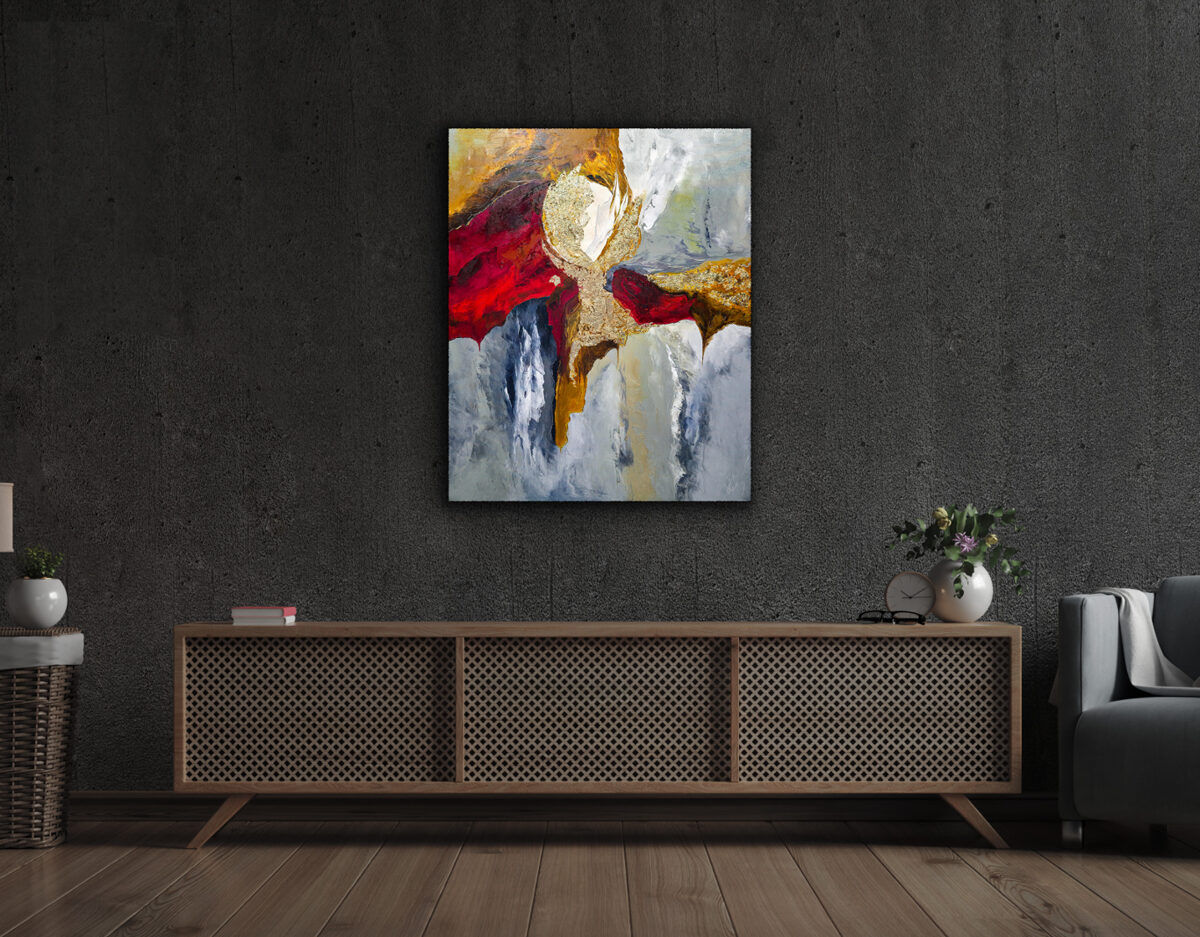
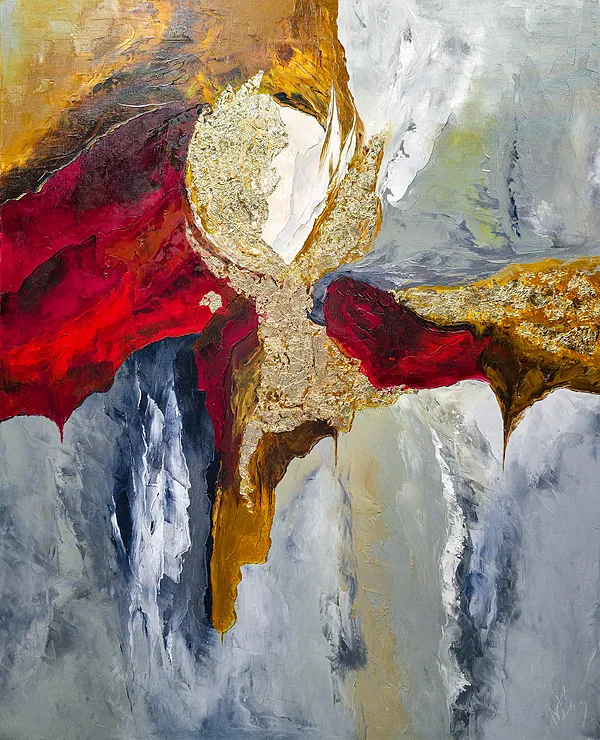
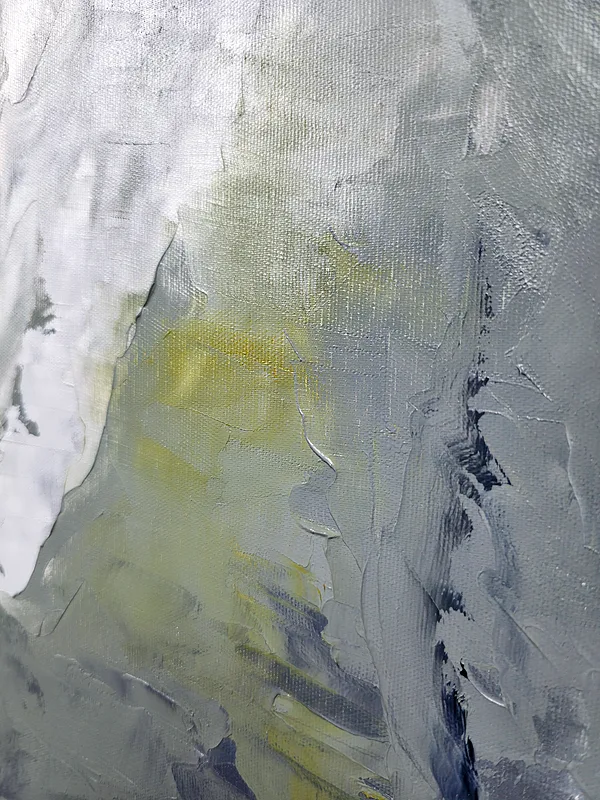
At the centre of the composition, a golden-white form unfolds, evoking a flame, a wing spreading wide, and a radiant apparition enveloped in light. Around it, sweeping forms of crimson and carmine unfurl like wings. The movement from the red, wing-like expanse towards the golden centre becomes a painterly echo of the seraph’s approach, while the colour of the flame embodies the power of a purifying touch. In the upper region, a space of white and silvery grey opens out beside the gold, arching above the central apparition like a celestial vault.
The painting’s biblical resonance lies in the prophetic calling of Isaiah, when the heavenly vision becomes a divine commission.
“Whom shall I send, and who will go for us?” comes the divine question, to which Isaiah replies: “Here am I; send me.” (Isaiah 6:8, KJV)
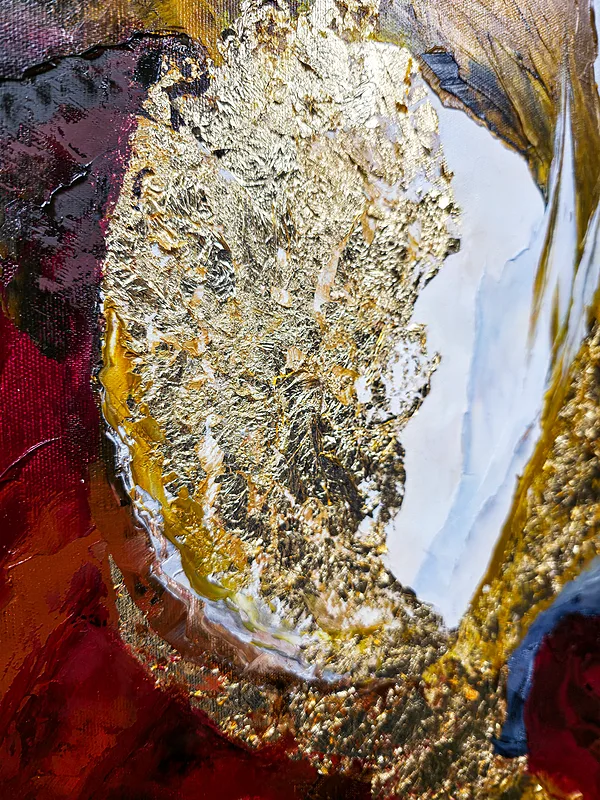
Nestled within the radiant centre rests a white seed, its softly curved shape almost embryonic. Around it, the granular gold closes like a protective sheath enclosing life: at once seed coat, womb, and sanctuary, guarding the mystery taking shape within. The white form has already come into being in the invisible realm and is now poised to unfold towards the light. It is as though the Word itself were being conceived in the heart of the painting.
The stream of light descending from the gold symbolises the earthly journey of the divine Word, while the blue-grey depths evoke the weight of the human world. Crimson and carmine embody the force of prophetic fire, gold the glory of heaven, and white the purity of the Word coming into being. The prophecy thus becomes an image of a calling born of vision: the divine message touches the human being, takes shape within, and then sets forth into the world through the spoken word.
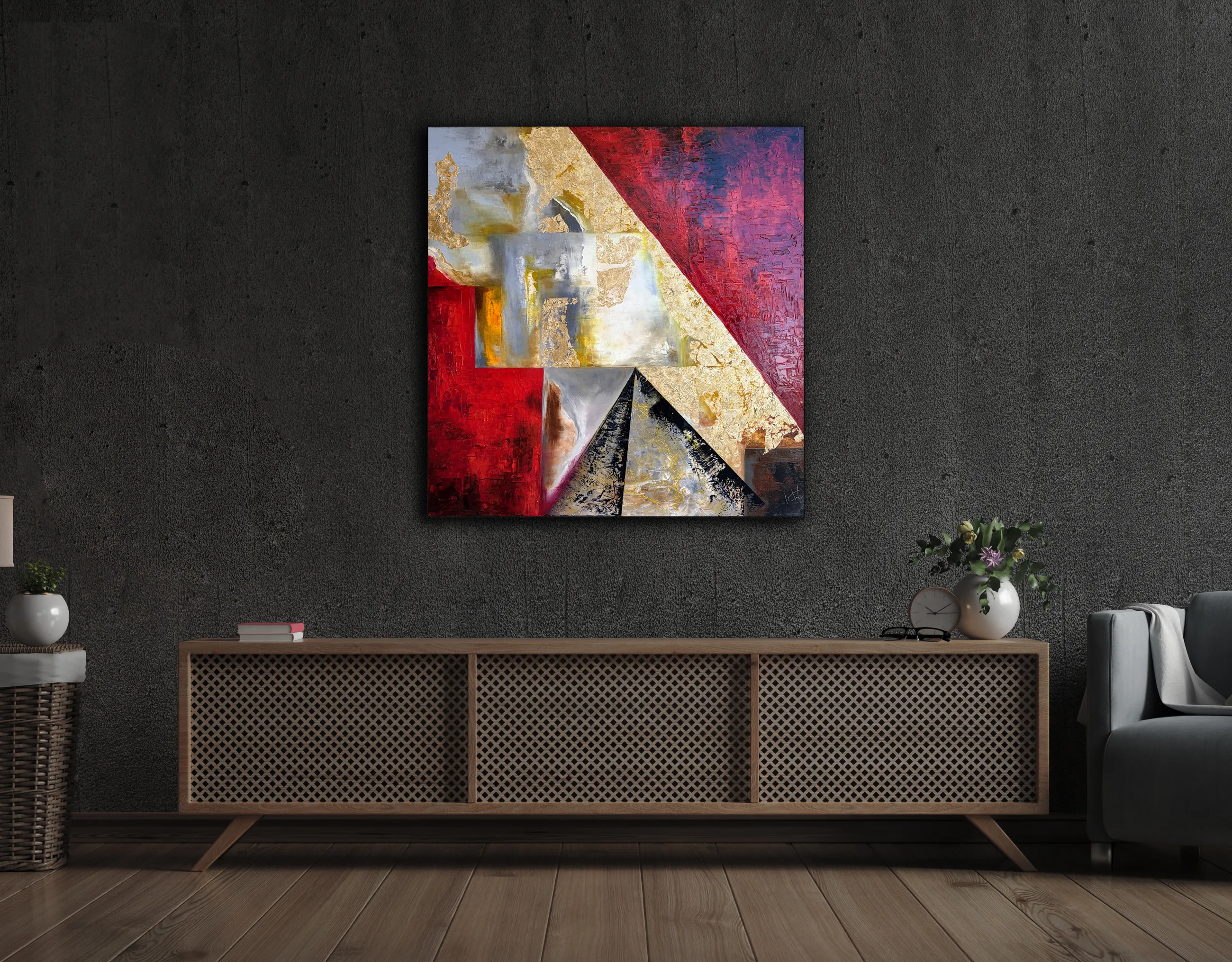
The Geometry of Light
- 100 x 100 cm
- Oil and gold on canvas
- Created: Sitges, 2026
- PRIVATELY OWNED
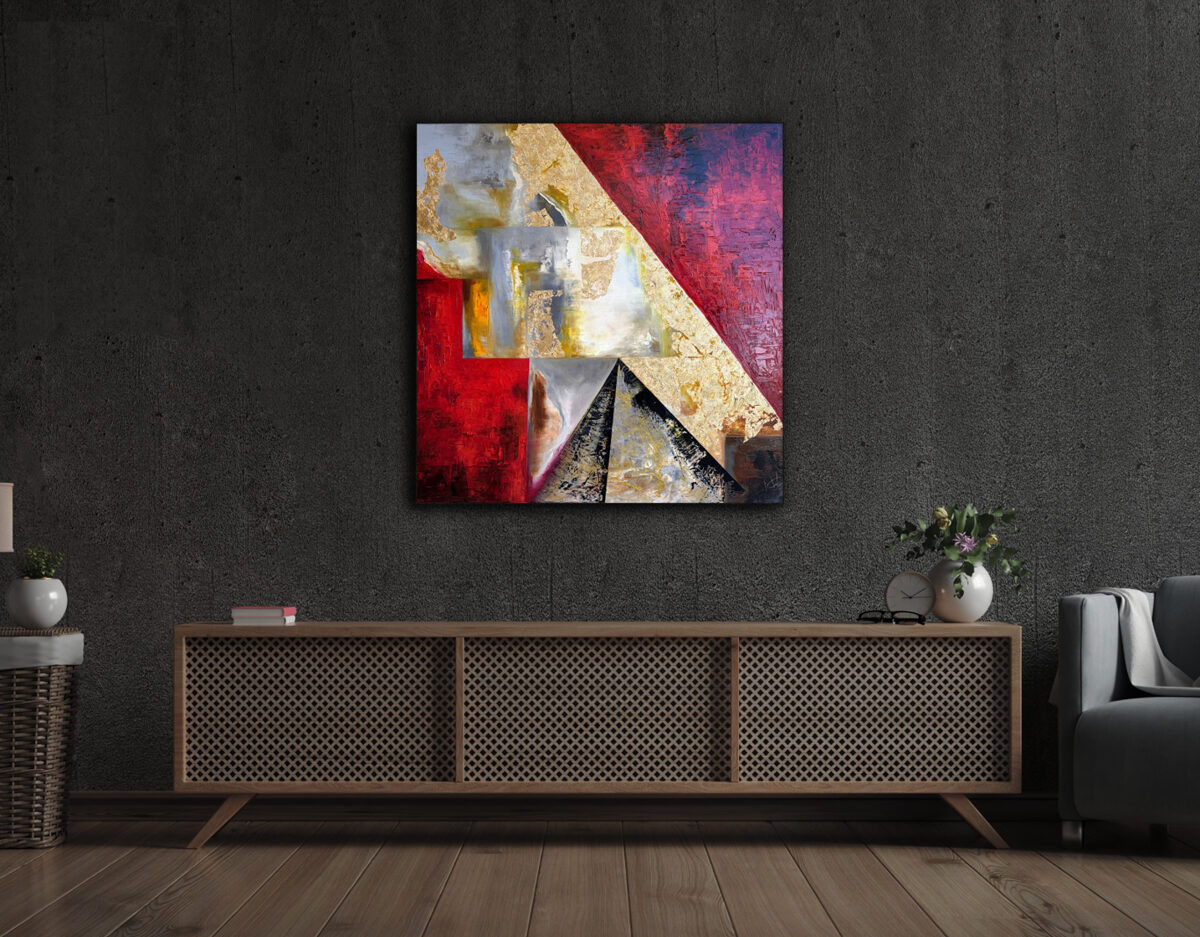
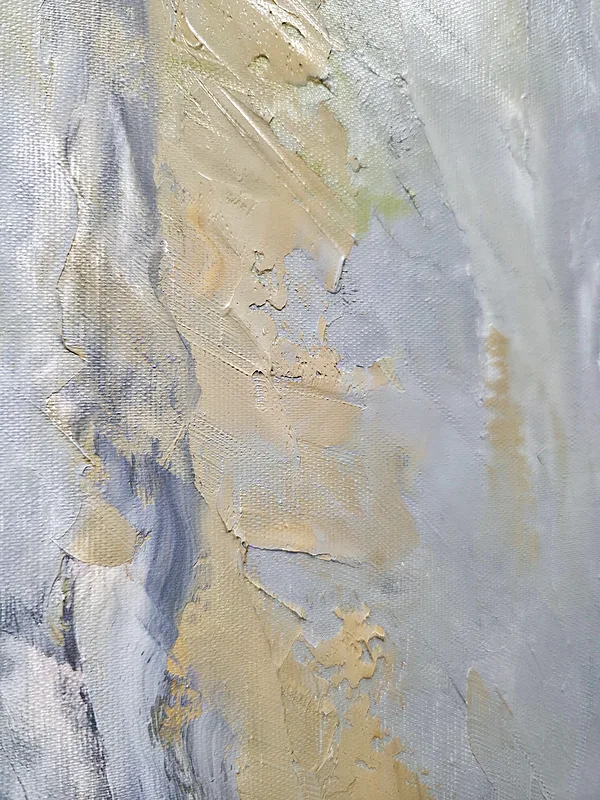
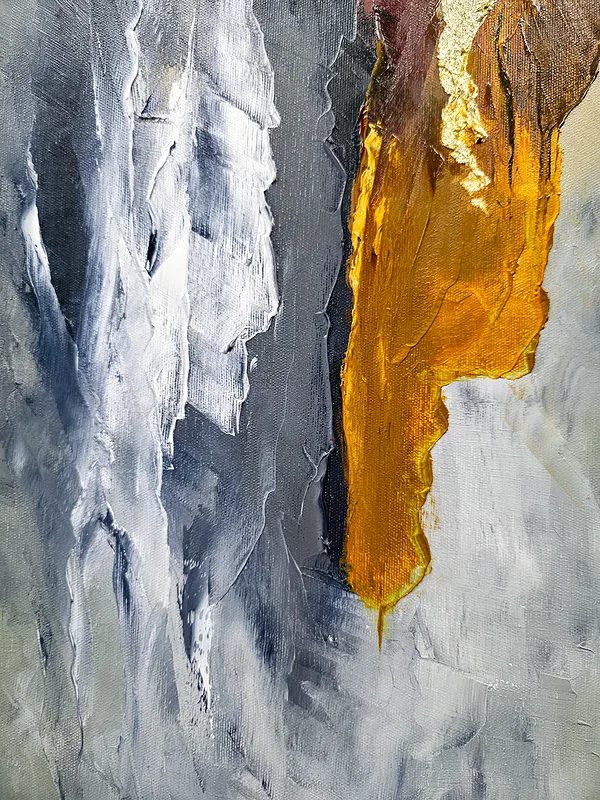
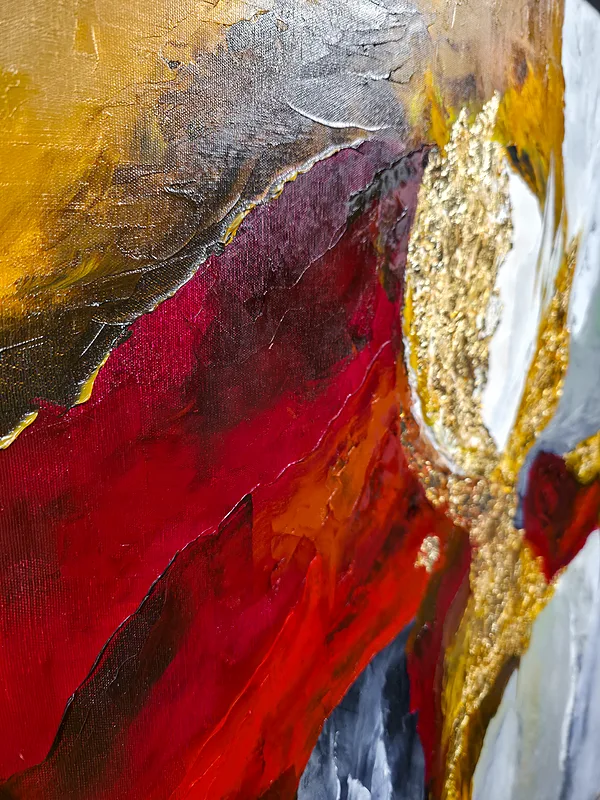
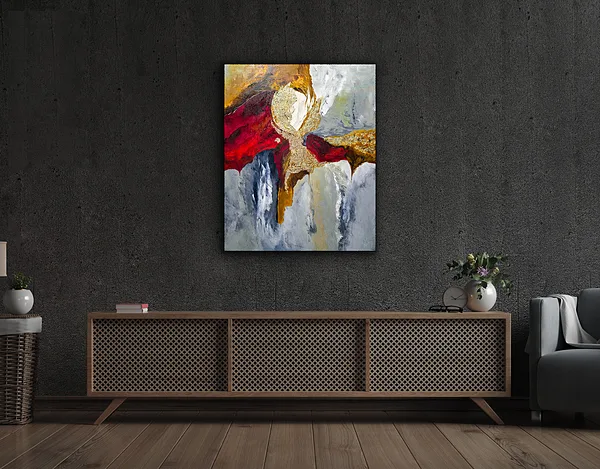
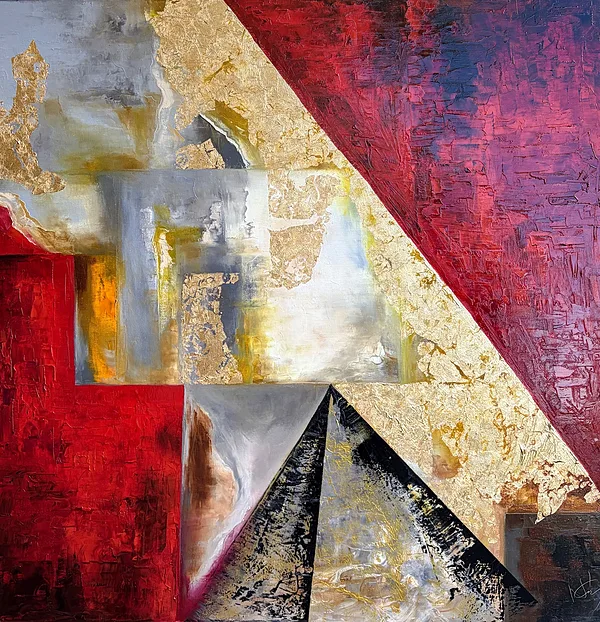
Emerging from radiant layers of gold, crimson-tinged depths, and pearlescent tones, the composition reveals the sacred structure of the earthly world. Divine will unfolds through space as light governed by geometric law and disciplined order, echoing the harmony of creation preserved in Scripture:
“Thou hast ordered all things in measure and number and weight.” (Wisdom 11:20, KJV)
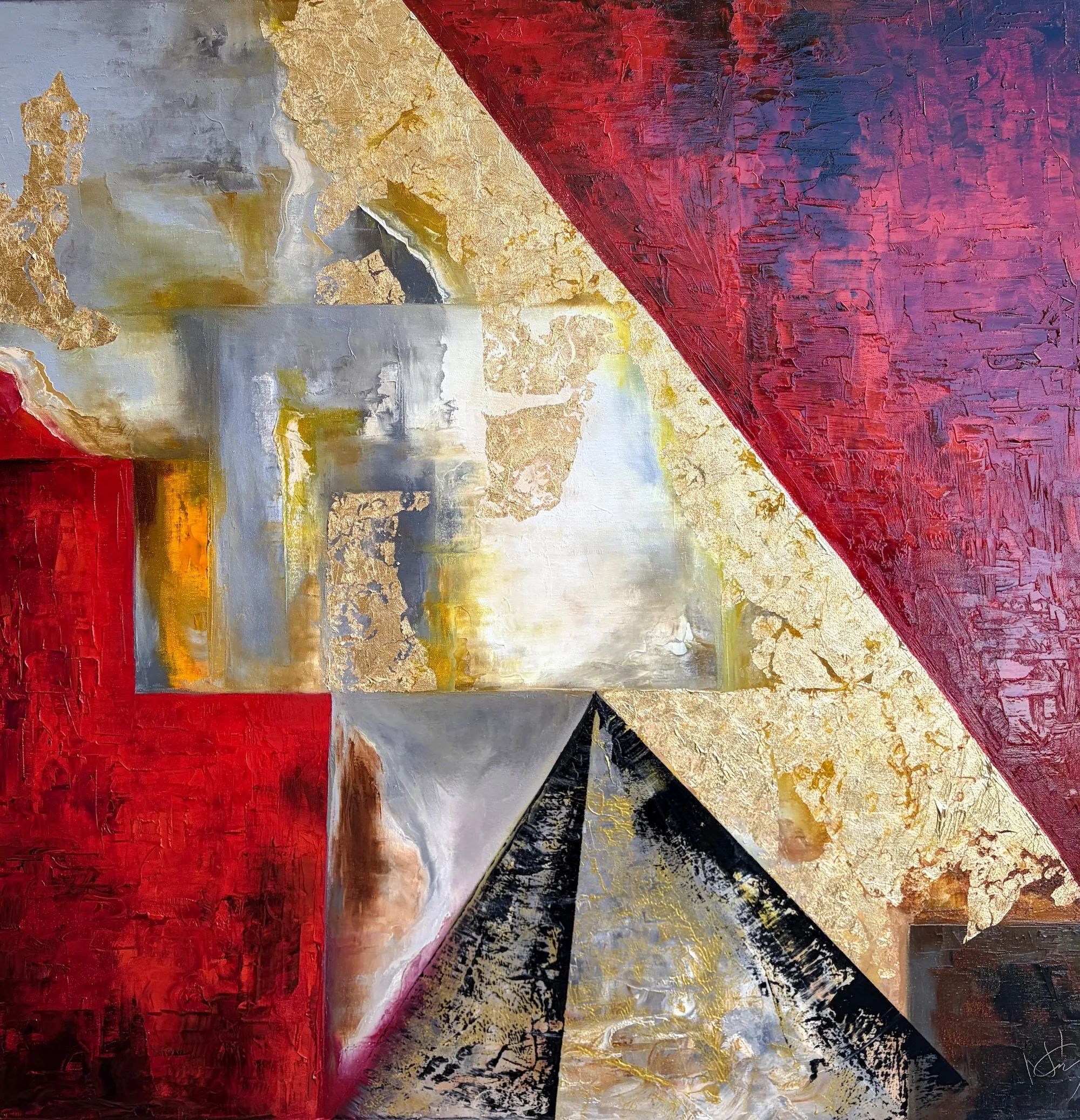
Rising from the centre of the composition, a monumental pyramidal form evokes the ancient memory of sacred mountains.
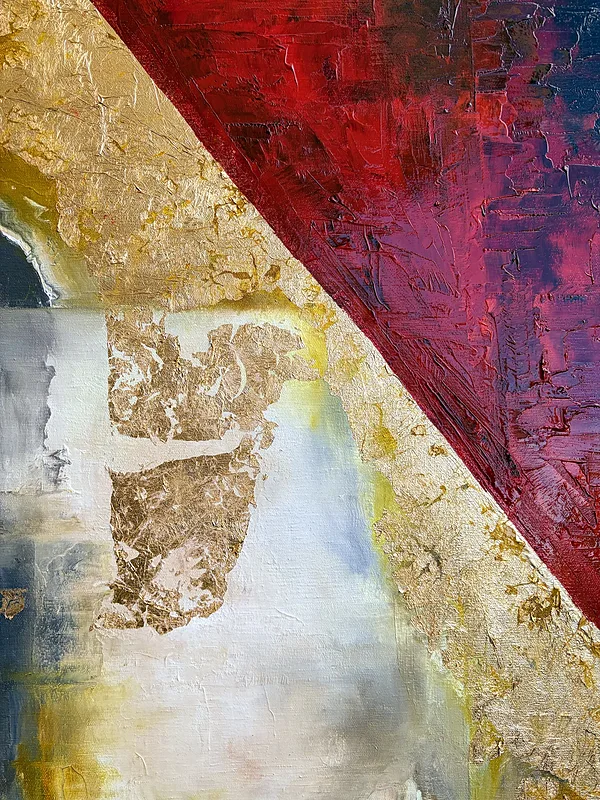
In the upper right, layers of glowing red, tending towards ruby, drape themselves over the composition like a royal mantle.
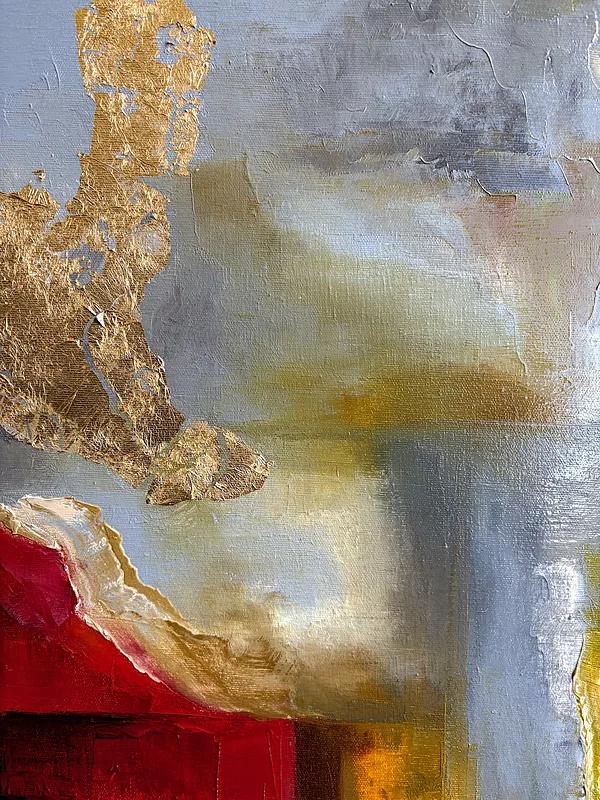
In the central region, translucent forms float and unfold against the golden background, their surfaces shimmering with pearlescent light. Their silvery-white gradations evoke the radiance of the glorified Jerusalem and the promise of the heavenly gates.
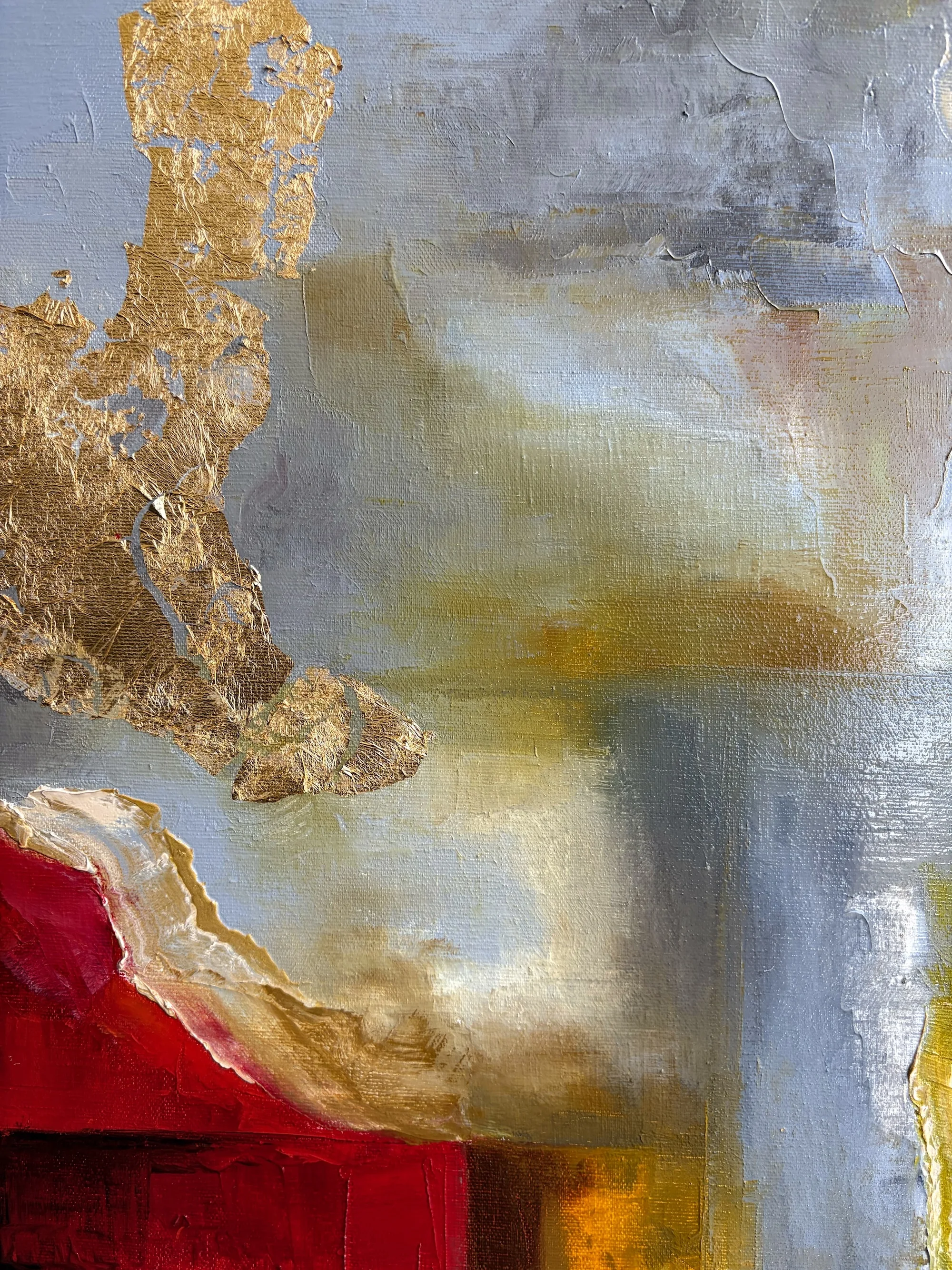
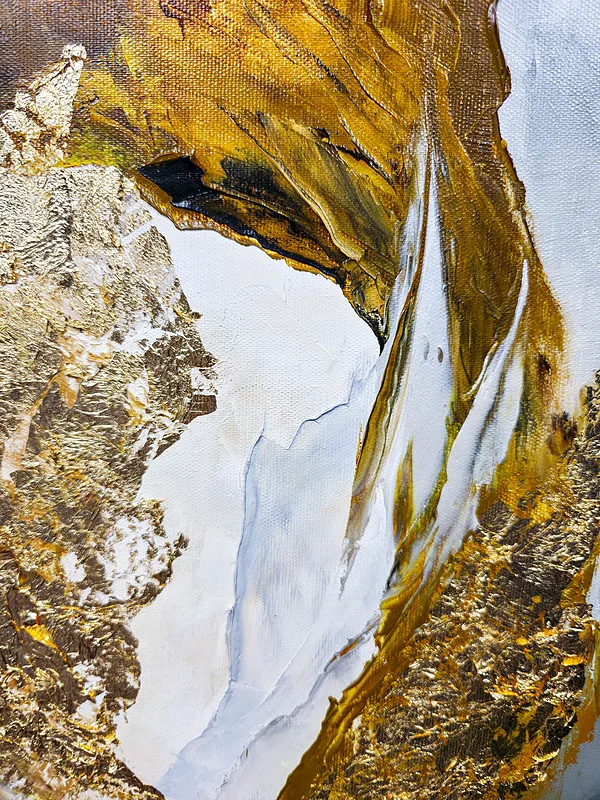
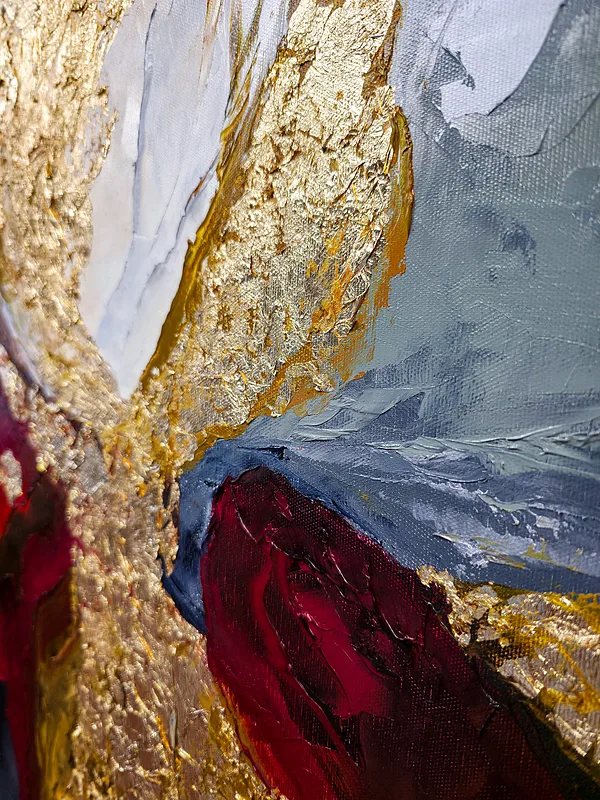
A diagonal band of gold traverses the centre of the painting, creating a transition between the earthly and heavenly realms. The fissures in its richly granulated texture preserve traces of glorification and grace. Gold embodies the power of light condensed into matter, while also recalling the sacred radiance of Byzantine icons.
The deep burgundy, the almost black tones of the lower region, and the grey square in the bottom right evoke the weight of earthly existence.
The disciplined order of light and geometry elevates the painting into a vision of the sacred structure of creation: form emerges from chaos, and light calls all things into order. The wisdom of creation finds expression in the Psalmist’s words: “O LORD, how manifold are thy works! in wisdom hast thou made them all” (Psalm 104:24, KJV). The majesty of divine light is evoked in the declaration: “Who coverest thyself with light as with a garment” (Psalm 104:2, KJV).
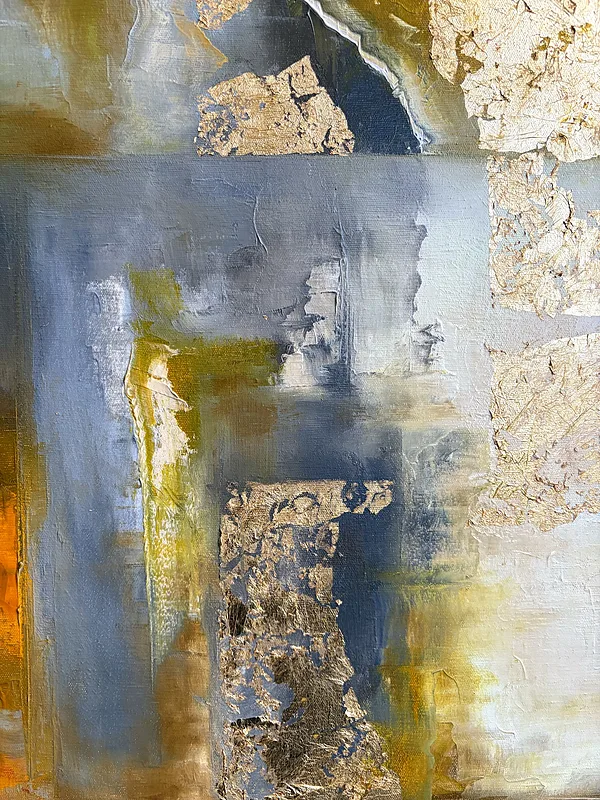
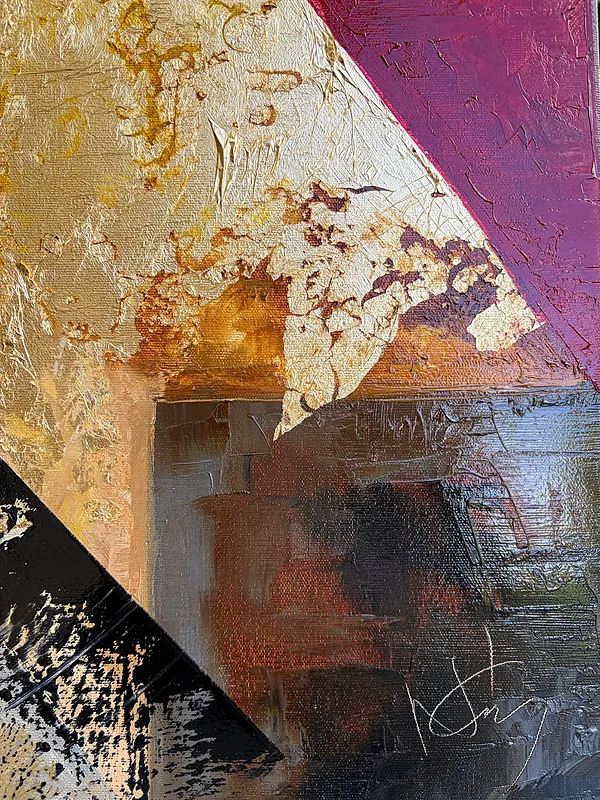
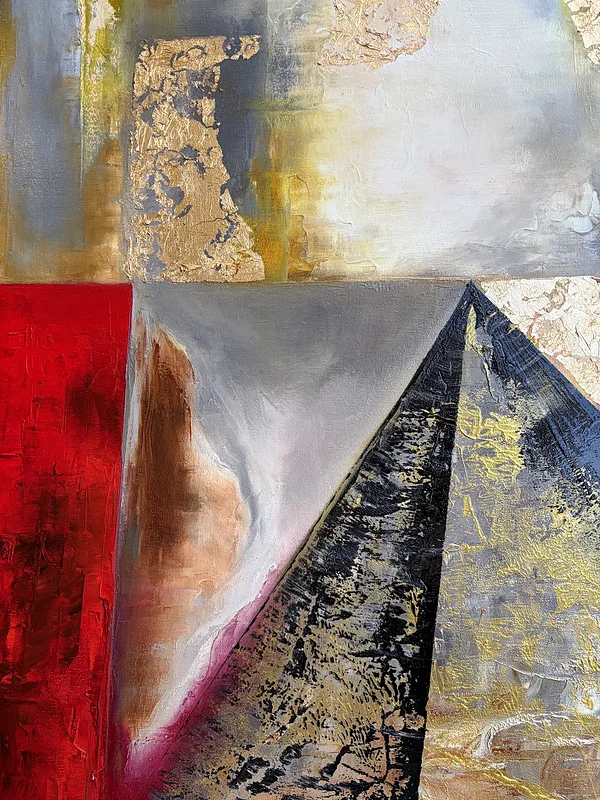
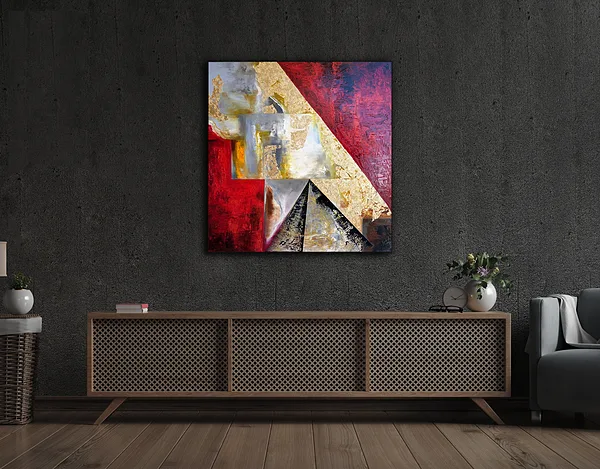
Esther's Secret
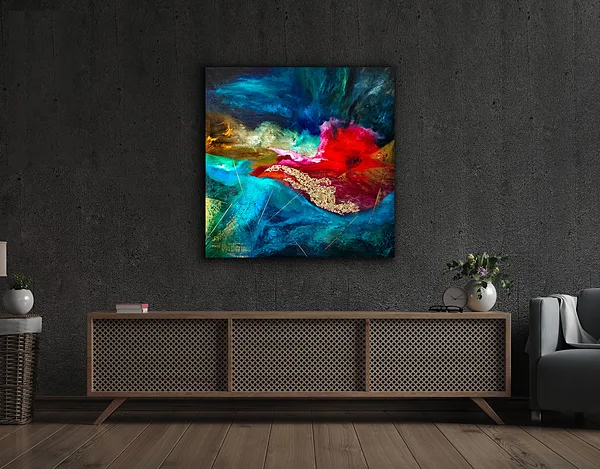
- 120 x 120 cm
- Oil and gold on canvas
- Created: Sitges, 2026
- The artwork is part of the 'Old Testament III - In Search of the Secrets of Eternity' cycle
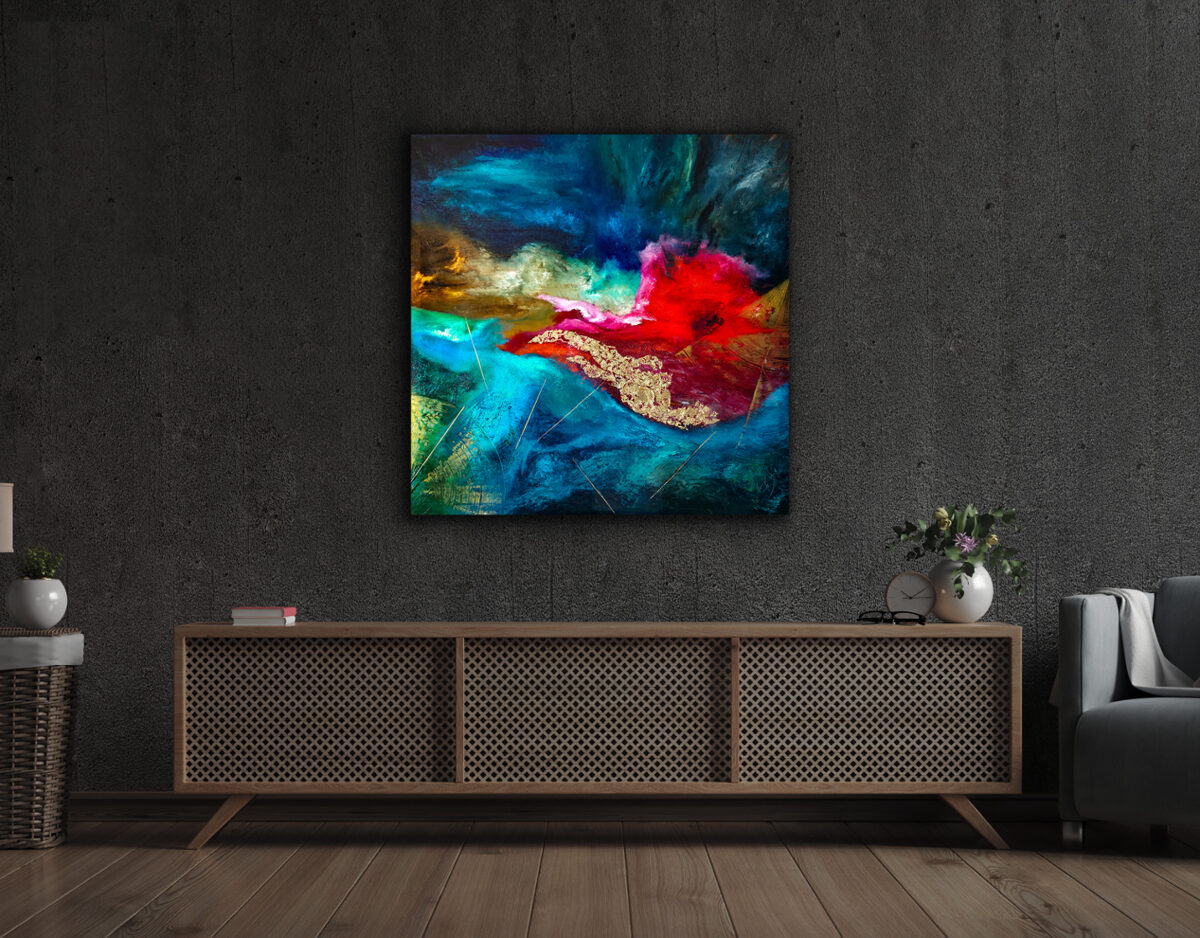
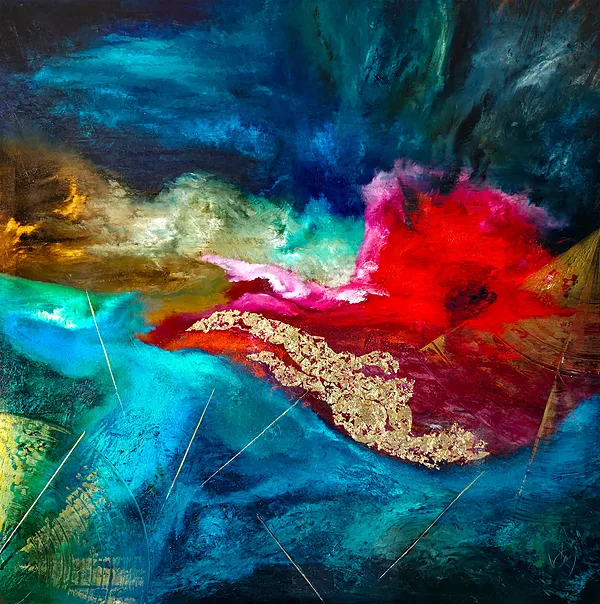
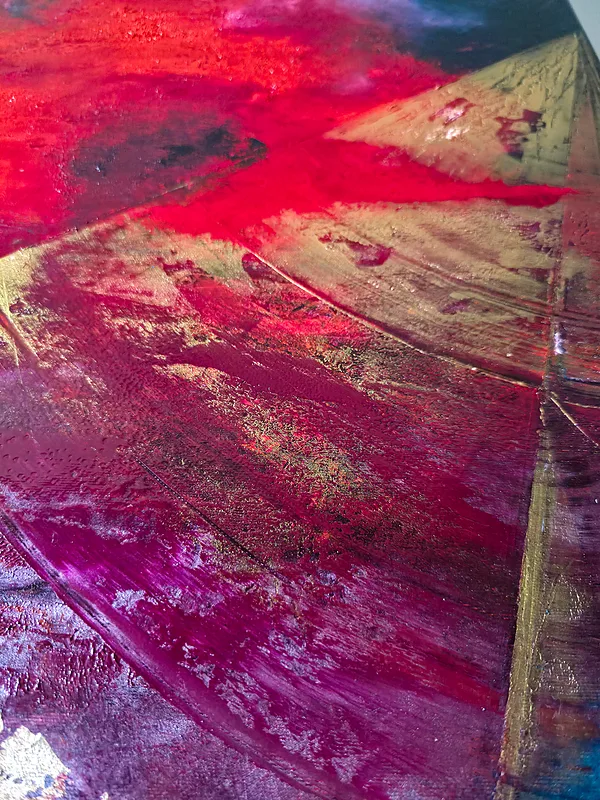
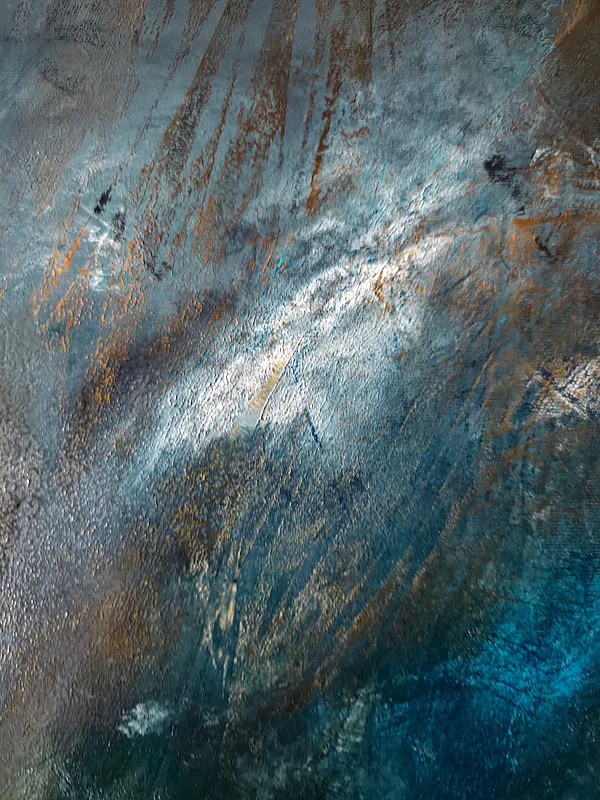
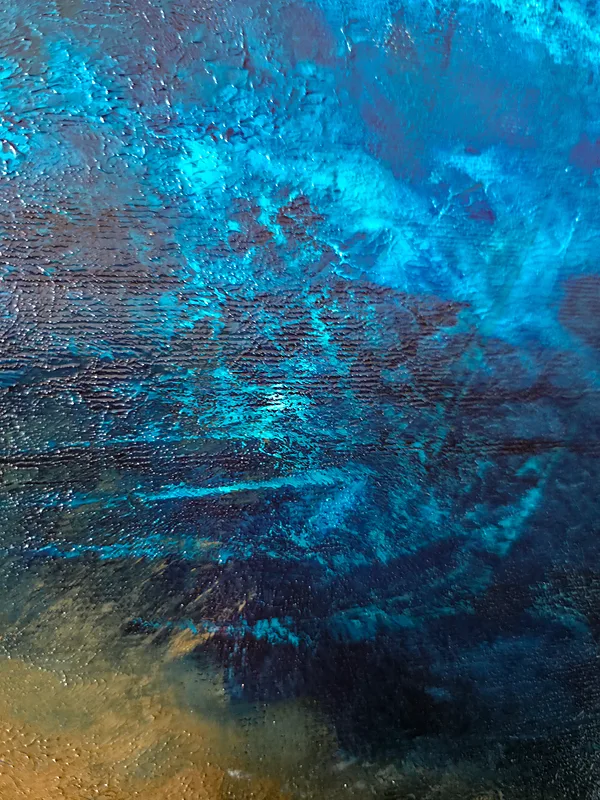
The painting evokes the story of Esther, the Jewish woman who concealed her origins and became queen of Persia, whose courageous intervention led to the deliverance of her people. The deep blue and indigo expanses of the upper region embody the mysterious order unfolding behind historical events. Emerging from layers of golden ochre and ivory, lighter fields evoke Esther’s dual position: the splendour of royal dignity and the hidden identity of a woman who guards the secret of her origins.
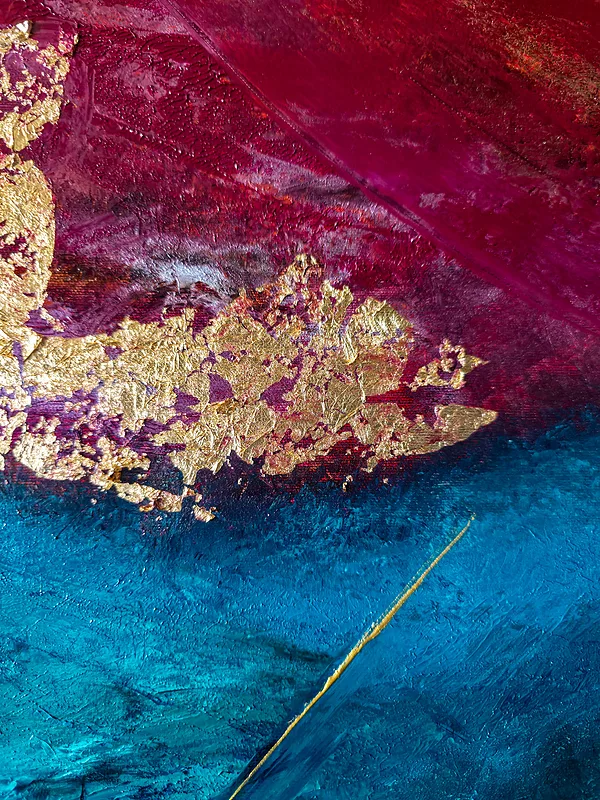
On the right side of the composition, a surge of scarlet and crimson concentrates the menace of Haman’s destructive plot. The convex golden surface extending diagonally across the centre evokes the royal sceptre, whose touch marked the moment of grace and deliverance for Esther. The golden-ochre triangle on the right also recalls the power of the Persian court and the majesty of the royal office.
The queen accepted the danger and interceded with the king on behalf of her people: “If I perish, I perish.” (Esther 4:16, KJV). These words embody the dignity of self-sacrifice and the responsibility one assumes for the fate of others.
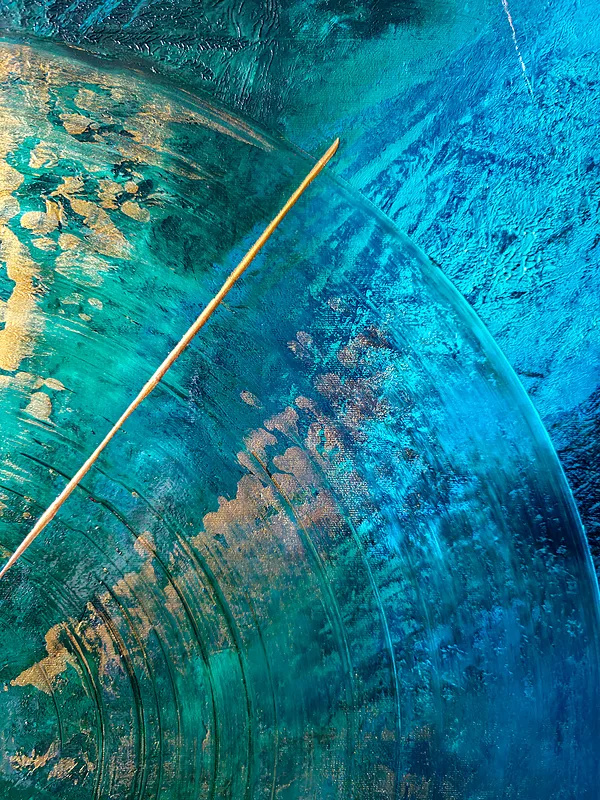
The undulating turquoise, cyan, and ultramarine in the lower part of the painting evoke Esther’s unblemished purity and the grace that ultimately preserved her life. In the lower left corner, an arcing form articulated with flecks of gold suggests protection and life preserved. As colours and directional movements converge, a tension unfolds between threat and deliverance, vulnerability and courage. The deliverance of a people condemned to destruction is commemorated in the festival of Purim.
The painting elevates Esther’s story into a universal parable of personal responsibility: dignity reaches its fulfilment when one places one’s own fate in the service of saving others.
King Josiah ("...let no one make his son or daughter pass through the fire to Molech!")
- 45 x 45 cm
- Oil and gold on canvas
- Created: Sitges, 2026
- The artwork is part of the 'Old Testament III - In Search of the Secrets of Eternity' cycle
- AVAILABLE FOR PURCHASE
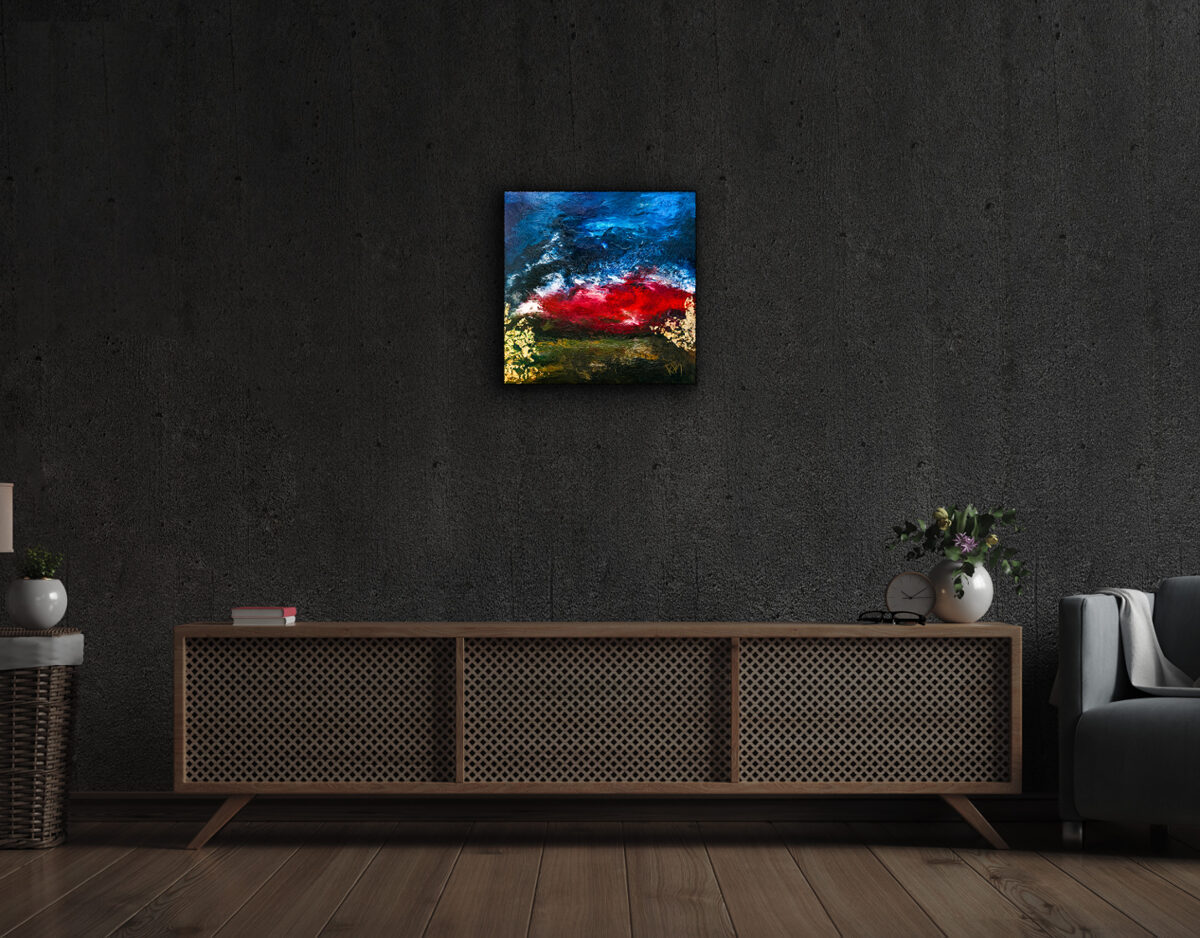
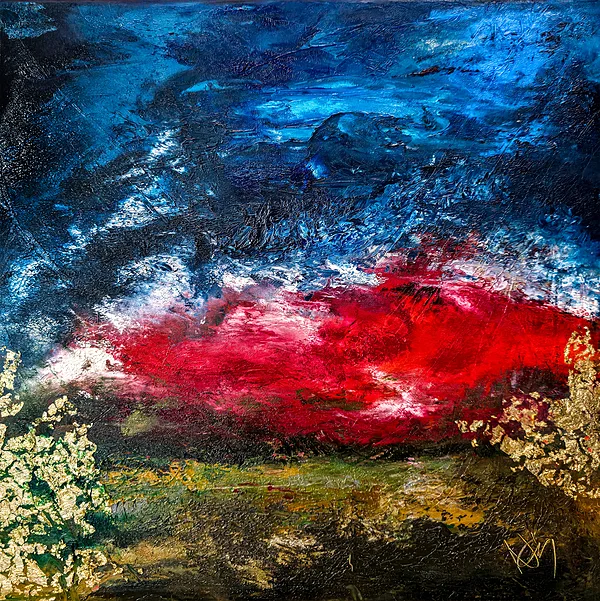
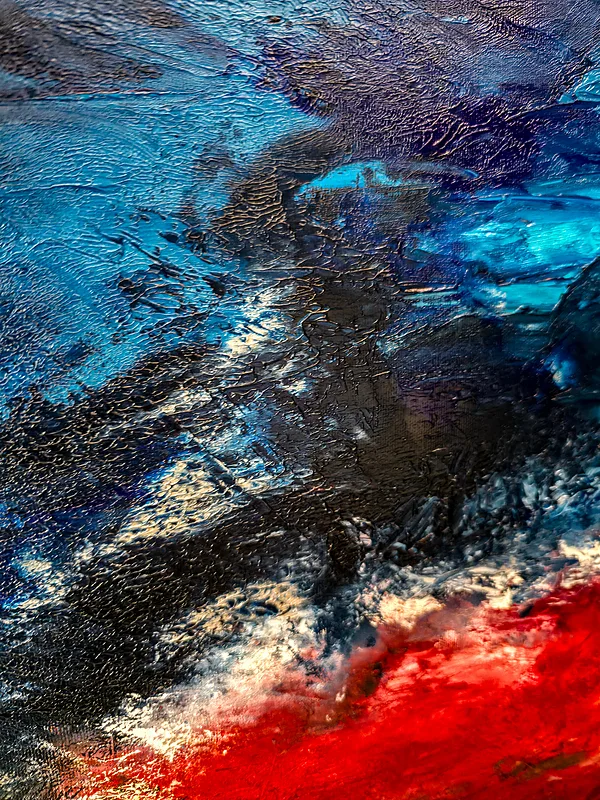
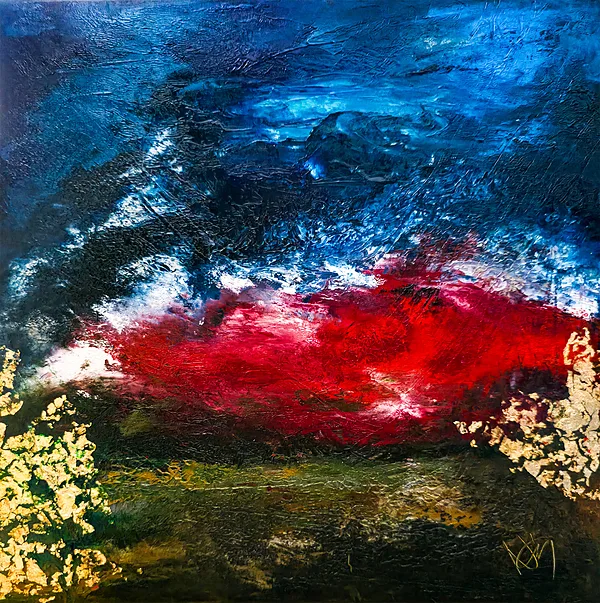
In the artist’s vision, one of the Bible’s most profound moral turning points unfolds: King Josiah confronts the horrific practice of child sacrifice, purges the sacred sites of Judah of foreign cults, and calls his people to renew their covenant with the Eternal. Amid swirling indigo, fissures of silvery light, and verdant earth tinged with gold, the moral transformation of an entire age comes into view. The Bible praises the king in exceptional terms:
“And like unto him was there no king before him, that turned to the LORD with all his heart, and with all his soul, and with all his might, according to all the law of Moses.” (2 Kings 23:25, KJV)
In the eighteenth year of Josiah’s reign, during the restoration of the Temple in Jerusalem, Hilkiah the high priest discovered the Book of the Law of the LORD. When Shaphan the scribe read its words before the king, Josiah recognised how far his people had strayed from their covenant with the Eternal. He ordered the destruction of the altars and sanctuaries associated with foreign cults. The Second Book of Kings records the cleansing of Topheth in these words:
“And he defiled Topheth, which is in the valley of the children of Hinnom, that no man might make his son or his daughter to pass through the fire to Molech.” (2 Kings 23:10, KJV)
This biblical event forms the dramatic centre of the painting. The work also conveys the force of the moral awakening that impelled Josiah to restore the Law.
Descending from the deep blue vault above, a cobalt-blue sphere evokes the presence of the Holy Spirit. Within the composition, the memory of ancient sacrificial flames is transformed into a solemn affirmation of the sanctity of life.
The Book of Judges 11:12 (Jephthah's Vow)
- 70 x 70 cm
- Oil and gold on canvas
- Created: Sitges, 2026
- The artwork is part of the 'Old Testament III - In Search of the Secrets of Eternity' cycle
- SOLD
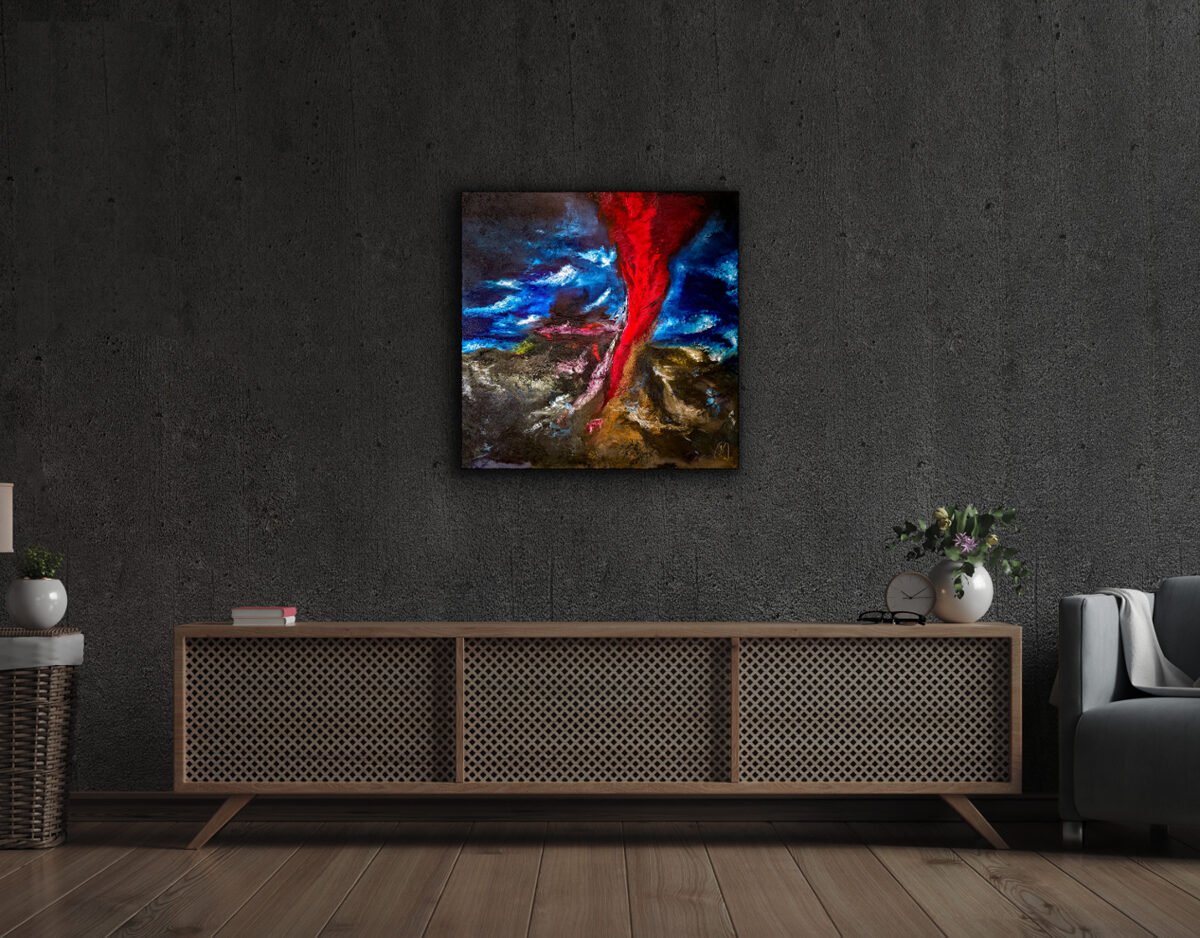
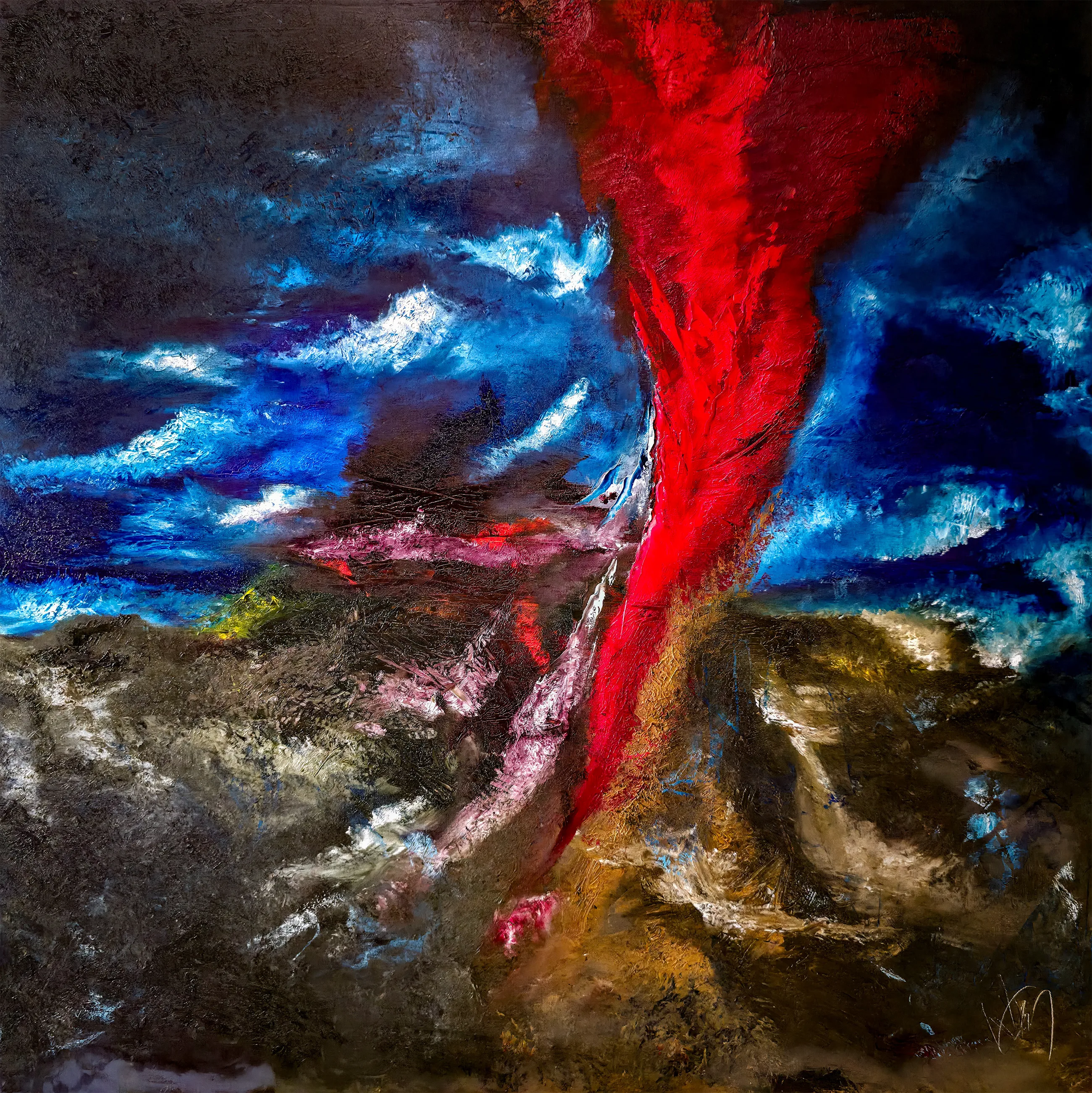
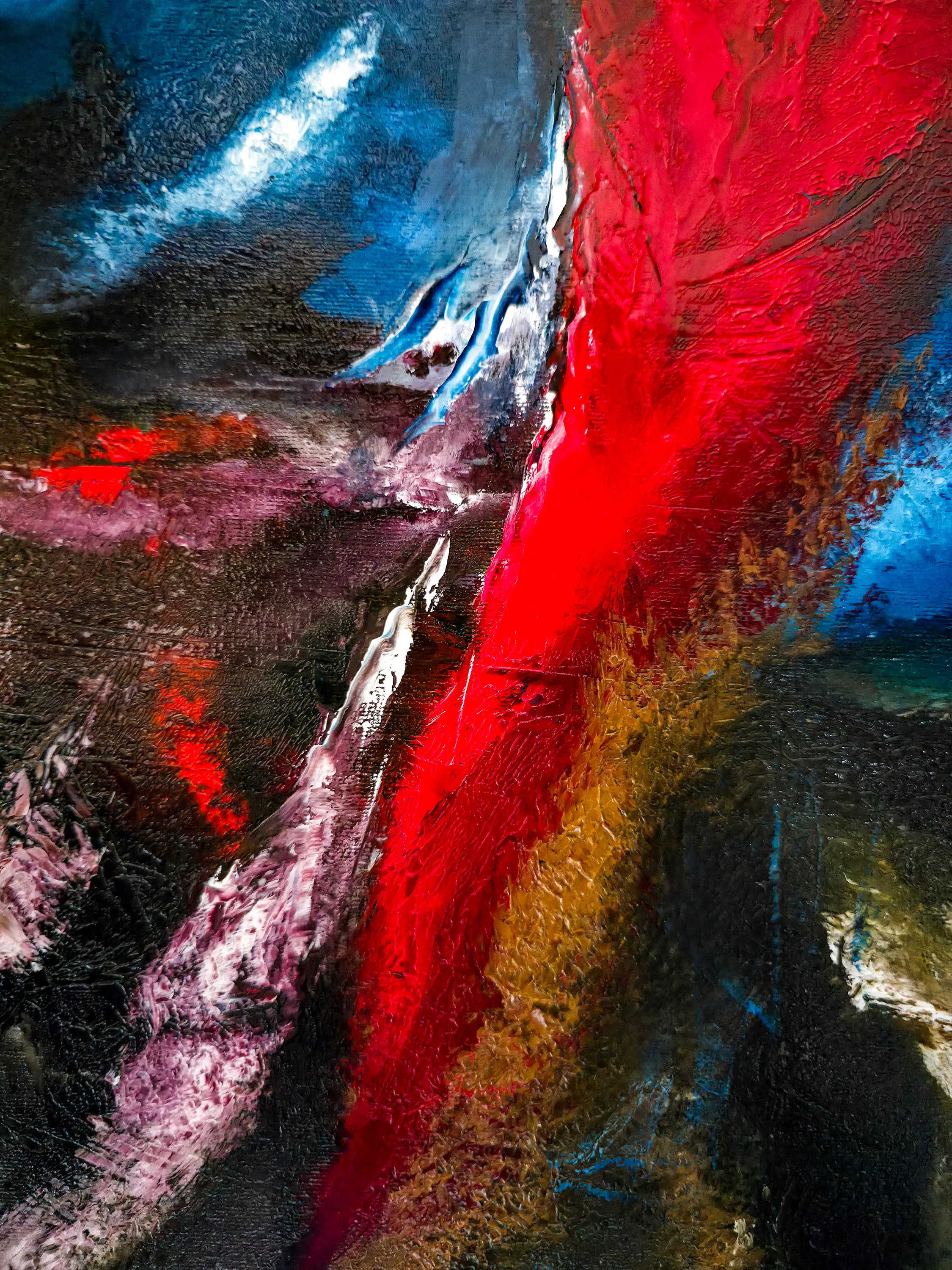
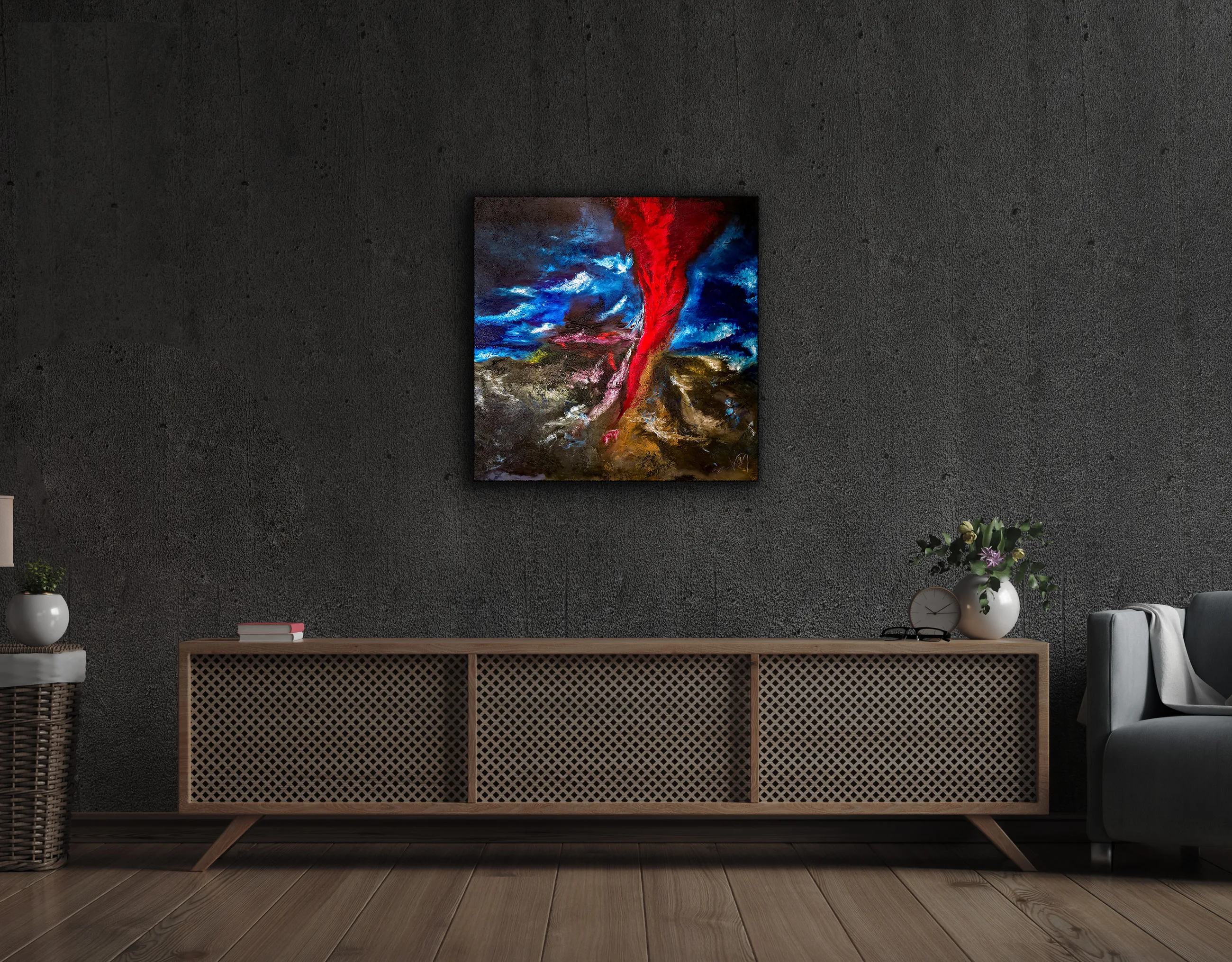
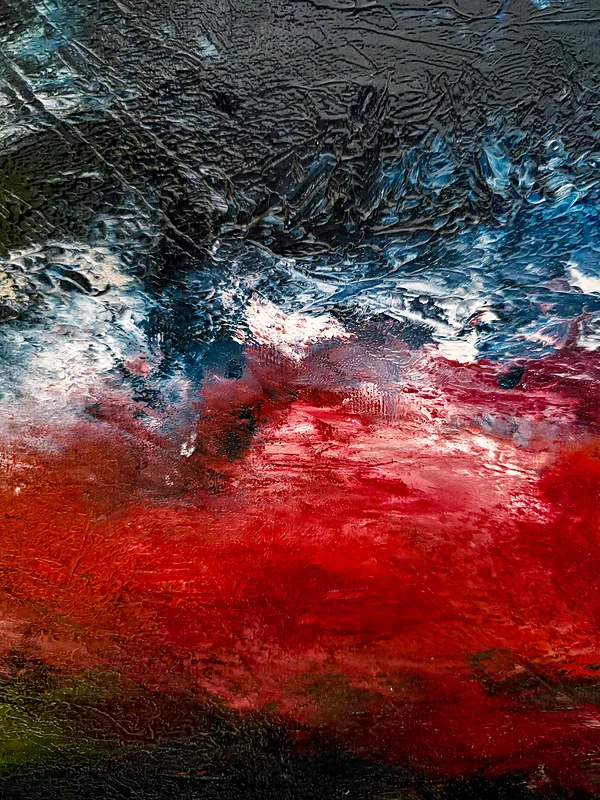
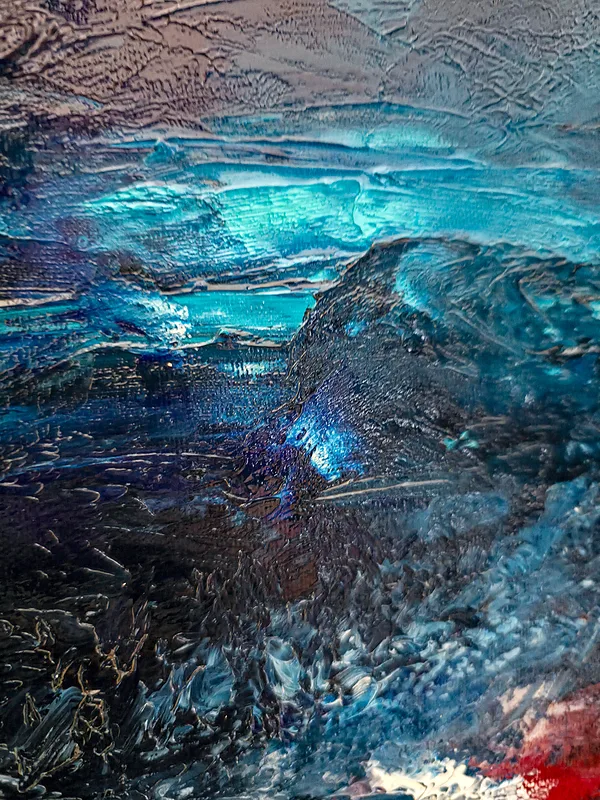
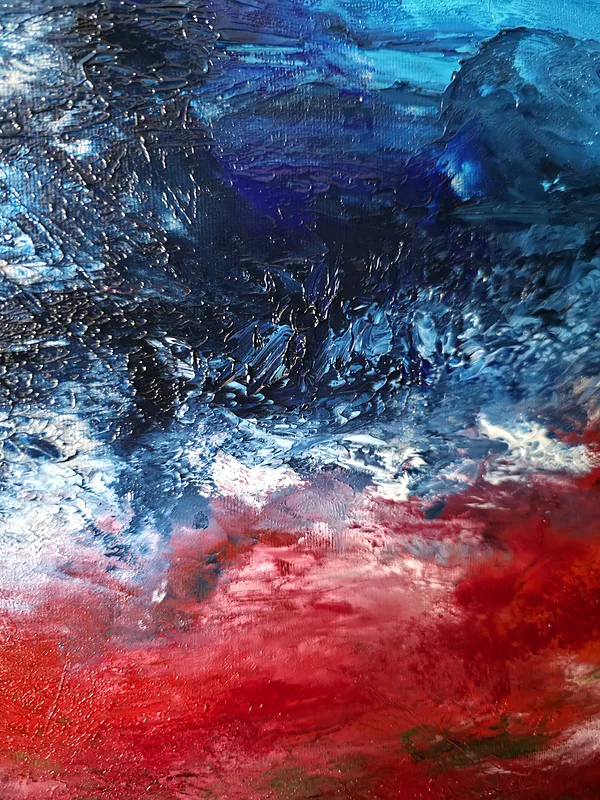
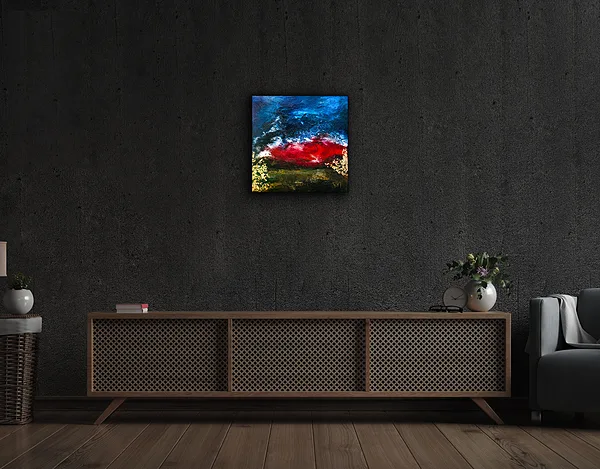
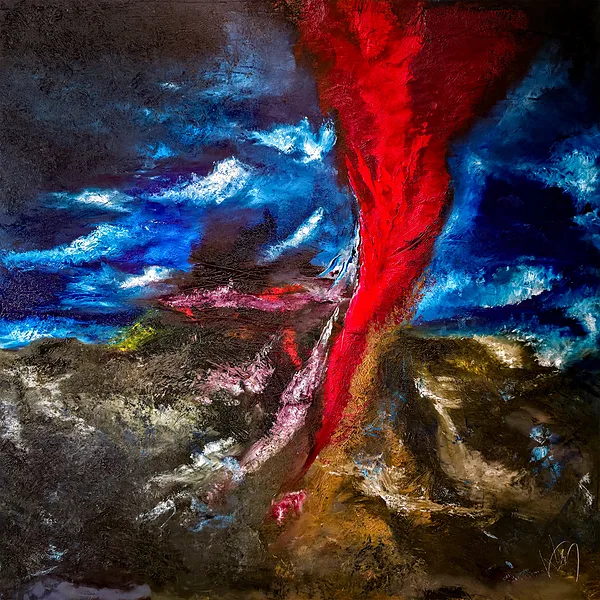
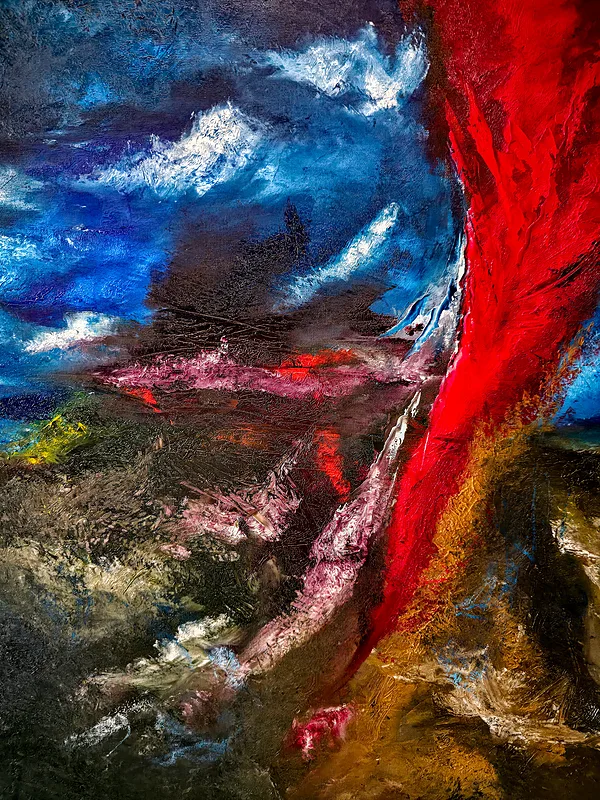
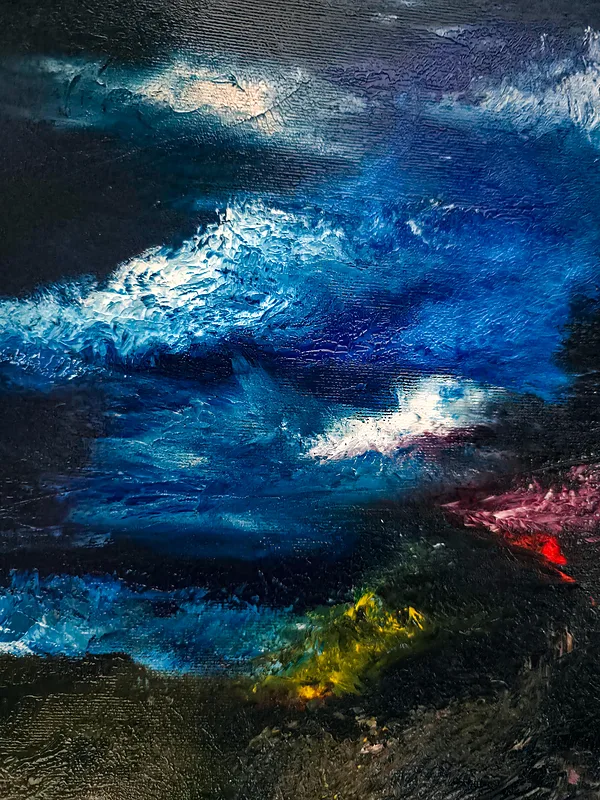
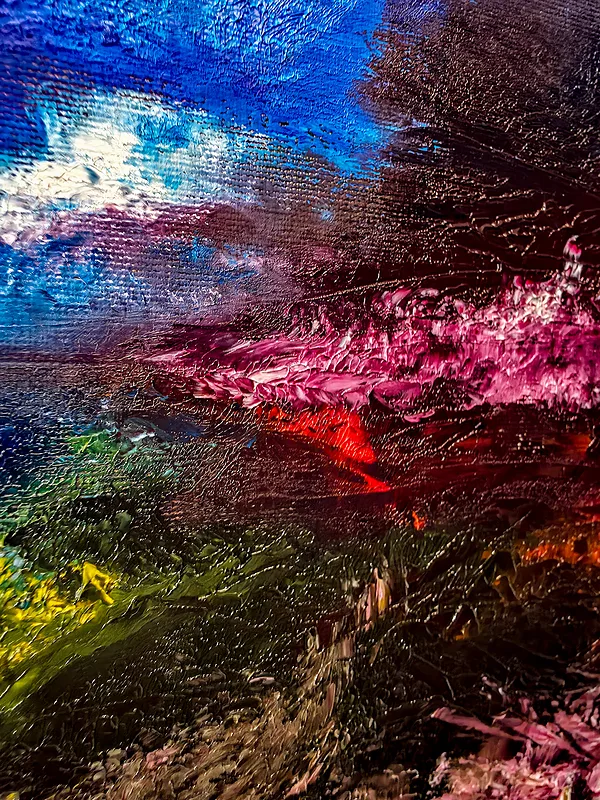
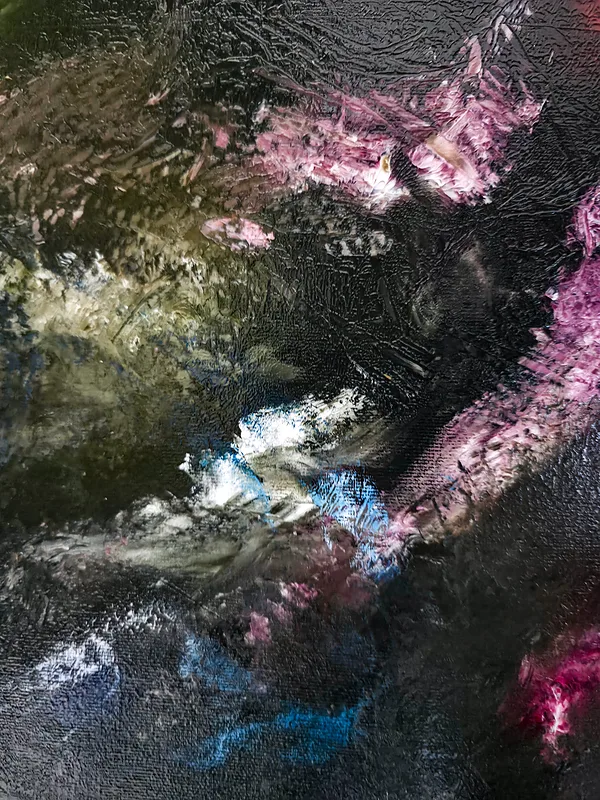
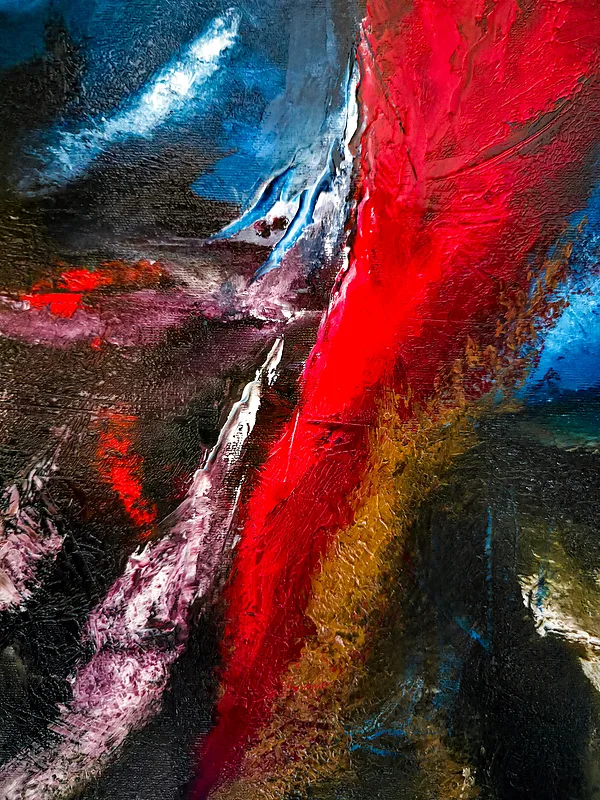
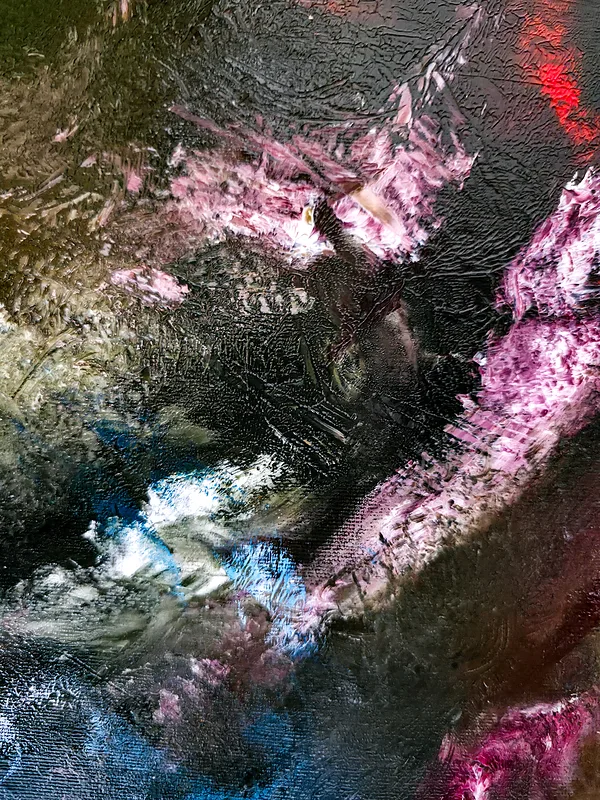
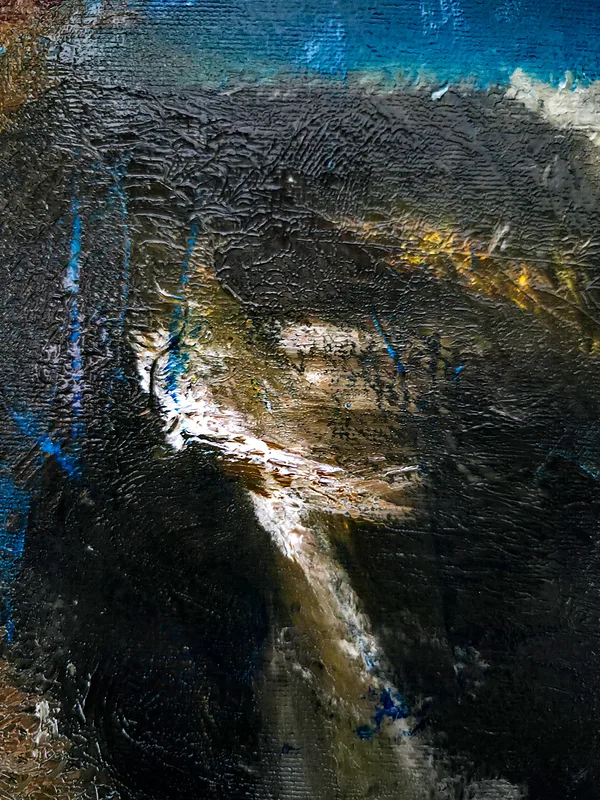
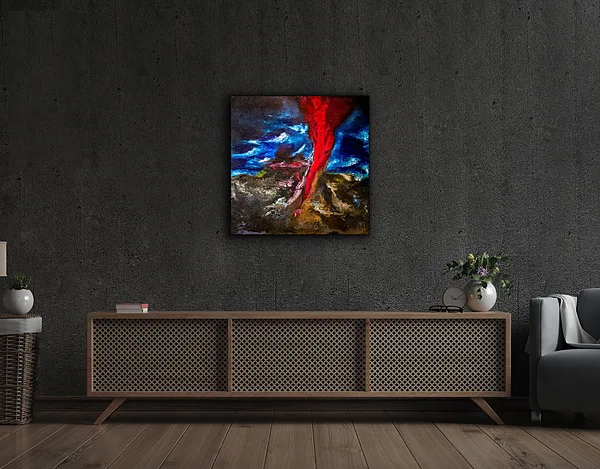
To evoke one of the most harrowing stories of the Old Testament, the artist calls upon the elemental forces of nature. Above the swirling currents of cobalt and ultramarine, the heavens split open, and a vast scarlet funnel plunges from the torn firmament into the earth with the force of a comet. Between the whirling currents of silvery light and the earth seemingly frozen in gold and bronze, fate rises like a blazing pillar of fire, condensing into a single vision the intoxication of triumph, the irrevocable weight of a spoken word, and the tragic fulfilment of a young woman’s destiny.
The painting gives visual form to the story told in the Book of Judges. Jephthah, a warrior of Gilead, had found refuge in the land of Tob. When the Ammonites threatened Gilead, the elders turned to him for help, and he rose to become the leader of his people. On the eve of battle, he made a vow to the Eternal:
“If thou shalt without fail deliver the children of Ammon into mine hands, then it shall be, that whatsoever cometh forth of the doors of my house to meet me, when I return in peace from the children of Ammon, shall surely be the LORD’s, and I will offer it up for a burnt offering.” (Judges 11:30–31, KJV)
Jephthah defeated the Ammonites, but when he returned home, his daughter came out to meet him, dancing to the sound of a tambourine.
Emerging from the dark, earthy tones, a delicate, gently curving pink form preserves the fragile presence of youth, life, and innocence. Beside the crimson vortex, this slender, silvery-shimmering shape may be read as the symbolic presence of Jephthah’s daughter.
The theological interpretation of the story remains an open question: was Jephthah’s vow fulfilled through the sacrifice of his daughter’s life, or did the sacrifice signify her permanent renunciation of marriage and motherhood, a life consecrated to God? The painting leaves this mystery unresolved, entrusting its interpretation to the viewer and preserving the harrowing ambiguity of the biblical narrative.
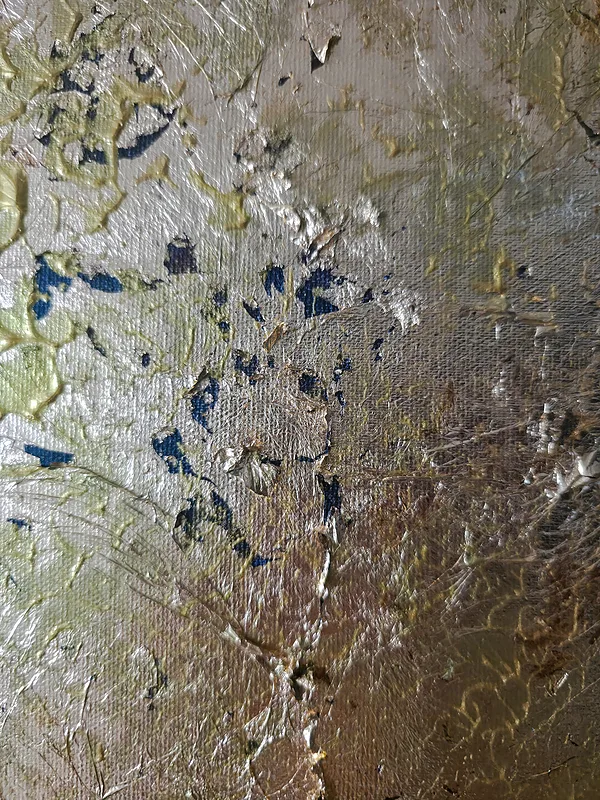
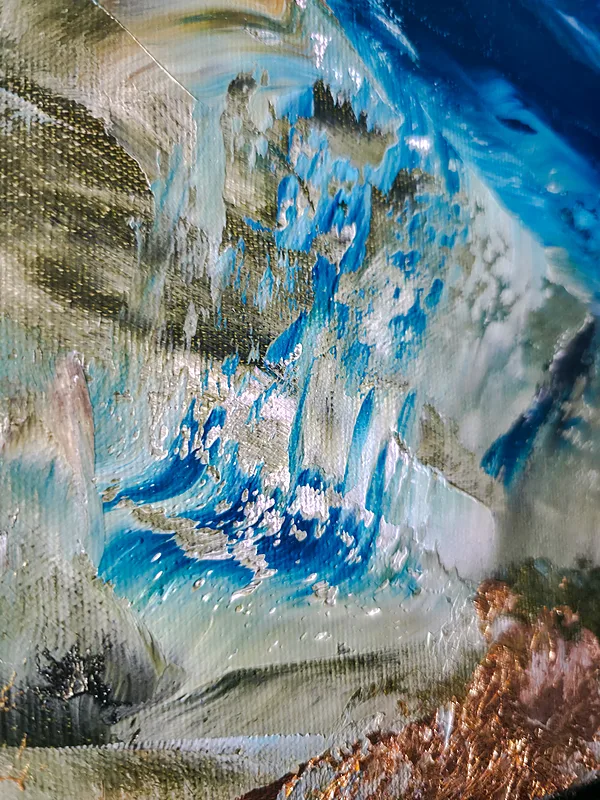
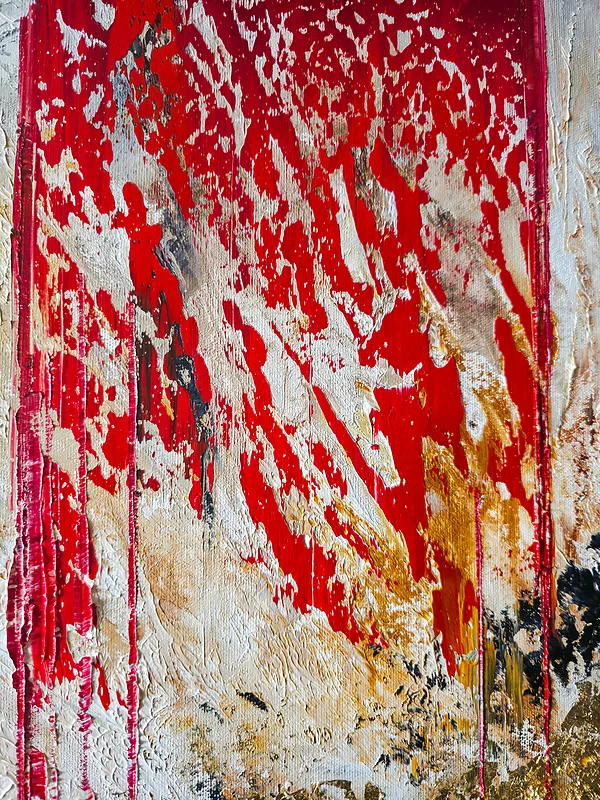
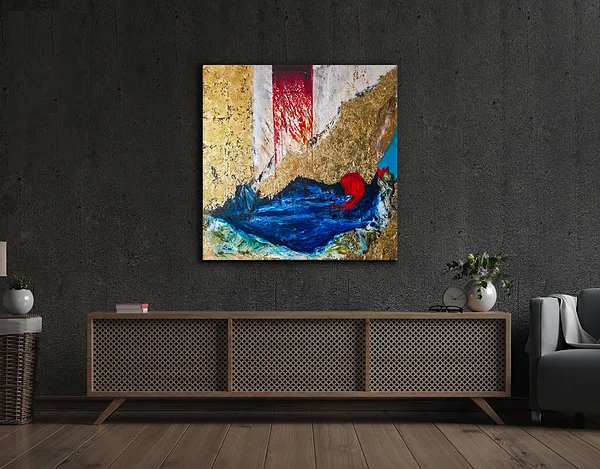
The Book of Isaiah
- 100 x 100 cm
- Oil and gold on canvas
- Created: Sitges, 2026
- The work is part of the 'Old Testament III - In Search of the Secrets of Eternity' cycle
- AVAILABLE FOR PURCHASE
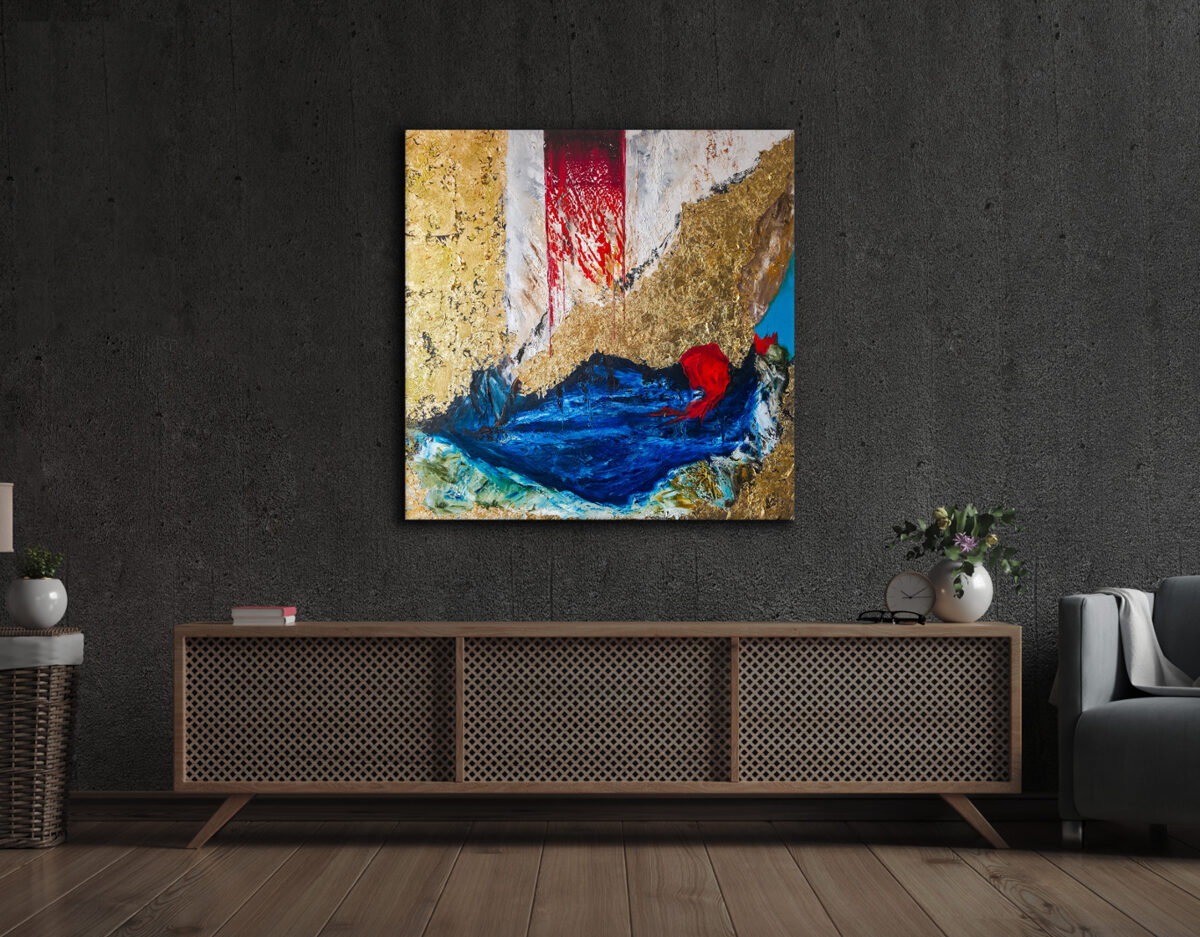
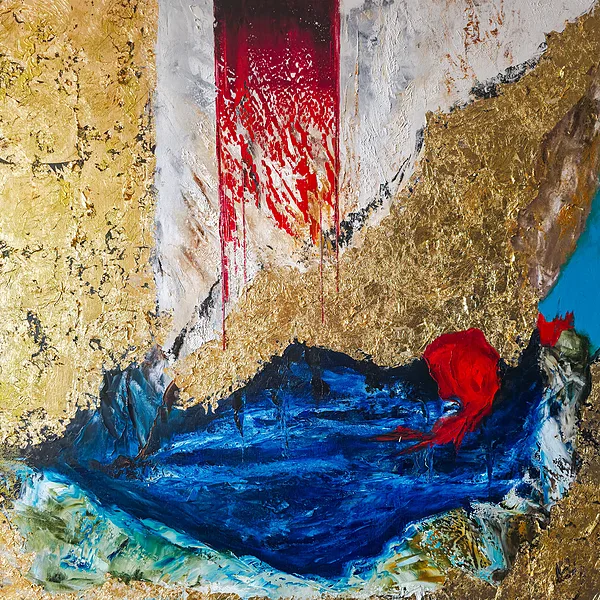
The painting evokes the prophetic world of Isaiah, where the fire of the divine utterance, judgement, and the hope of renewal converge in a single monumental composition. The prophet, who lived in the eighth century BC, becomes the voice through which the divine will is proclaimed to humanity.
On the left, a fractured golden surface recalls the walls of an ancient sanctuary. Beside it, a crimson structure rises amid ridged layers of silvery-white paint, its flowing, fiery forms evoking the glowing coals of the heavenly altar. In Isaiah’s vision, a seraph takes a burning coal from the altar and touches the prophet’s lips, purifying him for his divine calling:
“Here am I; send me.” (Isaiah 6:8, KJV)
The great mass of gold rising diagonally on the right evokes both Jerusalem in tribulation and Zion renewed. Its cracked surface bears the wounds of history, while its radiance preserves the hope of a future yet to come. The lower portion of the canvas is dominated by undulating masses of deep blue, cobalt, and ultramarine. Water surging from the depths evokes the fulfilment of Isaiah’s prophecy: the wilderness brought back to life.
“For in the wilderness shall waters break out, and streams in the desert.” (Isaiah 35:6, KJV)
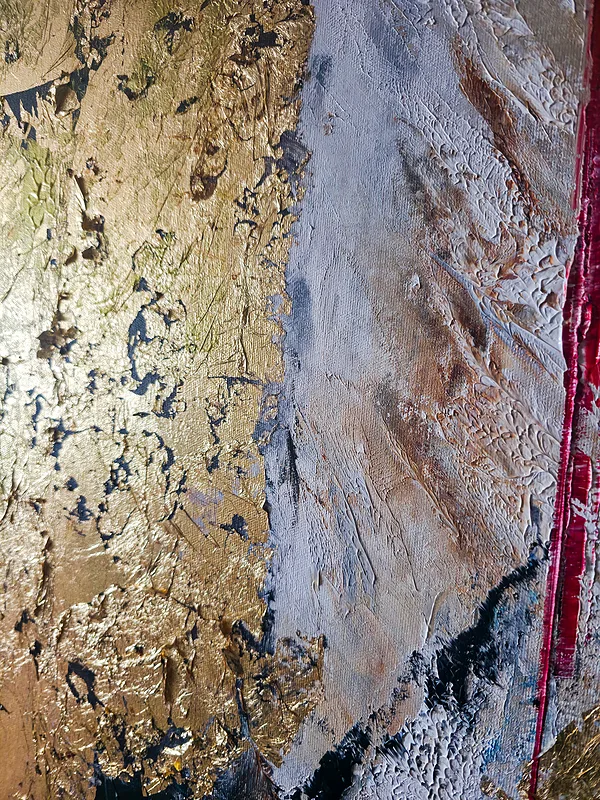
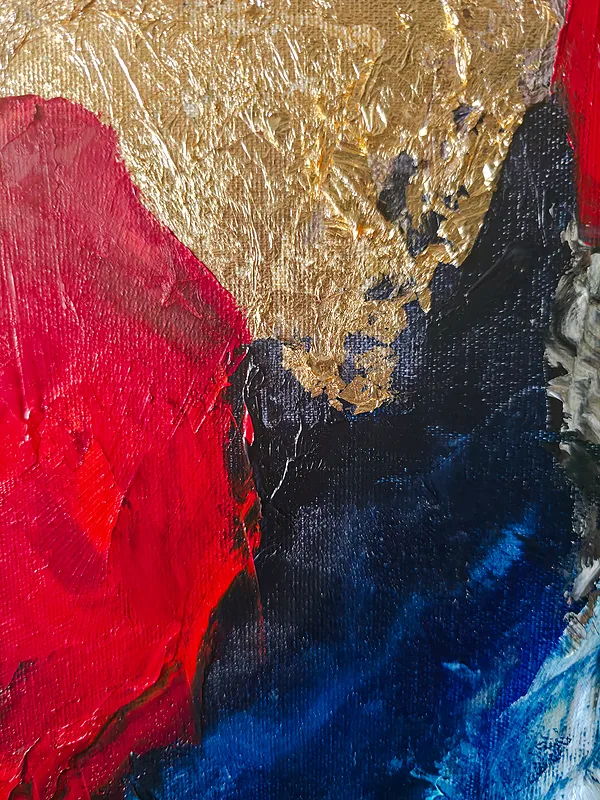
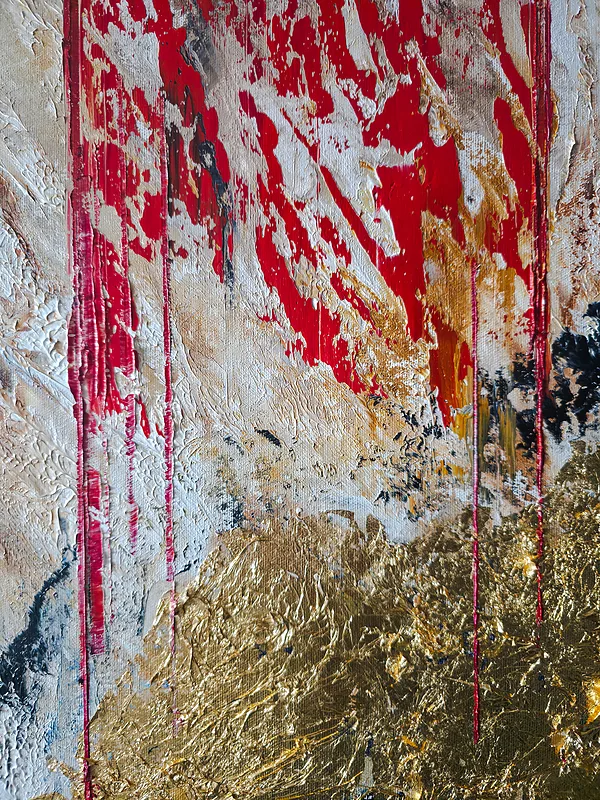
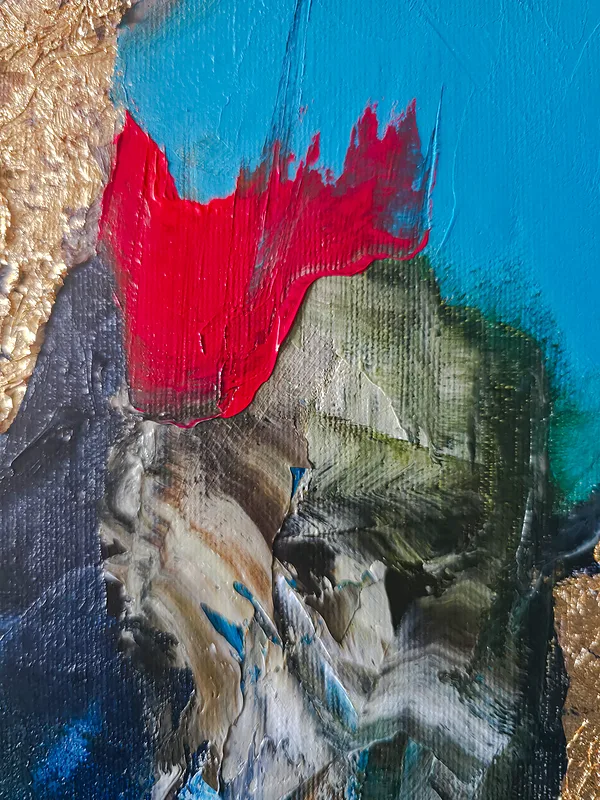
The turquoise glowing along the edges evokes the enduring promise of the Garden of Eden. Above the blue abyss, the red form embodies the living force of the prophetic word, while the crown-like motif emerging at the far right conveys the hope of endurance and renewal. The painting reveals the timeless truth at the heart of the Book of Isaiah: earthly powers pass away, but the word of God endures through the centuries.
“The grass withereth, the flower fadeth: but the word of our God shall stand for ever.” (Isaiah 40:8, KJV)
The Rock of Horeb
- 80 x 80 cm
- Oil and gold on canvas
- Created: Sitges, 2026
- The artwork is part of the 'Old Testament III - In Search of the Secrets of Eternity' cycle
- AVAILABLE FOR PURCHASE
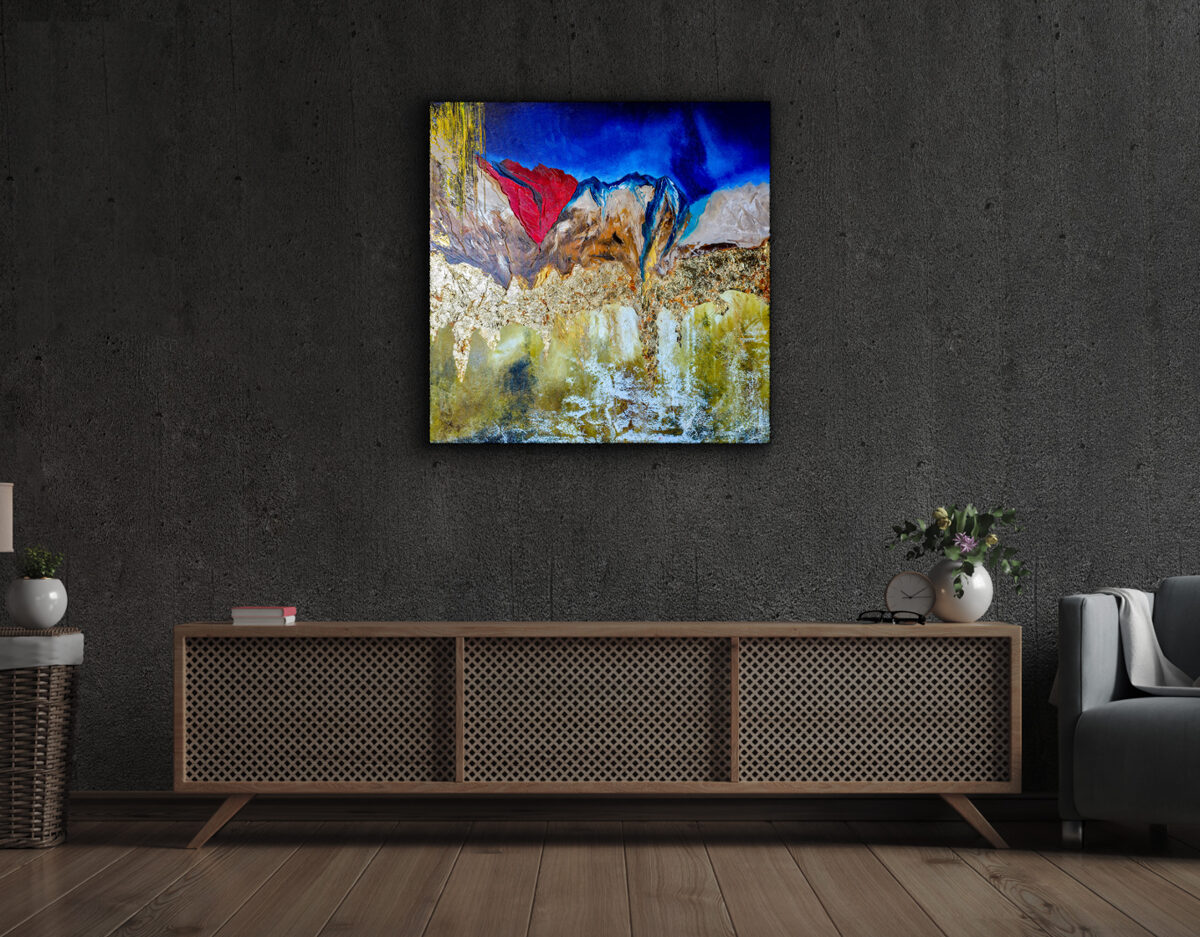
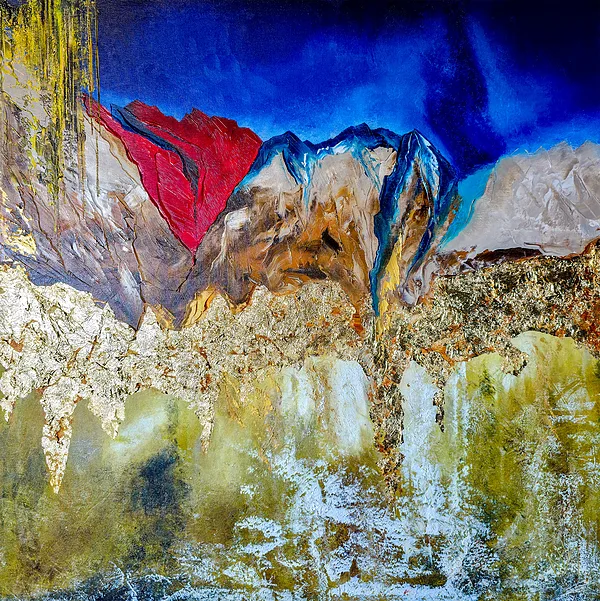
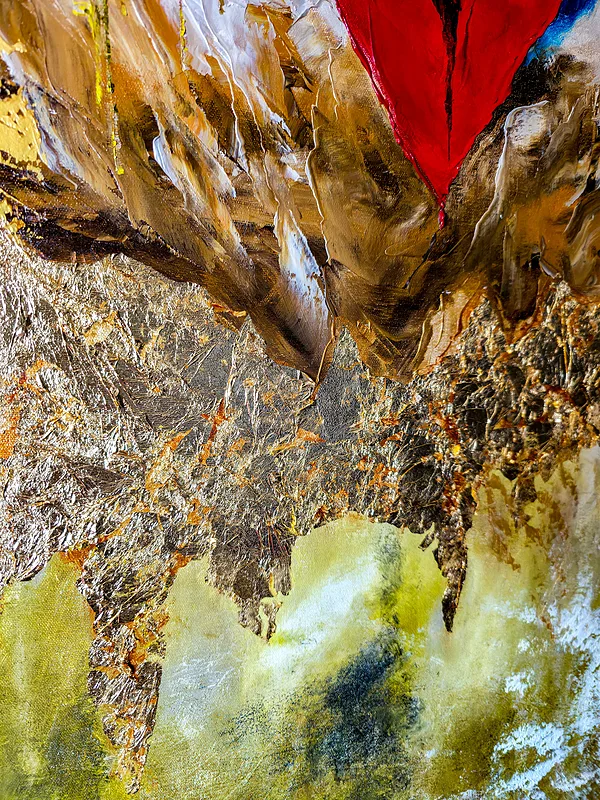
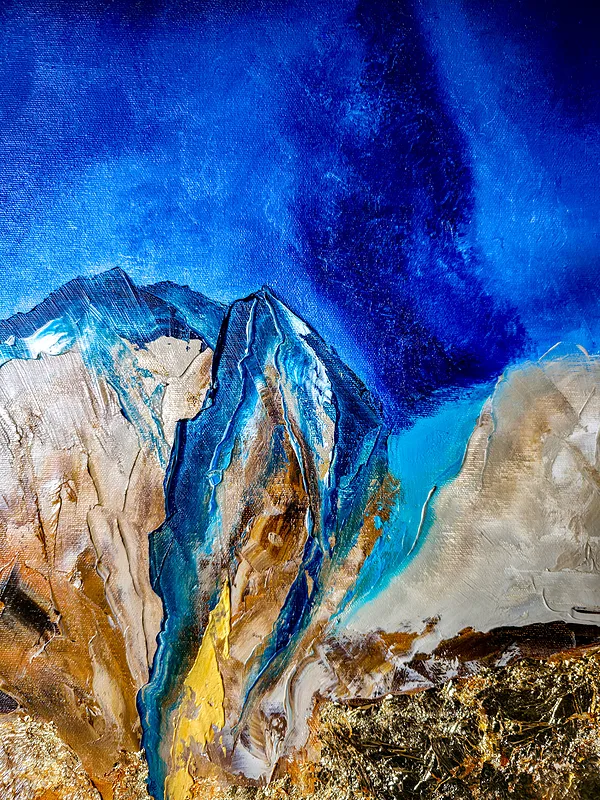
The painting evokes one of the defining moments of the Israelites’ wilderness journey: for a people tormented by thirst, water flowing from a barren rock becomes a sign of life and divine providence. Beneath a monumental cobalt-blue sky, masses of ochre, brown, and greyish-white rock press against one another, creating a world of ancient, elemental weight. Blue and turquoise currents break through the stillness of the stone, widening into a luminous expanse of water across the lower part of the composition. In the heart of desolation, the possibility of life emerges.
“Behold, I will stand before thee there upon the rock in Horeb; and thou shalt smite the rock, and there shall come water out of it, that the people may drink.” (Exodus 17:6, KJV)
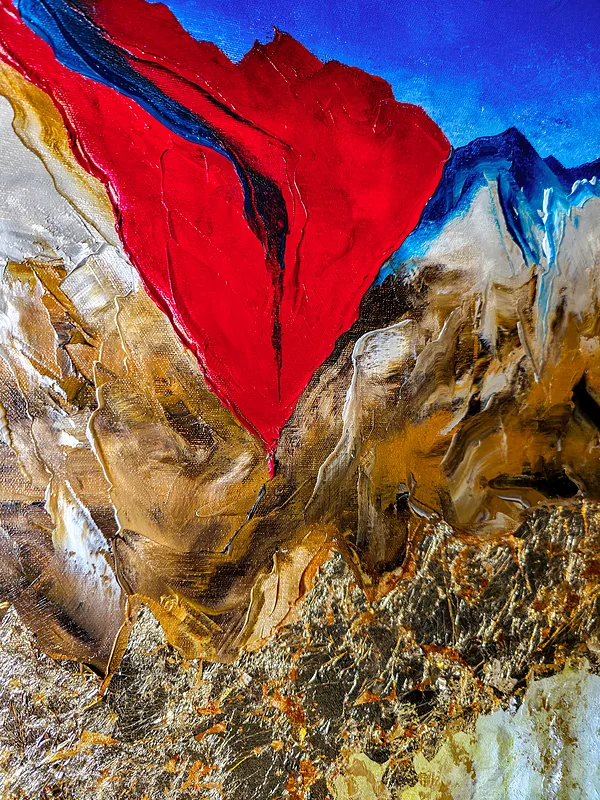
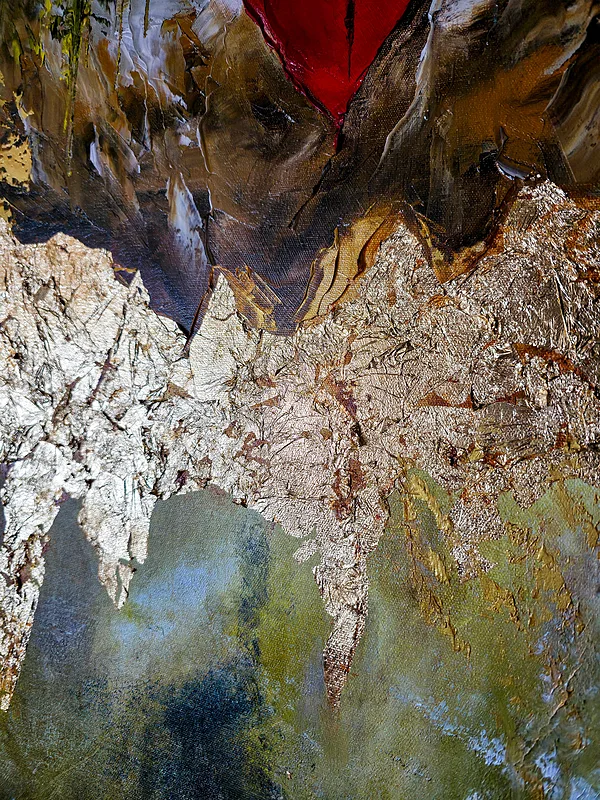
One of the composition’s most striking motifs is the glowing red form in the upper left, in which the shape of a serpent’s head emerges. Its vivid colour stands in sharp contrast to the cool blue background, evoking the dangers of the wilderness journey. In the biblical narrative, the serpent embodies the threat of death, while also recalling the possibility of deliverance. The Book of Deuteronomy condenses the thirst and perils of the wilderness into a single, memorable image:
“Who led thee through that great and terrible wilderness, wherein were fiery serpents, and scorpions, and drought, where there was no water; who brought thee forth water out of the rock of flint.” (Deuteronomy 8:15, KJV)
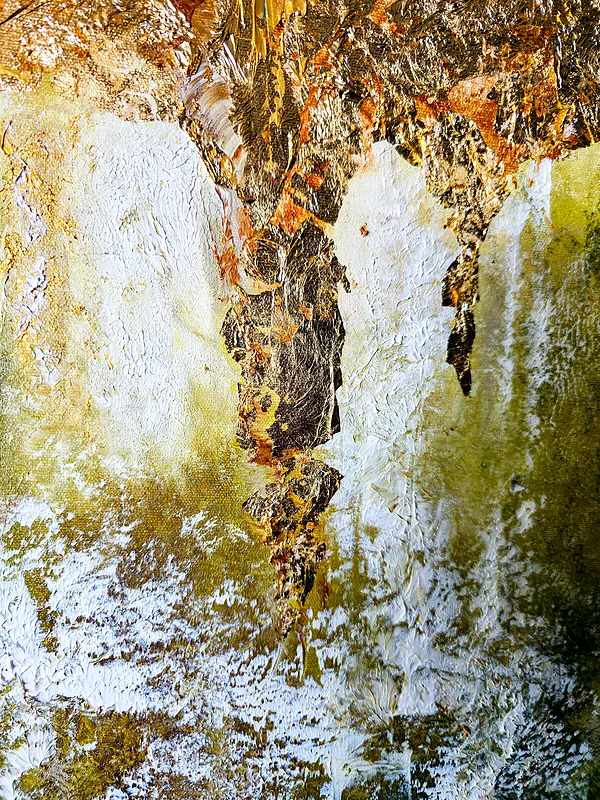
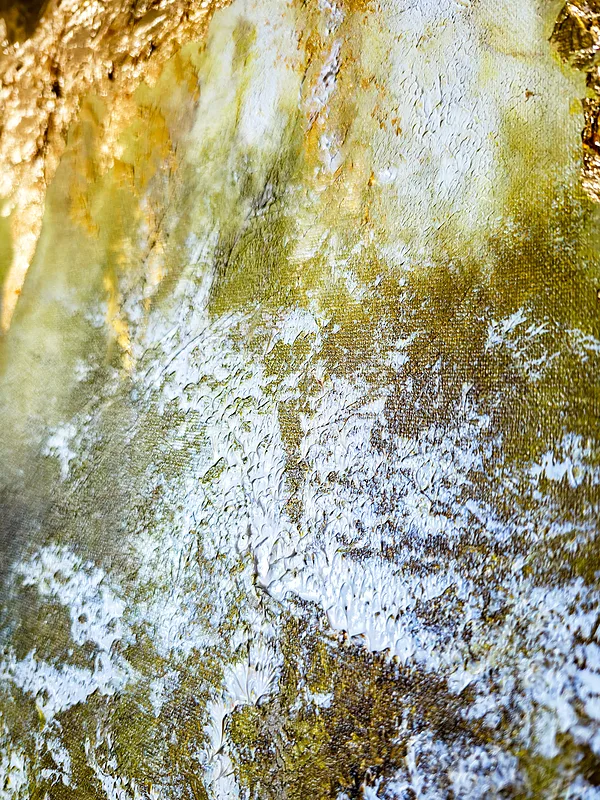
The red form undergoes a curious transformation, also suggesting the image of an altar. The serpent’s head evokes the memory of danger in the wilderness, while the altar suggests the human response to divine providence. This interpretation places the red motif on the threshold between fear and the sacred, threat and hope. Gold emphasises the sacred presence and sustaining power of the divine, while the rough, layered surfaces of the rocks retain the weight of the earthly realm. The water finding its way between the blue sky and the stone binds the different elements of the painting together, expressing the emergence of life from the depths.
The Sign (Rahab's Rescue)
- 80 x 80 cm
- Oil and gold on canvas
- Created: Sitges, 2026
- The artwork is part of the 'Old Testament III - In Search of the Secrets of Eternity' cycle
- AVAILABLE FOR PURCHASE
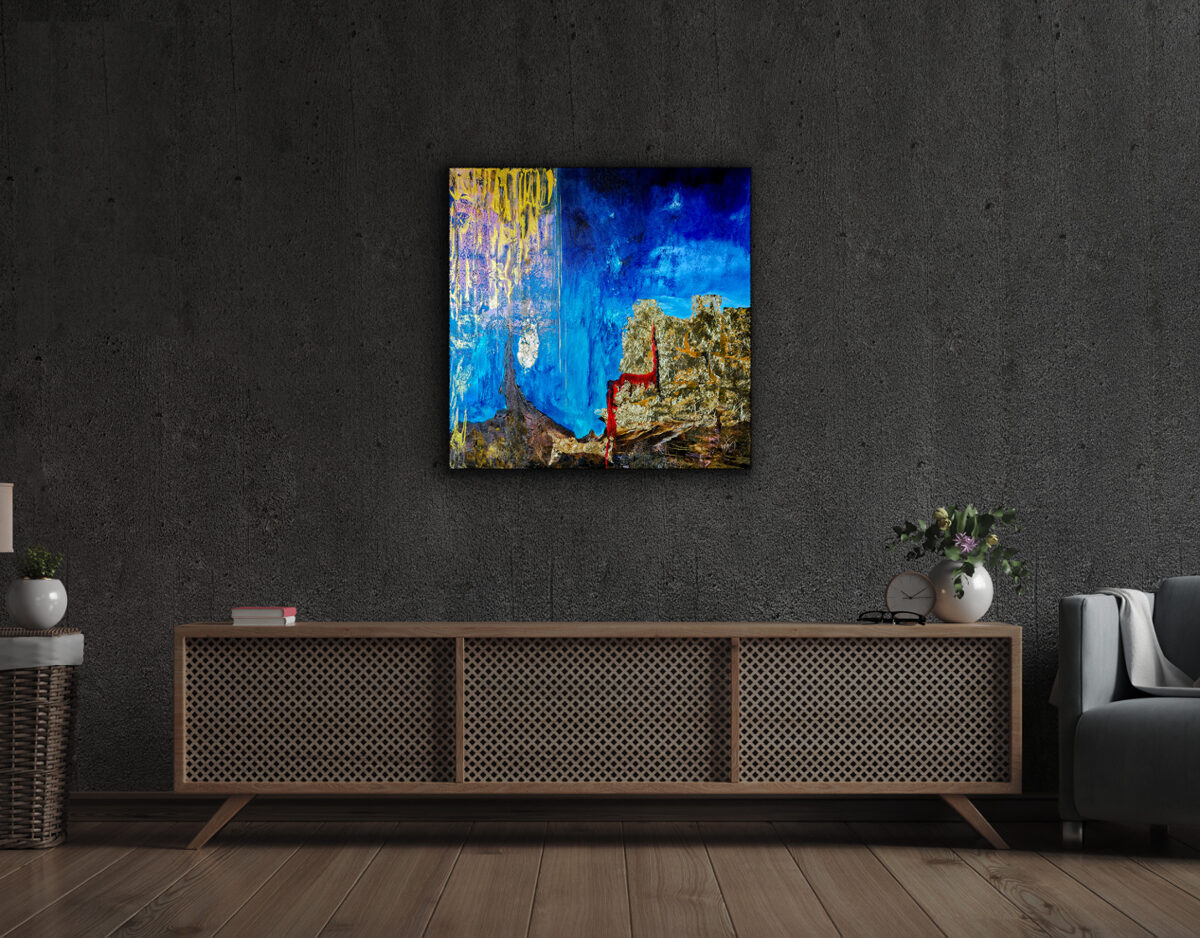
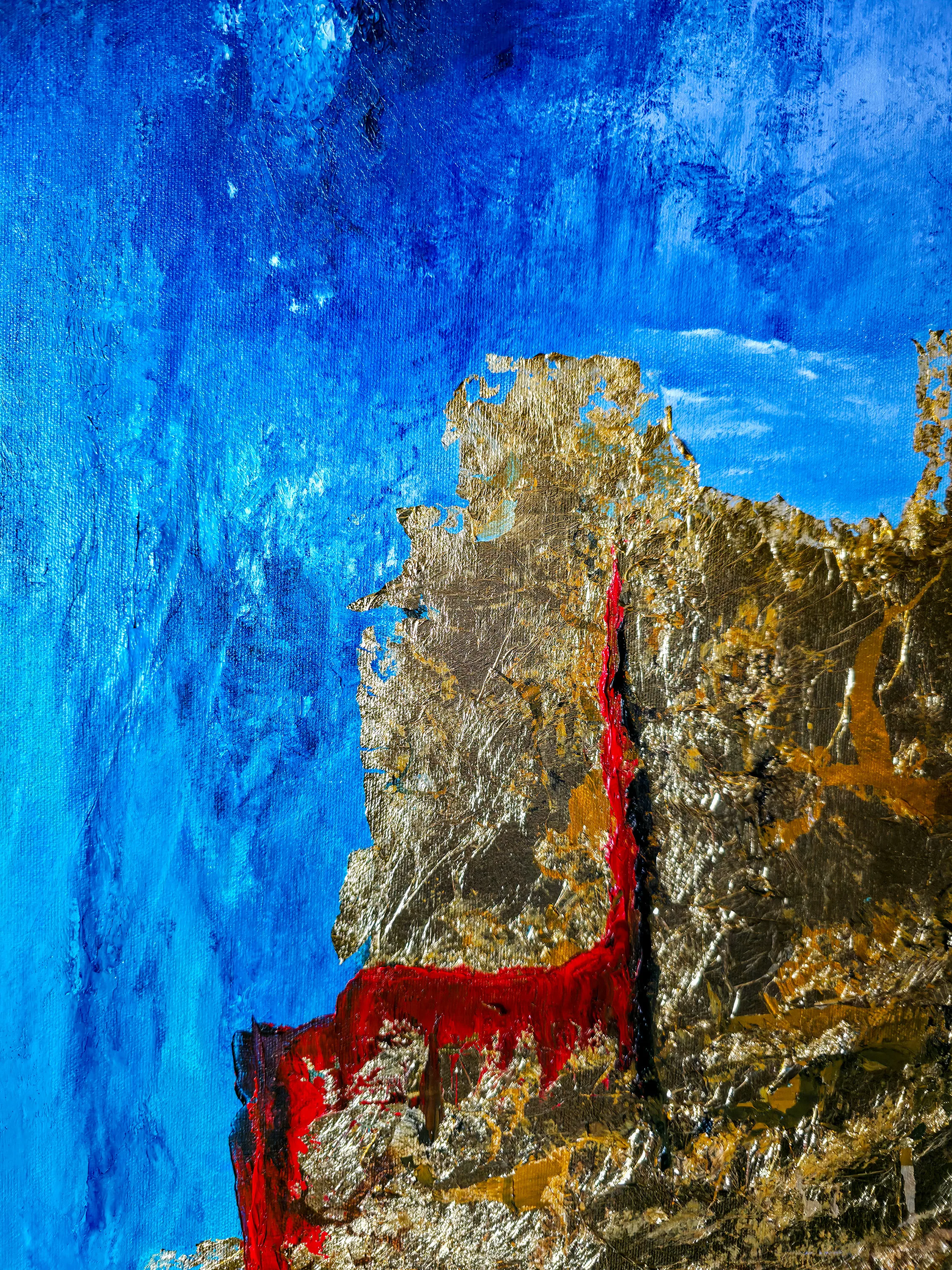
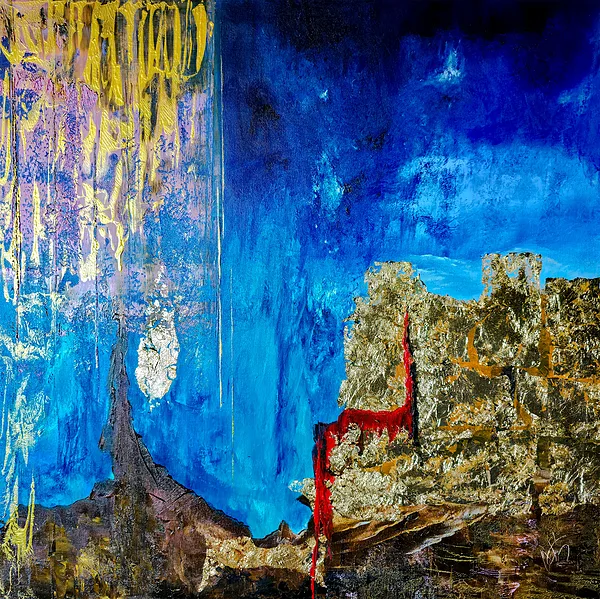
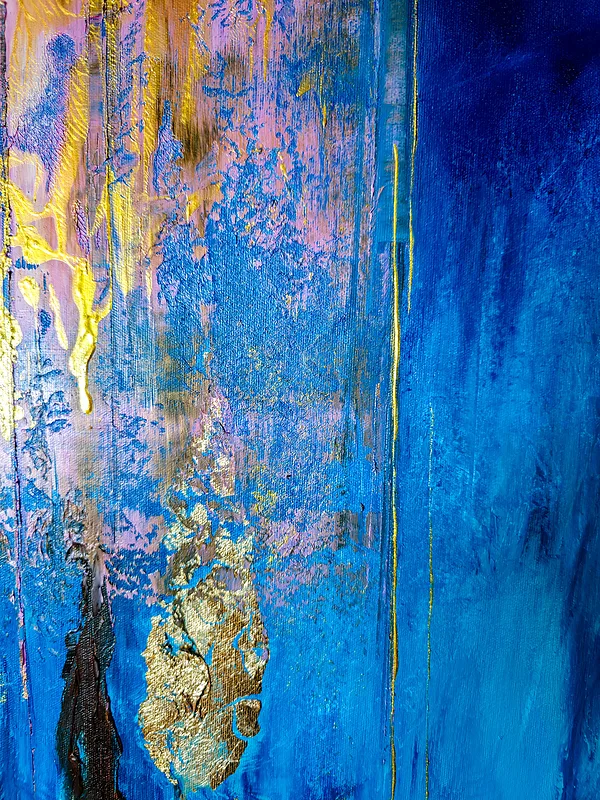
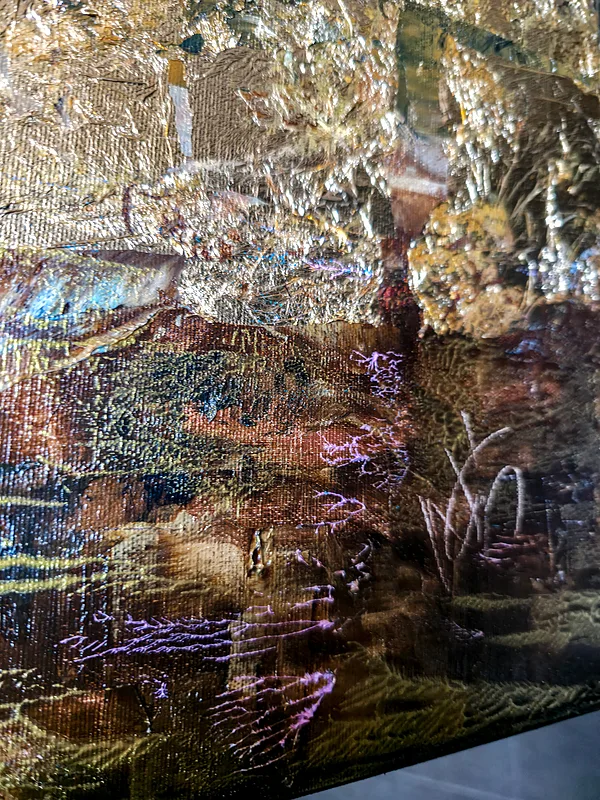
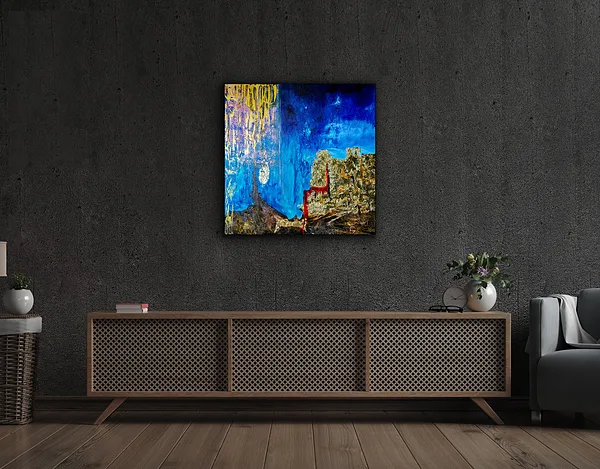
The painting evokes the biblical story of Jericho’s destruction and Rahab’s deliverance.
Two spies sent by Joshua found refuge in Rahab’s house. In return for her help, she asked that her life and the lives of her family be spared. The promise of deliverance was made visible by a scarlet cord tied in the window:
“Behold, when we come into the land, thou shalt bind this line of scarlet thread in the window which thou didst let us down by.” (Joshua 2:18, KJV)
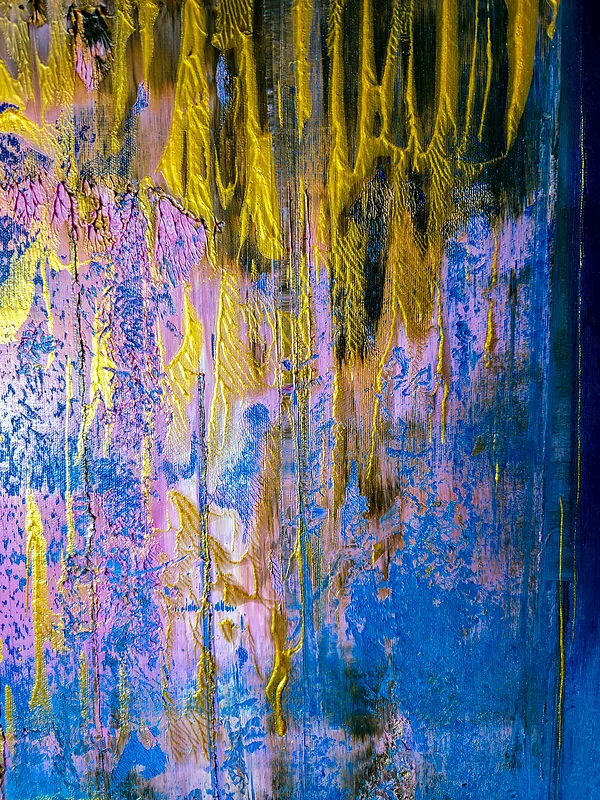
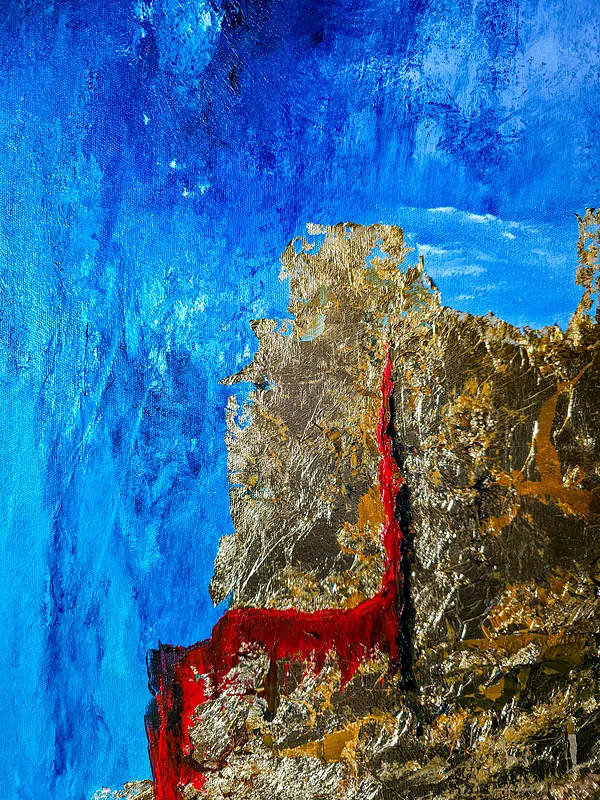
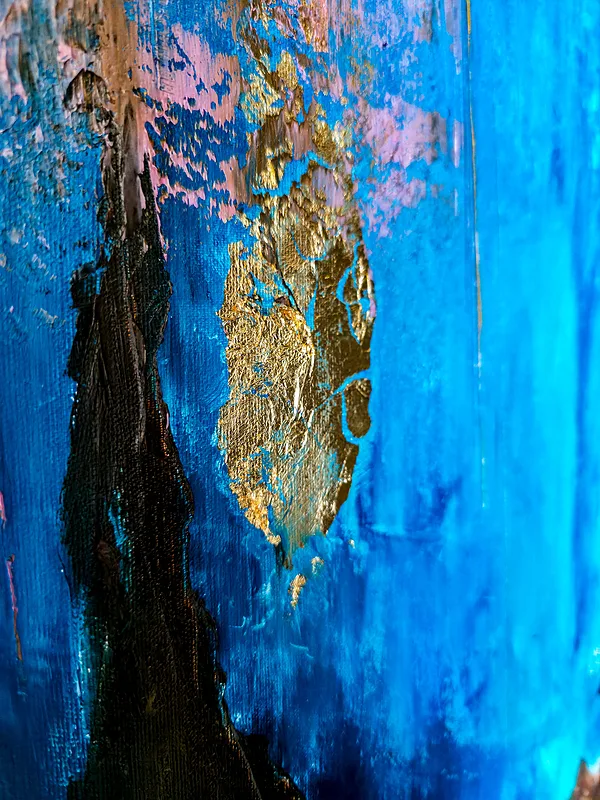
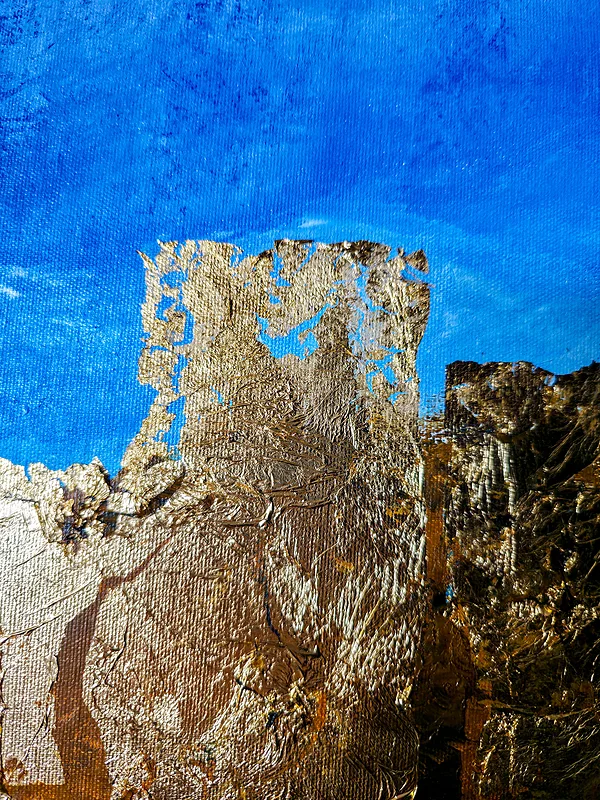
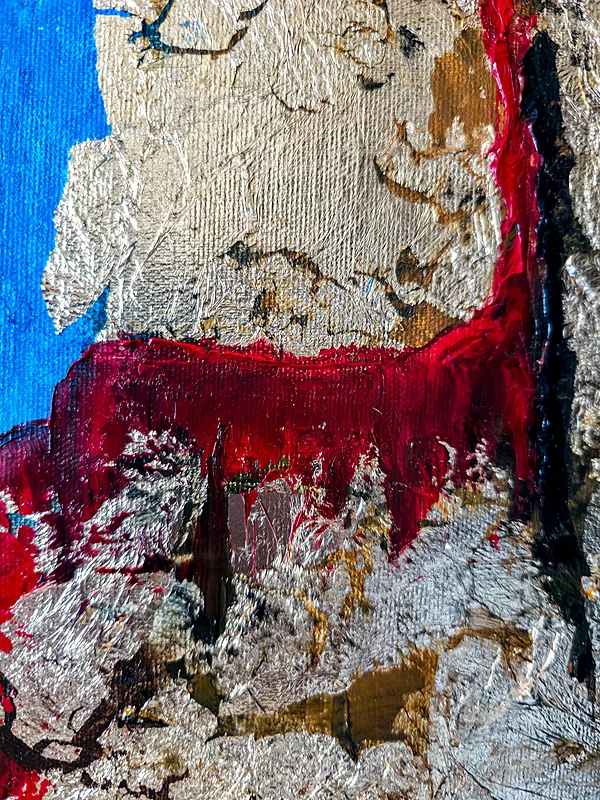
The fractured golden surfaces dominating the right side of the painting evoke Jericho’s power and monumental grandeur. The cracked edges of the metallic layers already suggest the tension of impending collapse. In contrast, the deep blue space on the left evokes a sense of infinity and mystery. In the upper corner, sacred forms descend through layers of pink, lavender, and gold, suggesting the Creator’s purpose and presence, while the dark brown and black tones in the lower part of the composition convey the weight of destruction.
The defining element of the composition is the red form extending across the golden wall on the right. Its horizontal and vertical sections evoke a window, a marked passage, and a descending cord. The scarlet line connects Rahab’s window with the promise of deliverance. Its narrow, incandescent presence stands out against the mass of gold: in the face of monumental walls, it is not strength but a promise given that proves decisive.
Following the collapse of Jericho’s walls, the Book of Joshua recounts Rahab’s fate:
“And Joshua saved Rahab the harlot alive, and her father’s household, and all that she had.” (Joshua 6:25, KJV)
At the heart of the painting, the boundary between destruction and survival takes shape. The gold, symbolising the earthly power of the city, acquires an additional meaning of protection through its juxtaposition with the scarlet sign.
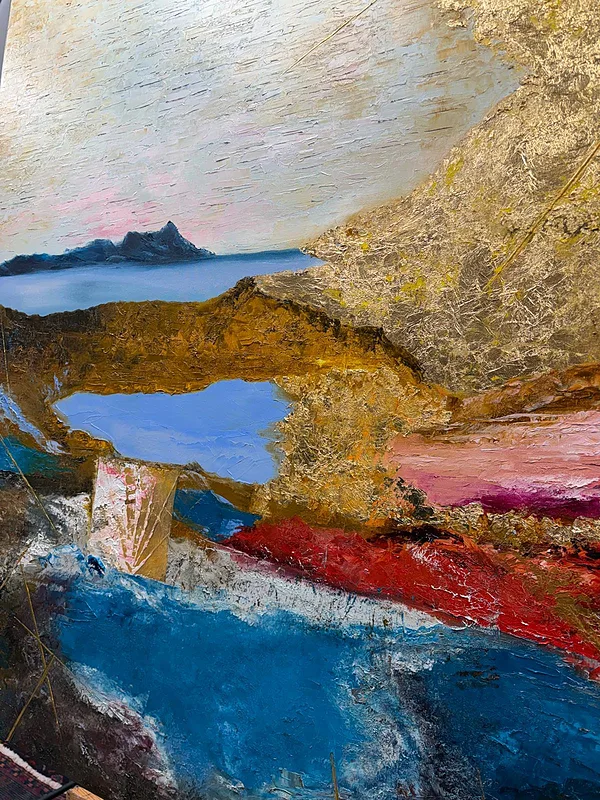
The Covenant
- 140 x 140 cm
- Oil and gold on canvas
- Created: Sitges, 2026
- The artwork is part of the 'Old Testament III - In Search of the Secrets of Eternity' cycle
- SOLD
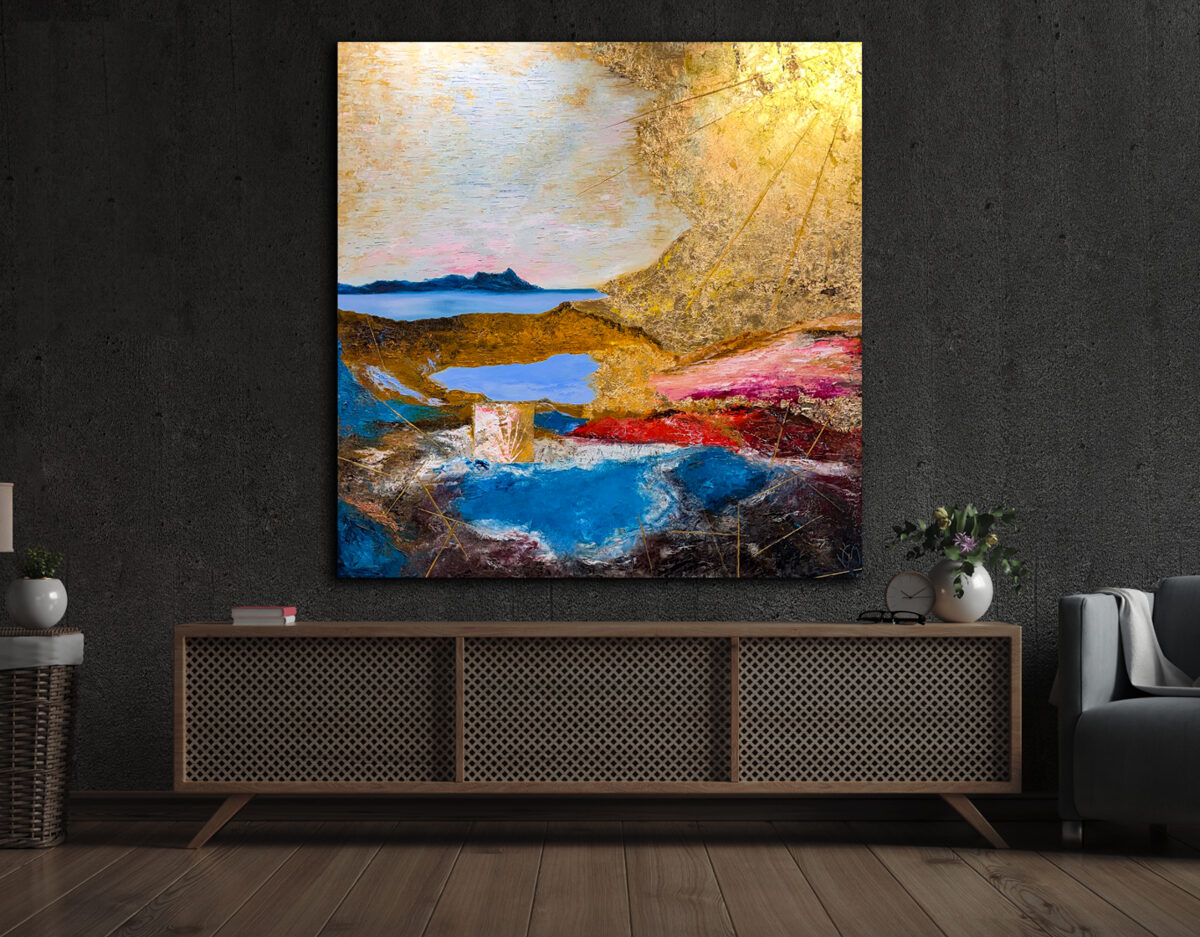
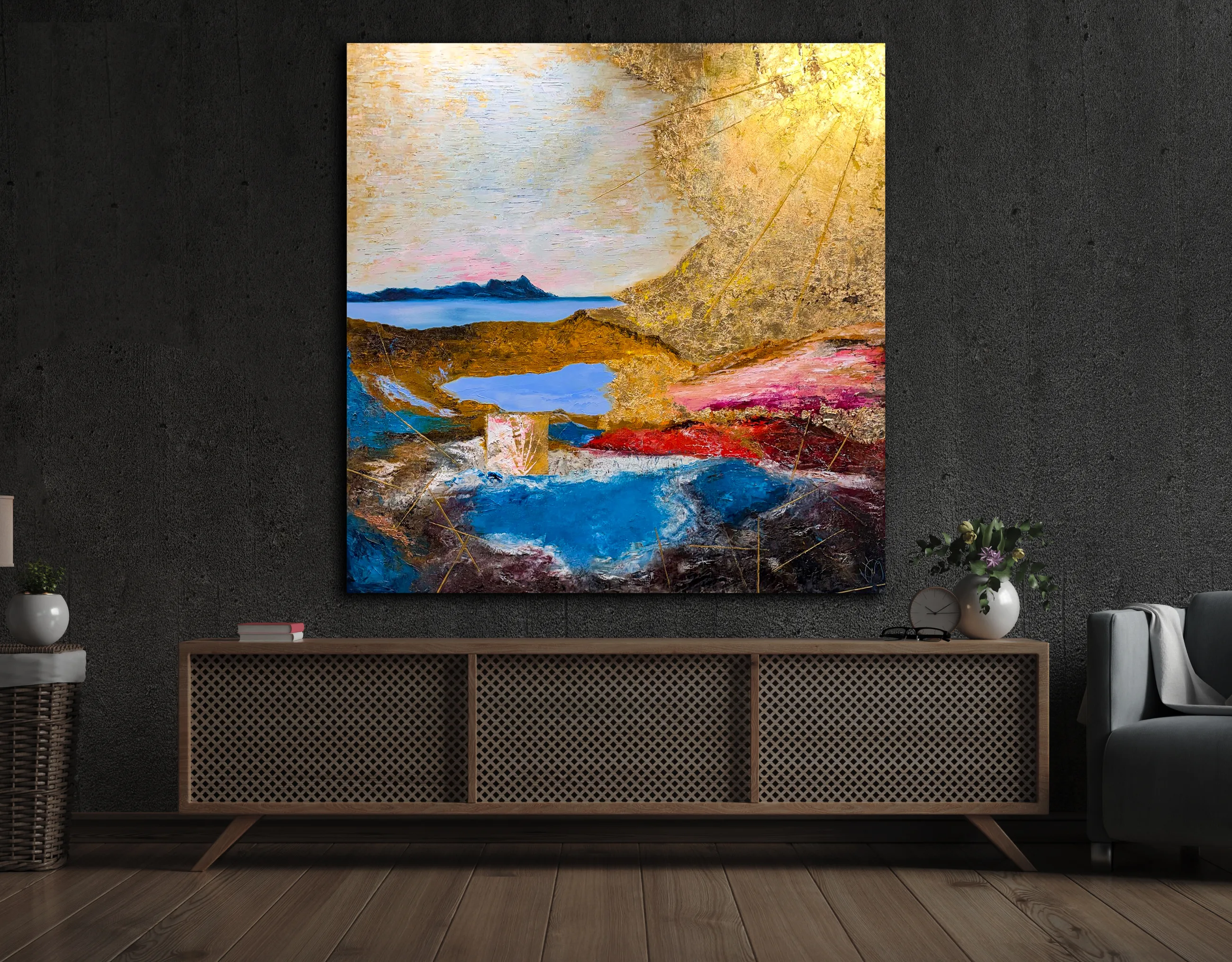
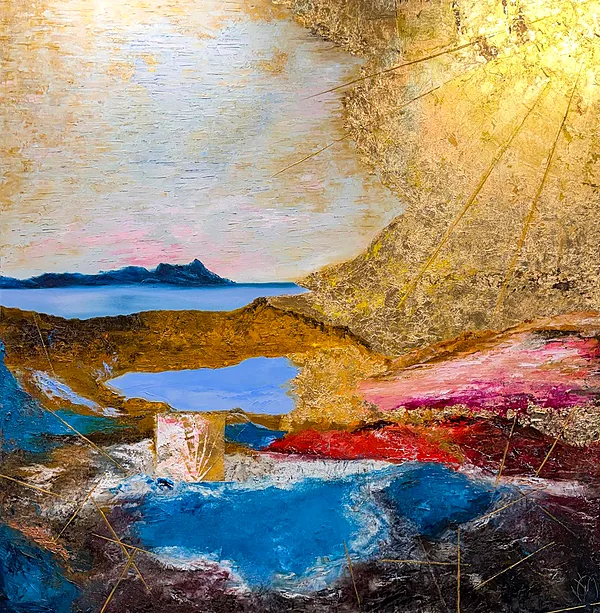
In this remarkable work, the artist explores the mystery of faithfulness born of a promise: the sacred bond through which the spoken word transcends the moment, guiding generations through trials and tribulations until, at last, it finds fulfilment in land, home, and belonging. The biblical narrative underlying the painting begins with Abraham’s calling and the divine promise made to him:
“Get thee out of thy country … unto a land that I will shew thee.” (Genesis 12:1, KJV)
The promise later unfolds into a visible horizon:
“For all the land which thou seest, to thee will I give it, and to thy seed for ever.” (Genesis 13:15, KJV)
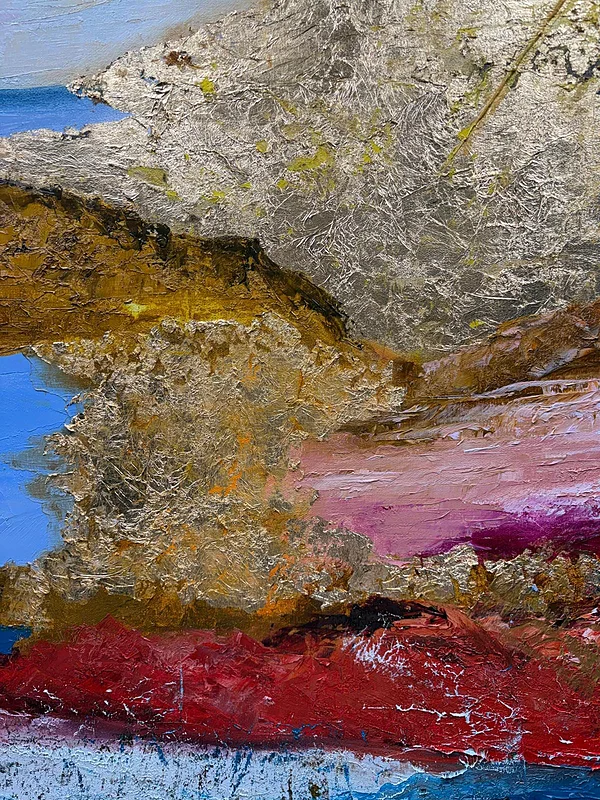
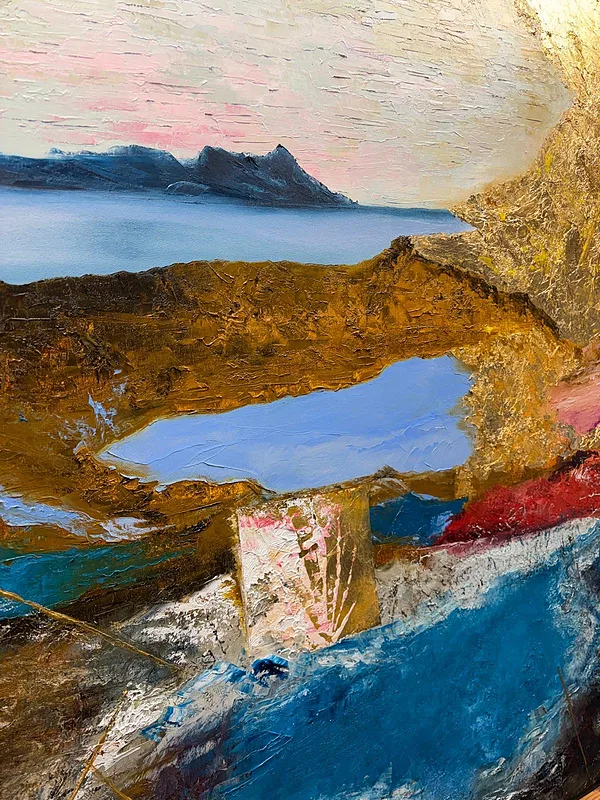
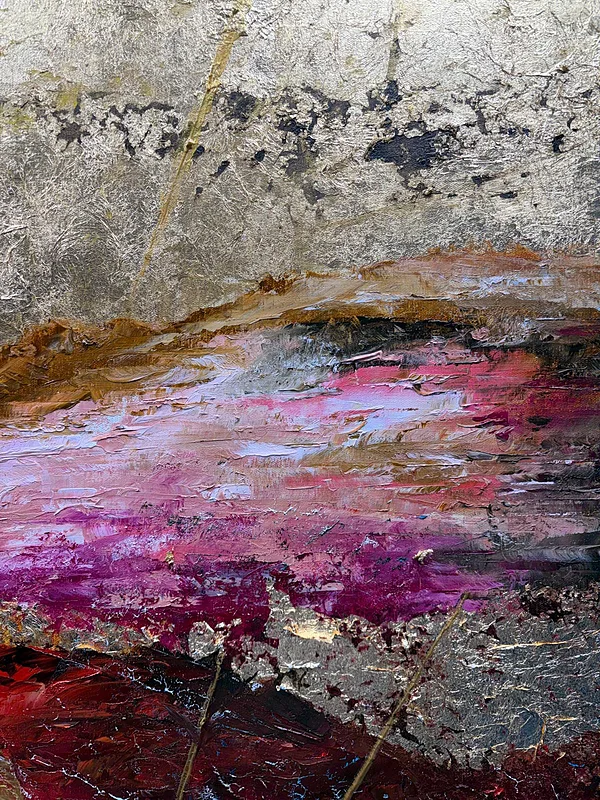
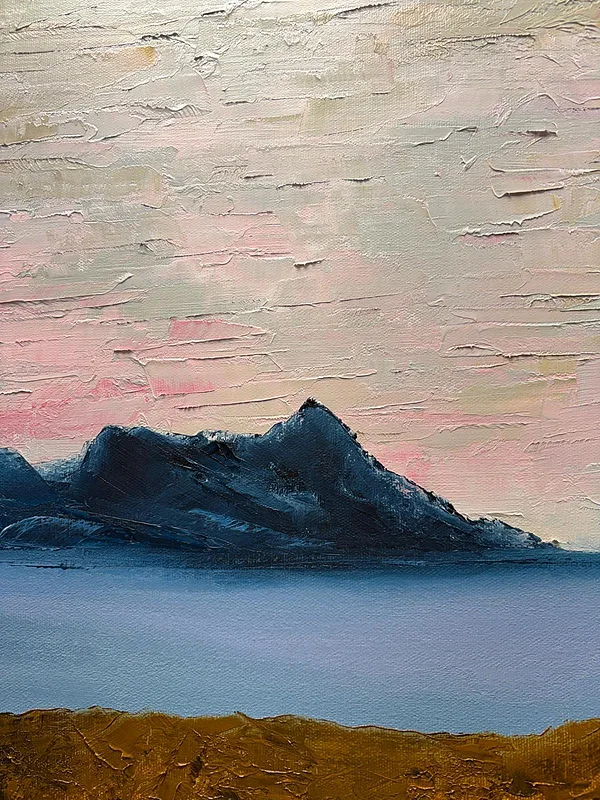
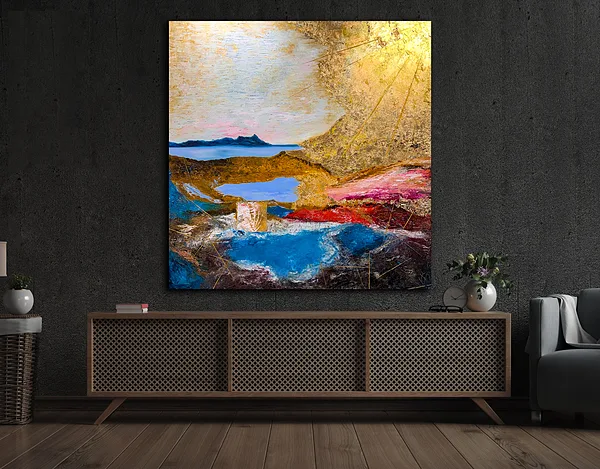
Beneath the pearlescent sky, a dark blue mountain range traces the contours of a distant world, while the band of pale blue water stretching between the mountains and the viewer evokes the stillness of what is yet to come. In the foreground, a broad tongue of ochre-gold earth cuts across the composition. Its rough, furrowed surface gives tangible form to the Promised Land. Within its embrace, clear blue water symbolises life, fertility, and blessing, evoking the abundance of Canaan, the biblical land flowing with milk and honey.
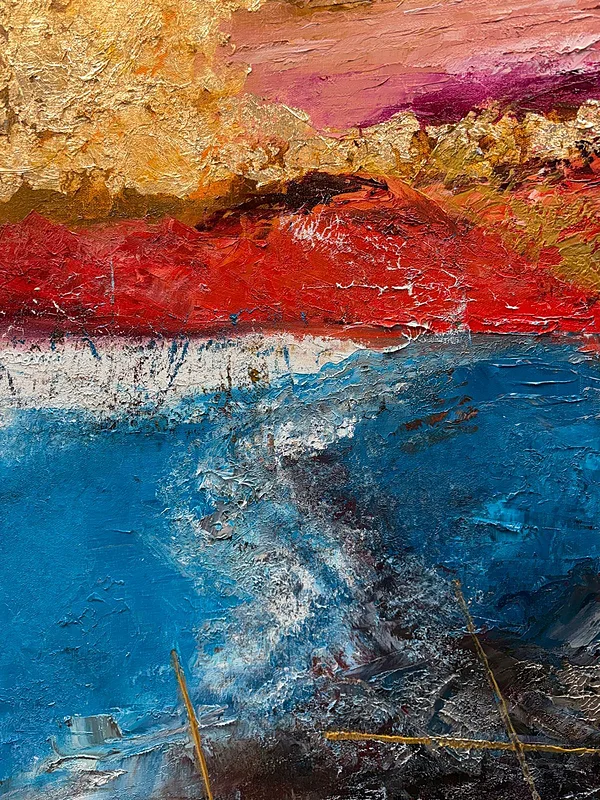
From the upper right, an immense field of golden and silvery light descends over the landscape, enveloping the earthly world like a heavenly mantle.
Among the deeper layers of the composition, a vertical golden rectangle rises like a sacred gateway set within the landscape. Its precise geometry transforms the path of wandering into a threshold, opening a passage between promise and fulfilment. Within it, a motif in white and delicate pink branches upwards, evoking at once a root, an open palm, and the tree of life.
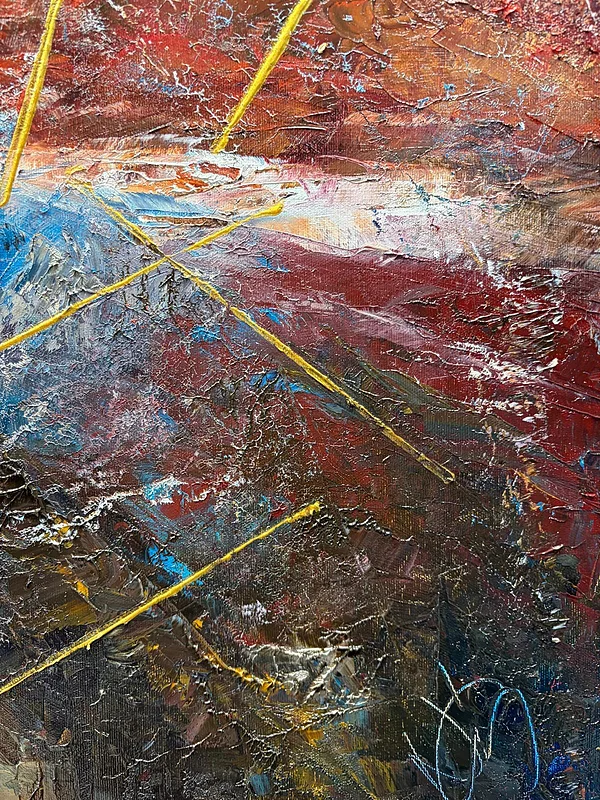
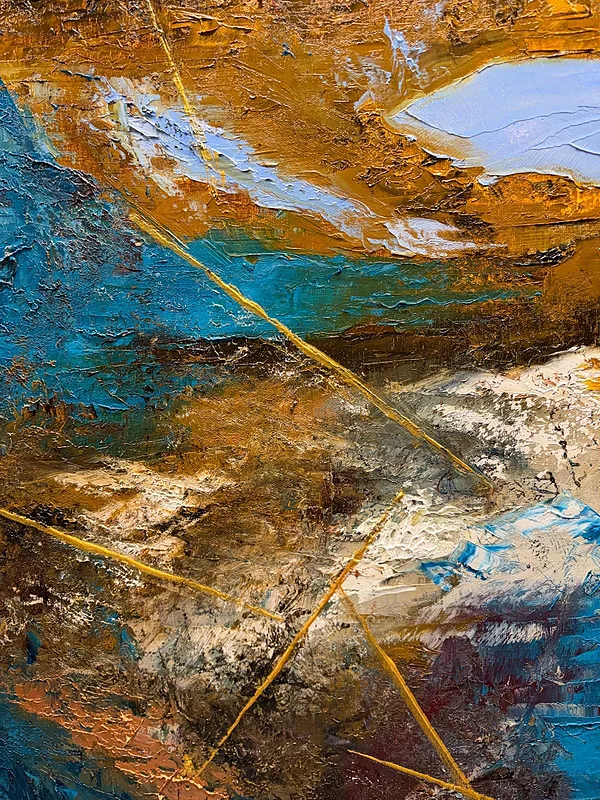
The painting’s three-dimensional structure folds time upon itself. In its depths, the long journey towards the fulfilment of the promise unfolds; in its raised golden layers, the radiance of divine faithfulness shines forth; and across its expansive horizon, the promise finds its ultimate fulfilment.
The Book of Judges (Gideon Defeats the Midianites)
- 140 x 160 cm
- Oil and gold on canvas
- Created: Sitges, 2026
- The work is part of the 'Old Testament III - In Search of the Secrets of Eternity' cycle
- RESERVED
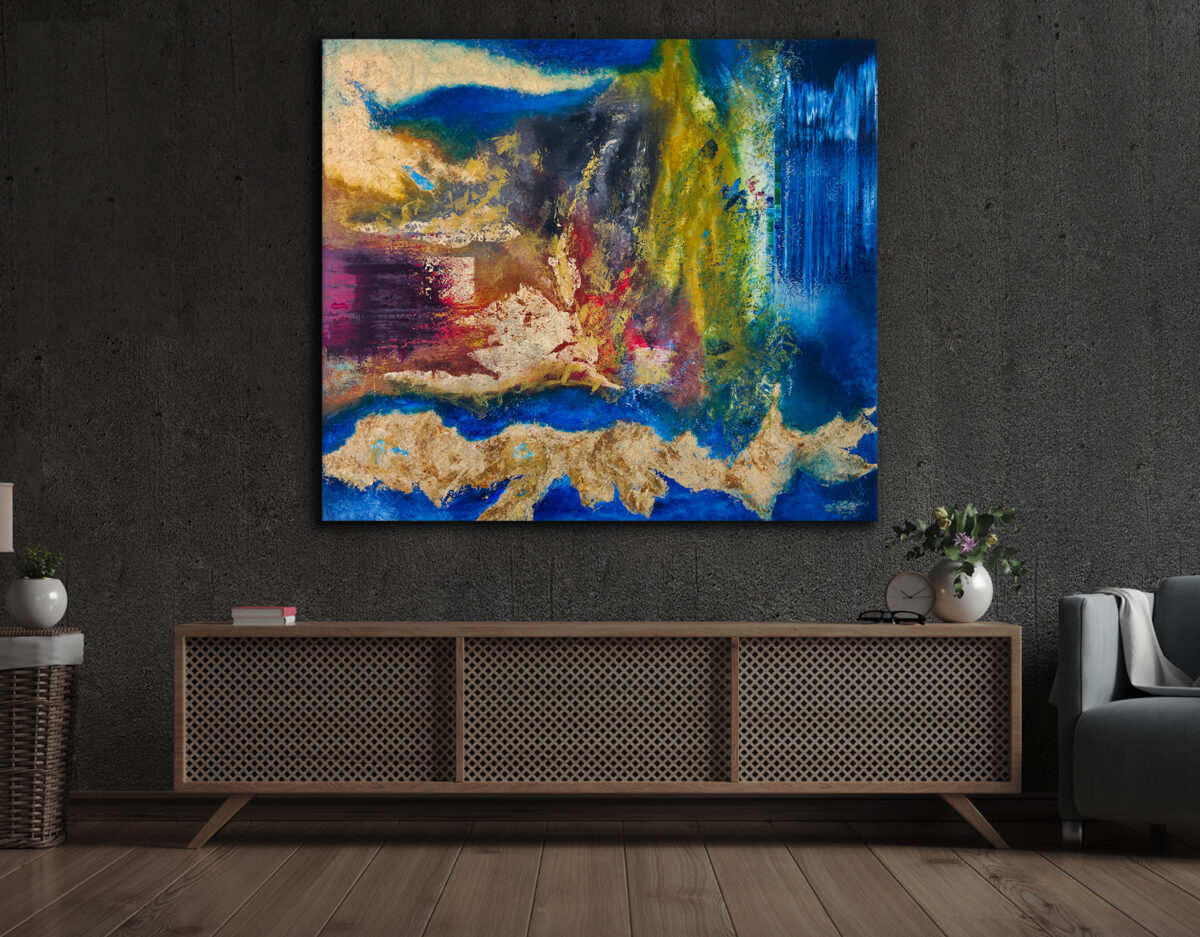
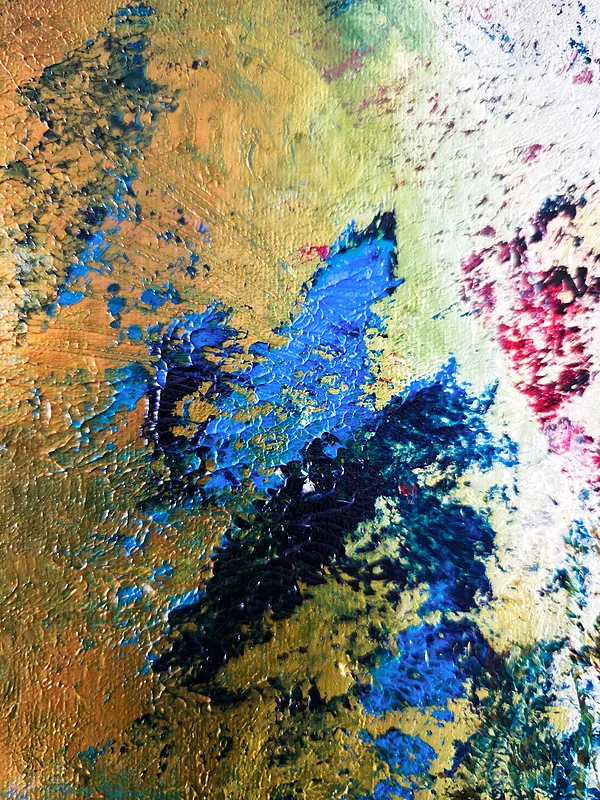
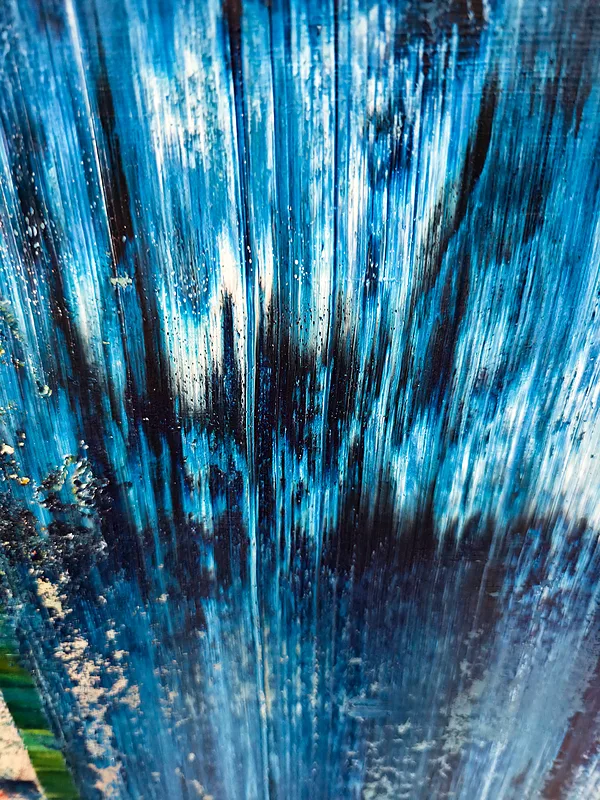
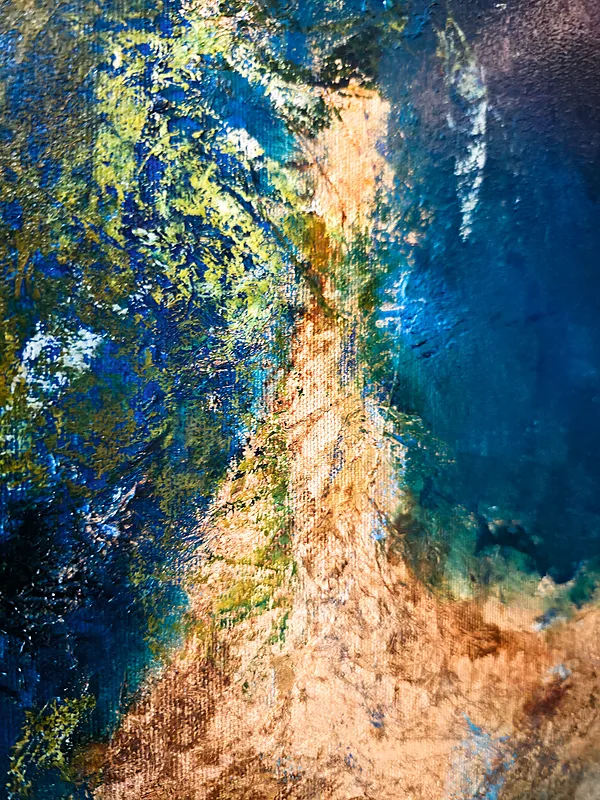
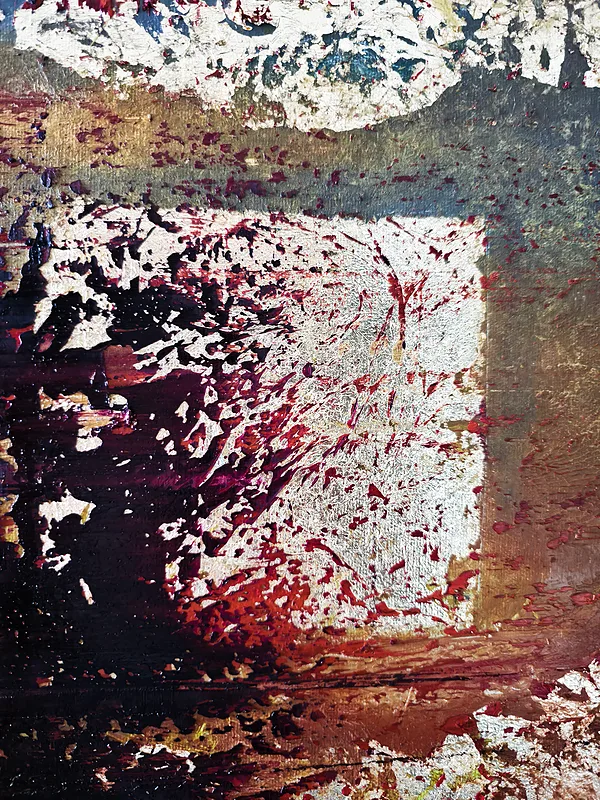
The artist condenses the drama of Gideon’s story into the collision of two elemental forces. On the left, a vast backdrop of gold, bronze, scarlet, and soot-black layers surges forward, bearing the weight of an entire world. From the right, the dazzling blues of cobalt, ultramarine, and turquoise descend in vertical currents, seemingly arresting the advancing mass.
According to Scripture, Israel is oppressed by Midian. Fleeing an enemy that repeatedly destroys their crops, the people retreat to mountain strongholds and caves. Gideon himself is secretly threshing wheat when a remarkable greeting is heard:
“The LORD is with thee, thou mighty man of valour.” (Judges 6:12, KJV)
In the central field of abstraction, dark masses begin to churn and gather. The Midianites, Amalekites, and peoples of the East fill the valley, “as grasshoppers for multitude”, their camels beyond counting.
The dark, earth-toned masses pressing into one another give form to this overwhelming force. Black, brown, red, and grey layers are compressed together, set against the clear, ordered expanse of blue on the right.
The canvas evokes Gideon’s victory while leading us back to the sacred moment of his calling. Within the gold lingers the memory of the altar; within the red, the fire that sprang from the rock and the light of the torches concealed inside the jars continue to burn. Below, the once-terrifying multitude of Midian collapses into disarray as it flees, while on the right, the steadfast flow of cobalt blue evokes the strength of the three hundred chosen men. Between these opposing forces rises Gideon’s face, hardened like stone: the likeness of a man whom the Eternal called mighty even when he still sought refuge in the shelter of his own fear.
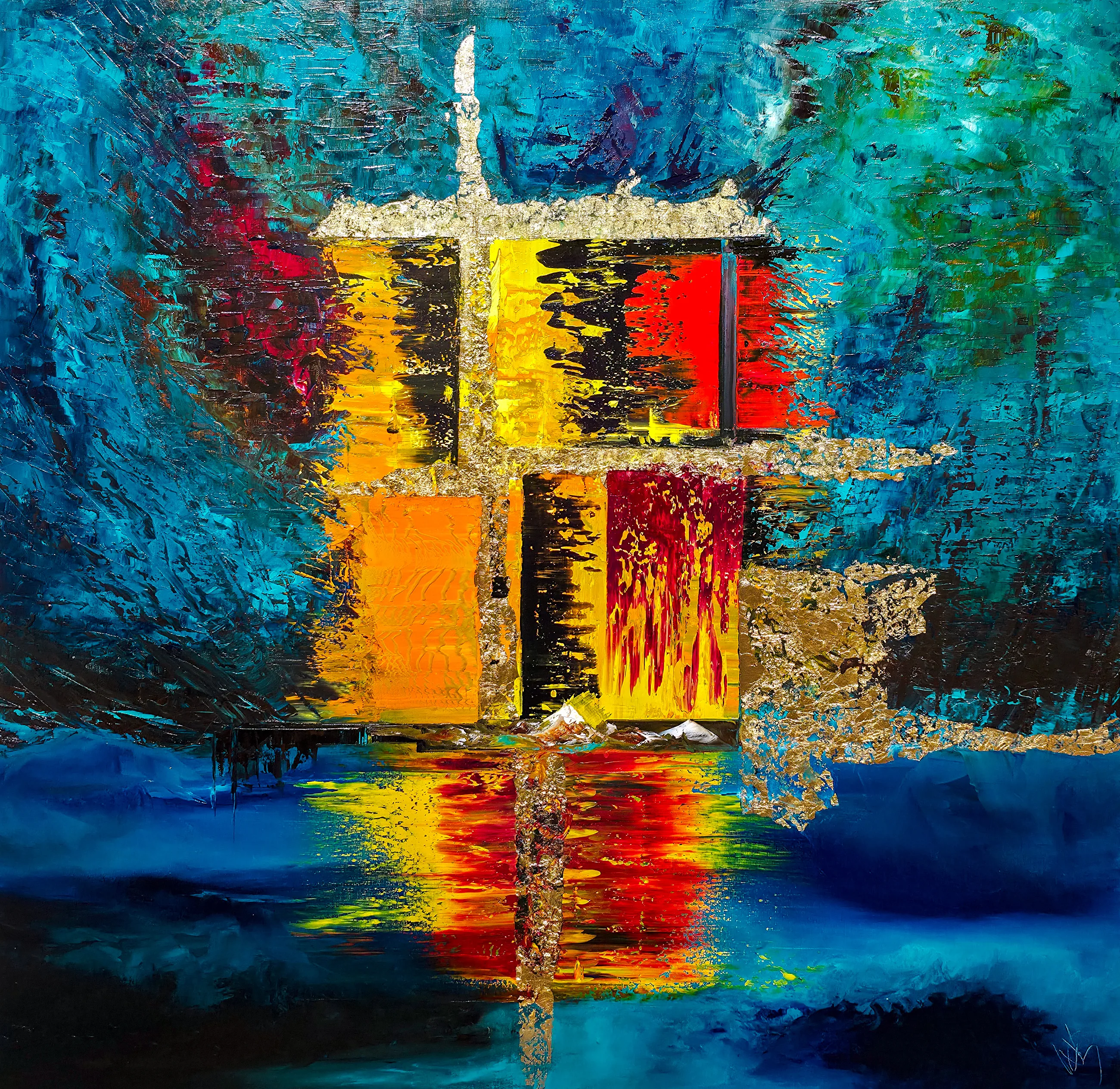
Legend of the Sacred Mountains
- 120 x 120 cm
- Oil and gold on canvas
- Created: Sitges, 2026
- The artwork is part of the 'Old Testament III - In Search of the Secrets of Eternity' cycle
- SOLD
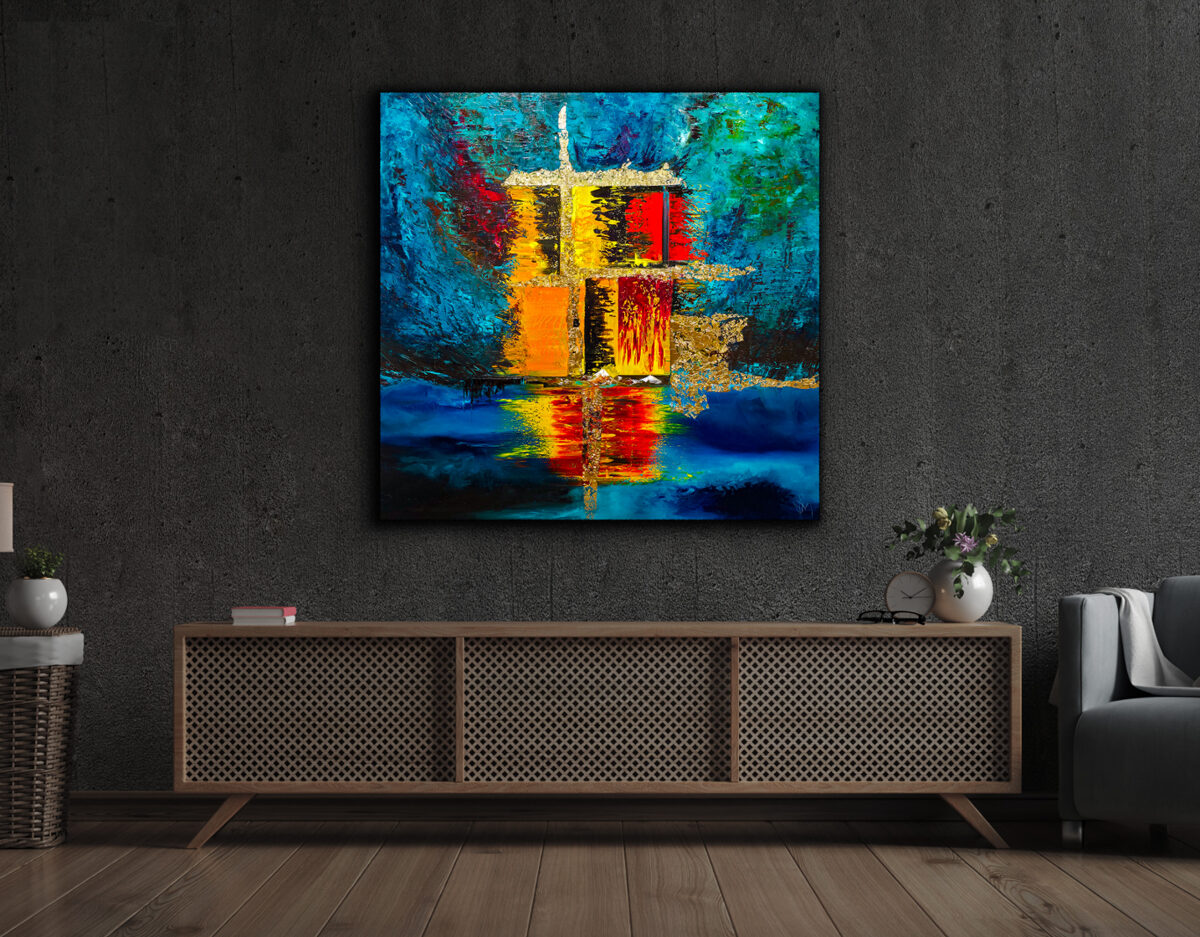
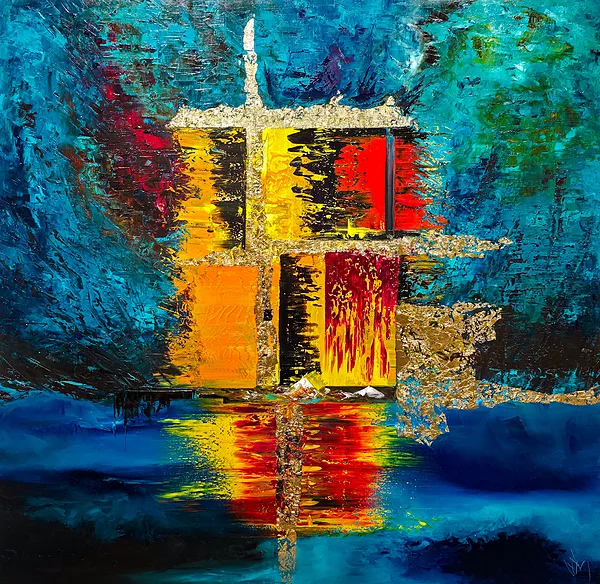
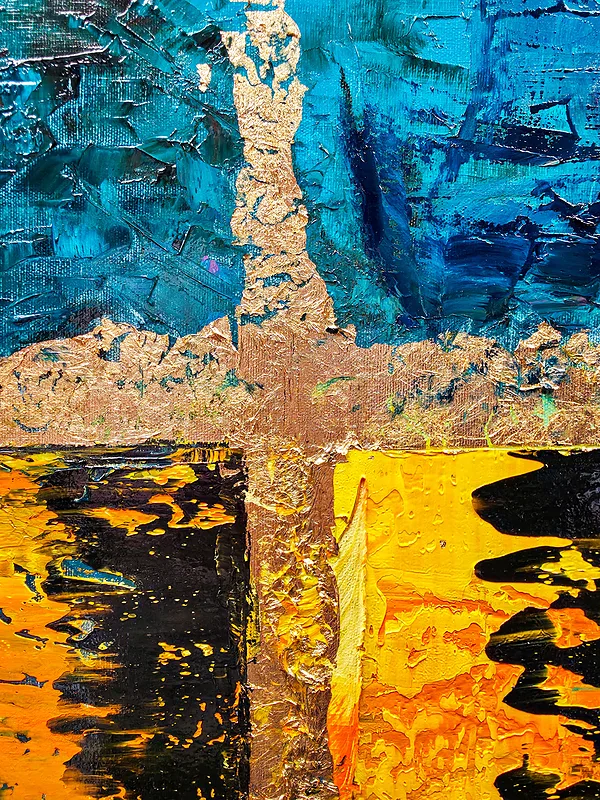
The painting leads the viewer into the timeless realm of the sacred mountains. Emerging from the cosmic stillness of deep blue and turquoise, the emerald-tinged glimmers, and the radiance of granular gold, a mysterious, tiered form rises into view. It evokes an ark, a sanctuary, a heavenly gate, and a mountain reaching towards the sky, as though the memory of the biblical holy places had converged in a single mystical vision. Enclosed in gold, the articulated structure at the centre radiates order and sustaining strength amid the boundless blue expanses that undulate around it.
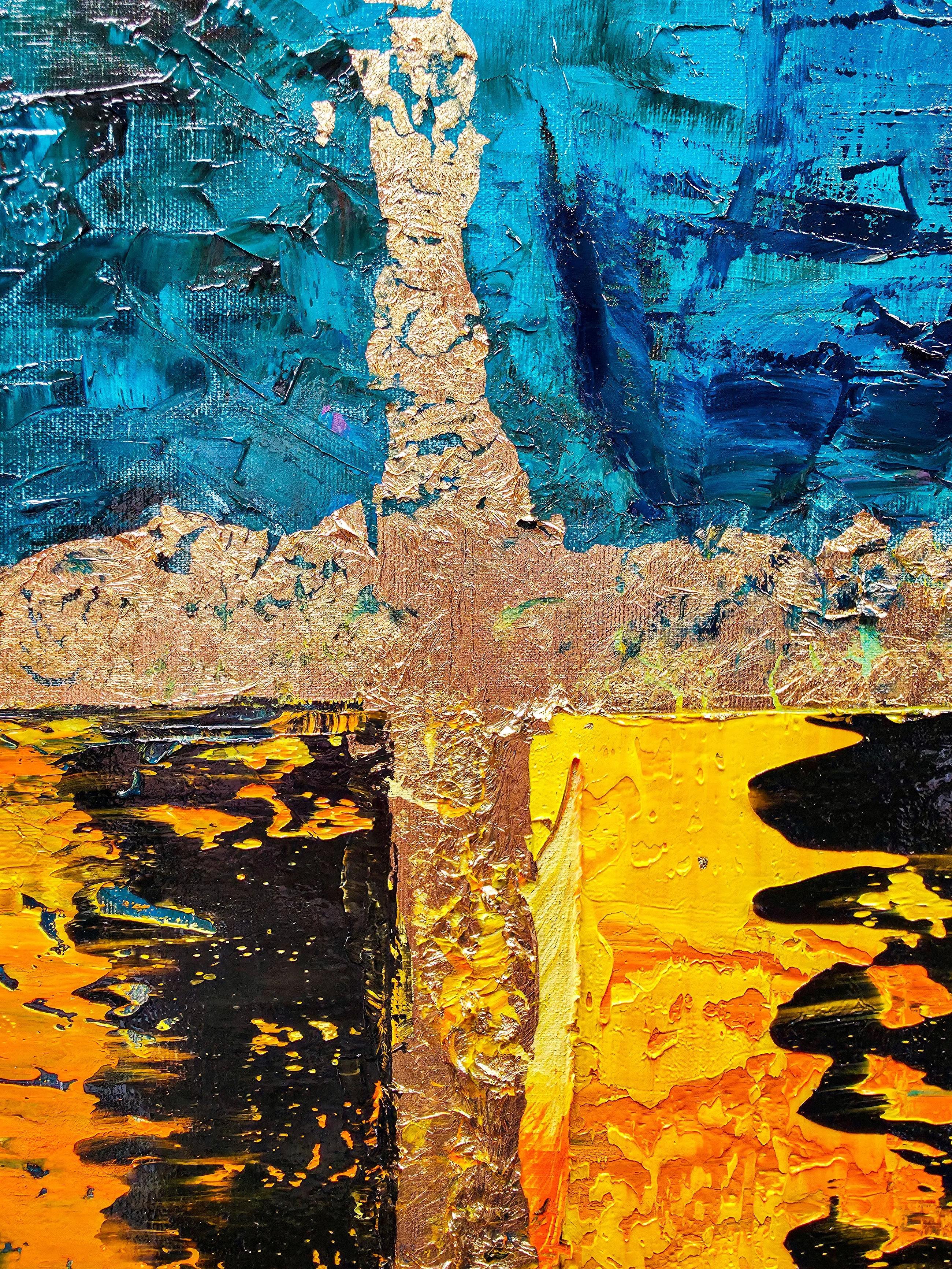
The vertical axis of gold symbolises the passage between the earthly and heavenly realms. The grid-like arrangement of vertical and horizontal golden bands evokes the ground plan of an invisible sanctuary, embodying the sustaining power of the covenant, which establishes a steadfast centre even in a world of constant change.
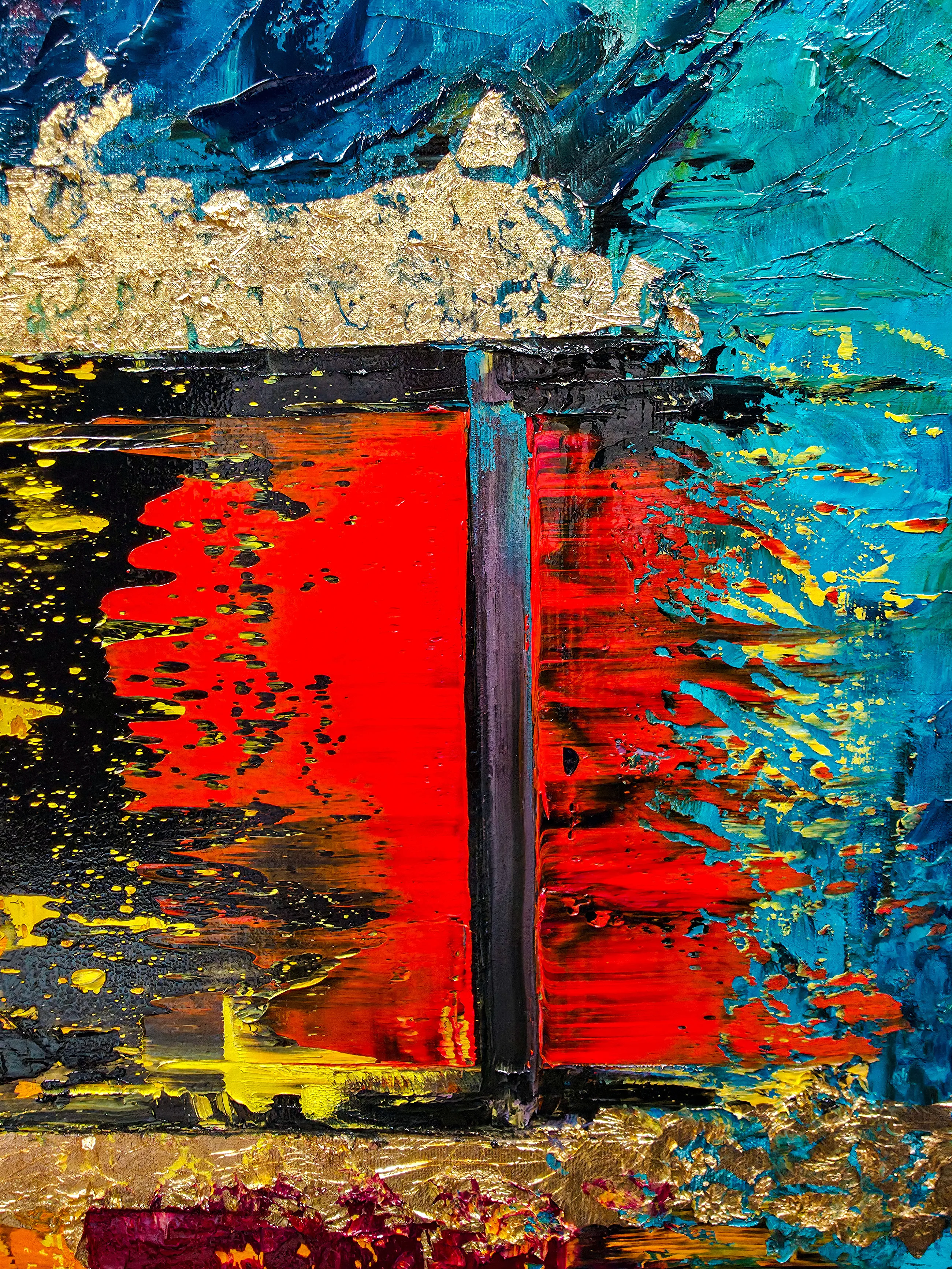
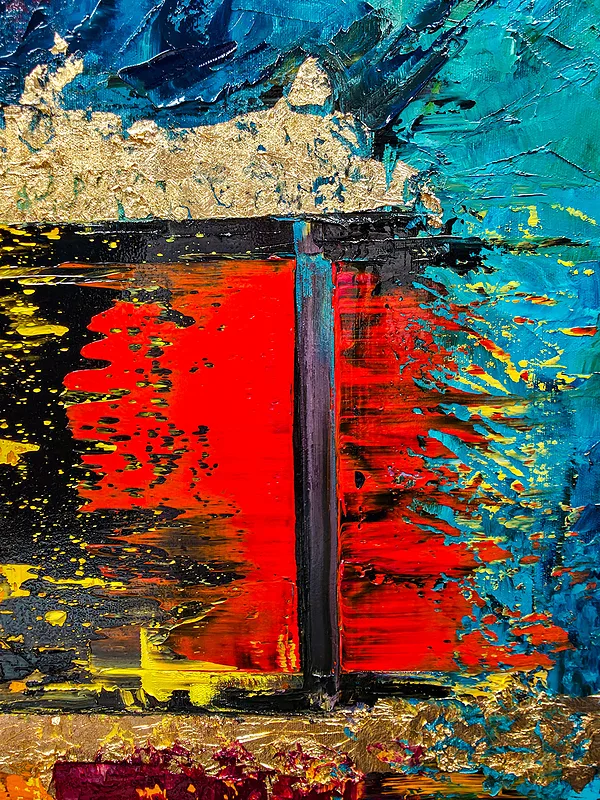
Within this layered structure, the memory of Mount Sinai emerges first. In the central chromatic chambers, fields of red, orange, and yellow flare into life, evoking the fire associated with the story of Mount Carmel.
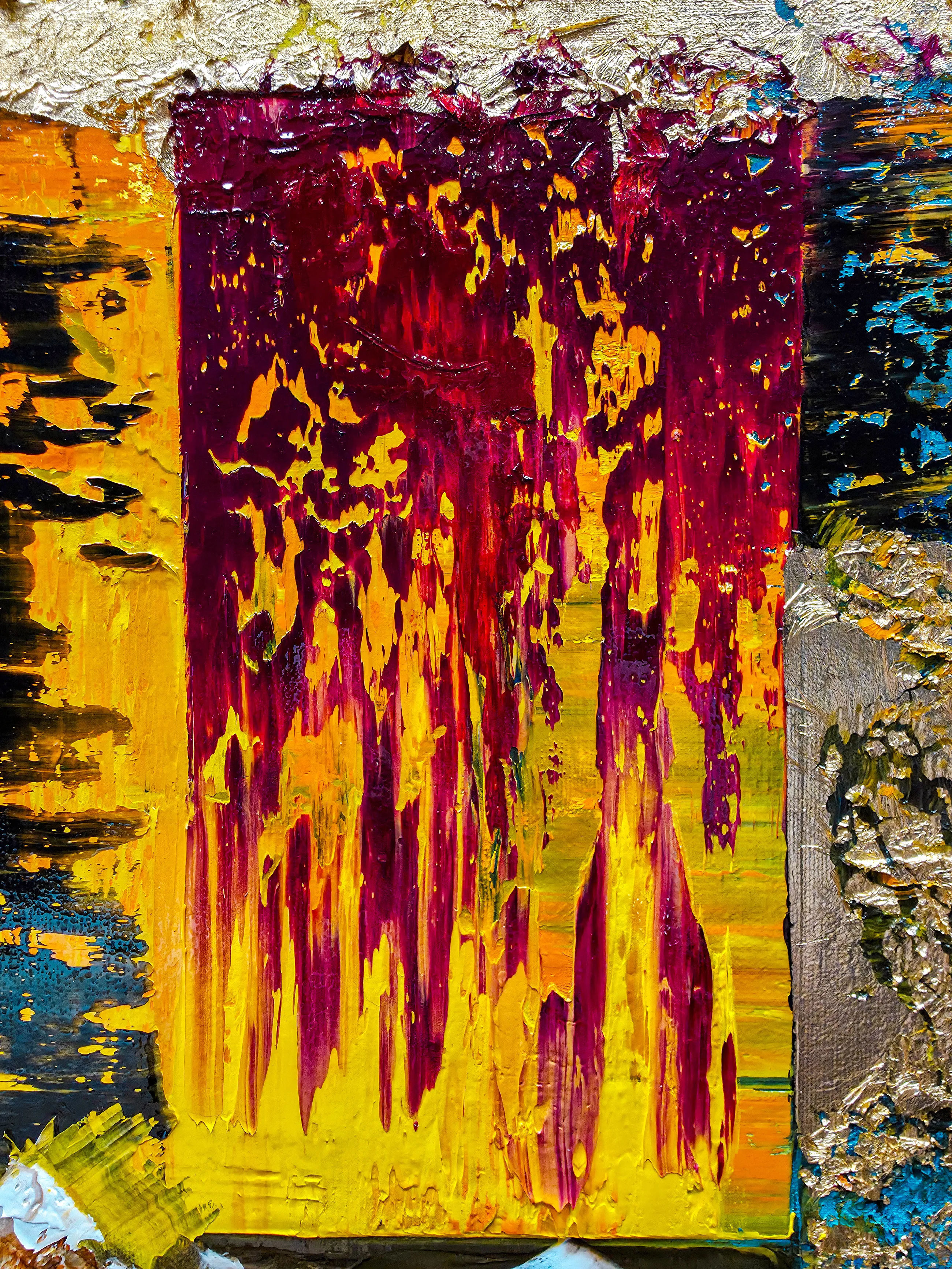
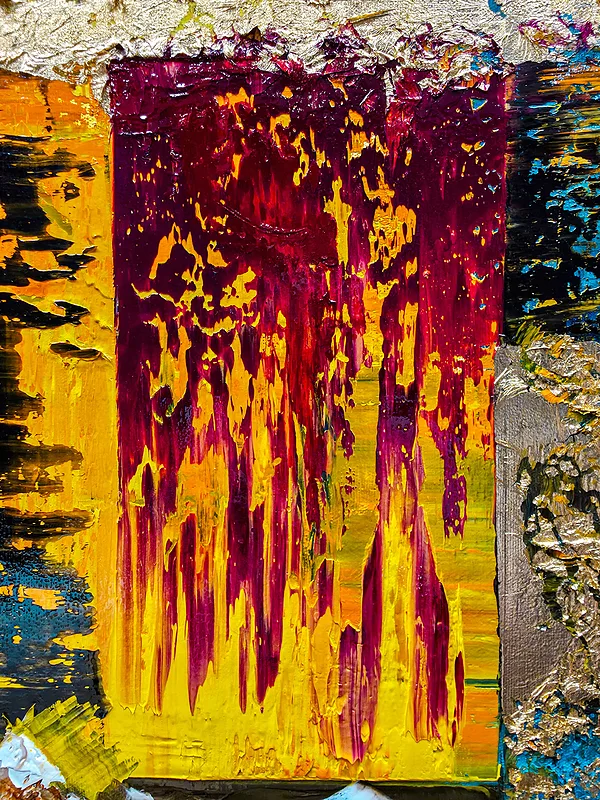
The azure and turquoise surrounding the composition evoke the sanctified presence and peace of Mount Zion, where the Ark of the Covenant was kept during the reign of King David. The purple and burgundy shadows on the left preserve the memory of sacrifice and obedience, recalling the story of Abraham and Isaac, as well as the sacred significance of the Temple Mount. Above the blue expanses, glimmers of green hold the promise of renewal: the life-giving essence of water and the vital creative force of the Garden of Eden.
The memory of Mount Nebo emerges through the painting’s distant vistas. Just as Moses beheld the Promised Land from the mountain, the central form of the composition remains both within reach and mysteriously remote. Sinai represents the Law and the covenant; Zion, the sanctified presence of God; Carmel, the testing of faith; the Temple Mount, sacrifice; and Nebo, promise and relinquishment.
Yet the painting depicts no single geographical place. Instead, it evokes the eternal archetype of the sacred mountain: the inner height towards which each person must make a pilgrimage within themselves.
Eden Matrix (Genesis 2.5)
- 55 x 46 cm
- Oil and gold on canvas
- Created: Sitges, 2026
- The artwork is part of the 'Old Testament III - In Search of the Secrets of Eternity' cycle
- AVAILABLE FOR PURCHASE
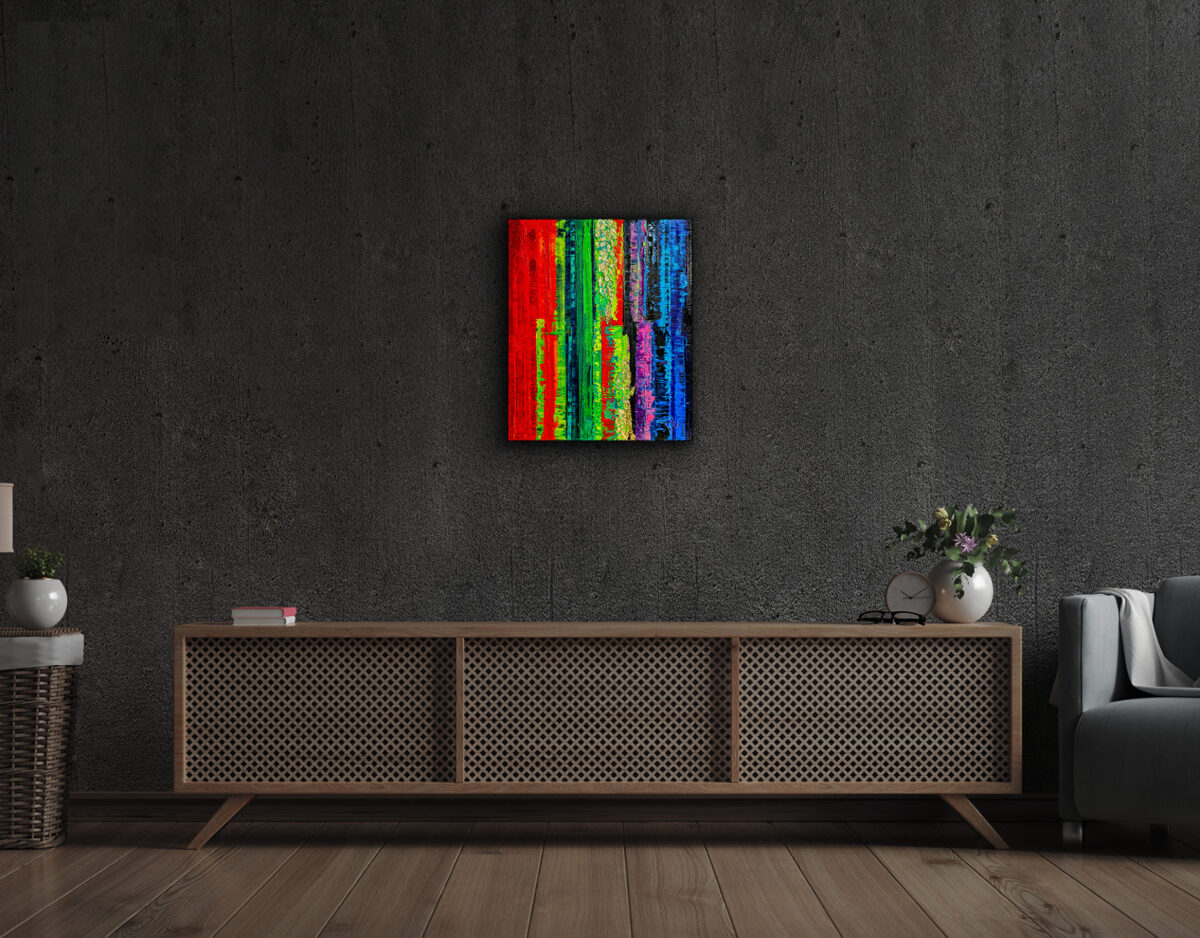
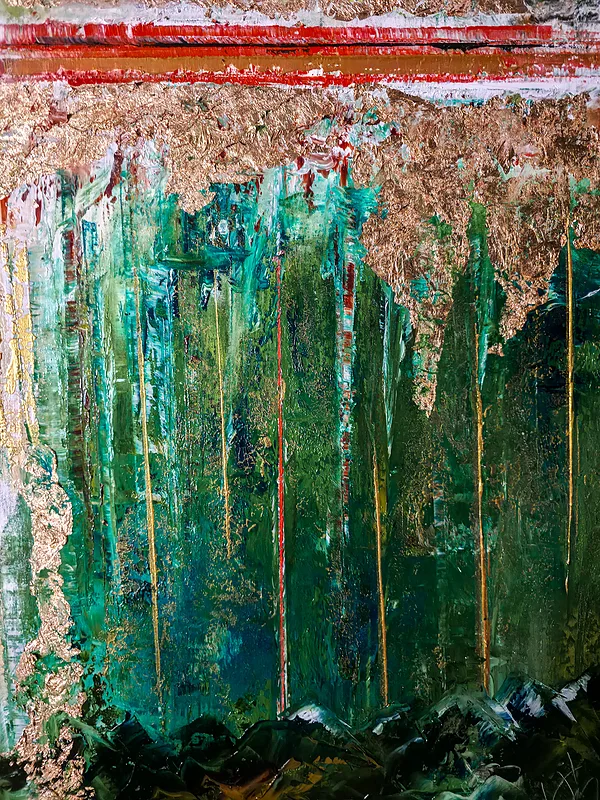
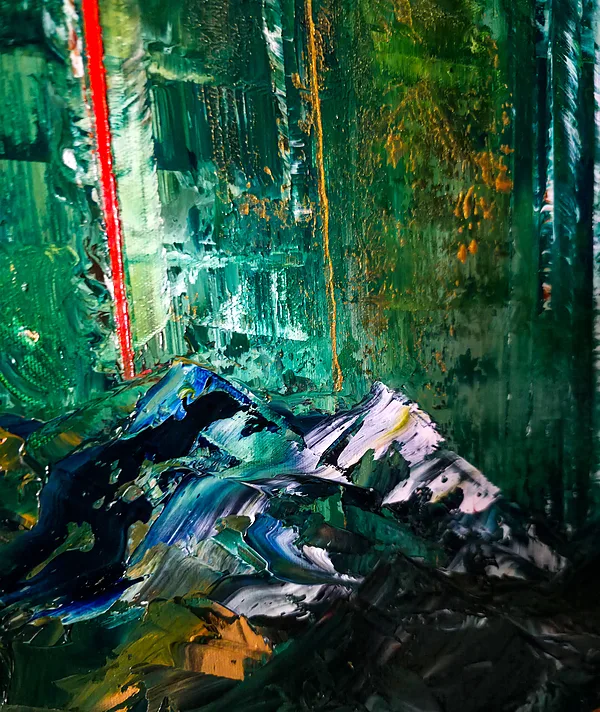
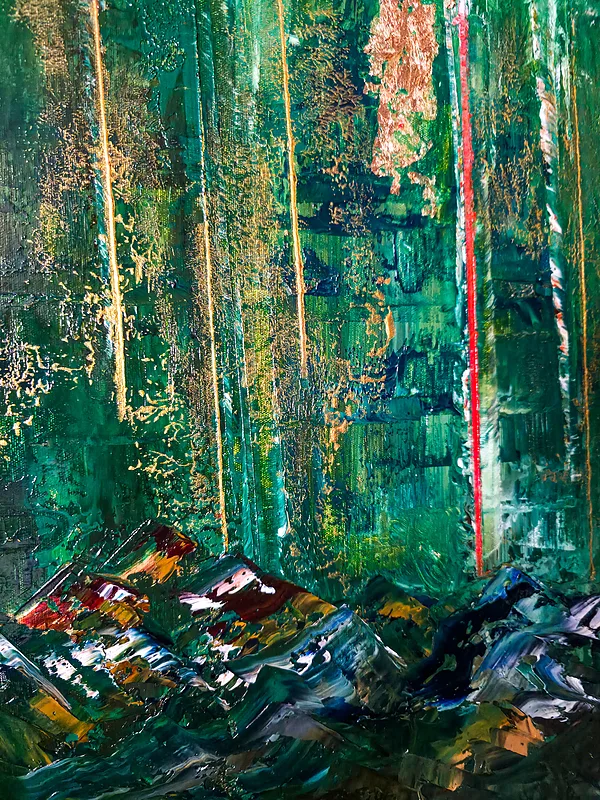
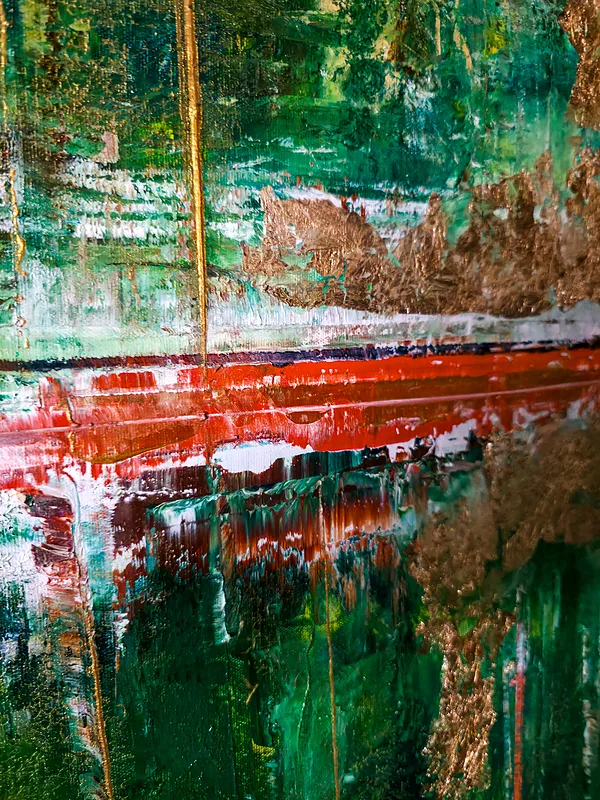
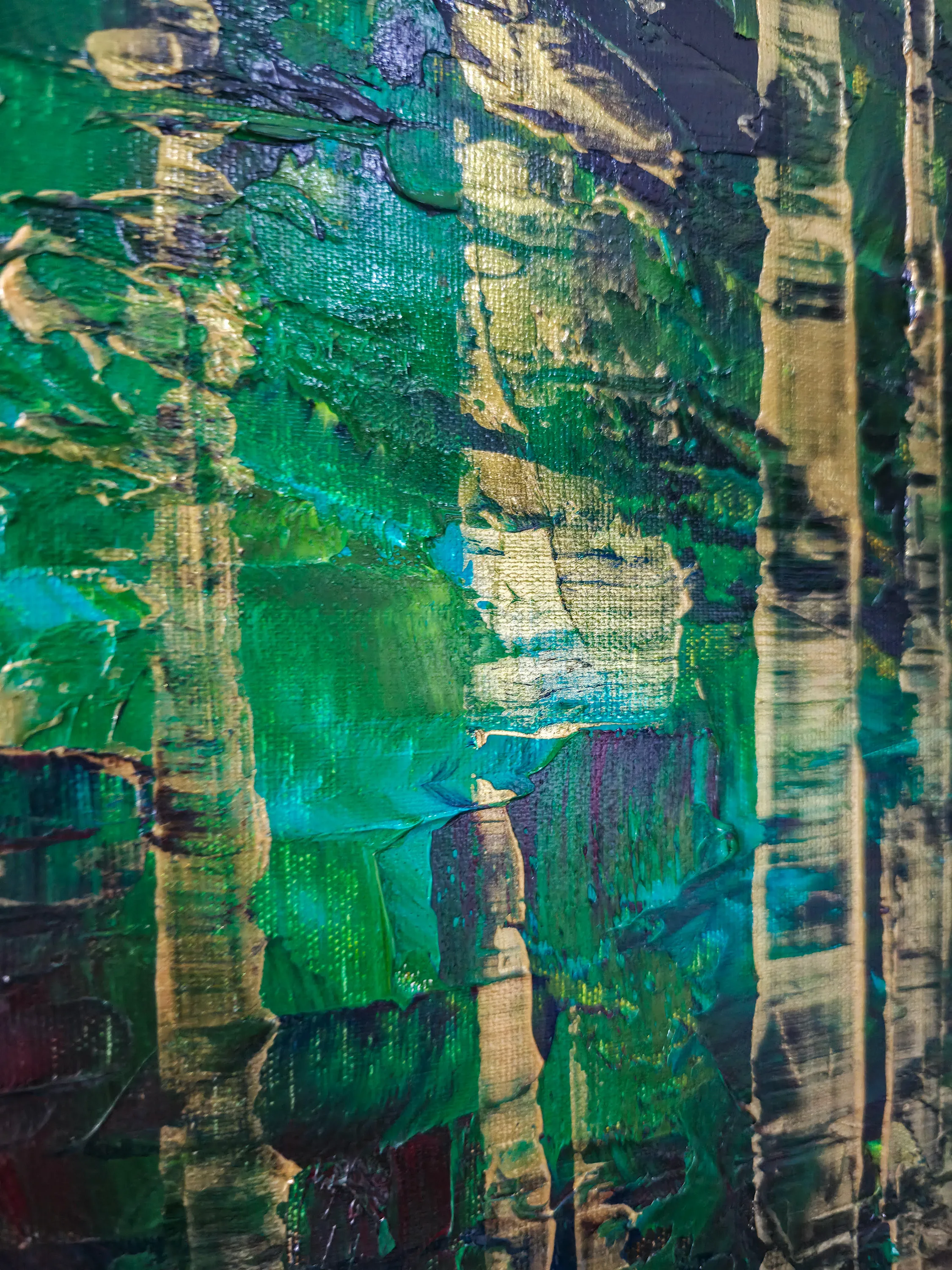
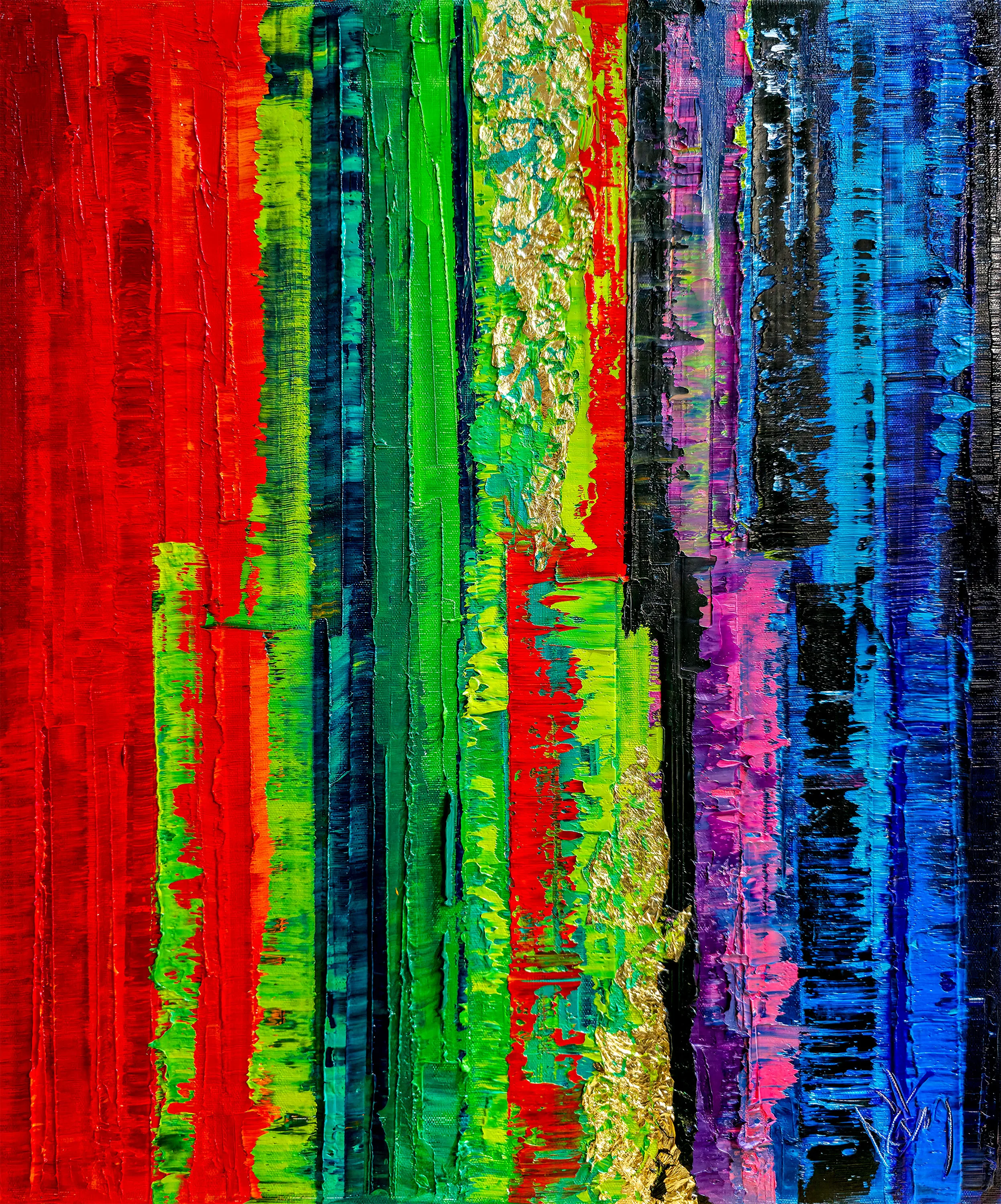
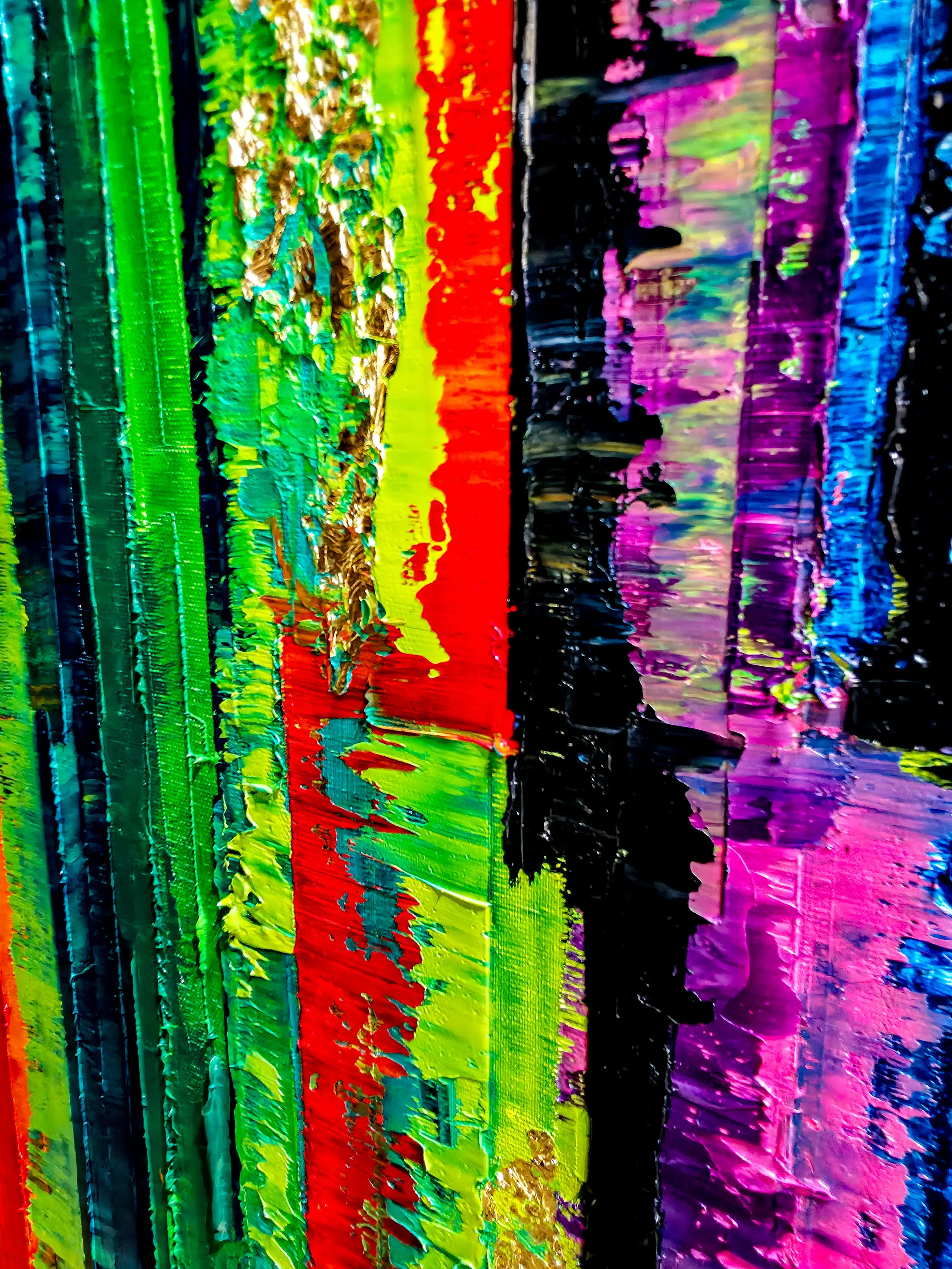
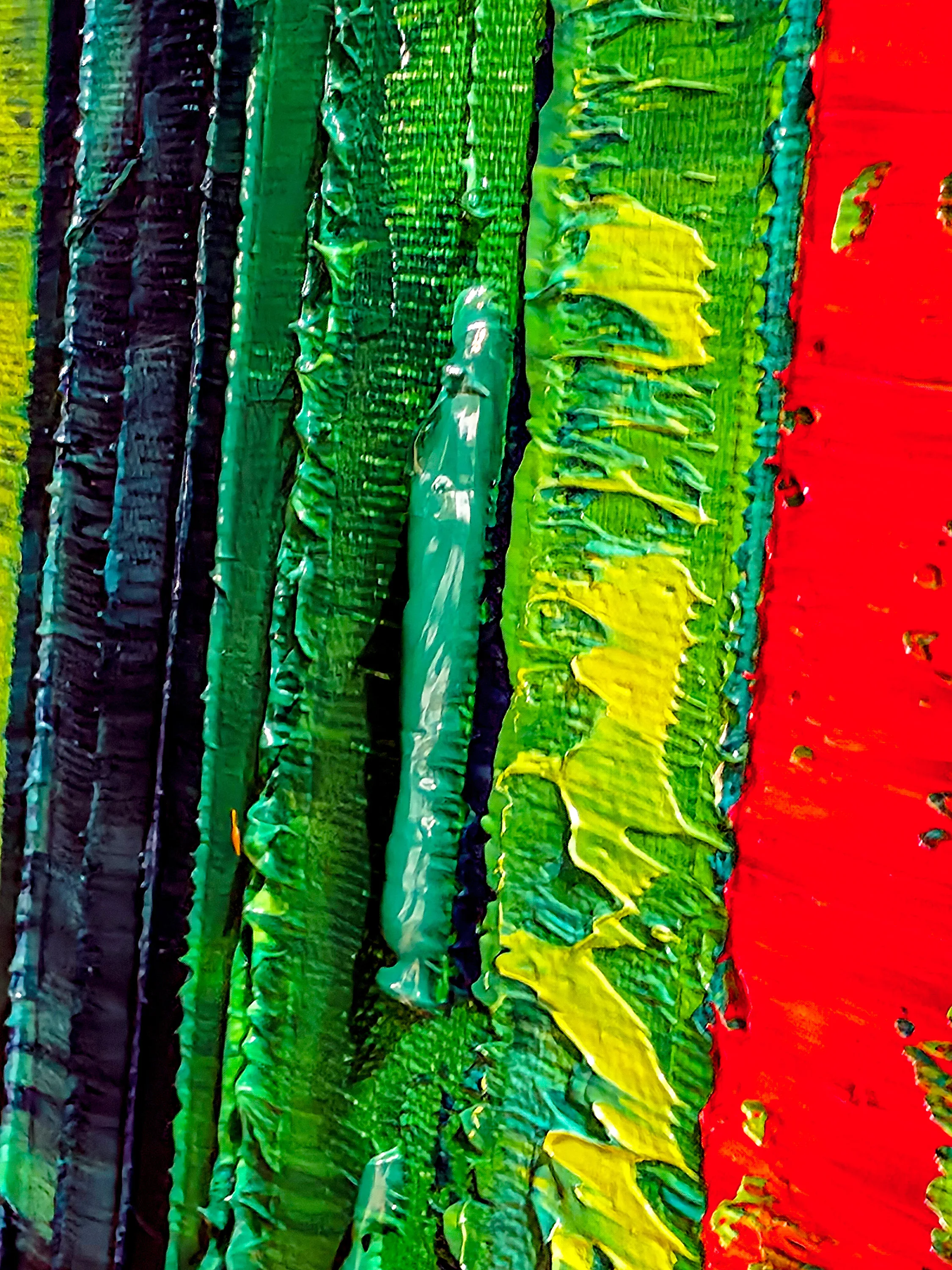
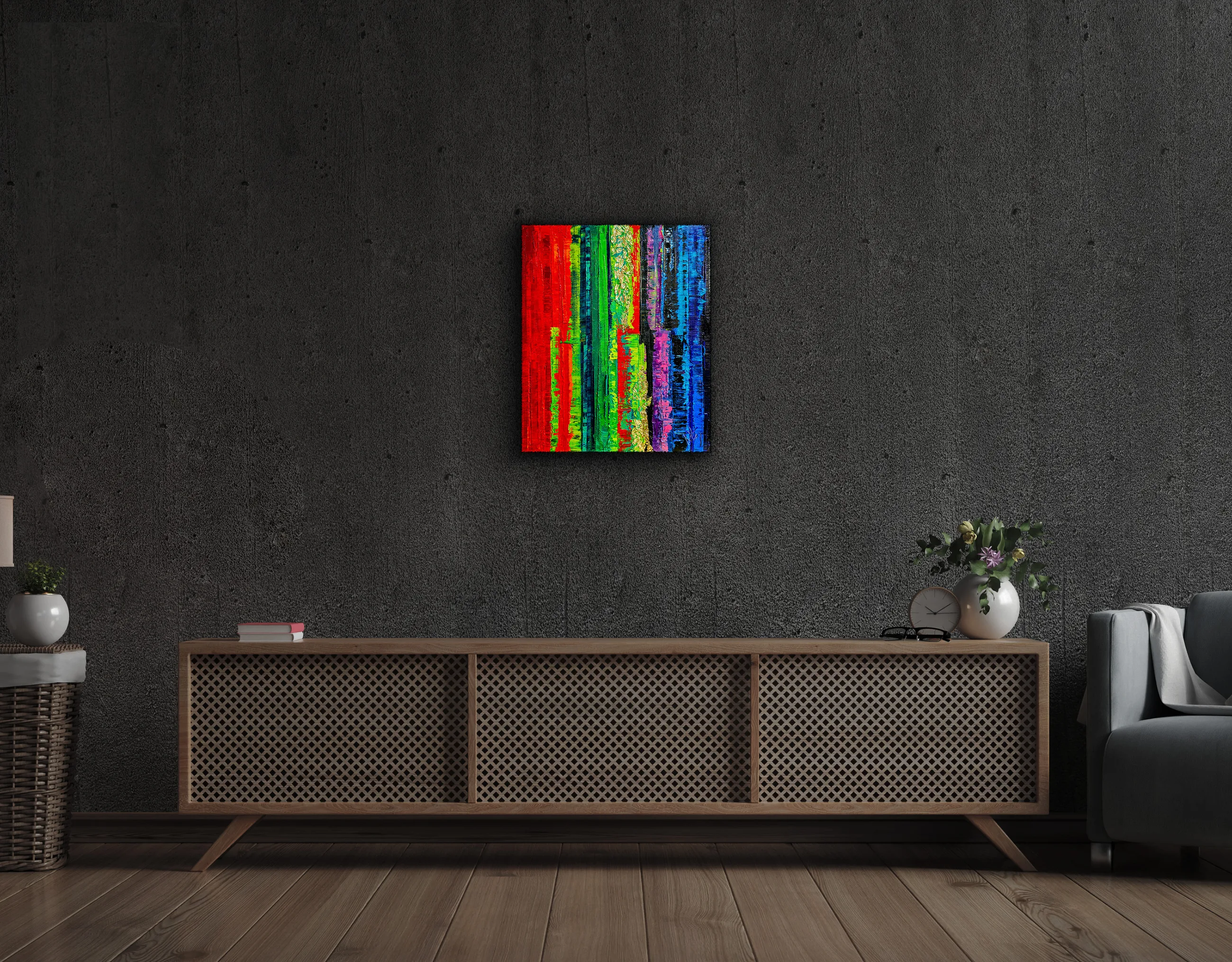
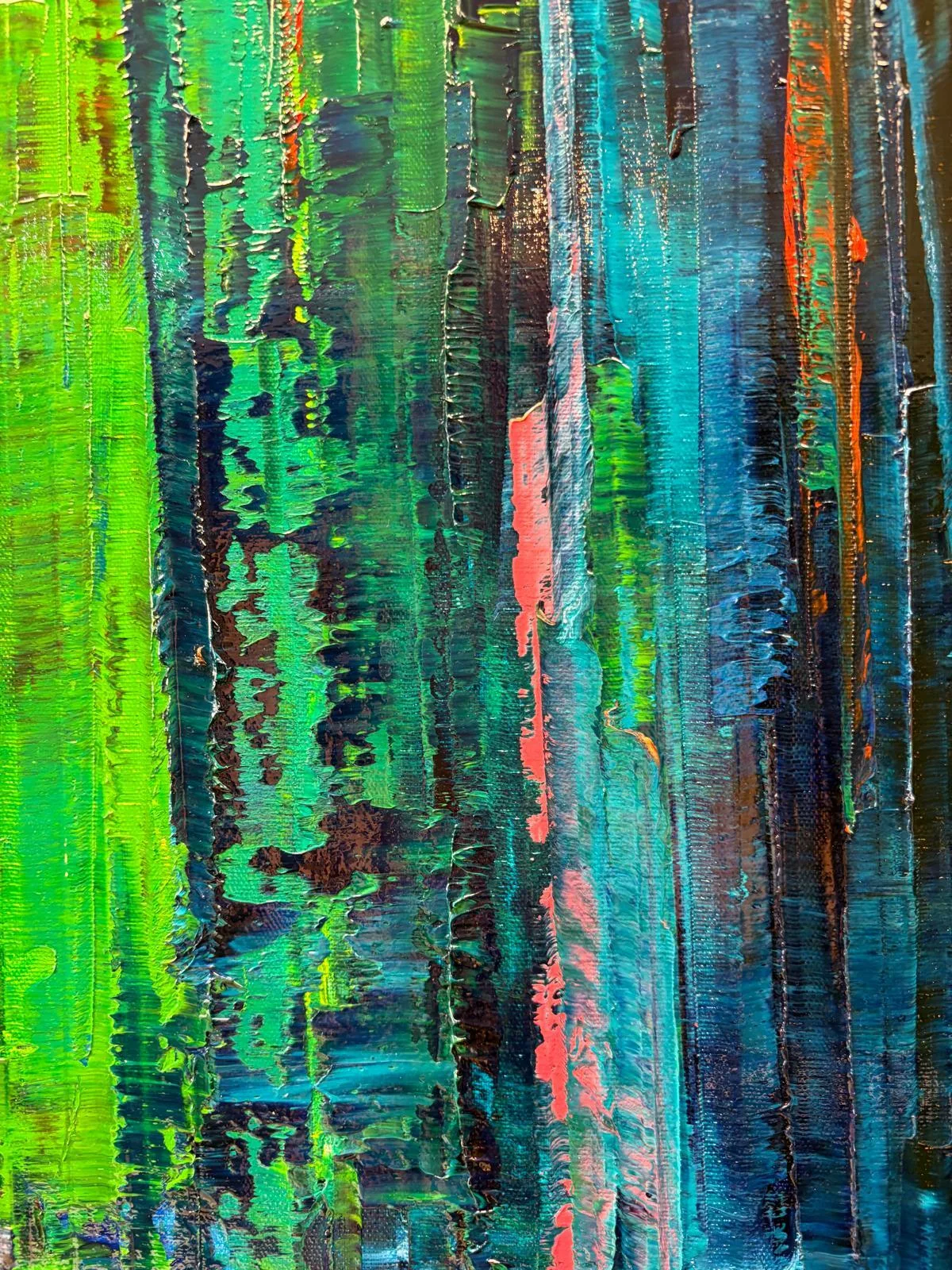
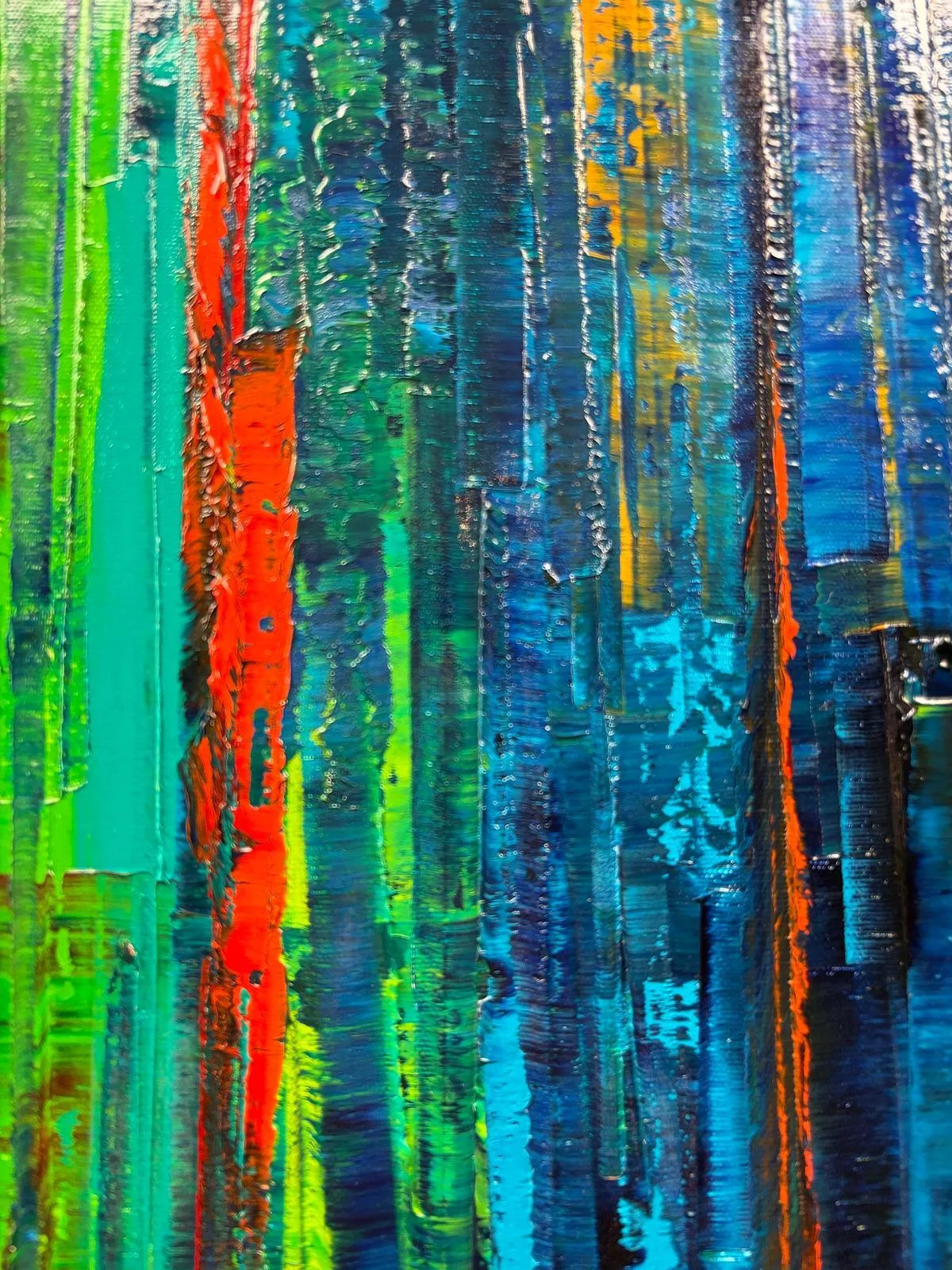
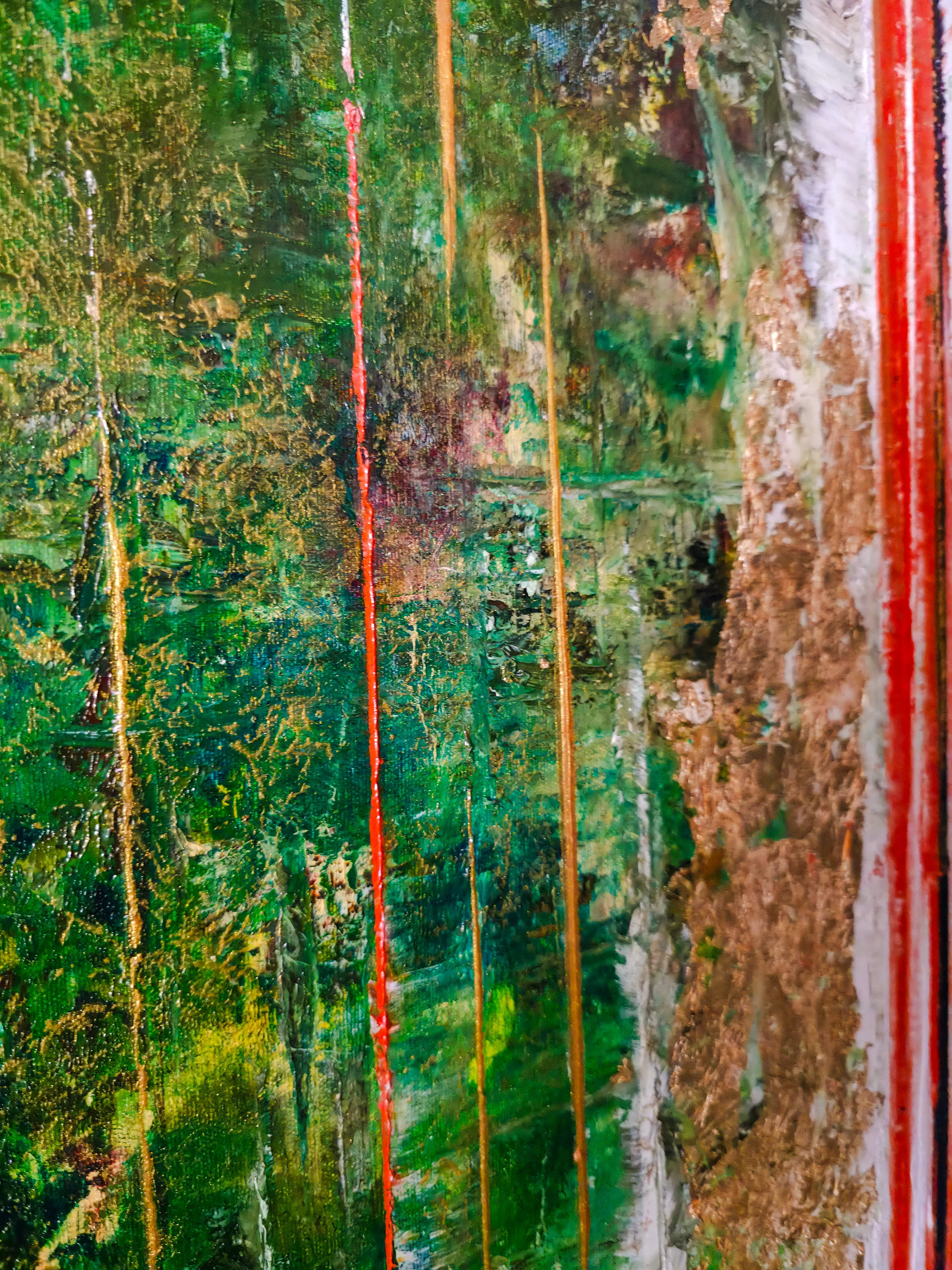
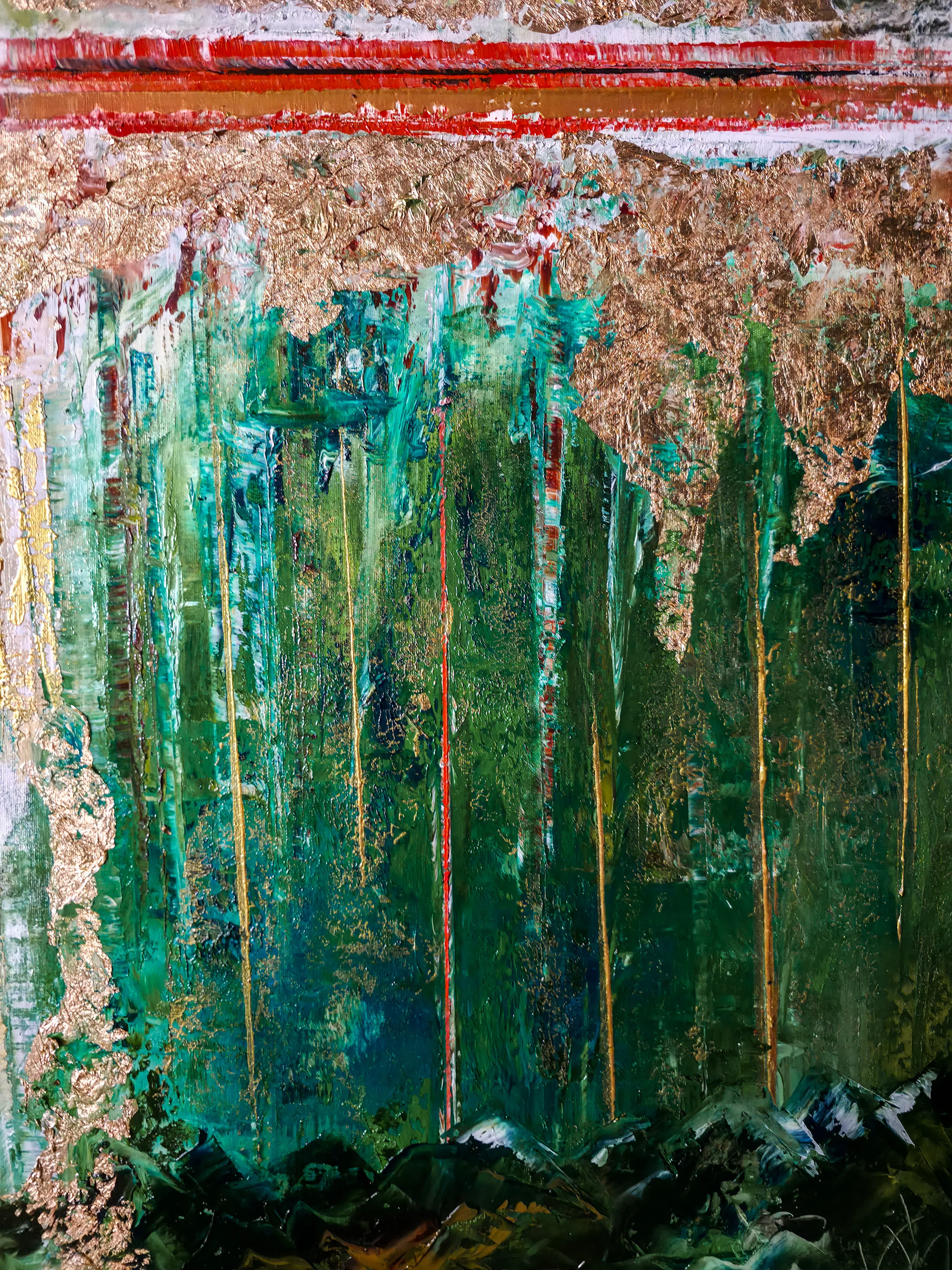
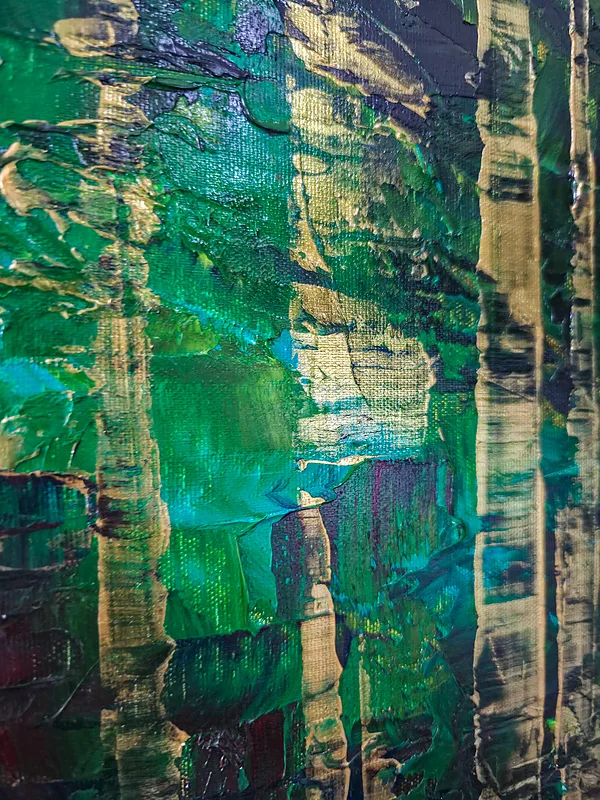
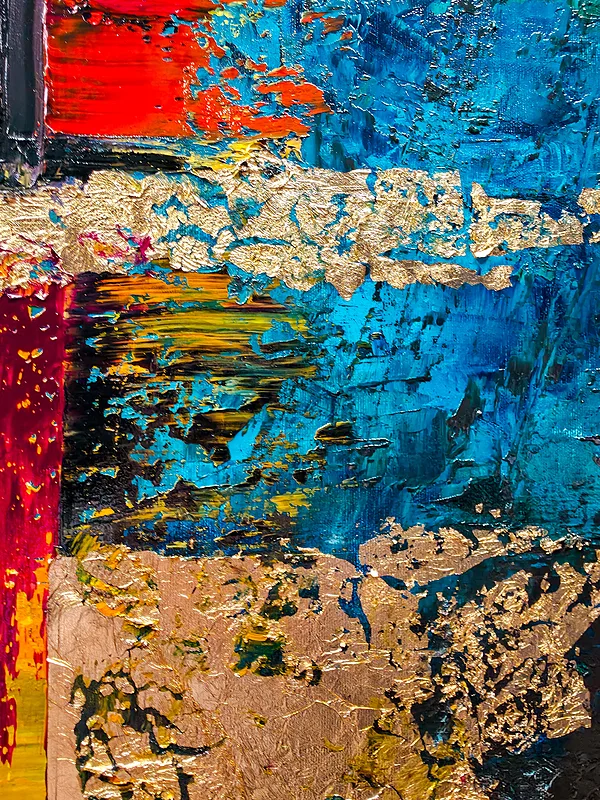
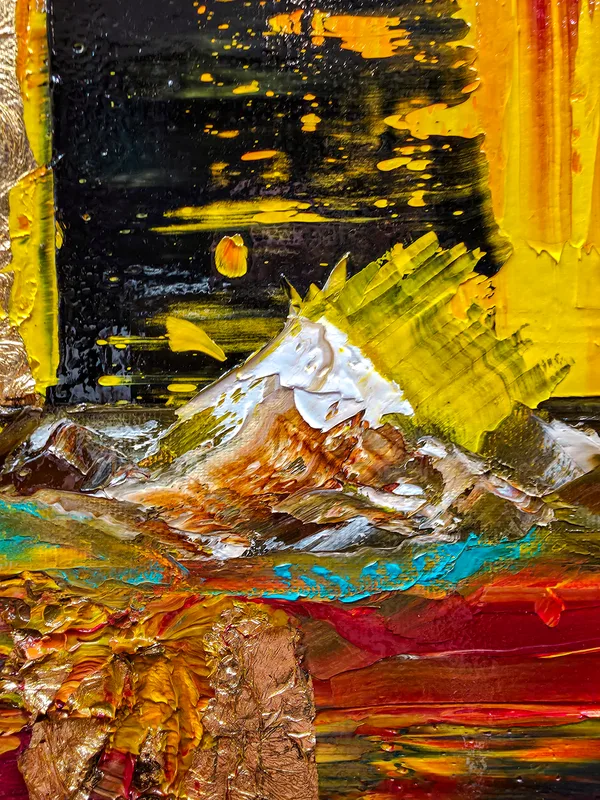
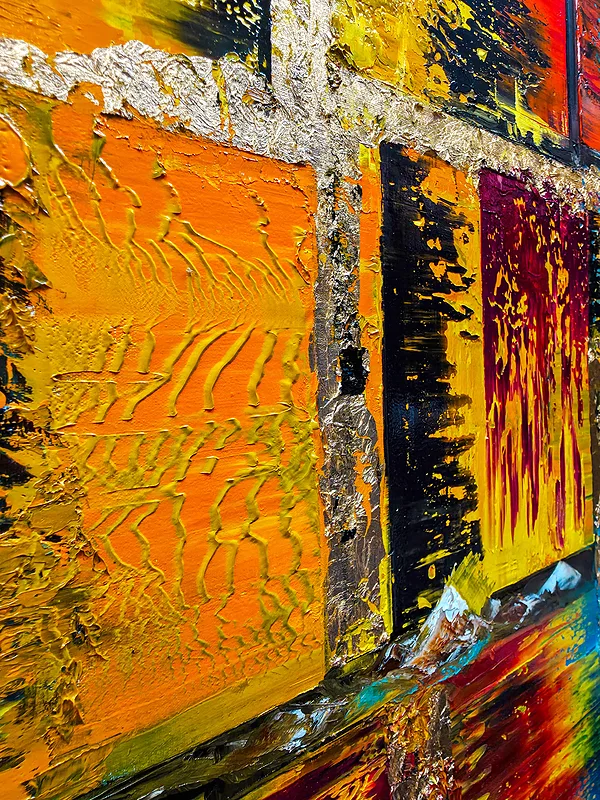
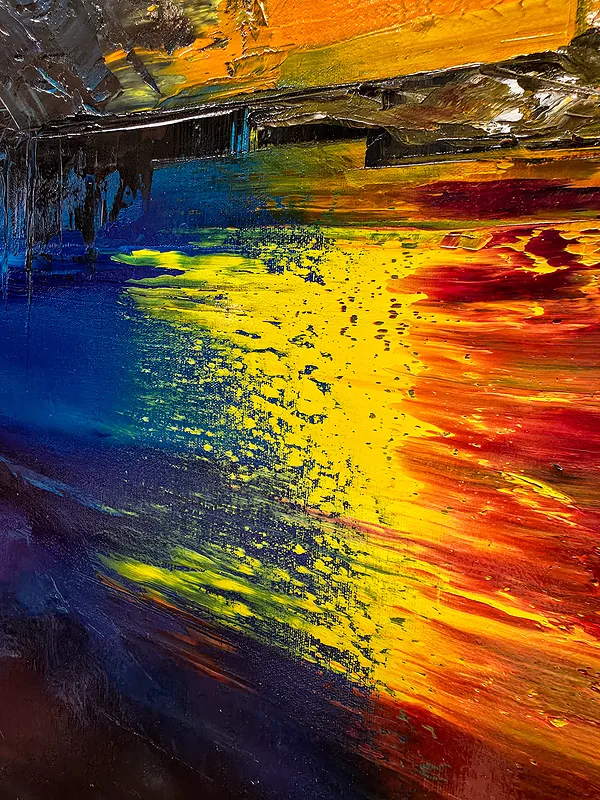
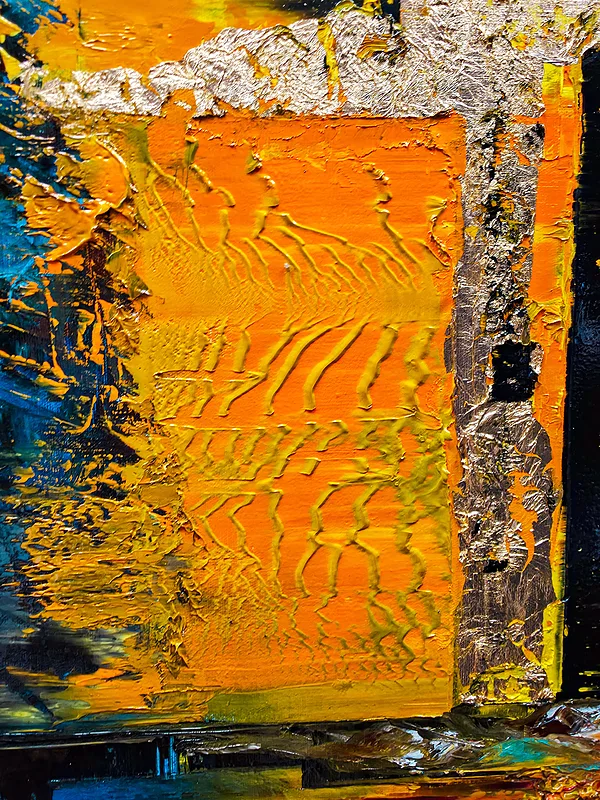
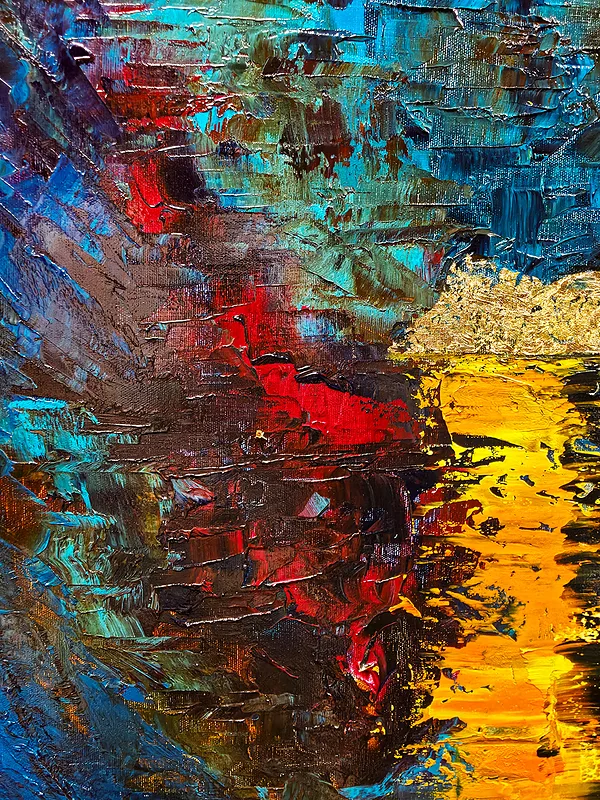
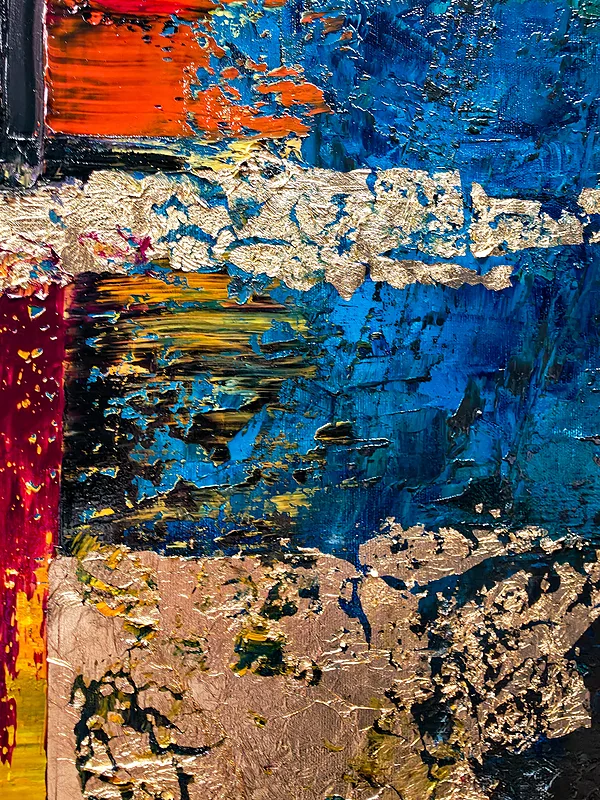
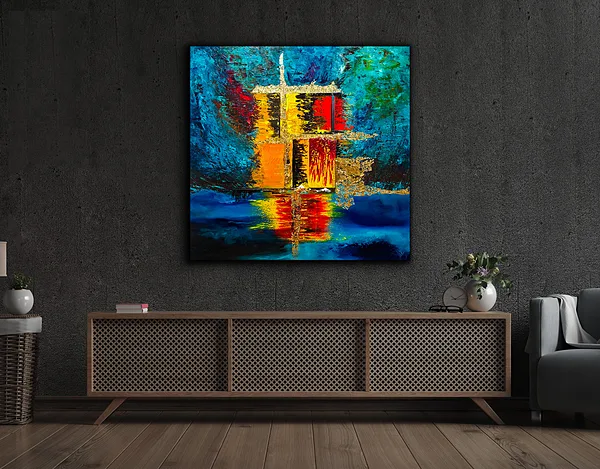
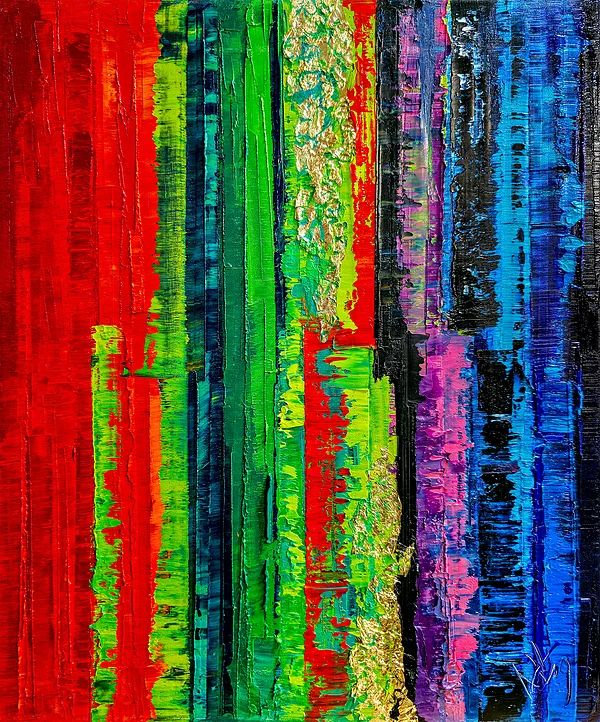
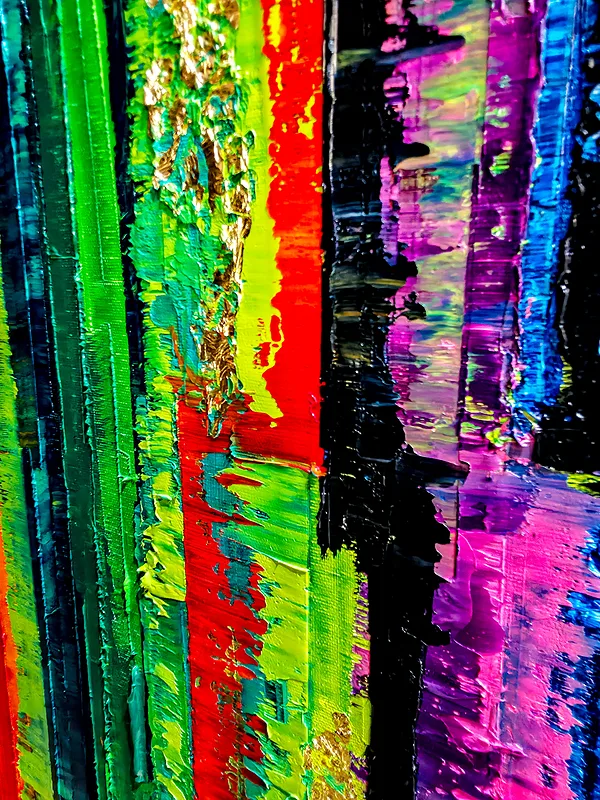
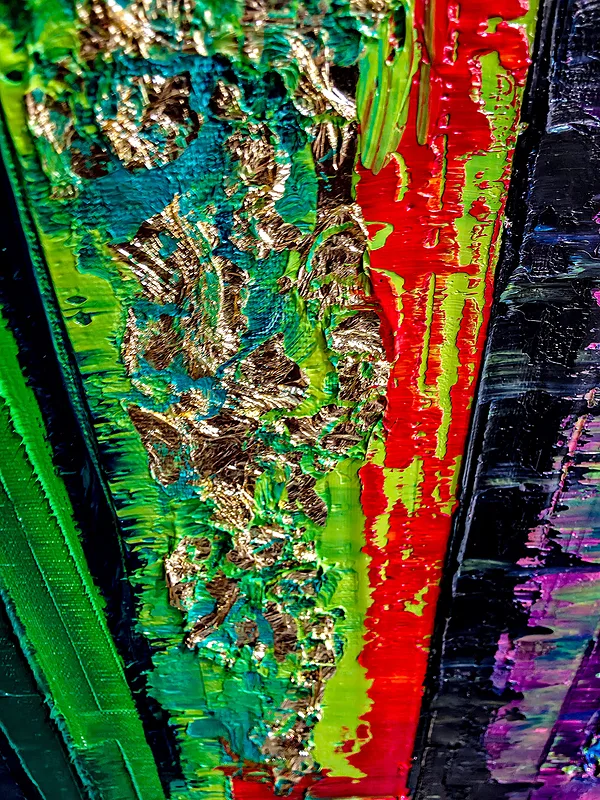
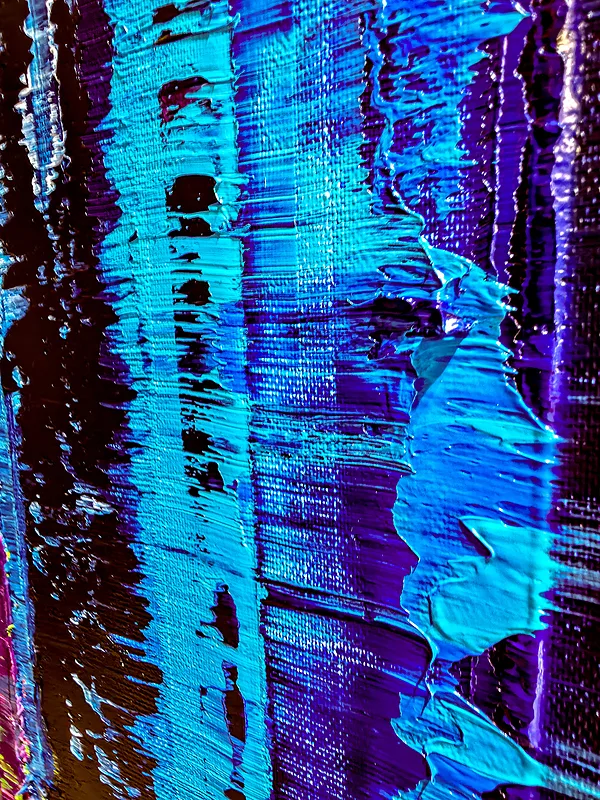
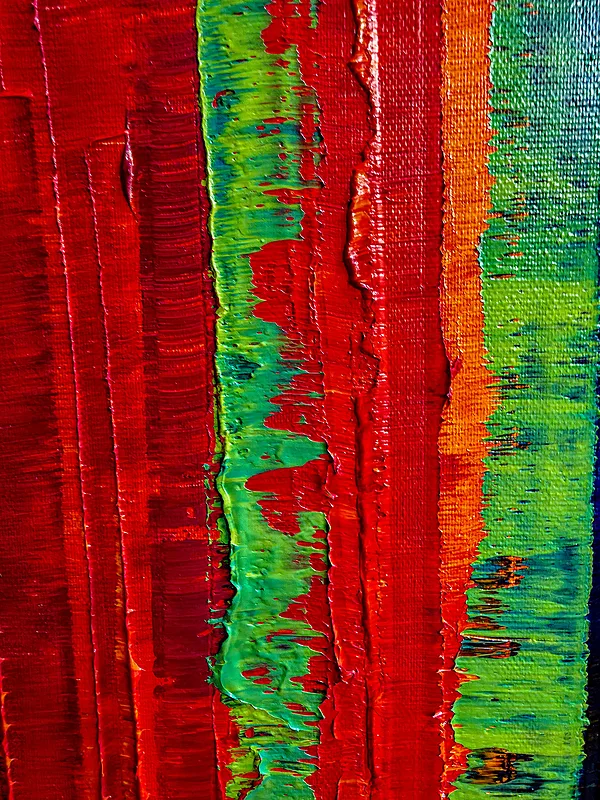
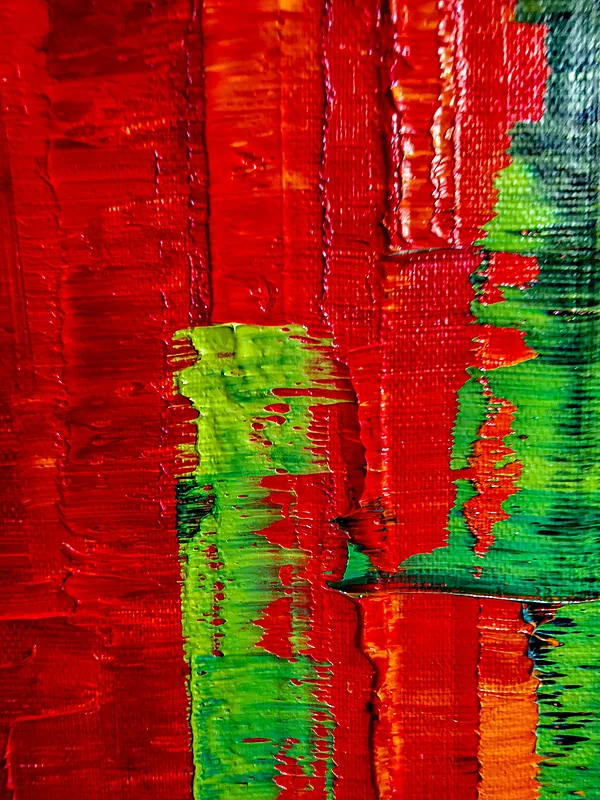
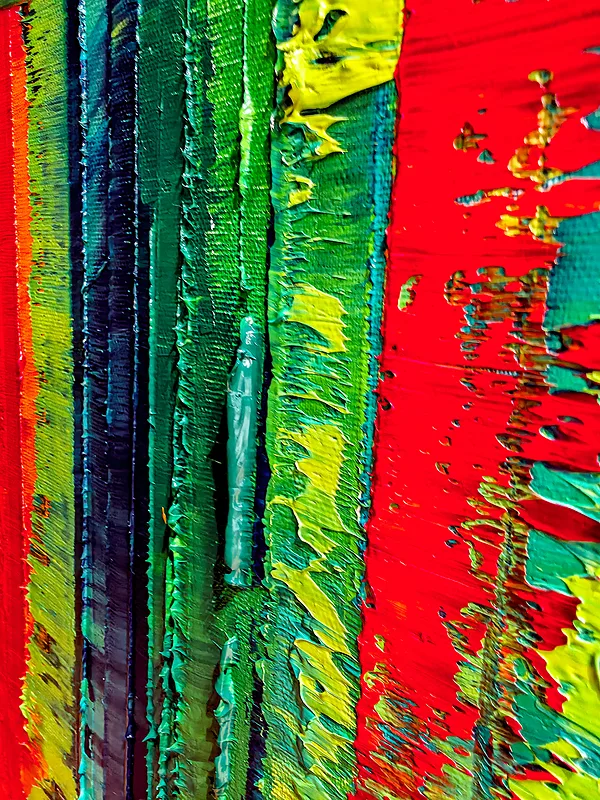
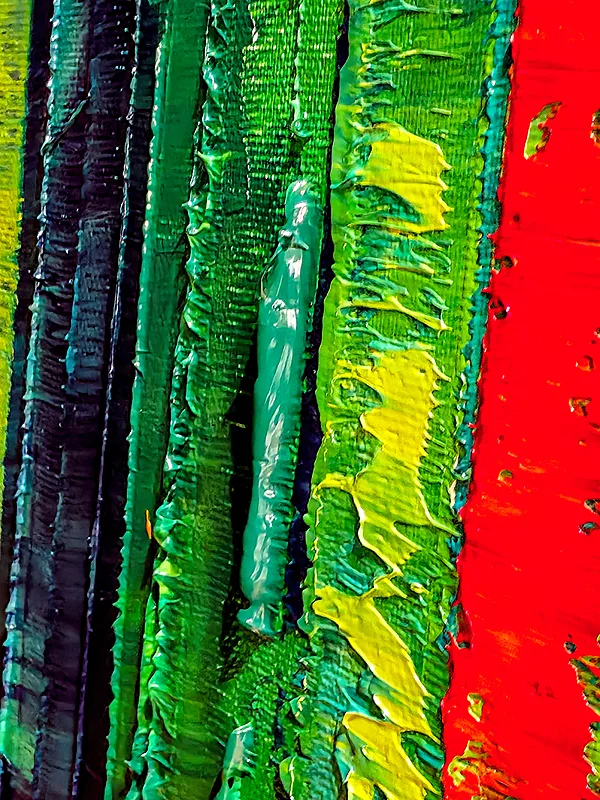
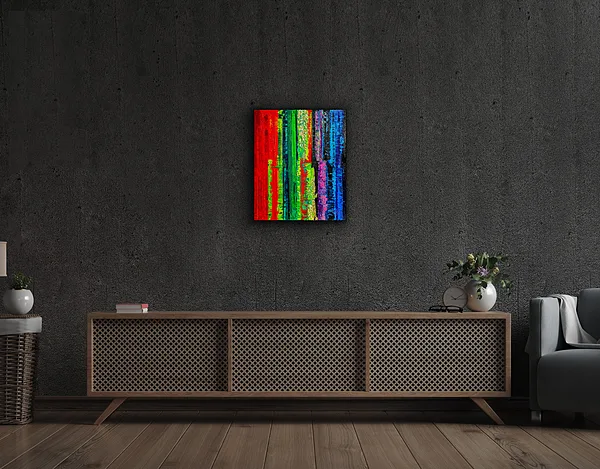
Viewed from a distance, the painting’s visual elements coalesce into a surprisingly disciplined order. Its colours stand in vertical columns, and the composition as a whole evokes a monumental, abstract forest of paradise. On closer inspection, however, the inner vitality of this order reveals itself: within every band, further colours, fissures, and translucent layers emerge, revealing an inexhaustible proliferation of life unfolding within the structure itself.
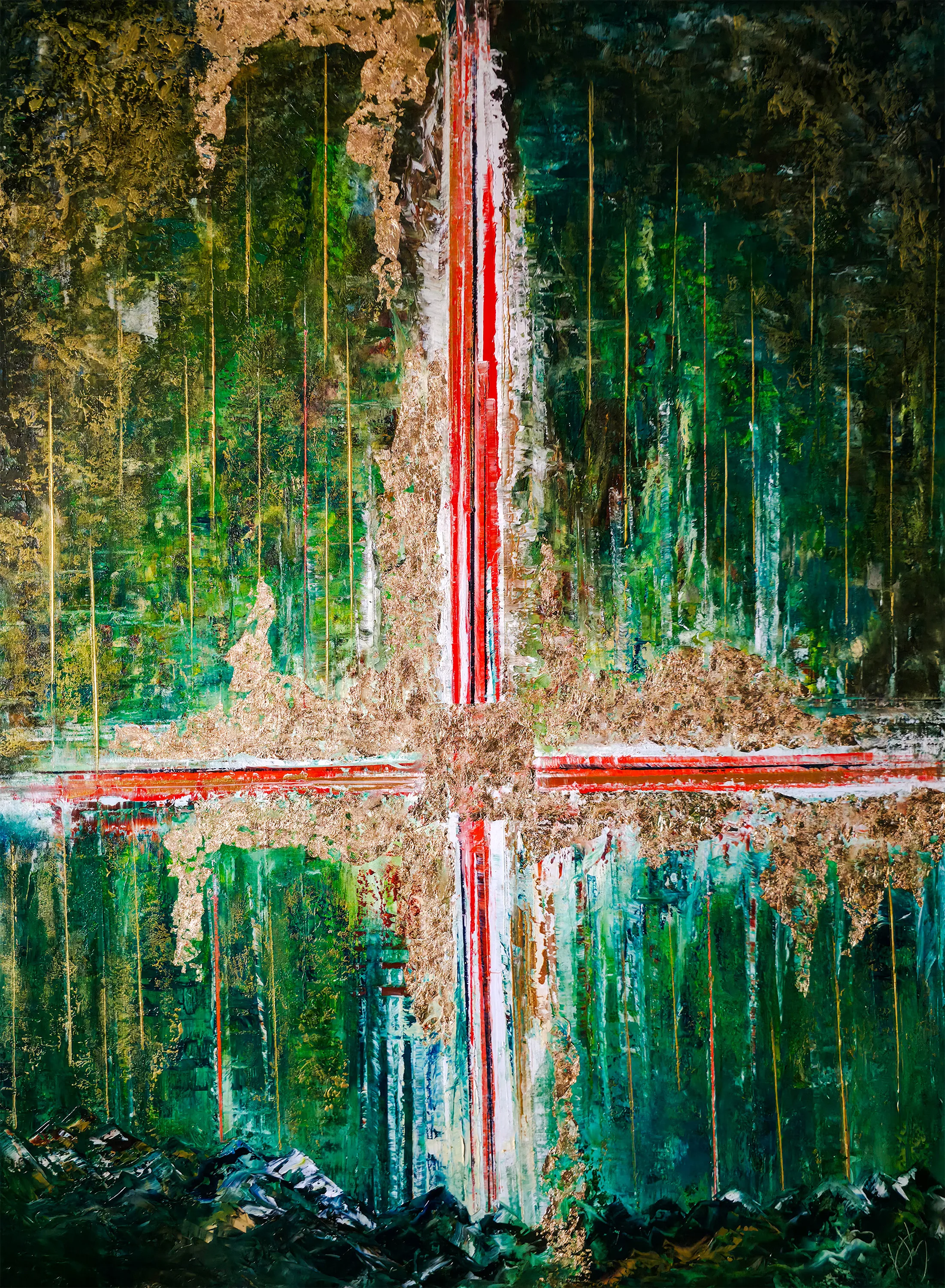
The vertical bands of scarlet, emerald, malachite, gold, purple, and cobalt reveal the sometimes unfathomable structure of existence.
“For every plant of the field before it was in the earth, and every herb of the field before it grew.” (Genesis 2:5, KJV)
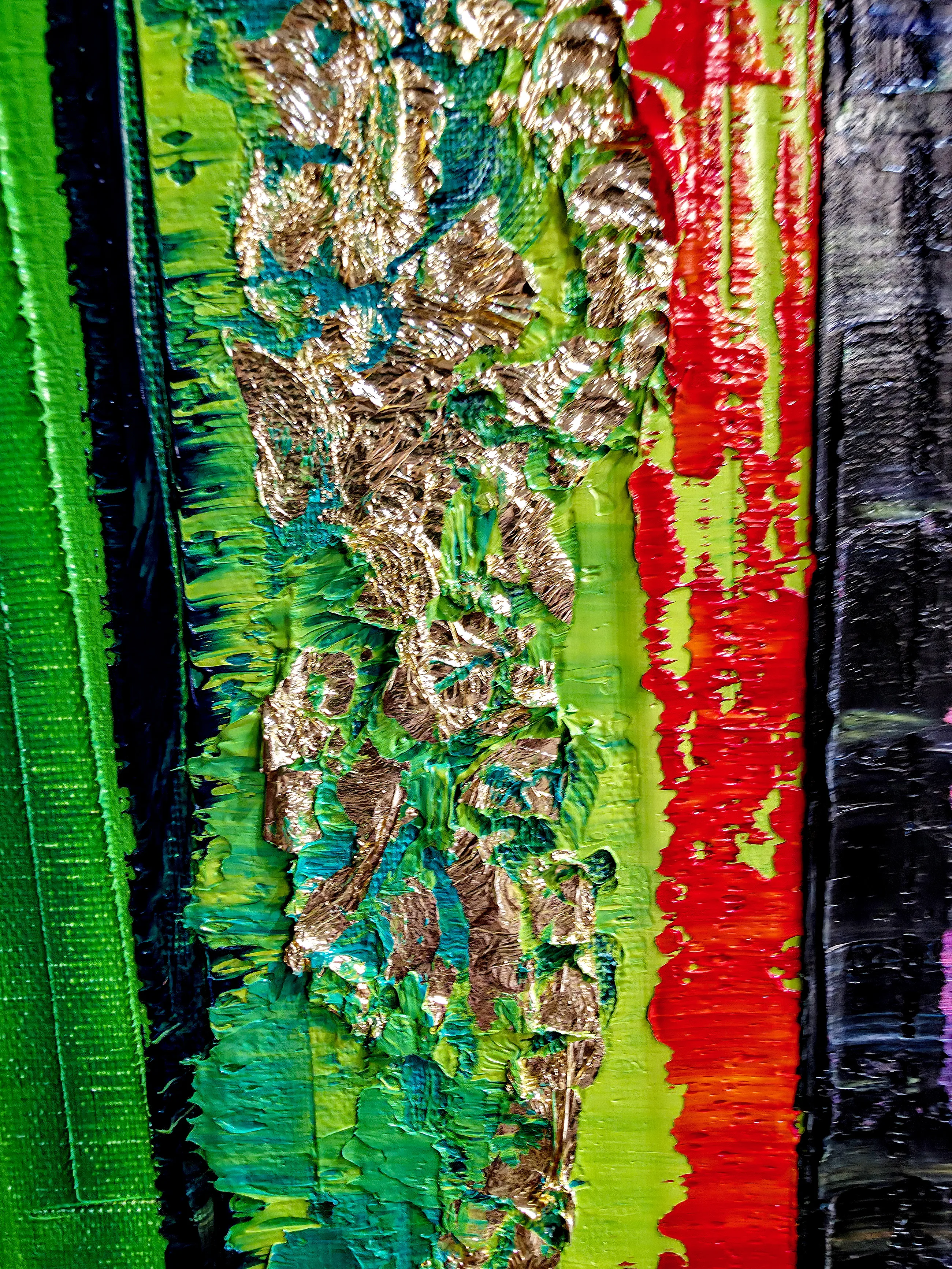
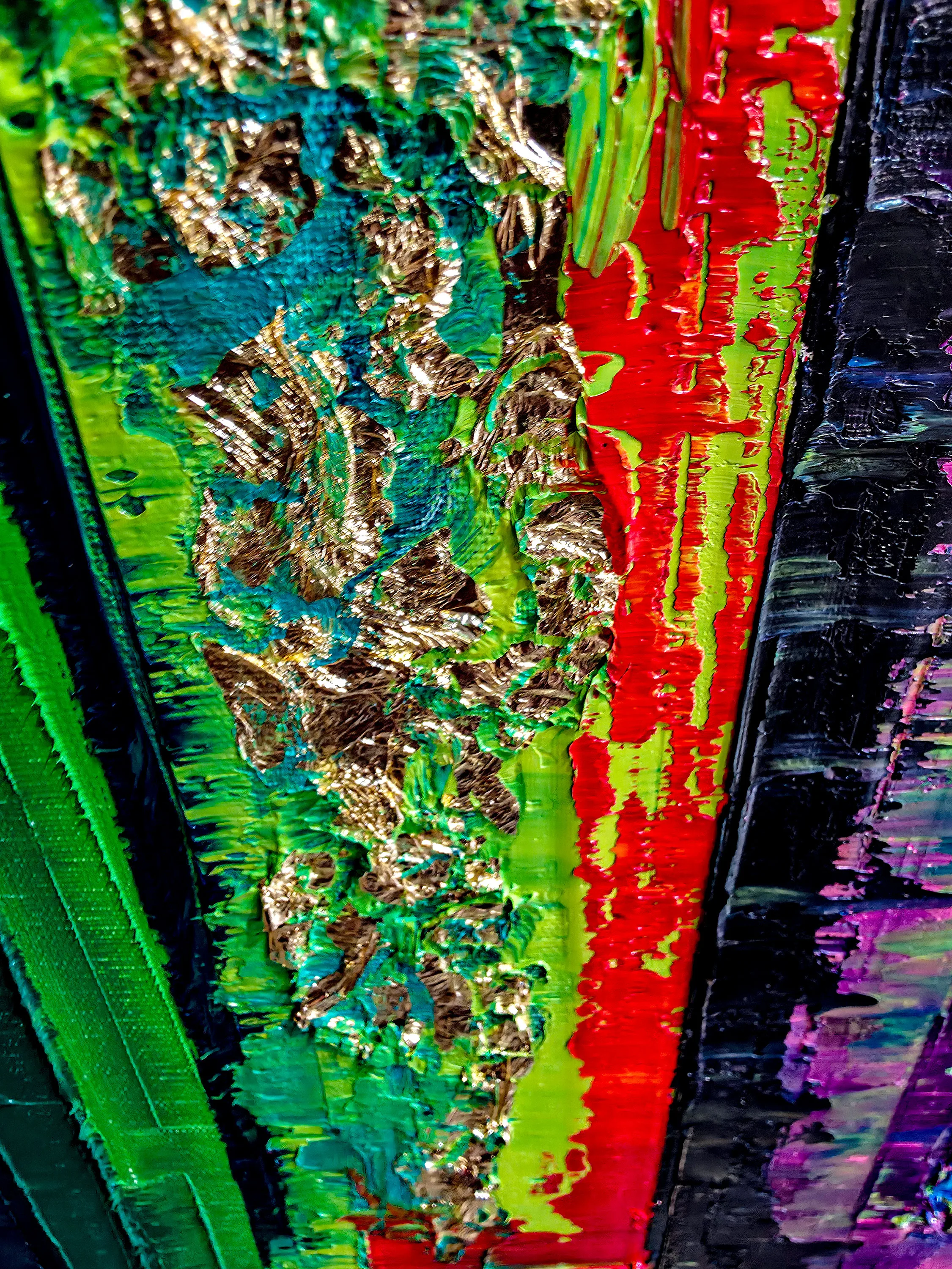
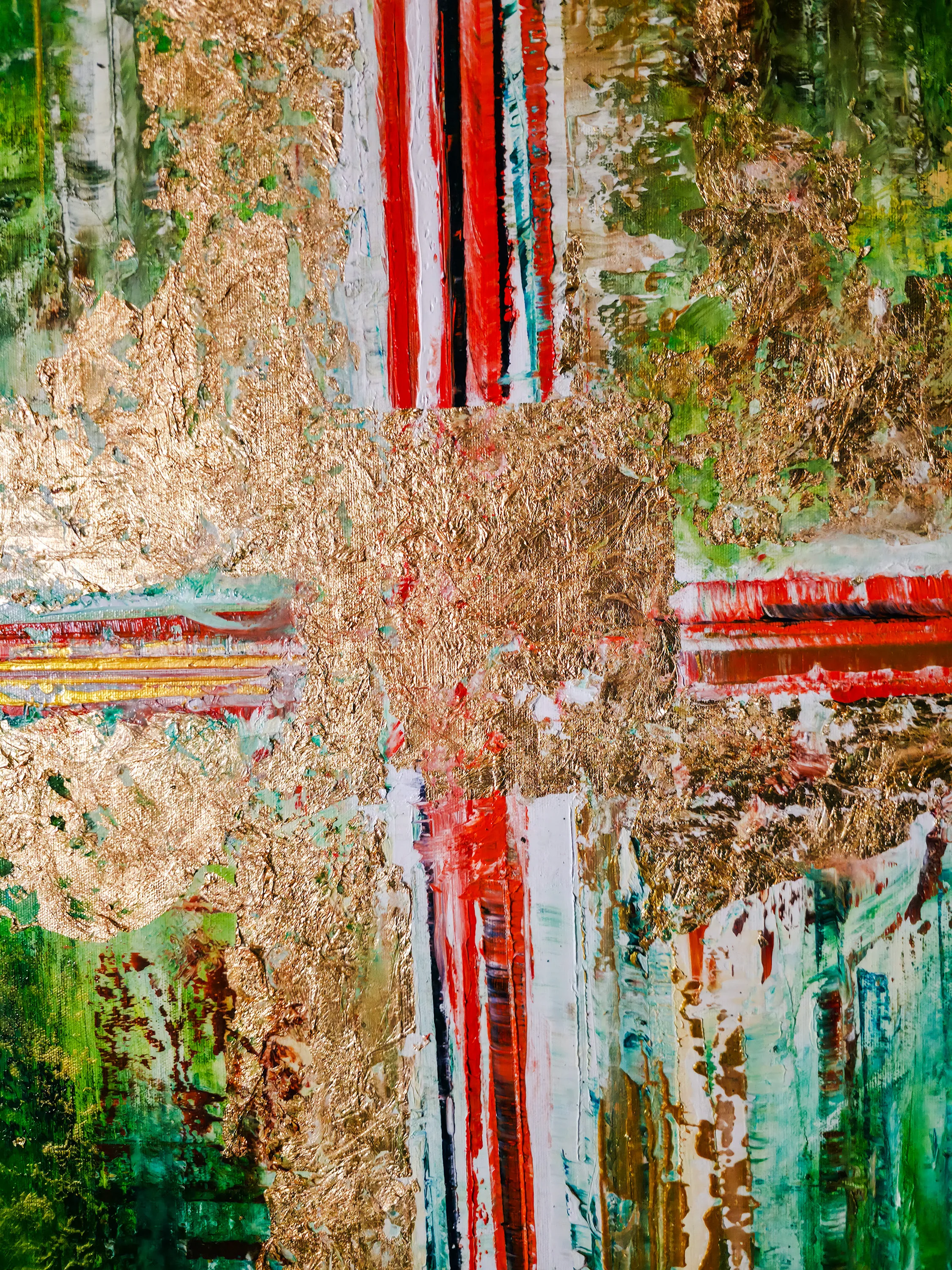
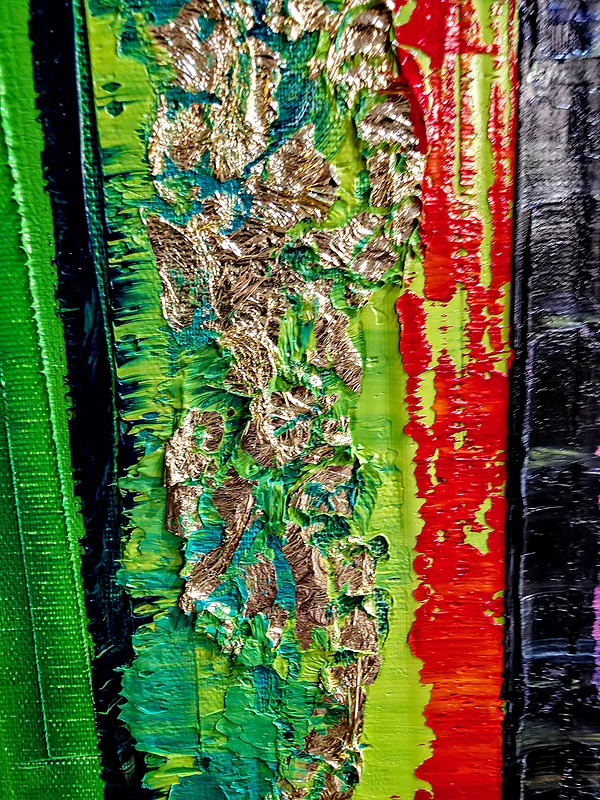
The emerald and malachite layers of the central green field suggest plant stems, tree trunks, and the delicate veining of leaves. Between them rises a relief-like formation of gold, evoking the Tree of Life growing at the heart of Eden.
The bands of turquoise and petrol blue running through the greens, followed by the deep cobalt on the right, evoke the river of Eden.
On the left, glowing scarlet and vermilion convey the fervour of creation, while the black band on the right establishes a boundary between the saturated greens and the cooler realms of purple, violet, and cobalt. The interplay of red, green, blue, and gold expresses the inseparable relationship between growth, life, water, and sacred origins.
The painting brings disciplined order and the exuberant vitality of matter into a single field. Eden Matrix is therefore more than a recollection of lost paradise: it evokes the primordial pattern of creation, a hidden order that continues to operate within all living things.
The Blessing of Aaron
- 120 x 100 cm
- Oil and gold on canvas
- Created: Sitges, 2026
- The artwork is part of the 'Old Testament III - In Search of the Secrets of Eternity' cycle
- SOLD
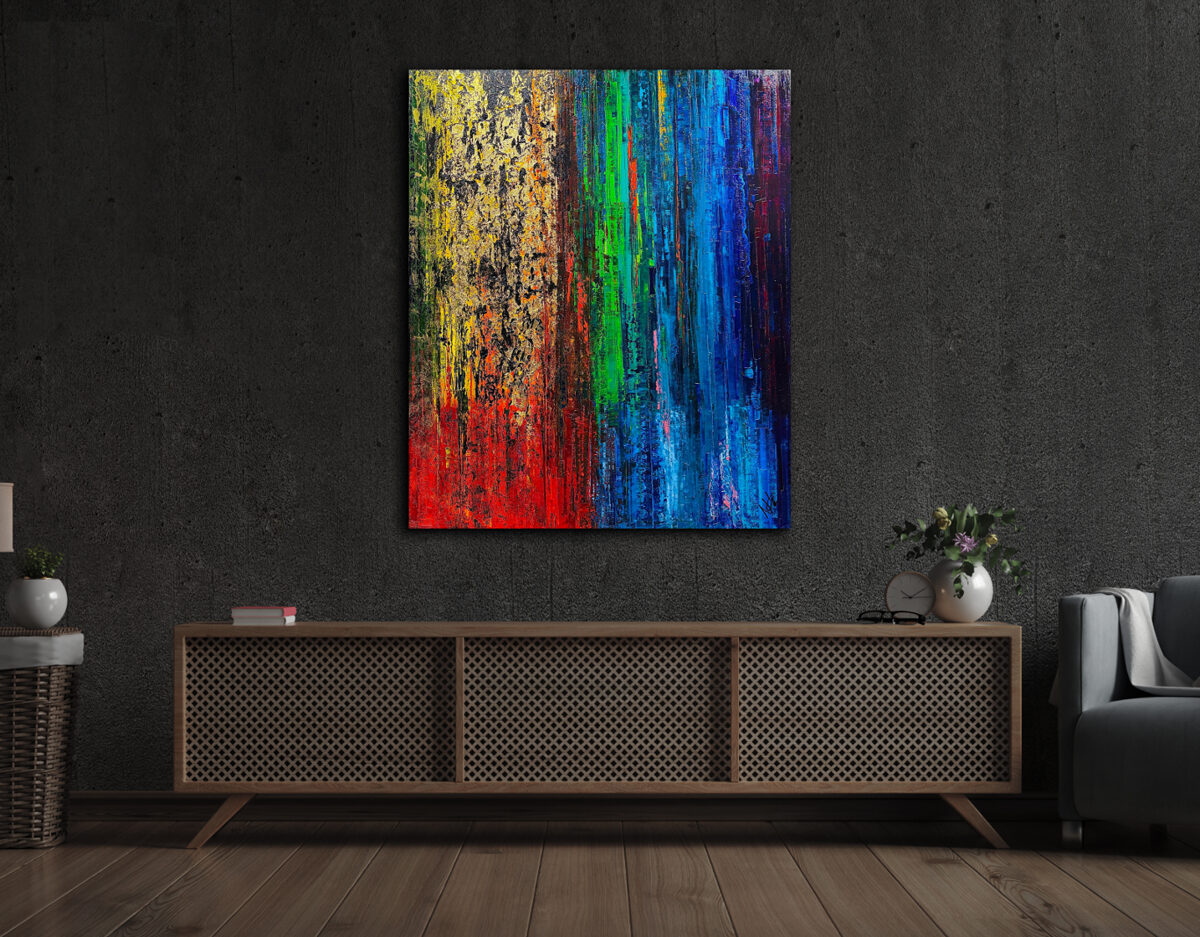
The three sentences of the blessing unfold across the canvas as three interwoven stages of spiritual experience: protection, grace, and peace.
The painting presents one of the most sublime revelations of the Old Testament, the Aaronic blessing, through a monumental composition of colour. The vertically cascading layers of paint evoke the curtains of a sanctuary radiant with heavenly light, while the interplay of gold, red, emerald green, and deep blue gives form to the three gifts of divine presence: protection, grace, and peace.
“The LORD bless thee, and keep thee: The LORD make his face shine upon thee, and be gracious unto thee: The LORD lift up his countenance upon thee, and give thee peace.” (Numbers 6:24–26, KJV)
The interplay of red, black, and gold conveys the protective power of the first sentence of the blessing. Red represents living love, black the depths of mystery, and gold the radiance of divine glory. Together, these colours envelop the viewer like a royal mantle. The emerald green unfolding at the centre symbolises grace and rebirth; its upward-reaching forms evoke Aaron’s rod that blossomed and the promise of renewed life. The deep blue and violet on the right lead towards the peace expressed in the third sentence of the blessing. Turquoise highlights evoke the life-giving essence of water and the vital creative force of the Garden of Eden.
The three colour fields merge into a single, uninterrupted flow: from protective love comes grace, and from grace, peace. The painting thus becomes a liturgy of colour woven from the words of the Aaronic blessing, in which divine love preserves, renews, and leads humanity back to the fullness of creation.
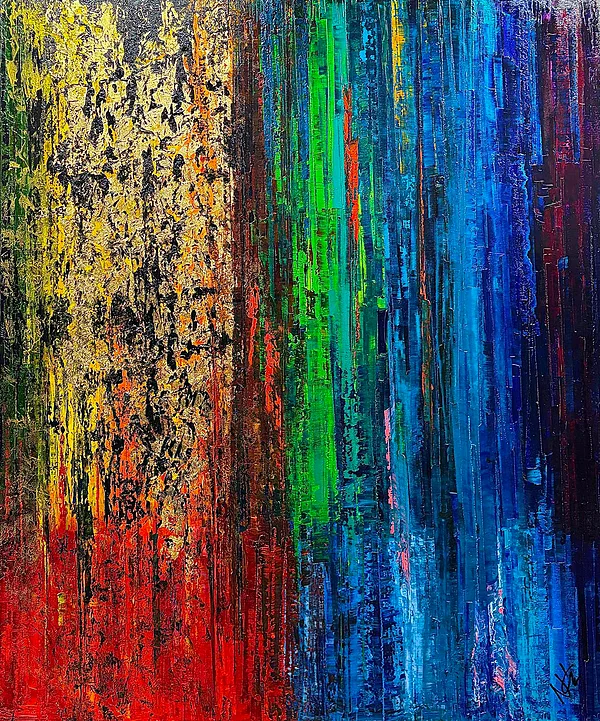
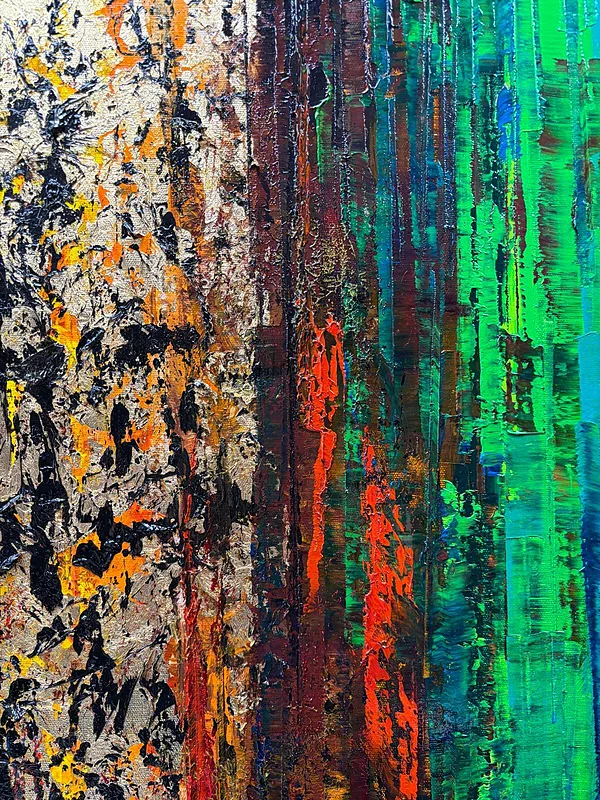
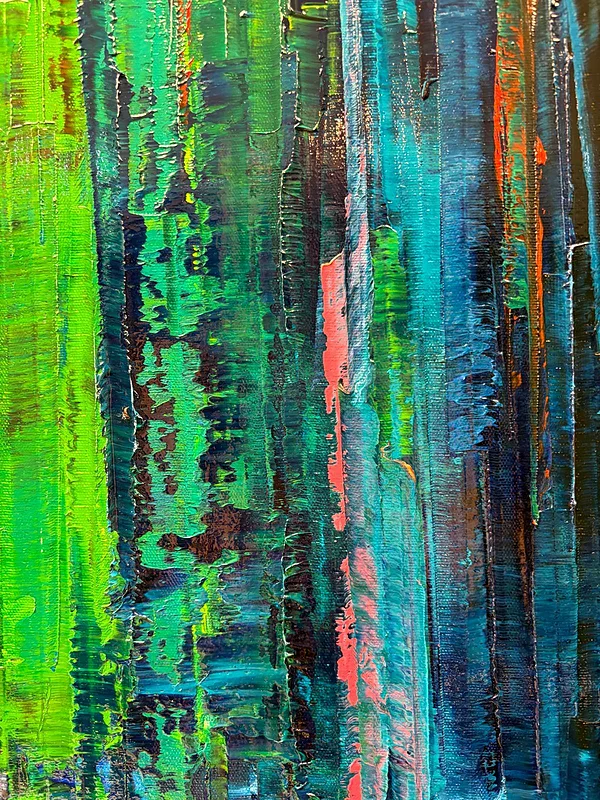
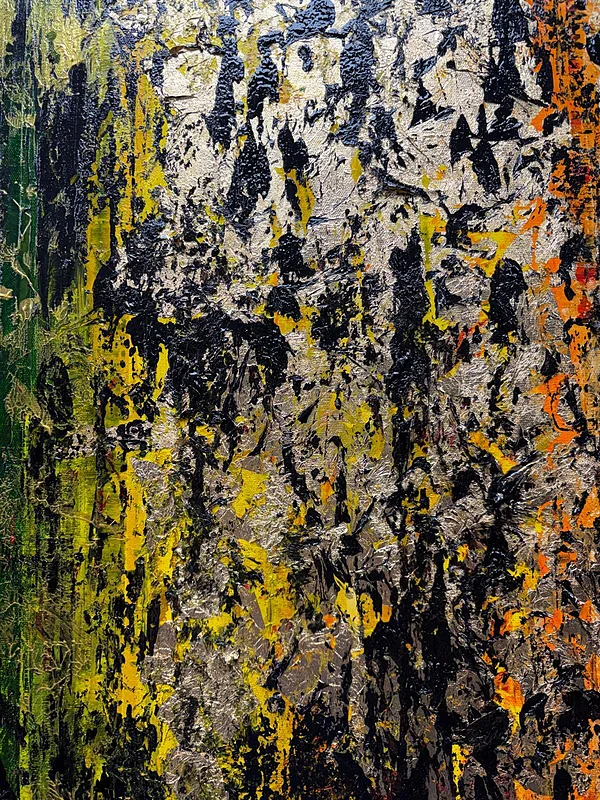
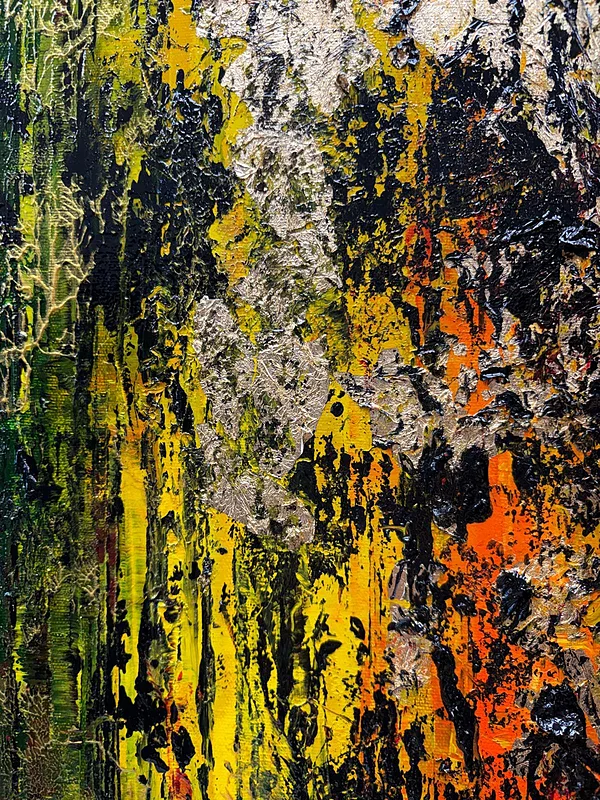
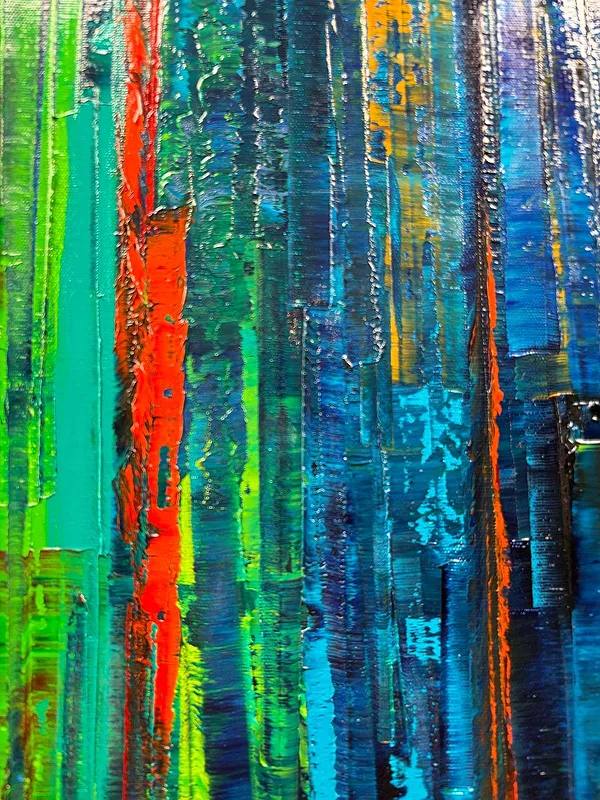
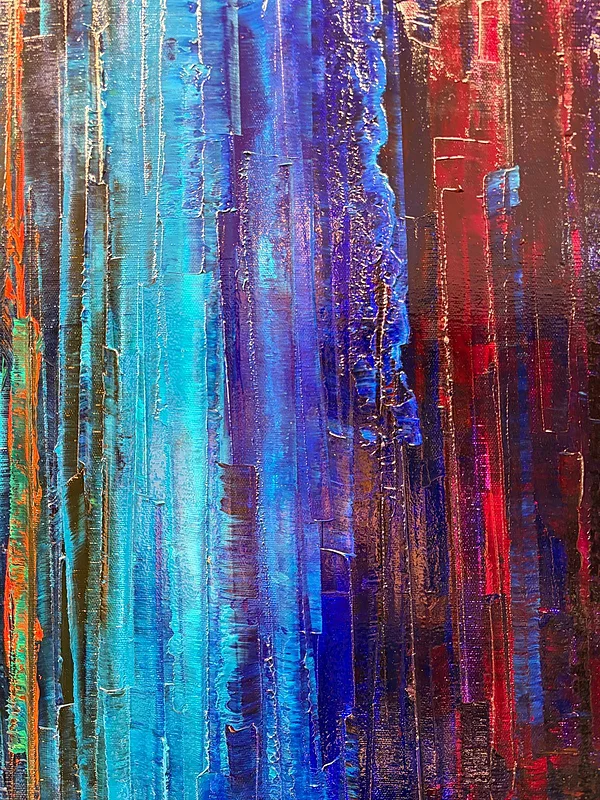
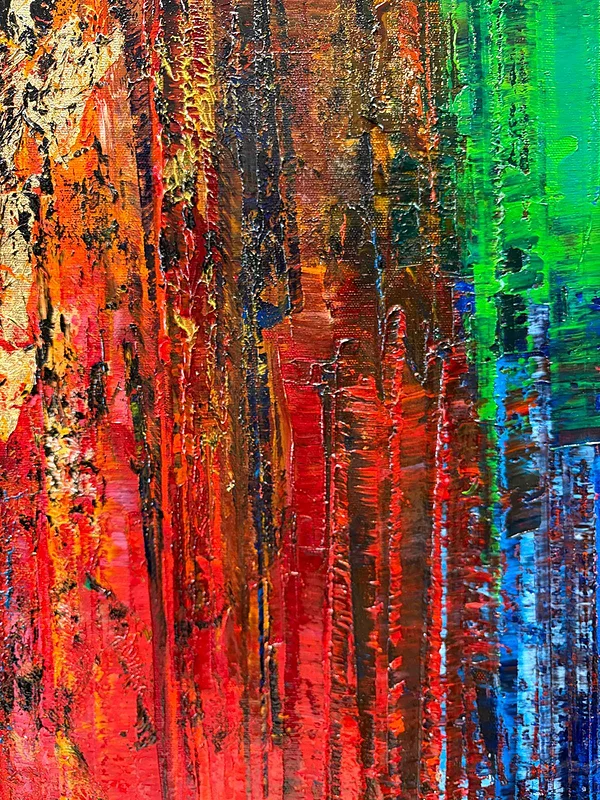
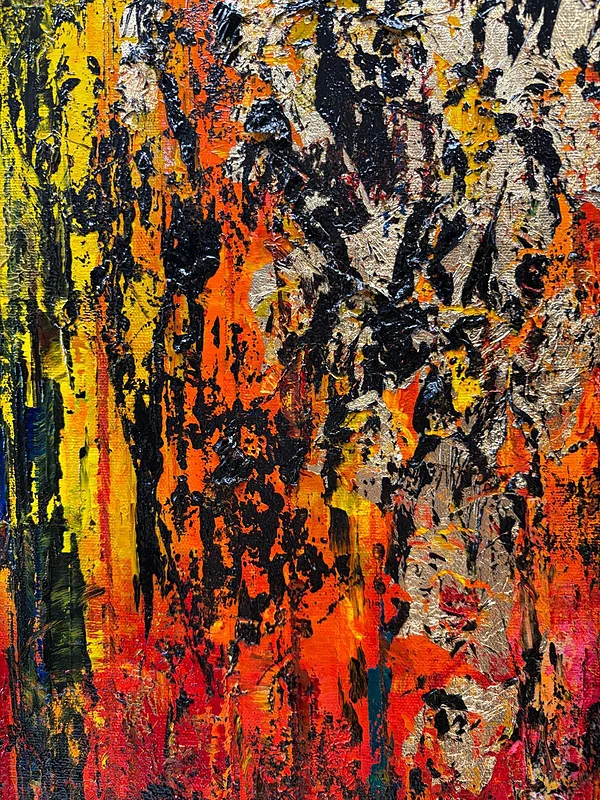
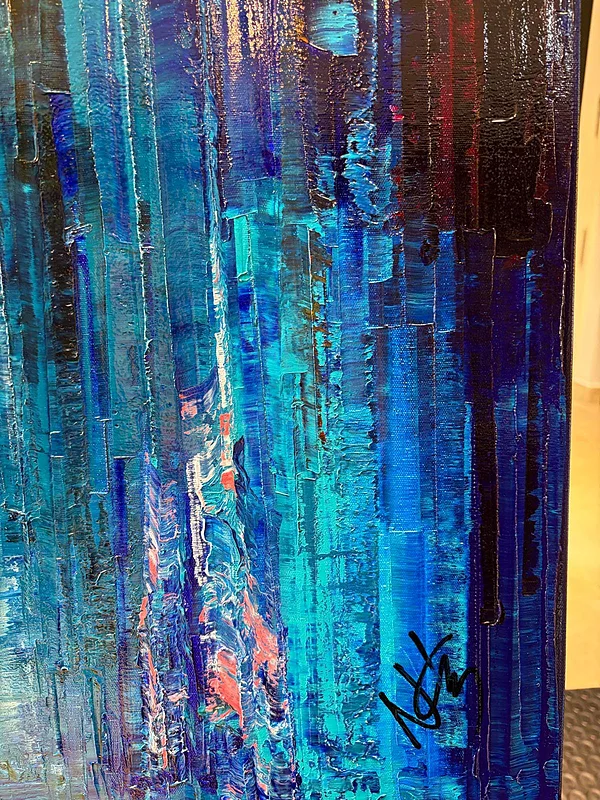
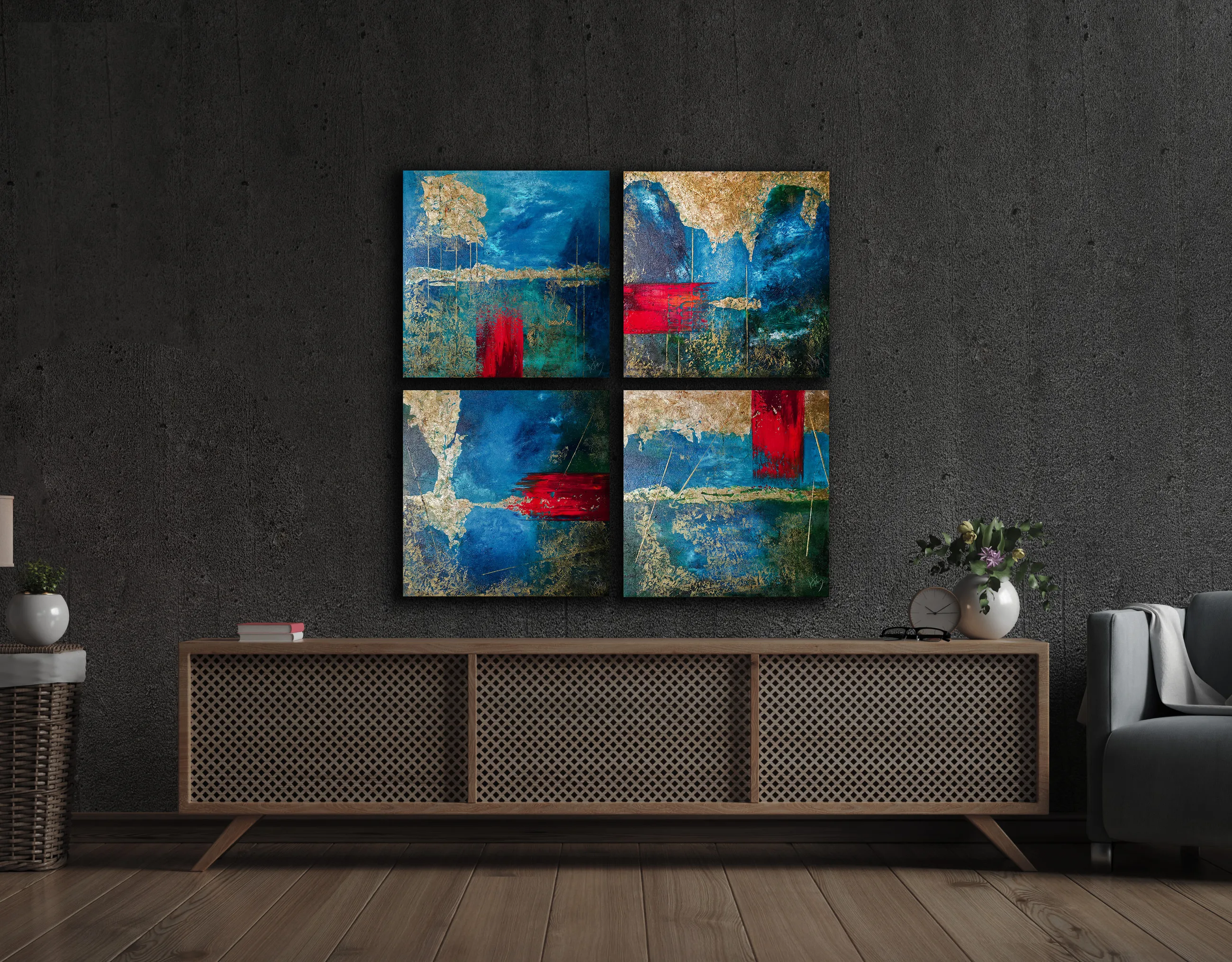
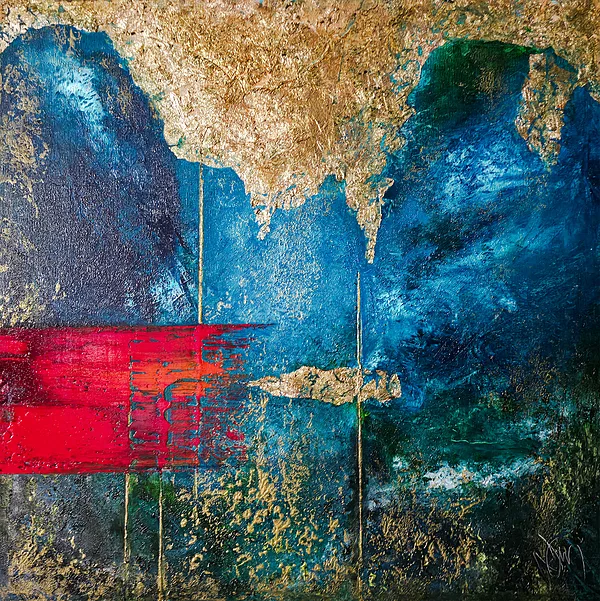
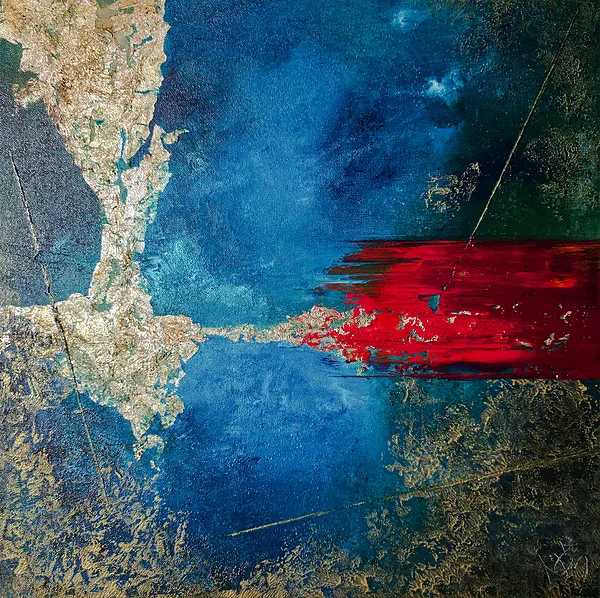
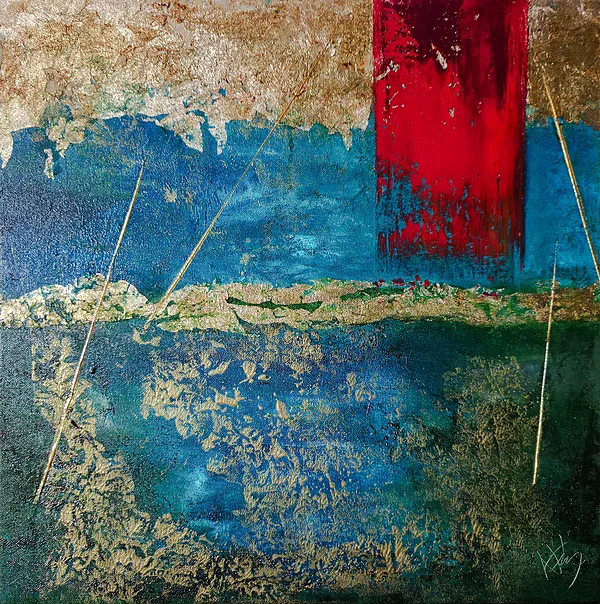
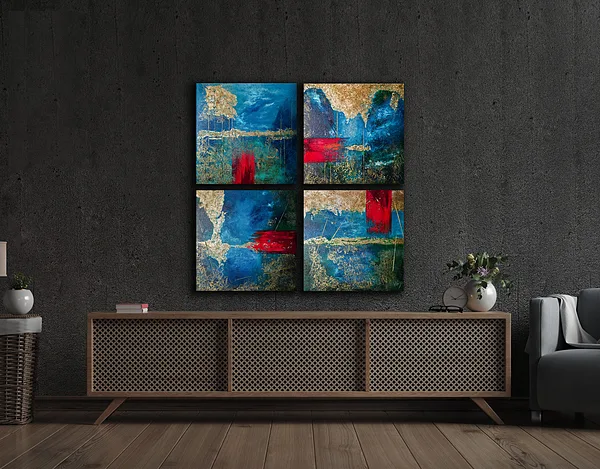
Four (quadriptych)
- 4 x 50 x 50 cm
- Oil and gold on canvas
- Created: Sitges, 2026
- The work is part of the 'Old Testament III - In Search of the Secrets of Eternity' cycle
- AVAILABLE FOR PURCHASE
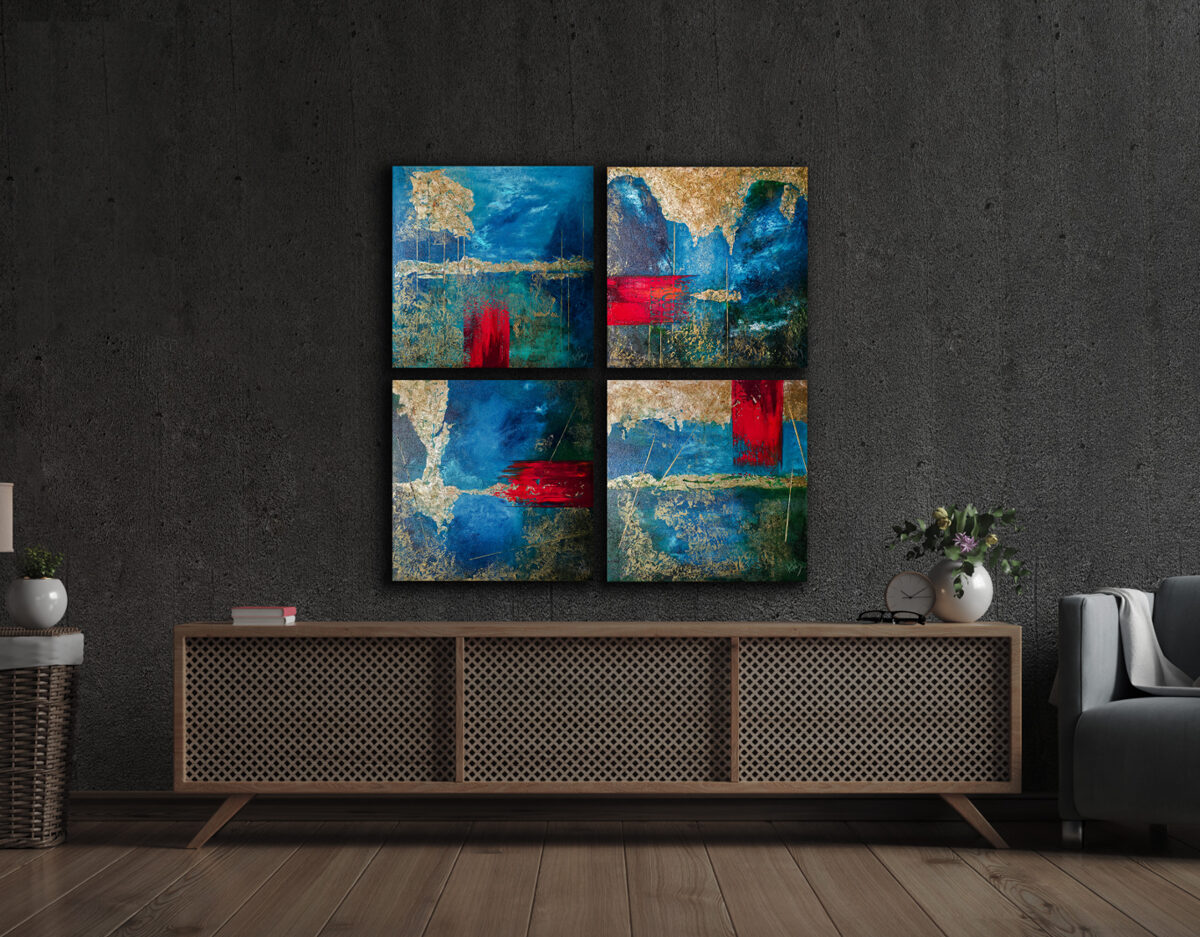
“And a river went out of Eden to water the garden; and from thence it was parted, and became into four heads.”(Genesis 2:10, KJV)
The Four is a quadricon comprising four distinct yet closely interconnected paintings. Their arrangement is deliberate: together, the four panels form a unified whole, evoking a defining moment in the biblical account of creation, when the river flowing from the Garden of Eden divides into four branches to nourish the earth in all four directions.
In the Bible, the number four symbolises completeness, the order of the world, and the universal reach of divine providence: four cardinal directions, four river branches, four regions of the earth, and life flowing outwards in every direction.
Each painting reveals a world of its own, yet remains part of a single narrative. Rich layers of leaf green, marsh green, sedge, reed, and foliage evoke flourishing river valleys teeming with life. Deep blues and turquoises convey the mysterious power of water, while the varied shades of green suggest abundant vegetation and the diversity of created life. Golden surfaces and delicate, luminous lines express the presence of the divine will, which not only brings the world and its inhabitants into being but also sustains and protects them.
In each painting, a fiery red current enters from a different direction: south, east, west, and north. Red symbolises creative power, the energy of life, and perpetual renewal. The four red currents are destined to converge at the centre of the composition, where they will form the image of an earthly altar.
The Four offers a visual interpretation of the order of creation and the universal reach of divine blessing. The four river branches, the four cardinal directions, and the altar that emerges at the centre together proclaim the unity of the world, the continuity of life, and the all-encompassing presence of the creative will.
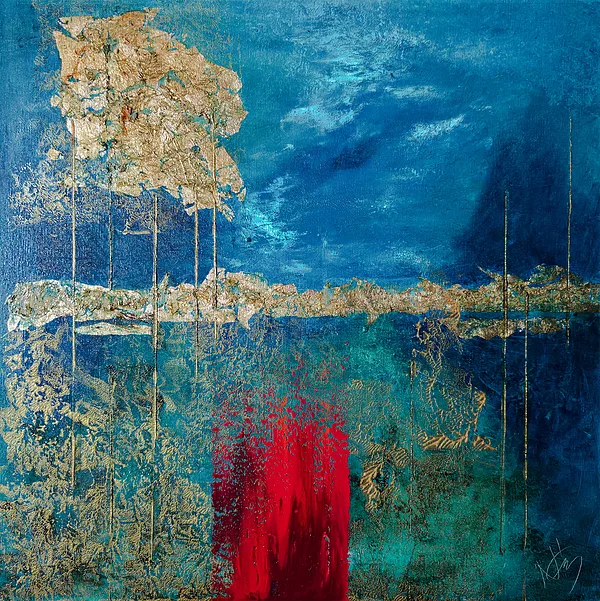
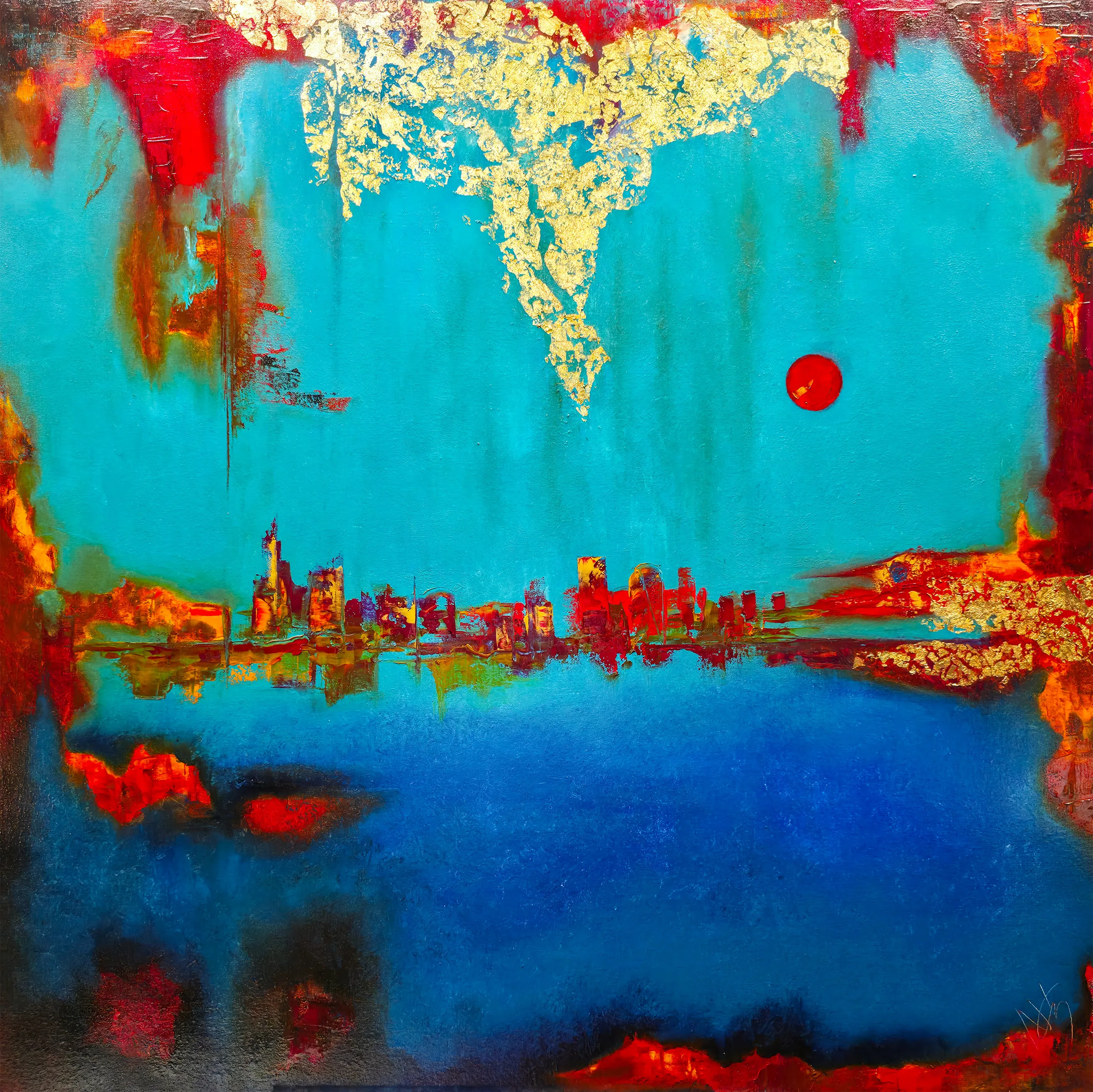
The Promise of the Future
- 100 x 100 cm
- Oil and gold on canvas
- Created: Sitges, 2026
- The artwork is part of the 'Old Testament III - In Search of the Secrets of Eternity' cycle
- SOLD
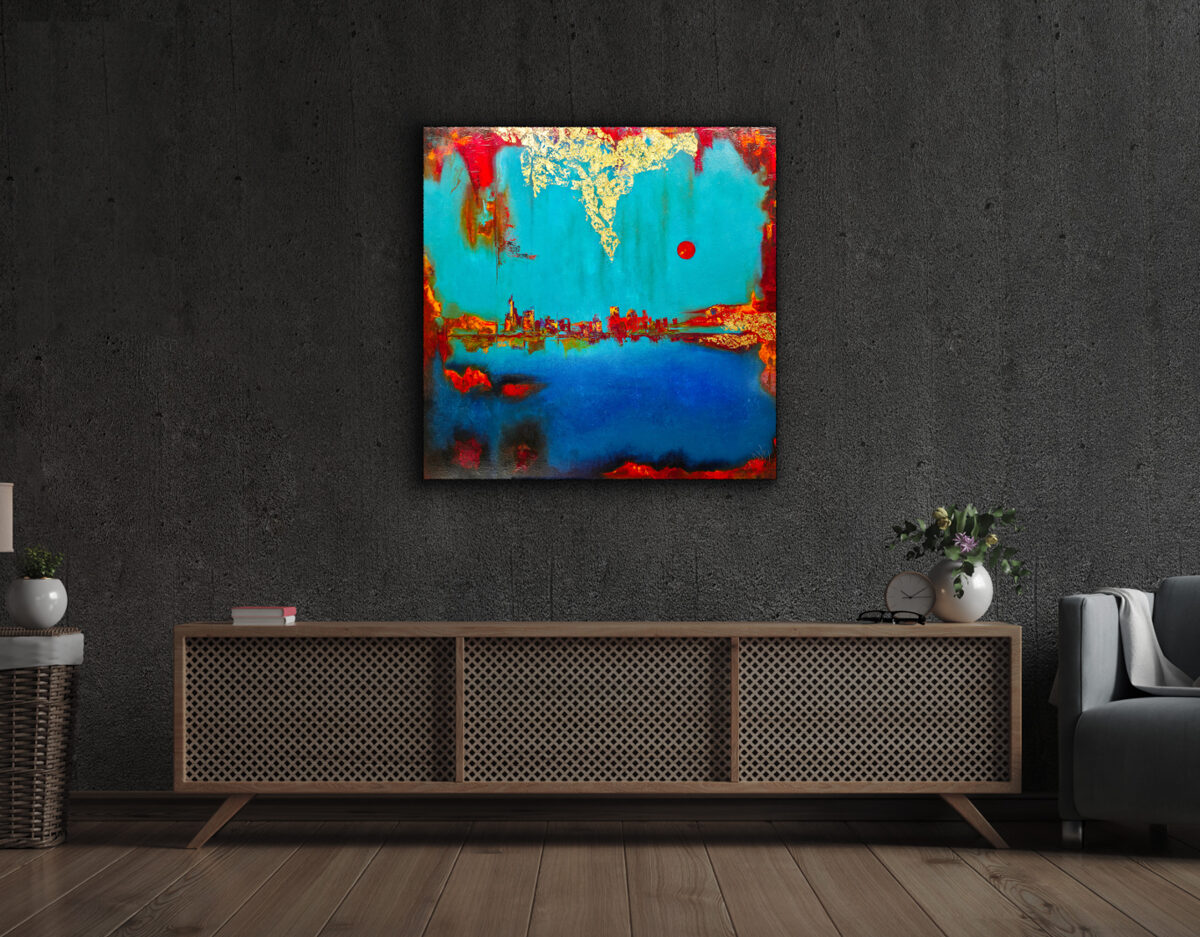
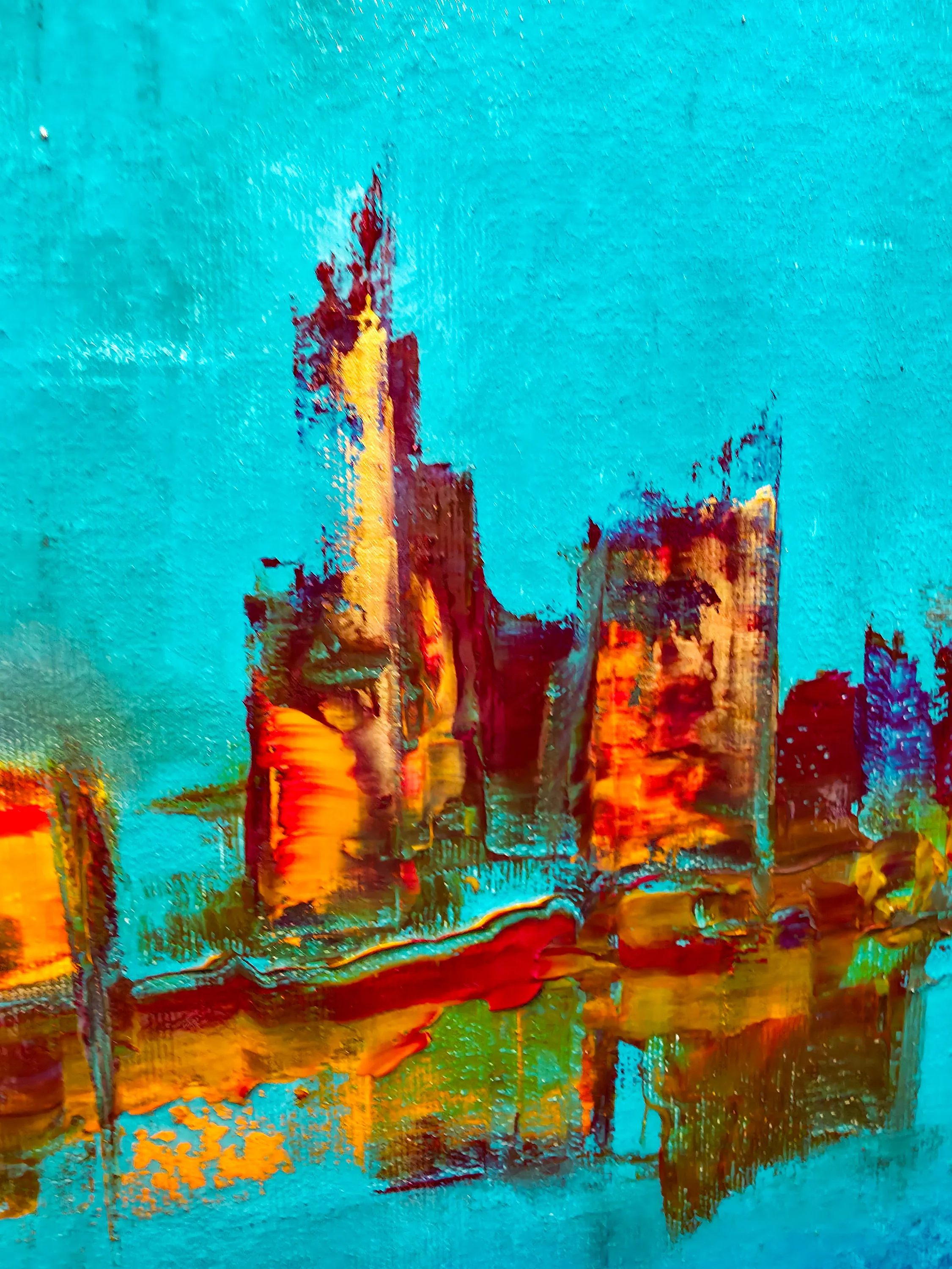
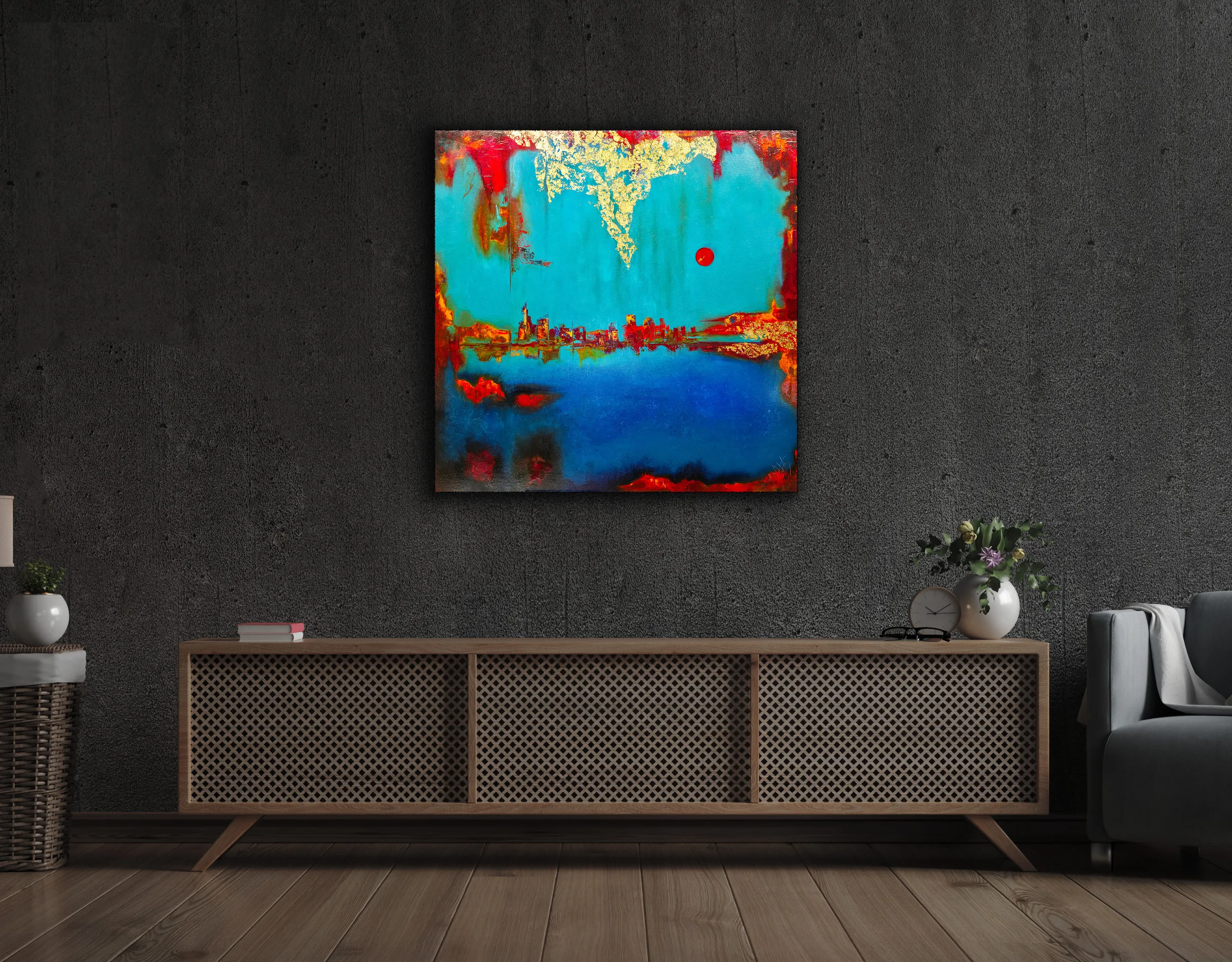
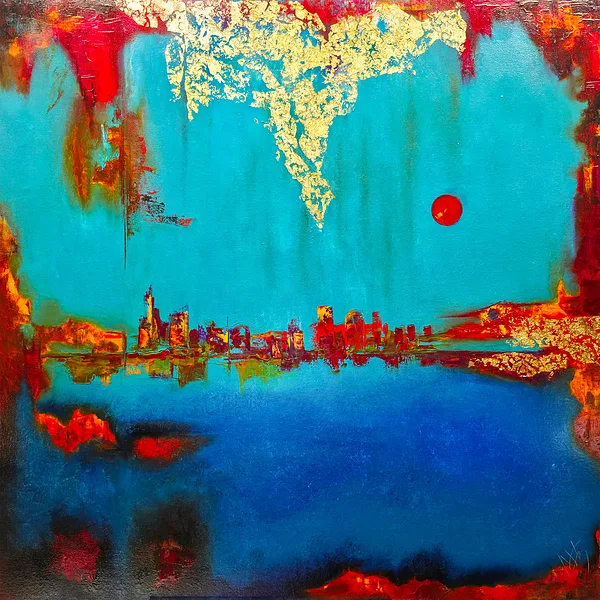
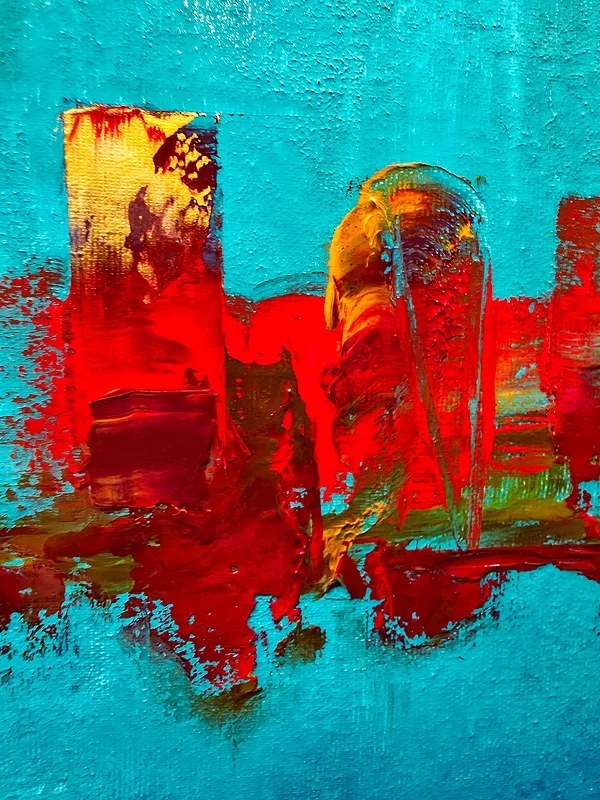
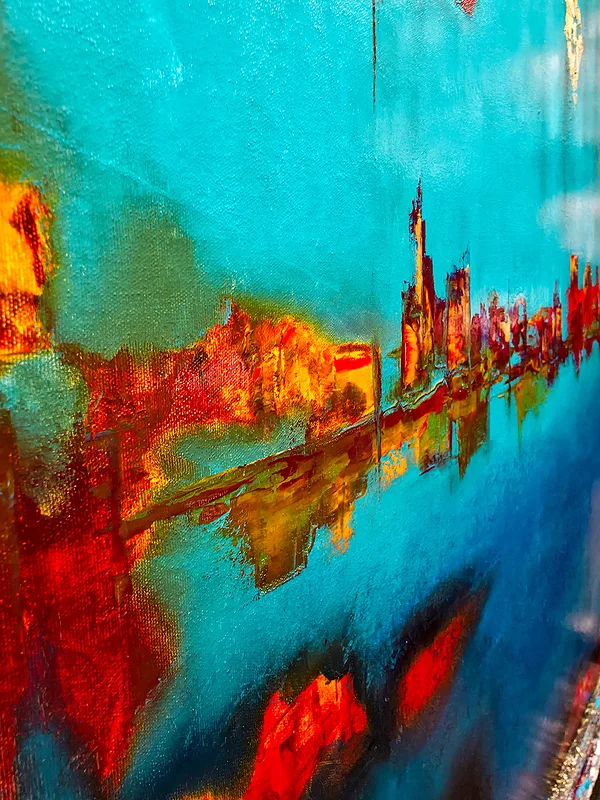
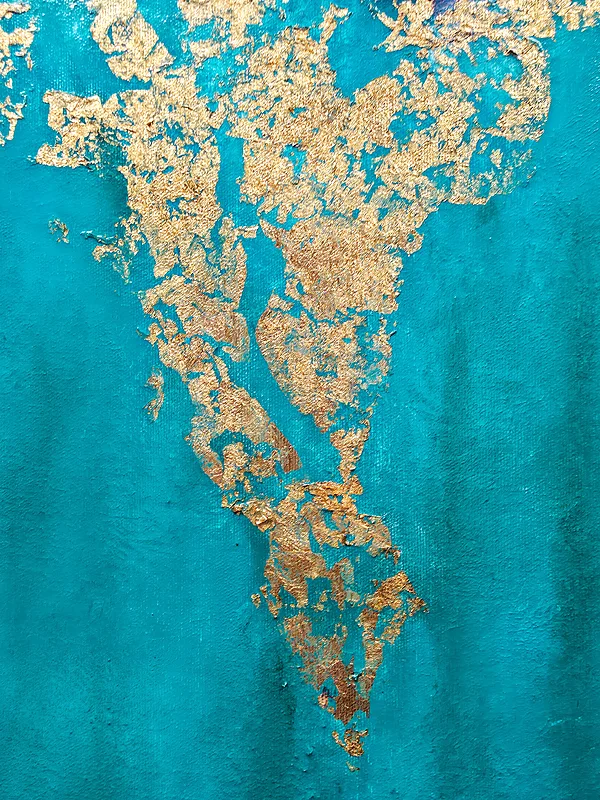
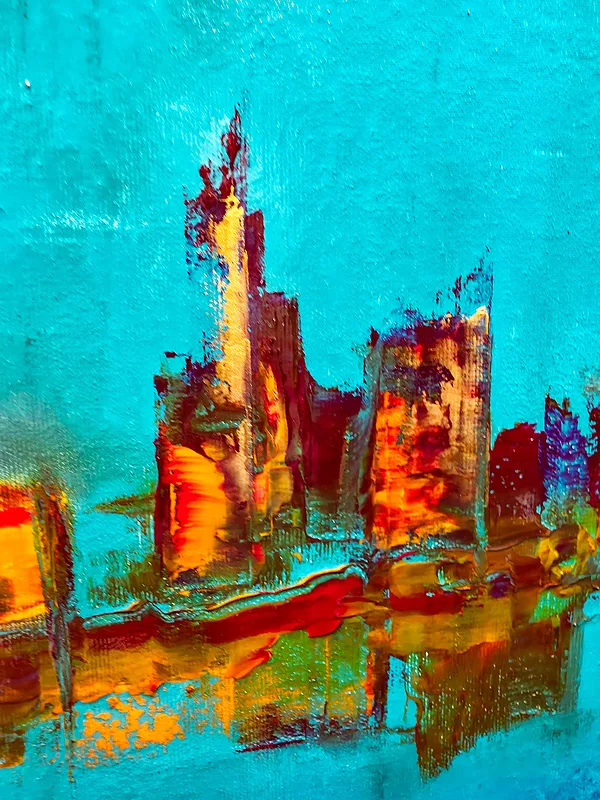
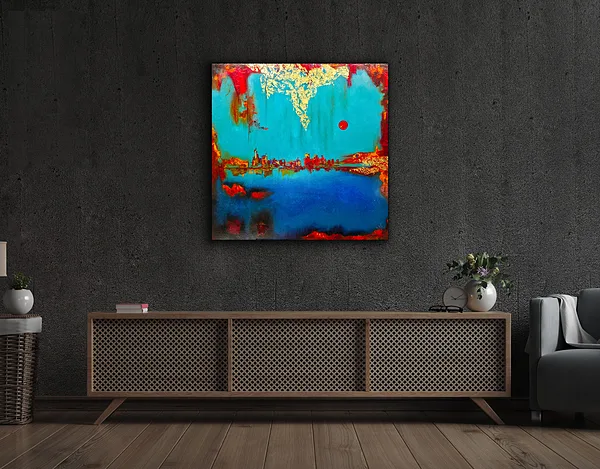
In the radiant infinity of turquoise, amid glowing reds and fragmented gold leaf, a distant, luminous city emerges on the horizon. Its towers and gate-like structures evoke a vision of the Jerusalem to come. Golden light descends from above, while beneath the city, the blue deepens into a vast, water-like expanse.
The painting evokes the radiant vision of the future proclaimed in Isaiah’s prophecy:
“Arise, shine; for thy light is come, and the glory of the LORD is risen upon thee. […] And the Gentiles shall come to thy light, and kings to the brightness of thy rising.” (Isaiah 60:1–3, KJV)
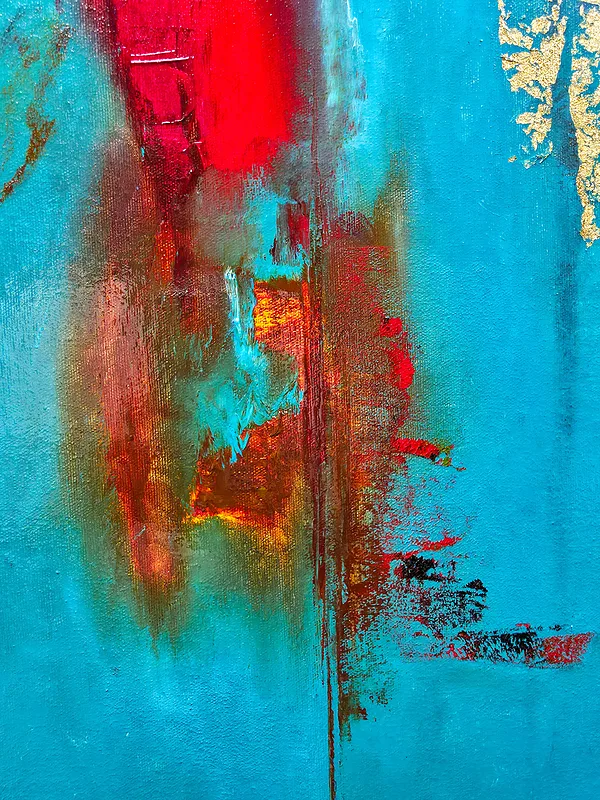
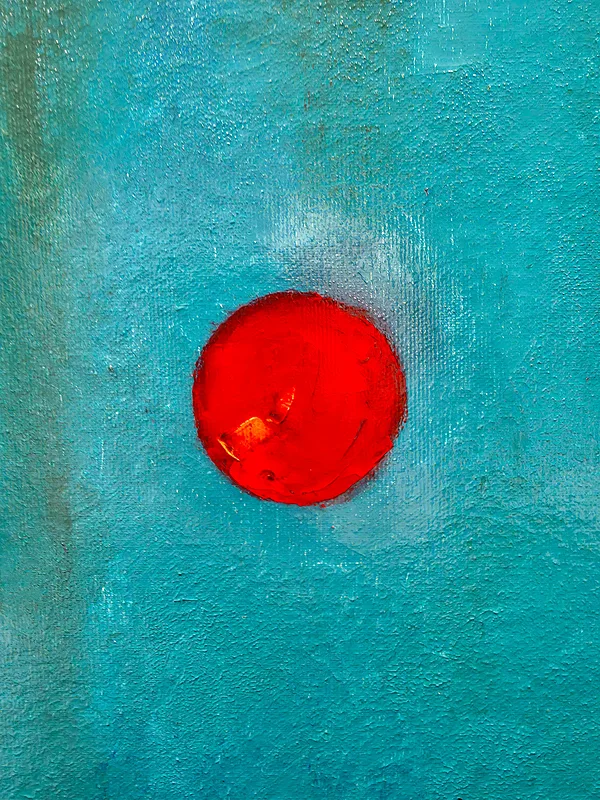
The vast field of turquoise sky opens up an expansive realm of anticipation and fulfilment. A glowing red disc floats high above, drawing the eye like an incandescent sign, while a narrow extension of the fragmented gold field descends towards the city.
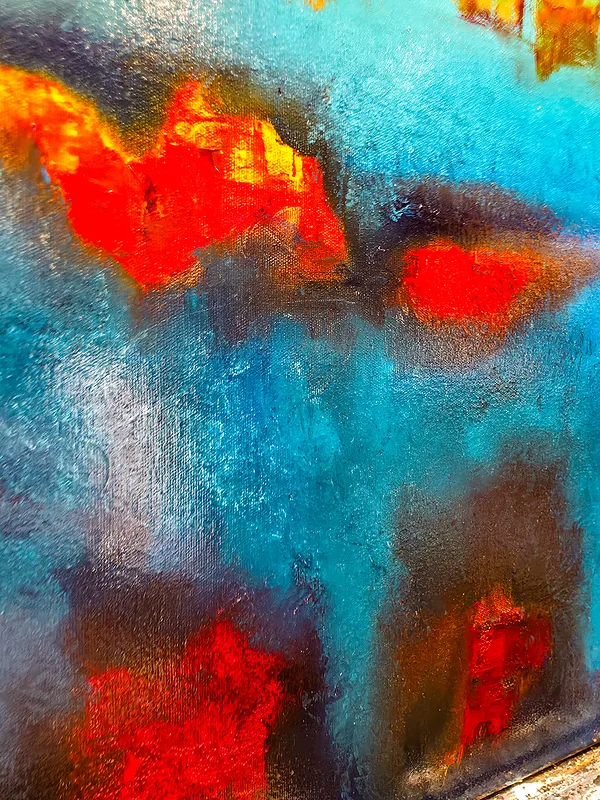
Beneath the city, the turquoise gradually deepens into cobalt and ultramarine. Streaks of red and gold reflections flow downwards, connecting the horizon with the depths, as though the city’s radiance were permeating the whole of creation. Along the edges of the painting, glowing shores of red and gold mark the meeting of past and future.
Isaiah’s vision ultimately expands into the promise of a new creation:
“For, behold, I create new heavens and a new earth: […] for, behold, I create Jerusalem a rejoicing, and her people a joy.” (Isaiah 65:17–18, KJV)
In the painting, sky and water, city and light merge into a single radiant horizon. Distant Jerusalem already bears the first glimmer of the world to come, in which the promise of the Eternal will be realised as a new order, a new life, and ultimate fulfilment.
The Will of Heaven
- 140 x 140 cm
- Oil and gold on canvas
- Created: Sitges, 2026
- The artwork is part of the 'Old Testament III. - In Search of the Secrets of Eternity' cycle
- RESERVED
“More to be desired are they than gold, yea, than much fine gold…”
(Psalm 19:10, KJV)
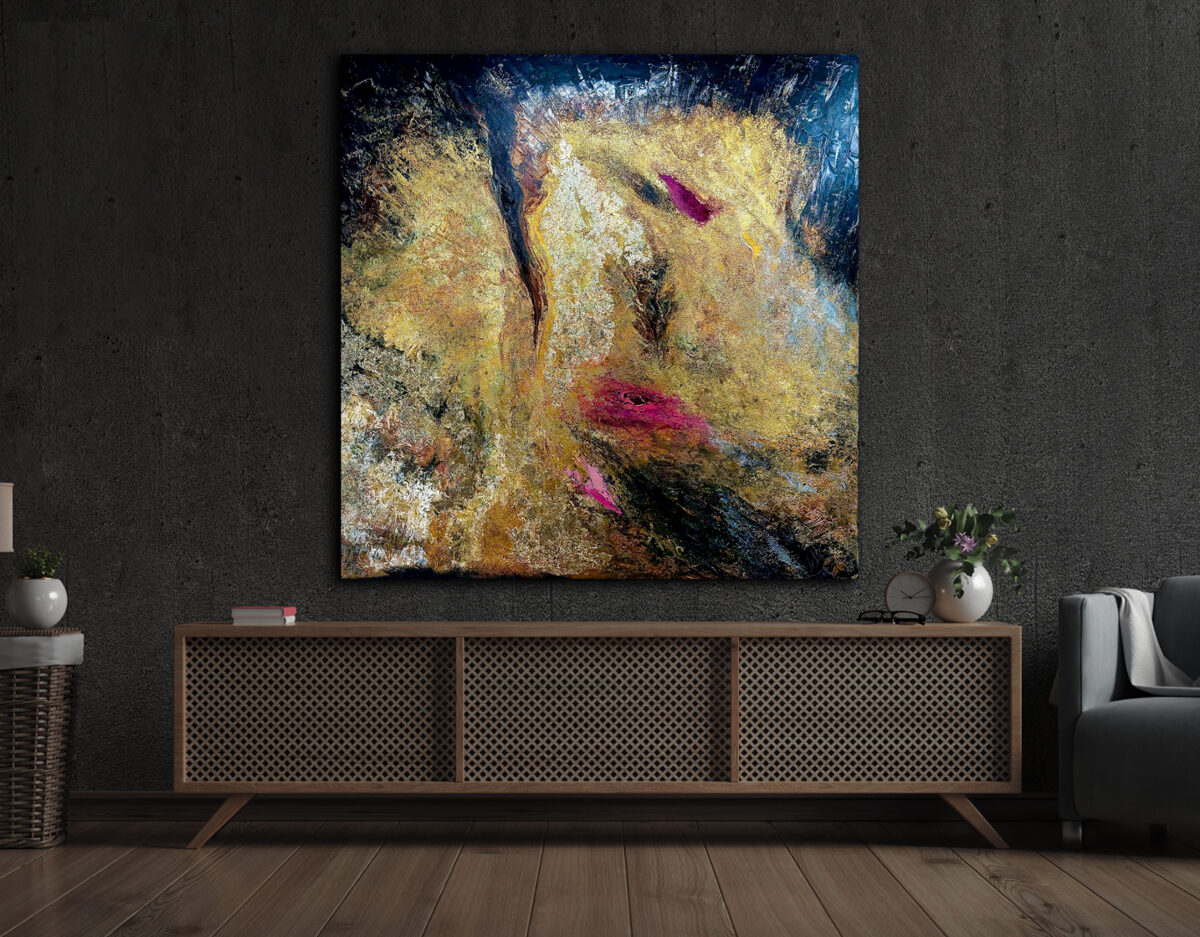
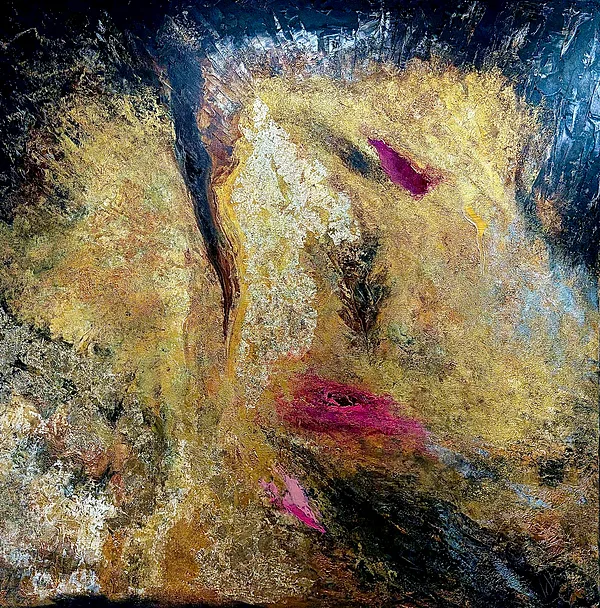
As though the golden mantle of the Eternal’s glory were bending over the earth, this monumental painting unveils a profound mystery of the Old Testament: the eternal radiance of the heavenly will, which permeates the world and the human soul, from the Creation through the history of the Covenant to the visions of the prophets. Within the thickly applied, rough, at times stone-like layers, centuries of prayers seem to have coalesced. The luminous fields of gold evoke Solomon’s Temple, where earthly matter became the vessel of a heavenly presence.
Among the golden fields, forms of glowing purple and crimson pulse like precious stones, evoking the rubies set in the high priest’s breastpiece, the seal of the Covenant, and the burning coal in Isaiah’s vision, through which the human voice is transformed into a divine commission. The wing-like mass of gold unfolding on the left, together with the luminous form at the centre, recalls the cherubim guarding the Ark of the Covenant, while the light revealed between them becomes a sanctuary for the invisible Presence.
At times, the gold flows downwards like a river; at others, it surges upwards like a flame. The heavenly will descends into the human world, while the human soul rises towards heaven through prayer. Within the tension between radiance and the wounded, darker layers, the drama of human freedom also finds expression.
Thus, gold becomes a purifying mirror, calling us to choose between the glitter of possession and the radiance of sanctification. In the visionary world of the painting, the heavenly will takes shape as law in the Torah, as covenant in the Ark, as light in the flames of the Menorah, as prophetic utterance on the lips of those called by God, and as historical action and heavenly message. Across the eternity that transcends time, it bestows order, direction, and hope upon humanity.
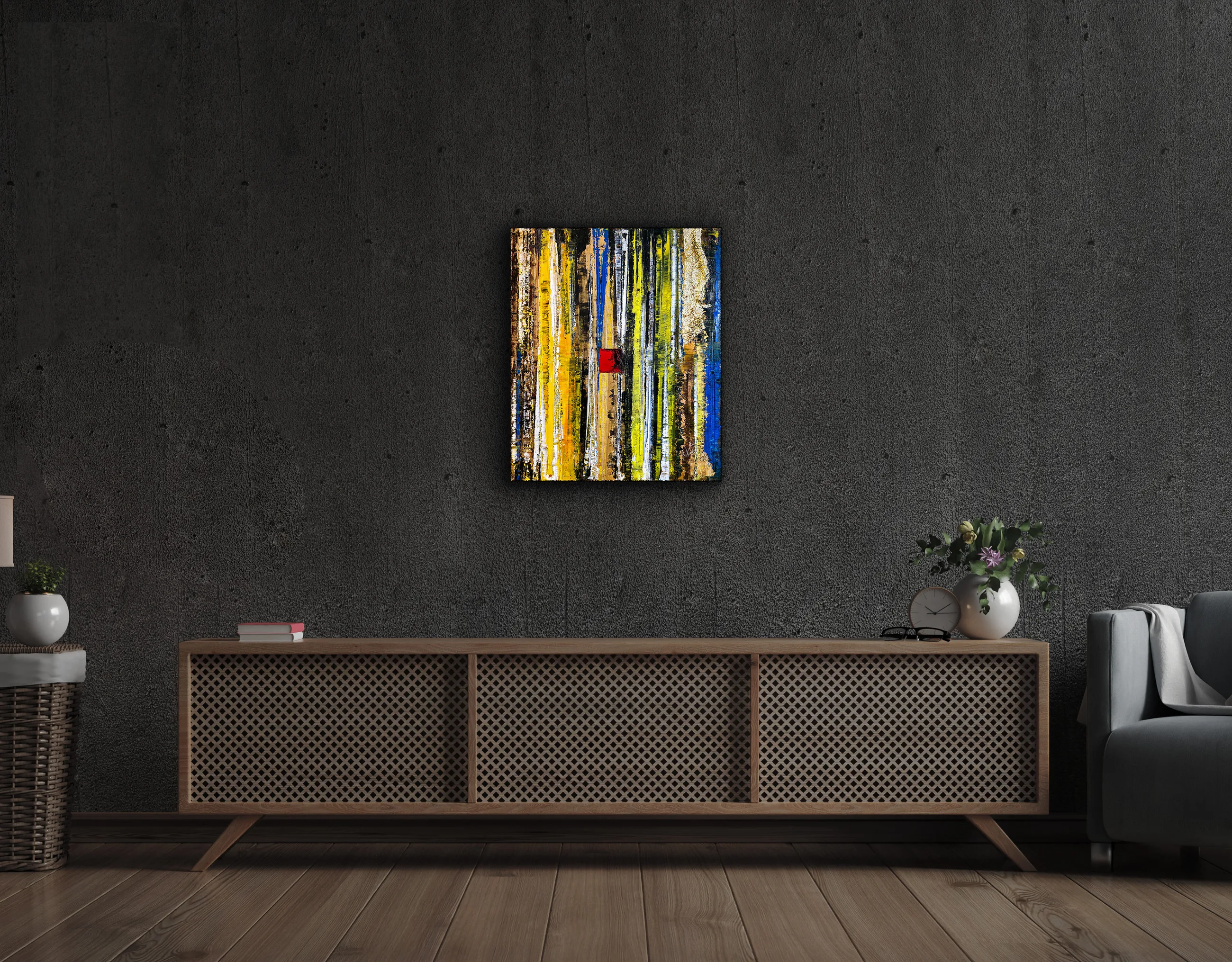
Coincidentia (Moses and Jesus, the 'Pharaoh' and Herod)
- 55 x 46 cm
- Oil and gold on canvas
- Created: Sitges, 2026
- The artwork is part of the 'Old Testament III - In Search of the Secrets of Eternity' cycle
- AVAILABLE FOR PURCHASE
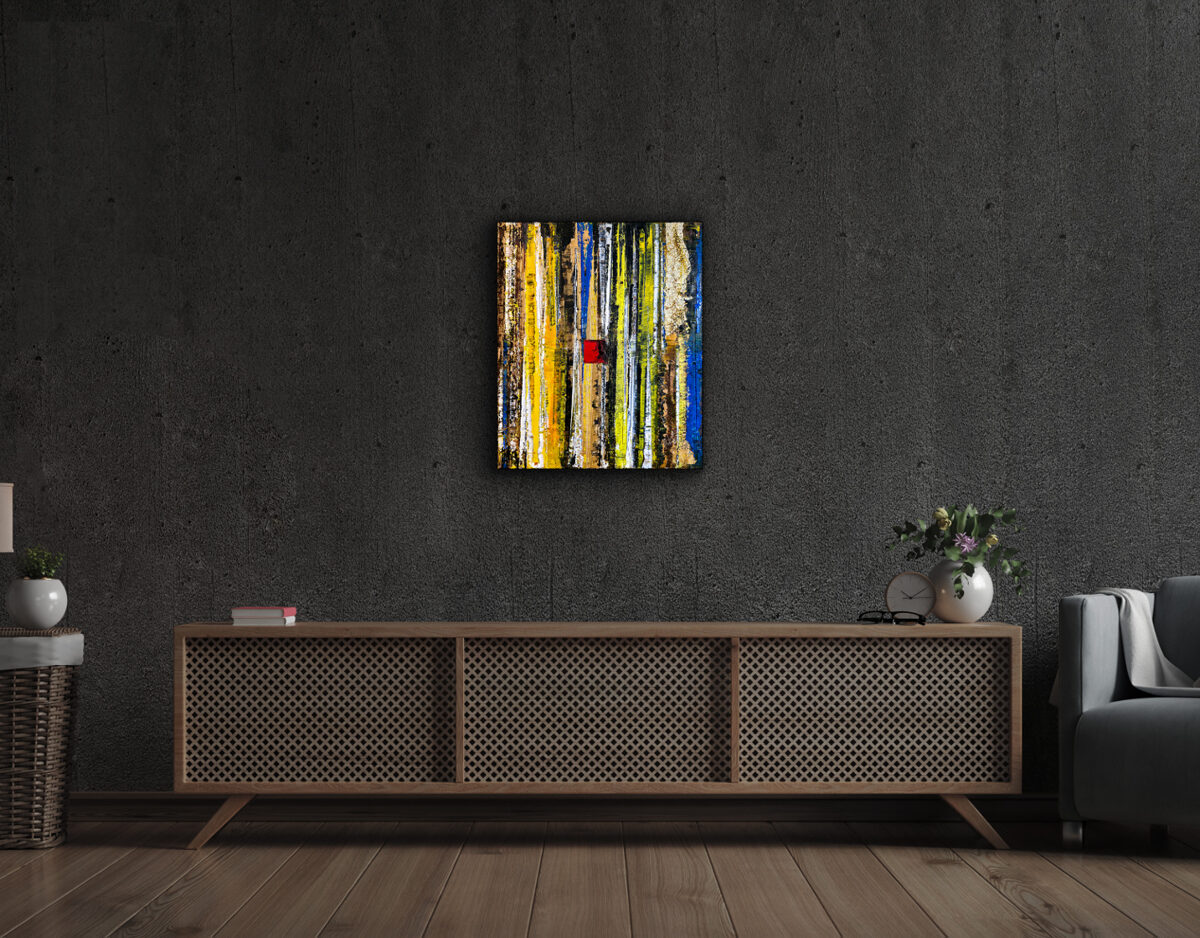
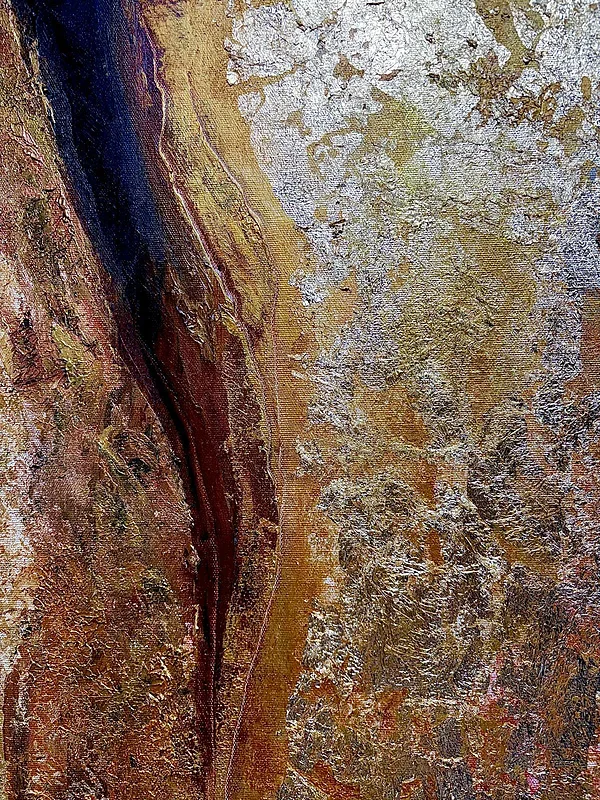
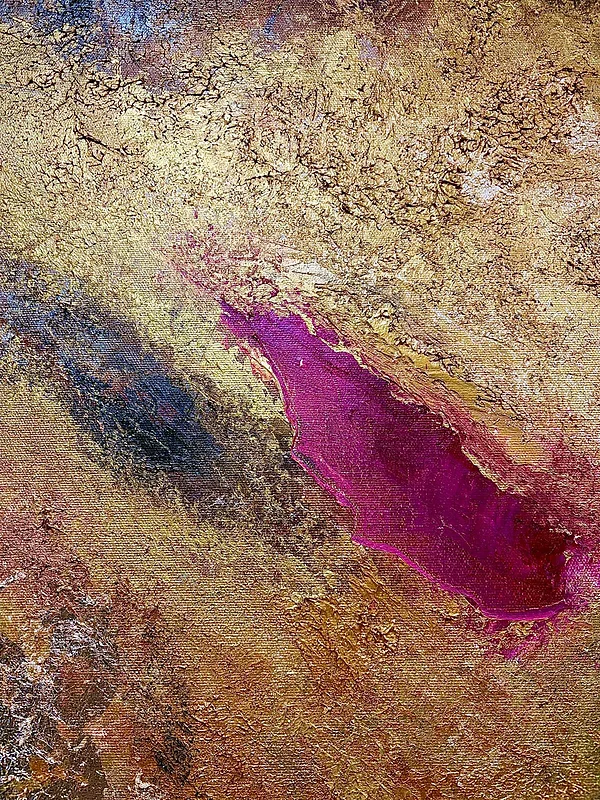
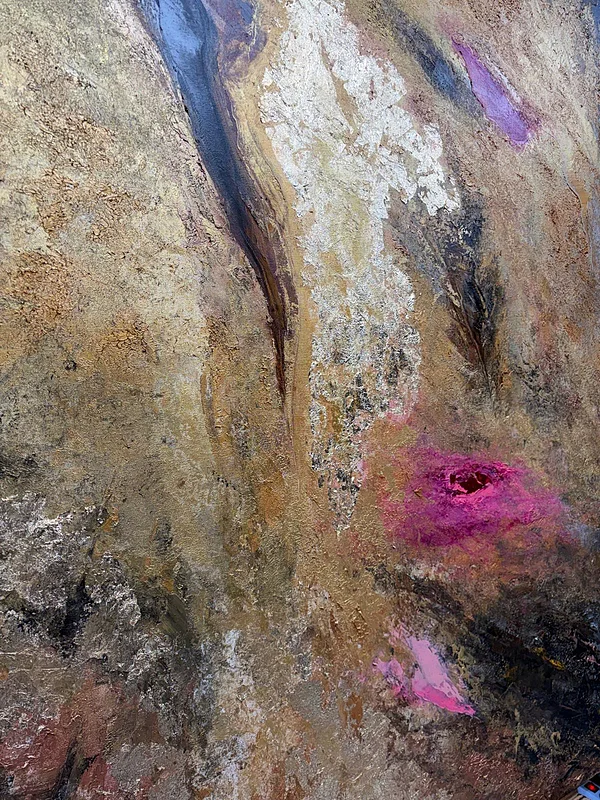
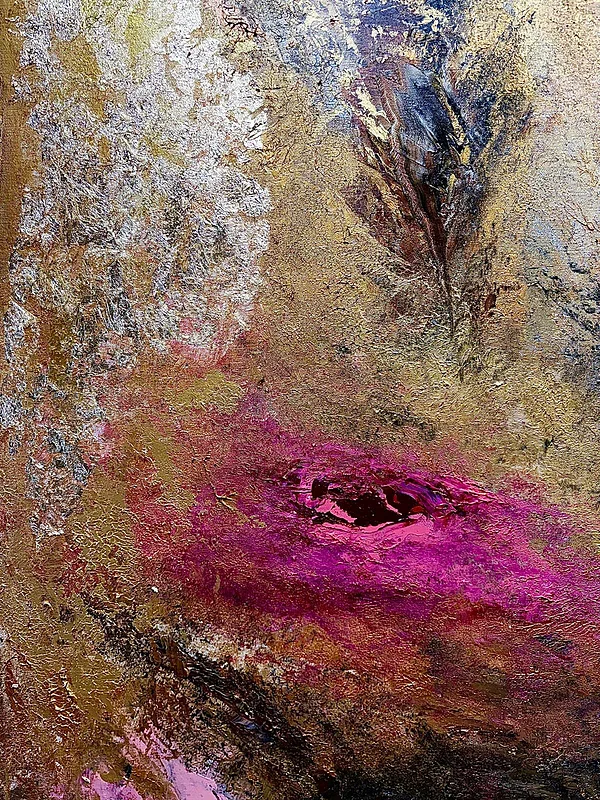
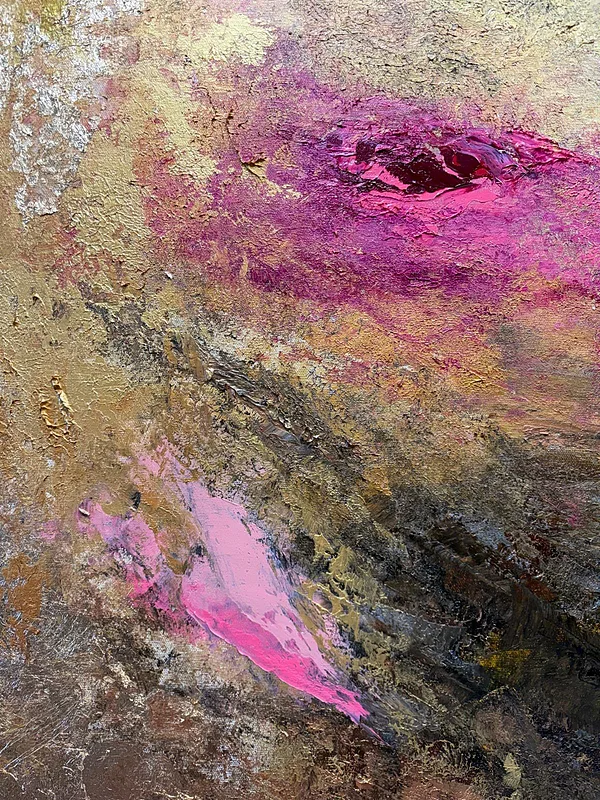
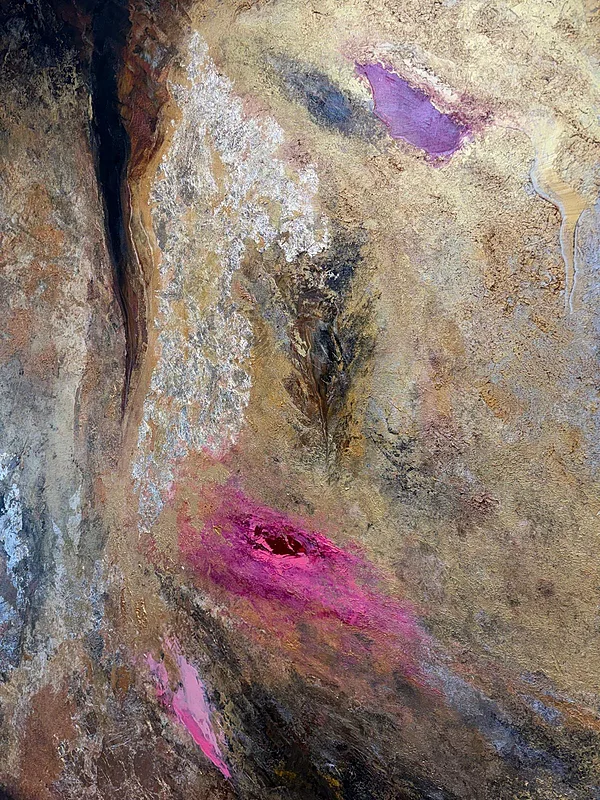
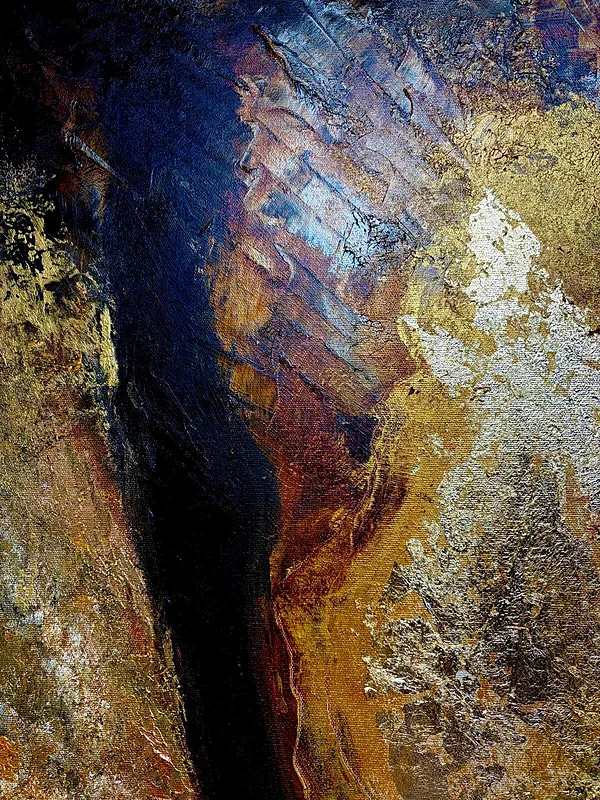
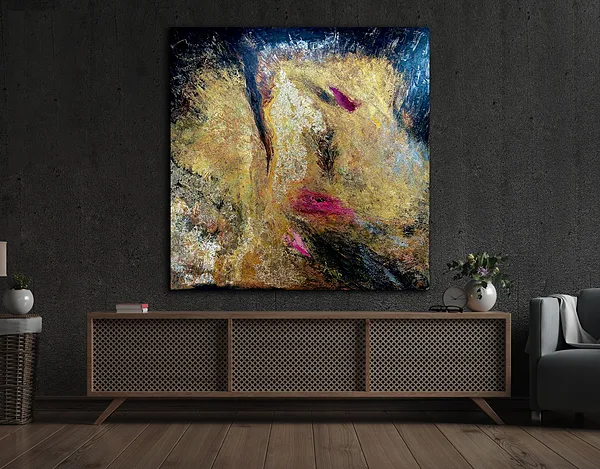
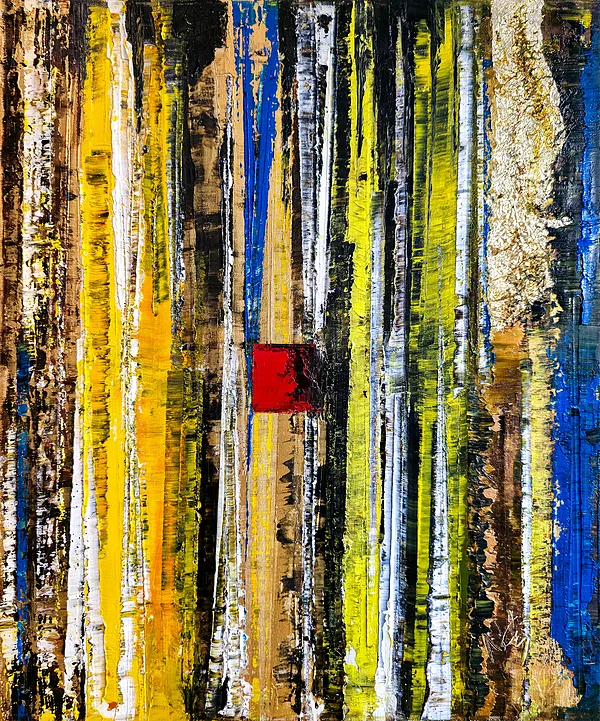
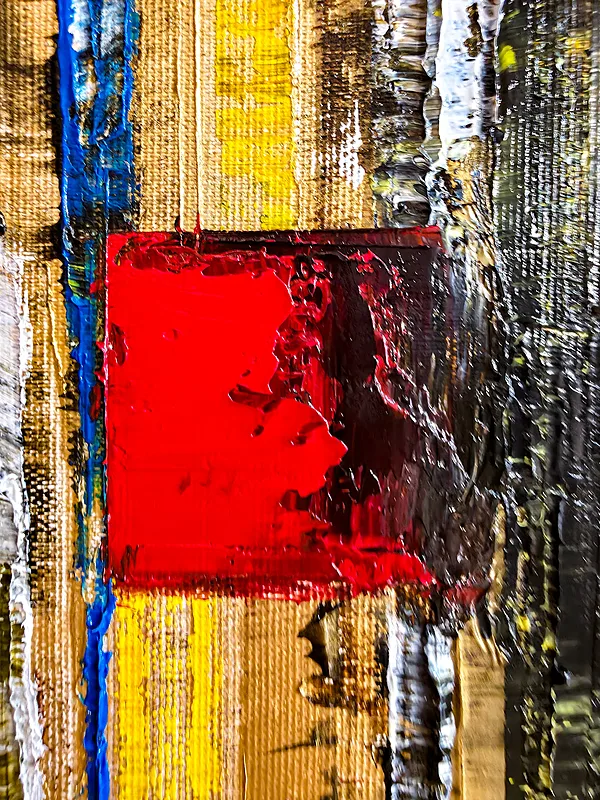
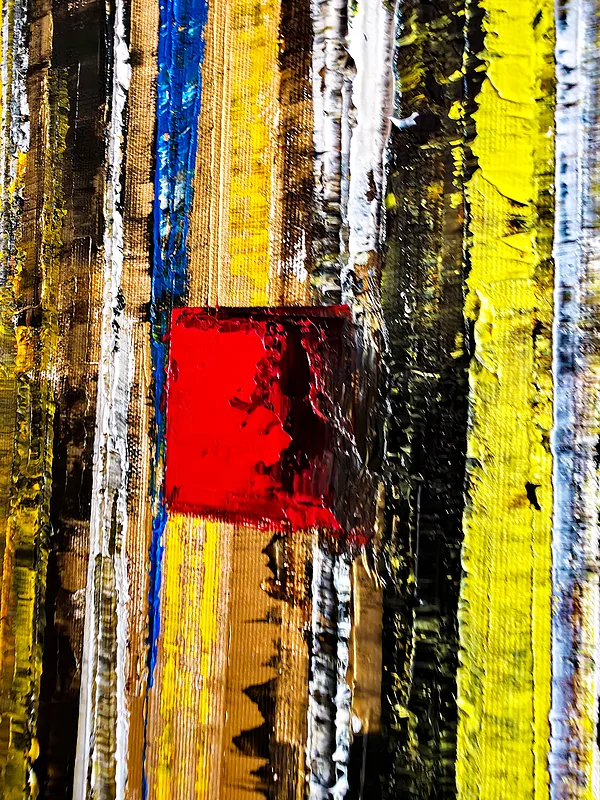
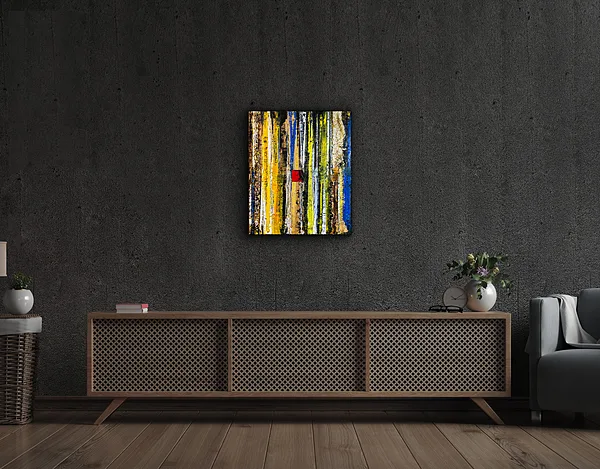
The painting Coincidentia reveals a mysterious correspondence between two biblical narratives separated by centuries: the parallel between the births of Moses and Jesus. In both stories, the birth of a child poses a threat to the ruling power, and in both, despite a decree of death, a path to deliverance emerges. The fear of Pharaoh and Herod springs from the same realisation: the life that has come into the world carries the promise of a future beyond the control of earthly power.
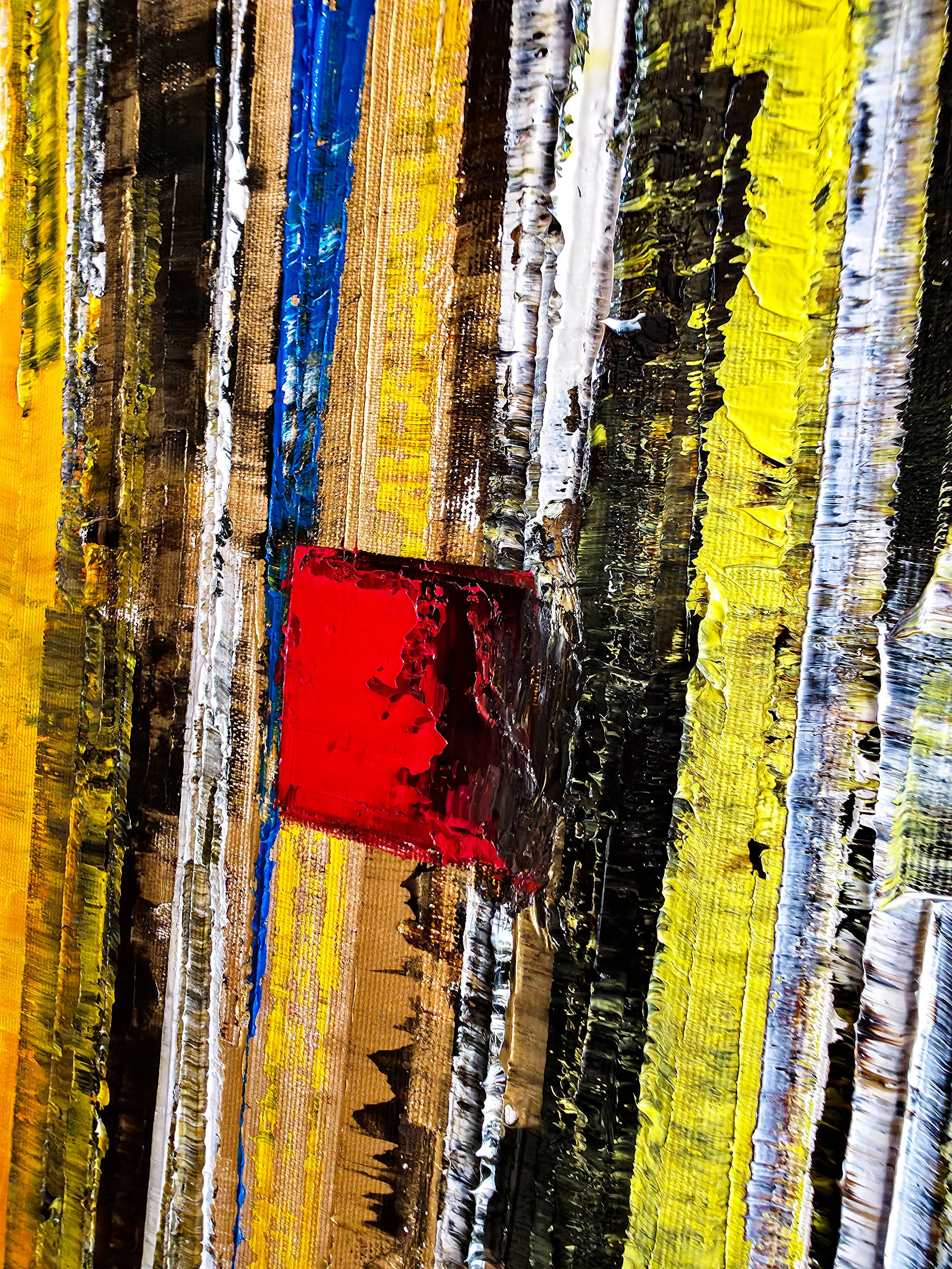
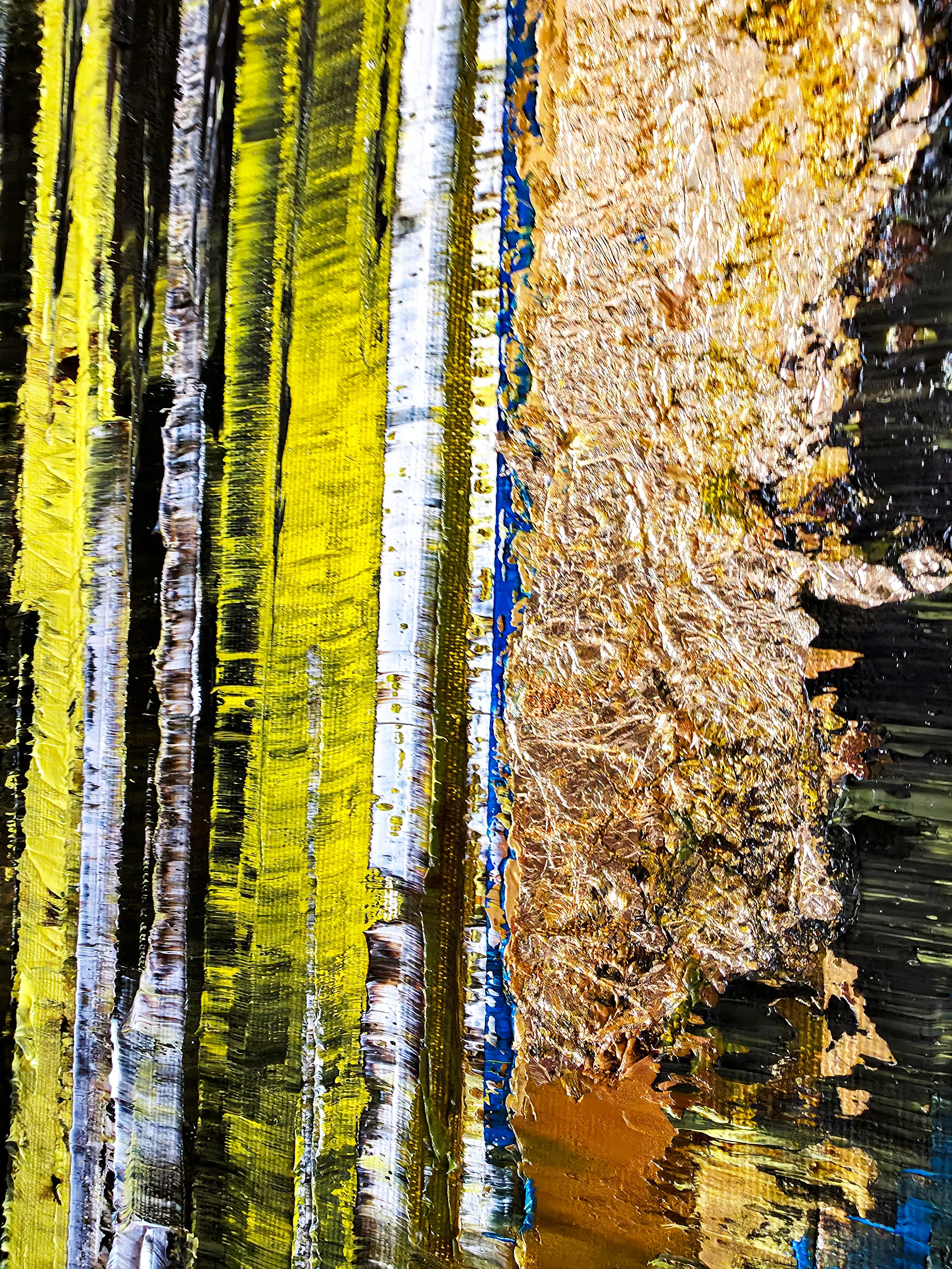
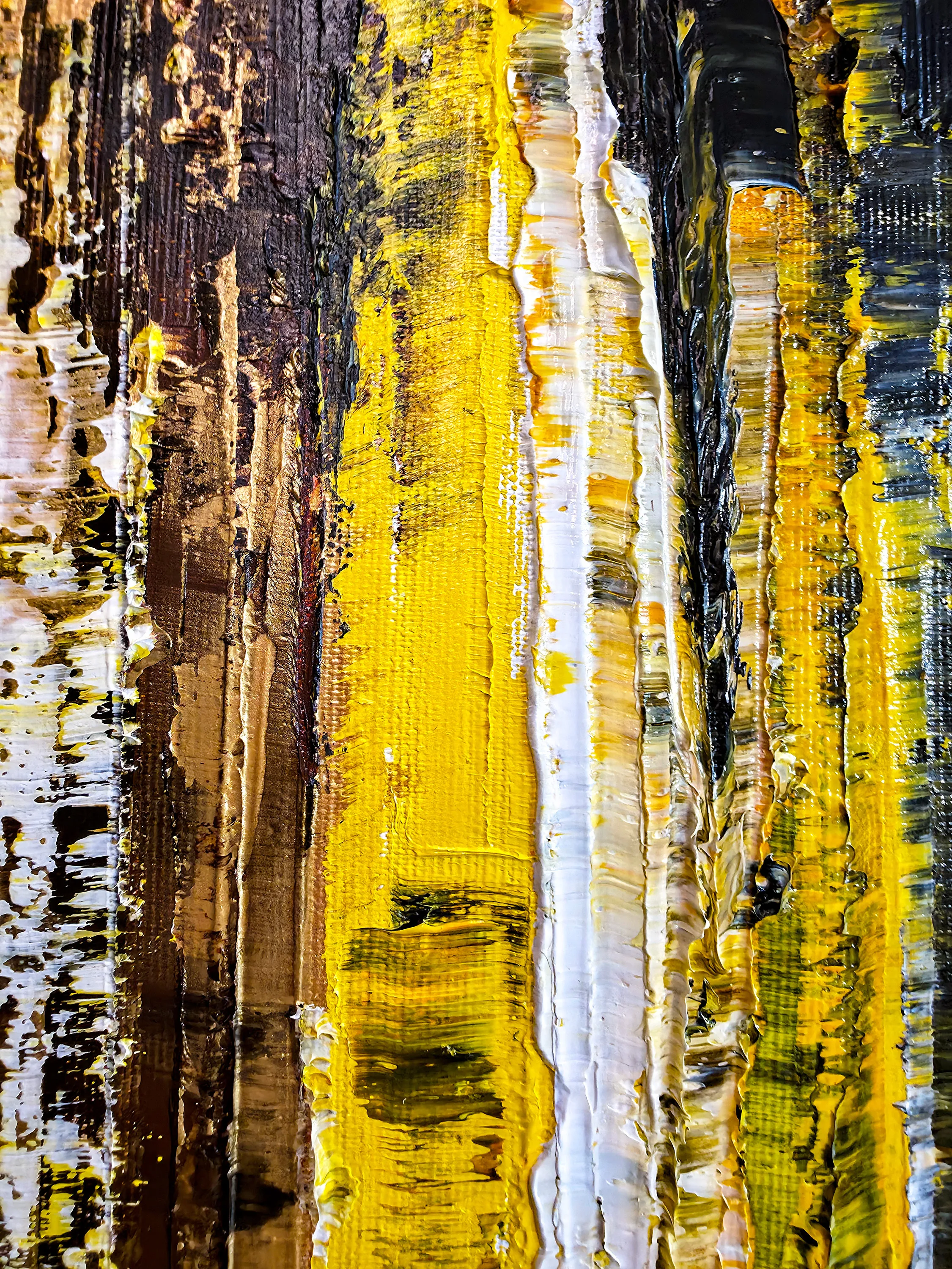
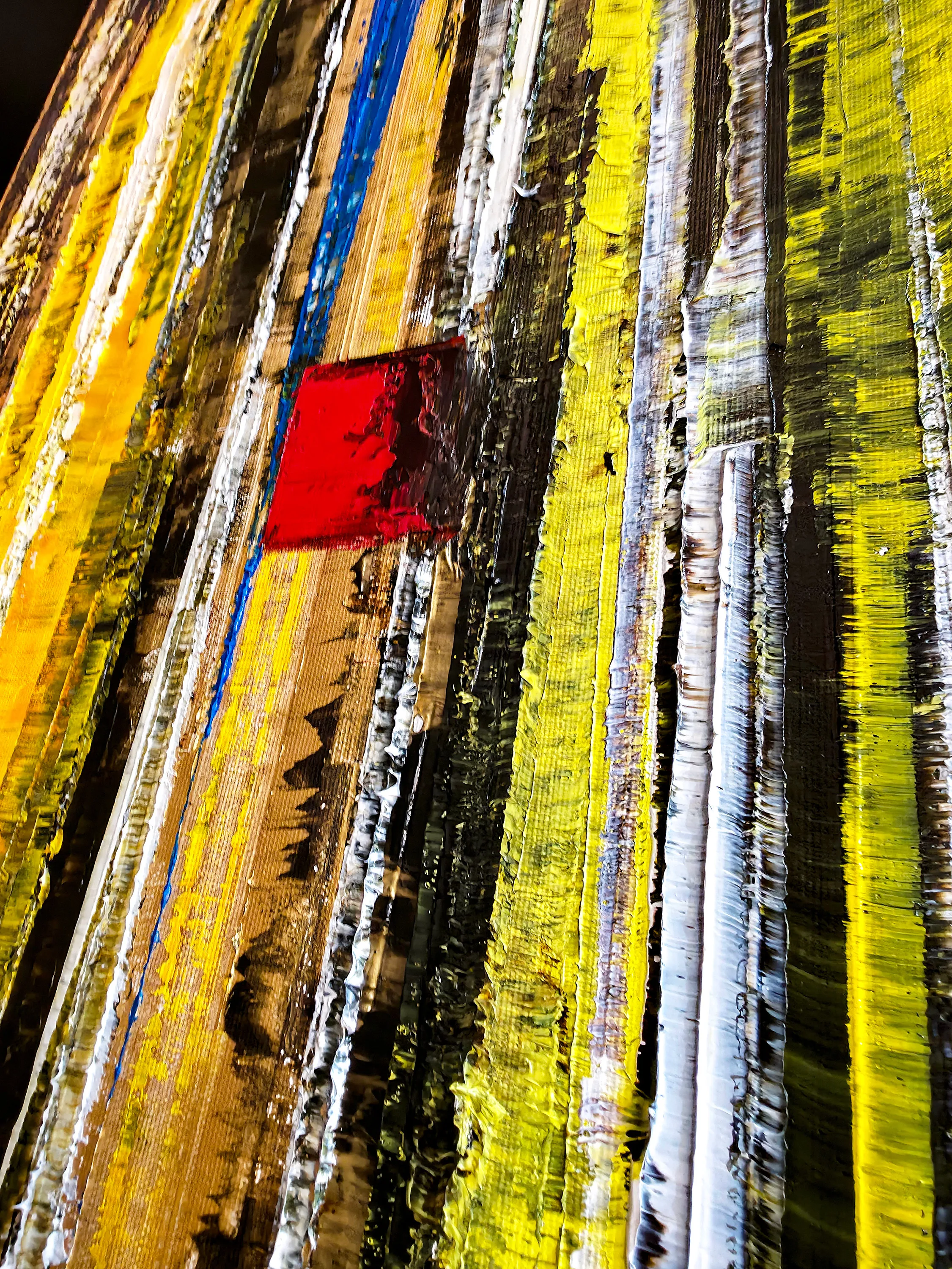
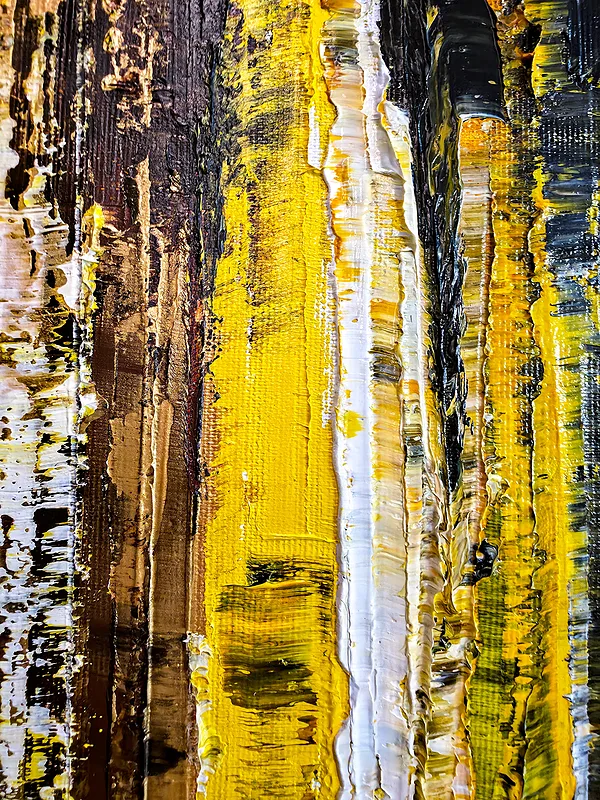
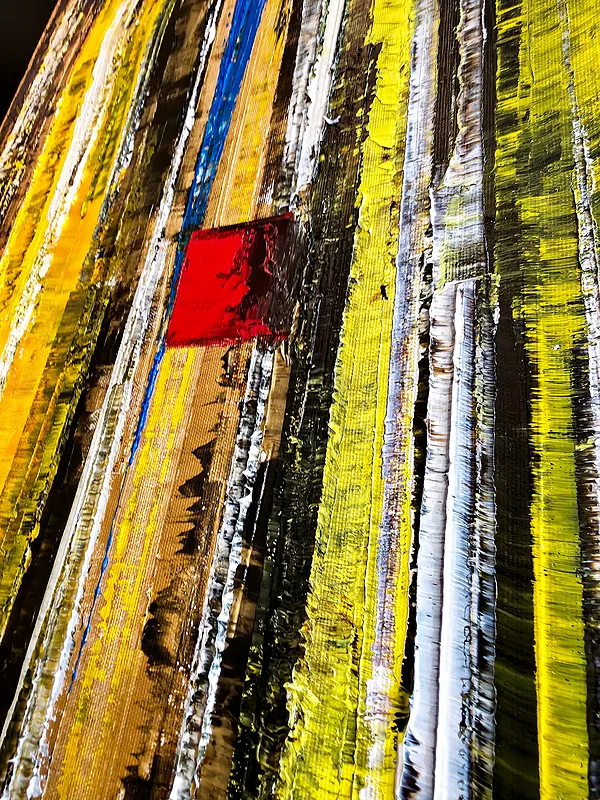
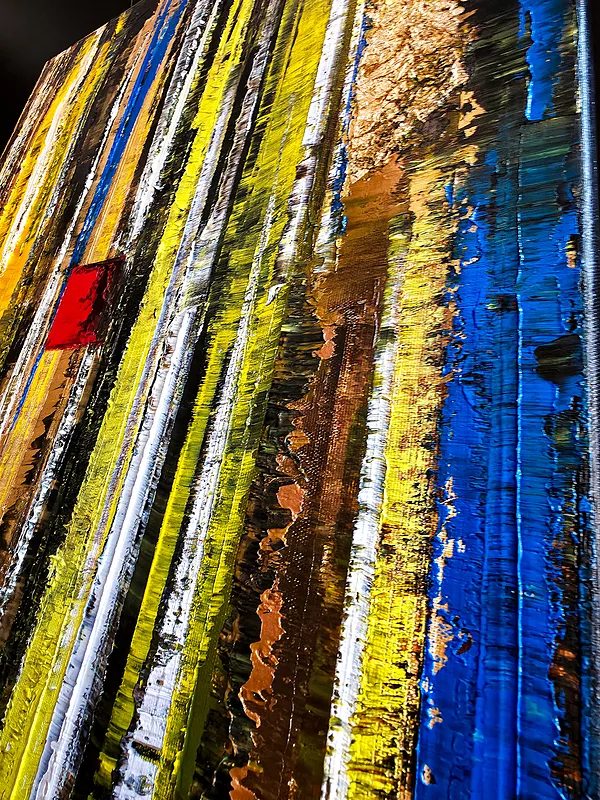
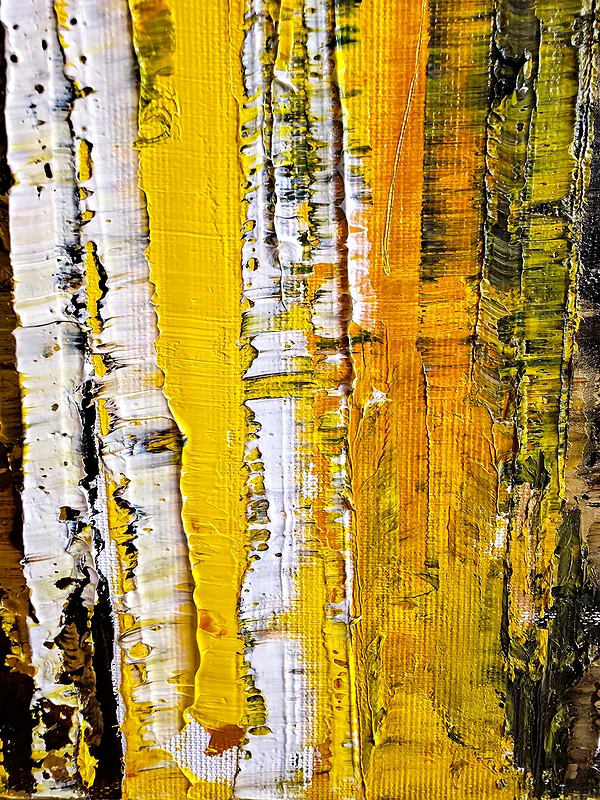
The composition’s long, vertical bands of colour evoke successive layers of time. Columns of gold, earth brown, black, ivory white, sun yellow, and cobalt rise side by side, linking historical eras. The narrow stream of blue recalls the Nile, whose waters once preserved Moses’s life. The lighter bands of paint open narrow passages between the dark and golden layers, serving as visual intimations of the possibility of deliverance.
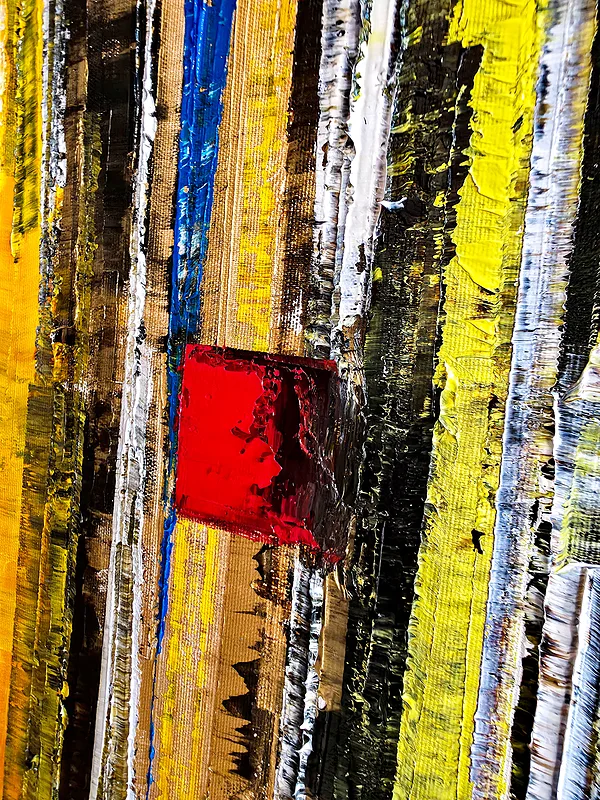
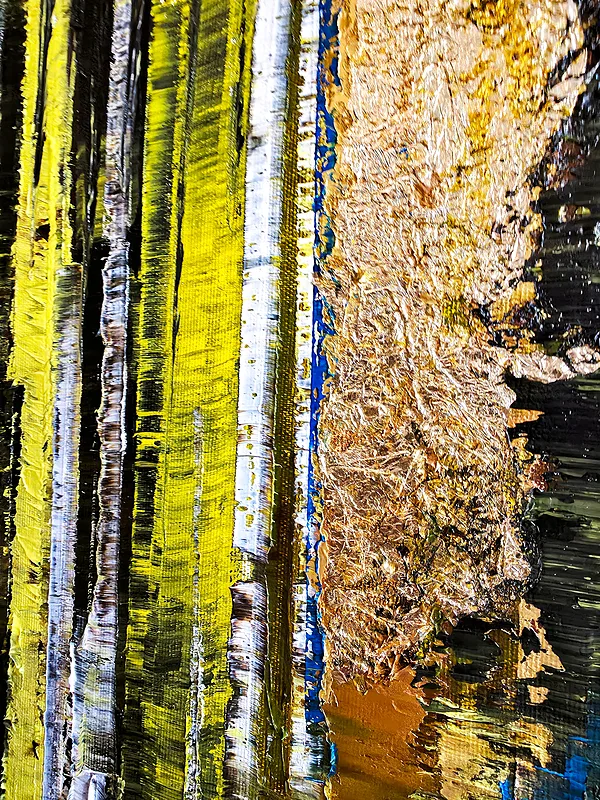
At the centre of the painting, a glowing red square, the symbol of the One, becomes the spiritual axis of the composition. Around it, gold emerges from the canvas, at times as a thin stream of paint, at others in thick, relief-like layers, evoking the radiance of timeless order and divine presence.
Centuries separate Pharaoh and Herod, yet the same fear turns them against the most vulnerable of lives. Their decrees seek to halt the future, but the very children condemned to destruction become bearers of a story greater than themselves. Within the painting’s vertical order, historical distances gradually close: the destinies of Moses and Jesus are superimposed, while the red square shines as the seal of a correspondence that transcends time.
Coincidentia reveals the eternal order underlying recurring patterns in history.
Miriam
- 150 x 100 cm
- Oil and gold on canvas
- Created: Sitges, 2026
- The artwork is part of the 'Old Testament III - In Search of the Secrets of Eternity' cycle
- AVAILABLE FOR PURCHASE
“And Miriam the prophetess, the sister of Aaron, took a timbrel in her hand; and all the women went out after her with timbrels and with dances. And Miriam answered them, Sing ye to the LORD, for he hath triumphed gloriously.” (Exodus 15:20–21, KJV)
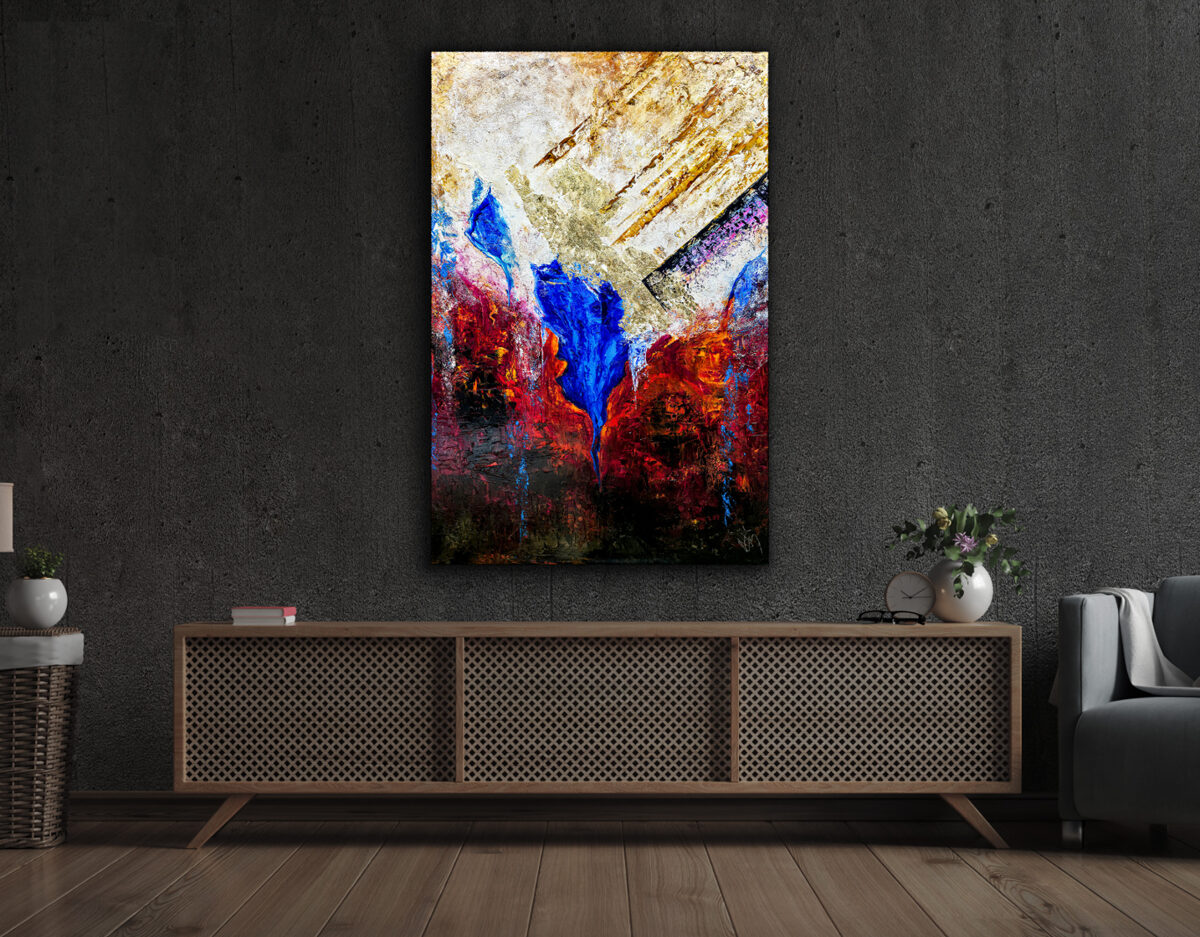
The painting transforms Miriam’s life into a vision of deliverance and thanksgiving emerging from adversity. From the earthy depths of crimson and brown, a deep blue form rises amid layers of white light, while golden rays above bring celestial order to the composition. The dark, red-tinged lower region evokes the weight of bondage in Egypt, where Pharaoh’s deadly decree threatened the lives of Hebrew infant boys:
“Every son that is born ye shall cast into the river.” (Exodus 1:22, KJV)
The blue first evokes the Nile, among whose reeds Moses’s basket drifted. Miriam, still a young girl, watched over her brother from the riverbank, already serving, through her vigilance, the future of Israel. Later, the image of the river expands into the mighty gateway of the parting Red Sea. The same waters that once cradled the life of a single child now open a path to freedom for an entire people.
Rising above the earthly layers of red and black, the central blue form embodies the power of deliverance. Turquoise rivulets of paint evoke the life-giving waters and the creative force of the Garden of Eden, while veils of white suggest the light of grace descending upon the earth. The composition’s upward-flowing rhythm expands Miriam’s personal story into a collective memory of her people’s deliverance.
The golden rays in the upper realm embody the radiance of divine glory. Among them, a dark square interrupts the path of light, signifying Miriam’s human frailty and recalling her challenge to Moses’s authority and the subsequent seven days during which she was excluded from the camp (Numbers 12). Yet gold enfolds the dark form and carries the eye onwards, placing the memory of punishment within the wider horizon of forgiveness and restoration.
Miriam’s story reveals the encounter between human frailty and divine faithfulness.
The Realm of Light
- 100 x 100 cm
- Oil and gold on canvas
- Created: Sitges, 2026
- PRIVATELY OWNED
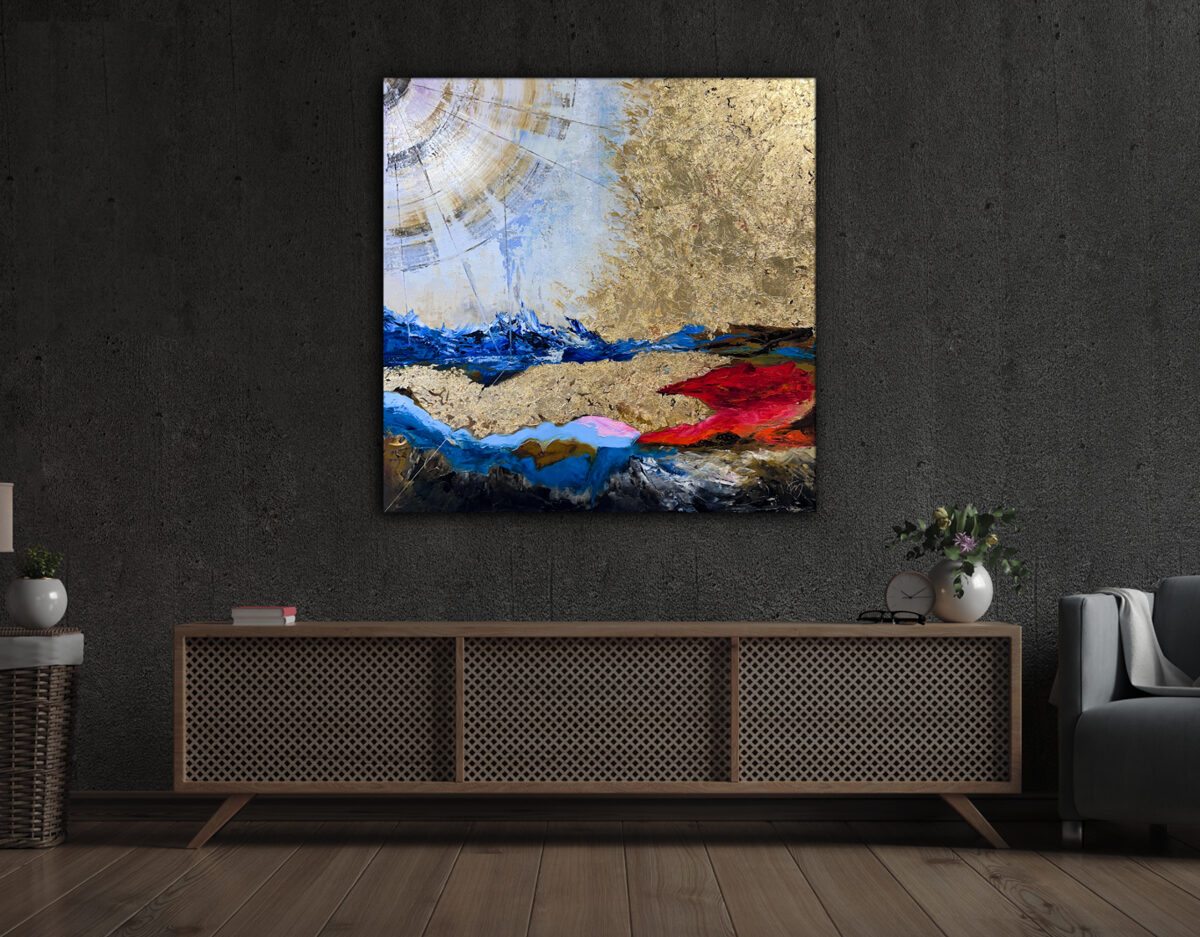
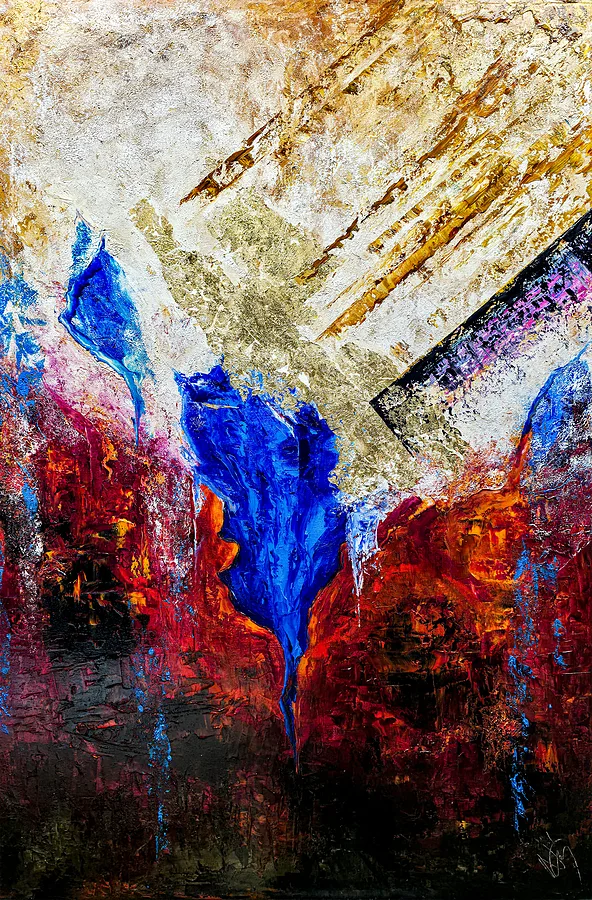
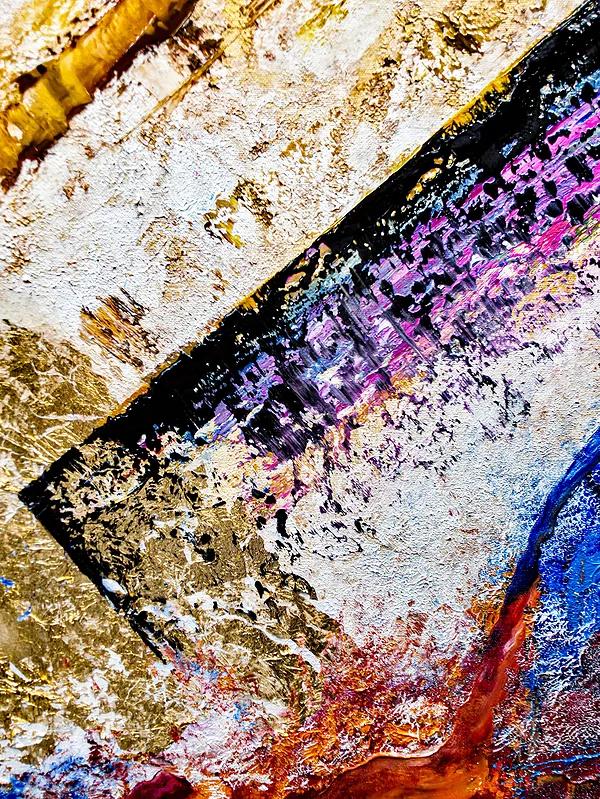
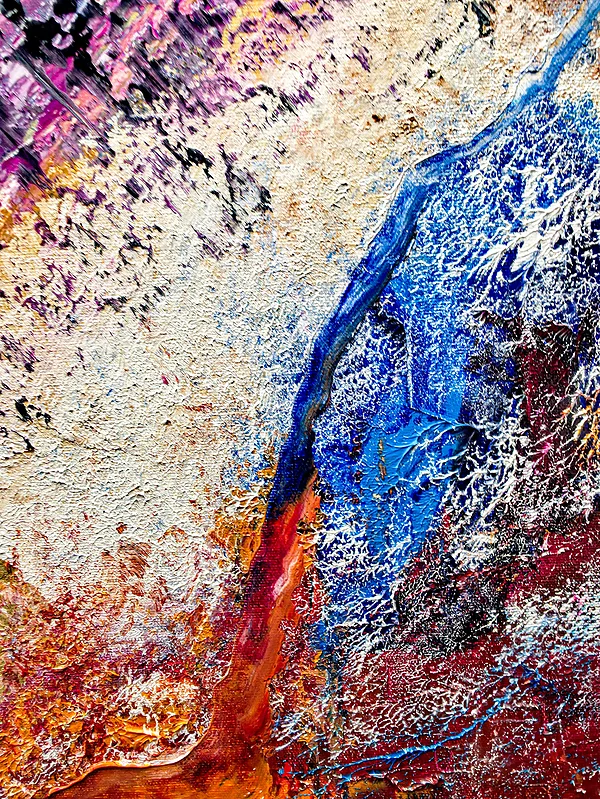
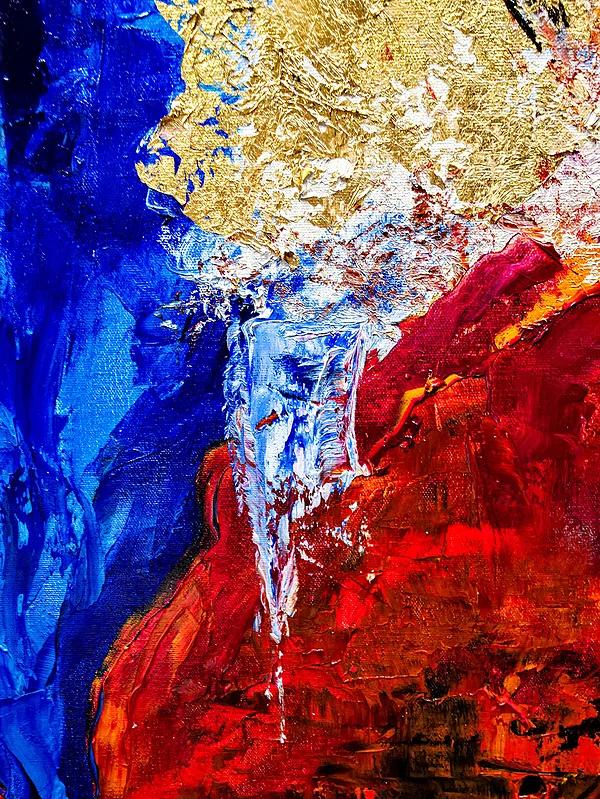
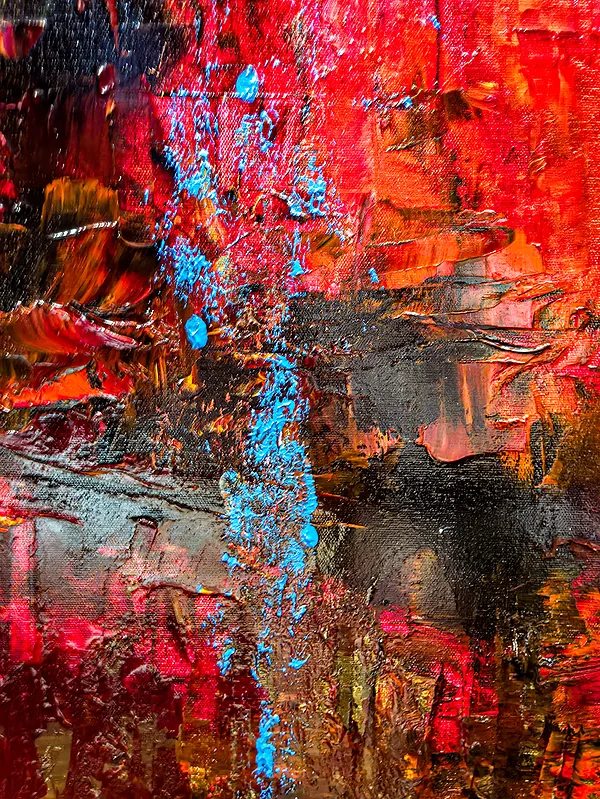
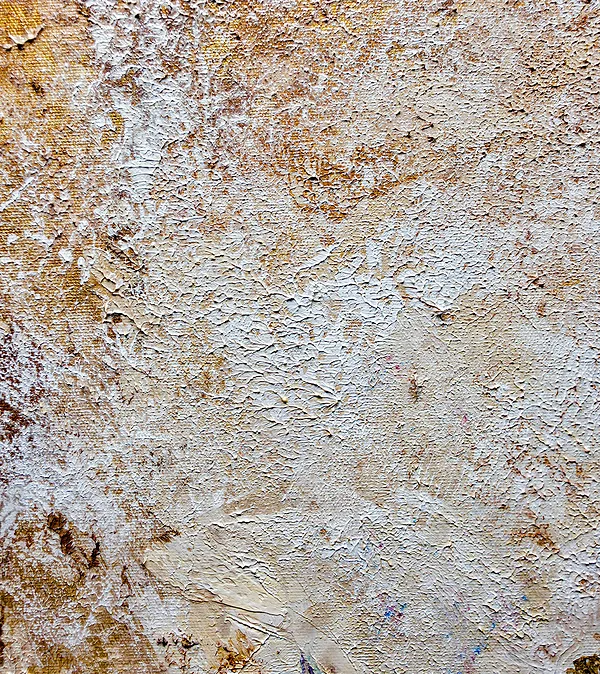
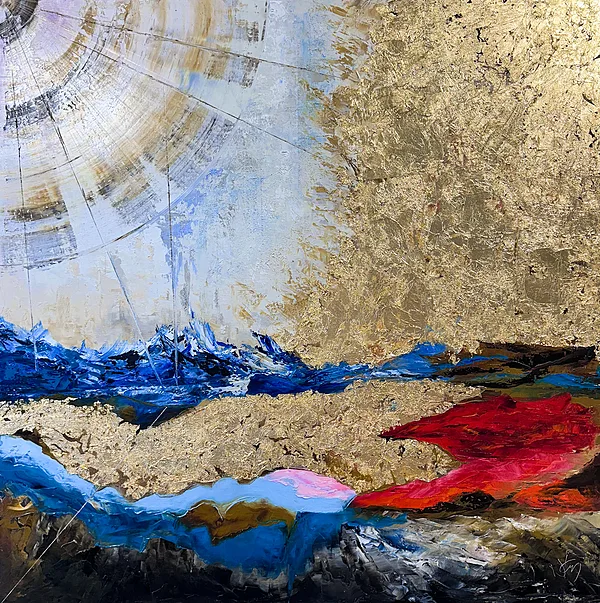
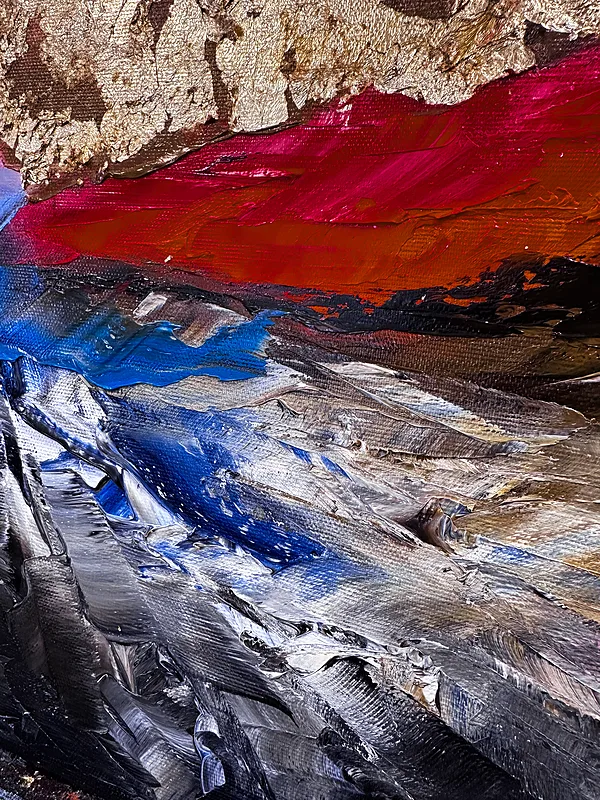
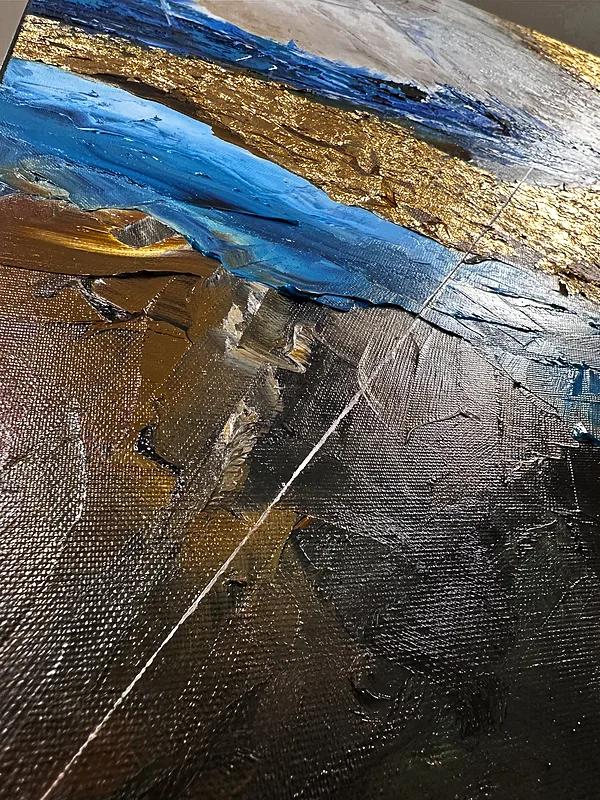
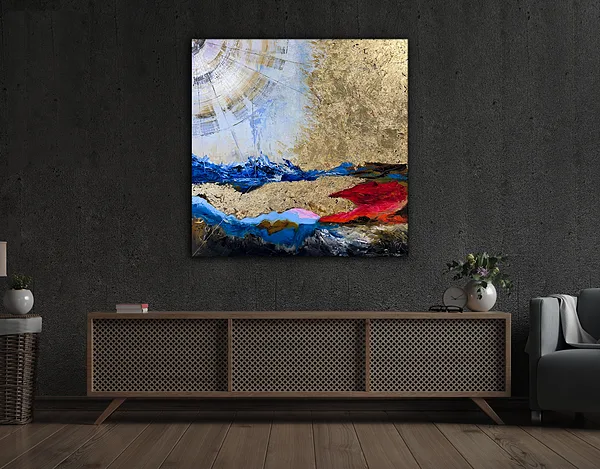
Within this richly layered composition, suffused with an inner radiance, an arc of sunlight emerges across a quarter-circle, quietly commanding the composition and gently permeating the entire work with its elemental force. It evokes the creative moment of Genesis, when order arises from the still-formless depths and the divine word, resounding through the silence, kindles light within existence.
“And God said, Let there be light: and there was light.” (Genesis 1:3, KJV)
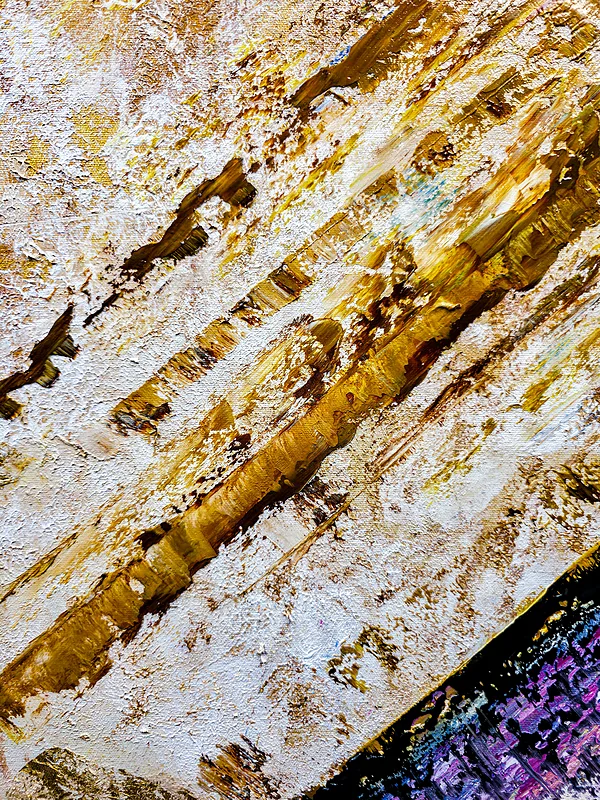
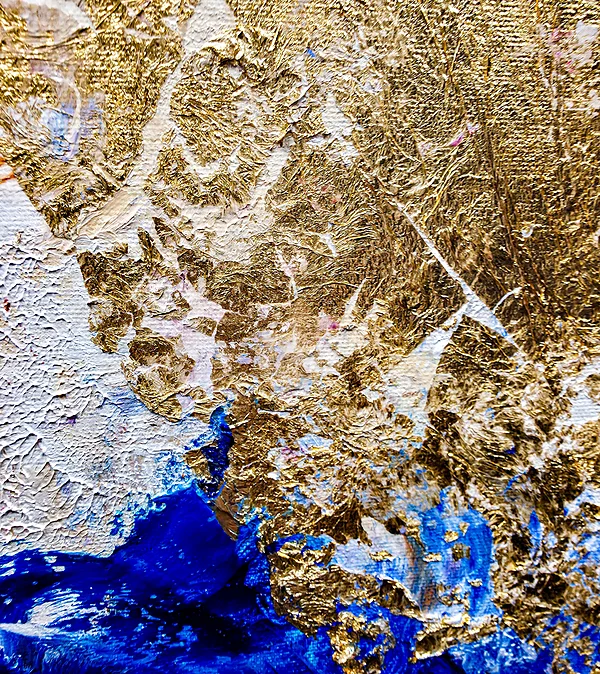
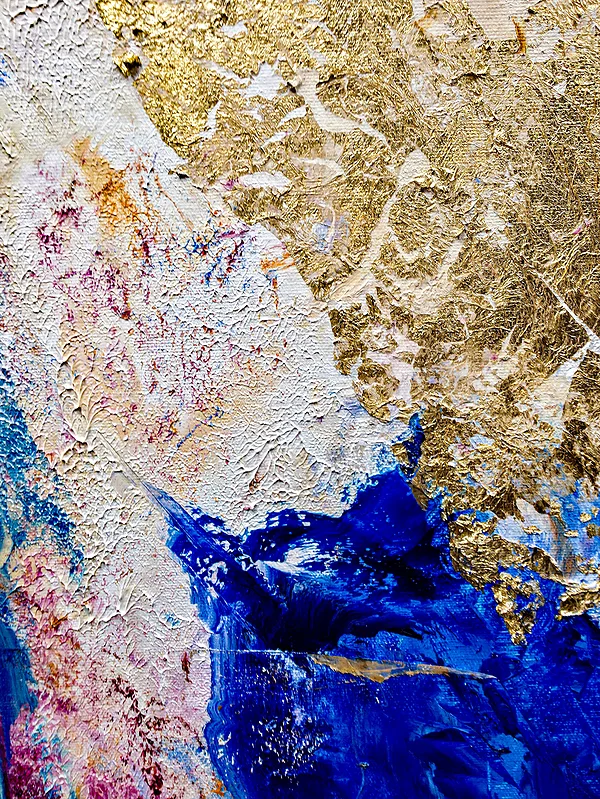
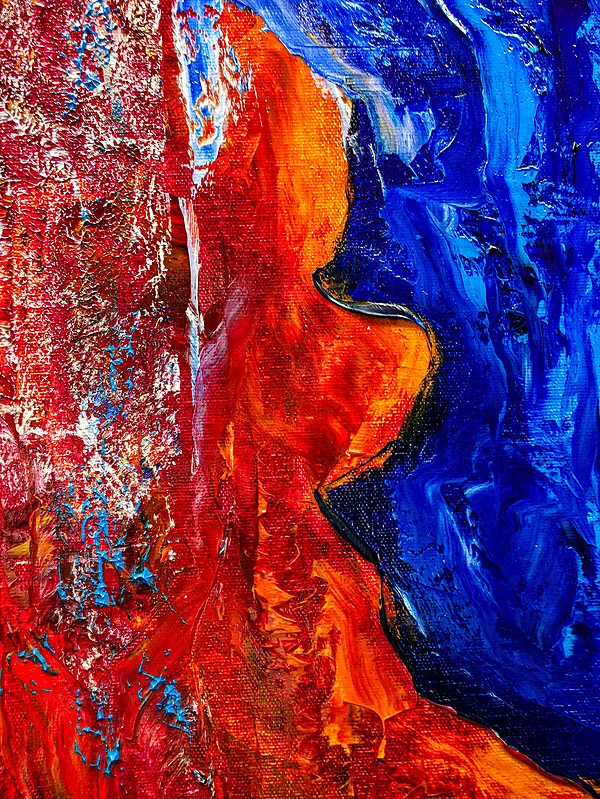
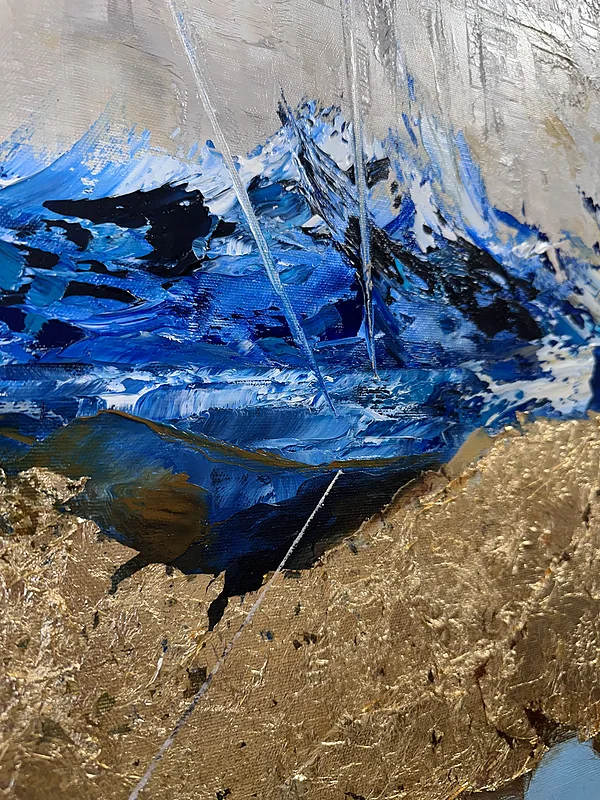
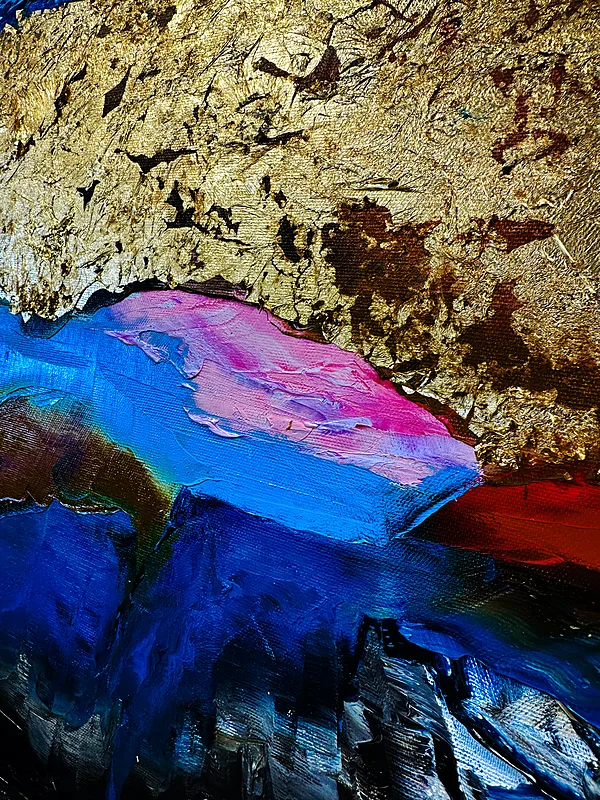
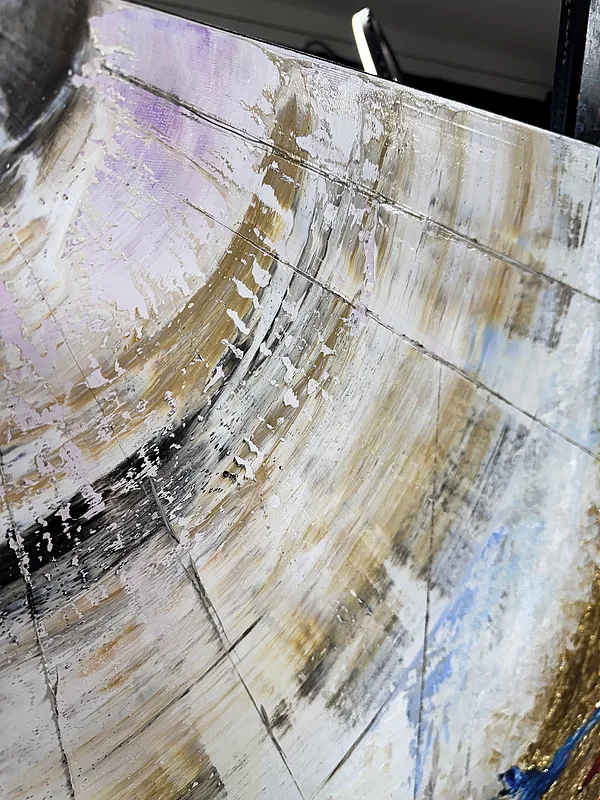
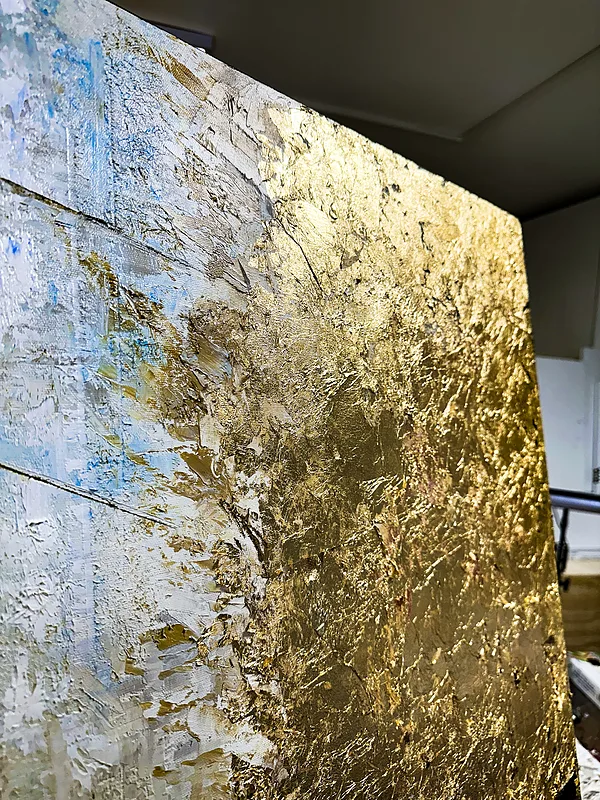
Whites dissolving into pearlescence and translucent surfaces do not dazzle; instead, they invite the viewer in, conveying the quiet certainty of a beginning slowly unfolding. On the right, gold spreads as a dense, living substance, not merely as radiance but as a sustaining presence, where light has arrived, come to rest, and condensed into a fullness glowing from within. Its texture is rich and rugged: light has become matter, the invisible is already at work within it, and every subtle vibration bears the imprint of a new birth.
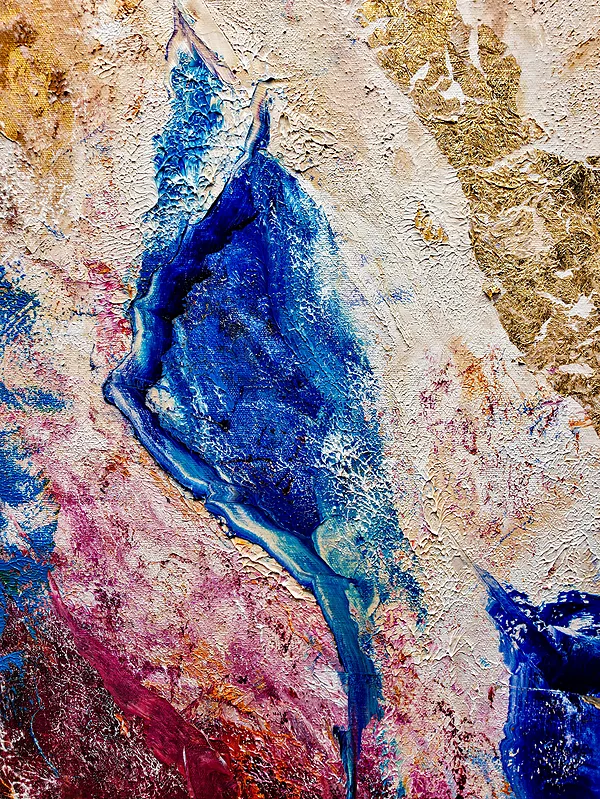
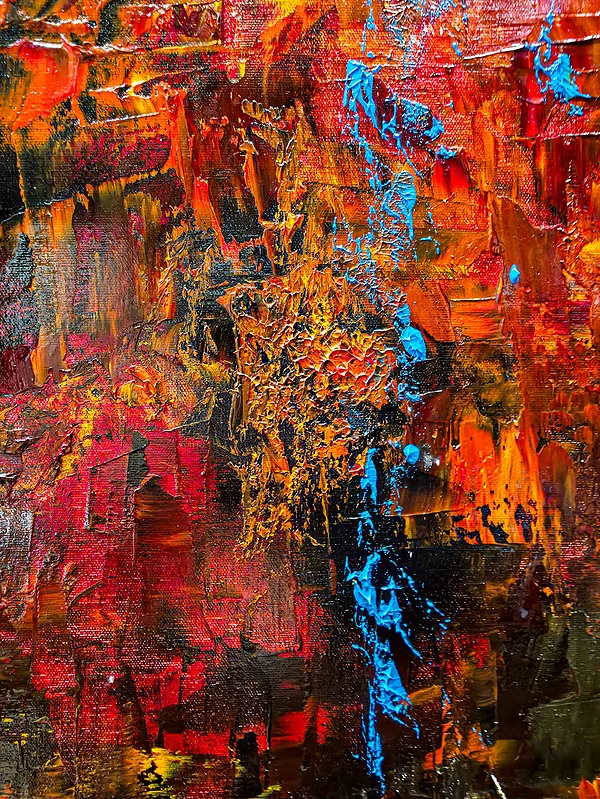
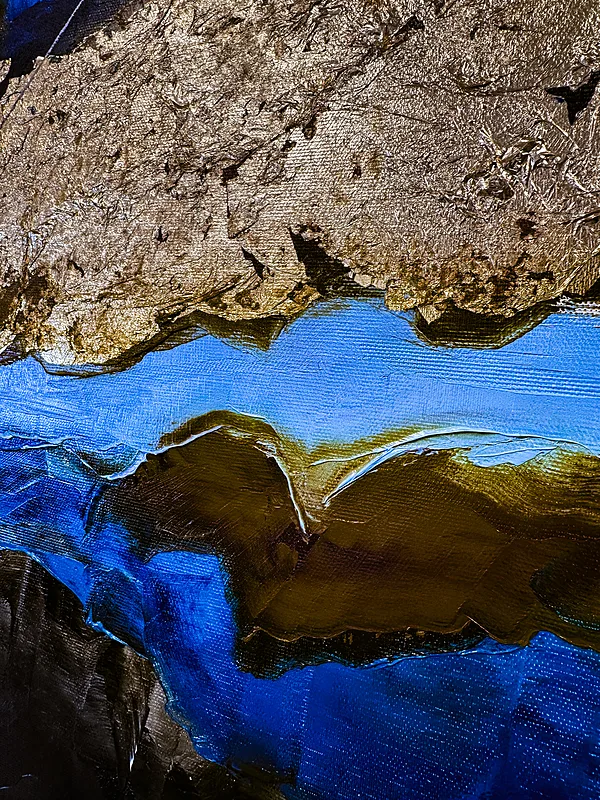
In the lower part of the painting, pale blues and earth tones dissolve into one another, evoking the material substance of a world coming into being, where water, earth, and light intertwine to trace the first signs of created order. The intense red mark within the composition, concentrated yet spreading outwards, suggests the mysterious premonition of life emerging: a pulsating inner core carrying within itself the dynamism of creation yet to unfold. A pale pinkish band forms a gentle transition, as though the first, still-fragile stirrings of life were already dawning within raw matter.
The turbulent depths churning in the lower part of the painting preserve the dark, pulsating layers of the primordial world’s unrest. Matter still remembers chaos, poised to receive the order that is about to emerge.
Argaman
- 100 x 100 cm
- Oil and gold on canvas
- Created: Sitges, 2026
- The artwork is part of the 'Old Testament III - In Search of the Secrets of Eternity' cycle
- AVAILABLE FOR PURCHASE
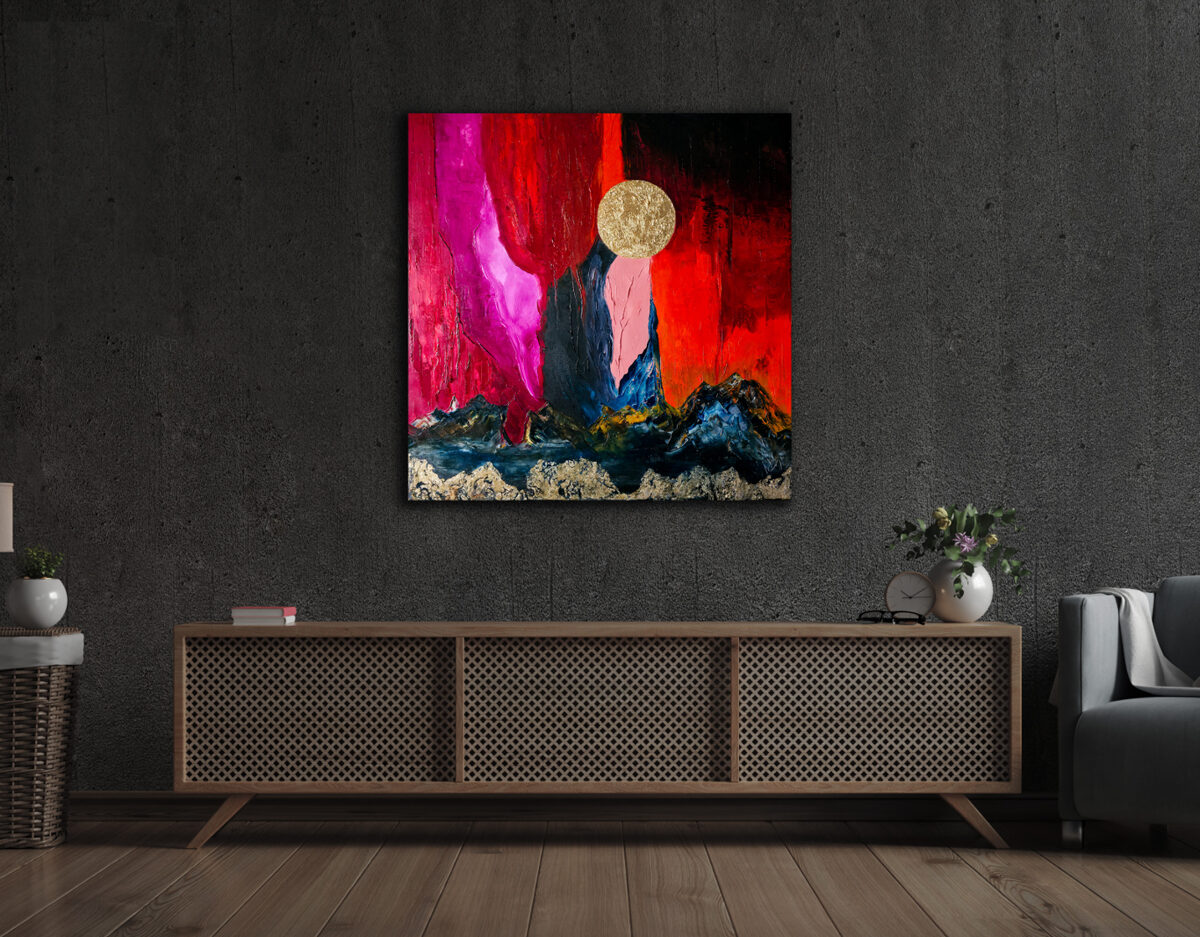
Tamás Náray’s work leads the viewer into the world of Old Testament holiness, into the sacred realm of the wilderness Tabernacle, adorned with purple and gold. Argaman is the ancient Hebrew term for purple, a colour that, beyond earthly splendour, embodies the dignity of beauty consecrated to the service of the Eternal. In antiquity, the most precious purple dyes were extracted from sea snails, transforming a hidden treasure of the deep into the sumptuous adornment of royal robes and sacred hangings.
At Mount Sinai, the Lord gave Moses detailed instructions for the construction of the Tabernacle. Alongside gold, silver, and bronze, threads of blue, purple, and scarlet were to lend the sanctuary its sacred dignity:
“And let them make me a sanctuary; that I may dwell among them.” (Exodus 25:8, KJV)
On the left side of the painting, radiant cyclamen and deep purple fields evoke heavy velvet curtains and silk hangings bathed in light. Opposite them, glowing expanses of scarlet and blazing red evoke the awe-inspiring divine manifestation at Mount Sinai, where the Lord descended in fire and enveloped the mountain in smoke.
At the centre of the composition, a dark blue, almost black form rises towards the heavens. Between the purple and scarlet fields on either side, a mysterious passage opens. A pale pink form, reminiscent of a wing, suggests the enigmatic unveiling of sacred space.
The golden disc in the upper part of the painting dominates the swirling colours through its precise geometric form. A symbol of eternity, completeness, and the unchanging divine order, it shines above the passionate currents of purple and red.
The dark, rocky ridges in the lower third evoke the sombre mass of Mount Sinai. Golden details glimmer among the deep blue, black, and earth-toned layers, conjuring the image of sanctified ground touched by heavenly light. The painting evokes the Tabernacle erected in the heart of the wilderness, where heaven and earth meet, bearing enduring witness to the divine presence.
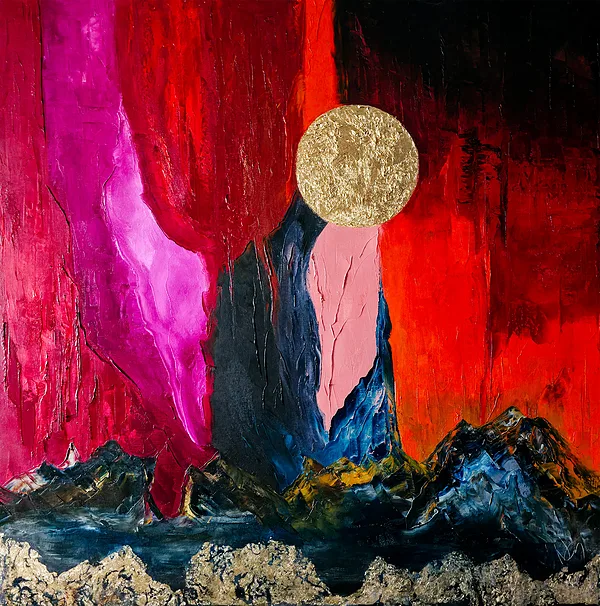
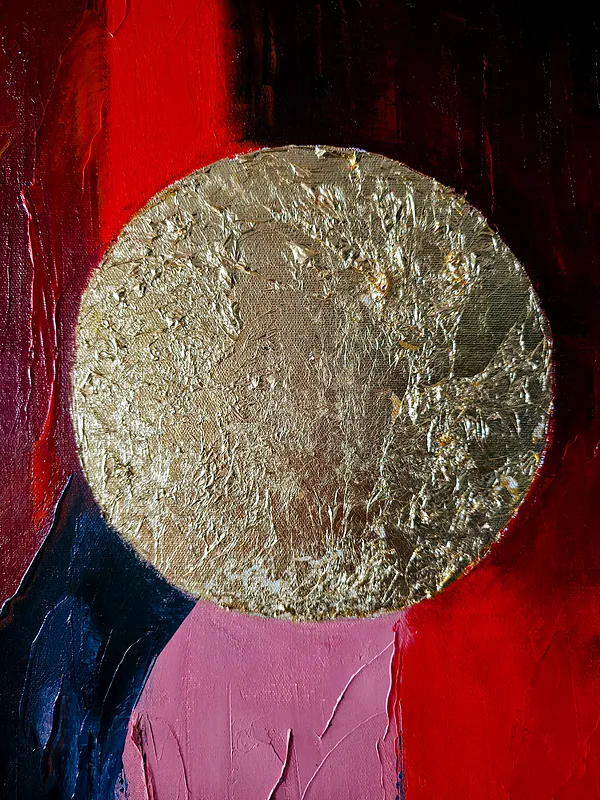
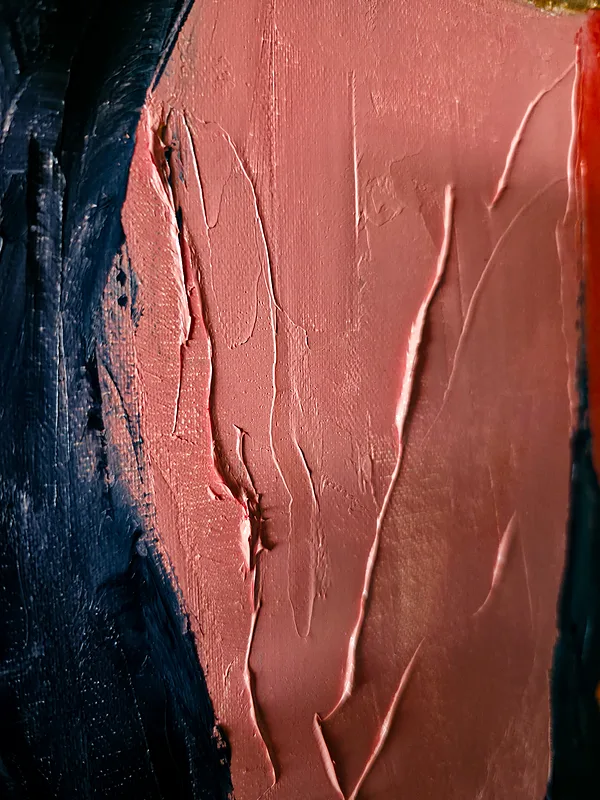
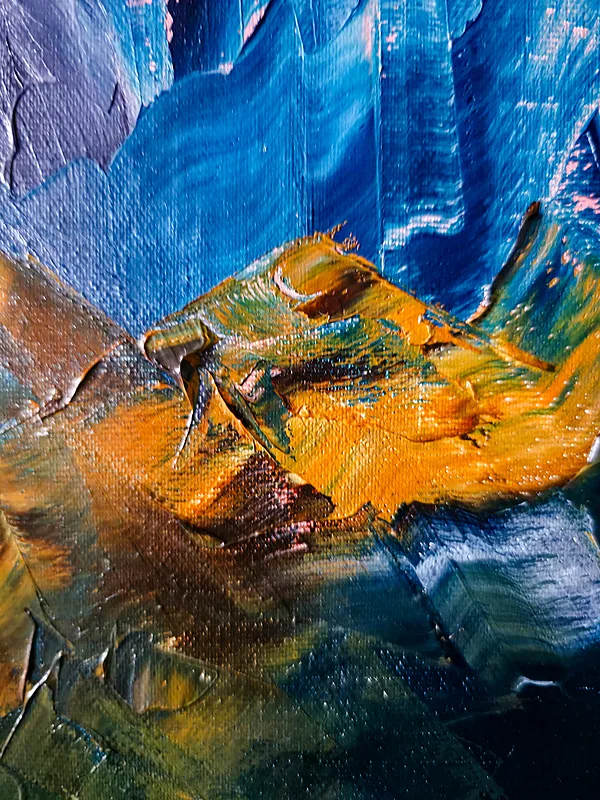
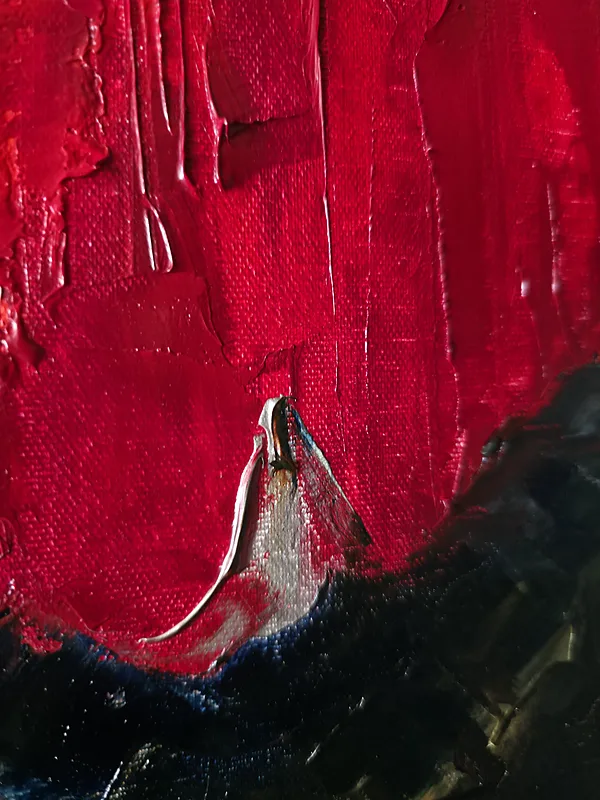
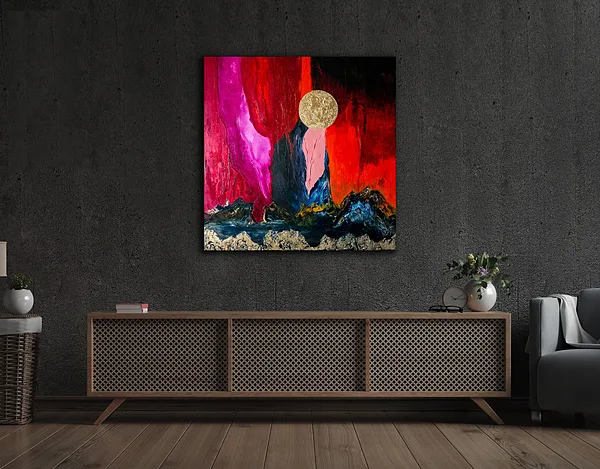
The Vestments of Aaron
- 100 x 150 cm
- Oil and gold on canvas
- Created: Sitges, 2026
- The artwork is part of the 'Old Testament III - In Search of the Secrets of Eternity' cycle
- AVAILABLE FOR PURCHASE
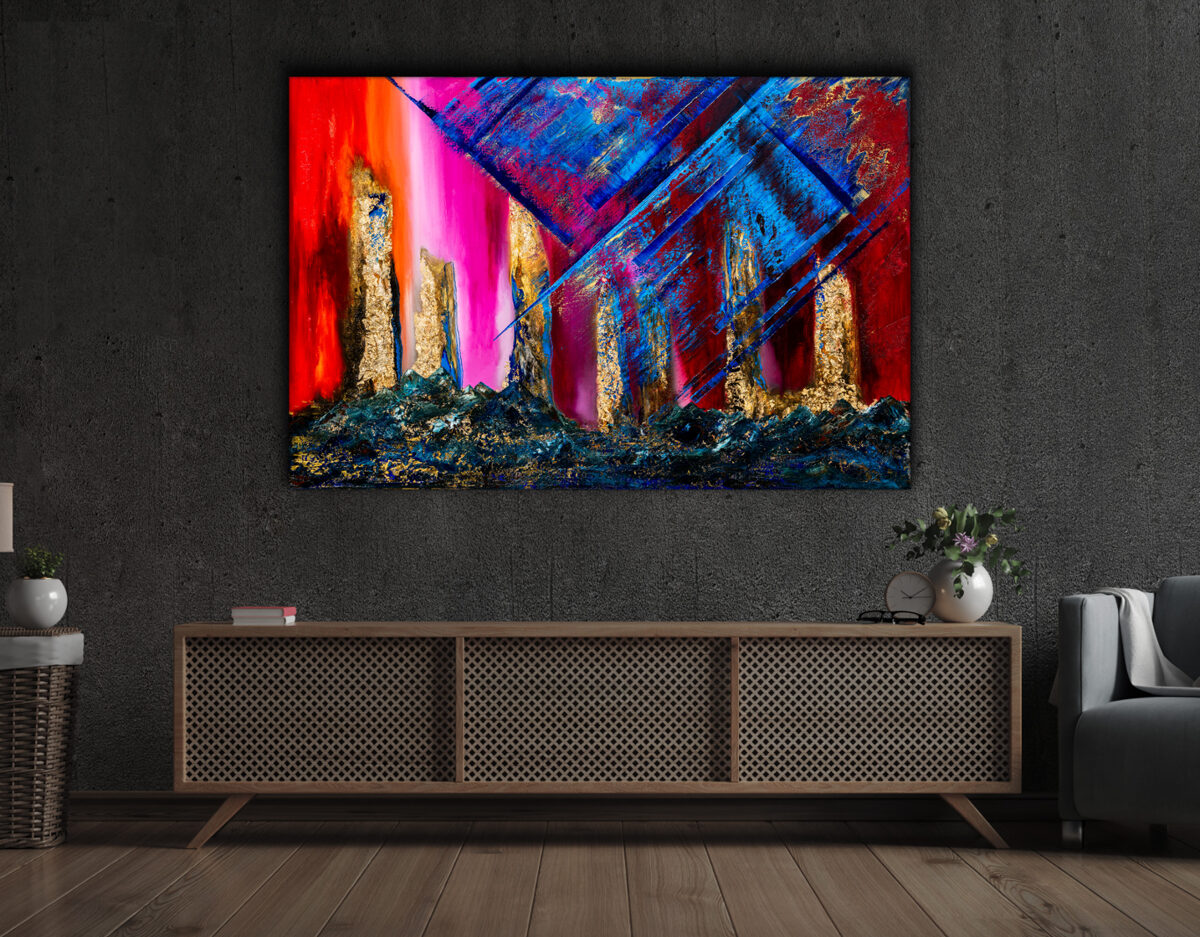
“And thou shalt make holy garments for Aaron thy brother for glory and for beauty.” (Exodus 28:2, KJV)
The painting evokes the sacred beauty of the high priest’s vestments as described in the Old Testament. Layered gold surfaces, deep blue diagonals, and radiant fields of purple, crimson, and magenta bring to life the movement of an invisible loom, upon which diverse materials and colours are woven together into a single ceremonial fabric.
The seven golden columns rising on the left stand out from the composition as guardians of sacred order. They evoke the biblical memory of Israel’s tribes and their ancestral heritage: Benjamin, Simeon, Zebulun, Issachar, Asher, Naphtali, and Gad, whose destinies were bound to the history of the Promised Land. Along the lower edge of the painting, Mount Zion emerges, interwoven with deep blue and golden light, connecting the memory of the holy city and the divine presence with the world of the high priest’s ministry.
Among the deep blue and purple forms, the ephod, Aaron’s ornate shoulder garment, and the breastpiece of judgement, worn over his heart, take shape. The twelve precious stones of the breastpiece bore the names of the twelve tribes of Israel. Upon his shoulders and over his heart, the high priest carried his people before the Eternal: the stones on his shoulders symbolised responsibility, while the precious stones over his heart evoked the love expressed through intercession.
The golden radiance of the composition also recalls the light of the seven-branched Menorah, the golden lampstand of the sanctuary. Its branches sprang from a single piece of gold, and its seven lamps served to illuminate the sacred space. The interwoven lines of gold and blue unite the distinct forms within a single, living order, just as every element of the high priest’s vestments expressed the unity of consecrated service.
Upon Aaron’s forehead, a plate of pure gold bore the inscription: “HOLINESS TO THE LORD.” (Exodus 28:36, KJV) This declaration encapsulates the meaning of the entire composition: through human devotion, the glory of the Eternal becomes visible, while the beauty of consecrated service shines forth as light, illuminating the created world.
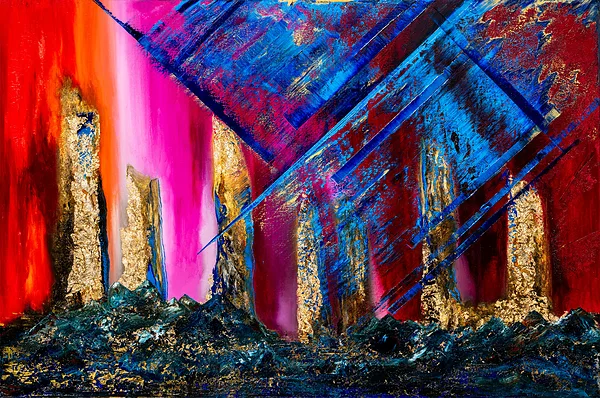
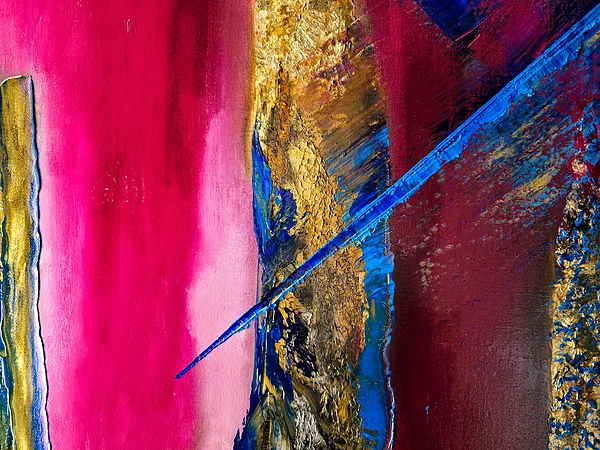
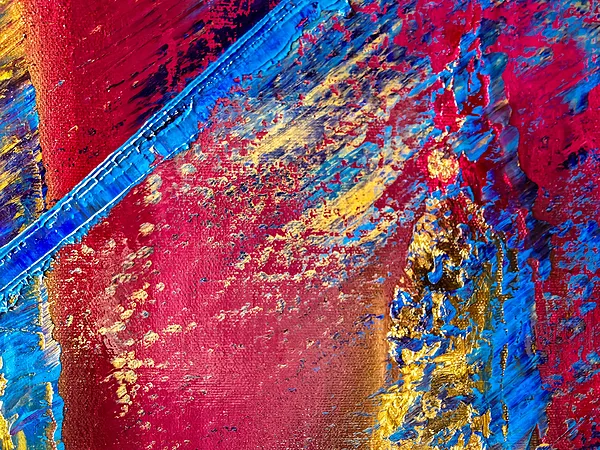
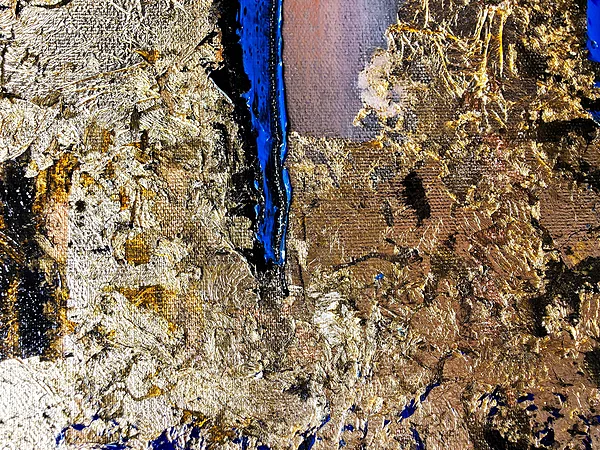
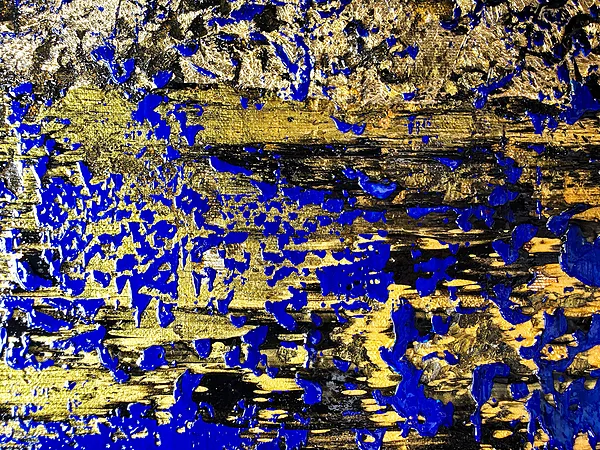
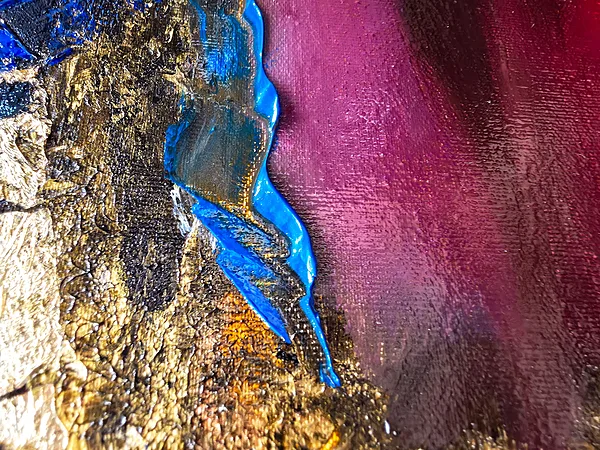
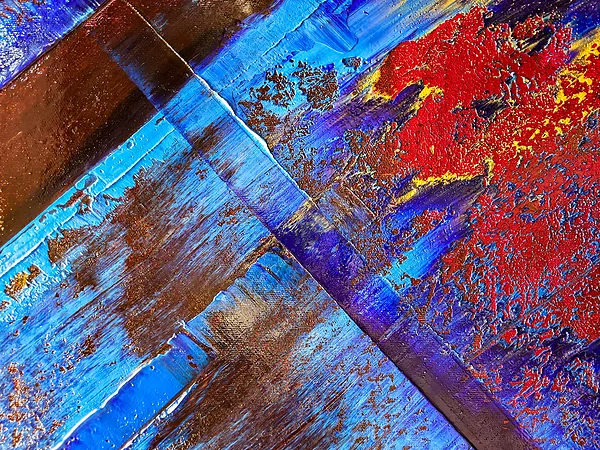
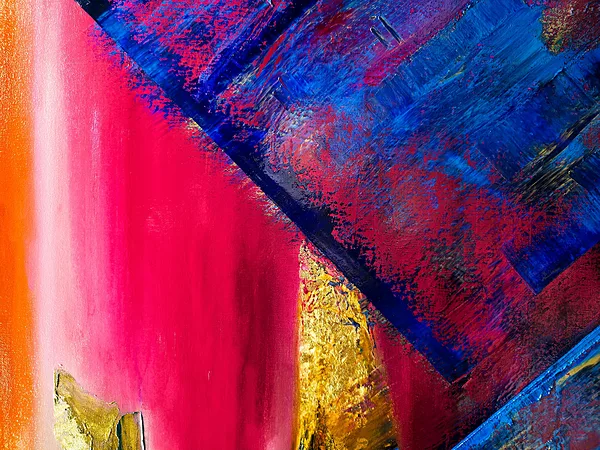
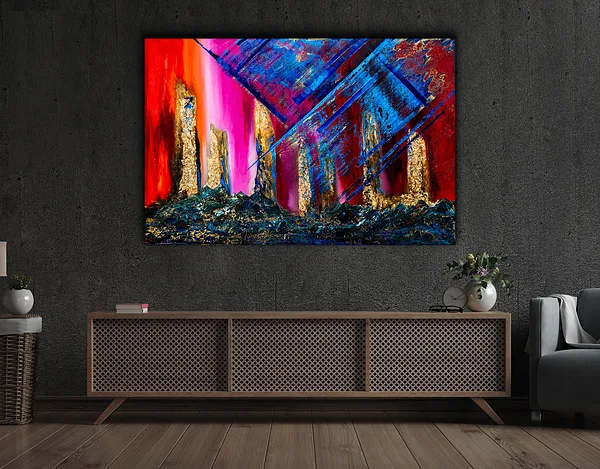
The Transfiguration on Mount Tabor
- 70 x 51 cm
- Oil and gold on canvas
- Created: Sitges, 2026
- The artwork is part of the 'Old Testament III - In Search of the Secrets of Eternity' cycle
- AVAILABLE FOR PURCHASE
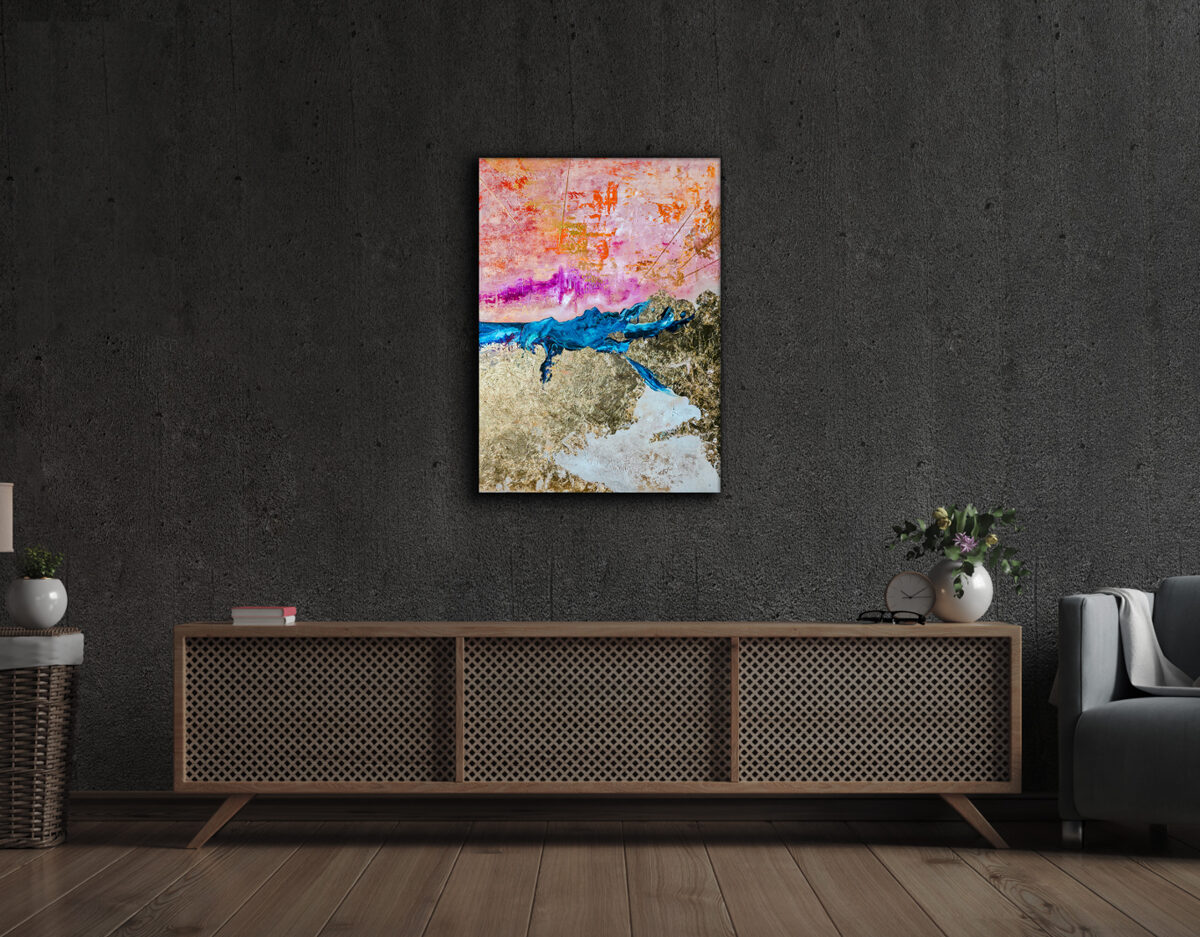
The Transfiguration on Mount Tabor is a work within the Old Testament cycle that anticipates the New Testament. It evokes one of the most sublime moments of divine revelation in the Gospels: the unveiling of Christ’s divine glory. The appearance of Moses and Elijah establishes the connection between the two Covenants, as the testimony of the Law and the Prophets converges in Christ.
According to the Gospel narrative, Jesus led Peter, James, and John up Mount Tabor, where, before the eyes of his disciples, his face shone like the sun and his garments became dazzling white. Moses and Elijah appeared beside him, bringing the Law, the prophetic tradition, and Christ’s divine glory together in a single revelation.
“And was transfigured before them: and his face did shine as the sun, and his raiment was white as the light.”(Matthew 17:2, KJV)
The rose-gold atmosphere of the upper part of the painting conveys the radiance of heavenly glory. Amid delicate, spreading traces of ochre and gold, violet glimmers emerge. Indistinct forms appear across the fragmented, fresco-like surfaces, while the descending arcs of gold in the upper reaches evoke the light of the revelation pouring down from above.
Running across the middle of the composition, a thickly applied ridge of sapphire-blue paint becomes the visual heart of Mount Tabor. Its undulating, sculptural form stretches across the canvas like a ribbon of silk. Here, the earth transforms into an outstretched hand, a palm that receives and bears the glory being revealed.
At the moment of the Transfiguration, Peter wished to erect three tabernacles, one each for Jesus, Moses, and Elijah. Then a bright cloud overshadowed those present, and the voice of the Father was heard:
“This is my beloved Son, in whom I am well pleased; hear ye him.” (Matthew 17:5, KJV)
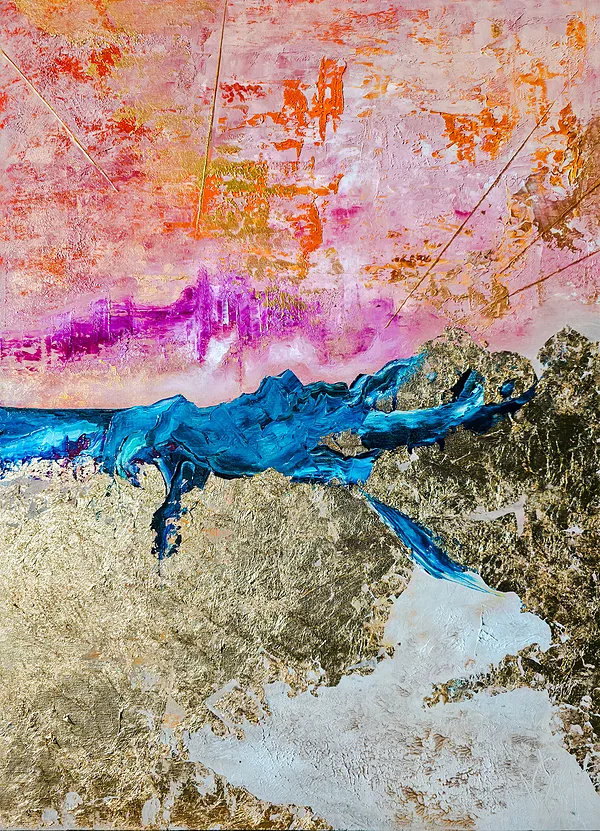
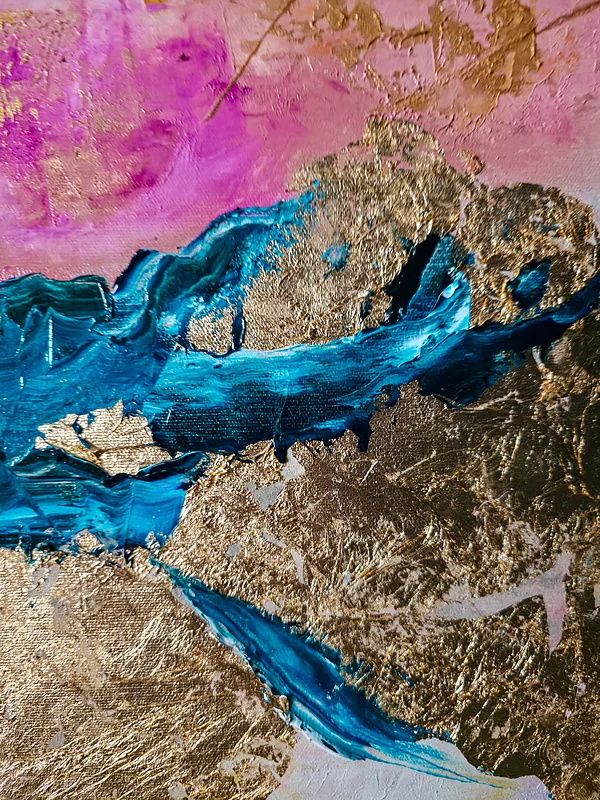
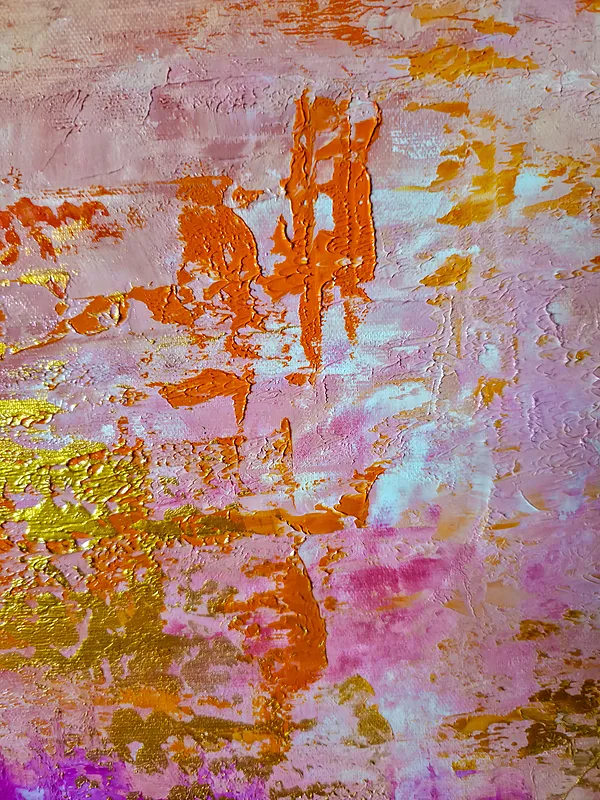
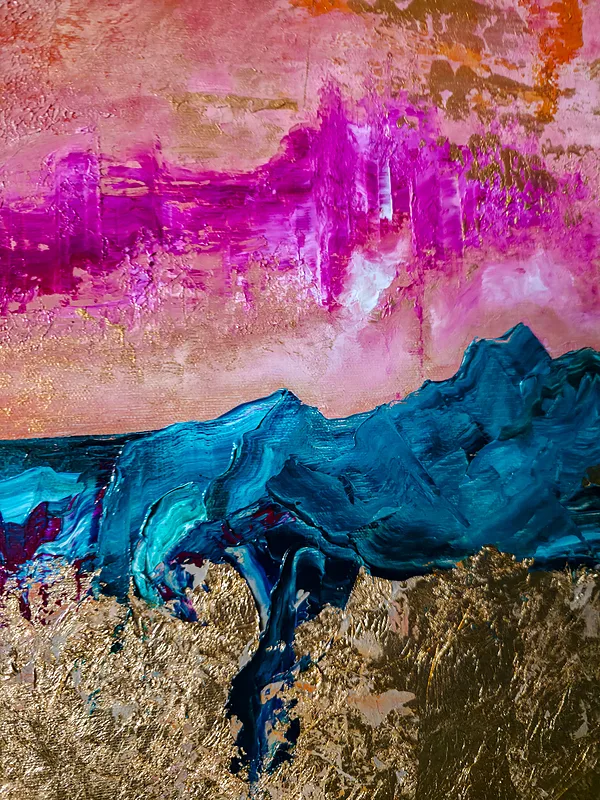
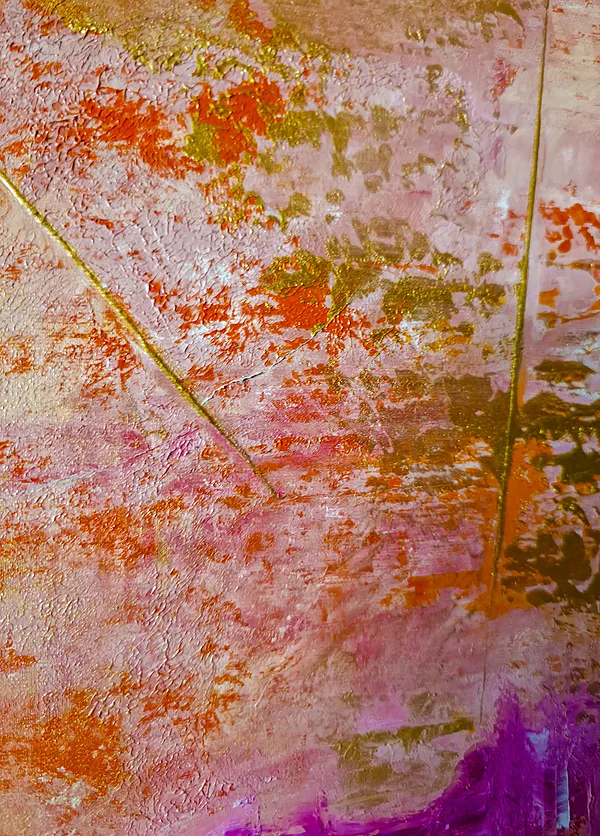
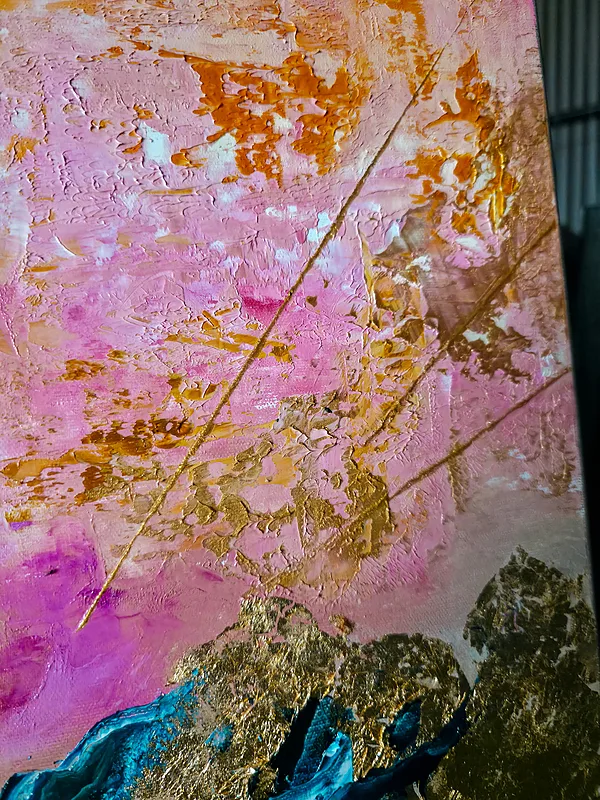
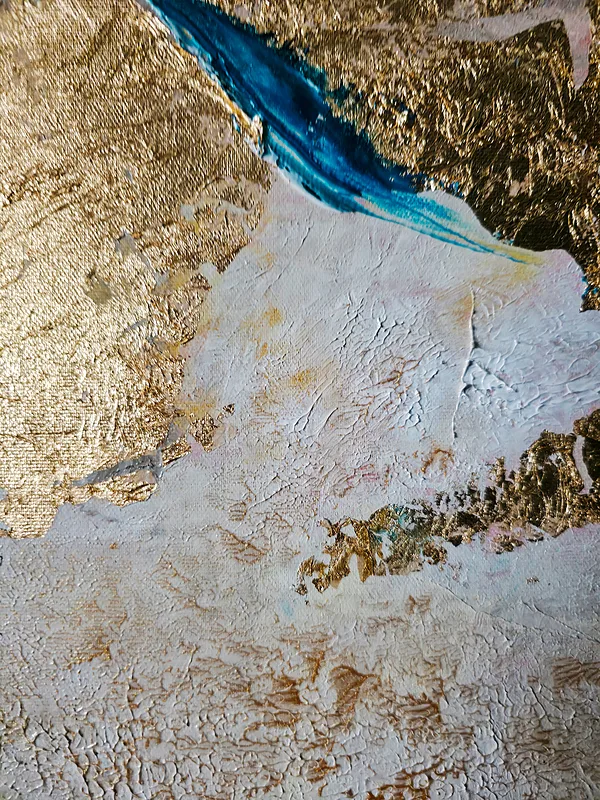
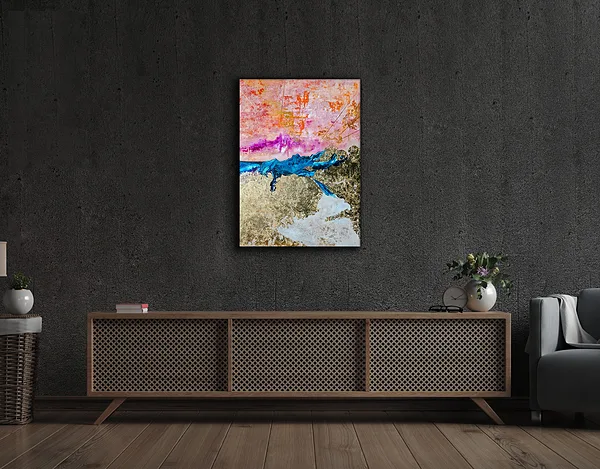
The Sapphire Firmament
- 91 x 91 cm
- Oil and gold on canvas
- Created: Sitges, 2026
- The artwork is part of the 'Old Testament III - In Search of the Secrets of Eternity' cycle
- AVAILABLE FOR PURCHASE
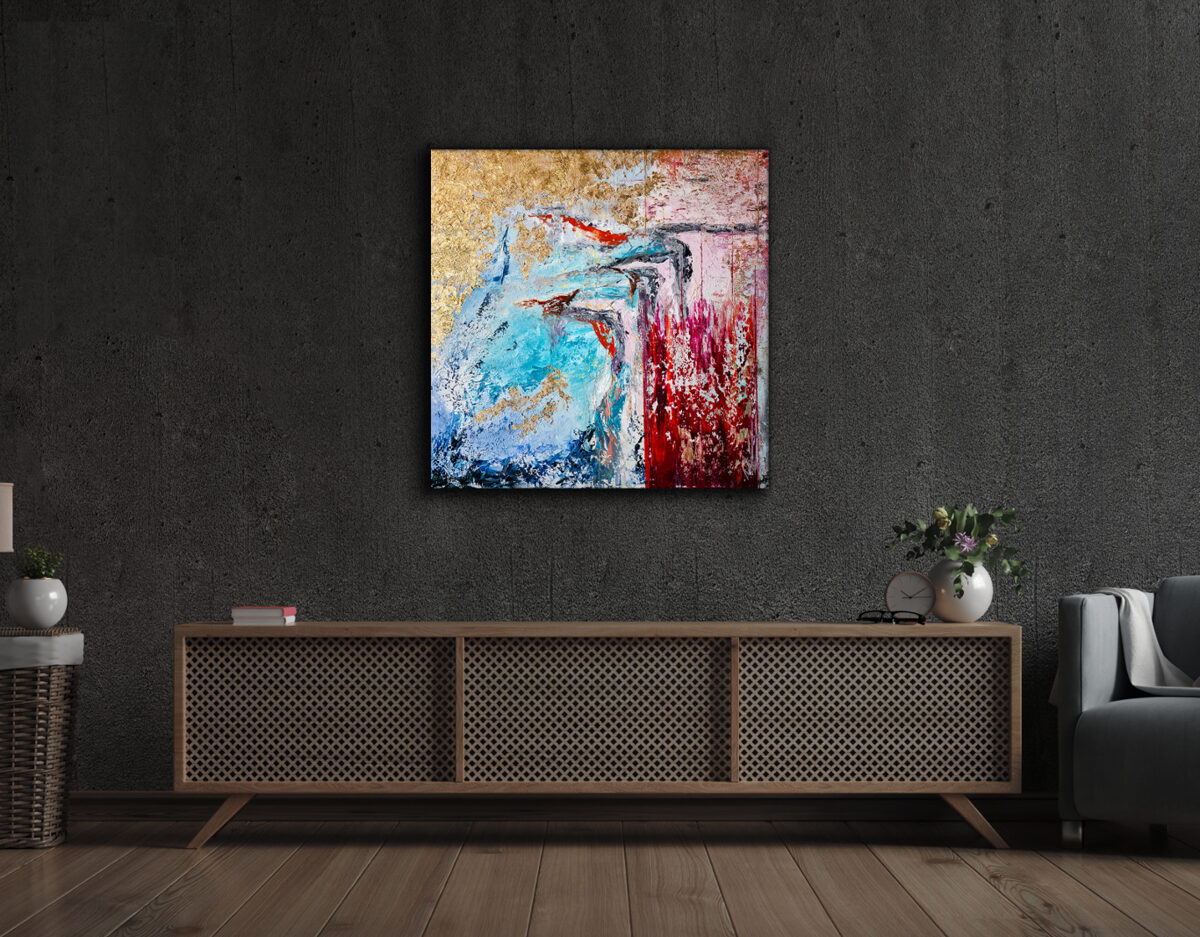
The Sapphire Firmament transports the viewer into the realm of Old Testament theophanies. From the ceremonial splendour of patinated gold leaf, through flowing turquoise and sapphire-blue hues dissolving into pearlescent whites, to the glowing depths of crimson and the graceful movements of soaring forms, a singular celestial landscape unfolds. Here, the mighty forces of nature meet the majesty of the divine presence. The composition evokes the wondrous moment when the heavens open above Mount Sinai, the earthly realm is suffused with heavenly light, and all the beauty of creation proclaims the glory of the Eternal. Sapphire, one of the most precious gemstones of the Old Testament, assumes particular significance in the Book of Exodus, when Moses, Aaron, Nadab, Abihu, and seventy elders of Israel ascend Mount Sinai and witness an extraordinary manifestation of God.
“And they saw the God of Israel: and there was under his feet as it were a paved work of a sapphire stone, and as it were the body of heaven in his clearness.” (Exodus 24:10, KJV)
The upper-left area of the canvas is dominated by a richly layered, almost bas-relief-like surface of gold. Extending across the composition, broad, interflowing fields of ice blue, turquoise, aquamarine, and luminous azure unfold. Among the lighter turquoise surfaces, reddish and golden brushstrokes give rise to forms reminiscent of birds. Their sweeping movements evoke the freedom of flight between heaven and earth, while also recalling the biblical image of Noah’s dove.
Paint layers interwoven with turquoise and silvery white, edged with slate-grey contours, trace the outlines of a monumental series of interlocking gateways or a celestial structure.
Against a pale pink, pearlescent background, a form rising upwards and deepening into rich purple evokes the majesty of a heavenly throne, whose radiant inner space gradually transforms into a sacrificial altar.
In the first chapter of the Book of Ezekiel, above the heavenly firmament appears a throne resembling sapphire stone, surrounded by fire and radiance. In Isaiah’s vision, the Lord sits upon a lofty throne, with seraphim proclaiming his holiness around him.
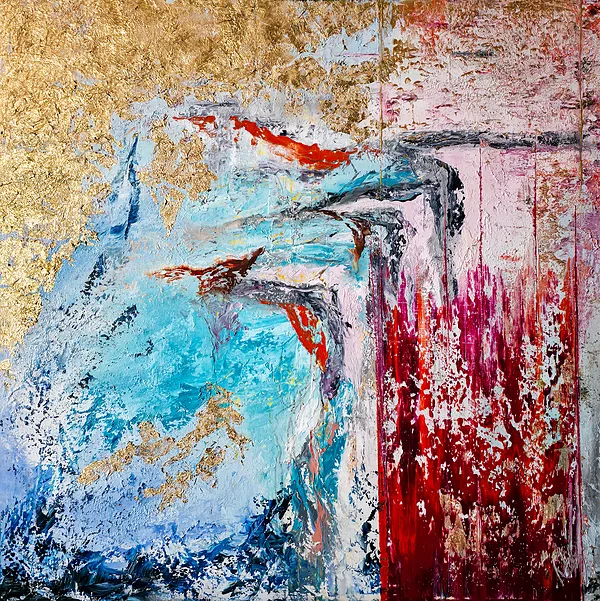
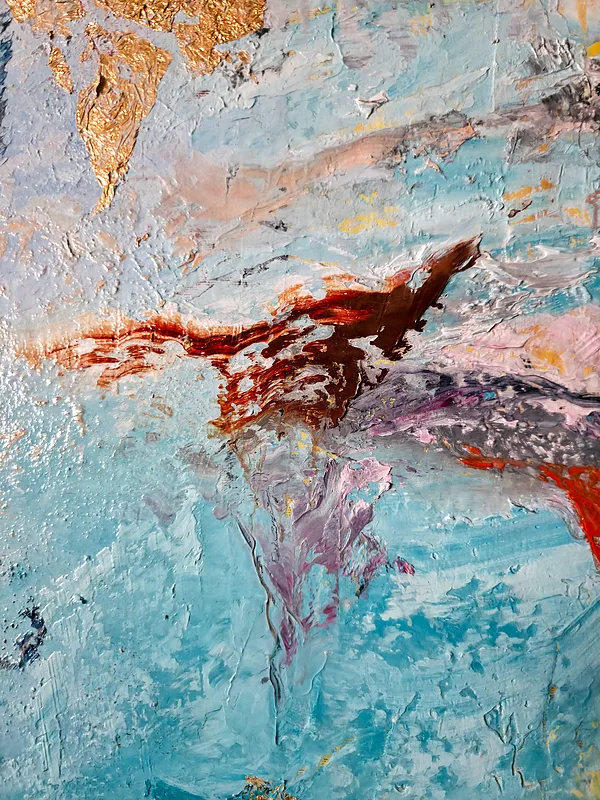
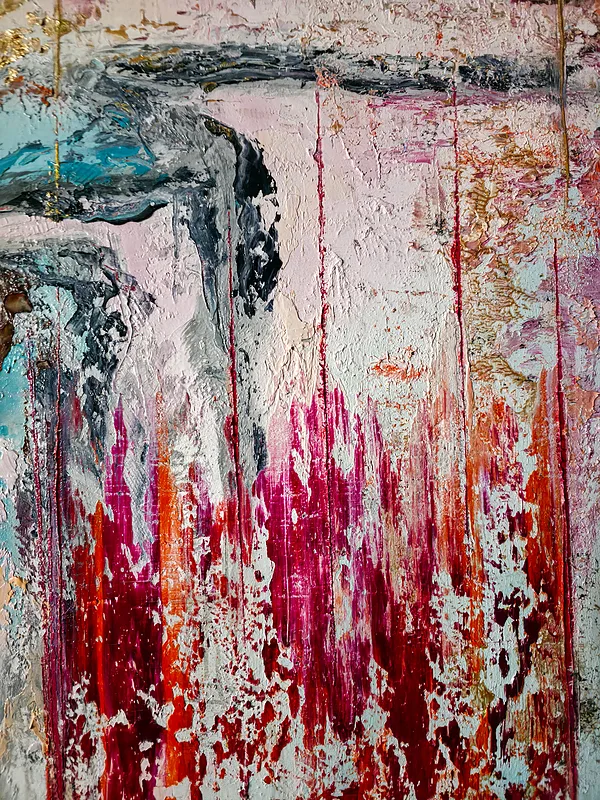
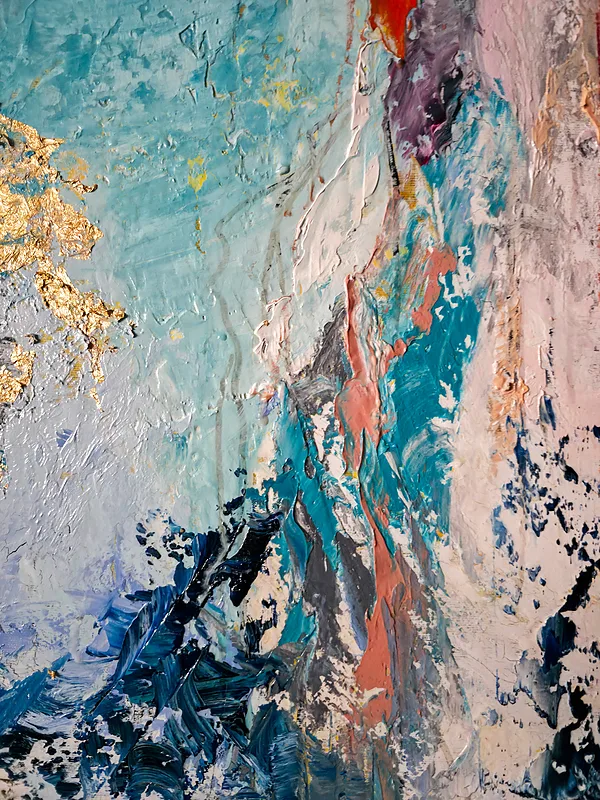
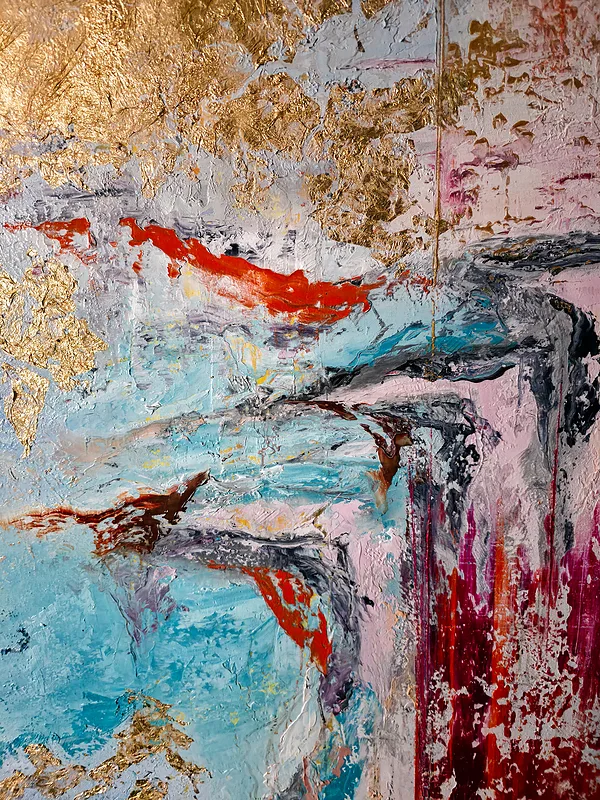
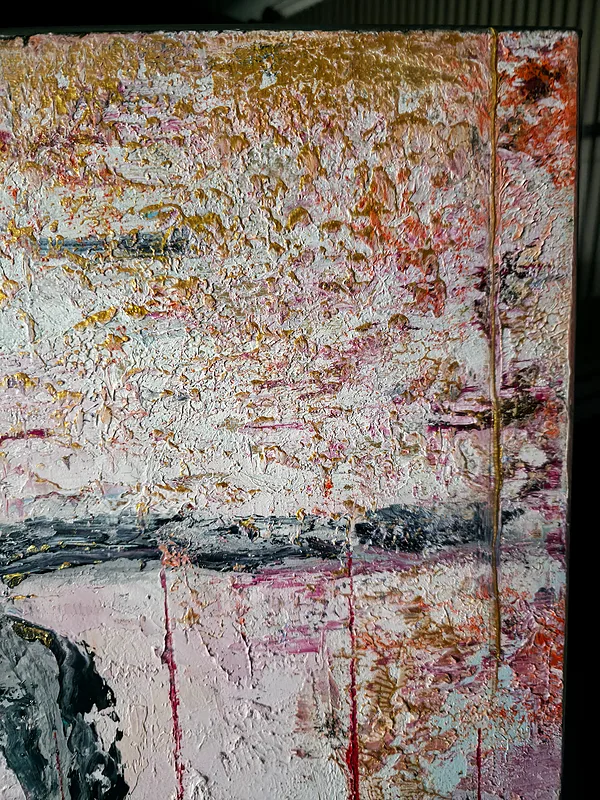
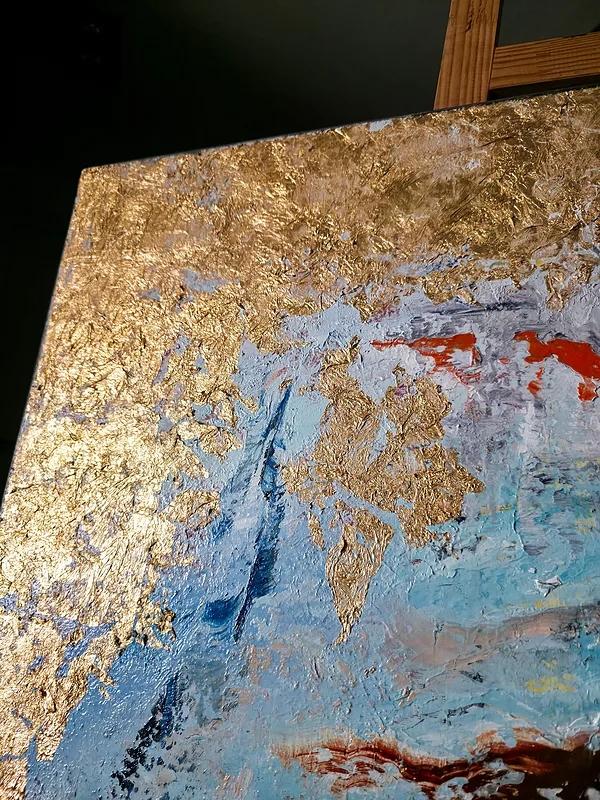
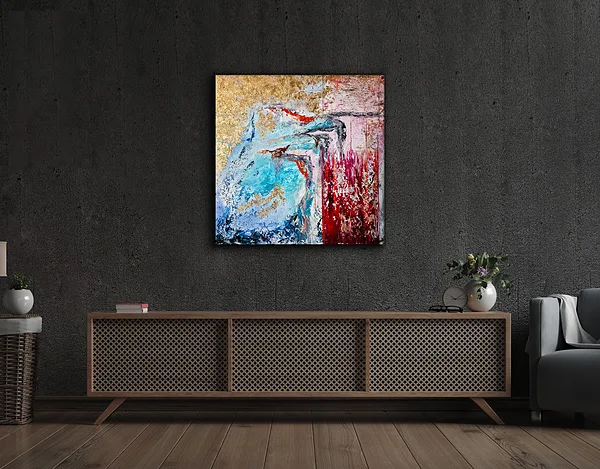
Jacob's Ladder
- 100 x 100 cm
- Oil and gold on canvas
- Created: Sitges, 2026
- The artwork is part of the 'Old Testament III - In Search of the Secrets of Eternity' cycle
- AVAILABLE FOR PURCHASE
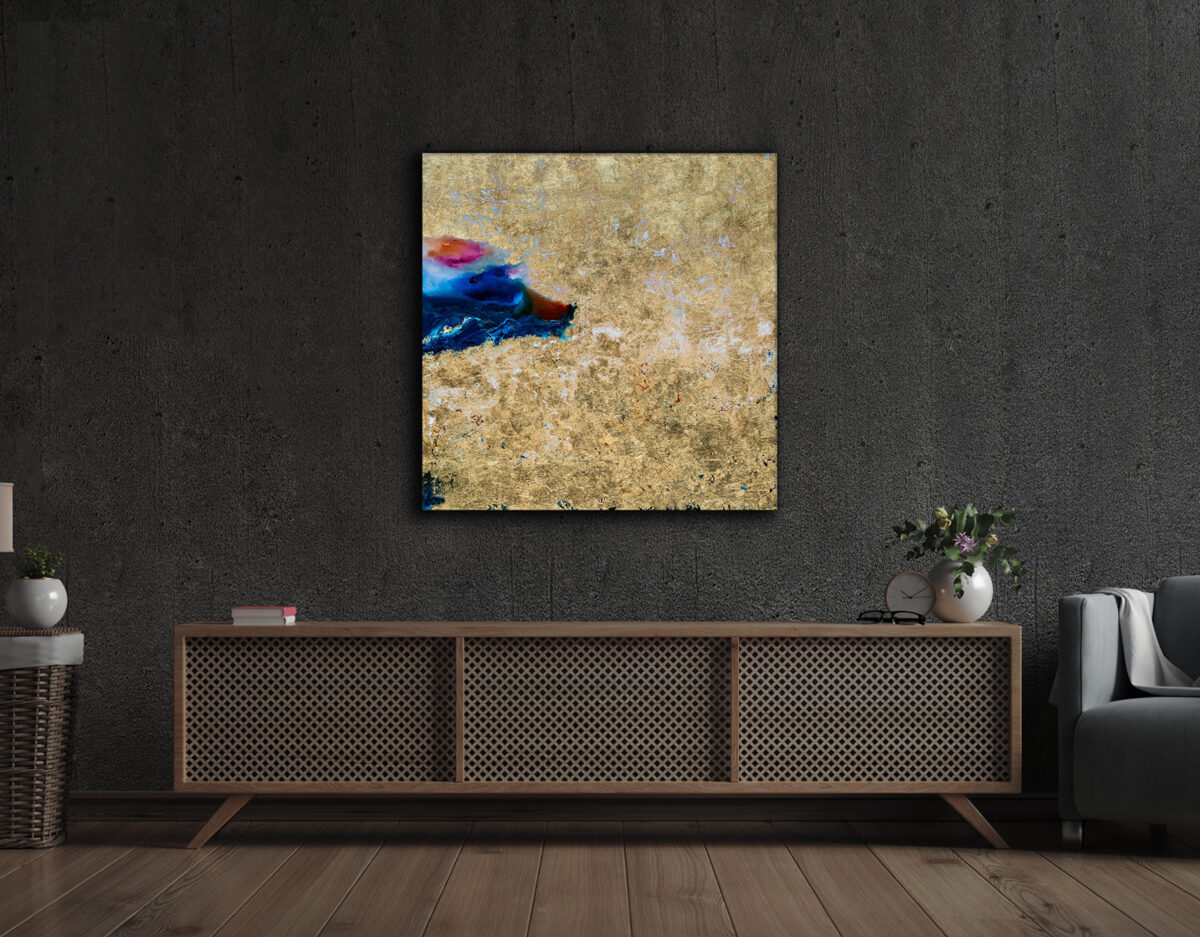
This luminous work leads the viewer into the mysterious realm of Old Testament visions and dreams. The golden field that floods the canvas, shimmering in a thousand shades, evokes the nocturnal dream of a solitary traveller: that extraordinary moment when the gates of heaven opened before Jacob and the Eternal revealed the wondrous path connecting earth and heaven.
In the silence of the night, an extraordinary vision appeared to Jacob in a dream: a ladder extending from earth to heaven, with angels ascending and descending upon it, and the Lord standing above, reaffirming the covenant He had made with Abraham and Isaac.
“And he dreamed, and behold a ladder set up on the earth, and the top of it reached to heaven: and behold the angels of God ascending and descending on it.” (Genesis 28:12, KJV)
The patinated surfaces of the honey-coloured gold leaf evoke, in places, the walls of an ancient sanctuary and, elsewhere, a manuscript adorned with gold, its timeworn pages preserving the mysterious signs of biblical memory. Emerging from the left, a deep-blue form penetrates the radiant world of gold with striking vitality. Dense layers of indigo and ultramarine, darkening almost to black, are articulated by brilliant cobalt-blue brushstrokes, rocky furrows, and translucent glimmers of azure.
Yet the painting’s most extraordinary secret reveals itself only gradually. In the central area, the subtle divisions of the gold layers begin to disclose the outlines of a ladder, almost imperceptible at first, its structure divided into small rectangular sections. Faint, fragmented grid-like details emerge from the broken gold surfaces, following two parallel vertical lines and evoking the image of a mysterious ladder. This elusive ladder may be understood as the conceptual centre of the work.
Jacob’s sacred encounter unfolds as the composition’s deepest inner event. Upon awakening, he was overcome by the realisation of the extraordinary significance of the place, whose true nature had until then remained unknown to him:
“Surely the LORD is in this place; and I knew it not.” (Genesis 28:16, KJV)
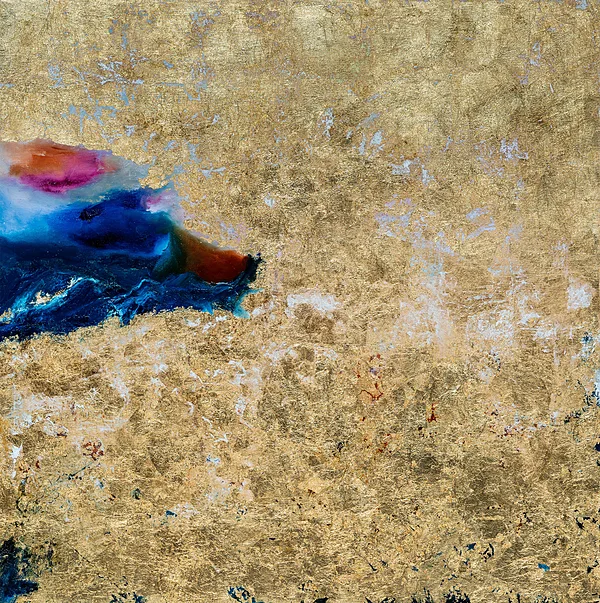
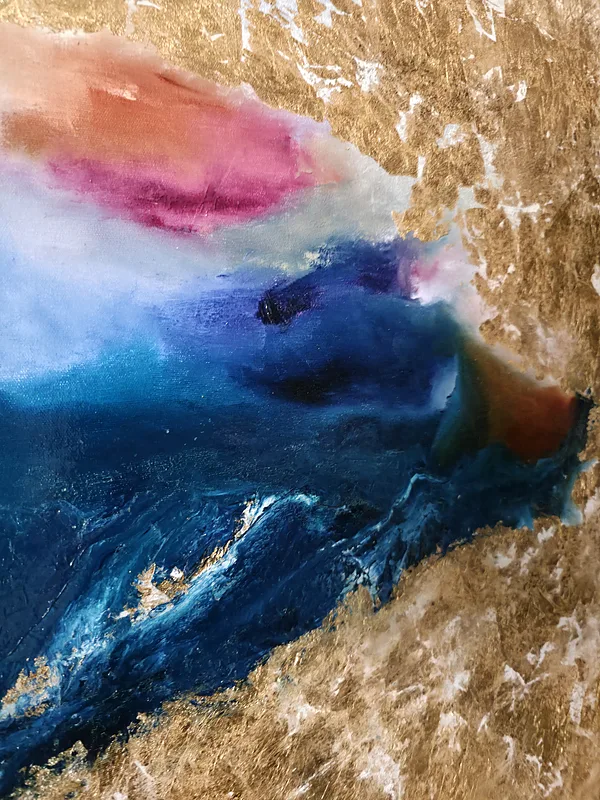
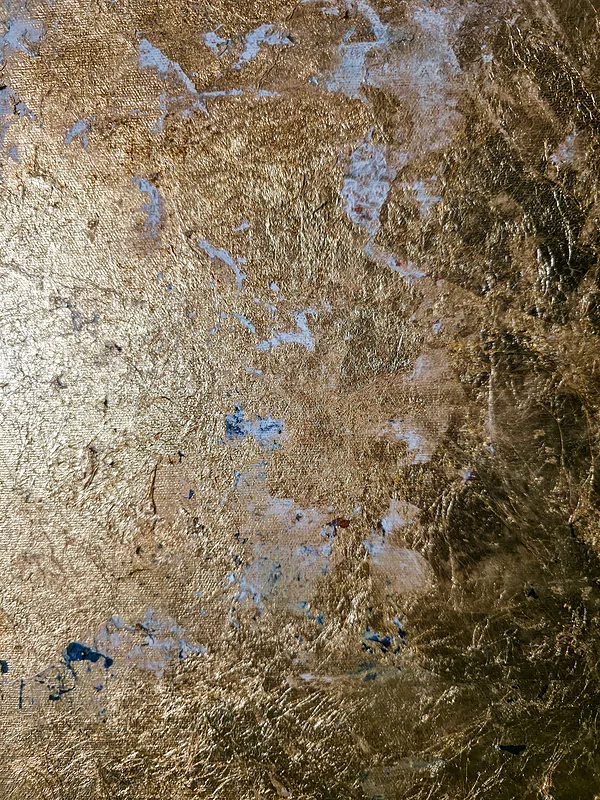
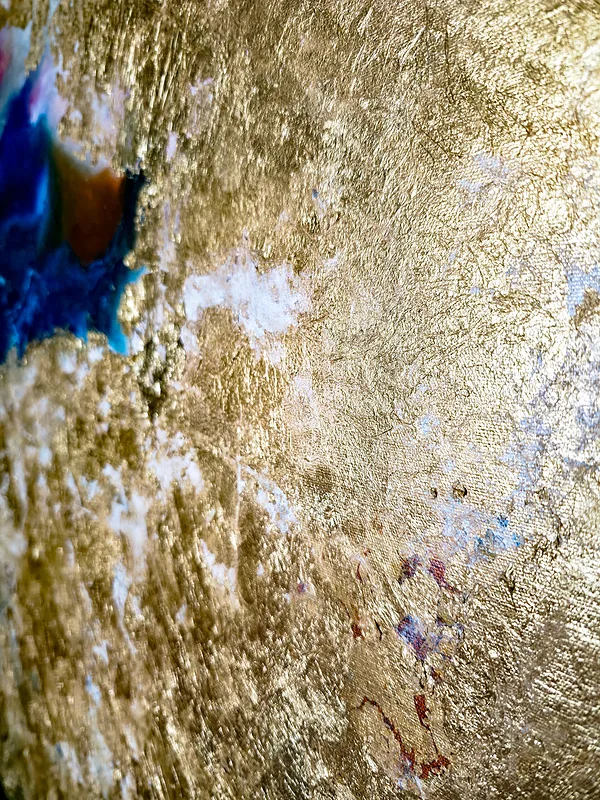
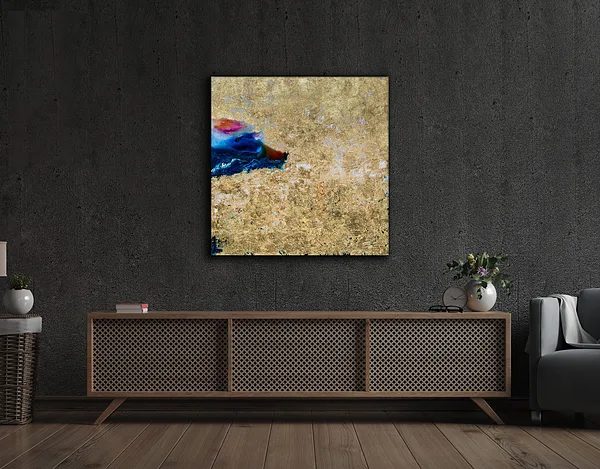
The Story of Light
- 146 x 96 cm
- Oil and gold on canvas
- Created: Sitges, 2026
- PRIVATELY OWNED
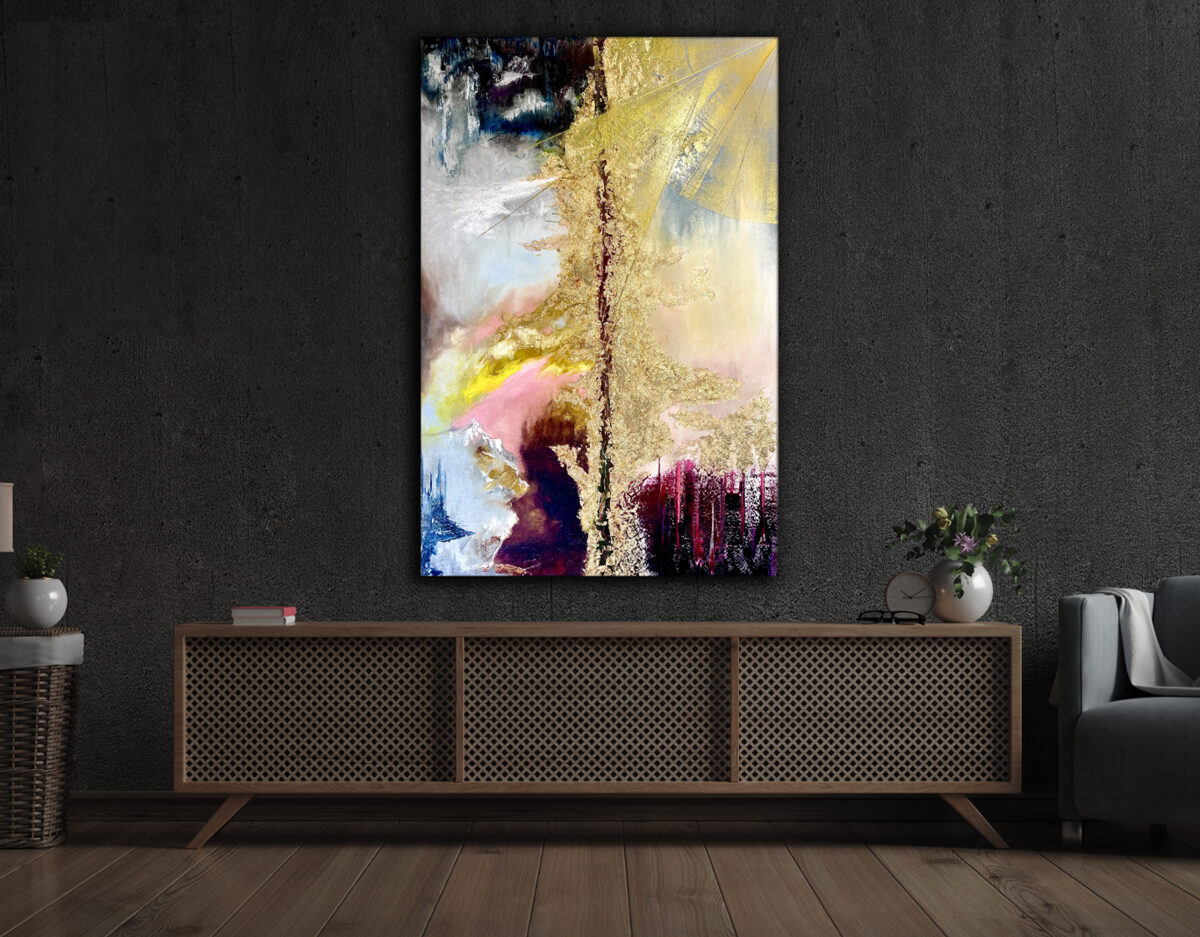
This abstraction, woven from radiant layers of light, preserves the memory of the pristine first moment of Creation, as Scripture recounts the very beginning of all things:
“And God said, Let there be light: and there was light.” (Genesis 1:3, KJV)
A single, gentle, all-embracing movement flows throughout the canvas: the descent and ascent of light, as delicately merging radiance unfolds like a sacred vision. Running through the centre of the composition, a golden axis resembles a heavenly rift through which the light of eternity enters the created world. Its richly layered, granular surface, dusted with gold, shimmers with vitality, as though the material still retains the warmth of the divine touch. A deeper, earth-toned band running through its centre lends an intimate sense of cohesion to this radiance, like grace emerging from an ancient wound.
Within this vertical shaft of golden light, a faint reflection of Jacob’s ladder emerges, evoking the meeting of heaven and earth and the invisible presence of angels permeating the space. In the upper-right area, the geometric purity of a golden solar arc bends towards the composition with solemn order, its rays brushing the surface with delicate threads of light that diffuse like a veil of mist.
Light permeates and softens, illuminating hidden depths from within. The pink hues, billowing like a veil of silk, embody the inner beauty of purification, becoming an expression of mercy and love. To the left of the golden rift, deepening shades of crimson evoke the motionless depths of the primordial beginning. Pale blue and turquoise radiance merge into them like the breath of the divine wind sweeping across the waters, as the first dawn emerges from the formless infinite.
In the lower-right corner, deep burgundy tones gather into rich, velvety layers. The paint trails cascading downwards resemble the tears of time. The regal dignity and poignant beauty of the crimson hues resonate throughout the composition, uniting its contrasting elements in a single, contemplative vision.
“For with thee is the fountain of life: in thy light shall we see light.” (Psalm 36:9, KJV)
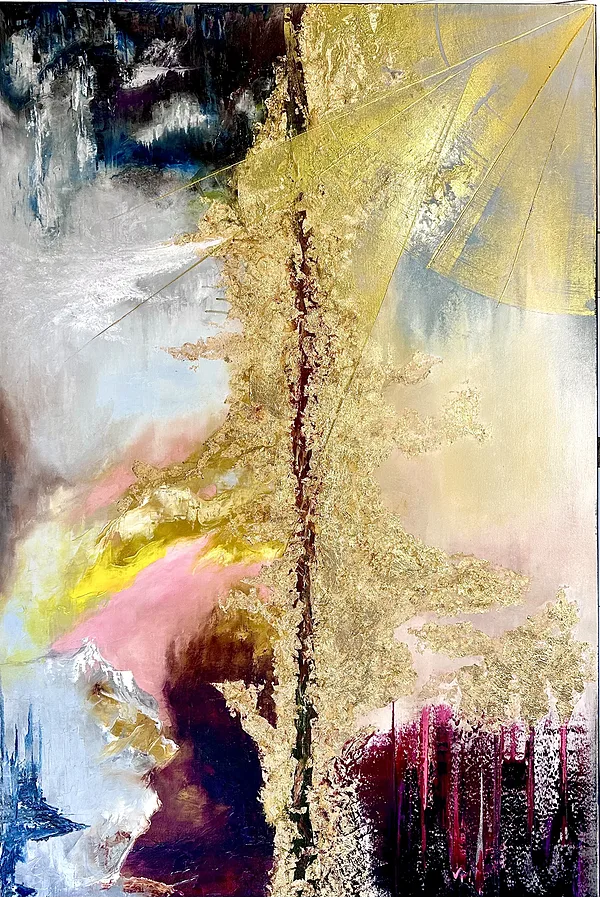
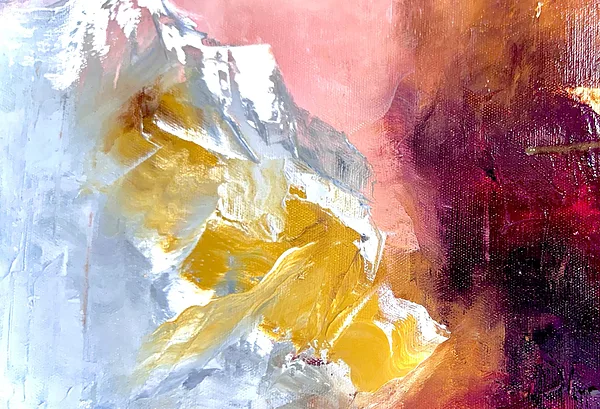
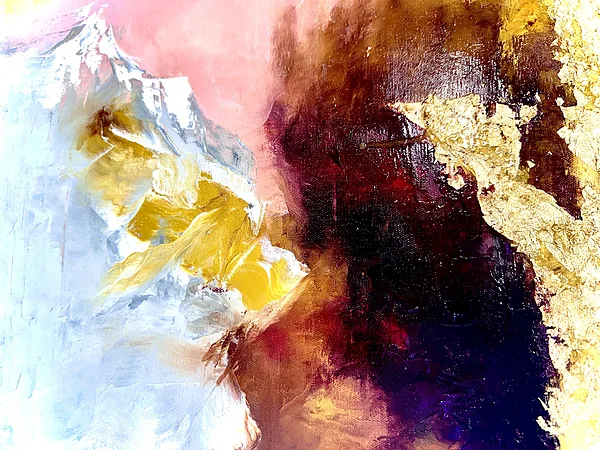
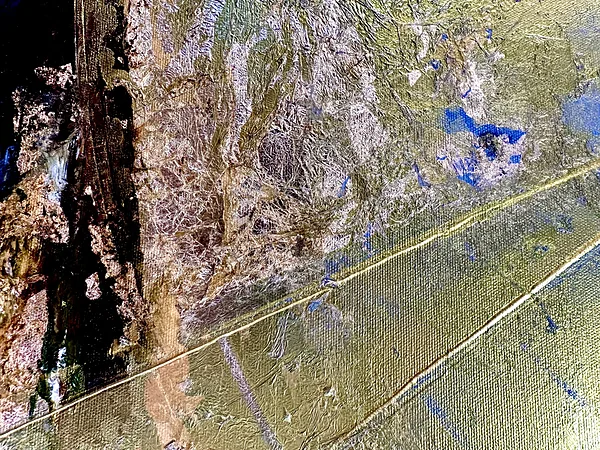
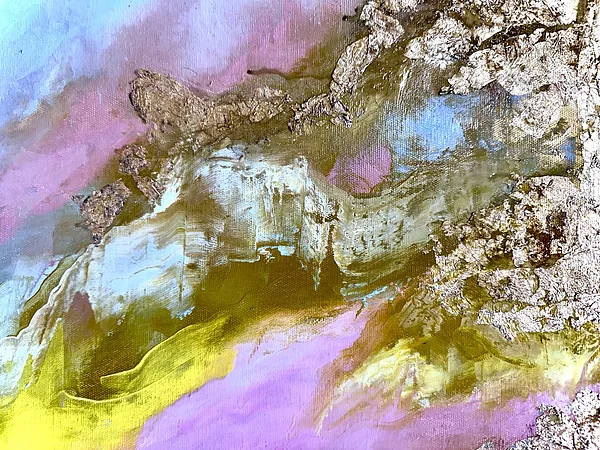
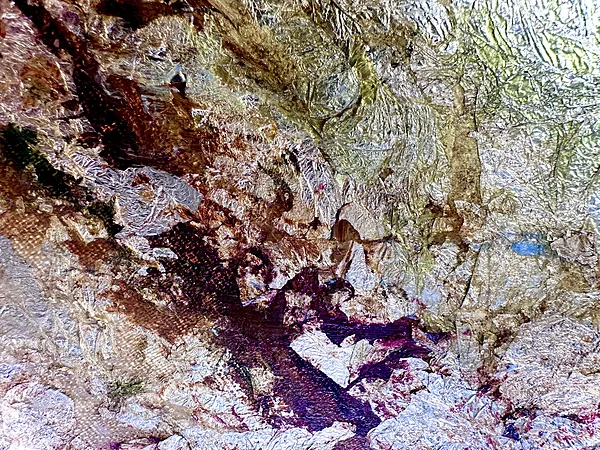
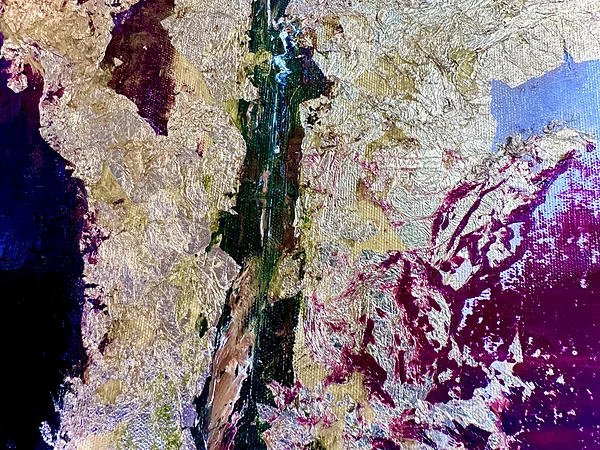
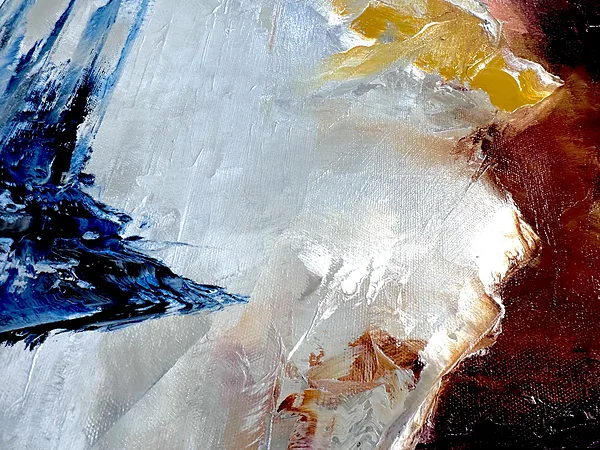
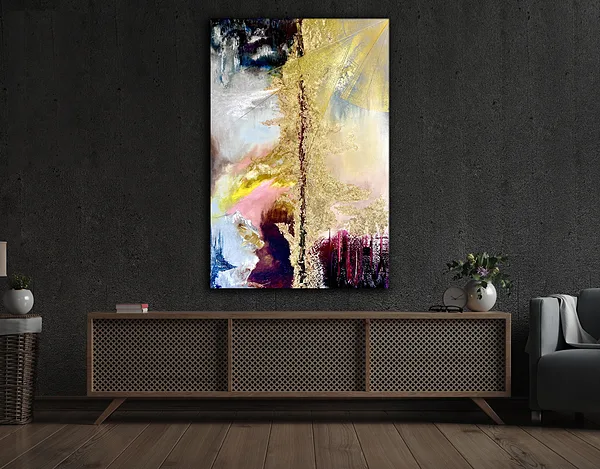
The Preserving Grace
- 150 x 110 cm
- Oil and gold on canvas
- Created: Sitges, 2026
- The artwork is part of the 'Old Testament III - In Search of the Secrets of Eternity' cycle
- AVAILABLE FOR PURCHASE
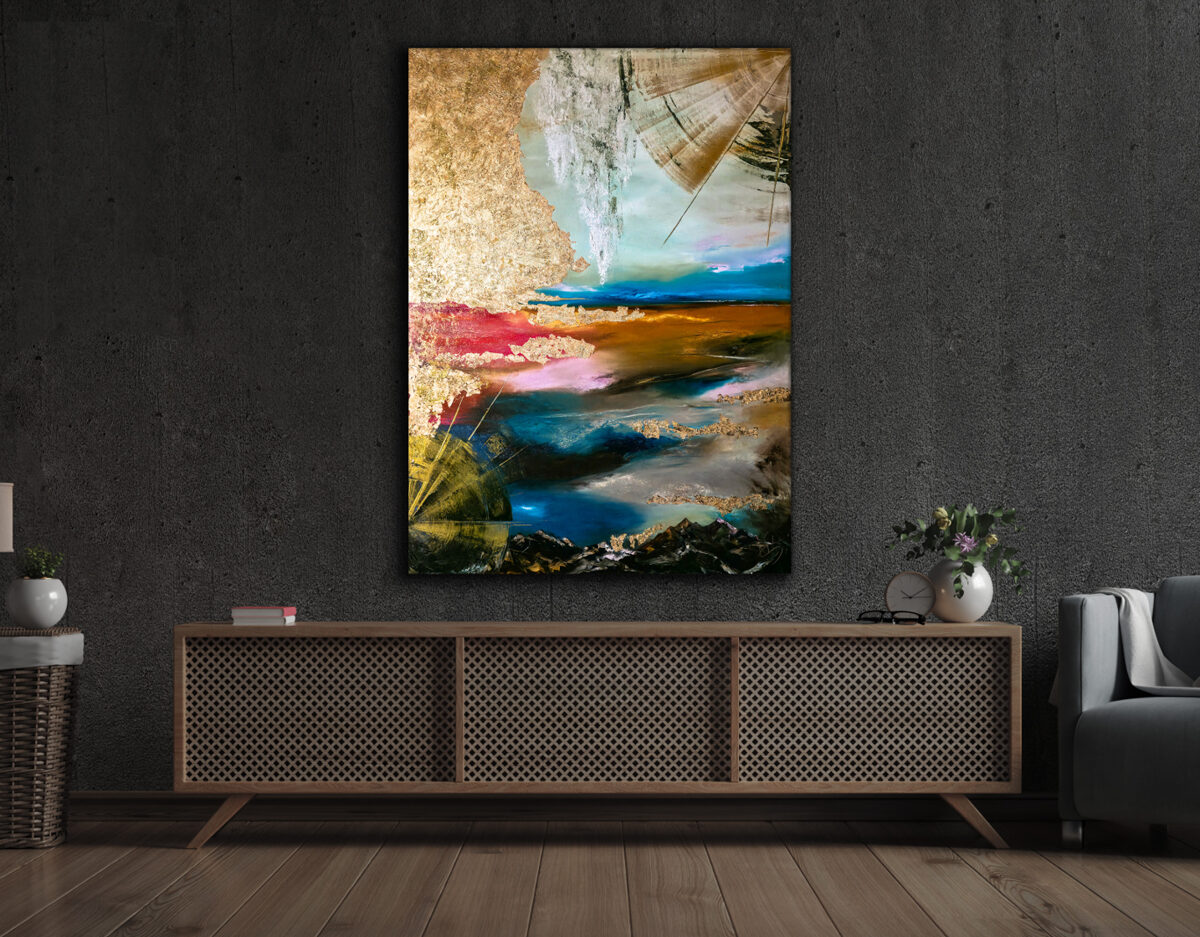
“But Noah found grace in the eyes of the LORD.” (Genesis 6:8, KJV)
Tamás Náray’s painting explores the mystery of divine providence and the sustaining power of grace. Its layered fields of colour, sculpturally raised gold surfaces, and overlapping spatial planes evoke the interconnectedness of the created world.
“And God said, Let there be a firmament in the midst of the waters, and let it divide the waters from the waters.”(Genesis 1:6, KJV)
The worlds separated from one another remain connected by an invisible order.
The upper-left area of the canvas is dominated by a delicate, lace-like surface shimmering in pale gold and champagne hues, spreading over the composition like a protective mantle. Beneath it, a veil of white evokes the pillar of cloud that guided the people of Israel on their journey through the wilderness.
In the upper-right corner, a radiant golden circle, articulated by radiating lines, shines like an ancient solar emblem. Its long golden lines lead towards the heart of the composition, while the deep-blue and olive-green form in the lower-left corner responds to it as its darker, earthly counterpart. The diagonal tension between these two forms establishes a visual relationship between heavenly light and its reception on earth. The promise in the story of Noah completes the arc of the covenant:
“I do set my bow in the cloud, and it shall be for a token of a covenant between me and the earth.” (Genesis 9:13, KJV)
The composition’s radiant band of turquoise and cyan carries the ancient promise of the Garden of Eden. Surrounding it, undulating depths of petrol blue, ultramarine, slate grey, and black evoke the ever-renewing currents of life. In the prophet Ezekiel’s vision, the river flowing from the sanctuary brings life to everything it reaches:
“And every thing shall live whither the river cometh.” (Ezekiel 47:9, KJV)
The red and coral hues embody the kindling of vital energy, while the copper-red and bronze bands evoke the primordial substance of the earth.
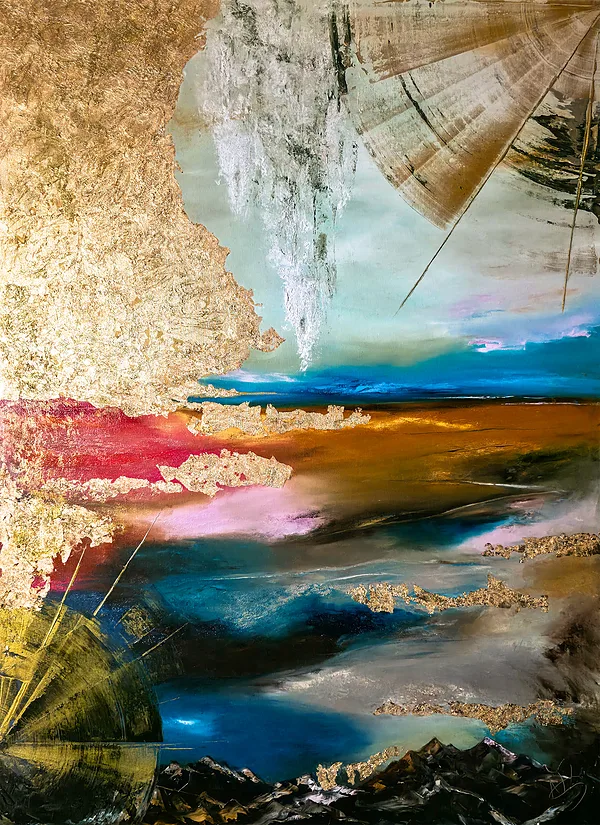
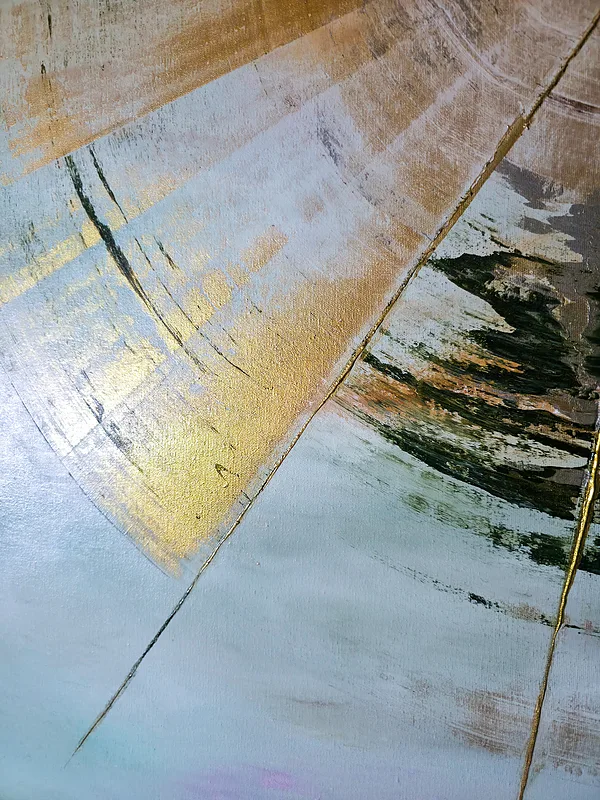
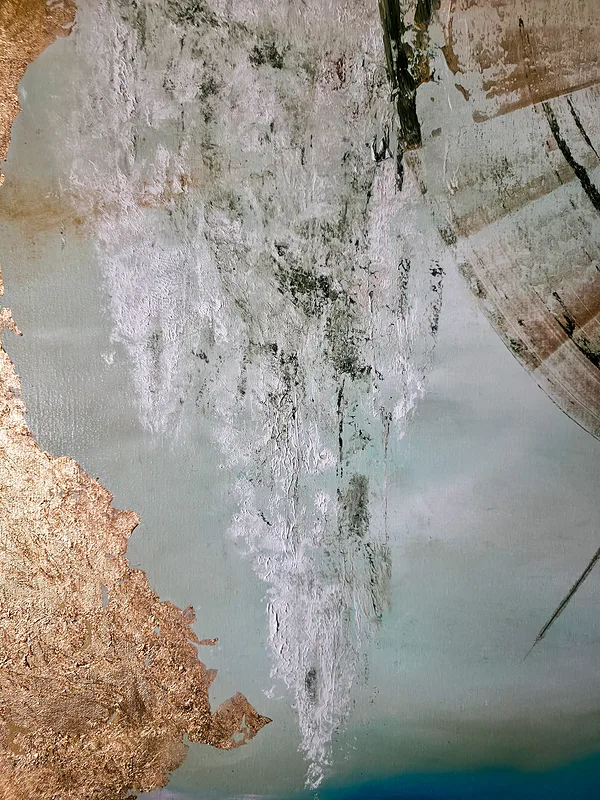
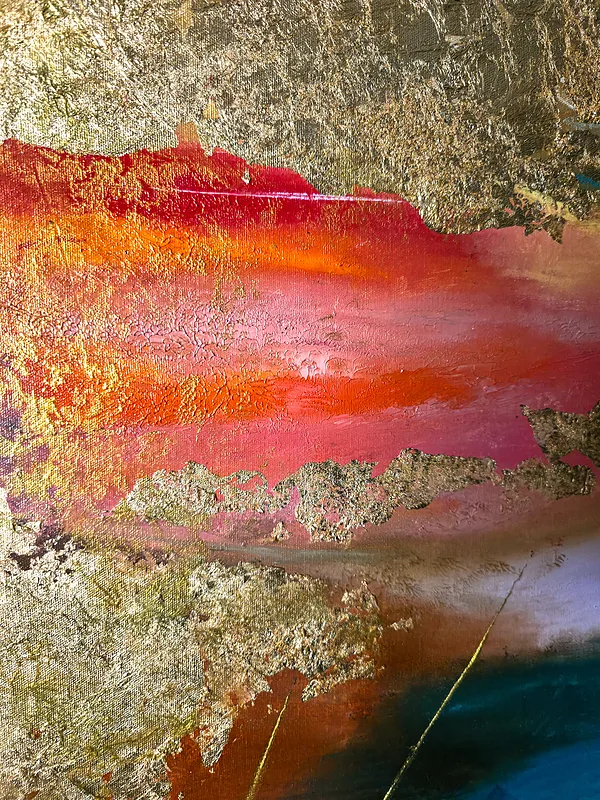
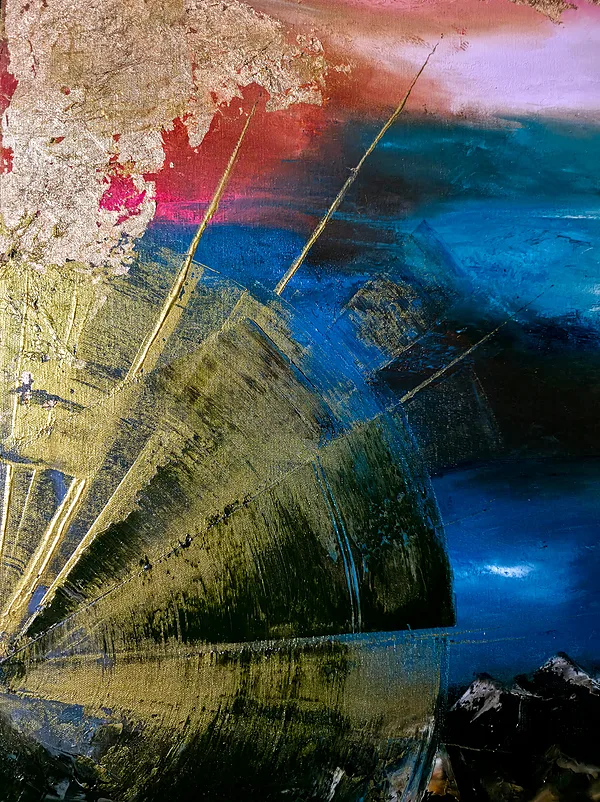
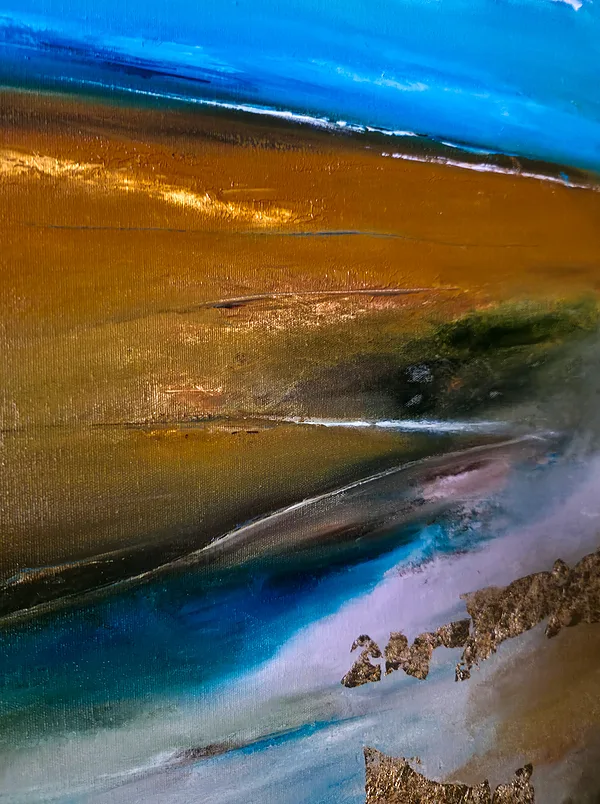
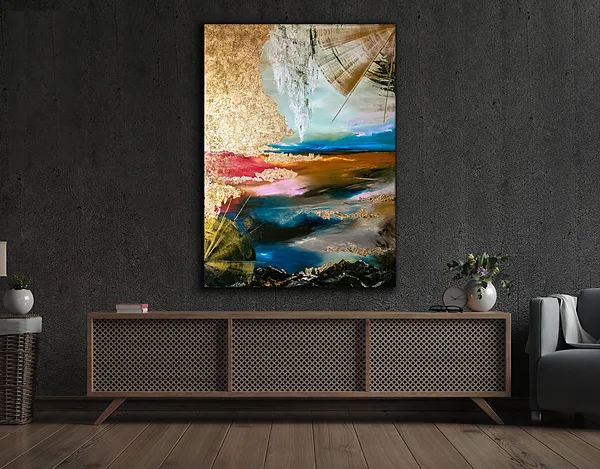
"Thus the heavens and the earth were finished..."
- 160 x 120 cm
- Oil and gold on canvas
- Created: Sitges, 2026
- The artwork is part of the 'Old Testament III - In Search of the Secrets of Eternity' cycle
- RESERVED
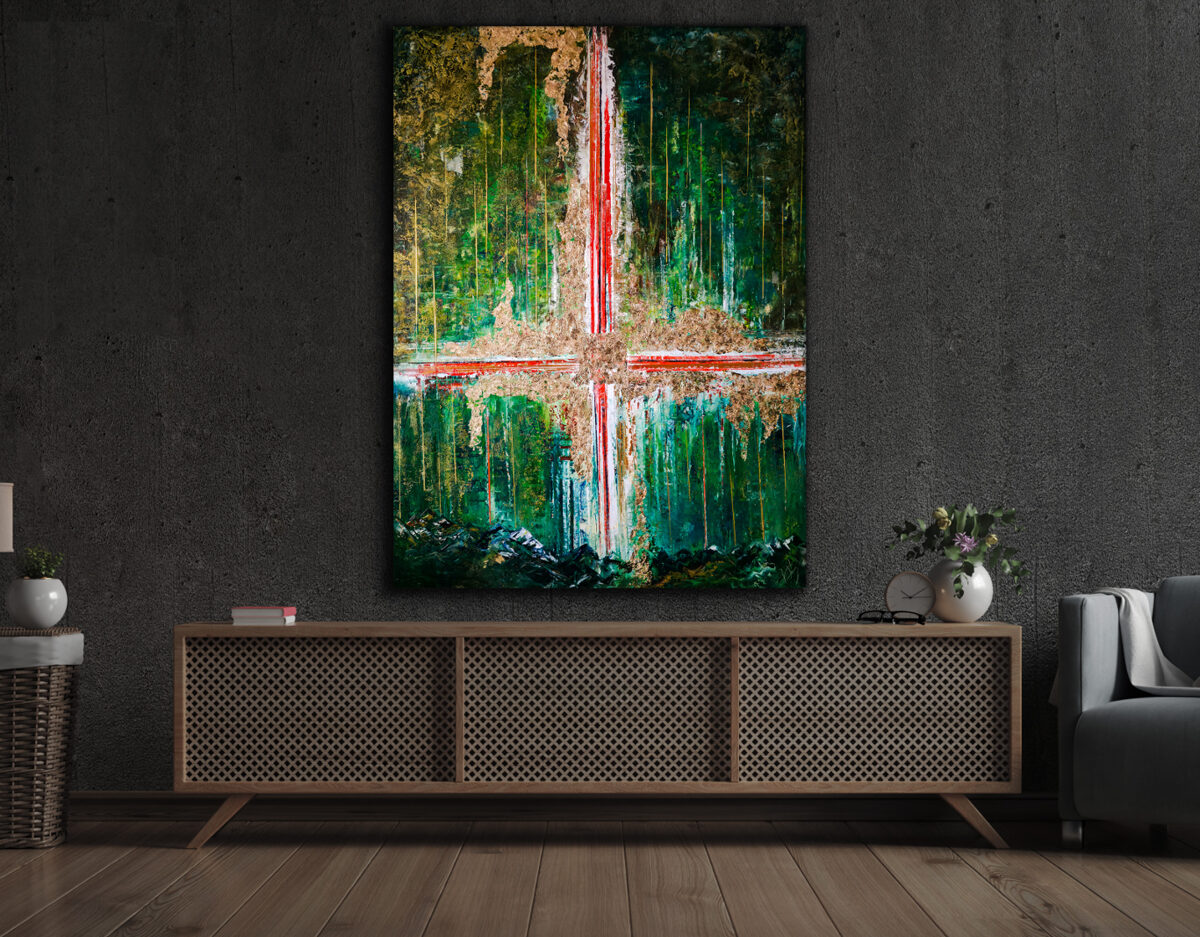
“Thus the heavens and the earth were finished, and all the host of them.” (Genesis 2:1, KJV)
Tamás Náray’s painting contemplates the ultimate order of time while simultaneously reaching back to the beginning. The creation of the world returns to the point from which it emerged: the point at which light and darkness, heaven and earth, the visible and the invisible converge. The painting represents not an ending, but a fulfilment: the circle of Creation closes, while its divine order remains eternal.
At the centre of the composition appears a golden altar motif, its edges slightly weathered, symbolising the fulfilment of Creation and the eternity of divine order. Gold represents not only the creative will and the sustaining power of the divine, but also the inner transformation from which all change arises. The golden altar becomes the place where time and space meet, where beginning and end become one.
The vertical and horizontal bands of red and white evoke the four cardinal directions, the order of the world, and the all-pervading power of the divine presence. The cross-shaped composition simultaneously alludes to the cosmic order of Creation, the unity of the world, and the eternal cycle of sacrifice, thanksgiving, and renewal.
The deep greens, blues, and layers of gold embody the richness and diversity of the created world. Golden lines flowing both upwards and downwards suggest the movement of divine will, connecting heaven and earth, the visible and the invisible. In the dark lower region, reminiscent of a mountain range, sacred mountains emerge as witnesses to the order of Creation. They embody the solidity of earthly existence and a permanence that transcends time. We pass away, but Creation endures: the mountains remain, and the order of the world persists.
The work is at once an ending and a new beginning. The created world returns to its origin, while the eternal presence of divine order reminds us that all transformation begins within, and that the essence of life lies in light, order, and unity.